




Abstract
This article investigates how tensions between temporal structures influence the perceptions of Danish job centre pathways among long-term unemployed citizens and frontline professionals, as well as the challenges they face in aligning with the temporal imperatives of the job centre's institutional time. This study draws on qualitative individual interviews with 28 long-term unemployed citizens, two focus group interviews with frontline professionals and observations of four unemployed citizens’ meetings in Danish job centres. Through an expanded conceptualisation of J. David Lewis and Andrew Weigert's notion of social time structures, we establish that accepting dominant principles and demands is necessary for alignment with the institutional time of the job centre. We find that unemployed citizens’ misalignment with the job centre's institutional time can lead them to contest the progression of their pathways and dispute the priorities established in their pathways. Furthermore, we demonstrate that frontline professionals are similarly challenged in aligning with the institutional time. Our analysis reveals that temporal alignment cannot be assumed for either long-term unemployed citizens or the frontline professionals involved in delivering job centre pathways. Temporal alignments constitute a significant tension in Danish job centres and are crucial for the perception of job centre pathways held by both long-term unemployed citizens and frontline professionals.
Keywords
Introduction
Employees in the job centre speak their own language. I speak my own language. That's how it's divided. I follow my own world. […] They speak their own language: “according to these paragraphs”. I say: “according to my reality”. (Bob, 43)
In this article, we investigate the tension that Bob addresses; that it is challenging for unemployed citizens with complex social and health problems to align with the dominant logics of their job centre pathways. Based on a qualitative research design, we explore temporal aspects of the experiences of job centre pathways. We focus on how the job centre as an institution applies a particular social time structure to move unemployed citizens away from cash benefits. As we will show, adhering to this particular social time structure proves difficult for not only the unemployed citizens but also the frontline professionals whose role it is to deliver the pathways. Through an expanded conceptualisation of sociologists J. David Lewis and Andrew Weigert's (1981) notion of social time structures, we investigate how tensions between temporal structures influence unemployed citizens’ and frontline professionals’ perceptions of job centre pathways. The article makes a significant contribution to the research field by incorporating the experiences of both unemployed citizens and frontline professionals. Furthermore, by expanding the theoretical framework, this study differs from other studies focusing on social temporal structures. The challenges of aligning with institutional time encompass more than the ability to align with the temporal rhythms of the pathways and orientate oneself towards the future. As we will show, the temporal imperatives that dominate the job centre pathways also rely on alignment with perceptions of progression, prioritisations and meaningfulness.
Temporal dimensions of pathways towards employment
In the Danish job centres, ‘pathway’ (in Danish: ‘forløb’) is an emic concept figuring in Danish policy documents, official descriptions of job centre initiatives, as well as in the everyday language of frontline professionals and unemployed citizens. Thus, the term ‘pathway’ is rooted in the empirical context and reflect the terminology used within the job centres. When frontline professionals in this study speak of ‘pathways’, they refer to the overall instrument available to them for making progress for unemployed citizens towards a future away from social assistance, whether that be education, employment or pension. These job centre pathways are at the centre of the tensions between temporal structures that constitute the object of investigation in this study. Using pathways in delivery of services in the Danish welfare state is common practice. All recipients of Danish welfare services have a right to a well-executed pathway. The ambition is that all pathways should focus on coherence, user-involvement, progression and holistic initiatives tailored to the unemployed citizens’ individual needs and wishes (Andersen and Breidahl, 2022; Borger.dk, 2024; Mehlsen et al., 2015; Ministry of the Interior and Health, 2024; Monrad and Danneris, 2021). Pathways are made up of different activation initiatives such as work placements and meetings between frontline professional and citizen (Danneris and Caswell, 2019). In this article, we are concerned with the temporal frictions that exist in these pathways. The active labour market policy in Denmark entails certain temporal conditions for the delivery of these pathways. Pathways should live up to a pre-given timeliness, according to which meetings should be held and initiatives started at a certain minimum frequency for it to be seen as active (Monrad and Danneris, 2021; Nielsen et al., 2021). Through pathways, case workers at job centres are required to document and develop the working capacity of the unemployed citizen (Nielsen et al., 2021) as well as to motivate unemployed citizens to construct identities as people who are able to enter the labour market (Caswell et al., 2011). These temporal imperatives are consequences of political objectives, which means that an emphasis on efficiency and timeliness have reorientated what is valued in the temporal structure of social work (Colley et al., 2012; Craig et al., 2024; Hjärpe, 2022; Jørgensen, 2022; Jørgensen, 2023). As linear clock-time orientations gain traction in temporal structures of social work and welfare services (Colley et al., 2012; Hjärpe, 2022; Reinecke and Ansari, 2015), temporal imperatives of efficiency in welfare institutions influence the scope of action for frontline professionals’ interactions with unemployed citizens in vulnerable positions (Colley et al., 2012). Studies suggest that professionals are increasingly subject to ‘paperwork time’, focusing on efficiency and documentation, rather than to a desired but subordinated ‘compassionate time’ (Yuill and Mueller-Hirth, 2019).
Unemployed citizens’ experiences of job centre pathways
A range of studies offer theoretical perspectives on temporality in their studies of unemployed citizens’ experiences of time in their interaction with the welfare state and during periods of unemployment. They show citizens’ temporal experience of unemployment and of the job centre pathway, which involves feelings of stagnation and waiting (Andersen, 2020; Auyero, 2011; Carmo and d’Avelar, 2021; Danneris, 2018), inability to control one's own time (Carmo and d’Avelar, 2021; Mulinari, 2021; Nielsen et al., 2021) and a feeling that time is wasted (Marston and McDonald, 2008). Furthermore, for long-term unemployed citizens in vulnerable positions, the lived experience of job centre pathways is not one of a linear path towards betterment. Rather, it is an experience of everchanging overlaps of different stages of deterioration, progression, stagnation and derailment, which contrasts with the temporal imperatives of welfare institutions (Danneris, 2018; Danneris and Nielsen, 2018). Unemployed citizens’ experiences of powerlessness are prevalent in the literature. Some experience an incapacity to escape their situations (Caswell et al., 2015). The experience of agency and powerlessness vary, depending on their interaction with the system (Olesen and Eskelinen, 2011), their capacity for understanding information and action taken by the municipality (Larsen and Caswell, 2022) and to what extent they experience being subordinated to the will of others (Auyero, 2011; Caswell et al., 2011). Our study of temporality in employment services contributes to the research field by incorporating the perceptions of both unemployed citizens and frontline professionals. By including both perspectives, we emphasise the challenges that both groups experience in aligning with institutional time. Other studies have focused on unemployed citizens’ experiences of powerlessness; this study investigates similar tendencies for frontline professionals, which are related to adhering to the institutional time. Furthermore, we show that aligning with the imperatives that are prevailing in job centre pathways is a temporal matter.
Study context
Danish employment services are based on an active labour market policy administered by municipal job centres (Caswell, 2020; Klindt and Ravn, 2020) with a strong emphasis on welfare conditionality, that is, requirements that unemployed citizens must meet to be eligible for social assistance (Larsen and Caswell, 2022; Nielsen and Monrad, 2023). Since the beginning of the 2000s, the group targeted by active labour market policies has been expanded significantly, so that unemployed citizens with considerable social and/or health problems, defined as problems other than unemployment, are now also required to be available to the labour market to receive welfare benefits (Nørup, 2020). Currently, the Danish welfare conditionality is softening for vulnerable unemployed citizens, which leads municipalities to search for more user-involving approaches to introducing this group into the labour market. Although the softening makes it possible to change the municipalities’ strategies, welfare conditionality remains a major part of the national employment policies (Larsen and Caswell, 2022), which means that at the bottom line, municipalities will be assessed on parameters of success in the active labour market policy, such as frequent meetings and activation initiatives (Nielsen and Andersen, 2023).
Theoretical framework: Structures of social time
In our investigation of how temporal structures influence long-term unemployed citizens’ and frontline professionals’ perceptions of job centre pathways, we draw on Lewis and Weigert's (1981) perspective on social time structures. Viewing job centre pathways through a lens of temporal concepts invites attentiveness to the social and structural contexts that both unemployed citizens and frontline professionals operate in. It also highlights conflicts in the temporal imperatives that unemployed citizens and frontline professionals must orientate towards when involved in job centre pathways. Social time refers to the idea that time is related to human conceptualisation and social phenomena, and thus not a purely quantitative astronomical time (Sorokin and Hassard, 1990). Social time is context-bound and situational (Craig et al., 2024; Hjärpe, 2022). This entails that different practices and logics dominate different contexts (Craig et al., 2024; Wyn et al., 2017). Lewis and Weigert propose a paradigm for the sociology of time that is rooted in a conceptualisation of social time. They suggest that different forms of social time exist at individual, group, organisational and societal levels of society: self-time, interactional time, institutional time and cyclic time. In this study, we will focus on the concepts of self-time and institutional time. Self-time is time as experienced by the individual in the form of remembered pasts, experienced presents and imagined futures, and it is therefore crucial for identity and a sense of purpose in life (Järvinen and Ravn, 2017; Lewis and Weigert, 1981). Institutional time is time in bureaucracies and formal organisations, rigidly structured and with less undefined free time compared to self-time. For frontline professionals, time spent on paperwork has increased at the expense of time spent with the target group (Jørgensen, 2022). Since in the temporal logic of social work, ‘institutional time’ is orientated towards the future (Fahlgren, 2009; Yuill and Mueller-Hirth, 2019), there is a potential for conflict, as unemployed citizens are more concerned with their problems that exist ‘here-and-now’, in ‘self-time’ (Hjärpe, 2022). The institutional time of the Danish job centres is influenced by the legislative framework that shapes the temporal conditions and imperatives of the pathways, such as a focus on timeliness and efficiency. Different forms of social times are structured hierarchically through ‘temporal stratification’: people are expected to structure their lives according to the macro levels of time. In this case, institutional time takes precedence over self-time, that is, unemployed citizens must subordinate their self-time to fit into the institutional time. Lewis and Weigert introduce two further concepts, temporal embeddedness and temporal synchronisation. Temporal embeddedness means that the different social times overlap and are integrated or embedded in each other (Lewis and Weigert, 1981). A high level of temporal embeddedness relates to an individual's feelings of self-continuity and future-orientedness and conversely, a low level of temporal embeddedness can result in desynchronisation of social time forms (Järvinen and Ravn, 2017). Temporal synchronisation derives from temporal embeddedness and temporal stratification and entails aligning one's time to the stratified social times. Accordingly, successful temporal synchronisation is to align one's self-time to institutional time as well as to have social roles that are embedded in the hierarchy of social time. This results in alignment with the social order created by social times (Järvinen and Ravn, 2017; Lewis and Weigert, 1981).
We expand Lewis and Weigert's framework by incorporating the principles that dominate different social time structures and by revealing how they influence and structure unemployed citizens’ and frontline professionals’ perceptions of pathways. In doing this, we uncover the challenges associated with accepting the dominant demands of institutional time. Thus, institutional time is not solely the temporal conditions that one function under, for example, particular rules of timeliness, requirements for meeting frequency, size of case load, specific lengths of work placements, etc. Being aligned with the institutional time of the job centre involves being aligned with the ideas of progression, meaningfulness and prioritisations that dominate this time structure. Together, the temporal conditions and the dominant principles constitute the institutional time of the job centre. These temporal imperatives are not decided by the unemployed citizens or the frontline professionals; rather, the institutional time of the job centre is bound by a legislative framework, which means that case workers are working to involve unemployed citizens in assessment measures in which they are required to participate if they are to continue to receive social benefits (Nørup, 2020). Research shows that employment services have an optimistic view of unemployed citizens’ resources (Larsen and Caswell, 2022) and are concerned with cultivating these resources in anticipation of this group entering the labour market in some capacity (Danneris and Nielsen, 2018), working towards making ‘passive’ benefit recipients become ‘active’ (Wright, 2016). These circumstances influence the characteristics of institutional time, both through the protocols for temporal conditions for interaction with the job centre, for example, the protocols for timeliness decided by legislation, as well as influencing the dominant principles, that is, the optimistic view of unemployed citizens’ resources. We operationalise these as characteristics of the job centre's institutional time that actors must adapt to, to be aligned with the specific temporal structure. Likewise, for the unemployed citizens’ self-time, we include the elements that are dominant within this temporal structure. For that reason, when we investigate the perceptions of pathways through a theoretical conception of social time structures, we are attentive to aspects of self-time such as the lived experience of everyday life, complex social and health problems and the experience of misalignment with institutional time. In that way, it is characteristic of the institutional time of the job centre that both unemployed citizens and frontline professionals are subjugated to its temporal imperatives, as the capacity to decide what is ‘too slow’ or ‘too fast’ is outside of their influence (Hjärpe, 2022).
Data and methods
The study was conducted in collaboration with a Danish municipal job centre, and the dataset comprises individual qualitative interviews with 28 long-term unemployed Danish citizens with complex social and health problems, observations of four unemployed citizens’ meetings in the municipality and two focus group interviews (Halkier, 2006; Järvinen and Demant, 2011) with frontline professionals. The first author conducted all the interviews and observations. Unemployed citizens were invited to participate in the project through invitation by the frontline professional handling their case or by a frontline professional at relevant activation initiatives. The municipal actor facilitated the contact by either setting up a date and time for the interview or, as in most cases, by obtaining verbal consent from the unemployed citizen to allow a researcher to contact them. To avoid pressuring unemployed citizens to participate in the study, as it was a municipal employee who invited them, or them participating in the hope that it would benefit their pathways, during the initial contact, the first author emphasised that he was not a representative of the municipality, and that the interview was a possibility to tell their story to someone outside of the municipality. Most of the interviews took place at the job centre or at the site of the activation initiative in which the unemployed citizens were involved. Other interview locations included the interviewee's home and telephone interviews. The interviews lasted between 15 and 70 minutes, most commonly around 45 minutes.
Observations of meetings proved difficult to conduct, because many unemployed citizens were either hesitant to allow the first author to participate or were unaware of when an upcoming meeting would take place. If researcher participation in the next meeting was consented to, citizens were asked to inform the first author when the next meeting would be held, or if the first author was allowed to contact them again regarding participation in the meeting.
Participants for the focus group interviews were invited by a collaborator in the municipality. The first focus group interview comprised case workers who worked with the target group in this study. The second focus group consisted of representatives of the job centre's rehabilitation team. A rehabilitation team is an inter-professional team that operates in the Danish employment services. It consists of representatives from municipal departments of social services, healthcare and employment services, as well as a representative from a regional clinic of social medicine. The team assesses cases in which unemployed citizens are at risk of being excluded from the labour market. They make a recommendation for further action that can help unemployed citizens gain access to the labour market, and if this is not feasible, they can recommend a permanent disability benefit (Dall and Sarangi, 2018; Nielsen et al., 2021). In this focus group interview, employees from different municipal departments were represented; one from the job centre, two from the social department, one from the health department and one representative from a regional clinic of social medicine. In this article, the two focus group interviews will not be distinguished, and all frontline personnel will be referred to as frontline professionals to protect confidentiality. This project is committed to responsible and ethical research practice throughout the study, and the project was approved by the Research Ethics Committee at the University of Southern Denmark. All participants were informed of the aim of the project and the possibilities for withdrawal from the study, prior to giving their consent to participating in the study.
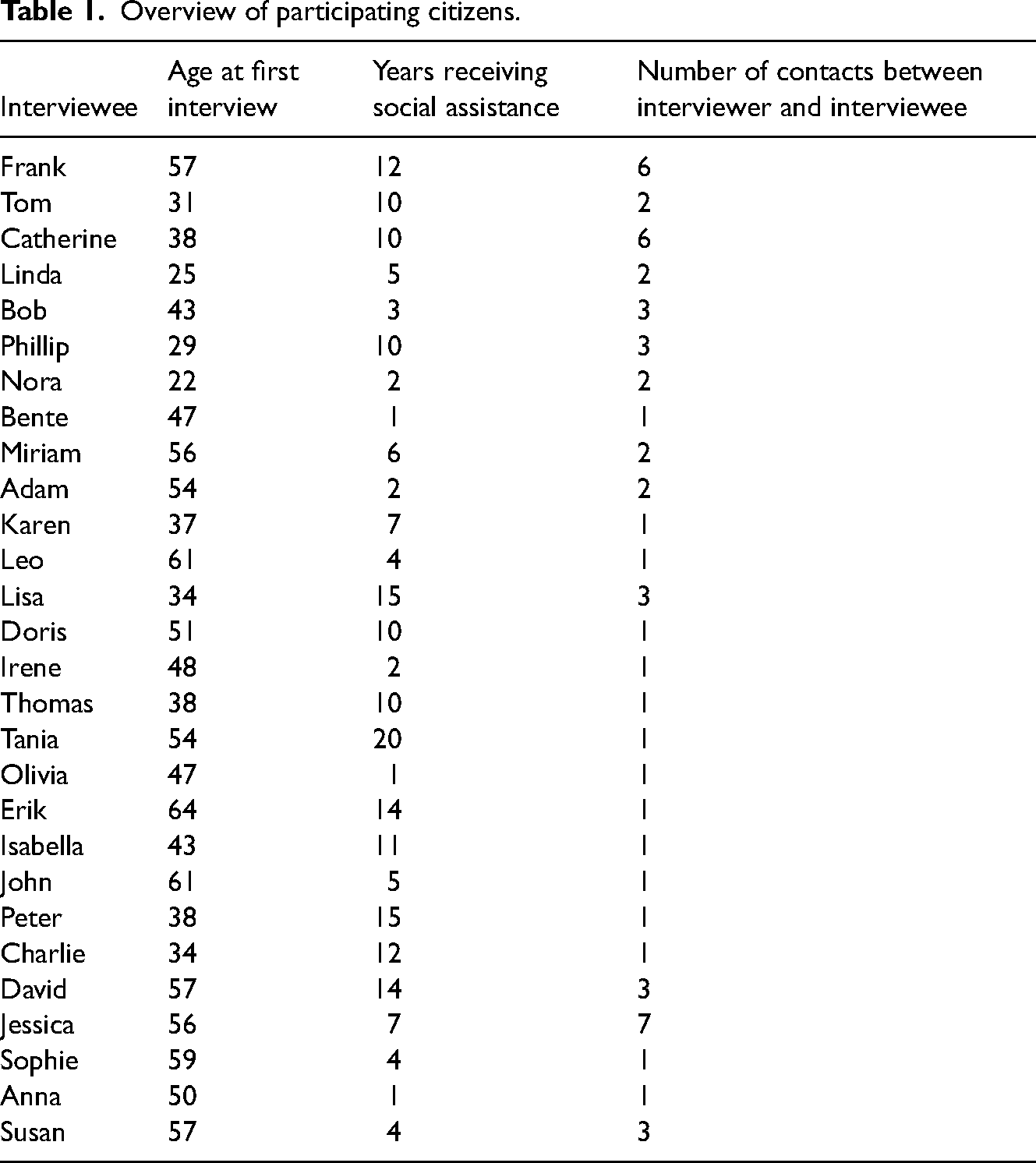
Most of the unemployed citizens had received social assistance for several years and had been through several work assessments and municipal initiatives and had encountered many different case workers. Some of the participating citizens were unemployed because of deteriorating health caused by long and physically demanding working lives, others because of mental illnesses. Some had never had a connection to the labour market. They were involved in different types of job centre pathways, but all were categorised as having complex problems other than unemployment, which means that they were severely challenged in finding their own way towards the labour market (Table 1).
Overview of participating citizens.
Qualitative interviews are well suited for gaining insight into the unemployed citizens’ experiences and perspectives on their pathways (Kvale and Brinkmann, 2009). The interviews were structured around the unemployed citizens’ experiences with the municipality and more specifically with the job centre. Although the interviews were based on a semi-structured interview guide (Tanggaard and Brinkmann, 2010), the interview style was open, which allowed for interviewees to highlight the issues that were most important to them. Existing literature shows that unemployment is not a linear process for this target group (Danneris, 2018), which underlines the importance of insisting on a longitudinal approach to capture changes through time in temporal investigations of pathways. We had continued contact with several of the unemployed citizens in the form of quick check-ins and longer interviews. This longitudinal approach allowed us to follow the participants closely through their pathway and to investigate their perceptions of pathways and temporal displacements as they took place, thereby accentuating potential changes and critical moments in the lived experience of the pathways (Carduff et al., 2015; Thomson, 2007).
By observing meetings, we gained insight into how municipal processes were explained to the unemployed citizens, into how they explained their challenges to the frontline professionals’, and into the unemployed citizens’ capacity for aligning with the institutional time structure.
The focus group interviews were aimed at uncovering the frontline professionals’ understanding of their role in helping the unemployed citizens progress, their view of the unemployed citizens’ challenges and the qualities of the institutional time of the job centre. The interviewer initiated the focus group interviews by encouraging discussions among the frontline professionals about their views on the central challenges that they themselves, and the unemployed citizens, faced during their pathways. During these discussions, norms and interpretations of their role as frontline professionals were highlighted, and challenges in their work were discussed from different perspectives (Halkier, 2006).
Analytical approach
The aim of our study is to identify the tensions between social time structures and how challenges in aligning with the institutional time influences the perception of job centre pathways. In our analysis, we will derive the experiences of institutional time from our empirical material. We are occupied with showing both frontline professionals’ and unemployed citizens’ experiences of tensions between social time structures and how they clash – and align – with the institutional time.
The interviews were recorded and transcribed verbatim, and written observations, in the form of field notes, were recorded during or immediately following observations in the field (Emerson et al., 2011). The analytical process was inspired by the abductive approach suggested by Timmermans and Tavory (2022). The empirical material was read thoroughly multiple times before coding began to allow the researchers to familiarise themselves with the empirical material. The empirical material was processed through both an open coding strategy and a focused coding strategy, which allowed us to identify surprising patterns and develop specific themes in the material (Timmermans and Tavory, 2022). During this iterative process, we realised that frontline professionals and unemployed citizens assessed the pathways differently, highlighting different elements as valuable. Similarly, temporal language permeated the empirical material, which guided us towards theoretical conceptions that could open the differences in assessment for thorough analysis.
Results
In the following, our results are presented in two sections: (1) In the first section, Contested progression, we analyse how perceptions of progression in pathways are affected by alignment with the institutional time. We show divergences in both what is perceived as effective in providing progression in unemployed citizens’ cases, as well as what is perceived as a meaningful goal to progress towards. (2) Secondly, in the section Challenging adherence, we analyse how not only unemployed citizens, but also frontline professionals are challenged in adhering to the institutional time of the job centre and how they adhere to the institutional time in different ways.
Contested progression
The institutional time structure of the job centre pathways plays a crucial role in the unemployed citizens’ perception of the pathways in which they are involved. As discussed above, the institutional time of the job centre is accompanied by certain temporal imperatives, including a future-oriented logic in which progression is sought through frequent meetings between frontline professionals and the unemployed citizen, as well through unemployed citizens’ participation in different activation and assessment initiatives (Nielsen et al., 2021). In Lewis and Weigert's framework, the orientation towards the future is a characteristic of the institutional time, a quality originating from the rigidity of bureaucratic timetables, in which the efficiency of the organisation is dependent on tight temporal structures (Lewis and Weigert, 1981). The institutional temporal logic is a guiding principle for the frontline professionals’ handling of pathways: the professionals invite unemployed citizens to align with the institutional time by orienting themselves towards a future in which they will be in a different situation than they are now, for instance by having achieved a (re)connection to the labour market or by receiving a disability pension. In the following excerpt from a focus group interview, a frontline professional was asked how the citizens’ health status influences the pathways and explained that the frontline professionals are concerned with moving the unemployed citizens’ case forward: The target group that I work with are ‘activity ready’ citizens. It's both physical and mental health that is challenging. But also the motivation. Both things play a role. It's something that prolongs the casework and limits us. But I always try to tell the citizens, “You’ve been here for a long time. It doesn’t benefit you to stay here anymore. If you want to cooperate and get to another place, have some peace and clarification, then we must do something. “Well, that's what you and the previous case worker said”. “That may well be, but…”. And then I try to take what is clarified in the case. “This is where we are, and the case is lacking this”. And that motivates them in some way. It does something, that I promise them something. I don’t promise them a disability pension, I don’t promise them flexible employment, but I promise them that something will happen in their case. […] It doesn’t stand still, but it is necessary that they do something as well.
In terms of the theoretical framework of social time, unemployed citizens who are misaligned with the institutional time are not experiencing the institutional framework as progressing their case. In our empirical material, this is expressed through several accounts of stagnation. Some unemployed citizens do not perceive the initiatives introduced to them by frontline professional as constituting appreciable parts of their pathways. The longitudinal design of the study allowed us to get updates on unemployed citizens’ experiences of their pathways. We initiated these updates by asking whether something new had happened in their pathway since we last spoke. Commonly, the interviewee reported that there were "no news" and that nothing had happened in their pathway. Later, it would emerge that the unemployed citizens had attended meetings at the job centre or other activities related to their pathway. Danneris (2018) identifies a similar tendency of reporting that "nothing happens", when activities has in fact taken place. Other interviewees acknowledged that initiatives were initiated to fulfil requirements of job centre pathways, in which assessment of working capacity and activation are essential for progress, while simultaneously disqualifying the effectiveness and relevance of these initiatives on the progression of their case. One such unemployed citizen, Frank (57), describes his experience of his job centre pathway in the excerpt below. During the last five years, Frank has been involved in two job centre pathways aimed at clarifying and developing his working capacity, a two- and three-year pathway, respectively. The first two-year one, there was no plan. I was just sent out to all kinds of rubbish. “Well, we have to see how much you can do” [impersonating his case worker]. Yes, now I’ve been here for five years, you’ve put me into all kinds of initiatives and all kinds of rubbish, building LEGO-bricks, you know. So, you must know how much I can and can’t do. So, it's just been stalling.
For other unemployed citizens, the contested experience of progress is tied to differing prioritisations made by the job centre and unemployed citizens, respectively. While the institutional time is experienced as having an explicit focus on assessment and employment, some unemployed citizens are more concerned with their current health and social issues and thus, their self-time. Nora (22) has been involved in a job centre pathway since she finished her secondary education two years ago. She experiences a general satisfaction with her job centre pathway and feels involved in the planning of it. However, she notes differences between her own priorities and the priorities of the frontline professional involved with her case: Nora: My case worker was like “you only have one year left; you have to do something”. I was like, “Yes, but isn’t it more important that I get better, and then I can always add more years on my [pathway]?”. […] Interviewer: It sounds like there is a difference between what your case worker thinks and what you think? Nora: Yes, there is. And they- it's not to badmouth them, but they think that if you can [participate in an initiative] then it looks good on their papers, but they need to remember to listen to me, right?
Challenging adherence
In the previous section, we showed how unemployed citizens experience misalignment with the institutional time of the job centre; in this section, we will show how the institutional time of the job centre also governs frontline professionals. Adhering to the institutional time involves both the temporal conditions of the frontline professionals’ work and their perception of the pathways in which they are involved. The institutional time is a principal measure of the frontline professionals’ work, as highlighted in the following excerpt in which a frontline professional highlights how time structures their work. We prioritise according to time. If you have such a big caseload, we have to down-prioritise something, because we have to get something else done. Sometimes, when I’m engaged in a rehabilitation case, a senior pension [case] comes in, and we must take care of that. It's about being flexible and setting aside something else. And suddenly someone else needs something, and then we get new casefiles. You simply can’t engage yourself; you don’t get close to this citizen and get the experience of knowing who the citizen is when they call. You need a civil registration number, and then you have to look up- and phew, what was it with this case? […] [If the case load was smaller], then we could keep up with timeliness. We have timeliness reminders coming our way, then we are behind on initiatives, then we are behind on meetings [with citizens]. We don’t have a fair chance. Because our caseloads are so big and we have to get all the way around, and we have to try and make it individual and adjust- It is just difficult being 100% in a case when we have so many. Employee 1: In some cases, well maybe we don’t think that you are coming back to the labour market, but there is no documentation. We can’t just say that because you don’t want to come back to the labour market, then you get a disability pension. You have to go out and try some things, you have to have some arguments for why you can’t and not just because you think you are old and worn out. Employee 3: Yes, well that's clear. There are some of these cases where it must be artificial. Where these meetings must be artificial. We can see that there just isn’t a possibility for making some big life changes for this citizen, but there are just some paragraphs that needs to be adhered to, and if they want to participate in adhering to these paragraphs, then that's that. Otherwise, we have to say, “well you are welcome to not do anything, but then you can’t get any money.” Employee 4: I think it's very important to say that out loud. Saying that because you don’t speak Danish, because you don’t think that you should contribute to the labour force in Denmark, then you have to choose if you want to co-operate and get the benefits or not co-operate and not get the benefits. Maybe we should society-wise make it clearer that it is actually a choice. Employee 2: The challenge is that there should be some progression during these pathways that they are in, in the municipality. I know, there are some pathways where you artificially keep citizens just because they must be in a pathway. Then it's not very nice going to work, when you are dealing with those cases. But there is no paragraph in the legal framework to [do that]. But I will say, that if someone has been homeless for 12 years, doesn’t have any social network, has mental and physical health problems, is on [financial] social assistance, and doesn’t have a stable job, then it would be strange if their motivation didn’t begin to drop. You can say, many of these citizens have given up beforehand and are present at the meeting because we’ve asked them to, so they can receive their benefits. We use the motivational conversation technique. Does it work in the beginning? No, it takes time. But it is obviously about motivation and trying to encourage and clarify the resources that they have. Because they do have some [resources], and it's important for us to identify those resources, clarify them, and in that way change the citizens’ view of themselves a bit. And that's difficult, and it takes time. But, if there's one thing we must do, it is to believe in the citizen. We believe in the citizen until the end.
Concluding discussion
This study shows how social time structures, and the challenges in aligning with them, influence the perceptions of job centre pathways for both long-term unemployed citizens and frontline professionals. Although temporal conditions play a crucial role in job centre pathways, aligning with the institutional time is not solely a question of rhythms; that is, attending activities in the job centre pathway on time. It is also the process of aligning with the dominant principles of the institutional time of the job centre around which the pathways are structured. This includes viewing pathways as beneficial and realistic, as well as helping unemployed citizens’ progress towards a goal that is shared by the institution. We show how unemployed citizens are influenced by the temporal imperatives of the institutional time, and how unemployed citizens who are misaligned with this time structure both contest the progression within the pathways and dispute the prioritisations that are made in them. Our findings show it is not only unemployed citizens who resist and challenge the institutional framework of their pathways; frontline professionals are not passive representatives of institutional time but are similarly required to align with the time structure. When adhering to institutional time, frontline professionals are engaged in exercising the institutional time on the unemployed citizens involved in pathways, attempting to align the unemployed citizens with the principles of the institution. Frontline professionals take different approaches to adhering to the temporal structure, which influences their perception of pathways. However, it is a shared condition for everyone involved in job centre pathways, both unemployed citizens and frontline professionals, that alignment with the institutional time remains the sole opportunity to function within the institution. Other studies highlight that experiences of meaningfulness occur more often in situations in which citizens’ wishes to align with the institutional aim of labour market participation (Monrad and Danneris, 2022; Danneris and Caswell, 2019). This study contributes to that body of research with the finding that living up to temporal demands plays a decisive role for achieving successful job centre pathways. The conflicts that stem from temporal displacement between individuals and institutions may influence people's perception of pathways, making them seem "artificial", that is, constructions that are not perceived by either the unemployed citizens or the frontline professionals as serving a meaningful purpose and that are thus meaningful only in the institutional time. The dominant principles of the pathways may thereby become barriers for the pathways themselves in the interaction with this group of unemployed citizens, who do not progress on a linear path (Danneris, 2018). The rigidity of the institutional time means that success is only possible within the principles of the institutional time. In this way, unemployed citizens who are challenged in aligning with such temporal demands are at risk of experiencing incoherent pathways that are perceived as artificial.
Our theoretical starting point enabled us to investigate the temporal displacements but is insufficient for understanding how some of these tensions may be overcome. Philosopher and ethnographer Annemarie Mol's (2008) conceptualisation of care provides an additional perspective that may further our understanding of the temporal conflicts. In her investigation of care in diabetes clinics and diabetes self-care, she operationalises care in two logics of practice, the logic of choice and the logic of care. The linear clock-time orientation that dominates the institutional time of the job centre resembles the orientation of the logic of choice and proves to be insufficient for managing emergent complex processes (Reinecke and Ansari, 2015). Practice informed by the logic of care does not follow a linear, pre-given set of possibilities. Instead, the practices are attentive to the specific needs of the individual, which involves being flexible in the care initiatives that are provided. This may prevent frustrations related to fitting unemployed citizens with complex health problems and differing motivation into predetermined solutions, such as those dominant institutional time. Although job centre pathways aim to incorporate unemployed citizens’ individual needs into a holistic approach that resembles the logic of care, the institutional time that structures the pathways is not compatible with this. A major challenge in the flexibility of pathways is that their explicit goal, that is, employment, is set in advance (Larsen and Caswell, 2022). Frontline professionals in other settings of social work, such as childcare services, experience a similar challenge of promoting positive change in unemployed citizens quickly, but being attentive to the circumstance that establishing relations and providing care requires time (Jørgensen, 2023; Nissen et al., 2023). Governmental expectations of productivity which structure the institutional time of welfare service institutions, influence how frontline professionals interpret and respond to needs (Jørgensen, 2023). However, solidarity with unemployed citizens who are dependent on social support and care requires institutions to be able to support citizens that are unable to align with the cost-effective focus and prioritisations in the institutional time (Nissen et al., 2023). Our study shows that unemployed citizens struggle to align with the pathways when these pathways do not reflect the unemployed citizens’ own prioritisations. Unemployed citizens who are misaligned with the institutional time risk falling outside of frontline professionals’ possibilities for responding to their needs. Furthermore, practice informed by the logic of care is challenged by the temporal scarcity that professionals experience when managing a large case load. In the context of economic competitiveness and cost efficiency, the conditions for care practices in social work are changing (Nissen et al., 2023). Time as a pillar for valuation of the professionals’ role means that it is necessary to work within pre-given possibilities, as you cannot ‘get all the way around’ an unemployed citizen.
While Lewis and Weigert's study from 1981 distinguished between the conditions of blue-collar workers and freer (to coordinate their working day) professionals (Lewis and Weigert, 1981), Järvinen and Ravn's study on time management of young drug users points to the topicality of Lewis and Weigert's hierarchical model of social time structures in contemporary Western societies, with increased flexibility in work hours, etc. (Järvinen and Ravn, 2017). Järvinen and Ravn argue that the emancipation from hierarchical time structures is predominantly affecting the middle and upper classes of society (Järvinen and Ravn, 2017); meaning, the target population of this study is less affected by the emancipation of time structures. In fact, it is a well-documented phenomenon in this research field that citizens experience powerlessness in their interaction with unemployment services (Auyero, 2011; Caswell et al., 2015; Danneris, 2018; Nielsen et al., 2021; Olesen and Eskelinen, 2011). Furthermore, in this study we identify expectations for both unemployed citizens and frontline professionals to subordinate themselves to the institutional time of the job centre, which shows that the stratification of social time structures is relevant in this field.
Our findings show that temporal alignment with job centre pathways cannot be assumed for either long-term unemployed citizens or for the frontline professionals involved in delivering the pathways. This indicates the need for an increased attentiveness towards temporal tensions in Danish job centre pathways. Being involved in a pathway is a temporal matter. This means that unflexible pathway structures, including both temporal conditions and the prioritisations that dominate a specific institutional time, can create situations where both unemployed citizens and frontline professionals have trouble aligning with the institutional time of the job centre. In these situations, there is a risk that initiatives may be experienced as counterproductive. This study recommends that initiatives aimed at this target group are attentive to the challenges related to aligning with the institutional time of the job centre. Furthermore, initiatives should ensure that frontline professionals are provided with temporal conditions that allow them to respond adequately to unemployed citizens’ complex needs.
Footnotes
Acknowledgements
We want to thank all the participating citizens and frontline professionals for sharing their stories and perspectives and allowing us to observe their meetings. We are also grateful to the reviewers and editors for relevant and constructive comments and suggestions.
Declaration of conflicting interests
The authors declared no potential conflicts of interest with respect to the research, authorship, and/or publication of this article.
Funding
The authors disclosed receipt of the following financial support for the research, authorship, and/or publication of this article: This work was supported by the Novo Nordisk Foundation grant numbers: NNF21OC0068656 and NNF22OC0077471.
