




Abstract
To explore the information behavior in the context of child injury prevention, we conducted online focus groups with parents, professional caregivers, and intermediaries as part of a larger project. In this paper, we discuss our qualitative interview design: audiovisual, synchronous online focus groups. To do so, we analyze a crucial methodological issue of focus group interviews: the flow of communication. In our study, three main topics emerged that influenced the flow of communication in online focus groups: (a) communication mode(s), (b) (co-)moderation, and (c) distractions and interjections of other people. We conclude that depending on the research topic and target group, audio-only communication may be advantageous compared to audiovisual communication because lay people may disclose more on sensitive topics. Moreover, the considerate composition of the focus group is essential for participants’ interaction, so that all participants feel they have an important part to contribute to the discussion. Skilled co-moderation is crucial to successfully integrating all participants and evolving communication threads, and dealing with disruptions.
Keywords
With the growing diffusion of online media, online focus groups have become increasingly popular, especially in market research (Sweet, 2001). Early online focus group studies in market research were mainly text-based and/or asynchronous (e.g., Brüggen & Willems, 2009; Sweet, 2001; for an overview, also see Stewart & Williams, 2005). Thanks to technological progress, online focus groups have been further developed into webcam meetings, which is the focus of this study. Such online focus groups are, on the one hand, very similar to face-to-face focus groups because they allow for audiovisual, synchronous interaction. On the other hand, there are crucial differences because participants do not share the same physical space, and the interaction is technically mediated. Although more and more people are used to communicating via webcam meetings, especially after the COVID-19 pandemic, the technology might prompt an uncomfortable atmosphere for some participants, and “moments of disjuncture” (Adams-Hutcheson & Longhurst, 2017, p. 148) may occur.
There has been little social science research on how this setting affects the methodological quality of audiovisual, synchronous online focus groups. Existing studies comparing different forms of online focus group interviews with face-to-face focus groups paint a rather conflicting image (see Jones et al., 2022, for a literature review). For example, Abrams et al. (2015) found that face-to-face focus groups result in more topic-related data than online focus groups. In contrast, Kite and Phongsavan (2017) evaluate the depth of their data obtained with webcam focus groups similar to that obtained through face-to-face groups. Comparing the effectiveness of online audio focus groups and face-to-face focus groups, Cheng et al. (2009) even found that online interviews provided more information, a better quality of answers, greater group interaction, and more openness.
The aim of this paper is a thorough evaluation of audiovisual, synchronous online focus groups as an original research design. The core of our analysis is the flow of communication among participants because this is a distinctive feature of focus groups, where several people are interviewed at the same time (Dawson et al., 1993). This flow of communication becomes even more relevant in a computer-mediated situation (Reid & Reid, 2005). The flow of communication comprises what and how people communicate in focus groups. High quality of data means that participants disclose sensitive, broad, and deep information on the research topic while interacting with the other group members (Brüggen & Willems, 2009; Gothberg et al., 2013). Thus, using focus groups examining child injury prevention as an exemplar, we evaluate how webcam meetings are suitable for online focus groups. In the following, we will first describe the context and method of our study. This provides the background for the methodological evaluation of the exemplar and already provides first insights into the advantages and pitfalls of online focus groups for our specific topic (strategic communication for child injury prevention) and our target groups. Second, we will take a deeper look at the question of what factors influence the flow of conversation, and, in doing so, we will integrate insights from our study into the state of research.
Context and Method of the Study
The study which serves as an exemplar is part of the research project “Mobile health in health-related consumer protection” (MogeV) that aims at developing a theory- and evidence-based communication strategy for the prevention of child injuries for different target groups (see also Stehr, Reifegerste et al., 2022). The project is based on a multi-perspective multiplier concept (see Reifegerste et al., 2022). Therefore, in addition to parents as primary caregivers of young children, we also interviewed professional caregivers as first-order multipliers and intermediaries as second-order multipliers (i.e., representatives of relevant institutions in the context of child injury prevention, such as associations of midwives or an accident insurer).
Research Design
We conducted eight focus groups in December 2020 and May 2021. To adhere to social distancing measures during the COVID-19 pandemic, we had to transfer our research design to the online environment.
Sampling and Recruitment
The sampling of our three target groups was based on a qualitative sampling plan (Schreier, 2017). For people to be willing to share with the group, it is important that they have something in common regarding their life situation and that there are no huge differences in terms of expert knowledge (Krueger & Casey, 2015). Also, the mixing of different roles, for example medical professionals and patients, is discouraged because of perceived differences in status (Tausch & Menold, 2015). Therefore, to enable a dense exchange within the different target groups, we used focus groups that were homogeneous regarding their role (parents, professional caregivers, and intermediaries). At the same time, there needs to be some variation in the group to enable a discussion on contrasting views (Krueger & Casey, 2015). Therefore, the sampling plan aimed at heterogeneity regarding other characteristics, such as previous experience/predispositions regarding app use (see Table 1). For parents, we included mothers and fathers of young children in different age groups (infants up to 1 year and toddlers under 7 years). One main focus of the MogeV-project is to examine the potential of mobile media for child injury prevention. Therefore, it was not problematic that the sample of online focus groups is limited to people having access to the internet and with a certain amount of digital literacy (see, e.g., Matthews et al., 2018) because we wanted to interview potential app users. However, to ensure including both perspectives, we purposefully sampled parents with high and low previous experience regarding app use. Previous studies showed that it is possible to recruit people with low online usage for online interviews (Rupert et al., 2017). For the professional caregivers (one group each with medical and pedagogical staff), we included male and female participants, people with high and low work experience, and negative vs. positive predispositions regarding app use.
Overview of Focus Groups.
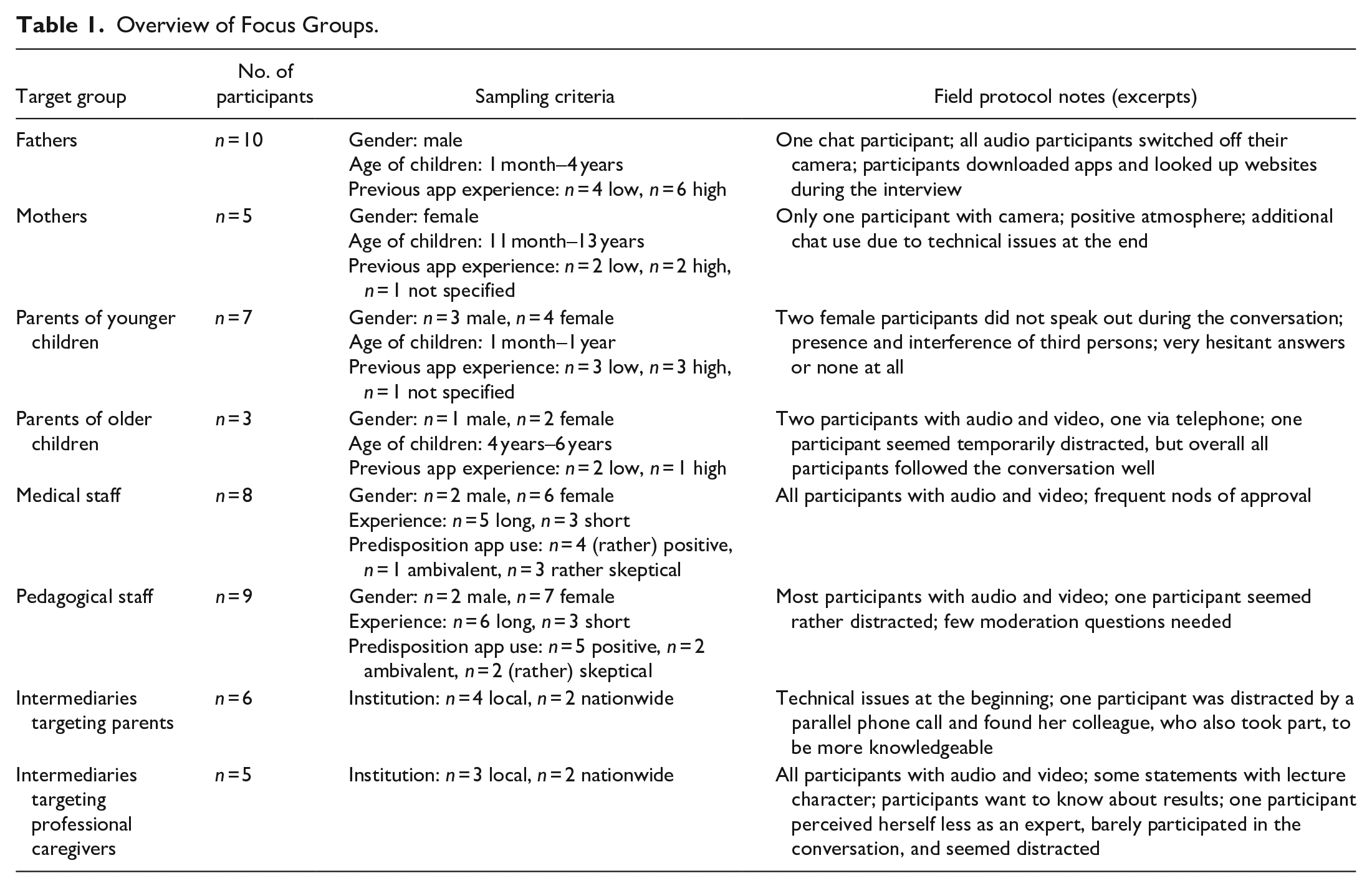
For the groups of intermediaries (i.e., formal multipliers targeting parents and professional caregivers), we included people from local and nationwide institutions, assuming that they may differ in their communication strategies, for example, regarding their communication network and channels used. In addition to methodological rigor, resounding health-related research projects are also characterized by participatory elements and knowledge transfer into practice (Higginbottom & Liamputtong, 2015). Therefore, with their consent, we remained in contact with the intermediaries after the interviews for follow-up actions (MacDougall & Fudge, 2001). Contact was maintained via email, which was easy to continue because communication leading up to the online focus groups and sending the link to the webcam meetings had already been done via email.
In market research, focus groups often have a size of 10 to 12 participants; noncommercial, complex topics require smaller group sizes, especially if participants are highly emotionally involved and have high levels of expertise or experience (Krueger & Casey, 2015; Morgan, 1996). The main purpose of our study was to get a range of opinions on the potential of mobile media for information behavior on child injury prevention. Although this is a topic with high emotional involvement for parents, most participants had low to no previous experience with injury prevention apps. Therefore, we planned to conduct focus groups with six to eight participants. However, group size varied between three and ten due to no-shows and oversampling. In addition, the ongoing pandemic challenged recruiting intermediaries from health-related institutions because of their limited time resources. Therefore, we decided to also include individual interviews for this target group, but those are not discussed in this paper.
Data Collection
The core method of our project was a synchronous webcam meeting to enable live interaction between the focus group participants (Morrison et al., 2020). To limit the cognitive load of the online focus groups, we restricted their duration to 90 minutes. Therefore, we transferred some basic questions regarding sociodemographics and information behavior to a beforehand online survey. While sociodemographics were collected with standardized measures, information behavior was assessed with open-ended questions (Züll & Menold, 2019). The online survey was also used to gather and document informed consent in advance of the online focus groups.
An interview guide was used to prepare and structure the discussion. Crucial for the questioning route of focus groups is a coherent composition: an easy opening question, a fluent transition between different questions and topics, and from broader issues to specific inquiries with good time management (Krueger & Casey, 2015). Before starting the online focus groups, in addition to general remarks on the topic and method, we had to clarify any technical issues and how to use the microphone and chat function during the interview. Our easy-to-answer opening question for all participants was about the number and age of their children and, for professional caregivers and intermediaries, also their professional relationship to the topic of child injuries. The main part of the focus groups dealt with three different sub-topics: information behavior, prevention behavior, and behavior in critical injury situations. In each sub-topic, we started with a broad and very open question. In the interview guide, one to three key questions, possible specific follow-up questions, and the planned duration were noted for each sub-topic. At the same time, the moderators had to react flexibly when participants introduced new topics or anticipated later topics. At the end of the interview, every participant was asked to give a closing statement.
A special feature of the webcam meeting was a presentation that was displayed in parallel, in which the structure of the interview and transitions from one topic to another were reflected. This presentation was also used to display prompts as enabling techniques (Arthur et al., 2014) to stimulate the flow of conversation. For example, we included participants’ responses from the online survey on preferred sources to introduce the discussion on information behavior. Because the pretest showed that most people did not use smartphone apps for child injury prevention, we also showed and explained some app examples.
Flow of Communication in Online Focus Groups
The focus of this paper is to evaluate the flow of communication in online focus groups. The flow of communication refers to in how far participants interact with each other and if they disclose sensitive, broad, and deep information on the research topic. In our study, three topics emerged that influenced the flow of communication in online focus groups: (a) communication mode(s), (b) (co-) moderation, and (c) distractions and interjection of other people.
Communication Mode(s)
Although the online focus groups were planned as webcam meetings where all participants took part with audio and video, some participants had trouble with one or both. Hence, people were alternatively integrated via telephone into the webcam meeting and could also type in the chat box, resulting in a rather hybrid meeting format that also varied between groups (see Table 1).
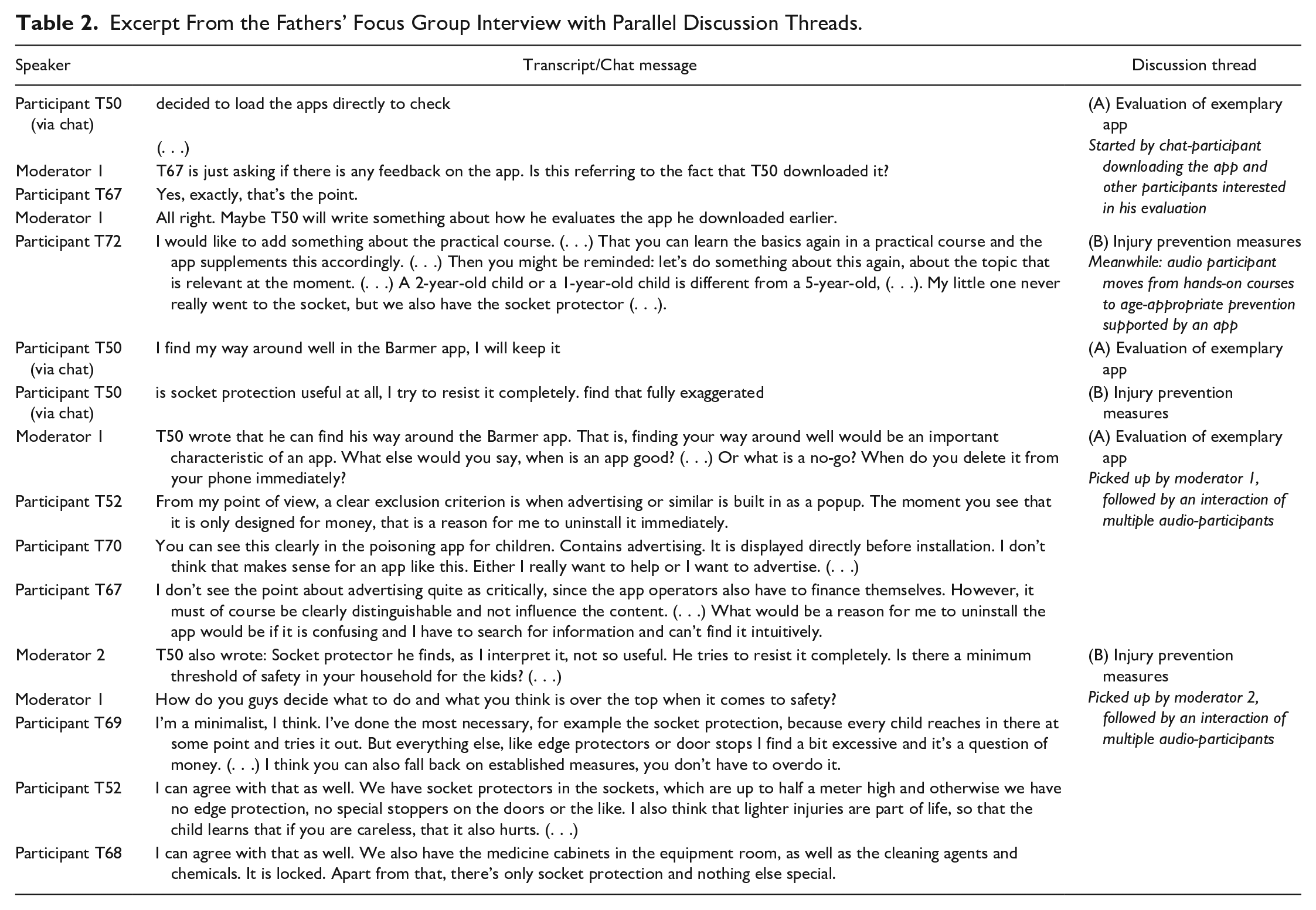
With the meeting software used and many participants not having a headset, sound problems occurred when multiple people had their microphones switched on at the same time. This limited participants’ interaction because they unmuted their microphones to make a statement and subsequently muted themselves, so the next person could take their turn and give a statement. This was especially the case for professional caregivers and intermediaries who appeared to be wanting to represent their expert roles (Bogner & Leuthold, 2005). Some of the answers in these groups, therefore, had more of a lecture character with a length of 3 to 4 min. Nevertheless, the conversation in the groups with professional caregivers and intermediaries kept a good flow and few follow-up questions had to be asked because all participants had a high need to share. For example, in the group with medical staff, participants frequently approved each other’s statements by nodding their heads, which also supported the flow of conversation without the need for the moderators’ interference. Most participants in these groups had their cameras switched on. In contrast, in the focus groups with parents as lay people, most participants only took part via audio. This was especially the case in the two gender-homogeneous groups. Still, both groups were characterized by a very positive and engaged atmosphere. Participants referred to each other’s statements in their responses (see Table 2 for an example from the fathers’ group), and the audio discussion was supplemented by comments in the chat.
Excerpt From the Fathers’ Focus Group Interview with Parallel Discussion Threads.
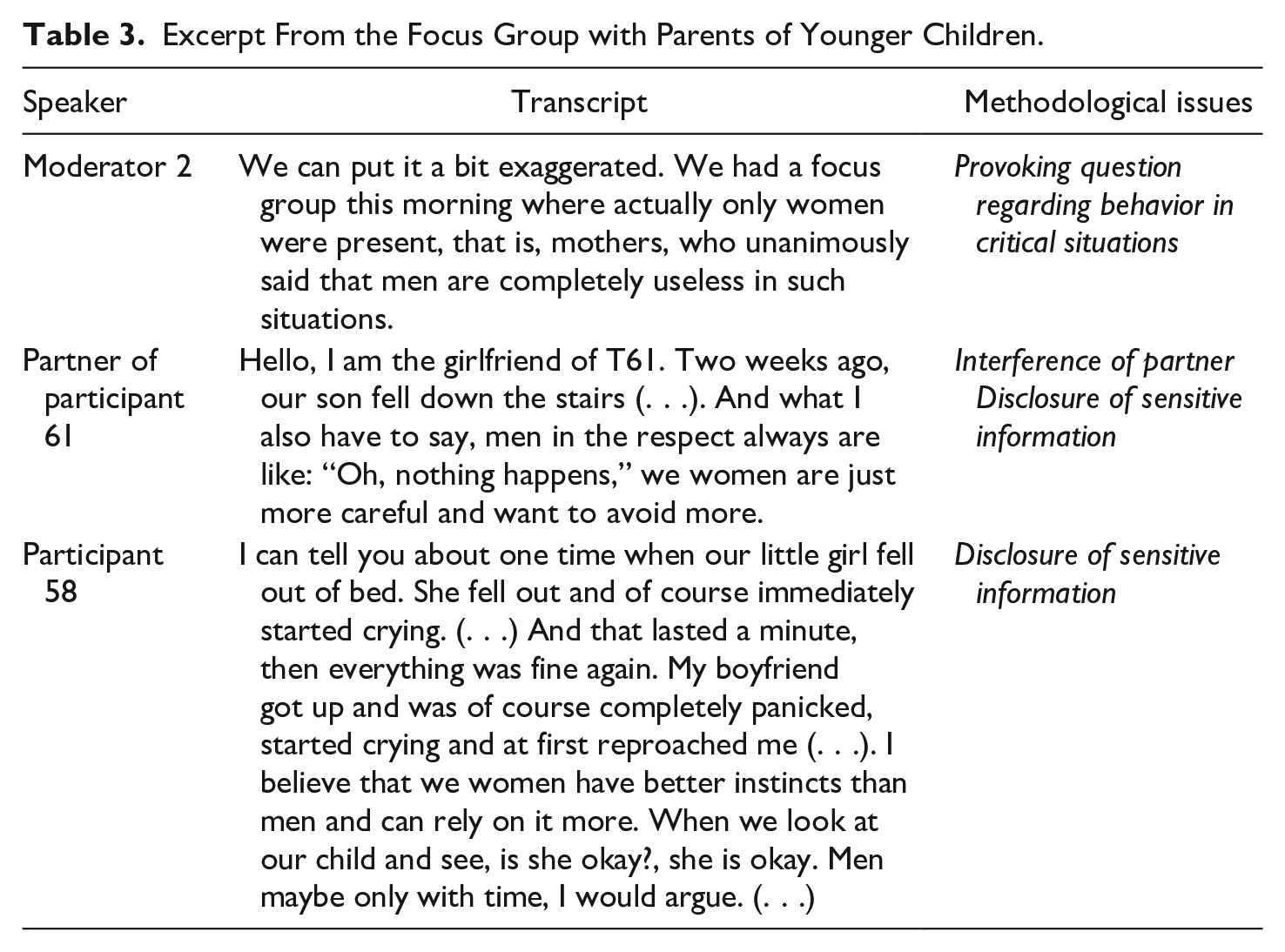
In our focus groups, parents were asked to and did disclose sensitive information, for example, regarding previous experiences with child injuries (see Table 3). Disclosure of sensitive information may have been facilitated by the participants’ comfort of being located in their own homes (Stewart & Shamdasani, 2017). In addition, we know from research on computer-mediated communication that this type of interaction allows people to have greater control over their self-presentation (Walther, 1996). Therefore, it may facilitate a trustful exchange of personal information in online focus groups (Lobe, 2016).
Excerpt From the Focus Group with Parents of Younger Children.
However, in each group, there were participants who mostly withdrew themselves from the conversation. The gender-heterogenous group with parents of younger children turned out to be the most difficult in this respect. Two participants (both female) did not speak out during the whole main part of the interview. In general, questions in this group were answered very hesitantly or not at all. Most participants in this group had little interest in the focus of the study (smartphone apps as an information source). It was also the group with the most distractions and interjections of other people (see below). All of this contributed to a low flow of communication. In the groups with intermediaries, there was also one person in each group who participated little in the conversation and seemed very distracted. Both persons stated at the beginning or at the end of the interview that they perceived the other participants as more knowledgeable than themselves (and thus felt like they could not contribute as much).
Hence, it seems that participant interaction and disclosure of information depend on various factors, the type of (online) communication mode only being one of them. To ensure the inclusion of all participants’ opinions, everyone was encouraged to give their conclusion during the closing round of the online focus groups.
(Co)-Moderation
In online focus groups, it turned out to be especially difficult to integrate all participants equally into the conversation. In face-to-face focus groups, one would seat dominant talkers next to the moderator to influence them through body language, would encourage shy people by making, and discourage ramblers by breaking eye contact (Krueger & Casey, 2015). Not being in the same physical space, this is not possible in online focus groups.
Therefore, in our online focus groups, the moderators mainly guided verbally through the conversation. During the interview, they repeatedly asked if other participants had anything to add or if there were different views on the discussed topic. As mentioned above, all participants were kindly requested to give an opinion at the end of the interview.
As recommended for focus groups, the interviews were guided by a moderation team of two people (Krueger & Casey, 2015). It is better to have four eyes and ears so as not to miss anything and to be able to ask good follow-up questions. For online focus groups, it is even more important to have a co-moderator to facilitate the integration of all participants and parallel attention to technical issues and the content of the interviews (Morrison et al., 2020). This was especially important in the fathers’ group with a participant that could only participate via chat. Due to comments by the chat participant, several discussion threads developed in parallel, which had to be picked up by the moderators one after the other (see Table 2). Thread (A) on the evaluation of an exemplary app was initiated because the chat participant had downloaded the app and other participants wanted to know about his experiences. In the meantime, the audio discussion focused on thread (B) about injury prevention measures. At one point, the chat participant made comments on both threads at the same time. He made an evaluation of the app (A) and provided a different point of view on prevention measures (B). Hence, the moderators decided to first pick up on thread (A) and later on came back to thread (B) to discuss the different opinions on prevention measures.
Distraction and Interjection of Other People
During the online focus groups, some people seemed distracted when looking at second screens, their smartphones, or other people present in their homes. These issues were documented in the field protocol notes of each interview (see Table 1)—which was easier if the distraction was visible in the participants’ camera field. Distractions or other people interfering in the interview are common problems with focus groups. However, with online focus groups, moderators have less control over them. If, for example, accompanying persons ask to participate in an in-person focus group, this normally happens before the interview, and moderators can decide how to deal with the request (Krueger & Casey, 2015). In contrast, interjections of other people, who directly or indirectly influenced participants’ answers during the online focus groups, happened without premonition. In some cases, other people were not in the camera’s visual field, but it could be noted that participants made eye contact and talked to people behind the screen. In other cases, participants’ spouses spoke out actively. Although this was not the focus of our study, these interjections could provide insights into gender issues regarding parenting, stereotypes, and roles in children’s supervision. In the case presented in Table 3, the girlfriend of a male participant decided to answer the question about gender differences in handling critical situations (instead of her partner). She disclosed an accident that happened to their son and stated that women are more careful than men. Another female participant took this as an opportunity to speak up and attest to mothers having better instincts when dealing with children.
Other distractions were also not purely disruptive but relevant to the content. For example, the fact that participants downloaded and viewed apps (see Table 2 for an example) or searched for websites as possible sources of information during the interview also contributed to the discussion. In addition, distracted participants were an indication that they did not feel they could provide good information because they were not interested in the topic or considered others to be more competent. This gave the moderators an opportunity to recognize the issue and work toward better participant engagement.
In addition, having to care for their children during the interview disrupted the conversation flow. The advantage for recruitment—parents can participate in the online focus group from home and do not need a babysitter—can also be a disadvantage for the flow of the interview, especially for parents of younger children and single parents.
Discussion
In sum, the applied online methods allowed for a high-quality data collection but also provided some difficulties. Online focus groups were very convenient for our target groups—parents with young children and geographically dispersed experts—and improved recruitment. It may be advisable to have a qualitative sampling plan (Schreier, 2017) to decide in advance, based on the research interest, regarding which characteristics participants should be homogeneous or heterogeneous respectively. However, all planning aside, especially with the online format, one must be prepared that not all participants will show up on the agreed date.
In this paper, we focused on evaluating the impact of (a) communication mode(s), (b) (co-)moderation, and (c) distraction and interjection of other people on a crucial methodological quality criteria of focus groups: the flow of communication, that is, what and how people disclose information on the research topic. In the following, we will provide lessons learned from our study for our research topic and other research fields.
Regarding the communication mode, it appears like a great step forward that, due to technical advances, online focus groups can now be realized as synchronous webcam meetings instead of asynchronous and/or text-based interactions. There are clear advantages to a synchronous discussion because people can speak to each other without having to spend time typing. However, because our focus groups differed regarding the dominant communication mode, we were able to identify advantages of audio-only communication compared to audiovisual communication. Gender-homogeneous groups with audio-only communication resulted in a very engaged atmosphere. In contrast, in audiovisual groups of gender-heterogeneous parents and intermediaries, several participants withdrew themselves from the conversation. One possible explanation is that the camera images may have underlined (status) differences in those groups. The differences we observed between audio-only and audiovisual groups are in line with Gothberg et al. (2013), who found that telephone focus groups encouraged more disclosure than audiovisual online focus groups. Of course, there are also advantages of audiovisual focus groups, such as broader impressions of the respondents. In addition, the flow of conversation can be supported through nonverbal cues like nods. However, advantages and disadvantages must be well weighed. Especially for sensitive topics such as child injuries or other rather stigmatized health topics, such as mental illnesses or sexual-infectious diseases, audio-only communication may support a trustful and egalitarian exchange.
Comparing the different focus groups and communication modes in our study, it seems that an even more crucial aspect than the communication mode is the participants’ motivation to speak out in the group. This motivation was higher in gender-homogeneous groups, if people were interested in the topic, and did not perceive others to have a lot more expertise than themselves. Therefore, a fitting composition of the focus groups is essential. Moreover, it is crucial to give every participant the feeling of being an important part of the group–issues also known from in-person focus groups (Krueger & Casey, 2015). However, this aspect is even more important in online focus groups because it is easier to withdraw yourself from a group interview if you do not share the same physical space but can hide behind your screen.
With limited possibilities of body language and no eye contact, it is difficult for the moderation to equally integrate all participants in the discussion. We tried to do so verbally but rarely by calling upon individual participants. One possibility would be to use the private chat function, for example, to encourage restrained people. However, this could also be perceived as overly intrusive and should at least be clarified as a possibility in advance of the focus group. Co-moderation is highly recommended for online focus group interviews to ensure parallel attention to technical issues and the content of the interviews (Morrison et al., 2020). We found it indispensable not only for technical issues but also to pose good follow-up questions, especially if the hybrid format led to the development of parallel discussion threads. Both moderators should be well-informed about the purpose of the study and ask clear questions but also be open for the participants’ perspectives (Krueger & Casey, 2015). The assignment of responsibilities and interaction of the co-moderators should be pretested in a group situation in advance to conducting the actual online focus groups.
While it was convenient for participants to be in their own homes, there was also a range of disruptions and direct or indirect interferences of third persons. These issues were protocolled by moderator 1 after the interviews, to the best of her knowledge (which was easier to capture if the distraction could be identified in the visual field of the camera), to consider possible distractions or social desirability when interpreting the data. To capture the data collection situation of online interviews more comprehensively in future studies, respondents could be asked to indicate possible interfering factors and the presence of other people in a short post-survey (similar to such questions in online surveys).
However, it should be noted that distractions were not only disruptive. Participants who used their smartphones to download exemplary apps or searched for informational websites also contributed to the content of the discussion. An idea would be to even integrate this more into the discussion, for example, by sharing the screen and collectively exploring an app or a website. In some cases, distracted participants could also be a signal to the moderators that someone feels left out of the discussion.
Interjections of participants’ partners in our online focus groups showed that child injuries are a topic of family communication for which it could be valuable to include both parents in a dyadic interview study, where gender issues such as the distribution of care work, and characteristics of the relationship and communication structures could also be analyzed (Manning & Kunkel, 2015). In general, for topics that involve several people collectively making a (health) decision, such dyadic interviews may lead to more comprehensive data than individual interviews (e.g., Bjørnholt & Farstad, 2014; Polak & Green, 2016). However, it is not recommended to include several couples into one focus group (Krueger & Casey, 2015), because this typically results in a discussion of the respective dominant or more forthcoming partners of each couple.
The varying communication modes and different disruptions of the flow of communication in our online focus groups led to a complex set of authentic data, which enabled various insights into our research topic but also brought some challenges for the comprehensive data analysis. Therefore, we decided to apply a variable-oriented data analysis approach (Miles et al., 2019). In our results, we were able to differentiate multiple sources and reasons for information behavior regarding child injury prevention (Reifegerste et al., 2022), examined the potentials and limits of mobile media in this context (Stehr, Ermel et al., 2023), and uncovered different beliefs regarding prevention behavior (Berlekamp et al., 2023).
Limitations
Our evaluation of online focus groups as a social scientific method is limited by our specific topic and sample. However, because we interviewed three different target groups, we were able to provide insights into how, for example, lay people and experts may act differently within online focus groups. Due to the ongoing pandemic, we were not able to conduct any face-to-face interviews. Hence, we cannot compare online and face-to-face focus groups in this paper. Moreover, we examined different types of online focus groups that have arisen from the circumstances. Future studies should plan a controlled comparison of audiovisual and audio-only online focus groups with face-to-face groups. Nonetheless, our investigation of online focus groups as an original research design provides an evaluation of advantages and pitfalls that should be considered in future research.
Conclusion
To ensure a good flow of communication in synchronous online focus groups, the advantages and disadvantages of different communication modes should be carefully weighed. Audio-only instead of audiovisual communication may be favorable for the trustful and egalitarian exchange on sensitive topics. In online focus groups, it is easy for participants to withdraw themselves if they do not feel competent or motivated to speak out. Therefore, a considerate composition of the focus group and giving every participant the feeling of being an important part of the interview are essential.
Although it is convenient for people to participate from their own homes, online focus groups come along with some technical difficulties as well as many possible distractions and interjections of other people. Depending on the research topic, distractions and interjections may also contribute to the content of the discussion and could be integrated into the discussion.
Holding together different communication modes (chat, telephone, and audiovisual interactions) and dealing with various interruptions can be challenging. Hence, skilled co-moderation and thorough protocolling of the circumstances of data collection are essential.
Footnotes
Declaration of Conflicting Interests
The authors declared no potential conflicts of interest with respect to the research, authorship, and/or publication of this article.
Funding
The authors disclosed receipt of the following financial support for the research, authorship, and/or publication of this article: The project was funded by the German Federal Institute for Risk Assessment, Grant Agreement Number 60-0102-02.P580.