



Abstract
Active social and employment services are a crucial infrastructure of the welfare state. As these services are designed to help people in need of support to overcome periods of insecurity in their life course, their effective provision has also been seen as an element of the implementation of the social investment (SI) welfare state. However, the transition to the SI state is linked to numerous preconditions. This is especially true with regard to vulnerable people like the long-term unemployed (LTU). The provision of social services that meet the specific needs of this group requires the actors responsible for implementing social and employment policies to have adequate operative capacities. This article compares Germany and France as two European welfare states that – confronted with persistently high long-term unemployment – have taken different reform paths over the last 20 years that partly run counter to their political-administrative systemic conditions and governance traditions to meet this challenge. Empirically, the article draws on a systematic content analysis of selected policy documents and secondary literature. It is shown that the recent German reform path of combining central steering responsibility with local scope for action can be a way to come closer to a social investment-oriented service policy for the LTU. However, the article also reveals that neither state (yet) has the necessary operative capacities for a shift towards an SI state. Overall, the changes in the understanding of the SI paradigm and the welfare state's constant reluctance to invest in implementation capacity make its sustainable application unlikely.
Introduction
Both counselling and active social and employment services for the (re-)integration of the unemployed into professional and social life have been an integral part of the European welfare state's infrastructure for decades. Given their encompassing and possibly preventive nature, such services have been said to have the potential to put a shift towards the social investment (SI) paradigm of the welfare state into practice (Sabel et al., 2017: 177). However, this has also been considered to be full of preconditions (ibidem) as the design of services must be tailored to individual needs in order to make substantial social investment possible. The challenge is particularly high with regard to the long-term unemployed (LTU). As LTU people usually face multiple problems, they need particularly complex service offers as well as longer-term support from the competent integration agencies (cf. European Court of Auditors, 2021: 7) 1 .
Scholars of the SI paradigm have recently stressed that the orientation of the welfare state towards this idea is not solely functional (cf. Morel and Palme, 2017) in the sense of only concentrating on increased labour market participation, as has been criticised (cf. Bothfeld and Rouault, 2015; Saraceno, 2015). Rather, they emphasise the potential of the SI state to enable individuals, including particularly vulnerable people, to participate in society and lead independent, self-determined lives as ‘social citizens’ (Morel and Palme, 2017: 187–188; Plavgo and Hemerijck, 2021). Against the backdrop of this argumentation, it is particularly worth looking at the activity of the welfare state when confronted with complex problems like LTU. What does the welfare state do to lend effective support to the affected groups or individuals and to offer individually tailored (but also politically legitimate) social services? The predominant focus in the literature is on the macro level of public policymaking (Garritzmann et al., 2018) and the conception of policy instruments. In this article, it is argued that this is not sufficient to answer this question. Rather, it is necessary to look at the level of policy implementation and to question the operative capacities of the organisations charged with implementing social service policies.
This article studies this ‘operational core of the social investment state’ (Klenk and Reiter, 2023) in the field of social service policies for the LTU in Germany and France. It asks how administrative reforms in both countries since the early 2000s have affected the operative capacities of the organisations in charge of implementing social service policies for the LTU, and what can be learned from the comparison about the implementation prerequisites of the SI state. To answer these questions, the article applies an analytical framework that is developed referring to the policy capacity approach of Wu et al. (2018), combining it with insights from policy implementation literature (Hudson et al., 2019). In line with the major ideas of this Special Issue (cf. Klenk and Reiter, 2023), the article is based on the following assumptions: first, the understanding of the SI state is (still) contested; second, the contested understanding of the concept hampers its practical relevance and applicability in the course of public policy implementation; third, adequate capacity for the implementation of social service policies is required to allow for resilient social integration via individual empowerment.
The article is divided into six sections. In section 2, the theoretical fundament of the argumentation is explained, connecting the debate on the SI state to the implementation perspective on public policymaking. Section 3 uses the policy capacity approach (Wu et al., 2018) as a starting point to develop an analytical framework for assessing the (changes of the) operative capacities of policy implementing organisations. In section 4, the framework is applied to compare the impact of administrative reforms in Germany and France since the early 2000s on the operative capacities of the organisations charged with implementing social service policies for the LTU. Section 5 discusses the findings, mixing both the long-term and cross-country perspective. It shows that the (recent) German reform path of combining central steering responsibility with local scope for action can be promising, but that, overall, implementation organisations in both states lack the operative capacities for resiliently designing tailor-made social service offers. Based on this, section 6 concludes that making the social investment state applicable still has a long way to go.
Theoretical fundament: three dimensions of implementing social investment
In the debate on social investment as a paradigm of the welfare state (Garritzmann et al., 2022a, 2022b; Hemerijck, 2018), three functions of SI policy are placed in the foreground: first, the organisation and provision of individual basic income security (‘buffer’), which basically relates to the classic Keynesian-Beveridgean (Hemerijck, 2018: 810) model of the post-Second World War (re-)distributive welfare state and also to its neoliberal antipole model (ibidem) 2 ; second, the active support for labour market (re-)integration, including the management of the transition of individuals from one employment or unemployment or training into another or new employment (‘flow’); and third, the support of employees through the guaranteed provision of ‘capacitating social services’ in various life situations (‘stock’) (Hemerijck, 2018: 816–817).
While this encompasses the full range of functions that the modern welfare state is, in principle, supposed to fulfil, proponents of the SI concept speak of it as a paradigm change (cf. Garritzmann et al., 2022a, 2022b; Hemerijck, 2018). They argue that the concept has the potential to make the welfare state more resilient in the face of persistently complex social and economic challenges, precisely because it focuses primarily on social services (flow and stock). As compared to the classic, passive function of wealth (re-)distribution via financial transfers, social services are seen as active, targeted means of the welfare state to overcome individual hardship and to increase the well-being of individuals as well as, based on this, of society and the economy overall. And this – so the argument goes in reaction to the critics of the SI concept (cf. Bothfeld and Rouault, 2015; Saraceno, 2015) – particularly promotes the opportunities of disadvantaged groups (e.g. single parents, people at risk of poverty, minorities). Social investment, seen from this broad perspective (cf. Hemerijck, 2018: 815–818), is said to pay off not only in the short run with regard to less needy groups, but also in the longer term with explicit regard to more vulnerable groups (Plavgo and Hemerijck, 2021). Ultimately, it is believed that SI can improve social and gender equality and can ensure the effective integration particularly of socially weak people (ibidem).
The argumentation seems convincing, but scepticism remains high (Van Hooren and Ledoux, 2023). On the one hand, the SI discussion has so far paid little attention to the classic fields of intervention of the welfare state, such as poverty reduction, old-age security, health and care. SI research has, for a long time, concentrated on fields where social investment seems ‘particularly paying’ (e.g. child and youth policy, family policy, education policy, active labour market policy, knowledge economy) (cf. Garritzmann et al., 2022a, 2022b). One criticism was therefore that SI mainly produces ‘Matthew effects’ (corresponding to the biblical saying ‘to him who has shall be given’) (cf. Pavolini and Van Lancker, 2018). On the other hand, persistent scepticism about the SI concept and the viability of the SI state can also be related to the debate on SI so far being mainly focused on the macro level of policymaking and the design of appropriate policy instruments (Garritzmann et al., 2018). In contrast, little attention has been paid to the implementation conditions of social investment. The disregard for the capacities of the welfare state to put the SI idea into practice, however, represents a blind spot in the academic debate (Bothfeld, 2016; Dingeldey, 2020). Specifically, the problem here is the capacities of those actors and organisations that are responsible for the implementation of social service policies and the provision of services. As is stressed by scholars of policy implementation, adequate levels of capacities for policy implementors (e.g. financial, personal, knowledge resources, but also organisational capacities and governance competences) can make a difference to the success or failure of policies (Hudson et al., 2019: 8). Therefore, the implementation phase can be considered crucial in terms of the transposition to, and also the long-term acceptance of, the SI paradigm and the success or failure of the SI state.
Referring to insights from implementation research, implementation can be considered critical in at least three dimensions here. First, in the structural dimension (Gunn, 1978), adequate resource endowment basically enables implementors to operate as investors in the sense of being able to finance certain services, having at hand the knowledge and time to consult about support and opportunities. Second, in an actor-related regulatory dimension regarding the individual agent working in an implementing organisation (‘street-level bureaucrat’; Brodkin, 2016; Lipsky, 1980) and the organisation itself (Hudson et al., 2019; Imperial, 2021), discretion for decision-taking is important. Seen from this perspective, rules for operational flexibility are necessary for the design of tailor-made social service offers. Such discretion is particularly crucial to counsel and support persons in complex problem situations, who need carefully designed and often complex social service packages diverting from standard solutions. And third, in a process-related dimension, the endowment of implementing organisations with (internal and external) governance competencies is important (Hudson et al., 2019: 3–4). Scholars focusing on the implementation process emphasise that the modern (welfare) service state is dependent on the ability of networked implementation, entailing effective mechanisms for intra-organisational steering and for the coordination of state and non-state actors at different levels and in different policy sectors (Hudson et al., 2019). This is crucial for the SI state in order to make the most effective use of its own operating capacities and/or to effectively bundle its own resources with those of other cooperating partners (ibidem).
Analytical framework and design of the study
Analytical framework: studying the operative capacities of implementing social services
Relating to the theoretical argument unfolded above, I use the policy capacity approach of Wu et al. (2018) as a source of reference to build an analytical framework for studying the operative capacities of the implementors of social services. The approach has primarily been applied in the context of the study of policy formulation and design at the government level (cf. Mukherjee et al., 2021). However, due to its multi-perspective conceptualisation, it can be utilised for the analysis of every stage of public policymaking, including implementation (Andersen and Breidahl, 2023; Wu et al., 2018: 4).
According to Wu et al. (2018: 3), policy capacity is defined as ‘the set of skills and resources – or competences and capabilities – necessary to perform policy functions’. Policy capacity is located at three levels: the system, the organisational and the individual level. Here, this comprises a bundle of analytical, operational and political capacities, respectively (ibidem: 4).
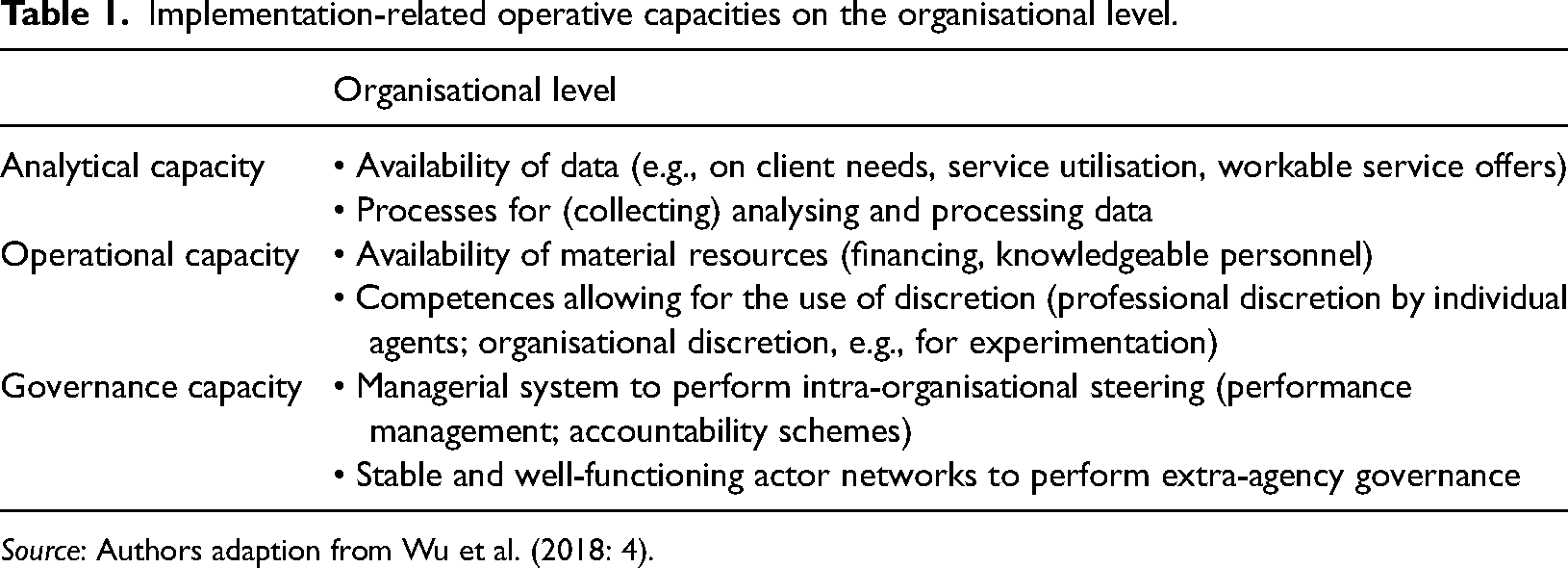
With regard to the particular perspective of this article on implementing organisations, I focus on the organisational level (cf. Table 1). Here, I am particularly interested in the capacities of public (state or municipal, functionally specialised or universal) organisations that are formally responsible for the implementation of these policies and can either provide the related social services (counselling, coaching, training, care, etc.) by themselves or commission other public or private organisations to provide them.
Implementation-related operative capacities on the organisational level.
Source: Authors adaption from Wu et al. (2018: 4).
In regard to the analytical capacity first, I look at the availability of information and knowledge in the context of the task performance of the relevant implementing organisations (Wu et al., 2018: 8–9) (cf. Table 1). Analytical capacity refers to processes for collecting and analysing data on client needs, service utilisation, etc. From an SI perspective, this is necessary for public agents to be able to assess the specific difficulties of clients and to recognise their specific needs. For the implementing organisation as a whole, analytical capacity is needed to gain information about the suitability and quality of their services. Given the existence of viable data collection mechanisms, such information can be (electronically, digitally) stored and made accessible for different service collaborators (Wu et al., 2018: 9).
As far as operational capacity is concerned, the availability of resources like finances or knowledgeable personnel needs to be taken into account (Lundin, 2007; Wu et al., 2018: 10) (cf. Table 1). Empirically, this can be examined on a quantitative basis. When studying operational capacity from an SI perspective, the existence of rules and competences for professionals working in the implementing organisation to use discretion is also important (Brodkin, 2016; Lipsky, 1980). This operationalisation deliberately deviates from the model of Wu et al. (2018). From the SI perspective, competency in terms of discretion is a major operational capacity implementing actors to be able to make flexible decisions appropriate to clients.
Finally, as well deviating from the model of Wu et al. (2018) and supplementing it according to the SI perspective, the governance capacity of implementing organisations has to be taken into account (cf. Table 1). Governance capacity is located at an intermediate level between political capacity and operational capacity (cf. Wu et al., 2018: 8). The view of governance capacity is based on the premise that implementation is not only a functional but also a political process (Hudson et al., 2019; Hupe and Hill, 2016). It refers to the existence of the institutional conditions to perform intra-organisational steering (performance management systems; accountability schemes), and to the existence of stable, well-functioning actor networks to perform extra-agency governance.
Design of the study: Case selection and methods
Case selection
For this article, Germany and France were selected as classic examples of the conservative European welfare state, traditionally sharing a number of characteristics, but also differing in terms of their state and administrative organisation. Seen from this article's focus, the case selection is justified by the fact that in both countries the traditional structures of welfare state policymaking have been called into question precisely in the area of social service policies for the long-term unemployed (LTU) due to important reforms during the early 2000s. In France, with the introduction of the fully decentralised Revenue de solidarité active (RSA) between 2004 and 2009, and in Germany, with the so-called Hartz reforms from 2002 to 2005, policy systems were installed that partly contradict the traditional political-administrative structures and governance traditions in the field of social service policy.
When first looking at those classic structures, in both countries financial social security is largely based on social insurance with welfare being tax-financed. In social services, non-state and civil society actors, especially charities and church agencies and also domestic unpaid (mostly female) workers, traditionally play an important role in the provision. In terms of the organisation of the state and public administration, France is a strongly centralised state that intervenes at all levels of governance and in all stages of public policymaking. Non-state actors are integrated into processes of public policymaking via intensive social consultation. In terms of policy implementation, they act as important partners and/or contractors of the competent public actors, that is, mostly the departments and the municipalities. Notwithstanding a comprehensive decentralisation of tasks since the early 1980s, the central state continues to play an important role in public policy implementation. Germany, in contrast, is a federal state characterised by a decentralised administrative organisation. The governance of public policies is based on multilevel and cross-sectoral coordination among different actors. Non-state actors (relating to the neo-corporatist tradition of state-society relations) are included in public policy processes on a regular more or less institutionalised basis, depending on the sector. Social service policies are implemented at the sub-national level, mostly under the control of local public actors, namely the municipalities.
When turning our attention to the reformed systems of social services policies for the LTU, the following picture emerges.
In Germany, a new system of providing basic benefits for the LTU was installed with the so-called Hartz reform by the former Social-Democrat-Green Government between 2002 and 2005. As a result, the former unemployment assistance and the social assistance for employable people between the ages of 15 and 67 were merged to form the new means-tested basic income for jobseekers (ALG II), which has been formally anchored in the Social Code II (SGB II) since 2005. The SGB II, among other things, regulates the provision of social services linked to the cash benefit. It distinguishes between employment-related ‘flow’ services – such as job placement, vocational training (§ 16 SGB II) or financial incentives to take up work (§§ 16b–16i SGB II) – and services to actively support social integration (‘stock’), such as childcare, debt counselling, psychosocial counselling, etc. (§ 16a SGB II). The individual benefit package is determined by the local jobcentre, which concludes a formal integration agreement with the applicant of the ALG II (§ 15 SGB II). With the introduction of ALG II, the then Red-Green Federal Government deliberately linked the policy of social services for the LTU with a social investment perspective. The competence for the implementation of this policy was removed from the general system of social assistance, which is administered by the municipalities, and was placed with the Federal Employment Agency (BA). The BA has since centrally controlled and monitored the local jobcentres, which have to implement the policy. 3 However, the BA or the jobcentres are required by law (by the SGB II) to cooperate with the municipalities as being responsible for ‘stock’ social services as well as with other non-public local social service organisations.
In France, a specific system of basic benefits and support services for the LTU or people affected by precariousness, the Revenue minimum d'insertion (RMI), had already been established by the former Socialist Government in 1988. It was replaced between 2004 and 2009 by the current Revenue de solidarité active (RSA). The RSA reform not only expanded the group of beneficiaries but also strengthened the system's focus on the labour market integration of the LTU; it was explicitly meant to introduce a social investment perspective (Avenel et al., 2017). Like the German ALG II benefit, the French RSA is also a means-tested and flat-rate benefit that can be granted to unemployed people between the ages of 25 and 65 upon application (Art. L262-1 and Art. L262-27 Code de l'action sociale et des familles (CASF)). Since the complete decentralisation of the benefit in 2004, the départements are fully competent for the fulfilment of the task (Art. L 262-24 CASF). Since 2009, this has entailed responsibility for the so-called initial orientation of RSA applicants. In this context, the départements refer to the claimants to social or vocational service providers with whom they formally cooperate 4 and to whom they expect to offer the services most appropriate for the applicant's situations. Unlike in Germany, active employment and social services for the LTU are not explicitly named by the CASF as the major regulatory basis. Instead, it is up to the départements and their cooperation partners to use instruments regulated in different laws in order to put together individual service packages based on integration contracts (contrat d'insertion; Art. L262-35 and Art. L262-34 CASF) with the RSA beneficiaries. Given that the RSA is a decentralised task, the départements are formally largely left to determine the implementation of this policy.
Given the design of the systems of LTU social service policies in Germany and France partly running counter to the traditional administrative-organisational conditions, and given both legislators’ explicit determination to strengthen the social investment character of these policies, the comparison of the two countries is particularly interesting here.
Data collection and methods
Data to investigate the (change of the) operative capacity of the organisations charged with the implementation of the social service policies for the LTU in Germany and France stem from secondary sources (expert organisations, governmental and public administrative control agencies, scientific analyses). In the German case, the BA's statistics and directives, reports from the responsible Federal Ministry of Labour (BMAS), parliament (Bundestag) documents and evaluation reports by externally commissioned evaluators were taken into account. In the French case, the analyses of the government's own social policy directorate DREES (Direction de la recherche des études de l'évaluation et des statistiques) and the evaluation reports of the French Court of Auditors (Cours des Comptes) on the implementation of the RSA policy served as data sources.
Data were collected via intensive desk research (Van Thiel, 2014) and were obtained on the basis of online research. Data collection focused on the central categories of capacity endowment and development of implementing organisations in the two countries studied. This means that for the study period from 2002 to 2022, a systematic research was carried out for: 1) qualitative information on data collection and utilisation mechanisms and processes in the implementing organisations (analytical capacity); 2) statistical and qualitative data on the financial, personnel and regulatory resources of the implementing organisations (operational capacity); and 3) qualitative data on the institutional prerequisites for internal and external governance. All data used here are publicly accessible and freely available. They have been examined based on the qualitative method of intensive document and secondary analysis (Noetzel et al., 2018: 370–381).
The following section will examine what the endowment with capacities of the organisations charged with the implementation of social service policies for the LTU in Germany (the local jobcentres) and in France (the départements) looks like and how this has changed since around 2005.
Implementation capacity: Comparing the development and status in Germany and France
Analytical capacity
In Germany, the collection of data related to the receipt of ALG II benefits has been an important component of LTU social service policy since the Hartz reforms came into force (Brenke, 2015; Schmidt and Weißbrodt, 2019: 281f.). All jobcentres are legally obliged to collect and transmit data on benefit recipients ‘on an ongoing basis’ to the BA (§ 51b SGB II). Conversely, the BA carries out evaluation centrally (§§ 53–55 SGB II and §§ 280–283 SGB III) and compiles labour market statistics and other statistical evaluations (§ 53 para. 1 SGB II; § 281 SGB III). Additionally, it is required to regularly research the effects of employment policies through its own Institute for Labour Market and Employment Research (IAB) or have it researched by means of external commissioning (§ 282 SGB III). The BA makes the statistics available to the jobcentres for use in connection with the performance of their tasks (§ 53 paras. 4, 5, 6 SGB II). Overall, regulatory adjustments in the area of statistics since 2002 (e.g. the Hartz III Act 2004; the Act on the Adjustment of the Microcensus 2007) have contributed to providing the jobcentres with data and findings on the effects of policy instruments, and thus with analytical capacity. However, until a few years ago, the focus was on the success of activation policy understood as the fastest possible placement of the unemployed in any kind of work (Bothfeld and Rosenthal, 2018; Schmidt and Weißbrodt, 2019: 284). The requirements for data collection and evaluation were less suitable for mapping the specific support needs of the LTU and the suitability of support measures in the sense of a social investment in the individual (Dingeldey, 2020: 38). Only recently has this gradually changed as the support of the LTU has been organised in a more differentiated way within the jobcentres (cf. Section 4.3).
Since the creation of the RSA in France, the collection of data related to this has been a statutory task of the départements and the social security branches CNAF/CAF and MSA (Art. L262-54 CASF). They transmit the data to the DREES, which reports to the French Ministry of Social Affairs and is responsible for the evaluation and nationwide analysis of social data, and to the national statistics authority, INSEE (Rance and Roth, 2021: 60). In addition, the départements are asked to use the data to develop their annual departmental inclusion strategy (Plan départemental d'insertion) and to exchange data with relevant national public actors (Art. L 262-54 CASF). Since 2009, the Code de l'action sociale et des familles (CASF) has not only stipulated data collection but also obliged all actors involved in the implementation to mutually exchange data (Art. L262-56 CASF). This requirement was intended to achieve greater personalisation of the counselling for RSA recipients (Tomasini, 2013: 181). In the past, however, the mutual exchange of data has repeatedly come up against limits, among other things due to inadequate cooperative relationships or deficits in the technical interoperability of the data collection systems (Cour des Comptes, 2022: 149–150; Tomasini, 2013: 184). During the Covid-19 crisis, it also became apparent that the data collected only partially fit the information needs for a comprehensive provision of beneficiaries, such as with health services (Rance and Roth, 2021: 61).
When comparing the two cases, both the German jobcentres and the French départements can regularly use data on clients and the effectiveness of instruments. While in Germany, the data provided by the central level only recently focused more clearly on the special problems and needs of the LTU, in France, corresponding data have been made available for a longer period. However, their effective use and thus the application of analytical capacity oriented towards the social investment idea are regularly hindered by deficits in data exchange among the actors involved.
Operational capacity
When looking at operational capacity as a basis for a shift towards the SI state, both the financial and human resources of the German jobcentres and the French départements as well as the opportunities of the counsellors employed there to flexibly use discretion must be considered.
Availability of resources
An important aspect for a shift towards SI relates to the endowment of public organisations charged with social service policy implementation with adequate material resources. In Germany, the Federal Government invested in specific support instruments within the framework of the so-called integration title of the BA's budget from 2005 onwards (Bothfeld, 2016; Dingeldey, 2020). However, following an initial evaluation of the Hartz reforms, the funds made available for ‘activation and vocational integration’ of the LTU were drastically reduced, from EUR 1,412,546 in 2011 to EUR 541,315 in 2012 (BA 2023a, 2023b; Bothfeld, 2016: 3; Dingeldey, 2020), notwithstanding a consistently high number of long-term unemployed. 5
As for personnel resources, the BA greatly increased them immediately after the third Hartz law (Hartz III Act) came into force in 2004 (Brenke, 2015: 469). Since 2014, the BA's staffing level has been constantly high (2014: 95,600; 2020: 98,700) (BA, 2015: 55; BA, 2021: 115). Approximately 40% of the BA's total staff work in the area of basic benefits and services for the LTU, that is, in the BA-carried jobcentres (gE) (BA, 2015: 55; BA, 2021: 115; own calculations). Against the background of an overall decline in unemployment, the number of ALG II recipients per job counsellor has also continued to fall in recent years. While in 2014 there were 28.1 people per job counsellor, in 2020 there were 20.7 people per counsellor on average (BA, 2015: 55; BA, 2021: 115; BA, 2022a; own calculations). Since the mid-2010s, studies have criticised the inadequate qualification of job counsellors for the LTU (Brenke, 2015; Spermann, 2014). Notwithstanding the introduction in 2005 of the concept of case management for intensive counselling of people with special needs, including a particularly favourable low counselling ratio of 1 (counsellor) to 80 (unemployed people) (Deutscher Bundestag, 2008: 17; ISG and Steria, 2013: 63–64, 67), and also notwithstanding the nationwide introduction of a new counselling concept from 2017 onwards (Bähr et al., 2018: 83–86; Deutscher Bundestag, 2015: 4), the topic of qualifications remains on the BA's agenda. It most recently formed the backdrop for further employment policy reforms in 2019 with the Participation Opportunities Act (Freier and Senghaas, 2022: 166–167).
In France, expenditure on social services in connection with receipt of the RSA is significantly lower than spending for ALG II recipients in Germany. Its share was only 8.2% of the départements’ total expenditure on the RSA of EUR 12.4 billion in 2020 (DREES, 2022c: 225). The ratio of expenditure on benefits as compared to social services has shifted continuously since 2009, to the disadvantage of expenditure on active integration services (in 2009 the share was still 17.3%), and has only remained stable since 2019 (Cour des Comptes, 2022: 15–16, 21ff.). One explanation for this is that it is precisely the départements with a comparatively high proportion of benefit recipients (e.g. due to particular economic or budgetary challenges) that find it particularly difficult to provide financial resources for adequate provision of social services to RSA recipients (Gouvernement de France, 2022).
With regard to the personnel resources of the départements, these fluctuate strongly in the field of social affairs as a whole but have increased slightly since 2009, amounting to 121,450 employees in 2020 (DREES, 2022c: 51, 55,). However, no exact figures are available on how many of these employees were/are employed in the RMI/RSA sector (DREES, 2022c: 53). Moreover, no valid statements can be made about the counselling ratios. What is certain, though, is that RSA recipients who have been referred by the département's social services to a local agency (Maison de l’emploi) of the national employment administration (Pôle Emploi) normally receive a relatively intensive counselling. Depending on the severity of the individual needs, the counselling ratio at Pôle Emploi varies between 1 (counsellor) to 363 (RSA beneficiaries) and 1 to 59 (Cour des Comptes, 2022: 135). Overall, the evaluation report of the Court of Auditors points to numerous deficiencies in counselling quality, including long waiting times or the placement of beneficiaries in integration offers that are unsuitable for their individual situations. These deficiencies are less pronounced in Pôle Emploi or the local Maisons de l'emploi than in the départements or associative social service providers (Cour des Comptes, 2022: 133, 146–147).
Comparing the two countries, financial and personnel resources vary. In Germany, an initial orientation towards the neoliberal goal of quick labour market integration initially hampered the use of material resources for social investment, even though these had been strengthened. In France, resources vary with the different départements’ economic and financial strengths. In less well-off départements, which often count a high number of LTU, resource capacities are low.
Competencies for the use of professional discretion by individual agents
Another aspect in terms of the possibilities of a shift towards the SI idea during implementation relates to the formal discretion of the professionals to arrange tailor-made service packages. Formal discretion is created through the regulation of policy instruments, which can vary in terms of strictness (i.e. specification of content) or of the range of instruments available.
In Germany, the Hartz reforms initially aimed to give ALG II beneficiaries access to the widest possible range of instruments of active employment support. Moreover, the legislator created several new instruments (e.g. promotion of self-employment) and opened up access to the instruments of general employment promotion under Social Code III (§ 16 SGB II), particularly to vocational training support. However, there was neither an obligation for job counsellors to use these instruments nor a right of beneficiaries to corresponding support (Dingeldey, 2020: 38). Against this backdrop and in view of the installation of intra-organisational control systems oriented towards key figures of (quick) integration success (Section 4.3), only sparse use of the broad range of instruments was made (Spermann, 2014: 7). Thus, in 2009, the legislator again reduced the range of instruments applicable by job counsellors. It was only from 2016 onwards, in the light of an ongoing political discussion on the (so far unsuccessful) reduction of long-term unemployment,4 that the spectrum of instruments in the SGB II was again widened. In particular, the Participation Opportunities Act adopted in 2019 created new instruments (such as individual coaching or wage subsidies for private employers) to reduce the number of LTU (§§ 16e and 16i SGB II). Due to the recent reform of basic social support policies for the LTU, the ALG II is being replaced with the new Citizen's Income from 2023. This further strengthens this move towards formally facilitating the application of potential social investment instruments. In particular, individual coaching will be used more decidedly and a right to vocational training has been created. However, the effects remain to be seen.
In France, the 2009 reform introducing the RSA aimed, among other things, to improve the targeting of LTU social service policies with regard to the labour market integration of beneficiaries (Avenel et al., 2017: 80). The départements were obliged to put in place systems to filter out different groups of RSA applicants according to their particular needs. In this context, the legislator also formulated the task of the initial orientation of RSA claimants. After reviewing the applications, the département's competent social services refer the claimants to a suitable cooperation partner in LTU social service policy. This ensures that employable RSA applicants can be referred to Pôle Emploi in order to ensure their access to the most appropriate employment support instruments of the Code du Travail (Cour des Comptes, 2022: 124ff). In the recent past, up to 47% of all RSA applicants 6 were referred to Pôle Emploi or a specialised organisation based on this procedure (Cour des Comptes, 2022: 120, 133). However, the département's guidance systems are ineffective. The proportion of RSA claimants referred to Pôle Emploi varies considerably between the départements (between 25% and 81%) (Cour des Comptes, 2022: 121–122). Moreover, the remaining claimants are rarely referred to other appropriate social service organisations after too long a waiting period (Cour des Comptes, 2022: 123–124). What is more, those RSA beneficiaries counselled by Pôle Emploi are seldom offered tailor-made service solutions as the local employment offices rarely conduct individual profiling to determine claimant needs (Cour des Comptes, 2022: 141–146). Overall, it is not the restriction of the professional discretion of the job counsellors that is problematic, but the overtaxing of orienting counsellors of the département's social service units through excessive complexity and management requirements (Cour des Comptes, 2022: 146).
The comparison shows that in Germany, counsellors’ discretion was initially restricted immediately after the Hartz reforms came into force. The neoliberal focus of the regulation of discretion changed only in the recent past. Since the introduction of new counselling instruments to the SGB II from 2016 onwards, one could speak of a move towards social investment. In France, the use of discretion favouring the shift towards SI by the employees of the départements or the service providers commissioned by them was, in principle, possible. However, in very few départements is it possible to identify the different needs of the RSA beneficiaries effectively.
Governance capacity
Besides the existence of analytical and operational capacities, adequate governance capacities are a prerequisite for a transition towards SI in the course of implementing LTU social service policies. Institutional conditions for intra-organisational steering and for extra-organisational governance and policy coordination are important in this respect.
Managerial system to perform intra-agency steering
In Germany, the Federal Employment Agency (BA) has been the centre of policy implementation control since 2004. It structures the counselling and placement activities in the 4062 jobcentres through uniform organisational schemes, recommendations for the application of standard operating procedures and directives that translate the legal foundations of LTU social service policy into binding mandates for action. Initially, the BA's steering approaches were strictly oriented towards the goal of rapid reintegration into employment (Brenke, 2015: 468). The Hartz III Act 2004 was decisive for this orientation. Its cornerstones included the introduction of performance management systems based on internal target agreements between the regional directorates of the BA and the local jobcentres. In addition, a controlling structure was introduced to enable the systematic checking of the fulfilment of centrally specified key objectives (Deutscher Bundestag, 2008: 49, 53). As regards the shift towards SI, this had rather undesirable consequences. The jobcentres, fixed on the fulfilment of the predefined key objectives, were concerned with filtering out easily employable persons. In contrast, the system was not designed for the LTU with their sometimes-specific support needs. This only changed in 2014 following a series of new internal requirements of the BA, including, in particular, the introduction of the new counselling concept ‘BeKo’. Consequently, jobcentres have been required to tailor their counselling more towards the applicant's needs (Bähr et al., 2018: 83–85). They are now obliged to perform a standardised profiling of ALG II applicants in order to create an individual strengths and weaknesses profile, which also includes information on the social, health, etc. situation of applicants, at the beginning of the counselling process. This should allow for more individually adapted service offers (Freier and Senghaas, 2022: 163–164).
In France, since 2004 the départements have used their organisational sovereignty to put in place the appropriate internal structures to manage service provision. In doing so, they have followed different paths based on their administrative-organisational traditions (cf. Kuhlmann et al., 2011). They have never been completely autonomous in their choices of organisation, though. From the beginning, the French legislator involved different state and non-state actors,3 and thus defined multilevel and intersectional cooperation obligations. The 2009 reform even increased the coordination requirements by intensifying the labour market orientation of the RSA policy. Since 2009, the départements have explicitly had the role of the leading actor (chef de file) of policy implementation (Cour des Comptes, 2022: 42–43). Notwithstanding that, they do not have (complete) control, either internally or in interaction with the other actors involved, thus missing the necessary general overview for steering. In its recent evaluation of the RSA, the French Court of Auditors showed that the départements generally lack an overview of the current number of beneficiaries within their reach and the needs of those beneficiaries. As a result, they are hardly in a position to fulfil their function as the leading actor for the referral of beneficiaries to the appropriate integration service provider (Cour des Comptes, 2022: 44, 115–123).
The comparison of the two countries shows that the centralisation of the internal control in Germany has enabled an effective steering of the jobcentres, thus strengthening internal governance capacity. Initially after 2005, this resulted in jobcentres with a neoliberal orientation that were focused on rapid labour market integration of the ALG II recipients. Only recently has a stronger orientation towards the needs of the beneficiaries and the SI idea become apparent. In France, from 2004 onwards the départements were formally in charge of the organisation and control of the implementation as well as the strategic orientation of the LTU service policy. However, numerous central government regulations prevented an effective use of this competence, that is, in favour of the implementation of SI.
Stability of extra-agency governance
Stable cooperation among all actors involved in social service policy for the LTU is central to policy implementation being oriented towards the goal of SI (Hudson et al., 2019: 3).
In Germany, the Federal Government's evaluation report on the Hartz reforms in 2008 already pointed out that more personalised social services can succeed under the condition of stable coordination between the BA and the municipalities, as well as other actors who are commissioned by the jobcentres to provide social services (Deutscher Bundestag, 2008: 159–162). The Federal Ministry of Labour and Social Affairs (BMAS) and the BA have only reacted to this insight since 2014, launching various initiatives to improve external governance capacity. One example is the Networks for Activation, Counselling and Opportunities (ABC) initiative, which the BMAS launched in 2014. This initiative, which has evolved into a networking base for the relevant actors, aims to improve the cooperation of all local actors involved in the counselling of the LTU (Bähr et al., 2018: 370–371). Several model projects to combat LTU in a regional context (LTU priority regions), which the BA launched in 2020 and 2021 in view of the renewed rise in LTU against the background of the Covid-19 pandemic, can also be mentioned (BA, 2022a: 70). The projects aimed to strengthen the coordination of actors in the region, such as through joint discussion forums or cooperation procedures at staff level (ibidem). Overall, most of these initiatives have so far failed to be sustainable, that is, they have not become institutionalised, despite the long tradition of multi-actor, intersectional coordination and cooperation at the sub-national level.
In France, the external dimension of governance of the LTU social service policies has faced several challenges since decentralisation in 2004. First, decentralisation was never complete due to the legal involvement of central state actors or public actors organised at central state level (CNAF, MSA, Pôle Emploi) (Cour des Comptes, 2022). Second, the 2009 reform made the départements the leading implementation actor, obligating them to issue annual territorial integration pacts and bilateral cooperation agreements as formal bases for external governance (Art. L263-2 CASF). However, this was never associated with any authority to issue instructions to the other actors and statutory cooperation partners on the ground. The départements thus find themselves in a difficult position: they depend on the cooperation of the above-mentioned partners3 to be able to adequately complete their implementation task. At the same time, they lack the instruments for effective, if necessary, hierarchical control in the event of conflicts (e.g. over financing issues or questions of control of the beneficiaries). The challenge of coordination has thus not diminished, despite the introduction of the lead actor function. Against this background, the French Court of Auditors has described the lack of coordination as a central obstacle to the effective implementation of basic protection and inclusion policies in the interest of the beneficiaries (Cours des Comptes, 2022: 44, 115–123).
Comparing the two countries, it becomes clear that the external governance capacity is more pronounced in Germany not only because of a long tradition of public-non-public cooperation at the local level, but also, especially more recently, against the background of the partly state-sponsored emergence of local policy cooperation networks. In France, the départements have had to fulfil numerous coordination obligations in the context of policy implementation since 2009, which hinder rather than encourage them to establish effective local governance structures.
Discussion: SI in the light of the welfare state's implementation capacity in Germany and France
The shift towards the social investment (SI) welfare state is full of prerequisites, particularly with regard to vulnerable or disadvantaged groups, such as the LTU. The provision of social services that meet the specific needs of this group, in particular, requires the actors responsible for implementing social and employment service policies to have adequate operative (i.e. analytical, operational, governance) capacities. A comparison of the capacities of the German jobcentres and the French départements as major implementing organisations has revealed both similarities and differences.
In terms of analytical capacities, in both cases, systems and processes for collecting and analysing data on client needs, service utilisation, workable service offers, etc. have existed since the entering into force of major policy reforms in the 2000s. Based on these structural conditions, both the German jobcentres and the French départements were in principle able to use necessary knowledge to arrange and provide needs-based service packages for the LTU applying for support. However, there were always limits to the effective use of analytical capacity in both cases. In Germany, the data provided by the central level of the BA and the rules formulated to steer data collection and use on the local level were initially concentrated on the neoliberal goal of rapid employment integration. Only recently has the focus of the German Federal Government and the BA changed to take into account, more clearly, the specific obstacles of the LTU for social and employment integration and the needs of the LTU. In France, different public organisations have long provided the départements with data on the basis of which they could implement individually appropriate service policies. However, their effective use and thus the application of analytical capacity are regularly hindered by deficits in data exchange among the actors involved.
In regard to the operational capacities, the lack of availability of resources (e.g. financing, knowledgeable personnel) has been a problem for the policy-implementing organisations in both cases. In Germany, the legislator initially provided the jobcentres with more resources, before, from 2009 onwards, again reducing the resource endowment. Only more recently has the legislator again decided to provide for a better endowment of the implementing organisations with resources, especially for counselling LTU people. In France, the argumentation of the départements that a more effective use of resources could achieve better integration successes, especially with vulnerable groups, was the background for the complete decentralisation of the RSA task in 2004 (Kuhlmann et al., 2011). However, the limits of this argumentation quickly became clear. In départements with low economic power, structural problems and therefore a high level of long-term unemployment, in particular, it is barely possible to provide sufficient material resources to deliver an individualised social service policy. This problem has recently contributed to the French central government launching a model project for the recentralisation of the RSA from 2022 onwards (Gouvernement de France, 2022). The comparison of the endowment of the policy-implementing organisations with competences for the use of discretion has revealed a similar picture. In the German case, central directives from the BMAS and the BA initially restricted the use of professional and organisational discretion for individualised counselling of the ALG II applicants. Only in the recent past have new competences for discretion been created in view of the labour market policy orientation towards the goal of reducing the number of LTU. In France, it has been possible, in principle, since 2004 for the départements to organise an individualised service policy and to allow the use of discretion in the course of LTU social service policy implementation. Due to different political constellations in the different départements, the inclination of départements to organise their RSA policy towards the social investment idea varied. What is more, central government's cooperation requirements proved to be an overall obstacle to flexible policy implementation.
In terms of governance capacities, it turns out that the centralisation of internal control in Germany has enabled an effective steering of the jobcentres, thus strengthening internal governance capacity. Initially, after 2005, this led first to the jobcentres having a neoliberal orientation and focusing on rapid labour market integration of the ALG II recipients, and has only recently become the basis for a stronger orientation towards the needs of the beneficiaries. Moreover, in the German case, the external governance capacity seems to be more pronounced than in the French case, due to a long tradition of public-non-public cooperation at the local level, and also due to the more recent centrally sponsored emergence of local policy cooperation networks in favour of adequate social service policymaking for the LTU. In France, the comparison has revealed that numerous central government regulations, among other things, have hindered the départements from making effective use of their formal governance competences in both internal and external governance. The comparatively strong decentralisation of responsibility in combination with a nevertheless pronounced intervention of the central state in local policymaking have proven to be problematic. Additionally, départments with low economic power and high unemployment rates, in particular, could be susceptible to implementation influenced by local political conflict (cf. Hupe and Hill, 2016).
In the light of the comparison, some political-practical conclusions can be drawn with regard to the assumptions formulated at the beginning of this article. First, an adequate endowment of the organisations responsible for policy implementation with operative capacities is an important prerequisite for a potential shift to the SI state. Secondly, governance capacity is particularly important. This results from the allocation of competences for the implementation of social services and the organisation of the implementation process. Neither a highly centralised nor a highly decentralised structure seems appropriate here. Rather, for the implementation of a social service policy that understands SI in terms of needs-sensitive, ‘socially progressive’ (Morel and Palme, 2017: 196) welfare state support, especially for vulnerable groups and individuals, a governance structure that combines the strategic advantages of central policy planning and control with the flexibility and appropriateness advantages of decentralised policy implementation appears to make sense. Thirdly, SI as a concept remains unclear. In the two cases examined here, the understanding of social investment changed in the course of the period under study. This change was particularly evident in the case of the German social service policy for the LTU. But also in France, where one of the aims of the 2009 reform was to promote faster labour market integration of RSA beneficiaries, this volatility in the interpretation of the concept became apparent. Against this background, the fourth conclusion is that a sustainable implementation of SI is difficult.
Conclusion
This article has studied social services for the long-term unemployed as critical infrastructures of the welfare state. Taking Germany and France as empirical examples, it has comparatively examined the capacities for the implementation of those services as a potential basis to realise a shift towards the SI state. The initial questions were: how have administrative reforms in both countries since the early 2000s affected the operative capacities of the organisations in charge of implementing social service policies for the LTU? And what can be learned from the comparison about the implementation prerequisites of the SI state?
The article adds to the literature on welfare state policymaking in several respects. Empirically, it updates the German-French comparison of social policymaking. With a specific focus on policy implementation and the challenges that arise in both countries regarding social service policies for the LTU, it has filled a gap in the literature; this mostly concentrates on decision-making. Conceptually, by linking the policy capacity (Wu et al., 2018) and implementation process (Hudson et al., 2019) perspectives, this article contributes to the understanding of the capacity preconditions of social service policies in the modern service state (Bothfeld, 2016: 2), which – as a welfare state – might be oriented towards the SI paradigm.
The analysis has revealed that the basic decision in favour of centralising or decentralising responsibility for policy implementation, and also the structuration of the governance of policy implementation, make a difference as regards the possibilities of implementing organisations using their operative capacities to put the SI state into practice. Even though the more centralised German model has seemed more suitable for SI-oriented policy implementation in recent times, neither full centralisation nor full decentralisation seems adequate to implement this welfare state paradigm. Overall, the article concludes that neither state has (yet) the necessary operative capacities for a sustainable shift towards the SI state. The changes in the understanding of the SI paradigm and the welfare state's constant reluctance to invest in implementation capacity make its sustained application unlikely.
Footnotes
Acknowledgements
I would like to thank the anonymous reviewers for their valuable comments and suggestions for improvement.
Declaration of conflicting interests
The author declared no potential conflicts of interest with respect to the research, authorship, and/or publication of this article.
Funding
The author received no financial support for the research, authorship, and/or publication of this article.
