




Abstract
Seasonal forecasts are fast being popularised as a key tool in the enablement of seasonal climate adaptation, particularly in agricultural practice. Derived from advances in meteorological science and technology, a seasonal forecast introduces a novel temporal framework that seeks to coordinate the rhythms of agricultural practice against a modelled future. However, a ‘season’ is comprised of a complex knit of temporalities, differentiated across those actors that comprise the networked pathways, and through which, seasonal forecast information must be communicated before it can be enacted in practice. Such temporal barriers to the use of seasonal forecast information in agricultural decision-making have been less commonly and critically assessed across the literature on climate service use. Utilising interview data collected from a variety of actors across one communication pathway in the Sidama Region of Ethiopia, this article appraises the seasonal forecast as a novel temporal framework and describes how it has become embedded and extended through rhythms of agricultural practice. Although seasonal forecasts are seen to have some coordinative effect, we find that the seasonal forecasts are disconnected from extant temporal frameworks that govern existing rhythms of local agricultural practice. This limits their potential use in adaptation decision-making. We summarise key lessons learned for the development and communication of seasonal forecasts, which must more meaningfully account for the multiplicity of temporalities that influence agricultural practice.
Keywords
Introduction
Our seasons, once reliable markers of time, are in a state of flux under climate change. Novel seasonalities are emerging across social life, forcing a re-appraisal of embedded seasonal rhythms of human activity. Seasonal adaptation is thus of global importance, but a priority in sub-Saharan Africa due to the region’s socio-economic vulnerability to climatic change (Devereux et al., 2013). Poignantly, IPCC 6th Working Group II's report on climate change impacts, adaptation, and vulnerabilities in Africa paints an unequivocal picture of the ‘necessity’ of seasonal adaptation strategies (Trisos et al., 2022). It is against this backdrop that seasonal forecasts have become popularised as tools that could enable seasonal adaptation (Hansen et al., 2019). However, despite receiving ever greater research funding and policy interest, there is little critical reflexivity of the temporal fracturing arising from ways of forecasting seasons.
Derived from advances in meteorological science and technology, a seasonal forecast is an example of a climate service; themselves most simply defined as the provision of forecasted climate information for decision-making (Brasseur and Gallardo, 2016). The perceived utility of seasonal forecasts to inform adaptive practice in sub-Saharan Africa is extensive, with potential application across a wide variety of sectors, including food security and nutrition, energy production, water management and disaster risk management (Dinku et al., 2014; Hansen et al., 2019). Yet there remains a persistent gap between their theoretical and realised societal impact.
Many factors contributing to this utility gap have been identified. Its root cause has been attributed to a supply-driven mode of service development that precludes the production of contextually useable and useful services (Dilling and Lemos, 2011). A shift in this model of service development to one instead characterised by ‘co-production’ has been correspondingly prescribed (Vincent et al., 2018; Vogel et al., 2019). 1 However, most ‘co-produced’ approaches taken have focussed on solving spatial, infrastructural, political, and cultural barriers to service use (Daly and Dilling, 2019; Findlater et al., 2021; Tall et al., 2014). While these barriers all have temporal aspects, less attention has been given to temporalities themselves as potential barriers. Using a case study from within the Ethiopian agricultural sector, we argue that the disconnections between novel seasonal forecasts and extant temporal frameworks that govern local rhythms of agricultural practice exacerbate the climate service ‘usability gap’ (Lemos et al., 2012). These disconnections, and the temporal tensions that arise, are currently overlooked in service development.
Seasonal forecasts are commonly described relative to their agricultural application. Such a forecast is typically comprised of a three-month ahead meteorological climate outlook and associated tailored agricultural advisory information according to that outlook. A seasonal forecast therefore does important temporal work. Firstly, a ‘season’ is temporally parameterised according to selected meteorological metrics deemed important to a (often generalised) spatial geography. The forecast constructs a discrete temporal framing of the season according to chosen metrics, such as rainfall, that are meteorologically calculable and predictable. Secondly, the forecast re-configures temporal rhythms of seasonal agricultural practice according to the interpretation and communication of that forecast by the associated governance system through which it is deployed for use. Agency, traditionally held locally, is recast according to a new regime of practice defined by a network of ‘experts’.
The embedded model for seasonal forecast production and communication is premised upon a conceived governance ‘value chain’ under the aegis of the Global Framework for Climate Services. Typically, this involves a linear arrangement of actors organised from imagined ‘producers’ to ‘users’ of climate information, and a range of intermediaries (Hewitt and Stone, 2021). See Figure 1. 2 In this article, the value chain will be re-cast as an actor communication pathway, hereon ‘communication pathway’. 3 To be performed, the forecast must travel through the communication pathway coordinating rhythms of all actors against a shared temporal framework. As such, the seasonal forecast can be seen as a scientific artefact of temporal coordination – a ‘tool of synchronisation’ (Jordheim and Ytreberg, 2021). Importantly, the seasonal forecast product is immutable. Forecast information is intended to be extended through agricultural practice unchanged in its state (Latour, 1995).
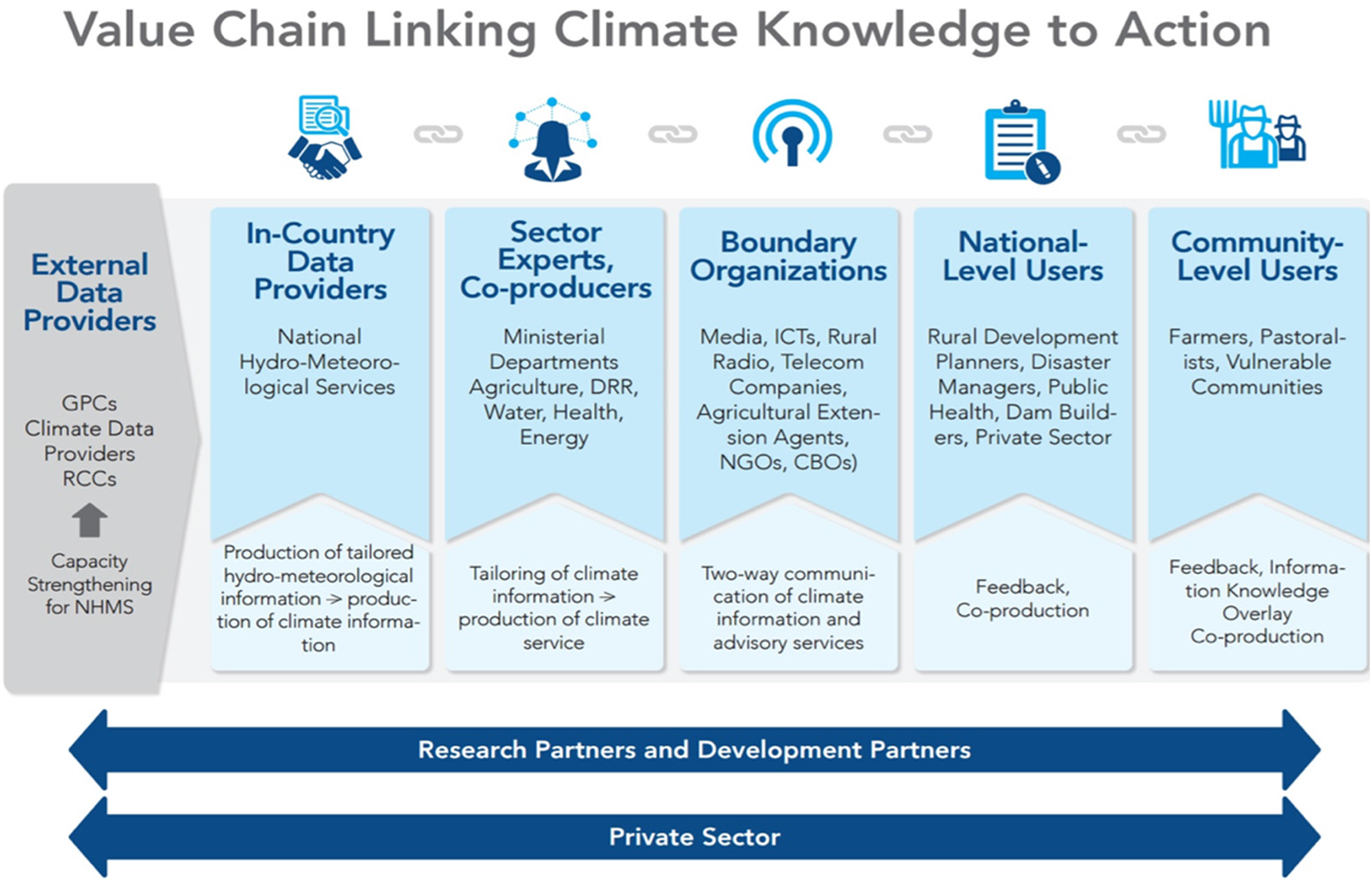
Model actors and prescribed roles involved along the ‘climate services value chain’, linking climate knowledge to action.
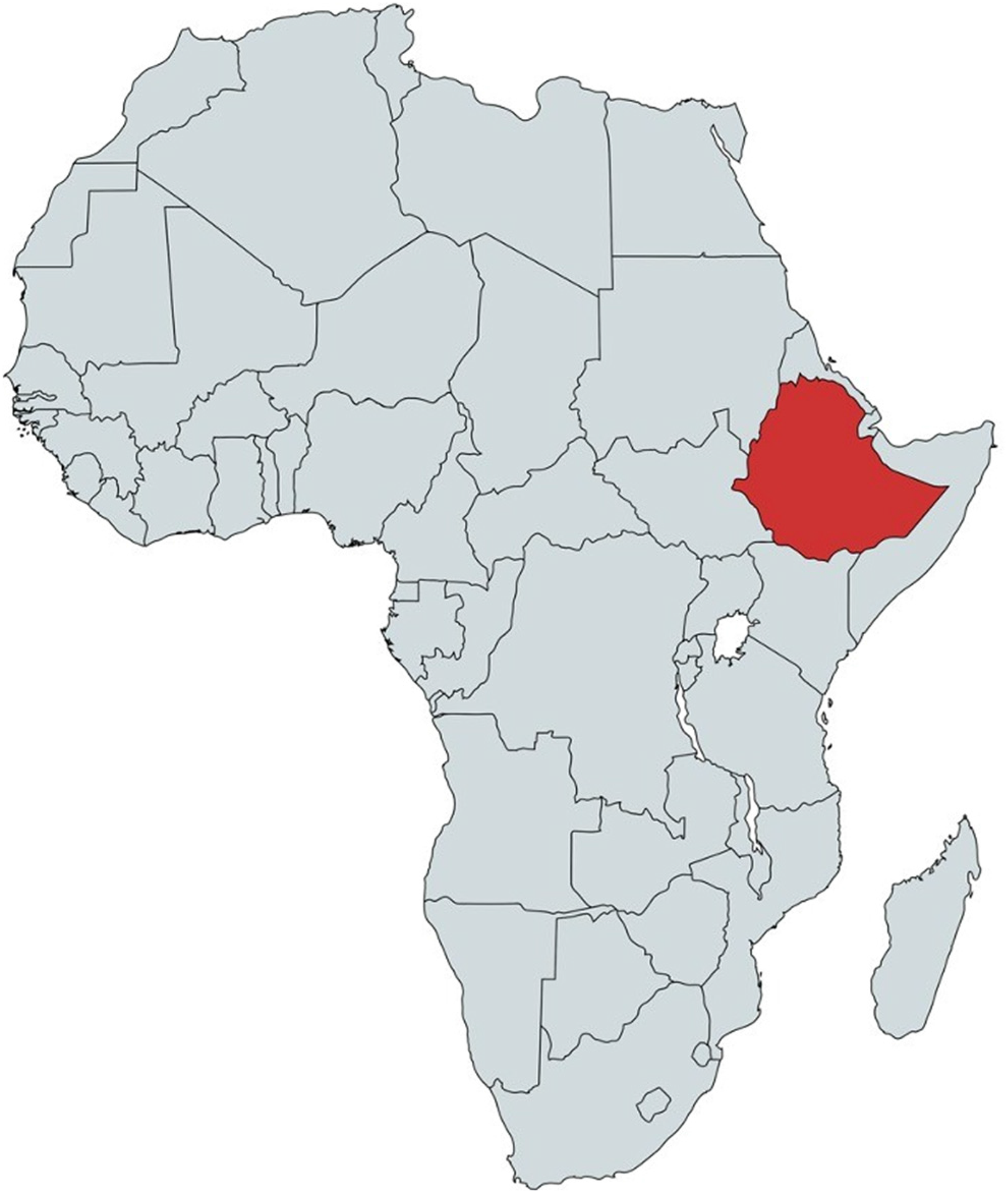
Political map showing the countries of mainland Africa and Madagascar. Ethiopia is highlighted.
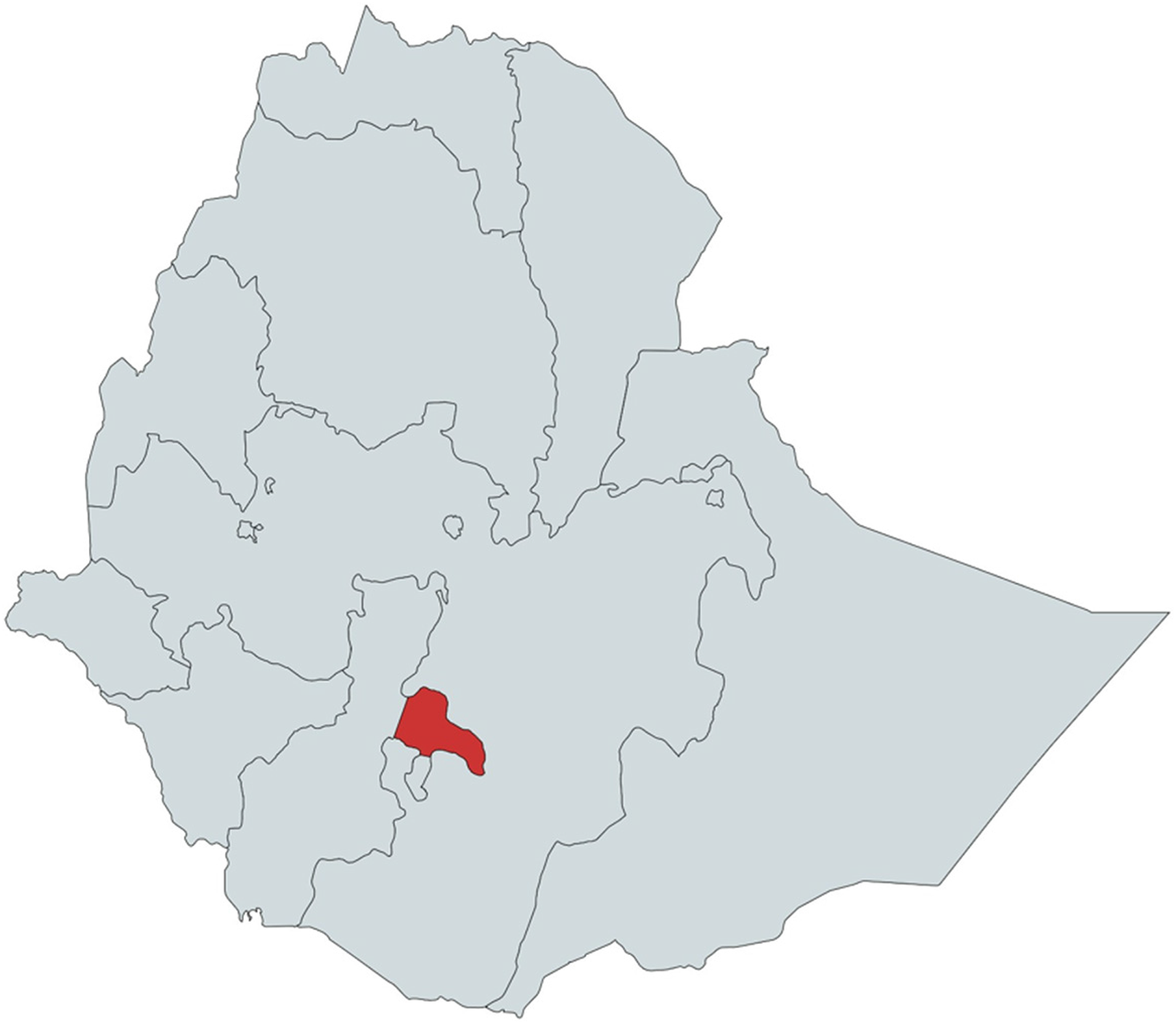
Political map showing the Regions of Ethiopia. Sidama Region is highlighted.
Yet the conceived communication pathway is characterised by a heterogeneous range of actors who operate according to multiple different relations to time, each influenced by a range of socio-cultural factors. There is an existing diversity of situated and embedded temporal frameworks against which a rich knit of seasonal rhythms is unfolding. Temporal diversity across communication pathways remains unaccounted for in seasonal forecast development and communication. By using a case study of one pathway in the Ethiopian agricultural sector, this article asks the following four questions:
How are seasons constituted as temporal frameworks, used to organise rhythms of agricultural practice, by actors along a communication pathway? How do seasonal forecasts act to coordinate divergent temporal frameworks of actors along the communication pathway? What effect does introducing a seasonal forecast have on the rhythms of agricultural practice? What consequences do divergent temporal frameworks have for the use of seasonal forecasts in organising rhythms of agricultural practice?
In the conceptual framework section, we introduce the conceptual handholds used to interpret the coordinative effect of the seasonal forecast. The case study and methods are outlined in the case study and methods section. The findings section is the core of this article, seeking to answer the research objectives. We then conclude and offer some lessons for the future development of seasonal forecasts.
Conceptual framework
Time is a central feature of social order, a ‘veritable social institution’ (Durkheim, 1965: 23). An institution that gives apparatus, meaning, and stability to social life (Scott, 2008). Numerous examples across the literature on the sociology of time make visible time's coordinative effect on social life, with EP Thompson's (2017) work on ‘clock time’ and its disciplining of the Western European workforce perhaps the most manifest. Daily life is littered with other examples, from the scheduling of public transport to participation in seasonal celebrations. Both examples hint at the notion of a ‘shared time’, a common system of relating to and organising time. It is these common systems, or ‘temporal frameworks’, and their construction and utilisation in processes of social ordering, that this article focuses on. In particular, how they enable patterns, or rhythms, of agricultural practice to emerge, recur and disappear.
Frameworks and regimes
To study the temporal work done by forecasts, we explored the interdisciplinary literature on temporal frameworks and their coordination of societal practice. The intent was to understand how seasonal forecasts act as temporal frameworks and may then clash with other extant temporal conceptions of a season. Temporal frameworks refer to the structures and systems that societies construct to organise time, providing a temporal apparatus through which social order can be coordinated. In his foundational work on the sociology of time, Eviatar Zerubavel (1985) writes that temporal frameworks include the calendars, schedules, routines, and other mechanisms that establish coherent ‘sociotemporal order’; or a consensus regarding the proper sequential structure, duration, temporal location and recurrence of activities, events, and other time-related concepts. Relevant to Ethiopian agriculture, this could for instance comprise cropping calendars that define the temporal sequence of land preparation, planting, fertilisation, irrigation, and harvesting. The instrumental purpose of temporal frameworks relative to decision-making and planning has thus received significant attention, it is through sociotemporal ordering that individuals and groups are able to schedule activities, allocate resources and set temporal priorities (Bardram, 2000; Raco et al., 2018). The notion of a shared time, of being ‘in-sync’ with others, is emphasised too in analyses of social engagement (Bastian, 2014).
However, we know that conceiving time solely as a linear and objective phenomenon is only one, though dominant, perspective (Adam, 1990, 1995). The way in which we perceive, measure, and experience time is instead imbued with a range of socio-cultural factors, enabling a multiplicity of heterogenous temporal frameworks to exist across society at any one point-in-time. For example, many other temporal rhythms are tracked in the organisation of societal practice beyond just the ticking clock. Societal, cultural, political, and economic norms, values, rules, and beliefs are integral to how a temporal framework is constructed and performed (Birth, 2008; Coetzee, 2021; Porter and Stockdale, 2016). Chisholm Hatfield et al. (2018), for instance, describe how time and timing are utilised differently, for competing purposes, across knowledge systems through the comparative account of Western climate science and the traditional knowledge of Native American tribes in the United States – an account which strongly echoes the case study of this article.
Importantly, Chisholm Hatfield et al.'s account also makes visible the role of power in the normative enactment of these competing temporal frameworks. Temporal frameworks may themselves then exist in varying states of harmony or dis-harmony, which has important consequences for the normative constitution of a socio-culturally coherent rhythm of practice (Sharma, 2014). The concept of temporal regimes more fully captures this idea of temporal hegemony, extended through technological, political, or material power (Torres, 2021). Thus, although capturing the instrumental dimension of constructed sociotemporal orders is an important part of this article, it is not the sole objective. Instead, the conceptual lens of temporal regimes makes possible an investigation into how temporal hegemony precipitates the particular engagement in, or disengagement from, patterns of agricultural practice.
Rhythms and coordination
It is against these differently shared temporal frameworks that the performance of recurring, or rhythmic, patterns of societal practice can be observed. This article draws on the concept of rhythms as it has been used across existing works taken from human geography, the sociology of organisations, planning theory, anthropology, and critical time studies. Starting from a notion of the world as moving according to rhythms, rhythms are observed whenever, ‘place, time and an expenditure of energy’ intersect (Lefebvre, 2004a: 15, 2004b). Used in this way, the concept of rhythms provides analytical purchase to explore the interplay between time, space, and human experience. Rhythms also arise in more-than-human phenomena, such as in biological and environmental systems (Leshed et al., 2014; Whitehouse, 2017). However, it is agricultural rhythms and the coordination of these rhythms, ‘that together produce a new capacity or emergence’ (Gan and Tsing, 2018: 103) that are of interest to us in this article. We focus, then, on the rhythms of human and more-than-human assemblages.
Commonly defined relative to the repetition of diachronic practice, that rhythms emerge through the recurrent patterning of connected practices rather than objective temporal sequencing of practices is an important distinction to make (Walker, 2014). Approaching rhythms as chronological arrangements of practice alone, ‘misses the way in which practices connect, shape, and affect each other in constituting the plenum of activity’ (Blue, 2019: 938). For example, the practice of crop fertilisation is woven into wider rhythms of seasonal agriculture – done sympathetically to variable seasonal agricultural conditions rather than taking place in a temporal vacuum. Appreciating the connections and abuttals that enable, or disenable, the recurrence of practices is essential.
The notion of ‘coordination’ emerges, then, as a related conceptual process – there is an appreciable need to understand how and why agricultural practices come together to form seasonal agricultural activity (Larson and Zemke, 2003; Southerton, 2020a). Broadly speaking, research done on the processes of coordination has been split across two main lines of inquiry. The first is typified by the work of Gan and Tsing (2018: 103), who have zoomed in on the ‘mutual attunement and accommodations’ made across assemblages, using the example of a Japanese Satoyama Forest. The second focuses more on the top-down temporal disciplining of human and more-than-human assemblages to achieve a specifically desired social order (Glennie and Thrift, 1996).
Case study and methods
Research design
A qualitative phenomenological approach was undertaken to fully explore the research questions, through an interpretation of the lived experiences of selected participants (Creswell, 2013). The intention was not to provide a rich description of the day-to-day reality of participants but to critically assess the construction and use of different temporal frameworks in the coordination of social activity. By conducting in-depth interviews and participant observations, we wanted to produce an empirical case study that would both animate the conceptual literature on time as a social institution and add to existing debates surrounding the usability of climate services in a way not yet done.
Qualitative phenomenological research faces criticism for its centring of subjective interpretation and issues of transferability across research contexts. To be sure, further research is required to explore the phenomena more fully and better inform practice across the science–policy–society interface, both within the same and across different research contexts. However, this research study opens up a novel debate on the temporal barriers to climate service use. A debate we hope to see attracts more engagement across the field of climate services.
Study location
The study was conducted in Ethiopia (Figure 2), a country in the Horn of Africa whose economy is predominantly reliant on agriculture. Around 60% of households are engaged in small-scale agriculture for livelihoods – rising to 90% in rural areas (FAO, 2022). Being predominantly rain-fed, Ethiopian agriculture is reliant on the arrival of seasonal rains. Sidama, the administrative region of focus within this study (Figure 3), has a bimodal rainfall pattern meaning that there are typically two periods of rainfall known as the Belg and Kiremt rains, or locally as Badhessa and Hawado respectively.
Ethiopia is characterised by a strong centralised bureaucratic administration that extends through five spatial levels of governance. From largest to smallest these are: National, Regional, Zonal, Woreda and Kebele. Table 1 shows the geographic sites where data was collected and their corresponding administrative scale. This was done to capture a full agricultural communication pathway, through which a seasonal forecast is intended to travel and coordinate agricultural practice.
Breakdown of participants included in the study, including the respective geographic site and administrative scale of study participants.
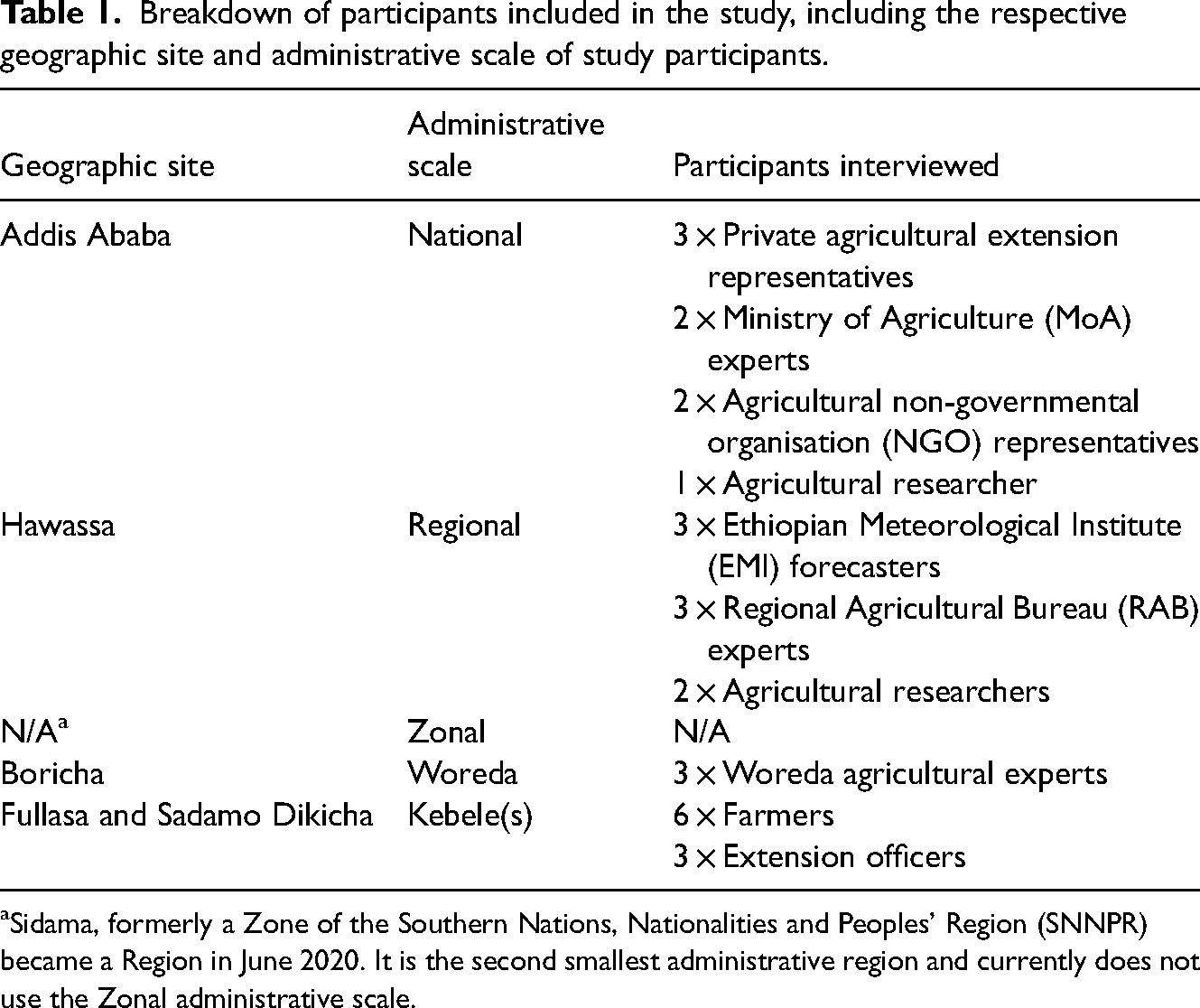
aSidama, formerly a Zone of the Southern Nations, Nationalities and Peoples’ Region (SNNPR) became a Region in June 2020. It is the second smallest administrative region and currently does not use the Zonal administrative scale.
Methods
Empirically, this article comprises an inductive analysis of interview data from 28 participants collected through a combination of individual and group interviews. Interviews were conducted during a period of fieldwork in Ethiopia, May–June 2023, a particularly pertinent period when the annual meteorological forecast of the Belg season is typically evaluated and the forecast for the upcoming Kiremt season released. As such, an evaluation of the coordinative effect of the seasonal forecast on the 2023 Belg season and its developing effect on the 2023 Kiremt season was made possible. Participant observation was used as a method of data triangulation, the coordinative effect of the seasonal forecast on social practice being not always self-obvious to some participants. Importantly, observations were also carried out during attendance at the National Climate Outlook Forum of the Ethiopian Meteorological Institute (EMI) where the national-level seasonal forecast is evaluated and produced. Previous fieldwork undertaken in May 2022, where the first author worked with EMI in Addis Ababa, was used to further contextualise the study.
Interviews are a ubiquitous qualitative research method. A purposeful conversation with intentionally selected participants enables the collection of relevant data (Kvale and Brinkmann, 2009). In-depth individual and group interviews following a semi-structured procedure were used to elicit the emic perspective of participants, enabling an interpretation of the lived experience of the coordinative effect of the seasonal forecast. A short topic guide (Appendix 1) guided the interview but allowed for flexibility, important in more fully exploring the social phenomena in question. Interviews were conducted either in English, Amharic or Sidama dialect according to participant preference. A local research assistant provided translation support. Participants were deliberately selected according to their belonging to an envisioned communication pathway, where the model pathway (Figure 1) was translated to the study location according to the author knowledge of the Ethiopian context. Belonging to such an envisioned communication pathway did not necessarily pre-determine knowledge of or access to the seasonal forecast information with the communication pathway representing only a theoretical model, seen as desirable by some, of potential information flow.
Transcribed interview data was coded through a process of thematic network analysis using NVivo 12 software, with codes ordered and categorised into themes (Attride-Stirling, 2001). Coding followed the six-step process described by Braun and Clarke (2006: 87); (i) transcription and familiarisation of data; (ii) generation of initial codes; (iii) identification and collation of codes into themes; (iv) review of themes and generation of thematic network; (v) refinement and interpretation of themes; (vi) analysis of themes. The themes reflected the research objectives of the study and are presented in the findings below.
Findings
In the section below, the findings are presented with respect to our four central research questions and the conceptual schema constructed in the conceptual framework section. To reiterate, the concepts utilised have not been chosen for their purely descriptive function, instead having been selected to enable an analysis of the implications of constructing and utilising a novel temporal framework in processes of social ordering. So, alongside their descriptive function, the findings also lend themselves to a reflexive commentary on the governance, complexity, and contestation of temporalities. A commentary is expanded upon in the final section when we discuss the lessons learned.
How seasons are constituted as temporal frameworks, used for the organisation of rhythms of agricultural practices, by actors along a communication pathway
Although all actors referred to a ‘season’ as a temporal framework in the organisation of agricultural practice, how seasons were framed and the forecast was diverse – every participant described their seasons differently. However, the presentation of findings will focus on two interpreted typologies of doing so, themselves nuanced across individual experience, and are broadly bracketed as: (i) Science-Metric; (ii) Traditional-Practice. We unpack both below. The typologies discussed are author-constructed categories but would, believably, be recognisable to participants.
To be clear, these remain just two of many typologies potentially interpreted from the collected data, and by no means wish to assert that there is a rigid polarity between them. The various groupings of social actors that embody and substantiate each of the respective author-constructed typologies do not exist in a vacuum. Instead, there is a diversity of engagement between the actors across the communication pathway. Consequently, a complex range of mutual influences effects the construction of a spectrum of temporal frameworks. However, a comparison of the two chosen typologies serves to best highlight tensions between novel and extant temporal frameworks, and any coordinative influence of the seasonal forecast on local rhythms of agricultural practice. We necessarily simplify the broad spectrum of potential temporal frameworks that could have been explored to make this comparison possible, drawing out a set of dominant characteristics for each bracketed typology relevant to the governance of agricultural rhythms.
Rainfall calendars versus calendars of practice
Western cultures often emphasise linear clock- and calendar-based temporal systems (Postill, 2002; Zerubavel, 1982). EMI's seasonal forecast is rooted in and produced by Western technoscientific knowledge systems and is emulative of Western calendrical pre-eminence. Seasons were framed as discrete temporal parcels, identified through the presence or absence of rainfall as a meteorological metric, repeating sequentially each Gregorian-calendar year. The seasonal calendar of Sidama, characterised by the Science-Metric typology, was therefore a rainfall calendar. Participants that ascribed to the Science-Metric typology were able to map the rainy seasons against the Gregorian calendar quite definitively, “Belg runs from March to May in Sidama. Then the Kiremt season from June to September. Here it can extend up to November” (EMI Forecaster 3). Interestingly, there was perceived variation even amongst regional-level participants. A representative of the Regional Agricultural Bureau (RAB) explained instead that, “the Belg rain is normally February and March, and then Kiremt is June to September” (RAB Expert 1).
Rainfall calendars remain useful agricultural tools because of the obvious link between rainfall and agriculture. Their usage in agricultural policymaking in Ethiopia is understandable, providing a mechanism for the time management of agricultural governance over large geographic areas, “we are adjusting our working calendar or agricultural calendar based on which rainy season it is” (MoA Expert 2). The temporal precision of meteorologically defined rainfall calendars, compared to the temporal complexity of those situated calendars of agricultural practice discussed further below, is an important enabling factor in the successful coordination of governance systems (Bardram, 2000).
Yet, Michelle Bastian (2012: 25) cautions, ‘When we look at a clock or calendar, we can see fairly quickly whether we are becoming out-of-synch with some worlds, but not with others’. Governing agricultural practice through rainfall calendars alone runs the risk of asynchrony with local agricultural practices. Under the Traditional-Practice typology, the picture was more complex and less temporally definitive, characterised by a greater attentiveness to a range of temporal rhythms and practices tracked through the cropping season. Local farmers do recognise a Belg and Kiremt season but for them, they were crop seasons, ‘traditionally we grow crops in two seasons. That's the Belg and Kiremt season’ (Farmer 4). Rainfall and crop seasons are intimately related but they are by no means identical. For local farmers, the Belg crop season ran from February to September through an extended rhythm of sowing, growing, and harvesting of which the Belg rainfall is just a part: ‘and the Belg starts in February. And at that time, the long-cycle plants will be planted. And it continues up to September’ (Extension Agent 1). In the same fashion, the Kiremt crop season was extended from April until November. One ex-agricultural extension officer even described that Belg started at the beginning of January during a period of ‘psychological preparation’, where “[farmers] start to talk about agriculture, they sit together, they have coffee … they start to talk … they prepare themselves” (RAB Expert 3).
That the crop seasons overlapped gave rise to another way of framing seasons, through the engagement, or comparative disengagement, in agricultural activity. Rainfall was an intrinsic property of this seasonal division but it did not precisely map onto the meteorological rainfall seasons, “For us, every year we have 12 months. Six months are rainy months (Hawado) and six months are not rainy months (Arro). In these six [rainy] months, we plan our agricultural activity” (Farmer 1). Indigenous cultures have historically placed importance on cyclical rhythms, which were born out of local experience (Cheryl, 2015). For local farmers in Sidama, the seasons more closely resembled an ongoing rhythmic cycle of ‘wet and dry’, interwoven with complex cultural practices that extended temporally within and across these cyclical periods. Franz Krause (2022) writes similarly of rhythmic periods of wet and dry across land-water nexuses, comparable to agriculture, emphasising the importance of recasting these as an ‘evolving web of relationships between human imaginations and practices and the materialities of water (and) mud’. Tightly defined meteorological calendars cannot capture this complex web of temporal relationships.
Forecasting seasons
As seasons were temporally parameterised differently across the communication pathway, so too did their forecasting differ. The temporal start-point from which patterns of practice were perceived to become enacted depended on what counted as legitimate knowledge. Ascribing to the Science-Metric typology enables seasonal forecasting through ‘scientific systems’ (EMI Forecaster 1). Global Climate Models (GCMs) that predict the amount, timing, and distribution of rainfall have thus become used for operational seasonal prediction by EMI (Korecha and Sorteberg, 2013). In so doing, the 3–6-month temporal framing of the season is further reified. Modelled seasons become socially imposed through policy because of the perceived ‘scientific objectivity’ of the GCM. 4 A phenomenon Matthias Kaiser et al. (2022: 23) reiterate as common across diverse policy spheres: “Quantification, numeracy and statistics became instruments of policy-making not only for the economy but basically throughout all areas of state authority”. In turn, EMI's seasonal outlooks include policy and practice recommendations across many key sectors.
Comparatively, seasons in the Traditional-Practice typology were not delineated by the binary presence of rainfall and their forecasting utilised alternative knowledge systems. Traditional rainfall forecasting methods were used, but the knowledge made use of by farmers was not only for the forecasting of rainfall but also for forecasting appropriate seasonal rhythms of practice that extended well before the onset of the rain. Traditional knowledge passed down generationally, such as the interpretation of natural seasonal indicators in the environment, was commonly used, “there are two trees that make a sign that the time has come for Kiremt. The tree is like a natural indicator. And sometimes there is a type of grass which, without any rain, starts to grow” (Farmer 1). Farmers have also picked up experiential knowledge themselves, “it's known that February is the rainy season, so they prepare their land in December and January” (Extension Agent 3).
How do seasonal forecasts act to coordinate divergent temporal frameworks of actors along the communication pathway?
Technological and political legitimisation
Seasonal forecasts have become legitimised and embedded into agricultural rhythms in various ways. Temporal hegemony has been exerted through a sense of techno-optimism, legitimising the Science-Metric typology while de-legitimising the Traditional-Practice typology. Manjana Milkoreit (2017) places technology as a centrally coordinative factor in the construction of collectively shared visions of socio-climatic futures. Shared beliefs in the potential of technology for improved futures went hand in hand with how some participants foresaw the role of the seasonal forecast in ordering agricultural rhythms of practice, “There are three types of farmers. Proactive, active and the laggards … Proactive farmers are the farmers who are ready to accept and implement technologies” (RAB Expert 1). Alternative forms of knowledge were deemed as anachronistic, “they [farmers] depend on their primitive ways, their old-fashioned ways, and they are not coming to our modern scientific way of forecasting” (EMI Forecaster 3). Techno-optimism has imbued scientific seasonal forecasts with the power to dictate the seasonalities of agricultural practice due to their perceived capacity to represent future meteorological conditions more accurately.
Technological advancement is a frequent medium of perceived societal progress, proffered as a solution in many other studies on agricultural climate adaptation in Ethiopia (Asrat and Simane, 2018; Tesfaye and Seifu, 2016). The Ethiopian Government itself has also placed much stock in technoscientific advancement, a core part of its 10-year ‘Pathway to Prosperity’ Development Plan 2021–2030 (FDRE Planning & Development Commission, 2021). The legitimisation of the seasonal forecast in agricultural practice makes sense as a part of Ethiopia's modern development plan, and is synonymous too with the broader global shift in reliance towards technoscientific knowledge in governance and policy-making (Forman, 2007). To be clear, empirical work on the socio-economic impact of seasonal forecasts on agriculture across sub-Saharan Africa does suggest potential benefits (Vaughan et al., 2019). Yet socio-economic impact alone remains just one indicator of seasonal forecast ‘quality’, improvement in crop yields is not analogous to long-term climate adaptation and resilience outcomes (Bremer et al., 2021). Neither is past empirical work done through controlled interventions a fair representation of the likelihood for sustained adoption of seasonal forecasts over time by local communities, beyond the environment of a research project.
Political legislation has also served as an important mechanism for the material embedding of forecast systems into state governance, reifying the techno-optimism conferred upon the seasonal forecast. In particular, the National Framework for Climate Services (NFCS) has materially animated the novel temporal framework of the seasonal forecast by articulating, in policy, an organisational structure through which the seasonal forecast should travel and be performed – from its production to use. EMI has the mandate for forecast production under the NFCS, charging the way in which EMI frames and forecasts the season with state authority. When asked how seasons should be forecast participants frequently endorsed the hierarchy of the NFCS, placing EMI on the top rung of the metaphoric governance ladder: “there should be a platform from the national meteorological agency that every organisation interested in working on this sector can access” (Agricultural NGO Representative 2).
Societal legitimisation
Climate change has had a compounding influence, further legitimising the seasonal forecast as societal actors recognise its potential utility. At the local level, farmers themselves reflected on the new legitimacy of the seasonal forecast, “the best way is to make decisions that are scientific. That's what I think” (Farmer 3). Similarly, other farmers have begun to feel there is no choice but to re-align practice given the dearth of stable alternative temporal frameworks. Farmers have been left to feel, “there is no option, there is no other option” (Farmer 6) but to follow the new temporal framework. The erosion of historical markers, with which local farmers navigated seasons, by climate change is a problem across sub-Saharan Africa (Jiri et al., 2016). Local reasoning for conferring legitimacy to the temporal framework and re-aligning practice is thus polarised, with both ‘pull’ and ‘push’ factors influencing alignment. One factor not described by local farmers themselves was if the benefits of re-alignment were made legible. ‘Model farmers’ that could translate the temporal tableau of those novel agricultural rhythms, normatively endorsed by the seasonal forecast, into a locally coherent regime of practice were seen as important by actors elsewhere in the communication pathway, “it is better to introduce [the forecast], especially by selecting farmers, model farmers, trained by EMI” (EMI Forecaster 1).
Extending the temporal framework
To manifest the desired coordinative effect on agricultural rhythms, the seasonal forecast as an immutable artefact of temporal coordination must be extended through the communication pathway. The primary structure of extension was described by a representative of EMI, “We have a good structure from Ministry of Agriculture to local-level. So, this extension system gives advisories to the farmers on the time for land preparation, for input utilisation” (MoA Expert 2). The MoA Expert was describing the centralised agricultural extension system of Ethiopia. A governance system that follows the full scalar pathway of Ethiopian administration, through national-regional-zonal-woreda-kebele scales. That the seasonal forecast makes operational use of the extension system is attributed to the NFCS, creating a new organisational assemblage that foments the coordination of agricultural rhythms: “The NFCS is mostly the coordination mechanism. How different sectors operate and what kind of information they must deliver” (Agricultural Researcher 1).
Infrastructural resources were essential in communicating the forecast information through the extension system; in particular, digital communications influenced the potentiality for coordination. An MoA expert praised the speed of forecast communication made possible by telecommunications, “[forecast information] reaches from Federal to Regional, Regional to Zonal, Zonal to Woreda at the same time in one day” (MoA Expert 2). Telecommunications, as artefacts of modernity, have the power to ‘speed up time’ and enable temporal coordination across space (Laurian and Inch, 2019). Of course, we must remember that this is only the case, “for those that can access it” (Agricultural Researcher 1). Access to telecommunications infrastructure in Sidama was not equitable. Ironically, those local farmers intended as ‘end-users’ of the forecast information have the least access to the digital infrastructure that could afford the seasonal forecast its intended coordinative power.
Resource and skill capacities of the actors across the communication pathway tasked with the production and communication of the forecast information were another key determinant of extension. The successful coordination of agricultural rhythms depended on the capacity of each link in the communication pathway to pass on a temporally legible description of the seasonal forecast. However, as the seasonal forecast information travelled through the communication pathway it often became distorted, so much so that it could become unusable by the time it reached the local context in which it was intended to be used, “It [forecast use] depends on the explanation. So, it's their explanation by the DA [extension agents], maybe they're not explaining properly” (EMI Forecaster 1). As the forecast passed through the communication pathway, from ‘producers’ to ‘users’, it had less of a coordinative effect. So much so that EMI forecasters imagine coordination would be much improved if the communication pathway was simplified, “the information may fail to be delivered to the farmers so it's better maybe to be communicated directly from EMI to the farmers. Otherwise, the information or the message changes” (EMI Forecaster 2).
What is the effect of introducing a seasonal forecast on the seasonal rhythms of agricultural practice?
The seasonal forecast has had a coordinative effect on the agricultural rhythms of some farmers in Sidama. For several farmers, agricultural rhythms are now re-aligned to the temporal framework imprinted upon them by the seasonal forecast, “we receive a lot of information from the government, and we are very grateful for this. We have information from our DA's [extension agents] they tell us when to plant, when to prepare our land” (Farmer 2). This is not to say that all farmers in Sidama who utilise the scientific forecast information submit entirely to the associated novel temporal framework. Instead, they integrate the forecast information into an existing repertoire of skills utilised for navigating the season. Yet, by integrating scientific forecast information, the rhythms of local agricultural practice inevitably become more closely coordinated with those rhythms normatively prescribed by the seasonal forecast.
For other farmers, the coordinative effect is less direct but stems nonetheless from the influence of the seasonal forecast. An example helps to illustrate this. The Ethiopian agricultural extension system is an important distributor of agricultural inputs and is a mechanism through which modern agricultural techniques are taught at the local level. The inputs provided and skills taught season-on-season are influenced by the forecast, “let's say there is no rain forecast. At that time, we will inform our farmers to prepare ponds [for irrigation] in their farm … So, we give information with solutions. What to do, how to cultivate, how to prevent the problem” (Woreda Expert 3). The performative effect on local rhythms of agricultural practice was made clear by one farmer, “they [extension agents] are teaching us. At the same time, they are delivering or giving us selective seeds and fertilisers. Because of this we are almost dependent” (Farmer 1). Having previously said that local farmers are not entirely submissive to the novel temporal framework, the reference to ‘dependency’ here does suggest that individual temporal agency is contingent on the reliance on State-led agricultural apparatuses – an apparatus where forecast information is central to decision-making.
Conversely, for many other farmers, the seasonal forecast continues to have little coordinative effect. Many described how they continued to enact the same agricultural rhythms as always, despite having received the seasonal forecast. Extant temporal frameworks continued to be re-animated by preference, “[Participant] we start from February to prepare our land, to sow our crops. We continue until September cultivating different crops. [Interviewer] What information do you use to make these decisions? [Participant] We follow our tradition” (Farmer 3). We discuss below why the forecast may not have had a coordinative effect, where despite knowledge of forecast information extant temporal frameworks continued to shape local rhythms of agricultural practice.
What are the consequences of divergent temporal frameworks for the use of seasonal forecasts in organising rhythms of agricultural practice?
The slow temporalities of local (agri)cultural change
Assumptions regarding how agricultural decisions are to be made differ according to the temporal frameworks utilised to organise time-related activity. The temporal frameworks typified in this article are no different. Assuming that seasonal agricultural decisions at the local level are dictated purely by rational economic choices is naïve, a trap that many actors in the communication pathway have fallen into. A corresponding expectation forms that the temporal coordination of agricultural rhythms with the seasonal forecast is deemed logically inevitable, as the forecast holds the scientific promise of maximising productivity under climate change. Communication of the forecast information is then also implicitly assumed to be enough to cause the coordination of rhythms – if the forecast is communicated it will be put into practice. One EMI forecaster expressed surprise that local farmers were not utilising the forecast, despite having “distributed our products in telegram, in radio, television” (EMI Forecaster 1). The Science-Metric temporal framework therefore appears to endorse the antiquated ‘loading-dock’ approach to science-society knowledge integration, an approach prefaced on the idea that decision-making improves in line with the quantity of information communicated (Dilling and Lemos, 2011).
While agriculture is important in household economies across Sidama, it is also deeply culturally significant, “agriculture is all things for us. Yeah. It's a life for us. For me, it's life, it's soul” (Farmer 4). For some, agriculture was linked to religion, “it's our culture. As a Christian, the Bible also tells us to work and to produce food” (Farmer 2). In so many ways, agriculture is culture, and so the temporalities of agricultural practice become institutionalised across wider social life. Local production and harvest of enset, a root crop, coincides deliberately with the Sidama New Year's celebration of Fichee-Chambalaalla to enable the preparation of a favourite cultural dish called Buurisame, “food is prepared for Chambalaalla, prepared from the agricultural product of the community. Because of this they connect their crops with Chambalaalla. There is a type of crop, enset, which is prepared for Chambalaalla” (Extension Agent 3).
Greater attention is needed to the cultural aspect of agricultural temporalities as cultural institutions are more often associated with inertia than change, and it is a change in practices that the use of seasonal forecasts demands (Farrell, 2018). Experiences from Sidama bear this out, as one agricultural researcher described the arduous process of changing local preferences towards a more drought-resistant crop type, “it took me two years, three years, to change from the cereal food system to the roots and tuber system” (Agricultural Researcher 2). To enact the appropriate rhythms of agricultural practice according to the seasonal forecast farmers would need to change these (agri-)cultural practices season-on-season, using information often received only shortly prior to the onset of the meteorological season. Instead, the normative expectation for dynamic coordination held by forecast ‘producers’ is dwarfed by the weight of inertia, and historical rhythms get repeated.
Additionally, even if the coordination of agricultural rhythms is temporally appropriate according to locally embedded culture, farmers are often unable to respond with the necessary speed and flexibility even if they wanted, “it's very difficult to change immediately according to the rain condition because they don't have seed stock. If it's on the shelf they can take it and plant it but that is not the case” (Agricultural Researcher 2). Agricultural practices of smallholders are known to be inflexible, with limited capacity for short-term change due to resource constraints and inherent risk aversion (Collier and Dercon, 2014). That the use of seasonal forecasts is currently predicated on short-term agricultural flexibility represents a stark temporal fracture with the Traditional-Practice temporal framework.
Urgent production, slow governance
Those actors involved in the production and communication of seasonal forecast information through the communication pathway used various terms that expressed a sense of ‘temporal urgency’: there was an ‘urgent need’ for the seasonal forecast to mitigate against the burgeoning ‘climate crisis’ (Laurian and Inch, 2019; Southerton, 2020b). This sense of temporal urgency has been performed through preferential resource investment into: (i) the rapid development of the technoscientific capacity to produce an accurate meteorological forecast and (ii) the variety of methods used for its communication – both of which can be easily and quickly quantified; delivering novel metrics that enable a swift evaluation of the ‘quality’ of the seasonal forecast. There were many examples of this across those actors that ascribe to the Science-Metric typology, on the scientific accuracy of the forecast: “[Participant] so the forecast, compared to what they observed, is almost similar. [Interviewer] So the forecast was good for the Belg season? [Participant] Yes, it was good for the Belg season” (EMI Forecaster 2). Or when asked about how they were improving the seasonal forecast, an MoA expert described the number of digital services it is provided through, “so now that's what we're trying to do, to communicate it differently using a digital platform” (MoA Expert 2).
Comparatively, the improvement of the seasonal forecast relative to the demand needs of those intended to make use of it was somewhat side-lined. Some described this as a resource and skill issue, that ‘the national met service (EMI) doesn't have the capacity, given funding, expertise and communication, to give contextually specific forecasts’ (Agricultural NGO Representative 1). However, ‘slow governance’ processes that could enable the proper accruement of resources, skills and knowledge needed to foster the transdisciplinary production, or ‘co-production’, of the seasonal forecast are perhaps untenable because of the apparent sense of temporal urgency (Stengers, 2018). EMI staff describe the period in which the seasonal forecast is produced as, ‘very busy, very busy indeed. They [users] need the forecast information before the season starts’ (EMI Forecaster 3). A period that one forecaster described as beginning only ‘two to three weeks’ before the beginning of the season (EMI Forecaster 2). That slow governance processes are side-lined within this ‘urgent’ organisational environment is hardly surprising.
There are few shortcuts to the adaptation of agricultural rhythms, a fact well-known by sectoral experts. One Woreda expert spoke about a 10-year community familiarisation process led by a local NGO on inter-cropping techniques that is only now bearing dividends, “when they bring it [inter-cropping advisories] here, the community receives it actively … because they are so familiar” (Woreda Expert 3). Lessons learned about the importance of slow governance in agricultural adaptation elsewhere in Sidama need to be heeded and applied to the production of the seasonal forecast, to overcome the temporal clash with the contextual urgency in which they are produced. The existing climate services literature emphasises the importance of long-term trust-building processes for successful co-production (Vaughan and Dessai, 2014). For example, Baztan et al. (2020) describe how community trust building, through the production of shared narratives beyond the imperatives of seasonal adaptation, can have a considerable impact on societal engagement in climate services.
Desirable futures
The temporalities of future adaptation across the communication pathway are also fractured, influencing how the seasonal forecast becomes or does not become, normatively embedded in an envisioned socio-climatic future of the agricultural practice. According to one agricultural researcher, “I think the farmers do not even believe that the climate is changing … they are responding somehow to what's happening, what they face. For example, they change crop varieties, switch planting dates. But not as an intention that it's [climate] changing, an adaptation … the policy makers are very aware though. For them, climate change adaptation is producing more long-term” (Agricultural Researcher 1). A RAB expert confirmed that “farmers are simply trying to shift with, what can I say, the short-term changes of climate. For example, if in one season there is a change they try to change to that specific season”; contrasted with how for them agricultural adaptation is bound up in an envisioned future of long-term, “agricultural-led industrialisation” (Both RAB Expert 3). Interviews with local extension agents bore this observation out, where references to adaptative practices were couched in season-on-season cyclical changes in rhythms as opposed to systemic change across a multi-year horizon, “climate adaptation means selecting crops for the season. By doing that, we say we are adapted to climate change” (Extension Agent 2).
For those policy makers that view agricultural adaptation on longer more linear time scales, the seasonal forecast is a key part of the envisioned ‘agricultural-led industrialisation’. The forecast represents a temporal framework that could maximise economic productivity by coordinating agricultural practices of farmers across Ethiopia, including Sidama, “when we talk about climate adaptation, we talk about economic adaptation. Adaptation and economic growth are related” (RAB Expert 2). Futures of coordinated agricultural practice imagined by policy makers and ‘producers’ of the seasonal forecast, linked to industrial nation-building and related ideals of Western modernity, is at odds with those futures imagined by local farmers. Priorities at the local level were instead focussed on inter-generational sustainability, “So, we understand that we have to do something for our children, to provide for our children” (Farmer 5). The socio-climatic future of agricultural practice imagined by local farmers was therefore not representative of how other actors in the communication pathway saw the future. The seasonal forecast being, in its current guise, variably important to each envisioned future; more so for policy makers than local farmers.
Crucially, seasonal forecast information alone did not reflect the imagined futures of agricultural adaptation held by local farmers, which prevented coordination of agricultural practices around the forecast. For coordination to take place seasonal forecast information had to be combined with a raft of wider material resources and infrastructures that could together make visible the forecasts’ potential utility in achieving locally desirable futures, “an agroclimate advisory is not a standard product. It must be followed by other agricultural services … if you don't have that, then they quit” (Private Agricultural Extension 1). The bundling of climate services has received much research interest; this case study adds further weight to the argument that seasonal forecasts must come as part of an indivisible package rather than stand-alone products if their use is to be maximised (Paparrizos et al., 2023). From the case study, ‘service bundles’ could include agricultural inputs, market linkages and mechanisation services. Otherwise, the seasonal forecast information remains more useful to policy makers than perceived ‘end-users’.
Lessons learned and conclusion
Temporal frameworks underscore the dynamic nature of our temporal experience. Certain ways of structuring and perceiving time are prioritised according to beliefs, values, norms, rules, and knowledge, and this has consequences for the rhythms of societal practice. What is most evident from the case study is that there exists a diversity of temporal frameworks across the communication pathway through which the seasonal forecast is intended to travel and have a coordinative effect. Seasons in Sidama are variously framed and forecasted; what a season is, or when it is, is not clear cut. There is a complex layering of interrelated seasonalities. Actors track a variety of temporal rhythms, giving rise to an apparent multiplicity of temporal frameworks, and variously interpret how seasonal rhythms unfold. We can more simply say that the communication pathway is polyrhythmic, and that polyrhythmicity is not well understood or integrated into the current model of seasonal forecast production and communication.
We have focused on two temporal frameworks, typified as a Science-Metric framework or Traditional-Practice framework, to animate the consequences of divergent seasonal temporalities on the intended coordinative effect of the seasonal forecast. Below, we reflect on some lessons learned and further research opportunities for the future production and communication of seasonal forecasts, and climate services more generally.
Temporal disciplining versus temporal attunement
Coordination across human and more-than-human assemblages is often seen as desirable, a barometer of adaptation that signifies human ‘skill’ in navigating surrounding environments (Ingold, 2021). Coordination has also been linked to a sense of community which can in turn support transformative climate adaptation (Bastian, 2014; Ziervogel et al., 2022). However, how rhythms are coordinated, and what is lost through coordination, needs critical appraisal. The coordinations currently engendered by the seasonal forecast arise through a process more akin to top-down temporal disciplining, made possible through a combination of technological, political, and material power (Torres, 2021). In effect, the forecast seeks to replace those extant temporal frameworks that govern local agricultural practice in Ethiopia. Perhaps this is justified? After all, climate change is changing embedded seasonalities and seasonal forecasts could help navigate these changes.
However, there are a few counterpoints to be made. The first is to question the ethics of top-down temporal disciplining. Uncritically accepting a season as meteorologically defined could erode the temporalities of traditional local cultures. Western science should not ‘colonise time’ (Nanni, 2012). Ethical concerns arise too because of the uncertainty of climate modelling. Who takes responsibility for the consequences of an inaccurate forecast? (Roudier et al., 2014). Finally, the efficacy of top-down temporal disciplining should be questioned. This case study shows that embedded seasonal rhythms commonly resist top-down temporal coordination.
Perhaps there is value in seeking coordination through ‘temporal attunement’ instead of temporal disciplining. Gan and Tsing (2018: 142) refer to attunement as a process of mutual temporal accommodation directed by no ‘higher authority’. Alternatively, Miriam Jensen (n.d) outlines a more engaged process using seasonal calendars as tools that create mutual awareness of other seasonalities across social groups. The emphasis here being on the ‘mutuality’ of attunement, that it is an equitable alignment of temporalities across actors done in a way that could enhance seasonal adaptation. There have been many efforts to co-create agricultural calendars for organising local farming practices in Ethiopia (see, e.g., Kassie et al., 2013). Yet the focus has been on agriculture as a solely economic endeavour, side-lining the wider socio-cultural complexity of agricultural temporalities. Existing agricultural calendars have also been produced in isolation without integration with the seasonal calendars of actors elsewhere in the communication pathway. Mutually attuning seasonal calendars across communication pathways holds promise for reducing temporal fracturing and improving the development and communication of seasonal forecasts. Further research is needed to fully explore how such processes of temporal attunement may also provide new lessons for science and policy. Being receptive and appreciative of traditional knowledge could provide both seasonal forecasters and agricultural policy makers insights into the more-than-human temporalities and seasonal rhythms that are tracked and woven into the existing ways local communities adapt to seasonal change.
Temporal legibility of seasonal forecasts in agricultural adaptation
Due to their probabilistic and uncertain nature, the utility of seasonal forecasts is most temporally legible when agricultural adaptation is appreciated across longer timescales. For example, if one forecast every 10 years is inaccurate, it is likely that a farmer would still be better off overall across this 10-year time-horizon by using the forecast information for agricultural decision-making rather than not. However, appreciating adaptation across such temporal horizons is a privilege held predominantly by policy makers rather than farmers. References to seasonal forecasting's place in processes of ‘agricultural-led industrialisation’ were highly demonstrative in the policy sphere. In contrast, local farmers were cautious towards forecast information; their historical experience of which has proven it is not 100% reliable. Rather, adaptation was understood on much shorter timescales. In essence, farmers typically coped with, or reacted to, short-term changes in weather rather than engaging in longer-term seasonal (or multi-year) adaptation planning. We can make sense of this by reflecting on the typically limited stock of adaptive resources a smallholder farmer has access to, and the potential consequences of an inaccurate forecast if resources are committed in error (Etana et al., 2023). When communicated in isolation, seasonal forecast information was quite temporally abstracted from these preferred shorter-term cycles of agricultural adaptation.
If seasonal forecasts are to be made more useful and useable at the local level, mechanisms for improving their temporal legibility need to be explored. Model farmers were previously raised as one option, but other creative ways of embodying temporally abstract seasonal forecast information need further deployment. Examples could include the use of role-play and visual arts (Stiller-Reeve and Naznin, 2018). The case study also strongly reiterates the case for bundling forecast information alongside a portfolio of other agricultural services. This is essential in animating the envisioned futures of agricultural adaptation held by local farmers and re-positioning the forecast as a salient tool in achieving these futures. Case-by-case research would be needed to identify each contextual portfolio.
Seamless seasons
Seasonal timescales are perceived as highly pertinent in agricultural decision-making (Bruno Soares et al., 2018). However, with seasons being so temporally malleable across communication pathways the ‘seasonal timescale’ is indistinct. Currently though, seasonal forecasting acts to cut out a discrete temporal parcel from a complex weave of agricultural rhythms and call it a season. Agricultural decision-making processes are then expected to conform to this temporal regime in a way that is unnatural. Agricultural decision-making is continuous through time. It does not take place only at the three ‘cookie-cut’ points through the Gregorian-calendar year at which a seasonal forecast is produced in Ethiopia. The point here is a reminder that a seasonal forecast is not a silver bullet for seasonal adaptation. Continued research and support into the provision of ‘seamless forecasting’, which is more representative of the cyclical rhythms of local agricultural practice, is needed (Klemm and McPherson, 2017). Providing forecast information from a full range of temporal horizons, across daily, weekly, monthly, sub-seasonal and seasonal timescales, is resource-intensive but potentially transformative.
Slow governance in urgent contexts
The current focus on climate services, such as seasonal forecasts, was born out of the third World Climate Conference (WCC-3) in 2009. It has been 14 years since the established and envisioned benefits of communicating climate information to decision-makers were described at WCC-3. Yet, the theoretical benefit of climate services remains far from realised. Since many ongoing problems are driven by the powerful rhetoric of the climate crisis, they can be attributed (at least partially) to the contextual urgency in which services are being produced. Engaging in the meaningful transdisciplinary ‘co-production’ of climate services is seen as a time-consuming luxury, and so the development of seasonal forecasts primarily remains under the remit of the physical sciences. Current funding structures that favour short-term service development across project cycles, typically lasting four to six years, only add to this sense of urgency (Findlater et al., 2021).
Yet seasonal adaptation is highly complex. It is a process characterised by uncertainty, ambiguity, and trade-offs. Transdisciplinary modes of service production could democratise the production of knowledge and help improve the salience, credibility, and legitimacy of seasonal forecasts for adaptation (Van der Linden et al., 2020). Hence, although responding to the climate crisis is urgent, taking the time to respond appropriately is essential. Otherwise, the field of climate services will continue to re-invent the wheel for the next 14 years and we will still be discussing the same familiar problems as now.
Footnotes
Acknowledgements
The authors would like to warmly acknowledge and thank all the participants involved in this work for their reflection and insight. We acknowledge funding support from:
The Norwegian Agency for Development Cooperation (Norad) through the Norad-funded project: RAF:23/006 ‘Improving Smallholder Resilience through Customised Climate Services’. European Union's Horizon 2020 research and innovation programme under grant agreement no. 869730 (CONFER). The Research Council of Norway (project number: 288737 ‘Co-producing Gender-responsive Climate Services for Enhanced Food and Nutrition Security and Health in Ethiopia and Tanzania’).
Finally, we also acknowledge Scott Bremer for his careful and helpful comments during the research and writing process, and the European Research Council (804150) CALENDARS Project that finances his support.
Declaration of conflicting interests
The authors declared no potential conflicts of interest with respect to the research, authorship, and/or publication of this article.
Funding
The authors disclosed receipt of the following financial support for the research, authorship, and/or publication of this article: This work was supported by the Direktoratet for Utviklingssamarbeid (Grant No. RAF:23/006), Norges Forskningsråd (Grant No. 288737), and the Horizon 2020 Framework Programme (Grant No. 869730).
