




Abstract
This paper is about how Western Norway beekeepers synchronise their practices to perceived patterns of seasonal rhythms and adapt their timings and ways of working as they sense shifts in these rhythmic seasonal patterns associated with climatic and environmental (and social) change. It contributes to work on adaptation governance with an emphasis on the time sensitivity of adaptive action in institutions – the importance of taking the right action at the right time – and that this timing is coordinated at the convergence of multiple temporalities across human and more-than-human worlds, within temporal assemblages. The research was conducted in close collaboration with beekeepers over the 2021/2022 seasons and found them to be temporally literate practitioners that are capable of gauging shifts in temporalities, drawing on diverse temporal frameworks (both formal and informal), and recalibrating. Recalibration came both in small incremental micro-manoeuvres to maintain synchrony in a seasonal pattern, or collective efforts to fundamentally adapt or reconfiguring seasonal patterns when patterns fail to ‘hold’. From this perspective, the paper centres and elevates temporal synchronisation in adaption, with attention to the institutionalised capacity of temporally competent practitioners to make use of and recraft the cultural frameworks governing timings.
Introduction
A nascent body of studies shows of how beekeepers are adapting their activities to climatic changes (e.g. Landaverde et al., 2023; Lehébel-Péron et al., 2016; Vercelli et al., 2021). Beekeeping is seen as important for building resilient ecosystems (Andrews, 2022; Maderson and Wynne-Jones, 2016), but studies reveal how exposed and vulnerable bees and beekeeping are to climate-related risk. While research shows beekeepers deploy a host of adaptive strategies, there is sparse attention to the implications for the temporal frameworks affecting the timing, sequencing, duration, and clustering of practices (Hoover and Hoover, 2014; Phillips, 2020). In examining the field of beekeeping in Western Norway, we reveal how practitioners coordinate their practices to perceived patterns of seasonal cycles; from phenological to climatic, beehive, social, technological, regulatory, and cultural rhythms. And we analyse the work required of beekeepers to adjust their seasonal frameworks – formal frameworks like calendars and more informal senses for good timing – to maintain synchronisation in the face of climatic and environmental change. In this way, we bring a temporal dimension to adapting beekeeping, and indeed, introduce ways of analysing ‘adaptation as timing’ more generally.
Our research connects to work on the temporalities of climate adaptation, studying the different conceptions of time structuring communities’ efforts to adapt (Arnall and Kothari, 2015; Bowden et al., 2019). Most mainstream adaptation work starts from a linear notion of time, measured by the clock and calendar, and extending from the past into projected climate futures. Many scholars of adaptation focus on the speed with which communities move along ‘adaptation pathways’ in preparation for climate risks (Nobert and Pelling, 2017). But we join others in suggesting that we lower the gaze to consider how climate change impacts on lived temporalities in the present (Brace and Geoghegan, 2011; Bremer and Schneider, 2024; Oppermann et al., 2020). This means bringing into focus the everyday temporal rhythms – plural, cultural, relational, and contested – that pattern community life and coordinate the timing of activities; from crop-cycles to fish migration, or the school year. So seen, the adaptation challenge is to re-coordinate the timing of activities to ensure synchronisation within shifting social–ecological temporal patterns, whether in infrastructure management (Penn et al., 2016), hunting seasons (McNeeley and Shulski, 2011), or cultural traditions (Chisholm Hatfield et al., 2018). This work emphasises the time sensitivity of adaptation – the importance of taking the right action at the right time – and that this timing is coordinated at the convergence of multiple temporalities across human and more-than-human worlds (Bremer et al., 2024).
This paper approaches adaptation governance as the ways institutionalised fields of activity revisit timings in the face of temporal complexity and instability (Jupille and Caporaso, 2022). It focuses on the adaptive capacity that emerges where temporally literate practitioners interact with the temporal frameworks – such as seasonal calendars and cultures – that guide their timely practice. This capacity affords a cultural repertoire (Swidler, 1986) of ways for practitioners to incrementally calibrate and coordinate their timings to cope with small variations and shifts simultaneously happening in temporal assemblages. It also recognises the ability of skilled practitioners to more fundamentally reconfigure or adapt whole temporal patterns by altering their practices.
From this point of departure, our study of Western Norway (Vestland) beekeepers was steered by two research questions:
How do Vestland beekeepers define beekeeping seasons through coordinating their practices to patterns of environmental temporal rhythms? How do beekeepers perceive environmental temporal rhythms changing, and adjust their practices to re-configure patterns of beekeeping seasons?
Conceptual way markers
Our enquiry into the shifting seasonality of Vestland beekeeping was guided by a set of conceptual way markers.
Inspired by Adam (2005) and Ingold (2000), we saw beekeepers as dwelling in an environment coursing with rhythms of motion and change; what we term ‘temporalities’. There is a polyphony of entwined ‘natural’ and ‘cultural’ temporalities manifest in an environment, some of which are apprehended materially – the diurnal cycles of sunlight, the phenology of plants, the pulsing rivers, the rhythms of infrastructures like roads – while others are experienced through socio-cultural norms or rules, of what activities are permitted where and when for example. Within such a ‘timescape’ (Adam, 2005), Tsing and colleagues (Gan and Tsing, 2018; Tsing, 2015) show us how temporalities entangle into ‘temporal assemblages’ or knots (what we will also call patterns) that ‘hold’ through an evolving process of coordinating relative to each other via incremental adjustments and accommodations. For example, rhythms of temperature, pollinators, flowering, and beekeeper activities coincide as an assemblage for pollination (Hempel, 2023; Phillips, 2020). Temporal assemblages are always morphing and becoming; sometimes in harmony, sometimes discordant, seeking attunement (Tsing, 2015).
From such a reading of timescapes, we can interpret the work of anthropologists (Bourdieu, 1977; Ingold, 2000; Krause, 2013), studying how people culturally track temporalities and perceive assemblages meaningfully for their life ways and the activities they are engaged in, such as beekeeping. ‘Seasonal patterns’ are one important way of distinguishing and naming assemblages and can be defined as: ‘individuals’ and groups’ perceived patterns in yearly rhythms that they segment into periods meaningful for them, and effect practices that maintain or change these patterns’ (Bremer and Wardekker, 2024). The ways in which people apprehend the rhythms they are carried on has also been a focus for geographers, especially through Lefebvre et al.’s (1999) work on rhythm analysis (see Oppermann et al., 2020).
Where a perceived temporal pattern is shared by a group or field of activity, it can be institutionalised; built into the rules, norms, and culture ordering the timings of what people think, feel, and do (Blue, 2019; Jupille and Caporaso, 2022; Zerubavel, 1981). We start from the institutionalised field of beekeeping in Vestland, Norway, studying the individual beekeepers that pattern their practices according to seasonal temporalities. We look at how seasonal patterns act as repertoires or frameworks for timing practices (Swidler, 1986); a template for temporally literate practitioners to know how to act when, and to orient themselves relationally in time. Simultaneously, the repetition of practices becomes part of temporal assemblages. To use the earlier example, beekeepers’ practice of moving hives into orchards for pollination each year is itself a rhythm intertwined with the phenological, climatic and other rhythms that converge in pollination season. As such, practices are not just timed to temporal patterns but constitutive of them (Shove et al., 2012). It stands then that as practitioners skilfully alter their practices, they alter the whole temporal pattern or assemblage that they are tied up in.
Critical time scholarship highlights that shared patterns and time frames are essential for synchronising institutions (Bastian, 2012; Birth, 2013), and bringing about ‘workable temporal arrangements’ around which people align (Jordheim and Ytreberg, 2021). To continue the example, consider rules and agreements organising dates for when hives are moved en masse into orchards, in time for the opening of the blooms. Left to individual beekeepers’ sense of time, hives could sporadically move out over weeks, rather ineffectively. Concurrently, shared patterns are also the site of power displays, where power chronography (Sharma, 2014) makes visible the uneven politics of temporality, how powerful actors’ time frames are privileged and others are forced to recalibrate their timings accordingly. Do orchardists dictate when hives are moved into the orchards? Or do beekeepers? Or the bees?
Finally, we are concerned with how seasonal patterns change as repertoires for practice for beekeepers. On the one hand, we can look at change as incremental using Tsing's (2015) concept of ‘coordination’, to describe the co-evolution of temporalities in an assemblage through constant adjustments and accommodations, moving towards synchronisation. For example, when temperatures increase earlier in the season, blooming will likewise shift, pollinators tracking this alter their foraging patterns, and beekeepers adjust their practical timings. Coordination is thus the sum of often-preconscious ‘micro-manoeuvres’ of humans (and other forms of life) for coping with variability in seasonal patterns from year to year (Oppermann et al., 2020). On the other hand, humans (and to varying degrees, other forms of life) deliberately exercise agency in collectively adapting or drastically ‘reconfiguring’ seasonal patterns when those patterns fail to hold or are seen as undesirable. Or indeed where a group acts in response to, or anticipation of, a major risk (Bastian, 2012). In this way, groups can alter environmental temporalities by choosing to alter practical timings.
Following these way markers, we studied how beekeepers interact with and adapt the institutionalised temporalities patterning their practice, as a form of adaptive capacity. We were interested in how individual beekeepers perceive seasonal assemblages from their standpoints within these assemblages, timing their practice relative to intersecting rhythms. We were particularly interested in how beekeepers perceive the constant incremental changes coordinating seasonal patterns, and the ways in which they deliberately and collectively choose to adapt or reconfigure seasonal patterns.
Case study and method
Vestland beekeepers
We studied beekeepers in the Norwegian county of Vestland. Located on Norway's west coast at about 60° north, the landscape ranges from scattered archipelagos along the frayed coastline to high mountainous regions in the east, dissected by long steep fjords. Outside the region's capital Bergen, the county has a rural character.
The climate is influenced by low pressure systems rolling in from the west, across the Atlantic Ocean, and bringing significant precipitation; Bergen experiences an annual average rainfall of 2490 mm. The Nordic climate is characterised by long winters resulting in a relatively short agricultural growing season. The lower regions along the coast typically experience moderate summer and mild winter temperatures due to the maritime influence.
As large parts of Vestland are inaccessible mountainous areas with unsuitable alpine vegetation, most beekeeping activities are concentrated in the valleys, the lower coastal regions, and the archipelagos along the coast. Hardanger fjord, the valley of Vossevangen and the Øygården islands are particularly important for local beekeepers (see Figure 1, left).
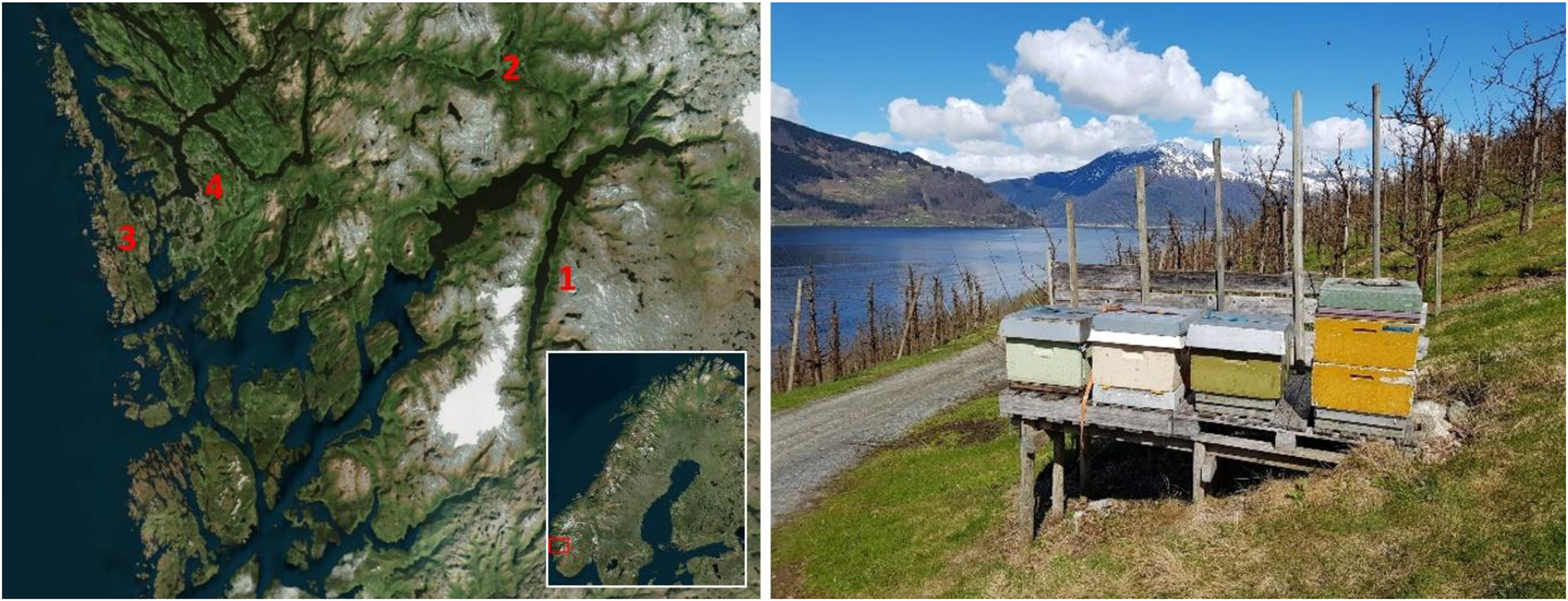
Hardanger fjord (1), Vossevangen valley (2), Øygården islands (3), Bergen city (4) (left); Honeybee hives during pollination in Hardanger Fjord fruit orchards (right).
Because of its topography and microclimate, the 179 km-long Hardanger fjord is one of Norway's main fruit areas, accounting for 40% of national production in an iconic cultural landscape (MH, field notes). Fruit farms run along a thin margin of land between the fjord edge and the steep hillsides behind (see Figure 1, right). Fruit production is dependent on insect pollination to achieve the highest possible yield and quality, with much of this provided by honeybees. The annual bloom is therefore a critical period, when migratory beekeepers work with local orchardists to distribute hives among the orchards, coordinated by beekeeping associations.
The valley around the town of Vossevangen, located about 60 km inland from the coast, is characterised by a microclimate of relatively warm summer temperatures and low precipitation (compared to the rest of Vestland). These favourable climatic conditions, in combination with a high occurrence of wild raspberry bushes in the local woods and clearings, make the valley attractive for migratory beekeepers.
Øygården forms a 60 km-long archipelago, consisting of six main populated islands and about 1500 unpopulated islands, islets, and reefs. The landscape is relatively flat along its north and west aspects, and characterised by lakes, swamps, and heathlands. The coastal heathlands are a semi-natural biotope, shaped by centuries of grazing and beekeeping practices. The islands are dominated by the common heather, which blooms from late-July.
Our units of analysis were the individual beekeepers operating around Vestland County, most of whom are organised as members of the Norwegian beekeeping association and its local branches. The local branches are the main hub for interaction. In addition to organising courses, public events, and conferences, they are an arena for discussion and sharing, both via member gatherings and social media groups. There are about 380 beekeepers in the study area, mostly hobby-beekeepers with two to four hives. About 20 members operate on a semi-commercial scale with more than 20 hives, and there is one fulltime commercial beekeeper running more than 100 hives. Compared to other countries the number of hives managed by (semi-)commercial beekeepers is relatively low, owing to high retail and wholesale honey prices, government subsidies, and pollination service compensation. Honningsentralen, a member-owned beekeeping cooperative, pays its members a fixed wholesale price per kilo. For these reasons beekeepers look upon each other as collaborators rather than competitors.
Method
We deployed three linked qualitative methods: (1) semi-structured interviews; (2) participatory observation at beekeeping meetings and field trips; and (3) a focus group workshop. Our mixed-method approach added depth and more comprehensive insights than could be observed through one method alone. While observation apprehends the everyday gestures of beekeepers, interviews better interrogate why they act as they do, and a workshop reveals what is shared (Denzin, 1978; Lamont and Swidler, 2014; Lareau, 2021).
We ran 14 semi-structured interviews over Spring 2022, focusing on both the semi- and fully commercial beekeepers with at least 15 hives, who participate in pollination activities. We reasoned that these beekeepers have a greater experience of the transhumance cycles of beekeeping around the county, and that their commercial scale (and financial risk) means that they think deeper on their practices than a hobby-beekeeper might. Interviewees were selected through the local beekeeping association, and their hives represented about 65% of hives moved to Hardanger during the 2021 pollination season. We conducted interviews with a pair of interviewers and structured discussion around three topics: seasonal practices and routines, expectations for the future climate, and opportunities afforded by extended-range forecasts beyond 10 days. Interviews lasted about 90 min, were recorded and transcribed, and were sometimes run as part of a field visit.
We conducted participant observation at several junctures over 2022. Two of us attended a 2-day pollination seminar in Hardanger fjord in May 2022, organised by fruit growers and beekeepers during the pollination season. One of the co-authors (MH) is himself a semi-commercial beekeeper in Vestland and observed other beekeepers in their apiaries throughout the 2022 season, collecting and sharing notes with the co-authors. Two of the co-authors attended the 2022 Vossamøte, Norway's largest beekeeping conference, to discuss seasonality and perform temporal mapping exercises with attendees.
We concluded data collection with a full-day workshop in November 2022 with 13 beekeepers. Participants were partly recruited from the pool of interviewees (eight) and, to add new perspectives, we invited five other local beekeepers of various scale and experience. We particularly sought beekeepers identifying as female, as a group underrepresented in the interviews. The workshop opened with a short presentation before giving participants time to walk around, observe and discuss visualised data pinned to the walls, including de-identified beekeeping calendars distilled from interviews, graphs of historical temperatures and rainfall, seasonal forecast maps, and a map of projected climatic shifts for 2030–2050 relative to 2000–2020. Following this, we organised three discussion sessions around the following three questions: Do you share common reference points and milestones during the year? Have you experienced changes in these common references over time? How do you adapt to experienced and expected changes? Discussions were structured by a circular calendar template divided by Gregorian months, where groups could collectively draw and annotate a calendar of their beekeeping year. A circular calendar template was adopted because: (1) it is recognisable in Norwegian culture as the ‘shape of the year’ (Hofseth, 2018); (2) it enables participants to represent temporalities as cyclic rhythms; and (3) how those rhythms ‘layer’ and overlap in assemblages (see also work of McKemey et al., 2020).
For the purposes of this paper, the names of all interviewees and workshop participants were pseudonymised (Figure 2).
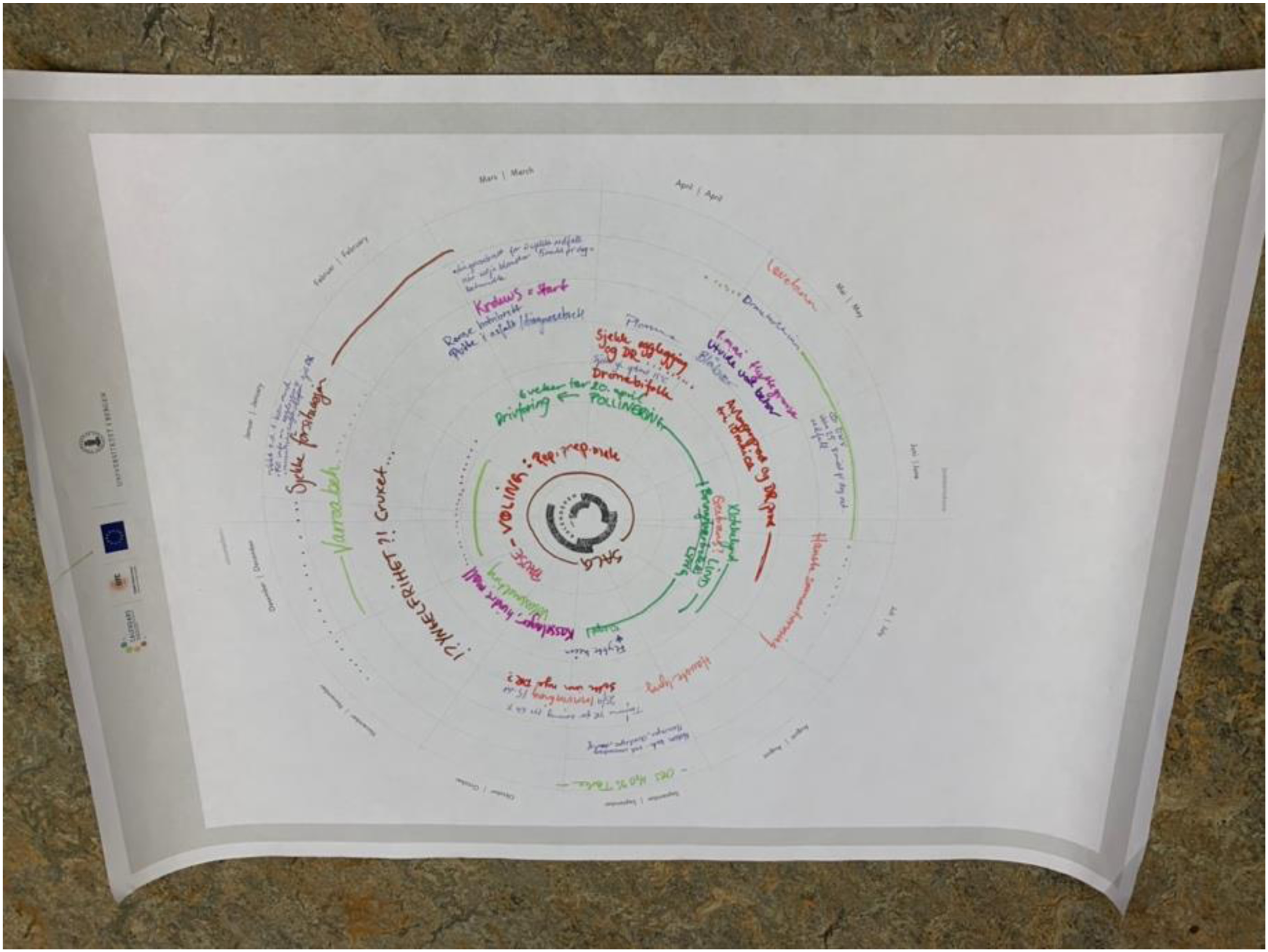
Beekeeping calendar produced for Western Norway through group work at a workshop. It is written in Norwegian (Photo: Scott Bremer).
Our positionality was important in this study. One co-author (MH) is an active member of the local beekeeping club, and well known to the community. This facilitated unique access and insights to this group but may have coloured their interaction with us. Another co-author (SM) is a hobby-beekeeper in Germany, while the other co-authors were entirely new to beekeeping, providing for both ‘insider’ and ‘outsider’ perspectives. We conducted this research as four male, early-to-mid career researchers, all from outside Norway (Canada, Germany, New Zealand), and from highly interdisciplinary backgrounds, ranging from engineering and climate science to political and social sciences. Three of us are fluent in Norwegian, so the research was conducted in English and Norwegian.
Results: The five beekeeping seasons of vestland
Beekeepers variously distinguished seasonal periods according to how they apprehended the temporalities flowing through the beekeeping year. Two divided the year by the honey they harvested – spring, summer, and heather honey – while others described the year in flowerings. One divided the year according to the locations where he placed his hives in a transhumance cycle – from the fjord to the mountains to the islands – while another reckoned the year in his production statistics and calendar of pollination contracts. Some beekeepers divided the year according to how they feel and their activity levels. Nora said, ‘I think that both me and the bees have a lot of energy and expectation for May and June’, while Håvard noted, ‘I am colossally busy in June especially’. But there is also a reasoning that the unpredictability of conditions in Vestland make it difficult to define seasonality, meaning some beekeepers act to the conditions they face day-to-day; ‘I thought about developing a [calendar] for planning, because much of beekeeping is the same thing over and over again each year. But the weather, available time; there are so many factors, uncertainties’ (Stian).
Notwithstanding this diversity, beekeepers do share some common temporal reference points for dividing the year into seasons and coordinating practices. Two interviewees clearly distinguished five seasons, with these patterns resonating with other interviewees’ descriptions, and seen in calendars drawn at the workshop. While beekeepers variously perceive these five seasons, and the boundaries are fuzzy, they are more-or-less distinctive and performative in patterning beekeeping practice. For two beekeepers the year begins with wintering-in the bees, arguing that conditions in the hive going into the winter season determine the success of the following year's colony; ‘You can say that the next year starts in the autumn. If you can have a good wintering, with young bees, enough feed, clean boards, and everything is in order, [then you may have a good season]’ (Stian).
Winter (late-September to early-March)
Anticipating winter, beekeepers transport their hives back to ‘home base’ in the Bergen hinterland or further afield. The season is signalled by the ‘wintering-in’ procedure (between 25 September and 15 October), as a shared practical reference point timed in anticipation of reduced temperatures and activity in the hive. ‘I think it's the most labour-intensive period’, notes Nora, ‘and also the most challenging cognitively. You must be careful about everything. Do the bees have enough food? Are the colonies strong enough? Is the queen good? Should any hives be merged? […] Wax moths, you must be observant for them. And think about how many frames to give the bees’. Most keepers remove all heather honey, believing it to be a poor winter food source given its perceived effect on bees’ digestion (this is contested), and replace it with a sugar solution. Then they strap the lid of the hive on, sometimes covering them in windproof wrap or weighing them down with rocks against winter storms, and leave them undisturbed; ‘Now I'm not going to look at you for six months. My back hurts and I'm exhausted’ (Stian).
‘The bees go to bed when they have finished the sugar solution. And then the temperatures drop in October, rainy days […] and it's getting darker in the evenings. And [the bees] go into this kind of cluster’, said Julian. Over winter, keepers think of the hive as ‘calm’ and ‘cosy’, with the bees clustered ‘in peace’, keeping their strength for spring. ‘Then we can have a brood break, so it's easier to manage the overall situation’, notes Øyvind. ‘And that’s good for managing Varroa counts, the parasites laid in the brood’, said Ragnar. But keepers complain that Vestland temperatures can spike over winter, creating unpredictable patterns of brooding and draining the hives of energy as there are no sources of food to forage before March. ‘On the west coast, we sometimes see bees still flying on Christmas Eve’, noted Arne. With frosts from early-December, the queen stops laying eggs, and during this brood-break the Varroa mites cannot lay eggs in brood cells, and live exposed on the bees themselves. At this time, beekeepers can treat Varroa mites with oxalic acid (see also the section ‘Introduced species’).
With the bees wintered-in, October is devoted to ‘slinging honey’ – extracting the heather honey from the frames in a centrifuge – and drying it to reduce the water content, ready for collection by Honningsentralen in mid-October, or jarred for sale at the Christmas markets in November and December. The rest of the winter, especially January and February, is devoted to maintenance work, ‘Washing frames and melting wax for the frames…melting it two or three times to ensure its completely clean. […] At the same time, I’m washing and scraping boxes clean. And if they need some paint, I give the kids a few crowns to paint them’ (Ahmad). Winter is also a time for doing the books and collecting production statistics; ‘These are important for me to plan, and not least for getting support from the state if I have a bad year’ (Stian).
Wintering-Out (early-March to late-April)
The wintering-out season starts with the first warm days of around 6–10°C in early-March. For most beekeepers, the blooming of the willow and hazel trees signals the beginning of this season, and depending on the location, the crocus bloom. Many beekeepers share pictures on social media showing which plants are blooming, and where.
During the cold months, the bees stay in a cluster to keep temperatures in the colony constant. With the first warm days, they go on their cleansing flight, i.e. they defaecate and remove dead bees. Bees also start to collect pollen, water, and nectar. These flights show beekeepers that the colony has awoken. The queen starts laying eggs again, and the colonies build up strength.
For beekeepers, it is a time of expectations. Øyvind reported that ‘March is […] the waiting game, and you wait, you wait. You’re quite eager to see the bees fly again. I think, for me, February, March are the hardest months in the year because you want spring to come’. For Arne, the time of the willow bloom is ‘the best time to be a beekeeper. That is just lovely. Because I love this tree. And the bees are up in the tree and then you climb up in the tree, and you just hang out there with the bees. For them it's often like their first proper flying’. It is also a busy time for beekeepers. They need to get a picture of the hives’ status after winter. This involves checking the strength of the colonies, if the queen is still alive and laying eggs, and that there is enough food. Some count honey frames; others weigh hives with luggage scales. If colonies are too weak, they are merged with other colonies.
At that time, most beekeepers worry about the unstable weather, as described by Ragnar, ‘it can go from nine to twelve degrees with sun and then change over to […] hail and snow mixed with water’. If it is too warm too early, colonies will start building up strength but become vulnerable to starving when it gets cold in late-spring. To avoid that, most beekeepers provide the hive with pollen and sugar pads.
Over this time, beekeepers try not to disturb the colonies too much, with beekeepers not transporting hives to Hardanger orchards for pollination letting the hives build up strength by themselves. Erik explains that it is his ‘philosophy […] to let the natural rhythm unfold itself’. And Øyvind adds that ‘[if] I wasn’t doing pollination, I’d let the bees follow their biology, and the natural rhythms’. Beekeepers who make hives available for pollination start preparing these hives by late-February to have enough forager bees ready by mid-April. On average, it takes 21 days for a worker bee to hatch. After that, she lives for a maximum of 42 days. During this time, she exercises different tasks within the hive before becoming a forager bee for her last 20 days. So, it takes around 40 days to ‘produce’ forager bees, that is, those bees that leave the hive to gather resources, such as honey and pollen, and are therefore important for pollination. Beekeepers need to consider different temporalities – of the bees, the fruit trees, the weather conditions – in building up the colony for pollination, while social calendars can also interfere with this practice.
Pollination (late-April to early-June)
The pollination season on Hardanger fjord is a key temporal coordinate in the year, with eight interviewees moving hives to orchards every year. The start of the season is coordinated with orchardists and facilitated by the beekeeping club. Øyvind explains, ‘we have direct contact with the farmers, and they say, “Oh, it’'s blooming in two days now, so you should come”’, and Håvard notes, ‘Now the fruit are flowering earlier and earlier, so we move out there already around 20 April’. This sees beekeepers winter out their hives earlier to ensure they have strong hives with at least seven frames fully covered by bees, as an agreed minimum for orchardists paying for pollination services. There is also a fixed regulatory reference point anchoring the start of pollination season, a biosecurity measure requiring that hives are moved into Hardanger before 1 May to avoid the spread of ‘fireblight’ disease. Fireblight is a contagious disease affecting apples and pears mainly, that has spread from North America. The disease overwinters in cankers, and as temperatures warm these cankers exude a bacteria-filled ooze that spread to susceptible plants via insects. The biosecurity law aims to limit this vector, but as climate change brings warmer spring temperatures, this fixed date may need to shift (section ‘Introduced species’).
Pollination season is determined by the interaction of climatic and phenological rhythms. Orchardists prefer cold temperatures over March and April, to delay flowering while there is still a chance for frosts to destroy the crop, but by May ‘they want it warm, but no so warm that all of the blooms open at once’ (Håvard). Following the wild flowerings of willow, blueberry, and dandelion, then, ‘Cherries and plums bloom first out of the fruits. Anywhere within a period of three weeks from the 20th of April to the first week of May. In good weather the blooming can be over in a week. In colder weather it can last for up to four weeks’ (Frode). This is followed by apple and pear flowering. Beekeepers are hoping for steady warm periods without too much wind – ‘If it's up around 20°C, you can see the weight of the hives increase’ (Håvard) – but having experienced wet weather in May, some beekeepers will include a frame of extra food in the hive for the bees to eat if they cannot forage.
‘The bees are enjoying themselves in Hardanger’, Erik explains, ‘when the weather is there, they have a lot to draw on, both pollen and nectar […] so this is a period when there is the most development in the hive, [when] you replace old bees with young bees’. Beekeepers drive out to check their hives every 1–2 weeks over this period and add super boxes (for honey) and frames so that the colony has space to grow and reduce the risk of swarms leaving the hive. In monitoring the hive, Nora draws on several sources of information, ‘based on what I observed the last inspection, how the weather has been, the Facebook group chat, and following the weight from the sensor I’ve installed’. While some beekeepers harvest honey there is usually quite little, and some prefer to leave it to the colony, to strengthen the hive. From the end of April, the queen makes drones which will hatch around 17 May – Norwegian constitution day. This shows how beekeepers use nationally significant festivals, such as Easter or the 17 May, as temporal reference points to gauge and manage the progression of the season. As such, beekeepers have quite strict timing for the start of producing queens, from 10 to 20 May, to ensure that new queens are fertilised in flight with the drones in the clear June weather. Some beekeepers keep some hives at ‘home base’ for producing queens and splitting off new colonies.
Pollination seasons ends as it begins, in negotiation with orchardists. ‘I usually like to leave [Hardanger) as soon as I can after the apple has bloomed, in the first week of June’, Håvard said, ‘Because then there's not much left for the bees’, squeezed onto orchards between the fjord and the steep forested slopes above. Øyvind told us, ‘The next big thing is the raspberry flower […] from an economic point of view you should be there when the raspberry starts because they give so much nectar and honey’.
Raspberry (early-June to mid-July)
This period is defined spatially, as a time for moving to harvest the honey flow from wild-raspberry and fireweed. Beekeepers are spread out, but half of those we spoke to move their hives into the mountainous valleys around Voss. The moving operation can be arduous, as Julian explains: ‘I transported the hives from Hardanger to Voss. […] First, I had to collect all the honey and drive it to Voss […] And then, I went back to Hardanger and had to wait until evening for the bees to come back to the hives. And then lock up the hives and [move them to Voss]. I think I finished at 3 am’.
‘Voss is one of the best places in Vestland for beekeeping’, notes Håvard, ‘because it is inland, and you get (annual) temperature records almost every year around Saint Hans (24 June)’. Øyvind adds, ‘(Higher) night temperature has a lot to say too, thinking of nectar production’. Beekeepers consider various factors in situating their hives, as Erik explained, ‘It must have sun for as long as possible in the day and be accessible! So that I can drive a car and trailer up and lift the hives off the trailer. […] I look for tall forests because there you get raspberry’. Other considerations include access to water for the bees, soil type, and exposure to wind, with Stian making much of the effect of each valley's micro-climates. Otherwise, location is also determined in negotiation with local landowners, synching with their land use and remunerating them with honey. Some beekeepers extend the raspberry season by progressively moving hives up the valley side, as snow recedes more flowers spring up higher up the sides of the valley. Besides high temperatures, June's rainy days and snow melt also provide the moisture that is important for raspberry nectar, so that when the bees do forage, a hive can produce up to 7 kg of honey on a single day of perfect conditions, according to Erik. For this reason, he notes ‘if you get 5–10 (flying) days in June, you’ve had good weather’.
Raspberry season is talked about as an energetic and busy time, when a growing population and activity level in the bee colony is mirrored in the activity of the beekeeper. Ahmad, for example, drives 2.5 h out to check his hives almost every weekend, to ensure the bees have enough space to avoid swarming and frames for collecting honey, and feed them sugar as required, often camping in the apiary. Frode stocks each of his hives with two brood boxes and two supers. It is also the period when queen production and colony splitting peaks, with this organised among beekeepers, who often collaborate on these activities and share queens.
By late-June there is often a lull in honey production between the end of the raspberry flow, and the beginning of the heather flow. Beekeepers harvest the raspberry honey in early-July, sometimes leaving a few kilos for the bees to eat in case the heather bloom starts late, before another long move, shifting the hives to ‘lyngland’ – the heather-covered Øygården islands – for the coveted cross-leaved heath (klokkelyng) honey.
Heather (early-July to mid-September)
From early-July, beekeepers move their hives to the Øygården islands (such as Sotra, Haugesund or Stjørdal) for the bloom of heather røsslyng (Calluna vulgaris) or klokkelyng (Erica tetralix). As they bloom at different times, beekeepers try to get nectar off both plants. Usually, klokkelyng starts in the second week of July and røsslyng from the last week of July. Some interviewees explained how challenging it is to move hives between heather locations. Beekeepers will share pictures on Facebook and inform their colleagues about the best spots. Ragnar told us that ‘there is a lot of enthusiasm around the heather because it's so important for the Norwegian beekeeper’.
Usually, heather is a reliable nectar source. Ideally, its soil should be moist, and the days warm.
‘Heather is almost two months. You can have good flow days in early September, up to end of September. Some say also if you have a rockier landscape, the North faced heather blooms the latest, and then you can stretch out the flow to seven weeks maybe’ (Øyvind). However, in September, conditions can become challenging when the sun's angle lowers every day and nights get too cold.
The heather season interacts with other calendars. First, many beekeepers wait for the heather bloom before they themselves go on summer vacation. Håvard tells new beekeepers, ‘To not travel away for holiday until you get the bees into the heather. Then they are sound, and one can take a week or two away’. Second, because of regulations about fireblight, beekeepers are not allowed to move their hives back to home base before 10 October. This can create challenges for beekeepers. They must start wintering-in bees while they are still out on the islands, rather than back at home-base, where they have their equipment and feed. This creates extra work, to drive everything out to start feeding the bees and then pick them up shortly after. By that time, the hives are much heavier than when they transported them out. A related problem might emerge if it gets too cold on the islands and bees cannot process the feed because they are already clustering.
The heather honey itself poses challenges to beekeepers. Arne describes it as a ‘double edged sword’ because ‘it is very relaxing when they harvest the heather but once you have to process it, that's the worst thing’. Because of the viscosity of the heather honey, beekeepers need a needle machine to break its surface tension before ‘slinging’ it out of the frames with a centrifuge.
Managing an unpredictable beekeeping season
These five seasonal patterns are a framework for anticipating conditions and managing practices (Hastrup, 2016), for as Stian notes above, ‘much of beekeeping is the same thing (…) each year’. Yet seasons ‘repeat with difference’ (Lefebvre et al., 1999), and beekeepers have strategies for coordinating practices to, and evening out, seasonal variability. Stian and Håvard, for example, act according to the weather they face from day-to-day, rather than planning far into the future. Others address variability by stocking hives with sugar in case floral food sources become scarce. Nora notes that she closely monitors the temporalities composing seasons, such as with technologies that monitor hive weight. And others reduce risk associated with variability by spreading hives over different locations. But beyond normal variability, beekeepers re-coordinate practice to perceived changes to temporal assemblages.
How beekeepers perceive seasonal patterns to be re-coordinating
Beekeepers discussed ways in which they perceive their seasonal patterns of practice to be evolving as certain temporalities have shifted, demanding that plants, bees, beekeepers, and other communities incrementally re-attune their timings for seasonal assemblages to hold. This relates to shifts in understandings of seasonal patterns and the timings of activities to better sync to morphing temporal assemblages as a way of managing uncertainty; for example, triggering pollination ever-earlier with rising temperatures. We focus on six overlapping ways in which seasonal patterns are re-coordinating.
Climatic change
Vestland is experiencing (and projecting) long-term changes to climatic patterns, with a warming trend reducing the number of ‘winter days’ when the temperature falls below 0°C, and shifting precipitation patterns in ways that negatively impact on the times when bees can fly. Warming can see the bees active over winter, demanding that the keeper provides more food when there is nothing to forage, and meaning there is less frequently a protective layer of snow to shelter the hives from winter storms. Warming can also trigger wintering-out early, introducing the risk that suddenly – dropping temperatures will see brood production collapse. Håvard was most nervous about how a perceived reduction in flying days in June would narrow the window for when virgin queens can be fertilised by drones; ‘Now June can be a bit uncertain, you can get a cold north wind. So, if you don’t get normal June weather, then you can have some bad pairings’. This means that queens are not mated with enough drones to ensure the necessary genetic variability. Nora is concerned that beekeeper training fails to account for climatic specificity and change: ‘All the literature is written by old men [from the east] who have their experience from a time without climate change. Methods can seem a bit rigid […] But we are in the west. We don't have winter, we have climate change’.
Phenological change
Linked to climate change, a warming trend sees unexpected plant flowering, most prominently resulting in the progressively earlier flowering of fruit trees as a trigger for pollination season. This forces beekeepers to shift wintering-out practices forward to prepare sufficiently strong hives for moving out to Hardanger. Gunnar remembers, ‘Two years ago the pollination started very early, and the beekeepers were a bit too slow […] Many beekeepers were on Easter holiday [when] plants in Hardanger started flowering. It was a big problem’.
Introduced species
Beekeepers are adjusting the seasonal patterns of their practices to accommodate introduced pest species, which are extending their ecological niche and activity in a warming climate. The risk of fireblight disease, which spreads through fruit trees when temperatures exceed 20°C, has seen biosecurity laws impose rigid temporal boundaries – attached to the Gregorian calendar – about when hives can be moved around the region; effectively anchoring the start of pollination season, and end of heather season (section ‘Pollination (late-April to early-June)’). Another concern is around Varroa mite. Originally occurring in Asia, since the late-1960s this parasite is spreading across Europe. Most problematically the mites feed on, and damage or kill, the bee larvae, reducing the number of bees able to forage, and ultimately causing the collapse of bee colonies. The usual brooding break during winter frosts – when larvae are not being produced – reduces the spread of Varroa and provides a pause for treating the hives (see the section ‘Winter (late-September to early-March)’). However, with warmer winters it may be necessary to treat hives more often over the year.
Diversifying social relations to the environment
The way beekeepers relate to their environment affects when and how they act (see Box 1), with Håvard describing a changing composition of the Vestland beekeeping community since the 1970s. He remembers a national meeting when a speaker, ‘looked out over the crowd and said “Yes, there are more and more grey hairs”’. Håvard continues, ‘now the age group has decreased, and the interest increased. There was a time when we gave [beekeeping] courses and there were only five or six interested […] Now there are 60 [people attending]’. In the workshop, one group noted the growing diversity of age groups, genders, and overseas cultures as altering the patterns of practice. Ahmad, for example, brings knowledge that he learned beekeeping in Iraq before moving to Norway, while Nora expresses an interest in revising beekeeping; ‘When I took the course we had to read a book […] and its about a typical old man from Eastern Norway. Lots of knowledge, but he doesn’t have experience with our environment. […] If Tomas (a young local beekeeper) had written a book, I would read and follow it’. But notwithstanding these diverse worldviews, the beekeepers we spoke to share a common passion for the natural environment, and fascination for bee colonies. Stian observes, ‘it is those new beekeepers who are bitten by the beekeeping bug that continue. Those not bitten by the bug stop after a year. The beekeeping community is very engaged’.
The Vossamøtet meeting of 2022 was held on a crisp October's day in a hotel and conference centre with windows overlooking Voss's mountain lake. Authors SB and ED-S set up a stand outside the conference hall to ask beekeepers to draw their calendar. They were met by Tomas who told them that the Voss meeting is one of the three beekeeping events in the Norwegian calendar, particular for its focus on global research. Indeed, when the head of the Beekeeping Association opened the meeting, her presentation centred on the projects they collaborate on, and the need for research-based practice, with later talks from Australian and American beekeepers beamed in through Zoom, and an entomologist discussing Norwegian wild bee species. SB was seated at the back and observed what he was told is a typical audience of about 120 attendees, relatively mixed. While there was a sizeable set of men close to retirement, SB did remark around 40% were women, and that a significant number looked to be in their 30s. The talks were heavy with practical details, and audience members hungrily snapped photos of the slides with their mobile phones. Håvard gave a summary of the Vestland season and the relationship between temperature and hive weight, lamenting how few days topped the necessary 20°C (Figure 3). He finished with comments on how he leaves heather honey for his bees to feed on over winter, arguing that it does not affect bee digestion as others claim, which drew murmurs from the crowd. Over lunch, SB sat with a man in his 40s, who started beekeeping 5 years ago, and now helps train new beginners. He noted how his seasonal beekeeping practices have changed as his knowledge and understanding of bees evolved.
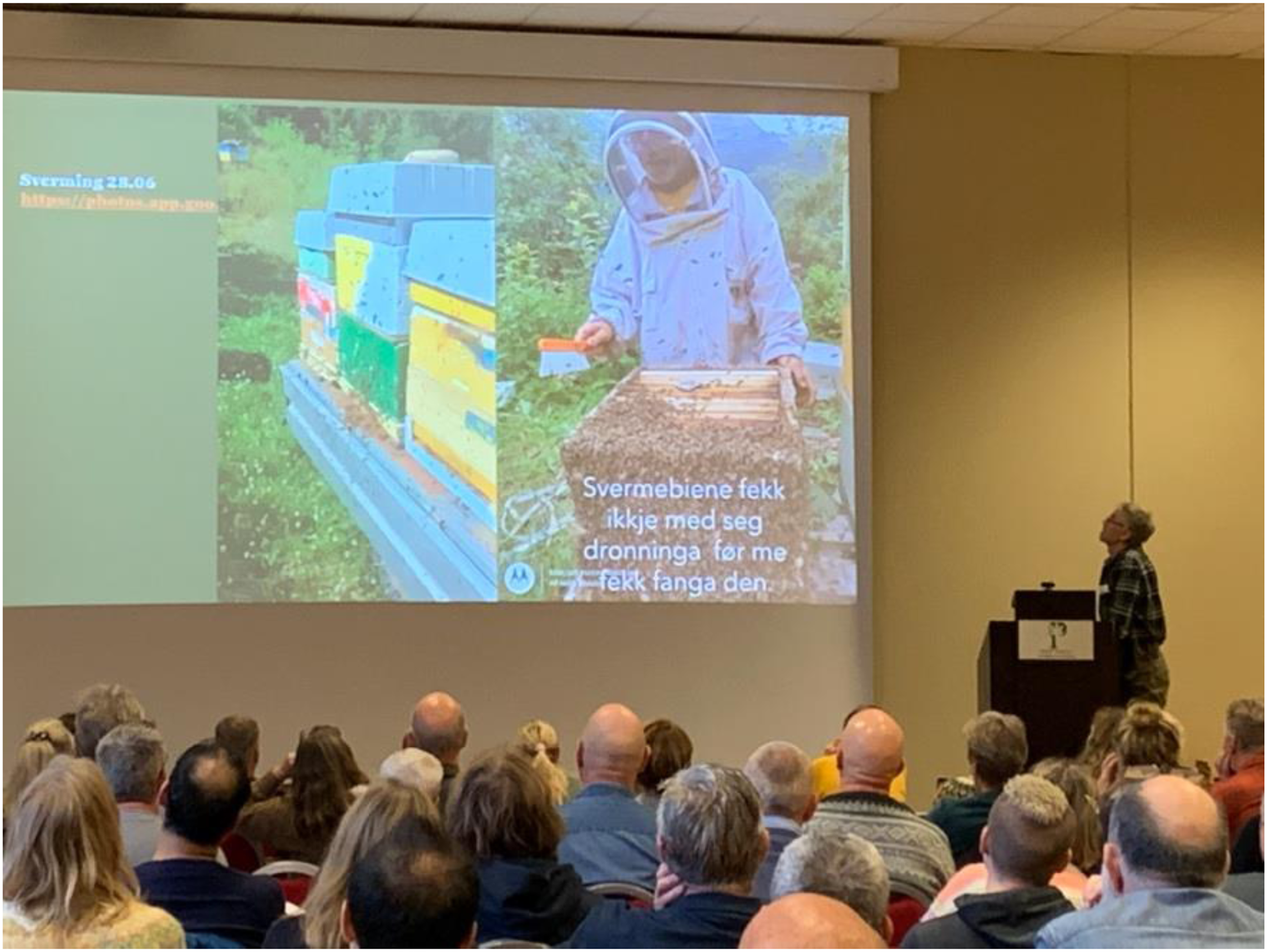
Håvard presenting his 2022 beekeeping season at the Vossmøtet (Photo: Scott Bremer).
Diversifying practices and technologies
At the Vossa meeting it was joked that there are 10 different beekeeping techniques for every five beekeepers, and these regular meetings serve as fertile spaces for comparing approaches, including the seasonal patterns of practice (see Box 1). Interviewees alluded to how experimenting with different techniques stretched the season (e.g. moving hives up the valley-side) or anchored it. Two interviewees, for example, experiment with hives with two queens, which appears to have quite a strict schedule, with Øyvind noting that on 28 March, ‘you start with feeding anyway, if it's snowing or if it's sunny and warm’. Others debated what to feed the bees, and when. Three beekeepers go against conventional wisdom and leave the bees heather honey as winter food, with Arne justifying this; ‘I feel that the bees are made to eat honey and it's really heavy. So, when you just replace honey with sugar, that's very easy human thinking’. Others feed the bees with artificial pollen replacement over the winter, but Stian and Nora both point out that there is little evidence that it works, and Nora is afraid that feeding sugar will adulterate her honey. Another key innovation was the use of scales and sensors to monitor hives, reducing the frequency of checking hives.
Partnering with bees
Beekeeping in Vestland has been seasonally defined by periods of pollination services and honey harvests. Human–bee relationships were built on co-producing these ‘outputs’. But some beekeepers are re-visiting how bees participate in social worlds. Arne, for example, is experimenting with making and selling mead from his honey, which affects his seasonal bundles of practices. Tomas has built a shelter over his hives and runs ‘bee safaris’ for visitors to diversify his income from beekeeping, extending, and differently punctuating the beekeeping season. And co-author MH, an urban beekeeper, has requests from businesses in town to keep bees on their roofs as part of businesses’ efforts to demonstrate themselves as socially and environmentally responsible.
How beekeepers adapt and reconfigure their seasonal patterns
In addition, we saw how beekeepers decide to adapt their collective seasonal patterns. By this, we understand the shared, deliberate actions by the field of beekeepers – and not only by individual beekeepers – to significantly alter, transform, reconfigure, and recalibrate the temporal assemblage in response to and anticipation of certain risks. These are measures to further manage beekeeping for a perceived unpredictability in beekeeping seasons of the future. We identified five aspects to beekeepers adaptive strategies.
Communication
From synchronising activities to sharing lessons and observations among beekeepers, communication plays an important role in deciding to jointly adapt seasonal timings. Often such exchanges occur in physical meetings, such as the social drinks at ‘The bee’ bar in Bergen, beekeeping club discussion groups, or the Vossamøtet. For Stian, these get-togethers are a ‘combination of input, education and experience’, and he feels that ‘you grow in this context’. Beekeepers referred to Facebook as a widely used communicative platform to share real-time information about the status of different flowerings and, accordingly, about good locations.
Training
Training is another element in the beekeepers’ adaptation strategy. This is particularly relevant for the beginners’ courses. Stian told us that ‘[the] beekeeping clubs have been working to standardise the course – that's the national project. But […] it's the local clubs that organise the courses. […] The challenge for the national beekeeping organization is to find course leaders who do not only talk about their own practice, but also link up to some of the standardised ways of beekeeping. So, we have courses for course-leaders [… to] try and standardize that: Locally adapted, but standard’. Through these standardised, yet adapted courses, new beekeepers learn about how to adapt to changes in local temporal assemblages.
Coordination
Formal coordination and organisation of interaction with other stakeholders, especially with Hardanger orchardists, contributes to the field's adaptation (Box 2). Previously, beekeepers and orchardists coordinated individually and informally. Now, there is a formal agreement between the associations of fruit growers and beekeepers about the number of hives and the timing for moving them. This arrangement increases the field's resilience by making sure all colonies are present around the same period, ‘on time’ taking the weather conditions into account. It also helps to distribute hives more evenly to ensure all areas are equally covered to provide better pollination coverage.
The pollination day was a 2-day event held at Ullensvang in Hardangerfjord in May 2022, co-organised by the Norwegian Institute of Bio-economy Research (NIBIO) and the Norwegian Beekeeping Association through its Vestland chapter, and drawing around 70 attendees. The goal was to bring together beekeepers and orchardists to understand each other's practices, business organisation, and requirements around pollination. Authors MH and ED-S attended to observe the meeting and present seasonal forecasts. On the first day, attendees took a field trip to interviewee Frode's orchard to tour his beekeeping operation and visit his honey house; a barn that he built as a centralised facility for processing honey, which beekeepers can rent out. The second day ran as a seminar at NIBIO's field office before walking through orchards together, to discuss matters of concern at the intersection of orchardist and beekeeper practices. One issue related to wildflowers such as dandelions. Some orchardists wanted to mow wildflowers to encourage the bees to focus on their fruit blossoms, but fruit trees offer little nectar so beekeepers prefer that wildflowers grow for the bees to forage and produce honey. These discussions circled around temporal rhythms, that different plants produce nectar at different times of the day so that one plant does not necessarily exclude the other; bees can visit fruit trees in the morning and dandelions in the afternoon for instance. Another issue was orchardists recent use of plastic tunnels to cover cherry plants and protect them from frost, hail and rain (Figure 4). There were animated discussions on where best to locate hives for bees to access cherry trees – at either end of the tunnel or within the tunnel – and how orchardists can construct tunnels to avoid bees getting lost.
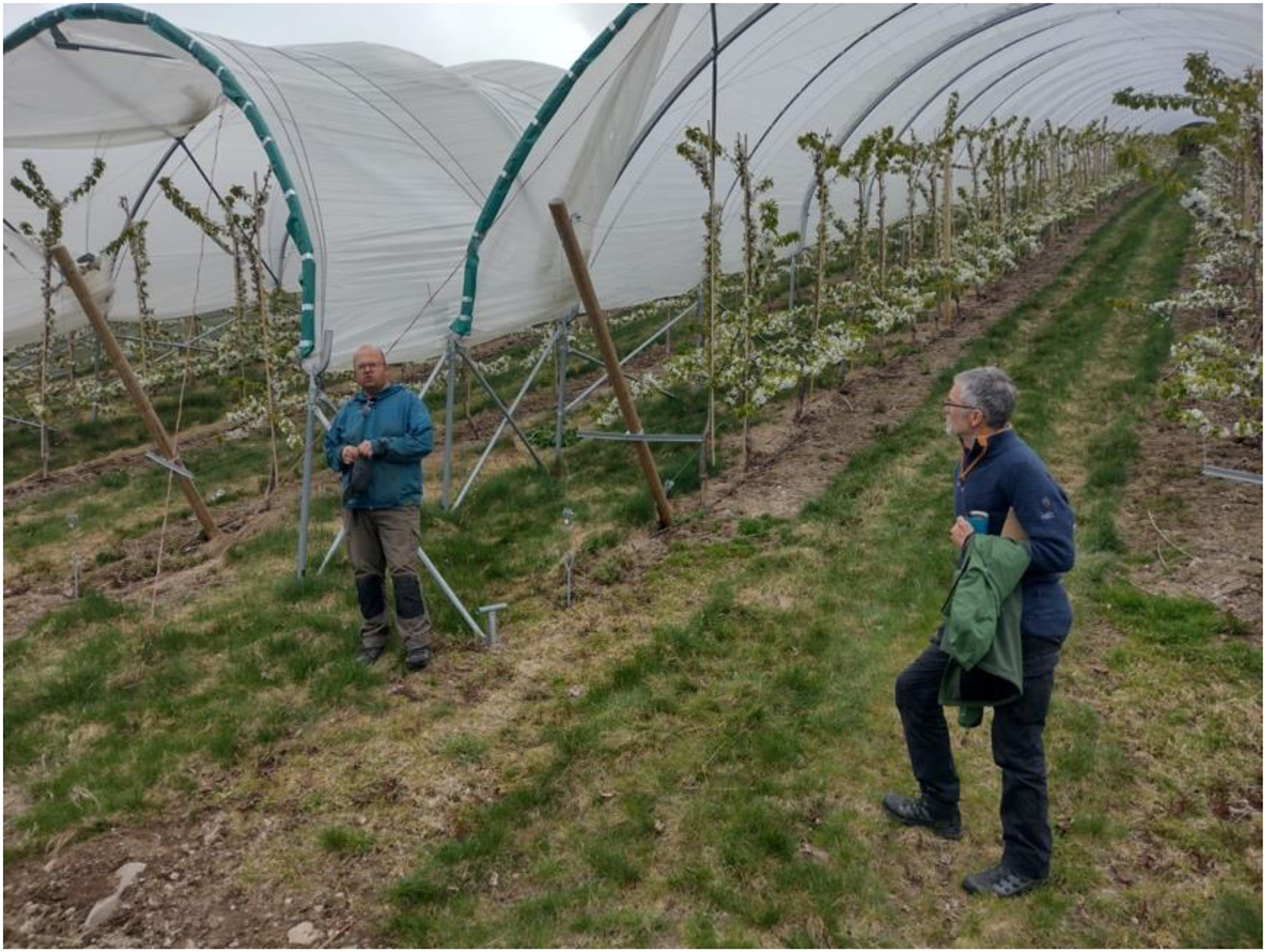
Fieldtrip to plastic tunnels covering cherry trees at pollination day (Photo: Etienne Dunn-Sigouin).
Mobility
Migratory beekeeping is an established practice in the temporal assemblage, and it has its own temporal patterns as beekeepers move to different locations to follow whatever is in bloom. Many see mobility as a way to adapt to increasing temperatures by experimenting with different locations and exploring specific micro-climates. Tomas tells us how he brings his hives to locations that are up to 250 m above sea level and have so far not been very attractive. Others look for colder spots at higher latitudes as an option for wintering hives and thus for coping with milder winters.
Use of, and hope for, science and technology
The use of, and hope for, new technologies is another element of beekeepers’ adaptation strategy (Box 2). Some beekeepers have started using sensors to monitor temperature, humidity, sounds, and other variables in their hives. Stian told us about this technological transition: ‘I talked to a guy at Nøtterøy and I said, “what you’re doing here is replacing 40 years of experience”. […] It changes your way of beekeeping […] because you can just eat breakfast and see which hive you’ll check today, “That one's green. That one's green. Oh, that one's yellow, I’ll check it today”’. Another technology might be weather forecasts. One of the authors (MH) presented forecasts to beekeepers every month over 2022 and collected feedback. Many noted how they found them useful for planning, for instance, for queen breeding. In the workshop, beekeepers expressed their hope that bee science will be able to breed Varroa-resistant bees. Norway's cold winters meant that beekeepers have not had to treat bees against Varroa in late-summer. But warmer winters mean that they may soon have to.
Discussion and conclusion
In this paper, we analysed how a group of beekeepers in Vestland perceive and respond to climatic and environmental, technical, and socio-cultural changes in the temporal assemblages that seasonally pattern their practices, and their relations to bees and the environment. We were interested in beekeepers’ capacity to agilely re-coordinate their timings as the seasonal rhythms they track fluctuate and shift, and indeed collectively choose to temporally adapt or reconfigure the seasonal organisation of their activities altogether, in the face of risks or necessities. We studied this adaptive capacity as the interaction between a group of temporally skilled practitioners and the institutionalised temporal frameworks that order their year, from formal and explicit calendars to more informal and tacit senses of good timing. From this angle, our contribution to adaptation research is through centring and elevating the role of temporal synchronisation in climate adaptation governance; timely adaptive action as action timed to (ever shifting) intersecting temporalities in the everyday.
Pursuing this enquiry into adaptation governance meant piecing together perspectives from sociological literatures on institutions, and environmental humanities work on temporal assemblages. It meant understanding the relation between agency and structure for temporal organisation. We saw beekeeping as an institutionalised field of practitioners (Scott, 2013), who individually worked according to diverse timelines but coordinated practices to shared seasonal reference points to reduce temporal clashes with the environment or within the group. Consider for instance the joint effort to ‘winter-in’ bees in late-September to ensure hives are ready for the winter cold, but also that honey is harvested to sell at shared Christmas market stands. There is a rich literature on temporal assemblages in organisations (Wipp et al., 2002; Zerubavel, 1981), but little regard for temporalities in the institutions governing disaggregated social groups (Jupille and Caporaso, 2022), with some important exceptions (Blue, 2019). Here then the study contributes to scholarship on institutions and governance more broadly conceived, by providing an empirical example of how temporal rhythms structure an institutional field, and are re-configured through agency. This likewise contributes to ‘time studies’, on the ways that groups (pre-consciously and consciously) synchronise across assemblages of plural temporalities.
A related contribution to time studies is to the agency that we attribute to human and more-than-human communities in the relational work of forming seasonal patterns that ‘hold’. Studying beekeepers’ seasonal patterns, we saw analytical purchase in representing people's practical rhythms as entangled with more-than-human rhythms in an environment (Tsing, 2015). This perspective reveals the continuous, incremental coordination of humans and non-humans, ‘to align with each other through timing to make living in common possible’ (Gan and Tsing, 2018: 103), and form workable temporal arrangements, e.g. for pollination. Here coordination is relational and structural, emerging from an evolutionary history of accommodations. But we also emphasised the agency of humans and non-humans that actively reconfigure temporal assemblages, drawing on work of critical time scholars (Bastian, 2012). For us, it is important to incorporate agency into analysis of temporal assemblages, to reveal deliberate efforts to adapt timings; consider beekeepers decisions to move en masse to pollinate orchards, or bees’ collective decisions of where to forage.
Our research found Vestland beekeepers to be temporally literate practitioners that are capable of gauging shifts in temporalities and recalibrating appropriately. They are skilled in using a stock of temporal frameworks, from the formal calendar of honey collection by Honningsentralen, to the technical readings of hive sensors or more informal and embodied knowledge and skills for ‘reading’ signs of environmental and social temporalities. And these frameworks demarcate some shared seasonal patterns (section ‘Results: the five beekeeping seasons of Vestland’). This skilled use of temporal frameworks enables beekeepers to perceive variations in the temporal assemblages they are entwined with, and respond with micro-manoeuvres to maintain synchrony, for example, to the rhythms of the hive, or the calendar of public holidays (section ‘How beekeepers perceive seasonal patterns to be re-coordinating’). We equate this to coping with variable temporalities. Going further, beekeepers perceived long-term shifts of phase in assemblages – e.g. related to long-term climatic change – requiring more concerted, collective decisions for re-calibrating the temporal organisation of practices (section ‘How beekeepers adapt and reconfigure their seasonal patterns’). This we equate to adapting or transforming the temporal patterns of practice, which seems to become pertinent when challenges are beyond individual adjustments, as where beekeepers coordinate with orchardists in the face of shifting pollination cycles.
Our study emphasises the time sensitivity of adaptation – the importance of taking the right action at the right time – and that this timing is coordinated to polyrhythmic temporalities (Bremer et al., 2024). It suggests temporal frameworks and competence as important but overlooked capacities enabling institutionalised fields of practitioners (like beekeepers) to ensure practices are undertaken ‘on time’. Insofar as temporalities become visible through particular activities or engagements with the environment, the capacity for temporal re-coordination will vary across sectors and scales, and lead to largely disaggregated governance measures. This links up with other climate adaptation literature (e.g. Frick-Trzebitzky et al., 2023; Teebken et al., 2023) which sees governance as the sum of micro-decisions. We found skilled practitioners capable of drawing on, and recrafting, their temporally patterned socio-material relations that connect them to their material and immaterial world. This might happen in small everyday forms of experimentation or in coordinated action within a field. Knowing more about such contexts of climate adaptation (see also Bremer et al., 2021; Meisch et al., 2022) can support existing adaptive climate action or else help to prevent maladaptation.
Footnotes
Acknowledgements
We want to acknowledge the contributions of the beekeepers who provided us access to the beekeeping community and participated in our interviews and workshop, with particular thanks to Alf Helge Søyland who so generously gave his time and insights. We also acknowledge the CALENDARS project research team for their feedback on this research, and the Climate Futures project team whose work provided a backdrop to this study.
Authors’ Contributions
All four co-authors contributed to designing this research, including defining research questions and concepts, the case study focus, and the method for data collection. All four co-authors contributed to data collection and curation. SB and SM undertook most of the data analysis, and most writing of the manuscript, but MH and ED-S also contributed substantially to data analysis and writing. All authors finalised this manuscript and validated it.
Declaration of Conflicting Interests
The authors declared no potential conflicts of interest with respect to the research, authorship, and/or publication of this article.
Funding
The authors disclosed receipt of the following financial support for the research, authorship, and publication of this article: This work was supported by the Climate Futures project funded by the Norwegian Research Council (grant number: 309562); the CANALS project funded by a Marie Skłodowska-Curie Individual Fellowship under the EU Horizon 2020 research and innovation programme (grant number: 895008); and the CALENDARS project funded by the European Research Council (ERC) under the European Union's Horizon 2020 research and innovation programme (grant number: 804150).
