




Abstract
This article examines how organizations coordinate routines to achieve reliable collective action in sustained, temporally complex crises. We conducted an observational study of the Uganda Red Cross Society’s Ebola emergency response operation, which lasted for almost two years. Our findings reveal that sustained crises necessitate both the enacting of clusters of interrelated routines to achieve reliable operations and the accommodating of unexpected events when coordinating these clusters. Thereby, this study contributes to research on coordinating routines in sustained crises in two ways. First, we challenge traditional views of routine clusters as stable and path dependent, arguing that tolerating temporal conflicts between routines enables the flexible coordination of routine clusters during sustained crises. Second, we introduce the concept of temporal manipulation, which challenges existing thinking about the need for temporal alignment of routine performances. Temporal manipulation is the ability of routine participants to exercise agency by altering the past and/or future to successfully coordinate routines with diverging temporalities. This suggests that manipulating time, rather than aligning it, can be an effective means of coordination in sustained crises.
Introduction
With over 2,200 deaths and a duration of 22 months, the 10th Ebola outbreak in the Democratic Republic of Congo (DRC) was the second deadliest Ebola epidemic in world history (World Health Organization, 2020a). Very early on, Uganda declared the outbreak in neighbouring DRC as a serious public health emergency, and strict measures to prevent the spread of Ebola into Uganda were implemented. One of the main actors was the Uganda Red Cross Society (URCS), the leading crisis response organization in the country. However, since URCS typically responds after short-term crises such as floods, accidents or landslides where the operations last for a very limited time, the Ebola outbreak posed a significant coordination challenge for URCS. It required coordinating a set of routines in a reliable way over extended periods of time while simultaneously responding to urgent events that challenged the continuity of the operation. In particular the alignment of the long-term oriented funding routine that was meant to secure the funding of the operation with the need to quickly close loopholes in the screening for Ebola symptoms (screening routine) of people crossing the border posed a major coordination challenge. However, URCS showed a remarkable degree of effectiveness: although the border between Uganda and DRC remained open and experienced high levels of traffic, the spread of Ebola into Uganda was prevented over this two-year period.
This type of sustained, long-lasting crisis presents organizations with very distinct coordination challenges: acting reliably over extended periods of time under conditions of an emergency requires actors to take a long-term perspective (Bansal, Reinecke, Suddaby, & Langley, 2022; Kim, Bansal, & Haugh, 2019), while constantly being ready to respond to acute developments that threaten the continuity of operations. Hence, coordinating collective action requires the upholding of reliable operations under conditions of an emergency for extended periods of time (Weick & Sutcliffe, 2007).
Research on coordinating in crisis situations has already pointed to the importance of enacting routines to ensure reliable operations in disrupted environments (Bechky & Okhuysen, 2011; Feldman, Worline, Baker, & Lowerson Bredow, 2022; Geiger & Danner-Schröder, 2021; Weick & Sutcliffe, 2007). The enacting of routines is seen as crucial in such situations since it enables routine participants to keep operations on track and to remain focused in adverse environments (Geiger & Danner-Schröder, 2021). Prior studies, for example, have explored how single routines allow, on the one hand, for standardized responses in adverse environments and, on the other hand, how routine participants quickly reorganize routine performances to respond to novel, unexpected developments (Bechky & Okhuysen, 2011; Danner-Schröder & Geiger, 2016). More recent studies have shifted the focus from the performance of a single routine in situations of crisis towards more complex emergencies that require the coordination of multiple routines (Geiger & Danner-Schröder, 2021; Geiger, Danner-Schröder, & Kremser, 2021). Such coordination of multiple routines requires enacting the right routine at the right time (Geiger et al., 2021).
While all these studies shed important light on the question of how routines are performed and coordinated in situations of crisis and in emergencies, they all focus on short-term emergencies where multiple routines are coordinated ad hoc (Baker, Feldman, & Lowerson, 2013; Danner-Schröder & Geiger, 2016). However, the ability to withstand adversity over extended periods of time requires reliable operations that cannot exclusively rely on ad hoc coordination, as research on so-called high-reliability organizations has already highlighted (Weick & Sutcliffe, 2007; Weick & Roberts, 1993). Operating under conditions of adversity for extended periods of time requires continuity of operations while simultaneously being able to respond to unexpected, novel events that threaten this very continuity (Patriotta & Gruber, 2015). Seen in this way, long-term, sustained crises require stable, reliable operations that can be performed for extended periods of time (Darkow, 2019). Research on the coordination of multiple routines has already argued that reliable operations require a tighter coupling of interdependent routines compared to ad hoc coordination (Rosa, Kremser, & Bulgacov, 2021). This raises the question of how multiple routines are coordinated in response to a long-lasting, sustained crisis where ad hoc coordination reaches its limits. In adopting a routine dynamics lens, our study investigates how multiple routines are coordinated in response to sustained crises that extend over prolonged periods of time to achieve collective action.
We address this question by studying the Ebola emergency response operation of URCS, which was ongoing for almost two years. Our findings suggest that, first, enacting a so-called cluster of interdependent, complementary routines that are connected via interfaces is important to ensure reliable operations over extended periods of time. Second, leveraging a temporal lens, we show that the ability to tolerate temporal conflicts and to manipulate the past and/or future enabled the flexible coordination of the routine cluster.
These insights contribute to our understanding of collective action in sustained crises where the need for efficient and reliable outcomes is balanced with the need for flexibility. We thereby challenge existing insights on the coordination of routine clusters that favour stability and path dependence by introducing the notion of tolerating temporal conflicts. By tolerating temporal conflicts, tightly coupled, highly interrelated routines can be de-coupled, thereby increasing the temporal complexity of routine clusters; in this way, routine clusters can be successfully coordinated in sustained crises that are themselves temporally complex. Furthermore, we challenge existing thinking around the need for temporal alignment of routine performances (Turner & Rindova, 2021) for successful coordination by introducing the notion of temporal manipulation; this describes the ability of routine participants to exercise agency by manipulating the past and/or future in the present to successfully coordinate routines that expose diverging temporalities.
The remainder of the paper is structured as follows. In the next section, we discuss the coordination of multiple routines in (sustained) crises and connect it with insights from studies of time and temporality to develop our research question. We then introduce our case study, the data collection and our approach to analyzing our data before we report our main findings. In the discussion, we elaborate on the role of time in coordinating routine clusters and the way routine participants tolerate temporal conflicts to address coordination problems. Moreover, we argue how manipulating time is a distinct way of addressing coordination problems between routines to ensure flexibility. We conclude with a brief summary and reflection on the limitations of our study.
Coordinating Multiple Routines in Crises and Emergencies
Organizational routines are central tenets for organizing, and a multitude of routines are performed in organizations (Feldman & Pentland, 2003). It is, hence, well established that coordinating collective action requires the enacting of multiple routines by diverse actors (Geiger et al., 2021; Kremser & Blagoev, 2021; Turner & Rindova, 2018). Building on routine dynamics research that defines routines as ‘repetitive, recognizable patterns of interdependent actions, carried out by multiple actors’ (Feldman & Pentland, 2003, p. 95), studies have explored how routines are performed in responding to situations of crisis and disruption. They are recognized as playing a key role in responding to unexpected events (Geiger & Danner-Schröder, 2021), as routine participants either standardize or flexibilize their performances to cope with uncertainty (Danner-Schröder, 2020; Danner-Schröder & Geiger, 2016; Okhuysen & Bechky, 2009; Rerup, 2009). For example, by studying an emergency response operation in the aftermath of earthquakes, Danner-Schröder and Geiger (2016) showed how actors standardized the performances of routines to avoid variations in situations of high uncertainty, whereas the performances were flexibilized in the actual response efforts to deal with a variety of different, unanticipated situations. In a similar vein, research on routine dynamics has opened up novel ways of understanding how actors improvise routine performances in the aftermath of an acute crisis and how these new patterns become stabilized, contributing to a new normal following the acute crisis (Baker et al., 2013). Moreover, routine dynamics studies enable us to better grasp how mindful and mindless processes are enacted in response to acute, sudden disasters (Levinthal & Rerup, 2006).
While all these studies predominantly focus on the performance of a single routine, more recent studies indicate that coordinating collective action in response to crises and emergencies requires the enactment of multiple interdependent routines (Danner-Schröder, 2020; Geiger et al., 2021; Hoekzema, 2020; Kremser & Schreyögg, 2016; Rosa et al., 2021; Spee, Jarzabkowski, & Smets, 2016). For coordinating multiple routines, time and the right timing of actions play a fundamental role. By studying firefighting operations, Geiger et al. (2021), for example, show that firefighters coordinate multiple, interrelated routines ad hoc through the enactment of temporal boundaries. Enacting temporal boundaries allows them to terminate the performance of one routine just in time to ad hoc start the performance of another interrelated routine in response to an unexpected, urgent event (Geiger et al., 2021, p. 248).
All these studies have in common that they discuss the role of time and timing in the ad hoc coordination of interdependent routines in response to acute emergencies and crises with a relatively short duration and confined temporal horizons (Bechky & Okhuysen, 2011; Faraj & Xiao, 2006). For example, a firefighting operation typically lasts between five minutes and 24 hours and is demarcated by a clear and distinct beginning and ending (Geiger et al., 2021). Without a doubt, these studies provide us with important insights into how coordinating unfolds in acute emergency and how the ad hoc coordination of multiple interdependent routines enables responses to unexpected events. However, these insights are of limited value when it comes to understanding how actors coordinate multiple routines in response to sustained, creeping and enduring crises (Boin, Ekengren, & Rhinard, 2020; Skade, Lehrer, Hamdali, & Koch, 2024), as these require more stable operations that can be sustained for extended periods of time (Darkow, 2019).
Research on the coordination of multiple routines shows that reliable operations call for a different means of coordinating interdependent routines in a so-called ‘cluster’ (Kremser & Schreyögg, 2016). A routine cluster is defined as a set of ‘complementary routines, each contributing a partial result to the accomplishment of a common task’ (Kremser & Schreyögg, 2016, p. 698). It is specific to a cluster that, in order to achieve reliable outcomes (‘a common task’), the interdependence between routines is coordinated through the programming or designing of interfaces (Rosa et al., 2021). These interfaces provide routine participants with a normative prescription of what can be expected of a complete routine performance (Kremser & Schreyögg, 2016, p. 716). In contrast to the ad hoc coordination of multiple routines, where temporal boundaries are enacted to instantaneously decide which routine needs to be connected with the next one, in clusters, routines are coordinated via interfaces (Rosa et al., 2021, p. 248). To achieve this, the timing (what/when) of these interfaces needs to be determined to ensure a smooth coordination of interdependent routines (Turner & Rindova, 2018). Through this timing of interfaces, the performance of one routine can be ensured to finish ‘just in time’ for the other, complementary routine to be able to start (Kremser & Schreyögg, 2016, p. 716). The timing of these interfaces, hence, plays a crucial role when it comes to the analysis of how coordination between routines is achieved (Hoekzema, 2020). As pointed out in the study of garbage collection routines by Turner and Rindova (2018), it is crucial that the timing of the interfaces between routines is aligned for successful coordination. In their case, actors engaged in two distinct routines and relied on timing-based patterning to predict the termination of a specific routine performance (at the interface) to be able to start the subsequent, interdependent routine (Turner & Rindova, 2018, p. 1257). If the timing of the interfaces differed, the coordination of interrelated routines failed and led to misalignment (Turner & Rindova, 2018, p. 1273).
However, this type of event- or clock-time-based coordination of multiple routines that predicts the termination of a routine performance reaches its limits in crises and emergencies (Geiger et al., 2021). Particularly sustained crises have the potential to radically interrupt otherwise well-aligned temporalities (Kornberger, Leixnering, & Meyer, 2019, p. 241; Kornberger, 2022). Crises that evolve over extended time periods (e.g. the climate crisis, refugee crises or the Covid-19 pandemic) are temporally complex (Blagoev & Schreyögg, in press) as they are characterized by multiple temporal rhythms and expose tensions between the multiple, interdependent rhythms of organizations and society (Kunisch, Blagoev, & Bartunek, 2021, p. 1413). Because of this temporal complexity, actors are confronted with manifold, co-existing and potentially even conflicting temporalities (Kunisch et al., 2021; Reinecke & Ansari, 2015). First studies have shown that in dealing with such co-existing, potentially conflicting temporalities, routine participants are able to exercise temporal autonomy – the capacity to uncouple from dominating temporalities (Geiger et al., 2021, p. 253) – and enact idiosyncratic temporal structures (Blagoev & Schreyögg, 2019, p. 1820). In enacting these structures, routine participants relate to ‘present, past, and future, including the depth of past and future horizons’ (Hernes, 2022, p. 41). As ‘agents of time’, routine participants can be said to be oriented towards past, future and present at any given moment, although they may be primarily oriented towards one or another of these within any emergent situation (Emirbayer & Mische, 1998, p. 364). Seen this way, routine performances may differ with regard to how far the temporal horizon of routine participants reaches into the past and/or future (Schultz & Hernes, 2020, p. 109). These insights suggest that in order to accomplish the successful coordination of multiple routines, routine participants aim at aligning the temporal horizons of related routines by reaching into the past or future.
Combining these insights from routine and temporality studies leads us to suggest that coordinating multiple routines via interfaces in a cluster may play an important role in accomplishing collective action in sustained crises. This raises the question of how the right timing of routine performances is accomplished, since relying on clock- or event-time does not seem to suffice in sustained, temporally complex crises. Insights from time and temporality studies on the reach of temporal horizons may provide us with a fruitful theoretical toolkit to better understand how coordinating in sustained crises is accomplished. With sustained crises becoming more and more frequent (George, Howard-Grenville, Joshi, & Tihanyi, 2016), our study hence asks how multiple routines are coordinated in response to sustained crises that extend over prolonged periods of time, to achieve collective action.
Methods
Research setting: The Ebola response operation by URCS
Our interest in studying how multiple routines are coordinated in sustained crises calls for a qualitative approach to data collection and analysis (Blagoev & Costas, 2022; Miles & Huberman, 1994). For our data collection, we mainly relied on observations of actions and actors, which is suitable for studies of routine dynamics (Dittrich, 2021).
As we are interested in understanding how multiple routines are coordinated in long-lasting crises, we purposefully sampled (Patton, 2015) an organization that relies heavily on routines in the execution of its tasks and which is involved in managing a long-lasting emergency. We had the opportunity to study the Ebola response operation of the Uganda Red Cross Society in Uganda and the way this response organization coordinated multiple routines in their relief efforts. The operation is embedded in the broader context of the 10th Ebola epidemic in the DRC that lasted from 1 August 2018 until 25 June 2020. As the second-worst Ebola outbreak in world history (World Health Organization, 2020a), which was declared a ‘public health emergency of international concern’ (World Health Organization, 2019), this crisis presented us with a typical case (Siggelkow, 2007) of a long-lasting, sustained crisis. It unfolded over an extended period of time and presented the organizations involved with a multitude of challenges along the way.
When the DRC declared the outbreak of Ebola in North Kivu on 1 August2018, its epicentre was located only around 100 kilometres from Uganda. In order to contain the epidemic and to prevent its spread into Uganda, the Ugandan Ministry of Health initiated a wide range of activities. Checking people crossing the border at official and unofficial border crossing points for symptoms of Ebola was a key measure in which URCS played an instrumental role in its capacity as an auxiliary to the government. During the epidemic in DRC, Uganda accounted for only four cases and thus was able to successfully contain the spread of Ebola (World Health Organization, 2020b).
The long-lasting and dangerous nature of the disease demanded a high degree of vigilance to ensure that the operation was reliable. Even one positive Ebola case could amount to a potentially severe disaster since it could spread easily within communities. At the same time, URCS was confronted with a number of unpredicted, unexpected events that threatened the reliability of its operations and which required urgent attention to avoid potentially fatal developments. Hence, it was critical to respond swiftly and with high levels of awareness at all times.
Data collection
To address our research question, we collected multiple sources of data. We combined data collected during observations, in-depth analysis of documents, and interviews conducted during and after our observations in the field. This resulted in a total of 672 hours of observations (two researchers were in the field at the same time), 133 pages of field notes, 58 informal interviews with people involved in the operation and 681 pages of documentation (in particular, funding documents and situation reports). In addition, we attended 23 hours of coordination and risk assessment meetings. Table 1 presents a detailed overview of all data collected.
Data sources.
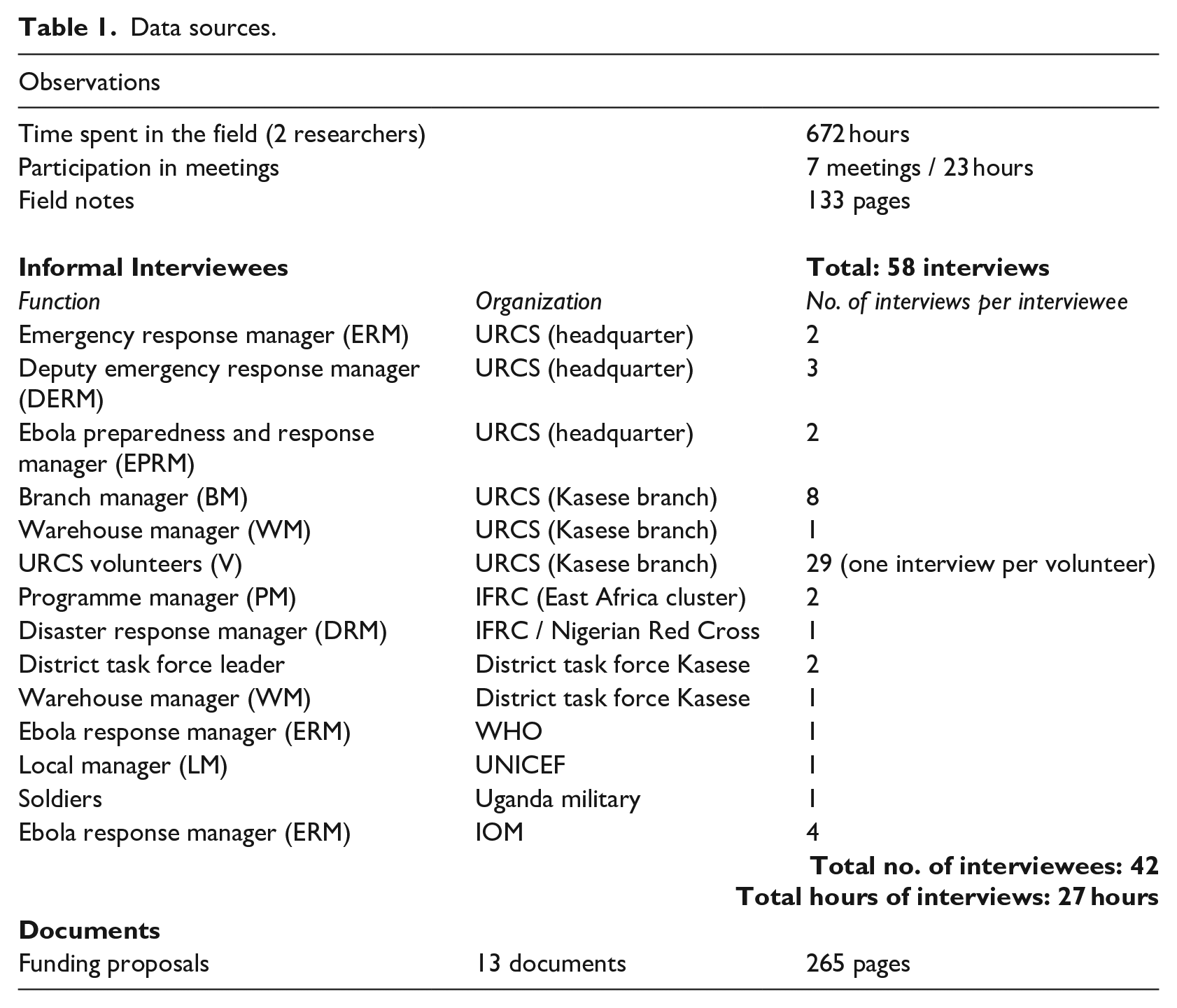
After familiarizing ourselves with the case and the particularities of the outbreak, we conducted a field visit to observe the operations of URCS in July 2019. This field visit occurred in the aftermath of the first Ebola outbreak in Uganda, allowing us to closely follow the ongoing operation at its peak. Consistent with studies of routine dynamics, the observations formed the most important part of our data collection (Dittrich, 2021; Feldman & Orlikowski, 2011). During these three weeks, we focused on observing how routines were enacted and how they were coordinated. To do so, we decided to shadow the branch manager of the local URCS branch who was responsible for the operation in Kasese and the volunteers working under her leadership. By shadowing the branch manager and the URCS volunteers, we observed the operation at 18 screening points located alongside the border, thereby gaining a detailed understanding of how these screening points were established, how they were supplied and how the screening procedure took place. Conducting the research as a team allowed us to focus on different aspects and to observe activities at different locations at the same time.
As part of our observations, we conducted informal interviews (Spradley, 1979) with a large number of people involved in the operation, covering a wide range of URCS staff across different hierarchical levels (particularly with URCS volunteers who were performing most routines), as well as members of the International Federation of Red Cross and Red Crescent Societies (IFRC) who were supporting the operation. Moreover, we informally spoke to members from other agencies involved in the operation. These informal interviews were held throughout the day during observations whenever time permitted – for example, while driving to another location, during walks along the border or as part of the observations – and lasted between 15 and 90 minutes. After returning from Kasese, we also observed members of URCS and IFRC involved in the administrative and financial parts of the Ebola operation in the URCS headquarters in Kampala for four days, providing us with detailed insights into the operation’s backbone. In addition, as is typical for observational studies (Spradley, 1979), we had dozens of informal conversations each day that also found their way into our field notes.
Data analysis
To answer our research question, we relied on an abductive approach to analysing our data, combining our theory-informed focus on routines, coordination and the timing of interfaces with a more open approach to reveal what routine participants actually did to coordinate multiple routines (Locke, Golden-Biddle, & Feldman, 2008; Sætre & Van de Ven, 2021; Timmermans & Tavory, 2012). Hence, our data analysis unfolded in three steps. Consistent with studies of routine dynamics, our unit of observation consisted of the actions taken by actors, whereas the unit of analysis were the patterns of actions (routines) which emerged from these actions (Kremser & Geiger, 2024).
In the first step, we aimed to identify the central routines that were enacted as part of the operation. We quickly noticed that some actors had shifting roles, being involved in more than one routine (Kremser & Blagoev, 2021). Therefore, we could not rely on the observation of actors but had to code for single action steps instead (Pentland, Hærem, & Hillison, 2010) that we either observed in the field or reconstructed from the interviews. Following Kremser, Pentland and Brunswicker (2019), an action step was coded as belonging to the same routine if the action built the immediate, situation-specific context for the next. Conversely, two actions were considered part of different routines if the successful accomplishment of one action did not rely on situation-specific information about the other. For example, the action ‘drafting the situation report’ precedes the action step ‘calculate budget’; without a situation report no budget can be calculated since it builds on the information from the report (how many people are affected, and so on). Both action steps, hence, build the immediate, situation-specific context for each other and therefore were coded as belonging to the same routine (screening). However, the action step ‘assessing if new funds are necessary’ and the action ‘receiving report on loopholes’, for example, do not rely on situation-specific information from each other and are hence coded to be part of different routines (screening and setting up screening points). This coding procedure resulted in the identification of four routines that were enacted by URCS members in the response operation: (1) funding; (2) setting up screening points; (3) screening; (4) supplying.
Second, given our interest in the coordination of multiple routines, we analysed the interrelations of these four routines. It quickly turned out that the four identified routines were highly interdependent, and their coordination relied on specific interfaces. Going back to the literature on routine clusters helped us in sharpening our analytical focus on the interfaces between the four routines since they are key to an understanding of how coordination unfolded (Rosa et al., 2021). Informed by the literature on routine clusters, it is important to note that these interfaces do not exist outside of routines but instead are part of the performance of a focal routine, which triggers the performance of the complementary interrelated routine. As Kremser et al. (2019, p. 82) put it: ‘interdependence within and between routines “happen[s] on the level of action steps”’. More specifically, we analysed which action step of one routine built the interface to the related, complementary action of the interrelated routine. This allowed us to identify which action step in which routine marked the interface to another related routine, i.e. which action step needed to be concluded so that another, related routine performance could be accomplished. For example, the action step ‘calculating budget, no. of necessary screening points’ of the funding routine builds the interface to the setting up screening points routine since it determines how many volunteers can be recruited to staff the screening points (action step: recruiting volunteers). We could thus identify five interfaces between the four routines, which we labelled as I1, I2, I3, I4, I5 (see Figure 1). Moreover, we depicted which action steps were enacted as part of these interfaces (interface action step; see codes in Table A in the appendix). In doing so, we were keen to identify which interface action step built the boundary to the related interface action step of the other routine. Therefore, each interface consists of two interface action steps, one in each of the related routines. To account for these two interface action steps making up the interface, we extended our numerical code. For interface I1, for example, the corresponding interface action steps would be I1.1 (calculate budget for response plan of action/number of necessary screening points) and I1.2 (recruiting volunteers to staff screening points) respectively. I1.1 builds the interface action step of the funding routine with the setting up of screening points routine, while I1.2 marks the interface action step of the setting up screening points routine with the funding routine. Identifying these interface action steps was crucial for the subsequent stage of our analysis.
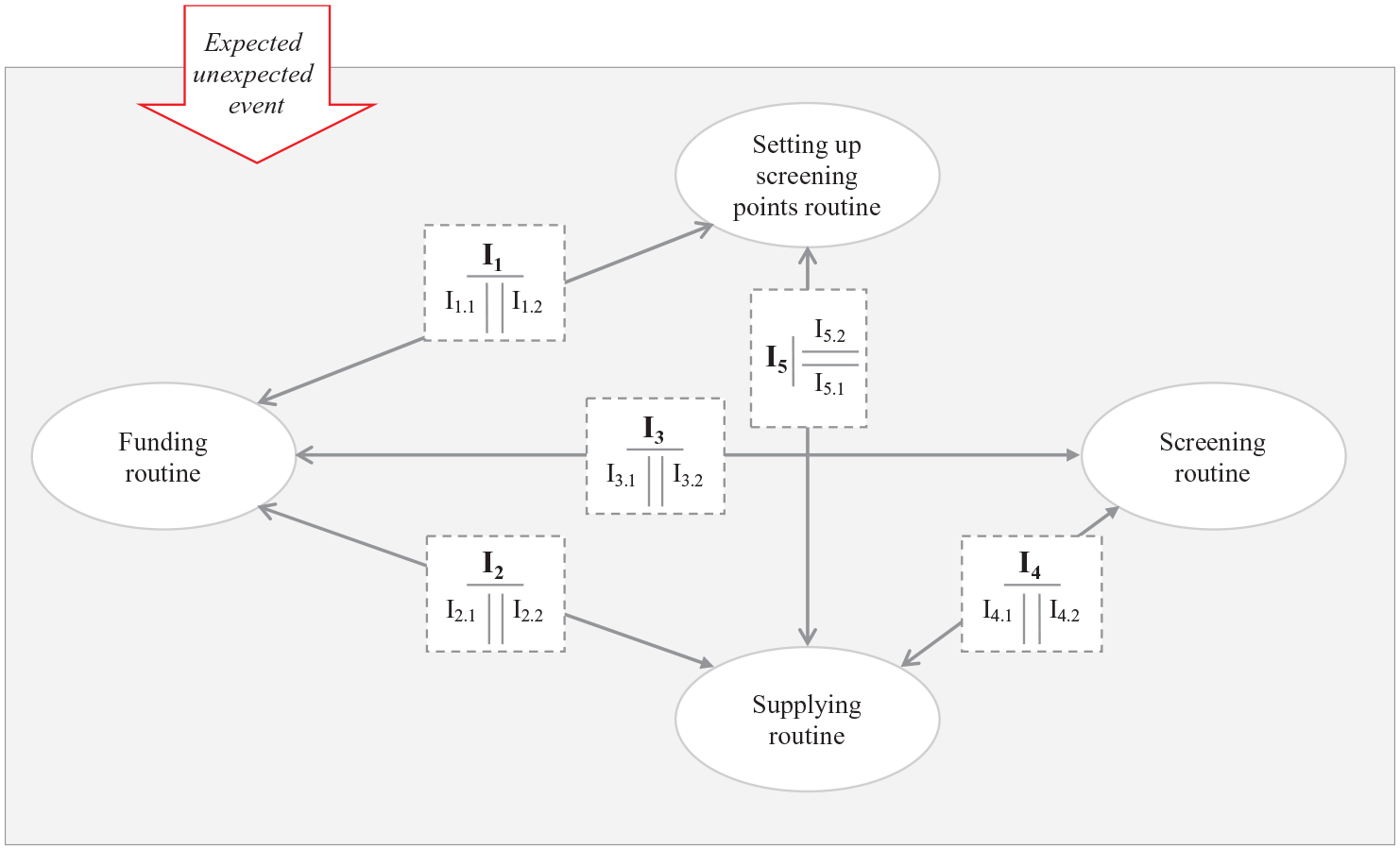
Ebola operation routine cluster and interfaces.
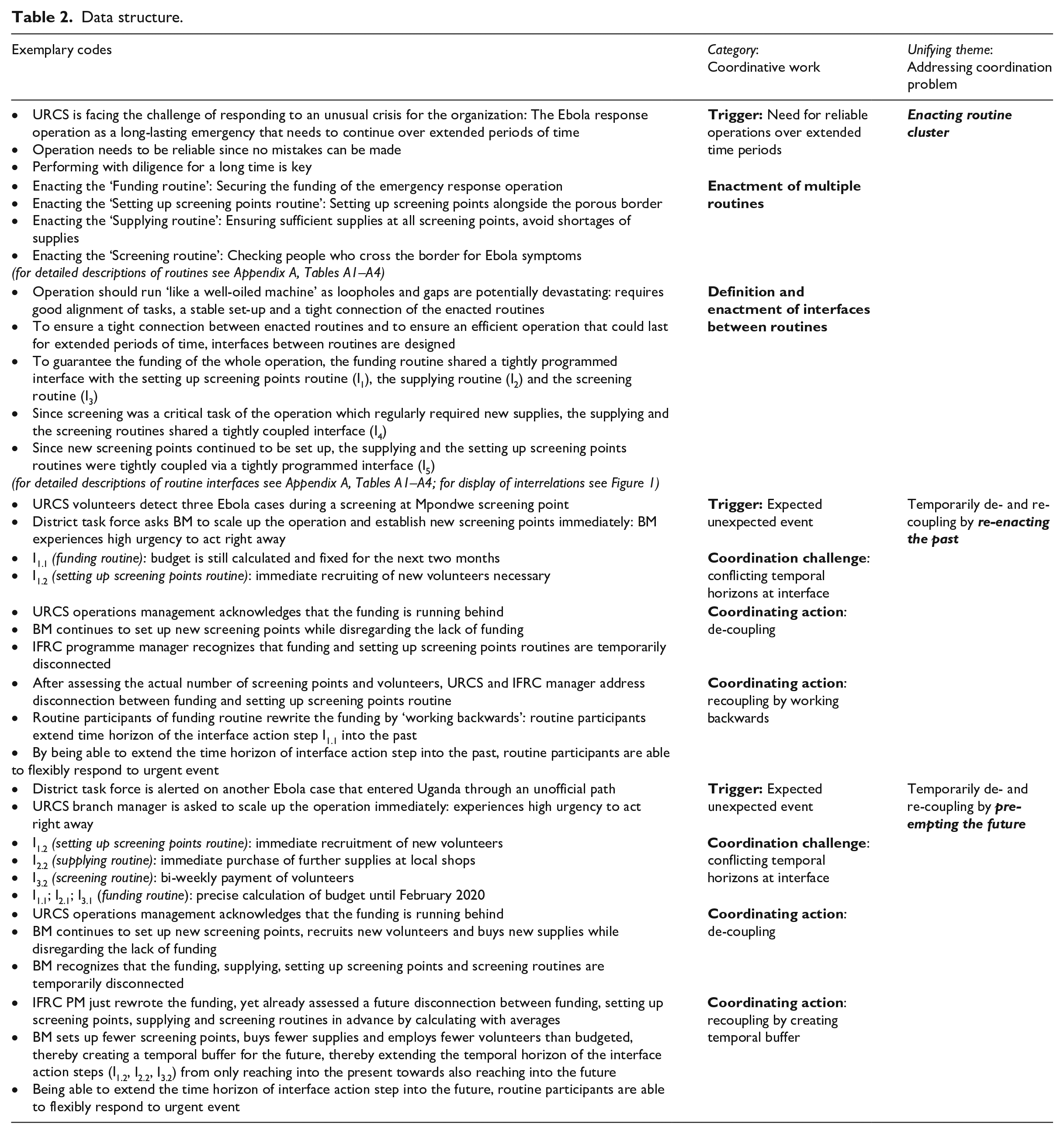
Third, since we were interested in how multiple routines were coordinated in sustained crises, we used the critical incident technique (see Bott & Tourish, 2016; Kremser & Schreyögg, 2016 for a similar approach) to identify critical situations that challenged the reliability of the identified routine cluster. After having identified a number of incidents, we then decided to focus our subsequent analysis on the ones our interviewees perceived as the most severe and problematic. We were interested in understanding how these events affected the coordination at the interfaces between the four routines. Informed by our theoretical toolkit of time and temporality, as developed above, we aimed to analyse how routine participants were addressing the temporal horizons of interface action steps by reaching into the past and/or future. With the temporal horizon, we refer to how deep the routine participants, in performing an interface action step, reach into the past and/or future (Schultz & Hernes, 2020). For example, the funding routine looked six months into the future since this is the common duration of a funding period, and hence its interface to the related routines had a temporal horizon of six months into the future. Our analysis of the critical incidents revealed that differences in the temporal horizons of interface action steps turned out to be a coordination problem that needed to be addressed. Based on our critical incident technique, we started by identifying events that triggered coordination problems (trigger). We then aimed to uncover how these translated into a coordination problem for routine participants (coordination challenge). Next, we were interested in how these coordination problems were addressed by routine participants at the interfaces (coordinating action) by reaching into the past and/or future. Similar observations with regard to these categories in our data were grouped into each of the identified categories (trigger; coordination challenge; coordinating action). Subsequently, each specific category was then summarized into one unifying theme (Miles & Huberman, 1994). Table 2 provides an overview of our data structure that we also used to structure our findings section. Table A in the appendix provides a detailed overview of the identified routines with the respective action steps, the interfaces, interface action steps and the temporal horizon of the interface action steps.
Data structure.
Findings
Our findings section is structured in two parts. First, we show that in order to achieve reliable operations over extended periods of time, URCS enacted a cluster of complementary routines that were connected via interfaces. Second, we uncover how participants increased the temporal complexity of this cluster to be able to flexibly respond to unexpected events that threatened the continuity of the operation.
Enacting a routine cluster
In response to the Ebola outbreak in neighbouring DRC, preventing the spread of Ebola into Uganda was the primary concern of URCS. To achieve this, it was decided that all people crossing the border from DRC to Uganda should be screened for Ebola symptoms and, if symptoms were detected, they were referred to an Ebola treatment unit for further testing and isolation.
Need for reliable action over extended time periods
The Ebola response operation was considered to be very distinct from the normal work of URCS and presented the organization with novel coordination challenges. The responsible emergency response manager explained: “This operation is really new for us. . . . Normally, in emergency responses, we deal with floods or landslides . . . But this is always short term. Ebola is a whole lot different: we knew from the beginning that this can last for quite some time . . . and we cannot make any mistakes here. You know, if just one positive case passes the border, it is critical.”
Upholding reliable operations over extended periods of time became a key concern of URCS, as the programme managers expressed: “We need to operate reliably here since we cannot make any mistakes, the whole country depends on us. Unlike rescuing people from floods or distributing relief items after natural disasters, here we have to perform with diligence for [a] long [time].”
At the same time, members were aware that they did not know how the situation might develop, as the Ebola preparedness and response manager said: “It is really unknown at this stage how it will develop in DRC and where. We start now with a couple of screening points alongside the border, but how many we actually need and how long this will be necessary is unclear.”
As our data analysis reveals, the alignment to ensure reliable operations over extended periods of time was achieved by enacting a routine cluster (see Figure 1 for the cluster and the interfaces between routines).
Enactment of multiple routines: To ensure reliable operations over extended periods of time, URCS enacted four complementary routines, which were connected through programmed interfaces (see Table A in the appendix for a detailed description of the routines).
(a) The funding routine: The main task of the funding routine was to ensure that the entire operation was supplied with the necessary monetary resources. As the responsible IFRC disaster response manager explained: “URCS does not have any funds of their own to run such an operation . . . Ensuring funding is the first and foremost thing to do.” The funding routine was first enacted on 7 August, 2018 with the start of the Ebola outbreak in DRC. At the time of our engagement, the operation was funded through a so-called ‘international appeal’ that was launched on 17 March, 2019. In order to calculate the amount of funding necessary, a rapid assessment of the situation was conducted and, based on this information, the URCS disaster response manager, together with the programme manager of IFRC, developed different scenarios of what could happen (i.e. how many people might potentially be affected by the outbreak) and what resources would be needed (i.e. supplies, number of volunteers required and number of screening points). After deciding on the most likely scenario, they calculated the necessary budget for the next six months, which is the standard funding period for an international appeal. Once the funding had been approved by IFRC, the funds were transferred into the URCS account and the operation could unfold for a duration of six months.
(b) Setting up screening points routine: The task of the setting up screening points routine was to establish sufficient screening points along the border between Uganda and DRC. This required information about the location of formal and, particularly, informal border crossing points. As the deputy emergency response manager explained: “Before we can start screening, we first need to identify where to set up screening points. Since this is a very porous border with many informal crossings, we need to make sure to cover those as well and set up our screening tents there.” Once the locations of screening points were identified, the necessary infrastructure for the screening had to be set up. At each screening point, URCS volunteers set up a tent, a station where people could disinfect their hands with chlorine water, and a thermometer to measure their body temperature. Once screening points were fully set up, the actual screening could be performed.
(c) The screening routine: The task of the screening routine was to ensure that every person crossing the border from DRC to Uganda got screened for Ebola symptoms. The screening routine started with URCS volunteers ensuring that every person who wished to cross the border first disinfected their hands, then their body temperature was taken with a thermometer. A volunteer taking the body temperature told us: “It is very important that we screen everyone who passes, even if it is hectic like on market days with so many people crossing. But this needs to be done diligently.” People were only allowed to proceed if their body temperature was below 38 °C; otherwise, volunteers would isolate the person and call for an ambulance to transfer the suspected case into an Ebola treatment unit for further testing.
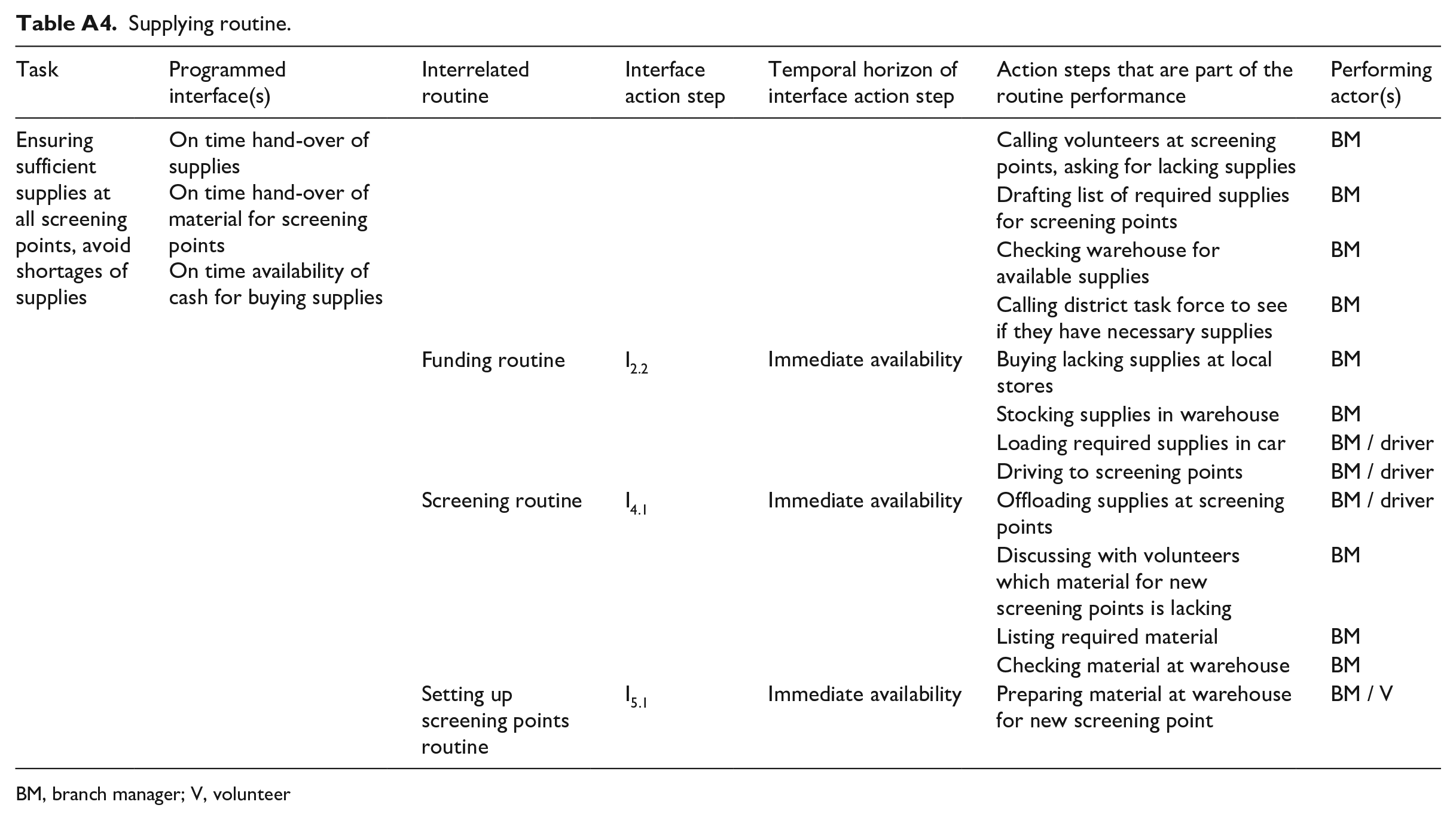
(d) The supplying routine: The main task of the supplying routine was to ensure a timely provision of supplies to screening points (existing and newly established ones). To do so, the branch manager regularly purchased necessary supplies such as face masks, chlorine for disinfection, thermometers and batteries from local vendors and stored them at the branch warehouse. She frequently contacted the volunteers at the screening points to find out whether more supplies were needed and subsequently stocked up with what was needed. Every day, when she visited the screening points by car, she took supplies with her, handing them over to the volunteers. As she explained: “Supplying the screening points is one of my main and critical tasks. As you have seen, the screening points are far away from each other, and it takes very long to get there, so I have to ensure that I bring the necessary supplies each time I come. Without them, they [the volunteers] cannot continue screening.”
Definition and enactment of interfaces between routines: A tight coordination of these four routines was seen as critical to ensuring a reliable operation, as the emergency response manager explained: “In this operation, all the tasks needed to be very well aligned. If we do not operate like clockwork, there will be loopholes and gaps which are potentially devasting. We have to ensure that everything is there and ready in time and that sufficient volunteers are available to screen at all times.”
Likewise, the Ebola preparedness manager pointed out: “Setting up this operation is different from our normal emergencies like floods or landslides. There, you apply for short-term funding and just start doing things more ad hoc. Here, we know that this operation can last for years, so we needed to establish an operation that runs like a well-oiled machine.”
The long-lasting nature of the emergency required a stable set-up which required a tight connection between the enacted routines, as a volunteer who was responsible for preparing chlorine water at the screening points noted: “You know, here everything is tightly connected, we depend on the others so much and for such a long time. Without a timely supply, we would have to stop, which is not possible because we cannot close the border point.”
As our data analysis shows, this tight interconnection between the four routines was achieved via interfaces (see Figure 1 for an overview of the cluster and Table A in the appendix for details). Since ensuring the necessary funding for the operation was critical, the funding routine shared a tightly programmed interface with the setting up screening points routine (I1), the supplying routine (I2) and the screening routine (I3). The interface action steps that were part of the funding routine were the calculation of the necessary budget for setting up screening points (I1.1), for providing sufficient cash to purchase supplies (I2.1) and for paying the volunteers who performed the screening (I3.1).
The setting up screening points routine depended on the interface with the funding routine in order to recruit the necessary volunteers [recruiting volunteers to staff SP] (I1.2); the supplying routine depended on the funding routine since the branch manager required sufficient cash to buy supplies [storing supplies needed at local warehouse] (I2.2); and the screening routine was interrelated with the funding routine since all volunteers who were performing screening needed to be paid [bi-weekly payment of volunteers] (I3.2). As the IFRC disaster response manager said: “Without cash in our accounts, we cannot pay volunteers, buy supplies or set up any screening points.”
Likewise, the supplying and screening routines shared a tightly coupled interface (I4): offloading the necessary equipment at the screening point built the interface, which enabled the volunteers to continue screening [offloading supplies at SP] (I4.1). Usually, volunteers performing the screening routine called the branch manager should they lack or nearly have exhausted the supplies, which built the interface to the supplying routine [calling BM in case of shortfall in supplies] (I4.2). Moreover, the supplying and the setting up screening points routines were coupled with a tightly programmed interface (I5): storing necessary equipment such as tents, chlorine and thermometers in the warehouse was a precondition for being able to set up screening points [preparing material at warehouse] (I5.1). Only if sufficient equipment was available in the warehouse, could it be loaded into the car and transported to the screening point which was to be set up [loading equipment in car] (I5.2). This tight programming of routine interfaces was seen as necessary to ensure an efficient operation that could last for extended periods of time.
However, as our analysis of the critical incidents revealed, this well-oiled cluster of routines was repeatedly challenged by expected unexpected events which, due to the urgency of these events, required immediate action. Our analysis of these critical events revealed two distinct ways in which the cluster of routines was coordinated should unexpected, urgent events threaten its well-aligned operation. Given our interest in the dynamics of the cluster, we studied what happened at the interfaces between routines in response to these critical events.
Temporarily de- and re-coupling by re-enacting the past to respond to emergencies
Expected unexpected event: The first Ebola cases. On 11 June 2019, URCS volunteers who were performing the screening routine at Mpondwe screening point detected three people showing Ebola symptoms. After isolating them, they were transferred to the closest Ebola treatment unit in Bwera/Uganda and tested for the virus. One day later, the cases were confirmed positive, hence marking the first three Ebola cases in Uganda. This was seen as a major concern, calling for immediate, urgent response efforts. In an emergency meeting with all involved partners on 12 June, the leading district task force called upon URCS to immediately scale up the operation and establish new screening points at the border to prevent people from entering the country without getting screened. As the district task force leader said during that meeting: “It is vital that we continue screening at the border with high diligence; no one shall slip through. URCS is mandated to scale up the operation and intensify the screening.”
Coordination challenge: Conflicting temporal horizons at the interface (I1). The need to immediately intensify the border screening activities created a severe coordination problem at the interface between the funding and the setting up screening points routines (I1). When the three cases occurred in Uganda, the situation on the ground became very urgent, as the URCS branch manager recalled: “After the positive cases, everyone was in crisis mode, and the public was very concerned.”
This led to a conflict between the temporal horizons of the interface action steps of the funding (I1.1) and the setting up screening points routine (I1.2). While the temporal horizon of routine participants at the interface action step of the funding routine (I1.1) reached six months into the future, and was supposed to reach into the future for another two months at the time of the event (because the operation had already been running for four months), the temporal horizon of routine participants in the interface action step that was part of the setting up screening points routine was oriented towards the immediate present and required the immediate recruitment of new volunteers (I1.2). Hence, the temporal horizons conflicted: immediate upscaling (I1.2) versus a calculated budget for six months (in this case, for another two months) (I1.1).
Coordinating action: De-coupling. URCS operations management was quite aware of the conflicting temporal horizons of these two interface action steps, as the responsible URCS Ebola preparedness and response manager explained: “We know that we currently lack the financial resources for those additional screening points. But there is no alternative; we cannot wait until August to set up new screening points and then apply for additional funds.” Or, as the branch manager said: “We quickly responded to the call from the district task force and set up these new screening points.” A volunteer operating at one of the new screening points said: “It was such an urgent situation. There was no possibility of waiting; we had to act now.” As a result, the branch manager simply decided to set up new screening points and thus disregarded the interface with the funding routine. She said: “You know, I actually do not really look into the funding documents. Usually, Kampala [URCS headquarters] tells me if we lack resources.” The IFRC programme manager confirmed: “you know, operation and financial system – they do not move in parallel”. As a result of this decision, the tight coupling between the two routines became de-coupled, and new screening points were established, irrespective of the lack of funds.
Coordinating action: Re-coupling by working backwards. This de-coupling of the funding and the setting up screening points routines was eventually addressed at a later stage, namely in August 2019, when the six-month funding period was drawing to an end. While assessing the number of screening points and the number of volunteers engaged in screening, the de-coupling between the funding and the setting up screening points routines became apparent: “It became clear that in total we had 418 instead of 184 volunteers engaged in screening”, the URCS emergency response manager explained. To address this gap, the IFRC and URCS managers referred to the interface action step of the funding routine (I1.1), as they explained: “You work backwards and say, okay, now we are talking about actual Ebola cases in Uganda, which was the worst-case scenario back then.” By engaging in what they called ‘working backwards’, they referred to the worst-case scenario initially developed as part of the funding routine in March 2019. As the deputy emergency response manager said during the write-up: “We now go back to the original document and take the previously rejected scenario and refer to it for the new proposal. This way, we justify the new resources by working backwards.” This process of working backwards in the write-up was reflected in the funding document. The new proposal stated that ‘418 volunteers have been conducting screening’ (emphasis added). By working backwards, routine participants extended the temporal horizon of the interface action step into the past [calculate budget for response plan of action] (I1.1). It now was not only oriented towards the future (the next six months) but also towards the past (the last two months) by stating that 418 volunteers have been conducting screening. By extending the temporal horizon of the interface action step of the funding routine into the past, routine participants were able to re-couple the two routines in the present, thereby rectifying the de-coupling that took place in the past. Being able to re-couple in the present allowed the routine participants to respond to the urgent event flexibly. Routine participants were able to de-couple the tightly programmed interface since they knew that they were able to re-couple them at a later time and change the past in the future by working backwards. Or, as the IFRC programme manager put it: “Well, you know, we are aware that we need flexibility, and it somehow has to work out in the end.” In this case, the routine cluster was flexibly adapted by adjusting the temporal horizon of the interface action step to reach into the past and future.
Temporarily de- and re-coupling by pre-empting the future
Expected unexpected event: On 17 July 2019, the district task force discovered that another Ebola suspect had entered Uganda – this time through an unofficial route, which explained why the person was not detected during screening. The person was identified as a fishmonger who had spent the day at the market in Mpondwe and later returned to DRC, where she then was diagnosed positive. As she was in close contact with many people at the market, there was a high risk that she had infected others. As a result, the district task force was on high alert and called for an immediate coordination meeting to discuss the matter: “It looks like we still have not sufficiently managed to close this porous border in the district. Cases continue to increase in the DRC; we have to be on high alert and very aware of the risk we expose our communities to”,
the leader of the district task force stressed during a district task force meeting. “I would ask that URCS closes these gaps we still have.”
Coordination challenge: Conflicting temporal horizons at the interfaces (I1; I2; I3). The need to immediately close the informal border crossing points created a severe coordination problem at the interface between the funding, the setting up screening points, the screening and the supplying routines. Closing the porous border meant that URCS had to set up and operate a large number of additional screening points, which required the immediate recruitment of additional volunteers (I1.2). It further entailed that additional supplies were immediately required to set up and equip the new screening points. Since these additional supplies were unavailable in the warehouse, the URCS branch manager had to buy them at local shops (I2.2). Moreover, to perform the screening at the new screening points, the branch manager had to recruit 18 new volunteers who needed to be paid bi-weekly (I3.2).
This immediate response, which affected the interface of the screening, the supplying and the setting up screening points routines, conflicted with the temporal horizon of the corresponding interface action step of the funding routine (I1.1; I2.1; I3.1). Even though the occurrence of another Ebola case in Uganda was somehow expected, it had not been considered in the writing up of the funding proposal. Instead, the calculated budget (I1.1; I2.1; I3.1) had been very precise: “As you have seen, the funding proposal is very precise, asking for 418 volunteers, covering screening points until February 2020. This was needed since this is a long, ongoing situation and not an acute emergency . . . So, we had to have rigour here,”
the deputy emergency response manager explained. “We cannot accommodate these unknowns in the funding”, the IFRC disaster response manager stressed: “Our back donors want precise numbers.” Hence, the temporal horizon of routine participants at the interface action step reached six months into the future and specified precisely the number of volunteers for this period (I1.1; I2.1; I3.1). This conflicted with the temporal horizon of the interface action step of the setting up routine: here, routine participants had a temporal horizon that reached into the immediate present since this called for the immediate recruitment of new volunteers (I1.2). Likewise, the temporal horizon of routine participants at the interface action step of the supplying routine reached into the immediate present and required new supplies to be bought straight away (I2.2). Similarly, the temporal horizon of routine participants at the interface action step of the screening routine reached into the immediate present and required the immediate payment of the newly recruited volunteers who were carrying out the screening (I3.2).
Coordinating action: De-coupling. Despite the conflicting temporal horizons at the interfaces between the routines, the branch manager did not waste any time after the district task force meeting and went to the warehouse to see what supplies were available. It quickly became clear that new tents and screening equipment needed to be bought: “As you see, our warehouse is almost empty. We have to get at least four more tents, and we also lack thermometers, face masks, chlorine, so basically everything. We now need to go and buy it.” By setting up and supplying new screening points, the branch manager directly followed the lead of the district task force without taking into consideration that there was no funding secured to scale up the number of screening points. As she said: “You know, it is like the situation in June. I am not consulting with Kampala for funds; we just have to do this; it is our mandate. The district task force is in the lead here.” As a result, the tight coupling between the four routines became de-coupled: new screening points were set up, additional volunteers were recruited, and new supplies were bought without any changes at the interface with the funding routine.
Coordinating action: Re-coupling by creating a temporal buffer. When the IFRC programme manager learned about the newly established screening points and the upscaling of the operation, she knew that there was nothing she could do at that point in time: “We just rewrote the funding.” Hence, the temporal horizon of the interface action steps of the funding routine (I1.1; I2.1; I3.1) remained unchanged. Interestingly though, as the volunteer responsible for overseeing the attendance sheets of the volunteers told us: “You know, right now, we have 442 volunteers that are conducting screening. But before these new screening points were set up, there were just 367.” The Ebola preparedness and response manager was quite aware of these fluctuations and explained: “We did not start with all 442 volunteers in the beginning. We always knew that at some point, we might need more.” As these quotes illustrate, managers were conscious that they would require flexibility to swiftly respond to new developments in the future. To demonstrate this flexibility, the routine participants changed the temporal horizon of the interface action steps of the setting up screening points (I1.2), the supplying (I2.2) and the screening (I3.2) from not only reaching into the present but also to pre-empt future developments. By setting up fewer screening points, buying fewer supplies and employing fewer volunteers than the funding would have allowed, a temporal buffer for future developments was created that allowed them to swiftly increase the operation in the present of the urgent event. To create such a buffer, routine participants changed the temporal horizon of the interface action step from reaching only into the present (we need now) to also reaching into the future. This was possible because managers were aware that, in the future, the interface with the funding routine did not relate to the actual number of volunteers working on a specific day, but rather an average over a period of time, as the IFRC programme manager explained: “So, in theory, you write that you will cover 418 volunteers for this time, and then you budget for these, right? But then, when you receive the attendance sheet, you have to pay them, and you may never have 418 volunteers in the field on a specific day. You may have like 367 or like 440-something. And when you evaluate that, then you can play with the budget lines.”
This temporal buffer on the interface allowed for the re-coupling of the previously de-coupled routines in the future, and thereby created flexibility to respond to urgent developments in the present. As our analysis has shown, the cluster was adapted, with routine participants changing the temporal horizon of the interface action steps by pre-empting the future.
Figure 2 summarizes our findings and shows how a cluster of highly interrelated routines was able to accommodate a flexible response to expected, unexpected events that occur in sustained crises and that demand immediate attention.
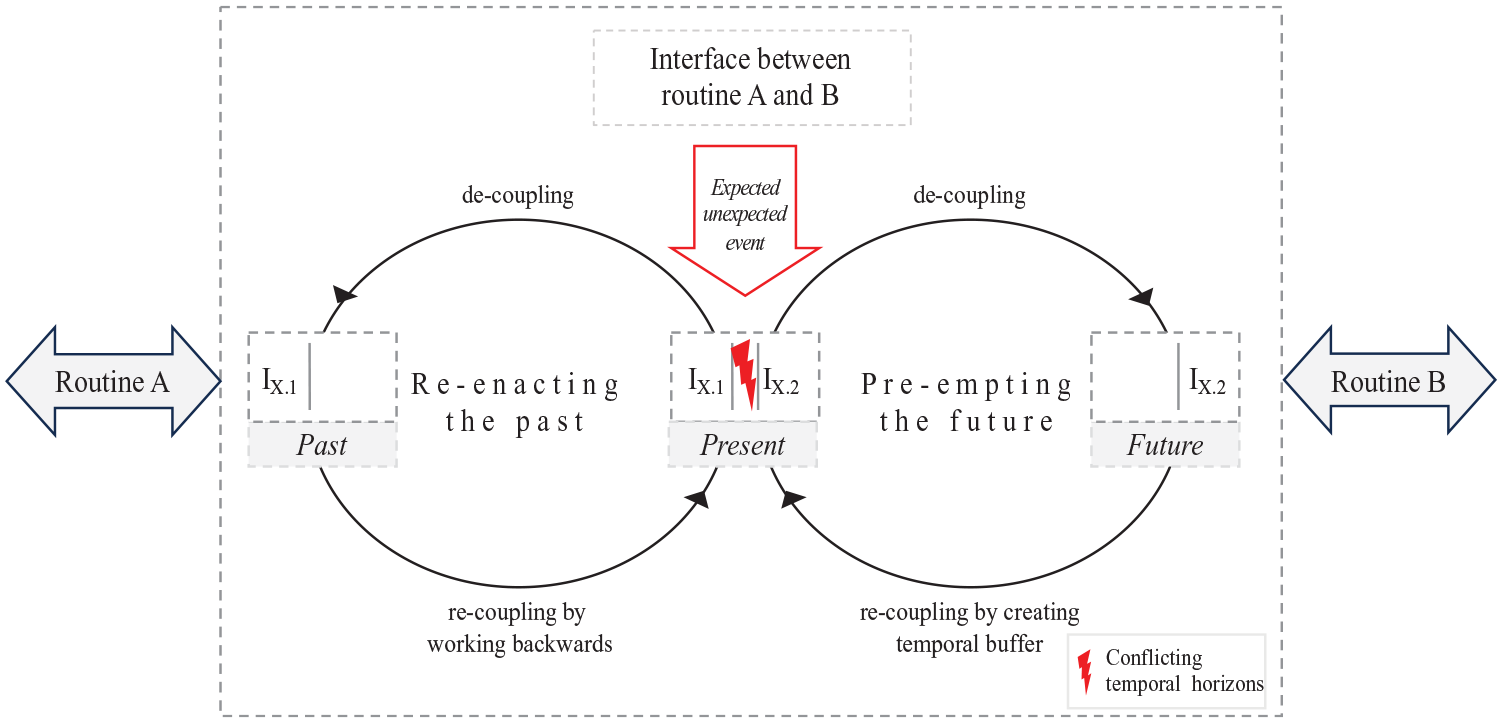
Flexibility of routine clusters in response to expected unexpected events.
Our study indicates that coordinating routines in sustained crises requires the coordination of a routine cluster to achieve reliable outcomes over prolonged periods of time. Unexpected events, however, that require an immediate response may trigger the emergence of conflicting temporal horizons between routines. As we show, these conflicting temporal horizons can be tolerated because routine participants temporarily de-couple interrelated routines. This de-coupling is possible because routine participants are aware that they can re-couple these routines by manipulating the temporal horizon. This way the cluster of routines is able to flexibly accommodate unexpected events by temporarily de- and re-coupling routines through manipulation of the temporal horizon of the interfaces.
Discussion
In this paper, we seek to answer the question of how multiple routines are coordinated in response to long-term, sustained crises to achieve collective action. Our findings allow us to make two contributions that help us better understand how collective action in sustained crises is coordinated. First, we contribute to research on the coordination of routine clusters in sustained crises which are temporally complex. By introducing the notion of tolerating temporal conflicts, we challenge existing insights on the stability of routine clusters. As we argue, the ability to tolerate temporal conflicts increases the cluster’s temporal complexity; in this way, routine clusters can be flexibly coordinated in sustained crises that are themselves temporally complex. Second, we challenge existing thinking around the need for temporal alignment of routine performances by introducing the concept of temporal manipulation. This refers to the agency routine participants are able to exercise to purposefully manipulate the past and future in collective routines. Here, coordination is not – as is commonly assumed – achieved by aligning temporalities but, instead, by rendering the manipulation of time (instead of alignment) as a means of coordination. Together, these insights allow us to understand how a cluster of highly interrelated routines is coordinated in sustained crises that require the enactment of reliable outcomes over extended periods of time while at the same time being able to respond to urgent developments.
Flexible coordination of routine clusters by tolerating temporal conflicts
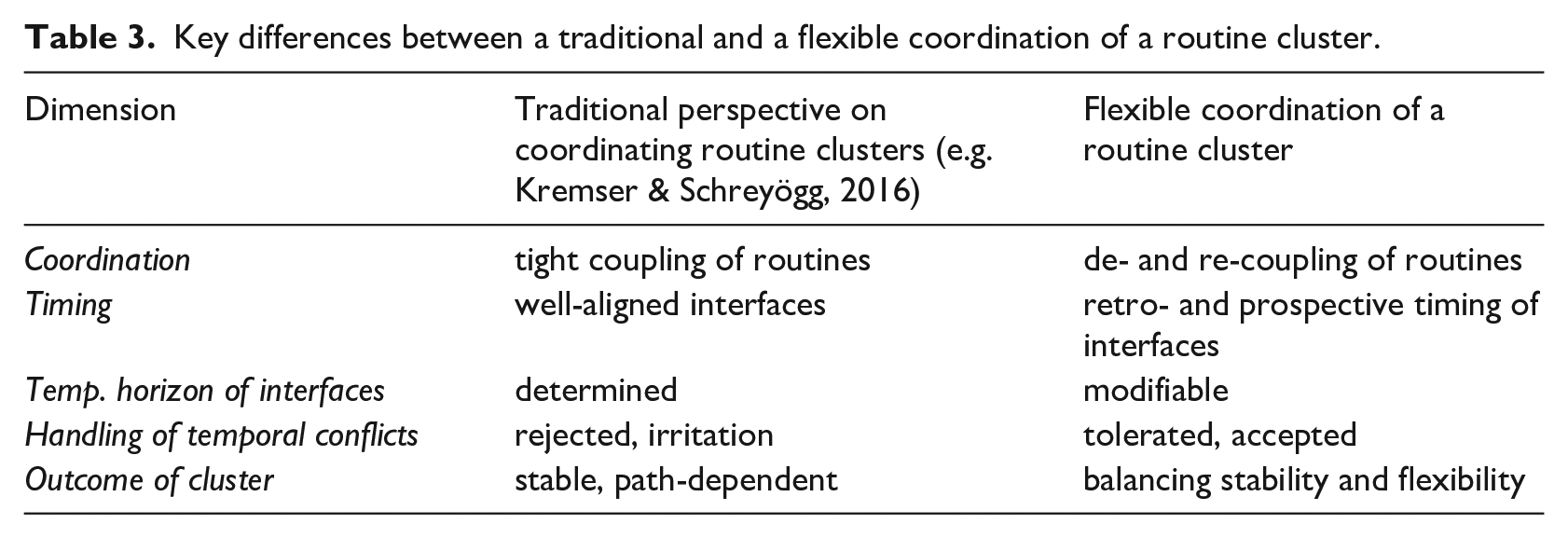
Prior research has shown that coordinating collective action over extended periods of time requires the coordination of a cluster of highly interrelated, complementary routines (Kremser & Schreyögg, 2016; Rosa et al., 2021). Typically, in such a cluster, the coordination of interdependencies is achieved through a tight coupling of interfaces between routines. This requires that the timing of interface action steps is well aligned to ensure a smooth handover at the interface (Kremser et al., 2019). As prior studies have argued, any temporal conflict that might arise at the interfaces of routines is rejected within the cluster, implying that deviations from the existing temporality will ultimately be disregarded (Kremser & Schreyögg, 2016; Turner & Rindova, 2018). Studies have found that where patterns of routines do not rely on the same temporality, irritations occur that render the cluster less flexible (Sailer, Loscher, & Kaiser, 2024, p. 1907). As a result of this rejection of temporal conflicts, a routine cluster is commonly assumed to be stable, leading to potentially path-dependent outcomes (Kremser & Schreyögg, 2016).
We challenge this commonly held assumption by arguing that through tolerating temporal conflicts the tight coupling of highly interrelated routine interfaces can be de-coupled. In our case, instead of rejecting incompatible temporal horizons that threaten the timing of interfaces and cause irritation, conflicting temporalities were tolerated. This tolerating of temporal conflicts allowed a de-coupling of highly interrelated routines, which could then be performed independently of each other, allowing them to respond flexibly to urgent developments in the coordination of the routine cluster. Table 3 summarizes the key differences between the cluster as stable and our perspective on flexible clusters.
Key differences between a traditional and a flexible coordination of a routine cluster.
Our findings demonstrate that the coordination problem, resulting from the different, conflicting temporal horizons, was not addressed by immediately resolving the conflict through processes of negotiating (Slawinski & Bansal, 2015) or by entraining to one dominant temporality (pacer) (Pérez-Nordtvedt, Payne, Short, & Kedia, 2008). On the other hand, at least theoretically, it would have been possible to, for example, change the temporal horizon of the funding routine to a much shorter future horizon to better align it with the temporal horizon of the screening routine. This would then require frequent updates of the funding routine, thus affecting the entire cluster by diminishing its capability to achieve reliable outcomes over extended periods of time. Instead, the ability to tolerate temporal conflicts ensured the continuity of the operation.
These insights have the potential to extend our perspective on how coordination unfolds in sustained crises that are temporally complex (Bansal et al., 2022; Kunisch et al., 2021). It is important to note that the ability to tolerate the co-existence of conflicting temporal orientations differs from concepts such as ambitemporality (Reinecke & Ansari, 2015) or temporal ambidexterity (Slawinski & Bansal, 2015). Ambitemporality and temporal ambidexterity refer to the ability of organizations to incorporate multiple temporalities (Reinecke & Ansari, 2015, p. 640), thereby describing how organizations engage in temporal brokerage or temporal negotiation to navigate through temporal complexity. Through temporal brokerage, conflicting parties develop a ‘coincident interpretation’ (Reinecke & Ansari, 2015, p. 640), which suggests that temporal conflicts strive to coincide.
Our notion of tolerating temporal conflicts, however, departs from this understanding and develops the idea that organizations can simultaneously process differing temporalities for extended periods of time without striving for any kind of harmonization or brokerage between these conflicts. Instead, tolerating temporal conflicts allows actors to simultaneously process the non-simultaneous (‘Gleichzeitigkeit des Ungleichzeitigen’) (Baraldi, Corsi, & Esposito, 1997, p. 215). This simultaneous processing of the non-simultaneous allows actors to deal with a higher degree of temporal complexity (Luhmann, 1995). As systems theory argues, the ability to simultaneously process different temporalities increases the capability to process complexity (Blagoev & Schreyögg, 2019, in press; Luhmann, 1995), which enables organizations to be better equipped for dealing with sustained, temporally complex crises (Kunisch et al., 2021). The ability to tolerate temporal conflicts, hence, allows routine clusters to deal with temporally complex, sustained crises.
Temporal manipulation versus temporal alignment in coordination
Prior studies have commonly assumed that the successful coordination of multiple routines requires getting the timing of outcomes right (Geiger et al., 2021; Turner & Rindova, 2018). More generally, in studies on coordination, it is assumed that temporalities need to be aligned for successful coordination. This is achieved either by relying on clock-time (at the same time) or on event-time (triggered by the same event) to coordinate interdependent activities (Turner & Rindova, 2021). Studies on temporal work have shown that in processes of coordination, shared temporal structures such as calendars or harvesting cycles are created and re-created to support the alignment of interdependent tasks (Orlikowski & Yates, 2002).
Our study departs from this idea of temporal alignment and makes the case that routine participants have the ability to exercise agency by purposefully manipulating time itself to achieve coordination. Such a perspective builds on an agentic view of time (Emirbayer & Mische, 1998, p. 970) that has consistently argued that past and future are not fixed points in time but instead are continuously created and re-created through situated present activity (Hernes & Schultz, 2020). The critical argument for our context is that past and future are, like the present, enacted and hence are created and re-created through time (Hernes, 2016; Wenzel, Krämer, Koch, & Reckwitz, 2020).
Our findings build on this perspective and relate it to the coordination of routines by showing how routine participants have agency in purposefully manipulating past and future in an effort of coordinating. By purposefully manipulating past and/or future in the present, routine participants, as ‘agents of time’, are manipulating time itself in order to achieve coordination. Here, coordination is not accomplished by relating between temporalities (as in clock- or event-time); instead, time itself is subject to manipulation in processes of coordination. Such a notion of purposeful manipulation of time for coordination not only builds on the general, theoretical insight that past and future are the result of a situated activity in the present (Hernes & Schultz, 2020) but also makes the important point that actors are aware of and reflexive towards this process and hence can manipulate it according to their own needs. Figure 2 shows how routine participants, in being reflexive about the construction of time, are able to intentionally manipulate the past by re-enacting it in the present, or how they manipulate the future in the present by pre-empting future developments in the present. Quite interestingly, our study has shown that routine participants were aware that past and future are ‘their own creation’ and hence used this insight to manipulate past and/or future in the present. Seen this way, past and future are not only the result of situated activity, but actors can be reflexive about this process and hence manipulate it deliberately and intentionally intervene in this process to achieve coordination. Hence, our study shows not only that time is enacted as part of routine performances but, more importantly, that routine participants, as ‘masters of time’, are able to be reflexive about this process, which puts them in a position to purposefully manipulate time for coordinating. Exercising agency in manipulating time seems to be – as our study has shown – particularly important for being able to successfully coordinate multiple routines in temporally complex settings such as sustained crises. Here, aligning with dominant pacers does not work since temporalities may differ and are potentially conflicting.
Conclusion
In this paper, we have explored how multiple routines are coordinated in sustained, prolonged crises. We depart from prior research by showing, on the one hand, that sustained crises require the coordination of routines through defined interfaces in a routine cluster and cannot rely on ad hoc coordination. On the other hand, we reveal how clusters are not necessarily stable and path dependent but instead can allow for flexible responses to unexpected, urgent events. Embracing conflicting temporal orientations at the interfaces between routines and the ability to purposefully manipulate past and/or future are key ingredients for coordinating multiple routines in prolonged crises. Our paper thus shows how stability and flexibility are balanced in the coordination of collective action in sustained crises.
However, our study is not without limitations. First, our data set lacks a longitudinal perspective, which would have allowed us to potentially observe additional coordination challenges to those we identified. We tried to mitigate this shortcoming by asking our informants about what they had done in the past and how their current actions aligned with this. Moreover, the project is part of a longer-lasting research collaboration with URCS, which gives us deep and thorough insights into the organization for extended time periods and allows us to put our observations into perspective. Second, we acknowledge that by focusing on one focal actor, URCS, we could only partially grasp the entire complexity of the crisis response operation involving multiple partners. We would assume that by enlarging the perspective, the coordination problems observed in this study would be more severe and complex, and the ability to embrace conflicting temporal orientations and to manipulate time might have played an even more important role. Hence, it would be very interesting to explore how our findings play out in the performance of multiple routines across organizations.
Footnotes
Appendix: Descriptions of routines
Supplying routine.
| Task | Programmed interface(s) | Interrelated routine | Interface action step | Temporal horizon of interface action step | Action steps that are part of the routine performance | Performing actor(s) |
|---|---|---|---|---|---|---|
| Ensuring sufficient supplies at all screening points, avoid shortages of supplies | On time hand-over of supplies On time hand-over of material for screening points On time availability of cash for buying supplies |
Calling volunteers at screening points, asking for lacking supplies | BM | |||
| Drafting list of required supplies for screening points | BM | |||||
| Checking warehouse for available supplies | BM | |||||
| Calling district task force to see if they have necessary supplies | BM | |||||
| Funding routine | I2.2 | Immediate availability | Buying lacking supplies at local stores | BM | ||
| Stocking supplies in warehouse | BM | |||||
| Loading required supplies in car | BM / driver | |||||
| Driving to screening points | BM / driver | |||||
| Screening routine | I4.1 | Immediate availability | Offloading supplies at screening points | BM / driver | ||
| Discussing with volunteers which material for new screening points is lacking | BM | |||||
| Listing required material | BM | |||||
| Checking material at warehouse | BM | |||||
| Setting up screening points routine | I5.1 | Immediate availability | Preparing material at warehouse for new screening point | BM / V |
BM, branch manager; V, volunteer
Acknowledgements
We kindly acknowledge the support of the Uganda Red Cross Society and Alex Mugyisha in particular for providing us access to this exciting field and for the long-standing research collaboration. Moreover, we are thankful for the great guidance we received from the Editorial Team of this Special Issue, and we are indebted to our three reviewers for their critical eye and great suggestions how to sharpen the contribution of the paper. The paper has benefitted from feedback of participants of the EGOS SWG 14 2021 conference in Amsterdam and we have received valuable feedback from Jochen Koch, Iris Seidemann, Lorenzo Skade, Anja Danner-Schröder and Samer Faraj. We have not received any specific funding for this project.
Funding
The author(s) received no financial support for the research, authorship, and/or publication of this article.
