




Abstract
The sustainability transformation of the food system involves imagining a sustainable future whilst functioning within the current unsustainable food system. Some argue there is a difference between the goal-oriented and comfort seeking form in which the near future is engaged, and the reflexive, imaginary way in which the distant future is engaged. This begs the question, how is engagement with near and distant futures balanced, and what does this mean for the overall sustainability transformation of the food system? We studied future engagement in practices of food entrepreneurship in the Dutch province of Flevoland during the disruption caused by the covid-19-induced lockdowns. This disruption posed a challenge and an opportunity to study near and distant future engagement in depth. Through an online survey and offline semi-structured interviewing, we questioned practitioners of sustainable food entrepreneurship during the first and second lockdown, respectively. The findings show near future engagement is mostly associated with immediate change in practices enforced by the covid-19 lockdown, whereas distant future engagement primarily was visible in continuous change in practices as associated with sustainability. However, this does not mean near and distant future were perfectly balanced. Therefore, we argue pre-existing trends with regards to sustainability can be accelerated or obstructed when they meet the immediate effects of disruption. Our paper concludes by stating the need for more research to the interaction of near and distant futures in different contexts and circumstances.
Introduction
Sustainability transformations of the food system pose a conundrum. On the one hand, they require aspiring to sustainable food systems in a distant future. On the other hand, these distant futures are not realized overnight. Those actors that are best situated to change the food system and make distant imaginaries come to fruition, also have to operate within the current food system which demands dealing with the near future. This begs the question, how is engagement with near and distant futures balanced, and what does this mean for sustainability transformations of the food system? In this paper, we aim to answer this question by studying future engagement in practices of food entrepreneurship. Particularly, during the disruption as caused by the covid-19-induced lockdowns in the Dutch region of Flevoland. Food entrepreneurship requires bearing the costs of uncertainty (Dimov, 2018): it involves aspiring to a more sustainable distant future whilst at the same time dealing with various uncertainties of the current food system. Flevoland is particularly relevant to study food entrepreneurship due to its history of food entrepreneurship and agricultural production (Vriend, 2014). Furthermore, its capital Almere positions itself as a growing green city, and actively stimulates sustainable food entrepreneurship (Van der Gaast et al., 2020).
We have a practice-based understanding of entrepreneurship. This means we consider entrepreneurial practices of food (e.g. producing, processing but also selling and managing) as the unit of analysis instead of individual entrepreneurs (Gross and Geiger, 2017; Thompson et al., 2020). Entrepreneurial practices only endure when they are reproduced over time (Nicolini, 2017), and are therefore always evolving and continuously changing over time (Claire et al., 2019). Furthermore, social disruptions can cause immediate and enforced changes in practices because adaptation is required to the ‘new normal’. By studying practices during a disruption, we can explore how future engagement feeds into the immediate changes and continuous changes in practices. To capture future engagement for the near and distant future, we conceptually build on ‘modes of future engagement’ (Mandich, 2019; Welch et al., 2020) and ‘material temporality’ (Hernes et al., 2020). These concepts appreciate the imaginative properties of future engagement in envisioning a distant sustainable future, as well as the more anticipatory way to deal with the near future through the maintenance of daily operations in the current food system. At the same time, both appreciate the boundedness of future imaginations within situated practices.
The disruption as caused by the covid-19 outbreak shaped our methodology as well. The covid-19 pandemic incited two (partial) lockdowns in the Netherlands that caused a major social and economic disruption. The first started in March 2020 and ended in June 2020. The second started in October 2020 and ended in April 2021. As a disruption, it posed both a constraint and an opportunity for our research. It offered an opportunity to explore the role of future engagement in changing practices during disruption in a more in-depth manner. At the same time, it also limited access to research participants. Therefore, we conducted a survey after the first lockdown as a means of safe structured interviewing. Through this survey, we gained a snapshot of general expectations of the future in terms of economic and sustainability prospects, as well as immediate changes due to the disruption. Following, we conducted interviews during the second lockdown to gain more in-depth understanding to how future engagement hangs together with (changing) practices in times of disruption.
In the next section, we explain our conceptualization of near and distant future engagement and our practice lens to disruption and change. This is followed by an explanation of the methods in which we further explain how the disruption of covid-19 shapes our research design. Following, we discuss our findings in which we first discuss the changes that have occurred in practices, after which we analyze near and distant future engagement as an element of this change. Lastly, in our discussion, we will reflect on how near and distant future engagement are balanced in practices of food entrepreneurship and what this means for sustainability transformations of food.
Theoretical framework
In this section, we will first explain why we study future engagement within a practice ontology during a disruption. Second, we will introduce the theoretical foundations of future engagement on which we will built in this paper. Lastly, we will conceptualize engagement with near and distant futures to set up the method and analysis of this study.
Practice ontology and disruption
In this paper, we employ the practice lens as an infra language, i.e. as an heuristic device to generate understandings (Nicolini and Monteiro, 2017). The practice lens (or practice ontology) implies that practices are the unit of analysis instead of individuals (e.g. entrepreneurs or enterprises) (Claire et al., 2019; Gartner et al., 2016; Thompson et al., 2020). Entrepreneurial practices are not separated from but firmly grounded in wider everyday activities (De Clercq and Voronov, 2009; Johannisson, 2011), they are sets of sequentially ordered activities that are enacted or performed by various actors (Claire et al., 2019; Thompson et al., 2020). Furthermore, practices are bundled together to form larger constellations (Nicolini, 2010; Schatzki, 2011; Shove et al., 2012). A food enterprise for instance can emerge through the bundle of food production practices (e.g. weeding and harvesting) and administrative practices (e.g. finances and paperwork for certification). Practices are future oriented (Shove et al., 2012) and organized around certain ends and objects (Nicolini and Monteiro, 2017). For example, the performance of food production practices includes material components (e.g. harvesting machines) and is oriented towards certain goals (e.g. the quality of the product, being profitable).
This notion of ‘ends’ instills a sense of teleology or goal in its future orientation (Mische, 2009). However, the orientation towards certain ends does not mean that a deviation of goals is impossible (Nicolini and Monteiro, 2017). Practices are no fixed structures (Nicolini, 2017; Welch, 2017; Welch et al., 2020). As Nicolini (2017: 21) explains: ‘practices only exist to the extent that they are reproduced’. Practices change and continuously evolve because the actors that perform them adapt to ever changing circumstances, therefore they contain ‘the seeds of constant change’ (Warde, 2005: 141). Moreover, disruption and social upheaval can cause immediate enforced de- and re-routinization of practices (Brons et al., 2020; Spaargaren and Oosterveer, 2010). A discontinuity of social life requires adaptation to the ‘new normal’, which in turn incites changes in performances that could over time result in a reconfiguration of practices. In this paper, we will examine change in performances during a specific disruption, and study the future engagement that accompanies these changes.
Future engagement
The study of the future in social science is gaining momentum (Beckert and Suckert, 2021), which relates to the increasing importance of climate change and the uncertain future it poses (Oomen et al., 2021). This scholarship of the future provided a crucial addition to our practice lens. Practice theory assumes future engagement to be part of the ‘teleoaffective structure’ (Schatzki, 2002: 80) which incorporates normativity (what ‘ought’ to be done) and affectivity (emotions and feeling concerning what is to be done). This structure is tied to individual practices and not to individual practitioners. Schatzki (2002) gives an empirical example of herb production practices, where the labourers that performed these practices had personal opinions and emotions that coexisted but did not interfere with the common ends in their work. Welch et al. (2020) claim the teleoaffective structure fails to appreciate the role of reflexivity in future engagement. Similarly Mische (2009) argues that practice theories correctly show that actions are embedded in situated practices and imaginations of the future do not automatically lead to change, but they risk losing out of sight the imaginative, creative and willful in which thought and action are put together in new ways. Especially in times of uncertainty, such reflecting and thinking critically about the future is relevant (Beckert, 2013, 2016; Mische, 2014).
We draw on the concepts of ‘modes of future engagement’ (Mandich, 2019; Welch et al., 2020) and ‘material temporality’ (Hernes et al., 2020) to conceptualize engagement with near and distant futures. Both ‘modes of future engagement’ and ‘material temporality’ appreciate the boundedness of future imaginations within situated practices. At the same time, both make a distinction between engagement with near and distant futures that is absent in practice theory.
The ‘modes of future engagement’ concept embeds projectivity, the forward-looking element of human agency, in the social practices of everyday life (Mische, 2009; Mandich, 2019). Everyday life involves access to reality in different ways, which means the future is projected in different formats, or ‘modes’ of engagement (Mandich, 2019; Welch et al., 2020). Welch et al. (2020) illustrate this through the example of laundry practices. In the performance of laundry practices, there is an unconscious pull towards what is convenient and familiar. At the same time, the performance of this practice is planned in accordance to other practices (e.g. other chores or paid work) by timing this task and other tasks within a time-frame. On the other hand, when evaluating laundry performance based on criteria such as sustainability, and thinking of changing things, it requires imagination how the present could be different in the future. Similarly, when actively exploring alternative, more sustainable ways of doing laundry, the future is engaged in a more adaptive, improvisational manner. In sum, whereas near futures are engaged in a more teleological, unreflexive way, distant futures require reflexivity and imagination that things could be different in the future.
Hernes et al. (2020) argue, similarly to Welch et al. (2020) and Mische (2009), the need to understand the difference between teleological and imaginary forms of future engagement. Their ‘material temporality’ concept attunes future engagement to the specificities of food entrepreneurship (Moser et al., 2021; Hernes et al., 2020). In their study, they specifically examine a large beer and dairy company and show that there are different ways in which matter ‘does’ time, for example, how it determines how human actors perceive, and engage with, time. However, future engagement that is closest to the present relies on direct experience, future engagement with a more distant future requires imagination. When producing six pack of beer, the components of the six pack (the beer itself, the aluminium of the cans and the glue of the packaging material) all flow through time with different durations and speed that can be timed and ordered. However, when imagining an alternative (and more sustainable) production process in the distant future, imagination is required because the altered material processes in the distant future cannot just be timed and ordered in the same fashion as material processes in the near future.
Near and distant future engagement
Conceptualization of engagement with the near and distant future.
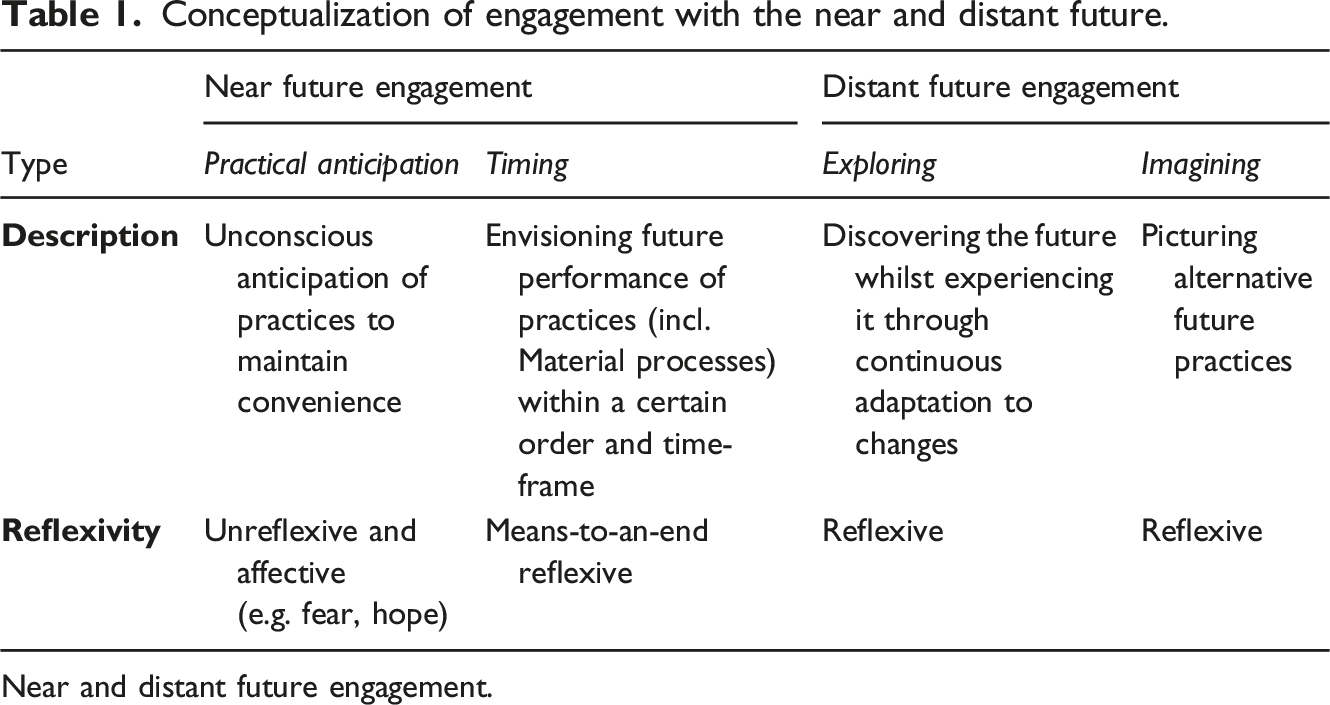
Near and distant future engagement.
Distant future engagement is characterized by a reflexive type of engagement that relies on imagination and experimentation. Exploration relies on creativity and results in innovation (Welch et al., 2020). It requires adapting to new circumstances instead of clinging to the past in the present such as practical anticipation, or placing past, present and future in a certain order such as in timing. Rather, it implies continuously discovering the future by experiencing it (Mandich, 2019). By exploring the future day by day, slowly but steadily the distant future draws near. Imagination refers to the imagination of a certain practices in completely different way in a distant future (Mandich, 2019). This also involves the imagination of material processes as part of these practices. As Hernes (2020) argues, a future sustainability target to produce more sustainability invokes a different form of future engagement than planning the near future production within current beer producing practices. ‘To aim to launch a new product in 5 years’ time means to imagine the intended product 5 years from now, including the processes that constitute it and the intersections with related processes, such as distribution, acquisition, consumption and disposal’ (Hernes et al., 2020: 5).
Context: Food entrepreneurship in Flevoland, the Netherlands
We study near and future engagement in practices of food entrepreneurship in the context of sustainability transformations of the food system. The latter refers to the ongoing challenge to (re)organize food systems in a more sustainable way. For instance, there is the aim to produce and process food more sustainably, for instance by using more extensive production methods (e.g. organic). But there is also a challenge in terms of logistics, for instance to create shorter supply chains (Larsson et al., 2016; Paloviita, 2009). The balancing of near and distant futures is important for food entrepreneurship in sustainability transformations. As Dimov (2018) explains, entrepreneurship includes bearing uncertainty which he describes as ‘being at the mercy of time’ (p.6). Aspiring to a sustainable future requires making commitments in the present. But because the future might turn out differently, those that make the commitments (in terms of resources, actions, etc.) stand to lose what they have committed to. Furthermore, the uncertainties and opportunities offered by disruptions triggers both creativity and fear in entrepreneurship, causing some entrepreneurial practices to endure over time, some to collapse, and new ones to emerge (Gross and Geiger, 2017; Johannisson, 2014).
By studying (changes in) entrepreneurial practices during the covid-19-induced disruption, it is possible to closely examine how near and distant future engagement feeds into these changes. Our study focuses on food entrepreneurship in the province of Flevoland in the Netherlands. Flevoland presents a relevant research site, because it is the stage on which an ongoing sustainability transformation of the food system is unfolding in which entrepreneurship plays a major role. This province is relatively young, as it was reclaimed from the sea in the 50s and 60s of the 20th century. Originally, the province was created for agriculture and food production. At the same time, the first inhabitants were strictly selected for not just their agricultural skills, but their entrepreneurial prowess as well (Vriend, 2014). In a later stage, cities such as Almere and Lelystad emerged in the province that had a different purpose: to cope with the increasing population in the near city of Amsterdam (Jansma and Wertheim-Heck, 2021). Recently, cities such as Almere are reconnecting with their agricultural hinterland and have started to position themselves as green growing cities. This results in policy that foregrounds sustainable and healthy food, which has a profound influence on food entrepreneurship as well (Van der Gaast et al., 2020, 2021).
Methods and materials
Our study is shaped by the 2020 covid-19 pandemic. Covid-19 caused several (partial) lockdowns in the Netherlands which resulted in a disruption for food entrepreneurship (e.g. restaurants and shops had to close up for the unforeseeable future). This disruption offered an opportunity to study engagement with near and distant future in changing practices, as was explained before. However, this disruption also limited access to research participants. Safety concerns with regards to social distancing made direct interviewing harder, especially during the first lockdown. Furthermore, adapting to the lockdowns caused time constraints that made it harder for entrepreneurs to participate in the study. Since we are interested in exploring the phenomenon of future engagement in practice in depth, we use an interpretive approach. However, we combine a qualitative and a quantitative form of interviewing. The value of the quantitative study lies not in a traditional, positivist sense of measuring and assessing patterns of variables. Instead, it provides a larger overview in terms of what types of responses to the disruption were visible, and what types of measures were taken. This overview serves as a scaffolding for our in-depth study as is done through semi-structured interviewing. Therefore, no statistical analysis was done and only descriptive statistics were used. For participants, we selected entrepreneurs, since we consider entrepreneurs to be practitioners in entrepreneurial practices that have key insights into the performance of all entrepreneurial practices as performed by their firm. Our study consisted of two phases:
List of participants. The asterisk (*) indicates the interview was conducted online.
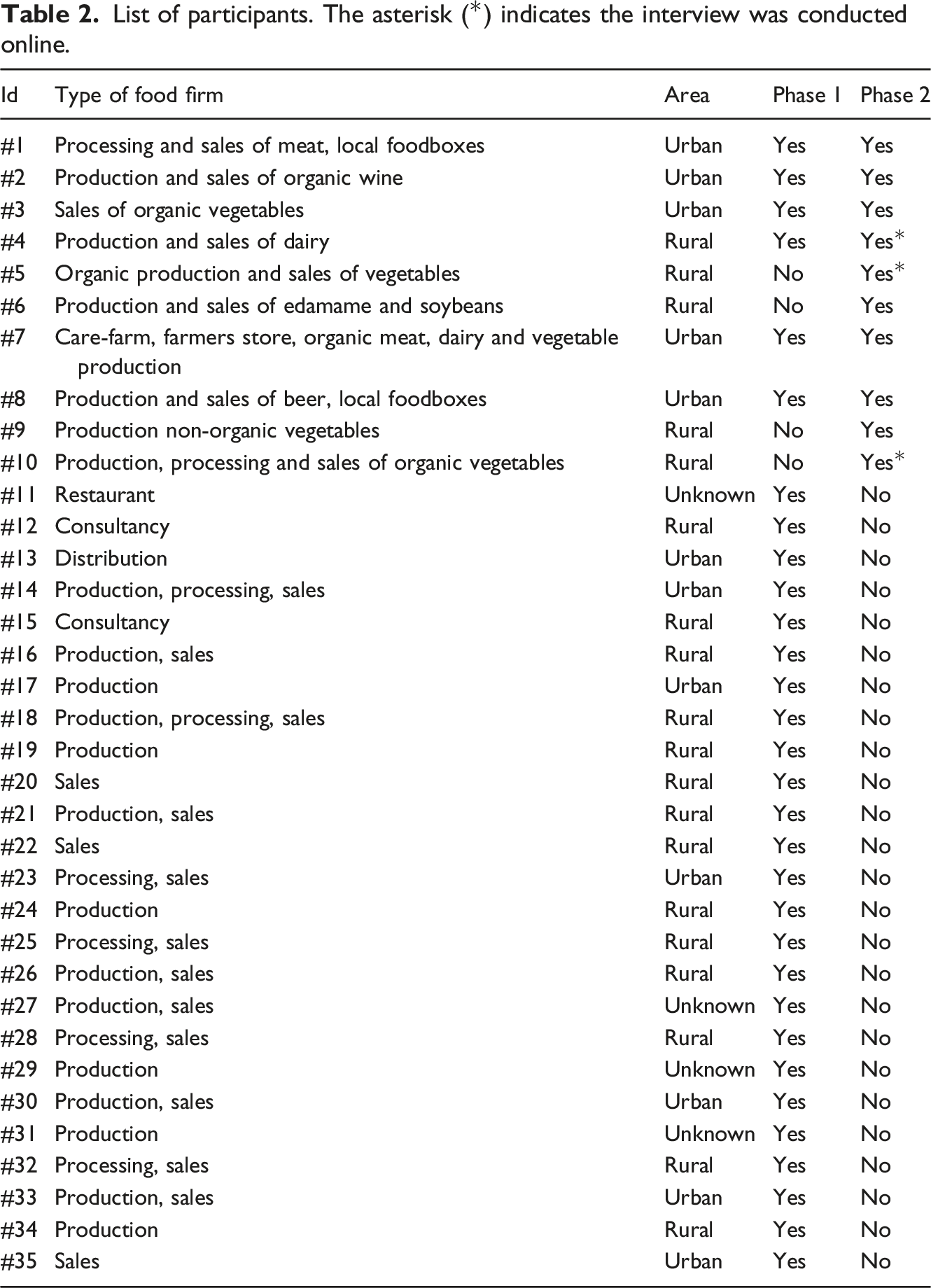
In both Phase I and II, we chose to not specify our understanding of the concept ‘sustainable’. As we discussed before in this paper, in food system transformations there exists multiple imaginaries of what a sustainable food system should or could look like (De Krom and Muilwijk, 2019). Choosing a specific definition would oversimplify this complex reality. Furthermore, explicating to entrepreneurs a specific definition of sustainability could result in the fact they would not discuss certain activities that they themselves might consider part of their sustainability activities because they did not fit this description. This in turn can cause obfuscating practices or forms of future engagement that are crucial for this paper.
Findings
In our findings, we first provide a more general depiction of the impacts of the disruption on food entrepreneurship. Second, we zoom look more specifically at the changes that have occurred in entrepreneurial practices. We distinguish changes in working conditions and market conditions. Lastly, we will discuss near and distant future engagement as visible in these changes.
The impact of the disruption on food entrepreneurship
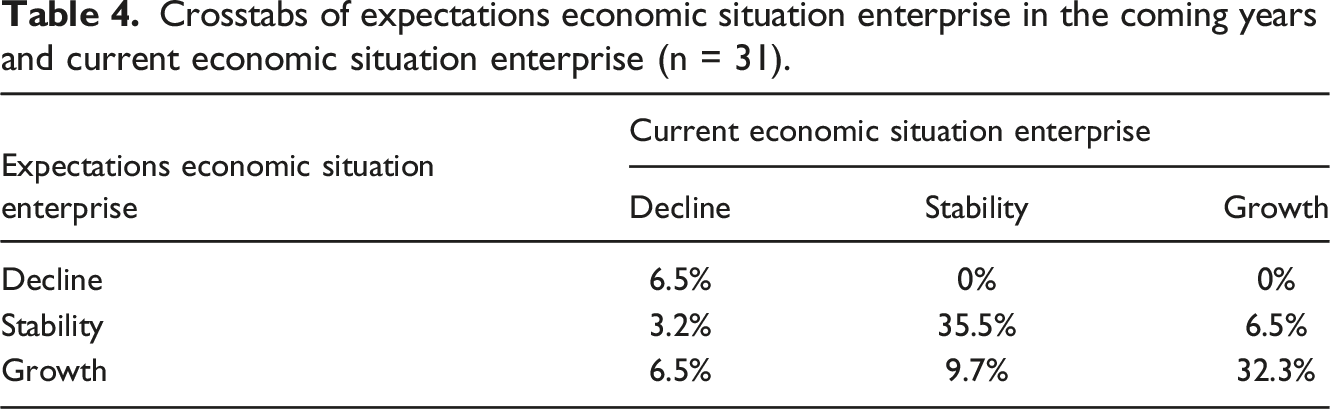
Crosstabs of expectations economic situation enterprise in the coming years and situation enterprise before covid-19 (n = 31).
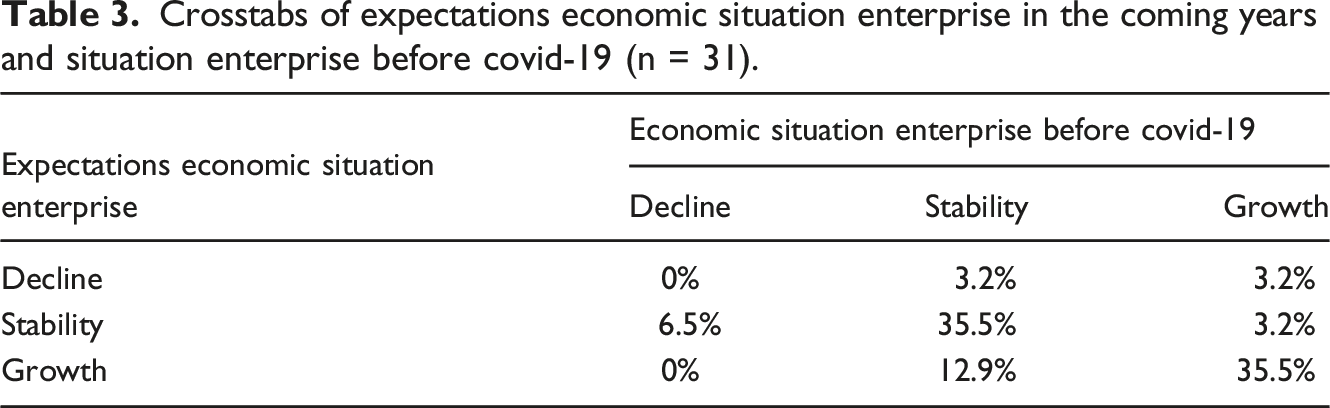
Crosstabs of expectations economic situation enterprise in the coming years and current economic situation enterprise (n = 31).
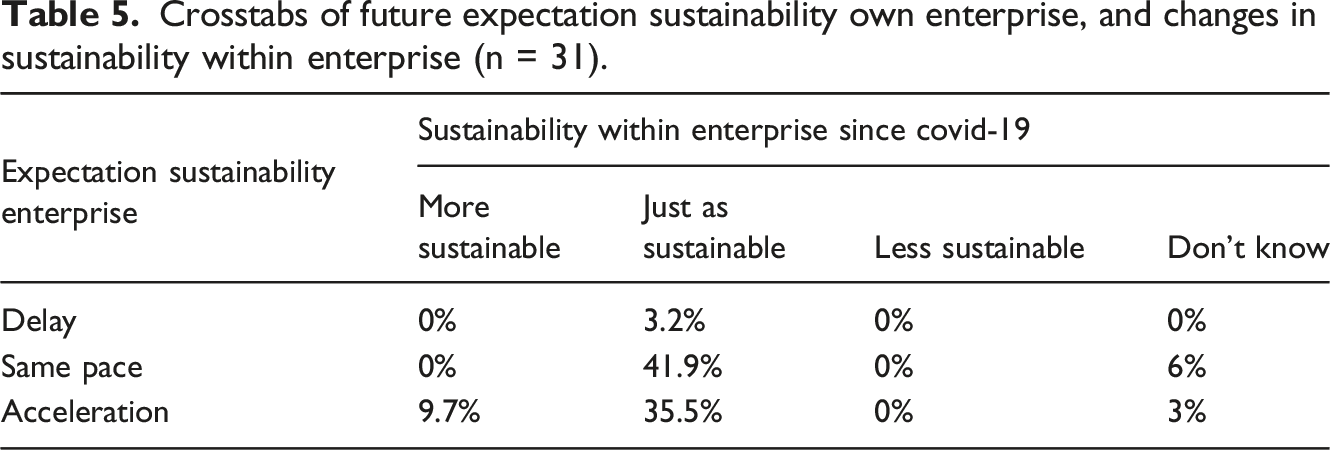
Crosstabs of future expectation sustainability own enterprise, and changes in sustainability within enterprise (n = 31).
Crosstabs of future expectation sustainability own enterprise, and current economic situation enterprise (n = 31).
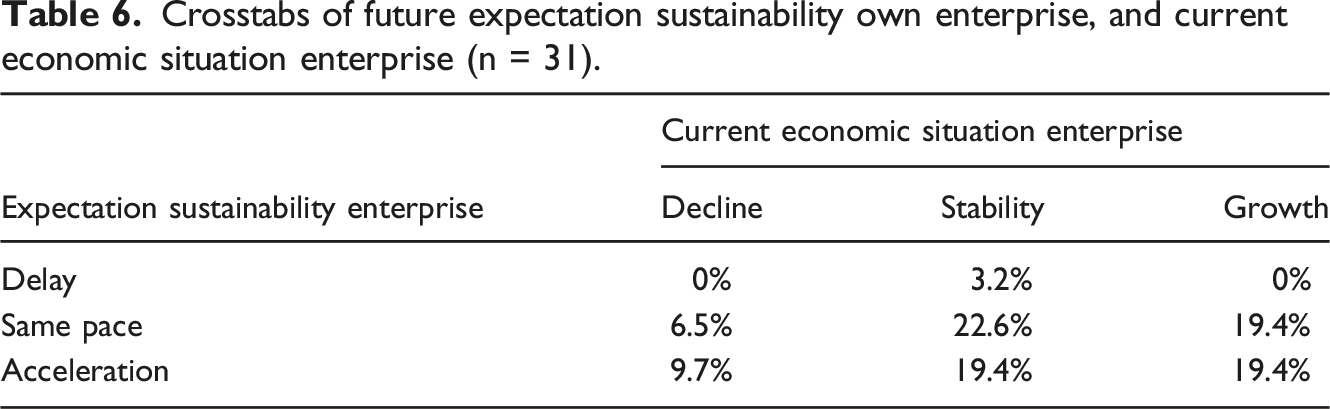
The semi-structured interviews help to interpret these survey findings on the immediate impact of the disruption. None of the interviewed entrepreneurs report a decline, and most of them claim they perform well economically since the covid-19 lockdown. As several interviewees pointed out: ‘people always have to eat’ (#3, #5, #6). As far as sustainability is concerned, some interviewees explained the covid-19 situation advances the trend towards sustainability. Many entrepreneurs claim that sustainable food is in even higher demand since covid-19, which also translates in higher demand from large retailers. They attribute this to more concern of people where their food has come from, and that their food has a story behind it, but also that more people are aware of sustainability concerns due to the crisis they are currently in. Moreover, they explain it is not an option to limit ‘sustainability’ to save expenses on the short term. The following quote illustrates well why this is so:
If I would want to work less sustainably, I would have to go back on the investments we already did. Furthermore, we would have to work differently which would cost me more and gives me less results. It would mean we would invest time to do worse, so no that is not what I want (#1).
Furthermore, some entrepreneurs indicate most efforts to make operations more sustainable are tied up in long-term investments that are already made, or that are necessary to maintain operations. For example, #5 was in the middle of building a new storage facility with solar panels, residual heating and a rainwater collection system when the first lockdown started. Such long-term investments in sustainability, which also include more energy efficient machines or windmills, are crucial for cutting down costs and therefore cannot be (dis)missed. Lastly, when asked about sustainability efforts, some of the respondents refer to their efforts to adapt towards the changing climate that become more urgent every day and which will be discussed more in depth in the next paragraphs.
Changes in food entrepreneurship during the disruption: working and market conditions
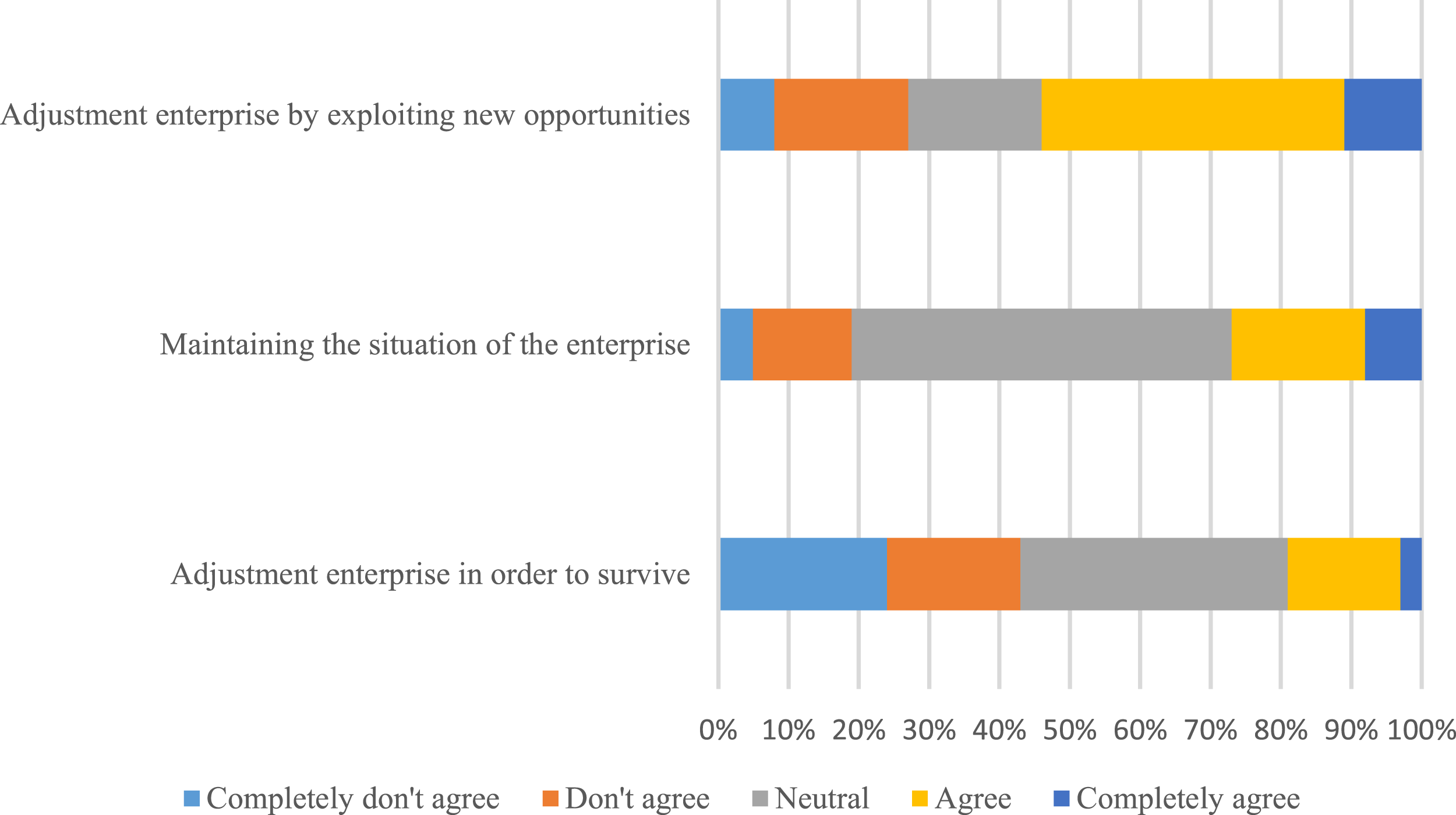
Next, we will explore more specifically what changes were brought on by the covid-19 situation. First, we will demonstrate through our survey findings that the changes can roughly be subdivided in changes in working and market conditions. Figure 1 displays the survey findings on the question what measures were taken by entrepreneurs under duress of the lockdown. The most popular measures are to develop new business models, sales platforms or markets (23.1%), and to use new or different marketing (20.5%). Figure 2 shows that a majority either agrees or completely agrees with the statement that they spend most of their time exploiting new opportunities, whereas the least agreement can be found on the statement that adjustments must be made for survival. In other words, a change in market conditions occurred through to the covid-19-induced lockdown which in turn inspired entrepreneurs to exploit the new opportunities that emerged by developing new marketing, business models and markets. Measures taken due to covid-19 (n = 31). Response to covid-19 situation of enterprise (n = 31).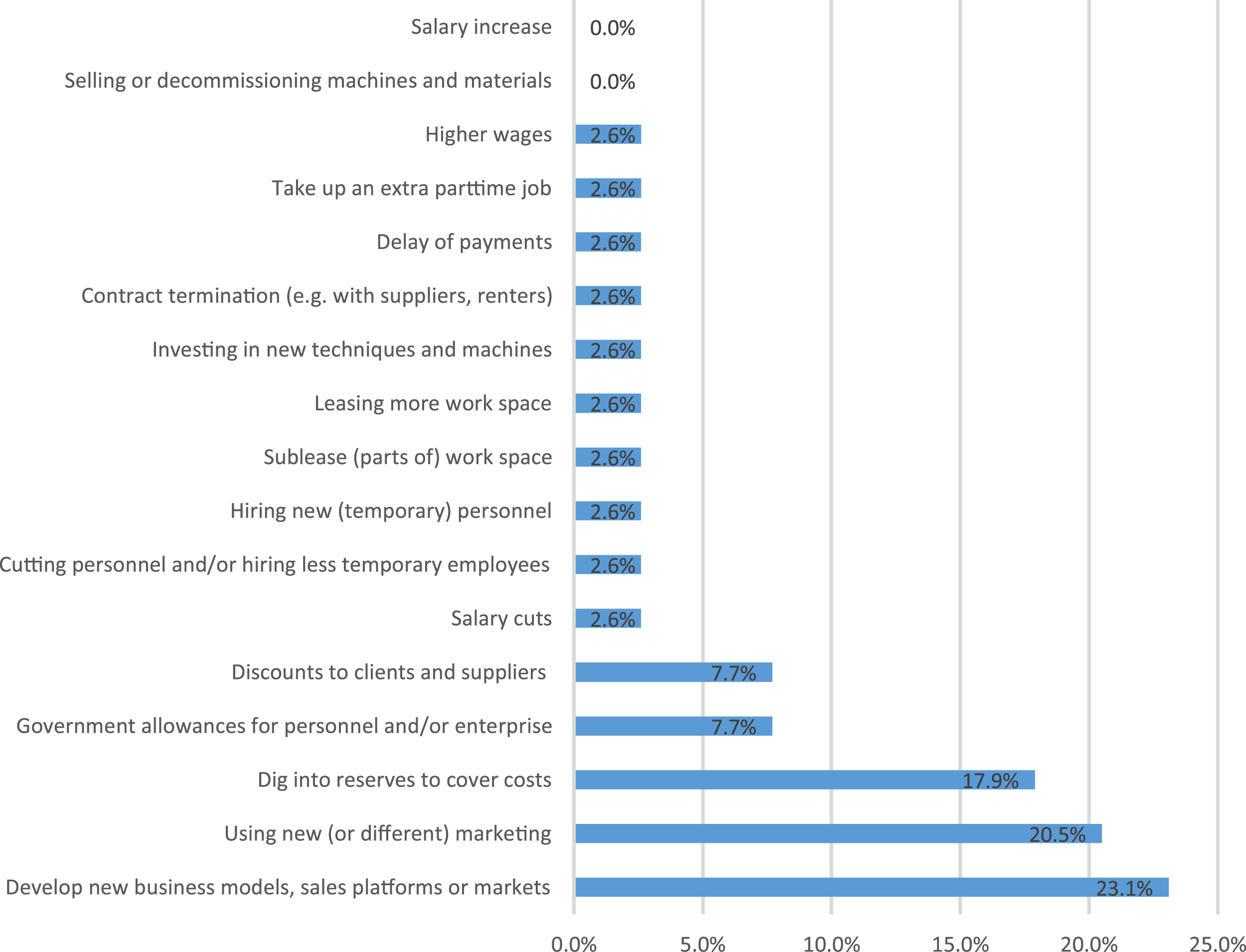
On the other hand, Figure 1 also shows entrepreneurs had to dig into reserves (17.9%), ask for government allowance (7.7) and give out discounts (7.7%). The more impactful means to limit expenses (salary cuts, cutting personnel, hiring less temporary employees, sublease work space, contract termination, delay payments) and increase expenses (hiring new personnel, leasing more workspace, investing in new techniques and machines, higher wages) were less popular. The limited need to radically cut expenses might also have to do with the timing of the survey. It can be linked to the national financial aid that covered salaries of employees of certain business to a large extent to avoid massive unemployment (Antonides and Van Leeuwen, 2021). Nevertheless, it becomes clear that some changes to the working conditions were visible in response to the covid-19-induced lockdown. By means of the semi-structured interviews, we can explore a bit further how these changes affected practices of food entrepreneurship in detail.
Changes in working conditions: production, processing and managerial practices
The semi-structured interviews showed change in working conditions manifested mostly in production and processing practices and managerial practices.
In terms of production (e.g. sowing, harvesting) and processing (e.g. cutting, packaging) practices, the safety measures (e.g. social distancing) as induced by the outbreak of covid-19 were of almost no concern. These practices are either performed by flexible workers with a wide range of competences, or by the farmer and owner. Especially because most of the production practices are performed outside, there were little to no restrictions in terms of covid-19. One interesting contrast is the wine company of #2 that completely runs on volunteers. The harvest of the grapes was very strictly coordinated according to the standards of social distancing. Some adaptations were necessary to fit the social distancing rules in shops. The shop of #3, that sources local and organic food directly to customers in the city, had to move to a different location because the previous location was too small. A dairy farmer (#4) adapted by inventing a system of small boxes in the countryside where people could come and pick up the products. The most profound changes in production practices have little to do with covid-19 and more so with climate change. The negative effects of climate change require constant changes and adaptation of production practices. Pests, diseases, droughts and heavy rainfall cause impediments that require alterations in production processes. As #10 explained, all the extra revenue that he obtained since the covid-19 outbreak was made undone due to the loss in crops because of droughts and heavy rainfall.
In terms of managerial practices, the covid-19 situation caused reorganization – in addition to switching from in person meetings to digital meetings, as well as the temporary suspension of international meetings. On the farm of #10, one of the larger agricultural firms that incorporates large processing and production operations, a system was devised to back-up the day labourers by those in daily management. In case of an outbreak, management would step in to enact the processing and production practices. On the farm of #7, that includes a care-farm and a farmer shop, it was the other way around. In the beginning of the lockdown when the care-farm had to temporarily close down, the employees were used to help out in the farmer’s store to package the meat from the farm. The care-farm particularly required a lot of reorganization in terms of the transport of the clients to the farm, and the paperwork to guarantee their safety in the new covid-19 situation. This also meant the managing work shifted; it was less about managing employees in their care-work and more about administrative duties. Another important change to managerial practices is the application for financial aid from the government in response to the lockdown. Only a small amount of the interviewees applied for this aid, as is congruent with the small percentage as found in the survey (see Figure 1).
Change in market conditions: sales and logistical practices
Change in market conditions especially manifests in sales and logistical practices. The most profound change is the shift in sales channels from direct sales to web shops. This can largely be attributed to the fall in demand from sales channels that had to close down due to the lockdown, such as cafés and restaurants. For some, the shift towards web shops caused a professionalization of the logistical process. For example, the wine company of #2 had to introduce automated ordering and payment module and an insured delivery in response to the increase in demand. This considerably reduced the efforts of manually checking whether the payment was done in time and of delivering the wine themselves. The brewery of #8 shifted from direct sales to taking orders via their web shop. Before covid-19, they sold and promoted their beers through fairs, their web shop was barely used. Since covid-19, this turned around completely. They performed the logistical practices (e.g. packaging, delivery) themselves:
The bar that we use for events used to be in the front of our storage facility because we used it so much, now it is all the way in the back. And the boxes for delivery we have reordered five times over because all we do now is fill boxes (#8).
The covid-19 situation also led to the introduction of several box schemes, where entrepreneurs pool their products together and sell them collectively as one food box. In the interviews, two of those box schemes were introduced. #1 was one of the initiators of Flevourbox, which included produce from all over Flevoland,. #8 invented Allybox which pooled products from within the city of Almere. The development of such schemes involved developing new sales practices (e.g. marketing and promotional activities) as well as logistical practices (e.g. a delivery system to get the products from the wide range of producers to consumers).
Engagement with near and distant futures during the disruption
Change in working conditions and near future engagement
Timing was discernable in the reorganization of working conditions as was done through managerial practices. This was the case with the social distancing conditions in the wine company for instance. As the following quote shows, both groups of people as well as the material flows (harvesting, lunch, bedroom break) were managed in such a way that they would keep a distance towards one another: We split everyone into groups of four, with one experienced and three unexperienced volunteers. (…) These groups of four go to a specific part of the vineyard to work, pick grapes and so on. Coffee and lunch breaks are all separate: the experienced volunteer shows them the route towards the lunch facility, to the toilets and after 10 minutes the next group can have their break (#2).
Furthermore, timing was also visible in large agricultural firms that planned ahead for the harvest. In case of an outbreak among their production and processing staff, management would step in to help with the harvest and processing. They also considered a scenario where the borders would close, and workers from other countries could not help to do the harvest, in which case they would recruit people that became unemployed because of the covid-19 situation. For #9, one of the smaller farms with less employees, this was not possible. Hence, in that scenario the produce would have to remain on the land. The care-farm of #7 planned ahead to a possible situation where the care-farm would be forced to close for a longer period, and the government would not help out financially. In that case, they would ask their employees to either take a leave of absence, or work on the ‘regular’ farm to milk the cows or weed the crops. Two elements of timing are visible in these examples. First, we see a clear imagination of a future action as if it is already accomplished (Mandich, 2019; Welch et al., 2020). Second, we can see that the changes to the labour force due to covid-19 are planned in line with the material properties of the farm and the work that needs to be done.
Practical anticipation is visible in the demand for government aid. For those that applied for government aid, it was the first measure they took after the first lockdown. Therefore, they applied during a moment in time when there was very little knowledge of what the effects of covid-19 would be. This uncertainty triggered emotional responses, such as nervousness and worry. However, it was not just fear, but also the need for convenience and familiarity in daily practices. It is important to note that this fear was not driven necessarily only by concern for the convenience of the entrepreneur, but for the clients and customers. #7 for example asked for the support just in case things would go wrong. She kept the money apart in order for her to be able to give it back at the end of the year in case it turned out she did not need it. For the care-farm, it was important to keep the routines of the clients as familiar as possible and therefore, it was also important to make sure that they could continue pay their employees whatever happened. She applied for the government allowance because she wanted ‘no fuss’ (#7). This also works the other way around. #6 deliberately did not ask for aid because he was afraid he had to pay it back at some point and he would have already spend the money. In sum, we see an instinctive and unreflexive pull towards comfort, driven by a fear of losing convenience over time.
Change in market conditions and near future engagement
Timing is also visible in the change in market conditions. Especially in terms of logistics, planning ahead and envisioning what must be done is important. Furthermore, such changes are co-determined by different material elements such as the living conditions of animals, the processing process and the extra logistics in between that must be ordered. This is especially the case when the product has specific sustainability features. #1 saw an increase in demand for his grass-fed meat because more people started to buy local food online during the first lockdown. Accommodating this higher demand requires timing every element of the supply chain (e.g. purchasing, butchering, processing, distributing) and place them in order. The following quote illustrates this:
Packaging and freezing takes about three weeks. After a cow gets butchered, it is first kept apart for two to three weeks. Then the meat gets processed: you have to portion it, vacuum it and freeze it, then it is sent to your distribution centre, and that takes a minimum of three weeks. So, you have to switch your operations in such a way that you can process five cows a week instead of two. This also means finding out where to get the cattle. In some instances, you have to buy them from somewhere else, but they need to have had the same life as our cows (#1).
A similar process is visible with the wine company of #2, that not only had to set up an online delivery and payment system, but also saw an increase in demand and a better harvest than expected, which meant organizing logistics in such a way that the wine could be stored, sold and shipped smoothly. This means taking into account the time it takes to produce, package and store the wine in such a way it does not lose its quality.
Change in working conditions and distant future engagement
Imagination was required to deal with the effects of climate change. The wine production company of #2 aspired to the long-term goal of creating permaculture that helps among other things to attract birds, insects and yeasts to keep diseases at bay, and cultivating a more resilient soil to withstand climate change effects. This requires writing a long-term business plan which imagines what this means in terms of revenue and logistics. #10, that claimed all his extra revenue during the covid-19 crisis was made undone due to the damages of climate change, envisioned how he can maintain a resilient soil in the distant future despite the expected damage of climate change. A distant future imagination is crucial in this because it is hard to fathom what will exactly happen, and the effects themselves are easily underestimated: Currently I am mostly busy with giving an answer to (…) what climate does to our business model on the long term. Because that is not a small thing and it is going to affect us all. It’s just that I already experience the effects, and you experience it way less. But overall we all underestimate what will exactly happen (#10, own translation).
Exploration goes hand in hand with imagination in climate adaptation. According to #9, food producers always have to consider every season what crops to change or maintain in their crop rotation, and they base this decision both on the market as well as the environmental circumstances. In other words, they have to adapt to ever changing circumstances. As another entrepreneur explains: ‘we are dealing with living products, they can change every day’ (#5, own translation). This means in practice that even though imagination produces a distant future of permaculture and soil resilience, exploration helps to get there step by step. Achieving permaculture is a matter of experimentation, such as finding better and more resistant breeds and introducing other crops in the rotation that make artificial fertilizer obsolete. For example: introducing permaculture on a vineyard incited experiments with growing other crops (e.g. potatoes, sugar beets) next to the grapes whilst expanding the vineyard. The use of green fertilizer in growing cabbage is one of the experiments to see if excessive rainfall can be drained more easily, which can help to increase the resilience of the soil.
Change in market conditions and distant future engagement
Exploration can be found in the emergence of box schemes. Most firms took up these new box schemes adjacent to their daily operations. They emerged spontaneously out of support for those local entrepreneurs that saw their demand shrink during the lockdown. Those entrepreneurs that were involved in a box scheme (#1, #8) stressed the learning by doing nature of their efforts, and that what works and what does not work is found out along the way. The pricing of the box, logistics (e.g. the amount of boxes that can be produced or delivered in a short amount of time, by whom and how) were not planned in detail on forehand. Therefore, these entrepreneurship practices were characterized by adapting to what worked and did not work, whilst enacting the logistical and sales practices to create the dinner boxes. As one of the interviewees remarked: It is not something we have planned for one or two months in advance, how are we going do it and how are we going to plan it? We just did it (#8).
Since box schemes are not immediately profitable and take up a lot of time, they can interfere with personal life. #1 divided the work for Flevourbox amongst different entrepreneurs, and coordinated the marketing strategy, but did not participate in the day-to-day social media or packaging activities. For the Allybox, #8 had to do everything, from collecting the food from different participating entrepreneurs, to packaging and delivery. #8 kept on going, even though both her time and the profitability of the box were limited, because she expected that at some point in the distant future it would pay out in one way or the other even though she had no clear idea in what way. In other words, neither timing, nor imagination triggered the emergence of the box schemes but exploration. If this entrepreneur would have planned this from the start, based on the efficiency, logistics and the profitability, the box scheme might not have emerged. But by doing it and inventing it along the way, it emerged anyhow. An interesting contrast is posed by a similar initiative to pool resources of entrepreneurs that only existed in the imagination of an entrepreneur and never saw the light of day. #3 considered collectively selling products with entrepreneurs to occupy the bigger space she had access too since the lockdown. However, she decided to not to actively pursue it. The fear of possible food safety concerns played a large role in that: What I aspire, but I need other people to do it, is creating a food hub. I tried to attract cheese producers, bakers or butchers to sell their goods in my shop. But for me, to organize that, it is not convenient. I don’t want the responsibility for making sure the meat is frozen in the right way, and if that goes wrong… I don’t want all that (#3).
This quote shows elements of fear for losing convenience and comfort, which indicates practical anticipation. At the same time, this fear seems to be brought on by imagining a possible distant future, and realizing what this could do to her daily practices. Therefore, partaking in or taking the initiative for a box scheme is a balancing act between the promise of experimentation and the familiarity of keeping things as they are.
Discussion and conclusion
Overview of changes in practices and near and distant future engagement.
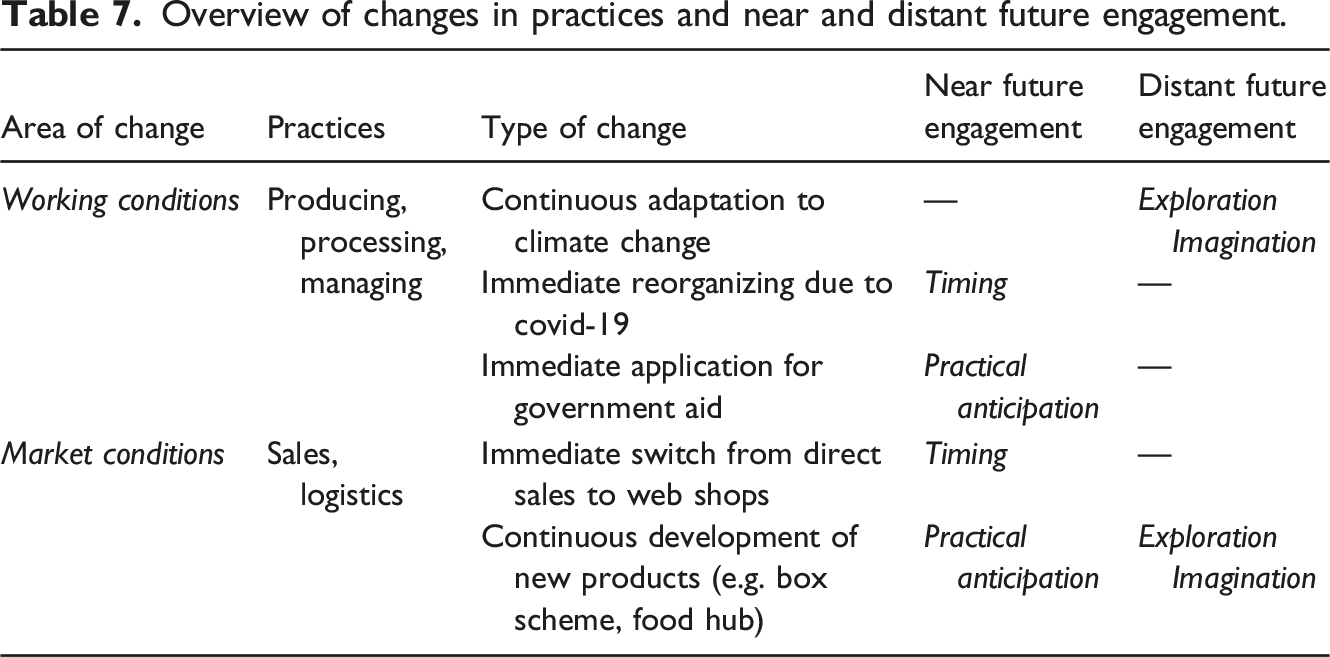
This table shows near future engagement feeds into immediate changes in practices, whereas distant future engagement coincides with continuous change. This relates to the distinction made in our theoretical framework between the continuous change in practices, and the immediate and enforced changes in practices brought on by disruptions. The change in food production practices (e.g. natural fertilizers to create a more resilient soil) as brought on by climate change is not a one-time, enforced rearrangement but a continuous trial and error. It demands continuous experimentation. In contrast, immediate change is visible in the measures taken to adopt to covid-19. The reorganization of producing, processing and managing practices, as well as the switch from direct sales to web shops was an immediate enforced change in performance and triggered by the restrictions brought on by covid-19. Entrepreneurs had to professionalize their online sales because they were forced to, their usual sales channels were unavailable.
Based on this overview, it is possible to suggest a clear balance between climate adaptation on the one hand, that is associated with continuous change and distant future engagement, and covid-19 adaptation on the other hand that involves immediate change and near future engagement. Yet, this would be an oversimplification. The continuous development of new products shows why this is the case. The experimentation with new products such as dinner boxes was clearly triggered by covid-19. The enforced change in logistical and sales practices to switch from direct sales to web sales enabled the development of a box scheme. Furthermore, the covid-19 situation resulted in the fact that some entrepreneurs struggled to sell their products and decided to pool their products through these box schemes. On the other hand, distant future engagement, in the form of exploration, was used develop the box schemes step by step. Furthermore, the ‘support your locals’ idea behind it is also clearly inspired by the demand for shorter supply chains which also precedes covid-19 and relates to sustainability.
This example shows distant and near future engagement are not necessarily separate pathways, they can become entangled when continuous change meets immediate change within practices. The sustainability concerns that brought on the trend in entrepreneurial practices to shorten supply chains can be seen as a continuous change in practices that preceded the disruption as caused by covid-19. When the disruption of covid-19 caused the immediate and enforced change of logistical and sales practices, this emerging trend of short supply chains was accelerated. Similarly, distant and near future engagement can also clash. In our results section, we discussed the example of the shop owner that sold organic vegetables and was forced to move due to the covid-19 disruption. Her new (spacious) location, together with the pre-existing trend of creating shorter supply chains, led to the imagination of a food hub. However, in contrast to the box-scheme developing entrepreneurs, this entrepreneur did not have to change her logistical and sales practices (apart from relocating). This might explain why practical anticipation was triggered which made the entrepreneur realize how this imagination could cause a breach in comfort and convenience when it would materialize. As a result, the change required to actually let the food hub materialize was never achieved.
This insight in how near and distant futures can together form an enabling or constraining factor is important for sustainability transformations of the food system. Based on the findings of this study, the argument can be made that sustainability has become itself a form of continuous change. As both the survey and interview findings show, sustainability efforts did not diminish during the lockdown. Some changes in terms of sustainability, ranging from ongoing investments in sustainable energy and machines to organic production methods, were already set in motion. When considering organic production practices, for example, the materials used (e.g. seeds, machines) to sow, harvest or weed crops or to process food (e.g. to turn grapes into wine), as well as the methods employed cannot be stopped midway. The same applies to sales and logistics practices when considering short and local supply chains. Such chains, that include customers, contracts and logistical operations, are hard to alter in the spur of the moment. On the contrary, since local and organic food is in demand, and since the effects of climate change are already experienced by food producers, there is more incentive to further intensify the efforts. However, when it meets disruptive, immediate change such as brought on by covid-19, the specific (re)configuration of practices shape whether sustainability is accelerated or obstructed.
Limitations and future directions of research
Sustainability transformations of the food system are centre stage in this paper. However, such transformations are very context-specific. The situated context of food entrepreneurship in Flevoland is distinctive, even on a national scale. They have a relatively high share of organic farmers, mostly in vegetable farming. 15% of the agricultural land in Flevoland is dedicated to organic farming which contrasts with the 3.4% for the Netherlands as a whole (Dekking et al., 2020). This explains the concern for the quality of the soil, and the adaptive capacities of the soil vis-a-vis climate change. A different focus might occur in a different context where non-organic produce is the standard. Therefore, to understand fully how near and distant future engagement interact in food entrepreneurial practices, it is important to study this in other contexts as well, for instance where there is less organic agriculture, more meat or dairy production than vegetables. This might help get more insight in how near and future engagement coexist in various circumstances. Furthermore, this paper also was shaped largely by the specific disruption of covid-19. It might be interesting to study continuous and immediate change in practices, and near and distant future engagement, in other types of disruptions as well. For instance, disruptions on a smaller (e.g. company) scale. Do we see similar patterns in continuous and immediate change? Such research can further the scope of how near and future engagement can shape sustainability transformations of food, in different contexts and circumstances.
Footnotes
Acknowledgements
The authors would like to thank the entrepreneurs for their participation in the interviews and survey.
Declaration of conflicting interests
The author(s) declared no potential conflicts of interest with respect to the research, authorship, and/or publication of this article.
Funding
The author(s) disclosed receipt of the following financial support for the research, authorship, and/or publication of this article: This work was supported financially by Gemeente Almere (Almere 2.0) in cooperation with Flevo Campus.
