



Abstract
The study of future-making – how practitioners make and enact imagined futures – has become a cornerstone for understanding the temporal dynamics of organization, strategy and entrepreneurship. This article investigates the texture of practical knowledge that enables entrepreneuring practitioners to jointly address the challenges inherent to future-making. We conduct a video ethnography of a business modelling programme producing 79 hours of audio-visual recordings. Using multimodal conversation analysis, we unpack different forms of practical knowledge that simultaneously binds practitioners in a web of mutual expectations and establishes modes of thinking and acting for the creation of imagined futures. This contributes to existing studies by demonstrating that the discursive, embodied and material dimensions of future-making are fundamentally entangled within textures of practical knowledge. Consequently, we shift the mode of theorizing towards non-representationalism, which opens up new frontiers for future research to observe, participate and reflect with practitioners on the textures of practical knowledge constitutive of future-making in different circumstances and contexts.
Introduction
The study of future-making has recently gained prominence due to a growing recognition that imagined futures are a cornerstone for understanding the temporal dynamics of organization, strategy and entrepreneurship (Wenzel, Krämer, Koch, & Reckwitz, 2020). As the future is unknowable (Ramoglou, 2021), entrepreneurs, managers and workers cannot act solely by identifying optimal choices based on past statistical information (rationalism) or using explicit scripts, rules and norms (institutionalism) (Beckert & Bronk, 2018). Instead, they create and use imagined futures to attend to questions of possibility rather than epistemology (Gartner, Bird, & Starr, 1992; Riles, 2010). If deemed credible more broadly, imagined futures create ‘fictional expectations’ (Beckert, 2016) that performatively structure decisions within organizations, competition between firms, and decisions of crucial stakeholders like investors, consumers, regulators, courts and employees (Beckert, 2021; Komporozos-Athanasiou, 2020; Oomen, Hoffman, & Hajer, 2021). In this regard, the study of future-making has become a topic of keen interest in organization, strategy and entrepreneuring studies given that imagined futures gauge and guide diverse organizational relations and processes (Flyverbom & Garsten, 2021).
Prior research points to practices (Wenzel et al., 2020), strategic accounts (Kaplan & Orlikowski, 2013), visions (Venus, Stam, & Van Knippenberg, 2019), stories (Garud, Schildt, & Lant, 2014), templates (Flyverbom & Garsten, 2021) and fabulations (Hjorth, 2013) or the affordances of material sketches (Comi & Whyte, 2018), prototypes (Liedtka & Kaplan, 2019), strategy tools (Jarzabkowski & Kaplan, 2015) and models and algorithms (Lindenbaum, Vesa, & den Hond, 2020) to explain the emergence of imagined futures. We posit that, despite these insights, existing literature has little to say about how practitioners attend to the challenges of future-making, which has led to a neglect of practical knowledge in current theory. In this article, we study textures of practical knowledge – shared, bodily and tacit understandings of intentions, rights, obligations and expectations (Gherardi & Strati, 2012; Nicolini, 2011) – that results from, and also a crucial resource for, participating in future-making practices. In particular, we focus on how practical knowledge is utilized by entrepreneuring practitioners to mutually address the challenges of formulation (understanding one another when uttering individual conjectures about the future), representation (making visible representations of individual conjectures) and organization (organizing individual conjectures into collections of conjectures). Our research question that drives this article is How do entrepreneuring practitioners address the challenges of formulation, representation and organization when engaging in future-making in practice?
Drawing on the ongoing praxeological turn in management, organization, strategy and entrepreneurship literature (Golsorkhi, Rouleau, Seidl, & Vaara, 2010; Nicolini, 2012; Thompson, Verduijn, & Gartner, 2020), specifically an ethnomethodological perspective (Rawls, 2008), we study future-making as something entrepreneuring practitioners do collaboratively, using visual artefacts and other tools and templates. We conduct a video ethnography that utilizes naturalistic audio-visual recordings of five teams who participated in an intensive two-week programme focused on creating images of future business models. Analyses show practitioners address the challenge of formulation through gist (rephrasing another’s conjecture into new words), upshot extension (extracting and extending meaning of a conjecture) and upshot challenge practices (questioning problematic presuppositions). Practitioners address representation through ‘note-talking’ (noting conjectures by combining bodily and discursive elements of affirmation), revision (editing conjectures represented on existing notes) and recruitment practices (seeking assistance from others). Finally, practitioners address the challenge of organization using practices of display (placing conjectures to establish relations to other conjectures and pre-existing categories), arrangement (placing conjectures in a new order) and relocation (moving conjectures to different spatial locations). Detailed multimodal analyses of each of these practices evidences textures of practical knowledge through which practitioners engage and assemble future-making in situ.
Our study responds to recent calls to investigate future-making (Wenzel et al., 2020), in particular, to pay attention to the ‘oftentimes subtle, partly mundane, and perhaps even short-sleeved ways in which organisational actors engage with the future’ (Wenzel, 2021, p. 10). We contribute to theory by demonstrating that future-making is determined, at least in part, by a texture of moment-to-moment practical knowledge. Much is gained when the significance and meaning of discursive, embodied and material dimensions of future-making are conceptualized as entangled within textures of practical knowledge. Consequently, we shift the mode of theorizing towards non-representationalism in which future-making practices are a practitioner’s phenomenon – sites of practical knowledge that shape real-time creation of imagined futures (Llewellyn & Spence, 2009). These findings also contribute to those practitioners whose work is temporally oriented to the future by providing the means to reflect upon tacit practices, which could improve the depth of uniqueness, coherence and plausibility they can achieve in such a setting.
Theoretical Background
Literature on imagined futures argues that entrepreneurs, managers and workers aim to construct credible images to shape the future through them (Beckert & Bronk, 2018; Beckert & Suckert, 2021). Imagined futures thus become performative in the present (Oomen et al., 2021) by structuring decision-making, relationships and expectations within and between organizations (Beckert, 2016; Komporozos-Athanasiou, 2020). In this sense, organizational and entrepreneurial activities, such as strategic planning, capital budgeting, technology projections, economic forecasting, perceptual maps and business modelling, are ‘instruments of imagination’ (Beckert, 2021) or ‘scopic systems’ (Knorr Cetina, 2006) through which actors create the future and make it visible from a specific perspective in the present.
In this vein, the study of future-making considers the future temporal perspective and how imagined futures are enacted and produced. As opposed to imagining a future situation ‘as if’ it was already accomplished and reconstructing the required paths to such an outcome (e.g. Fuglsang & Mattsson, 2011; Pitsis, Clegg, Marosszeky, & Rura-Polley, 2003), future-making argues that it is through collaboration that practitioners express and enact imagined scenarios (Comi & Whyte, 2018). Wenzel et al. (2020) recently draw on a practice theory perspective (Nicolini, 2012; Schatzki, 2005) to argue that the future is not an objective ‘thing’ out there waiting to be revealed through more accurate instruments (e.g., Bacon-Gerasymenko, Coff, & Durand, 2016), nor it is a subjective perception in the minds of specific individuals (e.g. Ganzin, Islam, & Suddaby, 2020). Rather, imagined futures are an experienced temporal category that ‘actors co-produce and enact through future-making practices’ (Wenzel et al., 2020, p. 1443). Future-making thus reflects what practitioners actually “do” together to make imagined futures, rather than what they say they do or wish to do (see Jarzabkowski, Balogun, & Seidl, 2007). Accordingly, the study of future-making has shifted towards the real-time practices through which practitioners collaboratively make a realizable image of the future in the present.
Although not explicitly mentioned, future-making is particularly relevant for entrepreneuring literature (Steyaert, 2007) because creating organization relies, in the first place, on the performance of practices towards constructing a coherent and plausible imaginary future (Thompson, 2018). Recent work has returned to the entrepreneurial imagination (Elias, Chiles, Duncan & Vultee, 2018), starting with the idea that the future is not only unknowable but that it is invented (Hjorth, 2013; Verduyn, 2015). Notably, Chiles and colleagues (2021) recently posit that the entrepreneurial imagination is a relational, unconscious, particularizing, embodied and visionary process. Through exercising imagination, entrepreneurs generate new meaning and significance (Cornelissen, 2013), guiding the design of an artefact, technology or an organization (Berglund, Bousfiha, & Mansoori, 2020; Doganova & Eyquem-Renault, 2009). Consequently, future-making in an entrepreneuring context suggests that imagined organizational futures are not objective (e.g. McMullen & Shepherd, 2006) nor merely the subjective products of the minds of individual entrepreneurs (e.g. Kier & McMullen, 2018), but rather produced in and through social practices within which practitioners jointly exercise their creative imaginations (Thompson, 2018).
The challenges of future-making
Despite future-making gaining interest in organization, strategy and entrepreneurship studies, few scholars have prioritized a practitioner perspective and thus have not considered the challenges that future-making entails. Drawing on design anthropology literature (Clarke, 2017; Gunn, Otto, & Smith, 2013; Murphy, 2016), we posit that these challenges can be framed in terms of formulating, representing and organizing conjectures.
First, the challenge of formulation refers to the need to understand one another despite the ambiguity inherent in the momentary utterance of a conjecture (Due, 2018; Landgrebe & Heinemann, 2014). Constructing an imagined future is a process of developing a shared image of a desirable future situation that is intrinsically incomplete (Murphy, 2005; Thompson, 2018), as no group can imagine a future with as much detail and complexity as the present. Nevertheless, practitioners must formulate a future situation that is, to some degree, likely to be coherent and plausible to audiences (Kaplan & Orlikowski, 2013) to lend cognitive and pragmatic legitimacy (Garud et al., 2014). At the heart of the challenge, to paraphrase Wittgenstein (1953), is that because we cannot ‘see’ into another person’s mind to access their thoughts about the future, the mind becomes irrelevant for understanding future-making. Rather, the only recourse practitioners (and scholars) have is through participating in social practices. In this sense, speakers and listeners need mutual ways of formulating a conjecture such that a listener not only understands a speaker’s utterance, but also the speaker understands a listener’s embodied and discursive cues through which they communicate that they understand, qualify or add to a conjecture.
The second challenge for practitioners is creating representations of conjectures in order to keep a public account of agreements, while retaining the possibility that the account will be further developed (Suchman, Trigg, & Blomberg, 2002). The present moment of formulating conjectures is a fast-moving situation (Luck, 2014). Practitioners need to coordinate their interactions in order to make visible conjectures into more meaningful, itemized and publicly observable pseudo-data they can revisit later (in different times, places, contexts and with different people) (Luck, 2010; Wilf, 2016). Nevertheless, doing so in the present creates a tension between participating in immediate conversation, as a speaker or listener, and engaging in an activity to keep account (e.g. sketching, note-taking, illustrating, etc.) that also demands their attention (Comi & Whyte, 2018). Speakers and listeners are thus tasked with transitioning into writers, who not only write but also participate in the production of writable talk (Kameo & Whalen, 2015). This increases the complexity of practices through which speakers, listeners and writers navigate each other’s responses, while simultaneously interacting with visual artefacts upon which conjectures are materially represented (Mondada & Svinhufvud, 2016).
The third challenge confronted by practitioners is the problem of visually organizing individual conjectures to ‘create a whole that is both greater than and different from any of its constituent parts’ (Goodwin, 2000, p. 2). In this sense, the meaning of an individual conjecture also gains additional meaning and significance by its relation to other conjectures, and their relation to other visual artefacts (other notes, sketches, templates or projects). As such, it is not enough to individually formulate and visually represent conjectures, because they need to ‘hang together’ in a meaningful semiotic-spatial organization that is itself in the process of being organized (Murphy, 2016). Adding to or altering a conjecture can have effects for one or more other conjectures, and thus practitioners need to take great care to (re)organize conjectures in precise and meaningful ways lest incoherence and contradictions arise. This process is not so much determined by the ‘things in themselves’, such as a prefigured diagram or template being used, but rather through practitioners’ present social interaction (Luck, 2014). Consequently, practitioners need ways to coordinate their intentions and actions in order to identify, discuss and resolve problems of organizing individual conjectures into coherent and plausible collections.
Addressing the challenges of future-making
Existing organization, strategy and entrepreneurship literature has little to say about how practitioners attend to the challenges of future-making. Studies of future-making that delve into discourse point to strategic accounts (Kaplan & Orlikowski, 2013), visions (Venus et al., 2019), stories (Garud et al., 2014) and fabulations (Hjorth, 2013) as explanations for how practitioners communicate coherence and plausibility of imagined futures. However, the mundane discursive practices through which practitioners address practical challenges to create strategic accounts, visions, stories or fabulations are themselves not elaborated upon. Similarly, research on entrepreneurial rhetoric (van Werven, Bouwmeester, & Cornelissen, 2014), storytelling (Lounsbury, Gehman, & Glynn, 2019) and framing (Snihur, Thomas, Garud, & Phillips, 2021) largely considers the characteristics of successful communication towards legitimizing imagined futures, rather than the practices through which conjectures are developed by teams (and supporters). Hjorth (2013) makes progress in this direction by theorizing that the use of discursive practices is not simply as tools for communicating coherence and plausibility, but are themselves a form of creative expression. And yet, the way practitioners address practical challenges in order to create imagined futures remains a black box.
Similarly, research on the embodied and material dimensions of future-making rarely zooms in on the details of how practitioners address the challenges of future-making. Several authors, for example, have theorized upon the affordances (possibilities and constraints) of material sketches (Comi & Whyte., 2018), prototypes (Liedtka & Kaplan, 2019), strategy tools (Jarzabkowski & Kaplan, 2015), and models and algorithms (Lindenbaum et al., 2020) for the emergence and visualization of imagined futures. However, the ways in which practitioners attend to challenges of visually representing conjectures, in which they must coordinate a role transition between speakers, listeners and writers, has not been explored. Relatedly, Elias and colleagues (2018) and Clarke, Cornelissen and Healey (2019) theorize that sensory and embodied gazes and gestures of entrepreneurs facilitate the co-development of aesthetic value or influence investor judgements of future value. Nevertheless, we learn little detail about how gazes and gestures are deployed, understood and reacted to by all practitioners present, which undermines our ability to explain future-making as a collaborative phenomenon.
Finally, the sparse attention paid to the practical challenges of future-making has led to little insight into the role of practical knowledge. Studies of future-making practices have foregrounded practitioners’ conscious and purposeful interactions (Comi & Whyte, 2018; Elias et al., 2018), even as it is acknowledged that practitioners enact practices ‘blindly’ by utilizing practical knowledge (Garfinkel & Sacks, 1970; Rawls, 2008). Practical knowledge (or practical ‘knowing how’ or knowing-in-situation) is a shared, bodily and tacit activity that results from, and is also a crucial resource for, participating in practices (Gherardi & Strati, 2012; Nicolini, 2011). It follows that future-making rests upon the performance and assembly of practices which are themselves composed of practical knowledge rooted directly in the human body, but only visible and meaningful when they are applied (Schatzki, 1997). Contrarily, Comi and Whyte (2018), for example, state that the ‘architects listen[ed] to their clients, with a view to translating verbal requirements into visual forms’, but do not investigate how practical knowledge is being employed in explanations of how architects and clients coordinate mutual intelligibility. Consequently, without a detailed analysis of practitioners’ ways of dealing with the challenges of future-making in practice, we fail to notice and theorize upon the texture of practical knowledge as it relates to future-making.
In summary, although recent theory on imagined futures enlists future-making as a cornerstone of its framework, existing organizational, strategy and entrepreneurship literature offers limited insight into how this may look in practice. In the present article, we address this gap by investigating the practical knowledge through which conjectures are formulated and visually represented, and complex imagined futures emerge as an organizational phenomenon.
Methodological Considerations
We adopt the praxeological turn occurring in organization, strategy and entrepreneurship literature (Golsorkhi et al., 2010; Nicolini, 2012; Thompson et al., 2020), specifically an ethnomethodological perspective (Rawls, 2008). This perspective prioritizes practitioners’ displayed orientation, technologies and tools, language, practical knowledge and embodied movements by closely considering the practices underpinning mutual interaction (Llewellyn, 2008). We conduct a video ethnography (Heath, Hindmarsh, & Luff, 2010) that utilizes naturalistic audio-visual recordings that provide a powerful yet accessible way for researchers to prioritize practitioners’ concerns and observe and theorize practical knowledge ‘in motion’ (Luff & Heath, 2019). In particular, the audio, visual and timing affordances offered by video offers novel multimodal insights into the embedded, processual, interactional, material and embodied nature of entrepreneuring (Ormiston & Thompson, 2021). Hence, this research methodology is consistent with our aim to understand the role of practical knowledge in future-making practices.
Research setting
Our study takes place in 2015 at a enterprise accelerator programme in the United Kingdom called Ignite Accelerator. The accelerator was organized and delivered by three directors with extensive commercial and entrepreneurial experience and was attended by 11 young entrepreneurs. After one week of personal development and commercial training, seven entrepreneurs (five teams) with the strongest basic business ideas (from directors’ perspective) proceeded to a second week of intensive discussions on developing their imagined business models. The remaining four entrepreneurs then assisted as participants. Table 1 provides an overview of the practitioners’ backgrounds.
Profile of programme entrepreneurs, participants and directors.
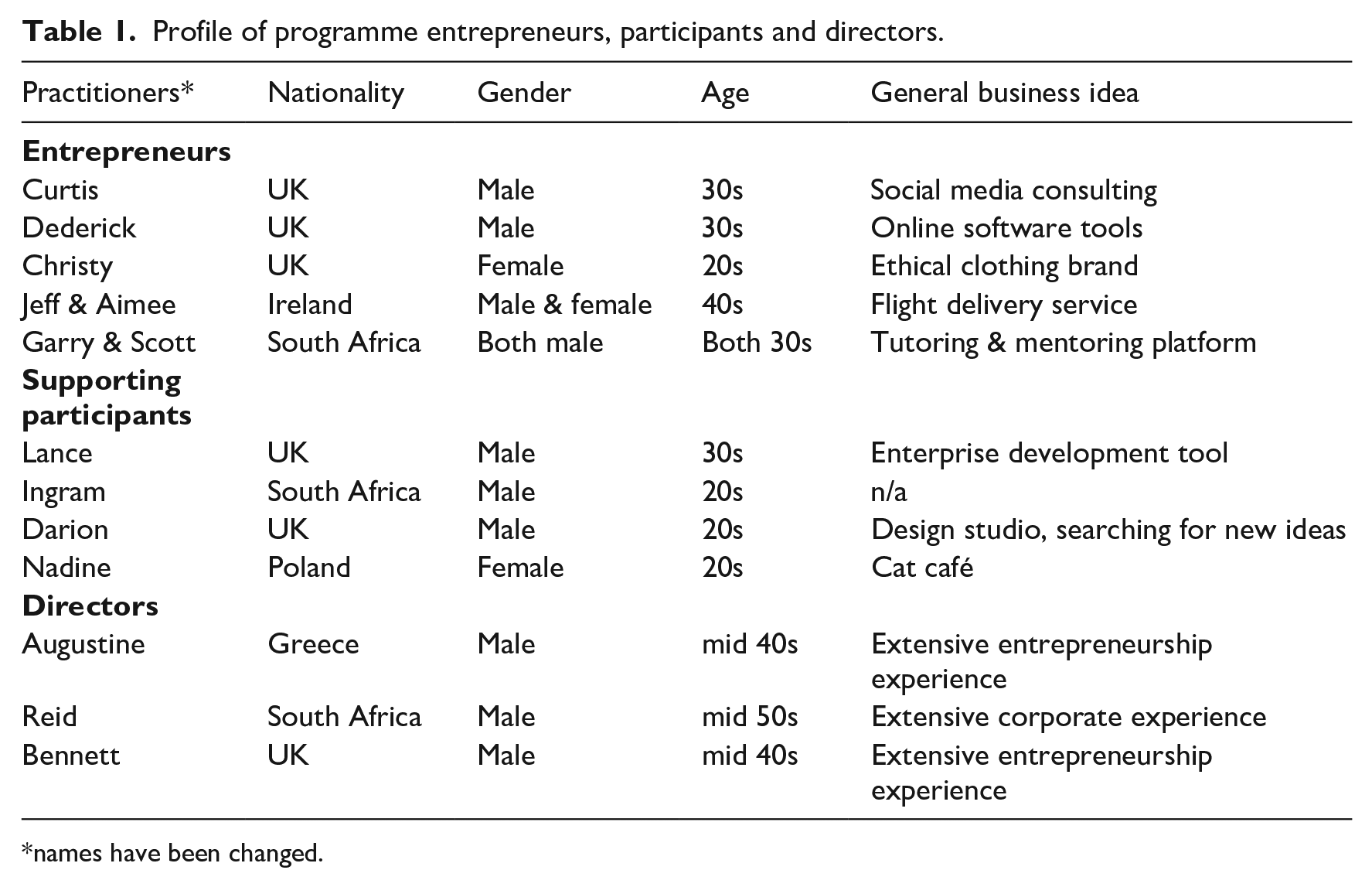
names have been changed.
Importantly, the accelerator directors used the business model canvas (BMC) to structure the programme’s second week. The BMC was designed by Osterwalder, Pigneur and Clark (2010) and it is widely used in enterprise practice and education to assist new business model development. As a visual template, it identifies the primary functions, or sections, of a nascent business (see Shepherd & Gruber, 2020). The directors took a step-by-step approach informing everyone about the various sections of the BMC they had to ‘fill in’. These briefing sessions were followed with idea development workshops where entrepreneurs, directors and other participants worked in break-out rooms (directors and participants rotated per session) to complete each section of the BMC. Each entrepreneur or team was given a large printout of the BMC, which was attached to a wooden board, as well as a flipchart, sticky notes, pens and markers. Figures 1 and 2 show a BMC before and after the programme.
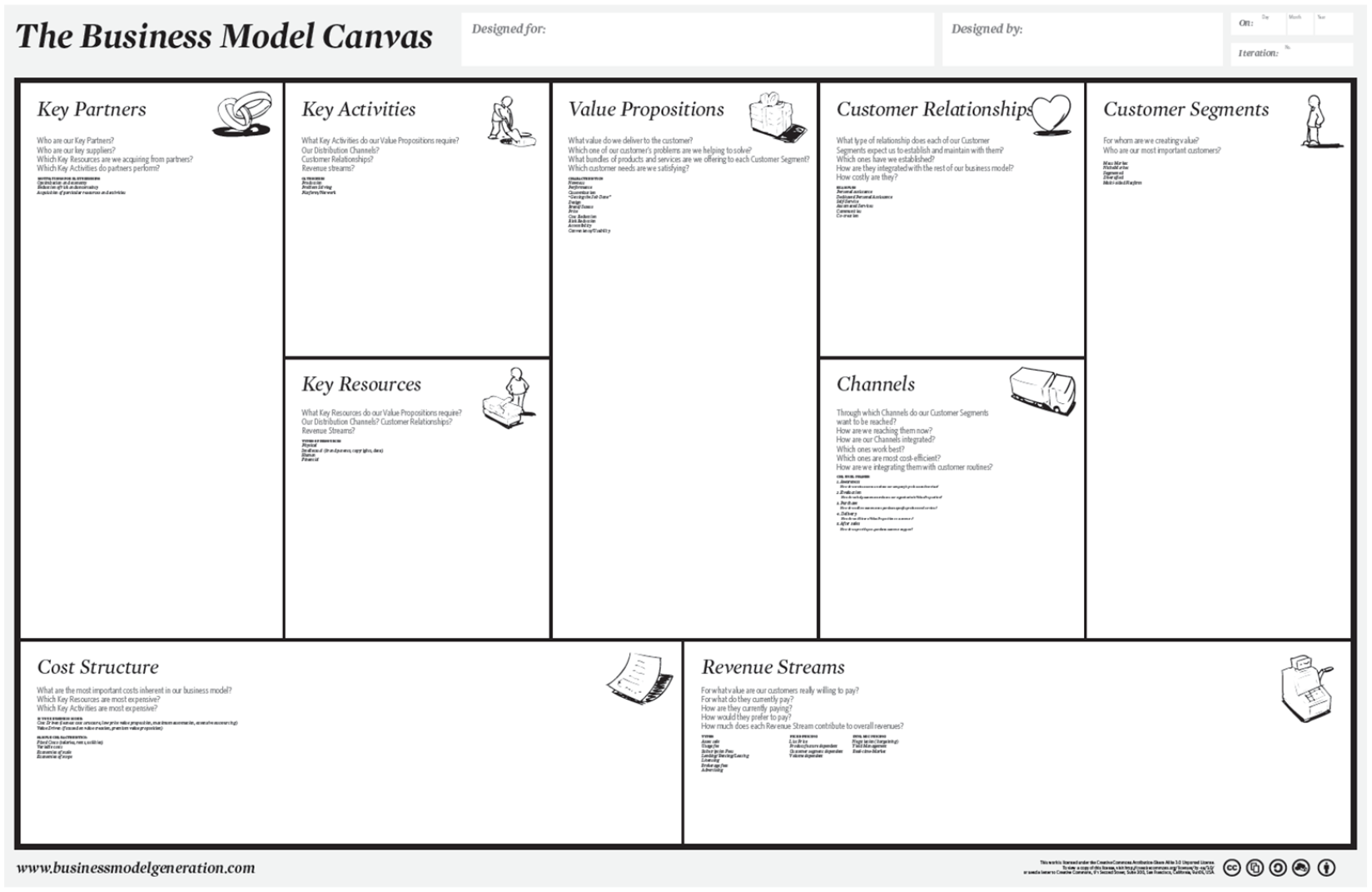
Business model canvas template before programme.
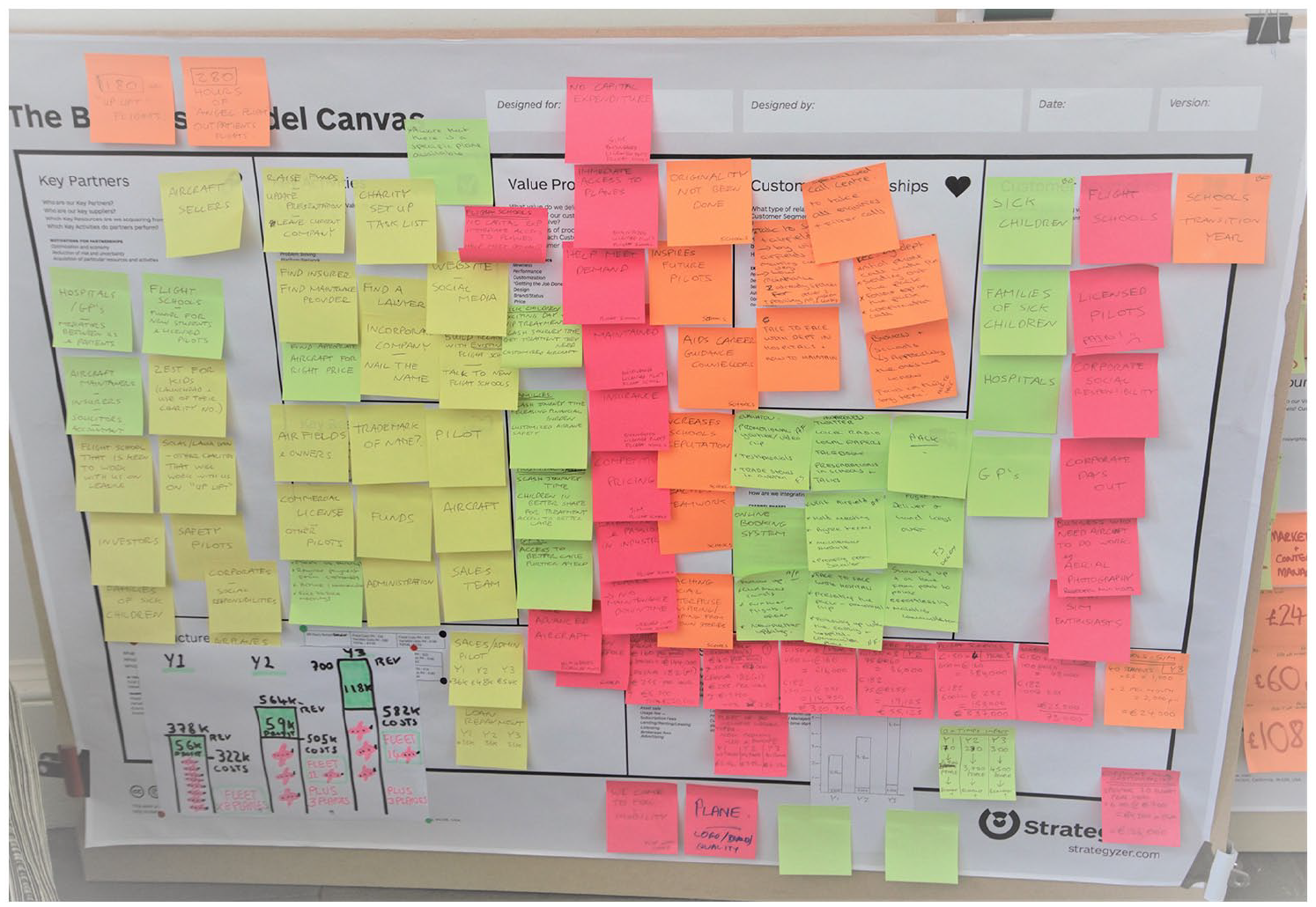
Business model canvas template after programme.
Data collection
Various forms of data were collected in our research site. The core dataset consists of audio-visual recordings of break-out sessions in which practitioners developed and discussed conjectures. This was augmented by interviews with practitioners and participant observation during the entire two weeks.
Audio-visual recordings
Although we have recordings of the first week of the programme, we utilize the audio-visual recordings from the business idea development sessions that occurred during the second week. Recordings of each team were made per break-out room. In particular, one video camera was used in the main briefing room while a combination of laptops and iPads were placed in the other four break-out rooms. The break-out rooms were quiet, intimate spaces for the most part, which allowed unmanned cameras to be close to the practitioners without being too intrusive. Because there were more practitioner teams than researchers, occasionally one or more practitioners would move out of frame of the video camera, stand in front of the template, or otherwise face away from the camera. Nevertheless, researchers were constantly rotating between rooms, observing idea development interactions, checking the positioning of the cameras and replacing memory cards where necessary. Similar to Best and Hindmarsh’s (2019) experience, practitioners quickly engaged in their activities with little regard for the cameras. After editing videos to remove empty space, we had 79 hours of useable recordings.
Interviews and participant observation
One of the authors also collected interview and observation data over the length of the programme. This included participant observation over the course of two weeks. In particular, the researcher joined teams to talk about their motivations, and participated with idea development – mixing among them with ease by sharing meals, leisure activities and debates. This also included being asked for insights and for feedback during briefing sessions. Pictures were also taken of the evolving business model templates on a step-by-step basis. Moreover, the researcher conducted interviews with practitioners after sessions to understand their general experiences, including detailed debriefs with each team every evening. These data were used to situate our analyses of observed practices and were especially helpful in understanding the tacit intentions and expectations present, as well as experiences of the practitioners during and after break-out sessions.
Data analysis
Our approach to data analysis is guided by a growing body of work within management and organization studies that draws on ethnomethodology and conversation analysis of transcribed sequences of interaction using the Jeffersonian method (Best & Hindmarsh, 2019; Hindmarsh & Pilnick, 2007; Llewellyn, 2015). Rather than use observations as a resource to develop general propositions, this method demands a close attention to sequential conduct. This is because practical knowledge is a mutual accomplishment and sequential conduct is where this knowledgeability manifests itself (see Heath et al., 2010).
In line with prior studies, we use a small set of excerpts to illustrate our findings. To arrive at these findings, we first identified broad features of practical challenges and activities of each entrepreneurial group. To do this, each author watched recordings of break-out sessions from the first two days of the second week of the programme, noting interesting observations and descriptions of practical activities, which we then discussed. As only one of the authors was present during the programme, this activity helped us to talk about challenges at site in terms of practical concerns. Next, we selected clips of video recordings and reviewed them as a team. For example, we noticed that practitioners spent much of their time re-arranging sticky notes on the BMC template (including discussing if and how to do so), which often led them to revising their conjectures. We paid specific attention to cases that illuminated the orderliness of an activity, and those where there was a breakdown, as in excerpt 8 of this study. Finally, we used video editing software to ‘trim’ selected video clips into fragments (lasting, on average, 30 seconds) that related to one of the three practical challenges. We then organized these instances into three collections and further analysed them using multimodal conversation analysis (Heath et al., 2010). The following section presents selected candidate instances and analysis of practices to demonstrate how practical knowledge is employed by practitioners to address the challenges of formulating, representing and organizing conjectures.
Practices of Formulating Conjectures
To address the challenge of formulation (the need to understand one another’s conjectures), all practitioners regularly draw upon practices of gist, upshot extension and upshot challenge. In this section, we unpack these practices in order to demonstrate the sequential conduct through which practical knowledge is manifest and makes agency possible.
Gist is a common practice in conversation that enables both the speaker and listener to establish a way of understanding one another’s meaning (Heritage & Watson, 1980). In this setting, gist begins by a speaker uttering a conjecture about an element of an imagined business model. In turn, the listener establishes understanding by rephrasing the speaker’s utterance, which may simultaneously preserve, delete, or transform a conjecture in the process. Excerpt 1 provides a simple instance of a gist with an entrepreneur-director pair (E = entrepreneur; D = director).
Gist (arrowed) (E = entrepreneur; D = director).
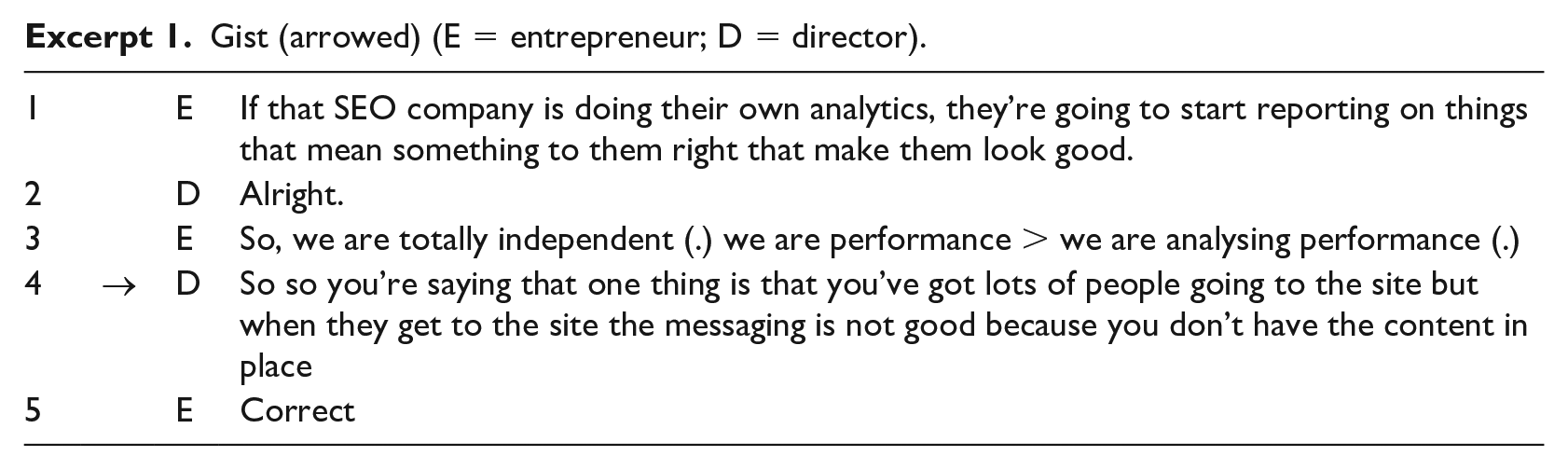
In Excerpt 1, E is talking with D about what might make his business analytics idea valuable. E makes a conjecture about current industry practices to highlight the possible value of his service. D listens and uses continuers (line 2), until E attempts to state possible uniqueness and value, although E does so with a repetition and ending in a pause (line 3). D follows E’s utterances (line 4) with a so so, such that his initiation into the gist is clear, and rephrases the conjecture (‘you’re saying. . .’) in his own words. In this simple exchange, we see that D tacitly understands that E is attempting to spell out a conjecture, but struggles putting this into words (line 3). D uses this moment to coordinate meaning by rephrasing it into other words (line 4), which tacitly establishes the basis for reciprocal judgement by E, in this case an affirmative ‘correct’ (line 5). This allows E and D to mutually establish meaning of a conjecture in the moment. Hence, it is through sequential action that they mutually reveal a practical understanding that the speaker is intending to make a conjecture, it is an appropriate moment for the listener to intervene to rephrase an utterance, and that the speaker has the right and obligation to provide a judgement.
Alongside gist, practitioners frequently solicit and extend the meaning of another’s conjecture using upshot extension. The practice enables practitioners to both establish mutual intelligibility of conjectures and extend their possible implications. This provides a vital way for practitioners to build upon each other’s talk towards denser, more coherent and plausible conjectures. Excerpt 2 provides an example with a different entrepreneur-director pair (E = entrepreneur; D = director).
Upshot extension (arrowed) (E = entrepreneur; D = director).
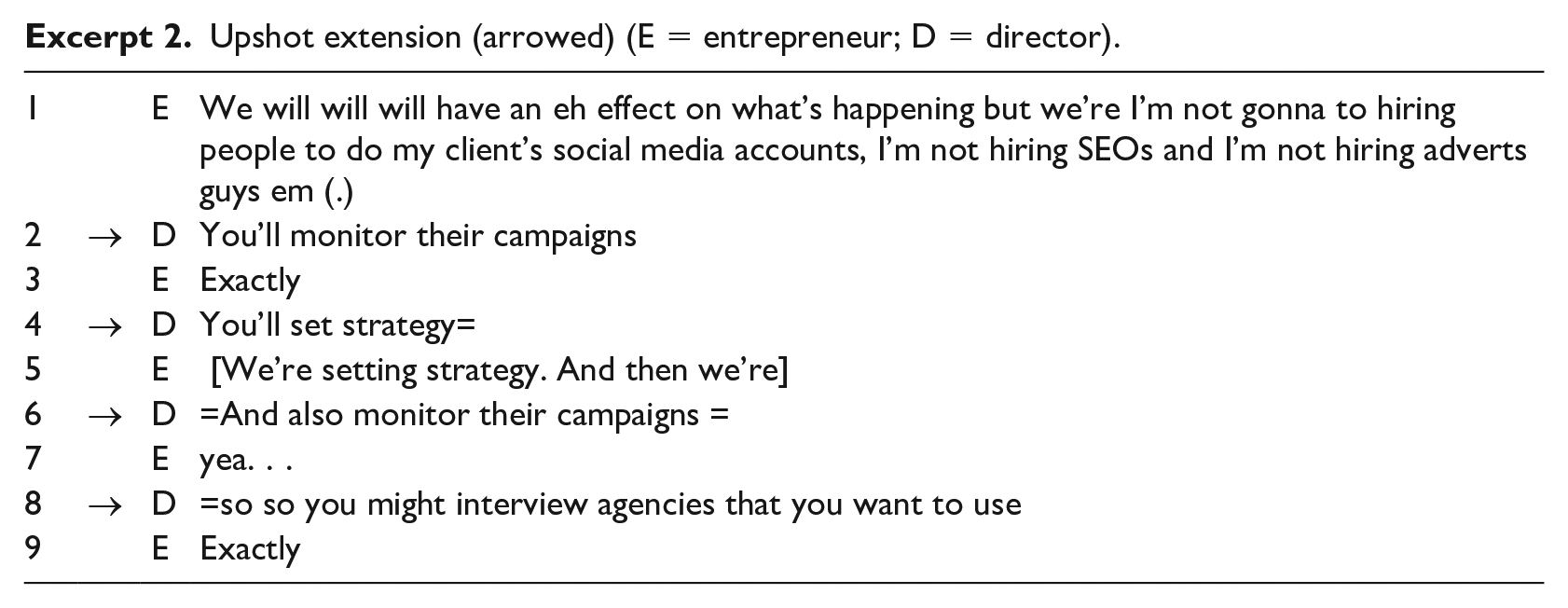
In Excerpt 2, E is conversing with D about the details of an imagined advertising service. E lists services he does not want to offer (line 1), ending with an em utterance and pause. D uses the pause to elaborate on the possible implications of E’s statement, specifically proposing services the company could offer (lines 2 and 4). E agrees explicitly (line 3) and by repeating D’s utterance (line 5). D follows the implications a step further stating that E could ‘monitor campaigns’ (line 6) and explore companies to partner with whomever offer complementary services (line 8), which invites a judgement by E (he affirms, line 9). In this excerpt, practical knowledge constitutive of the practice is revealed in its performance: D understands that E is intending to make a conjecture about possible value; both D and E share an understanding that it appropriate that D uses the pause to not only establish intelligibility (lines 2 and 4), but also to extend its possible implications (line 8), evidenced by E’s use of affirmations (lines 3, 5 and 7). Finally, both practitioners tacitly recognize that E has the right to judge (but not an obligation to accept) D’s rephrasing (line 9).
Finally, when a speaker states a conjecture, they not only make a proposal about the future but necessarily invoke presuppositions to do so. An upshot challenge is a form of question-answer practice that signals and invites discussions over these presuppositions, which can deem some conjectures to be improbable or an issue for further work. Excerpt 3 provides an example with an entrepreneur-participant pair (E = entrepreneur; P = participant).
Upshot challenge (arrowed) (E = entrepreneur; P = participant).
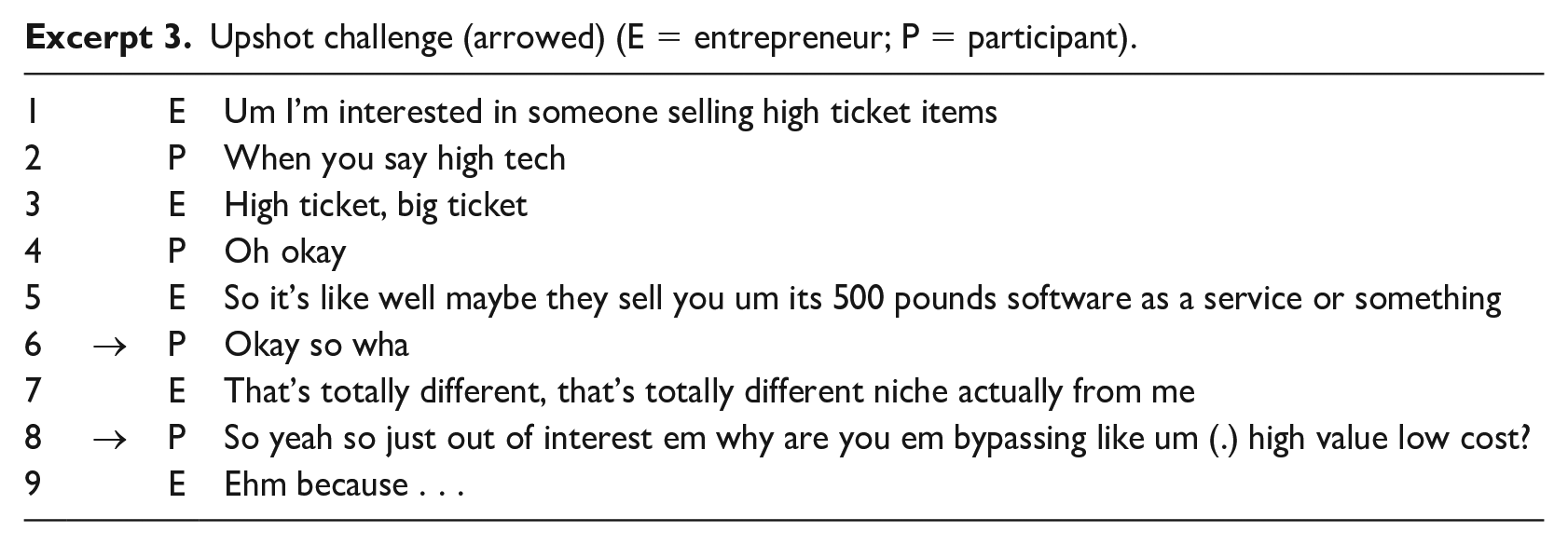
In Excerpt 3, E and P discuss the characteristics of a possible client group, with E stating he’s interested in ‘someone selling high ticket items’ (line 1). After a short pause, P begins to ask a clarifying question (line 2), although E realizes that P misheard his prior statement, and he repairs the error by restating the terms (‘big ticket’) (line 3). E continues with what he means, saying what would not fall into this group (lines 5 and 7). On line 6, P begins to ask a question, waits for E to finish his explanation, and prefaces his upshot challenge (‘so yeah so just out of interest’) to finally ask the question (line 8). The upshot challenge question specifically asks why E would not like to target a specific type of client based on his prior conjectures, which leads to further discussion about why this is more desirable than alternatives (line 9, not shown in excerpt). An important feature of upshot challenge is that practitioners use it to push back against conjectures that are communicated with certainty (line 1), without openly stating they disagree. This excerpt evidences a mutual understanding that it is appropriate in this setting for a listener to question the basis for a speaker’s displayed certainty, and that the speaker has the rights and expectation to respond accordingly.
Practices of Representing Conjectures
To address the challenge of representing conjectures, entrepreneuring practitioners regularly engage in practices of ‘note-talking’, revision and recruitment. Our analysis of instances below reveals the forms of practical knowledge involved in these practices, which simultaneously affect the making of imagined futures.
One way of representing conjectures is to make them visible through note-talking practice, which combines discursive elements discursive elements of affirmation inscribed of affirmation inscribed in bodies (‘nods’) and verbal cues (‘yeahs’) with writing key utterances into words and expressions that fit with the confines of the sticky note. In note-talking practice, one practitioner visibly assumes a ‘writing position’ (facing template, grabbing note-pad, taking off top of marker), indicating to others that they expect something in the ensuing talk to be worth writing down. Upon affirmation of a conjecture, the ‘writer’ transitions into writing position, condenses utterances into a single written word or expression that is ‘readable’ (neither too small nor too large) and typically ends the discussion on this topic. Note-talking not only materializes agreements, making them available to others not present, but often does rephrase meaning (and can be a topic of discussion itself). Excerpt 4 provides an illustrative instance with a different entrepreneur-participant pair (E = entrepreneur; P = participant).
Representation through note-talking (arrowed) (E = entrepreneur; P = participant).
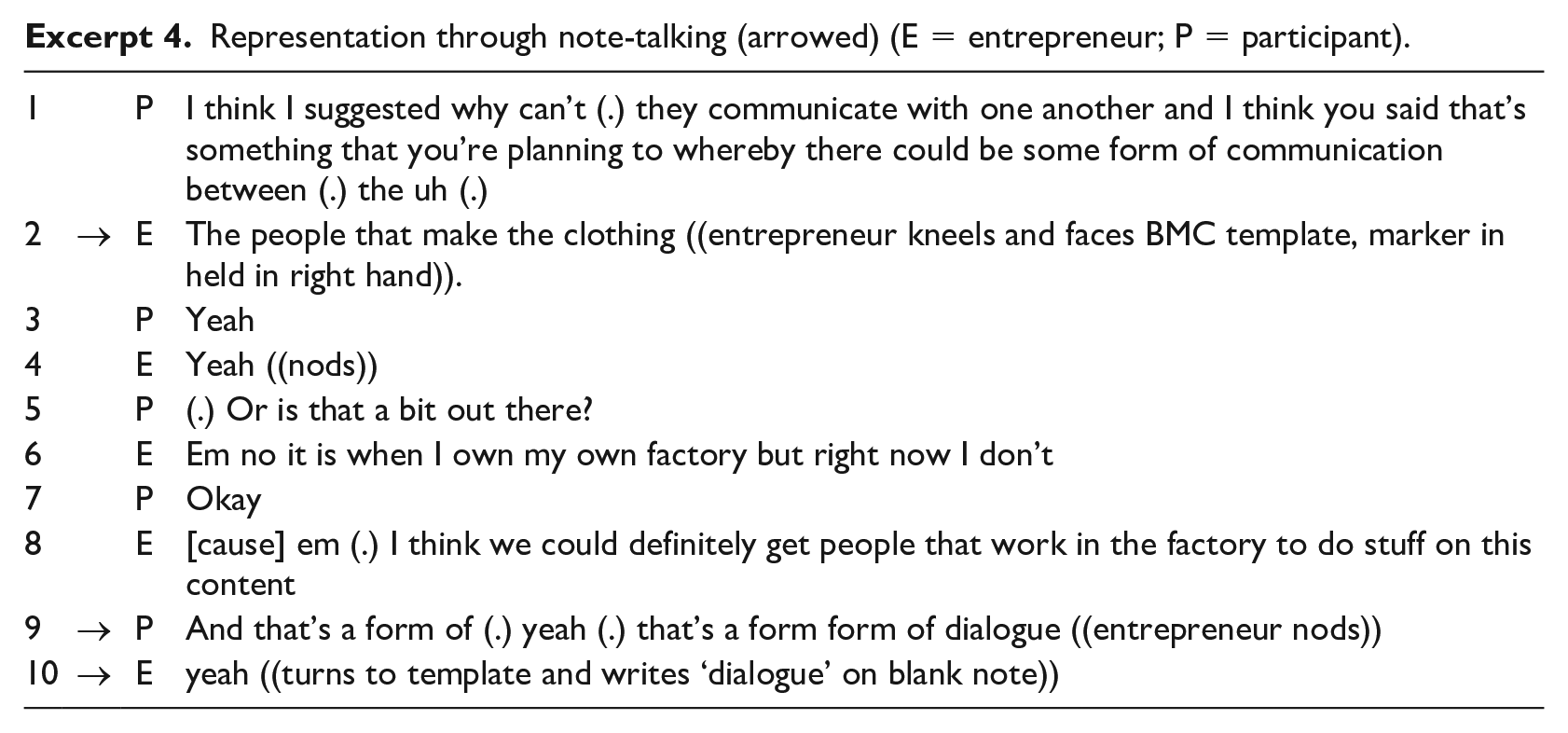
In Excerpt 4, E and P discuss possible ways that an ethical clothing company may add value. P returns to a conjecture that he made previously in the conversation (line 1), while E holds a marker (without cap) and kneels next to the template near a blank sticky note (line 2) and utters ‘yeah’ (line 3). P, observing that E agrees but has not noted anything (lines 3 and 4), raises the question of whether his conjecture is still relevant (line 5). E responds that it would be irrelevant in the future but in the short term it could make sense (line 6) and utters that she thinks it would be possible (line 8). P initiates a gist to the conversation (‘a form of dialogue’) (line 9), to which E displays affiliation by nodding (line 9), and transitions into writing by turning to face the template writing ‘dialogue’ on the note (line 10). In this excerpt, we see practical knowledge playing a role through E’s writing position, which tacitly communicates a readiness to P to engage in note-taking. However, when E does not write, P understands this to mean that she may not agree (line 5). Her subsequent clarification and then reaction to P’s gist coincides with a nod in such a way that achieves a shared understanding of affiliation. As she transitions into writing, she also tacitly communicates the end of this particular discussion and a transition to the next.
Second, practitioners draw on revision practice to edit conjectures represented on existing notes. In these cases, revision begins by moving one’s body to visibly attend to text on existing notes. This is followed by vocalizing a problem or question, or even anticipating a problem by observing another’s embodied cues. Subsequent discussion proposes alternatives, which can lead to an affiliation and written revision of the note, or replacement with new one. Excerpt 5 provides an example of revision with an entrepreneur-entrepreneur pair (co-founders) (E1 = entrepreneur 1; E2 = entrepreneur 2).
Representation through revision (arrowed) (E1 = entrepreneur 1; E2 = entrepreneur 2).
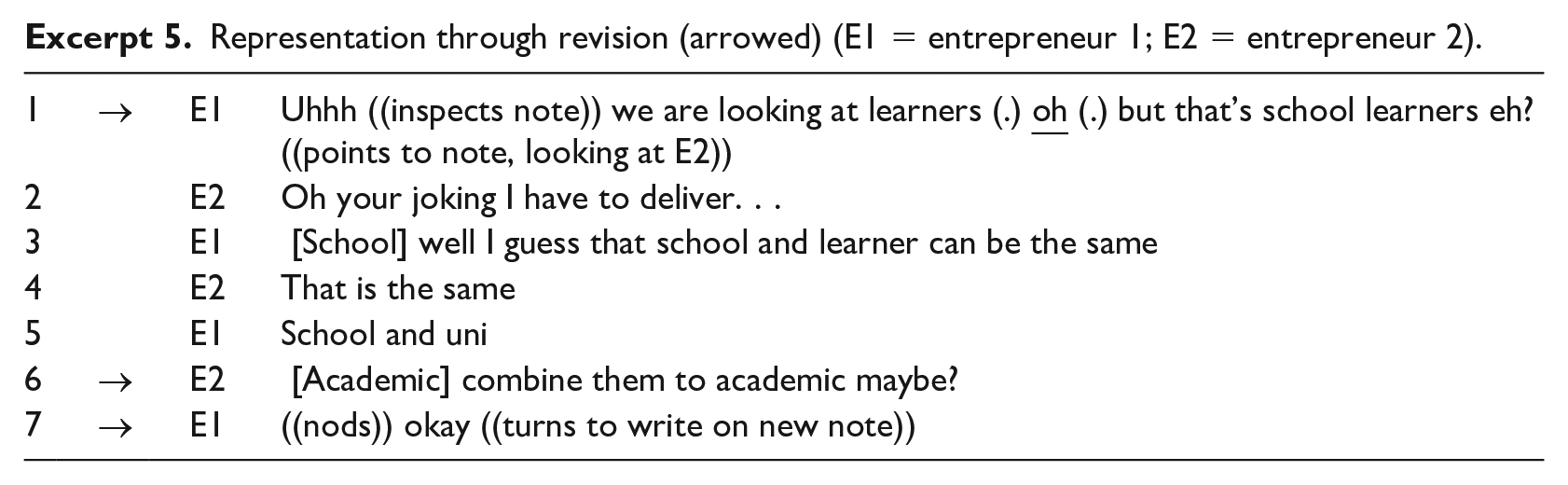
In Excerpt 5, the two entrepreneurs are attending to conjectures of possible categories of customers for their imagined online tutoring platform. E1 turns his body to inspect a previously written note then utters ‘oh’ and pauses, points to the note and suggests a problem (line 1), which draws E2’s attention to his point of concern. E2 glances at E1 and responds negatively since a revision at this point would mean more time for discussion (which they do not have) (line 2). However, he does not finish his statement as E1 interrupts by venturing a solution (line 3). E2 agrees by confirming their equivalence (line 4). As E1 reads ‘school and uni’ learners from the note, he turns attention to revise these conjectures (line 5). E2 then proposes that the different customers written on the notes may fall under an ‘academic’ label (line 6). This invites a judgement by E1. E1 displays an affiliation with a nod, verbally agrees and turns to the existing note to add ‘academic’ as a superordinate label (line 7). This excerpt shows revision organized around a mutual understanding that: a conjecture needs to be readdressed (line 1 and 2); both have the rights to propose alternative phrasing (lines 3 to 6); and it is appropriate for E1 to pass judgement and expected that he revise the text (line 7).
Finally, practitioners often use recruitment practice to seek assistance (requested, solicited or anticipated) in representing conjectures. The recruitment of others is not only used to help overcome practical problems that may occur during representation, such as lack of time or a conflicting engagement task, but is influential in the constitution of a conjecture itself. This can include verbal requests, indirect and embodied indications of requiring assistance, or even giving anticipatory assistance. Excerpt 6 provides an example of anticipatory assistance with an entrepreneur-participant pair (E = entrepreneur; P = participant).
Representation through ‘anticipatory assistance’ (arrowed) (E = entrepreneur; P = participant).
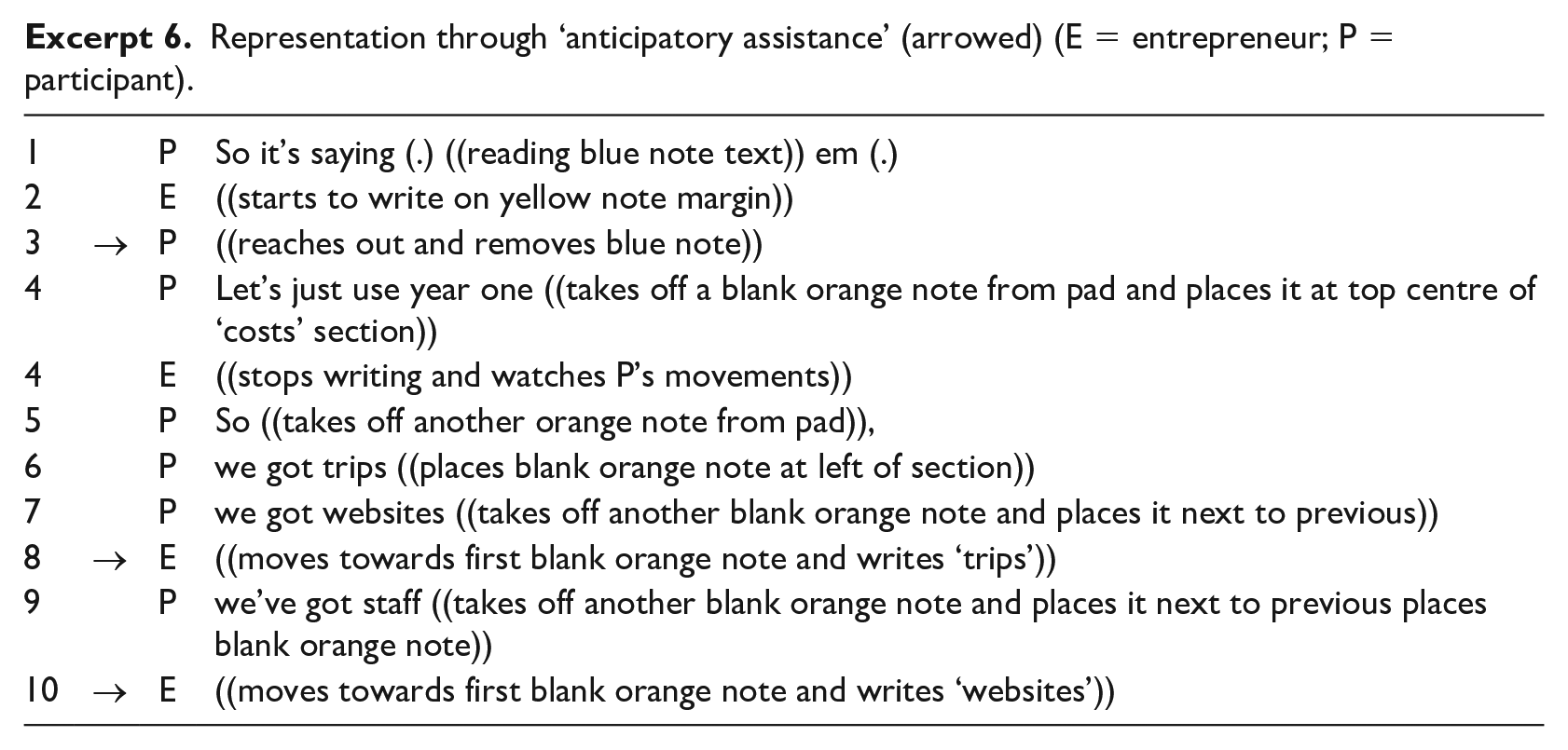
In Excerpt 6, E and P are working to imagine possible costs of a business model. P begins a revision by uttering ‘so it’s saying’, frowns and pauses while reading a blue note (stuck to the costs section of template) (line 1) while E attends to another note (line 2). P abruptly reaches out and removes the note (line 3), which catches E’s attention. In this case, P evidences an assumption that he has the rights to pre-emptively solve a problem (likely due to too many words but this is not stated explicitly). On line 4, he places a new orange note on the top centre of the section, stating, ‘let’s just use, year one’ (line 7). P takes another blank orange note and places it on the left of the section saying ‘we got trips’, repeats the action stating ‘we got websites’ (lines 6 and 7). E evidences she not only tacitly understands P’s intention, but finds it appropriate for him to take these actions, evidenced by her writing ‘trips’ (line 8). P repeats the action and states ‘we’ve got staff’ (line 9), with E continuing to note P’s statements (line 10). The pair repeat the turns a few more times until all the prior note’s text is represented on separate notes, spurring them to discuss each possible source of costs in more detail (not in the excerpt). Practical knowledge is demonstrated here in that E does not ask for assistance, nor does P explicitly explain why he is taking action. Rather, both share an understanding that P is engaging in a revision, that P’s assistance is not only necessary but that it is appropriate to follow P’s unspoken directive to revise the meaning of conjectures.
Practices of Organizing Conjectures
Finally, entrepreneuring practitioners address the challenges of organizing individual conjectures into coherent and plausible collections through the practices of display, arrangement and relocation, which likewise draw on, and reproduce, situated forms of practical knowledge.
First, display practice is employed to discuss and place conjectures spatially to establish relations to other conjectures and the categories set forth by the BMC template. To do so, practitioners discuss their possible location (e.g. this, that, here, there) within an aspect of the template. This happens in combination with the action of ‘placing’, to bring attention to possible spatial relationships among texts. In many cases, the practice is carried out without issue, such that the displayer inspects the ‘proper’ location for the conjecture and simply places it below or next to an existing conjecture, which enables observers to pass judgement by rejecting or affirming explicitly (‘yeahs’) and implicitly by moving onto another topic. In excerpt 7, we show an example of an entrepreneur-participant pair confronted with the question of the proper location for the conjecture, given the template and other notes. Indeed, as the number of conjectures increases over time, we see more cases of practitioners overtly negotiating this complexity through display practice.
Organizing conjectures through display (arrowed) (E = entrepreneur; P = participant).
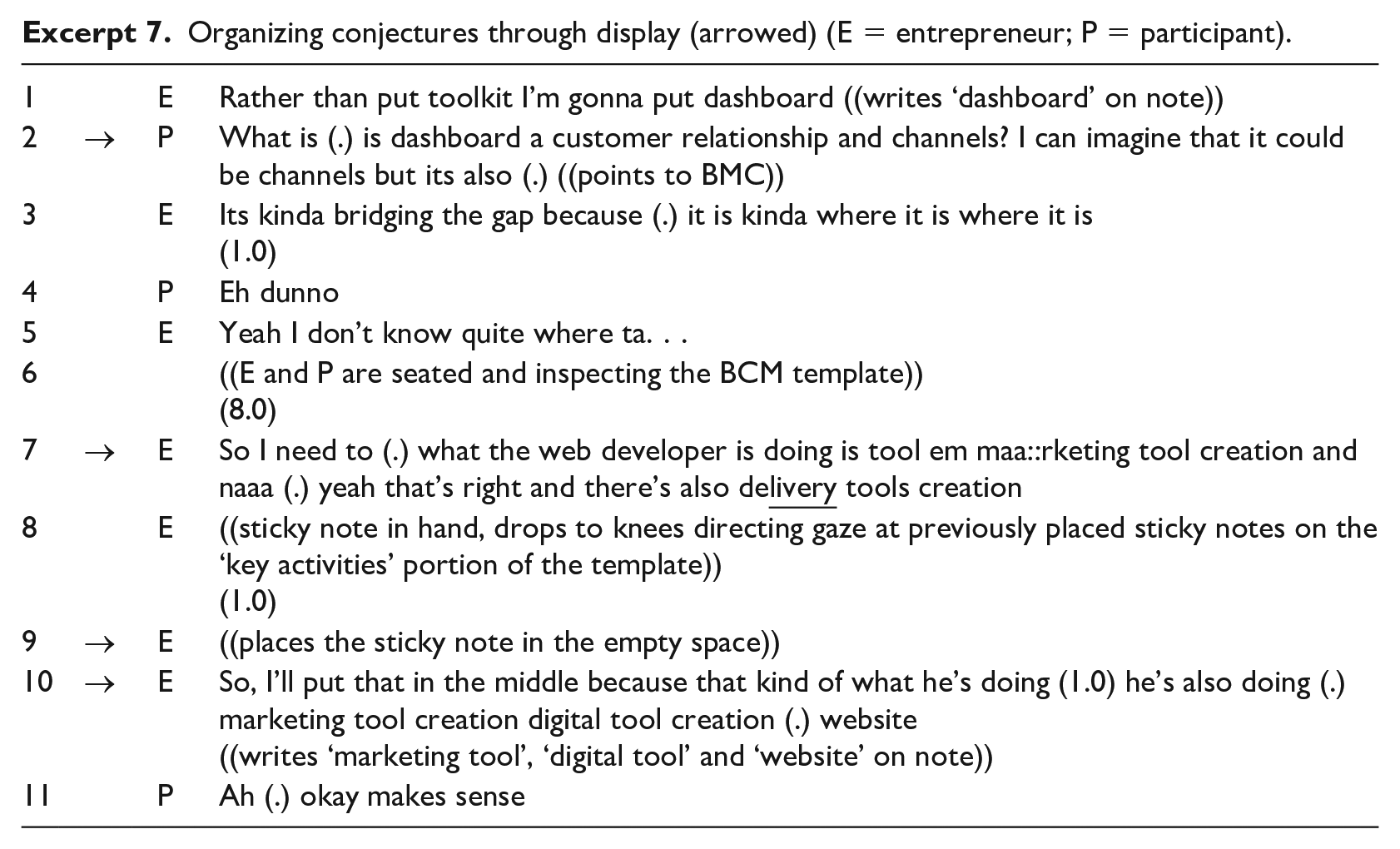
In Excerpt 7, E is working with P to develop ideas for the ‘key activities’ section of the template. On line 1, E writes ‘dashboard’ on a note he holds in his hand, paraphrasing their prior discussion. P explicitly initiates a display practice by asking E where the note should be placed on the template, as it could go in two different places. E agrees (line 3) and both indicate they are not sure where it should be displayed (lines 4 and 5). This explicit exchange evidences a mutual understanding that the placement of the note confers additional meaning, and that this needs to be carefully considered. They spend the next eight seconds silently inspecting the BMC template (line 6) then E makes an utterance about where to place the note (line 7). In particular, he reads closely the existing notes in the ‘key activities’ section of the template then reaches out and places the sticky note in the middle of this section (line 8). As he does so, he produces an account for P of his actions (‘I’ll put that in the middle’, because that is ‘what he’s doing’ (line 10). The placement in the ‘middle’ of this section is purposefully beneath the middle yellow note. By placing the note in a specific location, he makes it clear to P why he believes that this conjecture is derivative of ‘process development’ category and should be displayed in this portion of the template. His suggested display implies a reaction from P, which P affirms (line 11). As this excerpt shows, display relies on a mutual understanding that each individual conjecture will obtain additional meaning by establishing relations with other conjectures, and that E has the right to propose these relations. Of course, proposals of display can also become a topic of discussion, and may even feed back into reconsideration of the conjecture itself.
Second, it is important to acknowledge that practitioners can revisit previously placed notes at any time and, when working with revolving participants and directors, they often alter their arrangement to bring clarity and plausibility. Similar to revision, practitioners coordinate a practice of arrangement by verbally indicating an issue with current arrangement and may recruit others for assistance. In Excerpt 8, we show an example of a breakdown in this practice between an entrepreneur and a participant, which helps illuminate the practical knowledge with which practitioners normally carry out this practice.
Organization of conjectures through arrangement (breakdown arrowed) (E = entrepreneur; P1 = participant 1; P2 = participant 2; R = researcher).
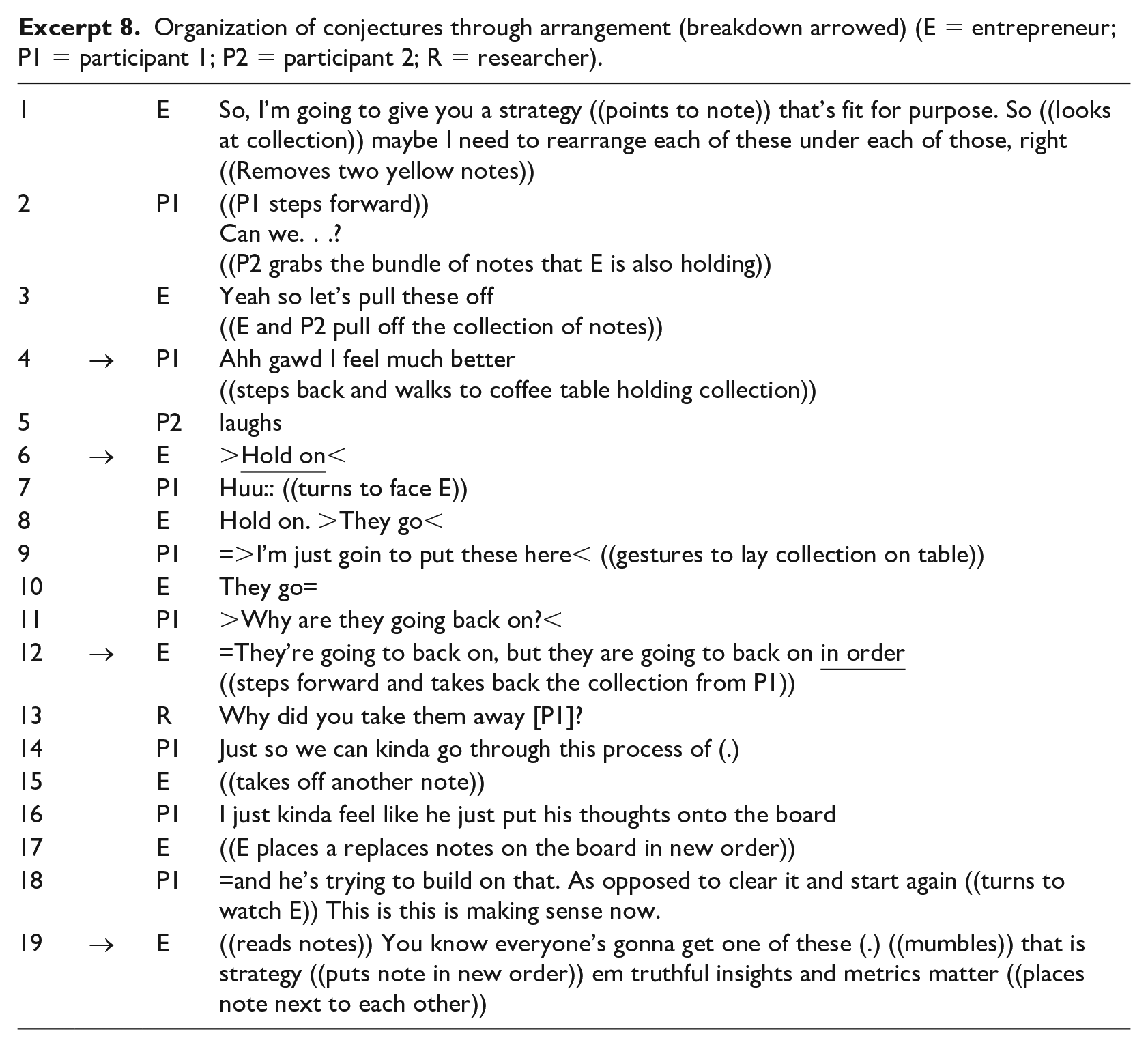
In Excerpt 8, the entrepreneur and participants are working on the ‘value proposition’ section of the BMC. E initiates the practice by verbally indicating he is not satisfied with the meaning being conferred by the current relationship between notes on the template (line 1). Next, E accepts P1’s request to assist (lines 2 and 3), however, P1 misunderstands that E would like to rearrange the collection of notes rather than permanently remove or revise them (line 4), which produces distress by E (lines 6 and 8). E then retrieves the collection and clarifies his intentions to put the notes ‘back in order’ (line 12) in response to P1’s confusion (line 11). Interestingly, R recognizes a breakdown and elicits P1’s tacit reasoning (line 13) to which P1 explains he feels E ‘just put his thoughts onto the board’ which complicates their meaningful organization (lines 14, 16 and 18). Meanwhile, E completes the rearrangement by not only placing the notes in a new order, but by verbalizing his reasoning of the new arrangement to P1 and P2 (line 19). In this instance, we glean the practical knowledge around which the practice of arrangement is typically organized by evidencing a moment when it is not fully shared. This breakdown prompts practitioners to explicitly state previously tacit intentions and repair the situation.
Finally, practitioners achieve an organization of conjectures by engaging in relocation practice, in which collections of notes are moved to different spatial locations on the BMC. As opposed to attending to arrangements of notes at the same spatial location, in these instances, practitioners are concerned with altering their spatial locations on the visual template. Engaging in this practice allows practitioners to agree upon certain collections of notes more (or less) coherent or plausible vis-a-vis others, and hence, is a crucial way that decisions are made regarding possible future scenarios. Thus, engaging in this practice often stimulates negotiation about the relative status of collections. Excerpt 9 providing an example of an entrepreneur-director pair (E = entrepreneur; D = director).
Organization of conjectures through relocation (arrowed) (E = entrepreneur; D = director).
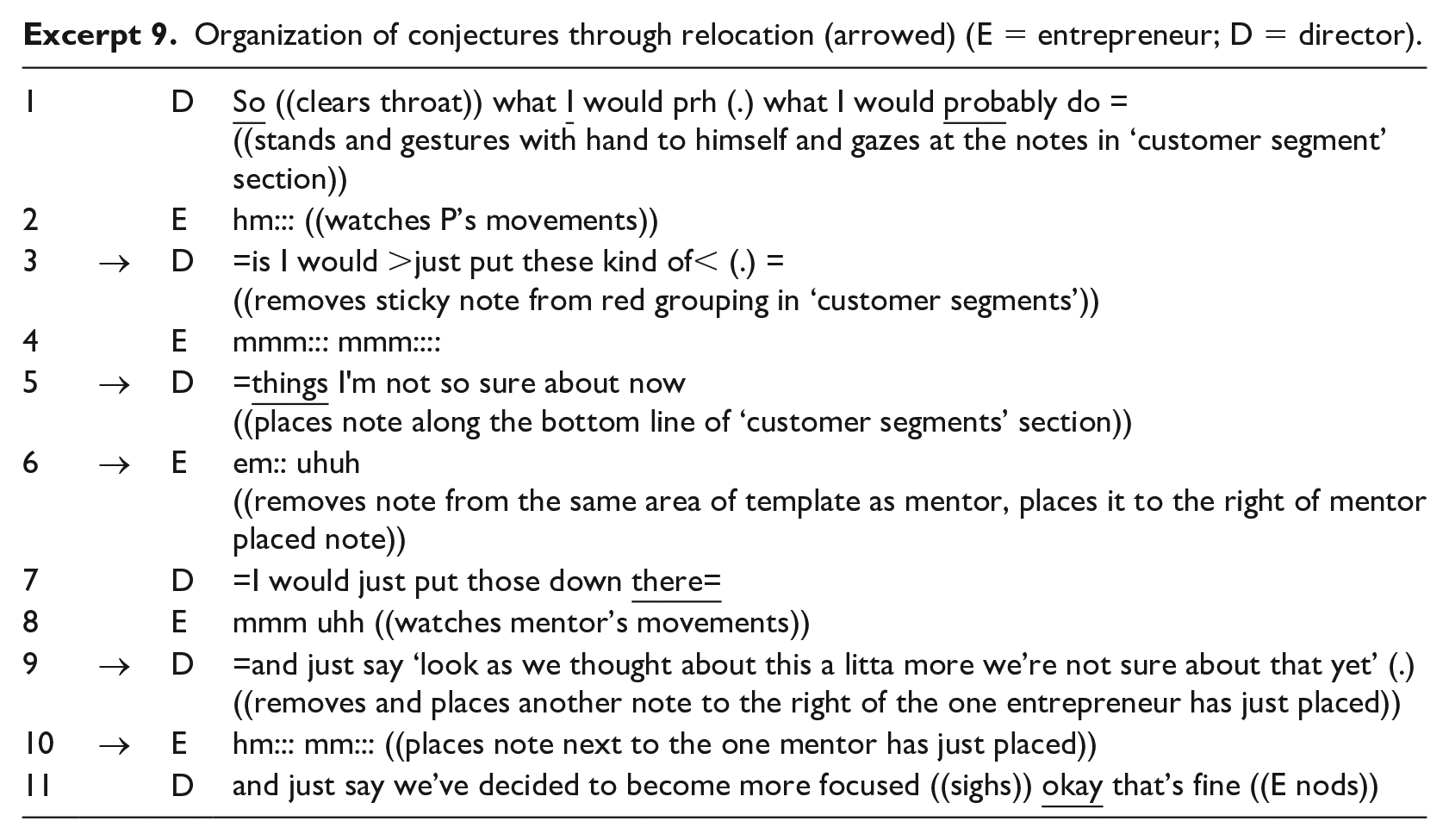
In Excerpt 9, D and E are revisiting previous conjectures of clients for an imagined flight simulator service. D points towards himself while his gaze and utterance are towards a specific collection of notes (line 1). D reaches out with his right hand and quickly removes a note, as E’s gaze follows his movements (line 3). D places the note in the lower corner of the ‘customer segments’ section of the template, combined with the utterance ‘things I’m not so sure about now’ (line 5). E immediately removes another note and moves it to the right of D’s, replicating their notes’ prior arrangement, but in a different location on the template (line 6). This evidences that she shares an understanding with P by retaining the meaningful relations of the notes that make up the collection, and approves that it is appropriate for D to take such an action. D removes another note and relocates it next to E’s, and directs her to say to her teammate that ‘we’re not sure about that yet’ (line 9). E again mimics D’s actions (line 10) and D finishes with a directive statement that E should say to the group that she has become more focused and ‘that’s fine’ (line 11). As can be gleaned from this excerpt, both practitioners share an understanding that: D intends to relocate conjectures on the template and holds the rights to do so; and E understands and endorses relocation by participating in reproducing the order of the notes in a different spatial location. This sequential conduct simultaneously establishes new relations between collections of conjectures, making one more (or less) plausible than another, thus influencing the emergence of an imagined future.
Discussion
In this article, we used a video-ethnography to investigate how entrepreneuring practitioners (entrepreneurs, mentors and participants) in a UK-based accelerator programme handle the challenges of future-making inherent in efforts to develop images of business models. Our analyses of audio-visual recordings revealed that practitioners repeatedly utilize a variety of practices for formulating conjectures (gist, upshot and upshot challenge), making conjectures visible (note-talking, revision and recruitment), and organizing individual conjectures into a meaningful whole (display, arrangement and relocation) that have yet to be identified and theorized in existing research. This article furthers our understanding of future-making by providing the first fine-grained account of practical knowledge, which contributes to theory in a number of ways.
Contributions to theory
First, this study contributes to theory by demonstrating that future-making is determined, at least in part, by a moment-to-moment texture of practical knowledge. Existing research has made gains by shifting understanding of imagined futures from a form of cognitive work towards the future-making practices that practitioners jointly enact (Wenzel et al., 2020). Nevertheless, researchers have foregrounded conscious engagement in future-making (e.g. Comi & Whyte, 2018) and have neglected the study of practical knowledge utilized to co-produce imagined futures. Similarly, entrepreneuring scholars broadly acknowledge that creating organization, new business models and opportunities involves the recursive social construction of imagined futures (Thompson, 2018) manifest in artifacts (Berglund et al., 2020), yet the practical knowledge employed to do so remains under-studied. As a result, existing research has not examined how practical knowledge guides practitioner interaction, despite it being an anchor point of the practice theory tradition (Schatzki, 1997). Our study provides a more nuanced view. We show that an utterance, gesture or gaze, through which imagined futures are created, are meaningful and influential in the moment due to a mutual understanding of intentions and rights. These bind all practitioners present in a web of mutual expectations, but do not absolutely determine their actions. By studying such practices, we offer an alternative way into understanding how imagined futures are made by tracing their origins to the tacit ways in which practitioners address practical challenges. Textures of practical knowledge, in other words, direct and fashion the assembly of subsequent modes of thinking and acting on imagined futures. Accordingly, our study furthers theory by evidencing that practical knowledge is reproduced through specific instantiations, that are, at the same time, a shared resource that enables practitioners to jointly accomplish future-making when combined and assembled in intricate ways.
Second, our findings lead to critical questions regarding studies that theorize embodiment and materiality as transcending their particular material instantiations and circumstances (e.g. Clarke et al., 2019; Comi & Whyte, 2018). While practitioners rely on subtle gestures and gazes to communicate with each other, and visual artefacts performatively act as instruments of reification, what remains unavoidable is that their significance and meaning is entangled within practical knowledge that coordinates interaction (Cooren, 2020). As an alternative, we propose an immanence perspective in which the relevance and meaning of embodiment and materiality are contingent within textures of practical knowledge that we have detailed (Curtis, 2014). This perspective argues that to understand if and how a gesture, gaze, tool or visual artefact is performative of an imagined future, scholars must attend to how and why practitioners jointly observe, understand and react to them. Hence, further theoretical development on the role of embodiment and materiality in future-making will occur as scholars analytically prioritize the diversity of practices through which practitioners reveal and reproduce practical knowledge.
Finally, this study contributes to literature on future-making by shifting the mode of theorizing towards non-representationalism (Lorino, Tricard, & Clot, 2011). Prior research has used thematic analyses to arrive at representations of future-making practices based on their ability to correspond to a diverse set of ordinary activities (Comi & Whyte, 2018; Elias et al., 2018). This suggests a distinction between scholars’ thematic conceptions of practice and practitioners’ specific activities. For example, Comi and Whyte (2018) propose that ‘imagining practice’ is conceptually composed of, but distinct from, the ordinary activities of sketching, discussing and deciding. Alternatively, our study shows that the practices of formulation, representation and organization are, in the first instance, a practitioners’ phenomenon, something that they draw upon, monitor and orient to in real-time interaction (Llewellyn & Spence, 2009). Hence, we make no categorical distinction between the practices described herein and the ‘lay’ practices of practitioners. This mode of theorizing takes mundane practices seriously, which leads to an epistemological shift from representing towards observing, participating and reflecting with practitioners the textures of shared practical knowledge constitutive of future-making practices in different circumstances (top management meetings, strategy workshops, hackathons) in other cultural contexts.
Contributions to practice
There are also some practical implications specific to practitioners whose work is temporally oriented to the future. First, educators and directors instigating ‘instruments of imagination’ – business modelling, strategy workshops, technology projections, etc. – often explain the elements of a generic task, model or template, then subsequently encourage participants to merely ‘fill it in’. Very rarely is there training or clear expectations on tacit aspects of the work. It is likely that practitioners without experience with formulation, representation and organization practices, aspects this research reveals to be critical, will struggle to competently participate. This study thus provides some justification for including more detailed considerations of these practices in practice, which could possibly improve the depth of detail and uniqueness they can achieve in such a setting. Second, in highlighting the close physical interaction necessary to complete these practices, this article perhaps reveals some of the challenges that online teamwork poses for future-making. It is taken for granted by the directors in our study that the programme should be held in close physical proximity, some travelling over great distances to join, suggesting that their experience shows the importance of physical interaction. This article may be used to prompt further exploration of whether, and if so how, future-making practices might be conducted online in an age of spatially distributed teams.
Footnotes
Acknowledgements
We would like to thank the Ignite accelerator organizers for welcoming us to the programme and for their hospitality, generosity and patience with our data collection efforts and video recording equipment throughout. We also thank all the entrepreneurs and other participants of the programme for their willingness to participate and support the study. Additionally, we would like to acknowledge the three anonymous reviewers who helped us sharpen our thinking and refine our arguments. We appreciate the helpful comments provided by participants of the 4th Entrepreneurship as Practice Conference, RENT 2018 and AOM 2019 as well as Dimo Dimov who was involved in earlier versions of the article. Finally, we thank the special issue guest editors Trish Reay and Daniel Hjorth for their thoughtful guidance throughout the review process.
Funding
The author(s) received no financial support for the research, authorship, and/or publication of this article.
