




Abstract
As scholarly currency, contributorship in scientific research is important for a researcher’s academic career. Therefore, library and information science (LIS) researchers should receive credit for research contributions. This study analyzes Contributor Roles Taxonomy (CRediT) contribution statements in LIS scholarship to determine the frequency of CRediT roles and explore the role of gender in LIS contributorship. Research articles were collected from LIS journals published in 2023 and 2024 and contribution statements were extracted. Analysis of CRediT statements reveal a collaborative writing culture with nearly all contributors involved in writing activities. There is a gap in women-men authorship, with women contributing to 45.15% of scholarship and 54.85% men. There are disparities in leadership and technical roles: gender gaps exist between supervision, project administration, data curation, and funding acquisition, with men more likely to take on funding and supervision roles, and women more involved in administrative and curation roles. While women LIS researchers are closer to achieving parity in terms of co-author and contributorship, there are disparities in the division of labor within LIS research culture.
Keywords
Introduction
Authorship and contributorship in scientific research are important dynamics of academic life; contributing to research impacts annual performance reviews, promotion, tenure, and reputation. Receiving credit for your work, therefore, is important scholarly currency. Bourdieu’s (2004) idea of scientific capital, or the accumulated social capital from scientific recognition and prestige, helps explain this phenomenon. Scientific capital explains why authorship is more than individual recognition, but about the accumulation of symbolic power within academia. Understanding how authorship and contributorship decisions reflect academic power structures becomes significant for creating more equitable research cultures.
There is a growing number of multi-authored research articles, and it can be challenging to deduce the research contributions of individual authors; the traditional author order is no longer sufficient (Sugimoto and Larivière, 2018). Library and Information Science (LIS) has seen an increase in multi-authored works (Chang and Huang, 2012; Hosseini and Erfanmanesh, 2015) and understanding authorship contributions and acknowledging diverse research roles are essential for transparency and collaboration. One solution is the adoption of the Contributor Roles Taxonomy (CRediT), a method of assigning specific and standardized roles completed by authors using standardized vocabulary.
Research is slowly examining how gendered divisions of research labor shapes scientific contribution across disciplines (e.g. Zhao et al., 2026), demonstrating that gender diversity in research teams influences not only who does what, but how credit is distributed. As women and men often have different contributions to scientific production (Larivière et al., 2021) and receive various levels of credit and acknowledgment for their labor (Ni et al., 2021), extending this line of inquiry to specific and unexamined disciplines is essential for understanding whether and how these dynamics vary.
LIS encompasses two related but distinct subfields: library science and information science. Library science focuses on libraries as institutions, library collection management, and professional librarian practice, while information science focuses on information systems and retrieval. Crucially, LIS is a feminized field with a long history of gender stratification, making it an especially meaningful site for examining gendered divisions of scholarly labor (Buttlar, 1999; Eva et al., 2021; Olsgaard and Olsgaard, 1980). Contributorship in LIS has received little attention in scientific literature thus far.
Our analysis treats LIS as a scholarly discipline and examines publication and authorship practice for the entire LIS discipline. Our integrated approach recognizes the interconnected characteristics of LIS graduate programs, professional associations, and researchers, while acknowledging the discipline’s diversity.
This research studies scholarly attribution within library and information science publications by measuring the frequency of CRediT roles and analyzing how contributor roles are related to gender in library and information science scholarship.
Our research questions are:
What is the frequency of each CRediT contributor role in library and information science publications?
Does gender affect the frequency of authors’ CRediT roles in library and information science publications?
Literature review
Gender in LIS authorship
A critical starting point to examining equity in academic scholarly publishing is the distinction between sex and gender. Sex refers to biological characteristics such as anatomy or chromosomes (male/female), whereas gender reflects socially constructed roles, norms, and identities (woman/man; Canadian Institutes of Health Research, Government of Canada, 2018; Kaufman et al., 2023). Despite broad agreement on these differences, the terms are often conflated in scholarly writing and research, leading to knowledge gaps and misinterpretation of results (Epps et al., 2022; Kaufman et al., 2023).
This distinction is relevant to LIS scholarship, where sex/gender has been extensively researched in regards to authorship (Buttlar, 1999; Cline, 1982; Gul et al., 2016; Lipetz, 1999). One of the earliest bibliometric studies of LIS authorship was conducted by Olsgaard and Olsgaard (1980), who examined five well-known LIS journals and found that the highest percentage of women authors (39.6%) in one academic journal fell well below the 61.5% of women academic librarians employed at the time. Subsequent research has shown increases in women’s authorship, however it has yet to match women’s majority presence in the profession (Cline, 1982; Gul et al., 2016; Lipetz, 1999). More recently, Monroe-Gulick et al. (2024) analyzed 10 LIS journals from 2003 to 2021 and found women accounted for roughly 56% of authors, however the authors do not include the percentage of men, non-binary, or unknown gendered contributors. Shah et al. (2025) found women LIS researchers publish more from non-European countries compared to Europe, and while the current study did not measure researchers’ geographic location, the EBLIP journal list is international in scope.
This figure still falls short of recent professional demographics. A 2018 census of Canadian academic librarians found that 73.58% were women (Revitt et al., 2019), while a 2024 report found that 89.2% of librarians working in all US libraries were women (Department for Professional Employees, 2025). This mismatch between representation in the workforce and in publications has persisted for decades.
A notable shift in LIS gender authorship research is the move from concentrating on single journals, to broader multi-journals and global analyses. Early work often examined single titles from both library science and information science, such as College & Research Libraries (Cline, 1982), Journal of the American Society for Information Science (Lipetz, 1999), or The Electronic Library (Gul et al., 2016) providing detailed, but singular perspectives on gender authorship. More recent scholarship has expanded its scope, using multiple journals or large datasets to capture the broader themes emerging in LIS publications (Lund and Shamsi, 2023; Monroe-Gulick et al., 2024; Zhang et al., 2023).
These recent studies have revealed not only the persistence of underrepresentation in authorship but also subject and methodological differences between genders. Monroe-Gulick et al. (2024) and McBurney et al. (2025) found that women were more likely to publish in areas such as diversity, information literacy, reference services, and medical librarianship, while men dominated in technology, systems, and information science journals. Zhang et al. (2023) went further in their analysis and observed that women authors favored qualitative approaches, such as interviews, while men more often employed theoretical methods. Moving beyond individual preferences, a subsequent study found gendered patterns in research collaboration, where all-female research collaborations study a wider breath of topics and methodologies compared to the specialized and technical topics and methodologies of all-male collaborations (Zhang et al., 2025). Taken together, these findings suggest that inequities in LIS publishing are embedded not only in overall authorship, but also in the subjects of and approaches to the research.
Librarians working in different types of libraries can have significantly different levels of research productivity. School librarians, for example, publish very little, if at all (Tam and Dukić, 2024). The stakes are raised even higher for LIS faculty, who are expected to publish at a higher rate than librarian practitioners, no matter what type of library the practitioner works in. For LIS faculty, gender differences in authorship are nearly at parity. In a 2024 Association for Library and Information Science Education (ALISE, 2024) report of Canadian and American LIS faculty members, there are 651 men (49.13%) and 674 women (50.87%).
LIS authorship research has relied on the binary classification of gender, which can conceal the existence and contributions of non-binary and gender-diverse scholars, further limiting our understanding of equity in scholarly publishing. We recognize that research on LIS authors should expand beyond its binary recognition of gender; however, in our study, we were unable to capture gender-diverse individuals and this remains an important limitation of our study.
Science collaboration and traditional roles in LIS research
Research relies on collaboration; many stakeholders come together to work on solving problems through research. Librarians and information professionals have a long history of collaborating: collaborating with faculty on information literacy (Andres and Usova, 2024), with teachers (Stewart and Oniel Deans, 2020), on evidence synthesis projects (Monnin and Lê, 2024), and even an entire journal dedicated to collaboration (Collaborative Librarianship). This collaboration extends to the research that librarians conduct.
Librarian-authored journal articles have seen increases in authorship numbers over the years (Chang and Huang, 2012; Hosseini and Erfanmanesh, 2015). Das et al. (2021) found the degree of collaboration increased slightly for publications in College & Research Libraries, during the study period of 2009–2018. Zhao et al. (2021) looked at all publications published by top-ranked LIS schools and found the co-authored articles are the norm, with 75% of American publications and 91% of Chinese publications co-authored and national and international collaboration increasing substantially within their study’s timeframe (2008–2017). With increased co-authorship comes a tension to the traditional academic method of giving credits or rewards for research (Cronin, 2005).
Librarians and information professionals have a well-documented history of not receiving credit for the work they do (Clarke et al., 2022; Post and Chassanoff, 2021; Ross-White, 2021). As a service-based profession, and a profession which is predominantly female, previous research shows librarians are undervalued for the work they do (Clarke et al., 2022). Ensuring that team members receive credit for the work they perform should be a priority throughout research and scholarship. Paul-Hus et al.’s (2020) research shows acknowledgment sections throughout scholarship are associated with academic status and gender, with more senior, male academics receiving credit for their intellectual labor.
This is seen in specific research contributions, such as technical tasks. Data curation has traditionally been an overlooked contribution: “there is relatively little training provided to doctoral students, nor are many scientists prepared to engage in this” (Larivière et al., 2021: 123) and the authors suggest curating data was a previously invisible role within research teams. Larivière et al. (2016) find the authors involved in technical tasks are less frequently granted authorship compared to those in conceptual roles. In their study, Larivière et al. (2016) find older authors are involved in conceptual tasks, while their younger, less senior colleagues complete technical tasks. This aligns with the Matilda effect, or the systemic minimization of women’s contributions in science, as coined by Rossiter (1993).
In some disciplines, author order has significance, such as the principal investigator being listed first or the supervisor last, however LIS does not exclusively share this tradition. There are issues with giving more weight to the first author, with the first author not always contributing to the majority of the labor (Owens, 2023). Monroe-Gulick et al. (2024) measure “primary” women and men authors in LIS scholarship, however the authors do not define “primary,” so it is unclear whether they are referring to the first author or the corresponding author. From 2003 to 2001, Monroe-Gulick et al. found 56.37% of articles with women primary authors.
While traditional roles of first and last authorship may have been sufficient in the past, there should be appropriate credit for the research tasks that authors play when collaborating together on scholarly work, especially as multi-authored works are now the norm in LIS scholarship. Contributor Role Ontologies and Taxonomies (CROTs) are one way for authors to get credit for the work they do on scholarly publications. One well-known CROT is the Contributor Role Taxonomy (CRediT; National Information Standards Organization (NISO), 2026), which consists of 14 roles that authors can assign to themselves, such as working on the study’s methodology, performing data analysis, or contributing to writing activities.
Since it was introduced in 2014, CRediT has been adopted by an increasing number of major publishers and academic journals, particularly in those disciplines where collaboration and multiple authors are more common, such as medicine, engineering, and science (Baethge, 2008; Cronin, 2001; Henriksen, 2016; Wuchty et al., 2007). It is worth mentioning there are other CROTs available, such as The Taxonomy of Digital Research Activities in the Humanities (TaDiRAH), used mostly by the digital humanities, DataCite, which has additional terminology for creators, and Scholarly Contributions and Roles Ontology (ScoRo), which provides more specific role descriptions (e.g. patent holder, accountant; DataCite Metadata Working Group, 2021; Perkins et al., 2014; Shotton and Peroni, 2017). However, CRediT is the only CROT approved as an ANSI (American National Standards Institute)/NISO (National Information Standards Organization) standard. CRediT is also by far the most widely-used CROT, adopted by publishers such as Wiley, Sage, and Elsevier, and repositories such as Zenodo (Hosseini et al., 2023). This study focuses on CRediT, as it provides standardized contributor roles and CRediT’s wide adoption by journals, publishers, and organizations.
LIS scholarship consists of qualitative and quantitative methods, including surveys, case studies, scientometrics, and experiments (Järvelin and Vakkari, 2022). While CRediT has challenges with attributing non-author contributions by research collaborators (Godskesen et al., 2026; Hosseini et al., 2024) and has issues with the granularity of collaborator roles (Godskesen et al., 2026), CRediT can track collaboration more accurately than listing authors at the top of a journal article.
Studies have addressed research contribution and acknowledgment in scientific research broadly, in terms of author order (Larivière et al., 2021), discipline (Larivière et al., 2021), age (Costas and Bordons, 2011), career stage (Jamali et al., 2020; Larivière et al., 2016), academic rank (Corrêa et al., 2017; Costas and Bordons, 2011; Fox, 2020), and academic status (Paul-Hus et al., 2020). However, special attention in LIS authorship and contributorship should be paid to gender, as gender differences are a reality in librarianship, a women-majority profession (Eva et al., 2021; Rutledge, 2020). Investigating gender differences in collaborative librarian research teams is important since the lack of acknowledgment of contributions can be a barrier to working in academia and could result in lower academic capital (Sugimoto and Larivière, 2023).
Positionality statement
As authors, we acknowledge that our social positions and professional experiences shape our approach to our research on gender in LIS research contributions. We are three liaison librarians at the University of Manitoba, a mid-sized public research university in Winnipeg, Manitoba, Canada, located on Treaty 1 territory.
Our gender and backgrounds are particularly relevant to this research and may influence our perspective on gender equity, as two of us identify as cisgender women and one as a cisgender man. We have worked together in mixed-gender and single-gender research teams, experiences that have influenced how we view contribution, collaboration, and recognition in LIS research. We recognize that our own positions within academia come with privilege and potential bias, and we share this statement to be transparent about how our perspectives inform our analysis and our commitment to advancing equity in scholarly work.
Methodology
Data collection
Using a list of 145 library and information science journals identified by the Centre for Evidence Based Library and Information Practice (Supplemental Appendix 1), we identified 129 journals actively publishing. The list identifies both library science (e.g. College & Research Libraries; Library Trends) and information science (e.g. Journal of the Association for Information Science and Technology; Journal of Information Science). Of the 129 journals, eight required that authors include a contributor statement (6.2%).
The 129 journals’ first issues of 2023 and 2024 were downloaded and imported into Covidence, a web-based screening and extraction tool, for screening. Issues were downloaded by the authors navigating to the journal’s website and downloading articles manually. Covidence, a web-based screening and extraction tool, primarily used for knowledge syntheses, was selected because of it’s ability to easily screen large datasets for inclusion and exclusion. Research articles identified by two independent screeners were included that were in English or French. Articles which were excluded include letters, editorials, book reviews, and column articles. Screening conflicts were resolved through discussion by all co-authors. All articles falling within the inclusion criteria were full text screened by one screener. A PRISMA-style flow chart of included studies is included (see Figure 1) to transparently illustrate the article screening and selection process.
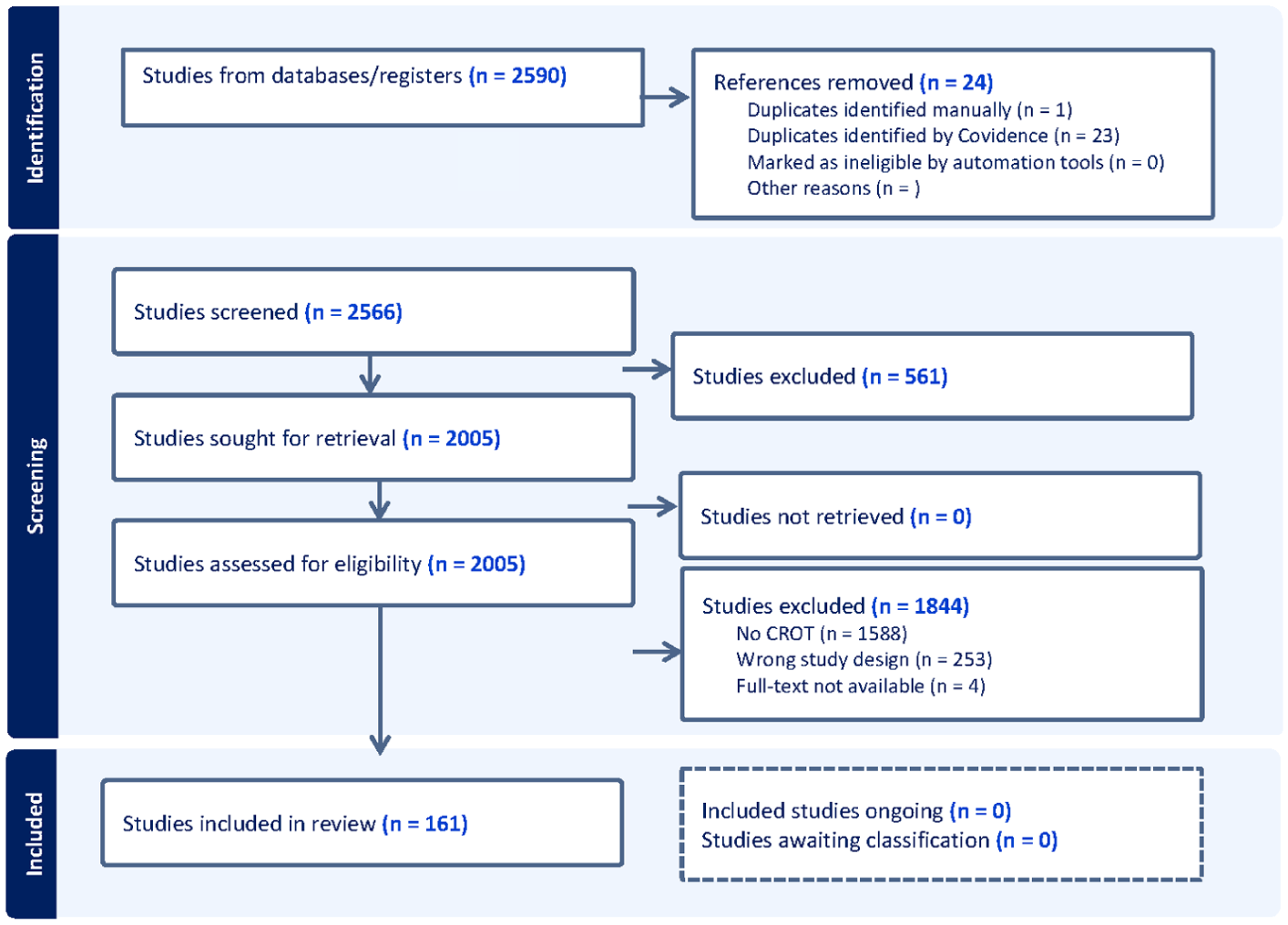
Flow chart of the data collection process for included studies.
There is a limitation to this sampling approach: collecting the first issues of 2023 and 2024 provides a narrow 2-year window, which may not capture longitudinal trends in CRediT adoption and contribution patterns in LIS. However, due to the early stage of adoption in LIS, the reality that some journals only publish a single, annual issue, and the manual methods used by the authors, the authors acknowledge this constraint while maintaining the dataset represents a snapshot of CRediT use in LIS.
Contributor Role Ontologies and Taxonomies (CROTs) determination
While completing a research project on journal requirements for CRediT statements from the same dataset, we found overwhelmingly that publications and researchers are using CRediT (76%) over informally-written CROTs (24%), meaning statements not adhering to well-established CROTs such as CRediT. As well, standardization of the 14 CRediT contributor roles allows for structured analysis which would not be possible with the use of informal contributor statements. Table 1 details each of the 14 CRediT contributions and their definition.
CRediT contributions and definitions (American National Standards Institute /National Information Standards Organization (ANSI/NISO), 2022).

Gender determination
For our CRediT author dataset, we used Wiki-Gendersort (Bérubé et al., 2020) to determine the gender of this study’s 413 authors. Wiki-Gendersort assigns gender to over 65,000 first names using algorithmic methods from Wikipedia pages. The creators of Wiki-Gendersort evaluated its coverage and accuracy, finding that it is more wide-ranging and accurate (97%–99%) than four other gender checking software: GenderChecker, Gender.c, NamSor, and the U.S. Census (Bérubé et al., 2020). A 2021 study by Sebo (2021) concludes that “Wiki-Gendersort is probably a good alternative for researchers wishing to use an accurate and completely free tool, with little risk of misclassification (errorCodedWithoutNA 2.2%) and relatively few unrecognized names (naCoded 4.5%)” (p. 419). Paul-Hus et al. (2020) used Wiki-Gendersort to determine gender, but roughly 30% of authors could not be identified. The creators of Wiki-Gendersort acknowledge a limitation of their algorithm is identifying gender of Asian names, which is also acknowledged by Paul-Hus et al. (2020).
In the Wiki-Gendersort algorithm, first names are assigned gender as masculine, feminine, unisex (first name used for both genders), and unknown. If 75% or more of the pages are assigned masculine, the name is identified as masculine; the same method is used for feminine names. If at least one page is identified as a gender, but less than 75%, the name is set as “unisex” (first name used for both genders).
For each ASCII character-converted first name, a list of 1000 Wikipedia pages is generated, and gender pronouns are searched until the page list is exhausted or 20 pages can reach the gender threshold. First, a search is conducted of page titles containing the name and searches summary text for pronouns. If this initial set of pages do not identify a gender (masculine/feminine/unisex), a second search is conducted for page content containing the name and pronouns or gender in the title. If this does not reach the threshold, the name is identified as unknown.
Results
About 2590 articles were published by library and information science journals in their first issues of 2023 and 2024. Of those, there were 1748 research articles identified as candidates for using a contributor statement. 161 contributor statements were found, reflecting the early and uneven adoption of contributorship practices in LIS journals, including 123 using CRediT and 38 using informal contributor statements. In 2023, there were 56 CRediT statements, and in 2024, there were 67 CRediT statements, suggesting very modest growth year-over-year.
Within this dataset, there are 413 authors with CRediT contributions. Among these 413 authors, the researchers matched 361 authors to gender with Wiki-GenderSort, with remaining authors classified as unisex (n = 13), unknown (n = 21), unidentified (n = 18). We matched unidentified names with diacritics to the non-diacritic name variant and searched online to identify gender pronouns, if available (n = 10). The researchers identified pronouns of 41 unisex/unknown authors through online resources (e.g. an author biography written using their preferred pronouns or an author-created LibGuide with preferred pronouns indicated), leaving a final dataset with 413 gendered authors: 186 women, 226 men, and 1 unidentified author.
For articles with CRediT statements, in 2023, there were 90 women, 113 men authors, and one unidentified author. In 2024, there were 96 women and 113 men authors. For articles with CRediT statements, there is an average of 3.6 authors per article in 2023 and an average of 3.1 authors per article in 2024. In our dataset, all co-authors from articles with CRediT statements are included in contribution statements, while additional collaborators may or may not be listed in articles’ acknowledgments sections.
Frequency of CRediT roles by LIS authors
As seen in Figure 2, the most common roles across all LIS authors aligns with the traditional manuscript structure of IMRaD (Introduction, Methods, Results, and Discussion), with writing–review & editing (n = 318, 77.2%), writing—original draft (n = 268, 65%), conceptualizing the study (n = 264, 64.1%), designing the methodology (n = 243, 59%), and analysis of data (n = 205, 49.8%). The least common roles are resource provision (n = 52, 12.6%), funding acquisition (n = 46, 11.2%), and using software (n = 33, 8%).
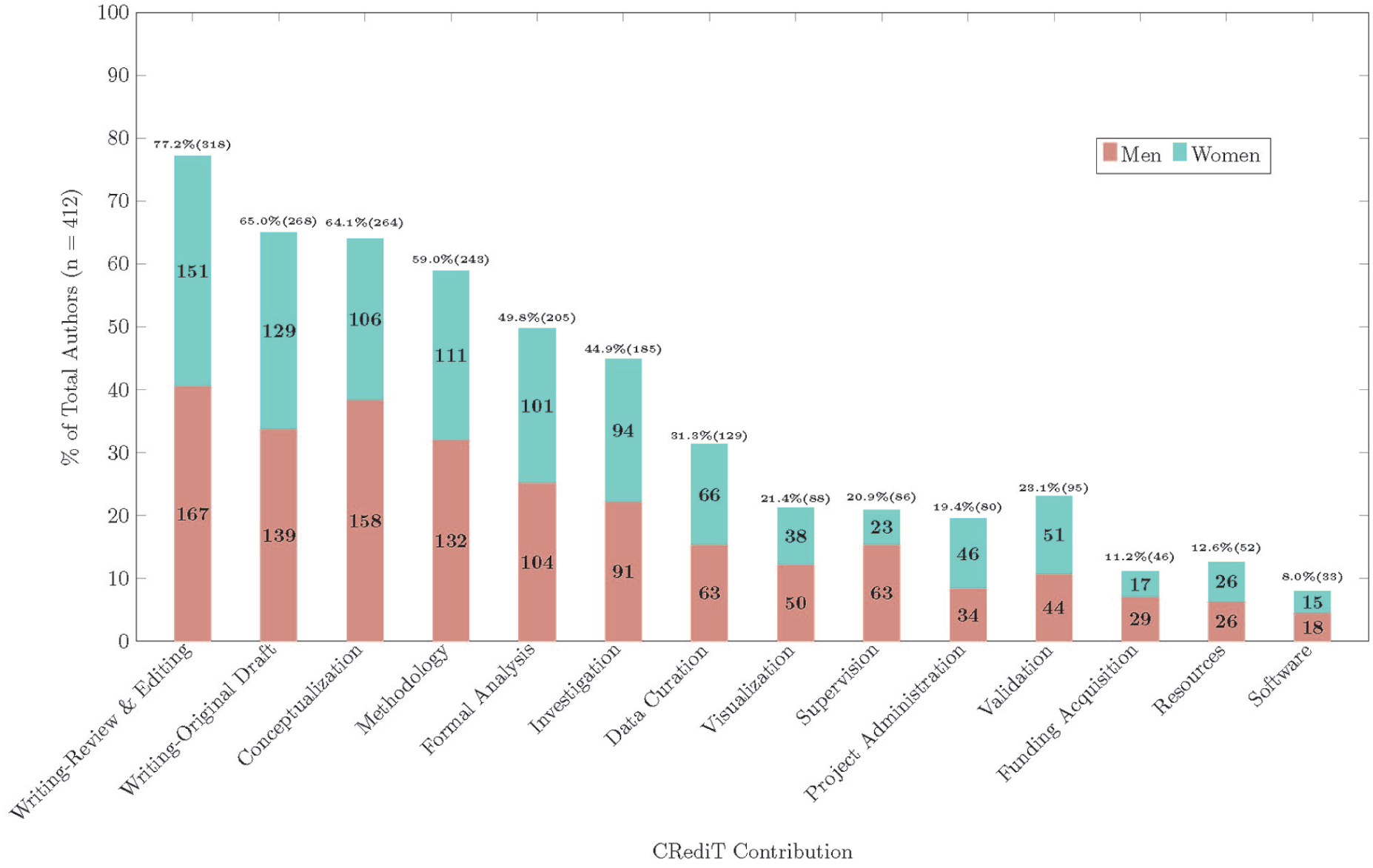
Number and percentage of total author CRediT contributions, by gender.
Women have higher representation in data-intensive and analytical roles, while being underrepresented in traditional leadership and oversight roles (see Figure 2). Women are overrepresented in data curation (35.5% women vs 27.9% men) and project administration (24.7% women vs 15% men), while men show higher representation in supervision (27.9% men vs 12.4% women) and conceptualization (69.9% men vs 57% women).
Figure 3 shows the percentage of men and women authors performing specific roles, compared to overall men and women authors respectively. Men have higher participation rate in conceptualization, methodology, supervision, funding acquisition compared to women. Women have higher participation in data curation and project administration compared to men proportionally strong participation in writing roles. Funding acquisition and software remain low for both genders, although men (n = 29) more frequently contribute to acquiring funding compared to women (n = 17).

Percentage of men and women CRediT contributions.
A chi-square test revealed significant gender differences across CRediT roles, χ2(13, n = 2091 total author-role contributions) = 29.55, p = 0.005, Cramér’s V = 0.12. Although statistically significant, the effect size indicates small association between gender and research contribution. Standardized residuals, reported from the perspective of women, identified three roles with notable gender imbalances: supervision showed the largest men over-representation (26.7% women, standardized residual = −3.76), followed by conceptualization (40.2% women, standardized residual = −2.22). Project administration showed a trend toward women over-representation (57.5% women, standardized residual = 2.01).
Post-hoc chi-square tests compared each roles’ gender distribution compared to the overall gender distribution across contribution role assignments (45.15% women, 54.85% men). After correcting for 14 multiple comparisons (Bonferroni-adjusted α = 0.0036), only supervision remained significantly different from the expected distribution (χ2 = 13.54, p < 0.001, adjusted p = 0.003), with men substantially overrepresented (73.3% men vs 53.5% expected). Neither conceptualization (χ2 = 4.32, p = 0.038, adjusted p = 0.11) nor project administration (χ2 = 3.87, p = 0.049, adjusted p = 0.15) reached statistical significance after correcting for multiple testing.
Research teams
Table 2 presents research team contributions at the authored article level. For the purposes of this study, a “research team” refers to the collective group of authors listed on a single article; each article’s authorship represents one research team. Rather than examining individual contributions, this analysis examines whether at least one member of a research team performed a specific CRediT role. This approach captures the breadth of scholarly labor represented across teams as a whole, regardless of how many team members performed each role.
Number and percentage of CRediT contributions, by research team.

When looking at research teams, and whether any research team member contributed to a particular role within their team, results show three tiers of roles:
Many (<75%): Conceptualization, Methodology, Formal Analysis, Investigation, Writing—Original Draft, Writing—Review & Editing
Middling (40%–61%): Validation, Data Curation, Visualization, Supervision, Project Administration
Few (>30%): Software, Resources, Funding Acquisition.
An area of concern is the frequency of validation, with 43% of research teams having at least one member verifying their results, experiments, and/or research output.
First authorship
Table 3 presents first authors’ contributions to research. Of note, both women and men authors achieved first authorship at equal rates; there are 67 men first authors, with 29.6% of men authors (n = 226) as men first authors and 55 women first authors, with 29.6% of women authors (n = 186) as women first authors.
Number and percentage of first author CRediT contributions, by gender.

One first author’s gender was undetermined and not included in gender analysis.
The contributions performed by first authors mirror the contributions performed by authors overall, with a few differences. Conceptualization and methodology are performed slightly more frequently by first authors. First authors take on intellectual ownership roles of conceptualization (n = 110, 90.2%) and methodology (n = 105, 86.1%) more frequently. Writing activities remain very high for first authors regardless of gender (93.4%), however reviewing and editing manuscripts is being done by fewer first authors (73.8%) when compared to total authors (77.2%). Visualization and formal analysis show steady participation, with visualization being done by more men.
Fewer women first authors perform conceptualization (85.5%) and methodology (83.6%) compared to men first authors (94% and 88.1%, respectively). There is also a gender gap when it comes to supervision and funding acquisition; both have men contributing nearly twice as often when compared to women first authors, when looking at percentages of men and women first authorship, although overall n are low for each role. There is a higher percentage of women first authors performing project administration, data curation, validation, and formal analysis compared to men first authors.
Discussion
Contributions in LIS research and scholarship
LIS research has a high percentage of participation in writing activities, which demonstrates equitable collaboration within research teams. Participation in writing activities suggests most research is collaborative rather than having single authors involved in writing and editing. There is collective intellectual work of LIS research regardless of gender. High IMRaD participation from all contributors shows genuine collaboration within research teams, rather than one team member taking on intellectual work alone. Indeed, this trend extends to intellectual contribution (i.e. conceptualization). This study found LIS contributors with the conceptualization role on the high end at 64.1%, whereas in PLOS disciplinary journals, Larivière et al. (2021) found conceptualization contributions between 38% and 65%.
Regardless of gender, technical specialization is lacking in LIS scholarship as indicated by low participation in software and resources contributions. Software contributions are highly specialized and not distributed among research teams equally. This reflects the type of research that LIS authors are engaged in—not relying heavily on software and resources—and could reflect the education or training (or lack thereof) of LIS researchers. Resources and funding acquisition is low for LIS scholars compared to other disciplines found in PLOS ONE publications (Larivière et al., 2021). Since funding can determine research capacity, demonstrate career progression, and increase prestige and reputation, the current study’s funding contributions are concerning.
Supervision and project administration also remain lower compared to other disciplines (Larivière et al., 2021), possibly indicating a more collaborative, equitable research culture in LIS. Low contributions of validation are also concerning, as validation refers to ensuring the research is replicable; if LIS scholars are not confirming their research can be reproduced, there could be a reproducibility crisis in LIS scholarship, a possibility noted by Larivière et al. (2021).
Gender representation and disciplinary context
There is a gap in women-men authorship, with women contributing to 45.15% of scholarship and 54.85% of men in the current study, when looking at known gender. This is in stark contrast with Larivière et al.’s (2021) study of multidisciplinary authors, when looking at known gendered authorship, with women authors at 39.94% and men at 60.06%. Our current study shows there is more balance toward women representation in LIS scholarship compared to other disciplines, but men still hold the majority. This is a trend seen throughout many disciplines: men publish more than women (Sugimoto and Larivière, 2023).
Our findings on first authorship suggest that women authors in LIS are receiving appropriate credit for their scholarly contributions. When examining first authorship, women LIS first author representation (45.08%) is much closer to the multidisciplinary average found by Larivière et al. (2021) at 46.51%, a difference of only 1.43%, and the same is found for men’s first authorship in LIS (54.92%) and Larivière et al.’s (2021) findings (53.49%). This study’s findings are positive given historical concern about the Matilda Effect. When zooming out from first authorship to this study’s findings overall authorship, LIS may have more equitable practices in scholarly authorship and contribution, with a higher percentage of women publishing research, compared to other disciplines.
It is worth noting that our comparison is based on librarian and information professionals publishing in LIS journals; this is not representative of the profession as a whole. Men publishing more than women is concerning as the demographics of librarians are predominantly women, showing a continued disparity in the gender representation in LIS scholarship.
Leadership and authority gender gap
Though women representation is encouraging when looking at overall authorship and contributorship, there is disparity between men and women LIS authors in leadership and authority roles. There are gender gaps with the supervision role, which suggests gender disparity in senior roles, and the project administration role, which suggests gender disparity in administrative roles. The gap in supervision toward men, confirmed by chi-square and post-hoc testing showing significance (adjusted p = 0.003), and project administration toward women is striking, as this indicates gender differences in research leadership: women authors are not assuming research leadership as frequently as men and women are taking on more of the “academic housework.”
Men have higher percentages in conceptualization and methodology, roles that indicate intellectual ownership and directing research. When looking at first authors, there is also a gender gap in conceptualization (94% of men/85.5% of women) and methodology (88.1% of men/83.6% of women). Are women discouraged from taking ownership of methodological and conceptual contributions? A gender gap is also seen in data curation, which is more frequently performed by women and junior authors. While it is encouraging that the role is now elucidated by way of contribution statements, it remains troubling that women are more frequently performing a traditionally lower-weighted role.
Gender gaps in contributor roles have implications on career trajectory and advancement. In the LIS discipline, if conceptual, methodological, and supervisory roles are valued more, while technical and administrative roles are valued less, this could impact promotion and tenure decisions. If women are guided to technical and administrative roles—whether by direction, expectation, or self-selection—this trend could contribute to reduced opportunities for leadership positions and slower career advancement.
This study’s findings align with historical patterns, seen through the Matilda Effect, of women’s intellectual and leadership research contributions systematically underrecognized. With men in conceptual and leadership positions and women taking on technical and administrative positions, this trend perpetuates in LIS, even if contributions are credited in author contribution statements. The perceived value of different research contributions remains unequal in LIS scholarship. Our results suggest that women participation in research is approaching parity with men, however disparities remain, especially in terms of how research roles are distributed and potentially valued.
Recommendations
With this study’s findings, the authors recommend:
All LIS authors should include contributor statements when publishing their research.
All LIS journals should require contributor statements from authors.
CRediT should be the required contributor role ontology and taxonomy
Limitations and future research
An important limitation of this study is our inability to identify gender diverse LIS authors. Another limitation of this study is the sample size; we collected data from the 2023 and 2024 first issues of LIS journals, however CRediT is only used in 6% of LIS research so the overall dataset is small. Future research studies could expand the dataset to examine contributor statements over an extended time period. If, over time, more journals require and/or authors provide contributor statements the additional data will aid us is deeper analysis of contributor roles and can aid us in determining whether external interventions are needed (e.g. additional training or supports on how to lead research projects or supervise research team members).
Authors may interpret CRediT contribution roles differently. While these roles are intended to standardize research contributions, as they were developed in the biomedical sciences, they may not be easily interpreted across different disciplines. Finally, CRediT has limitations in reporting actual contributions to research, both in terms of assigning contributions and in terms of available contribution roles (Hosseini et al., 2024).
Conclusion
CRediT author contribution statements reveal with more granularity the scholarly labor that goes into publications, making previously hidden patterns of research contributions visible. When examining CRediT statements in LIS scholarship, authors collaborate effectively, especially with writing activities. However, there are low validating and low funding rates, which are both concerning.
Looking at gender in LIS scholarship, there is greater gender balance compared to other disciplines. However, traditional gendered research contributions are reflected in LIS scholarship, despite being a profession that is predominantly women. This study provides empirical evidence of gendered patterns in LIS research. Women and men achieved first authorship at equal rates (29.6%) and women contributed to 45.15% of overall scholarship compared to the multidisciplinary average of 39.94% measured by Larivière et al. (2021). However, men LIS authors take on leadership roles more frequently, while women LIS authors shoulder administrative and technical tasks more often, with supervision showing significant disparity (adjusted p = 0.003).
Unequal valuation of research contributions hinders scholarly recognition and career progression, perpetuating traditional hierarchies of gender roles in research. It is important to continue to monitor and address disparity in LIS scholarship. Achieving gender equity in LIS research contributions requires systemic change in how scholarly labor is allotted, recognized, and rewarded. Addressing this disparity requires collective action: journals should mandate author contribution statements, institutions should value all research labor equitably in promotion and tenure decisions, and the profession must actively encourage and promote women to take on leadership positions in LIS research.
Supplemental Material
sj-docx-1-lis-10.1177_09610006261447557 – Supplemental material for Author contribution statements and gender dynamics in Library and Information Science scholarship
Supplemental material, sj-docx-1-lis-10.1177_09610006261447557 for Author contribution statements and gender dynamics in Library and Information Science scholarship by Justin Fuhr, Mê-Linh Lê and Caroline Monnin in Journal of Librarianship and Information Science
Footnotes

Ethical considerations
There are no human participants in this article and informed consent is not required.
Author contributions
JF: Conceptualization, Data Curation, Formal Analysis, Investigation, Methodology, Visualization, Writing—Original Draft, Writing—Review & Editing. M-L.L: Conceptualization, Data Curation, Investigation, Methodology, Writing—Original Draft, Writing—Review & Editing. CM: Conceptualization, Data Curation, Investigation, Methodology, Resources, Writing—Original Draft, Writing—Review & Editing.
Funding
The authors received no financial support for the research, authorship, and/or publication of this article.
Declaration of conflicting interests
The authors declared no potential conflicts of interest with respect to the research, authorship, and/or publication of this article.
Supplemental material
Supplemental material for this article is available online.
Author biographies
References
Supplementary Material
Please find the following supplemental material available below.
For Open Access articles published under a Creative Commons License, all supplemental material carries the same license as the article it is associated with.
For non-Open Access articles published, all supplemental material carries a non-exclusive license, and permission requests for re-use of supplemental material or any part of supplemental material shall be sent directly to the copyright owner as specified in the copyright notice associated with the article.
