




Abstract
In many sports, women receive less prize money than men, frequently by having fewer prize ranks. This issue has been discussed extensively over decades. While many people consider different prize structures for men and women unfair, others argue, e.g., that men attract greater public interest or that the competition is harder among men—particularly, when more men than women participate or when the competition duration is longer for men. In this paper, we focus on the discussion of fairness in the distribution of prize ranks in endurance sports, concerning the number of prize ranks for men versus that for women, compared to the severity of the competition. We present two methods to distribute prize ranks across gender based on the individual performances w.r.t. gender-specific records. We suppose these “across gender distributions” to be fair, as they suitably respect that women generally are slower than men. Introducing a statistical fairness measure, we provide a tool to assess the fairness of prize rank distributions. Finally, we evaluate commonly used prize rank distributions regarding their gender equity. For our investigations, we focus on triathlon. In triathlon competitions, often women have the same number of prize ranks as men, which might be considered fair. However, it will turn out that, from the perspective of performance, in many competitions it would have been much fairer to assign more prize ranks to men than to women. We shortly show that this result also applies to other endurance sports and discuss possible practical implications.
Introduction
Problem definition
In sports it often happens that women receive less prize money than men. More and more disciplines are deciding to join the gender-equal prize distribution, among others the Freeride World Tour (Abenteuer-Magazine, 2020), but differences in the prize structure are still common, especially in soccer (Reality Check team, 2019) or golf (Heath, 2021), where it is widely discussed to finally close the gender gap regarding money and income inequalities.
However, the general question is what is considered to be fair. At first sight, it seems unfair to reward women less than men. Nevertheless, competition organizers and sports clubs justify the imbalance in rewards by several reasons, which have been discussed extensively in various articles and papers. Economic motives, such as media coverage in connection with the number of spectators and sponsors or the revenue from advertising, but also physical differences between men and women in terms of absolute performance—higher output deserves higher reward—are often decisive for the amount of prize money (iRunFar, 2015). Often the prize money structure is regulated by circumstances that women can hardly influence, such as when their distance or duration of the competition is not as long as that for men. Though, the female gender has been demanding the different conditions finally to be adjusted, which is, e.g., the case for the World Championship in Cyclocross (Rauter-Nestler, 2017).
In this paper, we concentrate on triathlon, which by the majority of people is considered to be generally fair w.r.t. the prize structure, such as other endurance sports are as well, as they assign prizes equally to both genders in most competitions. Triathlon is often selected as a positive example for not disadvantaging women (Arthurs-Brennan, 2015). Though, it needs to be examined carefully what can be called “fair” in the first place. For the Ironman distance at Austria-Triathlon 2019, for instance, there were 10 prize ranks for men, but only 5 for women. Since many people say that this is unfair, the majority of race organizers changed their rules such that both genders have the same number of prize ranks. (The organizers of Austria-Triathlon kept changing it back and forth, ending at ”same number” for the time being (Austrian Triathlon Verein, 2023). Equal prize structures might be fair from the ethical point of view, but are they also fair w.r.t. performance? A short answer might be ”no,” because there were 149 male race finishers, but only 13 female. Though, what if the 13 female finishers were all top class triathletes? A look at the finish times of the first 20 male and the first 10 female finishers reveals big disparities when they are compared to the respective world records (quotient of finish time and world record): yet the 20th man performed better in relation to the male world record than the second women did in relation to the female world record, see Figure 1. Considering this result, it would even be fairer to give only one woman prize money, when 20 men receive prize money.
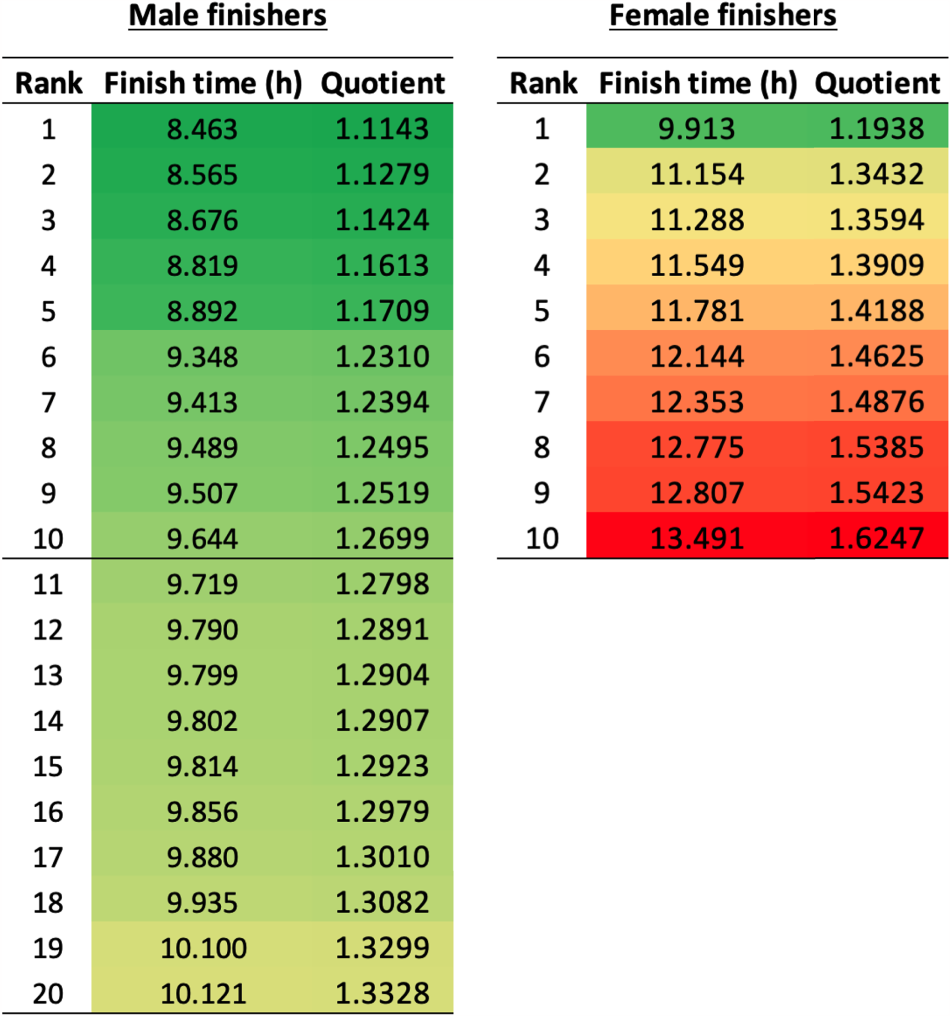
Results from Austria-Triathlon 2019 (Ironman distance) colored in relation to the quotient of finish time and the gender specific world record, which was 7.594 hours for men and 8.304 hours for women.
The core of this problem has already been described in an article about prize money for surfers: Before prize money was divided equally between the sexes, the men’s winner received twice as much prize money as the women’s winner for the reason that there were twice as many male athletes competing (Rimkus, 2018). For the same motivation, it still happens quite often – also in triathlon – that there are more prize ranks for men than for women. So our core questions will be:
What would be fair distributions of prize ranks across men and women? How fair are existing distributions of prize ranks?
We will not discuss, whatsoever, what shall be fair amounts of prize money among the prize ranks. This leaves room for further research. Though, we assume that the prize money is decreasing for increasing ranks.
Related results from the literature
To the best of our knowledge, there have been no scientific investigations on fair distributions of prize ranks across men and women so far. However, there exists literature presenting results on how athletes’ performances are related to the total amount of prize money and its spread over the prize money ranks. Ehrenberg and Bognanno (1990) found a positive relation between the total amount of prize money and the athletes’ performances as well as between the prize spread between adjacent ranks and the athletes’ performances, restricting their research to results from the PGA tour. For road racing tournaments, however, Lynch and Zax (2000) concluded from their research that the positive relation between the total amount of prize money and the performance might primarily connect to the fact that races with higher prize money attract faster runners. Becker and Huselid (1992) found out that also in motor sports the difference in prize money between higher and lower ranks has a positive relation to the contestants’ performances, which is confirmed by Frick and Prinz (2007) for marathon races. Demsetz (1995) investigates how contestants respond to different pricing structures and compares compensations based only on final ranks with compensations that also take into account the actual performances. His final point is that rank-order compensations lead to better performance. We will return to that in Section “Other distributions.” Extending that line of research, O’Toole (2009) investigates gender disparities in these incentive effects of different total amounts and structures of prizes in marathon races, but his samples show only insignificant differences between genders. However, O’Toole does not compare the spread of prize ranks between men and women w.r.t. fairness, which we will do in this paper. Different from the above, Brown (2015) suggests 10 ways to best distribute prize money w.r.t. the principles of stakes fairness in different situations and mentions performance-based proportionality, but also he does not elaborate the gender criterion.
Contribution of this paper
In this paper, we will first give an overview on existing methods of prize rank distributions (Section “Existing prize rank distributions”). After that we introduce prize rank distributions that are supposed to be fair regarding gender equity and individual performance (Section “Fair prize rank distributions”). We further introduce a fairness measure for prize rank distributions using mathematical-statistical methods (Section “A fairness measure”) and finally use that measure to assess which common methods of prize rank distributions can be considered as fair (Section “Evaluation of existing prize rank distributions”). For the assessment we evaluate different competitions in triathlon, differentiating between amateurs (in triathlon usually called age groupers) and professionals.
We mainly restrict our approaches to the distribution of prize ranks in triathlon, but the results can easily be adapted to other endurance sports, e.g., long-distance running, biathlon, or cycling, as we shortly show in Section “Evaluation of existing prize rank distributions” by an example from marathon. Section “Possible implications for practice” discusses pros and cons of the newly introduced prize rank distributions and identifies possible solutions for practice.
The aim of this paper is to raise awareness that current practices of prize rank allocations can be unfair and to suggest other options that might be interesting to be considered in the future. Anyway, our objective is not to say that the approaches proposed in this paper must necessarily be implemented soon.
Note that, in this paper, we do not regard the amount of prize money on the prize ranks nor income structures; this surely leaves room for interesting future research. Furthermore, we are quite aware of the fact that in many countries there exists a third agency recognized gender, the diverse gender. However, since this gender is not considered in a separate category in sports yet, we omit it in our investigations.
Prize rank distributions
Existing prize rank distributions
Method 1
A method frequently used for prize rank distributions is to assign the same number of prize ranks to both men and women, i.e., to award the first w places in the men’s ranking as well as the first w places in the women’s ranking. Among others, the international organization “World Triathlon,” organizer of the World Triathlon Championship Series, and the “World Triathlon Corporation,” organizer of the “Ironman” event series, set up their competitions accordingly (SportsEngine Inc, 2022; World Triathlon, 2018). The international governing body “World Triathlon” organizes its competitions under the policy that “the amount and depth of prize money must be equal for women and men” (World Triathlon, 2018). Likewise in other sports, e.g., the “International Biathlon Union” (IBU) follows the same principle when hosting the World Championships, World Cup, or other biathlon contests (Zhovtiuk, 2020).
Method 2
Another method of rewarding athletes’ performances is to distinguish between the number of prizes for men and women by allocating prize money for the first m men and the first w women, with
The specific values for w and m are chosen and published by the organizers before each race and differ between the competitions.
Method 3
In addition to a gender equal prize distribution, some organizers apply time limits: Athletes receive bonuses for finishing a race within a certain gender-specific time limit or beating a given limit is even a prerequisite for receiving the full prize money in the first place. This is especially applied in marathon competitions, e.g., in the one held in Sevilla, Spain (Instituto Municipal de Deportes del Ayuntamiento de Sevilla, 2022).
Per default none of the above methods, in particular the most commonly applied Methods 1 and 2, can be considered as being fair, speaking from the perspective of the genders. In most competitions, at least in triathlon, the number of male athletes is significantly higher than that of female athletes. This can be seen for instance in the famous triathlon event series “Ironman,” where the average global female participation only adds up to 21% of all entrants (Lacke, 2020). Therefore, with Method 1 men have a much harder time getting hold of the prize money. In the second method, however, high performing women seem to have a disadvantage from having fewer prize money ranks as it should not be to their detriment if only few female participants register for the event.
In order to provide the most attractive and fair competition regulations for both sexes, in the next step we present alternative, supposedly fair models for gender equitable distributions of prize money.
Fair prize rank distributions
The idea is to take the world records of the considered discipline as an orientation to generate a gender-neutral ranking across men and women. While the total number of prize ranks – together with the prize money assigned to them – is determined and announced by the organizer prior to a race, it will be clear only after the race how many prize ranks from the combined ranking will go to men and how many to women, as this depends on the individual performances of the athletes. The sequence of places in the combined ranking is determined in ascending order w.r.t. the male world record for men or, respectively, the female world record for women. Here, we consider two options.
Quotient Model (QM)
The sequence of places is determined in ascending order according to the quotient of the finish time and the respective world record (male/female). Starting with place number one with the smallest quotient, everyone up to the predefined number of prize ranks in total gets prize money. The proportion of women and men who receive prizes is not predetermined.
Let us consider again the example of the Austria-Triathlon 2019 from Figure 1, where the organizer proclaimed 15 prize ranks prior to the race, 10 of which were intended for men, five for women. With the proposed across gender ranking (AGRing), the first five prize ranks would go to men, followed by the first women, who is then followed by another nine men – according to the lowest quotients given in the third column of each of the tables. So, respecting the actual performances of the athletes, in total, 14 prize ranks would go to men and only one to a woman.
Difference Model (DM)
The general approach is the same as in the QM, but instead of the quotient of the finish time and the gender specific world record, the difference between the finish time and the gender specific world record is taken to rank the contestants.
Generally, we consider both models as rather fair, because the distribution of prize ranks between men and women is purely determined by performance and not fixed in advance. Note that with either of the models the athletes’ perspectives slightly change: To estimate their chances of winning a prize, now they need to take into account their competitors from both genders, with their respective performances in comparison to the gender specific world record. This is a novel situation requiring a new view on the competitive situation. In Section “Possible implications for practice,” we discuss in more detail whether and how the models could be implemented in actual races. While the DM is easier to understand and to evaluate during the race, the QM to us seems to be fairer w.r.t. different finish times for men and women, as it is to be expected that higher finish times directly lead to higher differences to the world record and therefore disadvantage slower finishers (generally women).
To emphasize that it is actually worthwhile discussing practicality of the proposed models, they first shall be used to evaluate the fairness of existing prize rank distributions (cf. Section “Existing prize rank distributions”) in Sections “A fairness measure” and “Evaluation of existing prize rank distributions.”
Other distributions
A few other ideas for prize rank distributions shall be discussed shortly. One of them is applied in practice occasionally, but not widely spread; the others are fictitious variants to the QM and the DM, but cannot be considered as highly fair performance wise. For these reasons, such distributions will not be considered for further analyses.
As a variant to the QM and the DM, one could use the best finish times of the particular contest as yardsticks instead of the world records. In this case, there would be two winners, male and female, and the ranking after them would be cross-gender. This variant would overcome concerns about not even the best finisher of each gender being guaranteed to win a prize, which will be discussed in more detail in Section “Possible implications for practice.” On the other hand, it could be considered as unfair, if all finishers from one gender were very slow, from the gender specific view, whereas at least the best finishers from the other gender were, in the extreme case, all close to the world record. To remedy this, a gender specific time limit could be introduced as a shield for bad performances. Nonetheless, this model leaves other open questions to be discussed, one of them being how to apply the time limit regarding the total number of prize ranks. For example if the competition had been planned with 20 prize ranks and – according to the model – among the first 20 finishers there were 15 of gender A not meeting the time limit and 5 of gender B, all meeting the time limit, should then the number of total ranks be reduced to 5 or should finishers from gender B move up to the prize ranks?
Similar discussions could arise for the variant to the QM and the DM, where the track records are used as yardsticks instead of the world records. Though, at least after a couple of repetitions of a competition on the same track, this model can be assumed as being similarly fair as the QM or DM from Section “Fair prize rank distributions.”
A method with time limits is already applied in reality (cf. Section “Existing prize rank distributions,” Method 3), but does not establish an across gender ranking. It is to assign prizes to each gender separately, but to restrict them by a time limit. If, e.g., the first 10 places of 100 men and the first 10 of 50 women are rewarded, it is much easier for women to receive a prize than for men. If, however, a time limit is defined that may not be exceeded, it is no longer a matter that 1/10 of men and 1/5 of women win a prize, as now the focus is not on the number of participants but rather on whether the athletes perform sufficiently well. This model also prevents large sums of money being paid in a competition with rather bad podium times, but it still raises questions as the above about what to do with ranks being left idle by one gender.
As a supplement to the QM and the DM, instead of a predetermined amount of money for each rank, the respective prize money could also be variable w.r.t. the quotient or difference (see, e.g., Brown (2015) as mentioned already in Section “Introduction”). However, as Demsetz (1995) and O’Toole (2009) found out, the problem could arise that one loses the sporting idea of being the first to reach the finish line, because in case of a very small time difference between the first two places the second place would get almost as much money as the first place. To remedy this, the athletes on the podium could receive extra bonuses (Frick and Prinz, 2007). Anyway, as mentioned in Section “Introduction” already, in this paper, we will not take into account the actual amounts of prize money, but only the order on prize money ranks.
A fairness measure
In order to assess the fairness of typical methods for (gender specific) prize rank distribution like the ones in Section “Existing prize rank distributions,” the idea is to compare them to the fair QM and DM. For this purpose, we introduce an unfairness factor.
As it seems to be nearly impossible to evaluate how prize money should be distributed w.r.t. specific amounts (e.g., first rank receives x$, second rank receives y$, etc.) and how many ranks should receive prize money so that it is fair, we restrict our investigations as follows: In the method that is to be evaluated, we compute for all prize ranks, which in practice are pre-determined by the race organizer, the “error” in ranking by comparing the actual ranks to the fictitious fair ranks from the QM or DM. That is in a competition with m prize ranks for men and w for women, we compare the ranks of the first m men and the first w women to the ranks that they would reach in the AGRing, which would provide
For the unfairness factor, this “standard error” is scaled such that its minimum is 1. In the following we introduce the unfairness factor w.r.t. the QM, but all definitions and proofs apply the same way for other models, in particular the DM.
Throughout the rest of this paper, we assume, w.l.o.g., that
For

In Section “Properties of the unfairness factor” we will show that the minimum of the unfairness factor is indeed 1. An unfairness factor of 1 implies that, given the specific finish times of a competition, the SRing is closest possible to the fair AGRing. The higher the unfairness factor, the more unfair it is to assign, of the overall
Examples
In order to standardize the examples (and later the analyses), we generally set the number of prize ranks for men to
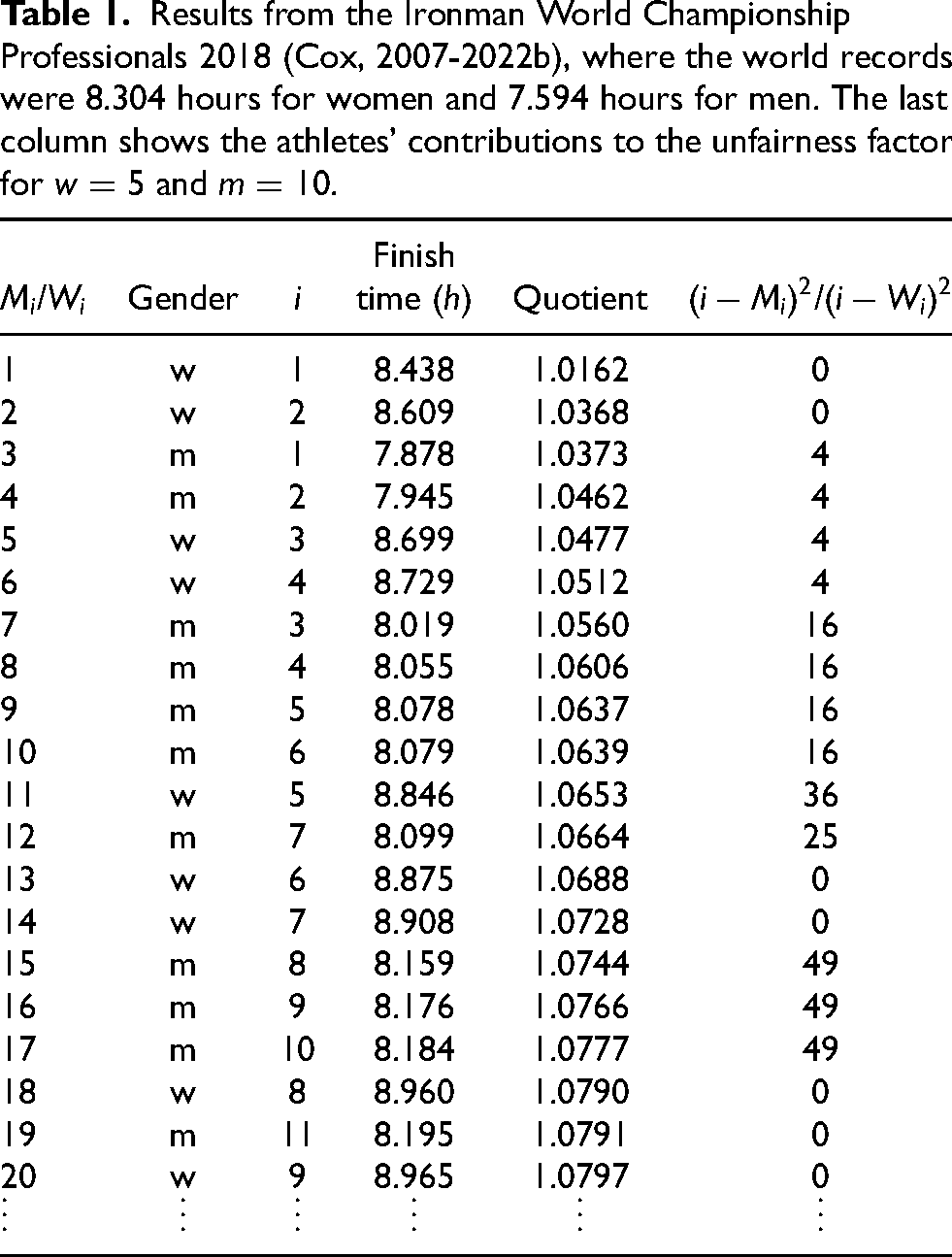
Table 1 shows a ranking example with the athletes’ contributions to the unfairness factor. The finish times, given in column 4, are taken from the Ironman World Championship Professionals 2018 (Cox, 2007-2022b). Column 1 shows the fictitious across gender ranks (AGRs) according to the QM, whereas columns 2 and 3 show the gender of the athletes and their actual split ranks (SRs). The quotients of the finish time and the world record, which was 8.304 hours for women and 7.594 hours for men at the time of the competition, are given in column 5. For
Results from the Ironman World Championship Professionals 2018 (Cox, 2007-2022b), where the world records were 8.304 hours for women and 7.594 hours for men. The last column shows the athletes’ contributions to the unfairness factor for
One issue might be irritating at first sight: Assuming there were
Now, given this awareness, a second – maybe questionable – issue is that we chose to punish directly those who receive prize money in the SRing, but not in the AGRing. Why did we not do it the other way around? The simple answer is that the other way around the ranking errors could add up to 0, even though the SRing was extremely unfair. Assume, e.g., the first 15 AGRs all being settled by women. Then the ranking errors for those 15 athletes, who receive prize money in the AGRing, would add up to 0, while we would completely neglect that there are 10 men and 10 women who would receive prize money in one of the rankings, but not in the other.
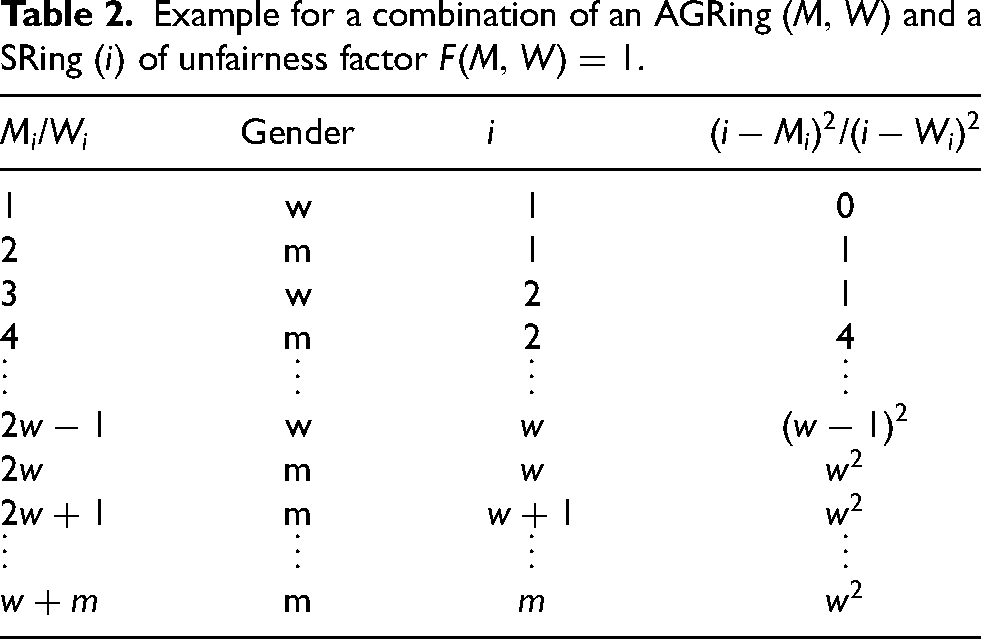
Table 2 shows an example for an unfairness factor of 1. There, the AGRing alternately ranks the first w women and the first w men and after that ranks the remaining
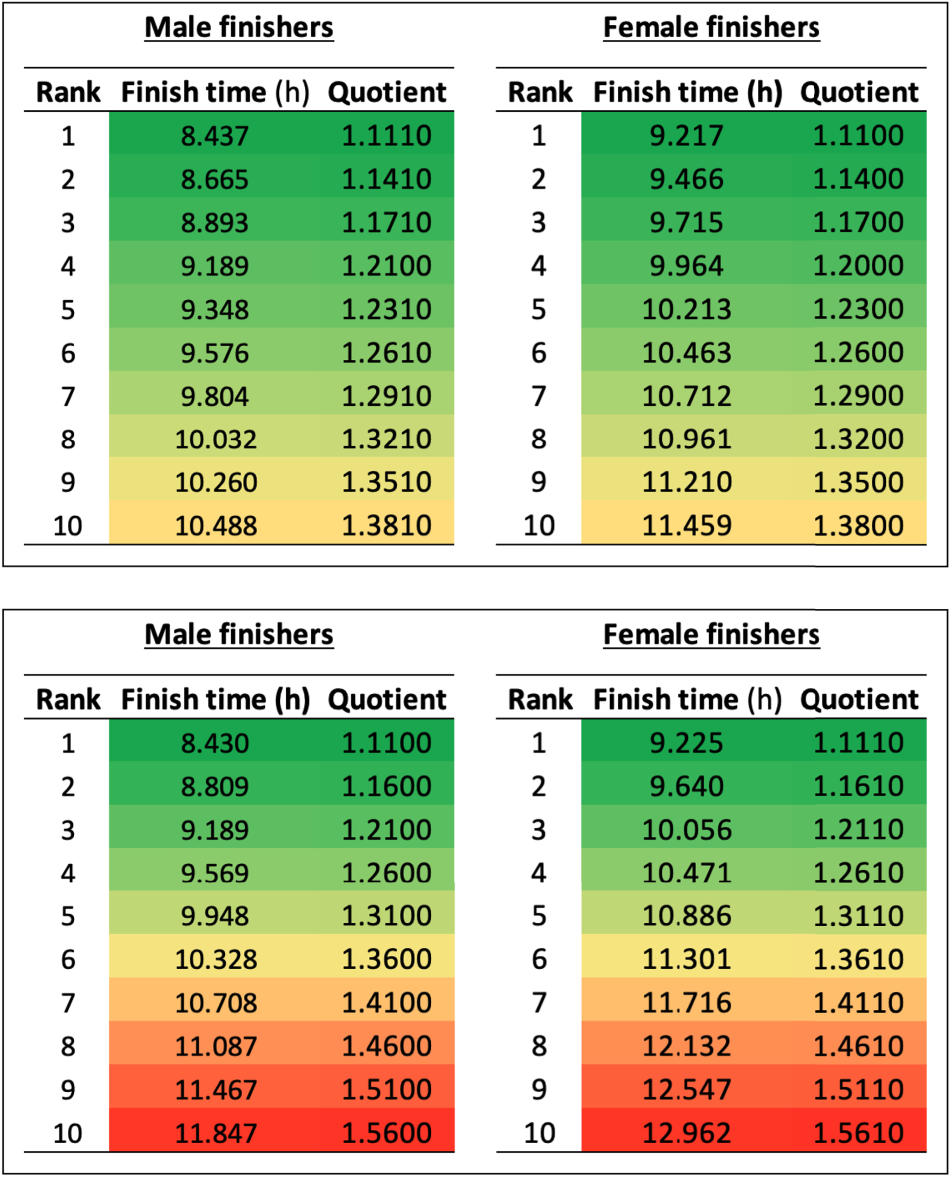
Two fictitious examples with
Example for a combination of an AGRing
The Austria-Triathlon 2019, which we took as an example in the introduction to illustrate that it is not necessarily fair to have
On the contrary, competitions with
Note that the unfairness factor is not defined for
Properties of the unfairness factor
The minimum unfairness factor
Computing
The minimum of
Evaluation of existing prize rank distributions
We evaluated the most common methods for prize rank distributions (Methods 1 and 2 from Section “Existing prize rank distributions”) regarding fairness compared to the QM and the DM, using Ironman World Championship Professionals 2011–2019 (Cox, 2007-2022b) Ironman World Championship Amateurs 2011–2019 (Cox, 2007-2022b) Ironman Texas Professionals 2011–2015, 2017, 2019 (Cox, 2007-2022a) Ironman Texas Amateurs 2011–2015, 2017, 2019 (Cox, 2007-2022a) Austria-Triathlon Ironman Distance 2011–2020 (Pentek-timing GmbH, 1993-2022)
We chose those competitions, because after an extended search for race results they turned out tobe the ones with best access to complete ranking lists. Furthermore, they provide a good mixture of professional and amateur competitions. While the Ironman World Championships are highly professional, where also the amateur athletes (the age groupers) perform on a very high level, the Austria-Triathlon is a pure amateur race. Ironman Texas settles somewhere in the middle. For Ironman Texas, we disregarded the competitions in 2016 and 2018, because they had shortened bike tracks. In 2020 (and 2021) competitions were very limited due to the COVID-19 pandemic.
To have a standard evaluation method all analyses were done with
Main observations
Analyzing the above competitions, the overall outcome is that for amateurs it would be fairer to have less prize ranks for women than for men, even if women had only up to 20% as many prize ranks as men. This is true for nearly every competition that has been considered. For professionals, however, it highly depends on the number of prize ranks that are assigned to women: If the number of destined women prize ranks were only up to 20% of the number of men prize ranks, it would be fairer to assign women the same number of prize ranks as men. This changes at between 30 and 40%, where – like in the amateur case – again it becomes fairer to assign less prize ranks to women than to men. These outcomes are mostly independent of whether the unfairness factor was calculated w.r.t. the QM or w.r.t. the DM. We consider more details of our analysis in the remainder of this section.
Figure 3 shows the average unfairness factors over all considered competitions for the different values for w, where
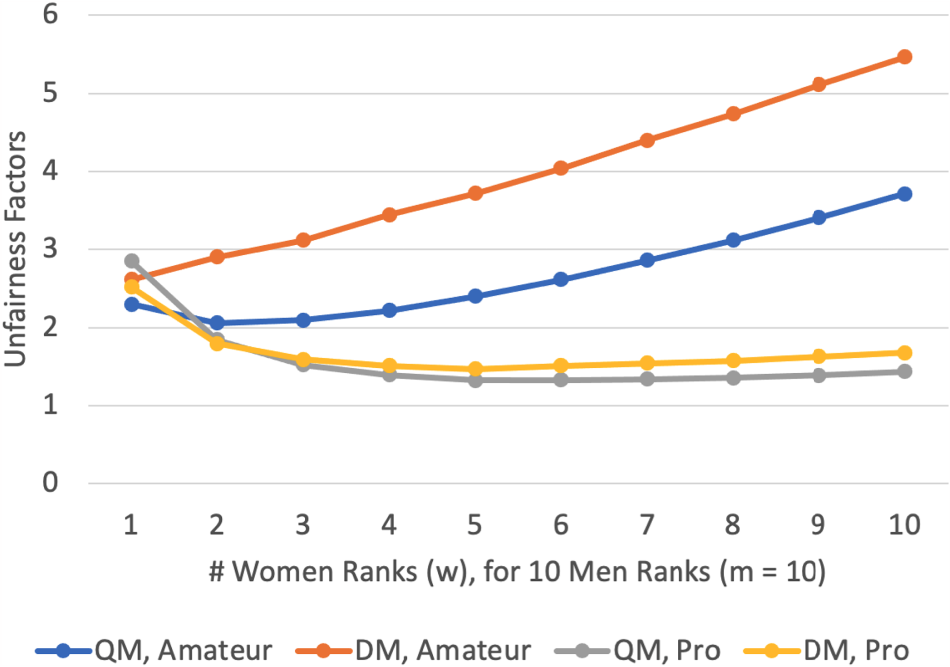
Unfairness factors on average over all considered competitions (26 for amateurs, 16 for professionals).
Nevertheless, it might be interesting to discuss if, in particular for the DM, it would be even fairer to have no prize ranks for women at all, i.e.,
For professionals, the situation is a bit different. The highest unfairness factors are reached at
It is eye-catching that the unfairness factors of professional races are generally lower than those of amateur races. This indicates what the authors had expected from their own experience: in professional competitions the difference between highly performing men and highly performing women is not as big as in amateur races – w.r.t. both the number of highly performing women and their quotient/difference compared to the world record. This fact is also reflected by the higher value of w at the minimum unfairness factor.
Let us take a closer look at the single competitions to see that the average values are not a product of single peaks (or valleys). Table 3 shows, for
Number of amateur competitions (out of 26) where Method 2 is fairer (#) and approximate average unfairness factors (F), for

For the 16 professional competitions, the results are very similar: For
Number of professional competitions (out of 16) where Method 2 is fairer (#) and approximate average unfairness factors (F), for

Special cases
Looking at Table 4, two issues are interesting: One is that there remain two professional competitions (only one, for the DM) where Method 1 remains fairer also for QM: The first 9 women all settle between AGRs 11 and 23, 10th woman has rank 24. DM: The first 9 women all settle between AGRs 12 and 23, 10th woman has rank 24.
Note, however, that for both models, the unfairness factors of Methods 1 and 2 are very close to each other. Neglecting the completely different ranking situations between Ironman Texas 2015 and 2017, what they both have in common is that the slightly larger unfairness of Method 2 results from the spread of a similar unfairness over more ranks. Also for the Ironman Texas 2015, with AGRs 20 and 19, in the QM, the 10th woman ranks directly behind the 9th and therefore makes a rather small contribution to the numerator in the unfairness factor.
The other interesting issue, for the professional competitions, is that the number of competitions, in which Method 2 is fairer, is not constantly growing for the QM (see
Possible influences on (un-)fairness
It might be interesting to investigate whether factors like the gender ratio among finishers of a competition or the total number of race finishers have an influence on the unfairness factor or on the fairest prize rank distribution between the genders. For this purpose we compared, on the one hand, the unfairness factors for the settings with
Overall, we could not find any dependencies between those numbers. (All figures hereafter relate to analyses with the QM.) The Pearson correlation coefficients for the different numbers of finishers and the unfairness factor are close to 0. The correlation coefficient for the gender ratio and the unfairness factor over all competitions, for
The correlation coefficients for the different numbers of finishers and the fairest ratio for prize rank distribution are again close to 0. The average of the gender ratio over all analyzed amateur competitions is 5.05, which fits the idea that it would be fairest to have two prize ranks for women, when men have 10 (i.e., 5 times as many for men as for women). However, again a closer look at the different series shows that this cannot be transmitted to single series or even competitions. Considering only the amateur competitions, for the Ironman World Championship series, on average it would be fairest to give 5.37 times as many prize ranks to men as to women, but the average gender ratio is 2.67. For the Ironman Texas series the average fairest prize rank ratio is 3.63 and the average gender ratio is 3.08, while for the Austria-Triathlon the average fairest prize rank ratio is 6.67 and the average gender ratio is 8.57. There is even more variation for single competitions, e.g., Ironman Texas 2017 has prize rank ratio 10 and gender ratio 2.95, while Ironman Texas 2014 has prize rank ratio 2 and gender ratio 3.46. The professional competitions and also the correlation coefficients between the gender ratio and the fairest prize rank ratio show similar randomness.
Other sports
The analyzed triathlon competitions already show very well that often the aim of being fair from an ethical point of view (same number of prize ranks for both genders) conflicts with the aim of being fair from the performance perspective. Though, it might be interesting to also see an example from other sports. For this purpose, we chose the Munich Marathon series, as it provides good public access to complete ranking lists (Munich Marathon GmbH, 2004-2022). Again, we analyzed the years 2011 to 2019. For the Munich Marathon, there is no distinction between amateur and professional starters, which seems to be quite common for marathon races.
The comparison of the published SRings with the fictitious AGRings shows results that are similar to those of the analyzed amateur triathlon competitions. Unfairness is minimal at
Number of marathon competitions (out of 9) where Method 2 is fairer (#) and approximate average unfairness factors (F), for

Possible implications for practice
With the insight that the commonly used practice to have the same number of prize ranks for men and women is often not fair from the perspective of performance, it is worthwhile to discuss the applicability of alternative prize rank distributions in practice, with its benefits and drawbacks.
Practicability of AGRings
First of all, we have a look at practicability of AGRings. One issue mentioned already in Section “Fair prize rank distributions” is that athletes would have to slightly change their perspective: instead of only considering their competitors of the same gender, in AGRings they would have to consider all contestants regardless of gender. This issue alone would not make a big difference, but at the same time, the comparison with other contestants would become harder as one has to know about the other athletes’ quotients (or differences) compared to the world record.
Here, however, we need to distinguish two views. One is that athletes might want to estimate their chances of winning a prize prior to the race. For this, the difficulty to compare yourself to the other contestants stays pretty much the same: the only difference to SRings is that when comparing your past finish times to those of your contestants, instead of considering the absolute individual finish times, you need to consider the individual quotients (or differences). As you know in advance how many prize ranks are allocated in the race under consideration, in both cases you simply need to estimate how many athletes might perform better than you. With SRings you need to consider only your own gender and absolute finish times, with AGRings you need to consider both genders and relative finish times.
Another issue is that athletes typically also want to estimate their ranking during a race. This seems to be harder with relative finish times than with absolute finish times. However, here it might be worthwhile to mention that this possibility is often not even given in SRings. In many competitions, athletes start in different groups or even one by one. Then comparison with other athletes is at least difficult, even impossible with athletes who start later. This is often the case not only in triathlon, but, e.g., also in biathlon. Furthermore, even rankings w.r.t. relative finish times are widely applied in practice already. One prominent example is the Paralympics as well as other competitions for persons with disabilities, where in many sports finish times are factorized according to the level of disabilities. For example, this practice is applied in track cycling, cross country and downhill skiing. There, individual time factors are applied to every athlete, whereas the QM and DM only suggest two different time factors: one for men, the other for women. In the end, in both cases, all athletes are ranked in one table – according to their factorized finish times – and the best athletes, according to this ranking, will receive a prize, while the total number of prize ranks is announced before the race.
Since in the proposed AGRings there are only two time factors, the difficulty to compute current rankings during the race could be resolved when using the DM (and not the QM). To completely eliminate this issue and have the situation that the ranking order is the same as the order of finish line crossing, women would have to start earlier than men – exactly by the difference between the female and the male record. Then, however, in particular for competitions, where that difference is not big, the fastest men could be slowed down by groups of women, who do not cross the finish line before them. To avoid such and similar interferences, but still have the winners to cross the finish line first, the start groups in competitions with many contestants are usually organized such that only those athletes that are most likely to finish on the front ranks start in the early start groups. However, for the QM, which for performance assessment we still consider slightly fairer than the DM (cf. Section “Main observations”), the problem of current ranking calculation is very similar to that in Paralympics for factorized finish times and cannot be overcome easily.
Other drawbacks of AGRings are the following:
Even if the sum of prize ranks (and money) were the same in the AGRing as it were in the SRing (summed up over both genders), athletes could feel being robbed of medals (or trophies in general). Assume, e.g., an Olympic competition: While for SRings there would be two gold medals, two silver and two bronze medals, for AGRings there would be only one of each. This issue has already been discussed by athletes, e.g., for horse-riding competitions, which are generally held cross-gender (Peiffer and Lesser, 2021). As, from the results presented in Section “Evaluation of existing prize rank distributions,” it would have to be expected that in AGRings women receive less prize ranks than men, the motivation for female athletes might be lower – maybe in general, but with high probability at least for those athletes who would, during the race, be on or close to those ranks that would only receive prize money in a setting with more prize ranks for women, e.g., the same number as for men. Again given that the above analyses showed that it would have to be expected that in AGRings women receive less prize ranks than men, one also should consider the following: If you want to change it in the long run that there are fewer highly performing women than men, it would for sure be the wrong signal to award less women than men. It might discourage high potential women from pushing their limits (in both training and competition) or, even worse, from participating at all.
To draw a complete picture, in contrary to these psychological drawbacks, also psychological benefits of the proposed AGRings shall be mentioned. For this purpose, let us exemplary examine the idea that at least the first female finisher is guaranteed to win a prize. Now consider the extreme case that there might be one female starter only, who is a low performer, but in this setting she is guaranteed to win a prize. On the other hand, several men are performing at world’s elite level, one of them not winning a prize, but the low performing amateur female would win the prize instead. How fair does this seem to him? From the authors’ personal experience, such settings can quickly lead to the situation that women who end up on a prize rank are generally told, usually by male finishers, that for women it is much easier to win a prize. This feels discrediting for women, in particular when they do not belong to the low performers. Ending up on a prize rank in an AGRing, however, defies all slander.
Given that both the SRings and the AGRings have their benefits and drawbacks, it might be worthwhile to think about combined versions.
Options for prize rank distributions in practice
To summarize the different options for prize rank distribution and to introduce hybrid versions, we work with the example from Figure 1 for illustration. In that particular competition, Austria-Triathlon 2019 (Ironman distance), they had
Method 1
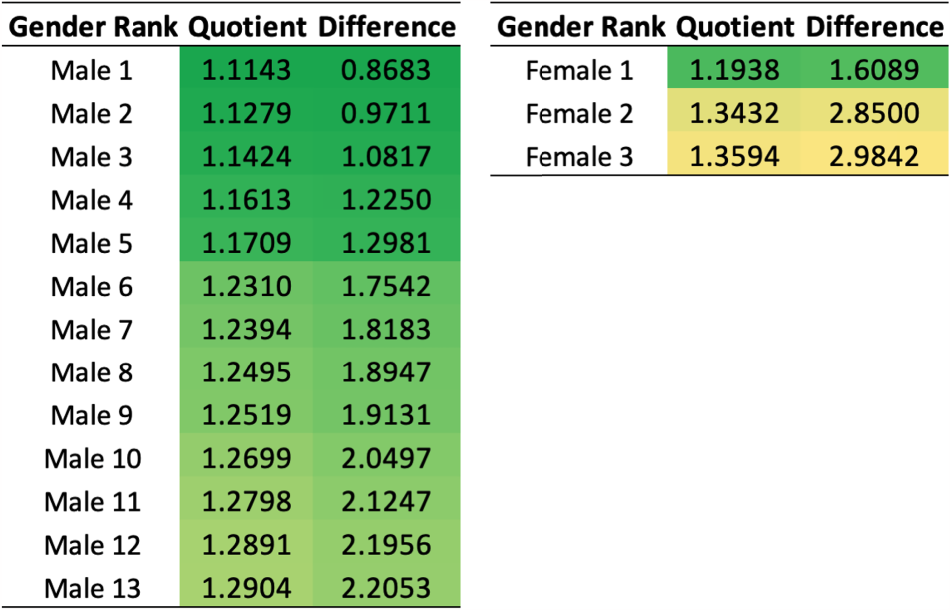
With Method 1, the first 8 finishers of each gender would win a prize. They are shown in Figure 4 together with their quotients and differences in comparison to the gender specific world record. There, it is remarkable that the eighth woman, who was more than 50% or nearly 4.5 hours above the female world record would win a prize, while the ninth men with only 25% or not even 2 hours above the male world record (see Figure 5) would not.
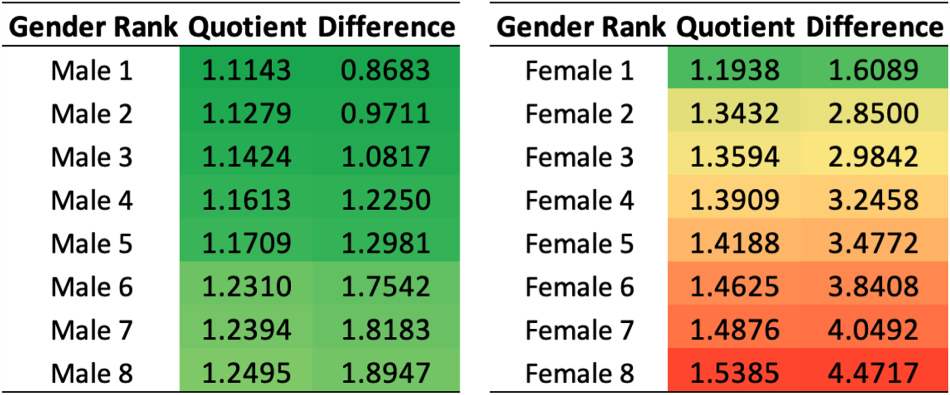
Prize rank holders from Austria-Triathlon 2019 (Ironman distance) for Method 1.
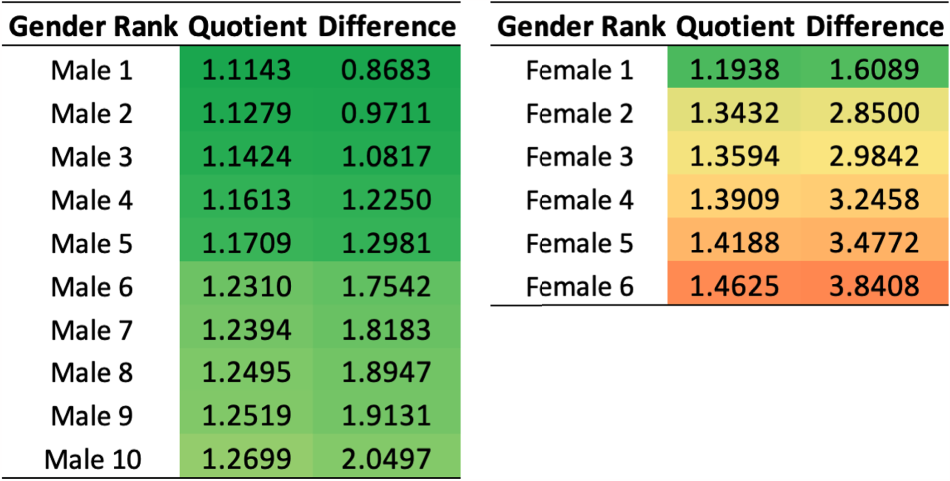
Prize rank holders from Austria-Triathlon 2019 (Ironman distance) for Method 2.
Method 2
The organizers of that particular competition tried to pay tribute to this perceived unfairness by assigning less prize ranks to women than to men, hence applying what is called Method 2 in this paper. For 10 prize ranks for men and 6 for women, the results are shown in Figure 5. For this particular competition, the situation now seems to be a bit fairer compared to Method 1. However, how can you know already at the time of competition announcement, which is the point when the number of prize ranks should be communicated, how many prize ranks would be fair for each gender from the view of performance? For the considered competition, after all, only one prize rank for the female starters would be fair w.r.t. performance compared across both genders.
AGRings
This argument leads us to the suggested AGRings, for which the ranking would be as shown in Figure 6. One woman plus 15 men would be awarded, which is supposed to be the fairest distribution performance wise – in this case for both the QM and the DM. Possible drawbacks of this method were discussed extensively in Section “Practicability of AGRings,” which inspires for hybrids of split and across genders rankings.
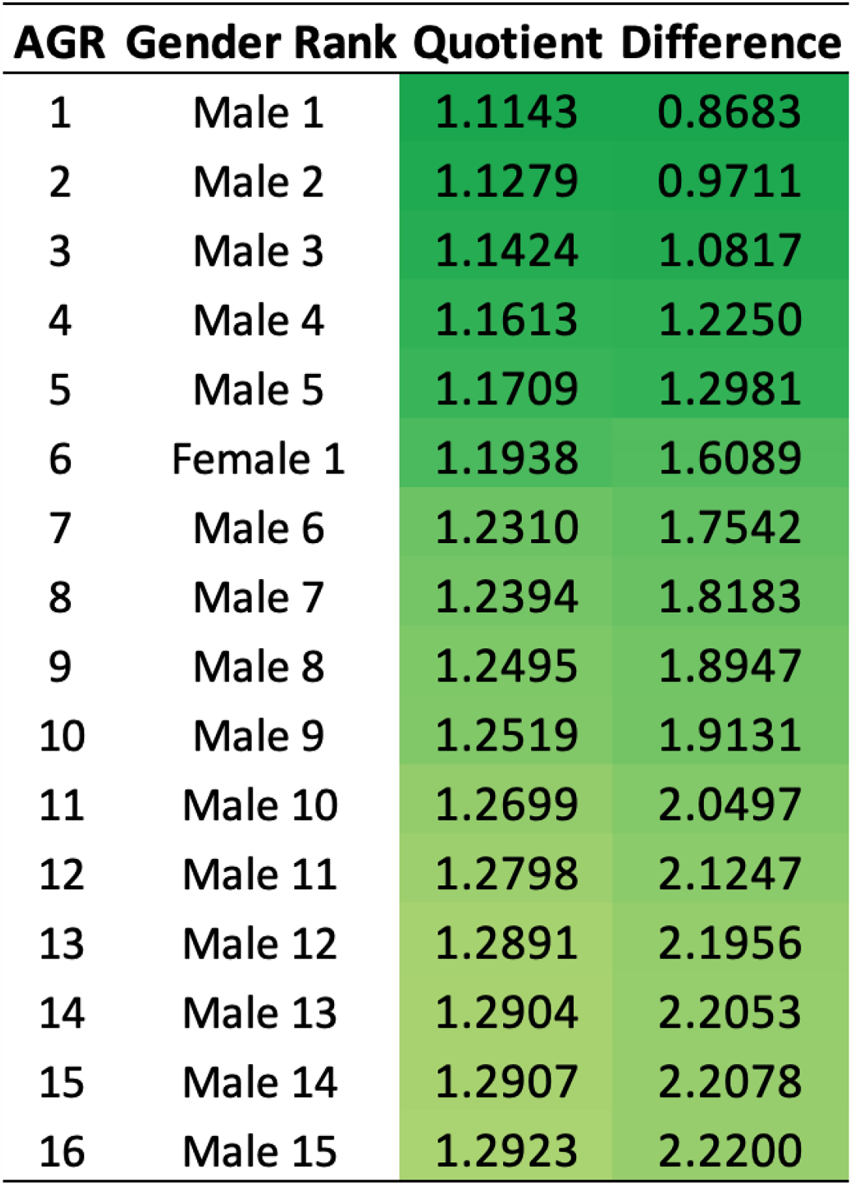
Prize rank holders from Austria-Triathlon 2019 (Ironman distance) for AGRings.
Hybrids
To combine the advantages of both SRings and AGRings, one idea is to award prizes to the three best finishers of each gender plus the next 10 best finishers according to relative finish times across gender. The result of this is shown in Figure 7. With this approach, each gender would be sure to have a full podium, but still it would be paid attention to possibly big performance differences between the genders. Of course, also other numbers of fixed prize ranks per gender and across gender prize ranks could be chosen here.
Prize rank holders from Austria-Triathlon 2019 (Ironman distance) for a hybrid of split and across gender ranking: each gender has its podium, beyond that the prizes are assigned w.r.t. relative finish times.
Other ideas of hybrids include the distribution of prize money and therefore shall be discussed only briefly in this paper. One option could be to spread prize money in the classical way with the same number of prize ranks for men and women (Figure 4), but then add rewards based on the AGRing (Figure 6). Note that also for the ranking schemes depicted in Figures 6 and 7 different versions of prize money distribution are conceivable. One could either reward the first three women (in Figure 6 only the first) with the same amounts as the first three men, or one could have 16 levels of prize money, where the three women would then settle on levels 6, 15, and 16 – according to their relative performance. However, as mentioned before, the question upon fair amounts and fair spreads of prize money is a field of research on its own and leaves room for future work.
Conclusion and future work
This paper introduced gender-equitable distributions of prize ranks that assess athletes’ performances across gender. From those distributions a fairness measure was derived to evaluate the gender equity of other, split gender distributions. The analyses of numerous triathlon competitions revealed that, with respect to that measure, it is not necessarily fair to assign the same number of prize ranks to both genders, as it is done nowadays in most competitions. Neither, by default, can it be considered as fair to distribute the number of prize ranks between men and women according to the respective number of starters or finishers. From the performance perspective, on average it would be fairer to have less prize ranks for women than for men, meaning that basically only an ethical aspect would speak for an equal distribution of prize ranks. Since we have analyzed quite a high number of competitions, of which most brought this result, we claim that, for triathlon, we can extend our results to generality – with a few exceptional competitions, as they do also exist among the analyzed ones.
Our short analysis of marathon races shows that also in other sports one should expect a discrepancy between ethical fairness and fairness w.r.t. performance. In future investigations, the methods presented in this paper can be used by scientists and organizers to assess the fairness of different prize rank distributions.
For triathlon, we observed that the fairness situation differs a bit between amateur and professional competitions. Whereas for amateurs it would be fairest to give prize money to only the best one or two women, while the first 10 men receive prize money, for professionals, the fairest would be to award the best five women.
With respect to the considered QM and DM, we consider the QM to be the better choice for AGRings, for the assessment of performance. However, when it comes to practicality, the DM has some advantages, which were discussed in Section “Practicability of AGRings.” Although we regard both considered versions of AGRings as generally practicable, one should not neglect their drawbacks as also discussed in Section “Practicability of AGRings.” Hybrid versions, e.g., with a fixed number of split prize ranks plus extra across gender prize ranks might be a solution.
It is important to emphasize that the intention of this paper is not to say that it is indispensable to switch to new prize rank distributions better sooner than later. As we have seen, there is no clear answer what approach is to be considered fairest and best applicable at the same time. Rather, the aim is to raise awareness that the current practice to award prizes by gender can be quite unfair and to suggest other options that might be interesting to be applied or at least to be discussed, e.g., together with fair amounts and spreads of prize money in future research.
Footnotes
Acknowledgments
Special thanks go to Andreas Bley for many helpful discussions on the contents of this paper. We also want to thank Oliver Rau, in a dialogue with whom the idea was born to publish our ideas on AGRs. And last but not least, we thank the reviewers and editors of this journal whose comments helped significantly to improve the presentation of the conflicting advantages and disadvantages of the proposed prize rank distributions.
Fundings
The author(s) received no financial support for the research, authorship, and/or publication of this article.
Conflicting interests
The author(s) declared no potential conflicts of interest with respect to the research, authorship, and publication of this article.
Appendix
To prove Lemma 1, for the sake of brevity, we only consider the numerator