



Abstract
While both school and public libraries cater for young people and share common goals in supporting their communities, there is limited research about how they interact with each other. Using a replication study methodology, this article discusses the findings from two surveys of staff in Australian public and school libraries to gain insight into how they operationalise their relationship with each other, identify their levels of interactions and understand the factors impacting those interactions. Quantitative and qualitative findings from 119 public and 120 school library participants working throughout Australia suggest variance in the interactions between sectors but mostly reported low levels across the last 5 years. Identified factors impacting these collaborations positively and negatively included staffing, time and budget. Staffing was a big issue and many public libraries noted that local school libraries were not being staffed or even included in newly built schools as noted by one participant. Another interesting finding was participants’ perspective of the need for the interaction which was greatly shared by school library staff who felt their school collection and programs were adequate for their students or public library staff who’s outreach attempts have gone unanswered. This could be problematic in ensuring that students understand the value of the public library after they leave school. There were also clear misunderstandings identified between responses from both sectors with regards to factors like the budget and communication about collaboration opportunities. Despite these challenges, participants from both sectors shared a recognition of the potential benefits of collaboration in supporting lifelong learning in their communities and “the value of libraries” in general.
Introduction
School and public libraries are both tasked with serving the youngest members of the community (Phillips, 2025) through programming and collections. These connections are often made explicitly through professional library organisations at the international and domestic levels. The International Federation of Library Associations (IFLA) and United Nations Educational, Scientific, and Cultural Organization (UNESCO) developed both the IFLA-UNESCO School Library Manifesto (2025: 2) and the IFLA-UNESCO Public Library Manifesto (2022: 3) and both of these core documents note the importance of networking and partnering with the other library. The American Library Association (ALA) has an Interdivisional Committee on School/Public Library Cooperation including the American Association of School Librarians (AASL), Association of Library Services to Children (ALSC), and Young Adult Library Services Association (YALSA), and this group developed the Public Library and School Library Collaboration Toolkit (2018) to support these partnerships including exemplars, and templates. In Australia, the Standards and Guidelines for Australian Public Libraries developed by the Australian Public Library Alliance and Australian Library and Information Association (ALIA, 2021) describes partnerships and outreach with schools in a variety of areas including the Library Management guideline considering Marking and promotion, the Service Points guideline specifically focused on Library buildings, Opening hours and Outreach services, the Programs guideline looking at school holiday activities for young people, and the Partnerships and Collaboration guideline.
Despite the obvious connections between school and public libraries and a surplus of practitioner examples of successful partnerships in the professional literature, there is still limited empirical research about how these types of libraries interact with each other. This research sought to address this gap in the Australian context. Using a replication study methodology (Bundy, 2002), this article discusses the findings from two surveys – of staff in Australian public libraries and Australian school libraries respectively – conducted as part of the research project “Essential connections: School and public library co-operation for children.” The purpose of this study was to gain insight into how contemporary school and public library staff understand and operationalise their relationship with each other and their mission in the 21st century. It aimed to establish the current interaction between the sectors, possible barriers to interaction and insight into how school and public library staff define their relationship with each other and to their communities. The article will report on findings from the following research questions:
What are the current levels of interaction between school and public libraries in Australia and how have they changed over the last 5 years?
What are the factors impacting these interactions?
In order to establish the foundational understandings of the relationship between school and public libraries in Australia, the literature review shares a historical overview of the development of these community structures before bringing the discussion into the contemporary practices of school and public libraries emerging from this research.
Literature review
The relationship between the school and public library and the extent to which libraries generally are part of a community’s educational infrastructure has been the focus of interest over time. From the late 19th to the early 20th century the drive to establish public libraries in the Australian community included efforts to improve literacy in children and educational opportunities for adults. The public library was positioned practically and conceptually to address this deficit and as a surrogate for access to satisfactory “in house” school library infrastructure (Vincent, 1983: 39). While school participation increased, little changed in the following decades in the provision of resources. Public libraries continued to fill the deficit created by inadequate funding for schools, with few adequate school libraries and few qualified staff available until the late 1960s. It can be argued that this early positioning of public libraries in Australia for the remediation of social and educational deficits and the under-resourcing of school libraries continues to influence their perceived role and mission into the 21st century.
Changes in pedagogy over time and extensive government funding in the 1970s led to the expansion of the number of school libraries and courses for teacher librarians in Australia. According to Vincent, this led to a greater need for clarification of the role of school and public libraries and their staff in services for children (1983: 41). What ultimately emerged was an intrinsically siloed definition of the types of services school and public libraries delivered for children as well as the educational requirements of the library staff. The drawing of these both tacit and explicit boundaries in the 1970s has helped shape both education for librarianship and the provision of library services to children and youth in Australia to the present day.
According to Johnson, the 1990s saw a shift in the mission of public libraries to a more managerial and technological one, which impacted their level of commitment to children’s services (2007: 3). This decade was considered “a time of crisis in library services to children” (Johnson, 2007: 3), with reduced staffing, funding and “changes to management style without an understanding of librarianship” (2007: 3) in public libraries. However, at this time there is also evidence of growing interest and awareness of the benefits of collaborative practices across public and school libraries, evidenced through reports such as Student usage of public libraries in NSW (Guldberg, 1991) and Libraries: The other classroom? A report on research into secondary student (VCE) usage of Victorian libraries (Dowling, 1992). Professional associations were also giving greater consideration to the relationship between public and school libraries. An acknowledgement and commitment to collaboration between the two sectors in providing services to children was developing at the policy level (Renshaw and Goodhue, 2020: 15).
The early 21st century once again saw challenges to public libraries as they struggled to remain relevant in the face of technological change. In response, public libraries sought to engage with their communities in new ways, including reconceptualising public libraries as a key contributor to national and international early literacy objectives and initiatives. Subsequently, early literacy and information literacy became a central feature of many Australian public libraries’ lifelong learning initiatives. These initiatives would appear to present both a clear challenge to the established boundaries of the two sectors and an opportunity for increased collaboration.
Contemporary perspectives
In the 21st century and informed by concepts such as life-long learning, the literature suggests that the relationship between the public library and the school library in supporting children continues to be defined conceptually as complementary-one supporting the other in partnership but with distinct missions. For example, Carroll and Wakeling (2024) found that contemporary public library staff adopt tacit professional boundaries as part of their everyday practice when considering the degree and type of support they provide to education providers. This in turn was shown to influence the types of activities and resourcing they see as their responsibility, with care taken not to deliver what was seen as formal education (Carroll and Wakeling, 2024: 200). The ongoing operationalising of these distinctions can also be evidenced in public library collection policies which may include limitations on the purchase of textbooks or multiple copies of required literature by schools, the parameters drawn around age groups targeted for formal programming and the types of activities delivered. This literature review further suggests that there are fundamental barriers to both collaboration and co-operation which can only be overcome by concerted structural and professional change.
Collaboration and co-operation
The commitment of contemporary public libraries to deliver literacy and information literacy programmes to both adults and children suggests that there continues to be a strong educational mission in the public library sector which would appear to align with that of school libraries. However, there has been evidence of a structural disconnect between the library sectors reflected in the international literature, which appears endemic in the profession. Public libraries in Australia have taken on the mantle of champions in early childhood literacy. This has seen public library administrators, the professional association and practitioners promoting the public library as having a critical role in delivering programmes supporting early childhood literacy objectives. State programme such as State Library of Queensland’s (n.d.) First 5 Forever and State Library of Western Australia’s (n.d.) Better Beginnings are examples of the ways in which large State libraries have engaged with this initiative. At the local level, the delivery of programmes such as storytimes and early literacy events for a range of community groups is almost ubiquitous in the public library sector. According to the National and State Library Australasia (NSLA, 2023) group in their annual statistical report, public libraries (including State libraries) delivered 78,782 early childhood programmes in 2021–2022 to 1,583,734 participants (pp. 16–17). At the same time, there is also evidence of large State libraries providing substantial resourcing to support subject curriculum in schools. However, this activity does not appear to operate in collaboration with teacher librarians or school library associations with strategic documents and policies failing to include these potential partners. For example, in the Early year’s handbook for public libraries list of resources and websites developed by the State Library of Victoria and Public Libraries Victoria (2023), school library associations, teacher librarians and school libraries received no mention as a resource or partner in early literacy initiatives though “primary schools” are mentioned as possible stakeholders (2023: 11). These examples point to both structural, disciplinary and conceptual issues which require exploration.
While a great deal of the research literature around public-school library collaborations stems from a similar period to the Bundy (2002) study, internationally there is evidence in the contemporary literature of an increased awareness of the opportunities provided by effective collaborations between public and school library networks. Attention is given to strategies which may be useful in overcoming the common barriers which have been shown to inhibit collaboration. Practical examples such as the Limitless Libraries (Nashville Public Library and Metro Nashville Public Schools, n.d.) initiative in the city of Nashville, Tennesee, United States, provide direction on how these collaborations can be implemented effectively. Limitless Libraries leverages the expertise of both professional library communities extensively integrating professional learning, programming, library systems collections and importantly acquisitions and processing. According to school librarians Kimery and Winsten, through this programme, it is “exciting to witness how this extensive access to materials can fuel a learner’s personal passion and discovery” (2024: 36). Enthusiastic for the potential of this collaboration and highlighting the advantage of youth-focused staffing, the authors go on to state: Being able to collaborate with two public librarians who know our collections and the needs of our learners well is a partnership like no other. By working together, we ensure that our school library collections are exemplary, and our city’s young people are never without equal access to current, high quality collection to support their academic and personal needs. (Kimery and Winsten, 2024: 37)
Another example of efforts to address identified barriers to collaboration in the United States is the collaborative initiative the Public Library & School Library Collaboration Toolkit (AASL, ALSC, and YALSA, 2018) from three ALA divisions that serve children and youth librarians, teacher librarians, publishers and educators. These three divisions work together to produce several resources to advocate for children and youth services and to support collaboration across sectors including the Toolkit which expresses the view that: When school and public library staff collaborate to meet the needs of youth, they can increase the impact of their efforts manyfold. By building a seamless bridge for lifelong learning between school and public libraries, both can work together to help the young people and families in their communities achieve their life goals. (2018: 7)
International perspectives
Further research around the degree and value of collaboration between school and public libraries is of ongoing interest internationally including countries like Finland (Tikkinen and Korkeamäki, 2023), Germany (Lammers-Harlander, 2017), Hong Kong (Leung et al., 2020), Jamaica (Thompson et al., 2023), Serbia (Pejovic et al., 2023) and the United States (Kammer and Moreland, 2021). Researchers demonstrate a large degree of alignment in their findings largely concluding that disciplinary boundaries have created barriers to professional collaboration and such boundaries requires structural change through a variety of administrative and professional initiatives aimed at increasing opportunities for collaboration. A study conducted in Zanzibar by Omar et al. (2024) investigated the degree of support given to school libraries by public libraries with a focus on the promotion of lifelong learning and literacy. This research is framed around an expectation that public libraries should provide support rather than overarching collaboration. The authors note that while such collaboration was shown to exist informally and was valuable, there were few structural supports for the implementation of this collaboration (2023: 105). Using a questionnaire as the primary data source supported by interviews and focus groups, the study found that 70% of the total 130 questionnaire respondents felt that the public libraries provided either “weak” or “very weak” support to school libraries (2023: 109). Interestingly, the perceptions of public and school library staff of the effectiveness of existing collaborative programmes differed somewhat. According to the findings, 75% of public library staff found these existing programmes to be “ineffective” “or somewhat ineffective” while 66.5% of school library staff had a similar response. No library staff in the study rated current collaborative programmes as “very effective” (2023: 105).
Structural and disciplinary barriers to collaboration have also been highlighted by Tikkinen and Korkeamäki (2023) in Finland. Somewhat pessimistically, they state that when dealing with school and public libraries, “The two professions partially share the same goals and tasks, but they differ in their methods of reaching these goals” (2021: 731). The differences they discuss highlight some of the potential structural barriers identified in the research which create silos between the two library sectors. These reasons include differing conceptions of literacy shaped by their different terminology and disciplinary backgrounds (2021: 731), making communication at times difficult. Notably, Tikkinen and Korkeamäki (2023) highlight the distinctions which can be made between collaboration and cooperation with collaboration defined as working together and cooperation the dividing of a task into “independent sub tasks” later drawn together (2021: 732). Interviewing four “school-public library pairs” (Tikkinen and Korkeamäki, 2023: 735), the study found that, like the Zanzibarian study (Omar et al., 2024), formal documents and policies “that promoted working together, were indicative of a high level of commitment” to co-operation (Tikkinen and Korkeamäki, 2023: 741). For collaboration to occur, they conclude “long-term development work must be devoted to enhancing the process of working together” (2021: 742) and that “successful integration of librarians into instruction necessitates administrative-level support” (2021: 742). This literature review clearly demonstrates that despite barriers to collaboration, public and school libraries worldwide are engaging each other to serve their communities. This study continues to investigate the current climate of such relationships in Australia.
Methodology
This research replicated a study from the early 2000s (Bundy, 2002) which investigated levels of interaction between public and school libraries in Australia. The use of a replication study methodology provides an opportunity for longitudinal insights on this issue in Australia and internationally. The current study used two versions of a survey based on the original study, one designed for staff in school libraries and one for staff in public libraries. In May and June 2023, these two surveys were disseminated online through email lists and listservs for various professional associations for libraries in Australia and each state and territory. This also provided an opportunity to communicate the aims of the study with the professional associations and their members.
The first part of the survey consisted of a participant information sheet which included the opportunity to indicate informed consent. It was made clear to participants that the research replicated Bundy’s study (2002). However, further information about the original paper was not provided as the researchers believed that providing more information prior to completing the survey may influence participants’ responses. A citation to Bundy (2002) was provided on completion of the survey. All data collection was anonymous with questions tailored to each library sector (e.g. The school library version asked for school type and level while the public library version asked for library type). Each survey included demographic questions such as location, title, number of staff in the library, library type and qualifications. This was followed by Likert-scale questions related to interactions between the sectors, levels of interaction and changes over the last 5 years with opportunities throughout for free responses. The aim of this additional data allowed for greater contextual insight into responses. The survey for each group can be found in Appendices 1 and 2.
The surveys collected quantitative and qualitative data with two approaches taken to analysis. Quantitative analysis of the Likert-responses used SurveyMonkey and descriptive statistics. Qualitative analysis of the free text responses was completed in three phases using a thematic analysis approach as described by Braun and Clarke (2012). In order to address our research questions, we specifically sought out responses related to interactions between different library types and factors impacting those interactions. First, two members of the research team went through all of the qualitative data independently and developed a preliminary set of codes based on emergent themes. Then, they met to discuss their analyses, identify codes in common and come to agreement on any conflicting or overlapping codes. Overall, there was a high level of agreement regarding the codes; the main issues were around duplicate codes. For example, initially codes focused on the amount of interaction and if participants were positive or negative about how much or how little the two libraries interacted. Given these codes were actually related to the same thing, the researchers decided to collapse them together under the code. “Level of interaction.” This supported the reliability of data, that researchers were coding consistently. The validity of the data was supported through multiple identification of codes throughout the data, that multiple participants were sharing similar perspectives and experiences around interactions between school and public libraries. After deciding on the final set of codes shown in Table 1, the researchers re-coded the free text responses using these codes as tags in Survey Monkey, allowing for identification and analysis.
Final codebook relating to interactions.

The findings explore the quantitative and qualitative data in more detail before delving into their implications in the discussion.
Findings
The findings are presented in two sections. First, the quantitative demographic data of the participants provides insight into where participants were located and who they were as staff members of public and school libraries. Next, we explore the findings related to the levels of interaction between the two library sectors, considering the factors identified by both sets of participants impacting those interactions, and the changes in interactions over the last 5 years.
Demographics of participants
Overall, there were 119 participants from the public library sector and 120 participants from the school library sector. Collected demographics described below include the Australian state or territory, regionality, library type and level and qualifications of participants.
Australian state and territories
As shown in Figure 1, participants responded to the surveys from various states and territories across Australia.
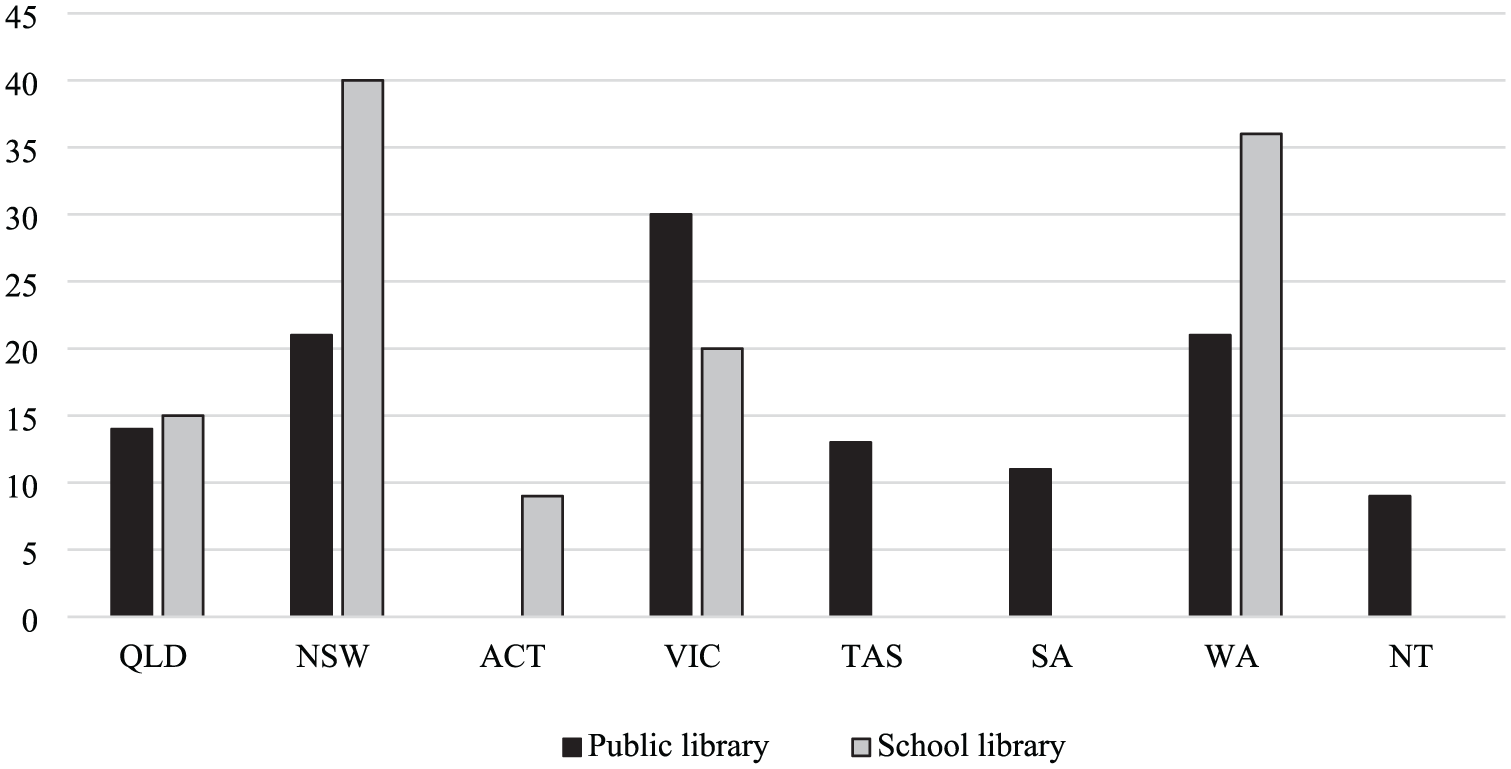
Number of participants per states and territories.
Of the 120 school library participants, five states and territories were represented including Queensland (QLD), New South Wales (NSW), Australian Capital Territory (ACT), Victoria (VIC) and Western Australia (WA). The most populous state in Australia and the only state retaining a requirement for a qualified teacher librarian in government schools, NSW, made up 17% of participants. This was 50% more than Victoria at 8%, the next most populous state but with no such mandate. There were no school library responses from South Australia (SA), Tasmania (TAS), and the Northern Territory (NT). Of the 119 public library participants, seven states and territories were represented including NSW, QLD, VIC, WA, TAS, SA and NT, with VIC participants making up the highest state with participants at 25%. There were no responses from the ACT for the public library participants. The sample for both school and public libraries is considered by the researchers to be a fair representation of the library sectors in terms of overall populations, geographical regions and sector within Australia.
Regionality
Given the physical size of Australia and that approximately two-thirds of the total population live in the capital cities (Australian Bureau of Statistics, 2025), it was also important to consider regional factors of the participants’ locations such as degree of remoteness, community size and access to infrastructure. Region and sector of both groups of participants can be compared in Figure 2.
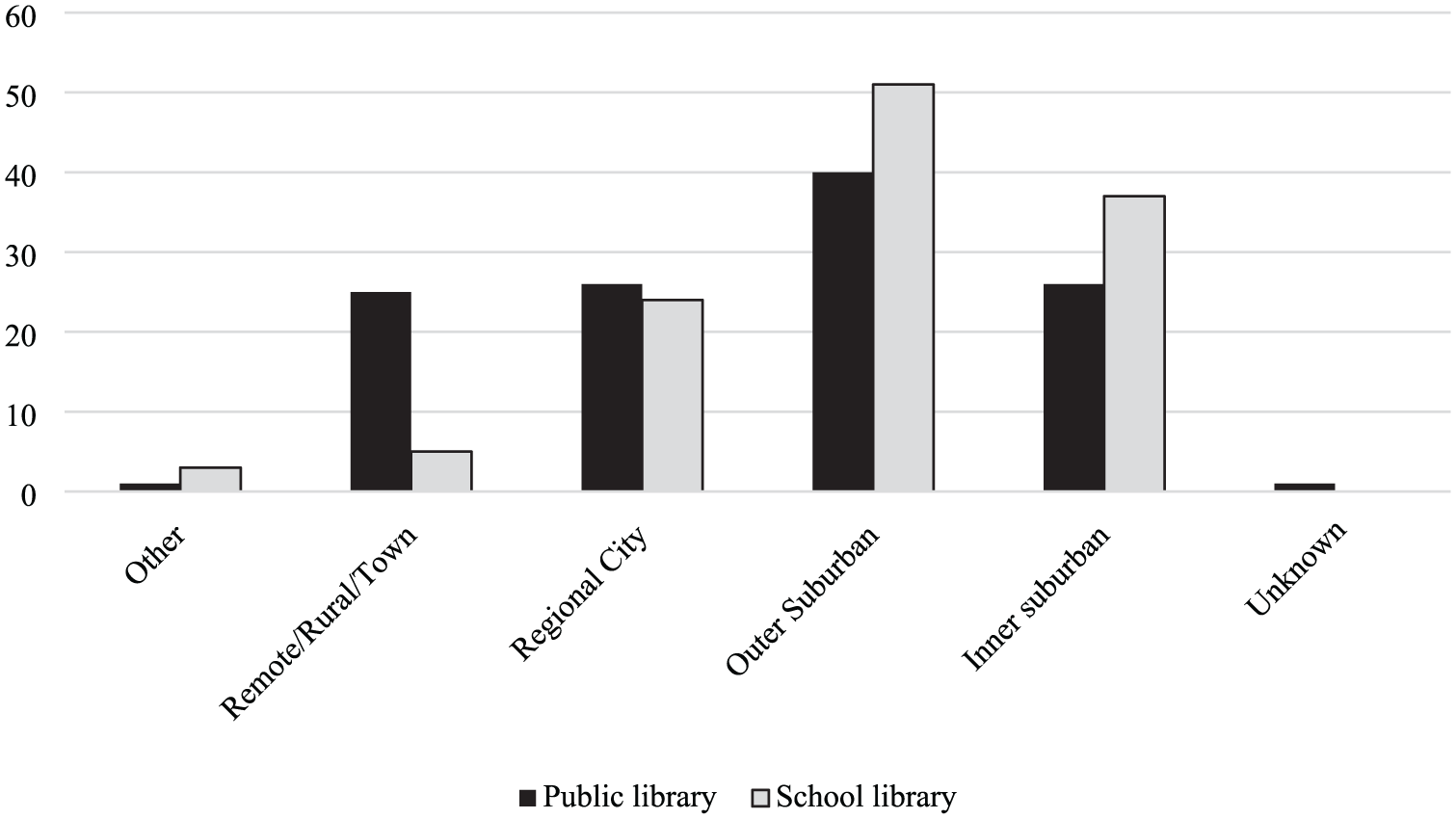
Number of participants per region.
The geographic region of responses for both school and public libraries was evenly distributed; however, there was a significant difference between the number of responses from school libraries identifying as being from Remote/Rural/Town and public libraries identifying in this same way. The lack of response from schools in the NT, SA and TAS, which potentially have more remote services, may have impacted this response. Additionally, there were more suburban school library responses than public library responses. The representation of regional school and public libraries was substantively even. In terms of location, the “outer suburban” response was identified in both school and public libraries as the largest group at 34%.
Library types and levels
As shown in Table 2, there was representation of various libraries by types and levels across both public and school libraries.
Public library types and school levels of participants.
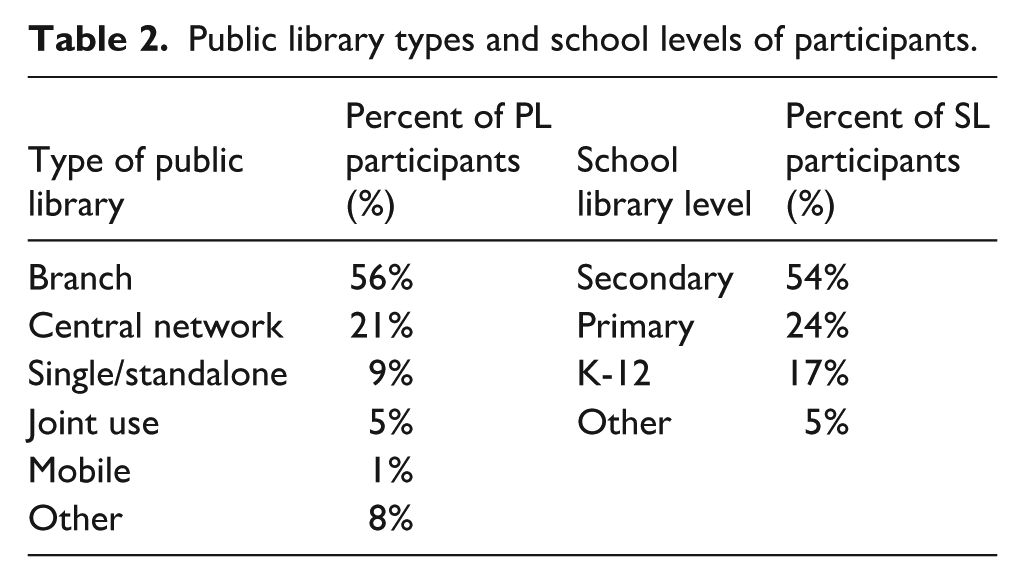
For school libraries, government schools (52%) and non-government schools (47%) were almost evenly represented while the majority of participants came from the secondary school level (54%). In the public library sector, those working in branch libraries made up 56% of the responses. This range of library types and levels provides a useful cross section sufficient to represent the public and school library sectors in Australia.
Staff and qualifications
Further demographic questions examined staffing in each type of library. Participants were asked how many full-time equivalent (FTE) staff members worked in their library and these results are show in Table 3.
Number of FTE staff in each sector identified by participants (n = 249).
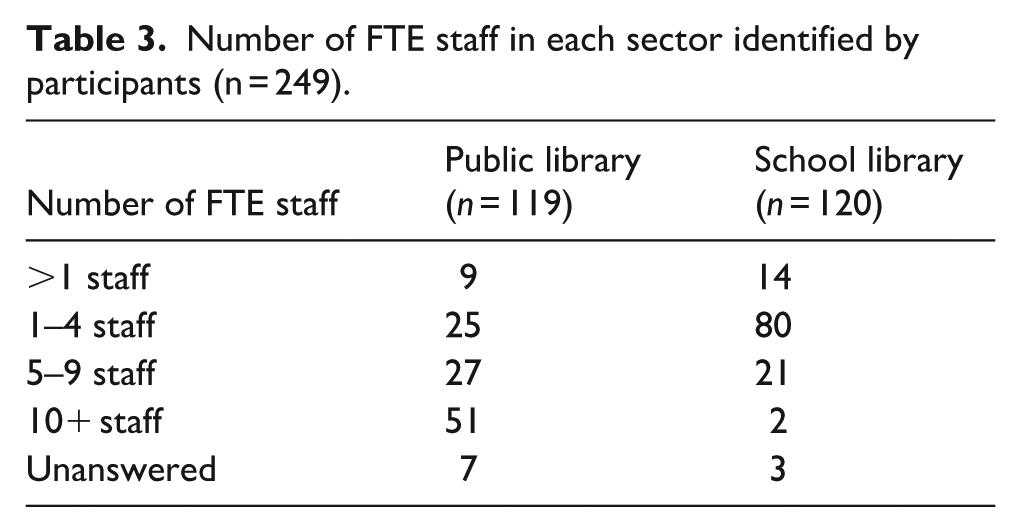
The highest number of FTE staff employed in each sector was 190 public library staff and 12 school library staff. Participants could elaborate on this question and some did, like a public library respondent noting “I am sole part-time worker at the branch working 16 hours per week” and a school library respondent stating “Our library is staffed one day per week.” While staffing data in Australian school libraries is not available (Hay, 2022), it is not common for Australian teacher librarians to have teaching responsibilities outside of the library given their dual qualifications (e.g. A qualified English teacher studies to be qualified as a teacher librarian and becomes hired as 0.5 teacher librarian and 0.5 English teacher.)
Another survey question asked participants specifically about their formal library and information qualifications. Formal entry level qualifications for employment in Australian libraries are at vocational and professional entry level. Qualifications include vocational diplomas in library studies leading to library technician qualifications and employment and professional undergraduate (Bachelors, and post-graduate (graduate diploma and masters) degrees leading to a librarianship qualification and employment. A master’s degree for teacher librarian qualifications is the benchmark for teacher librarian qualifications and employment. Teacher librarians require an initial education degree to undertake teacher librarian qualifications. The results of the question about formal qualifications are shown for both library types in Table 4.
Responses to the survey question “Do you have formal library and information qualifications?”.
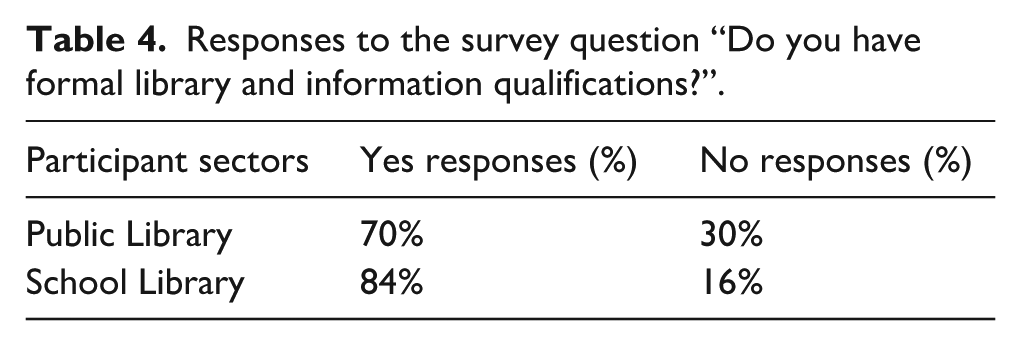
The school library participants also reported that 66% of them had a qualified teacher librarian in their school library, meaning someone dually qualified with both education/teaching and library and information studies degrees. Differences in staffing models and professional entry requirements between the sectors requires a deeper analysis to see if this data has any significant impact on responses. Cross tabulation of these findings with location, employment and library sector responses will be analysed and discussed more extensively in further publications.
Title
A final demographic question asked participants what title best described their current employment role and elicited a variety of responses. In order to streamline the data, examples of common titles were given as options for the participants. The responses are listed for each sector with percentages of participants in Table 5.
Employment Titles Identified by Participants by Percentage.
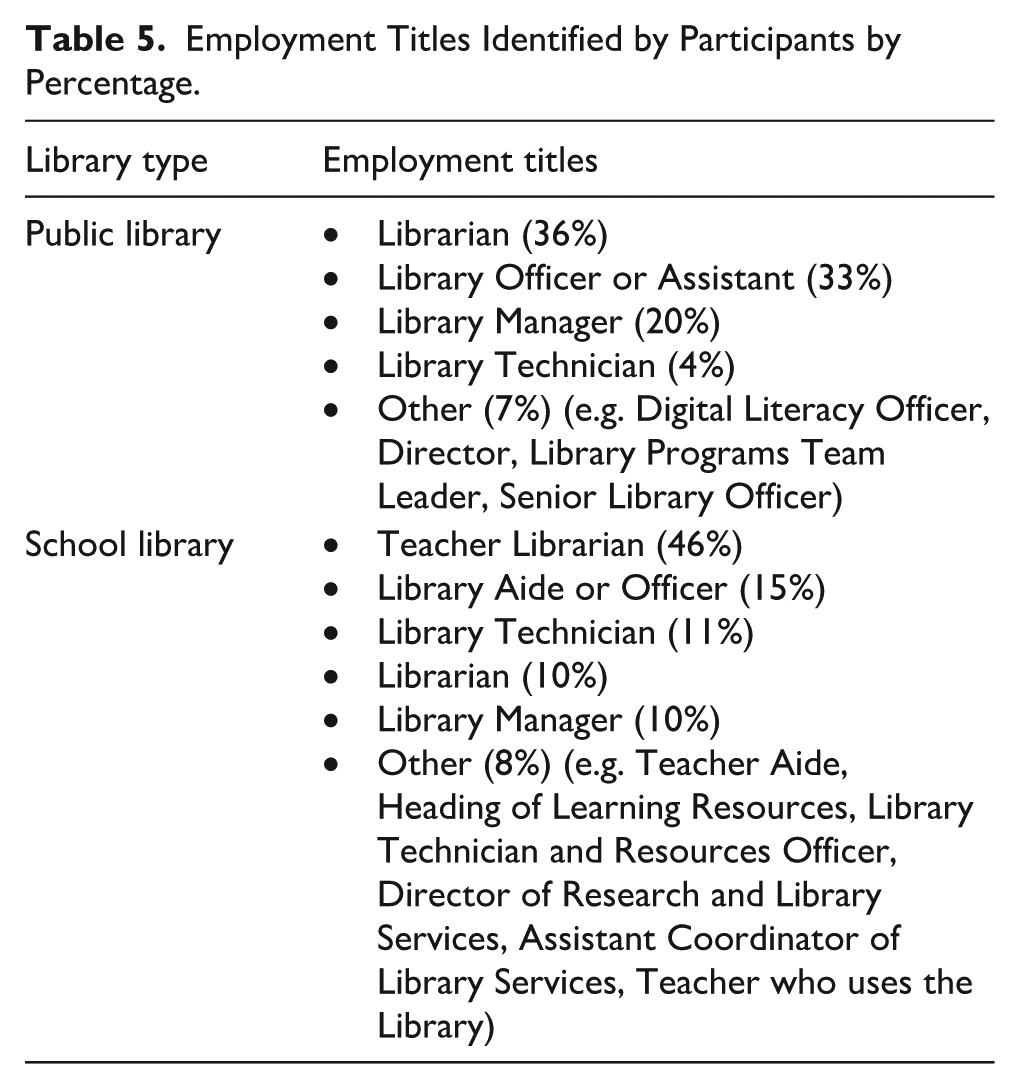
Employment titles are based on qualifications as previously described with library technicians holding entry level qualifications; library aides, officers and assistants holding higher qualifications like a Bachelors degree; and librarian, library managers, and teacher librarians holding the highest level of qualifications like a Masters degree with the teacher librarians also having some type of education degree. Participants who noted “Other” held an array of employment titles which would require varying qualifications as shown in Table 5. As shown in the demographic results, participants from both the public and school library sectors represent a variety of geographic areas and regions in Australia, library types and levels, qualifications and titles.
Public-school library interaction
The following findings share the data collected which indicates the current levels of interactions between the library sectors, the factors impacting these interactions and how they have changed in the last 5 years.
Level of interaction
When asked about the level of interaction between public and school libraries, there were distinct differences between responses from the two sectors as shown in Figure 3.
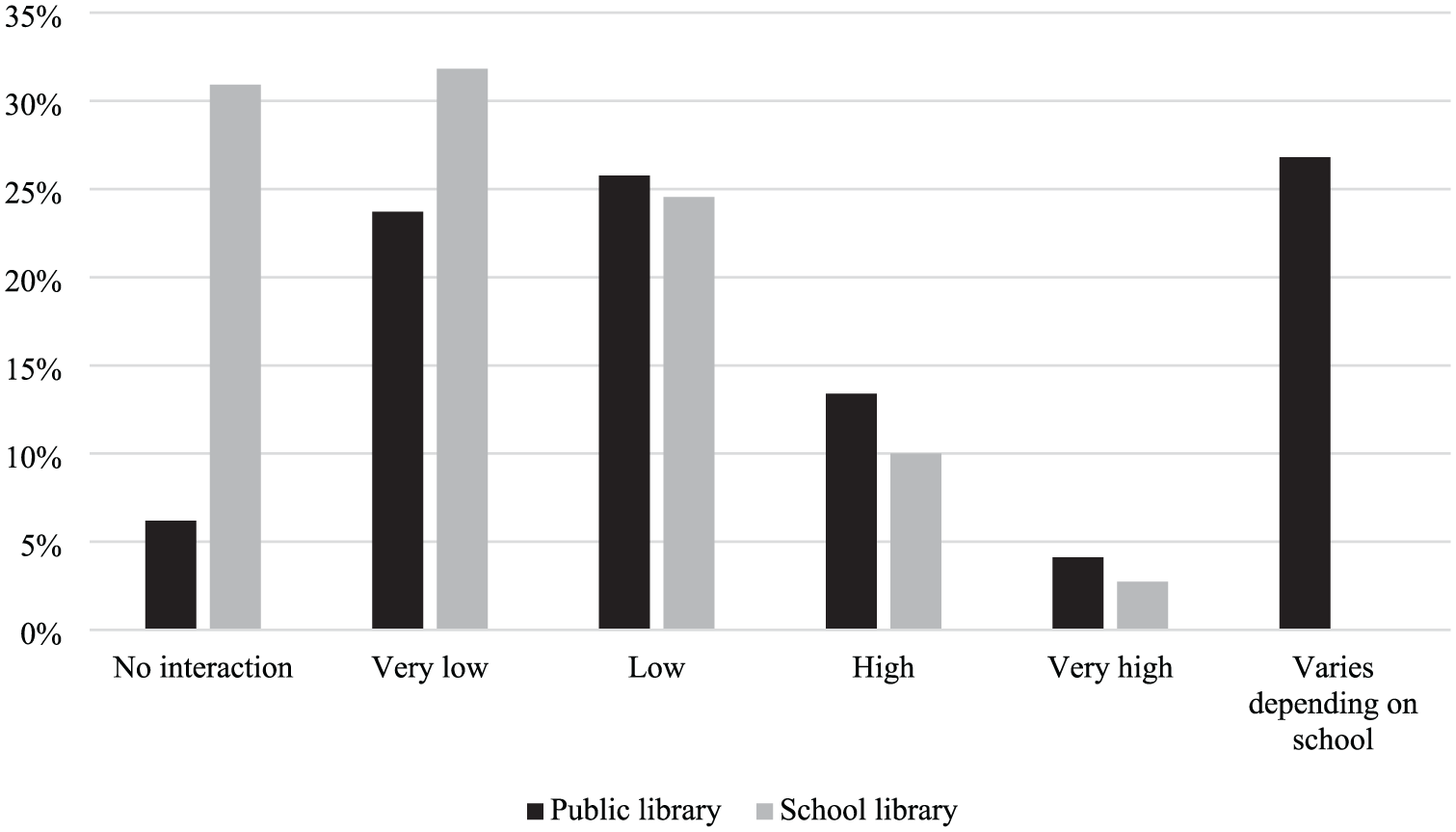
Level of interaction reported by public and school library participants.
The public library survey also included an option about the variance among schools; 26% of public library participants noted that their interactions did vary from school to school. As shown in Figure 3, 30% of the public library staff responding to this question stated there was either no interaction (6%) or very low levels of interaction (24%) with their local school library. By comparison, 29% of school library staff believed there was no interaction and 30% said interaction was very low. Overall, 59% of the school library participants believed there was little or no contact, and 32% of public library staff had the same response. This difference between the sectors raises questions. There was little difference between the sectors for high and very high responses.
Within the free-text data collected in response to the request for more details about the current level of interaction, responses varied widely; from the identification of positive interactions between public and school libraries to negative or no interactions, as well as responses indicating there was no perceived need for these interactions at all.
Positive interaction
Some responses indicated positive interactions, or being open to collaboration, outreach and contact. One school library staff member at a Victorian outer suburban primary school commented positively on the degree of contact, writing that they, “Promote activities together, share ideas, organise visits between the town library and school library, have run book sales together to fundraise, run complementary activities.” Most of these positive interactions were noted by public library participants including one VIC public library respondent in the inner suburbs who noted that “We also share news about services, new collections and upcoming programmes of interest to the local demographic.” Another VIC respondent in an outer suburban public library wrote: As an Education Librarian in public libraries, I focused on getting the message beyond the front office/past the generic school email inbox. I found that going into schools in person and introducing myself was a big help. I made sure to visit at least once per term, so that the office staff recognised me and were very happy to help promote our campaigns, programs and services. I got contact emails for library staff, wellbeing coordinators and literacy coordinators. I made sure to respond to emails when they reached out.
A common response regarding contact saw it largely restricted to special occasions. For example, a respondent from an outer suburban public library in WA noted that: All local public and private schools are contacted with details of outreach activities the library offers. Schools then contact the library and arrange times if they want to participate in the activities. Participation varies between schools. Library will also contact schools to arrange collection of school library materials returned in error to the public library.
Another public library respondent from QLD noted a well-developed relationship between the sectors in their response: The Library responds to Expressions of Interest for engagement with schools across the region. Library is an active member of the local Teacher Librarian Network - a library representative attends monthly meetings, a significant number of projects delivered in collaboration with TL Network including a biennial literature festival, ongoing liaison with Network co-ordinator for planning of library events and activities to avoid clashes and maximise opportunities for sharing of ideas, resources and promotion.
Negative or no interaction
As reflected in the low levels of interaction noted in Figure 3, a lack of interaction was identified more frequently than high levels. Both frustration and empathy were expressed by many public library participants about this. This dichotomous response is illustrated by the following observation from a qualified teacher librarian currently working as a library assistant in a public library in SA. They wrote: Schools contact us (usually last minute) if they would like to visit or have us visit them - mostly for special occasions such as Book Week, Science Week etc. We have quite a lot of schools, kindergartens, and childcare centres in our Council area and tend to work more with childcare centres as they generally aren’t as ’busy’ and are much easier to schedule visits with. We would like to work more with schools but connections can be tricky to make as teachers and admin staff are already so busy and overworked, I think organizing a visit is often put in the ‘too hard basket’. A lot of the time when we have school visits scheduled, they are not on time or cancel at the last minute. This is no one’s fault, but again, due to the crazy pressures put on teachers and the amount of work it takes for them to organize a simple visit to the library (consent forms, parent helpers, bus/public transport/walking dependent on the weather etc etc).
Another respondent from an inner suburban library in NSW again highlights this not uncommon frustration and lack of responsiveness stating that: On several occasions I have attempted to contact the full time Teacher Librarian of a large public primary school a block away from the Library but have found the Teacher Librarian (TL) doesn’t return phone calls and doesn’t reply to emails. . .I have found schools usually interested in public library collaboration when the Library offers a special service that the school sees as especially beneficial to their students and their teaching programme.
Of note is that comments were made regarding the willingness of school libraries to collaborate. For example, one librarian from Western Australia summed up their frustration explaining that: Some schools want absolutely nothing to do with the library even when we are offering them free services like a whole-school incursion. Other schools want us only on their terms and will contact us when they want to work on something or want us to tie into them.
While these free-text responses on the level of interaction were numerous amongst public library staff, school library staff had less to say. One recurring theme that did receive comment was that contact was limited to the return of books. For example, a respondent from an inner suburban school in the ACT noted that “I return books to them that end up in my library accidently. This is the level of contact.” The need for additional resourcing was also raised as a point where contact was made by school participants, although rarely mentioned by those from public libraries. A respondent from an outer suburban NSW school for example states that I “use my local library as needed. e.g. unable to source a book through my school library, or a book needed for short term use that does not justify the cost (texts to support my uni study). I do a number of library author talks when I can. I prefer to purchase my own books.”
Dealing directly with classroom teachers was an unexpected theme noted by several public library participants. For example, a staff member from an outer suburban public library in VIC said that “We interact with teachers and classes directly, as opposed to school libraries.” Another respondent wrote that “We do provide Outreach opportunities to local schools; however, these interactions are between the library and the school rather than the school library specifically.” Other public library participants noted structural and practical barriers to contact; for example, one respondent indicated a “Lack of response from schools. Difficult to get communication past the front office/admin staff.” Another respondent, a qualified teacher librarian working in a VIC public library, stated that “Despite various forms of communication it has been hard to make inroads to visit students at school. The same students come to the library most days after school but it is difficult to extend that number of students.”
No need for interaction
A number of participants identified a lack of support for interacting or collaborating in the first place. This was most often reflected by the school library staff in their responses, or by the public library participants in describing their attempts to get a school to collaborate. Participants across VIC in particular noted this. A public librarian in regional VIC said that, “The school hasn’t shown a lot of interest in involving the public library in their classes or curriculum” while another librarian in outer suburban VIC said, “Most school interactions are tied to Book Week, National Simultaneous Storytime and Science Week. Further visits are encouraged but this does not seem to be a priority for the schools.” A library manager in inner suburban VIC thought this related to schools “Not understanding and valuing the role that public/school libraries can play in their own teaching plus the lives of their students and their families.” A library officer in outer suburban VIC described varying levels of interactions across different schools in their council area being more successful with teachers: The librarian [in the closest primary school] did not seem to see any need to make a connection with the library and passed my contact details on to the junior classroom teachers. In 2022 this resulted in one visit to our library by Grade 1 classes for a special event that our library paid for. Since then, I have contacted the same teacher earlier this year, and she expressed an interest in visiting again. I offered to visit their school instead, but have not been taken up on this. The second closest primary school, which does not have a library at present, brought their prep grades to the library in 2022 for a Storytime session. I visited the prep grades again this year and they plan to ask me back again this year. The third closest primary school teachers invited me to visit once last year to read to their second and third grades. Their librarian did not show any interest in my visit.
Responses from school library staff reinforced what the public library participants relayed regarding the attitude of those working in school libraries: that there was a view by many that there was no need for the interaction. This response was especially notable from participants working in private schools. A K-12 teacher librarian in regional QLD said, “Our school library is currently well resourced and staffed, so students and staff usually find most of their needs met there.” A secondary teacher librarian in outer suburban WA echoed this, “My current school library is well staffed and resourced. There is little need to use the resources that public libraries provide. . .” The Director of Research and Library Services at a secondary school in inner suburban NSW noted “We don’t have a need for interaction as our school library is well-appointed. If a new need arises, the school considers how to meet it on our own or with other schools,” while a K-12 teacher librarian in outer suburban NSW noted, “We have not had any formal cause for interaction with our local library.” A secondary school librarian in inner suburban NSW echoed this, saying “I’d be happy to strengthen the relationship between the school and the public library, but as we’re a private school with a large budget, we’re able to fully support the needs of our students.”
In addition, some of these private school library participants noted that a collaboration was not something they had ever thought about pursuing at all. A secondary school librarian in outer suburban WA stated that “I had not thought about connecting with the local public library as we currently have no need for it” while a secondary teacher librarian in inner suburban WA said, “We have a well-staffed, well resourced library, so I think it has just never come up.” Two participants seemed surprised at the thought. A K-12 library manager in outer suburban WA said, “I have never seen public libraries work with school libraries. . . I’m not sure there’s a lot of scope for school libraries and public libraries to work together.” A K-12 teacher librarian in inner suburban ACT reflected on a similar point writing: I have never considered reaching out to them to create interactions. I use the library to collect additional resources to support my teaching. When I go in, I have never identified myself as from a school library to create relationships.
Some school library staff working in secondary government schools also agreed with this idea. A teacher librarian in inner suburban QLD said “I’m not sure what the public library could offer us as a school. Yes, they do a lot for teenagers but what can the school gain from that interaction?” This comment is especially surprising since this teacher librarian works with teenagers. Others discussed it in terms of learning, like this comment from a library manager in outer suburban VIC: “Public Libraries are not in line with the curriculum. A different spectrum for learning.” A teacher librarian in regional NSW noted a similar issue: I work in a joint use library. The School is partnered with TAFE and University and all three sectors work together in a shared space. There has, historically, been little or no interaction with the public library. This is perhaps due to the academic nature of the library I work in.
Expanding on the factors which influence levels of interaction, including structural changes which enhance interaction, a respondent noted. in a comprehensive and thoughtful response that: The biggest change that really increased our interactions with schools was streamlining the offerings that we had in terms of incursion topics. I focused on making sure that anything we offered to schools was a value add, and something that only public libraries could offer. There had to be a reason that schools would engage with us they are already dealing with an overcrowded curriculum and in some cases, many logistical hoops to jump through before even getting to the incursion or library visit. This really did help ensure that we became a valued part of the community and that our local schools were consistently booking in to visit or have our staff visit their students.
With the clear focus public libraries have on early literacy, some participants noted closer connections to that age range than school-aged youth. A librarian in outer suburban VIC described stronger ties to childcare centres in noting: “Some kinder/day-care centres might come to get books from us. Otherwise, we don’t have much to do with school libraries.” In a similar vein, another librarian in outer suburban VIC said that “Local kinder groups will visit our library and school children and teenagers in the area will use the public library (for browsing/entertainment and studying purposes). We have no direct contact with any of the local school libraries.”
Another respondent from an outer suburban library in VIC noted with some frustration economic factors that draw attention to the need for collaboration. They write: Considering the current economic climate, especially in Victoria, this is possibly the hardest time to convince schools that it is in their best interest to partner with local libraries to offer students a larger variety of content and space to gather, extending their community beyond schooling life. More specifically, that a public library adds to what a school already provides, such as a more extensive/contemporary book selection (perhaps with better funding), spaces for students to engage on their terms, and potential programming to explore students’ skills more informally, ultimately supporting their formal education.
The degree of engagement, empathy, frustration and understanding displayed, particularly in the comments by public librarians, once again highlights the question of why there is such a substantial difference of perspective between the two sectors. The following section will outline the factors respondent felt influenced levels of contact.
Factors impacting interaction
Another question asked participants to identify factors which determined the current level of interaction and gave them seven options as shown in Figure 4. They could choose more than one of these options and also give more information in the free-text after the question.
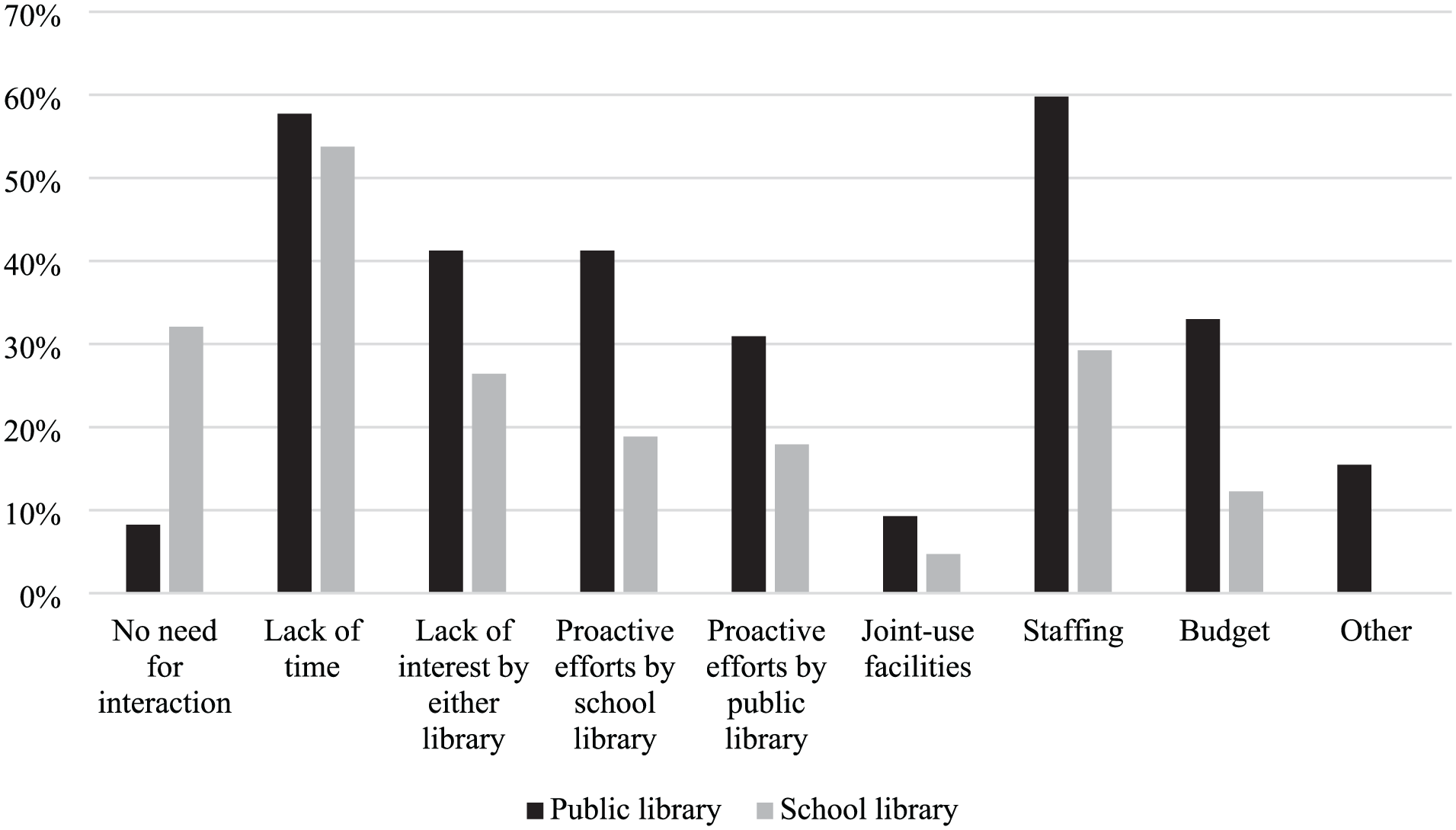
Factors identified as impacting interaction between library sectors.
As can be seen in Figure 4, budget and staffing were frequently indicated by public librarians as a key factor, as was being proactive. Lack of time was fairly similar in frequency as a factor for both school and public librarians. Of particular note in these responses, and similar to the discussion in the previous section, was that over 30% of school librarians felt they had no need to interact with the public library, while less than 10% of public library staff had a similar view. That such a significant number of those working in school libraries indicated this requires further exploration as it has implications for the interactions between the two sectors and the way young people use the public library as adults. As previously noted, budget, time and staffing were coded as part of the qualitative data analysis and are described in more detail in the following sections.
Budget
Budget was a factor identified by 12% of school library participants and 33% of public library participants as affecting their level of interaction through excursions, incursions and resources. However, it was most often noted by the public librarians and often in reference to the school library budget, not their own budgets. For example, a public librarian in an outer suburban area of QLD said, “without adequate budget for books many of these schools rely heavily on receiving our weeded items and on our services supporting these gaps.” A public librarian who had worked in schools previously also said “I expect they are all as poorly funded as us and also struggling to increase their offerings.” At the same time, a public librarian in remote QLD noted that, “Often, the school feels that we have a larger budget than we have.” Another public librarian in remote VIC noted “we would love the ability to work more closely together and have found in our context time and cash poor are the biggest barriers.”
This reason was echoed by the school library staff. A secondary TL working in a public school in regional WA said the “main reason” their interaction with public libraries is so low is because of “school budget cuts” and that “cost cutting by school administration means our library staffing has been reduced significantly and one staff member is not qualified in library services.” A library technician at a non-government secondary school in outer suburban WA also recognised the influence of budget issues and the positive impact an interaction with the public library can have. They noted that their school library has approached the local public library who were “very receptive and supportive in [their] requests for greater collaboration” so they “are hoping to be able to spread [their] budget out by utilising some of the resources the public library already have (activity kits etc.).” One public library respondent in outer suburban NSW cited budget as an issue in a different way, noting that “I feel sometimes school and public libraries feel that they are in competition with each other, and fear that cooperation might result in reduced funding/resources.” The relationship between resourcing and capacity to interact and collaborate is an interesting one as it in turn impacts factors such as time and staffing.
Time
As with budget, time was another factor identified by the participants as limiting interactions and, again, most participants from both sides focused more on the school library’s lack of time than the public library’s time availability. The public library staff were very cognisant of the time pressures on teachers. For example, three participants in inner suburban public libraries in VIC identified time as a big inhibitor on their interactions with schools. A public librarian noted that “teachers are also very busy and do not have time to collaborate,” while two public library managers referred to “lack of time in teacher’s day” and that “part of this [limited interaction] is due to the time constraints on teachers.” Public library staff in NSW echoed these thoughts as shown through this response from a library officer in a branch library in a remote area of NSW: “Basically lack of interaction is due to lack of time during school hours and the fact that the library is not open at a suitable time when school students could visit.” In regional NSW, a librarian said that a barrier to engagement is that library staff “have so little time for planning and engagement,” while a Library Manager shared that: We would love to have schools visit during Book Week, but often school workload is high at this time. . .Our programs are spread across all age groups- baby bounce, preschool, holiday activities, youth and retirees and seniors- time is an issue.
A secondary teacher librarian in a government school in an outer suburban area of NSW agreed, noting that “Timewise - My teaching timetable has been very full, leaving bare minimum time for my own admin work.” Two public library officers in an inner suburban area of SA discussed a similar situation there, with one stating “I feel like the pressures on teachers continue to grow and they have less time and energy to do anything ‘extra’,” and the other describing a more detailed situation: We would like to work more with schools but connections can be tricky to make as teachers and admin staff are already so busy and overworked I think organizing a visit is often put in the ‘too hard basket’. A lot of the time when we have school visits scheduled, they are not on time or cancel last minute. This is no one’s fault, but again, due to the crazy pressures put on teachers and the amount of work it takes for them to organize a simple visit to the library (consent forms, parent helpers, bus/public transport/walking dependent on the weather etc etc).
Staffing
One of the biggest factors identified by both library sectors as impacting interaction was related to staffing. Often it was finding a particular staff member of the school or public library to champion the collaboration and develop a relationship. From the school library perspective, it was also related to staff changes and a lack of staff. Participants described particular staff members or positions in the library or school that champion interactions between the library services. A public librarian in outer suburban VIC described it well in noting that “A passionate teacher or school librarian is sometimes all it takes to take the relationships up to the next level.” Another public librarian in outer suburban VIC said that: Since COVID we have resumed engagement with existing contacts, new staff have been hired that have created new contacts and there has been a more proactive deliberate approach in engaging with schools. . .We have dedicated staff who have within their PD engaging with local primary and secondary schools. This includes: providing library tours, class sign ups, donating weeded items, sharing library events with students, author visits to classes.
A library officer at a P-12 government school in outer suburban WA cited “the proactiveness and budget of the YPS librarian from our public library” as “a key point” as well.
Changes within staff were also identified as impacting interactions. From a positive perspective, a library manager in a government secondary school in regional WA mused that “As the staffing grows I anticipate the interaction will increase.” Staff changes were also noted more negatively. A public librarian in outer suburban WA cited such changes as “The only thing that seems to impact on how a school interacts with the library” while a public librarian in outer suburban VIC noted that “Staff changeover at libraries and schools can make it difficult to maintain and continue the momentum of relationships.” It was clear that staff changes also affect how the libraries can communicate. as one government primary school librarian in inner suburban VIC described “change of staff has led to a loss of contact with one of these libraries. No communication from them at all.” This was echoed by a librarian in a public library in regional NSW that cited reasons for “low engagement” including “high staff turnover at schools, school staff are time poor, requests and information doesn’t get past reception staff or gets lost.”
The issue with staff changes was amplified in many of our participants’ libraries through a complete lack of qualified staff in the school library represented in the responses. This factor was described in the free text in detail by participants particularly in WA, VIC, SA, TAS and NT. For example, a public librarian in inner suburban WA noted that the “lack of teacher librarians in public schools inhibits the forming of relationships between public libraries and school libraries because there is no specific point of contact.” An inner suburban library officer in SA identified that in their area, the lack of qualified teacher librarians “has been a huge gap in education for the past 10-15 years - students are missing out on those literacy connections and the wealth of knowledge from Teacher Librarians.” Another SA respondent, a mobile library manager in a remote area, said that “none of the local schools have Teacher Librarians only [school support officers] assigned to the Library.”
With this lack of full-time school library staff or any staff at all, public library participants make their contacts with other members of school staff. A public librarian in outer suburban WA noted that “I may communicate with school teachers or a Community Engagement Officer instead” while a public librarian in inner suburban VIC recognised that “Most schools seem to rely on class teachers to run in-school library classes and most school contacts are with class teachers who value libraries and have made this a priority.”
While response rates from two of the less populated areas of Australia – TAS and the NT – were low for this survey, public library participants who did contribute described a dire situation with a lack of qualified staff or no staff at all. A library officer working in a remote area of TAS noted that, “Many of us in the public library system are concerned about the lack of trained library staff working in school libraries. . .we do not know if the schools in our area even have a librarian.” A librarian in outer suburban area of the NT echoed this and even took it a step farther: Our local school libraries are no longer run by librarians. Staffing is an issue as I think the individual class teachers are scheduling their own time in their library and assisting their students as needed. . .One particular school is newly built and does not have a library at all. They send a class group to our library once a week for borrowing etc.
While the issue of not having qualified staff is worrying, the complete lack of a library is even worse. However, this is not unique to the NT, as described by a library manager in an inner suburban area of VIC who said, “the past culture that saw the importance of libraries and what they can offer is not there with staff. This can be seen in the new building plans for the school. There is no library!” The lack of a school library points to an even greater need for support for interaction between schools and public libraries.
Changes from 2018 to 2023
One of the critical things noted by the original research (Bundy, 2002) replicated by this study was the degree to which a more positive attitude towards interactions was emerging over the 5 years prior to the survey. We were interested in the same question so included a question asking participants if the levels of interaction between the two library sectors had changed in the previous 5 years from 2018 to 2023. These results are shown within Figure 5.
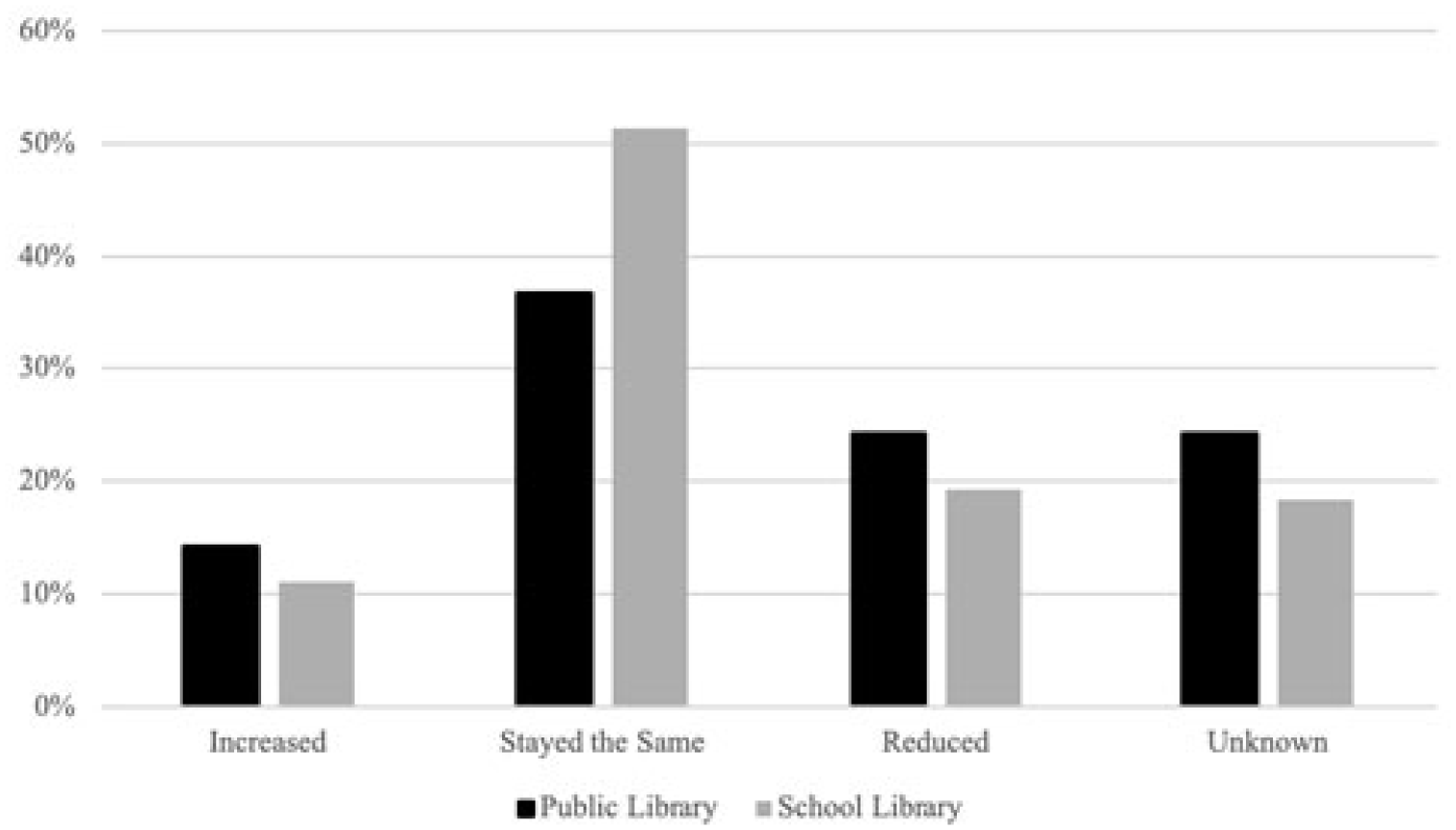
Changes in interactions between libraries from 2018 to 2023.
Both sectors most frequently noted that the interactions between libraries had stayed the same while many others did not know having only joined the library staff within the last 5 years.
Discussion
This research highlights the complex relationship between public and school libraries, particularly concerning their interactions in providing services to children. The responses gathered from library staff from both sectors show a recognition of the potential benefits of collaboration and also an acknowledgement of the significant barriers that impede such partnerships, revealing the systemic, logistical and attitudinal factors that influence how these two sectors work together. This discussion will explore the implications of these findings in relation to the research questions posed, while also considering the broader context of library services and the evolving roles of staff in school and public libraries.
Demographics and representation
The discrepancy in responses from rural and remote areas, with more participation from public library staff than school library staff in these areas may be indicative of a broader trend of diminished library resources in schools, particularly in rural areas. It is also worth noting that in public library responses, those in remote and regional locations were less likely to have a job title which required a formal library and information qualification. Overall, 30% of public library and 16% of school library respondents did not have formal LIS qualifications. Sixty-four percent (64%) of public library staff who identified as having a job title of “library officer” or “library assistant were from regional areas while 4% of school respondents working in remote or regional areas had a job title of teacher librarian. This is at a time when libraries in regional areas are increasingly being called upon to offer wide ranging community support and increased services. These responses reflect broader systemic issues, including the scarcity of qualified library staff in regional Australia, a factor of growing concern in Australia and internationally (Merga and Mat Roni, 2025). For example, some schools are choosing not to employ qualified school library staff in their library, using volunteers from the school community or teacher aides to fill this gap. As one participant who noted their employment title as ‘Other’ stated, ‘I am a teacher in a small primary school that has a teacher aide whose job is to check-out, check-in, and barcode books.’ Many public libraries in regional areas are also finding it difficult to attract qualified staff or for budgetary reasons, regional councils are placing caps on the types of positions opting for less qualified and highly paid staff in their libraries. The lack of qualified library staff noted by some participants would undoubtedly hamper the development of collaboration as libraries would lack a counterpart to engage. This gap reinforces the need for targeted strategies to address inequities in staffing and service provision in under-resourced areas. Addressing this gap would require targeted investment in staffing for rural and remote libraries, potentially through government initiatives or shared staffing models between school and public libraries, as described in the Joint-use libraries policy statement from Australian Library and Information Association (2019) Public libraries could also extend outreach programmes to schools without library staff, ensuring more equitable access to resources and expertise. However, at the same time, the researchers recognise the implications of this arrangement- that schools may decide to continue not staffing their library or have any school library at all, relying solely on the public library for their students” and staff needs.
Nonetheless, internationally, the research shows successful examples of collaborations between school and public libraries that employ qualified librarians within both. For example, Leung et al. (2020) share findings from a productive relationship between the two sectors with interlibrary loan and shared facilities as a highlight echoed by participants from the present study who described positive interactions. Thompson et al. (2023) describe how the collaboration between school and public libraries was integral in supporting young students during the COVID-19 pandemic in Jamaica which was brought up by our participants as well.
Disconnection and frustration
At the same time, this research also revealed a disconnect between public and school library participants when asked the reasons for the level of interaction they had experienced. From a public library perspective, there was recognition of the complexities involved in facilitating visits between schools and libraries. The recognition by public library staff of the busy schedules that school staff contend with, compounded by the logistical challenges of organising school excursions or incursions, underscores the reality imposed by time constraints which may create barriers discouraging library staff from pursuing collaborative opportunities. This sentiment reflects a broader issue where administrative burdens can stifle innovative programming and partnerships that could enhance student learning experiences. There was also frustration that school library staff were difficult to contact, if they existed on the school staff at all. Public library staff indicated they often received little response or interests in approaches they made to school library staff and that respondents felt disheartened by this. This is similar to the experience Kammer and Moreland (2021) found in their study of potential collaboration between public and school libraries in the regional US, where public librarians noted not knowing who to contact in the library and also recognised the busy scheduled of school librarians (44). An inability to contact school library staff raises concerns about the prioritisation of library services within schools. The implications of this could be significant; without effective communication and collaboration, the potential benefits of shared resources, programming and expertise remain untapped.
In contrast, school library staff did not always see the need for collaboration with the public library at all and there was not a similar recognition of the pressures facing under resourced public libraries indicated in school library responses. The belief held by some school library staff that a well-resourced and staffed school library should suffice to meet the needs of students, teachers and themselves indicates a potential underestimation of the value that public libraries can offer. This perception may stem from a lack of awareness regarding the diverse resources and programming available at public libraries, which can complement and enhance the educational experiences provided within school libraries. It indicates a need to address this knowledge gap; through LIS courses for school library staff, targeted professional development and outreach initiatives that highlight the mutual benefits of collaboration.
Budgets as catalysts and constraints
One of the most salient themes identified was the impact of budget constraints on these interactions. The financial challenges faced by school and public libraries when budgets are reduced can be a double-edged sword. On one hand, some school library participants indicated that limited finances led to them directing students to make use of resources provided by public libraries, to meet needs the school library could not. On the other hand, budget constraints may not only limit collection development but may result in reductions in staffing y limiting the time available for school and public library staff to engage meaningfully with one another and develop opportunities for true collaboration which benefits all stakeholders. Public library respondents noted that funding of dedicated staff for school liaison enhanced collaboration but cuts in budget limited opportunities when these dedicated roles were removed. While ideally support through adequate funding and structural support should be in place the positive aspect of this dynamic is the potential for enhanced collaboration through mutual necessity. When school libraries encourage students to utilise the public library, avenues for joint programming and shared initiatives can be opened which are of benefit to both institutions.
Such collaborations can foster a sense of community and shared purpose, ultimately enhancing the educational experience for students. However, the negative ramifications of budget constraints cannot be overlooked. Tight financial resources may lead to reduced staffing levels and limited hours of operation. When library staff are stretched thin, the time and energy required to build networks, plan collaboratively and engage in meaningful dialogue about best practices and resource sharing are significantly diminished. The implications of these staffing challenges extend beyond opportunity and accessibility. They can foster an environment of isolation among school and public library staff, where the lack of interaction with colleagues from other information institutions may lead to a stagnation of ideas and innovation. Cross-pollination of ideas and strategies enables libraries to meet the diverse needs of their communities. Without regular opportunities for collaboration, school and public library staff may miss out on valuable insights and practices that could enhance their services and outreach efforts.
The notion raised by one respondent that school and public libraries may be perceived as competitors in a shared market may also be a reason for a sense of defensiveness evident in responses from school library staff. This in turn may result in a reluctance in acknowledging the potential advantages of collaborating with public libraries. This reluctance could be exacerbated by current trends in school library staffing, with many schools ostensibly citing budgetary reasons for opting not to employ qualified library staff or even include library spaces in their physical designs (Merga and Mat Roni, 2025). The perception that collaboration might undermine any existing legitimacy school libraries hold could discourage proactive engagement with public libraries. To counter these challenges, it is essential to advocate for a paradigm shift in how school library staff view their role within the broader library landscape. Emphasising the importance of active collaboration rather than simply co-operating and resource sharing as a means of enhancing student outcomes rather than as a threat to the school library’s relevance is crucial. As has been identified internationally (Omar et al., 2024; Tikkinen and Korkeamäki, 2023), creating a culture where school and public libraries are considered partners and where conceptual silos are broken down requires systemic policy and structural frameworks which facilitate collaboration in promoting information literacy, fostering a love for reading and providing access to a wider array of resources can help to reshape these attitudes. Education for these sectors should also be considered in addressing these structural and conceptual barriers with consideration given to how these barriers can be addressed through the curriculum and if there are currently structural barriers in how we educate for the sectors that can be improved.
Bundy’s (2002) study posits that the individual and co-operative performance of school and public libraries during the formative childhood years is critical to ongoing development in literacy and learning and critical information literacy skills for the 21st century (2002: 47). Today these same priorities remain, and these connections remain are as important as ever.
Limitations and directions for future research
Limitations to this study relate to the survey dissemination and responses. Firstly, while using the professional associations to share the survey link was useful in promoting the research, it also attracted a specific type of library professional. Also, the lack of responses from both sectors from certain areas, including school library staff in SA, NT, and TAS, and public library staff from the ACT, was a limitation in gathering a full representation of Australia. There are a number of possible reasons for this including a lack of engagement or response from the local associations, limited distribution to those working in school or public libraries in those states and the possibility of unstaffed or no school libraries in those locations.
Future research could explore successful case studies of collaboration to identify best practices and scalable models. The regional disparities revealed through this research could be explored through participatory research methods that actively involve local communities in the identification of their specific needs and lead to the development of tailored solutions which recognise the differences in local areas. Additionally, investigating the impact of collaborative initiatives on student outcomes and community engagement could provide compelling evidence to advocate for greater investment in these partnerships.
Conclusion
Structural, disciplinary and conceptual barriers to collaboration between the two sectors appear throughout the literature across both time and place. Bundy (2002) found similar results in his earlier survey of staff working in Australian school and public libraries. This research sought to update those earlier findings. The findings of this research highlight significant opportunities and challenges in fostering collaboration between public and school libraries. Addressing barriers such as time and budget constraints, staffing shortages and siloed perceptions requires a multi-faceted approach involving advocacy, professional development, and systemic support. By leveraging their complementary strengths, public and school libraries can create a more cohesive and effective library ecosystem that benefits students and the broader community. A number of recommendations for enhanced collaboration were drawn from the findings of the research questions discussed in this paper. These recommendations could enhance future collaboration. These were the provision of opportunities to develop strategic initiatives and event-based interactions that emphasise the mutual benefits of collaboration by library networks and associations.
The role of public and school libraries working together to cultivate lifelong learners also must be recognised. By introducing students to public library services, school libraries can play a pivotal role in instilling positive attitudes towards library use beyond the school environment. This is particularly important in an era where access to information is increasingly digital and where students may encounter barriers to accessing resources once they leave the structured environment of school. With young adults being one of the least likely age groups to make use of the services provided by a public library (Phillips, 2025), collaboration between public and school libraries can create a continuum of support for students, ensuring that they are equipped with the skills and knowledge necessary to navigate information landscapes throughout their lives. Through concerted effort and strategic planning, the potential for meaningful collaboration between public and school libraries can be realised, enriching the services they provide and strengthening their collective impact on society, clearly articulating “the value of libraries” as identified by the quote from a teacher librarian in our title.
Footnotes
Appendix 1. Survey Questions for Public Library Staff
Can you provide further information about your response including examples of interactions, reflections on reasons for your response, any issues or suggestions?
Can you provide further information about your response?
Can you provide further information about your response including “other” factors, examples of how any of the factor affect public/school library interactions and any examples you might have?
Can you provide any further information about your response including any examples?
Can you provide further information about your response?
Can you provide further information about your response?
Thank-you for taking part in our survey. If you are interested in following up on the previous research, this is the citation:
Bundy, A. (2002). Essential connections: school and public libraries for lifelong learning, The Australian Library Journal, 51(1), 47–70. DOI: 10.1080/00049670.2002.10755976
Appendix 2. Survey Questions for School Library Staff
Can you provide further information about your response including examples of interactions, reflections on reasons for your response, any issues or suggestions?
Can you provide further information about your response?
Can you provide further information about your response including examples of these factors and how they affect interaction?
Can you provide further information about your response including any examples?
Can you provide further information about your response?
Can you provide further information about your response?
Thank-you for taking part in our survey. If you are interested in following up on the previous research, this is the citation:
Bundy, A. (2002). Essential connections: school and public libraries for lifelong learning, The Australian Library Journal, 51(1), 47–70. DOI: 10.1080/00049670.2002.10755976
Acknowledgements
The authors would like to thank the public and school library participants for sharing their perspectives for this study.

Ethical considerations
The Charles Sturt University Human Research Ethics Committee approved this research H23572.
Informed Consent
The study survey began with an informed sheet detailing the study to participants and indicating that by submitting their responses, they were giving their informed consent.
Funding
The authors received no financial support for the research, authorship, and/or publication of this article.
Declaration of conflicting interests
The authors declared no potential conflicts of interest with respect to the research, authorship, and/or publication of this article.
Data availability statement
Data is not available.