




Abstract
Informing and supporting researchers’ understanding of the challenges of scholarly communication, particularly how to avoid deceptive publishing practices, remains a challenge for the academic community and its stakeholders. Over the past decade, this community has developed various strategies to assist its members in addressing this issue. However, these measures do not seem to be sufficient, and many researchers, particularly younger and less experienced ones, continue to fall prey to predatory publications. This article presents a series of workshops on scholarly communication literacy as a pedagogical strategy to raise awareness and to prevent novice researchers from falling victim to the challenges of scholarly communication and unethical publishing practices. Most participants perceived these training workshops as an effective educational approach. The results of these educational seminars demonstrate that this type of pedagogical strategy that consists of training, awareness-raising, and prevention approaches is a key factor to informing and warning novice researchers about scholarly communication pitfalls and deceptive publishing practices.
Keywords
Introduction
In 1665, the first scientific journals, known as The Philosophical Transactions and Le Journal des sçavans, were born which gave rise to the traditional model of scholarly communication as we know it (De Silva and Vance, 2017; Haustein et al., 2015). For more than three centuries, the dominant traditional publishing model was that of subscription-based journals with a printed distribution format (Allahar, 2017). However, in the last three decades, new publication models have emerged that have generated changes, fractures, and challenges in the academic communication ecosystem (Altman and Cohen, 2022). These changes and transformations have allowed scholarly communication to better respond to the needs of the parties involved in knowledge generation and to promote science in a more ecosystemic way (Buitrago-Ciro, 2022). In general, scholarly communication is the process by which researchers create, evaluate, share, disseminate, and preserve their research (ACRL Scholarly Communications Committee, 2003; Klain-Gabbay and Shoham, 2018).
According to Maryl et al. (2020) and Zhao (2014) properly understanding the elements that constitute scholarly communication, how it works, and the content that it conveys can be complex, especially for novice researchers. In addition, these fledgling scholars are under constant pressure to increase their publications in order to be recognized and accepted by the academic community. Consequently, many researchers, particularly younger and less experienced ones, have become susceptible to the challenges of scholarly communication, particularly deceptive publications. Literature has identified that, in addition to misleading journals and publishers, misleading or predatory conferences are also affecting scholarly output (Elliott et al., 2022; Ibrahim and Saw, 2020; Pecorari, 2021). These entities deviate from good editorial practices, undermine research resources, public trust in science and the reputation of open access (Cobey et al., 2017; Cukier et al., 2020b; Eriksson and Helgesson, 2018; Grudniewicz et al., 2019; Shen and Björk, 2015). There is concern that researchers are not being informed of this issue or do not have the necessary knowledge to respond to these challenges (Asadi, 2018; Kurt, 2018; Salehi et al., 2020; Taylor, 2019). Meadows (2017) reports that the problem of deceptive or predatory publishing is global; they note that many researchers are not receiving training or education on how to choose a suitable journal or publisher before submitting a publication.
In response, the academic community has mobilized and made several efforts to understand the nature, causes, consequences, and possible strategies for preventing predatory publishing. Some of these efforts have focused on identifying the characteristics of these publishers and journals, compiling lists of these potentially misleading publishers and journals, and creating checklists to detect them (Beall, 2012; Cukier et al., 2020a; Strinzel et al., 2019). However, despite efforts to respond to this problem, deceptive publishing practices continue to expand, transform and grow. Buitrago-Ciro, (2021) notes that there is still no global policy on the part of the academic community to inform and support researchers to be better prepared for the challenges of scholarly communication, such as new publication models and misleading publication practices. Other efforts and initiatives have focused on assessing the scholarly communication skills and core research competencies of doctoral students or faculty. For example, Drisko and Evans (2018) evaluated the research skills of a group of doctoral students in social work. The results indicated that students should improve their capabilities in research design and methodology. Meanwhile, White and King (2020) analyzed the scholarly communication competencies of a group of doctoral students. The results indicated that the students presented limitations in research and scholarly communication skills and required training in this area. Similarly, Owens and Manolovitz (2021) explored the knowledge and level of interest of a group of graduate students and faculty on the different components of scholarly communication. The results showed a relationship between the participants’ levels of knowledge and their levels of interest. However, it was evident that, although both groups had general knowledge about topics related to scholarly communication, there were limitations or doubts on the part of the participants about new publication models such as open access and the use of article processing charges (APC).
In addition to these initiatives, other similar pedagogical approaches have focused on predatory publishing. For example, Babb and Dingwall (2019) developed an educational section to inform a group of healthcare professionals about techniques to critically appraise scholarly literature and to raise awareness of misleading publications. The educational sessions were attended by 33 participants. During the sessions, participants were asked to express their level of knowledge about predatory journals. After the educational sessions, a questionnaire was conducted to determine their effectiveness. Only seven participants responded to the questionnaire. The results of their study indicated that this training allowed the participants to increase their knowledge of these topics and to learn what a predatory journal is. El Bairi et al. (2023) developed two webinars, one in English and the other in French, aimed at university students and professors on how to identify predatory journals. A total of 270 participants attended the webinars. After the webinars, participants were invited to answer a survey to evaluate the educational section. The survey contained 29 questions and was written in French. A total of 221 participants answered the questionnaire. The results indicated that the participants’ knowledge of deceptive journals increased significantly from 48.9% to 81% after the webinar. In addition, almost 85% of the participants indicated they would share their knowledge with other colleagues, (El Bairi et al., 2023). Other initiatives such as Gerberi et al. (2021) focused on preventing and assisting health care professionals about the consequences and risks of predatory publishing to the integrity of the scientific literature.
Although these initiatives were considered as positive by the participants, young researchers, especially PhD students still face difficulties and gaps in issues related to scholarly communication and misleading publications. Therefore, a pedagogical workshop to help and train young researchers to better understand the processes of scholarly communication, the challenges of new publication models, as well as how to identify and avoid predatory publications could help address some of these gaps and challenges. According to the literature, the greatest efforts on the problem of predatory publishing and its possible prevention are made by academic libraries, but they are particularly focused on developed countries (Babb and Dingwall, 2019; Lopez and Gaspard, 2020; Shen and Björk, 2015; Xia et al., 2015; Zhao, 2014). However, the Latin American region is little mentioned in the literature regarding this issue and the efforts made to help students and researchers face these challenges (Buitrago-Ciro, 2021). In response, this article presents a series of workshops conducted in the Latin American region on scholarly communicate on literacy as a pedagogical initiative to raise awareness and to prevent novice researchers from falling victim to the challenges of scholarly communication and unethical publishing practices.
Literature review
Early initiatives to inform about deceptive publishing practices.
Criteria and characteristics are defined to determine deceptive tendencies
In its beginnings, the first information available about predatory publishing was scarce and ambiguous. However, after introducing the term “predatory publishing,” Beall attempted to clarify the nature of predatory publishing by creating a set of criteria to evaluate the good practices and ethical conduct of journals and publishers (Olivarez et al., 2018). These criteria were based mainly on the codes of ethical conduct, transparency, and best practices established by an international organization. Their function was to analyze publishers and open access academic journals to determine whether or not they had questionable or predatory practices (Beall, 2012). Although these criteria were questioned, they became the first point of support and a valuable tool to recognize and inform the scholarly community about this problem (Richtig et al., 2018).
In addition to the criteria presented by Beall, other researchers introduced and explored similar criteria to identify publications with deceptive or predatory practices. In an effort to educate researchers, Hansoti et al. (2016) presented criteria that were intended to help discriminate legitimate open access medical journals from misleading or predatory ones and to identify some of their characteristics. Shamseer et al. (2017) identified several characteristics to help the scholarly community distinguish potentially illegitimate journals from potentially predatory ones in the biomedical field. Similarly, Borroto et al. (2022) and Power (2018) present a list of criteria to help researchers evaluate, identify, and detect potentially predatory journals.
For their part, Kozak et al. (2016), Moher and Srivastava (2015), and Sousa et al. (2021) focused on analyzing the characteristics of invitations sent by spam email, which is one of the criteria identified to suggest whether a publication may have predatory tendencies. Knowing the characteristics of these invitations could minimize their impact and help the most vulnerable researchers recognize and avoid misleading publications early. In fact, Moher and Srivastava (2015) propose some strategies that researchers could consider before responding to these emails.
“Blacklists” and “Whitelists” to tackle predatory journals
The definition of criteria to identify predatory journals allowed for the creation of the so-called Blacklists and Whitelists. It should be noted that the symbolic use of black as a synonym for bad and white as a synonym for good has been perceived as a non-inclusive term or an expression of implicit racism (Houghton and Houghton, 2018; Khan, 2021). Blacklists were created as repertoires to alert researchers about journals or publishers that used unethical or misleading practices and consequently were potentially suspicious or predatory (Matumba et al., 2019; Strinzel et al., 2019). Beall was the first to organize and publish a list of potentially predatory journals and publishers on his website, which was available from 2011 to 2017, when the website was shut down.(Laine and Winker, 2017; Silver, 2017). These blacklists quickly became a tool employed to try to respond to the phenomenon of predatory publishing (Misra et al., 2017). However, they were just as rapidly questioned due issues surrounding the objectivity of their inclusion criteria (Crawford, 2014; Nelhans and Bodin, 2020; Nicholson, 2017; Silver, 2017).
Likewise, according to Manca et al. (2019) tracking and updating blacklists can be complex and they easily become obsolete. Supplanting Beall’s list, there is also the Cabells blacklist; later called “Predatory Reports.” Since 2017, this company has offered a subscription database with a list of potentially questionable journals evaluated and selected, taking into account a large number of predetermined criteria (Hoffecker, 2018; Nelhans and Bodin, 2020; Toutloff, 2019). Some consider this list to be more objective with a more transparent selection process than Beall’s list (Power, 2018). Other similar lists exist to help guide investigators away from predatory publishing. For example, Manca et al. (2017) provide a list of potentially predatory journals and publishers in the field of rehabilitation. The Kscien 1 list is also known, which uses a series of criteria to identify and determine potentially predatory journals and publishers (Kakamad et al., 2019; Kscien 2022).
In contrast to blacklists, there are the inverse whitelists, which identify a collection of journals and publishers considered legitimate. According to Matumba et al. (2019) whitelists predate open access and so the notion of whitelisting applies to both traditional subscription journals and open access journals. Cabells has offered a subscription whitelist for more than three decades, where it selects legitimate or authentic journals. This list provides descriptive and metric information about each journal (Bisaccio, 2018; Hoffecker, 2018). Meanwhile, the Directory of Open Access Journals (DOAJ) offers a free list of legitimate journals based on specific selection criteria such as appropriate peer review, longterm preservation and archiving and transparency in publication policies (Matumba et al., 2019; Power, 2018). In addition, journals indexed in bibliographic databases such as Web of Science, Scopus, and PubMed can also act as whitelists (Nelhans and Bodin, 2020; Neylon, 2017). Although blacklists and whitelists are used as tools to respond to predatory publishing, they are considered by some to be unreliable or possibly inappropriate. For example, Smith (2017) considers that these lists need to be updated periodically. In addition, it presents some problems of subjectivity. For their part, Strinzel et al. (2019) consider that these lists misclassify some journals that could be classified in a gray zone. Finally, Shamseer et al. (2017) notes that applying the criteria of these lists to evaluate a journal can be a long and difficult process for an average researcher.
Checklists and tools to identify potentially predatory journals and publishers
Checklists have become one of the most widely used strategies by the academic community at large to respond to the problem of predatory publishing. The literature in general provides evidence of the existence of many such checklists. For instance, a systematic review by Cukier et al. (2020a) of checklists in biomedical journals identified 1529 records, of which 581 were full-text articles and included checklists. However, only 93 had original checklists. Of these, 53 were indexed in databases, 30 came from university library websites, and 10 came from YouTube (Cukier et al., 2020a). One of the best-known initiatives on checklists is “Think. Check. Submit” which is supported by a coalition of scholarly communities and aims to help researchers make a good decision when choosing the right place to submit research (Cortegiani and Shafer, 2018; Dobson, 2016). It might be that factors such as a lack of concrete strategies, disagreements with Beall’s list, the increase in predatory publishing and the need to alert researchers have created the need to explore and establish these checklists as a strategy to try to respond to this problem. Although Ng and Haynes (2021) suggest that checklists are still in an early stage of development they believe adjustments can be made and their accuracy improved.
In addition to checklists, some tools have been created to help researchers assess the degree of authenticity of a journal and minimize the risks of false or misleading journals. For instance, the library of the University of Liège in Belgium made a tool called Compass to Publish. 2 This free tool allows users to assess the authenticity of an OA journal through a series of questions. On the other hand, the Center for Journalology at the Ottawa Hospital Research Institute is working on creating a digital journal authenticator. 3 This tool aims to help doctors, researchers, and patients identify and prevent potentially predatory journals. Currently, these strategies are widely employed by the academic community. However, their use may present some limitations. For example, on the use of checklists, Cukier et al. (2020a) considers that there is an excessive number of checklists, which can confuse and overwhelm users. On the other hand, it is important to note that the Journal Authenticator tool is still under development. Meanwhile, the Compass to Publish tool helps users to evaluate the authenticity of journals but does not evaluate their quality. Although these strategies have attempted to minimize the effects of deceptive publications, this predatory trend continues to grow in impact and young researchers still have difficulty responding appropriately.
New strategies are needed to inform and support young researchers
According to the literature, the pressure felt by researchers to publish is one of the main causes behind the influx of publications in predatory journals (Callaghan, 2016; Chambers, 2019; Kurt, 2018; Moher and Srivastava, 2015; Nielsen and Davison, 2020; Xia et al., 2015). In addition, novice scholars seem to be the main victims of deceptive publications; however, as a group they are not aware of the negative effects this can have on their professional careers (Darbyshire, 2018; Kurt, 2018). According to Shamseer et al. (2017) young researchers can be deceived more easily because they lack the necessary skills in scholarly publishing to identify a legitimate journal from a deceptive one. Meanwhile, Shen and Björk (2015) and a report by Inter Academy Partnership (IAP, 2022: 49) notes that disingenuous publications seek to defraud mainly researchers in low- or middle-income countries, which is where most of the world’s young researchers reside. To respond to this situation and to lend help particularly to these less experienced researchers, many agree that joint actions are required in addition to educational strategies to help young academics recognize and avoid predatory publishing (IAP, 2022: 10; Narimani and Dadkhah, 2017; Nielsen and Davison, 2020; Shamim, 2018).
A workshop on scholarly communication literacy and deceptive publishing practices
Understanding the phenomenon of predatory publishing necessarily requires some knowledge of open access and new publishing models of scholarly communication. According to the literature, some initiatives have focused on assessing the skills and competencies of doctoral students in issues related to scholarly communication and research. The results showed that students have some limitations and lack of knowledge on these topics (Drisko and Evans, 2018; Owens and Manolovitz, 2021; White and King, 2020). Other initiatives have focused on providing educational sections or workshops on how to identify and avoid predatory journals; as well as to identify the best places to publish. Results demonstrated that these types of workshops help students become aware of predatory publishing and its prevention (Babb and Dingwall, 2019; El Bairi et al., 2023). Although these initiatives are an important step, we believe that it would be useful and relevant to offer a pedagogical workshop where the two initiatives mentioned above from the literature are combined. For this purpose, a pedagogical workshop divided into two sections will be offered. In the first section, an initial training will be offered on issues related to scholarly communication and new publishing models such as open access and the risks of publishing in predatory journals. In the second section, a training will be offered on the phenomenon of predatory publishing and on some techniques and guidelines to recognize and avoid predatory journals, publishers or conferences. This initiative will help students to overcome the challenges related to scholarly communication and open access. In addition, they would be introduced to some strategies for identifying and avoiding predatory publications. As the literature indicates that providing educational workshops can be a positive strategy to support graduate students (Fong et al., 2016); we believe that a pedagogical workshop on scholarly publishing literacy and predatory publishing prevention would contribute to the fight against this issue. In response, this study describes pedagogical workshops that were offered to inform junior researchers of issues related to scholarly communication and new publication models; the workshops also supported them in identifying and avoiding predatory journals, publishers, and conferences.
Method
Three pedagogical workshops were offered to 60 doctoral students at three universities in Latin America- two in Colombia and one in Mexico between June 3 and June 25, 2022. The workshops were offered online via Google Meet and Zoom (Table 1). To recruit participants, a professor from The National Autonomous University of Mexico (UNAM) and two research program directors from two universities in Colombia were contacted. The participants were part of the communication science, education, psychology, and library and information science programs. As the study was conducted in the Spanish-speaking Latin American region, the workshops and the evaluation questionnaire were formulated in Spanish.
Delivery details of the workshops.

Each workshop lasted 90 minutes and was offered by two researchers with a background and interest in scholarly communication and information science. The workshops included eight general topics, divided into two sections. The first section focused on theoretical concepts. In this section, participants were introduced to scholarly communication and traditional publishing models; open access models and funding policies; predatory publishing and its relation to open access; the reasons why researchers engage in deceptive practices; and licensing and copyright. The second section highlighted more practical skills. This component presented concrete examples of guidelines and techniques for detecting predatory journals, publishers, or conferences. Participants were introduced to the easily recognizable elements to identify whether a journal or conference might be predatory. Next, more complex elements that might need more attention were presented. Finally, participants were shown some websites of hijacked journals and asked to identify, based on what they had learned in the workshop, which journals were authentic, and which were fake or commandeered. Participants were then introduced to some potential tools for avoiding predatory publishing.
After each workshop, a questionnaire was used as a data collection technique. Participants were invited to voluntarily and anonymously answer a questionnaire about the workshop they attended. Of the 60 participants, 45 responded to the questionnaire. The questionnaire was open between June 3 and July 14, 2022. The questionnaire given after the workshops had two central questions in a Likert scale format, meaning that the questions had a series of satisfaction points for each topic covered. The survey also included five complementary questions. The first question was about the relevance of offering such workshops as a pedagogical initiative to inform and help young researchers be better prepared to face the challenges of new models of scholarly communication including deceptive publications. The second was about the duration of the sessions. Next, the third question inquired whether participants would recommend the workshop to other colleagues. The fourth asked if there were any important issues that were not mentioned in the trainings and the fifth question asked for any comments or suggestions.
Once the surveys were completed via the SurveyMonkey platform, the data were downloaded and analyzed separately by each author. For the analysis of the data, initially the SurveyMonkey tool was used, which automatically summarizes, analyzes and presents the results. Responses to open-ended questions were extracted and analyzed in Excel manually. The final findings were compared separately by the two researchers of this study to minimize possible biases.
Findings
According to the findings, the workshops in general and the topics covered were very well received by the participating young researchers. More than 90% of the respondents stated that they learned a lot or a moderate amount on topics related to scholarly communication and publishing models, the different open access models, predatory publishing and how it relates to open access and the different forms of predatory publishing (journals, publishers, conferences). Also, more than 95% reported having learned a lot about the reasons why researchers may engage in predatory practices and the resulting consequences. Similarly, more than 84% said they learned a lot about guidelines for recognizing deceptive publications and techniques for analyzing potentially deceptive sources. In contrast, only 50% said they learned a lot or a moderate amount about licensing, copyright and the COPE (publication ethics committee). Just over 70% said they learned a lot about tools to prevent predatory publishing.
The following figure (Figure 1) shows the results to the question on how much the novice researchers (PhD students) learned about the different topics covered in the workshop.
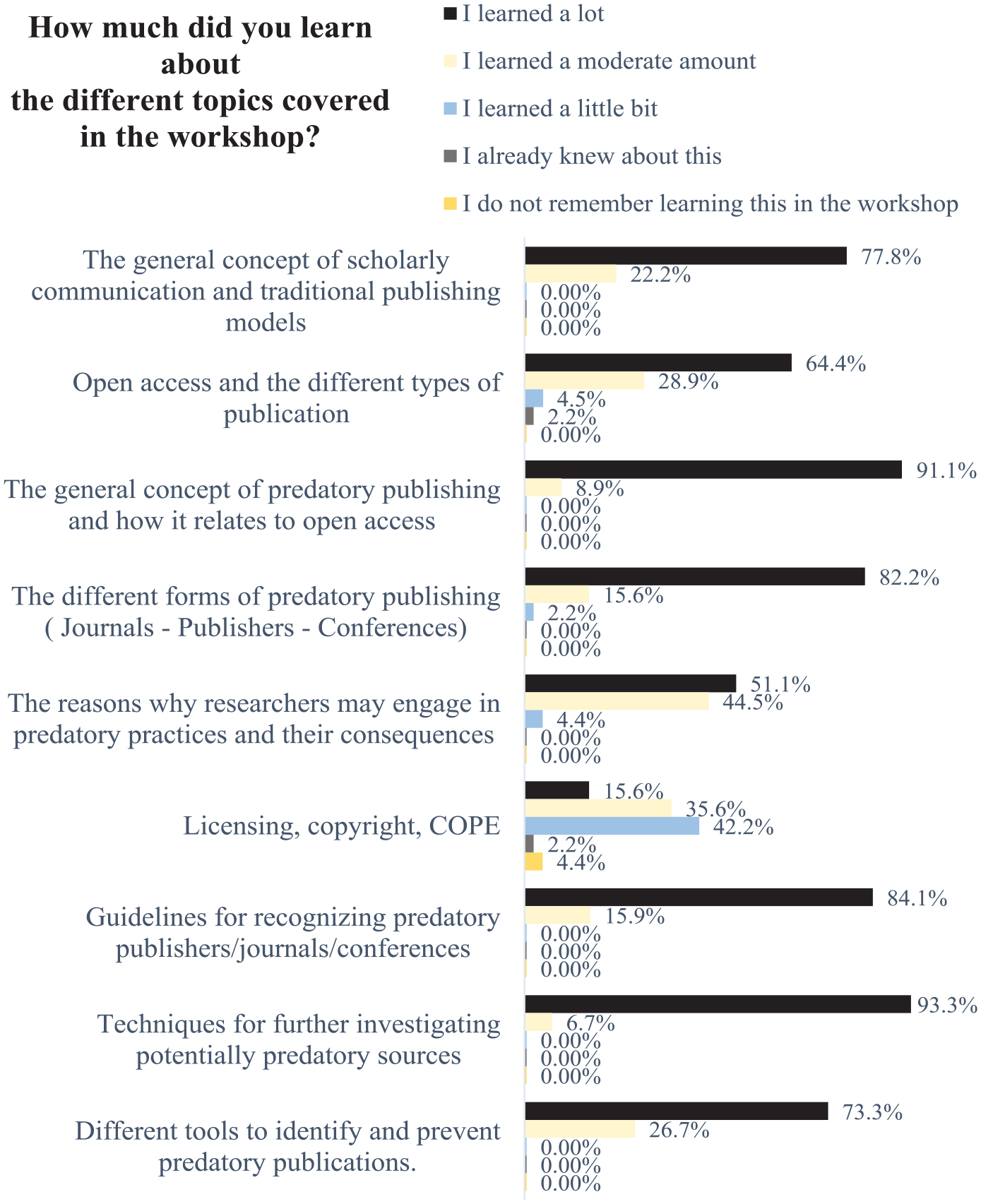
How much did you learn about the different topics covered in the workshop?
In addition, more than 90% considered almost all of the topics covered in the workshop to be essential or very useful. The following figure (Figure 2) shows the results of the question about which information was the most useful to help novice researchers avoid predatory editorial practices.
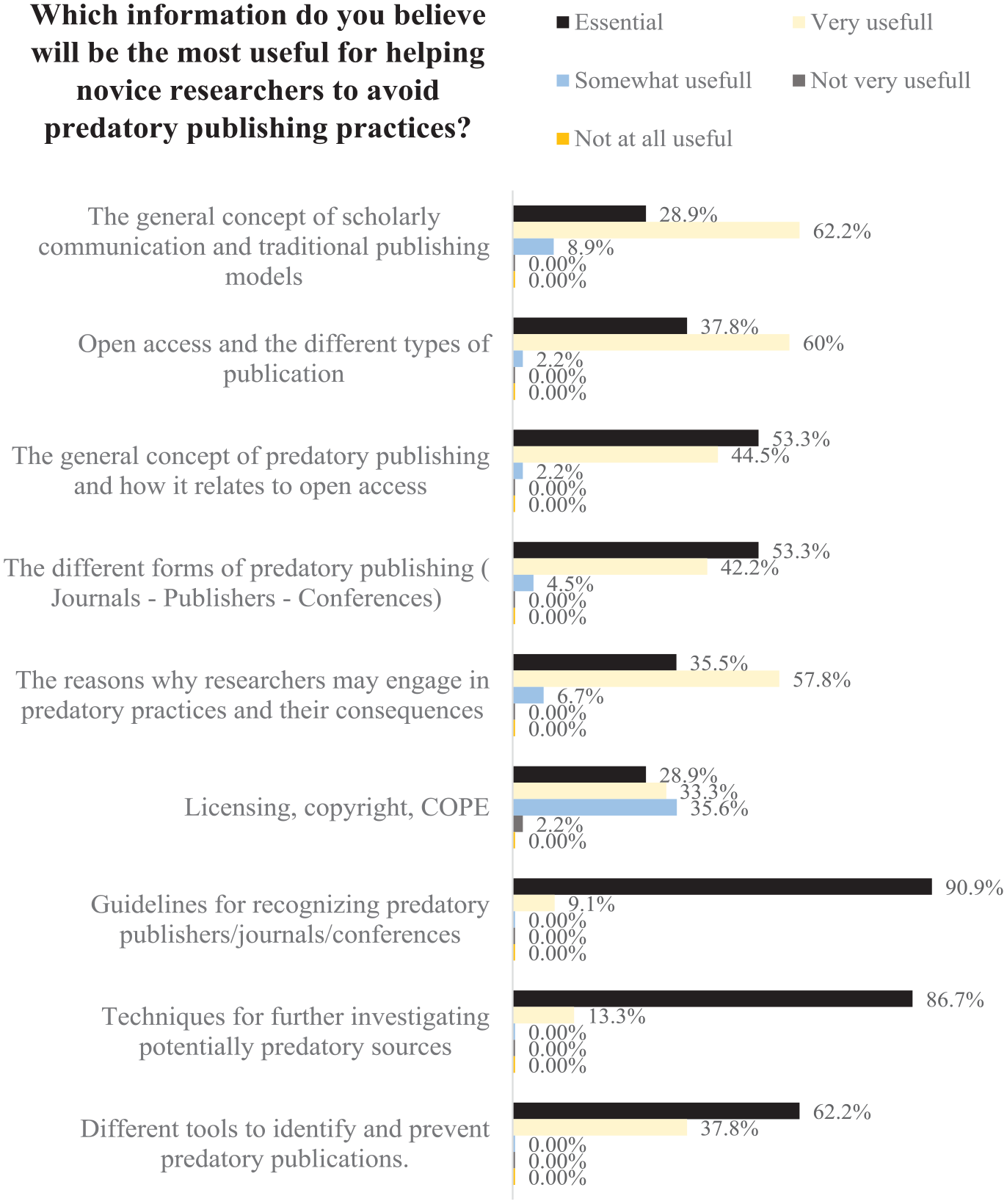
Which information do you believe will be the most useful for helping novice researchers to avoid predatory publishing practices?
Moreover, 100% of the participants affirmed that this type of pedagogical initiative is relevant to inform and warn young researchers about predatory publishing. In line with this, 100% of participants stated that they would recommend this type of training workshop to other colleagues. Finally, 60% of the participants indicated that the length of the workshop was just right, while 35% felt that the workshop was a bit too short.
Open written comments
Participants were invited to record any comments or suggestions they had about the workshop. Some of the comments received expressed the relevance and importance of the workshop to the participants. Other comments suggested extending the duration of the workshops or separating them into two distinct sections. Some of the comments are listed below:
P7: Se debería incluir un par de ejercicios más, por lo demás creo que es una excelente iniciativa.
[Author’s translation. P7: A couple more exercises should be included, otherwise I think it is an excellent initiative.]
P28: Excelente taller, muy metodológico.
[Author’s translation. P28: Excellent workshop, very methodological.]
P31: Poco conocía sobre publicación académica y libre acceso. Tampoco había escuchado hablar de revistas o conferencias depredadores. Muy útil este taller. Gracias.
[Author’s translation. P31: I didn’t know much about scholarly communication and open access. Also, I had not heard much about predatory journals or conferences. This workshop is very helpful. Thank you.]
P33: El tema de las conferencias depredadoras debería ampliarse más tiempo.
[Author’s translation. P33: The topic of predatory conferences should be extended more time.]
P35: Recomiendo este taller para cualquier estudiante de doctorado.
[Author’s translation. P35: I recommend this workshop to any PhD student.]
P38: Gracias por la formación. He aprendido mucho sobre este tema.
[Author’s translation. P38: Thank you for the training. I have learned a lot about this topic.]
P43: Pienso que deberían separarse los talleres en dos secciones diferentes. La parte teórica un día y la parte práctica otro día. Con más ejercicios prácticos en la segunda parte.
[Author’s translation. P43: I think the workshops should be separated into two different sections. The theoretical part 1 day and the practical part another day. With more practical exercises in the second part.]
Discussion
The results indicate that there is a widespread and general lack of knowledge about theoretical topics related to scholarly communication in general, open access, and predatory publishing. This agrees with White and King (2020) and Owens and Manolovitz (2021) who indicated that doctoral students should improve their skills on scholarly communication and its different components. This also agrees with Maryl et al. (2020) who state that it can be difficult for novice researchers to understand issues related to scholarly communication. Furthermore, all of the novice researchers reported learning a lot or a moderate amount about practical aspects of scholarly communication, such as guidelines for recognizing predatory publications, as well as techniques and tools for preventing potentially predatory publishing. This indicates that novice researchers are largely unaware of predatory publishing and possible ways to avoid it. This coincides with a number of studies that indicate that many researchers are not well trained or lack the expertise to identify predatory publishing (Asadi, 2018; Frandsen, 2017; Salehi et al., 2020; Taylor, 2019).
The results from the questionnaire also demonstrate that over 90% of novice researchers consider almost all the topics discussed at the workshop to be essential or very useful. This is in accordance with Babb and Dingwall (2019) and El Bairi et al. (2023) who offered workshops to inform individuals about predatory publishing. After these tutorials, the participants stated that the topics covered were very relevant and, moreover, they reported having learned and increased their knowledge about the subjects. These studies demonstrate that this initiative of providing educational workshops is a good idea and should be extended to other young researchers.
However, it is important to note that there are some challenges in offering such sessions. In our case, one of the main challenges was the estimated time for the workshops. On some occasions the allotted time was insufficient due to the number of topics examined. Another challenge was that the workshops were offered online, therefore, the inclusion of the practical exercises in the second section had some limitations. In fact, one of the participants (P7) noted in their comments that more exercises should be included in the workshops. A further challenge was that some participants were interested in developing more practical exercises, but the time was limited and did not permit for these activities. This gap was noted in the comments by two of the participants (P33; P43) who suggested to separate the workshop into two sections, offer more practical exercises, and extend more time to the predatory conference section. In addition to the challenges mentioned above, one of the limitations of this pilot workshop is that it was only conducted with a small group of novice researchers.
However, the positive responses and comments in the questionnaire show that beginner researchers are interested in this type of pedagogical activity. Therefore, and in accordance with the results of the survey, we believe that this type of training workshop is an effective pedagogical mechanism to inform and warn novice researchers about the challenges of scholarly communication and predatory publishing.
Some recommendations
It would be important for similar workshops in the future to extend the duration of the sessions or to organize two separate events. For example, offer a standalone workshop only for the theoretical concepts and an additional workshop for the practical section. It would also be possible to reduce the topics covered in the theoretical portion and dedicate more time to the practical exercises. At the workshops, there was great interest and good participation in the question round as well as during the practical exercises offered to identify a predatory journal, publisher, or conference. Finally, it would be relevant to evaluate if the young researchers who participated in these training workshops have been able to detect or avoid predatory publications more easily after this workshop.
Conclusion
There is evidence that students and novice researchers lack skills in adequately understanding the elements of scholarly communication, including new models of the publication and deceptive publication practices (Maryl et al., 2020; White and King, 2020; Zhao, 2014). The phenomenon of predatory publications has existed for more than a decade and continues to affect the academic community in general. However, there is still no global strategy to respond to this problem. Likewise, there is no agreed standard on best practices employed by universities in this regard. nor who is taking responsibility for training and informing students and researchers about these issues. Although the academic community has mobilized and created some strategies to caution its members about deceptive publications in particular; it is possible that these efforts and strategies are not sufficient or are not being offered in the regions or countries with the greatest need. In fact, the literature illustrates that there is concern about how little training researchers are receiving to identify and avoid disingenuous publications (Asadi, 2018; Salehi et al., 2020; Taylor, 2019).
In response, and in an effort to help novice researchers understand the important elements of scholarly communication and its connected challenges, educational workshops on scholarly communication literacy with an emphasis on predatory publishing were offered to a group of doctoral students. These sessions exhibited that informing novice researchers about scholarly communication and predatory publishing is beneficial. In addition, as supported by the results of the questionnaire, the workshops not only provided knowledge and training, but were perceived by novice researchers as a positive pedagogical strategy to better understand scholarly communication challenges, new publication models and practical responses to predatory publishing. Moreover, some of the participants indicated in the comments section that the workshops had been very useful, methodological and that they would recommend them to any PhD student. This is important because it means that this strategy could be extended to other academic communities. In fact, other Spanish-speaking universities in Latin America that heard about this proposal have shown great interest and contacted us to ask us to conduct this type of workshop for their researchers. This is important because it emphasizes the growing concern in this region surrounding issues related to scholarly communication, new publishing models and some of their challenges. This also reveals that these training workshops are beginning to be perceived positively by the academic community in the Spanish-speaking Latin American region.
Footnotes
Appendix: Questionnaire
Acknowledgements
These workshops were inspired by a series of pilot workshops offered by one of the authors of this article to a group of academic librarians in Latin America as part of a preliminary project to prepare academic librarians for the challenges of scholarly communication, specifically predatory publishing. We thank those who participated in the first pilot project. In particular, we thank Dr L. Bowker for her collaboration in creating the initial questionnaires. We also thank the doctoral students who participated in the educational workshops for this publication and those who voluntarily responded to the questionnaire.
Declaration of conflicting interests
The author(s) declared no potential conflicts of interest with respect to the research, authorship, and/or publication of this article.
Funding
The author(s) received no financial support for the research, authorship, and/or publication of this article.
