




Abstract
The topic of predatory publishing and ways to combat it is garnering considerable attention in many parts of the developed world, where academic librarians are emerging as leaders in this regard. However, less is known about how this phenomenon is playing out in developing regions, including Spanish-speaking Latin America. This study presents the results of a survey of 104 academic librarians in this region, along with follow-up interviews with seven respondents. The findings reveal that scholarly publishing literacy in general, and predatory publishing in particular, currently has low visibility in this part of the world, although there is growing recognition of and increasing concern about the issue. Although there is some debate about whether scholarly publishing literacy should be the sole responsibility of the library, many participants agree that the library has a role to play. Moreover, while most of the librarians who participated perceive that they have a solid knowledge of open access, they are less confident in their understanding of predatory practices and are seeking to increase their skills and knowledge in this regard to better support researchers at their institutions. To address this shortcoming, academic librarians in the region have expressed an interest in receiving training and in participating in international collaborations with other libraries that have already developed resources or programming in this area.
Keywords
Introduction
In recent years, scholarly communication has been threatened by the increase in predatory publishers, journals, and conferences and the negative impact that they have on research, such as circumventing the peer review process and polluting scholarly communication with low-quality research (Cukier et al., 2020; Richtig et al., 2018). The literature also points to concerns about researchers’ ability to recognize predatory practices (Asadi, 2018; Frandsen, 2017; Salehi et al., 2020; Taylor, 2019), which suggest that concern about predatory publishing could be considered in part as an issue of information literacy, since it is important for researchers to recognize that information creation is a process. In response, some researchers believe that academic librarians, who are already recognized as information literacy experts and who are emerging as leaders in this era of evolving scholarly communication models, can play a more active role (Brantley et al., 2017; Corrall et al., 2013; Zhao, 2014). For instance, Zhao (2014) observes that in the face of open access and related publishing models, academic librarians must be prepared to help researchers understand the complexities of the digital publishing environment. To this end, Zhao (2014) suggests that academic librarians need a range of knowledge and skills to support scholarly publishing literacy, such as research experience, knowledge of open access and copyright licensing, the ability to assess the relevance and quality of information, and digital media skills. Because academic libraries are responsible for supporting all types and levels of researchers within an institution, these units are well positioned to reach that public and to develop and implement strategies or training to combat the problem of predatory publishing. In other words, there is a growing sense that a key function of academic libraries is to provide advanced information literacy or scholarly publishing literacy instruction to researchers.
Numerous academic libraries are taking steps in this regard. For example, Buitrago-Ciro and Bowker’s (2020) comparative analysis of university library websites in the United States, Canada, and Spanish-speaking Latin America reveals that the majority of the US and Canadian libraries included in the study employ scholarly communication librarians, and nearly half offer workshops on predatory publishing. In contrast, very few of the Spanish-speaking Latin American university libraries included in the study appear to employ scholarly communication specialists or offer workshops on predatory publishing awareness, and this is despite the fact that Latin America has an active open access culture (e.g. Alperin et al., 2008).
Currently, no global policy exists to combat challenges associated with new models of scholarly communication, including predatory publishing practices. Moreover, there are no comprehensive reports on how universities and their libraries are responding to raise awareness and help researchers to address these issues. Most available literature focuses on individual library’s efforts in more developed regions, such as North America (e.g. Babb and Dingwall, 2019; Johnston and Boczar, 2019; Lopez and Gaspard, 2020) or Australia (e.g. Zhao, 2014). In these examples, common instructional activities include informing researchers about existing tools or resources, such as the CRAP (Currency, Reliability, Authority, Purpose) test, Think. Check. Submit., Cabell’s Whitelist and Blacklist, or the Directory of Open Access Journals (DOAJ). Some academic librarians, such as Lopez and Gaspard (2020), go further and propose new tools, such as STOPP (Scholarly Tools Opposing Predatory Practices), which they describe as a suite of decision-making tools that includes a conference assessment tool, an email assessment tool, a thesis converter assessment tool, and a website assessment tool, all of which are based on detailed checklists.
In contrast, while a growing body of literature documents the problem of predatory publishing in the developing world (e.g. Demir, 2018; Patwardhan, 2019; Shen and Björk, 2015; Xia et al., 2015), it presents few suggestions for addressing it. According to these studies, many authors who publish in predatory journals come from regions in southern Asia (especially India and Pakistan), the Middle East, and parts of Africa. Beshyah (2017) cites a low awareness of predatory publishing in the Middle East and Africa and issues a wake-up call for these regions, while Balehegn (2017) draws attention to the growing problem of predatory publishing in developing countries and calls for action. As described in detail in Buitrago-Ciro and Bowker (2020), several sociocultural factors contribute to putting researchers in developing regions at risk of predatory publishing. For instance, scholars in developing countries often need to publish—in English—to fulfill graduate program requirements or obtain a contract or promotion. Yet, few of these researchers are native English speakers, and they do not have large research budgets to hire translators or editors. In addition, although there may be a strong culture of open access, these researchers cannot afford to pay gold open access article processing charges. Moreover, they may not have the luxury of being able to wait for the often-slow conventional publishing process to wind its way to completion. Finally, some developing countries have financial incentive programs that reward publications. Consequently, scholars in developing regions may be more vulnerable to predatory publishing practices than are researchers in more developed countries.
Although recognizing and drawing attention to the problem of predatory publishing in the developing world is a good first step, it is now necessary to go further and to propose possible ways to address it. This requires a deeper understanding of how people in these regions perceive the issues, as well as what barriers they face in addressing them and what supports could help them to overcome these obstacles. To our knowledge, no in-depth research exists into predatory publishing in Spanish-speaking Latin America, even though this region is generally recognized as being part of the developing world and therefore facing many of the sociocultural challenges that could lead to predatory publishing. For instance, it has been documented that researchers in this region may need to publish in English in order to fulfill graduate degree requirements (Corcoran, 2015) or obtain career advancement (Cantoral, 2007), but that many face significant barriers as non-native speakers of English with limited financial resources (Ramírez-Castañeda, 2020). It has also been noted that researchers in Latin America demonstrate a desire to publish in open access (Alperin et al., 2008), and that financial incentivization schemes for publishing exist in the region (Bonifaz Chirinos, 2018). However, no studies specifically investigate the actual or potential role of academic libraries in this region for helping to combat predatory publishing. Indeed, the website analysis conducted by Buitrago-Ciro and Bowker (2020) suggests that this question is receiving little attention in Spanish-speaking Latin America at present. To shed more light on the situation, this article presents the results of a questionnaire and follow-up interviews with academic librarians in Spanish-speaking Latin America.
Literature review
Scholarly communication is generally understood to refer to the process by which research is created, evaluated, distributed, and preserved so that it is available to the wider community (Klain-Gabbay and Shoham, 2018). In its earliest days, research dissemination was carried out through personal correspondence (Larivière et al., 2015). However, in 1665, scholarly communication underwent its first transformation with the establishment of the first printed scholarly journals, which permitted a more structured and systematic record of scientific knowledge as well as a wider and more regular dissemination (Larivière et al., 2015). Moreover, this new scholarly communication format quickly adopted a subscription model, which remained the dominant scholarly publishing model until the late 20th century. Meanwhile, in the 1990s and early 2000s, easier access to the Internet, along with the development of digitalization and the invention of the World Wide Web, allowed scholarly journals to migrate online. During the same period, there was growing dissatisfaction with the rising costs of journal subscriptions, which created a barrier to accessing research articles. Together, the online format and the frustration with subscription prices opened the door for the creation of new models of scholarly publishing, including a movement to transform subscription-based models into open access models (Eger and Scheufen, 2018).
According to Crawford (2011), open access “allows access to the information for free on the Internet, meaning that any user can read, download, copy and distribute the information or use it for any other legal purpose” (p. 11). For Suber, one of the key proponents of the movement, open access “allows access to digital resources derived from scientific or academic production without economic barriers or restrictions derived from copyright” (Suber, 2012: 4). However, open access is not a single model; rather, it has multiple models. The best known are the green model (also referred to as self-archiving), the gold model (sometimes known as an author-pays model), and hybrid models that combine elements of conventional and open access publishing.
It is the gold model that has come to be associated with predatory publishing. In gold open access, journals charge a processing fee for accepted articles, which must be paid by the author or the author’s sponsor (e.g. affiliated institution or funding agency) (Crawford, 2011). Although the cost of article processing charges can vary from one discipline to the next, numerous authors have reported that these can be quite expensive. According to Wingfield and Millar (2019), the article processing charges in a legitimate gold open access journal such as PLOS One can cost US$1595, while PLOS Biology can charge US$3000 and Cell Reports can charge up to US$5000. For its part, the journal Nature confirmed that from 2021, it will charge more than US$11,000 for researchers who wish to publish their articles in open access (Else, 2020). According to Beall (2013) and Eve and Priego (2017), these high article processing charges led to the emergence of so-called predatory journals, which try to attract authors to pay a processing fee in return for a quick online publication with little to no peer review or editorial oversight. A study by Xia et al. (2015) revealed that the fees charged by predatory publishers are significantly lower, often in the area of just US$200 per article. According to Tennant et al. (2016), the expensive cost of gold open access may contribute to predatory publishing in developing countries, where gold open access support funds are not yet as well established as in more developed countries. As noted above, this comes on top of other factors that could exacerbate the situation of researchers in the developing world, such as the pressure to publish in English, the explicit linking of publication to graduation or career advancement, and the financial incentivization schemes for publishing.
What is predatory publishing? Academic librarian Jeffrey Beall (2010) introduced the term “predatory publisher” to describe publishers that were misrepresenting themselves and taking advantage of the gold open access model for economic gain. In Beall’s opinion, this represented a violation of the ethical standards of scholarly publishing. Cobey et al. (2018) conducted a study entitled “What is a Predatory Journal?” that aimed to summarize the literature on predatory journals and identify and describe their potential characteristics. Building on this, Grudniewicz et al. (2019) organized a Predatory Summit at which 35 participants (researchers, editors, publishers, funders, library and information science (LIS) professionals, and other representatives of academic and research institutions) from 10 countries came together with the goal of arriving at a more complete understanding of the notion of predatory publishing. At the end of the summit, the group produced the following definition:
Predatory journals and publishers are entities that prioritize self-interest at the expense of scholarship and are characterized by false or misleading information, deviation from best editorial and publication practices, a lack of transparency, and/or the use of aggressive and indiscriminate solicitation practices. (Grudniewicz et al., 2019)
This definition underlines that predatory publishers are primarily motivated by financial gain and are not seeking to support scientific rigor or to preserve research findings. As emphasized by Richtig et al. (2018), among others, several potential consequences could be associated with predatory publishing. For instance, the absence of serious peer review means that the quality of the research is not evaluated, and faulty research may therefore be published. Meanwhile, a predatory publisher might shut down their website and disappear, meaning that the research published there could be lost. Teixera da Silva (2013) speaks more directly to the potential consequences for authors who publish in predatory journals, including a scarred CV and a damaged reputation or career as a result of association with a predatory publisher, as well as a loss of finances, resources, energy, effort, and time for producing research that will not be taken seriously by other researchers. Finally, Forero et al. (2018) explain that predatory publications can decrease a country’s academic ranking in systems such as Scimago’s journal and country ranking.
In addition to publishing predatory journals, some unscrupulous publishers also organize predatory conferences. As explained by Asadi (2018) and Cobey et al. (2017), the organizers fail to conduct themselves with transparency and integrity and use aggressive techniques to encourage potential participants to submit their work, for a fee, but with little regard for academic content, quality, or best practices in scholarly communication. In the words of Cobey et al. (2017), this is “a pay-to-play model where researchers give money to speak at the event,” and the event itself may be poorly attended and disorganized (p. 410).
Although there is increasing recognition of predatory practices in the scholarly community, there nonetheless remain significant gaps, including in regions of the developing world such as Spanish-speaking Latin America, as observed by Buitrago-Ciro and Bowker (2020). In addition, some of the so-called predatory practices fall into a gray area that can be challenging and time-consuming to navigate. As Buitrago-Ciro and Bowker (2019) explain in their analysis of the evolution of predatory publishing, there is a growing interest in distinguishing between journals that are deceptive and those that are simply of low quality. However, as demonstrated by Cobey et al. (2018) and Grudniewicz et al. (2019), among others, it is not easy to come up with a definitive list of characteristics or an exhaustive definition. Therefore, researchers are seeking help, and one place they are turning to is their academic library.
According to Zhao (2014), academic librarians are well placed to help researchers learn more about how to avoid predatory practices, but first, librarians themselves must acquire a range of knowledge about scholarly publishing and information literacy. Scholarly publishing, according to Borgman and Furner (2002), is the way academics in any discipline disseminate information through formal and informal channels. Meanwhile, Weiner (2012) asserts that information literacy is the ability to critically evaluate information and its sources, accessing it in an effective and efficient manner. For Zhao (2014), these two elements are at the heart of scholarly publishing literacy. Librarians have long been responsible for teaching information literacy in universities, and now this can be broadened to incorporate elements of scholarly publishing literacy also. For instance, Donlan et al. (2017) explore how a collaborative project of information literacy workshops led by librarians and publishers could help researchers to better understand academic publishing and open access, including recognizing predatory journals. A study by Klain-Gabbay and Shoham (2018) on the role that academic libraries could play in the process of scholarly communication suggests that academic librarians can support faculty in this process; however, the study states that academic librarians first need to better understand the process of scholarly communication and acquire the technological skills necessary to support faculty. Meanwhile, Murphy (2019) emphasizes that the problem of predatory publishing will continue to evolve, expand, and be present in scholarly communication for a long time. Therefore, if researchers are to avoid the trap of predatory publishing, they must engage in continuing education and acquire knowledge that will allow them to identify the best places to publish. Once again, academic librarians, whose mission is to support researchers and who already have a history of providing training in digital and information literacy, would be well placed to provide ongoing training on good publishing practices to researchers.
While it is encouraging to see progress already being made in the general area of academic libraries offering support for scholarly publishing literacy, it is important to note that this is not happening uniformly around the world. The vast majority of examples come from countries in more developed countries, while far less appears to be happening in this regard in developing regions. Therefore, the objective of this study is to gain a better understanding of what academic librarians in Spanish-speaking Latin America know about new models of scholarly communication and predatory publishing practices. In addition, this study seeks to uncover what these librarians are doing or planning to do to support researchers in the area of scholarly publishing literacy and whether they are facing any obstacles in this regard.
Methods
Two data collection techniques were used for this study: a questionnaire and follow-up interviews with some of the questionnaire respondents. These methods are described in this section.
The questionnaire was developed in Spanish and contained 34 questions divided into four main parts: (1) demographic questions, (2) scholarly communication, (3) open access, and (4) library responses to predatory practices. Approval was obtained from the university’s Research Ethics Board, and the questionnaire was compiled and disseminated using the online tool Survey Monkey, which also offered some analysis functions. The questionnaire was designed as an anonymous questionnaire to encourage respondents to answer honestly with no concerns about repercussions. Therefore, the demographic questions were general rather than personal and did not allow for the identification of particular individuals or institutions (e.g. what is your job category, and not what is your job title; what country is your university in, and not what is the name of your university). To gather as much information as possible and to get a deeper understanding of the situation, all the questions were mandatory.
Before being launched, the questionnaire was pre-tested by three individuals whose profile was very similar to the target audience, but who were not directly part of that audience. Specifically, the pilot testers were people who came from a Spanish-speaking Latin American country and who had LIS training and work experience. The pilot testers suggested some minor modifications to the wording and order of several questions in order to improve clarity; however, no major issues were flagged.
The questionnaire was open between 30 July and 20 September 2020. Respondents had to meet the following criteria: (1) be 18 years or older and (2) hold a position in an academic library in Spanish-speaking Latin America. Respondents who answered “no” to either question were taken directly to the end of the questionnaire.
A combination of convenience sampling and snowball sampling was used to recruit participants. No incentives or rewards were provided for participation. The questionnaire link was distributed on the social media platforms LinkedIn, Twitter, and Facebook. A number of groups interested in the topic of open access and scholarly communication in Spanish-speaking Latin America were identified and asked to share the invitation with their members (e.g. International Federation of Library Associations—Latin America and Caribbean group). Other organizations that were contacted include Latindex (regional online information system for scientific journals in Latin America, the Caribbean, Spain, and Portugal); Redalyc (indexing system of high-quality scientific journals); Red Amigos (network of Mexican institutions for library cooperation); CABID (advisory commission of libraries and documentation of Chile); and Bibliomex (open Spanish-language Mexican list on the Internet about “the world of information”). Email invitations were also sent to members of my personal network, including the contacts from my time working as the Library Director at a university in Colombia. In all messages, people were encouraged to participate if they met the criteria, and they were also encouraged to share the invitation with others in the field.
At the end of the questionnaire, respondents were informed of an option to participate in a semi-structured follow-up interview with a goal of probing more deeply into the issues raised in the questionnaire. Once again, no incentives or rewards were offered. To preserve anonymity, respondents were not able to enter contact details directly into the questionnaire. Instead, respondents who wanted to participate in an interview were invited to email the researcher separately.
Once again, permission was obtained from the Research Ethics Board, who approved preliminary interview questions. Interviewees were emailed an information letter informing them of the nature of the interview and how confidentiality would be maintained. For instance, interviewees were assigned a number to preserve their anonymity. Participants also received the questions in advance to allow them to better prepare for the interview. Interviews were conducted in Spanish using the Zoom platform between 20 October and 10 November 2020, and they averaged 25 minutes in length. Interviews were recorded and the audio was later transcribed, anonymized, coded according to themes, and analyzed using NVivo, a tool that supports qualitative data analysis. The first step was to read through the transcripts to identify key terms or ideas. Next, a correlation matrix was generated which linked the main topics of the interview questions to the relevant terms or ideas in the interview responses. Finally, other important ideas that were not based directly on interview questions, but which the interviewees introduced, were also highlighted.
Results
This section presents the results of the questionnaire and interviews.
Questionnaires
The questionnaire was started by 160 people, but only 104 completed questionnaires were received and analyzed. The average completion time was 20 minutes.
Respondents’ demographic profiles
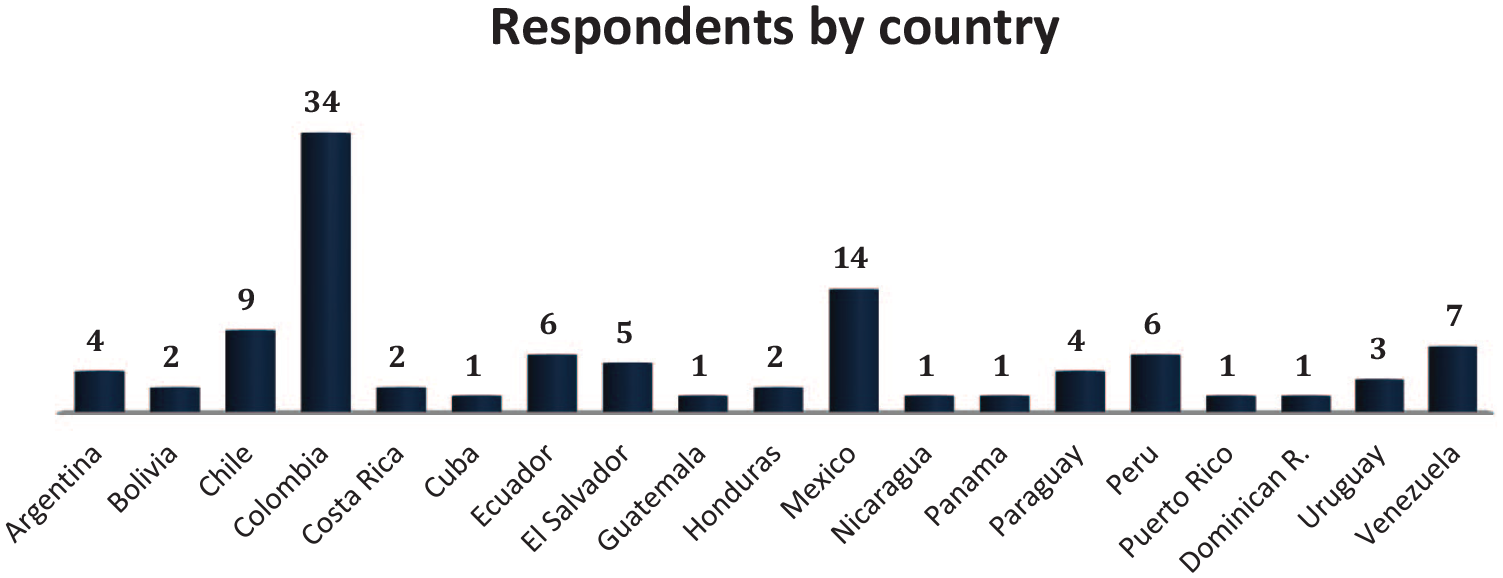
The questionnaire was anonymous, meaning that participants were not asked any personal questions that could identify them or their institutions. However, some broad demographic questions were asked to create a general profile of the participants. As illustrated in Figure 1, the first important observation to be made based on the demographic data is that at least one response was received from each of the 19 countries located in Spanish-speaking Latin America.
Respondents by country.
The country with the most participants was Colombia, with almost 33% (34/104), followed by Mexico with slightly more than 13% (14/104). Next came Chile with approximately 9% (9/104), Venezuela with nearly 7% (7/104), and Ecuador with just under 6% (6/104). From each of the remaining 14 countries, there were between one and five respondents.
Around 59% (61/104) of respondents indicated that they work at a mid-sized university, with about 20% (21/104) saying that their institution has fewer than 5000 students and another 21% (22/104) noting that their institution has more than 25,000 students. Moreover, approximately one-third of the institutions are public universities, while about two-thirds are private. The vast majority of institutions (92% or 96/104) are accredited by a higher education authority in their region. Similarly, the vast majority of the universities (94% or 98/104) offer graduate-level programs.
Regarding the type of professional position held by respondents, a majority of nearly 52% (54/104) identify themselves as library directors, while about an additional 3% (3/104) are associate directors or high-level managers. Among the other types of employees, almost 13% (13/104) are reference librarians and close to 9% (9/104) are librarians who specialize in bibliometrics. Meanwhile, just under 5% (5/104) are scholarly communication librarians. Finally, the remaining respondents (roughly 19% or 20/104) hold a wide variety of positions, including librarians responsible for digital platforms or computer resources, special projects librarians, and librarians who do not identify a specialization, as well as archivists and university press directors.
With regard to the respondents’ educational profile, 6% (6/104) indicate that they hold a doctoral degree, while 60% (63/104) say they have a master’s degree and 13% (14/104) specify that they have a graduate diploma. Meanwhile, 16% (17/104) of the respondents say they hold a bachelor’s degree, and the remaining 4% (4/104) indicate that they hold a technician qualification.
Finally, with regard to the discipline of their studies, the majority of respondents (74% or 77/104) hold a qualification in LIS, while just under 8% (8/104) received their qualification in management/administration, and the same number had training in technology. The remaining 10% (11/104) of respondents were educated in a variety of fields, including communication, history, and education.
Support for scholarly communication
Following the demographic questions, the next set of questions sought to identify how academic libraries are supporting researchers with scholarly communication overall. In the questionnaire, scholarly communication was presented as the cycle in which research is created, evaluated for quality, disseminated to the academic community, and preserved for future use.
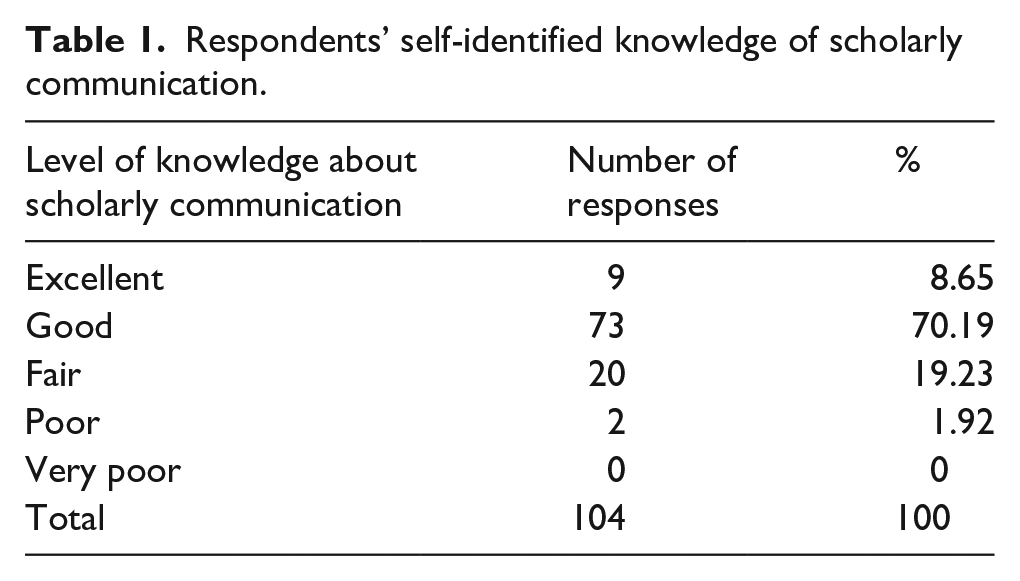
Respondents were first asked to evaluate their own knowledge of scholarly communication. In response, as illustrated in Table 1, roughly 9% (9/104) feel that their knowledge is excellent, just over 70% (73/104) say their knowledge is good, approximately 19% (20/104) say it is fair, and less than 2% (2/104) identify their knowledge as poor. However, in response to the question about whether their library employed a scholarly communication specialist, fewer than 32% (33/104) of respondents answered “yes.”
Respondents’ self-identified knowledge of scholarly communication.
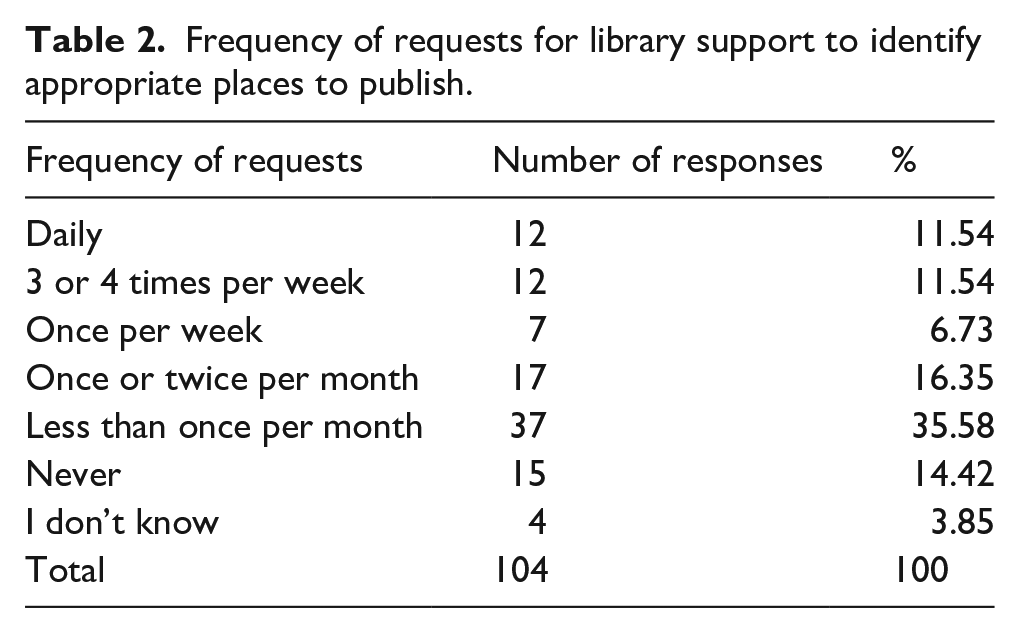
As summarized in Table 2, when respondents were asked how often researchers at their institutions seek support for identifying appropriate places to publish, almost 30% (31/104) say that it occurs once per week or more, while 16% (17/104) indicate that this happens at least once or twice per month. In contrast, just over one-third of respondents (35% or 37/104) note that this type of help is sought less than once per month, with an additional 14% (15/104) indicating that they never receive such requests. The remaining respondents (4% or 4/104) answered “I don’t know” to the question.
Frequency of requests for library support to identify appropriate places to publish.
When asked about their library’s services that support researchers in the area of scholarly communication, the greatest number of respondents (roughly 65% or 68/104) indicate that they offer information about journal metrics and impact factors, while an equal number specify that they provide information about open access (although none provide grants to support open access publishing). Close to 5% (5/104) of respondents note that their library offers support with academic writing, editing, or translation. However, almost 10% (9/104) of respondents suggest that their library does not offer any support for scholarly communication whatsoever.
Among those libraries that do offer some kind of training in an area of scholarly communication, the following were the five most common types of training offered:
Evaluating information quality or credibility (73% or 76/104);
Using digital media and tools to create or disseminate information (55% or 57/104);
Metrics literacy (e.g. understanding impact factors) (48% or 50/104);
Self-archiving or green open access (44% or 46/104);
Open access more broadly (39% or 41/104).
Support for open access
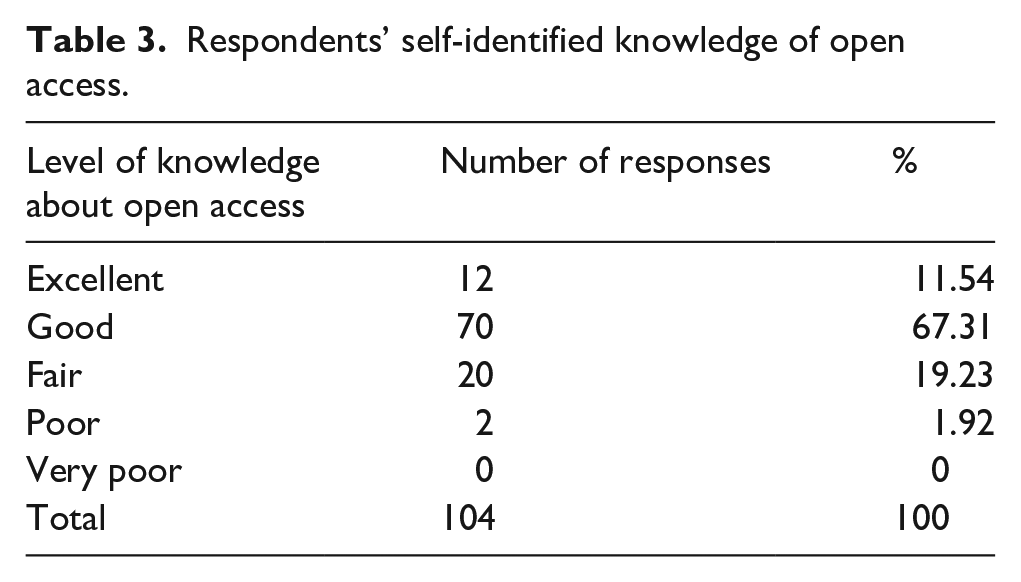
The next set of questions delved more specifically into how academic libraries support researchers with regard to open access. To start, respondents were asked to evaluate their own knowledge of open access, and the results are displayed in Table 3. In response, nearly 12% (12/104) judge their knowledge to be excellent, roughly 67% (70/104) say their knowledge is good, approximately 19% (20/104) say it is fair, and just under 2% (2/104) feel that their knowledge on this topic is poor.
Respondents’ self-identified knowledge of open access.
Respondents were then asked which types of open access they know most about. Green open access was the type familiar to most respondents (around 74% or 77/104), followed by hybrid open access (roughly 56% or 58/104) and gold open access (about 52% or 54/104). In contrast, respondents overall appear to know less about models such as bronze open access, diamond open access, or black open access:
Green open access (around 70% or 77/104);
Hybrid open access (nearly 56% or 58/104);
Gold open access (almost 52% or 54/104);
Black open access (approximately 17% or 18/104);
Bronze open access (close to 11% or 11/104);
Diamond open access (close to 11% or 11/104);
None (nearly 7% or 7/104).
Moreover, in answer to the question “Does your university have an institutional repository?” an overwhelming majority of over 91% (95/104) answered yes. Finally, given that Latin America has a well-developed network of non-commercial platforms designed to increase the visibility of scholarly publications in the region, respondents were asked to indicate which of the platforms could be accessed from their library’s website. Fewer than 3% (3/104) of the respondents said that no such platforms were available from their library’s website, while a selection of five different platforms were available from many of the library sites:
SciELO (just over 80% or 84/104);
Redalyc (nearly 80% or 83/104);
Latindex (roughly 71% or 74/104);
CLASCO (almost 51% or 53/104);
La Referencia (about 33% or 34/104).
Finally, respondents were also asked to indicate how their libraries support open access publishing. Almost 12% (12/104) specify that they do not offer this type of support. Meanwhile, the remaining libraries offer information, workshops, videos, and/or webinars on the following topics:
Institutional repositories, dissemination and visibility of research in repositories, and self-archiving (over 70% or 73/104);
Open access in general (close to 36% or 37/104);
Creative Commons licenses (roughly 30% or 31/104);
How to publish in open access journals (nearly 26% or 27/104).
Support around predatory publishing practices
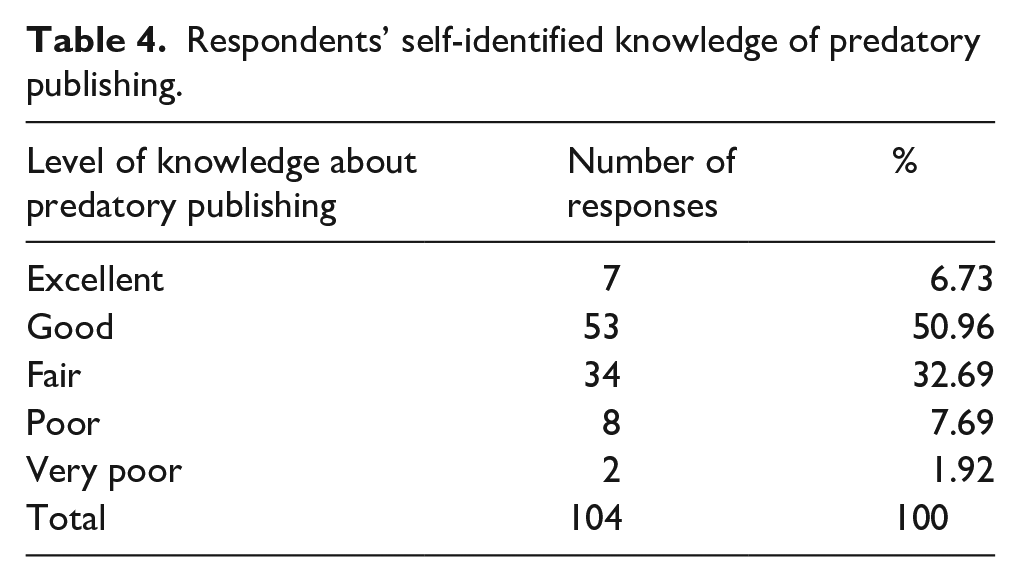
The final section of the questionnaire sought to identify whether and how academic libraries are working to inform researchers about the phenomenon of predatory publishing. As illustrated in Table 4, the first question asked respondents to evaluate their own knowledge of predatory practices. In response, almost 7% (7/104) feel they have an excellent knowledge, nearly 51% (53/104) indicate a good knowledge, about 33% (34/104) describe their knowledge as fair, and the remaining group of around 9% (10/104) say that their knowledge on this topic is poor or very poor.
Respondents’ self-identified knowledge of predatory publishing.
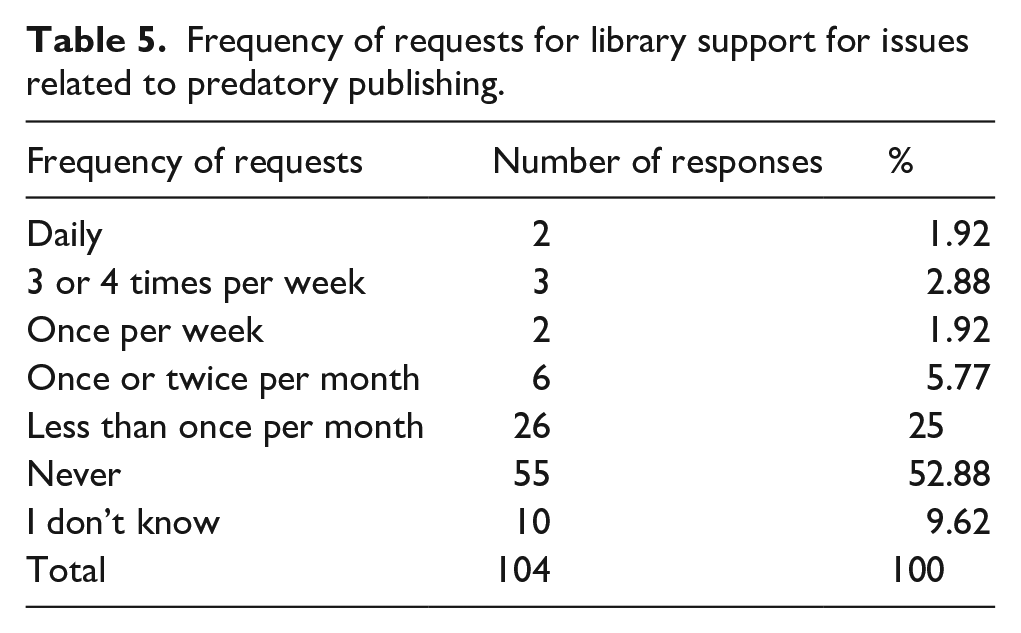
Next, respondents were asked how often their library’s users sought support for issues related to predatory publishing. As illustrated in Table 5, the most common response to this question is “never,” which came from almost 53% (55/104) of respondents. An additional 25% (26/104) indicate that users look for this information less than once per month. Approximately 12% (13/104) of respondents say that users ask for this type of support once a month or more, while nearly 10% responded “I don’t know” to this question.
Frequency of requests for library support for issues related to predatory publishing.
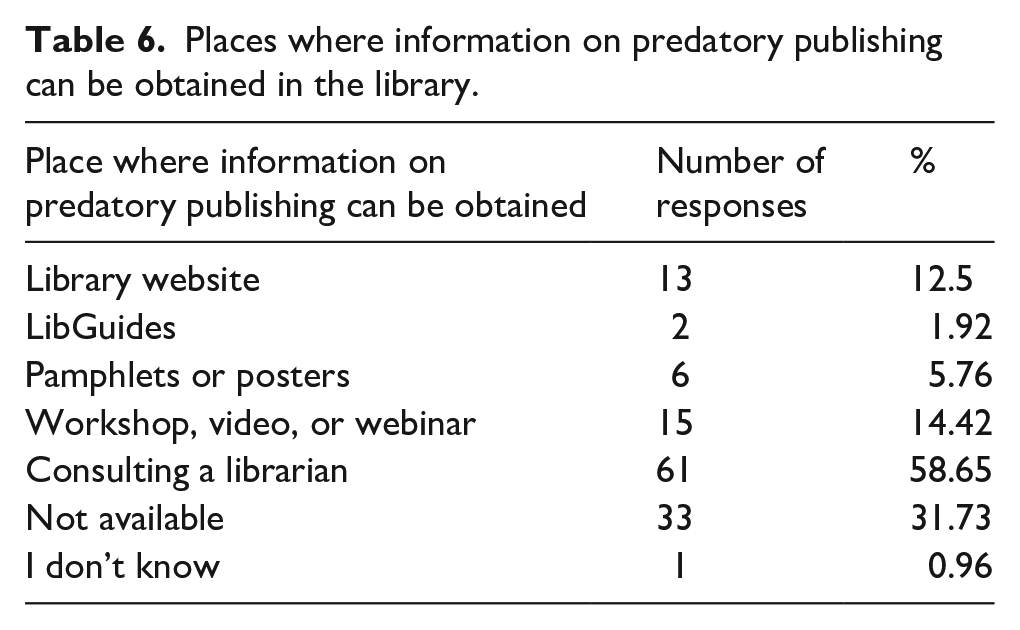
In cases where users do seek information about predatory publishing, respondents were asked to indicate where/how this information could be obtained, and these data are summarized in Table 6. Nearly 32% (33/104) of respondents replied that this type of information is not available in their library. In contrast, for libraries that do offer some support in this area, approximately 59% (61/104) of respondents say it can be obtained by consulting a librarian, just over 14% (15/105) indicate that it is available in a workshop, video or webinar format, and around 12% (13/104) note that some information is available on the library’s website. Less than 6% (6/104) make information available in posters or pamphlets in the library, while less than 2% (2/104) have created LibGuides on the topic.
Places where information on predatory publishing can be obtained in the library.
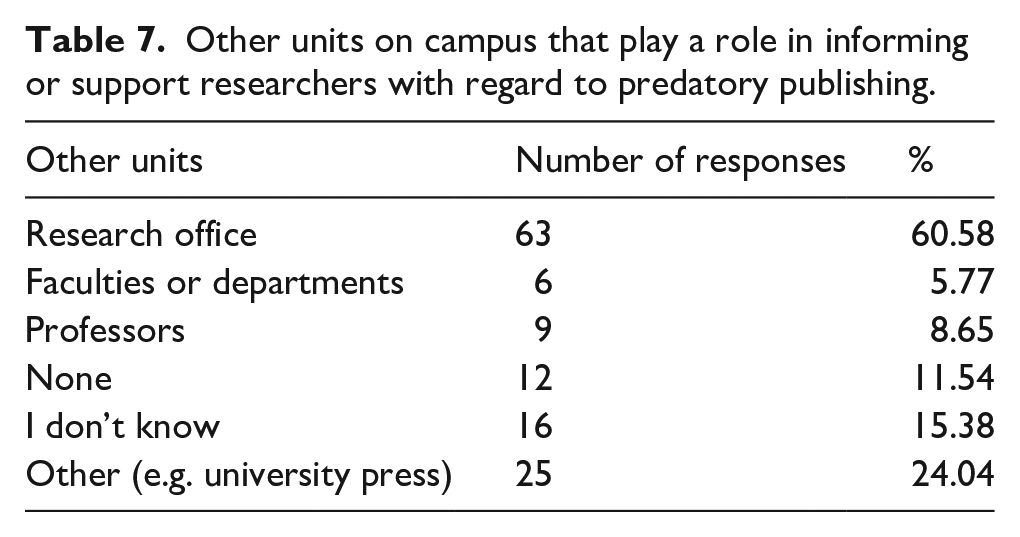
The questionnaire participants were then asked whether there were other units at their institution that play a role in informing or supporting researchers with regard to predatory publishing practices. As presented in Table 7, a majority of almost 61% (63/104) identified the university’s research office as taking on such responsibilities, while nearly 9% (9/104) indicated that this is done by individual professors, and around 6% (6/104) say that faculties or departments play role. Meanwhile, about 12% (12/104) say that no other unit beyond the library provides information about predatory publishing, and approximately 15% (16/104) answered “I don’t know.” Finally, around 24% of respondents answered “other,” and a number of these specified that the university press is involved.
Other units on campus that play a role in informing or support researchers with regard to predatory publishing.
In a related question, respondents were asked for their opinion about which unit should take on the responsibility for supporting researchers in regard to predatory practices. Just over 44% (46/104) identify the research office as the unit that should bear this responsibility, while nearly 30% (31/104) feel that the job should be done by the library. In addition, close to 11% (11/104) indicate that this should be a joint responsibility shared by both the research office and the library, while about 5% (5/105) feel that it should be shared by the research office, the library, and the faculties or professors, and approximately 3% (3/104) suggest a joint effort by the research office, the library, and university press. Altogether then, over 48% (50/104) of respondents identify the library as a unit that should play a central or shared role in providing support to researchers on the topic of predatory publishing.
Next, the questionnaire sought to establish which types of skill or knowledge could be useful for enabling an academic librarian to better support researchers in the area of predatory publishing. In response, the participants identify a range of skills and knowledge:
Guidelines for identifying predatory publishers (about 87% or 90/104);
Knowledge of the different models of open access and their implications (about 87% or 90/104);
Knowledge of licenses and copyrights (about 87% or 90/104);
Skills in the use of digital media to create and disseminate research (approximately 83% or 86/104);
Knowledge of the DOAJ (close to 80% or 83/104);
Knowledge of scientific journals in a particular discipline or field (around 79% or 81/104);
Knowledge of “blacklists” of predatory publishers, journals, and conferences (around 79% or 81/104);
Ability to apply quality indicators (metrics) to evaluate scientific journals (nearly 77% or 80/104);
Knowledge of Compact for Open-Access Publishing Equity (COPE) (just over 67% or 70/104);
Knowledge of “whitelists” of publishers, journals, and conferences (just under 65% or 67/104).
Next, respondents were asked to rate the importance of having different types of knowledge or skills. More than 65% (67/104) of respondents identify the following two skills as being obligatory:
Knowledge of quality indicators of open access journals;
Understanding the link between open access and predatory activities.
Meanwhile, more than 61% (63/104) of respondents identify the following four skills as being very important:
Knowledge of open access journals by discipline;
Ability to use digital media to create and disseminate open access research;
Understanding the different types or models of open access and their implications;
Understanding open access funding policies.
Respondents were also asked to consider cases where an academic library does not have scholarly communication specialists and to suggest what could be done in these situations to better support users on the topic of predatory publishing. Almost 27% (29/104) of respondents suggest training library staff in the areas of scholarly communication and predatory publishing, while more than 17% (18/104) recommend seeking support from or collaborating with other libraries (domestic or international) that do have a program for predatory publishing, and an additional 9% (9/104) encourage libraries to hire specialists.
As a final question, the respondents were asked whether they had plans to develop any resources or activities to inform their community about predatory practices. Around 40% (42/104) of respondents say that their institution has no immediate plans in this regard. However, about 38% (39/104) indicate that they are planning to offer workshops, webinars, or other training for their users, while nearly 7% (7/104) said they have plans to disseminate information on predatory publishing to their users through email or social media. Finally, approximately 3% (3/104) indicate an intention to engage a scholarly communication specialist.
Interviews
A total of seven questionnaire respondents from six different countries in Spanish-speaking Latin America (Argentina, Chile, Colombia (2), Ecuador, El Salvador, Mexico) participated in a semi-structured follow-up interview that was designed to allow further exploration of the following five themes that emerged from the questionnaire:
How can academic librarians improve their knowledge of predatory publishing?
What is the best format for academic librarians to learn more about predatory publishing?
Is there an interest on the part of academic librarians in Spanish-speaking Latin America to participate in an information exchange on the topic of predatory publishing?
Which university unit should take the lead on responding to predatory publishing, and in cases of a joint responsibility, what role should the library play?
What strategies are currently in place or planned for addressing predatory publishing?
How can academic librarians improve their knowledge of predatory publishing?
When interviewees were asked about how to help librarians improve their knowledge of predatory publishing, the ideas most often mentioned include staff training on predatory practices (57% or 4/7), staff training on open access (43% or 3/7), access to blacklists of potentially predatory publications (29% or 2/7), and access to whitelists of quality publications (29% or 2/7).
What is the best format for academic librarians to learn more about predatory publishing?
When interviewees were asked about a preferred format for learning more about predatory practices, the most popular options were an online workshop (85% or 6/7), a video tutorial (57% or 4/7), a face-to-face workshop (29% or 2/7), or a printed document (29% or 2/7).
Is there an interest on the part of academic librarians in Spanish-speaking Latin America to participate in an information exchange on the topic of predatory publishing?
In response to the question about whether it would be beneficial to exchange information with other institutions, all the participants agreed that this would be positive. In a more specific follow-up question, interviewees were asked whether they would be interested in exchanging information with institutions outside Spanish-speaking Latin America that had already developed resources in this area. Once again, all participants expressed an interest, and none perceived that English would present language barrier. However, two participants (29% or 2/7) noted that any such exchange would need to align with previously established agreements between the institutions.
Which university unit should take the lead on responding to predatory publishing, and in cases of a joint responsibility, what role should the library play?
Participants were probed about their opinion on who should take the lead for educating researchers about predatory publishing and what role the library should play. In response, 57% (4/7) said that the lead should be taken by the library, 14% (1/7) said it should be the research office, and the remaining 29% (2/7) said it should be a shared responsibility between the library and the research office. Participants were also asked what role the library should have if it worked jointly with other departments. Forty-three percent (3/7) of respondents suggested that the library should provide general support to inform users about predatory publishing, while another 43% (3/7) considered that the library should take the leadership role in any joint effort to inform researchers about predatory publishing. The remaining interviewee was more ambiguous, noting that the role of the library will depend on how much the library wants to be involved in these issues.
What strategies are currently in place or planned for addressing predatory publishing?
When participants were asked what strategies they currently use to address predatory publishing, 57% (4/7) state that they promote use of the institutional repository, 57% (4/7) offer information search support to researchers, and 57% (4/7) run workshops on scientific publishing. Meanwhile, 43% (3/7) indicate that they collaborate as requested with other groups (e.g. professors, university press, research office). With regard to future plans, 43% (3/7) state an intention to hire a specialist in scholarly communication, 43% (3/7) identify plans to hold a workshop on predatory practices, and 29% (2/7) indicate that they will be adding more material on the topic to the library’s website. In addition, 29% (2/7) of those interviewed have decided to create a course on the challenges of scholarly communication that will be open to all students and faculty at their institution, while 14% (1/7) intend to expand their service offering to include scholarly communication support for their library users.
Other ideas that came up during the interviews
The interviews were semi-structured around the five main questions outlined above; however, participants were also invited to share their experiences or raise other topics related to the challenges of scholarly communication and predatory publishing. As a result, a number of other ideas emerged.
Predatory publishing presents a significant challenge for academic libraries
All participants recognize that one of the greatest challenges currently facing academic libraries is the general lack of knowledge about predatory practices. At the same time, 71% (5/7) of the interviewees state that academic libraries (in their region) do not generally have staff who are trained in scholarly communication and who can suitably support researchers with issues relating to predatory publishing. For instance, the interviewees indicate that they had responded to the questionnaire on behalf of their institution since they were the person most knowledgeable on the topic, noting that their colleagues were less informed on the issue. Further to this point, an interviewee observed that one of the challenges in Spanish-speaking Latin American countries is that LIS training is more oriented to practical or technical library work (e.g. collection management, cataloging) rather than to supporting research, and that many librarians have a bachelor’s degree in LIS and have not themselves completed graduate studies or participated in research:
P6: . . . la parte operativa y técnica del personal de la biblioteca universitaria es importante, sin embargo, son pocas las personas que trabajan en bibliotecas universitarias con un perfil investigativo. [. . .] Existe una particularidad en nuestro país, y es que las ciencias de la información para nosotros está más orientaba hacia un trabajo más de tipo practico y de apoyo. [. . .] Este tipo de pregrado tiene una orientación muy profesional de tipo laboral, pero no tiene una línea de investigación que le permita a quienes la realizan comprender mejor el campo de la investigación. Yo considero que es importante una formación epistemológica teórica en investigación por parte del personal de la biblioteca, esto nos daría una comprensión y empatía hacia los investigadores. [Author’s translation. P6: The operational and technical work of the university library staff is important; however, few people working in libraries have a research profile. [. . .] In our country, LIS is more oriented towards practical and support work. This type of undergraduate program is very professionally oriented and does not incorporate research in a way that would allow LIS professionals to better understand research. I think it is important for library staff to have theoretical and epistemological training because this would allow us to understand and empathize with researchers.]
Finally, another participant comments that because they are under pressure to publish, researchers at their institution appear to be strongly focused on increasing their number of publications and citations, and they overlook the dangers of predatory publishing:
P5: Desde una perspectiva de Hispanoamérica, considero que aún estamos atrasados en estos temas de prevención y formación sobre publicaciones depredadoras. Muchos de nuestros investigadores están más enfocados en el impacto de su investigación y el número de citaciones que de la calidad de sus publicaciones. Y esto es debido a que en muchas de nuestras universidades y es el caso nuestro, los investigadores son evaluados y promovidos por el número de artículos publicados, pero muchas veces pasamos por alto todos estos riesgos que corren los investigadores cuando son presionados a publicar y muchas veces terminan publicando en estas revistas depredadoras. [Author’s translation: P5: From a Hispanic American perspective, I believe that we are still behind when it comes to preventing or providing training on predatory publishing. Many of our researchers are more focused on the impact of their research and the number of citations than on the quality of their publications. And this is because in many of our universities, and in my own university, researchers are evaluated and promoted according to the number of articles published. We are often unaware of the risks that researchers take when they are pressured to publish, and they often end up publishing in these predatory journals.]
Benefits of participating in the questionnaire and interviews
More than half (57% or 4/7) of the interviewees said that they felt that their participation in the questionnaire had helped them to better understand the challenges of scholarly communication and the dangers posed by predatory publishing. The same people also said that after participating in the questionnaire, they had begun to consult and to plan or take action to support researchers in dealing with the phenomenon of predatory publishing:
P2: Una de las primeras cosas en las que estamos trabajando gracias a su encuesta, es que estamos trabajando en crear el puesto de bibliotecario en comunicación académica en nuestra biblioteca. También pensamos crear talleres y biblioguías para informar a los investigadores desde el sitio Web de la biblioteca. [Author’s translation. P2: Thanks to your questionnaire, one of the first things we are working on is creating a scholarly communication librarian position in our library. We also plan to create workshops and put LibGuides on our website to inform researchers.] P3: Después de haber respondido la encuesta, anexamos e incluimos algunas informaciones pertinentes sobre los desafíos de la comunicación académica y las publicaciones depredadoras en nuestros talleres de bienestar digital. [Author’s translation. P3: After responding to the questionnaire, we included some pertinent Information on the challenges of scholarly communication and predatory publishing in our digital wellness workshop.] P5: La biblioteca introdujo un curso para nuevos investigadores becarios, que será dado por nosotros y dentro de este curso que será sobre comunicación académica, hemos decidido incluir una formación en revistas depredadoras. Una vez respondimos su encuesta, decidimos incluir este tema específicamente dentro de este curso. [Author’s translation. P5: The library introduced a course for new research fellows, which will be given by us, and within this course, which will be on scholarly communication, we have decided to include training on predatory publishing. After we responded to your questionnaire, we specifically decided to include this topic within this course.]
One of the interviewees said that after participating in the questionnaire, they had conducted their own questionnaire among researchers at their institution to see whether they knew about predatory publishing. According to this participant, most of those researchers said that they did not know about predatory practices:
P5: Nosotros una vez respondimos su encuesta, empezamos a darnos cuenta que es realmente un problema que desconocíamos y gracias a su encuesta, empezamos a leer y a consultar los investigadores de nuestra universidad sobre si tenían conocimiento acerca de los desafíos de las publicaciones depredadoras. Sin embargo los investigadores manifestaron que no tenían mayor conocimiento acerca de las publicaciones depredadores. [Author’s translation. P5: After we responded to your questionnaire, we began to realize that this is really a problem that we were unaware of, and thanks to your questionnaire, we began to read and consult with researchers at our university about whether they were aware of the challenges of predatory publishing. However, the researchers stated that they did not have much knowledge about predatory publishing.]
Experience with predatory publishing
Two of the participants (29% or 2/7) expressed that they have had some experience with predatory practices. One participant reported receiving an invitation to participate in a conference that they later identified as predatory. The conference indicated that a recognized researcher from the interviewee’s country was an alleged member of the academic board for that conference. A second interviewee related that there was a long history in their institution of publishing research in journals that were later identified as predatory. This was not only a scandal, but it also set off alarm bells in the institution about the dangers and consequences of this phenomenon.
Discussion
Completed questionnaires were collected from 104 respondents, and seven of these participated in a follow-up interview. An additional 56 people who started the questionnaire did not complete it. All questions were mandatory, and this, together with the questionnaire’s length and the lack of compensation, may have contributed to the abandonment rate of 35%. One strength with regard to the data is that all 19 of the countries in Spanish-speaking Latin America are represented in the questionnaire results, and 6 different countries are represented in the interviews. Therefore, the results represent views from across Spanish-speaking Latin America. However, the responses are not evenly distributed. For instance, one-third of the questionnaire respondents and two of the seven interviewees came from Colombia. As noted in the “Methods” section, I have a particularly well-developed professional LIS network in Colombia, which made it easier to reach people in this region. In addition, another 13% of the questionnaire responses came from Mexico, although this is not too surprising given that Mexico is the country with the largest overall population in Spanish-speaking Latin America (more than double that of the next most populous country in the region).
There is good representation among the types of universities participating, with questionnaire responses coming from small, medium, and large universities and from public and private institutions. Moreover, the vast majority of universities are accredited and offer graduate programs meaning that these are research-active institutions where scholarly communication is taking place. In summary, the fact that the results are not proportionally drawn from across the region will need to be taken into account when interpreting the results. Nevertheless, while the sampling is not perfect, the total number of participants, along with the fact that all countries in the region are included and that a variety of types of accredited and research-active universities are represented, will allow us to gain a better understanding of how predatory publishing is being addressed in academic libraries in Spanish-speaking Latin America. Furthermore, these findings can serve to complement the findings of Buitrago-Ciro and Bowker (2020), who investigate the same broad research question (i.e. how are academic libraries responding to predatory publishing) using an analysis of the websites of 20 academic libraries in six different countries in Spanish-speaking Latin America.
In terms of the respondents’ profiles, more than half are library directors or other high-level managers, and two-thirds hold a graduate degree. This high percentage of directors may be explained in part by the fact that, as noted in the “Methods” section, part of the recruitment strategy involved direct emails to my personal LIS network, which consists largely of library directors. However, another partial explanation may be that few academic libraries in this region appear to employ scholarly communication specialists. Therefore, the library director, who has a broad overview of the library service offering and who is likely to hold a graduate degree, may be the person most suited to respond to a questionnaire on the subject of scholarly communication and predatory publishing. One advantage of the participation of directors is that they are in a position to effect change in their libraries. For example, 10% of questionnaire respondents recommended hiring a scholarly communication librarian as part of a strategy to address predatory publishing. Meanwhile, it became clear during the interviews that several participants were indeed planning changes that stemmed directly from their participation in this project, such as intending to engage a scholarly communication specialist or taking steps to enlarge their service offering to include scholarly communication support. These outcomes will represent an increase in this type of expertise in the region, since, in line with the findings of Buitrago-Ciro and Bowker (2020), the questionnaire results indicate that over two-thirds of the respondents work in a library that currently has no scholarly communication specialist.
While the questionnaire results indicate that most respondents feel that they have a reasonably good understanding of scholarly communication, open access, and predatory publishing, it is important to remember that, according to most interviewees, this was the reason that they had volunteered or been nominated to respond to the questionnaire on behalf of their institution. The interviewees also emphasized that predatory publishing is a significant challenge facing academic libraries in their region, and that the majority of library staff are not well informed on the issue and cannot therefore currently provide support in this area to researchers. The lack of knowledgeable staff may explain why approximately one-third of questionnaire respondents indicate that no information on predatory publishing is currently made pro-actively available in their libraries and why 40% note that they are not aware of any plans to develop resources or activities on this topic. Recall that 59% of questionnaire respondents indicated that the main option available to library users for finding out more about predatory publishing was asking a librarian, which does raise some concern given that the librarians may not themselves be well informed on this issue. Only 14% of the respondents noted that their library offered some kind of workshop or video on predatory publishing, and according to the interviewees, there is more focus placed on promoting legitimate open access venues than on avoiding predatory publishers. Just 12% of the respondents said that they worked at a library that posted information about predatory publishing on their website, and this was mainly in the form of checklists. Meanwhile, only 2% of questionnaire respondents replied that their library had a more detailed LibGuide on predatory publishing that went beyond a simple checklist. Again, the relative sparsity of material or programming on predatory publishing seems to confirm the findings of Buitrago-Ciro and Bowker (2020), who found little evidence of this as part of their in-depth examination of the websites of 20 university libraries in Spanish-speaking Latin America.
The lack of available information on predatory practices could lead to the question of whether this type of support is in demand. According to the questionnaire results, almost one-third of respondents indicate that their library is asked to help users identify a suitable publication venue at least once per week, with another 16% getting such requests at least once a month. Furthermore, 12% of respondents say that library users ask questions about predatory publishing specifically at least once per month. This suggests that there is already an emerging demand for support in the area of scholarly publishing literacy. In addition, the interviewees emphasized that predatory publishing poses a significant challenge for academic libraries, noting that library staff in general are not well informed about the issue. If the staff are not well informed and if academic libraries do not currently pay much attention to combatting the problem, then it seems reasonable to infer that the issue presently has a relatively low visibility among researchers in Spanish-speaking Latin America. Recall that one interviewee conducted their own questionnaire and found that researchers at their institution were not well informed on predatory practices. Meanwhile, another interviewee suggested that researchers at their institution are under pressure to publish and consequently focus more on quantity rather than quality of publications. Therefore, it is possible that some library users are not asking for support with predatory publishing because they are not yet aware of the issue. If the libraries were to take steps to raise awareness of the issue, then it is likely that they would receive additional requests for support in dealing with it. As noted in the “Literature review” section above, there is a paucity of literature exploring the issue of predatory publishing in Spanish-speaking Latin America; however, literature from other developing regions (e.g. parts of Africa and the Middle East) point to this being a problem with negative consequences. Therefore, it is possible that something similar could be happening in Spanish-speaking Latin America, and the questionnaire and interview findings do appear to suggest that the problem is indeed beginning to emerge and starting to be recognized in this region. As a follow-on question, we might therefore ask ourselves what can be done to address the problem.
An obvious answer would seem to be that institutions should offer more support to researchers in this area, in which case one of the next questions to be addressed is which unit within the institution should take on this responsibility. When this question was put to the questionnaire participants, the majority indicate that, at present, this job often falls to the university’s research office; however, there is strong support for the library playing a pivotal role moving forward. For instance, 30% feel that the library should be entirely responsible for providing support on scholarly publishing literacy, while an additional 19% feel that the responsibility should be shared by the library and one or more other units (e.g. research office, faculties, university press). This feeling comes out strongly in the interviews also, where six out of seven interviewees say that the library should be wholly or partially responsible for providing this type of support, and 50% of these specify the library should take on a leadership role in this regard. It was noted in the context section above that, in several developed regions, academic librarians have already emerged as leaders in efforts to stem the tide of predatory publishing, and the results of this questionnaire and interviews suggest that this trend is starting to build momentum in Spanish-speaking Latin America also. This raises the question about what type of training or support the librarians themselves need in the area of scholarly publishing literacy before they are in a position to be able to support the researchers at their institutions.
While we have seen that knowledge of and support for predatory publishing appear to be relatively low in Spanish-speaking Latin American libraries at the moment, in contrast, the questionnaire results suggest that their knowledge about open access is strong. For instance, the vast majority of respondents identify their own knowledge of open access to be good or excellent, and almost all of them indicate that their library hosts an institutional repository, offers links to a network of non-commercial platforms that support green open access (e.g. SciELO, Redalyc, Latindex), and offers information and workshops on these topics. These results are in line with observations made by Alperin et al. (2008) and Buitrago-Ciro and Bowker (2020), who emphasize that there is a strong culture of green open access in Latin America. In addition, this suggests that there is already a foundation on which to build up expertise on predatory publishing. Although open access is not itself a form of predatory publishing, as explained in the “Literature review” section above, the gold model of open access did inadvertently open the door to predatory publishing. Therefore, an understanding of open access is a key element of scholarly publishing literacy. Indeed, when asked which types of knowledge or skill would be useful for enabling an academic librarian to better support researchers in the area of predatory publishing, close to 90% of the questionnaire respondents identify knowledge about different models of open access and their implications as being important, while 80% indicate that it is important to have knowledge of the DOAJ, and 67% identify the importance of knowing about COPE. Since there is already evidence of a strong foundation in knowledge of open access in academic libraries in Spanish-speaking Latin America, it could make sense to build on this by introducing additional skills from the scholarly publishing literacy skillset. As described by Zhao (2014), this skillset includes knowledge of open access, but goes beyond this to incorporate other elements too, such as evaluating scholarly communication venues and learning to distinguish between good and poor quality options. Therefore, academic libraries that already have supports for open access have some of the essential building blocks in place for offering broader support for scholarly communication issues, including predatory publishing. This is an argument in favor of making academic libraries key players in delivering scholarly publishing literacy support at their institutions.
The next question is what other types of knowledge or skill, in addition to knowledge about open access, do librarians need to develop to better support researchers in the acquisition of scholarly publishing literacy. Recall that over 40% of the questionnaire respondents identify their own knowledge of predatory publishing as being fair to poor. In addition, recall that in the interviews, it was suggested that those who volunteered or were selected to respond to the questionnaire are more knowledgeable in this area than many of their colleagues. Taken together, this suggests that there is room for improvement in helping academic librarians get up to speed in this area so that they may in turn offer better support to researchers at their institutions. When asked what types of information or training they need (in addition to knowledge about open access, as discussed above), close to 90% of respondents say they would like guidelines for identifying predatory publishers, journals, or conferences, while around two-thirds also want information about blacklists and whitelists. In addition, about two-thirds of the respondents also emphasize that training should focus on knowledge of quality indicators of legitimate open access journals and an understanding of the link between open access and predatory activities. Meanwhile, around 60% of respondents identify the importance of understanding open access funding policies, understanding the different models of open access, and recognizing open access journals by discipline. The questionnaire findings are largely confirmed during the interviews, where knowledge about open access, blacklists, and whitelists is also identified as being important. Globally, the questionnaire and interview results would seem to support our prior observation that the existing knowledge base on open access–related topics could provide a solid foundation on which to build a broader base of scholarly publishing literacy skills that includes knowledge about predatory publishing.
This brings us to the question of how this knowledge can be acquired, and the questionnaires and interviews brought forth a range of possibilities. One possibility mentioned was hiring a scholarly communication expert, but other options include offering additional training to existing library employees and collaborating with other institutions. With regard to training, some kind of workshop or video is the format recommended by the majority of interviewees. Meanwhile, the interviewees also agree that collaboration with other institutions could be a way to address existing gaps at their own institution. For instance, they note that cooperation with universities that already have a more developed program of scholarly publishing literacy would be of particular interest, even if these universities are in other parts of the world (assuming that English could be used as a lingua franca).
With regard to limitations of the study, one limitation of the questionnaire is that it does not include Brazil, which is a large country in Latin America that is research-active and that has a history of leadership in open access (Packer, 2000). Brazil was excluded from this study for the pragmatic reason that the author is not fluent in Portuguese. Therefore, the focus is restricted to Spanish-speaking Latin America. Another drawback is that my network is particularly strong in Colombia, but less well developed in other Spanish-speaking Latin American countries. As a result, there was a greater representation of respondents from Colombia than from other countries in the region, which needs to be acknowledged when interpreting the data. Another limitation is that no incentives were offered to participants for completing the questionnaire or participating in the interviews; this lack of incentives may have reduced the number of people willing to participate in the study. Moreover, all 34 questions were mandatory, which may have led some participants to abandon the questionnaire part way through. However, this was determined to be a worthwhile risk to ensure that those questionnaires that were submitted would be maximally useful. Finally, owing to resource limitations, it was not possible to have the interview data coded by multiple coders and to test for inter-coder reliability. Since coding can be subjective, this is a limitation of the study. To mitigate this situation partially, the coding was checked by the thesis supervisor, and in a few cases, modifications were negotiated.
Conclusions and recommendations
The results of this research offer some important insights into how academic libraries in Spanish-speaking Latin America are responding to new models of scholarly communication and predatory practices. The questionnaire and interviews reveal that, in general, predatory publishing does not yet have high visibility in academic libraries in Spanish-speaking Latin America; however, there appears to be growing awareness of and concern about this issue. Moreover, there is a marked interest on the part of many questionnaire and interview participants to develop more expertise in this area, to offer better support to researchers at their institution, and in many cases, to help establish the library as a key player or even a leader in this regard. Indeed, in some cases, simply participating in the questionnaire was a catalyst that led to actions such as an increased service offering on scholarly publishing literacy or the hiring of a scholarly communication specialist.
While the majority of academic libraries do not currently have many supports in place to help researchers acquire scholarly publishing literacy skills, they do have considerable experience with open access and can build on this foundation to eventually offer more robust support for scholarly publishing literacy. However, before they can begin to offer improved scholarly publishing literacy support to library users, academic librarians must first improve their own knowledge on the subject. In view of this, these librarians are particularly interested in participating in workshops or knowledge exchanges with librarians at institutions that have already developed resources or programming on this subject.
To this end, the development and delivery of a “train the trainers” style workshop on the topic of scholarly publishing literacy, with an emphasis on predatory practices, could be beneficial for academic librarians in Spanish-speaking Latin America. Using my experience gained working as an academic librarian in both Canada and Colombia, I am currently in the process of developing a webinar and accompanying resource kit for this target audience, and I plan to report on the results of this experience in a future publication.
Footnotes
Acknowledgements
Thanks are owed to the pilot testers, the people who helped to disseminate the questionnaire, the questionnaire and interview participants, and my thesis supervisor for feedback and editorial support.
Declaration of conflicting interests
The author(s) declared no potential conflicts of interest with respect to the research, authorship, and/or publication of this article.
Funding
The author(s) received no financial support for the research, authorship, and/or publication of this article.
