




Abstract
Every year, millions of people are forced to flee their homes to find safety. This paper investigates the information literacy experiences of people from forced migrant backgrounds as they settle into a new country during their first few years of migration. Using a qualitative and interpretive approach incorporating thematic analysis techniques, data were collected through 19 semi-structured interviews and were analysed adopting a thematic analysis approach. Participants were new arrival humanitarian migrants in Australia. The analysis uncovered five different and interconnected themes depicting the information literacy experiences among forcibly displaced people. The themes are: (1) undertaking education; (2) reaching out for help; (3) comparing and contrasting; (4) sharing stories; and (5) getting engaged. Grounded in the relational perspective on information literacy, a long-standing theoretical perspective to explore the information literacy of humanitarian migrants, the findings from this study provide an empirically derived evidence base to inform the design and delivery of services providing information, support and education to humanitarian migrants entering Australia for protection or resettlement.
Keywords
Introduction
Over 84 million people worldwide were forcibly displaced at mid 2020, with another 30,000 displaced every day, as a result of conflict, persecution, violence and human right violations (United Nations High Commissioner for Refugees, 2022). Each year Australia’s Humanitarian programme provides protection and resettlement to refugees and others in humanitarian need, and in 2021 Australia accepted and resettled 13,750 humanitarian migrants. While there are costs associated with the provision of settlement support to humanitarian migrants (Shergold et al., 2019), there is also evidence that, if resettled, adjusted and integrated effectively, forcibly displaced people have the potential to offer highly valuable cultural enrichment as well as economic, social and political contributions to the countries that welcome them (Hugo, 2011).
Humanitarian migrants are however, often resettled to a country with an unknown society, language and culture, that is totally different from their country of birth or origin. This creates, for humanitarian migrants, a range of barriers to successful resettlement and integration in terms of employment, health, education, and income. Access to, and the ability to use, information that is timely, accurate, relevant and tailored to their specific needs will help humanitarian migrants to effectively and independently navigation the unfamiliar, strange and frequently complex environment of the new host country (Bronstein, 2017; Lloyd, 2017). It will also help humanitarian migrants to make well informed decisions, reduce their reliance on government support services (Schreieck et al., 2017), and will help facilitate social inclusion and ensure they do not remain vulnerable within their host country (Caidi and Allard, 2005; Lloyd et al., 2013).
At present Australian government agencies and other organisations have limited evidence to inform the design and delivery of programmes providing information, support and services, to humanitarian migrants entering Australia for protection or resettlement. This paper outlines a research project that investigates the information literacy experiences of Australia’s humanitarian migrants during their first few years of settlement. An understanding of humanitarian migrants’ information literacy provides a perspective on what happens in the information experiences of this specific community and how they experience using information to learn in their new setting as they settle. This is an aspect of forcibly displaced people’s lives that has so far attracted little research attention when compared with the broad field of forced migration-related inquiry. Moreover, the paper adopts a relational perspective to study information literacy of humanitarian migrants, to contribute to the existing understanding of this phenomenon generated by other theoretical views. The paper begins with a review of relevant literature before providing an overview of the research approach and outlining the key findings from the study. The paper concludes by discussing the key implications of the study and identifying areas of further consideration.
Literature review
During the past 30 years, information researchers have been increasingly enquiring into the migration field. Beretta et al. (2018) provided an overview of information research within the migration context. Researchers have looked into different groups of newcomers such as skilled immigrants (Khoir et al., 2015; Sibal and Foo, 2016; Sayyad Abdi et al., 2019) or international students (Somerville and Walsworth, 2015), with the core space of inquiry being the forced migration context. A review of literature of the latter distinguished three areas of scholarly focus: Area 1 – studies that explored information support for refugee research (late 1990s–early 2000s); Area 2 – studies with a focus on information services to humanitarian migrants (early 2000s–early 2010s); Area 3 – studies that investigated humanitarian migrants’ information experience (early 2010s–current). These three areas of scholarly focus are discussed in detail below.
Area 1 – Information support for refugee research
The first area of refugee scholarly focus is visible in the late 1990s and early 2000s, when along with a growing trend in research on forced migration that had started in 1980s (Mason, 2000), the information profession observed a need to support scholars with research materials and resources. To address the need, information professionals initiated preparation of research resources and materials for refugee scholars who explored the forced migration phenomenon. The resources were also to be used by librarians and resettlement service providers who served the refugee populations. In that spirit, information professionals started to mainly publish about the specialised collections, services and reference tools they prepared for research support. These included current awareness services, library and information centre resources, academic research institutes and centres, electronic journals and newsletters, discussion lists, government and non-governmental organisations providing information for refugee and forced migration studies about refugees (Beyani et al., 1995; Mason, 1997; Paynter, 1998; Rhodes, 1996). For instance, Brock (2001) introduced The Refugee Studies Center (RSC) and Mason (2000) presented the Executive Committee of the High Commissioner’s Programme (EXCOM), a United Nations (UN) body, which was one of the producers of information about the plight of refugees. Mason (1999) provided a reference literature including monographs, periodicals, grey literature, and current information about refugees. As a documentation service, Bruun (1989) introduced the Mellemforkeligt Samvirke (Danish Association of International Cooperation) library and Svenson (1998) reported on the material that the Lund Regional Archives had on refugees who moved to South Sweden during World War II. Refugee research and information support services and material again attracted researchers’ interest in the past few years. For instance, within an archive context, Bloss (2017) introduced the Immigration, Migrations and Refugees: Global Perspectives, 1941–1996 database, from the Archives of the Central Intelligence Agency and Zabriskie and Comito (2017) wrote about the Refugee Library Project.
Area 2 – Information services to refugees
The second area of refugee scholarly focus started in the early 2000s, with a research trend of studying services and programmes that were provided by information and education agents, mainly public libraries which served refugee population during the resettlement process (e.g. Allen, 2001; Revelli, 2002).
In this second area of scholarly focus, the role of public libraries in tackling the social exclusion issue has been explored. Pateman (2002) describes a strategic, structural and cultural change process within a public library to develop a service to include the socially excluded population of asylum seekers. Aligned with the same direction, Gonzalez (2001) investigated opportunities that libraries should use to reach out to their marginalised refugee community to assist them to lead more successful and informed lives. Within a Danish context, Thorhauge (2003) discussed how the special local, national and global information provision for ethnic minorities support their integration into the society. In Norway, Audunson et al. (2011) indicated how public libraries support refugee women to build social capital and move from passively observing to actively participating in the new country. Mason (1999) went further and looked into the contribution of public libraries to refugee related research. From a more general perspective, the ethics of information provision to refugees was explored (Tirimanne, 2001). In more recent research efforts, good practices by European public libraries for their refugee users (Murányi and Könyvtári, 2016), information provision to refugees in camps (Kanyengo and Kanyengo, 2011), and the necessity for public libraries in host countries, such as Uganda, to collaborate with other organisations who work with refugees, for example, refugee service providers and community leaders (Akullo and Odong, 2017) have been investigated. Through an exemplar service streamlining government websites on a public library website, Naficy (2009) suggested how libraries could act as an information-intermediary helping their refugee users access official government information. Beyond the public library context, how school libraries could become a multilingual learning environment for refugee populations has also been explored (Boelens et al., 2015).
Area 3 – Refugees’ information experience
Beyond a focus on researching information services, and along with a growing realisation of the need to develop a more sophisticated understanding of users of these services, that is, humanitarian migrants, researchers shifted their attention to refugees’ information worlds and how they engaged with and adapted to their new information environments (Olden, 1999). We discuss this body of work under the umbrella term of ‘information experience’ to refer to all aspects of engagement with information (Beretta et al., 2018). More precisely, Hughes (2014: 34) describes the term information experience as ‘contextualised instances of using information’ which ‘integrates actions, thoughts and feelings related to the engagement with information, and considers social and cultural dimensions of that engagement’.
General themes that have been explored with an information experience focus were refugees’ information sources, information needs, information behaviours and practices, information literacy practices and socio-cultural differences that act as barriers to their integration and adaptation process in host countries (e.g. Hicks and Lloyd, 2016; Lloyd, 2015; Lloyd et al., 2013; Lloyd and Wilkinson, 2016; Lloyd et al., 2017; Mansour, 2018; Martzoukou and Burnett, 2018; Shuva, 2020) as well as in refugee camps (Obodoruku, 2018). Some of the studies with this focus explored specific situational information needs and behaviours such as information needs during refused asylum situations (Oduntan and Ruthven, 2017) or through employment seeking (Yeon and Lee, 2021). Some studies, using such understanding introduced practical tools to inform integration processes. An example is the information needs matrix by Oduntan and Ruthven (2019) which maps out the order in which refugees encounter information needs during their integration process. Such in-depth studies of refugees’ information experiences led to the articulation of concepts that further describe the information experience of refugees such as ‘fractured landscape’ (Lloyd, 2017) that described the disrupted information landscape that refugees deal with throughout the transition process, and ‘information resilience’ (Lloyd, 2015) as the outcome of information literacy practice. Through such concepts, refugee information experience research has explained how and to what extent transition processes cause refugees to disconnect from their previous familiar information landscape. Research has also explored what it takes refugees to construct a new information landscape in their new community to, again, confidently and competently, engage with information for their day to day practice (Lloyd, 2015).
The present study contributes to the evolving picture of refugees’ information experience with in the third area of focus discussed above. Using the relational perspective on information literacy, it further develops the existing understanding of engagement with information amongst refugees, and more broadly, humanitarian migrants. It presents an overview of different ways through which humanitarian migrants experience using information to learn.
The research approach
The research aim
This paper reports on a study that formed part of a larger research project investigating the information literacy experiences of newly arrived Australian migrants. The larger project involved three studies focussed on three different groups: (i) migrants who are either temporary or permanent migrants from the Migration Programme (i.e. migrants entering Australia via either the skilled migration or the family migration schemes), (ii) migrants who entered Australia via the Humanitarian Programme (i.e. migrants entering Australia because they need protection or resettlement) and (iii) Australian resettlement and integration service providers supporting migrants to Australia. This paper reports on the study focussed on the second group (i.e. migrants via the Humanitarian Programme). The findings reported here complement the findings on the first group (i.e. migrants via the Migration Programme) (Sayyad Abdi et al., 2019). Together the two studies will provide a new evidence base that can inform current and future initiatives to improve the information services and programmes offered to Australian migrants.
Theoretical perspective
To explore humanitarian migrants’ experiences of information literacy this study embraced the relational perspective of information literacy developed by Bruce (1997). Drawing on information and learning theory, the relational perspective of information literacy differs from other information literacy perspectives (e.g. socio-cultural or behavioural perspectives) in that information literacy is understood to reflect an internal relation between people and information, rather than comprising information skills, behaviours or processes.
The emphasis of the relational perspective on the variation in the experiences explored is another aspect that makes this theoretical lens different from other information literacy perspectives. From this perspective, an information literate person is ‘one who experiences information literacy in a range of ways, and is able to determine the nature of experience it is necessary to draw upon in new situations’ to learn (Bruce, 1997: 169). Information literacy, through a relational approach, is a transformative and learning experience which is driven by information use. In other words, from a relational lens, information literacy is seen as one’s different ways of using information to learn (Bruce, 2008). The variation in people’s information use experiences that is identified within relational information literacy studies can then be applied in practice to heighten or widen people’s experiences towards information literacy development (Bruce et al., 2014, 2017; Somerville and EchoHawk, 2011).
As an example, from such a theoretical perspective and in the case of the present study, information literacy for humanitarian migrants is interpreted as being able to engage with, and use information in different ways to learn about the unfamiliar and new home setting, its structure and how to navigate and resettle within it. As will be discussed in the Discussion section, such an identified variation in humanitarian migrants’ information use experiences can then be used by resettlement service providers to widen the humanitarian migrants’ ways of using information use. This study is one of a growing number exploring the relational perspective of information literacy outside of an educational or workplace setting, for example older Australians experiences using mobile devices (Linares Soler, 2018), serious leisure activities of adults (Demasson et al., 2016), older adults health (Yates, 2015) and during a natural disaster (Yates and Partridge, 2014).
Participants
Nineteen participants, 10 males and 9 females, between 21 and 65 years of age, took part in the study. Participants were all humanitarian migrants with or without refugee status (i.e. asylum seekers). All participants were moved to Australia in the past 5 years through Australia’s Refugee Humanitarian Programme or had arrived in Australia as an asylum seeker through other ways (e.g. by boat). Participants were from Afghanistan, Burma, Burundi, Eritrea, Iran, Sudan and Syria. They had various education and professional backgrounds ranging from gynaecology, ambulance paramedic and IT to people illiterate in their native language. In Australia, all participants were either not employed or employed casually, in non-relevant areas to their educational and professional backgrounds.
Participants were recruited through a snowball sampling approach from the general populace of Logan and Brisbane, Queensland, Australia. To approach participants, the research team used humanitarian migrants’ trusted connections. These included interpreters and case workers from different resettlement and integration service organisations (including the project’s industry partner), as well as active community members and leaders, with whom participants has personal and ongoing relationships. Being introduced by a trusted or personal connection allowed the researchers to be positively received by participants, earn their trust, build rapport with them and yet be culturally appropriate – an essential strategy of data collection among the sensitive, vulnerable and culturally diverse population of immigrants (Aroian et al., 2006). Involving human participants, prior to data collection, ethics approval to conduct the study was obtained.
Data collection
A qualitative and interpretive approach was used to obtain a deep understanding and interpretation of how the participants made meaning through the investigated experience (i.e. information literacy). The research data were collected through semi-structured in-depth interviews. Kvale (2007: 7) describes interviews as ‘a conversation that has structure and a purpose’. In-depth interviews were identified as the most appropriate approach for the study because of their suitability in obtaining data about people’s views, opinions, ideas and experiences, and where there is a need to ‘ask open-ended questions that elicit depth of information from relatively few people’ (Guion et al., 2006: para. 1).
Interviews were conducted face-to-face and were audio recorded. One member of the research team was exclusively responsible for undertaking data collection. This minimised variation in the interview process. Out of 19 interviews, four interviews were held in Farsi/Persian, the native language that both the interviewer and Afghan and Iranian participants spoke. Fifteen interviews were held in English: Thirteen with the assistance of three interpreters, and two interviews with no assistance where participants themselves could communicate in English.
In order to minimise the possible effects of interpretation on data, also been recognised as a threat to the validity of studies involving interpreted interviews (Kvale, 1989) a range of strategies were employed. Three interpreters were recruited from resettlement and integration service organisations and therefore, had extensive interpretation skills. They were still instructed to take notes of what the interviewees said during the interview, interpret verbatim what is said, and not to summarise, modify or clarify any parts of the interviewer’s questions (including follow up questions) or the interviewees’ responses. The interpreters were encouraged to translate shorter sentences than longer ones. Prior to the interview sessions, the interviewer clearly explained the interview questions to the interpreters to ensure the questions, including their wordings, were accurately and meaningfully interpretable to the participants. Vice versa, the interpreter informed the interviewee when precise translation was not possible, so more follow-ups with the interviewee were carried out. These strategies helped to a great extent avoid the issue of equivalence of meaning existing across the two languages and cultures (Sechrest et al., 1972). Interviews were between 65 and 90 minutes long (including interpretation) and were held in the project industry partner’s office or a place of interviewees’ choice. Participants were offered a gift voucher of $20 as a token of appreciation and to acknowledge their time and contributions.
A pre-defined set of questions was developed to stimulate discussion. In keeping with in-depth interview guidelines, the questions were altered dynamically to facilitate the conversation. The interview questions were designed to elicit participants’ experiences of using information to learn (i.e. information literacy). However, in developing the suite of interview questions, one challenge encountered was determining the best way to orient the participant to what the interview was about without unduly influencing the participant’s descriptions of their experiences of the topic. Information literacy is a very specific term, and one that the general population would not potentially be familiar with. Ashworth and Lucas (2000) suggest that, ‘the researcher and the researched must begin with some kind of (superficially) shared topic, verbalised in terms which they both recognise as meaningful’ (p. 299). For this reason, information field-specific terms such as ‘information literacy’ were avoided in interviews.
Open-ended questions were used to orient the participant to the phenomenon being examined, for example what kinds of information have you used to move to/settle in Australia? In addition to the main questions, a set of follow up questions were also asked where applicable. The follow up questions were asked to thoroughly understand any suggested but insufficiently uncovered aspect of the phenomenon, mentioned by the participant in the interview sessions (Rubin and Rubin, 2005). It is noted that the participants taking part in the first phase of the larger project (Sayyad Abdi et al, 2019) also answered the same questions. This was to enable a comparison across findings from two cohorts in future publications.
Data analysis
The interview data were analysed using the thematic analysis approach by Braun and Clarke (2006). The thematic analysis was adopted as the suitable analysis method given its strength in identifying patterns or themes of meaning within the data that are important to the description of the phenomenon. Accordingly, using such an approach allowed the researchers to uncover a set of themes that represented different experiences of using information to learn (i.e. information literacy) amongst the research population.
The data analysis undertaken in the study was an iterative one, constantly grounded in the interview data. The analysis process began with a phase of familiarisation with data which involved reading and re-reading the interview transcripts. This was then followed by a standard coding phase. This included labelling segments of the data set (i.e. all the 19 transcripts) that reflected a way of experiencing information use to learn. Each label represented the meaning of its associated segment and was considered as one code. A total of 131 initial codes across the whole data set were generated. In recording the codes, the two elements of information and learning, which are critical to the experience of the phenomenon under investigation were attended too.
Next in the analysis process was conducting a recursive search for similar meaning among codes. This was implemented within each interview and across all the interviews. In this phase, codes were constantly compared and contrasted. Similar codes in meaning were identified and collated to create more focused codes, and through a similar process, potential themes. Throughout this process, codes were continually regrouped while the relationships between codes and emerging themes were always attended. This allowed for a consistent yet distinctive-enough set of themes to be developed. In total, five final themes emerged. The themes were then defined and described by investigators and a descriptive label was assigned to each theme. The five themes, all together, portray humanitarian migrants’ experiences of using information to learn (i.e. information literacy) as they resettle in their new life.
Findings
The analysis of data resulted in five themes that depict the ways in which humanitarian migrants use information to learn about their new life setting throughout their resettlement and transition. These themes include (1) undertaking education; (2) reaching out for help; (3) comparing and contrasting; (4) sharing stories; and (6) getting engaged.
The five themes are more fully described below. For each theme, the meaning of the theme is described followed by a discussion of what information is for individuals in that theme and what is achieved (i.e. learned) using that information. Each theme also includes indicative quotes from the interviews that support the discussion in that theme. It is noted that there may be some grammatical errors in the indicative quotes included. These are due to the fact that interviewees or their interpreters were not native English speakers.
Theme 1: Undertaking education
During the resettlement and transition process, humanitarian migrants learn about their new life through undertaking education or being explained about the new environment, its different components (e.g. systems, occasions, events, language, norms), how it is structured and how it works. The education programmes are conducted by formal and authoritative sources (e.g. case workers, the host country’s official education system) in formal settings (e.g. classrooms or formal sessions). A participant, for instance, mentioned they learned about ‘Australia’s law and policy’, ‘housing’, ‘Centrelink’ and ‘medical systems’ through attending ‘information sessions [int. 19]’ run by their resettlement organisation. Another attended English classes to learn the language spoken in the host country [int. 8]. A participant also emphasised the importance of being formally educated:
And through education we could learn many things. Most of the problems our community is dealing with are not intentional. They don’t know the law. When you don’t know the law, you’d be breaking the rule unintentionally. And it’s very dangerous. . . When Australian children get educated, they learn about the law through education. But we haven’t had this education. Most of the penalties we receive are because of us not knowing the common knowledge [int. 3].
In this way of using information to learn, humanitarian migrants experience information as the broad structure of the new environment and its constituting components, such as systems (e.g. legal system [int. 19]), occasions, events, or even the ‘speaking language [int. 12]’ in the new country. This is delivered to individuals in a packaged format such as ‘one week of training [int. 12]’, usually flowing one way, directed at the individual.
What is achieved through using information (i.e. learnt) is a relatively accurate and standard understanding about the new environment and how things work in this environment, such as in the quote above.
Theme 2: Reaching out for help
During the resettlement and transition process, humanitarian migrants learn about their new life through reaching out to a known-to-them authoritative, accessible or familiar source. The migrant in this experience has a specific need for interpretation of the new setting. They reach out to their chosen source of information with an aim to get connected with the targeted part of the new setting. The quotation below indicates a range of information needs for which two of the participants reached out to their interpreter (i.e. source of information) for help:
Like appointments, transport, like where to go. When we go to some place, what should I say, and stuff like that. When she [the participant] receives a letter or something, she doesn’t know what it says [. . .] almost like everything, it’s totally different to her culture and language. So, she has to come to me [the interpreter] [int. 7].
In this way of using information to learn, humanitarian migrants experience information as the person to whom they reach out for an interpretation of the new setting (e.g. their case worker, interpreter, community leader or children). Reflecting on their sources of information in this experience, the participants described them as convenient, easy-to-access, and reliable for immediate and specific information needs upon arrival as well as during resettlement. A participant noted they reach out different sources of information for different types of needs:
For appointments with Centrelink or doctors, there has to be a person who interprets him and communicates with him to be able to understand. For other shorter stuff, he has relatives. They take him to show how to do it [int. 9].
What is achieved through using information (i.e. learnt) is an understanding of a specific part of the whole new environment obtained directly and immediately through assisted interpretation, and as indicated by the quote below:
It was very difficult. [I learned things] with the help of [name of the settlement organisation] who taught us how to catch a bus, train, go to bank, and slowly we became independent and now we can do whatever we want to do on our own [int. 18].
After the abovementioned understanding is achieved (e.g. using the train system in the quote above), the individual may feel confident to engage with information in that context in a different and slightly more independent way. For instance, the participants in the quotes below started to ‘get engaged’ with the elements of the new setting after learning them through reaching out to their case workers or interpreters:
I got sick between days I had to go to doctor many times. I had diabetes. [. . .][the resettlement organisation] contacted on behalf of me. [. . .] The first time it was [the resettlement organisation] that took me to doctor. Then I myself had to contact the doctor [int. 2].
However, there is also a chance that reaching out for help might be needed to be repeated before the learning occurs. The individual can choose to reach out to a different source, as suggested by one of the participants:
Even if they had explained how to use the oven, he was still confused so he asked for help from someone in the community. And they taught him [int. 11].
Additionally, the data showed that a slight change in the operation of the learned element may also cause the individual to require to reach out for help again:
Interviewer [asking the participant]: so were you able to do it yourself next time? Did you know what train or bus number to catch, and at which station or stop to get off?
Interpreter [interpreting the participant]: Yes, but if the location was changing to other places or another level, I have to take them, for the first time. After that, they can do it themselves [int. 8].
The data suggested language barrier as the most important element that triggers reaching out for help. Lack of language skills do not allow humanitarian migrants to confidently and independently explore, access and navigate the new environment. As a result, they reach out to their sources of information with good English language skills (e.g. their case workers, interpreters, community members, friends, families or children) to interpret the environment for them and connect them to the targeted element of the new setting. An example is suggested in the quote below where the participant’s children helped them navigate the real estate system of the host country:
My kids go to school, so they are able to search and they found a house. Even I don’t understand English, my kids do [so they communicated with real estate agents]. They are young but they are better than me. [. . .] They help with the language [int. 18].
Theme 3: Comparing and contrasting
During the resettlement and transition process, humanitarian migrants learn about their new life through discerning differences and similarities between their host and home countries. Almost all participants suggested that they learned about Australia (and their new lives) through attending to either differences or similarities between this country and their home country. The aspects of the two settings they can talk about include (but not limited to) ‘peace [int. 17, int. 18]’, ‘technology [int. 4]’, ‘People, transport, food, property [int. 8]’ or English pedagogy [int. 2]. For instance, the participant below describes how they perceive Australia as a fair and ‘good’ place through attending to its differences with their government at home:
[The home country], it was a country in peace and safe before the war. But the law, many times it’s man, don’t respect it. It’s something not good. And sometimes, man cannot get his right. He should pay money to get his right. And the government and the court, is something I hate it. And here, they [the people and the government] deal with all the people the same. That’s something good. I’m new here and they deal with me as I am Australian. [. . .] It’s a good thing. And they spent a lot of money for us to learn English, to live, to have food. All these things government give us. It’s very good [int. 5].
In this way of using information to learn, humanitarian migrants experience information as the differences or similarities that they experience between any aspect of the new setting they have arrived in, and the one they have come from. An example of difference as information is a new food or an unfamiliar concept of accommodation that the humanitarian migrant below experienced:
We always eat rice. The main food that we had is rice. And we eat that three times a day. And we eat it with some kind of chilli paste and something simple like that. But in here, they have snacks, they have different kinds of foods, even salad, we’ve never had sort of things like that. Everything’s totally different. Or property. When we stay in refugee [camps], we never rent a house [. . .] Cause when we say ‘This is our house’, that becomes our place; so we never rent or buy a house or anything like this. You just live there and if they break, we just rebuild and then live there [int. 8].
Some participants (and according to them, their communities as well) found everything in Australia new and different, about which they were ‘shocked [int. 4, int. 9]’. This implies how overwhelming a new setting could be for a newcomer. When asked what they found different in Australia, one of the participants explained:
So many things. In Australia almost we see everything. In my country, all we had was bush and houses in bamboos. So many different things [here] you’ve never seen before. No technology or anything like that [int. 13].
In contrast, an example of similarity as information was expressed by the participant below. In responding to how they knew that there were computers and WiFi in libraries, they talked about similarities they had assume about library facilities in the two settings:
In [name of their county] libraries had computers. So I was assuming that they had computers in libraries here as well [int. 4].
What is achieved through using information (i.e. learnt) is two folded. Using similarities as information supports a smoother and more confident and straightforward transition to the new setting. For example, the participant above who assumed existing similarities between the two settings, experienced an easier navigation of the system:
I think we were one of the best groups. . . I’m aware some other groups were super-shocked with everything. . . We managed to go to the library and use the Wi-Fi there to find places for inspection. We quickly found all those things [int. 4].
In contrast, using differences as information leads to an adapted practice or understanding suitable or compatible to the new setting. For example, seeing the obvious difference between the language spoken in Australia and at home, the participant below appreciated the necessity of learning the English language – a key tool for communication in the new setting:
Australia is my new home and I should know English to live in this country [int. 5].
It is noted that comparing and contrasting, and attending to similarities specifically, at times may lead to negative outcome. This occurs when a negative experience is linked to an aspect of the home country which has a counterpart in the host community. An example is the participant below who has a fear of police in Australia because of their negative experience with police in their home country:
I had punishment in [name of the county] and still afraid of police when I saws them in Australia [int. 16].
Theme 4: Sharing stories
During the resettlement and transition process, humanitarian migrants learn about their new life through attending to, or being exposed to shared stories by others (e.g. friends, family and humanitarian migrant community members). The following participant quotation illustrates this:
They [the community people] were sharing stories and I learnt from them. If I didn’t understand a part, I asked more: what did you do when you were fined? Everyone told their story and I learnt from them [int. 1].
In this way of using information to learn, humanitarian migrants experience information as the success or failure stories that others share, or personal learnings and perspectives about which they talk. For instance, the participant below stated that they learned about different places through listening to a conversation by the members of a community talking about them:
I met many people there, there were conversations about Coles, the library, Kmart, which were all new to me and I had to get to know them [int. 3].
Similarly, two other participants expressed that they learned they were ‘coming to somewhere that has peace and respect for law’ [int. 17] and is ‘beautiful [int. 18]’ through opinions shared with them by their families who had moved to Australia earlier.
It is noted though that information the humanitarian migrants are shared at times can be invalid or inaccurate or simply not fully applicable to one’s situation. What the participant below experienced is an example:
There is a confusion in information that you get from people to people. Some say “oh you should study before you can get a job” but then there are some that say “you don’t need to do any studies before you get a job [int. 17].
In these cases, what is achieved through using information (i.e. learnt), is not positive and useful learning, but confusion. However, where migrants use correct, accurate, precise and applicable information, what they achieve is an optimised perspective for resettlement-related problem solving and decision making. Using others’ previously tried successful or failed strategies, or personal learnings and perspectives enables migrants to go through situations similar to the shared ones in a more seamless and straightforward way, without making mistakes made by others in the past. In relation to this, one of the participants said:
I learn good things that I see and hear from others. And won’t do the bad things they say won’t work [int. 1].
It is also noted that a reciprocal aspect of using information is observed in this theme. When describing their experiences of using shared stories, participants did not always focus on ‘consuming’ shared stories for ‘their own benefit’, but ‘sharing for the benefit of others’. What is perceived to be achieved through using information in this way (i.e. learnt) is the betterment and empowerment of those with whom the stories are shared, including the sharer’s own communities back at home country. That is, the individual may share stories with other migrants or their people at home with the desire to support them towards self or social improvement. The following participant quotation explicitly indicates this:
That [what they learned as a migrant in Australia] was inspiring for me. . . If my country would be better, if I go back to my country, I don’t know when, I think I can just teach people how to behave, how to respect each other [based on what I learned in Autsralia].. it was good inspiration for me [int. 14].
Theme 5: Getting engaged
During the resettlement and transition process, humanitarian migrants learn about their new life through becoming engaged with it. The engagement with the environment occurs through navigating it consciously and intentionally or out of curiosity. The participant below described how they learnt from the new setting through engaging with it:
When you come here, you don’t know anything. You don’t know how they rented it [the place their resettlement service provider had rented for them to live in]. Everything is there. You don’t know how they bought it. Then you start to live without assistance and doing things on your behalf; then you start learning to live, specially budgeting, organising things, which you need to do without any help. After a month, I started to pay for my rent. It was a shared house [. . .] I was asking questions; how to pay for this and that, buying my new stuff. There was some stuff when I arrived, but I didn’t know how they had bought them. It was learning at the same time how to use your budget [int. 14].
Humanitarian migrants closely or distantly get engaged with the new setting. They either take actions on different occasions or only immerse themselves in the new setting and observe the components of the environment to see how they function in order to learn about them. That is, information use in this way occurs at two different levels. At an interactive, proactive and practical level, the individual generates two-way interactions between self and a component of the environment (e.g. interacting with people, for instance through ‘voluntary work [int. 2]’ or using a system within the new environment). An example is a participant who learned about the train system through trying to interact with it and use it:
In the first 8 months, I never caught a bus. I didn’t know how to catch a bus. I knew how to take the train. But not bus. There was a train station just behind the place we lived. I used to go there and look at the lines and figure out where we were and where we had to go, and how many stations we had to go to get, for example, to the city [int. 4].
At a less interactive and practical and more passive level, the individual, through one-way involvement, make only observations of the environment and its elements. An example of this is a participant who, by ‘looking at trolleys, and people and what they used to give to children and children like it [int. 13]’, learned about children’s favourite snacks in Australia, and felt more confident to decide what to buy for their own children.
In this way of using information to learn, humanitarian migrants experience information as any part or aspect of the new life setting that they attend to, and engage with. Examples are different systems in the host country they interact with (e.g. the transportation system in the quote above) or parts they make observations of (e.g. people’s gestures in different places and occasions). According to the data, information ease of use increases the chance of engagement with it. For instance, in the quote below, the closeness of a supermarket allowed more visits, and therefore more engagement with a part of the new environment:
I easily found it [the supermarket]. It was very close. So that closeness really helped get connected there and use it [int. 3].
What is achieved through using information (i.e. learnt) is a capacity to navigate and understand the new environment in a comfortable, confident, successful, or effective manner. The participant below, for instance, gave two examples of how volunteering in different occasions (i.e. practical engagement with different parts of the new environment) led them feel comfortable in the new setting:
As soon as I started my volunteering with them, I was there all the day. I wasn’t staying at home anymore. And I was enjoying myself a lot. And I was doing anything. I talked to clients. Another good thing about that was that my English was getting better. The thing that they knew my English was not good and they had still accepted me and trusted me was so important for me. I was seeing them like a family and I had a good feeling going and being there. I knew even for my English which wasn’t good, they never laughed at me or made fun of me, and instead were so supportive. They also had English classes time to time. I took their books and looked at them. I was progressing and getting better. I had started the change I needed to get settled [int. 4].
Before the second interview [government interviews for approving their refugee status], I’d got involved with a university research project in which I was helping my friend and her supervisor who was a university senior lecturer. It was an excellent experience. The project was about refugees and they all talked about refugees. It was like they were talking about me all the time. I had a feeling of being so important. Things were going so good. There was no income, but it was so good and I was so happy about everything. I was seeing the change, compared to the last year [int. 4]
It is noted that using information to learn through ‘getting engaged’ with the actual environment can be considered as a complementary way to learning through ‘undertaking education’ (i.e. theme 1), if not a preferred way. One of the participants, for instance, emphasised the effectiveness of engaging directly with the new setting compared to being explained about it at a concept level only:
There are so many things I learned about. But because I’d never seen them before, I didn’t really understand that [information]. [Before I arrived in Australia] they talked about emergency, fire, police, ambulance, how to contact them, in what situations one could contact them, how to go to toilet (because even toilets are different back in the refugee camp and in [the country]), also food, how to eat it, and so many other things, for example [. . .] how to put on the seat belt in the car or fasten the seat belt on the plane, the money.. I didn’t know any of those. But also when I arrived here, I didn’t know any of them so I and my caseworker had to go through them again [int. 10].
Also, as mentioned in Theme 2, getting engaged with the new environment as a more independent experience of information use can be considered as an extension to ‘reaching out for help’ to learn the new life setting.
Moreover, while experiencing information use to learn in the form of ‘sharing stories’ (i.e. Theme 4) might create negative emotions (e.g. confusion), the confidence and comfort that the individual obtains as a result of getting engaged with the environment makes this experience of information use generally a positive experience.
How are the themes related?
An analysis of the types of information use in the five themes revealed a pattern of increasing independency and inclusion that goes across the themes from theme 1 to theme 5 (depicted in Table 1).
Relationships between experiences of using information to learn among humanitarian migrants.
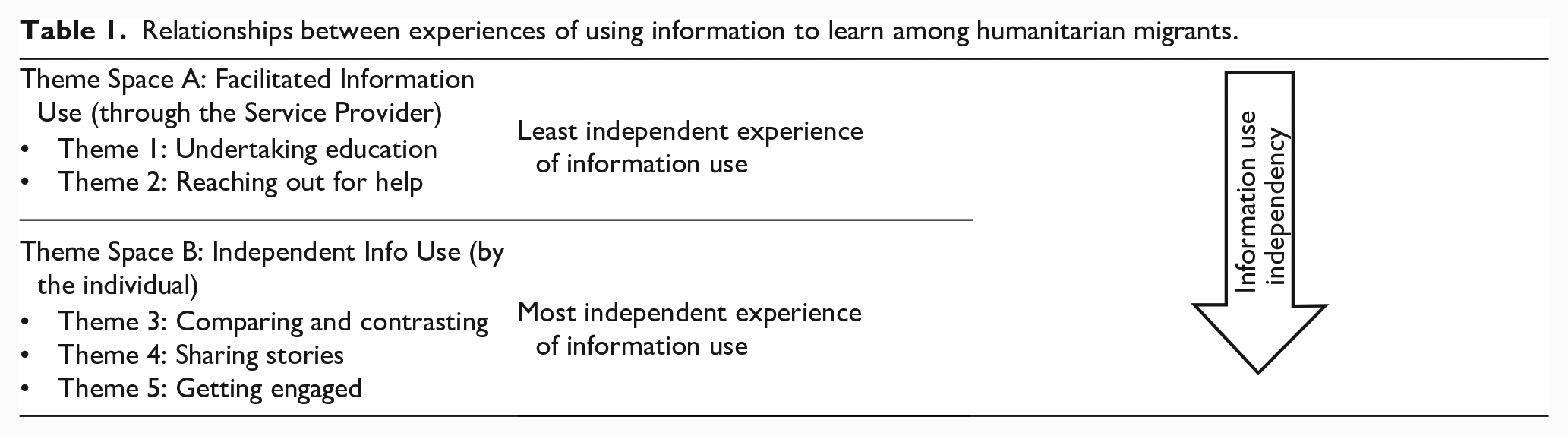
At a broad level, the themes are categorised into two parts: Theme Space A and Theme Space B. Theme Space A includes Theme 1 and Theme 2 which both describe humanitarian migrants’ information use as a facilitated experience. In these two themes, participants clearly emphasised the role of mediators and agents (e.g. case workers, interpreters, community leaders, trusted connections such as families, friends and children) in their information use towards resettlement and learning of the new life setting. The facilitation though is described to be more structured and controlled in Theme 1 compared to Theme 2 where facilitation occurs on demand and out of any controlled environment.
Theme Space B then includes three themes (Themes 3–5) that all describe independent ways of using information amongst humanitarian migrants. Information use within the themes of this space does not require any facilitation or intervention by the agents described in Theme Space A. Instead, the individual takes on a more proactive and contributory role in shaping their experiences of using information to learn. The humanitarian migrants appear to have more agency in how they experience information use in this theme space. They go beyond being a dependent recipient throughout the experience, to take charge in experiencing information use to learn.
Theme 3, the first theme towards independent information use, describes a very strong past-connected, personal and internal way of experiencing independent information use. Compared to other themes in Theme Space B (but also Theme Space A), the experience of information use in Theme 3 is very intertwined with individuals’ experiences from the past and their home country. That is, much of the experience of information use in Theme 3 is built with reference to and with the aid of humanitarian migrants’ past experiences in their home country.
The next theme in this space of independent information use, Themes 4, has a vivid social and sharing focus. The individual experiencing this way of using information independently connects with people within the new environment to learn from their shared stories about the host country. With a trace of reference to past experiences, similar to Theme 3, the humanitarian migrant in this theme may also choose to connect with people in the home country to share with a purpose of social betterment and empowerment for them. . In Theme 5 then humanitarian migrants demonstrate the most independency in experiencing information use to learn. Individuals in this theme very independently immerse themselves in the broad information environment of the host country, and become further included in it.
Considering the five themes together suggests a pattern through which humanitarian migrants’ information use move from more facilitated and less independent experiences towards more independent experiences with potentials for inclusion in the new society.
The similarity of the reported results and the outcome of a recent study by the authors (Names Removed for Peer Review, 2019) is noted here. In a former study, the authors explored the same phenomenon under investigation in the present study (i.e. experience of information literacy) amongst a different population – that is, skilled immigrants. A preliminary comparison across the two outcome sets reveals a high degree of similarities between the experiences of the two groups. Both groups use information to learn in many similar ways, such as through sharing stories, getting engaged in doing things and comparing and contrasting differences and similarities across the two life settings. Undertaking education, while a way through which both groups use information, is better supported amongst humanitarian migrants. Reaching out for help, mainly for the interpretation of the new environment, is an information use experience unique to humanitarian migrants. In contrast, reflecting and researching as a way of critically using a range of information sources to learn are experiences expressed by skilled immigrants only.
Discussion
The research reported here investigated Australia’s humanitarian migrants’ experience of information literacy. As suggested earlier in this paper, following a focus of research into information services tailored to refugees’ information needs, (research in Area 2 of the literature review), information scholars shifted their focus to conduct more user-focused investigations to explore information experience through the eyes of migrants themselves (research in Area 3 of the literature review). Research in this area is still emerging (Lloyd et al., 2017), and the understanding offered by the present empirical study contributes to the evolving picture of humanitarian migrants’ lived experience of information use.
The present study specifically sheds light on the current experiences of ‘information literacy’ amongst the humanitarian migrants – an aspect of their information experience that has not been investigated extensively, specifically within an Australian context. Among the few existing studies so far, all have approached information literacy of humanitarian migrants from a socio-cultural perspective to focus on the surrounding social and cultural factors that shape information literacy of this specific group. Through a socio-cultural lens, information literacy of humanitarian migrants has been mainly viewed as ‘at the heart of social life’ of this group of migrants (Hicks and Lloyd, 2016: 341), and within the intercultural settings they are situated. The present study contributes to the understanding of information literacy of humanitarian migrants from a different angle. The current study adopts a relational perspective to attend to the varying of experiences of this phenomenon. This study identified different ways through which humanitarian migrants experience information literacy, that is, the different ways in which they use information to learn. Adopting a qualitative interpretive approach incorporating thematic analysis techniques, this study uncovered five different ways in which humanitarian migrants engage with information to learn in the new host community when resettling and transitioning into it. The uncovered different ways and the relationships between them are summarised in Table 2. Adopting a relational perspective of information literacy, this study also contributes to research that has so far investigated information literacy from this viewpoint within an everyday life context in different settings (e.g. Demasson et al., 2016; Linares Soler, 2018; Sayyad Abdi et al., 2019; Yates, 2015; Yates and Partridge, 2014). This study situates information literacy within another everyday life setting (i.e. humanitarian migration) to paint a new portrait of this phenomenon when viewed from a relational lens outside of an educational or workplace setting.
Humanitarian migrants’ experiences of information literacy.
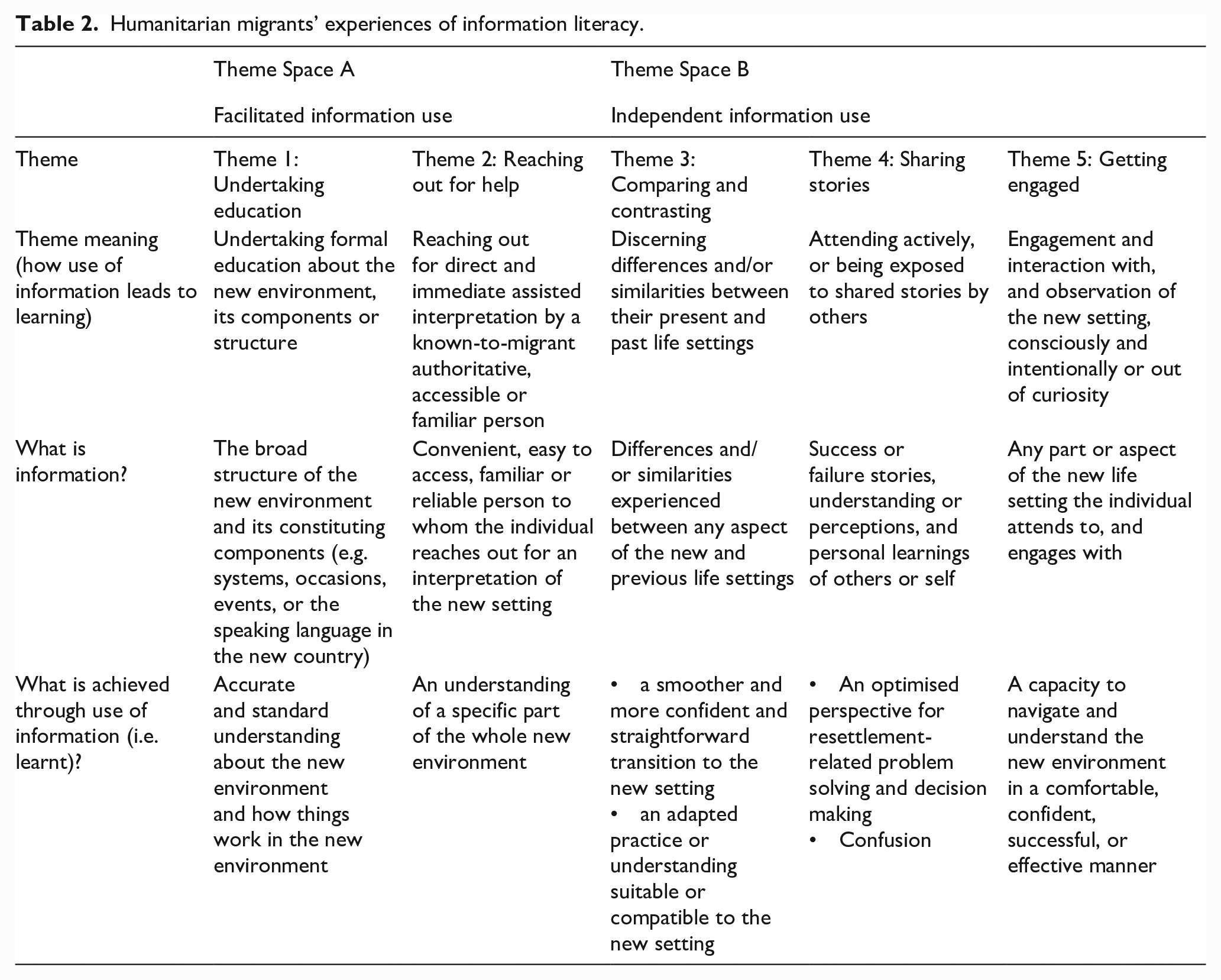
Along with findings of other studies into humanitarian migrants’ information experience, such as the situational map of sites and sources of the information landscape developed by Lloyd and Wilkinson (2016), an understanding of how humanitarian migrants seek, access and use information presented by Lloyd et al. (2017), a practical tool to inform integration process introduced by Oduntan and Ruthven (2017), or understanding of information needs and information seeking behaviours of refugees offered by Mansour (2018), Obodoruku (2018), Shuva (2020) and Yeon and Lee (2021), the outcome of this study further details the fractured information landscape of refugees, conceptualised by Lloyd (2017) and their journey towards ‘information resilience’ (Lloyd, 2015).. The five identified themes in this study all together describe how settling humanitarian migrants, following a disconnect from their familiar and comfortable-to-use information landscape, start to construct a new information landscape in the host country towards information resilience, competent and confident use of information, and consequently settlement and integration. The results of this study specifically add to the findings by Martzoukou and Burnett (2018), to acknowledge the importance of migrants’ past knowledge structure in shaping their information literacy in the new setting. The results summarised in Table 2 offer a basis to support the reconstruction of the fractured information landscapes of humanitarian migrants.
Resettlement and integration service providers can consider the findings of this study to design or redesign their services and programmes. They may, for instance, consider the revealed independency transition pattern across different types of information use (depicted in Table 1) when designing their services and programmes. That will shape offerings that strategically and smoothly heighten and widen individuals’ experiences of information use, support them to move from Theme 1 to Theme 5, and as a result, to become more independent with their information use. Additionally, the findings of this study can be considered in conjunction with the outcome of studies into the role of service providers to further inform the practice of such services and organisations. For instance, public libraries can consider the findings of this study jointly with the insights from the study by Audunson et al. (2011) into the role of public libraries in the lives of immigrant women. The articulated picture of information literacy journey of newly arrived humanitarian immigrants presented by this study joined with the portrayed role of public libraries, specifically in the early stages of migration offered by Audunson et al. (2011) can further inform public libraries on how best to provide their support and service to this cohort of immigrants in their early stages of settlement and integration towards active and full participation.
Further, resettlement and integration service providers may design services and programmes that provide a context for migrants to engage with information in a combination of the five identified themes. For instance, direct education (Theme 1) about an aspect of the new environment (e.g. law system) can be followed by contextualised and personalised interpretive assistance by case workers (Theme 2) to support migrants to understand how the broad and general information presented in an information session applies and is relevant to their unique personal situation. The individual who is provided structured and packaged information in a one-way direction in a short timeframe (Theme 1) may need assistance to unpack the received information and relate it to their specific situation (Theme 2), to then be able to use it themselves independently as in Theme 5. Such applications of the findings support formation of a united and connected new information landscape for them.
To support humanitarian migrants’ information literacy, it is, therefore, important for service providers to consider how best the identified ways can be combined and accommodated in specific offered programmes and services. Within that setting, information professionals are able to adopt a key role in assisting with further interpretation of the results from an information perspective.
When designing humanitarian immigrant support services and programmes, the findings of this study can also be accompanied by the results of its sister study (Name Removed for Peer Review, xxxx). The sister study similarly focused on the information literacy of newcomers, though from a skilled migrant background. That study revealed more independent and critical use of information through which migrants learn about their new setting, such as researching and being reflective. A combined yet comparative application of findings of the two studies can inform services and programmes that support humanitarian migrants for more sophisticated and independent ways of engaging with information. This further enables individuals’ independence as well as their deep learning about the new environment. Informationally literate and empowered, humanitarian migrants may become more independent in making informed decisions in all different aspects of their new lives – a crucial need for fruitful citizenship.
A future publication will bring the two sets of findings together for a closer comparison. This will involve a more detailed discussion about the similarities and differences in using information among the two groups, which will produce a more general understanding of the phenomenon of newcomers’ resettlement information literacy. The discussion will consider how differences in using information to learn in the more independent information user group (i.e. skilled migrants) could inform the enhancement of information use to learn in the less independent information user group (i.e. humanitarian migrants).
As with the majority of studies, the findings of this study have to be seen in light of some limitations. One limitation concerns the sample population studied. The scope of this study, in terms of geography, facilities and timeframe, did not allow the researchers to approach a full representative ethnic composition of humanitarian migrants resettled in Australia. It is therefore recommended that future studies explore the same phenomenon across other unexplored ethnic groups, in Australia and beyond, to further improve the generalisability and reliability of the findings presented here. In this regard, using multiple initiation points as well as census data can be beneficial (Sulaiman-Hill and Thompson, 2011). Also, while a range of strategies were applied to prevent possible effects of interpretation on data, it is acknowledged that the quality of the data collected in this cross-language qualitative study could still be improved through piloting the interview questions in participants’ language (Squires, 2009). Finally, within the scope of this study, there was no room for a deep exploration of each of the uncovered themes discussed above. Further studies could be designed to examine in depth each individual theme, its different aspects, requirements for realisation as well as challenges and barriers with which humanitarian migrants face when experiencing those ways of using information to learn during their resettlement and transition process.
Conclusion
This paper provides the outcome of a qualitative investigation into the experience of information literacy amongst people from humanitarian migrant backgrounds in Australia. The paper presents five different ways through which humanitarian migrants use information to learn about their new life. This ranged from dependent to independent ways of using information to learn. The understanding presented by this study is considered as a contextualised contribution to the abstract and theoretical concept of information literacy with potential for real world application. The paper suggests ideas for practical application of the findings to contribute more relevant and usable responses to resettlement information needs of the community of humanitarian migrants, which leads to their more impactful citizenship.
Footnotes
Acknowledgements
We gratefully acknowledge [Michael Zgryza] for their intellectual contributions to the project. We would like to thank all our participants for sharing their experiences with us. Ethics approval for the purpose of data collection was obtained from the research office of Queensland University of Technology.
Authors’ Note
Christine held the position of Dean Graduate Research from March 2018 to March 2023.
Declaration of conflicting interests
The author(s) declared no potential conflicts of interest with respect to the research, authorship, and/or publication of this article.
Funding
The author(s) disclosed receipt of the following financial support for the research, authorship, and/or publication of this article: This work was supported by the Australian Research Council [LP150101002].
