



Abstract
Information poverty is widely recognised as having a negative impact upon peoples’ health and wellbeing, and socioeconomic prosperity; however, whilst an issue of significant societal concern evidenced across a wide variety of adult groups and socioeconomic contexts, no studies have been previously undertaken with children. This appears a significant oversight given that many children across the globe are considered multi-dimensionally poor. This study thus sought to explore the possibility of information poverty amongst children. One hundred fifty-six children (aged 6–8) from five UK primary schools participated in a series of practical exercises exploring their information behaviours, and 34 parents and teachers were interviewed to provide further insights. Finding’s evidence self-protective information behaviours and unmet information needs amongst children aged 6–8; both characteristics of an impoverished information state. Whilst much can be explained in developmental terms (i.e. in relation to child age and emergent literacies), much can also be explained in information poverty terms encompassing issues of both information access and use. Notably, approximately half of our child participants considered themselves to be, in general, unsuccessful information seekers; and contrasts with the views of our adult participants who majority believed that children are, in general, successful information seekers. This paper provides the first evidence of information poverty in young children, and provides further insights into the role of parents in supporting their children’s information needs and shaping their developing information behaviours, with parental mediation of child media use appearing particularly problematic. Enduring inequalities in information access are also highlighted. Beyond call for further global research, a public communication campaign to increase awareness of child information poverty and contributory factors is recommended as an immediate priority.
Keywords
Introduction
Information poverty is widely recognised as having a negative impact upon the health and wellbeing, and socioeconomic prosperity, of individuals and communities (e.g. Lloyd et al., 2010; Marcella and Chowdhury, 2020; UNICEF, 2017). Related concerns include issues of social exclusion and social justice (Britz, 2008; Lloyd et al., 2013), and fundamental human rights including freedom of communication and expression (Britz, 2004). However, whilst an issue of significant societal concern evidenced across a number of adult population groups in a variety of socioeconomic contexts, we currently have limited understanding of information poverty amongst children. This appears to be a significant omission as we know that children can experience various other forms of impoverishment both social and economic (UNICEF, 2020). This study sought to address this gap in our understanding of information poverty, and in doing so, provides insights into the early manifestation of information poverty in young children.
Background
The information behaviours of young children
Whilst studies of information behaviour in young children are reported as limited (Barriage, 2022; Given et al., 2016), we are nonetheless beginning to build a picture of their emergent information behaviours from work conducted thus far. An overview is provided below to provide background context to our exploration of information poverty, with particular attention to early years (ages 3–9).
Information behaviours in children are reported to begin to emerge between ages 3 and 5, but to limited degrees dependent on individual cognitive development that in turn differs by child due to differences in both their environment and biological maturation (Given et al., 2016; Spink and Heinstrom, 2011). They obtain information largely through visual browsing and asking questions (Cooper, 2002) with their emerging information practices ‘shaped by the sources, tools, and people with which they engage’ (Given et al., 2016: 13). The concept of information is also reported to be an unfamiliar term difficult for children to conceptualise and define at this young age (Barriage, 2022).
Between the ages of 5 and 6 children are reported to have constructed ‘limited mental models of the notion of information’ (Shenton et al., 2008: 151), with developing search strategies described as ‘rudimentary’ (Shenton and Dixon, 2004b: 32); however, work by Spink et al. (2010: 201) also reports some children aged 5–6 as ‘sometimes performing complex web search interactions at the level of some adult web searchers’.
By ages 6–7 children are developing functional computer and search skills (Foss et al., 2012), but continue to largely obtain information through observing, listening and visual browsing (Cooper, 2002). They are described as ‘natural and inquisitive information seekers in the early stages of literacy development with limited skills in the use of textual information and meta-information’ (Cooper, 2002: 920). By age 7, many are also online. For example, OFCOM (2022) reports that by age 7 in the UK, 93% of children use video sharing platforms, 59% use messaging sites/apps, 39% use live streaming apps or sites, and 33% have an online profile on a social media app or site despite being under the minimum age of 13.
Between the ages of 8 and 9 children are reported to be moving from personal categorisation of information to understanding of more abstract categorisations based on taxonomic relations, and widening their access to information (Cooper, 2004). Much information seeking at this age remains motivated by personal experience and interests (Foss et al., 2012), but has begun broadening out to ‘more general and historical topics that are less rooted in their own lives’ (Shenton and Dixon, 2004a: 28).
Previous information behaviour studies also provide insights into the barriers experienced by young children when seeking information. These are commonly reported as relating to early stage reading and writing skills and developing cognitive abilities. Information literacy skills are also discussed. For example, Foss et al. (2012: 563, 568) describes children between the ages of 7 and 11 as developing searchers who experience ‘notable difficulties with basic skills, as well as with more complex abilities such as keyword query formulation’, with frustration reported as ‘extremely common’ amongst children of this age.
Information poverty and young children
Whilst definitions of information poverty vary somewhat by author, there is general consensus that key concerns relate to issues of information access, and information use; with key contributory factors generally reported as technology and literacy issues, and economic and sociocultural factors and norms. Recognised as a context sensitive phenomenon (e.g. Britz and Blignaut, 2001; Lingel and Boyd, 2013), some scholars also posit that, in some circumstances, information poverty can be a self-imposed state as part of peoples’ coping mechanisms (Diener, 1987; Sweetland, 1993; Wilson, 1983).
Previous studies have investigated information poverty across a wide variety of adult population groups and contexts, including janitors, single mothers and ageing populations (Chatman, 1996), female prisoners (Chatman, 1999), healthcare service managers (MacDonald et al., 2011), refugees (Lloyd et al., 2013), people with OCD (Bronstein, 2014), homeless men (Duff, 2015), people adopting minimalist lifestyles (Pollak, 2016), unemployed adolescents (Buchanan and Tuckerman, 2016), migrant workers (Bronstein, 2017), male prisoners (Canning and Buchanan, 2019), and young disadvantaged mothers (Buchanan et al., 2019). Whilst much information poverty research has involved economically disadvantaged groups, the theory of information poverty has also been used to more broadly explore the influence of structural inequalities on peoples’ information behaviours, for example, studies involving: young gay men (Hamer, 2003), extreme body modifiers (Lingel and Boyd, 2013), young parents (Greyson, 2017), mothers of children with disabilities (Gibson and Martin, 2019), and Muslim women in Arab society (Buchanan and Husain, 2022). Such studies, often involving stigmatised groups and/or sensitive topics, draw further attention to the social and cultural dimensions of information poverty, and challenge deficit perspectives of the information impoverished. Several also evidence that binary distinctions between the information rich and the information poor can be too simplistic, as people can be simultaneously information rich and information poor when their information needs are viewed holistically (some needs easily met, others not so, and influenced by various economic and sociocultural factors). Lingel and Boyd (2013: 990), discussing the contextual and fluid aspects of information poverty, argue that ‘Information poverty is generated in social situations where norms play out in terms of privilege and marginalisation’.
To date, no information poverty studies have been undertaken with young children. Adolescents have been studied under the lens of information poverty, but limited to two studies discussed below.
Moore (2016), via literature review, examined the influence of social networking sites (SNS) on the information seeking behaviours of adolescents aged 11–19, including some discussion from an information poverty perspective. However, the review is limited to synthesis of a small number of existing studies reporting on general information behaviours and/or the role of SNS, with none of the cited works themselves information poverty studies. No new empirical data is presented, and information poverty is limited to discussion in general terms.
Buchanan and Tuckerman (2016) examined the information behaviours of disadvantaged adolescents aged 16–19 from UK areas of multiple deprivations and provide evidence of information poverty. Conducted via fieldwork in community support groups, the authors report adolescent participants as living a ‘stratified existence within an impoverished (small) information world’ (Buchanan and Tuckerman, 2016: 527). The authors evidence significant access and internalised behavioural issues impacting upon participant information behaviours, the former influenced by technology and literacy issues, the latter by social structures and norms.
The above overview of previous studies illustrates that whilst there is some evidence of information poverty in young people, research is limited to adolescents aged 16+, with no studies to date conducted with children. As previously noted, this appears to be a significant omission as we know that children can experience various other forms of impoverishment both social and economic. For example, UNICEF (2020) report that 1.2 billion children worldwide are multi-dimensionally poor. Within the UK, 3.5 million children (25% of the total UK child population) are reported to live in absolute poverty (Francis-Devine, 2022) with similar rates reported in breakdowns for Scotland (the study zone), and projected to increase to 38% of the child population in Scotland by 2030/31 without action (Scottish Government, 2018). UNICEF (2017: 60), discussing relationships between information poverty and child poverty, posit that ‘[information poverty] contributes to expanding and extending gaps in opportunity for children, making the most disadvantaged even worse off and fuelling intergenerational cycles of poverty’. However, whilst drawing important attention to the issue of child information poverty, UNICEF (2017: 60) also highlight a paucity of research attention, with data on child information poverty described as ‘scarce’. UNICEF (2017) have called for further research to better understand information poverty amongst children, but progress appears limited in the intervening years as evidenced by our preceding literature review.
In summary, information poverty is widely recognised as having a negative impact upon the health and wellbeing, and socioeconomic prosperity, of individuals and communities; however, whilst an issue of significant societal concern, we currently have limited understanding of prevalence and impact amongst children, including how early information poverty manifests in children’s lives, and in what ways. This raised two key research questions:
Do children experience information poverty, and if so, in what ways?
If children do experience information poverty, what are contributory factors?
Methodology
Theoretical framework
Our theoretical framework was provided by Chatman’s (1996) small world theory of information poverty, which describes an impoverished information state as one in which people (to various degrees):
perceive themselves to be devoid of sources of help;
are influenced by outsiders who withhold privileged access to information;
adopt self-protective behaviours in response to social norms;
are mistrustful of the interest or ability of others to provide useful information;
withhold their true problems in the belief that negative consequences outweigh benefits;
selectively receive new information in response to their everyday needs.
Chatman (1996: 205) posits that in impoverished circumstances a stratification of information access and use will be evident in a ‘world on which (social) norms and mores define what is important and what is not’. In such circumstances people can withhold problems (and associated information needs) in the belief that negative consequences outweigh benefits; and variously employ self-protective behaviours of: secrecy (intentional concealment), deception (distortion of truth), risk-taking (aversion to risk), and situational relevance (focus on immediate utility).
It is important to note that whilst guided by Chatman’s (1996) theory of information poverty, our overall approach also incorporated an inductive element (see data analysis) in recognition of exploratory aspects (given the lack of previous information poverty studies involving children).
Sample
An important initial consideration when seeking to explore the early manifestation of information poverty in children was what age our child participants should be? As previously discussed (see #2 Background), information behaviours in children are reported to begin to emerge between ages 3 and 5, but to limited degrees dependent on individual cognitive development that in turn differs by child due to differences in both their environment and biological maturation. In broad terms, cognitive psychologists generally consider ages 6–7 (approximately) to be the point when autonomous behaviours and capacity for mental operations begin to more visibly manifest and rapidly develop in children (Woolfolk, 2016). This corresponds with Piaget and Inhelder’s (1972) third stage of cognitive development, concrete operational, when children’s thinking ‘becomes more organized and flexible’, and children are able to consider ‘alternative approaches and strategies for solving problems’ (Lightfoot et al., 2009: 397). Similar age-related developments are found in Bruner’s (1957) theory of cognitive development, and Erikson’s (1950) psychosocial theory of development, and are reflected in reports of developing information behaviours in children (see #2 Background). We thus identified ages 6–8 as an appropriate age range for our child participants (with age 8 providing an upper allowance for some variance in individual child development).
We also sought to involve parents and teachers of children aged 6–8 in this study, to provide further insight into child information behaviours (i.e. parents/teachers as passive observers of child information behaviours), and to also explore the role of parents and teachers in child information behaviours (i.e. parents/teachers as active participants in child information behaviours). Involving both groups would also provide further insight into children’s information behaviours in both their home and school environments. Given that the topics that we would be exploring with children would include secrets and barriers to information seeking that might involve their parents and/or teachers, and to avoid placing any unnecessary stress (and/or influence) on our child participants; we intentionally recruited parents and teachers who were not the parents or teachers of our child participants.
Child participants were recruited via invites to primary schools in the study zone (the Central Belt of Scotland), via the authors’ research institution outreach team, and through class teachers. Teachers were recruited via invites to schools, and via Facebook/Twitter, as were parents (for example, teacher recruitment via invites to the Scottish Primary Teachers Facebook group, and parent recruitment via Facebook local community groups within school catchments).
Data collection
Our fieldwork design was informed by general principles and guidelines for conducting research with young children. We recognised that child research participants should be accessed via their ‘adult caretakers’ (Carey et al., 2001: 327), in this case their teachers, who would not only facilitate access, but also help the researcher to ensure that the children understood the research process. In relation, we recognised that it was important that all explanations of the research process should be couched in simple concrete terms understandable to children (McKechnie, 2000: 64), and that the children should not only understand the nature of the research, but also that ‘their views will be respected’ and all contributions ‘taken seriously’ (McLaughlin, 2015: 10). The research process was thus carefully explained to the children in understandable terms by both teacher and researcher, and reiterated as part of the warmup and orientation exercise described below. We also recognised that child engagement required careful consideration of age-appropriate activities. When working with children, Tinson (2009) recommends a mix of techniques that give consideration to task appeal, attention span and timings. We thus avoided lengthy tasks (breaking activity down into five small exercises), and introduced further variety into the research design through use of various props and materials, and varied use of the physical classroom space (described below). Finally, in designing classroom exercises, we recognised that by age six, children are becoming familiar with taking part in shared discussions with their peers (Mukherji and Albon, 2015: 158), and that being in the company of their peers can also help children to better articulate their thoughts (Roberts-Holmes, 2011). The detailed design is described below.
Prior to tasks and as a warmup and orientation exercise, the researcher introduced the study to child participants via a hand puppet called Jack who it was explained wanted to find out information about dinosaurs (with the researcher providing examples of the types of questions Jack wanted to ask). Children were then asked what Jack might do to find answers to his questions (what Jack might use, who Jack might ask etc.). After some group discussion, the researcher then proceeded to tasks.
In the first task, children were given pictures of four sources of information (adults, other children, Internet, books), and asked to place a tick on pictures that they obtained information from, and a cross on those that they did not. Pictures with crosses were then collected in by the researcher with further tasks then focused on the sources variously used by participants.
In the second task, children were asked to put a number one on the source that they used most often to obtain information from (note. it was also explained that a number one could be placed on multiple sources if considered appropriate). Children were also asked if there were any other sources not depicted in the pictures that they obtained information from.
The third task asked children to put a smiley face sticker on any source pictures that they found easy to obtain information from, and a sad face sticker on any source pictures that they found hard to obtain information from. Children could also place both stickers on a source picture if they found the source sometimes easy to use, and sometimes hard to use.
In the fourth task, and to vary activity (to maintain child engagement), children were asked to get up from their desks and go to one area of the classroom if they felt that they were in general successful in obtaining the information that they sought, or to go to another area of the classroom if they felt that in general, they were not successful. Children who indicated that they are generally successful were then asked to move to another area of the classroom if they obtained this information by themselves (i.e. independently). Once all participant movements were completed, the researcher took a headcount of the respective groups.
The fifth and final task explored potential secrecy regarding information and/or information needs. Children (now back at their desks) were provided with a sheet of paper and asked to place a tick on the sheet if they had ever not asked a question or not revealed certain information, or a cross if this had never occurred. Children were also made aware that they could provide further explanatory details, but that this was entirely optional. Children were then asked to place their completed papers in a pirate treasure chest that had been brought along for this task (for engagement purposes and to communicate the value of their input including that the anonymity of their answers would be protected in the same way that a pirate might protect their treasure).
Throughout each of the five activities any additional information provided by children (e.g. children offering additional information to the researcher to explain and/or further discuss tasks) was noted by the researcher.
Semi-structured individual interviews were also conducted with parents and teachers of children aged 6–8. Questions explored parent and teacher observations and involvement in child information seeking behaviours including sources of information used and not used by the children in their care, how successful they feel that the children in their care are in obtaining the information that they seek (in general and independently), the difficulties and barriers that children experience as information seekers, and if there was anything that they thought might improve child information seeking. Parents and teachers were also asked if they thought that the children in their care kept any information and/or information needs secret.
Data analysis
Thematic analysis followed Braun and Clarke’s (2006) approach: data transcription and familiarisation; initial code generation; collating codes into themes; reviewing themes; refining, and then finalising themes. Data was disaggregated into meaningful categories via identification of patterns and regularities through iterative cycles of pattern coding and thematic analysis, with reference to source data (completed exercise materials, interview transcripts). Initial start-list codes were based on, but not limited to, Chatman’s (1996) concepts of information poverty (e.g. secrecy, deception). Further codes were emergent from data (e.g. access barriers, adult mediation roles). Analysis also included identification of exemplar quotes (from coded data extracts) for inclusion in this paper to evidence findings.
Ethical approval
Ethical approval was obtained via Institutional Ethics Committee (authors employing institution), with the study run in strict accordance with the University Code of Practice on Investigations of Human Beings. Informed written consent was obtained from all adult participants. Consent for child participants was obtained from participating schools who had been fully briefed on the study (purpose, design etc.) including ethical protocols, and who were provided with information sheets to brief all participating staff and children in advance. Prior to study activity with children the researcher took time to once more explain to child research participants what would be asked of them, including that participation was entirely voluntary. All exercises were undertaken in the classroom with the children’s class teacher present throughout.
Findings
Participant demographics are provided below, followed by findings.
Participants
In total, 156 children, 17 parents and 17 primary school teachers participated in this study. Participants were variously recruited from within the Central Belt of Scotland (the area of Scotland with the highest population density and diversity), and representing urban and semi-urban areas.
Child participants were from five primary schools all located in Quintile 1 (most deprived) of the Scottish index of multiple deprivation (SIMD, Scottish Government, 2019). 85 children were female, and 71 male. 4 children were aged 6, 104 aged 7 and 48 aged 8 (avg. age 7). Ethnic distribution was: 94 White, 47 Asian, 11 Arab, 3 Black and 1 Mixed.
Parents of primary school children aged 6–8 variously resided in SIMD Quintiles 1–5 (1 most deprived, 5 least deprived), with the majority resident in Quintile 4. Fourteen were female, and three male. Age range was 31–50. Ethnic distribution was: 16 White, 1 black. Fifteen possessed university qualifications, one possessed a college qualification, and one had attended university but not completed.
Primary school teachers of children aged 6–8 were from 12 primary schools (11 state, 1 private) with the schools variously located in SIMD Quintiles 1–5, and the majority from schools in Quintile 4. All teachers were female. Ethnic distribution was: 14 White, 2 Asian, and 1 Mixed. Collectively, our teachers possessed 173 years’ experience of teaching primary school children including 47 years of collective experience specifically teaching children aged 6–8.
Children’s use of common information sources
Initial activity with child participants explored the use of common sources of information (Internet, adults, books, other children) including ease and/or difficulty of use. Some variance in participation numbers in each of the activities is due to a number of factors: spoilage, children on comfort breaks during some tasks, and some non-completion.
One hundred forty-five of one hundred fifty-six child participants (93%) indicated that they use the Internet as a source of information, 132 of 156 (85%) indicated use of adults, 109 of 156 (70%) use of books, and 84 of 156 (54%) use of other children. In relation, 7% of our child participants indicated that they do not use the Internet to obtain information, 15% do not use adults, 30% do not use books and 46% do not use other children. Some children offered supporting explanations for why particular information sources were not used. For example, one child commented that they did not use the Internet because ‘Google lies’, and another that what they were looking for (not specified) ‘wouldn’t be on it’. With regard to adults, one child commented that adults ‘don’t know the English’, another that adults ‘don’t have the knowledge enough to talk to you’, and another that adults ‘ignore you’. With regard to books, one child commented that ‘books aren’t always right’, and another that book authors ‘might not know the answer, the author just guessed it’. With regard to other children, one child commented that they would not ask other children because they might ‘tell you the wrong answer’, and another that they might ‘lie’.
When asked to place a number one on the source of information that they used most often (or multiple sources if felt appropriate), 166 placements were made by child research participants with the ‘ones’ distributed across the four sources as follows: Internet (58%); adults (23%); books (13%); and other children (6%). Children were also asked if there were any other sources of information that they used not depicted in the pictures, with no further information sources added. Responses are illustrated in Figure 1.
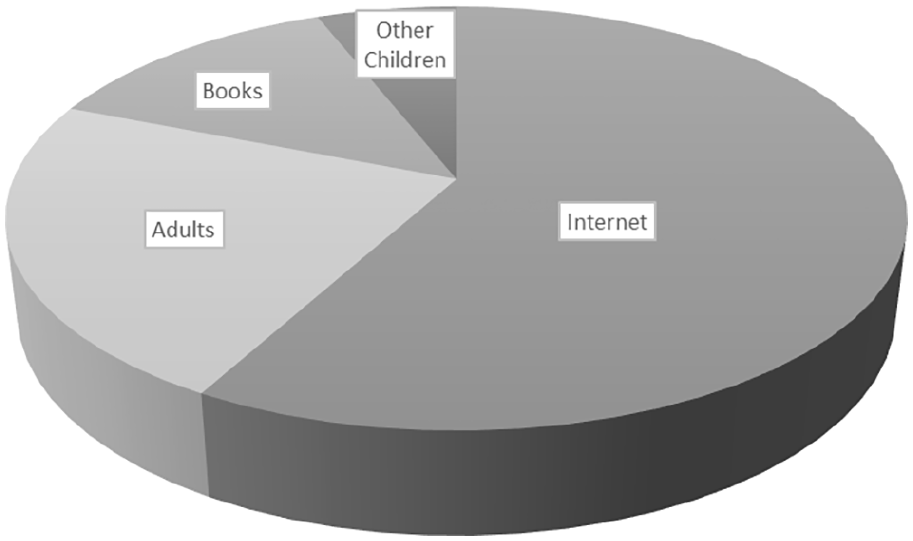
Children’s frequency of use of common sources of information.
With regard to ease or difficulty of use of information sources 70 of 139 children (50%) considered the Internet easy to obtain information from, 59 (43%) considered the Internet sometimes easy and sometimes hard to obtain information from, and 10 (7%) considered the Internet hard to obtain information from 38 of 124 children (30%) considered adults easy to obtain information from, 74 (60%) considered adults sometimes easy and sometimes hard to obtain information from, and 12 (10%) considered adults hard to obtain information from 29 of 97 children (30%) considered books easy to obtain information from, 50 (51%) considered books sometimes easy and sometimes hard to obtain information from, and 18 (19%) considered books hard to obtain information from 15 of 67 children (23%) considered other children easy to obtain information from, 29 (43%) considered other children sometimes easy and sometimes hard to obtain information from, and 23 (34%) considered other children hard to obtain information from. Responses are illustrated in Figure 2.
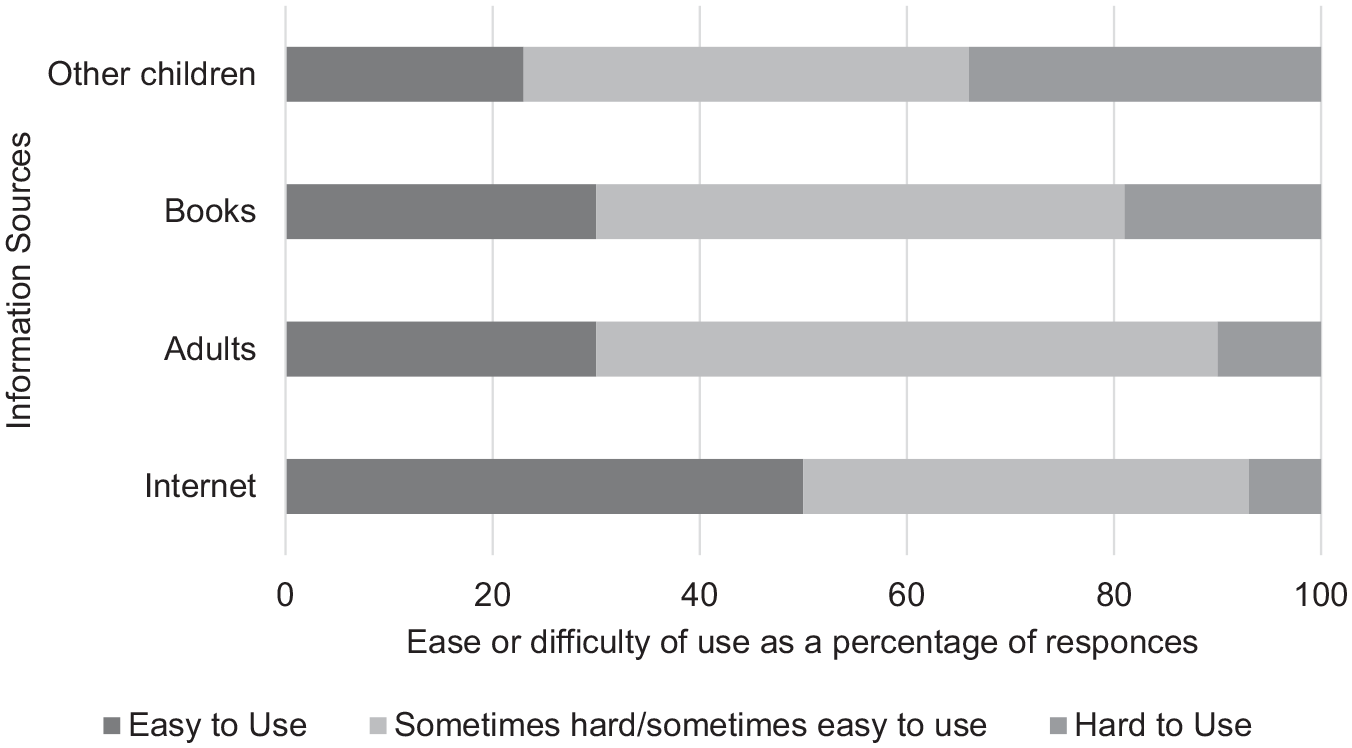
Children’s ease and/or difficulties in using common information sources.
Children’s success in obtaining information
Eighty-one of one hundred fifty-six child participants (52%) considered themselves to be, in general, successful in their information seeking; and 75 of 156 (48%) considered themselves not to be successful. In relation, it is notable that the class with the highest proportion of children who considered themselves successful information seekers (83%) was made up entirely of children from the White ethnic group (100%), whilst the class containing the lowest proportion of children who considered themselves successful information seekers (21%) was majority made up of children from minority ethnic groups (79%).
With regard to parent and teacher responses, 17 of 17 parents (100%) and 14 of 17 teachers (82%), thought that the children in their care are, in general, successful information seekers. For example, parents and teachers variously commented that their children/pupils ‘would find the information’, ‘definitely find out’, and ‘won’t stop’ until information is obtained.
Children’s success in obtaining information independently
Of the 81 of 156 child participants who consider themselves to be successful information seekers, 49 of 81 children (60%) also considered themselves to be successful independent information seekers. However, 32 of 81 (40%) did not regard themselves as successful independent information seekers and several discussed a dependence on adult support. For example, one child commented that they can only successfully obtain Internet information if an adult puts ‘up a web site’, or assists them to ‘spell the word’.
With regard to parent and teacher responses, 10 of 17 parents (59%) and 8 of 17 teachers (47%) thought that the children in their care could, in general, successfully obtain information independently. Indicative parent comments include one parent who said that their child ‘would get on fine’, and another who said that their child would ‘keep trying until they found something’. Teachers discussed child success in working independently as something that not only varied by child, but also something that could vary by topic and point in the curriculum (in terms of what has been previously taught and children’s maturity/abilities at that point), and the source that the information has to be obtained from (including practical access considerations). Parents and teachers who considered the children in their care not to be successful independent information seekers (41% of parents and 53% of teachers respectively) discussed various individual support needs as part of natural child development. Indicative parent comments regarding the support role that they provide to their children included mention of having to offer ‘direction’, to ‘guide’, and to help their children ‘find the right bit of information’. One parent on reflection thought that the support that they provided might be discouraging their child’s independent learning, commenting that their child had ‘never been given the opportunity [to independently obtain information]’.
Barriers to children obtaining information
With regard to barriers, the children themselves raised a number of information access barriers. Several commented that parents and teachers are not always available or able to answer their questions. For example, one child commented that their parents ‘don’t always know the answers’, and another that their parents ‘don’t really get it right’. With regard to teachers, one child commented that teachers can be ‘super busy and just say “go and sit down in your seat”’, and another commented that teachers ‘don’t listen to you’. Similar comments were made regarding other children. For example, one child commented that other children ‘wouldn’t know’, and another that other children ‘just want to play, instead of listening to you’.
Several children also discussed limited access to the Internet variously due to technology, time, and/or parental restrictions. For example, one child commented that their access device ‘isnae [isn’t] working’, and another that their access device ‘does not have enough battery’ to use for any length of time. Another child commented that they ‘never get a chance’ to access the Internet at home because someone else in the household ‘always uses the computer’, and another commented that they ‘don’t go on Google’ at home due to parent restrictions.
Issues with access to books were also raised by children including stock unavailability or damage. For example, one child commented that they could never obtain library books because ‘the other person has like got it before you’, and another recalled that they could not use a library book because ‘somebody has ripped the page out and you can’t get the answer’. Another child commented that they ‘don’t know what one [book] to start with’. Some children also discussed reading difficulties. For example, one child described the words in books as ‘too tricky’, and another as ‘too hard to read’.
When discussing child barriers to information, the majority of parents discussed their intermediary role, and appeared cognisant to both protective and restrictive gatekeeper aspects of such roles, particularly with regard to Internet access. For example, one parent explained that they restrict what information their child can access online because they ‘fear’ that their child might access information that ‘they don’t have the capability to understand’ such as ‘war or even famine . . . or adverts’. The parent was concerned that their child might ‘then think that could happen to me’ which could cause ‘unnecessary worry’. They described their restrictive practices as ‘on the side of caution’, but acknowledged that this ‘can stop [name] from finding out what they want to know’. Other parents discussed routinely advance vetting, filtering, and interpreting information for their children. For example, one parent commented: He asked me recently how long the Tooth Fairy had been around so I Googled it but obviously all the resources would have spoiled his childhood so I would never ever let him read them. . . and Santa stuff and things like that. Yeah, traditions in different countries, that then would spoil things for him in his childhood, I’d be careful about stuff like that, and medical things I suppose, cause [name] is a little thinker and he asks lots of questions so like a death in the family for a particular disease, I would still help him look things up, but I would check it before I let him read it.
Parent comments also demonstrated how personal beliefs can play a role in parent responses to child questions. For example, one parent discussed being asked by their child what happened after death, and told their child about heaven; but another parent discussing a similar query from their own child, had described heaven as ‘nonsense’ and had instead informed their child ‘about decomposition’. In another example, one parent informed their child that ‘Santa is not real’, whilst other parents discussed opposite responses to similar questions (i.e. Santa is real). Whilst the majority of parents monitored and controlled their child’s information access, one parent discussed allowing their child unsupervised Internet access, commenting: I am sure some people would criticise that yeah sure you are busy making dinner they could be looking up something thoroughly inappropriate I think that you can’t be there all the time…. You can’t, you can’t police their whole lives, you are not there in the playground when people are talking about things…. If you think that you can control everything they see and hear then you are kidding yourself on.
Some parents also discussed child motivation as a barrier to their children obtaining information, with children believed to not always possess the necessary attention span and perseverance to obtain information. For example, indicative parent comments described some children as being ‘too lazy’, of ‘lacking patience’ to obtain information, and expecting ‘instant satisfaction’.
The majority of teachers discussed child literacy skills (i.e. reading, information, digital) as a key barrier to information access given that children aged 6–8 were still in the early stages of learning such skills. For example, one teacher explained why a lack of reading skills can be a barrier for children, commenting that ‘it’s quite laboured, it’s a hard thing for them to do, if children are having to sound every single letter or every single diagraph by the time you’ve got to the end of the sentence you’ve no idea what it meant’. Several teachers also discussed limited information literacy. For example, one teacher commented that such young children do not yet have the ‘research skills. . . [to know] where to look or who to ask’, and another that they don’t yet know ‘what to type into like Google’ or ‘what words to search’. Some teachers also commented that literacy issues can also extend to the children’s parents. For example, one teacher commented that some parents ‘don’t have the language skills to help [their children]’, and that some pupils can be ‘better readers than their parents’. Similar to child responses, teachers also discussed limited child access to the Internet and books. For example, one teacher commented that ‘many of my pupils don’t really have access to the Internet’, and another commented that many children ‘have no books whatsoever, not even a newspaper at home, not even a comic’. Several teachers discussed their own attempts to provide books for their pupils, often at their own expense. For example, one teacher commentated ‘at Christmas and summer I buy them [class pupils] a book’. Another that: Very few children are read to. If I can take time out of my day, be it ten minutes at the end of a day, to try and read them a novel [. . .] I think that’s invaluable. They love it but some of them never ever get read to. . . . That double cupboard there [points to cupboard in classroom] is packed with my daughter’s books, books I have collected over the years. They love them. They pore over them. . . Some of them don’t have very many books at all.
And another that: Being able to invest in reading for pleasure materials, it’s not always possible to do that, quite often you will find that in a class library it’s the staff that have provided the books. It’s not the school funds per se that have afforded it.
Similar to parents, some teachers also discussed child motivation as a potential barrier. For example, one teacher commented that pupils can ‘expect to find it [information] straight away’ and have not yet developed resilience to persevere with information seeking. Another commented that children can ‘think they have failed if they have not found something out the first time’.
Children’s information needs and secrecy
Seventy-one of one hundred thirty-eight child participants (51%) indicated that they have concealed information and/or information needs from others. A small number of children provided supporting explanations on returned papers. A recurrent theme was shyness. Others stated that they were variously ‘scared’ or thought that their need might be ‘silly’, or had been in the company of people that they did not know well.
With regard to parent and teacher responses, 12 of 17 parents (71%) and 14 of 17 teachers (82%) thought that the children in their care do conceal information/information needs. Similar to children, parents also discussed shyness as a contributory factor. For example, one parent commented that ‘there would be some things he would be quite shy [about], . . .and he wouldn’t ask’ and another that there are some questions that their child ‘might be a bit embarrassed to ask’. Another parent commented that they felt that their child likes to ‘keep some things private’. Parents also provided some insights into topics concealed or reluctantly revealed by their children. For example, one parent discussed how their child had been reluctant to complete a recent task at school worrying ‘about giving too much away about himself’. Another parent commented that their child had been too ‘embarrassed’ to discuss boyfriends, later revealing that they had been worried that their parents would ‘flip out’.
Teachers also provided insights into secretive behaviours of children and influencing factors. One teacher believed that growing self-awareness and fear of looking ‘silly’ was ‘the biggest reason they [pupils] would not ask anything’. Some secretive behaviours would only become apparent when the consequences could not be hidden. For example, one teacher discussed a child who had been too embarrassed to reveal that they had needed the toilet and had subsequently soiled themselves in class. Teachers also discussed influence of family on their pupils’ secretive behaviours. For example, one teacher commented that there are children ‘who absolutely would not have told you anything for fear of drawing you into family situations’, or because they had been ‘influenced at home’ and ‘told not to share certain information’. Another commented that there are topics such as ‘being pregnant’ or ‘having babies’ that some children have been told by their parents that they are not allowed to discuss.
With regard to parents and teachers that felt that the children in their care do not keep secrets (29% of parents, and 18% of teachers); parents and teachers both discussed a lack of child inhibitions and self-awareness as contributory factors. For example, one parent commented that ‘everything that goes on in his head comes out his mouth’ and that their child will ‘hide nothing from me’, and another parent commented that their child has ‘no filter’ and ‘just comes out with anything’. In relation, some parents discussed making their children aware of what information should or should not be shared or asked for. For example, one parent recalled explaining to their child that ‘you could potentially offend [someone]’ because some questions ‘are quite rude to ask’. Teachers discussed how willingness to share information or ask questions noticeably diminished as self-awareness grows and children became ‘a wee bit more self-conscious. . . and less relaxed’, with several discussing ages 7–8 as key point in this respect. For example, one teacher commented, ‘their awareness, their self-awareness, their learning-awareness, to their image-awareness, all this now I think starts in primary three [in Scotland avg. age at start of primary three is 6–7]’.
Discussion
The most used information source by the majority of our child participants is the Internet (encompassing school VLE resources), closely followed by adults, and then to lesser degrees, books and other children respectively. Internet preferences appear comparable with general reports of media use amongst UK children of similar ages (OFCOM, 2022), and reflect the increased use in UK schools of online learning services encompassing games-based learning (for example, see maths and spelling resource Sumdog). In relation, the Internet is also considered by child research participants to be the easiest source to obtain information from (general note. in UK primary schools, much Internet use is directed learning within VLEs as opposed to independent searches at this age), followed by adults and books, and then other children. Other children are not used as information sources by almost half of our child research participants, and books are not used by almost one-third. A small number of our child participants indicated no use of adults or the Internet.
Approximately half of our child participants considered themselves to be, in general, successful information seekers; and approximately half considered themselves not to be. In relation, there is some indication in our findings that the number of children believing themselves to be, in general, unsuccessful information seekers is higher amongst children from minority ethnic groups, and warranting further research attention. In contrast, all parents and the majority of teachers considered children to be, in general, successful information seekers. A possible explanation for adults believing that children are more successful information seekers than children believe themselves to be, is adults not being fully aware or involved in all the everyday information needs of children. A further factor is child secrecy, with half of our child participants disclosing that they have concealed information and/or information needs from others largely due to fear of embarrassment and/or disapproval; and providing evidence of unmet information needs and self-protective information behaviours, both characteristics of an impoverished information state, with secrecy considered a ‘critical concept’ (Chatman, 1996: 193). Finally, when considering variance in child and adult responses to the question of degree of child success (or not) in information seeking, it should also be reiterated that our adult participants were not the parents and teachers of our child participants. However, whilst a potential variable to consider in relation to parent responses; our teachers were drawing on their substantial collective experience of teaching a wide range of children aged 6–8 to answer this question. We thus believe it remains a notable finding for further consideration and research.
A number of further factors impacting upon child information seeking behaviours are also identified. All participants (children and adults) discussed emergent literacy skills (reading, information, digital) as a factor with children often dependent upon adult support to locate, access, and use information (as skills naturally developed). Children and teachers also discussed limited access to information due to various practical constraints (e.g. adults unavailable, limited access to technology, and books unavailable or damaged). The former (early stage reading and writing skills and developing cognitive abilities) is consistent with previous reports of barriers experienced by young children when seeking information (see #2 Background). More notable are our findings regarding inequalities of access to information including teachers self-funding book provision in UK schools.
A further factor relates to parental restrictions. Several parents discussed routinely monitoring and controlling the information that their children had access to (some determined by personal beliefs), and some were aware that such gatekeeper practices, whilst in place for protective reasons, could also be restrictive. In relation, teachers also discussed overly restrictive practices amongst some parents including censorship and the encouragement of secrecy. Findings support the work of previous scholars reporting on the role environment plays in influencing the developing information behaviours of children. For example, Spink and Heinstrom (2011: 254) note that ‘cultural and social contexts. . . shape which information behaviour a child adapts’ through the development of ‘socially governed understanding’; and Burnett and Jaeger (2011: 62) discuss the influence of family and the ‘small worlds in which the individual lives’ on household information behaviours. Burnett and Jaeger (2011: 172) argue that information behaviours ‘mirror the norms, attitudes, values and concerns of communities lived in’. Burnett and Jaeger (2011: 170) also note that environmental influences can be ‘inherently neutral’ but can also ‘work to homogenise perspectives’.
If we return to Chatman’s (1996) six propositional statements that describe an impoverished information state, and apply to our findings:
With regard to proposition one (devoid of sources of help), none of our children appeared devoid of help, but several indicated limited access to help (e.g. parents, teachers, technology, books).
With regard to proposition two (behaviours influenced by outsiders who withhold privileged access to information), this is evident in parent and teacher roles as information gatekeepers.
With regard to proposition three (adoption of self-protective behaviours in response to social norms), this is evident in child secrecy, in some instances under the direction of parents.
With regard to proposition four (mistrustful of the interest or ability of others to provide useful information), this was evident in child mistrust of certain information sources (e.g. other children).
With regard to proposition five (belief that negative consequences outweigh benefits), this is evident in child secrecy due to fear of negative consequences (e.g. embarrassment or punishment).
With regard to proposition six (selectively receiving new information in response to everyday needs), this was not evident. In contrast, much child behaviour appeared naturally inquisitive.
Findings contribute to our general understanding of child information behaviours and the early manifestation of information poverty in children, identifying persistent inequalities of access to information, and providing further insight into the role of parents in supporting (or not) their children’s information needs and shaping their developing information behaviours. In particular, and in their intermediary role as information gatekeepers, parents’ balance between protection and restriction appears particularly problematic and is discussed further below.
Our findings regarding parental involvement are consistent with other reports of child media use and parental mediation challenges within the home. For example, OFCOM’S (2022) UK survey of child media use and parent’s attitudes to child media use reports that 89% of parents mediate their children’s online behaviours. Previous studies of parental mediation (e.g. Kirwil, 2009; Livingstone and Helsper, 2008) commonly report that, in general, parents favour social forms of mediation over technical forms, and in relation, typically adopt multiple strategies variously instructive and/or restrictive. Previous studies also report that many parents find mediation difficult and stressful with reported problems including how to identify appropriate and inappropriate websites, and determining at what age their children are entitled to privacy (Nikken and De Haan, 2015). It is also reported that whilst younger children are more accepting of parental mediation, acceptance decreases with age as children naturally seek ever greater degrees of independence, trust and privacy; and that from a child perspective, there are often problems with the clarity and credibility of advice provided by their parents (Haddon, 2015). In relation, mediation guidance for parents can also be problematic, for whilst child access to ‘all kinds of information, as long as it is within the law’ is an enshrined children’s right (Unicef, 2021), and overly restrictive mediation practices are widely reported as harmful to child development (e.g. Livingstone et al., 2017; Sturges, 2009; UNICEF, 2018); boundaries and freedoms remain left to parent discretion with limited practical guidance available (discussed further in Section #7). Our findings draw further attention to this complex challenge that has a key role in determining how large or small a child’s information world is.
Limitations and areas for further research
Although our child participants were from a number of schools and diverse sociocultural backgrounds, all the schools attended were located in Scottish Index of Multiple Deprivations (SIMD) Quintile 1, and the majority of child participants were of white ethnicity reflective of the Scottish demographic, with 96% of the Scottish population reported as ethnically White in the most recent census (Scotland’s Census, 2011). Adult participants were more broadly drawn from SIMD Quintiles 1 to 5, but again, the majority were of white ethnicity, and majority female. Parents were also majority University educated. The profile of our sample thus limits study generalisability, and we would encourage further studies with further (global) population groups including investigation of possible links between unsuccessful information seeking and child ethnicity (our findings suggested that child participants from non-white groups consider themselves to be less successful information seekers compared to white peers). Further studies might also include further age groups (both younger and older) to advance our developmental understanding of the manifestation of information poverty in young children. In relation, longitudinal cohort studies could be particularly insightful.
For ethical reasons (see Section 3), parents and teachers interviewed were not the parents and teachers of child participants. Although this study obtained valuable insights, it is possible that if the parents and teachers of child participants had been involved, a more complete picture of child information behaviours and influencing factors might have been obtained. Again, this could be considered for future studies, but would need careful consideration as to how this might potentially impact upon child participants.
Whilst we explored secrecy, we intentionally did not ask children for any details of specific information being kept secret and from whom, but recognise that such data would be valuable for further exploring child information poverty. Again, future studies might further (sensitively) explore secrecy. Again, longitudinal studies could be particularly insightful (i.e. exploring how secretive behaviours and topics emerge and change with child age).
Practical implications
Findings suggest awareness of information poverty in young children could be raised amongst adults, for whilst almost half of our child participants considered themselves to be, in general, unsuccessful information seekers; in contrast, all parents and the majority of teachers interviewed believed children to be, in general, successful information seekers. A public communication campaign (possibly via schools) could, in natural language, increase parent and teacher awareness of information poverty and contributory factors (e.g. access issues). Such a campaign might also extend to practical tips for addressing information poverty in both the home and school (for example, encouraging further use of local libraries). In relation, findings also suggest that parents would benefit from practical guidance and support regarding their associated mediation role. Such guidance is partially provided (implicitly) via directed learning from schools, but parents support a wide range of everyday information needs and interests extending far beyond what is covered by a school curriculum. Public libraries are ideally placed to provide such guidance including access to age-appropriate information resources and content. However, whilst libraries offer a variety of support to young children including after school clubs and homework clubs; an initial inspection of the websites of the two largest local authority public library networks in the study zone failed to identify any guidance or support (either direct or indirect) offered to parents/carers for developing their parental mediation roles. A further more thorough review would more fully determine the level of support available for parents/carers, but our initial review suggests a gap in parental mediation support.
Conclusion
Information poverty has been evidenced across a wide variety of adult population groups and socioeconomic contexts, but prior to this study, had not been explored in young children. This is an oversight of significant societal concern as we know that an alarming number of the global child population (1.2 billion) are multi-dimensionally poor (UNICEF, 2020).
With the participation of 156 children and 34 adults we have found evidence of unmet information needs and self-protective information behaviours amongst young children aged 6–8; both characteristics of an impoverished information state. Whilst much can be explained in natural developmental terms (i.e. in relation to child age and emergent literacy skills and cognitive abilities), much can also be explained in information poverty terms, with five of Chatman’s (1996) six propositional statements that describe an impoverished information state evident to various degrees in our findings, and encompassing issues of both information access and use. Notably, approximately half of our child participants considered themselves to be, in general, unsuccessful information seekers; and contrasts with the views of our adult participants who majority believed that children are, in general, successful information seekers.
Findings contribute to our understanding of information poverty in children, and provide further insights into the role of parents in supporting their children’s information needs and shaping their developing information behaviours. In particular, and in their intermediary role as information gatekeepers, parents’ balance between protection and restriction appears particularly problematic. Enduring inequalities in information access are also highlighted and extend beyond digital divide issues to fundamental book provision. Beyond further research studies with further children to further explore the extent of information poverty amongst children, we would immediately recommend public communication campaigns to increase awareness of child information poverty and contributory factors. Such a campaign might also extend to practical tips for addressing information poverty in both the home and school. In relation, parental support with mediation appears a further priority area for immediate attention (i.e. provision of practical mediation guidance and support).
Footnotes
Funding
This research was funded by UK Economic and Social Research Council PhD studentship award.
