



Abstract
User information behaviour on Instagram was explored via 274 responses to an online survey. Instagram is recognised as a powerful visual platform and consistently reports high engagement statistics across its variety of users. Research on Instagram to date has focussed on marketing communications theory, in particular its production of influencers as a new type of celebrity and source. The authors undertook an exploratory study to examine user interaction with the platform from the perspective of information behaviour research. The survey sought data relating to the rich body of information behaviour theory, particularly in relation to the needs or motivations underpinning information seeking, preferred sources of information and criteria for their evaluation, trust of Instagram creators and purposive and non-purposive engagement with information. An evolutionary model of information behaviour on Instagram is proposed, which draws on previous studies of information behaviour. The credibility of information on Instagram was a key theme in the survey findings, with respondents varying in the degree to which they trusted information on the platform and adopting complex, time-consuming and sometimes conflicting strategies to fact check where they felt reliability was important; future research exploring this further is recommended, to help understand the role and motivations of the information seeker in this process. The research also reveals a heightened blurring in comprehension surrounding the concepts of information and opinion amongst users and academics.
Introduction
Much of the information behaviour canon is predicated on a fundamentally normative notion of how people interact with information. Information behaviour models break down the process of information seeking into a series of rational stages (see e.g. Robson and Robinson, 2013): however, in the present research it is hypothesised that, for most users, the everyday processes of finding, coming upon, consuming and sharing information are much simpler than these models suggest. The majority of information interactions consist of one or two steps at most and many information interactions are non-purposive or serendipitous. The current study, seeks to explicate an activity that research shows people engage in multiple times a day (Rozgonjuk et al., 2020) in a simple manner and yet where the information encounter may be more meaningful than they (or information theorists) might have imagined. In doing so, the study focuses on Instagram as an extensively used form of social media that has been little examined by information behaviour researchers. Instagram is often cited as a medium that users engage in as a result of fear of missing out (FoMO), which ‘involves the subjective perception of missing out on the rewarding experiences of others, accompanied by the perceived need to stay constantly connected with one’s network (e.g. family and friends)’ (Rozgonjuk et al., 2020: 2).
While much research in information science begins with the premise that the user sets out to find information to fill a gap in existing knowledge (e.g. Dervin, 1999; Kuhlthau, 1999), the current research examines, in an open manner, individuals’ interactions with information in a way that recognises these may take a variety of non-predetermined forms. It can be argued that everyday information behaviour may be unintentional or non-purposive and results from casual encounters with information, where the ‘serendipitous discovery of information is different from purposive information seeking, as it is more about encountering or stumbling upon information when not directly looking for it’ (Agarwal, 2022: np). Foster and Ford (2003: 321), however, see serendipity as ‘a phenomenon arising from both conditions and strategies – as both a purposive and a non-purposive component of information seeking’. The current study adopts a similar definition of unintentional information behaviour, without any predetermined belief that the casual encounter with information may or may not be fortuitous. Serendipity, unintentional information encounter and non-purposive information encounter are all very closely related phenomena: from the perspective of the current study the authors seek to explore encounters with information that were intended as well as those that were not intended.
Instagram is recognised as a particularly popular social media platform, with an estimated 1.41 billion users (Iqbal, 2021), which has attracted the attention of academics as a successful and relatively long-standing visual media platform (Marcella-Hood, 2021). More recently, the platform is acknowledged for its impact on 21st century culture (Leaver et al., 2020), revolutionising the way people engage with visual content and actors, and exacerbating the phenomena of electronic word-of-mouth and social influence (Delafrooz et al., 2019). Despite an increase in academic attention surrounding Instagram, much of the research that has been carried out to date focuses on self-presentation (Duffy and Hund, 2019; Moon et al., 2016; Sheldon and Bryant, 2016) and marketing communications (Turner, 2019), often in the contexts of fashion and tourism. There is currently little information behaviour research that explores how users engage with information through the platform. Most research has focussed rather on the ways in which consumers interact with Instagram content to make purchasing decisions. The current exploratory study aims to identify some grounds on which future information behaviour research might expand.
If one considers the classic purpose of media, as illustrated by the vision of the BBC – to educate, entertain and inform, which are generally recognised as the major functions of media in all its forms – then Instagram might be most strongly associated with entertainment, due to its categorisation as a social media platform and the prevalence of celebrity, travel and popular culture content. However, research into motivations for using Instagram suggests that people are also using it to gather knowledge (relating to people, brands and destinations, etc.) as well as to document their own experiences, and in doing so informing others through their own output (Duffy and Hund, 2019; Kocak et al., 2020; Lee et al., 2015; Marcella-Hood, 2021; Sheldon and Bryant, 2016).
Based on the literature to date as well as discourse surrounding Instagram more generally, the type of information shared on Instagram might be characterised as focussing on less serious subjects, however during the COVID-19 global pandemic we have seen an increase in content surrounding political and health-related matters on the platform. A key feature of social media such as Instagram is that we as individuals can curate our own feed, actively following accounts and content we choose to see. In this way, Instagram users have a degree of control over the content and messages they consume but in doing so might block out objective and independent content that does not align with pre-existing beliefs (Bail et al., 2018).
This article discusses the results of an initial and exploratory study of these ideas further through primary research findings generated from a survey exploring how people uncover and engage with information on Instagram.
Literature review
This research draws on the rich literature of information behaviour from the information science domain; see Case and Given (2016) for an extensive review of the full range of work available. Media effects and the impact of social media, and motivations for using Instagram are also relevant topics that are explored in the following literature review.
Information behaviour and Instagram
Theoretical insights to underpin the design and execution of the current research are drawn from influential work on: process models of information behaviour, such as those of Wilson (2005); Belkin’s (1980) notion of an anomalous state of knowledge inciting information search; Kuhlthau’s (1993, 1999) conceptualisation of uncertainty at the outset of information seeking; Savolainen’s (1995) framework of everyday life information seeking and Dervin’s (1999) sense making metatheory. Chatman’s (1991) gratification theory has also been influential in considering aspects of daily life that might encourage or deter information seeking activity. The extensive series of Information Seeking in Context conference papers was also consulted as a valuable resource for those theorising the domain: many of these are available in the Information Research journal. Table 1 sets out some of the key influential theory that has directly informed the design of the questionnaire used in this study.
Indicative theory underpinning the questionnaire design.
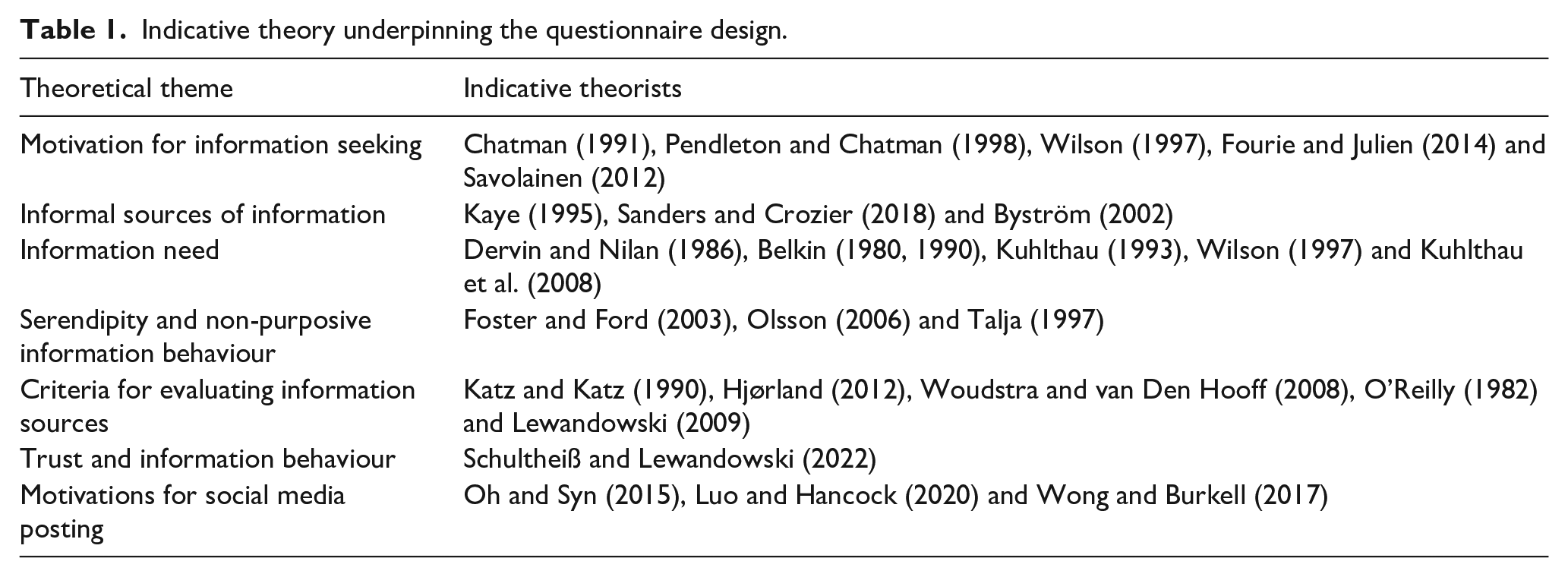
There is no Information Science research literature that deals directly and specifically with the topic of the current research, which is the use of Instagram as an information source. Often, when mentioned at all in the realm of information science, Instagram is simply included as an example of a potential source, as for example, in a study by Alhuwail and Abdulsalam (2019) who surveyed Kuwaiti citizens on their use of a variety of internet platforms as an information source and include Instagram as one possibility. The current research positions Instagram as more than just a single source but a network of possible information sources who are interacting, informing and influencing each other. A search of Library, Information Science and Technology abstracts and Library Literature discovered a very small number of papers that related to Instagram from an informational perspective and these are reviewed below.
There have been a number of studies on Instagram relevant topics, such as the use of hashtags in information retrieval (Huang and Copeland, 2020; Price and Robinson, 2021; Rauschnabel et al., 2019). Ford et al. (2014) found that hashtags, when used intentionally, were a useful means of creating networks (albeit possibly micro-networks) for sharing information and resources on social media platforms. Browsing as a component of social media information behaviour has also been uncovered by Shahpasandi et al. (2020). Instagram use in the context of specific communities has been explored, for example, in the management of health conditions (Meleo-Erwin et al., 2020) and veganism (Phua et al., 2020).
Jensen (2013) explored the role of Danish archives and museums in using Instagram and found that, even when acknowledging the importance of the users in generating and curating images, the institutions did not give up control or authority and continued to communicate in a ‘top down’ style, which does not align with noted beneficial characteristics of the platforms.
The strategic use of hashtags helps self-organised movement supporters to reach other people of the same interest in a timely manner and through different social circles. Self-motivated supporters became the bottom-up social forces in making the movement more visible to the public, ultimately facilitating the achievement of symbolic power (Wang et al., 2016: 851–852)
Wang et al. (2016) conceptualise the use of Twitter hashtags as a strategy to enhance the visibility and symbolic power of social movement-related information (see also, Newberry, 2021; Phua et al., 2020), examining how characteristics of hashtags drove information virality during a networked social movement. Wang et al. (2016: 851) analyse the ‘virality of social movement messages from the lens of strategic hashtag use on Twitter’. Other context-specific studies exist, such as Gumpo et al. (2020) who explore the use of Instagram as a source of information for young consumers when determining tourist destinations.
Buarki and Alkhateeb (2018: 288) investigate the use of hashtags to retrieve information on Instagram, arguing that ‘the use of hashtags in Instagram simplifies the retrieval of related shared micro-posts. . . [and the retrieval] of a group of images sharing the same hashtag’. However, the authors conclude that hashtags have limited retrieval benefits for users and need to be used in conjunction with keyword and other search approaches to be effective. This suggests that the process of actively searching for information using Instagram is potentially complex and unique to the information seeker.
It is interesting to note that, from a marketing perspective, the focus of research into Instagram is on opinion seeking rather than information seeking and the power or fame of the opinion giver, influencer or celebrity rather than the quality of the source, as this would be conceived in information science (see e.g. Katz and Fraley, 1984; Turner, 2019). In a pre-social media world, Flynn et al. (1996: 138) argued that ‘opinion seeking happens when individuals search out advice from others’, where users engage with messages of this sort in three ways: (i) seeking information, opinions and reviews (Opinion Seeking); providing information and stating their own opinions (Opinion Giving) and sharing, reposting the information or opinions of others (Opinion Passing). Whilst, in the context of the current research, the definition of information seeking could be achieved by simply replacing the word ‘opinion’ with ‘information’, the underpinning constructs are very different and from a disciplinary perspective have all kinds of conceptual variations. As an exploratory study, the current research sought to investigate whether and how users conceptualise and differentiate information and opinion.
Danniswara et al. (2017: 35) explore the influence of Electronic Word of Mouth (eWOM) referral, celebrity endorsement and information quality on consumer purchase decisions. They found ‘eWOM referral has relation towards purchase decision via purchase intention while information quality has relation towards purchase decision via brand satisfaction and via brand trust’. They found that consumers encounter information through a mix of flow experiences and browsing on Instagram but there was no relationship between celebrity endorsement and purchase decisions either directly or indirectly. Since their research was carried out, Instagram has become increasingly commercialised, with more mechanisms built in to facilitate direct purchasing and greater ability to measure the impact of eWOM.
Some providers of information can carry more weight than others, appear more authoritative, more reputable, more famous, more influential, whereby a whole new breed of player has emerged: the influencer. Although the phenomenon may have started with those that already held celebrity status, the situation has now evolved to one where the influencer has become acknowledged as a new breed of celebrity born through visual platforms, with Instagram in particular recognised as their marketplace (Jin et al., 2019). The current research did not seek specifically to explore influencers on the platform but, given their prominence in the literature and discussions surrounding Instagram, influencers were included towards the end of the survey, where respondents were asked to rank their perception of the credibility of information sources from very reliable to very unreliable. Future research might further explore the influencer as both an opinion giver and an information provider.
Media effects and the impact of social media
The impact of social media in the consumption of news and engagement in democracy has been much commented upon, with the notion of an echo chamber or social media bubble predominating. However more recently there have been indicators of a healthy aspect of social media’s impact on increasing interaction with democratic debate where it has been argued that ‘an individual who might ignore news about politics from traditional media sources may opt to read such information on Facebook if she sees her friends discussing the article on her News Feed’ (Anspach, 2017: 591).
Exposure to news on social media increases further interaction with a wider array of media outlets thus ‘improving not only public trust in the news but democratically desirable behaviours’ (Turcotte et al., 2015: 530). Interpersonal communications whether by credible opinion leaders and/or friends can influence trust in media sources via ‘a “two-step gatekeeping process” in which news audiences re-disseminate content to “secondary” audiences’ (Anspach, 2017; Turcotte et al., 2015: 531). Bail et al. (2018: np) explore the concept of the social media echo chamber further in the context of Twitter and found that, even the exposure of opposing information on social media, can further cement polarity in terms of politics.
The importance of word-of-mouth sources of information has long been noted in marketing and information behaviour research (e.g. Jansen et al., 2009). The echo bubble has been observed in action in relation to big political issues, such as election decisions, party affiliation and lockdown but ideological alignment is found to be much less influential on other topical areas of debate (Barberá et al., 2015).
The current research is informed by Chatman’s (1991: np) exploration of ‘everyday information lives’ which acknowledged the significance of voices from the smaller world that people inhabit where they draw information from trusted voices, which could include friends, colleagues and more recently from influential voices they have drawn into their milieu:
It seems that many members of a social world do not feel compelled to engage in information-seeking strategies. Yet they can still exhibit information behaviors. For example, they can assume a passive posture in which they receive information, do not act on it, or use it to add to their general stock of commonsense knowledge. Others may be active information gatherers. For them the world is a large reservoir of facts and events that help to shape their world and, in the sharing of what they know, modify the world of others (Pendleton and Chatman, 1998: 747).
While individuals are part of the great internet universe, their worlds may remain surprisingly small in these expansive new domains.
Motivations for using Instagram
The majority of research into motivations for using social media has focussed on more general personal motivators including social engagement, psychological factors, etc. Even in this realm the research that has been carried out is sporadic: ‘while academic research on the psychological roots of hashtagging is limited, few studies indicate that motivations beyond structuring and spreading content exist’ (Rauschnabel et al., 2019: 473). Rauschnabel et al. (2019: 484) identify the following 10 motivations for hashtagging (why people hashtag) on social media: Amusing; Organising; Designing; Conforming; Trendgaging; Bonding; Inspiring; Reaching; Summarising and Endorsing. Of course, the focus here is on the use of hashtags in posts rather than as an information retrieval tool. Organising comes closest to classic information management theory in use of hashtags to signal to others that content might be relevant to their own information needs and/or to create links to other related posts. Other of these motivations have information behaviour connotations such as summarising and endorsing information content, while trendgaging has relevance to environmental scanning.
Kocak et al. (2020: 625) also uncovered a range of motivations for using Instagram and categorised these as ‘self-expression, recording, socialisation, recreation, creativity, and prying’. Recording (Kocak et al., 2020), documenting (Sheldon and Bryant, 2016) or archiving (Lee et al., 2015) as a motivation for using Instagram is recognised across existing research, that is, users utilising the platform as a way of keeping a record of their lives and experiences.
Dumas et al. (2017: 1) explore the extent to which young people engage ‘in deceptive, potentially harmful acts to gain attention and validation on Instagram’. The authors highlight the prevalence of commercial reasons for posting online as a significant motivating factor. There are two important aspects of this research for the current topic: (i) that those posting on Instagram are likely to post ‘deceptive’ information and (ii) that posters may have non-altruistic motivations for posting information.
Sheldon and Bryant (2016: 94) found the four most common motivators for the use of Instagram to be: (i) surveillance, ‘to keep up with or gain knowledge about what others (i.e. friends, family and strangers) are doing’; (ii) documentation, acting ‘as a kind of virtual photo album for many people’ (Sheldon and Bryant, 2016: 94); (iii) coolness, as a means of ‘self-promotion and to gain popularity’ (Sheldon and Bryant, 2016: 95) and (iv) creativity, in ‘portraying skills and sharing creative posts with others’ (Sheldon and Bryant, 2016: 95). Creativity as a motivation is one that is thought to be unique to Instagram, whilst other identity-related motives are recognised in other examples of social media. In this categorisation, surveillance is a concept that would merit further exploration for information research.
Theorists can contribute to seven types of research gap as set out by Miles (2017). The current work seeks to explore a position where ‘knowledge may not exist in the actual field to theories and literature from related research domains’, by identifying some theoretical propositions that would provide fertile grounds for future research (Miles, 2017: 3–4). Whilst existing research acknowledges some of the motivations for creating content on Instagram, it does not fully explore the wider motivations and experiences of those who interact with content and information on the platform. The current research aims to address this gap, connecting some of the ideas that have been uncovered in the literature to date and contributing new knowledge.
Methodology
The current study was undertaken in line with the tenets of pragmatic research, an approach that commends mixed methodologies as a way to explore social science research topics, in line with Johnson and Onwuegbuzie (2004: 14) who sought ‘to position mixed methods research (mixed research is a synonym) as the natural complement to traditional qualitative and quantitative research, to present pragmatism as offering an attractive philosophical partner’.
Morgan (2007: 60) made a case for ‘the “pragmatic approach” as the new alternative paradigm, showing how it can both resolve the problems caused by the metaphysical paradigm while also providing a new range of opportunities for scholars in the field of social science research methodology’. This approach allows the researcher to move between deductive and inductive approaches in research design and analysis, recognising ‘that the actual process of moving between theory and data never operates in only one direction’ (Morgan, 2007: 70) through abduction. This enabled the authors, typically interpretive researchers, to undertake a survey and to design an instrument that combined closed and open questions in order to gather data that both explored existing information behaviour theory while also uncovering examples of previously unpredicted phenomena (see Appendix 1). While the authors fully acknowledge that open questions are traditionally poorly responded to in surveys (Evans and Mathur, 2018), the survey results produced an immense and unexpectedly rich data set, with typically 100–200 responses to each question. Some gave brief answers and others provided extended and thoughtful responses, resulting in 16,744 words of qualitative data.
The use of an online survey was also a pragmatic choice in the much more straightforward use of the word, in that the research was undertaken during the first Covid-19 lockdown period, when it was hypothesised that such a survey would both be practicable for remote design, dissemination and completion and appropriate to a time when many people were utilising online and virtual sources to a greater extent than ever before. This factor may also explain the rich and full responses that were given to the open questions. Given the focus was on users of Instagram, concerns about the ‘skewed attributes of the internet population, sample selection and implementation’ (Evans and Mathur, 2018: 858) were considered inapplicable.
The sampling criterion for inclusion in the research was simply that questionnaire respondents used Instagram, that is, were active on the platform. No demographic parameters, such as geographic location, were imposed on the research population as there was no intent to undertake a stratified sample analysis. This approach achieved a broad sample of respondents from across a variety of age ranges and geographic contexts. The survey was distributed through online networks using Instagram, Linkedin, Facebook and Twitter and snowball sampling was encouraged to elicit a greater response. Dissemination of the survey was also enhanced by its posting on the SurveyCircle website, which promotes completion of surveys freely for non-profit research. The survey received a response of 274, which is considered an adequate data set for this type of research, in line with other highly regarded studies, such as Sheldon and Bryant’s (2016) 239 respondents.
The survey was designed to be delivered in an online format using Jisc Online Surveys and consisted of a mix of open and closed questions. It was designed to be capable of easy response and tested on a pilot of 10 respondents. The survey was capable of completion in around 7 minutes, with some margin for extended qualitative response to open questions. The pilots identified where questions might be misinterpreted and where definitions were helpful. As a result the authors gave a definition of information as ‘facts about something or someone’, which was considered a simple definition that emphasised that there should be some sense of the factual accuracy of the information as an important characteristic. The survey consisted of five sections: (1) respondent demographics; (2) motivators for using Instagram and patterns of usage; (3) using Instagram to purposefully or unintentionally access information; (4) evaluating the information found on Instagram; and (5) respondent posting and sharing of information on Instagram. The questions were designed to be as unequivocal as possible and some of the multiple choice options were also adapted at the pilot stage, for example, motivations for using the platform. The inclusion of open questions gave respondents intermittent opportunities to express their own views in an unrestricted manner.
The resultant data set was analysed both quantitatively and qualitatively to maximise the depth of the insights that could be drawn from it. Quantitative results were analysed statistically using a spreadsheet approach. Qualitative responses were interpreted using thematic analysis, in line with Castleberry and Nolen’s (2018) five steps in thematic analysis ‘compiling, disassembling, reassembling, interpreting, and concluding’ (p. 808). Both authors examined the dataset independently before the findings were synthesised. The themes that emerged were then considered against existing theory to put the findings in context. Findings are structured thematically and reported using statistics, quotes and visuals (where appropriate) throughout the following discussion. The quantitative data were not used to test any hypotheses and were gathered in an open and exploratory manner, in keeping with the pragmatic approach of this study. The population demographics discussion that follows is there to delineate the sample that was achieved.
Research results
Survey demographics and background
In terms of geographic context, a large majority of respondents (more than 83%) were UK residents. Of those from outside the UK, responses were dispersed across a range of countries including the US and Canada, Europe, West Africa and Asia. The results should be read as representative for the most part of a UK perspective. The survey further consists of a relatively wide age range (Figure 1), which is in keeping with current Instagram user statistics (Iqbal, 2021), with the majority aged between 24 and 35 years (Statistica, 2021). Most respondents fell into the category of being employed (whether full-time or part-time) or a student (Figure 2).
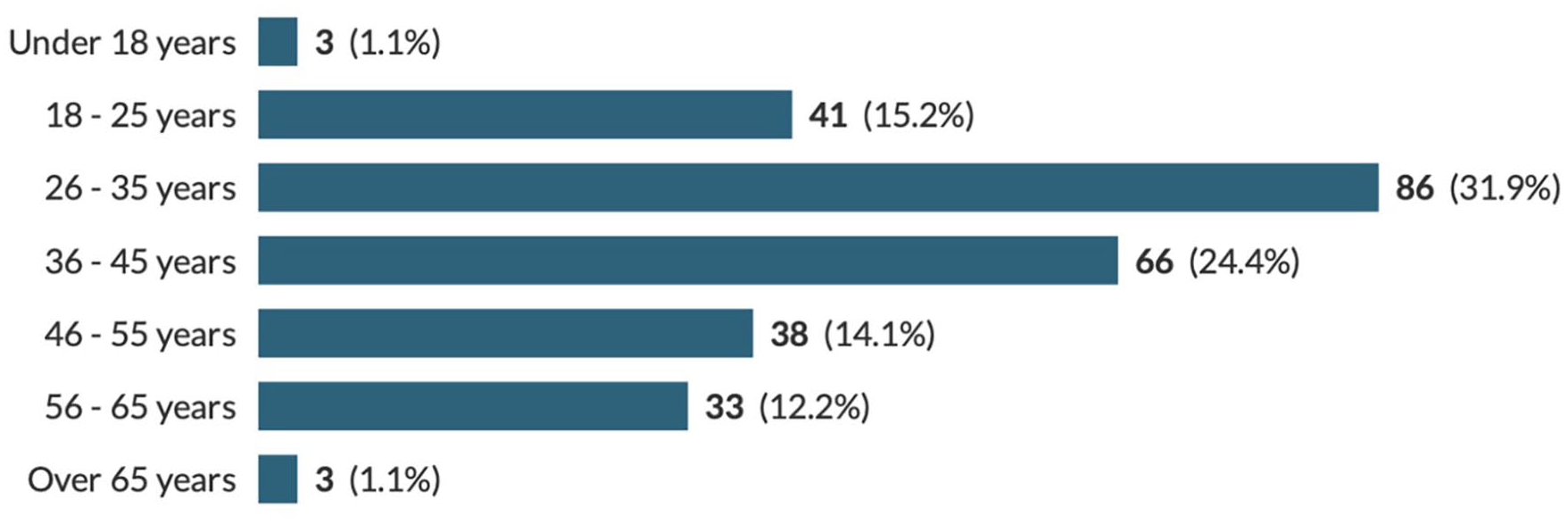
Respondents’ ages.
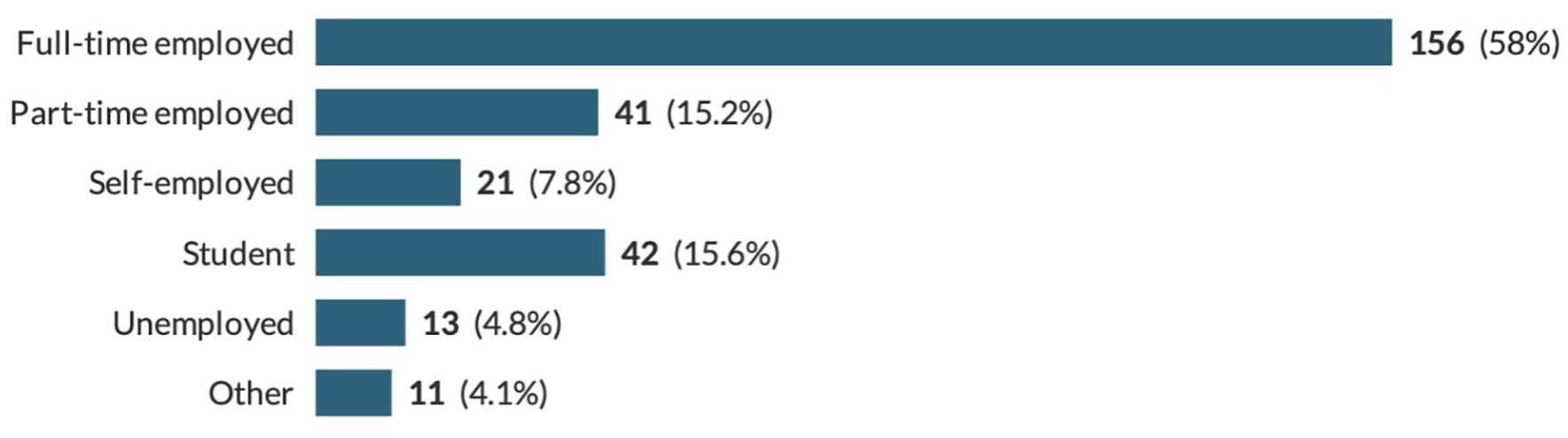
Employment status.
Respondents were asked to rank the importance of particular motivations for using Instagram and the dominant motivations were entertainment, inspiration, relaxation and work. Most respondents (86%) spent between 0 and 2 hours on the platform each day. There was an almost even split amongst respondents between those who kept a public (51%) and private (49%) profile. Only 13% of respondents shared content daily (Figure 3) and 11% of respondents had never shared their own content on Instagram, using the platform simply to consume other people’s content; in more open responses some of these individuals referred to themselves as ‘lurkers’. The largest proportion of respondents shared content on a weekly or monthly basis – presumably in an irregular manner, where the decision to post was motivated by the content itself and any meaning behind this.
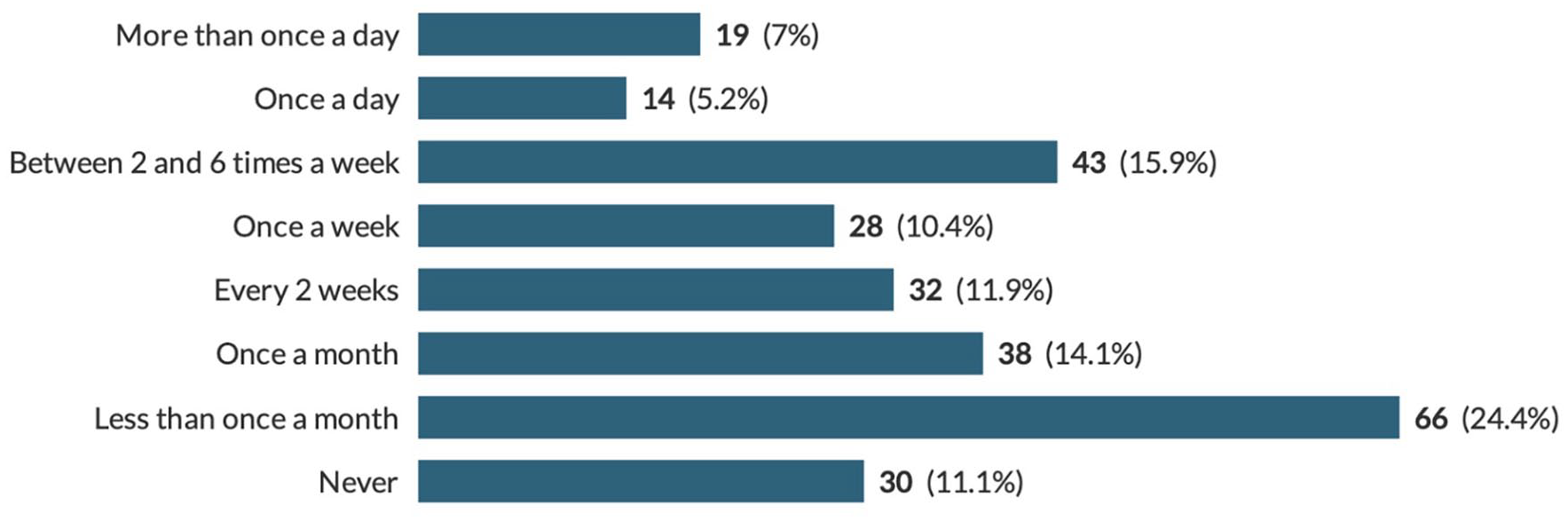
Frequency of content posting.
An overwhelming 82% of the content shared by respondents was owned by them, but 23% had also used Instagram to reshare content from others and 15% to share material that was found on platforms other than Instagram.
Respondents followed a range of content creators on Instagram (Figure 4), including family and friends (94%), independent businesses (70%), companies and brands (62%), celebrities (55%), influencers (39%) and media organisations (41%).
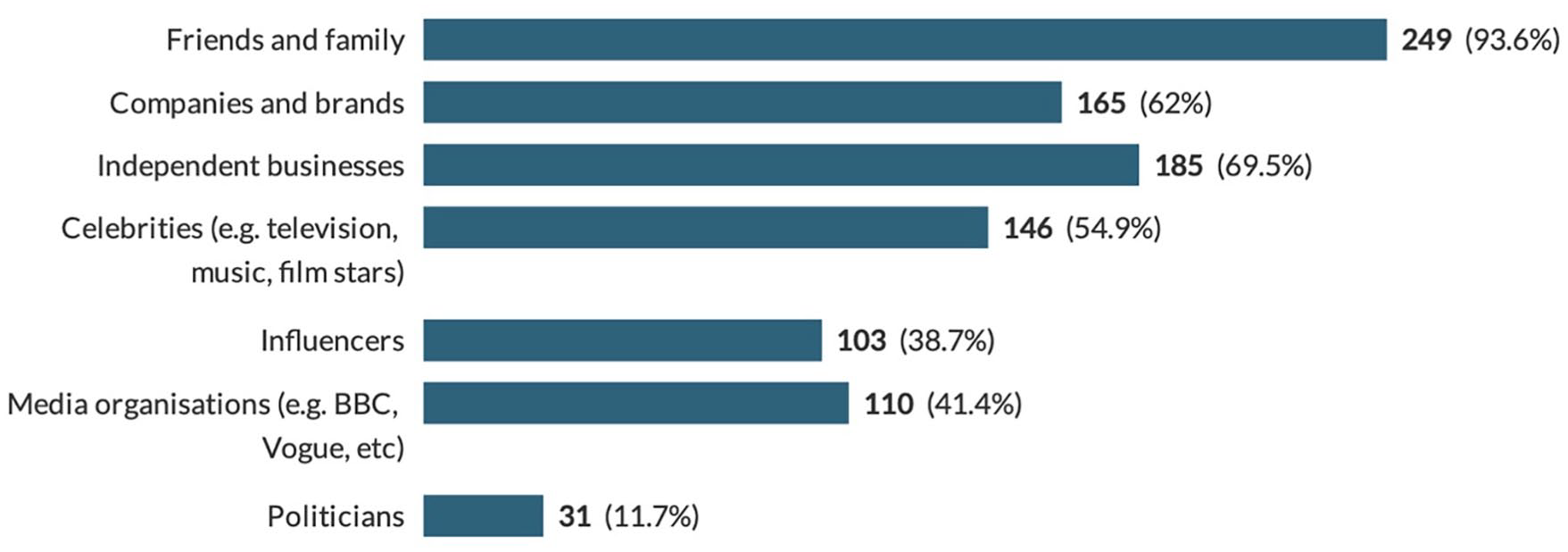
Types of accounts followed.
Only 39% of respondents claimed to have used Instagram consciously to actively search for information but a larger proportion (55%) were aware of having uncovered information spontaneously, without actually searching for this. Upon further open questioning it became clear that, regardless of intention, the types of information encountered and ways in which respondents engaged with this information remained consistent. One of the most significant findings relating to the spontaneous or serendipitous discovery of information on Instagram was the discovery of new brands, companies and products, reinforcing the power of the platform as a marketing tool (Haenlein et al., 2020).
Instagram consists of a number of visual feeds through which users can access content (mainly photographic and video): firstly through their own curated newsfeed, which is the home landing screen for an Instagram user (consisting of the accounts they follow and some targeted adverts); secondly, a more open search feed (consisting of new accounts to be discovered and where the platform predicts these based on other accounts that are followed, clicked on and engaged with as well as the wider network a user is part of); thirdly, a stories feed, where the most current of content is made available for a time-limited 24 hours and finally, a feed consisting of saved content that allows a user to store other users’ posts together to be viewed as part of a feed. Instagram users can also browse other users’ profile feeds specifically by clicking on a particular user. In their responses more generally, participants observed the way in which the platform appeared to successfully predict content they would like via the search feed and this aligns strongly to the idea of content that respondents were not actively looking for, had not knowingly curated and where information was often uncovered unintentionally. It became apparent later in their responses, that respondents often uncovered information unintentionally through the people they had actively chosen to follow on Instagram.
A significant majority of respondents (70%) could remember discovering a new product or service on Instagram. Product categories ranged quite broadly, consisting of: fashion; cosmetics; stationery; toys; home furnishings; food and drink; jewellery; books; fitness and pet products. Services were also uncovered and consisted of: restaurants; health and wellbeing and education. Overarching themes in the responses surrounding these discoveries were: the discovery of smaller independent and/or local businesses; the discovery of ethical brands and the power of influencer content as a significant way through which respondents discovered new products, services and ultimately brands and businesses. Friends and family were also influential as a source of information about new products and brands.
The following discussion explores themes in the survey findings surrounding Instagram as: a source of new and current information; a means of checking information and finding out more; a source of inspiration; an educational tool and a community engagement tool. The final section explores respondents’ perceptions of source credibility on Instagram.
Instagram as a source of new and current information
In their open responses to this part of the survey, it became clear that respondents saw Instagram as a real-world digital setting in which current information could be accessed in real-time. This is in keeping with original features that made Instagram popular, where (as a mobile app), users tended to upload content immediately, in and of the moment (Song, 2016).
Current news and information are made more accessible through Instagram’s ‘trending’ function, where topical information and frequently used hashtags are highlighted and can easily be accessed by users (Newberry, 2021). Some respondents appeared to find this useful – either to discover information first-hand or to find out more about information they had uncovered elsewhere. The Black Lives Matter movement was mentioned by a number of respondents, who felt that this was particularly powerful on Instagram, with a variety of user demographics communicating on the matter (Stewart and Gaffary, 2020). It became clear, from frequent references in open responses, that this movement had signified a shift for some users in terms of how they thought about the platform, where Instagram had become in their eyes a potential source of more serious and meaningful content. However, it was also recognised as a movement that gained such strong momentum that it became difficult for users to navigate the issue due to the volume of information that was being shared, with one respondent describing this as ‘useful but overwhelming’. This is redolent of the long-recognised problem of information overload (Bawden and Robinson, 2009).
Overall, Instagram was seen as a platform where organisations post current content, with the latest events and developments being shared here first – for example, trends, new product lines and the launch of small independent businesses were all mentioned. Due to the perceived immediacy of information on Instagram, many respondents used the platform to access news about people and current affairs.
Instagram as a means of checking information and finding out more
Respondents were using Instagram as a means of checking information and finding out more about a topic. One respondent referred to ‘seeing how things look in real life’, which is interesting in the context of the digital world, but reinforces the earlier point that Instagram was seen as a real-world stage, where real people communicate directly, with the implication that other forms of news consumption were not real, often biased, indirect, mediated and therefore, potentially flawed in some way.
Participants also read other people’s reactions to or opinions on the news – particularly around controversial stories or crises – where these other voices acted as influential intermediaries. Others used Instagram to validate or challenge current affairs through a variety of sources, for example, to confirm or deny a news story. This indicates that Instagram might counter intuitively be regarded as a more truthful window on the world than other forms of media, questioning previous thinking around trust (Schultheiß and Lewandowski, 2022): Instagram was regarded as a source, where the multiplicity of voices and views might be regarded as a positive opportunity to see a fact in the round. One respondent explained: ‘I follow a lot of informational accounts on Instagram so often I’ll search them and just read up on any news that they’ve shared recently. If there is trending news I look at the hashtags to see what people are saying as well’. Another reflected: ‘I use the search function to look for a topic of interest or an item of news that I’ve seen friends post about for example. Usually I’d go to Instagram for people’s opinions on things after I’ve searched online for news articles or websites’.
The platform was also recognised as somewhere to access people in ‘real life’, where, for example, some respondents referred to using Instagram to find out more about actresses and actors and other celebrities, from their own feeds. Respondents also used Instagram to gain additional visual information about aesthetic products (e.g. clothing and interiors) that they had seen elsewhere, to check what an item looked like from other perspectives, angles, again in real life.
Sometimes Instagram was used to actively search for specific product or company information, for example consulting hashtags or accounts to find out where a product is from, to check company opening hours or to access contact details. Some respondents saw the platform as a source through which to check the credentials of people and brands, assessing their follower numbers and content. One respondent referred specifically to checking a company’s ethics.
Instagram as a source of inspiration
One of the most significant ways in which respondents were using Instagram actively to seek information was to search for inspiration. This could be described as using the platform to gather ideas, to encourage creativity and ideation. The specificity with which respondents used Instagram to seek ideas ranged, with some exploring the platform feed in a very general way – open to inspiration of any type and from a variety of sources (albeit through their curated feed), and others seeking particular types of inspiration – for example, interior design, holiday destinations, restaurants, recipes, fashion, hair styles, etc. Previous research in this area has focussed largely on broader information behaviour of artists and other creatives (e.g. Mason and Robinson, 2011).
Instagram as an educational tool
A particular way in which Instagram was used to engage with information was where respondents used the platform to access specific guidance on how to perform a task or activity, in this way educating themselves. Some respondents referred to craft tutorials, some to fitness regimes and workouts and others to hair-and-make up tutorials. This suggests that expert advice can be sought through Instagram, where people use the platform to communicate their expertise around a particular subject and share this with others through Instagram.
Another way in which respondents found themselves learning through Instagram was in relation to lifestyle choices and, in particular, environmental issues, where several respondents spoke of learning about new products that were more ethical or sustainable. One respondent observed that the platform made it ‘easier to find out about smaller independent brands doing things differently – for example, reusable period products, toothpaste in non-plastic tubes – breaking away from the household names. Without Instagram, finding out about these brands would be difficult’.
Instagram as a community engagement tool
An interesting line of enquiry that was revealed in the survey findings (and a possible appeal of using Instagram to search for information) is the community aspect of the platform. As has already been mentioned, Instagram users curate a digital feed of accounts which they actively follow (Song, 2016). This effectively allows them to switch off from others outside of this circle, which has some obvious negative effects (Bail et al., 2018). However, this survey highlights the community aspect as a potential benefit, where in their responses some participants revealed that they were able to use Instagram to access information around more unique personal causes. In these instances, information was often more experiential than factual but there was a mix of both. The notion of experiential information is one that has largely been explored in relation to health information, where users sought information from those who had lived experience of dealing with a condition as well as information from health professionals (Meleo-Erwin et al., 2020; Rotliman and Schwarz, 1998). Further investigation of this community engagement activity would be valuable.
Source credibility on Instagram
Respondents were asked to reflect openly on how they judge the credibility of information on Instagram and, overall, results suggest that while they did not always feel that information on Instagram was reliable, this did not necessarily impact on their willingness to engage with that information. Several respondents referred to taking information on Instagram with ‘a pinch of salt’ and using Instagram more for entertainment purposes, where presumably accuracy was deemed less important. A number of respondents made reference to fact checking outside of Instagram, for example, searching for follow-up information on Google: to quote one respondent ‘if it matters do a Google search’. Indeed, 74% of respondents claimed to sometimes or always fact check information found on Instagram. It was generally accepted that if multiple sources (three or more) were saying the same thing, then the information was accurate.
Respondents’ ranking of the perceived reliability of information sources on Instagram can be seen in Table 2. It is worth noting that a significant number of respondents ranked each source as ‘neither reliable nor unreliable’ suggesting that the reliability of each category was uncertain, subjective and highlighting the complexity of the issue.
Perceived credibility of information sources on Instagram.
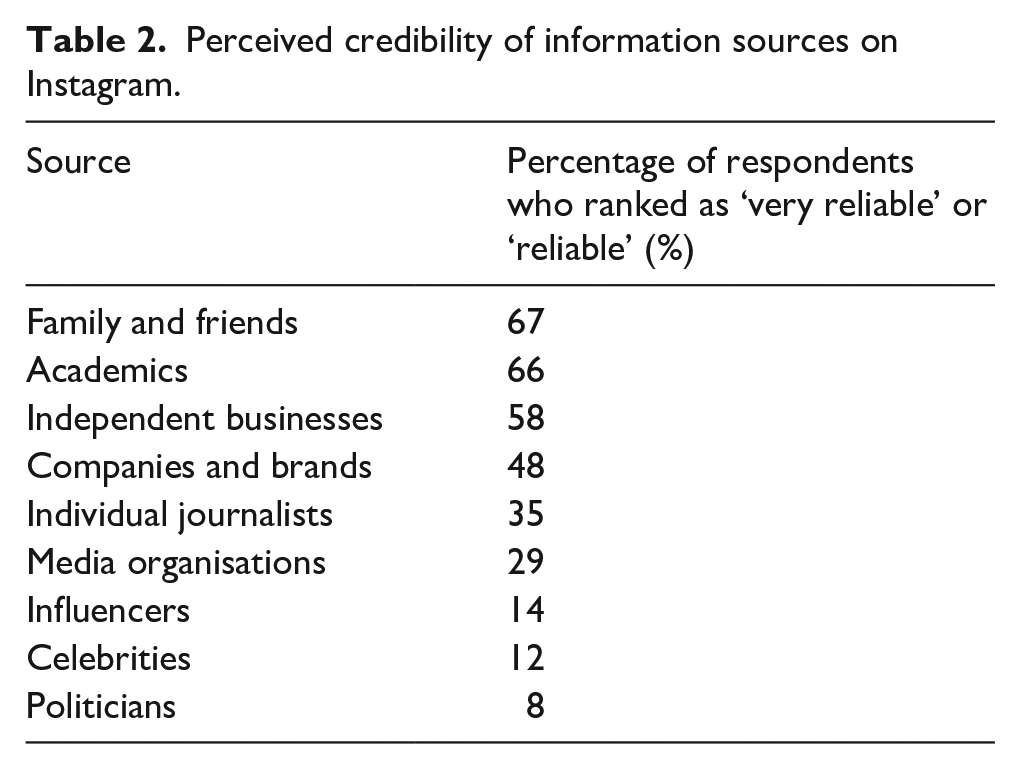
Influencers were mentioned by several respondents but held in low regard when it came to credibility. Clearly respondents were familiar with influencers on the platform, and a number followed influencers, but most did not regard their content as reliable. Interestingly, one respondent explicitly stated that they would be more likely to trust information from the company itself – which is at odds with the ethos behind influencer marketing, where traditionally these individuals were favoured as third-party information sources, seen as more objective and therefore trustworthy (Farivar et al., 2021).
It became clear in the responses that scepticism around information shared by an influencer arose from commercialisation of the practice, where it was believed that influencers were motivated by money and where overtly sponsored content (despite its disclosure via the word ‘ad’ or ‘paid promotion’) was particularly untrustworthy. One participant referred to Instagram as a ‘digital marketplace where nearly everyone is hustling for likes’. Table 2 illustrates the lack of perceived credibility of influencers and, indeed, 51% of respondents actively stated that they found influencers to be either ‘unreliable’ or ‘very unreliable’; less reliable than politicians (42%) and celebrities (41%). Paid promotions by influencers and obviously advertised content (where people felt they were being sold something) from companies and brands were generally regarded as less reliable in terms of information. The fact that so many respondents drew on these kinds of examples supports other research in the field suggesting that this type of content is particularly associated with Instagram as a platform (Dumas et al., 2017).
It is worth noting, however, that the credibility of the source in no way correlates with the frequency with which users access or are exposed to these sources: so, pleasing as it is to see how highly regarded academics are, in fact very few academics have significant followings on Instagram and their follower numbers are dwarfed by those of influencers, whose content was regarded as less factually reliable.
Respondents seemed to have formed their own individual strategies for deciding whether a source was credible on Instagram and these included: checking follower numbers and engagement (where high following equated to a higher level of credibility for some while others trusted those with lower follower numbers more); curating an Instagram feed to only include perceived trustworthy sources was something many mentioned; quality of content and reviewing follower discussion threads below a post. It is worth noting that these were personal strategies and did not necessarily conform (and sometimes even contradicted each other) making it difficult to draw any generalised conclusions in this area. Contrary to the result vis a vis academic credibility little reference was made to the expertise or knowledge base of the source.
Interestingly, many responses relating to this particular question appeared to draw on the actuality of how a particular source experiences a product or service. Credibility, in this context, could be defined as the honesty and motivation of the individual sharing that information, coming back to user incapacity to distinguish between opinion and information, where the two concepts are inextricably blurred by Instagram users. Again the experiential component was significant to user evaluation of a source, where experience was mentioned far more frequently than expertise or knowledge base.
Given the complexity of the issue, this is a valuable area for possible future research – where it would be interesting to explore the role of the information seeker in credibility assessment and the potential bias that is imposed in the process of curating a digital feed as well as the use of personal strategies for determining the quality of information. While, as we have seen, there is a body of literature on determining information quality (e.g. Katz and Fraley, 1984), there is little on determining the quality of opinion and what exists is somewhat dated: Harris (1997: np) provided an early guide to evaluating internet information, which drew heavily on information quality research and recommended ‘The CARS Checklist (Credibility, Accuracy, Reasonableness and Support)’. This is an area that would benefit from updating given the extent of subsequent change in online information behaviour and the emergence of what appear to be new measures.
There was an overall feeling, in response to open questions, that Instagram was a highly volatile environment for information and some respondents reflected on ‘emotionally charged’ captions and inauthentic and ‘over curated lives’: another referenced both these points referring to Instagram content as ‘obviously manipulated – either aesthetically or emotionally’ and ‘airbrushing life’. This bring to question not just the reliability of written content but also of photographic content, which may be highly stylised, manipulated or distorted. These issues were noted by several respondents who felt that the dominance of visual over written content led towards ‘style over substance’ when it came to information. The lack of hyperlinks was described by one respondent as a ‘closed system’, which does not lend itself well to sourcing or providing more evidence. Some of these ideas are at odds with earlier statements around Instagram as a ‘real-life’ setting. One respondent observed: ‘Instagram is primarily about image so it is propaganised to remove anything negative about the poster’s life. . . whilst some of what is posted may be true, I don’t ever believe that it’s the whole story’.
Conclusions and recommendations for future research
Theoretically the current research suggests that the relationship between information and opinion is becoming increasingly blurred and misunderstood by users and that information researchers need to consider the nexus between information and opinion in the context of the tripartite conception of Flynn et al.’s (1996) Opinion Seeking, Opinion Giving and Opinion Passing. We also need to consider how this breakdown might be understood in the context of information behaviour models. It would suggest that a more multidirectional interactive and iterative approach is needed. A related tension rests around the user’s concerns over (in)authenticity and real life experience as quality indicators alongside an awareness that the information being presented may be ‘over-curated’.
Information literacy researchers must also seek better ways of distinguishing between current notions of information quality and opinion quality in the eyes of users. How, for example, does the idea of authority differ depending on whether one considers oneself to be looking for reliable information or opinion? Do new information authority criteria emerge around the concept of real life and the capacity to interact with a piece of information in the round or from multiple perspectives?
This study confirms that people interact with information on a daily basis through platforms like Instagram in a mix of purposive and non-purposive ways. They might happen on an alleged fact in a casually encountered fashion (on any platform traditional or new) and then, their latent interest aroused, seek to understand it better, to validate or get a real life perspective from trusted voices via Instagram (or indeed another platform). The growth in use of media that are predominantly visual like Instagram, Youtube and TikTok means that information behaviour theorists must strive to explore these new platforms as they emerge in order to understand how their existence changes what have become widely accepted tenets of information behaviour. A model of information behaviour as manifest on Instagram would arguably look different from preceding models (Figure 5).
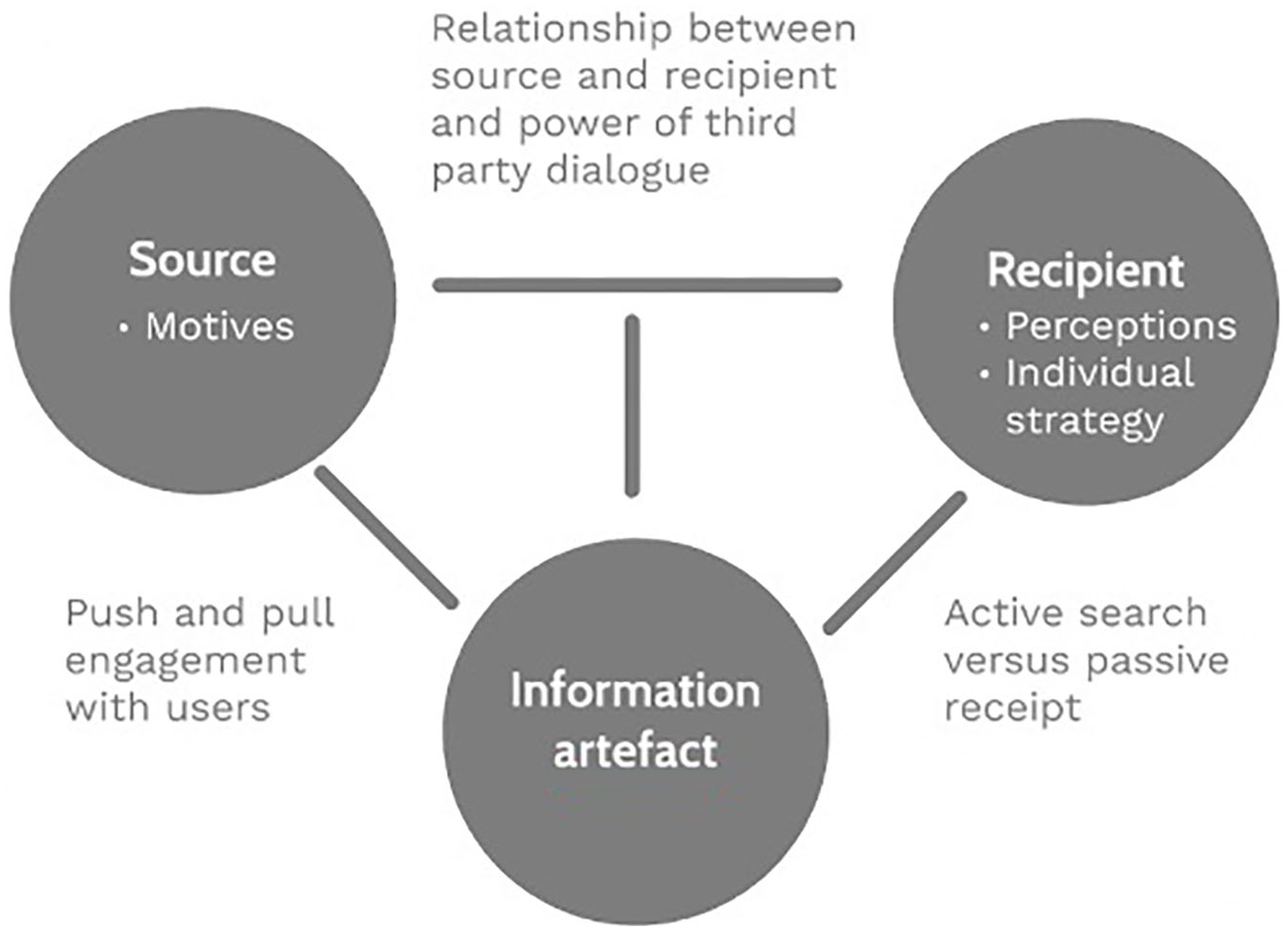
A model of information behaviour on Instagram.
We must also, as information researchers, engage thoughtfully with all new media disseminating information, for these appear and change swiftly, their popularity and significance to people’s lived experience may be significant and their long term impact on information literacy education may be profound.
The assessment of credibility of information on Instagram proved to be a complex issue and future research might seek to explore this further through qualitative research to help understand the role and motivations of the information seeker in this process. Instagram is viewed as a resource where the multiplicity of voices and views is regarded as a positive opportunity to see a fact in the round or in real life. Both of these concepts would benefit from further exploration to determine their impact as a phenomenon for current theories of information behaviour and epistemology.
Footnotes
Appendix 1
Declaration of conflicting interests
The author declared no potential conflicts of interest with respect to the research, authorship, and/or publication of this article.
Funding
The author(s) received no financial support for the research, authorship, and/or publication of this article.
