




Abstract
Background
With the increasing aging population and the development of surgical procedures, the proportion of older adults undergoing surgical procedures is on the rise. Postoperative cognitive dysfunction (POCD) often occurs as a postoperative complication in older adults. POCD may result from neuroinflammatory and oxidative mechanisms triggered by surgical and anesthetic exposures; MiR-29a-3p may reflect or modulate these neurotoxic pathways. This study analyzed whether miR-29a-3p is associated with POCD by detecting its expression level and evaluating its diagnostic value in POCD.
Methods
A total of 160 older patients participated in this study, divided into a non-POCD group and a POCD group. We used RT-qPCR to detect the expression level of miR-29a-3p in the study subjects and ROC to analyze the diagnostic value of miR-29a-3p in POCD. Pearson correlation analysis was used to assess the association of miR-29a-3p level with MOCA score and MMSE score, and Logistic regression was used to analyze the risk factors of POCD in older adults.
Result
Compared with the non-POCD group, the expression level of miR-29a-3p was reduced in the POCD group. The miR-29a-3p level is positively correlated with MOCA score and MMSE score, and has high diagnostic value in POCD. In addition, miR-29a-3p was a risk factor for POCD in older adults.
Conclusion
MiR-29a-3p is associated with POCD and may serve as a potential diagnostic marker of POCD, but the signaling pathway needs further study.
Introduction
As people age, their cognitive performance declines from stable to rapid over time, which may lead to mild cognitive impairment or dementia. 1 Perioperative neurocognitive disorders (PNDs) are the most common postoperative complication in older adults undergoing surgery, including postoperative delirium (POD) and postoperative cognitive dysfunction (POCD). 2 A prospective cohort study revealed POCD incidence of 29% at 3-months follow-up, rising to 33.6% at 12-months assessment, 3 and the clinical manifestations typically involve multidimensional cognitive impairments, including deficits in memory consolidation, learning capacity, sustained attention, and psychomotor coordination. 4 In severe cases, POCD may persist for years after surgery and may even develop into a permanent disease. 5 The current pathogenesis of POCD remains unclear due to differences in patient populations, diagnostic tools, and analysis of cognitive test results in the literature, which makes it difficult to draw firm conclusions about the pathogenesis. 6 Given the substantial negative impact of POCD on patients’ quality of life and functional independence, the development of reliable early diagnostic modalities represents a crucial step toward effective clinical management.
MicroRNAs (miRNAs) are endogenous, non-coding, single-stranded RNAs of approximately 22 nucleotides in length that inhibit gene expression by binding to the 3′UTR sequence of a target gene. 7 MiRNAs are ubiquitously expressed in the central nervous system (CNS) and play crucial roles in neuromodulation. The miR-29 family has been identified as a significant mediator of axonal regeneration and neural development and consists of miR-29a, miR-29b and miR-29c. 8 Notably, Wingo AP et al. showed that miR-29a-3p demonstrates a robust correlation with cognitive diseases in older adults, with 241 downstream targets in the cognitive trajector. 1 Based on these findings, we hypothesized that miR-29a-3p is involved in cognitive impairment behavior in the elderly and can be used as a biomarker for short-term prognosis of cognitive impairment after anesthesia in older adults.
Surgery and anesthesia may trigger a systemic inflammatory response, leading to perioperative central nervous system inflammation. 9 Since the integrity of the blood-brain barrier (BBB) is lower in elderly patients than in young patients, peripheral inflammatory factors are more likely to cross the blood-brain barrier and enter the central nervous system, causing neuroinflammation. 10 Advanced age and increased neuroinflammation are predictive factors for persistent POCD, and surgical neuroinflammation makes elderly surgical patients prone to POCD. 11
The purpose of this study was to investigate the expression of miR-29a-3p in POCD and speculate that miR-29a-3p has diagnostic value in POCD, which provided a new possibility for early diagnosis of POCD.
Materials and methods
Patients and specimens
A total of 160 older hip replacement patients from Ganzhou People’s Hospital were selected as the research objects. This was a prospective observational cohort study; no experimental interventions or randomizations were performed. The inclusion criteria are as follows: American Society of Anesthesiologists (ASA) classification II to III; The patient has no cognitive impairment, is in good mental condition and can cooperate with the scale test. No contraindications to anesthesia; Age ≥60 years old; No antibacterial drugs have been received in the past month. The exclusion criterion for this study was that the preoperative mental state examination score of minors was lower than 24 points. Current and past history of mental illness or central nervous system diseases; History of cardiovascular surgery or craniotomy; History of drug or alcohol dependence; History of liver failure or kidney failure; And people with a history of severe hearing and vision impairments. We strictly followed the “Guideline for the management of hip fractures 2020: Guideline by the Association of Anaesthetists” standard operating procedures.
12
Intraspinal anesthesia was used during the operation, with 0.2% ropivacaine. Details of the surgery and anesthesia can be found in the
Real-time quantitative PCR
Total RNA was extracted from the serum on ice and reverse transcribed into cDNA. Then, cDNA was used SYBR qPCR Mixon the RT-qPCR system. The relative expression levels were calculated with the 2-△△CT method normalized to U6.
Statistical analysis
The experimental data were analyzed using SPSS 23.0 software. T-test was used to evaluate groups’ differences. In addition, the Shapiro-Wilk test will be used to evaluate the normality of the distribution in each variable. The Receiver Operating Characteristic (ROC) curve was utilised to assess the diagnostic value of miR-29a-3p in POCD of older adults. Logistic regression was used to analyze the risk factors of POCD in older adults. Pearson’s correlation coefficient was utilised to evaluate the relationship between the level of miR-29a-3p and the scores attained on the MMSE score and MOCA score. The statistically significant difference was indicated by P < 0.05.
Results
The general data from the operated patients
Comparison of general data and related surgical indicators between the two groups.

POCD, Post operative cognitive dysfunction; BMI, Body mass index; ASA, American Society of Anesthesiologists; MOCA, Montreal Cognitive Assessment; MMSE, Mini-Mental State Examination. ***p < .001.
Expression of miR-29a-3p between non-POCD and POCD groups
As demonstrated in Figure 1(a), there was a significant difference in the expression of miR-29a-3p between pre-surgery and post-surgery (12 h, 24 h and 72 h), and miR-29a-3p expression levels were significantly lower after surgery (12 h, 24 h and 72 h) patients. As demonstrated in Figure 1(b), the expression of miR-29a-3p in the POCD group was lower than that in the non-POCD group. The ROC results showed that miR-29a-3p had significant diagnostic value in distinguishing POCD and non-POCD patients (Figure 1(c)), with an AUC of 0.902. The 95% CI was 0.858-0.946, the cutoff value was 0.636, and the sensitivity and specificity of miR-29a-3p were 87.1% and 76.5%, respectively. Expression and diagnostic value of miR-29a-3p in POCD. (a) expression of miR-29a-3p in pre-surgery and post-surgery (12 h, 24 h and 72 h); (b) expression of miR-29a-3p between the non-POCD group and POCD group in the post-surgery (72 h). (c) The diagnostic value of miR-29a-3p in POCD. ***p < .001.
Correlation between miR-29a-3p and cognitive function indicators in POCD
In the non-POCD group, there was no significant difference in MOCA scores between pre-surgery and post-surgery (12 h, 24 h and 72 h) (Figure 2(a)), while in the POCD group, MOCA scores were significantly lower in post-surgery (12 h, 24 h and 72 h) patients (Figure 2(b)). Compared with the non-POCD group, the POCD group had a significantly lower MOCA score in post-surgery (72 h) patients (Figure 2(c)), and the miR-29a-3p expression level was positively correlated with the MOCA score by Pearson correlation analysis (Figure 2(d)). MMSE scores were analyzed in the same way, and the results showed that in the non-POCD group, there was no significant difference in MMSE scores between pre-surgery and post-surgery (12 h, 24 h and 72 h) (Figure 2(e)), while in the POCD group, MMSE scores were significantly lower in post-surgery (12 h, 24 h and 72 h) patients (Figure 2(f)). The POCD group had lower MMSE scores than the non-POCD group in post-surgery (72 h) patients, and MMSE scores were also positively correlated with miR-29a-3p (Figure 2(g), (h)). The function of miR-29a-3p in POCD. (a) MOCA score of the non-POCD group in pre-surgery and post-surgery (12 h, 24 h and 72 h); (b) MOCA score of the POCD group in pre-surgery and post-surgery (12 h, 24 h and 72 h); (c) MOCA score in the non-POCD group and POCD group at 72 h after surgery; (d) The correlation of MOCA score and miR-29a-3p level at 72 h after surgery; (e) MMSE score of the non-POCD group in pre-surgery and post-surgery (12 h, 24 h and 72 h); (f) MMSE score of the POCD group in pre-surgery and post-surgery (12 h, 24 h and 72 h); (g) MMSE score in the non-POCD group and POCD group at 72 h after surgery; (h) The correlation of MMSE score and miR-29a-3p level at 72 h after surgery. ***p < .001.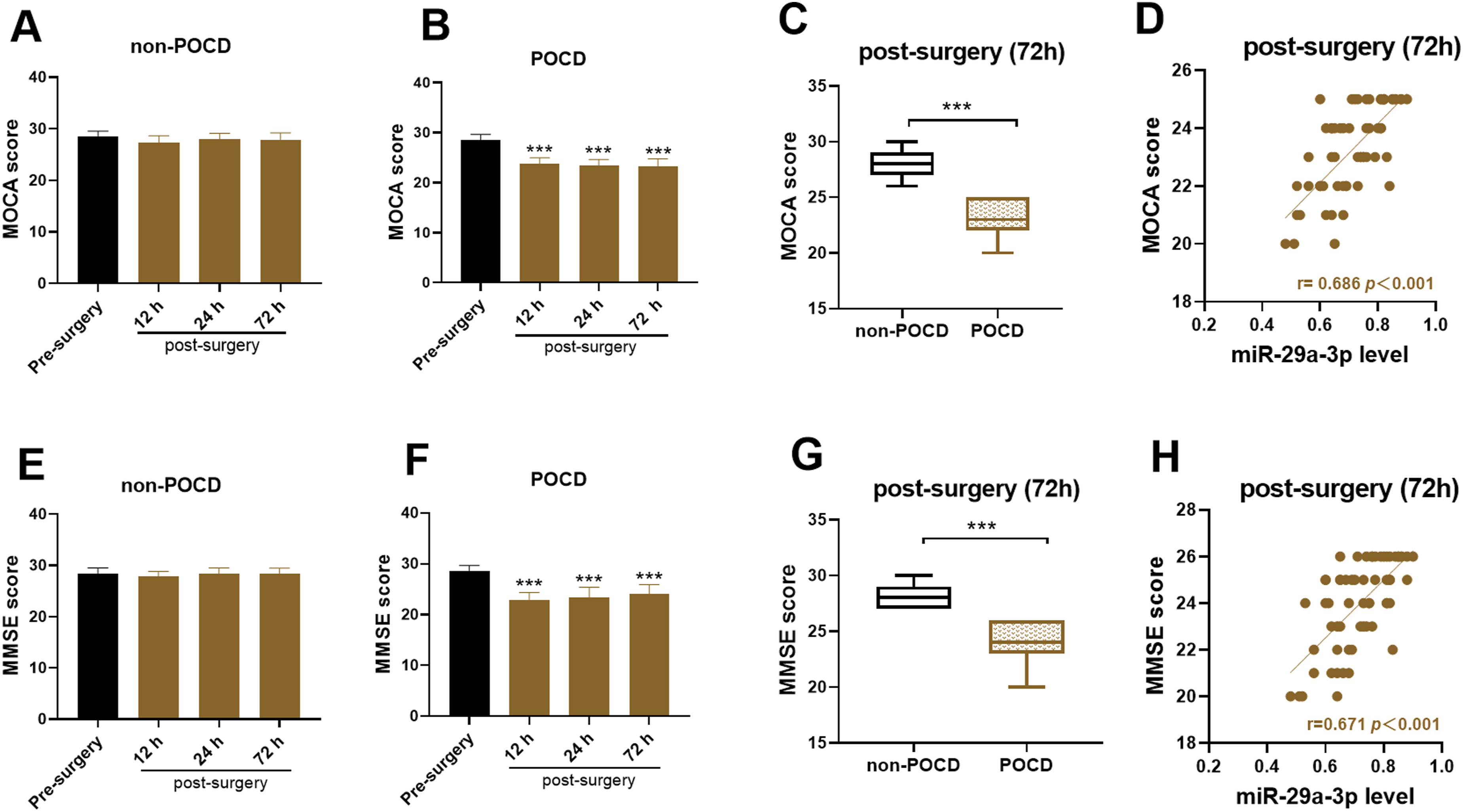
The risk factors for post-surgical POCD
Logistic regression analysis of the risk factors for post-surgical POCD.
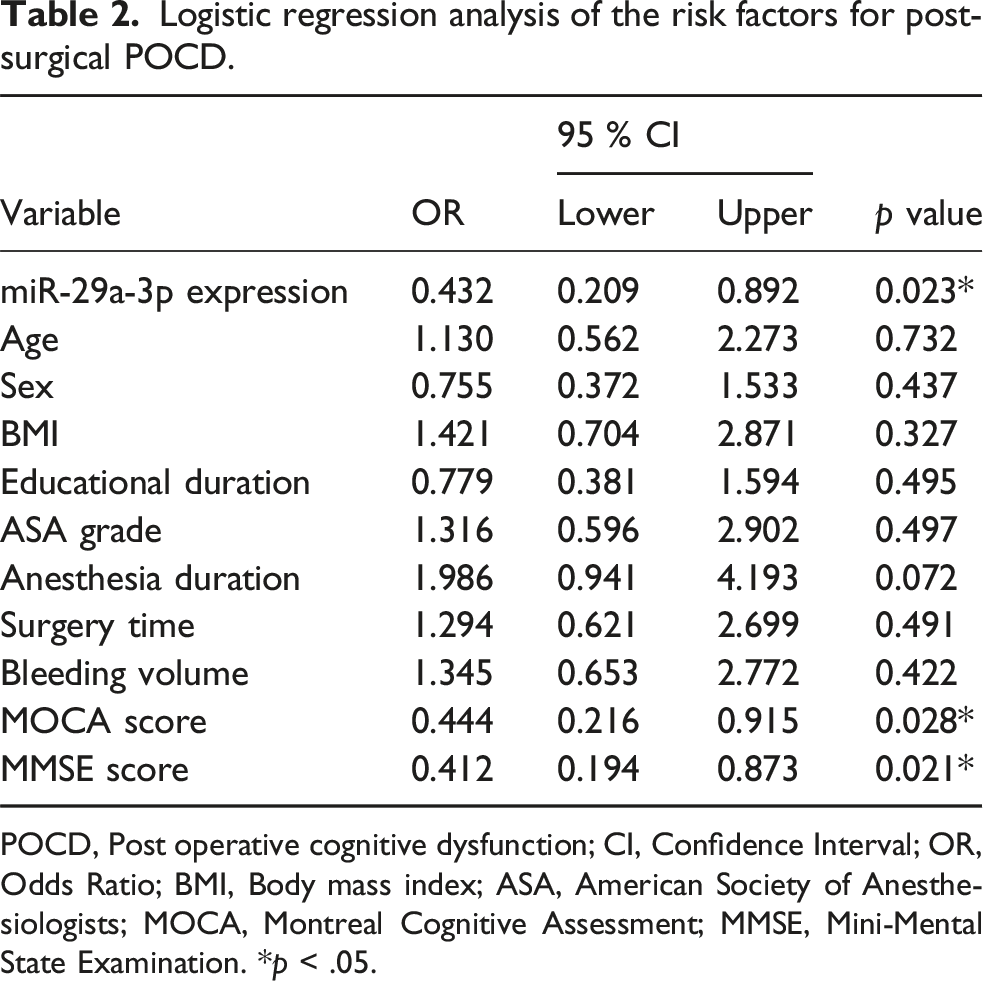
POCD, Post operative cognitive dysfunction; CI, Confidence Interval; OR, Odds Ratio; BMI, Body mass index; ASA, American Society of Anesthesiologists; MOCA, Montreal Cognitive Assessment; MMSE, Mini-Mental State Examination. *p < .05.
Discussion
POCD refers to postoperative mental disorders, anxiety, personality changes and memory disorders in patients without mental disorders before surgery. This is a complication of the central nervous system that occurs in the aftermath of surgical intervention.
15
This central nervous system complication exhibits a significantly higher prevalence in older adults compared to younger adults.
16
Research indicates that the incidence of POCD in patients aged ≥60 years
Multiple studies have shown that miR-29 is a key miRNA in various neurodegenerative diseases, including Alzheimer’s disease (AD) and Parkinson’s disease (PD). 18 The levels of miR-29, especially miR-29a and miR-29c, in the serum of PD patients are significantly reduced compared to normal individuals, 19 and it can be hypothesised that miR-29a-3p is implicated in the aetiology of PD. 20 In the SH-SY5Y cells of the Parkinson’s disease model, miR-29a-3p is associated with MPP-induced neurotoxicity. 21 RNA sequencing was performed on the plasma of early AD patients, and the results showed that the expression of miR-29a-3p was slightly dysregulated, which may be involved in synaptic transmission, cell signaling, structural maintenance, or cellular metabolism pathways and is a potential biomarker for AD pathology. 22 These evidences indicate that miR-29a-3p is closely related to neuroinflammation. Given the established associations between PD and increased POCD risk, 23 along with POCD’s potential progression to AD, 24 we specifically examined miR-29a-3p’s role in POCD. The results demonstrated that the expression of miR-29a-3p was significantly reduced, suggesting that miR-29a-3p may be associated with the process of POCD.
The pathological processes involved in POCD such as neuroinflammation, mitochondrial dysfunction, oxidative stress, BBB damage, neurotrophic support damage and synaptic damage. 3 Studies have shown that the permeability disruption induced by traumatic brain injury (TBI) in mouse bEnd.3 cells by miR-29a-3p mimic, 25 suggesting that miR-29a-3p may be closely related to the BBB and brain physiological activities. In hMSC cells, miR-29a-3p salvages oxidative stress and premature senescence induced by DiGeorge Syndrome Critical Region Gene 8 (DGCR8) knockdown. 26 Based on these results and our results, we speculated that miR-29a-3p is closely related to POCD.
MicroRNAs (miRNAs) are crucial intracellular regulatory molecules whose dysregulation can lead to significant consequences. 27 Given their well-established correlation with disease pathogenesis, miRNA is considered a new generation of biological diagnostic markers. 28 Studies have shown that extracellular mRNAs in the bloodstream are highly stable, which also provides the possibility for mRNAs to become clinical diagnostic markers. 29 Among these, miR-29a-3p has been identified as a potential biomarker for multiple diseases, primarily through its regulatory effects on cell proliferation and disease progression.30–33 The proliferation of hippocampal cells in POCD is closely related,34,35 and miR-29a-3p is closely associated with cell proliferation.36–38 Therefore, we examined the diagnostic value of miR-29a-3p in POCD. The ROC results showed that miR-29a-3p has significant diagnostic value in POCD, indicating that miR-29a-3p may become an underlying biomarker for POCD.
POCD encompasses postoperative mental disorders, attention, language fluency, orientation, and social skills. 39 The diagnosis of POCD mainly relies on the Neurocognitive Function Scale, and widely used assessments include MOCA and MMSE. 40 Studies have shown that miR-29a-3p is associated with changes in cognitive trajectories in older adults. 1 In patients with schizophrenia, miR-29a-3p is closely related to cognitive ability. 41 Our research findings indicate that MOCA score and MMSE score are risk factors for POCD, and the miR-29a-3p level is positively correlated with both MMCA score and MMSE score. An increasing number of studies indicate that endogenous miR-29a can repair brain damage,42–45 and the occurrence of POCD is also related to brain damage.46–49 Therefore, we reasonably speculate that the decrease in miR-29a-3p expression may lead to delayed repair of brain damage, resulting in the occurrence of POCD.
The existing drug treatments for improving POCD mainly focus on inhibiting neuroinflammation and neuroinflammation. 50 Many studies have shown that miR-29a-3p is related to inflammatory responses. In atherosclerosis, upregulation of miR-29a-3p improves ox-LDL-induced apoptosis and inflammation of HUVECs cells. 51 In mice with acute lung injury models, miR-29a-3p improves the condition by regulating inflammatory factors. 7 Based on these results, we speculate that miR-29a-3p may be related to POCD by regulating neuroinflammation. MiR-29a-3p exhibits multifaceted anti-apoptotic effects across tissues through distinct molecular mechanisms. In the nervous system, it modulates neuronal apoptosis via Bax expression regulation, as evidenced in osteoarthritis models where miR-29a-3p downregulates pro-apoptotic Bax. 52 Notably, overexpression of miR-29a-3p can eliminate the increase of HMGB1 mRNA induced by HuR, thereby inhibiting apoptosis of colonic tissue cells. 53 These studies suggest that miR-29a-3p may be associated with POCD by regulating apoptosis. In addition, miR-29a-3p is also associated with oxidative stress and mitochondrial dysfunction.54,55 Based on these studies, it is speculated that miR-29a-3p may not only serve as a biomarker, but also act as a mechanism bridge between perioperative injury and POCD.
There are some limitations to this study. Firstly, the sample size of this study is limited. Secondly, although miR-29a-3p may be involved in POCD, this study was unable to determine the molecular mechanism by which it participates in POCD. Finally, we may find the downstream targets of miR-29a-3p through bioinformatics analysis and other means in the later stage Therefore, the molecular mechanism in POCD still needs further research.
Taken together, our findings suggest that miR-29a-3p is a promising mechanistic biomarker for POCD and may reflect age-related susceptibility to perioperative neurotoxicity. Further studies should explore its role in mediating toxicological responses to anesthesia, surgery, or systemic inflammation in the aging brain.
Supplemental Material
Supplemental Material - miR-29a-3p as a mechanistic biomarker of postoperative cognitive dysfunction (POCD): Implications for age-related neurotoxicity
Supplemental Material for miR-29a-3p as a mechanistic biomarker of postoperative cognitive dysfunction (POCD): Implications for age-related neurotoxicity by Tuoyu Li, Xiaoxiao Dai, Rui Chen in Human & Experimental Toxicology.
Footnotes

Ethical considerations
This study was approved by the Ethics Committee of Ganzhou People’s Hospital, China (Approval No. 20220902), and written informed consent was obtained from all participants. All procedures performed in studies involving human participants were in accordance with the 1964 Helsinki Declaration and later versions.
Consent to participate
In addition, for investigations involving human subjects, informed consent has been obtained from the participants involved.
Author contributions
TY L and SL H jointly reviewed the literature and carried out the experimental design. R C performed data analysis, TY L and SL H wrote the manuscript and performed article integration. All authors agree to publish this study for publication.
Funding
The authors received no financial support for the research, authorship, and/or publication of this article.
Declaration of conflicting interests
The authors declared no potential conflicts of interest with respect to the research, authorship, and/or publication of this article.
Data Availability Statement
All data generated or analyzed during this study are included in this article. Further enquiries can be directed to the corresponding author.
Trial registration
As this was a non-interventional observational study, trial registration was not required under ICMJE definitions.
Supplemental Material
Supplemental material for this article is available online.
References
Supplementary Material
Please find the following supplemental material available below.
For Open Access articles published under a Creative Commons License, all supplemental material carries the same license as the article it is associated with.
For non-Open Access articles published, all supplemental material carries a non-exclusive license, and permission requests for re-use of supplemental material or any part of supplemental material shall be sent directly to the copyright owner as specified in the copyright notice associated with the article.
