




Abstract
Oxidative hair dyes consist of two components (I and II) that are mixed before use. Aromatic amines in component I and their reaction with hydrogen peroxide after mixing them with component II have been of primary concern. In addition, two in vitro genotoxicity assays are still required for the approval of the final products of oxidative hair dyes in China, and the substance in the oxidative hair dye that causes the high rate of positive results in genotoxicity tests, especially the Ames test, has not been fully elucidated. In this study, we analyzed the formulation of 55 different oxidative hair dyes from 7 color series and performed Ames tests in the strain TA98 with the S9 mix (oxidative hair dyes No. 1–30) and in strain TA97a without the S9 mix (oxidative hair dyes No. 31–55). We found that toluene-2,5-diamine sulfate (2,5-diaminotoluene sulfate, DATS) in component I may be the cause of mutagenicity in TA98, and hydrogen peroxide in component II may be the cause of mutagenicity in TA97a, and their positive concentrations were consistent with those that we calculated from Ames tests. The results suggest that the positive results for the oxidative hair dye in the Ames test were inevitable because of the existence of DATS in component I and of hydrogen peroxide in component II. Therefore, we should carry out safety assessments on each raw material and carry out risk assessments on the final products of oxidative hair dyes instead of genotoxicity tests in China.
Introduction
Hair dyes are classified into four categories: (1) oxidative (permanent) dyes, (2) direct (temporary or semipermanent) dyes, (3) metal salts, and (4) natural dyes. 1 By 2012, the global sales of hair dyes exceeded $15 billion, with sustained growth of 8 ∼ 10% annually. 2 It is estimated that the size of the Chinese hair dye market will reach more than $600 million in 2020. Among hair dyes, oxidative hair dyes are the most important group, with an approximately 80% market share in the European Union (EU) and the United States (US). 3 Oxidative hair dyes consist of two components (I and II) that are mixed before use and generate the dye on/in the hair via a chemical reaction. 4 In component I, there are mainly precursors (generally para-diamines or para-aminophenols and their ortho isomers) and couplers (generally meta-diamines, meta-aminophenols and mono- or polyhydric phenols), and in component II, there are mainly oxidants (generally hydrogen peroxide). 5 After mixing components I and II at a certain ratio (usually 1:1), the precursors, couplers and hydrogen peroxide undergo a chemical reaction to form colored dimers and/or trimers; the chemical processes involved have been well elucidated. 6
Hair dyes have been highly associated with mutagenicity since the establishment of the Ames test; in 1975, research found that 89% (150/169) of commercial oxidative hair dye formulations were mutagenic in this test, 7 and the large amount of aromatic amines in component I comprises the most active ingredient in oxidative hair dyes. 1 For instance, p-phenylenediamine (PPD), one of the major precursors, has demonstrated genotoxicity. 8 The hair dyes BR51 and BBR17 are capable of having highly cytotoxic and genotoxic effects on human cells. 9 A total of 57.5% (23/40) of hair dyes used in New Zealand showed positive results in the Ames test. 10
Although the different aromatic amine ingredients in component I have been subjected to different in vitro genotoxicity assays (especially the Ames test),11–15 the results are poorly predictive of the results of animal carcinogenicity assays. 16 Considering the high rate of positive results for oxidative hair dyes in in vitro genotoxicity assays and the poor predictive value of these results for in vivo assays, the EU only carries out safety assessments of raw materials and provides the highest safe concentration for oxidative hair dye formulations. 17 In China, however, two in vitro genotoxicity assays are still required for the approval of the final products of oxidative hair dyes (the Ames test or the in vitro mammalian cell gene mutation test and the in vitro mammalian cell chromosomal aberration test). Therefore, we often obtained positive results for oxidative hair dyes in the Ames test, especially in strain TA97a without the S9 mix and in strain TA98 with the S9 mix. There are three possible reasons for the high positive result rate for oxidative hair dyes in the Ames test 4 : (1) the proportions of precursors and couplers, 18 (2) their reaction times 14 and (3) the presence of hydrogen peroxide and other chemicals. 19 However, there has been no further research. To better understand which substance in oxidative hair dyes leads to positive results in these two bacteria, we analyzed the formulation of several oxidative hair dyes and performed the Ames test.
Materials and methods
Oxidative hair dyes
Fifty-five different oxidative hair dyes from 7 color series were used for the Ames test. The different colorants in component I were classified as precursors, couplers and direct dyes according to their usage (Table 1). The percentage content of different colorants in component I (to ensure patent protection, the names were not listed herein, and the different colorants are randomly sorted in the Tables) and oxidants in component II based on the manufacturers’ formulations are listed in Tables 2–4. Oxidative hair dye series No. 6 had only two different kinds of component II (mainly different hydrogen peroxide concentrations: 6% and 9%); when the same kind of component I was mixed with two different kinds of component II at the same usage ratio, they produced two different kinds of oxidative hair dyes. For example, component I of oxidative hair dyes No. 40 and No. 41 was identical, and when it was mixed with two different kinds of component II (hydrogen peroxide at concentrations of 6% and 9%), two different kinds of oxidative hair dyes were made.
Before the Ames test, the two components were mixed according to the usage ratio, dissolved at the required concentration in sterilized deionized water, and then tested within 30 minutes.
Classification of different colorants in component I (sorted by name).

Note: *INCI (International Nomenclature of Cosmetic Ingredients).
Components of 55 oxidative hair dyes (Component I precursors).

Note: *P-1 is the first precursor in manufacturers’ formulations, and so on.
Components of 55 oxidative hair dyes (Component I couplers).

Note: *C-1 is the first coupler in manufacturers’ formulations, and so on.
Components of 55 oxidative hair dyes (Component I direct dyes and component II oxidants).

Note:
*D-1 is the first direct dye in manufacturers’ formulations, and so on.
Bacterial strains
Bacterial strains TA97a and TA98 (lot no. 5170 D and 5317 D, respectively) were purchased from MOLTOX (Boone, NC, USA). All the strains were analyzed for their genetic integrity and spontaneous mutation rate before use.
Reagents and chemicals
Dexon (CAS No. 140-56-7) was purchased from AccuStandard (New Haven, CT, USA), and 2-aminofluorene (2-AF, CAS No. 153-78-6) was purchased from Sigma-Aldrich (St. Louis, MO, USA).
Toluene-2,5-diamine sulfate (2,5-diaminotoluene sulfate, DATS, CAS No. 615-50-9) was purchased from J&K Scientific (Beijing, China) (purity 99.71%). The 30% hydrogen peroxide aqueous solution (aq.) (H2O2, CAS No. 7722-84-1) was purchased from Sinopharm Chemical Reagent Co., Ltd (Shanghai, China).
S9 (Lot No.: 4004, 4010, 4134, 4191) was purchased from MOLTOX (Boone, NC, USA). S9 was mixed with cofactors (G-6-P, NADP, MgCl2, KCl, Na2HPO4, and NaH2PO4) to prepare a 10% solution before use.
Ames test
The plate incorporation assay was performed according to OECD Guideline 471 20 and the Safety and Technical Standards for Cosmetics of China (2015 version). Briefly, the contents were immediately added to 13 × 100 mm sterile tubes maintained at room temperature in the following order: 2 mL of molten top agar maintained at 45°C, 500 µL of S9 mix or buffer, 100 µL of the tested chemical dilution, and 100 µL of an overnight culture of the tester strain (approximately 1–2 × 10⁸ cells per tube). The contents were mixed and poured onto the surface of minimal agar plates. The plate was gently swirled to distribute the top agar layer evenly over the surface. When the top agar layer had hardened (2–3 min), the plates were inverted and placed in a 37°C incubator for 48 h. The colonies were then counted, and the results were expressed as the number of revertants per plate. A positive response was indicated when the number of revertants for each strain increased by 2-fold compared to the number for the vehicle control.
Oxidative hair dyes No. 1–30 (series No. 1–4) were tested in strain TA98 with the S9 mix, and No. 31–55 (series No. 5–7) were tested in strain TA97a without the S9 mix. Considering the substantial amounts of potential mutagens in oxidative hair dyes, the maximum test concentration (MTC) was above 5 mg/plate. The minimal inhibitory concentration (MIC) (µg/plate) was determined according to the reduction in revertants or diminution of the background lawn. Components I and II of oxidative hair dyes No. 54 and 55, respectively, were tested in strain TA97a without the S9 mix, and the MTC was 10000.00 µg/plate.
DATS was tested in strain TA98 with and without the S9 mix, and the MTC was 400.00 µg/plate. Hydrogen peroxide was tested in strain TA97a with and without the S9 mix, and the MTC was 300.00 µg/plate.
Statistical analysis
Statistical analysis was performed with SPSS Software (Version 20) using Pearson analysis. p < 0.05 was considered to be statistically significant.
Results
Ames test results in strain TA98
Oxidative hair dyes
Oxidative hair dyes No. 1–30 had a positive result rate of 46.7% (14/30) (Table 5). We found that all the positive oxidative hair dyes contained DATS, and the concentration of DATS was higher than that in negative oxidative hair dyes. In addition, the higher the concentration of DATS was, the lower the minimum dose was that caused the number of revertants to at least 2-fold higher than the number in the solvent control (Min dose 1). We found a clear concentration-dependent relationship between the concentration of DATS in component I (%) and the maximum dose that led to a number of revertants 2-fold lower than that of the solvent control (Max dose 2) (p < 0.01) (Figure 1). This suggested that DATS may be related to the positive results in strain TA98 with the S9 mix, so we calculated the concentration of DATS in the total hair dye that led to a number of revertants lower than 2-fold than that of the solvent control. We obtained an average concentration of 9.34 ± 2.57 µg/plate; below this concentration, oxidative hair dyes had a negative result in strain TA98 with the S9 mix.
Ames test results of oxidative hair dyes for strain TA98 with S9 mix.

Note: *If the oxidative hair dye showed a negative result, then the MIC was used as Max dose 2.

Concentration-dependent relationship between the concentration of DATS in component I (%) and the Max dose 2 (µg/plate).
DATS
We performed the Ames test with DATS and found that DATS obtained a positive result only in strain TA98 with the S9 mix (Table 6). The highest number of revertants lower than 2-fold of the number in the solvent control was obtained at a concentration of 12.50 µg/plate, which was consistent with the concentration of 9.34 ± 2.57 µg/plate observed for the oxidative hair dyes.
Ames test results for DATS in strain TA98.

Note: Δ(higher than 2-fold compared to the solvent control), **(concentration-dependent increase) (p < 0.01).
The vehicle control was sterilized deionized water, and the positive controls were Dexon (without S9 mix, 50 µg/plate) and 2-AF (with S9 mix, 20 µg/plate).
Ames test results for strain TA97a
Oxidative hair dyes
Oxidative hair dyes No. 31–55 all showed positive results; however, there was nothing like DATS in component I that was associated with these positive results, even when considering their molar concentration in the total hair dyes (µmol/g) (Table 7). Large standard deviations for the various combinations shown in Table 7 indicated that it was not the proportion of precursors, couplers or hydrogen peroxide that caused the positive results in the Ames test. Therefore, we considered whether it was caused by something in component II. Since component II in all dyes contained hydrogen peroxide, we calculated the concentration of hydrogen peroxide to determine the maximum dose (Max dose 3) and minimum dose (Min dose 2) that resulted in a number of revertants 2-fold higher than that in the solvent control; we obtained an average concentration of 267.00 ± 67.90 and 100.91 ± 35.98 µg/plate, respectively, between which the oxidative hair dyes would have a positive result in strain TA97a without the S9 mix. We found a clear concentration-dependent relationship between Min dose 2 and the concentration of hydrogen peroxide for Min dose 2 (µg/plate) (p < 0.01) (Figure 2).
Ames test results for oxidative hair dyes in strain TA97a without S9 mix.

Note:
34.01 is the molecular weight of hydrogen peroxide.

Concentration-dependent relationship between Min dose 2 (µg/plate) and the concentration of hydrogen peroxide in Min dose 2 (µg/plate).
Hydrogen peroxide
We performed the Ames test for aqueous hydrogen peroxide and found that hydrogen peroxide showed positive results only in strain TA97a without the S9 mix (Table 8). The positive concentration that resulted in a number of revertants higher than 2-fold of that of the solvent control was 98.30–240.00 µg/plate, which is consistent with the concentration of 100.91–267.00 µg/plate that we obtained for the oxidative hair dyes.
Ames test results for aq. hydrogen peroxide for strain TA97a.

Note: T (Toxic), Δ(higher than 2-fold of the solvent control), *(concentration-dependent increase) (p < 0.05), **(concentration-dependent increase) (p < 0.01).
The vehicle control was sterilized deionized water, and the positive controls were Dexon (without S9 mix, 50 µg/plate) and 2-AF (with S9 mix, 20 µg/plate).
To prove that hydrogen peroxide may be the cause of the positive result, we selected components I and II of oxidative hair dyes No. 54 and 55 as well as the same concentration of aqueous hydrogen peroxide to perform the Ames test in strain TA97a without the S9 mix (Table 9). Component I obtained a negative result in the Ames test, whereas component II obtained a positive result. Furthermore, the positive dose of component II was similar to that of hydrogen peroxide and that of the oxidative hair dyes (No. 54 was positive at doses of 10000 and 5000 µg/plate, whereas No. 55 was positive at a dose of 5000 µg/plate).
Ames test results of components I and II of oxidative hair dye No. 54 and 55 in strain TA97a without S9 mix.
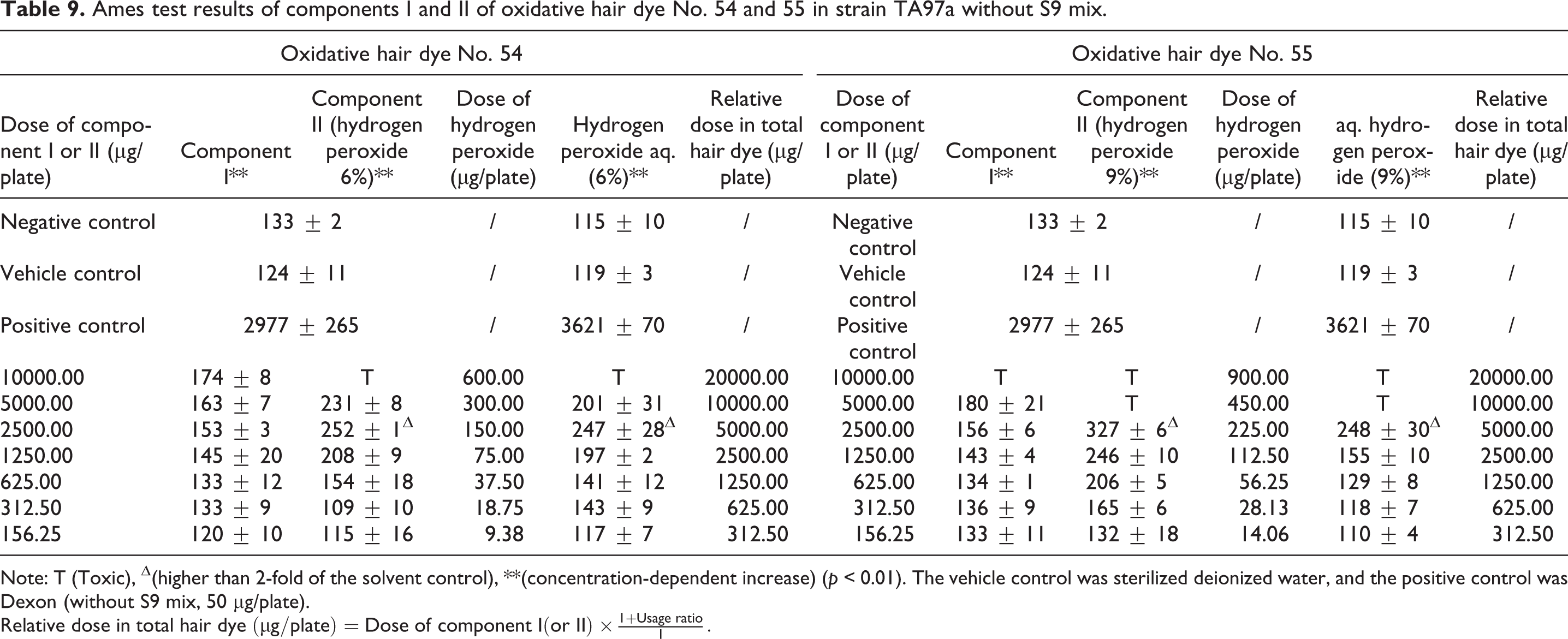
Note: T (Toxic), Δ(higher than 2-fold of the solvent control), **(concentration-dependent increase) (p < 0.01). The vehicle control was sterilized deionized water, and the positive control was Dexon (without S9 mix, 50 µg/plate).
Discussion
Oxidative hair dyes have become the focus of personal care products due to the need for the reaction between components I and II, and the aromatic amines in component I have become a top priority in research. Some researchers have focused on PPD in component I, 8 but the presence of DATS should not be ignored. Among 203 hair dye products approved for use in China from 2014 to 2015, the utilization rate of DATS reached 32.0%. 21 Among 82 batches of imported hair dyes randomly selected in Beijing, 30 batches used DATS, accounting for 36.6% of the total number. 22
In the EU and US, the concentration of DATS in oxidative hair dyes is 0.1–4.0%. 23 The Safety and Technical Standards for Cosmetics of China (2015 version) stipulates that the concentration of DATS should not exceed 4.0%. As this concentration is a mandatory provision, the concentration of DATS in oxidative hair dyes approved for marketing in China meets the requirement. The local sampling inspection result indicated that the DATS concentration in 50 batches of oxidative hair dyes sampled in Hunan Province did not exceed 4.0%. 24
However, another study confirmed that DATS exhibits mutagenicity in the Ames test with the S9 mix. 25 We compared the concentration of DATS in oxidative hair dyes from different manufacturers and the mutagenicity in TA98 with the S9 mix, which also suggests that DATS in component II may be the cause of the mutagenicity of oxidative hair dyes in TA98 with the S9 mix. The final report on toluene-2,5-diamine (DAT) and DATS by the Scientific Committee on Consumer Safety (SCCS) shows that although DATS obtains positive results in the Ames test, the in vivo test of the same genetic endpoint is negative, so there is no potential mutation risk caused by DATS in vivo. 26 The above results are also consistent with the conclusion of the US National Toxicology Program (U.S. NTP), which found that DATS is a noncarcinogen in rodents (rats and mice). 27 Therefore, the American Cosmetic Ingredient Review (CIR) expert group concluded that DATS is safe as a hair dye ingredient when used according to present practices and at a concentration ≤ 4.0%. 23
Considering the above, the EU only carries out safety assessments on each raw material in oxidative hair dyes and carries out risk assessments on the final product of hair dyes instead of genotoxicity tests.
17
In China, due to the need to perform the Ames test for oxidative hair dyes, this will result in a problem. If the final concentration of DATS in the total hair dye is 10 µg/plate (similar to the concentration at which oxidative hair dyes showed a negative result in strain TA98 with S9 mix), the MTC (or MIC) is 20000 µg/plate, and the usage ratio is 1, then the Ames test in TA98 will obtain a negative result in which the concentration of DATS in component I is not more than
The same problem exists for hydrogen peroxide. Hydrogen peroxide is weak but clearly has mutagenic effects in strains TA97 and TA102 without the S9 mix.28,29 This is consistent with our result showing that aq. hydrogen peroxide was positive in strain TA97a without the S9 mix but negative in strain TA97a with the S9 mix. Furthermore, the positive concentration of aq. hydrogen peroxide in strain TA97a without the S9 mix was consistent with the concentration we found in the oxidative hair dyes. This suggests that hydrogen peroxide in component II may be the cause of the mutagenicity of oxidative hair dyes in TA97a without the S9 mix. The results for oxidative hair dye series No. 6 can better illustrate this phenomenon. The positive dose for oxidative hair dyes No. 41, 43, 45, 47, 49, 51 and 53 (hydrogen peroxide concentration: 9%) was not higher than that of oxidative hair dyes (No. 40, 42, 44, 46, 48, 50 and 52) (hydrogen peroxide concentration: 6%) when using the same kind of component I, most of which had a lower positive dose. When we investigated oxidative hair dyes No. 42 and 43 further, we found that there were no precursors or couplers in component I that often led to a positive result in the Ames test, 4 further confirming that hydrogen peroxide caused the positive results in strain TA97a without the S9 mix. Hydrogen peroxide degrades rapidly when in contact with organic material, 30 which may be related to the negative result of hydrogen peroxide in strain TA97a with the S9 mix.
Hydrogen peroxide has been used in medicine for more than 100 years, 31 and it has been used at a concentration of 3% in dentistry. 32 Even instant coffee has hydrogen peroxide. 33 In addition, hydrogen peroxide is inevitably synthesized in the body (e.g., in the oral cavity, 34 urinary tract, 35 and respiratory system). 30 International Agency for Research on Cancer (IARC) concluded that hydrogen peroxide “is not classifiable as to its carcinogenicity to humans (Group 3).” 30 There is no consistent evidence of the genotoxicity in humans exposed to hair dyes occupationally or through individual use, 36 and research found no evidence of an association between the personal use of hair dye and cancer risk in Chinese women (the research was limited by small numbers of cases for certain cancer types). 37 Even for professional hair colorists, no clear differences in mutagenic activity in urine samples were observed between professional hair colorists and control subjects. 38
The CIR expert group noted the positive results of genotoxicity studies but determined that the results are not relevant to cosmetic use due to the rapid consumption of hydrogen peroxide by reactions with the proteins on the skin surface, and hydrogen peroxide is safe when used according to present practices and at a concentration ≤ 12.4%.
30
This presents a problem due to the need for the Ames test for oxidative hair dyes in China. If the final concentration of hydrogen peroxide in the total hair dye is 100 µg/plate (similar to the concentration at which oxidative hair dyes exhibited a negative result in strain TA97a without the S9 mix), the MTC (or MIC) is 20000 µg/plate, and the usage ratio is 1, then the Ames test in TA97a will obtain a negative result, for which the concentration of hydrogen peroxide in component II is not more than
Positive results in the Ames test, of course, may be caused by the complex reaction products produced by precursors, couplers and hydrogen peroxide. The reaction products of some colorants with hydrogen peroxide have been elucidated. For example, for m-phenylenediamine (m-PD) (once used safely in hair dyes at concentrations of up to 10% and normally used at concentrations of up to 3% 39 ), the mutagenicity was markedly increased after hydrogen peroxide oxidation, and 2,7-diaminophenazine was identified as the major mutagenic oxidative compound of m-PD. 40 However, due to the low concentration of m-PD in hair dyes and the fact that most m-PD was consumed by binding with other abundant hair dye components, only a nanogram level of 2,7-diaminophenazine could be detected under the normal usage of hair dye (40 mL of total hair dye). 11 In addition, it is common for marketed oxidative hair dye products to contain more than 2 precursors and/couplers, and they may contain more than 5 precursors/couplers. Thus, during hair dyeing, the consumer will be exposed to several reaction products simultaneously. In addition, the consumer will also be exposed to unreacted precursors/couplers at the same time. 41 Therefore, it is currently impossible to simulate such a complex reaction situation for oxidative hair dyes in experiments.
For oxidative hair dyes, DATS is often necessary in component I, and hydrogen peroxide is contained in nearly all kinds of component II. Therefore, positive results in the Ames test are inevitable because the concentrations of DATS and hydrogen peroxide in oxidative hair dyes that will allow a negative result are far below the maximum safe concentration at present. Moreover, even if there are mutagens in oxidative hair dyes, the results will be masked by the high positive rate, so it is of little significance to carry out the Ames test on the final products of oxidative hair dyes. SCCS think a positive outcome in one or more in vitro genotoxicity tests for both precursors/couplers and the reaction products are common, and these positive results are not confirmed in vivo. From the evaluations in the available studies, it can be deduced that for current users of hair dyes marketed in the EU, no clear indications for an increased cancer risk have been demonstrated, so the SCCS has raised no major concerns regarding the genotoxicity and carcinogenicity of currently used hair dyes or their reaction products (in 2010) in the EU. 42 Therefore, the EU only carries out safety assessments on each raw material in oxidative hair dyes and carries out risk assessments on the final products of hair dyes instead of genotoxicity tests. 17 As a result, China issued the Technical Guidelines for Cosmetic Safety Assessment (Draft) in July 2020, and the safety assessment method used for oxidative hair dyes will come soon.
Conclusions
We found that DATS in component I of oxidative hair dyes may be the cause of mutagenicity in TA98 with the S9 mix, and hydrogen peroxide in component II may be the cause of mutagenicity in TA97a without the S9 mix in the Ames test. When testing DATS and hydrogen peroxide separately in the Ames test, the positive concentration was consistent with the concentration that we calculated based on the positive concentration in oxidative hair dyes. The results suggest that positive results for oxidative hair dyes in the Ames test are inevitable because of the existence of DATS in component I and hydrogen peroxide in component II. Therefore, we should carry out safety assessments on each raw material in oxidative hair dyes and carry out risk assessments on the final products of oxidative hair dyes instead of genotoxicity tests in China.
Footnotes
Declaration of conflicting interests
The author(s) declared no potential conflicts of interest with respect to the research, authorship, and/or publication of this article.
Disclaimer
The statements described in this work are those of the individual authors and are not intended to represent the policies of the agency at which they are employed.
Funding
The author(s) disclosed receipt of the following financial support for the research, authorship, and/or publication of this article: This study was supported by research project of Shanghai Drug Administration (Analysis of mutagenic components of oxidative hair dyes with the Ames test).
