




Abstract
The aim of the study was to determine the relationship between anti-inflammatory effects of the natural polyphenolic compound tannic acid (CAS number: 1401-55-4) and myeloperoxidase (MPO) enzyme activity in paw edema model. Thirty-five female rats were divided into five groups. The paws of rats were injected subcutaneously in the plantar surface with formalin except for the control group. Indomethacin and tannic acid were intraperitoneally administered 1 h after formalin injection. The paws volume was measured by using vernier caliper. MPO enzyme activity was determined using 4-aminoantipyrine–phenol solution as the substrate for MPO-mediated oxidation by H2O2. About 17% and 13% edema inhibition has detected in the indomethacin-applied group, at the measurements run every other hour right after the treatment. An inhibition of 16% was found at the group treated with 25 mg/kg tannic acid. However, in the group treated with 50 mg/kg tannic acid, 15% and 7% of the edema inhibition was observed. Serum and paw tissue MPO activities were decreased in treated groups with indomethacin and tannic acid according to formalin control group. Our study results suggest that tannic acid may contribute to the treatment of inflammation by decreasing MPO enzyme activity, but the molecular mechanism is still not clear.
Introduction
Inflammation is an important biological response of the vascular tissues to harmful stimuli, such as pathogens, damaged cells, or irritants. 1,2 Inflammation can also cause numerous diseases, such as cancer, autoimmune diseases, cardiovascular diseases, and neurodegenerative diseases. 2 –6 Nonsteroidal anti-inflammatory drugs, such as indomethacin, are widely used in the treatment of inflammatory diseases. Although these drugs are highly effective, they have a number of deleterious adverse effects, such as gastrointestinal ulcers. 7 Therefore, researchers are continuously looking for new agents with fewer adverse effects for the treatment of inflammation.
Natural polyphenolic compounds are consumed in large amounts in the daily diet and can play an important role in the treatment of diseases. In our study, we used tannic acid which is a natural polyphenolic compound. Tannins are classified as hydrolyzed and condensed tannins. 8 –12 One of the hydrolyzed tannins, tannic acid, is found in drinks, such as black tea, green tea, coffee, and red wine, and also in nuts, fruits, and many vegetables. 9,13 –15 Tannic acid has major biological activities mainly as an antioxidant and has free radical scavenging properties. 9,12,14,16 However, these effects are not yet fully understood.
Myeloperoxidase (MPO) is an enzyme associated with both inflammation and oxidative stress. It is released by leukocytes and catalyzes the formation of reactive species. 17,18 The release and generation of MPO plays an important role in host defense. 17,19 Elevations in the activity of MPO have often been used as markers of polymorphonuclear leukocytosis in conditions of inflammation and sepsis. 10 The aim of this study therefore was to evaluate the relationship between the anti-inflammatory effectiveness of tannic acid and MPO enzyme activity in the formalin-induced paw edema model in rats.
Materials and methods
Animals
Thirty-five female Spraque-Dawley rats (150–300 g body weight) were used according to the guidelines of Eskisehir Osmangazi University, the care and use of animals ethical committee (approval no.: 364/2013). The animals were kept in polycarbonate cages in a room with controlled temperature (22 ± 2°C) and humidity (50 ± 5%). The animals had a 12-h light and dark cycle and were fed standard pellet diet and water ad libitum.
Formalin-induced paw edema in rats
The anti-inflammatory activity of tannic acid (CAS number: 1401-55-4, ACROS Organics, Morris Plains, New Jersey, USA) was evaluated by using formalin-induced hind paw edema model. Animals were divided into five groups with seven rats in each group as presented in Table 1. The paw edema induced by injecting 0.01 ml of 5% formalin into sub-plantar tissues of the rat
Groups and drug administration.

i.p.: intraperitoneal injection; s.i.: sub-plantar injection.
Determination of edema formation
The paw volume was measured before (0 h) and after formalin and drugs injection (1, 2, 3, 5, 12, and 24 h) using vernier caliper. The average feet swelling in test as well as standard groups were compared with that of control and the % inhibition of paw edema volume was calculated using the formula: Percentage Inhibition = [(V1 − V2)/(V1)] × 100; V1 = paw volume before formalin injection and V2 = paw volume after treatment agent and formalin injection at different time points.
MPO activity
MPO activity, an index of polymorphonuclear leukocyte accumulation, was measured in the inflamed paw tissue and serum sample according to the modified method of Wei and Frenkel. 21 MPO enzyme activity in hind paw homogenates and serum samples was determined using 4-aminoantipyrine and 2%-phenol solution as the substrate for MPO-mediated oxidation by H2O2 and changes in absorbance at 510 nm were recorded. One unit of MPO activity is defined as that which degrades 1 μmol H2O2/min at 25°C. 22
Statistical analysis
The study was evaluated by IBM SPSS Statistics 20 to perform the Shapiro–Wilk normality test was applied to numeric variables. The parametric data with a normal distribution are statistically evaluated with one-way analysis of variance and the data that did not show a normal distribution are statistically evaluated with the Kruskal–Wallis test. A value of p < 0.05 was considered statistically significant.
Results
Our study results evaluated the effects of tannic acid on the inhibition of edema and MPO activity in serum and tissue sample during the acute phase of inflammation. One hour after formalin injection treatment agents were performed in study groups (Figure 1(a) to (c)). About 17% and 13% edema inhibition has detected in the indomethacin-applied group, at the measurements run every other hour right after the treatment. An inhibition of 16% was found at the group treated with 25 mg/kg tannic acid. However, in the group treated with 50 mg/kg tannic acid, 15% and 7% of the edema inhibition was observed (Figure 2).
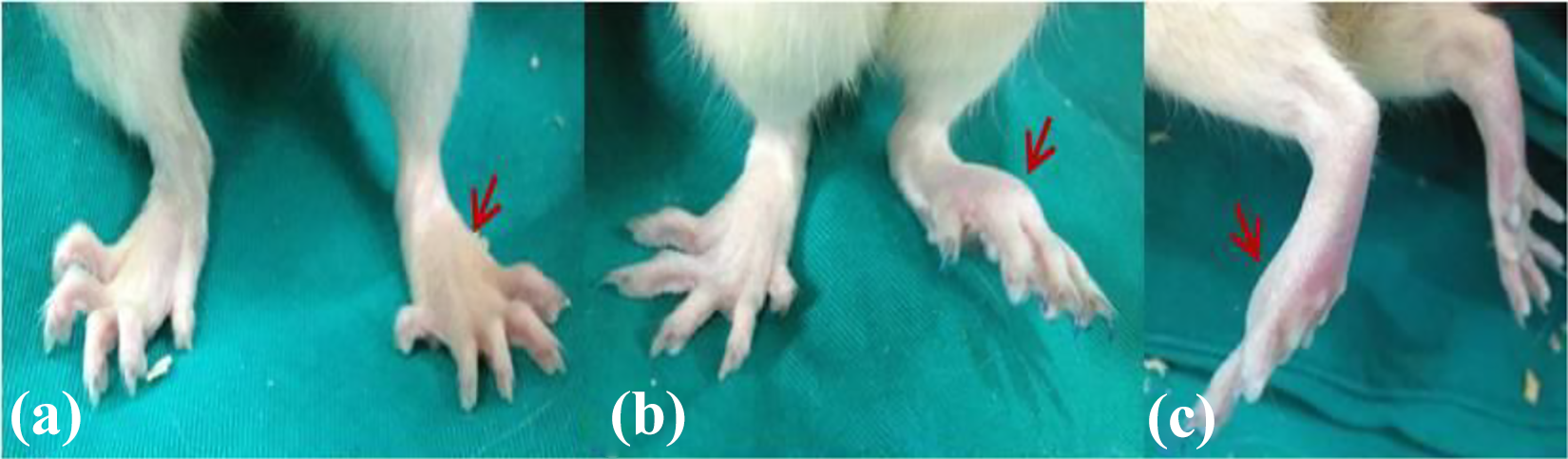
(a) After injecting the physiological saline. (b) and (c) After injecting the formalin.
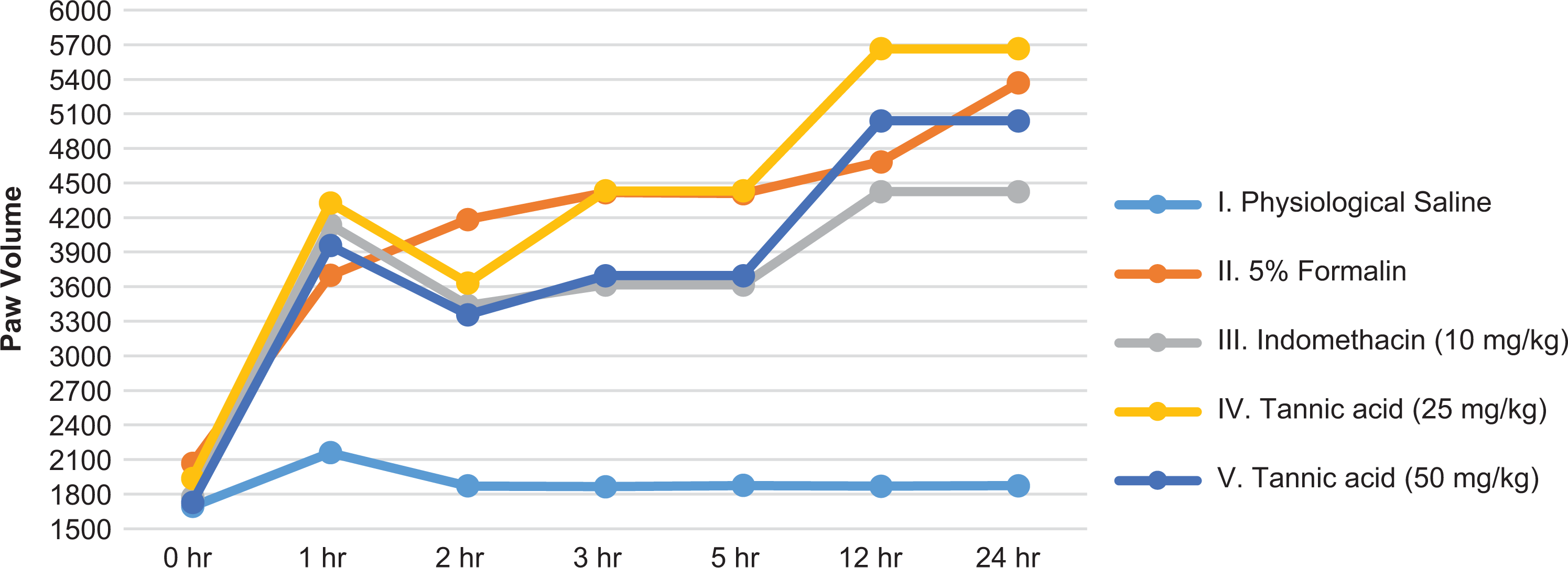
Paw volumes in all groups according to time.
In our study, 24 h after formalin injection, MPO activities were determined in serum and tissue samples. MPO activities of serum samples in indomethacin (p ≤ 0.001) and 50 mg/kg doses of tannic acid groups were found to be decreased (p = 0.002) compared to formalin control group (Figure 3). MPO activity in paw tissues was decreased in indomethacin and 25 mg/kg tannic acid groups (p > 0.05) (Figure 4).
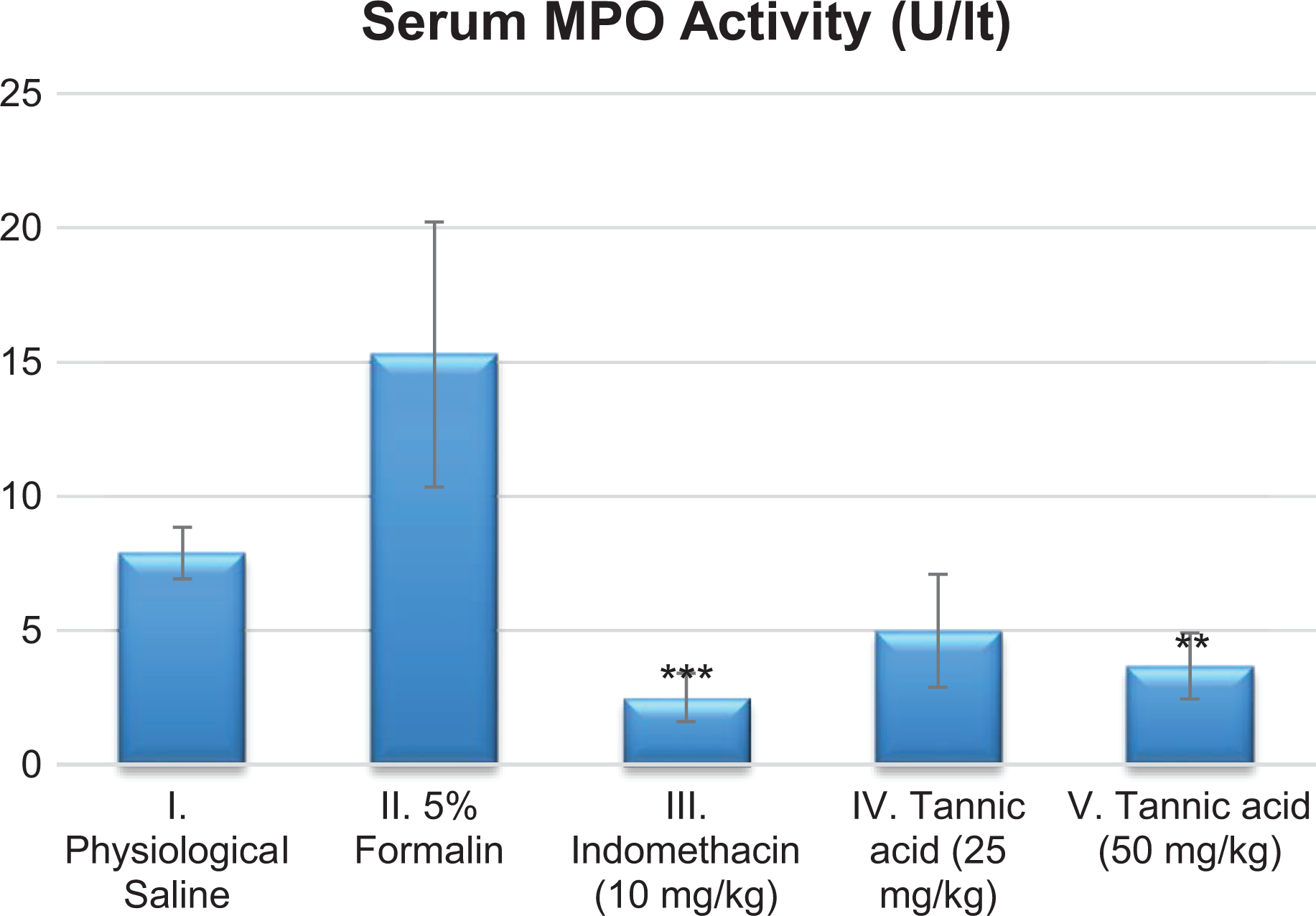
MPO enzyme activity in serum sample. Data are presented as mean ± SD. *p < 0.05, **p < 0.01, ***p < 0.001 (compared to formalin group). MPO: myeloperoxidase; SD: standard deviation.

MPO enzyme activity in paw tissue homogenate. Data are presented as mean ± SD. MPO: myeloperoxidase; SD: standard deviation.
Discussion
In our study, we investigated the effects of tannic acid on the inhibition of edema and MPO activity in serum and tissue samples during the acute phase of inflammation. The MPO enzyme activity was used as a marker for inflammation. In inflamed tissues, the activity of MPO is significantly increased and its inhibition evidence of anti-inflammatory activity. 23 It is well known that inhibition of edema induced by formalin in rats is one of the most suitable test procedures to screen anti-inflammatory agents. 24 MPO activity in this study increased in the paw after formalin injection when compared to healthy control rats. Anti-inflammatory drugs, such as indomethacin, have been shown to depress the increases in MPO activity during inflammation.
In recent studies, the anti-inflammatory effects of tannin-rich plant extracts, including tannic acid, have been investigated in paw edema model. 25 –29 The study determined the anti inflammatory activity of tannin-rich aqueous extract of Mirabilis jalapa Linn. by using carrageenan and formalin induced paw edema models in rats. Study results showed that aqueous extract administered at a dose of 200 mg/kg prevented carrageenan-induced paw edema with a percentage inhibition of 15.0%, 26.4%, 31.3%, and 39.0% at 1, 2, 3, and 4 h, respectively, whereas this was 25.6%, 35.0%, 50.0%, and 56.3% at a dose of 400 mg/kg at 1, 2, 3, and 4 h, respectively. The administered aqueous extract prevented formalin-induced paw edema with percentage inhibition of 15.10%, and 22.12% on first day, while 32.9% and 43.0% on fourth day at doses of 200 and 400 mg/kg, respectively. 27
Another study was investigated the anti-inflammatory activity of ethanolic flower extract of Newbouldia laevis, which contains tannins, in rat paw edema models. Significant anti-inflammatory activity was shown by the extract at all doses used (25, 50, and 100 mg/kg) to treat edema that was induced by formalin in rats, compared to the control group (p < 0.05). The flower extract reduced formalin-induced paw edema by 27.7%, 13.3%, and 14.4% after a 1-h treatment, and 58.5%, 61.8%, and 50.3% inhibition was observed after a 5-h treatment at doses of 25, 50 and 100 mg/kg, respectively. Percent inhibition increased over time. 29 Another study showed the anti-inflammatory effect of Sambucus ebulus rhizome extract, which includes tannins, in rat models. This study’s results suggest that the plant extract inhibited formalin-induced edema, especially at 200 mg/kg (p < 0.01). 25 The study investigated the anti-inflammatory effects of tannin-enriched fractions, which were isolated from the stem bark of Myracrodruon urundeuva, on paw edema in rats. Study results showed that tannin-enriched fractions have a potent anti-inflammatory action at 5 and 10 mg/kg, causing approximately 21% and 44% inhibitions of the rat paw edema, at 3 h after carrageenan administration. A significant inhibition of 28% was also seen at 4 h, with a dose of 10 mg/kg. Even at a smaller dose, the tannin-enriched fraction (5 mg/kg) was effective, inhibiting paw volume by 20% at 3 h. 28
Muthuraman et al. investigated that the anti-inflammatory effects of free (FPEO) and bound (BPEO) phenolic compounds of E. officinalis, including tannic acid and gallic acid, in acute and chronic inflammations in rat models. FPEO and BPEO phenolic compounds that include tannic and gallic acids were studied for their acute and chronic anti-inflammatory activities at doses of 20 and 40 mg/kg. The study results showed that pretreatment with FPEO and BPEO reduced carrageenan-induced acute inflammation as indicated by a decrease in paw volume. However, only high dose (40 mg/kg) of both fractions showed a significant anti-inflammatory response which was comparable to the anti-inflammatory drug diclofenac sodium in a pretreated group (p < 0.05). 26 Our study results evaluated the effects of tannic acid on the inhibition of edema and MPO activity in serum and tissue samples during the acute phase of inflammation. One hour after formalin injection treatment agents were performed in study groups. About 17% and 13% edema inhibition has detected in the indomethacin-applied group, at the measurements run every other hour right after the treatment. An inhibition of 16% was found in the group treated with 25 mg/kg tannic acid. However, in the group treated with 50 mg/kg tannic acid, 15% and 7% of the edema inhibition was observed.
Also, in the study, FPEO and BPEO phenolic compounds were found to decrease MPO activity in chronic inflammatory condition. A study showed that FPEO and BPEO reduced in the inflammation, but significant effects were observed only at high doses of both compounds that were comparable to anti-inflammatory drug-treated group. 26 In our study, MPO activity was determined in serum and tissue samples. MPO activity in serum sample was decreased according to formalin control group. This decrease was determined to statistically significant in indomethacin (p ≤ 0.001) and 50 mg/kg tannic acid (p = 0.002) groups. It was found that 50 mg/kg concentration of tannic acid in serum sample, act as anti-inflammatory agent such as indomethacin. Our results showed MPO activity in paw tissue was decreased in indomethacin and 25 mg/kg tannic acid groups. Tannic acid (25 mg/kg) may have similar effect with anti-inflammatory agent indomethacin in tissue sample.
In conclusion, our study shows that tannic acid, which is found in tannin-rich foods, may contribute to the treatment of inflammation by decreasing MPO activity. These results indicate that tannic acid may influence the inflammatory process similar to anti-inflammatory drugs, but the molecular mechanism remains unclear.
Footnotes
Declaration of conflicting interests
The author(s) declared no potential conflicts of interest with respect to the research, authorship, and/or publication of this article.
Funding
The author(s) received no financial support for the research, authorship, and/or publication of this article.
