




Abstract
Grape skin and seeds contain large amounts of phytochemicals such as polyphenols, resveratrol, and proanthocyanidins, which possess antioxidant activities. Cisplatin is widely used in the treatment of cancer. High doses of cisplatin have also been known to produce acute adverse effects. The aim of this study was to investigate the protective effects of antioxidant properties of whole grape juice (with skin and seeds) on cisplatin-induced acute gastrointestinal tract disorders and nephrotoxicity in Wistar rats. Gastric emptying is significantly increased in whole grape juice-pretreated rats when compared to cisplatin treatment alone. The expression of ghrelin mRNA of stomach is increased in rats with whole grape juice. However, pretreatment with whole grape juice did not reduce renal function markers in acute renal toxicity. No significant changes were recorded in the oxidative stress/antioxidant status parameters of any study group. In contrast, pretreatment with whole grape juice slightly improved tubular cell vacuolization, tubular dilatation, and cast formation in renal tubules. These results show that consumption of whole grape juice induces somewhat beneficial effects in preventing cisplatin-mediated dyspepsia but does not offer protection against cisplatin-induced acute renal toxicity.
Introduction
cis-Diamminedichloroplatinum (II) (cisplatin) and other platinum derivatives are among the most effective chemotherapeutic agents widely used in the treatment of a variety of malignancies, including head and neck, ovarian, and testicular cancers. 1,2 However, administration of a high dose of cisplatin is difficult in clinical practice predominantly owing to its strong side effects such as kidney and gastrointestinal tract damage. 3,4 Approximately 28–36% of patients receiving an initial dose (50–100 mg/m2) of cisplatin develop acute renal failure 5 and acute gastrointestinal tract disorders such as delayed gastric empting, early satiety, anorexia, and nausea. 6
The exact mechanism of cisplatin nephrotoxicity remains to be fully elucidated. Current experimental evidence suggests that cisplatin-induced oxidative stress is involved in the development of renal tubule injury. 7 In addition, Liu and Baliga’s research confirmed that cytochrome P450 2E1(CYP-system) also play a pivotal role in cisplatin-induced nephrotoxicity. It also initiated apoptosis through the generation of ROS during cisplatin treatment. 8
Another adverse effect caused by cisplatin is gastrointestinal function disorders, which can markedly decrease appetite and make continuation of chemotherapy difficult. Ghrelin is a growth hormone-releasing acylated peptide expressed predominantly in the stomach. The important roles of ghrelin include increasing food intake and body fat mass as well as stimulating growth hormone release and gastric motility. 9,10 Ghrelin has been proven to alleviate cisplatin-induced dyspepsia 4 and accelerate gastric emptying in rats. 11 Therefore, increasing ghrelin levels may help to improve chemotherapy-associated dyspepsia.
Antioxidants have become a focal point in cancer therapy, as most anticancer agents generate free radicals and alter the redox balance. Grapes are rich in polyphenols, flavonoids, proanthocyanidins, and resveratrol. Grape seed proanthocyanidin extract and resveratrol are polyphenols isolated from grape skin and red wine that have been reported to protect against cisplatin-induced nephrotoxicity. 12 –14 Consumption of grape juice at a concentration of 10 µL/g body weight in Wistar rats with pentylenetetrazol-induced oxidative damage for 17 days resulted in an improvement in liver and serum oxidative damage by increased enzymatic antioxidant defenses. 15 In addition, grape juice concentrate has been found to protect against oxidative DNA damage induced by hydrogen peroxide (H2O2) in peripheral blood cells in rats. 16 Clinical studies have reported that concentrated red grape juice supplementation exerts antioxidant, hypolipidemic, and anti-inflammatory effects in both healthy subjects and hemodialysis patients. 17 Either grape extracted compounds or grape juice own antioxidant properties and have been extensively studied in animals and humans. However, the effects of whole grape juice/cisplatin combination have not been assessed in regular dietary intake animal model. Therefore, the purpose of this study was to evaluate the efficacies of antioxidant properties of whole grape juice (with skin and seeds) on acute gastrointestinal tract disorders and acute renal injury induced by cisplatin in rats.
Materials and methods
Sample preparation
Fresh grapes were purchased from the Horticultural Research Station of the College of Agriculture and Natural Resources, National Chung-Hsing University. Extracts were prepared by homogenizing 325 g of washed, uncooked fresh grapes (fresh wet weight of the edible part, with skin and seeds, as would normally be eaten) without distilled water for 30 s on ice. For analysis, the whole juice was divided into two fractions. Some whole juice extracts were centrifuged and filtered with Whatman filter paper to remove unwanted residues. The supernatants were collected for analyses. Remaining whole juice samples were subsequently stored at −20°C and freshly thawed prior to administration to rats.
Determination of pH and total soluble solids (oBrix)
To determine the pH of grape juice, a digital pH meter was used. Total soluble solids were estimated as oBrix with a Master refractometer (oBrix approximately 0–33%; Master-M, ATAGO, Japan).
Determination of total phenolic content and total anthocyanin content
Total phenolic content of grape juice was determined by spectrophotometric method using Folin–Ciocalteu reagent. The extraction was based on the procedure described by Stella et al. 18 with some minor amendments. Briefly, Folin–Ciocalteu reagent and grape juice were mixed well and left for 6 min. Then, 20% sodium carbonate solution was added. The phenols were measured at 760 nm using spectrophotometer after reaction at 37°C for 60 min. A calibration curve was prepared using standard solution of gallic acid, and total phenols were expressed as milligrams of gallic acid equivalents per gram of sample. Total anthocyanine content was quantified using a pH differential method and expressed as milligrams of cyanidin-3-glucoside equivalents per milliliter. 19
Determination of DPPH-free radical scavenging activity
2,2-Diphenyl-1-picrylhydrazyl (DPPH) free radical scavenging activityof grape juice was measured using the method of Aadil et al.
20
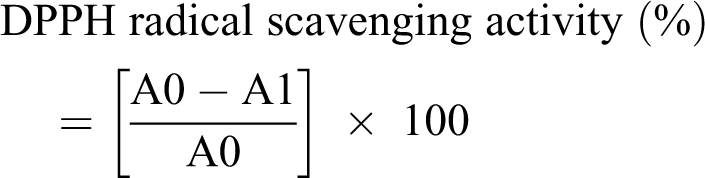
with some minor modifications. Juice and DPPH solution (0.2 mM in and ethanolic solution) were mixed, followed by incubation in the dark at room temperature for 30 min. The same procedure was conducted for blank with ethanol used instead of the sample solution. The decrease in the absorbance (due to protein donating activity) was measured at 517 nm using spectrophotometer. The DPPH radical scavenging activity was calculated as:
Measurement of total antioxidant capacity (TEAC)
Whole grape juice was centrifuged and filtered through a Whatman #1 filter paper. Grape juice/ethanol (1:5) solutions were prepared and then added to the diluted ABTS + solution. After 6 min, the absorbance decrease was read at 752 nm, against a blank (ethanol). Calibration curves for the Trolox equivalent antioxidant capacity were constructed by plotting absorbance versus concentration of Trolox standard solutions.
Animals
Twenty-one male Wistar rats (4 weeks old, average weight 125–140 g) were obtained from BioLASCO Taiwan Co. Ltd (Taiwan). The animal experiments were approved by the Ethics Committee on Animal Experimentation of Chung Shan Medical University (study number: 1192). Animals were housed in cages with a maximum of four rats per cage and given food and water ad libitum. After 1 week of acclimatization, animals were randomly divided into three equal groups. Group 1 (n = 7) served as the control and received a saline solution instead of grape juice without therapy. Group 2 (n = 7) received a single intraperitoneal dose of cisplatin 15 mg/kg body weight on the 7th day of the experiment. Group 3 (n = 7) received cisplatin and 10 µL/g body weight whole grape juice administered via an intragastric tube. Whole grape juice was administered for 6 days before the induction of cisplatin and then continued for two additional days. In the present study, whole grape juices were administered according to the method proposed by Rodrigues et al. 15 The doses of grape juice were determined by calculating the average amount of juice that would be equally consumed daily by a 70 kg human male. 21 Hence, whole grape juices were administered to the rats at 10 μL/g of body weight once per day. During the experiments, the amount was adjusted according to the animals’ weight. The body weights of all rats were recorded before and after cisplatin injection. Animals were sacrificed by carbon dioxide. Serum samples were collected and stored at −20°C until analysis. The stomach, liver, kidney, spleen, and intestine were immediately removed and weighed for the calculation of weight ratios. The stomach was opened, the contents were removed and weighed, and the tissue was washed in chilled sterile saline to remove adherent particulate matter. The effects of grape juice treatment on gastric emptying rate were calculated as: gastric emptying index (GEI) % = [1−(weight of stomach content/food consumed between 24 and 48 h post-cisplatin)] × 1004. The kidney and stomach specimens were immediately fixed in 10% neutral-buffered formalin for histochemical studies. The remaining kidney and stomach tissues were stored at −80°C for later measurement.
Oxidative stress analysis
Thiobarbituric acid reactive substances (TBARS) resulted from acid-heating reaction and served as an index of lipid peroxidation according to a previously described method. 22 In brief, kidney and stomach were homogenized in 10 volumes of phosphate-buffered saline (pH 7.4). The homogenate supernatant or serum was mixed with 40% trichloroacetic acid and 0.85% thiobarbituric acid and heated in boiling water bath for 20 min. TBARS were determined by absorbance at 535 nm.
Analysis of enzymatic antioxidant defense systems
Catalase (CAT) activity was assayed by measuring the rate of decrease in H2O2 absorbance at 240 nm. 23 The glutathione reductase activity was measured by changes in NADPH absorbance at 340 nm. 24 The protein concentration was determined by the Bradford method (Bio-Rad, Hercules, California, USA), using bovine serum albumin as a standard.
Histopathological analysis
Five-micrometer kidney sections were deparaffinized, routinely processed for hematoxylin–eosin and examined under light microscope 400× (Olympus BX-200, Tokyo, Japan) using blind procedures.
Measurement of expression levels of mRNA
Total RNA was isolated from the stomach samples using RareRNA reagent. Two milligrams of the extracted messenger RNA (mRNA) were denatured at 72°C for 10 min and reversibly transcribed to complementary DNA (cDNA) by incubation with reaction mixture. Two microliters of cDNA were amplified in a reaction volume of 50 μL containing 0.5 units Taq polymerase (Ex taq, TaKaRa, Japan), 200 mM dNTPs, 10 mM Tris-hydrochloric acid (pH 8.0), 1.5 mM magnesium chloride, 75 mM potassium chloride, and 10 pmol of each primer. The primer for ghrelin design was obtained from the study by Malik et al. 25 : forward 5′-TCCAAGAAGCCACCAGCTAAA-3′ and reverse 5′AACATCGAAGGGAGCATTGAAC-3′. The polymerase chain reaction (PCR) thermal cycle was programmed as follows: initial denaturation at 95°C for 2 min followed by 35 cycles at 95°C for 1 min; 55 C for 1 min and 72°C for 10 min. The final cycle was modified to allow for 2 min extension at 72°C. PCR reaction was performed on a programmable thermal controller instrument-thermal cycler model 2720 (Applied Biosystems, Foster City, CA). The products were visualized using electrophoresis on 1.5% agarose gel and ethidium bromide staining. We confirmed the quality of cellular mRNA by measuring the intensity of β-actin.
Statistical analysis
Experimental values are presented as means ± SD. Comparison of mean values between groups was carried out by one-way analysis of variance followed by Duncan’s test. Values of p < 0.05 were considered statistically significant. Different superscript letters indicate statistical difference in the same column.
Results
Composition of the grape juice
The main characteristics of the grape juice are shown in Table 1. Extracted grape juice exhibited over 90% DPPH radical scavenging activity.
Major families of compounds found in grape juice.

DPPH: 2,2-diphenyl-1-picrylhydrazyl; TEAC: Trolox equivalent antioxidant capacity.
Food and water intake
Before cisplatin injection, food intake in all rats was in the range of 9–10 g/rat. After treatment, there was noticeable decline in all test groups except control group. The average food intakes of cisplatin-treated group and pretreatment group decreased by 48.9% and 56.1%, respectively, compared to food intakes before treatment. Similar results were also observed for water intakes. Significant decrease in food intake is generally observed during chemotherapy (Table 2). The grape juice supplement did not improve food intake or body weight.
Influence of cisplatin injection (before and after) on food and water consumption in cisplatin-treated rats.a

aData are presented as mean ± SD (n = 7).
bSignificant difference in food intake before and after cisplatin injection for each group.
cSignificant difference in water intake before and after cisplatin injection for each group.
Body weight and relative organ weights
The effects of the whole grape juice supplement on body and relative organ weights in cisplatin-treated rats are shown in Table 3. The body weight of each group was measured from days 1 to 2 after cisplatin injection. Cisplatin administration for two successive days significantly decreased body weight by 12% when compared with control rats. Body weight loss was also observed in whole grape juice-pretreated rats. Cisplatin-treated rats and whole grape juice-pretreated rats showed a significant decrease in spleen/body weight ratio when compared with the control group. There were no significant changes in kidney/body weight or liver/body weight ratios between the cisplatin and whole grape juice-pretreated groups.
Influence of grape juice intake on body weight and relative weights of liver, kidney, and spleen in cisplatin-treated rats.a
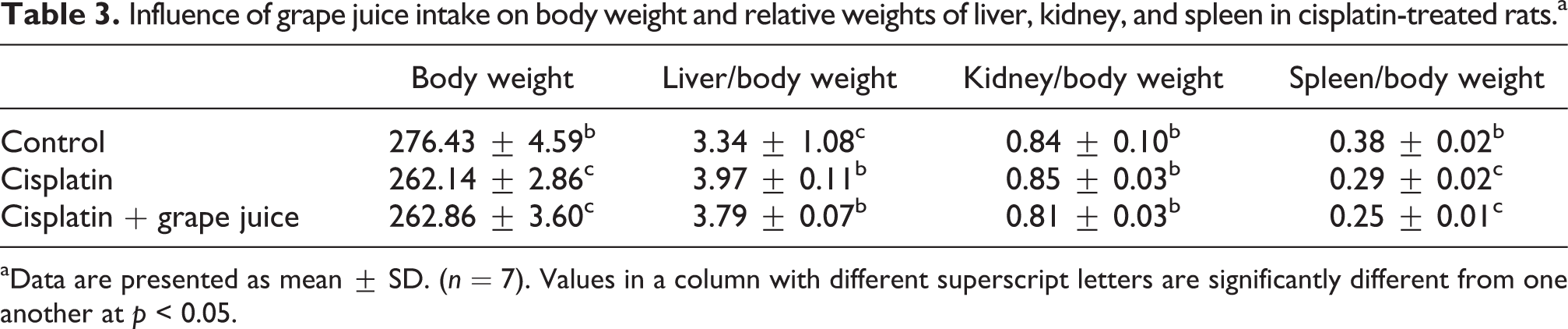
aData are presented as mean ± SD. (n = 7). Values in a column with different superscript letters are significantly different from one another at p < 0.05.
Gastric emptying
Two days after cisplatin injection, stomach contents were collected and weighed. Figure 1(a) shows that cisplatin treatment significantly decreased GEI by −48.9% when compared with controls (cisplatin: 48.28 ± 6.38%; control: 98.56 ± 0.24%; p < 0.01). In cisplatin-treated rats pretreated with whole grape juice, GEI increased 1.5-fold when compared with rats treated with cisplatin alone (cisplatin: 48.28 ± 6.38%; grape juice: 73.7 ± 3.77%; p < 0.01).

Effects of whole grape juice intake on (a) gastric emptying and (b) ghrelin mRNA expression in the stomach 2 days after cisplatin injection (15 mg/kg, intraperitoneal) in rats. Data are presented as mean ± SD (n = 7). Values with different letters are significantly different from each other. SD: standard deviation.
Ghrelin mRNA expression
The reverse transcriptase PCR results showed that there was low ghrelin mRNA expression in control group. Whole grape juice increased ghrelin mRNA expression in the stomach, while treatment with cisplatin significantly decreased ghrelin mRNA expression in the stomach (p < 0.05, Figure 1(b)).
Serum creatinine and urea levels
The serum creatinine and urea levels significantly increased in cisplatin-treated rats when compared with controls. Pretreatment with whole grape juice in cisplatin-treated rats did not significantly ameliorate these changes (Figure 2).

Influence of whole grape juice intake on serum (a) creatinine and (b) urea levels in cisplatin-treated rats. Data are presented as mean ± SD (n = 7). Values with different letters are significantly different from each other. SD: standard deviation.
Oxidative status
Serum, kidney, and stomach TBARS levels are shown in Table 4. Cisplatin treatment significantly elevated serum TBARS levels. Intervention with grape juice did not decrease serum TBARS concentrations. We also determined the renal level of TBARS and found no significant differences among the three groups. To further investigate the role of oxidative stress in the management of chemotherapy-associated dyspepsia, TBARS levels in stomach homogenates were determined. There were no significant differences among rats treated with cisplatin alone and those pretreated with whole grape juice in comparison with control rats.
Influence of grape juice intake on serum, kidney, and stomach TBARS levels in cisplatin-treated rats.a
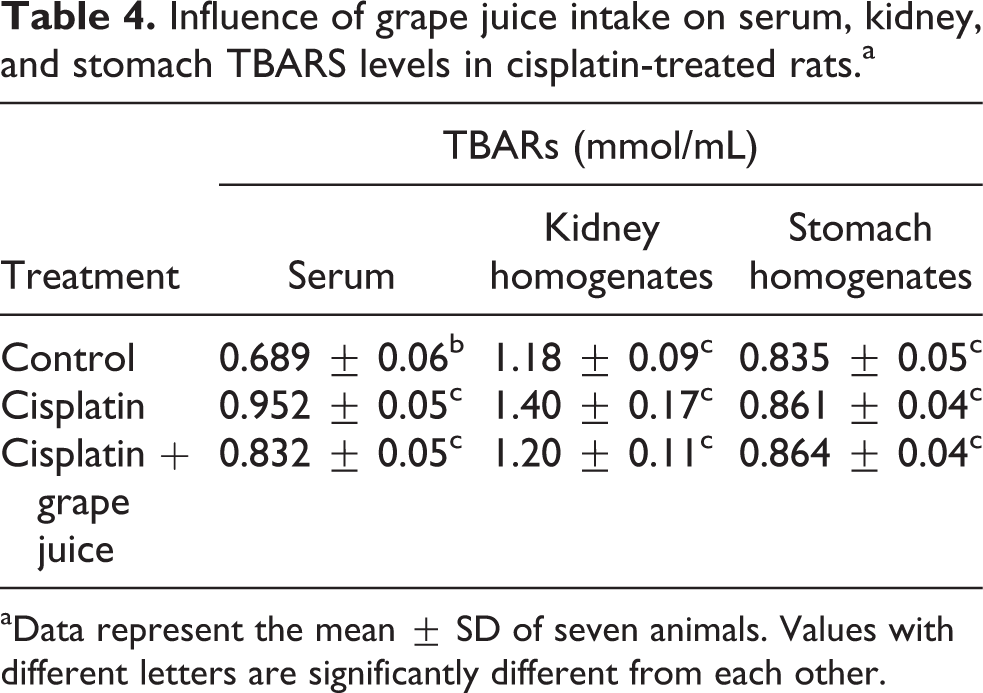
aData represent the mean ± SD of seven animals. Values with different letters are significantly different from each other.
Antioxidant enzymes
CAT and glutathione reductase activities were determined in kidney homogenates. There were no significant differences in CAT or glutathione reductase activities in kidney homogenates between control and cisplatin-treated groups. Activities of CAT and glutathione reductase in the kidneys were not influenced by whole grape juice consumption (Figure 3).
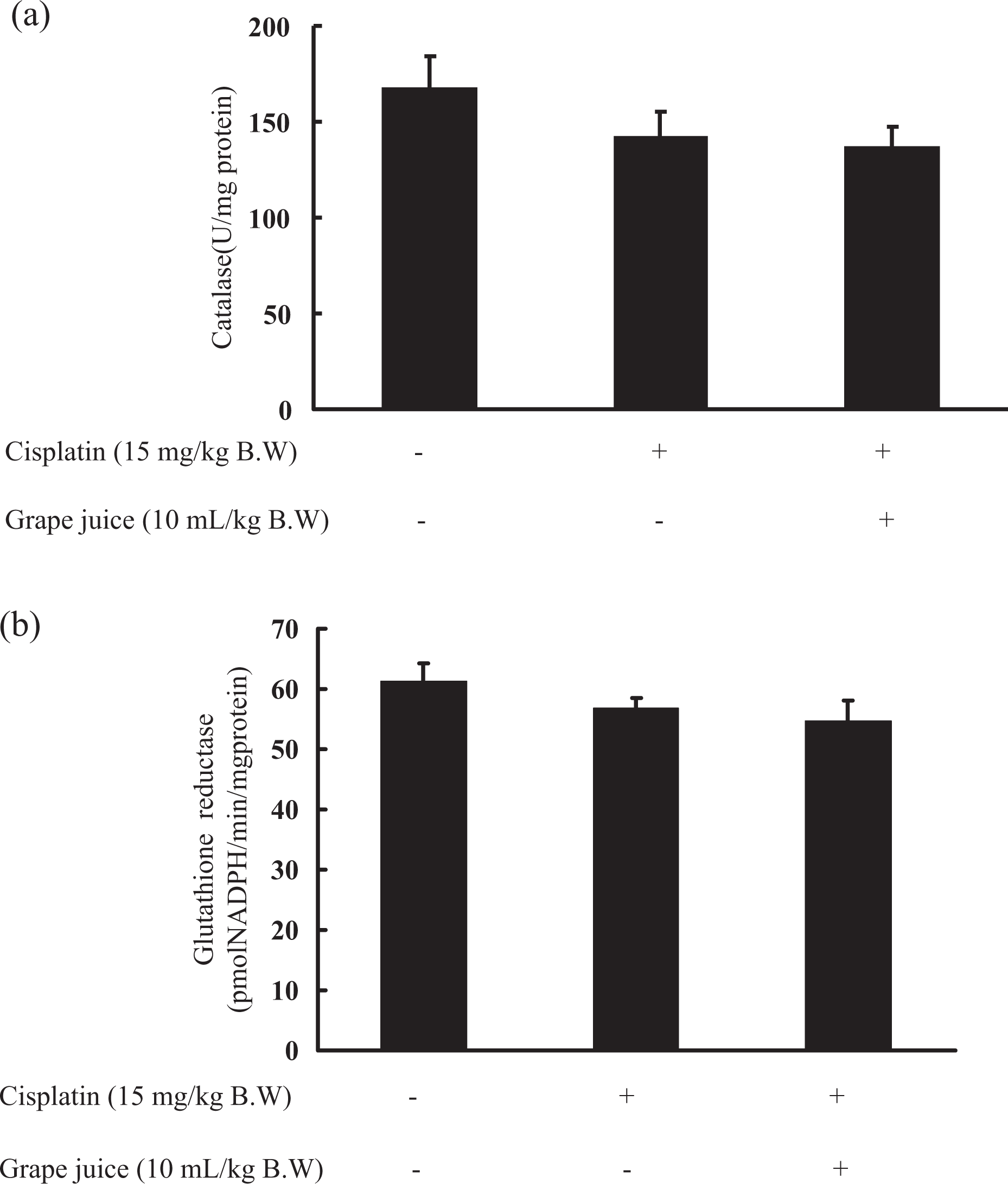
Influence of whole grape juice intake on kidney (a) CAT and (b) glutathione reductase activities in cisplatin-treated rats. Data are presented as mean ± SD (n = 7). SD: standard deviation; CAT: catalase.
Histopathological examination
Proximal tubular epithelial cells are thought to be the primary target of cisplatin-induced acute renal failure. No histological or pathological changes were observed in the control group. Significant tubular cell vacuolization, tubular dilatation, and cast formation were noted in the kidney tissues of cisplatin-treated animals. Whole grape juice consumption slightly ameliorated impairment of proximal tubules when compared with rats receiving cisplatin treatment alone (Figure 4).

Effects of whole grape juice on renal histology in cisplatin-induced nephrotoxicity. Kidney sections were stained with H&E and observed under ×400 magnification. In the rats that received PBS treatment alone (a), there was normal kidney architecture and histology. In the cisplatin-treated rats (b), there was marked injury to the kidneys with cast formation, vacuolation of tubules and dilation of tubules. These changes were less pronounced in rats pretreated with whole grape juice (c). ▴: cast formation; #: vacuolation of tubules; *: dilation of tubules; H&E: hematoxylin and eosin; PBS: phosphate-buffered saline.
Discussion
Cisplatin is one of the most widely used platinum-containing chemotherapeutic drugs in clinical practice. However, it has been reported that platinum may gradually accumulate and be retained in renal proximal tubules to cause severe renal dysfunction. 26,27 Cisplatin has also been demonstrated to provoke acute gastrointestinal tract disorders such as delayed gastric empting, early satiety, anorexia, and nausea. 6 This study simultaneously characterized a number of effects of cisplatin, providing insight into two of its major toxicities, namely dyspepsia and nephrotoxicity.
In this study, cisplatin induced significant reductions in body weight and spleen relative weight, with a significant increase in relative liver weight and an insignificant increase in relative kidney weight when compared with controls (Table 3). The decrease in body weight due to cisplatin treatment observed in the present study has been previously reported. 13,28,29 Moreover, the effect that cisplatin markedly reduces food intake 6,25,30 was also observed in this study. Malik et al. 30 has documented that cisplatin-induced reduction in food intake may result from nausea, delayed gastric emptying, or reduced locomotor activity. In agreement with the findings of a previous study, 30 we observed that cisplatin significantly produced the robust nature of gastric stasis and the presence of gas in the stomach which are potential indexes of disordered gastrointestinal tract function (data not shown). Therefore, the weight loss in animals treated with cisplatin may be partially due to gastrointestinal toxicity and the decreased food intake.
Some investigators proposed that cisplatin-induced acute gastrointestinal tract disorder is one of the serious adverse effect for patients receiving chemotherapy. 4,6,25,30 A serious consequence of gastrointestinal function disorders can markedly decrease appetite, reduce food intake, and then decrease body weight. An interesting finding of our study was an increase in gastric emptying observed after whole grape juice consumption. Furthermore, whole grape juice increased ghrelin mRNA expression in the stomach, while treatment with cisplatin significantly decreased ghrelin mRNA expression in the stomach. Ghrelin has been proven to alleviate cisplatin-induced dyspepsia 4 and accelerate gastric emptying in rats. 11 Rikkunshito, an herbal medicine that is rich in flavonoids, has been shown to enhance gastric emptying. 6 Owing to the unapparent changes of stomach histopathologica (data not shown) and the levels of stomach TBARS, there were no significant differences among three groups. Therefore, we speculated that grape juice may stimulate ghrelin mRNA expression in the stomach and accelerate gastric emptying via the presence of flavonoids. Further research is required to determine the exact mechanism of increase in ghrelin content by grape juice supplement. We hope that the novel findings of this study may promote more researchers to focus on antioxidant substances or other ingredients used in alleviating cancer-associated dyspepsia syndrome.
Studies on the pathogenesis of cisplatin nephrotoxicity have focused on oxidative stress. 7 Experimental studies in animals have revealed that cisplatin nephrotoxicity is associated with significantly higher oxidative stress status and impaired antioxidant status. 31,32 Cisplatin concentration used in the current study does not lead to increase in renal TBARS concentrations or the depletion of renal antioxidant systems when compared with control group. However, cisplatin-treated rats have significantly higher serum TBARs levels. Histological studies revealed that the kidney displays significantly histopathological lesions following cisplatin exposure. The increases in cash formation, tubular dilation, and vacuolization caused by cisplatin were significantly attenuated by pretreatment with grape juice. The previous studies showed that no correlation has been found between oxidative stress and biochemical indices or histopathologic indices. 33,34 Hence, these results indicated that cisplatin-induced nephrotoxicity was not directly associated with marked oxidative stress in tubular cells. Some studies have suggested that cisplatin nephrotoxicity is a complex and multifaceted process in which cisplatin triggers an inflammatory response 28 or direct tubular toxicity in the form of apoptosis and necrosis. 35 –37 Our results indicated that renal histopathological impairment tends to be ameliorated after whole grape juice supplement. As the improvement was rather weak, the anti-nephrotoxicity potential of grape juice is uncertain.
Grape seed proanthocyanidin extract, resveratrol, and dried black grape which play as antioxidants all offer protective effect against cisplatin-induced acute renal injury. 12,14,38 The examined whole grape juice exhibited over 90% DPPH radical scavenging activity in this study, which affords excellent antioxidant effect. Unexpectedly, whole grape juice which contains various phytochemicals such as polyphenols, resveratrol, and proanthocyanidins does not possess the same benefits as the isolated pure compounds from grape skin or seeds. Several studies suggest that supplementation with an antioxidant has failed to protect the kidney from damage induced by cisplatin. Two dietary antioxidants, curcumin and selenium, do not provide protection against cisplatin nephrotoxicity. 39 Metformin, with antioxidant and cytoprotective potential, also does not relieve cisplatin-induced nephrotoxicity but attenuates oxidative stress and preserves antioxidant defense in Wistar rats. 40 Although some literature suggests that bioactive compounds extracted from grape skin and grape seeds have strong antioxidant activities. We speculated that whole grape juice contains more components than grape skin and grape seed. The interactions among these components may cause the lack of effect of juice in ameliorating nephrotoxic conditions. Other impacts, like the low dose of the juice, insufficient pretreatment of the animals with grape juice or the high dose of cisplatin could be somehow the reasons why whole grape juice is inefficiently against the nephrotoxicity of cisplatin. If we increase the dose and/or drinking length of whole grape juice, more benefits may be present. Further studies are needed to clarify these ambiguous issues.
In conclusion, we observed that consumption of whole grape juice induces somewhat beneficial effects in preventing cisplatin-mediated dyspepsia. Whole grape juice exerts some effects on kidney histological impairment but does not function well in terms of improving serum creatinine and urea levels in cisplatin-induced nephrotoxicity.
Footnotes
Declaration of Conflicting Interests
The author(s) declared no potential conflicts of interest with respect to the research, authorship, and/or publication of this article.
Funding
The author(s) disclosed receipt of the following financial support for the research, authorship, and/or publication of this article: This study was supported by grant no. CSMU-INT-101-12 from Chung Shan Medical University.