




Abstract
This study evaluated the protective potential of curcumin on the possible side effects of bortezomib (Bt) therapy on normal cells in mice. The mice were segregated into three groups (n = 10) that included normal control, Bt-treated, and Bt + curcumin-treated groups. The Bt treatment resulted in significant decrease in the enzyme activity of erythrocyte δ-aminolevulinic acid dehydratase (ALAD). Also a significant decrease in the hemoglobin (Hb) was also noticed. On the other hand, curcumin co-treatment improvised enzyme activity of erythrocyte ALAD as well as Hb values. The study, therefore, concludes that curcumin co-treatment with Bt has a potential to take care of possible side effects of Bt therapy on normal cells.
Introduction
Bortezomib (Bt) belongs to a group of target-specific anticancer drugs and is a highly selective, reversible inhibitor of the 26S proteasome in cancer cells. 1 The proteasome is a ubiquitous enzyme complex that plays a critical role in the degradation of many proteins involved in cell cycle regulation, apoptosis, and angiogenesis. 2 In cancer cells, these pathways are excessively expressed and are elementary for cell survival as well as proliferation, so the inhibition of proteasome is an attractive potential anticancer therapy. 3,4 Recent reports also suggest that Bt may deregulate intracellular calcium metabolism resulting in caspase activation and apoptosis. 5
At present, it is the Food and Drug Administration approved proteasome inhibitor for the treatment of myeloma. Besides its target-specific efficacy against tumor cells, there are reports which indicate its side effects. The most common side effects are gastrointestinal disturbances (including nausea and vomiting, diarrhea, and constipation), thrombocytopenia, peripheral neuropathy, and grade 4 hematological toxicity. 6 In this study we have focused primarily on hematological toxicity of the drug and demonstrated the modulatory potential of curcumin in these conditions. Curcumin is a well-known phytochemical having many antioxidant, anticancerous, and anti-inflammatory properties which make it a potential candidate to be explored. 7 –9 Erythrocyte δ-aminolevulinic acid dehydratase (ALAD) is the regulating enzyme in the hemoglobin (Hb) synthesis and is responsible for proper Hb synthesis in vivo. 10 Any discrepancy in Hb synthesis is directly related to enzyme activity of ALAD. On the other hand, curcumin has been reported recently to be a good stimulator of ALAD in normal conditions as well as toxic conditions. 11,12 Therefore, the prime aim of this study is to explore the fate of ALAD during Bt treatment on normal cells and the possible protective effects of curcumin. So, this study is the first of its kind to unravel the modulatory potential of curcumin during Bt treatment on normal cells. The study shall be useful for the myloma patients undergoing Bt treatment to get rid of possible side effects.
Materials and methods
Chemicals
Bt was purchased from Cadila Pharmaceuticals Ltd (Ahmedabad, Gujarat, India). Curcumin was procured from Sigma Aldrich Company (St Louis, Missouri, USA). All other reagents were procured from Merck Chemicals (Germany) and Loba chemicals Pvt. Ltd (India).
Animals
Male Laka mice weighing 18–20 g were procured from the Central Animal House Facility, Post Graduate Institute of Medical Education and Research (PGIMER), Chandigarh, India. The animals were housed in polypropylene cages under hygienic conditions in the central animal house. The study was approved by Institutional Animal Ethics committee (IAEC), PGIMER, Chandigarh, India.
Experimental design
Animals were segregated equally (n = 10) and randomly into three treatment groups. Animals in group I served as normal controls. Animals in groups II and III were given Bt treatment at a dose rate of 0.15 mg/kg body weight via intravenous injection in the tail vein of mice on days 1, 4, 8, and 12. 13 Group III animals were given curcumin orally in drinking water using intubation gavage technique at a dose level of 60 mg/kg/body weight 14 on every alternate day. All the animals had free access to the diet and water. The study continued for a total duration of 12 days.
Collection of blood samples
Blood samples from animals were drawn after subjecting them to sodium pentathiol anesthesia and by puncturing the ocular vein using a fine capillary. Blood samples were collected in the heparanized test tubes.
Preparation of erythrocyte lysates
Erythrocyte lysates were prepared by the method of Ceballos-Picot et al. 15 Blood samples were drawn from all the animals belonging to different treatment groups at the end of the study. Erythrocyte pellets were obtained from the blood samples by centrifugation at 2500 r/min for 15 min at room temperature. The plasma and buffy coats were then removed, and the erythrocytes were washed twice in saline and stored at −20°C for 15 min. Lysed erythrocytes were prepared by thawing frozen samples and by the addition of three volumes of ice-cold distilled water. Cell membranes were removed by centrifugation at 1000g for 20 min, and the supernatant was used for the estimation of various biochemical parameters.
Protein
Protein assay was done by the method followed by Lowry et al. 16 Briefly, the samples were diluted with 100 mM phosphate buffer (pH 7.5) to a volume of 0.5 ml. The reactions were diluted with 0.5 ml of 1.0 N sodium hydroxide followed by the addition of 5.0 ml of reagent mixture (containing 48 ml of 2% sodium carbonate, 1 ml of 1% copper sulfate, and 1.0 ml of 2% sodium potassium tartarate). Following 10 min incubation at room temperature with the addition of Folin’s reagent, the color developed was measured using a spectrophotometer at 750 nm.
δ-Aminolevulinic acid dehydratase
ALAD, a regulatory enzyme in the synthesis of Hb which acts on the substrate δ-ALAD and converts it to porphobilinogen, which then reacts with Echrilic reagent and gives pink color, which was read at 555 nm. 17
Hemoglobin
Hb content in the blood samples was assessed by oxyhemoglobin method of Dacie and Lewis. 18 Then, 20 µl of fresh nonclotted blood was diluted in 4 ml of 0.04% ammonia solution (freshly prepared). The optical density was measured at 540 nm, and the Hb content was from a prestandardized curve.
Statistical analysis
The statistical significance of the data has been determined using one-way analysis of variance followed by a multiple post hoc least significant difference test. The results are represented as means ± S.D.
Results
All the results of various treatment groups (Gp-2 and Gp-3) have been compared with their normal controls (Gp-1). Results of Bt + curcumin (Gp-3)-treated group have also been compared with the results of Bt alone-treated group (Gp-2.). The enzyme activity of d-ALAD (Table 1) showed a statistically significant (p < 0.001) decrease following Bt treatment. Curcumin co-treatment with Bt resulted in significant (p < 0.001) rise in the enzyme activities of ALAD and was able to bring the enzyme activity to within normal range. The levels of Hb (Table 2) were also found to be significantly decreased following Bt treatment. However, upon curcumin supplementation, a statistically significant increase in the levels of Hb was noticed when compared with Bt alone-treated mice.
Effects of curcumin on the enzyme activity of ALAD in mice subjected to Bt treatment.a

ALAD: aminolevulinic acid dehydratase; Bt: bortezomib.
aData are expressed in mean ± SD.
b p < 0.001: least significance difference test when values are compared with normal control group.
c p < 0.001: least significance difference test when values of group III are compared with group II.
Effects of curcumin on Hb levels in mice subjected to Bt treatment.a
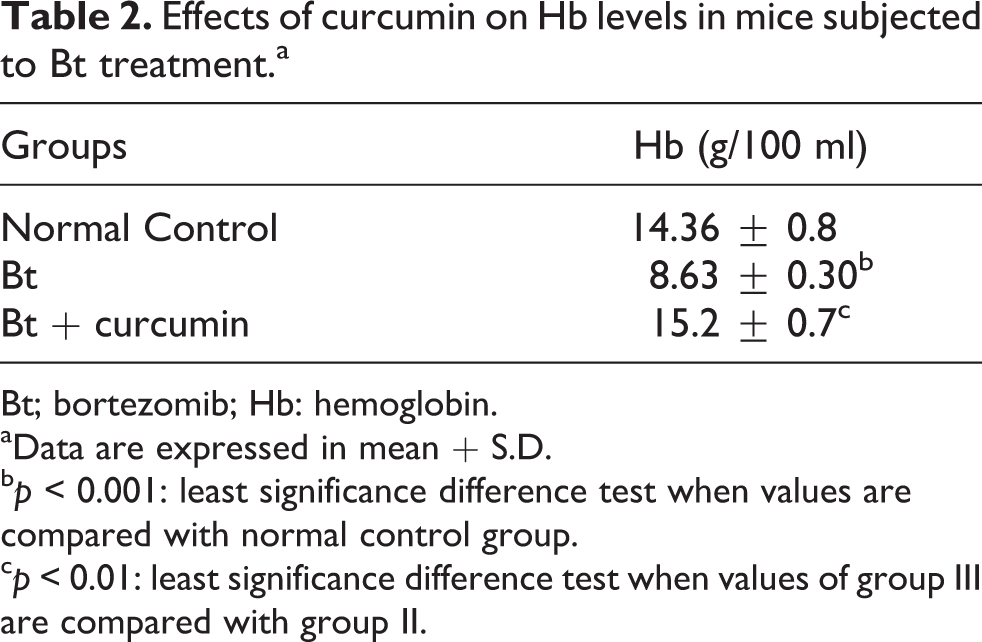
Bt; bortezomib; Hb: hemoglobin.
aData are expressed in mean
b p < 0.001: least significance difference test when values are compared with normal control group.
c p < 0.01: least significance difference test when values of group III are compared with group II.
Discussion
This study was designed to assess the toxic effects of Bt on the normal cells in mice and the protection afforded by curcumin under these conditions, if any. In this study, Bt treatment resulted in a marked decrease δ-ALAD activity. It basically catalyzes the condensation reaction of two substrate molecules called δ-aminolevulinic acid (ALA-substrate) to form one molecule of porphobilinogen which is followed by synthesis of Hb. 10 Since, boron present in Bt has high affinity for sulfhydryl group 19 , this might have caused possible inhibition of ALAD activity. The activity of ALAD has been reported to be markedly decreased during varied toxic states including lead, arsenic, and drug toxicities. 20,21 The direct consequence of decrease in the activity of ALAD is decline in the Hb levels. We also observed the similar trend in this study and noticed decrease in Hb levels upon Bt treatment in mice as a result of reduced activity of ALAD. Reduced activity of ALAD means accumulation of free ALA substrates that could also affect the normal cellular homeostasis via oxidative stress due to accumulation of reactive oxygen species.
Supplementation with curcumin improved the activity of ALAD as well as of Hb levels. Our result is in sync with the recent reports demonstrating ability of curcumin to improve ALAD activity. 11,12 The plausible reason for the above improvement in ALAD enzyme activity could be the capability of curcumin to prevent thiol group oxidation and its direct scavenging effects on reactive oxygen species. Moreover, ALAD is an octameric metalloenzyme that contains zinc in the activated state. 22 Hence, proper levels of zinc element are essential for the normal physiological activity of enzyme ALAD. 23 On the other hand, curcumin has been reported to maintain proper levels of zinc in toxic states including cancer. 24 So, in this study also curcumin might have maintained normal ALAD activity by regulation of zinc levels in mice.
This study added another dimension to the existing knowledge regarding target-specific drug Bt. The study concludes that curcumin taken along with Bt can take care of side effects of the drug.
Footnotes
Funding
This work was supported by the Department of Science and Technology (DST), India [grant number: SR/FT/LS-81/2012].