




Abstract
The aim of this study was to investigate the relationship between oxidative stress and chronic daily headache (CDH) in children. Although there are reports that oxidative injury may play a role in the pathophysiology of some neurologic disorders, such as migraine and epilepsy, by disrupting or destroying cell membranes through the formation of free radical and reactive oxygen species, the pathophysiology of headache is not clearly established. A total of 38 children (16 boys and 22 girls) with CDH, aged between 7 and 15 years, were enrolled in the study. The control group consisted of 39 healthy children (17 boys and 22 girls), aged between 7 and 14 years. The mean age was 10.9 ± 2.2 years for both the groups. Activities of erythrocyte superoxide dismutase (SOD), catalase (CAT), and glutathione peroxidase (GPx) as well as malondialdehyde (MDA) levels in all the children of both the groups were measured. Mean activities of erythrocyte SOD, CAT, and GPx as well as MDA levels were significantly higher in the study group than in the control group (p < 0.001). The findings of this study suggest that oxidative stress may play a causal or consequential role in children with CDH.
Introduction
Some biochemical abnormalities of the brain are reportedly associated with primary headache, such as migraine and tension type headache (TTH). These abnormalities may be a predisposing factor for headache or pathophysiologically associated with it. However, a causal and/or consequential relationship has yet to be established. 1
Malondialdehyde (MDA) is the major biomarker of the oxidant system, whereas superoxide dismutase (SOD), catalase (CAT), and glutathione peroxidase (GPx) are major biomarkers of the antioxidant system. 1,2 Oxidative stress is defined as a disturbance of the balance between oxidant and antioxidant systems in favor of the former. 2 Oxidative injury is reported to be an important factor in the pathophysiology of some neurologic disorders, as injury disrupts and destroys cell membranes, causing the accumulation of free radicals and reactive oxygen species. 2 –7 In addition, the reversible dilatation of cerebral arterioles, reported to be the cause of migraine, is probably a result of adenosine triphosphate-sensitive potassium channel activation through an oxidant mechanism. 8,9
There are a few studies, generally associated with migraine headache, investigating the relationship between oxidative stress and primary headache in children. Many of these studies report that oxidative stress may play a role in the pathogenesis of migraine headache. 1 ,2,7,10 Chronic daily headache (CDH) is also a common problem in children. 7,11 CDHs in children can be secondary to another disorder or a primary headache disorder. Although minor head traumas, viral infections, sleep disorders, and dietary issues are suspected factors, the exact etiology of CDH is still unclear. 12 ,13 Hence, this study aimed to investigate the relationship between oxidative stress and CDH in children.
Materials and methods
Patients with CDH were included in the study. All patients fulfilled the criteria for CDH according to the International Classification of Headache Disorders. 14 These include headaches occurring 15 or more days per month, lasting more than 4 h per day, continuing for at least 3 months, and having no underlying organic pathology. The severity of headache was evaluated on a scale of 0–10 in response to the question, ‘How painful were these headaches?’ (0 = no pain at all; 10 = pain as bad as it can be). To exclude secondary headaches, all patients had full systemic and neurological examinations; children with abnormal systemic or neurological findings for secondary headache were excluded. None of the patients in the study group had a history of chronic disease, drug use, cigarette smoking, or iron deficiency anemia. The control group consisted of 39 healthy children, similar in age and gender. In both the groups, children receiving special antioxidant diets, vitamins, minerals, or participating in competitive sports were excluded from the study. The dietary status and daily activities of the children in both the groups were also similar. All children were attending school for 5 h a day, receiving the same school diet, and they were also spending approximately 2–3 h a day at play as well as 3–4 h a day watching TV and/or on the computer.
The study was approved by the local ethics committee and written parental informed consent was obtained.
Oxidative injury and antioxidant enzyme status in erythrocytes can reflect oxidant injury in any body tissue, because erythrocytes circulating in the blood pass through all the tissues, including brain tissue, and are affected by oxidative stress in injured intracranial tissues or vessels. Thus, in order to assess the oxidative stress status in both the study groups, activities of erythrocyte SOD, GPx, and CAT and MDA levels were measured in serum samples from the children. The results from the study and control groups were compared statistically.
Blood samples were drawn between 9:00 a.m. and 10:00 a.m. following an overnight fast, from the antecubital vein by venipuncture into tubes containing EDTA and were immediately transferred to vacutainers containing heparin. They were centrifuged for 10 min at 4000g and 4°C. After separation of the plasma, the buffy coat was removed and the packed cells were washed three times with two volumes of isotonic saline. A known volume of erythrocytes was then lysed with cold distilled water (1:4) and stored in a refrigerator at 4°C for 15 min; cell debris was removed by centrifugation (2000 r/min at 4°C for 10 min). Erythrocyte lysates were stored at −70°C until assayed. CuZn-SOD, Se-GPx, and CAT activities were measured in the erythrocyte lysates on a ultraviolet–visible Recording Spectrophotometer (UV-2100S, Shimadzu Co., Kyoto, Japan). Erythrocyte CuZn-SOD activity was measured as described previously by Arsova-Sarafinovska et al.
15
Briefly, the erythrocyte lysates were diluted 400-fold with 10 mM phosphate buffer, pH 7.00. From this, 25 µL aliquots were mixed with 850 µL of substrate solution containing 0.05 mmol/L xanthine sodium and 0.025 mmol/L 2-(4-iodophenyl)-3-(4-nitrophenol)-5-phenyltetrazolium chloride in a buffer solution containing 50 mmol/L3-(cyclohexylaminol)-1-propanesulfonic acid and 0.094 mmol/L EDTA (pH 10.2). To the mixture, 125 µL xanthine oxidase (80 U/L) was added and the increase in the absorbance was recorded at 505 nm for 3 min. CuZn-SOD activity is expressed in units per milliliter. Erythrocyte Se-GPx activity was measured as described previously by Arsova-Sarafinovska et al.
15
Briefly, a reaction mixture containing 1 mmol/L Na
Statistical analysis was performed using the SPSS 16.0 statistical analysis program. Results are shown as mean ± SD. The Student’s t test was used to compare the differences between the groups. Correlation analysis was performed with Pearson’s correlation analysis test. A p < 0.05 indicated statistical significance.
Results
A total of 38 children (16 boys and 22 girls) with CDH aged between 7 and 15 years were enrolled in the study. The control group consisted of 39 healthy children (17 boys and 22 girls) aged between 7 and 14 years. The mean age was 10.9 ± 2.2 years for both the groups. There were no significant differences between the study and control groups in terms of age or gender (p > 0.05). The average length of headache in the study group was 20.3 ± 15.5 (2–60) months; the mean pain score was 8.2 ± 1.7 (5–10).
Mean activities of erythrocyte SOD, CAT, and GPx enzymes and MDA levels were significantly higher in the patient group than in the control group (p < 0.001; Figures 1 –4). In the patient group, there were no significant correlations among age, gender, length of disease, pain score, and MDA levels or antioxidant enzyme activities, except for CAT (p > 0.05). However, there was a positive, mild, statistically significant correlation between the length of headache and CAT levels (r = 0.35, p = 0.03; Figure 5). There were no significant differences between male and female patients for mean activities of erythrocyte SOD, CAT, and GPx enzymes or MDA levels (p > 0.05).

Mean erythrocyte SOD activities were significantly higher in the study group than in the control group. *t test; p < 0.05. SOD: superoxide dismutase.
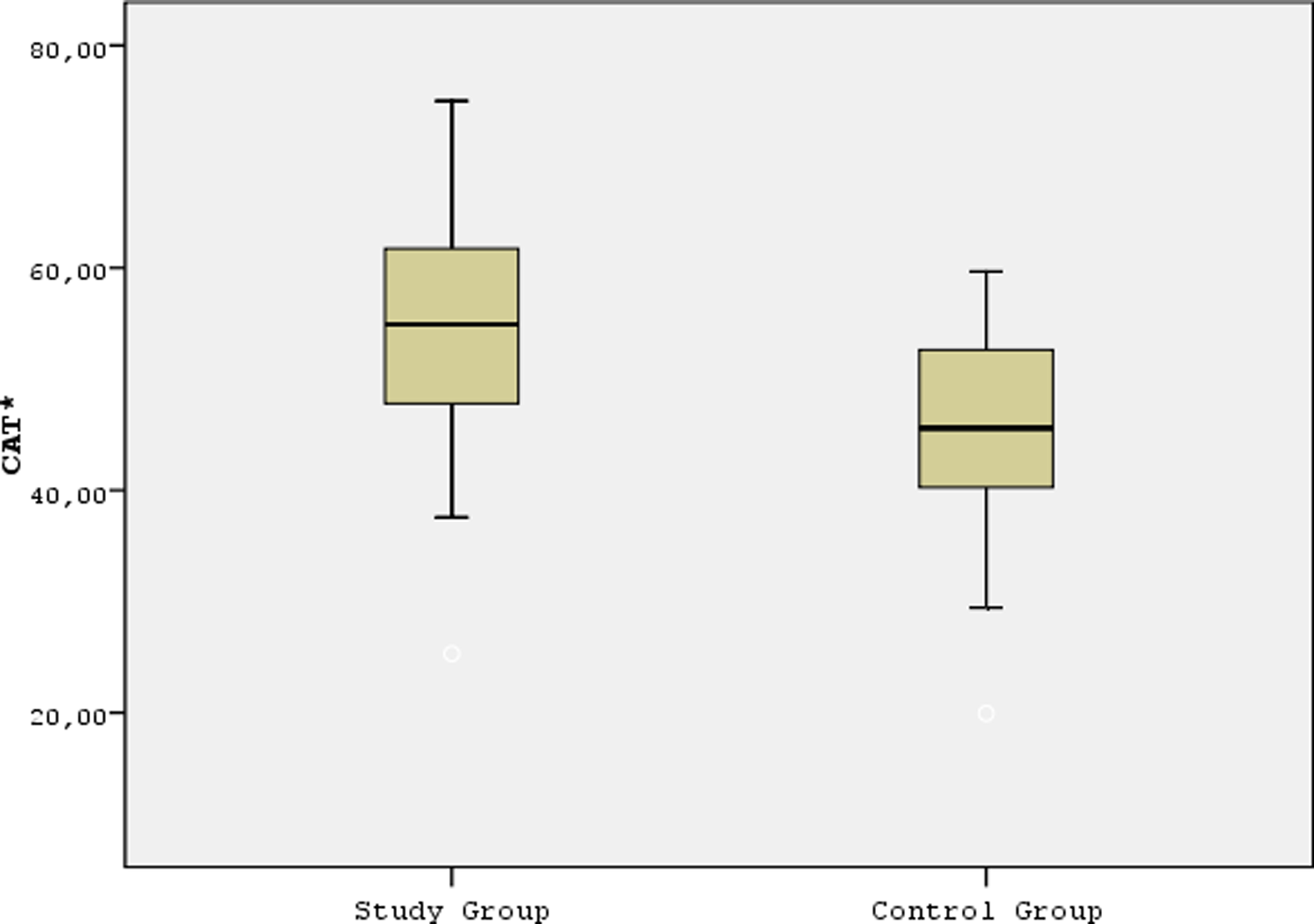
Mean erythrocyte CAT activities were significantly higher in the study group than in the control group. *t test; p < 0.05. CAT: catalase.

Mean erythrocyte GPx activities were significantly higher in the study group than in the control group. *t test; p < 0.05. GPx: glutathione peroxidase.

Mean erythrocyte MDA activities were significantly higher in the study group than in the control group. *t test; p < 0.05. MDA: malondialdehyde.
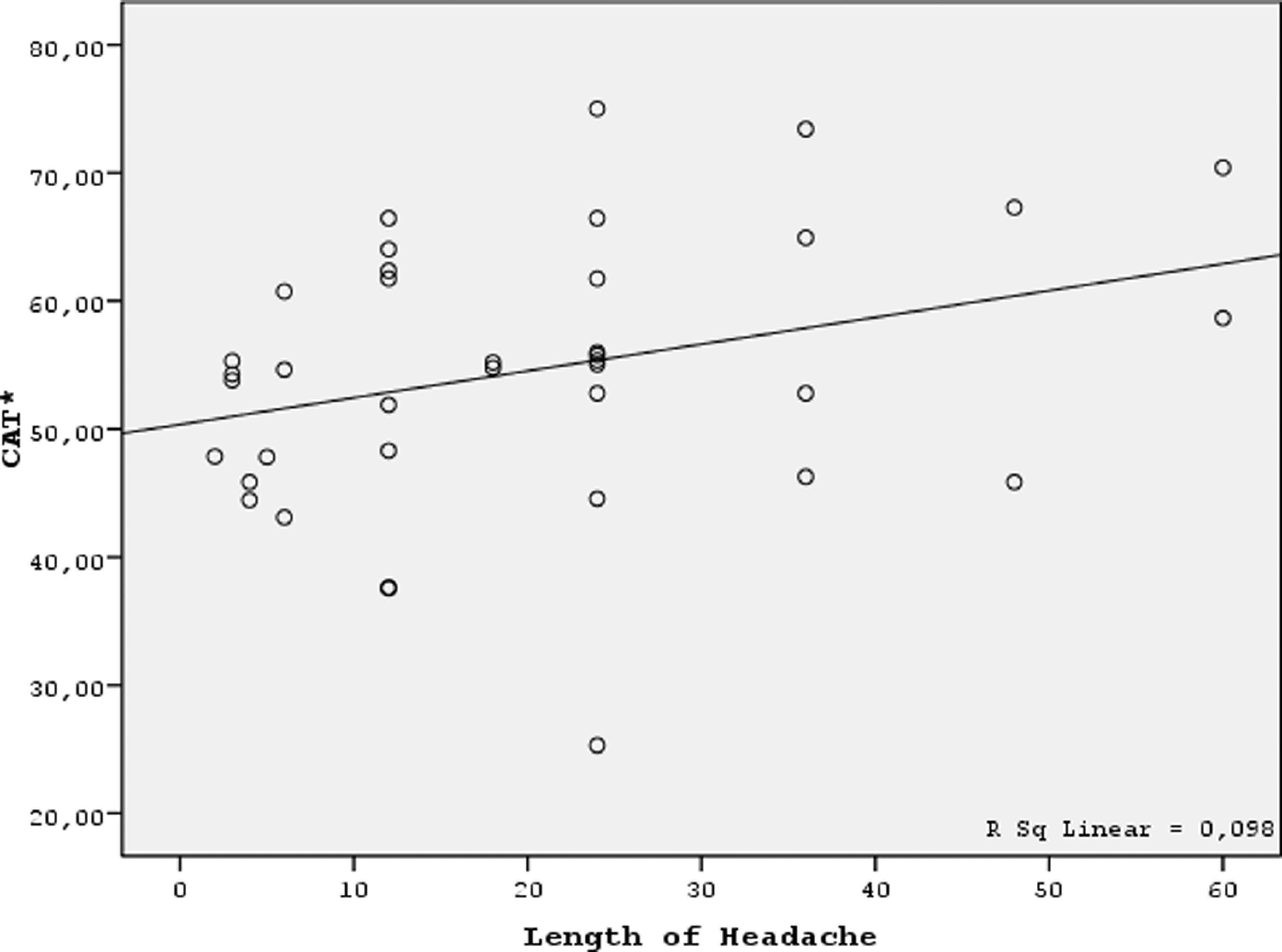
There was a positive, mild, statistically significant correlation between length of headache and CAT levels. *t test; p < 0.05. CAT: catalase.
Discussion
Oxidative stress is defined as an accumulation of free radicals and reactive oxygen species that can harm the organism, because of a disturbed balance between oxidant and antioxidant systems in favor of oxidants. 2 ,7,8,17,18 Today, there are neurological and psychiatric diseases, such as epilepsy, Alzheimer disease, schizophrenia, amyotrophic lateral sclerosis, and migraine, where the role of oxidative stress in the pathogenesis has been cited. 7 ,19 –23
It is difficult to measure free radicals and reactive oxygen species because of their high reactivity and short life spans. Therefore, clinical and experimental studies use antioxidant enzyme activities and lipid peroxidation markers as indicators of oxidative stress. 24 The most important antioxidant enzymes in the body are SOD, CAT, and GPx. 2 ,7 Antioxidant enzyme activities in different kinds of neurological diseases have been reported in various studies. Oxidant damage to neuronal cells was reported to be the possible cause of schizophrenia 25 and increased levels of oxidative stress were detected in the substantia nigra of Parkinson’s disease patients in postmortem studies. 26 The dilatation of vessels by free radical activation appears to play a critical role in the etiology of migraine. 19
The results of previous studies investigating the association between oxidative stress and headache are contradictory. 3 ,4,7,27 Because SOD protects the body against vasoconstriction or vasospasm induced by superoxide radicals, low erythrocyte SOD, GPx enzyme activities and platelet SOD activity may be related to migraine and tension-type headache. 3 ,4,27 In contrast to these studies, increased MDA, SOD, and GPx activities, related to the activation of antioxidant mechanisms in response to increased release of free radicals, were detected in epileptic children. 28,29 Alp et al. 10 demonstrated that the levels of total antioxidants were decreased in patients with migraine without aura. Erol et al. 2 demonstrated that SOD activities did not differ between groups, but both CAT and GPx activities were significantly lower in migraine patients. Hong et al. 30 proposed that individual differences in antioxidant capacity might be responsible for variable outcomes.
MDA is an end product of lipid peroxidation and one of the most important determinants of oxidative stress. 7,19 The most important effects of lipid peroxidation products are disruption and destruction of cell membranes. 7 Compared with other organ systems, the brain is more sensitive to the damaging effects of lipid peroxidation products. 31 Some studies investigating the role of oxidative stress in the etiology of headache showed increased serum MDA levels, which is a highly toxic substance. 1 ,5,7 Tuncel et al. 7 showed that MDA levels in patients in the migraine group were significantly higher than levels in a control group. The study of Gupta et al. 1 suggested that the levels of MDA in patients with migraine or episodic TTH were significantly higher than controls. However, Bockowski et al. 19 determined statistically significantly lower MDA levels and higher GPx activity in the serum and erythrocytes of children with migraine when compared with the results in the control group.
In the current study, all three antioxidant enzyme activities, including SOD, GPx, and CAT, were significantly higher in the CDH group than they were in the control group (p < 0.001). There was a positive, mild, statistically significant correlation between the length of headache and CAT enzyme activity (r = 0.353, p = 0.03). The study also determined significantly higher erythrocyte MDA levels in the patient group compared with those in the control group (p < 0.001). These findings may be the evidence of continued exposure to potent oxidative stress in patients with CDH. The increase in both oxidant and antioxidant systems in patients with CDH may be attributed to a continuously active antioxidant system to compensate the oxidant damage due to frequent and long-lasting headaches. These increases in oxidative systems may also be related to genetic polymorphisms in patients with headache. 32
In conclusion, this study demonstrated that both antioxidant enzyme (SOD, GPx, and CAD) activities and MDA levels in patients with CDH were significantly higher than a control group. These findings may suggest that oxidative stress plays either a causal or a consequential role in CDH. Further studies are required to distinguish the relational aspects of this situation. In the treatment of children with CDH, antioxidant supplementation may be considered.
Footnotes
Conflict of Interest
The authors declared no conflicts of interest.
Funding
This research received no specific grant from any funding agency in the public, commercial, or not-for-profit sectors.