




Abstract
An efficient enrichment procedure based on the combination of flame atomic absorption spectrometry (FAAS) and flotation for determination of Cd2+, Ag+ and Zn2+ ions in various biological samples using new collector is studied. The influence of pH, amount of 2-(((1H-benzo[d]imidazol-2-yl)methoxy)methyl)-1H-benzo[d]imidazole (HBIMMHBI) as collector, sample matrix, type and amount of eluting agent, type and amount of surfactant as floating agent, ionic strength and air flow rates on the extraction efficiency were evaluated and optimized. It is ascertained that under study metal ions is preconcentrated simultaneously from matrix in the presence of 0.005 M HBIMMHBI, 0.085% (w/v) of SDS form 750 mL at pH 6.5. The floated complexes metal ions eluted quantitatively with 6 mL of 1.0 M HNO3 in methanol lead to achieve preconcentration factor of 125. The detection limits for analyte ions were in the range of 1.3–2.4 ng mL-1, with recoveries more than 95% and relative SD lower than 4%.
Keywords
Introduction
The determination of trace metals in the environmental samples including food materials is required to designate the level of pollution, as the number of ecological and health problems associated with environmental contamination continues to rise. 1–7 Direct instrumental analysis of these samples is difficult because of complex formation and significant matrices, which invariably influence the normal instrumental analysis. In most real samples, the metal ions are in low concentrations (near or below the limit of detection of the instrument) in complicated matrices that make their direct determination impossible. Preconcentration can solve the above two problems and lead to simplified heavy metal determination. 7–12
The most common trace element analyses instruments are flame atomic absorption spectroscopy (FAAS), inductively coupled plasma mass spectroscopy (ICP-MS) and ICP-based techniques that among them these two later instruments require expensive equipment and maintenance. The simultaneous determination of metal ions via traditional ultraviolet–visible absorption molecular spectroscopy is a difficult task. The absorption techniques based procedure have superimposed curves and spectral overlap is combination of flame atomic absorption spectrometry (FAAS) with slight spectral interference and even accessible instrument widely applied for trace metal evaluation so that matrix interferences are overcome by addition of different matrix modifiers and/or performing a separation procedure using diver's organic reagents. 13–20 Among the various applicable procedures for separation and preconcentration, including filtration or centrifugation, inconveniences such as lengthy separation, time consumption for high sample volume, multi-stage, lower enrichment factor and consumption of organic harmful solvents can be overcome by the replacement of flotation. 17–36
Flotation/preconcentration method with unique advantages such as rapidity and excellent recoveries as well as simple and inexpensive equipments is able to analyze and enrich analyte from large volumes of sample solution to small amount of eluent to obtain a greater preconcentration factor compared with conventional carrier precipitation technique. In this technique, a small amount of surfactant and tiny air bubbles are required to perform a proper flotation procedure to prevent serious contamination risks, which could be manifested by the high blank value. Many factors influence the performance of flotation procedure, and the significant role is contributed to the colloid nature collector. According to our knowledge, there is still no reported flotation procedure reported in the literature, which is based on the simultaneous flotation of transition and heavy metal ions using 2-(((1H-benzo[d]imidazol-2-yl)methoxy)methyl)-1H-benzo[d]imidazole (HBIMMHBI). Therefore, it was decided to develop, in detail, an efficient flotation method for the extraction and preconcentration of trace amounts of some metal ions from aqueous media using HBIMMHBI and the metal ion determination by flame atomic absorption spectrometry.
Materials and methods
Instruments
The measurements of metal ion contents were performed with a Shimadzu 680 AA spectrometers equipped with a hollow cathode lamp and deuterium background corrector at respective wavelengths (resonance line) using an air–acetylene flame. The instrumental parameters were those recommended by the manufacturer. A Metrohm 691 pH/ion meter with a combined glass–calomel electrode was used for adjustment of test solution pH.
Reagents
Acids, bases and nitrate salt of all metal ions under study were of the highest purity available from Merck Darmstadt (Germany) and were used as received. Double-distilled deionized water was used throughout. The pH adjustment was done by the addition of dilute HNO3 or/and NaCl to sample to obtain the desired pH sample solution. The ligand HBIMMHBI was synthesized according to literature (Figure 1). 37

Structure of 2-(((1H-benzo[d]imidazol-2-yl)methoxy)methyl)-1H-benzo[d]imidazole.
Flotation–separation procedure
A combined glass electrode was immersed into a 1-L beaker of sample solution containing 0.5 µg mL-1 of metal ions under study. Then, 5 mL of saturated NaCl solution and 0.2% (w/v) of sodium dodecyl sulfate (SDS) and 0.04 mM of HBIMMHBI were added to the mixture, and then the test solution pH was carefully adjusted to 10 with NaOH solution. The mixture was then stirred for 15 min at 300 r/min and transferred quantitatively into the flotation cell and made up to the 750-mL mark with double-distilled water. An air stream (50 mL min-1) flowed for 2–4 min to raise the foam layer on the water surface, and after the formation of foamy layer, the aqueous solution in the cell became clear. Finally, the glass pipette tube was immersed into the cell through the foam layer and a water sample (5 mL) was sucked off and used for FAAS to evaluate unextracted metal ion contents.
Application of real samples
All plant samples (Citrus aurantium L., Rosa canina, Fumaria parviflora, Allium Cepa and tomato) are purchased from Omidiyeh, Iran; afterward, they were taken in small mesh. A 40-g real sample was heated in silica crucible for 3 h on a hot plate and the charred material was transferred to furnace for overnight and heated at 650°C. After cooling the residue, 10.0 mL concentrated nitric acid and 3 mL 30% H2O2 was added to mixture and again kept in furnace for 2 h at the same temperature. This heat treatment caused all organic matrices to be oxidized and decomposed. Finally, the residue was treated with 3 mL concentrated HCl and 2–4 mL of 70% (w/w) perchloric acid and evaporated to fumes, causing all the metal contents to change to respective ions. The solid residue was dissolved in water, filtered and its pH was adjusted to 10, with the addition of KOH. The proposed flotation method was applied to diluted sample to preconcentrate the metal ions under study, prior to their determination by FAAS.
Results and discussion
Effect of pH
A preliminary requirement of an efficient extraction method is based on formation of desired chelate with high stability constant complex that this phenomena significantly depend to solution pH. The influence of pH on flotation efficiency of Cd2+, Ag+ and Zn2+ ions in the pH ranges of 2–12 was investigated, and the respective results are presented in Figure 2. As it is obvious, above pH 10, the recoveries of all cations are sharply decreased, which may be attributed to possible hydrolysis of the cations. At lower pH due to protonation of reactive binding atom of chelating agent and competition of proton with metal ions for chelation with ligands recoveries significantly decreased. At pH 10, the ligand is deprotonated and its complexes with the metal ions of interest have higher stability.
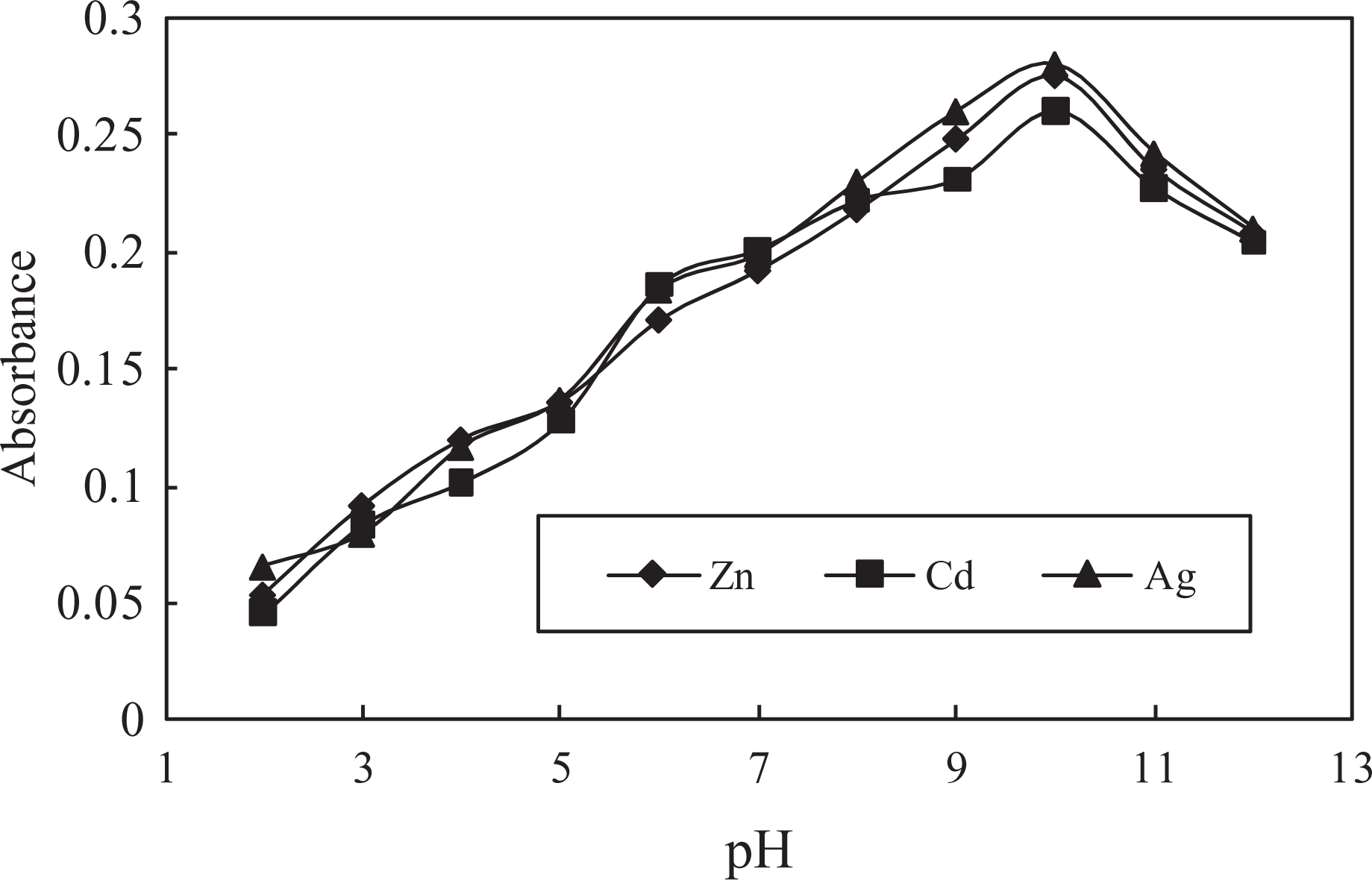
Effect of pH on metal ion flotation recovery.
Type and amount of surfactant
In the presence of surfactants a foam layer appeared and the neutral metal ions following flotation and/or respective precipitates extracted and transferred from sample solution to the foam layer.
Hydrophobic materials can more effectively secede from an aqueous solution than hydrophilic materials. Also, the foams of surfactant support the floated material and prevent the redistribution and cause an increase in the efficiency of flotation. A successful extraction procedure should maximize the extraction efficiency by minimizing the phase volume ratio (V org/V aqueous) and improve the enrichment factor. The influence of various effective surfactants, such as cationic, anionic and nonionic surfactants, and a set of similar tests under previously optimized conditions were carried out and respective results are presented in Table 1. It was found that the maximum flotation efficiency was achieved using SDS as a floating agent.
Effect of type of surfactant on recoveries of understudy metal ions, conditions: 2.0 μg mL-1 of interest ion, pH 10, 0.04 mM PHBI, 0.2 % (w/v) of each surfactant.

SDS: sodium dodecyl sulfate; PHBI: 2-phenyl-1H-benzo[d] imidazole; TAB: trimethyl ammonium bromide; CTAB: cetyl trimethyl ammonium bromide; DTAB: dodecyl trimethyl ammonium bromide.
The flotation efficiency significantly depends on the amount of surfactant. The influence of SDS in the concentration range of 0.03–0.4% (w/v) was examined. The respective results (Figure 3) show that the maximum efficiency was obtained by the addition of SDS to reach a concentration of 0.2% (w/v). At higher value some problems occurred due to the amount of foam in the flotation technique. This result might be related to the presence of the high amount of surfactants that led to an increase in the volume of the surfactant-rich phase. It seems that at higher SDS concentration via the formation of charged tertiary species (M-L-SDS), the extraction efficiency reduced. On the other hand, at higher surfactant content probably due to increase in the viscosity of the surfactant-rich phase, because of poor introduction of sample to nebulizer, lower sensitivity was achieved. At lower SDS concentrations (below 0.03% w/v), low preconcentration efficiency was obtained probably due to assemblies that were inadequate to quantitatively entrap the hydrophobic complex and float the complex.

Effect of amount of sodium dodecyl sulfate on metal ion flotation recovery.
Bubbling by air
Air gas plays an important role to float the chalets of analytes by bubbling. The efficiency of flotation and the shapes of floated materials depend on the bubble size of air gas, which is determined by the flow rate of the gas through a porous plate of fritted glass as well as the whole sizes in the plate. It was observed that after bubbling for 5 min at flow rate of 10–50 mL min-1, maximum recoveries were achieved using 25 mL min-1. A small amount of ethanol was added to the solution for the effective generation of numerous tiny bubbles.
Effect of ligand concentration
In this work, HBIMMHBI was (ligand) due to highly hydrophobic nature of its metal complexes has high tendency for selective flotation of soft acids such as Zn2+, Cd2+ and Ag+ ions. For this study, a set of similar experiments at fixed optimized value of all variables and different amount of HBIMMHBI as collecting agent in the range of 0.001–0.08 mM have been carried out and the respective results are presented in Figure 4. As it was observed, more than 98% of flotation efficiency was achieved at 0.04 mM of ligand, which was chosen for subsequent experiments. It is worth mentioning that the presence of excess amounts of the HBIMMHBI revealed adverse effect on the flotation process. At lower chelating agent the amount of formed complexes is low and recoveries significantly decreased. At higher value of chelating agent due to increase in the number of reactive sites of HBIMMHBI the flotation efficiency increase.

Effect of amount of 2-phenyl-1H-benzo[d] imidazole on metal ion flotation recovery.
Effect of electrolyte concentration
Also, the addition of salt can markedly facilitate the phase-separation process, via changing the density of the bulk aqueous phase. It was observed that the presence of electrolytes decreases the solubility of chelate due to salting out effect and lead to more efficient extraction. The lower solubility of surfactant is attributed to electrolytes promoting dehydration of the surfactant. Both KCl and NaCl were investigated as electrolytes in the concentration range from 0.1 to 3 M (Table 2) and the highest Cd2+, Ag+ and Zn2+ ions recovery flotation efficiencies were obtained at 1.5 M KNO3 concentration. The recovery decreased considerably with increasing KNO3 concentrations >1.5 M, which may be attributed to the additional surface charge of surfactant at higher KNO3 concentration that changes the molecular structure of the surfactant and consequently the micelle formation process. It is necessary to emphasize that different blank solutions were also evaluated and no significant signal was obtained.
Effect of type and concentration of salting out agent on the recovery of analytes.

Effect of methanol volume
Generally, the surfactant-rich phase obtained after the preconcentration contains a high concentration of surfactant. Moreover, it is necessary to decrease the viscosity of the surfactant-rich phase without excessive dilution of the micelle to facilitate the sample introduction into the atomizer of the spectrometer. Surfactant-rich phase was diluted with different acids of various concentrations and results are shown in Table 3.
Effect of type and concentration of eluting agent on recovery of analytes.

It was found that using 3 mL of 2 mL L-1 HNO3 in methanol is suitable for quantitative recoveries of metal ions under study. Smaller volumes of methanol were not tested because, in this case, it was not possible to quantitatively transfer the rich phase from surface solution for simultaneous determination of all metal ions. At higher eluent volumes, due to predomination of dilution, a decrease in absorbance (sensitivity) was achieved. A 3-mL volume of 2 mL L-1 HNO3 in methanol was, therefore, used throughout the remaining experiments.
Effect of foreign ions
Although, the FAAS with high selectivity is a suitable measurement system, the proposed method may suffer from a limitation such as interference during preconcentration step (cations reaction with ligand and/or anions that may form complexes with the metal ions under study) that decreases extraction efficiency. The applicability of the preconcentration method for the determination of analyte ions significantly depends on the matrix samples. Therefore, it is required to study the influences of some alkaline and alkaline earth ions and some transition and heavy metal ions on the recoveries of Cd2+, Ag+ and Zn2+ ions. To perform this study, a set of similar experiments using solution containing 400 ng mL-1 Cd2+, Ag+ and Zn2+ ions and various amount of interfering ion (different interfering ions-to-analyte mass ratios) in the presence of 0.2% (w/w) SDS and 0.04 mM of HBIMMHBI were subjected to the complete procedure and the results are given in Table 4. The tolerance limit is defined as the ion concentration causing a relative error smaller than ±5% related to the preconcentration and determination of analytes. It was found that all metal ions under study had recovered quantitatively in the presence of large amounts of alkaline and earth alkaline ions and some anions. The high selectivity of method may be emerged from incorporation of aromatic ring as non-local π electrons in addition to the presence of nitrogen atom as soft acid with high tendency to bind these metal ions (Table 4).
Effects of the matrix ions on the recoveries of the examined metal ions (N = 3).
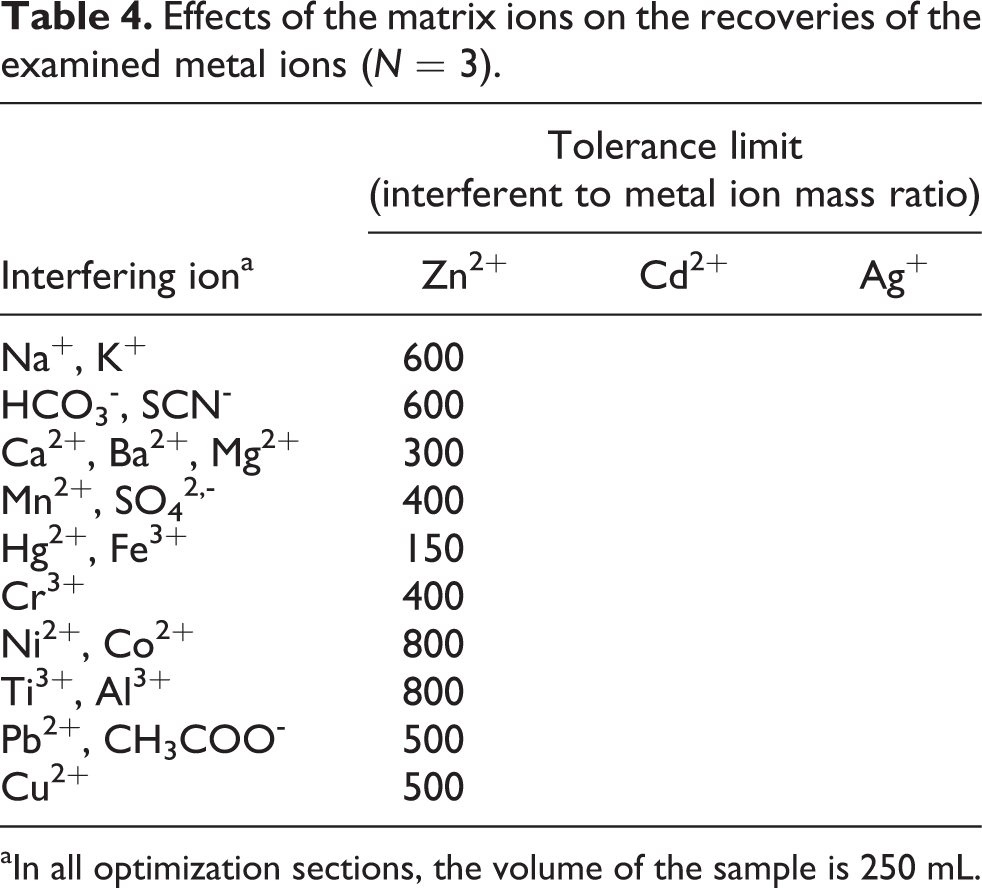
aIn all optimization sections, the volume of the sample is 250 mL.
Characteristics of the method
Table 5 gives the characteristic performance of the proposed method when standard solutions are subjected to the entire procedure. The SD of the proposed flotation procedure was examined by carrying out the recommended procedure, while the concentrations of metal ions were determined by FAAS. The limits of detection (the ratio between three times the SD of 10 blank readings and the slope of the calibration curve after preconcentration) were in the range of 1.4–1.7. Calibration with aqueous samples submitted to the same preconcentration procedure is sufficiently accurate to apply for the analysis of various real samples. Correlation coefficients >0.99 were obtained and only small deviations between sequential determinations were found. Preconcentration factor (ratio of initial solution volume to the volume of surfactant-rich phase) of 500/3 was obtained; enrichment factor (ratio of the concentration of the analyte of after preconcentration to that of before preconcentration, which gives the same absorbance) were 32, 35 and 39 for Ag+, Cd2+ and Zn2+ ions, respectively (Table 5).
Specification of presented method at optimum conditions for each element.

Flotation mechanism
In separation procedure via flotation, the surfactant has a very important role. The nature of interaction between SDS and respective complex must be studied to approach the actual mechanism of flotation. The proposed mechanism may proceed through a physical interaction or by forming a hydrogen bond between the hydrophilic part of SDS and the active sites in the ligand complex. Another possible mechanism is the interaction between SDS and complex, through a coordinate bond forming a self-floatable (M-L-SDS) species. In such cases, the hydrophilic part of the surfactant attaches to air bubbles and floats and thus separates the analyte-containing species.
In our research, the first proposal is more logical. This suggestion has been confirmed based on the flowing observation and experimental data: the metal content of the solid complexes isolated in the absence and presence of SDS excludes SDS. The floated species have the same color as that obtained in the aqueous solution. It was observed that increasing the temperature decreases the separation percentage and confirms that the physical force between SDS and the bis(2-hydroxyacetophenone)-1,4-butanediimine (M-BHABD) complex is destroyed by heating.
Applications
The proposed preconcentration procedure based on chelation of under study metal ions with HBIMMHBI in surfactant media for their determination in different matrices including treated according to experimental section was applied and the results are presented in Table 6 and Table 7.
Recovery studies of trace metal ions from some real samples.

RSD: relative standard deviation.
Recovery studies of trace metal ions from some real samples.

RSD: relative standard deviation.
Conclusion
The sensitivity, metrological characteristics, ecological safety, simplicity and convenience of the suggested procedure is superior with respect to the methods based on the extraction with organic solvents. The present method has the following advantages over reported methods: (1) synthesized organic reagent could be synthesized in our laboratory with high efficiency and low cost. This reagent is distinct in terms of sensitivity and selectivity toward metal ions. (2) Optimum volume of the eluting solution and low consumption of chemical reagents obtained using the present methodology permitted to design an extraction strategy presenting robustness, low cost, low detection limits and low relative SD for good extraction efficiency and lower toxicity than those using organic solvents (Table 8).
Comparative data from recent articles on preconcentration studies.

RSD: relative standard deviation; AAS: atomic absorption spectroscopy; PF: preconcentration factor; DL: detection limit; SPE: solid phase extraction; DDP: differential determination preconcentration; DRS: diffuse reflection spectroscopy; XAD-2: styrene resin.
Footnotes
Funding
This research received no specific grant from any funding agency in the public, commercial, or not-for-profit sectors.