




Abstract
Background:
In recent years, the use of herbal weight-loss products sold over the Internet has rapidly increased; however, the safety of these products has not been well documented yet. More importantly, the declared ingredients in these products could be different than the marketed contents.
Methods:
Nine different herbal weight-loss products sold over the Internet were obtained. The ingredients of each product were analyzed in the Laboratory of Forensic Medicine and the Scientific and Technological Research Laboratory of Inonu University.
Results:
Although all studied weight-loss products were presented as pure herbal, three of them contain sibutramine, three contain caffeine, and three contain caffeine + temazepam. The amount of sibutramine in each capsule was found to be over 10 mg. We analyzed toxic and trace element levels of nine herbal products and found that these herbal products, even in low amounts, contain Pb, Al, Ni, and Ba.
Conclusions:
Our results indicate that herbal weight-loss products available without prescription and claimed to be purely herbal may contain pharmaceutical substances like sibutramine or temazepam in high doses. Moreover, they also may become contaminated with toxic metals. Since people commonly use these products unaware of its real constituents and without the suggestion or control of a physician, they might cause various health problems some of which might be harmful. Strict legal rules and control mechanisms must be established to minimize their possible harmful effects.
Introduction
Being a major public health problem in both developed and developing countries, obesity impairs the quality of life and decreases longevity. Consumption of antiobesity/weight-loss products has been widely considered throughout the world. However, its prevention and treatment methods are not effective enough. 1 In addition to a few drugs currently used, many plant-based products are present as complementary medicine, and hence what is called the alternative medicine is gaining popularity. But, these products are not assessed as medical drugs and do not need prescription. Thus, they are sold on the market or Internet without any regulation. In this regard, the increasing consumption of phytotherapeutic formulations as alternative obesity treatments may lead to the usage of synthetic pharmaceuticals as adulterants. The illegally added adulterants are frequently anorexic, anxiolytic and antidepressant pharmaceuticals. 2 –4
In addition to such weight-loss products, national and international herbal remedies are readily available for online purchasing. They are presented as “purely natural products,” “dietary supplements,” “harmless,” or “traditional herbal” to imply as if there is no risk in using these products. Several drugs were licensed throughout the world for the treatment of obesity. 1 Among them sibutramine has been widely used.
It has been speculated that herbal remedies can be risky, since the declared ingredients of these products may be different than the actual contents. 3,5 –9 In addition to adulteration, improper preparation, lack of standardization, and contamination with toxic metals may associate with these products. They may contain banned chemical substances, pesticides, heavy metals, toxic ingredients, or microbial contaminations. The amount of certain ingredients might as well be different than declared.
In this study, we aimed to identify the nature and amount of certain undeclared harmful ingredients and toxic metal contamination of herbal weight-loss products that are marketed over the Internet.
Materials and methods
Nine herbal weight-loss products that are commercially available on the Internet and in pharmacies were randomly selected. Each product was chemically analyzed at the Laboratory of Forensic Medicine in Malatya and Scientific and Technological Research Laboratory of Inonu University in order to find out whether they contained any undeclared harmful substances and possible metallic contaminations. The product names were represented by capital letters from A to K in order not to disclose their commercial names.
Gas chromatography and mass spectrophotometer (GC/MS; Thermo Finnigan Trace GC Ultra—Thermo Finnigan Trace DSQ) was used to analyze the composition of these products that might act on body weight or any other kind of body function. To determine the concentrations of sibutramine, sibutramine tablet (Reductil®, Abbott, Germany) was dissolved in dichloromethane at the concentrations of 100, 200, 400, and 750 μg/ml to prepare standard solutions, which were then used for calibration of the analytical system. One tablet or capsule of each herbal weight-loss product was dissolved in 15 ml dichloromethane, and 1 ml of this solution was used for analysis. In the evaluation of chromatographic and spectrophotometric data obtained from other substances, mass spectrophotometer databank and Xcalibur Data System Software were used to compare the spectrums for qualitative analyses.
For the elemental analyses, inductively coupled plasma optical emission spectrometry (ICP-OES; VARIAN 725-ES, CCD simultaneous ICP-OES) was operated under suitable conditions including adjusting the wavelength suitable for each element (Ca (396.84 nm), Al (396,15 nm), Ba (455.40 nm), Fe (238.20 nm), K (766.49 nm), Cu (327.39 nm), Mg (280.27 nm), Mn (257.61 nm), Na (588.99 nm), and Zn (213.85 nm)).
High-purity water from a Milli-Q system (Millipore, Molsheim, France) was used in the preparation of all the solutions and samples. All standard solutions used (0.01, 0.05, 0.1, 0.2, 0.5, 1.0, 2.0, 5.0, 10.0, and 100 mg/l) were prepared by diluting 1 mg/ml stock multielement standard solutions for ICP-OES.
A microwave oven equipped with polytetrafluoroethylene (PTFE) vessels (model CEM, MARS-500) was used for the digestion of medicinal herb drugs, which was carried out under optimized conditions.
Dried sample of 0.500 g of herb drugs was placed in PTFE vessel for digestion. The vessel was closed, placed on the rotating turntable of the microwave oven, and digestion started.
The precision of the element measurement method was tested with standard deviation (SD) for both the certified reference material and samples. The results of the proposed method were obtained by the arithmetic mean of five digestions of each sample. All data were rounded off to one decimal point and presented as tables.
Results
Analytical results of the studied herbal weight-loss products are presented in Table 1. Concentrations of sibutramine in sibutramine-containing products were indicated in Table 2. Although all studied weight-loss products were declared as pure herbal, three of them contain sibutramine, three contain caffeine + temazepam, and three contain caffeine. The amount of sibutramine in each capsule was found to be over 10 mg.
Analytical results of herbal weight-loss products that are commercially available on the Internet

Concentrations of sibutramine in sibutramine-containing herbal products

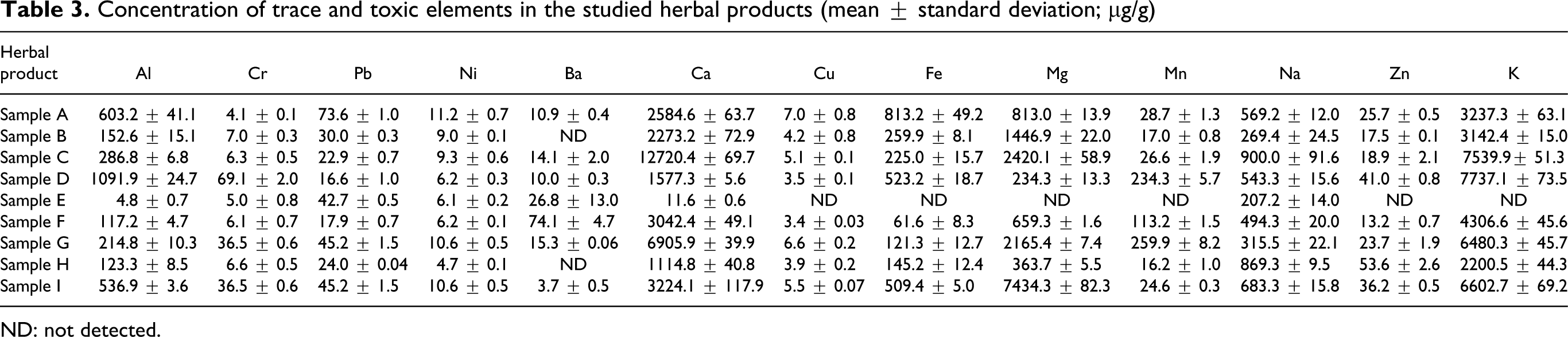
Average and SD of each toxic and trace element levels of nine herbal products are given in Table 3. Among the toxic metals, Al, Pb, and Ni were found to be at lower amounts in all herbal products, and Ba was found in seven of them. Additionally, it was shown that these products contain various levels of the studied essential elements that are given in the table.
Concentration of trace and toxic elements in the studied herbal products (mean ± standard deviation; μg/g)
ND: not detected.
Discussion
The prevalence of obesity has increased dramatically in recent years. Although obesity is a major and severe health problem, prevention and treatment methods are not effective enough. Dietary, behavioral therapy, and medical therapy have been the hallmarks of obesity treatment. All these interventions have displayed initial weight loss, but the problem with these approaches is their inability to maintain weight loss over a longer period. 1,10
Several drugs including sibutramine, orlistat, and rimonobant are licensed throughout the world for the treatment of obesity. Most widely suggested ones are appetite-suppressant agents including serotonin noradrenalin reuptake inhibitors, serotonin agonists, sympathomimetics, and, recently, leptin, and fat absorption inhibitors including orlistat and thermogenic agents. 1 Among these medical drugs, especially, sibutramine had been widely used for obesity treatment until banned by European Agency for the Evaluation of Medicinal Products (EMEA) due to severe side effects on cardiovascular system. 11,12
The history of pharmacological agents for obesity has been turbulent with many examples of drugs being removed from the market due to significant side effects. 13 Similar to the sibutramine, fenfluramine and dexfenfluramine were also withdrawn due to their side effects on heart valves. The other antiobesity drug, rimonabant, the first selective cannabinoid type 1 receptor blocker, was used as an antiobesity drug since it was approved and recommended by the Committee for Medicinal Products for Human Use (CHMP) of the EMEA in April 2006. 14 However, it has been later shown that the use of rimonabant was associated with psychiatric side effects such as anxiety, depression, and suicidal ideation; therefore, it was not approved by the US Food and Drug Administrastion, 15 and its use was suspended by EMEA. 14
So far, it has not been the successful long-term medical treatment options for obesity. Thus, the demand for herbal therapy is increasing and getting more popular. 5,6,16
In our study, we found that three of the nine herbal weight-loss products contain sibutramine, and the sibutramine content in each capsule is above the daily recommended dose (10–15mg/day). 17 Sibutramine is banned in many countries due to their cardiac-related side effects. 18 Most frequently encountered side effects of sibutramine are headache, insomnia, dry mouth, and constipation. 19 More importantly, sibutramine cardiovascular outcome (SCOUT) trial showed that sibutramine was associated with an increased risk of serious, nonfatal cardiovascular events such as increased heart rate and blood pressure and major cardiovascular dysfunctions. 12,14,20
We also found that six of the nine herbal weight-loss products contain caffeine. Caffeine belongs to the category of drugs that increase energy expenditure and thermogenesis; it has not been approved as an antiobesity treatment. 21 Additionally, three of the nine herbal weight-loss products analyzed contain both temazepam and caffeine. Temazepam belongs to a group of drugs called benzodiazepines. It affects certain chemicals in the brain that may become unbalanced and cause sleep problems. Temazepam is used to treat insomnia symptoms, such as trouble falling or staying asleep. Temazepam may also be used for other purposes not listed in this medication guide. Temazepam increases heart rate, ventilatory rate and depth, oxygenation, and hypocapnia, which help to sustain periodic breathing. 22 Temazepam is considered an addictive drug; it is easily abused and can lead to psychological dependence.
None of the studied herbal products had sibutramine, caffeine, or temazepam declared as an ingredient. Adulteration of allegedly ‘natural herbal medicines’ with undeclared synthetic drugs is a common and dangerous phenomenon of alternative medicine. 7
It was demonstrated that the slimming capsules declared as being pure herbal contained sibutramine and sibutramine metabolites. This first led to intoxications in 2005 from weight-loss products having undeclared concentrations of sibutramine that was greater than those in licensed medicines. 5 Allegedly herbal Chinese slimming capsules each containing 10 mg sibutramine were also reported from Poland in 2007. 6 From the 20 ‘herbal’ slimming products analyzed, 16 were found to have been adulterated with sibutramine. 3
In our study, we analyzed essential and toxic trace element levels of these herbal products, and we found that all herbal products contain low amount of Al, Pb, Ni, and Ba. All these toxic metals were found in every studied product, even though Ba was not detected in two products.
Trace elements are essential for many cellular functions. However, they may cause various diseases through deficiency, accumulation, or imbalance. 23 Among the trace elements, chromium is essential for glucose metabolism especially for binding insulin to cells. 23 Chromium is a nutritional supplement that has garnered interest for weight losing. 24 It was speculated that chromium histidinate is protective against obesity in animals. 23,25,26 Deficiency of zinc decreases adiposity in humans and rodent models, whereas deficiencies of copper, iron, and magnesium increase adiposity. 27
Some of the trace elements are not essential and can be toxic for cellular functions even at the lower concentrations. It is conceivable that toxic metals contribute to the pathogenesis of obesity by influencing various aspects of metabolism, such as by substituting for essential micronutrients and essential metals or by inducing oxidative stress. 27 Interestingly, lead interacts with iron, copper, and zinc in critical organs, even though the blood lead level sometimes remains unchanged. 28
Our findings show that the use of herbal products for the treatment of obesity may not be safe for human health. They have the potential to be harmful to humans as uncontrolled use of any substance in the human body. Untested herbal products may contain pharmaceutics in order to lose weight or some toxic metals, which might originate during cultivation or processing or might have been deliberately added. Subjects do not often expect any adulteration and adverse effects.
Similar to our findings, there is a noteworthy increase in the diversity of harmful substances in herbal weight-loss products, food supplements, and dietetic foods. 16 Some substances that have been added to the content were not declared in order to maximize the desired effect of such products, and contamination to herbal drugs has been previously reported. 5,7 –9
Conclusion
Our results indicate that herbal weight-loss products available without prescription and claimed to be purely herbal contain pharmaceutical substances like sibutramine or temazepam in high doses. Similarly, they also contain trace toxic metals. Since many people use these products without knowing its real content and without the suggestion or control of a physician, various potentially lethal health problems might occur. The other herbal products used for different purposes, which are not investigated, may also be potentially harmful. Strict legal rules and control mechanisms must be installed to minimize their possible harmful effects.
Footnotes
Funding
This research received no specific grant from any funding agency in the public, commercial, or not-for-profit sectors.