




Abstract
The role of serotonin receptors have been implicated in various types of experimentally induced seizures. Ondansetron is a highly selective 5-hydroxytryptamine 3 (5-HT3) receptor antagonist used as antiemetic agent for chemotherapy-, and radiotherapy-induced nausea and vomiting. The present study was carried out to examine the effect of ondansetron on electroshock, pentylenetetrazole (PTZ)-induced seizures and cognitive functions in mice. Ondansetron was administered intraperitoneally (i.p.) at doses of 0.5, 1.0 and 2.0 mg/kg (single dose) to observe its effect on the increasing current electroshock seizure (ICES) test and PTZ-induced seizure test. In addition, a chronic study (21 days) was also performed to assess the effects of ondansetron on electroshock-induced convulsions and cognitive functions. The effect on cognition was assessed by elevated plus maze and passive avoidance paradigms. Phenytoin (25 mg/kg, i.p.) was used as a standard anticonvulsant drug and piracetam (200 mg/kg) was administered as a standard nootropic drug. The results were compared with an acute study, wherein it was found that the administration of ondansetron (1.0 and 2.0 mg/kg) significantly raised the seizure-threshold current as compared to control group in the ICES test. Similar results were observed after chronic administration of ondansetron. In PTZ test, ondansetron in all the three tested doses failed to show protective effect against PTZ-induced seizure test. Administration of ondansetron for 21 days significantly decreased the transfer latency (TL) and prolonged the step-down latency (SDL). The results of present study suggest the anticonvulsant and memory-enhancing effect of ondansetron in mice.
Introduction
Epilepsy is a neurological condition characterized by recurrent seizures occurring due to abnormal electrical activity in the brain. Various conventional antiepileptic drugs (AEDs) are available to treat epileptic patients. However, despite the availability of these AEDs in about 20–30% patients, the seizures are not adequately controlled by these established drugs. 1,2 The epileptic discharges and subsequent epileptic seizures are associated with an imbalance between the excitatory and inhibitory neurotransmitters in specific brain areas. Based on this hypothesis, various agonists or antagonists of specific receptor subtypes are found to interfere with the occurrence of epileptic event in different experimental studies. 3 –5
Serotonin (5-hydroxytryptamine, 5-HT) is a monoaminergic neurotransmitter involved in various physiological and pathological processes such as appetite control, mood and behavior, cardiovascular functions, temperature regulation and endocrine regulation. 6,7 The role of serotonin has been implicated in many diseases such as depression, anxiety, schizophrenia, panic disorder, migraines and eating disorders. 8,9 There has been increasing evidence for the involvement of serotonin in several types of experimentally induced seizures. 10 –12 In central nervous system (CNS), the expressions of various 5-HT receptors have been identified on glutamatergic and γ-aminobutyric acid (GABA)ergic neurons both in the cortex and in the hippocampus.6,7,12 Among the various subtypes of serotonin receptors, the role of 5-HT1A, 5-HT2C, 5-HT3 and 5-HT7 receptor subtypes in pathogenesis and propagation of epilepsy has been recognized. 12,13 The 5-HT3 receptor is the only ligand-gated ion channel among the various subtypes of serotonin receptors that may result in de- or hyperpolarization of neurons by altering conduction and/or concentration of ions in the cells.6,12
Ondansetron is a highly selective 5-HT3 receptor antagonist that is widely used for the treatment of chemotherapy, radiotherapy or postoperative-induced nausea and vomiting. It has also demonstrated the affinity for 5-HT1B, 5-HT1C, 5-HT4, opioid and α1 receptors. 9 , 14 , 15 Ondansetron has been reported to be effective in the treatment of other diseases such as anxiety disorders, pruritis, irritable bowel syndrome, chronic refractory diarrhea and Parkinson’s disease. 9 , 16 Some researchers have shown the anticonvulsant potential of ondansetron in experimental models of seizures. 17 ,18 Serotonin also plays a crucial role in the learning and memory processes.19–21 Previous studies have reported reversal of cognitive deficit following the administration of 5-HT3 antagonists. 22 , 23 In a study, administration of RS66331, a 5-HT3-receptor antagonist and 5-HT4-receptor agonist, reverted the performance deficit produced by atropine as well as the cognitive impairment of aged rats in spatial memory test. 24
In the present study, we investigated the effects of acute administration (single dose) of ondansetron on electrically and pentylenetetrazole (PTZ)-induced convulsions in mice. In addition, a chronic study was also performed to assess the long-term effects of ondansetron administration on electroshock-induced convulsions and cognitive functions in mice.
Materials and methods
Animals
Healthy Swiss albino male mice, weighing 24–30 g (n = 6/group for acute and n = 8/group for chronic study), were used in the study. Animals were procured from the Central Animal House, University College of Medical Sciences, University of Delhi, Delhi, India. Animals were housed in groups of six mice per cage (43 × 28.6 × 15.5 cm) with a natural light/dark cycle and provided with free access to pellet diet and water. Procedures adopted during experiments on animals and their care were conducted in accordance with the guidelines of the Committee for the Purpose of Control and Supervision of Experiments on Animals, India, and the study was approved by Institutional Animal Ethics Committee, University College of Medical Sciences, University of Delhi, Delhi, India.
Drugs and dosing schedules
Ondansetron (Glaxo Group Research, UK), phenytoin (Sigma, St Louis, Missouri, USA), piracetam (Nootropil—M/s UCB India Pvt. Ltd, Vapi, Gujarat) and PTZ (Sigma, St Louis, Missouri, USA) were used in the present study. Ondansetron was dissolved in physiological saline and administered intraperitoneally (i.p.) once (acute study) and for 21 days (chronic study) at doses of 0.5, 1.0 and 2.0 mg/kg. Phenytoin was used as a standard anticonvulsant drug and injected at a dose of 25 mg/kg, i.p. Piracetam was administered at 200 mg/kg dose as a standard nootropic drug. PTZ was dissolved in saline and injected at a dose of 45 mg/kg, i.p. Control animals received normal saline.
Methodology
Increasing current electroshock seizure test. Increasing current electroshock seizure (ICES) test, as proposed by Kitano et al. 25 and modified by Marwah et al., 26 was used to determine seizure-threshold current (STC) for each animal. Starting with a current of 2 mA, electroshock was delivered to each mouse via ear electrodes as a single train of pulses (20 Hz for 0.2 s) with linearly increasing intensity of 2 mA/2 s using an electro-convulsiometer (Techno, India). The current at which tonic hind limb extension (HLE) occurred was recorded as the STC. If no tonic HLE was observed upto a current of 30 mA, electroshock was terminated and this cutoff current was used in the analysis.
PTZ-induced seizure test. PTZ was administered i.p. at a dose of 45 mg/kg. Immediately after PTZ administration, mice were observed for latency of first myoclonic jerk and generalized clonic seizures. The observation period for PTZ-induced seizures was limited to 30 min. 27
Transfer latency on elevated plus maze. The elevated plus maze consisted of two open arms (16 × 5 cm) and two closed arms (16 × 5 × 10 cm) with an open roof. The maze was elevated to a height of 25 cm from the floor. The animals were placed individually at the end of either of the open arms and the transfer latency (TL) was noted on the 1st day (i.e. 21st day of drug treatment). TL was the time in which the animal moved from the open arm to the closed arm. If the animal did not enter the closed arm within 90 s, it was excluded from the experiment. To become acquainted with the maze, the animals were allowed to explore the maze for 20 s after reaching the closed arm and then returned to their home cage. The animals were retested 24 h after the 1st day of training and the time taken to enter the closed arm was taken as TL. The cutoff time was taken 90 s. A prolongation or shortening of the TL was used as a parameter of learning. 28
Step-down latency on passive avoidance paradigm. The passive avoidance apparatus consisted of a box (27 × 27 × 27 cm) having three walls of wood and one wall of plexiglas, featuring a grid floor (3-mm stainless steel rods set 8 mm apart) with a wooden platform (10 × 7 × 1.7 cm) kept at the center of the grid floor which served as the shock-free zone (SFZ). Mice were placed in SFZ and once they step down from the SFZ an electric shock (20 V) was given through the grid floor. Animals were trained to remain on the SFZ for 60 s. The acquisition of step down latency (SDL) was recorded after 1 h of the third training session without shock. The experiment was repeated after 24 h without shock and the time taken for the animal to step down was recorded. This is known as the retention SDL. Prolongation of the SDL is considered as an evidence of retention of memory. A cutoff of 600 s was chosen for the animal that did not step down in this period. 29
Statistical analysis
The results were expressed as mean ± standard error of mean. Statistical analysis of the data was performed using one-way analysis of variance followed by post hoc Tukey’s test. The p values less than 0.05 were considered significant.
Results
Acute study
Effect of ondansetron on ICES test in mice. In single dose administration, ondansetron dose of 1.0 and 2.0 mg/kg and phenytoin dose of 25 mg/kg significantly raised the STC as compared to the control group (p < 0.001; Figure 1). However, no significant elevation in STC was observed with the administration of lower dose (0.5 mg/kg) of ondansetron, when compared with the control.

The effect of acute and chronic administration of ondansetron on increasing current electroshock seizure (ICES) test in mice. Values are expressed as mean ± SEM (analysis of variance (ANOVA) followed by Tukey’s test). a p < 0.001 versus control (acute); b p < 0.001 versus control (chronic).
Effect of ondansetron on PTZ-induced seizure test in mice. Single dose administration of ondansetron at all doses did not show protective effect against PTZ-induced seizures in mice (Figure 2).
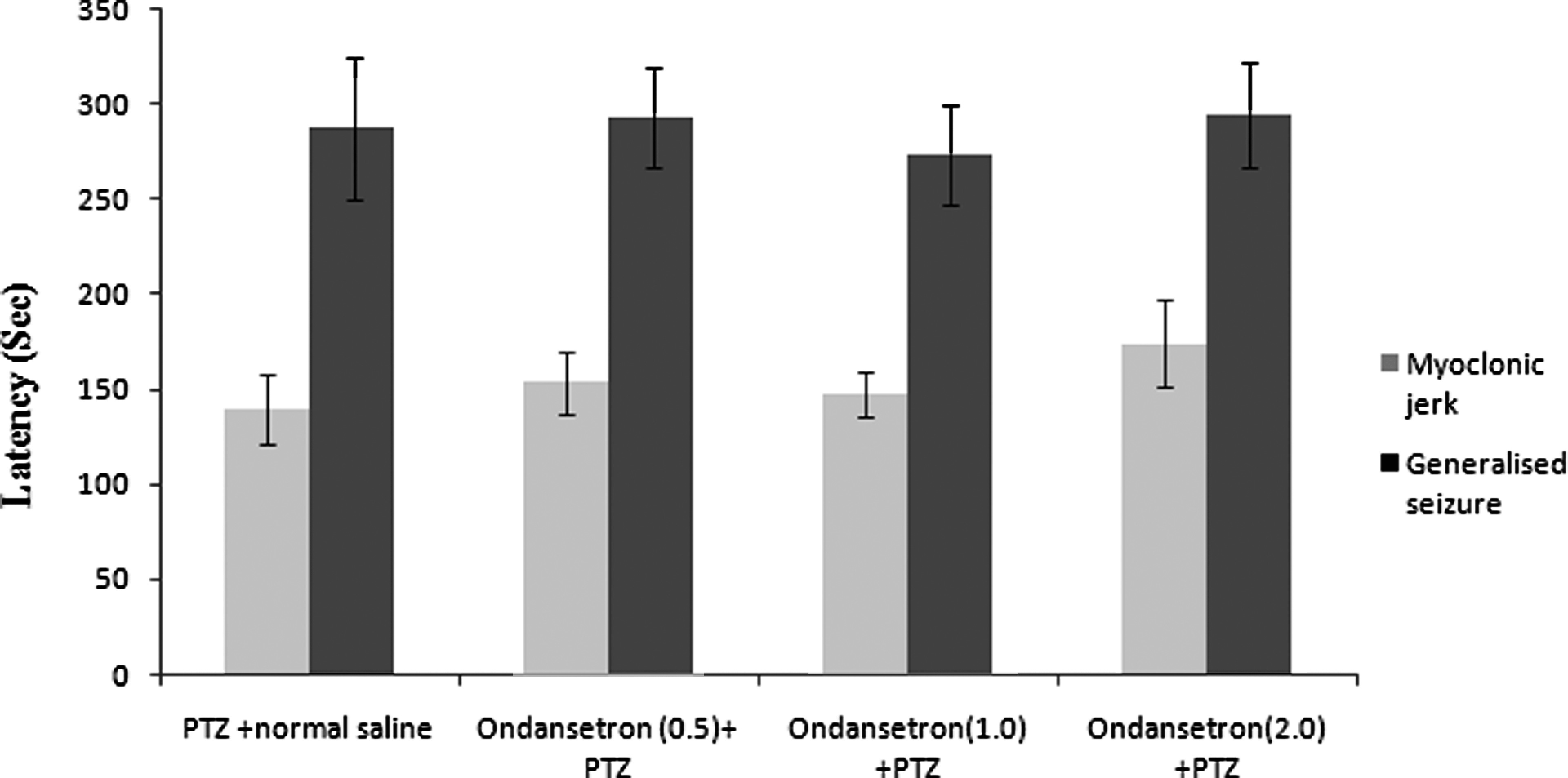
The effect of ondansetron on pentylenetetrazole (PTZ)-induced seizure in mice. Values are expressed as mean ± SEM.
Chronic study
Effect of ondansetron on ICES test in mice. After chronic administration of ondansetron and phenytoin for 21 days, the changes in STC were similar to the results of acute study.
Effect of ondansetron on TL on elevated plus maze. No significant change was observed in acquisition TL in ondansetron (0.5 mg/kg)-treated group when compared with the control. However, ondansetron in all the three test doses showed significant shortening of TL as compared to the control group. Piracetam (200 mg/kg, i.p.) administration significantly decreased the acquisition and retention latencies as compared to the control group (Figure 3).
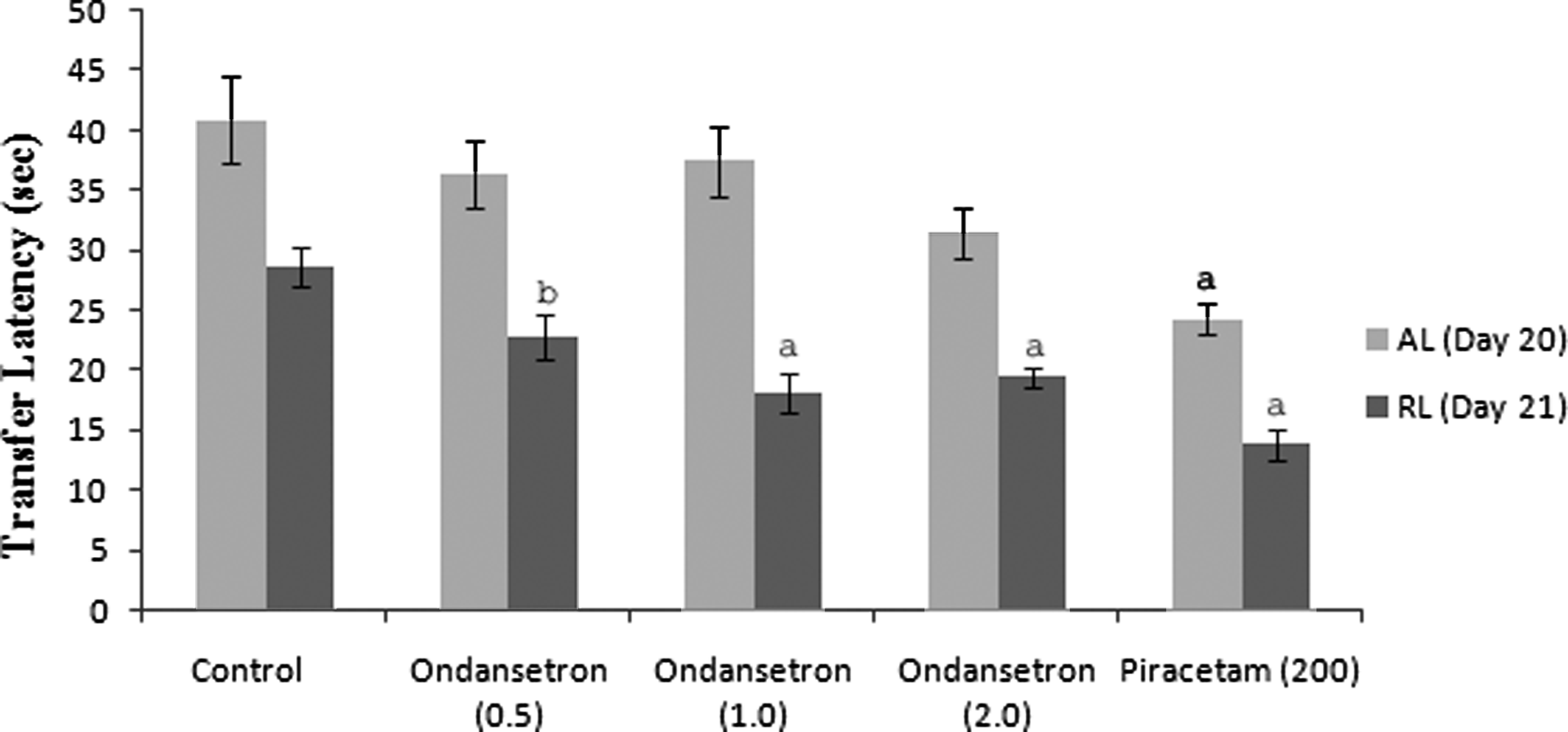
The effect of chronic administration (21 days) of ondansetron on transfer latency (TL) on elevated plus maze in mice. AL: acquisition latency; RL: retention latency. Values are expressed as mean ± SEM (analysis of variance (ANOVA) followed by Tukey’s test). a p < 0.001 versus control; b p < 0.05 versus control.
Effect of ondansetron on SDL in mice. Ondansetron at a dose of 2 mg/kg was found to significantly increase the SDL on day 1 (acquisition) when compared with the control group. On day 2 (retention), ondansetron in 1 and 2 mg/kg i.p. doses significantly prolonged SDL as compared to the control group. However, low dose (0.5 mg/kg) of ondansetron showed no effect on SDL. Treatment with piracetam also prolonged the acquisition and retention latencies as compared to the control group (Figure 4).

The effect of chronic administration (21 days) of ondansetron on step-down latency (SDL) on passive avoidance task in mice. AL: acquisition latency; RL: retention latency. Values are expressed as mean ± SEM (analysis of variance (ANOVA) followed by Tukey’s test). a p < 0.001 versus control; b p < 0.01 versus control.
Discussion
Epilepsy is a heterogenous group of disorder caused by abnormal ion transport across cell membrane and/or an imbalance between excitatory (glutamic acid) and inhibitory (GABA) neurotransmitter systems. Serotonin is the neurotransmitter of a diffuse modulatory system involved in epilepsy, mood regulation and cognition. 30,31 The diffuse nature of the serotonergic system supports the belief that serotonin exerts a tonic modulatory influence on widespread areas of the CNS through interactions with various subtypes of serotonin receptors. 7,32,33
In recent years, serotonergic neurotransmission has been found to modulate a wide variety of experimentally induced seizures. 5-HT receptors are widely distributed in both CNS and peripheral nervous system. The involvement of various 5-HT-receptor subtypes and their ligands in seizure disorders has been described in several animal studies.12,34 –36 The serotonin receptors appear to be involved in almost all networks of epilepsies. Imaging data and studies in animal models provide evidence that endogenous serotonin and its receptors 5-HT1A, 5-HT2C, 5-HT3 and 5-HT7 play a significant role in epileptogenesis and its propagation. 6,12,37
5-HT3 is a ligand-gated ion channel, leading to depolarization or hyperpolarization of neurons by changing conductance of Na+, K+ and Ca+2 ions across the membrane. 9,38 In CNS, the nuclei of brain stem, area postrema and nucleus solitaries and the spinal cord have high density of these receptors while cortex, hippocampus and amygdala have lower densities of 5-HT3 receptors. 6,39
Various knockout mouse models proposed a relationship between 5-HT and epilepsy. Spontaneous deaths due to seizures have been demonstrated in mutant mice that lack 5-HT2-receptor subtypes. 40 Furthermore, in 5-HT1A-receptor knockout mice, lower seizure threshold and higher mortality have been observed following administration of kainic acid. 41 The role of excitatory 5-HT3 receptor in the epilepsy has been advocated by various authors. 12,17,18 In the kindling model of epilepsy, the administration of m-chlorophenyl biguanide, a 5-HT3-receptor agonist, increased the duration of fully kindled seizures and also facilitated the development of seizure process in rats. 42 In addition, administration of zacopride (5-HT3 antagonist) was found to decrease the severity and to increase the latency of audiogenic seizures in DBA/2 mice. 43
Ondansetron, a well-known antiemetic drug, is a selective 5-HT3-receptor antagonist. In various studies, it has demonstrated that gastroprotective, 44 anti-anxiety, 45 anticonvulsant17,18 and antinociceptive activities 46 attenuated cocaine and methamphetamine-induced behavioral sensitization 47,48 and showed protection against lithium–pilocarpine-induced seizures. 49 In the present study, we have examined the effect of ondansetron on ICES test in mice, which is a simple and sensitive test to identify the pro- and anticonvulsant nature of the test drug. The results indicate that ondansetron at doses of 1 and 2 mg/kg was more effective in blocking the electroshock-induced convulsions as significant increase in STC in the drug-treated groups was observed as compared to the control group. The results were comparable with the standard AED, phenytoin. The protective action offered in electroshock test might be due to alteration in the influx of cations Na+, Ca+2 or K+, leading to the inhibition of neuronal depolarization. 17 The effect observed with ondansetron in the present study is in agreement with the study conducted by Swain and Mohanty 17 and Balakrishnan et al., 18 where ondansetron exerted anticonvulsant activity against electrically induced seizures in rats.
In PTZ-induced seizures test, the ondansetron in all the three doses did not inhibit clonic seizures caused by the administration of PTZ. Neurochemical evidences suggest that PTZ blocks GABA-mediated inhibitory effect. Activation of N-methyl-
Emerging evidence suggests that serotonin is related to mood and cognitive disorders, and all its receptors might be implicated in learning and memory processes. 19,21,53,54 The effect of ondansetron was also evaluated on memory using elevated plus maze and passive avoidance paradigms. Ondansetron decreased the TL on elevated plus maze and increased the SDL, indicating that the blockade of 5-HT3-receptor antagonist may be involved in the learning and memory process. Piracetam, a known nootropic drug, also improved acquisition as well as retention latencies in both experiments. Previous study has reported that ondansetron and tropisetron reversed the impaired learning induced by 1-(m-chlorophenyl)-biguanide. 55 Ondansetron administration also reversed the cognitive dysfunctions induced by phenytoin in rats. 18 The mechanism by which ondansetron improved memory is unknown, but it may involve enhancement of cholinergic function in the brain as 5-HT3 heteroreceptors are found to modulate the activity of several neurotransmitters such as cholinergic and glutamatergic systems in amygdala and hippocampus. 56 –58
To conclude, ondansetron produces anticonvulsant effect against electrically induced seizures and is devoid of effect on PTZ-induced seizures in mice. Chronic administration of ondansetron has also shown favorable effects on memory. These findings suggest that ondansetron could be a promising drug in the treatment of seizures. However, further experimental, biochemical and clinical studies are required to ascertain its anticonvulsant and cognition-enhancing potential.
Footnotes
Declaration of conflicting interests
The authors declared no conflicts of interest.