




Abstract
Cisplatin (Cisp) is one of the most effective chemotherapeutic drugs. However, the dose of Cisp is greatly limited by its toxicity. Recombinant human erythropoietin (rhEPO), a hormone that regulates hematopoiesis, has also been shown to exert tissue-protective effects. The purpose of this study was to explore the protective effect of rhEPO against Cisp-induced renal and liver dysfunctions. Adult male Wistar rats were divided into six groups of six each: control, rhEPO-alone group, Cisp-alone group and rhEPO + Cisp group (pretreatment, cotreatment and posttreatment conditions). Our results showed that Cisp-induced a marked renal and liver failure characterized by a significant decrease in body weight, organ weight and organ ratio and a significant increase in creatinine, blood urea nitrogen, alanine aminotransferase, aspartate aminotransferase, G-glutamyl transferase, alkaline phosphatase, bilirubin conjugated and bilirubin total levels in serum. Histological examination showed that Cisp caused kidney alterations. rhEPO treatments restored body weight, organ weight and organ ratio as well as serum biochemical parameters changed due to Cisp exposure.
Introduction
Cisplatin (Cisp) is currently one of the most important cytostatic agents in the treatment of a wide range of solid tumors. Cisp and related platinum-based therapeutics are now being used for the treatment of several types of cancer. 1 –3 However, the clinical usefulness of this drug is restricted due to some adverse side effects, such as nephrotoxicity and hepatotoxicity. 4 –6 Hepatotoxicity caused by Cisp has been rarely characterized and is less studied. However, it is known that Cisp is significantly taken up in human liver and that high dosage of this drug produces hepatotoxicity. 7,8 Until now, a large number of studies have been focused on the ways for prevention of Cisp side effects via supplementation of preventive agents for minimizing Cisp-induced kidney and liver damage. 9,10 Nevertheless, the use of recombinant human erythropoietin (rhEPO) has not been well underlined.
Erythropoietin, which is clinically used as rhEPO, is a cytokine originally used for its effects on erythropoiesis, since it supports the survival, proliferation and differentiation of erythroid progenitor cells. The biological effects of rhEPO are not limited to the hematopoietic system; many studies have recently shown that rhEPO is a pleiotropic cytokine that exerts broad tissue-protective effects in diverse nonhematopoietic organs. 11 rhEPO has been found to protect the brain and the spinal cord from ischemic injury, the peripheral nerve from diabetic damage and the heart from acute ischemic/reperfusion injury. 12 –15 Given that rhEPO receptors are expressed on renal tubular epithelial cells and hepatic cells, 16 –18 it is possible that the systemic administration of rhEPO may also provide protection against acute renal and liver damages caused by Cisp.
In this study, we looked for the protective effect of rhEPO on Cisp-induced nephrotoxicity and hepatotoxicity in Wistar rats. Using histological and biochemical analysis, we investigated whether rhEPO avoids Cisp-induced kidney and liver failure when it was administered simultaneously, before or after Cisp administration.
Material and methods
Chemicals
Cisplatin (cis-diamminedichloroplatinum II) was purchased from Sigma–Aldrich (France). Commercially available preparation of rhEPO (Hemax®, Bio SIDUS S.A., Argentina) was used.
Animal treatments
Experiments were performed on male Wistar rats weighing 120–140 g, kept at controlled environmental conditions at room temperature of 22 ± 2°C and 12 h light and dark cycles and allowed free access to food and water but fasted overnight before treatment. The experimental procedures were carried out according to the American College of Toxicology Statement on the Use of Animals in Toxicology and approved by the local ethics committee. For the time-course experiment, rats were divided at random into six groups of six each. All injections were administered by intraperitoneal (i.p.) route. The control group received a single injection of saline solution at 7.5 mg/kg body weight (bw). In each type of treatment, rhEPO and Cisp were used at 3000 IU/kg bw and 6 mg/kg bw, respectively. The rhEPO group received only rhEPO, and the Cisp group received only a single injection of Cisp. To test the effects of rhEPO on Cisp-induced nephrotoxicity and hepatotoxicity, three treatment conditions were experienced. In the cotreatment group, a single dose of rhEPO administered simultaneously with Cisp. In the pretreatment group, a single dose of rhEPO was injected 1 day before Cisp treatment. In the posttreatment group, a single dose of rhEPO was injected 5 days after Cisp exposure. Experimental design is detailed in Table 1.
Animal groups and treatments in the experimental design of this study. a

rhEPO: recombinant human erythropoietin, Cisp: Cisplatin.
aRats were exposed to Cisp and rhEPO in different treatment conditions: Cisp-alone, rhEPO-alone and rhEPO with Cisp (cotreatment, pretreatment and posttreatment).
After the animals are killed, the blood samples were collected for measurement of serum creatinine, blood urea nitrogen (BUN), alanine aminotransferase (ALT), aspartate aminotransferase (AST), G-glutamyl-transferase (GGT), alkaline phosphatase (ALP), bilirubin conjugated (DBIL) and bilirubin total (TBIL) analyses. Then, the animals were euthanized and kidneys and liver were immediately removed for weighing and for histological examinations.
Animal weight
Animal weight was measured and evaluated between the first day of Cisp/rhEPO administration and the final day of treatment. Weight loss was calculated as follows:
Kidney and liver ratio
Kidneys and livers were removed and weighed immediately. The ratio of kidney and liver was calculated using the following formula.
Serum biochemical analysis
Serum creatinine concentration was measured by the picric acid colorimetric method. 19 BUN was measured using colorimetric assay kit according to the manufacturer’s instructions (Stanbio Laboratory, USA). The enzymatic activities ALT, AST, GGT and ALP in serum and the concentration of BILD and BILT in serum were determined with the biochemical parameter counter: the Beckman Synchron CX9 Pro supported by Beckman Coulter Inc. (C x 9 Pro.Beckman).
Histopathological examination in kidney and liver tissues
Histological evaluation of the kidneys and livers was performed on separate groups of rats. Briefly, kidneys and livers were removed from rats at the end of the experimental period, were cut sagittally into two halves and were fixed in immersion containing 15% formaldehyde at room temperature for 24 h. After dehydration using graded ethanol, pieces of kidneys and livers were embedded in paraffin. The sections were stained with hematoxylin and eosin.
Statistical analysis
Data are expressed as means ± SD. Statistical comparison between different groups were done using one-way analysis of variance followed by Fischer’s post hoc to detect the difference between various groups. A p < 0.05 was considered to be significant.
Results
Effect of rhEPO on Cisp-induced body weight loss, organ weight, and organ ratio
The results showed that the body weight loss in the Cisp-treated group increased significantly when compared with the control group (Table 2). Thus, animals lost 36 ± 5.2 g in the Cisp group versus 6.4 ± 1.34 g in the control group. rhEPO + Cisp treatments (cotreatment, pretreatment and posttreatment), especially in pretreatment condition, restored body weight loss when compared with the Cisp-treated group (Table 2). In fact, animals in the pretreatment group lost 11.6 ± 8.11 g versus 36 ± 5.2 g in the Cisp-treated group.
Effects of rhEPO on Cisp-induced body weight loss, organ weights and organ ratio. a

rhEPO: recombinant human erythropoietin, Cisp: Cisplatin.
*Significantly different from the control group.
#Significantly different from the Cisp treated rats.
aValues are expressed as means ± SD. Superscript alphabets indicate a significant difference at p ≤ .05.
bSignificantly different from the cotreatment group.
cSignificantly different from the posttreatment group.
In the second set of experiments, we examined the effect of Cisp (6 mg/kg bw i.p.) on kidneys and livers weights (Table 2). Our result clearly demonstrated that organ weight decreased significantly when compared with the control group. Thus, the kidney weight decreased from 1.09 ± 0.2 g to 0.67 ± 0.13 g and liver weight decreased from 4.29 ± 0.43 g to 3.48 ± 0.4 g in control and Cisp group, respectively. This decrease in organ weight was significantly ameliorated with rhEPO administration especially in the pretreatment condition. Kidney weight passed from 0.67 ± 0.13 g in Cisp group to 0.97 ± 0.12 g in the pretreatment group. Furthermore, Cisp exposure induced significant change in organ ratio (liver and kidney) when compared with the control group (Table 2).
Effect of rhEPO on Cisp-induced kidney dysfunction
As shown in Figure 1, Cisp treatment caused a marked elevation of serum BUN and creatinine concentration in comparison to the control group (154.1 ± 7.53 mmol/l vs 6.58 ± 1.01 mmol/l and 376 ± 35.13 µmol/l vs 25.5 ± 2.88 µmol/l, respectively). rhEPO treatments (cotreatment, pretreatment and posttreatment) resulted in a significant reduction in BUN and serum creatinine levels. The results showed that rhEPO administration 24 h before Cisp presents the best protection against Cisp nephrotoxicity: 43.28 ± 10.5 vs 154.1 ± 7.53 and 113.6 ± 8.2 vs 376 ± 35.13 in BUN and serum creatinine levels, respectively.

rhEPO ameliorates renal functional impairment following Cisp injury. Values are expressed as means ± SD. Superscript symbols indicate a significant difference at p ≤ 0.05. rhEPO: recombinant human erythropoietin, Cisp: Cisplatin.
Effect of rhEPO on Cisp-induced liver dysfunction
The results of serum biochemical analysis revealed that treatment with a single dose of Cisp increased significantly (p < 0.005) the serum levels of ALT, AST, BILD, BILT, ALP and GGT, which are the indicators of liver toxicity, as compared to the control group (Figures 2A, B, 3A, B, 4 and 5). For example, serum ALT level increased from 5.67 ± 1.15 IU/l in the control group to 30.75 ± 4.03 IU/l in the Cisp-treated group. rhEPO administration simultaneously, 24 h before or 5 days after Cisp exposure, ameliorated the biochemical parameters, as compared to the Cisp-treated group. ALT serum level passed from 30.75 ± 4.03 IU/l in the Cisp-treated group to 8.33 ± 1.15, 5.25 ± 1.15 and 7 ± 2. 65 IU/l in cotreatment, pretreatment, and posttreatment conditions, respectively. The results showed clearly that rhEPO administration in pretreatment condition promoted the best protective effect against Cisp-induced liver toxicity.

rhEPO ameliorates (A) serum AST and (B) ALT level concentrations following Cisp exposure. Values are expressed as means ± SD. Superscript symbols indicate a significant difference at p ≤ 0.05. AST: aspartate aminotransferase, ALT: alanine aminotransferase, rhEPO: recombinant human erythropoietin, Cisp: Cisplatin.

rhEPO changes serum (A) TBIL and (B) DBIL level concentrations following Cisp treatment. Values are expressed as means ± SD. Superscript symbols indicate a significant difference at p ≤ 0.05. rhEPO: recombinant human erythropoietin, Cisp: Cisplatin, DBIL: bilirubin conjugated, TBIL: bilirubin total.

rhEPO ameliorates serum ALP level following Cisp injury. Values are expressed as means ± SD. Superscript symbols indicate a significant difference at p ≤ 0.05. rhEPO: recombinant human erythropoietin, Cisp: Cisplatin, ALP: alkaline phosphatase.
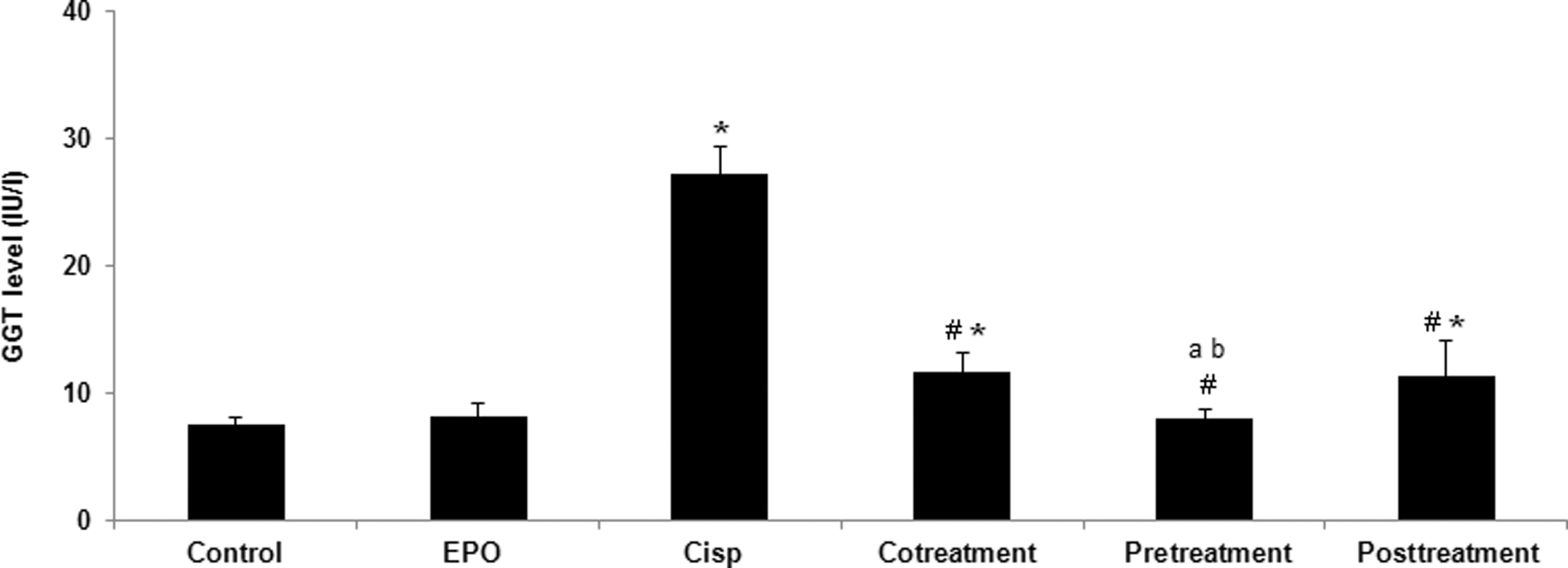
Effect of rhEPO on Cisp-induced change in GGT level. Values are expressed as means ± SD. Superscript symbols indicate a significant difference at p ≤ 0.05. rhEPO: recombinant human erythropoietin, Cisp: Cisplatin, GGT: G-glutamyl-transferase.
Effect of rhEPO on histologic changes caused by Cisp in kidney and liver
The histopathology of kidney was illustrated in Figure 6. The results showed extensive tubular epithelial cell necrosis, desquamation, vacuolization and swelling in the kidney of the Cisp-treated group (Figure 6C). Cisp + rhEPO administration (cotreatment, pretreatment and posttreatment) did not improve the histological appearance and no reduction was observed in tubular cell damage (Figure 6D–F). Histopathology of the liver demonstrated that Cisp administration (Figure 7C) did not cause any significant histological damage in liver as compared to the control group. Indeed, in liver tissue, no tissue damage was detected (Figure 7 D–F).

Histopathological changes in kidney after rhEPO and Cisp treatment conditions. Transverse section of control rat kidney (A), rhEPO-treated kidney (B), Cisp-treated kidney (C), cotreatment condition (D), pretreatment condition (E) and posttreatment condition (F). (a) Indicates a detached tubular cells and a glomerule basal membrane denudation, (b) indicates a tubular distension, (c) indicates a normal tubule and (d) indicates a normal glomerule. rhEPO: recombinant human erythropoietin, Cisp: Cisplatin.
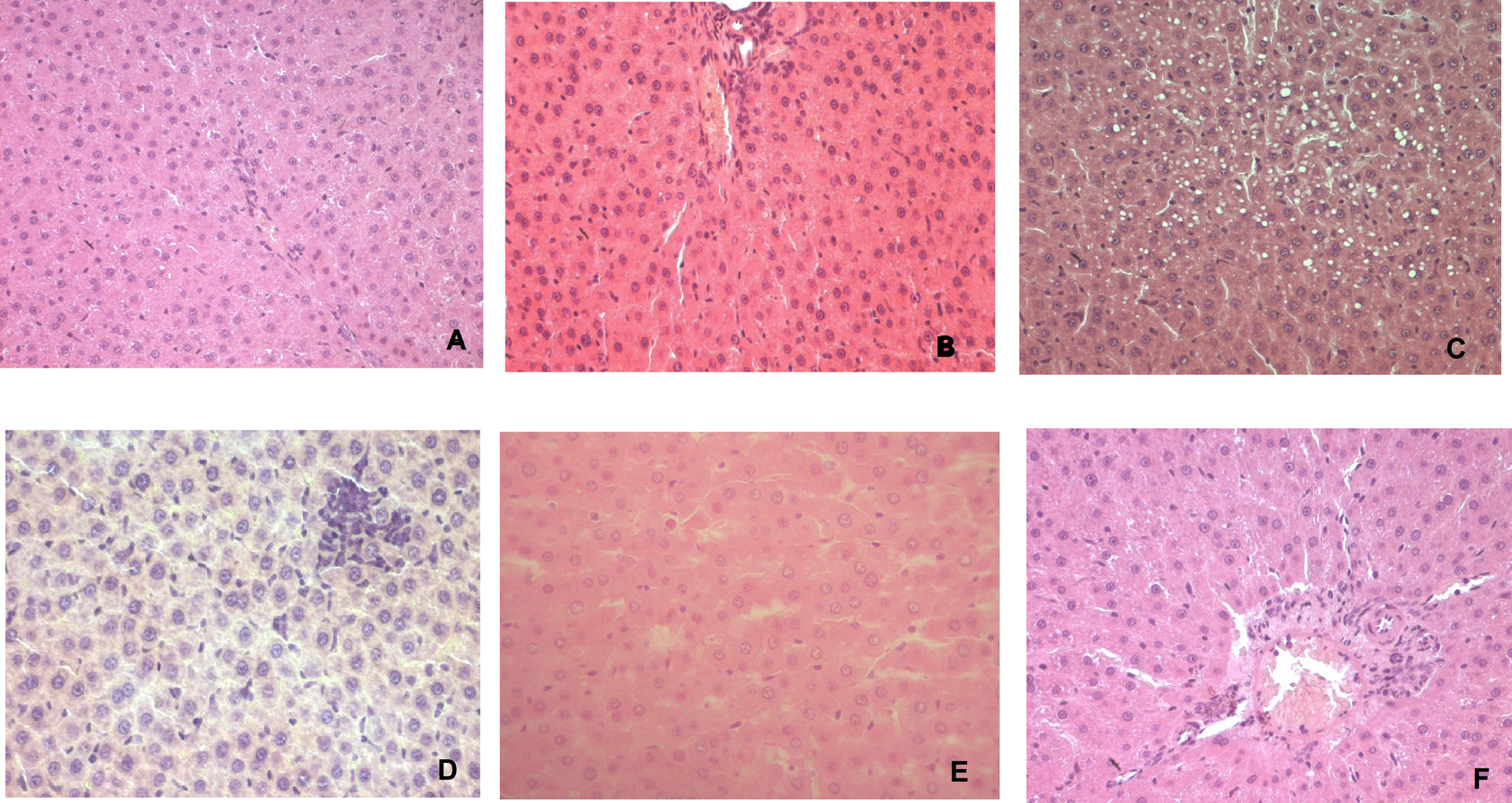
Histopathological changes in the liver of rats after rhEPO and Cisp treatment conditions. Transverse section of control rat liver (A), rhEPO-treated liver (B), Cisp-treated liver (C), cotreatment condition (D), pretreatment condition (E) and posttreatment condition (F). rhEPO: recombinant human erythropoietin, Cisp: Cisplatin.
Discussion
Cisp is one of the most potent chemotherapeutic anticancer drugs used for the treatment of various cancers. 20,3 In spite of its significant anticancer activity, the clinical use of Cisp is often limited by its undesirable side effects including nephrotoxicity and hepatoxicity. 21,22 The cytotoxic action of Cisp in kidney tissue is often thought to be associated with its ability to bind to the DNA and to form Cisp-DNA adducts 23,24 . Several evidences reported so far suggest that Cisp cytotoxicity also increases when the intracellular glutathione levels decrease. 25 Very little information is available on Cisp-induced liver injury and its mechanism in causing hepatotoxicity. There is a suggestion that the drug accumulates in significant amounts in hepatic tissue particularly when injected in high doses. 26,27
Many efforts have been made to improve the therapeutic index of Cisp using pharmacological strategies, such as the administration of chemoprotectors, intensive hydration and hypertonic saline. 28 –30 rhEPO, apart from its crucial role in hematopoiesis, has been shown to prevent several injuries. 31,32 In fact, it has been demonstrated that rhEPO receptors are expressed in many tissues, including the kidney and the liver. rhEPO administration decreased tissue damage by inhibition of apoptosis, reduction of inflammatory cytokines, maintenance of vascular flow through, increase of nitric oxide synthesis and decrease of lipid peroxidation. 31,33
In the present study, we demonstrated that rhEPO has a preventive effect against Cisp-induced failure in kidney and liver of rats. Nephrotoxicity caused by Cisp in this study was gauged by body weight loss, kidney weight loss, kidney ratio and biochemical parameters changes (creatinine and BUN in serum). Furthermore, the results clearly demonstrated that the administration of Cisp to rats caused an extensive necrosis of tubular epithelial cells, desquamation, vacuolization and swelling in renal tissue. These results are in agreement with Iseri el al., 22 showing that a single dose of Cisp induced a severe renal failure in rat characterized by an enhanced serum BUN and creatinine levels and obvious renal tissue damage. Groups treated by rhEPO, simultaneously, before or after Cisp administration, showed a lower level of serum BUN and creatinine than the group receiving the Cisp only. Furthermore, it demonstrated that the pretreatment condition was the most efficient in preventing this renal dysfunction caused by Cisp. This is in accord with Esposito et al. 34 who demonstrated that rhEPO preconditioning is effective in protecting the kidney against ischemia/reperfusion injury by reducing both tubular cell injury and interstitial infiltration.
The histological examination of the kidney showed that rhEPO administration in cotreatment, pretreatment and post-treatment conditions did not significantly improve renal lesion as compared to the Cisp-treated group. This could be due to the fact that our analysis was performed precociously, and it is known that the restoration of the renal function is observed at later stages. In fact, the regeneration of renal tubular cells starts between day 6 and day 10 of exposure to toxic agents. 34,35
The measure of liver weight demonstrated that Cisp caused a loss in liver weight as compared to the control group and an increase in serum levels of ALT, ALT, GGT, ALP, BILD and BILT, which are the indicators of hepatotoxicity. These results are in agreement with studies showing that Cisp caused a liver toxicity characterized by an elevation of ALT, ALT, GGT, ALP, BILD and BILT levels in seum. 36 –39 rhEPO administration, especially in pretreatment condition, restored the loss of liver weight and deceased significantly the level of biochemical parameters changed by Cisp. Histological examination of liver showed that Cisp exposure does not cause any significant alteration in liver tissue as compared to the control group. Thus, in our experimental condition, we deduced that Cisp induced a more pronounced failure in kidney tissues as compared to liver tissue. This is in agreement with several studies showing that the anticancer activity of Cisp is usually limited by its secondary effects especially its nephrotoxicity. 40,41 Furthermore, earlier studies have reported that Cisp therapy is usually associated with less common toxic effects, such as hepatotoxicity. 42,43 Our results corroborate with other studies using several phytochemicals agents for protection against the side effects of Cisp such as caffeic acid, lycopene, tomato juice and ellagic acid. 44 –47 These agents act by an antioxidant process, while rhEPO exerted a cytoprotective effect by the inhibition of apoptosis as well as reduction of inflammatory cytokines, an antioxidant and an anti-genotoxic effects. 31,33,48
In conclusion, the present study provided evidence that in addition to its well-known erythropoietic effects, rhEPO administration in cotreatment, pretreatment and posttreatment protects against Cisp-induced kidney and liver toxicity. Furthermore, we demonstrated that the protective action of rhEPO was more pronounced when it was administrated to rats 24 h before Cisp exposure.
Footnotes
Authors’ Note
The experimental procedures were carried out according to the American College of Toxicology Statement on the Use of Animals in Toxicology and approved by the local Ethics committee.
Funding
This research was supported by the Ministère Tunisien de l’Enseignement Supérieur et de la Recherche Scientifique et de la Technologie (Laboratoire de Recherche sur les Substances Biologiquement Compatibles: LRSBC).
Declaration of Conflict of Interest
The authors declared no conflicts of interest.