




Abstract
The World Library of Toxicology, Chemical Safety, and Environmental Health, commonly referred to as the World Library of Toxicology (WLT), is a multilingual online portal of links to key global resources, representing a host of individual countries and multilateral organizations. The Site is designed as a network of, and gateway to, toxicological information and activities from around the world. It is built on a Wiki platform by a roster of Country Correspondents, with the aim of efficiently exchanging information and stimulating collaboration among colleagues, and building capacity, with the ultimate objective of serving as a tool to help improve global public health. The WLT was publicly launched on September 7, 2009, at the Seventh Congress of Toxicology in Developing Countries (CTDC-VII) in Sun City, South Africa.
Keywords
Introduction and genesis
While a handful of Western countries tend to dominate the world in the generation of toxicology research, data, and activities, virtually every country makes some contribution to the output of this information. Certain countries have robust toxicology infrastructures and a well-identified information framework, while others do not. While countries have traditionally been relatively provincial in focusing on their own activities, the era of globalization has made it clear that such an approach requires serious reconsideration, and that toxicology from all quarters needs to be better inter-connected.
The importance of environmental information exchange has been raised as far back as the seminal 1972 Stockholm Conference on the Human Environment. The 1992 UN Conference on Environment and Development (aka Earth Summit) 1 held in Rio de Janeiro, Brazil, called for “intensified information exchange” in chapter 19 of its Agenda 21. As a result, a Global Information Network on Chemicals (GINC) was proposed, in 1994. GINC was placed under the framework of the Inter-Organization for the Sound Management of Chemicals (IOMC), with a pilot phase in Asia, and the support of the Japan Ministry of Health, in 1995. A series of meetings were held through 2000, and the GINC was gradually developed on the Web. Financial considerations forced maintenance to be suspended in 2003. Shortly thereafter, the US National Library of Medicine (NLM), the world’s largest biomedical library, and a component of the National Institutes of Health, after consultation with several of the GINC’s key developers, decided to take up the mantle and create a similar, but more broadly based, portal linking toxicology information from around the world. Under development for several years but accessible only as a password-protected pilot site, the WLT was ported to INND/Toxipedia (http://www.toxipedia.org) in 2008, with funding from NLM, and in partnership with the International Union of Toxicology (IUTOX). It was publicly launched on 7 September 2009 at the Seventh Congress of Toxicology in Developing Countries (CTDC-VII) in Sun City, South Africa, sponsored by IUTOX, with the Web URL of http://www.wltox.org. A session at this Congress was devoted to the WLT, and included talks outlining the roles of its partner organizations, plus a panel consisting of several Country Correspondents and a Continent Coordinator (Mohammad Abdollahi [Iran], Sanmi Areola [Africa continent], Ravi Gooneratne [New Zealand], Mary Gulumian [South Africa], Levi Oresh [Nigeria], Salah Soliman [Egypt], Aristidis Tsatskakis [Greece]).
Country-specific and multi-lateral information: structure, content, and navigation
Most of the WLT’s home page is occupied by a world map (see Figure 1
). One can click on any continent or region, and be led to the page for that geographic area, which presents links to information general to that area as well as to participating countries via their respective flags. There are currently over 50 countries represented, with several more under development. Country pages typically contain the following categories of information (see Figures 2 and 3
for sections of the Italy and Iran pages): Government agencies (National and, in some cases, regional authorities) Non-government organizations Universities Professional societies Poison information/control centers Miscellaneous resources Key publications – books, journals Databases Legal links (legislation and regulations) About (Country – news, demography, general country information) Multilateral organization contacts Literature references from TOXLINE (citations to the journals literature, either related to the country or by authors from the country, from the National Library of Medicine) Country correspondents may include other categories as they see fit, and with consultation of WLT staff.

World Library of Toxicology (WLT) home page.

Italy page (partial).
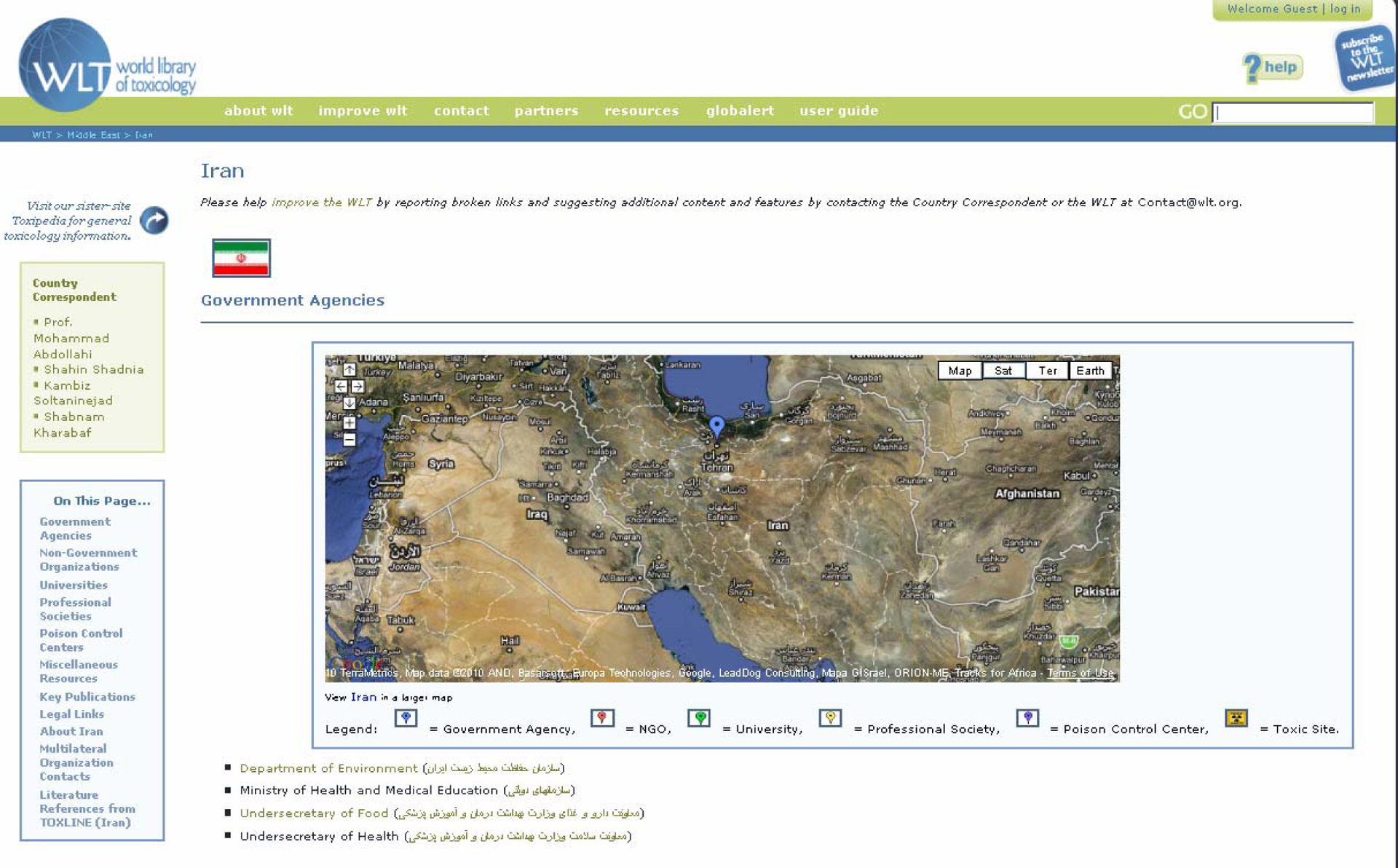
Iran page (partial).
Language
From the outset, it was understood that language could pose an obstacle to understanding, so a decision was made to make the WLT a multi-lingual resource. Thus, every entry appears first in its native language utilizing the appropriate character sets (e.g. Roman, Cyrillic, Mandarin, etc). This is usually necessary and preferred for native speakers within and outside their countries. However, English, which has lately been considered the global lingua franca, certainly of science, is also supplied. Thus, clicking on a non-English language entry will go to the URL for that site. If there is an equivalent English language entry, it will be listed, and hot-linked as well. However, if there is none, at least an English translation of the entry will be listed.
While Web sites predominate as the preferred listings, organizational entries not represented by a Web site are included as well. Thus, if no Web site is available, information such as e-mail address, FAX and/or phone number, and mailing address could be included.
Building database content: country correspondents
Although a global portal such as the WLT could technically be built from a centralized source, it stands to gain significantly, instead, by inviting contributions from participants representing their respective countries, who would be in the best position to provide complete and accurate information. Therefore, a network of country correspondents (CCs) was established. CCs are typically, though not exclusively, scientists engaged in toxicology research or application at governments or universities, who are well acquainted with the toxicological infrastructure in their countries. CCs have been identified via personal contacts and referrals and are not officially designated representatives of their country governments. In its developmental phase at NLM, the information provided by the CCs were, essentially, funneled through the WLT Project Officer, who reviewed the material and, usually, after several revisions had the IT staff post the country pages. Because information is not static, it became clear that significant resources would be required to update and maintain the portal. An automated link checker, for example, was used to identify broken links, which CCs in collaboration with NLM staff, would repair. There may be any of a number of reasons why a particular Web URL is inaccessible at any particular moment – the organization may have dissolved, the URL may have changed, there may be server problems, the wait time to connect may have become interminably long with the effect being as if the URL is totally inaccessible, etc. Having the CCs take direct control of troubleshooting and repairing such problems, as well as building the pages, as available in the WLT’s current platform on Toxipedia, results in a much more efficient operation.
Although Europe represents the greatest number of countries, a special effort is being made to increase participation from other areas, particularly in the developing world, and to offer information that would be of particular benefit to them. Africa is the first region to have a Continent Coordinator, responsible for identifying and working with CCs in the African continent.
Country Correspondents and Continent Coordinators are, in essence, the heart of the WLT, for they are in the best position to be knowledgeable about activities in their own geographic regions, and to supply credible information and insight. The value of having a technological edifice supported by a real human foundation is incalculable.
INND/Toxipedia – collaborative technology and security
With the WLT’s migration to INND/Toxipedia, a greater degree of control could be placed within the hands of the CCs, in a distributed environment, thanks to the still evolving technology of wiki’s. The wiki technology has an interesting history but was first used on the World Wide Web in 1995. Wiki is Hawaiian for quick and refers to the fact that changes are quickly made available to the public. Wikis are Web sites that function and grow by public participation and submissions. Wikis are increasingly recognized by the scientific community as a valuable tool for sharing information and education. 2,3
In the case of the WLT, that participation comes directly from the CCs. Every CC registers in the Toxipedia platform. This provides them with access to create and edit pages in the WLT. Once registered, the WLT Web manager restricts these editing abilities to their respective country page. The CC and their selected associates can thus rapidly update the pages or respond to suggestions from users or colleagues. This format allows for heightened security on each country page since the only user capable of editing a country’s pages is the CC for that country. The WLT managing staff receives daily reports of the updates made to the WLT. They have the ability to disallow an update if it is deemed inappropriate or irrelevant to the WLT. These operating and security measures allow the WLT to develop under the control of its contributors, with supervision intact at all times.
The role of IUTOX
IUTOX, founded in 1980, is the world’s largest toxicology professional society, representing over 20 000 toxicologists from industry, academia and government, from all 6 continents, and from 51 affiliated societies. Although it sponsors international congresses and fellowship programs, it recognizes the complementary advantages of the WLT. Specifically, the WLT provides a means of round-the-clock dynamic exchange across political and geographic boundaries, which could otherwise inhibit in-person meetings. In addition to being a mechanism for information exchange, the network that the WLT is building will provide a fruitful context for capacity building and educational exchange, 2 of the main goals of IUTOX. Figure 4 shows a map of the IUTOX-associated countries and societies and the relative sizes of these societies across the map. A common goal for both IUTOX and the WLT is for toxicologists to be able to identify and contact each other both between and within countries. Among numerous benefits, such recognition can stimulate development of country and region-specific societies of toxicology.

International Union of Toxicology (IUTOX) membership.
Review process and advisory team
Peer review is a cornerstone of scientific research and information dissemination. Over and above the CCs work, and that of the WLT’s partner organizations, another important consideration for the WLT was to assemble an independent review group. Although there had been a nascent steering team at the start of the WLT project, it has become dormant, and the WLT staff is in the process of reconstituting a new advisory group. This group will aim for a careful balance between relevant toxicological communities, such as government, industry, and academia, as well as a good geographical cross section internationally. It should be noted that since the WLT is a portal consisting, essentially, of links, the content under review will not be subject to the same level of scrutiny as would be demanded of actual toxicological data. The Advisory Team will actively review the WLT content and periodically interact largely via conference calls and e-mail.
Tools and specialized areas
An important goal is to make global toxicology information more readily accessible to encourage people to explore the global environment and related health issues. To this end, a clickable flag poster with the flags and name of the lead Country Correspondent (see http://toxipedia.org/x/HoBT) was created. The Country flag poster is a pdf file that is easily accessible and will encourage people to explore the countries involved in the WLT (Figure 5 ).

Interactive flag poster.
At the request of the Country Correspondents, we have begun to create several specialized topic areas and an emerging issues section. The specialized topic areas include teaching resources and ethics sections. As the WLT grows, these sections will become more country-specific. The emerging issues section address common priority issues related to the environment and human health. The first two to be identified were e-waste and pesticides.
The path ahead
Expanding the set of countries
There are some 200 countries in the world and the WLT was released with an initial set of about 50. This is a respectable start, but much work remains. It is true that some countries will have virtually no toxicology or environmental health infrastructure and others, such as failed states, may be too unstable to include. Nonetheless, there still remain dozens of countries which could make a welcome contribution to the WLT.
Expanding features
The WLT staff has developed an extensive wish list of features to enhance the utility of the portal beyond the addition of new countries. These include more robust mapping capabilities, to offer geographical representations of particular toxicology institutes and activities (see Figure 6 for a vision of what this might look like for South Africa); travel awards and fellowships, geared towards developing countries, to help graduate students and/or young researchers attend international meetings; allowing CCs to create their own Web presence on the WLT to offer a more in-depth look at the activities in their countries; creating a newsletter to keep users apprised of developments associated with the WLT and global toxicology in general; creating a kind of chat room/forum or information exchange so that CCs can readily communicate with each other; an educational component will allow syllabi and presentations to become part of the WLT site; incorporate an emerging issues section to highlight toxicological hot topics of concern; continue to explore new and evolving technologies that might improve site navigation and access.

Map of toxicology resources in South Africa.
Funding
An enlarged and stable source of funding is critical for the WLT to be maintained in a timely fashion, updated regularly, and expanded. Needless to say, accomplishing the projects anticipated above will require the WLT to be on a sound financial footing. In that vein, funding sources are being diligently explored. International organizations with like goals are being approached for sponsorship. Another mechanism to be implemented is the creation of two categories of WLT partners – affiliate and supporting. A minimum donation would be required to become a supporting partner.
Ideas
The WLT welcomes comments and suggestions from the CCs and any other interested parties on how it can be improved. Users and potential users have already been very helpful in guiding the WLTs progress. The e-mail address, Contact@wlt.org, has been set up for this purpose.
Footnotes
This research received no specific grant from any funding agency in the public, commercial, or not for-profit sectors.