




Abstract
This Comment addresses a data attribution issue and a critical methodological error in Fidalgo et al. (2025) concerning Holocene body size trends in Cantabrian brown bears. A miscalculated specimen leads to a misinterpretation of the timing of size reduction, which, based on available data, appears to have occurred only in historical times. Correcting this error and properly acknowledging previous research are essential for an accurate understanding of phenotypic change and anthropogenic impact.
Introduction
In the article titled ‘Highlighting the drastic body size decline in Cantabrian Brown Bear, Chamois and Wild Horse during the Holocene’ (Fidalgo et al., 2025), the authors present new metric and radiocarbon data for the brown bear (Ursus arctos), chamois (Rupicapra pyrenaica parva) and wild horse (Equus ferus ferus) from Cueva de Llamazares (Cantabrian Mountains, León, Spain). These data are then compared with additional measurements compiled from the literature.
In the case of the brown bear, humerus length and the proximal articular surface width of the radius were used to estimate body mass for Holocene individuals from the Cantabrian Mountains, applying the regression equations listed in Table 1.
Regression equations employed by Fidalgo et al. (2025) for body mass estimation.

The article concludes that there was a drastic reduction in bear body size during the Mid-Holocene, suggesting that a population bottleneck may have introduced a bias towards smaller individuals. According to the authors, their results indicate the onset of body size decline in Cantabrian brown bears as early as ca. 5000 years ago, based only on one specimen from the Sima de los Osos de Somiedo studied in García-Vázquez (2015). They further propose that bear populations were shaped more by their mobility patterns than by potential changes in human hunting pressure.
Data errors
A thorough comparison between Supplemental Table 1 of Fidalgo et al. (2025) and the original metric data and calculations presented in García-Vázquez (2015), has revealed the following errors (highlighted in bold in Table 2):
Data adapted from Supplemental Table 1 of Fidalgo et al. (2025).
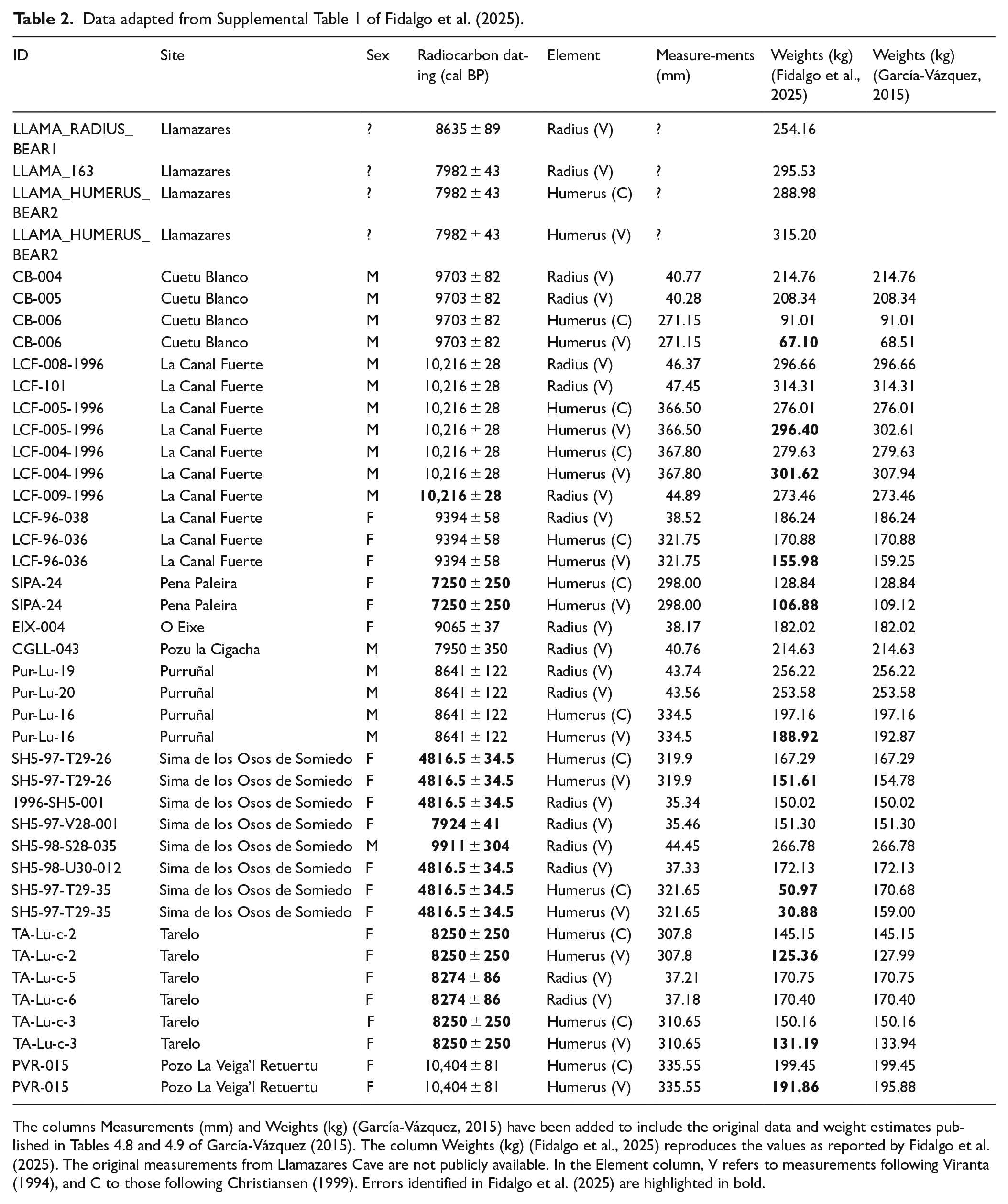
The columns Measurements (mm) and Weights (kg) (García-Vázquez, 2015) have been added to include the original data and weight estimates published in Tables 4.8 and 4.9 of García-Vázquez (2015). The column Weights (kg) (Fidalgo et al., 2025) reproduces the values as reported by Fidalgo et al. (2025). The original measurements from Llamazares Cave are not publicly available. In the Element column, V refers to measurements following Viranta (1994), and C to those following Christiansen (1999). Errors identified in Fidalgo et al. (2025) are highlighted in bold.
In the case of calculations based on Viranta (1994) equation for total humerus length, the measurements are similar but not identical to the values from Table 4.8 of García-Vázquez (2015).
The two weight estimates based on the humerus SH5-97-T29-35 (50.97 and 30.88 kg) are incorrect. These values form the basis of the hypothesis that body size reduction occurred prior to the last few centuries. However, when calculated using the correct measurements, the resulting weights (170.68 and 159.00 kg) fall within the expected female range.
Some of the radiocarbon dates used do not match the original data or have been misinterpreted.
Implications
Significant issues have been identified in Fidalgo et al. (2025), including both calculation errors and ethical concerns.
The most substantial technical error concerns the humerus from Sima de los Osos de Somiedo, specimen SH5-97-T29-35. Because the authors do not specify the input values used for their body mass estimation, it is not possible to identify the exact source of the error. However, the discrepancy is considerable: Fidalgo et al. (2025) report body mass estimates of 30.88 and 50.97 kg – values that are disproportionately low for an adult brown bear and fall well outside the normal range for adult females in the Cantabrian Mountains. In contrast, when calculated using the original measurements from García-Vázquez (2015), the estimated weights are 159.00 and 170.68 kg, values that fall well within the expected variation for adult females.
Furthermore, the radiocarbon date attributed to this specimen in Supplemental Table 1 of Fidalgo et al. (2025) does not correspond to any of the actual dates obtained for the site (see García-Vázquez, 2015: Table 3.1). Due to the fragmentary and commingled nature of the assemblage from this cave, individualisation of remains was not possible. Radiocarbon dates were obtained from a fragmented humerus and from ribs recovered in different excavation grids, which were subsequently analysed for stable isotopes (García-Vázquez et al., 2018) and ancient DNA (Fortes et al., 2016; González-Fortes et al., 2017). Therefore, it is not possible to assign a direct date to specimen SH5-97-T29-35 with any degree of certainty.
Errors in the interpretation of other radiocarbon dates originally published in García-Vázquez (2015): Table 3.1 – as well as those cited from García-Vázquez et al. (2011), Grandal-d’Anglade et al. (1997), Pinto Llona (1999), Pinto Llona et al. (2005) – and in the individualisation of specimens (highlighted in bold in Table 2) further affect the reliability of Figure 4 of Fidalgo et al. (2025) and, consequently, the broader conclusions drawn in the article.
The most recently dated brown bear specimen reported in García-Vázquez (2015) – a female skull dated to 2442 ± 61 cal BP – yields a body mass estimate of 173.56 kg, consistent with the expected size range for Holocene Cantabrian individuals. The lack of metric data for brown bears over the past 2000 years makes it difficult to determine precisely when the observed size reduction occurred. However, a marked population decline in the Iberian Peninsula appears to have begun in the 16th century, coinciding with the introduction of firearms (García-Vázquez et al., 2015; Nores and Naves, 1993). This decline corresponds to one of the genetic bottlenecks identified by Valdiosera et al. (2008), and it is plausible that body size reduction may have started at this point. For example, Buffon (1766) described the bears of Cantabrian Mountains and the Pyrenees as a single population, already noting that they were smaller than those from the Alps. By the 19th century, a brown bear weighing 350 kg in the Pyrenees was considered exceptional (Couturier, 1954).
The principal ethical concern lies in the handling of data provenance. The sources of the data used in the figures are cited only in the Supplemental Materials, rather than in the Materials and Methods section or the figure captions. This lack of transparency applies to all three species discussed in the paper. However, it is particularly problematic in the case of the brown bear, which is the focus of this comment. Of the 45 weight estimates presented, 38 are derived from García-Vázquez (2015), representing more than 12 individual bears. Fidalgo et al. (2025) contribute only four new measurements, derived from two individuals. An additional four values are drawn from Fernández Rodríguez (2010), all of which come from a single individual.
The same pattern is evident in the dental data: Figures 1a and 1b each include only a single new data measurement from Fidalgo et al. (2025), while the remaining data points are again sourced from García-Vázquez (2015). This raises serious concerns about proper data attribution, especially given the central role these reused data play in the authors’ interpretations. The heavy reliance on previously published data, with minimal new contributions and without appropriate referencing in the main body of the article, undermines both the transparency and scientific integrity of the study.
Finally, the authors have also misinterpreted the conclusions of the mitochondrial DNA study of Holocene brown bears presented in García-Vázquez (2015) and further developed in García-Vázquez et al. (2019), which suggests that Holocene brown bears recolonised the Cantabrian region from a cryptic refuge in France at the onset of the Holocene.
Conclusions
The main conclusion regarding brown bear size presented by Fidalgo et al. (2025) is weakened by significant methodological inaccuracies. The most critical issue concerns the body mass estimates, particularly for specimen SH5-97-T29-35, which the authors use to support a drastic size reduction during the Mid-Holocene. However, the calculations from the original data (García-Vázquez, 2015) yield values well within the expected range for adult females in the Cantabrian Mountains. The chronological attribution for this specimen is also erroneous, based on a misinterpretation of the site’s radiocarbon dates. Further issues – such as incorrect date attribution and misidentification of individuals – undermine the reliability of key figures and interpretations.
Beyond these technical issues, the article raises ethical concerns regarding data provenance and attribution. The majority of the osteometric and dental data used in the figures for the brown bear are derived from García-Vázquez (2015), yet these are not properly acknowledged in the main text, Materials and Methods section or figure captions. This lack of transparency affects not only the replicability of the study but also the fair recognition of prior research.
Footnotes
Author contribution
Funding
The author received no financial support for the research, authorship, and/or publication of this article.
