




Abstract
This manuscript responds to the comment of García-Vázquez on our recent paper, especially regarding the decline in body mass of the Cantabrian brown bear during the Holocene. The observations of García-Vázquez are reviewed point by point, addressing methodological aspects, that is, the use of the Viranta equation, the mass estimation of the specimen SH5-97-T29-35 and radiocarbon dating, as well as her ethical questions about the use of previously published data. Re-evaluations show that (1) the errors noted do not significantly affect the original conclusions of Fidalgo et al. and, (2) the use of third-party data was carried out in compliance with both legal regulations and open science principles. The new analyses maintain the pattern of declining bear body size after 7000–4500 years ago, without any conclusive evidence to link this phenomenon to the introduction of firearms in historical times. Neither this nor any alternative hypotheses are discarded, though. The importance of integrative meta-analyses in data-poor contexts is highlighted, and their legitimacy in the framework of collaborative and open science is defended, provided that sources of data are cited.
Introduction
In her comment ‘On the body mass of Cantabrian Brown bears: Misinterpretation of data in Fidalgo et al. (2025)’, García-Vázquez (2025) questions both errors in the mass estimation data of Cantabrian brown bears of different Holocene chronologies and ethical concerns within the paper ‘Highlighting the drastic body size decline in Cantabrian Brown Bear, Chamois and Wild Horse during the Holocene’, recently published by Fidalgo et al. (2025).
The above-mentioned errors focus on: (1) application of Viranta’s (1994) equation for the calculation of body mass through the length of the humerus; (2) an error when estimating the mass of the individual to which the sample SH5-97-T29-35 (Sima de los Osos de Somiedo) belonged; (3) the interpretation of the chronological ranges of the specimens included in the sample of García-Vázquez (2015); (4) and the ethical concerns resulting from having carried out palaeobiological considerations through meta-analyses that included data previously published by other authors, specifically Fernández-Rodríguez (2010), Notario (1964) and García-Vázquez (2015). Finally, (5) García-Vázquez (2025) uses those points to challenge the possibility that the decline in size observed in Cantabrian bears during the Holocene may have occurred before the introduction of firearms.
Hereby, we clarify the limited implication of the highlighted ‘errors’ of our paper and we state that no ethical concern exists. Nevertheless, some of the suggestions of García-Vázquez (2025) may help to take a more accurate look at her earlier García-Vázquez (2015) data, thus assessing the possible differences of the new results from those published by Fidalgo et al. (2025).
Point-by-point response to comments
Calculations based on Viranta (1994)
The discrepancies observed by García-Vázquez (2025) between the data presented by Fidalgo et al. (2025) and those presented by García-Vázquez (2015) stem from differences in the number of decimal places in the constants of the Viranta (1994) equation. To ensure comparability, the data have been recalculated, observing differences that in no case reached 10 kg, so that the interpretation of the results was not compromised. The detailed and updated database is provided in Supplemental Table 1, available online. To ensure full transparency, the original measurements used in the recalculations are also detailed.
The humerus SH5-97-T29-35
In her comments, García-Vázquez (2025) stated that the measurements of the humerus SH5-97-T29-35 from Sima de los Osos de Somiedo used by Fidalgo et al. (2025) did not correspond to the original ones and that this error was inducing the main error observed. When looking at Table 39 provided by García-Vázquez (2015; Figure 1) it can be seen that the data provided for the supposedly erroneous measurement (highlighted with an orange rectangle) corresponds to the one used by Fidalgo et al. (2025). This observation makes it clear that, if there were any error, it would have occurred in the original work by García-Vázquez (2015). However, in this response we have adopted the corrected data as proposed by García-Vázquez (2025) to assess the potential impact of this error on the interpretations of the results.
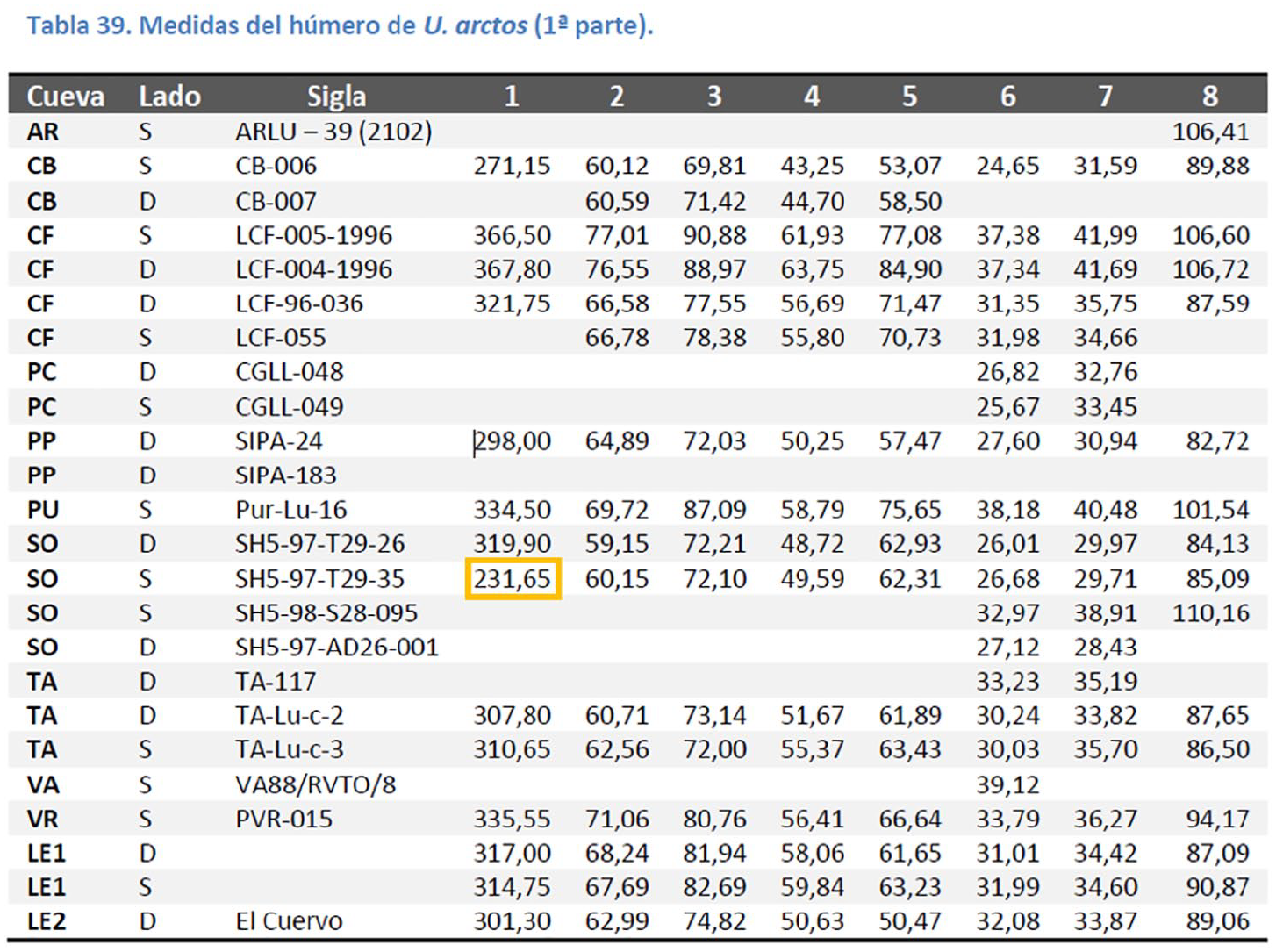
Translation of the original legend (in Spanish): Table 39 Measurements of the humerus of Ursus arctos (first part), modified from García-Vázquez (2015), Annex I, page 350. The small measurement of the length of the humerus SH5-97-T29-35 is highlighted with an orange rectangle. The first three columns in the Table stand for cave (‘Cueva’), aspect (‘lado’) and acronym of the sample (‘sigla’).
Radiocarbon dates
Considering the comments made by García-Vázquez (2025) on the estimation of the chronology of the bear specimens included in the work of Fidalgo et al. (2025), all the dates have been corrected, being more conservative in the assignments and the results from the radiocarbon analyses have been recalibrated with the CALIB RADIOCARBON CALIBRATION PROGRAM application (Calib Rev 8.1.0; Stuiver and Reimer, 1993) considering IntCal20 database (Reimer et al., 2020). To assess the impact of these changes (together with the changes in the estimates made with the Viranta (1994) equation), a new time series figure has been made for the Holocene of the Cantabrian Mountains against the mass estimates (Figure 2).
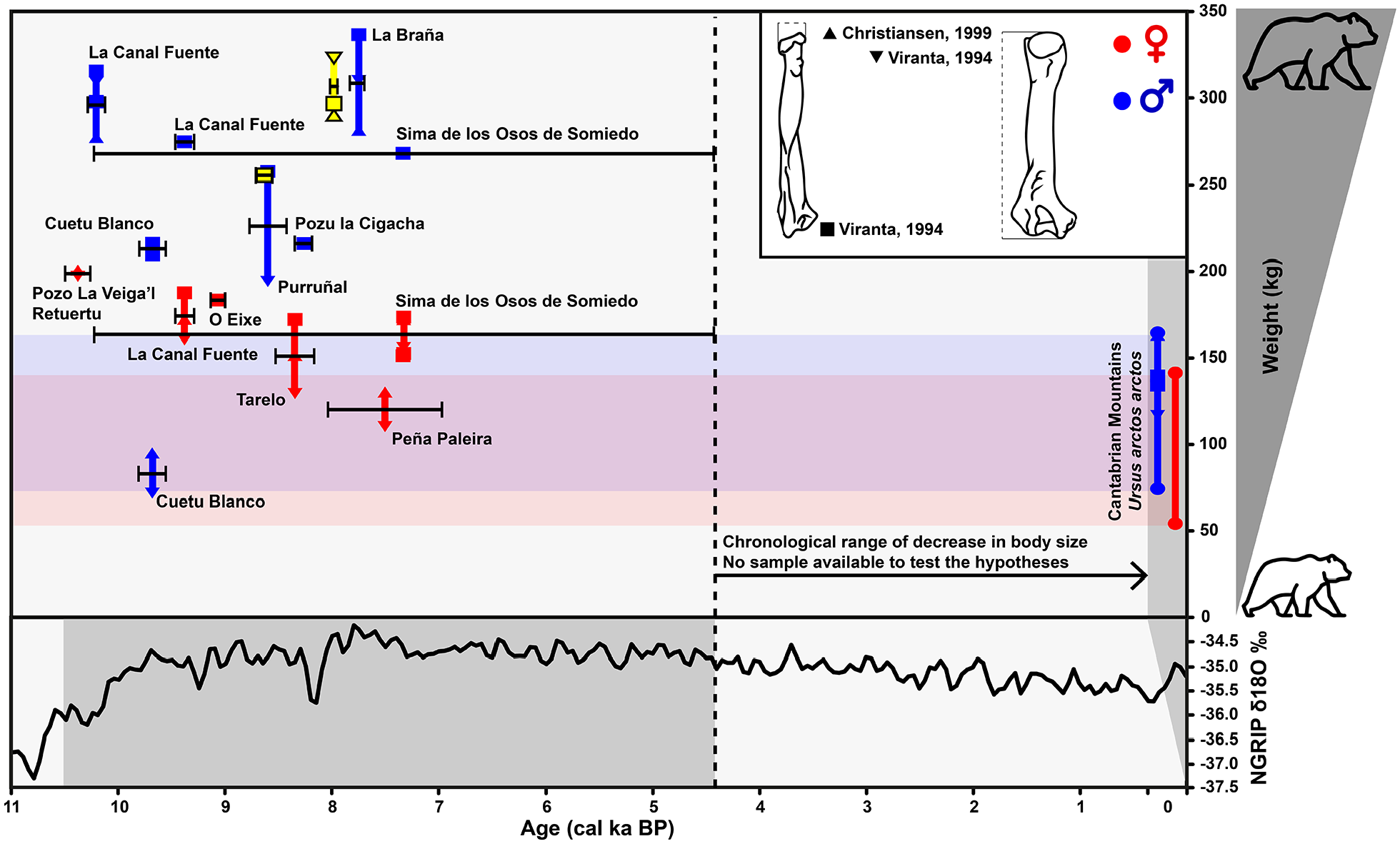
Representation of the estimated weight of brown bear (Ursus arctos) individuals found in Holocene sites in the Cantabrian Mountains together with weight estimates of present-day Cantabrian bears. The chronological range of each individual has been obtained from available radiocarbon dates. Weight estimation has been carried out with the biometric equations for radius and humerus of Viranta (1994) and Christiansen (1999). The original data can be seen in the Supplemental Table 1, available online. An estimate of climate changes inferred from the δ18O isotopic curve obtained from Andersen et al. (2004) is shown at the bottom of the graph. The data have been adopted according to García-Vázquez (2025).
Ethical concerns
The statement made by García-Vázquez (2025) about the ethical concerns involved in the use of a database that includes data published by previous authors in the work of Fidalgo et al. (2025) are unfounded because the all original sources were appropriately cited. All of the data sources are cited in our text. Namely, Fernández-Rodríguez (2010), Vidal Encinas and Prada Marcos (2010), Notario (1964) and especially, given her critique, García-Vázquez (2015) are all referenced, with the latter cited 4 times in the main text of Fidalgo et al. (2025). Furthermore, additional works by this author (García-Vázquez et al., 2015, 2018) were also cited, clearly acknowledging the significant contribution of her research and her collaborators to the study of the fossil brown bear.
As for the formal legality of using the data, the only study that might raise doubts is the one published by García-Vázquez (2015). In the online repository of the University of A Coruña (https://ruc.udc.es/entities/publication/73ffa568-2e25-4649-b180-f9689f29f737), where that PhD thesis was stored, the following reads regarding publication rights «The holders of the intellectual property rights authorise the visualisation of the content of this thesis through the Internet, as well as its reproduction, recording on computer support or printing for private use or for research purposes. Under no circumstances may this document be used for financial gain. These rights apply to the summary of the thesis as well as to its content». Based on this statement, the use of the data for research purpose, as performed by Fidalgo et al. (2025), is entirely permissible and should not give rise to any ethical or legal concerns.
Implications
Contrary to García-Vázquez (2025), no errors generated by Fidalgo et al. (2025) compromise the interpretation of the results as presented in our original article. The small discrepancies in the application of the Viranta (1994) equation hardly modify the results previously presented, as shown above. Furthermore, the ‘substantial’ error in the estimation of the mass of the individual to which the SH5-97-T29-35 specimen would belong has been traced back to the original work of García-Vázquez (2015; Figure 1). The chronology data of the specimens published by García-Vázquez (2015) have been revised following the observations of García-Vázquez (2025). These modifications allowed us to generate a new updated figure (Figure 2), equivalent to Figure 4 of the work by Fidalgo et al. (2025).
Comparing the original figure by Fidalgo et al. (2025) and the new Figure 2, it is clear that the pattern of size change between Cantabrian bears in the first half of the Holocene with respect to that of present-day Cantabrian bears is equally striking. The differences in the information shown in the two figures are minimal, leaving uncertainty as to the timing of this sharp decline in the size of Cantabrian bear individuals. What seems clear in both figures is that this change must have occurred between 7 and 4.5 cal ka BP at the latest. For the time being, more specific timing cannot be provided due to lack of data.
Incorporating the information provided by García-Vázquez (2025) of the female individual from 2442 cal a BP with an estimated mass of 173.56 kg (García-Vázquez, 2025), it could be considered that the decrease in size had not yet occurred in that chronology. Even so, the latter data is still far from the earliest records of generalised firearms use in Europe (ca. 16th century; Chase, 2003), a phenomenon to which García-Vázquez (2025) attributes the decline in size of Cantabrian brown bears. Although genetic and historiographical data seem to coincide in the timing of the decline in genetic diversity and the bear population with the beginning of the use of firearms (García-Vázquez, 2015; Nores and Naves, 1993; Valdiosera et al., 2008), there is still no reliable evidence that the process of body size decline in Cantabrian bears occurred so late. The hypothesis of an earlier body size decline due to loss of habitat connectivity due to agricultural growth and extraction of raw materials from Cantabrian forests (Albrecht et al., 2017) or hunting of bears even earlier than the generalisation of firearms (Ordiz et al., 2011; Zedrosser et al., 2011) cannot be ruled out. The lack of more samples prevents discarding hypotheses, as indicated in Fidalgo et al. (2025), who explicitly stated that the hypothesis put forward by García-Vázquez (2025) could also be plausible: ‘However, data scarcity prevents a clear determination of the starting time of body size decline, which might rather be linked to the genetic bottleneck dated ca. 350 years ago (Valdiosera et al., 2008)’.
Finally, we wish to reiterate the absence of ethical concerns in Fidalgo et al. (2025), as discussed in the previous section. The value of conducting integrative meta-analyses that help to reinterpret data provided by different researchers and improve scientific debates on complex issues is highlighted. Embracing the principles of open science, rather than accusing authors of unethical behaviour, arguably offers a constructive path forward for the scientific community. In our published paper (Fidalgo et al., 2025), all examined specimens were made available through open online repositories (see https://skfb.ly/p8pzS), ensuring transparency and accessibility. Similarly, all external data sources in our study were openly cited and appropriately referenced.
Conclusions
The detailed review of the observations made by García-Vázquez (2025) has not revealed methodological errors of sufficient magnitude to compromise the interpretations and conclusions presented in Fidalgo et al. (2025). Minor discrepancies derived from the application of Viranta’s (1994) equation, as well as the re-evaluation of the body mass of specimen SH5-97-T29-35, have proven to have a negligible impact on the overall observed pattern of body size decline in Cantabrian brown bears during the Holocene. Critical revision of the specimen chronology, through conservative recalibration of the radiocarbon dates, support the conclusion that this decline likely occurred after 7000–4500 cal a BP. However, the paucity of data prevents us from establishing a more precise time of onset.
Likewise, no ethical concerns have been identified in the use of data published by other authors and included into Fidalgo et al. (2025). All the data used were duly referenced, and in the relevant cases, it has been demonstrated that their use is covered by institutional licences allowing reproduction for research purposes. In this sense, the legitimacy of meta-analyses is reaffirmed as an essential tool for reinterpreting and enriching scientific knowledge based on previously published data, within the framework of a collaborative and open science.
Finally, although García-Vázquez’s (2025) hypothesis, linking the decline in body size in the Cantabrian brown bears during the Holocene to the use of firearms in historical times, is equally valid, the available data do not allow us to rule out a much earlier chronology for this phenomenon. Given de current limitations in sample density, it is prudent to keep open the discussion on the underlying causes, which are likely reflect a complex interplay of ecological, genetic and anthropogenic factors predating the widespread use of firearms.
Supplemental Material
sj-xlsx-1-hol-10.1177_09596836251358475 – Supplemental material for Lack of data and misperception of open science limit the scope of Cantabrian brown bear body mass studies, not misinterpretation of results: Reply to comment by García-Vázquez (2025)
Supplemental material, sj-xlsx-1-hol-10.1177_09596836251358475 for Lack of data and misperception of open science limit the scope of Cantabrian brown bear body mass studies, not misinterpretation of results: Reply to comment by García-Vázquez (2025) by Darío Fidalgo, Carlos Fernández-Rodríguez, Daniel Ballesteros, Andrés Ordiz, Christian Pérez de la Viuda, Juncal A Cruz, Sara García-Morato and Esperanza Fernández-Martínez in The Holocene
Footnotes
Author contributions
Funding
The author(s) received no financial support for the research, authorship, and/or publication of this article.
ORCID iDs

Supplemental material
Supplemental material for this article is available online.
References
Supplementary Material
Please find the following supplemental material available below.
For Open Access articles published under a Creative Commons License, all supplemental material carries the same license as the article it is associated with.
For non-Open Access articles published, all supplemental material carries a non-exclusive license, and permission requests for re-use of supplemental material or any part of supplemental material shall be sent directly to the copyright owner as specified in the copyright notice associated with the article.
