




Abstract
This paper examines how Chinese multinational companies manage labour mobility, with a focus on the sourcing and circulation of labour. Drawing on secondary sources, this study argues that labour mobility is a central issue in employment relations in China and for the Chinese MNCs operating abroad. It presents three employment archetypes that illustrate the varied strategies Chinese firms use to manage labour mobility within China’s societal constraints. Adaptive diffusion of these employment archetypes is not evident among Chinese MNCs in Europe. Instead, Chinese MNCs strategize to secure continued supplies of workers, replace migrant sources that become undesirable or inaccessible, and mitigate disruptions caused by voluntary labour turnover. Several mechanisms enable Chinese MNCs to manage their overseas workforces to maintain the employer dependency like that of migrant workers in China. These mechanisms include internal firm transfer arrangements administered directly by the employer; bilateral labour agreements negotiated through government interventions; and international and local worker deployment mediated through employment agencies. By highlighting the conflicts and negotiations underlying the management of labour mobility among leading Chinese MNCs in Europe, the paper provides an analytical framework for understanding the diversity of Chinese MNCs in structuring employment relations in an increasingly interconnected global labour market.
Keywords
Introduction
Internal migrant workers play a prominent role in both China’s domestic economic development and its ‘going out’ strategy, which aims to expand the country’s global influence through capital and labour flows. According to China’s national census data, the migrant population increased by 88.5% between 2010 and 2020 (NBSC, 2021) and migrant workers accounted for 40% of China’s working population by the end of 2022 (NBSC, 2024). This partially explains why Chinese multinational companies (MNCs) are able to bring migrant workers to their overseas operations (Yang, 2022; Zhang and Wang, 2018). However, the sustained deployment of Chinese workers abroad encounters challenges related to costs, availability of labour, and geopolitical conflicts (Lee, 2017). These challenges raise questions regarding how Chinese MNCs develop employment systems to source labour and manage its movement, as well as the implications for employment relations in the host countries.
Existing literature offers valuable insights into the impact of MNCs on transnational employment relations within and beyond their organizational boundaries. When large firms expand overseas, the management of their workforces in foreign countries often reflects their national characteristics (Edwards, Colling and Ferner, 2007). In the post-Second World War period, substantial literature on American companies in Europe (and globally) developed, and the transfer or diffusion debate on the Japanese model of employment was generated by Japanese MNCs expanding from Japan from the 1980s. The message in both cases is that MNCs from dominant economic powers have incentives to internationalize and potentially diffuse home-country employment models. There is a reductionism here: all firms from the United States or Japan are assumed to follow the norms of their national business model when operating overseas. There is also a universalism or ‘one best way’ of thinking about countries and models, with dominant countries exerting power over others (for a critique, see Smith and Meiksins, 1995). Considering MNCs from emerging countries, and China especially as the new global economic superpower, applying this framing narrative is particularly problematic. This is due to a lack of agreement on what constitutes ‘Chinese capitalism’; whether China has a single employment ‘model’, and how likely, if such a model exists, it could be freely applied in other national contexts without home institutional support (see Franceschini and Loubere, 2022).
This paper moves away from assessing the adaptability of the employment systems developed in China to host countries or regions. Instead, it focuses on conflicts and contests over controlling the movement of labour between Chinese employers and migrant workers, in the face of regulators and mediators of employment relationships in transnational labour markets. The theoretical foundation builds on recent labour process theory on labour mobility power and its implications for transnational deployment of labour in and for MNCs (Alberti and Sacchetto, 2024; Smith, 2006). Labour mobility power is rooted in the indeterminate nature of transforming or converting labour power into commodities in capitalist employment relationship (Smith, 2006, 2015). In simple terms, labour mobility power means workers can escape or overcome problems by switching employers. Workers are hired through the employment relationship, but they are not fixed to the employer. Labour mobility power signifies the fluidity and open-endedness of the employment relationship, ‘which relates to the fact that the worker can, within historical constraints, end his or her employment contract and quit one employer for another’ (Smith, 2006: 390). Employers manage labour mobility power using assorted strategies, whether skill minimization to smooth the effects of labour turnover, or hoarding labour through ‘internal markets’ that offer firm-specific (non-tradeable) benefits or rewards. ‘[Q]uitting becomes a source of conflict and negotiation between workers and employers, with regulative agencies, such as states, legal agencies, employers’ associations, employment agencies, and trade unions, involved as stakeholders in these contests’ (ibid: 390). Workers’ power to change employment and employers’ power to change one group of workers for another are both within the constraints of historical and societal infrastructures of employment relationships.
The objective of this paper is to highlight the centrality of the conflicts and negotiations over labour mobility inherent in employment relationships underpinning the influence of Chinese MNCs. Labour mobility is a crucial component of the employment systems relying on migrant workers within Chinese society. As Smith and Liu (2016: 5) argue, ‘the focus on labour mobility is essential for understanding the labour process in China, as industrialization has been driven by the movement of millions of workers across China, and mobility and the split between locals and migrants is significant not only for the life chances of individuals but critically for the organization of the labour process’. With the internationalization of Chinese firms, concerns about labour mobility and the sourcing and circulation of labour become extended on a transnational scale.
Existing research on the employment relations of Chinese MNCs in Europe, despite being in its infancy, shows the multiple sources of migrant workers employed and the diverse practices of relocating these workers from within and outside European countries. There is no unified approach among Chinese MNCs to adapt employment practices used in China to address the need to maintain a continuous supply of migrant workers, replace sources of migrant workers that become inaccessible, or mitigate the disruptive impacts of labour turnover caused by migrant workers leaving the companies voluntarily. We argue that this is due to the continued conflicts and negotiations between MNCs and migrant workers over employment status, often subject to interventions and mediations from other key institutional actors, such as national states and recruitment agencies. We present an analytical framework for understanding the mechanisms that enable Chinese MNCs to manage labour mobility with an underlying focus on restraining migrant workers’ independence from seeking alternative employment in the host countries.
The analytical framework developed is based on an integrative literature review (Snyder, 2019) to draw insights from multidisciplinary and emerging research on employment relations in Chinese MNCs in Europe. This methodological approach allows for the exploration of various disciplines, including international business studies, political science, labour geography, and sociology of work. From this body of literature, we propose an analytical framework to capture the dynamics of the transnational movement of capital and labour centred around Chinese MNCs. The unit of analysis in this framework is the employing firms, as they are the foremost actors in orchestrating capital and labour mobility. The geographic focus is Europe because the diverse migrant groups, pluralist institutions, and the presence of MNCs offer a suitable context for examining the intersection between mobility and immobility within the broader context of globally interconnected labour markets.
Territorialized analysis of transnational employment relations: An institutionalist paradigm
Historically, the development of labour institutions within a country leads to persistent national specificity in the regulation of employment relations. National institutional distinctiveness is embedded in formal regulatory structures that stipulate appropriate and inappropriate conduct for employers, employees, and their representative bodies. Monitoring, enforcement, and sanctions are conducted by labour market regulators, education agencies, and skill training providers, as well as trade unions and industry associations (Boyer and Hollingsworth, 1997; Hall and Soskice, 2001; Whitley, 1999). As institutionally formed entities, MNCs are bounded by both formal and informal institutions (Kostova et al., 2008). MNCs bear the institutional imprint of their parent firms’ origins while also needing to meet the requirements imposed by the unique national contexts in which they operate (Edwards and Bélanger, 2009). Employment relations in MNCs therefore reflect conformities and conflicts within institutional heterogeneity of the multiple locations where MNCs operate.
Home-country embeddedness effects in MNCs continue to shape employment practices in countries where MNCs operate (Geppert et al., 2006). MNCs’ inclination and capacity to transfer established employment practices from one country to another often give rise to changes in prevailing norms in work organization, employment conditions, and social relationships beyond their home territory. This phenomenon finds expression through research on the global expansion of American and Japanese MNCs, particularly in industries like the automobile sector, and the transformative changes in employment relations in the host societies of their investments. In the case of the United States, practices like mass production, Fordism, professional management, and the advent of multi-divisional companies have significantly shaped employment dynamics globally (Almond and Ferner, 2006; Edwards and Ferner, 2002; Vidal, 2013). Similarly, Japan’s influence is evident through the lean production methods, the promotion of long-term employment, worker’s representation through enterprise unionism, extensive cooperative networks of financing, trade, and supply chains (Elger and Smith, 1994, 2005 for a discussion on ‘Japanization’). These transformations originated from the distinct and recognizable national business systems and work organization models of the United States and Japan, which were disseminated or transplanted into new host societies through American and Japanese MNCs.
The diffusion of employment relations across countries is inherently political (Edwards et al., 2007). Institutional frameworks provide valuable analytical tools for understanding the competing forces and actors that shape transnational employment relations. The mobility of capital enables MNCs to evaluate national institutions and relocate to regions with relatively weaker regulatory, intermediary, and enforcement mechanisms (Streeck, 1991). While disparities in national institutions pose challenges for MNCs in managing workforces under diverse regulatory systems, they also afford MNCs the opportunity to bypass national regulations and implement employment practices that do not comply with established institutional frameworks of employment relationships (Compa, 2010). MNCs can experiment with employment practices in designated transnational spaces, such as Special Economic Zones (SEZs), where work and employment arrangements may not align with formal or informal employment institutions.
Recent research indicates a more proactive role played by MNCs in the process of transnational institution building (Ruggie, 2018). Adopting an organizational institutional perspective, scholars have provided insights into how MNCs contribute to the de-institutionalization and re-institutionalization of employment norms both within and across national boundaries (Djelic and Quack, 2008). Existing research, grounded in the institutionalist framework, emphasizes the role of capital mobility inherent in MNCs and its impacts on transnational employment relationships. In contrast, labour mobility is judged either as an individual or collective response by workers to the economic disparities brought about by the movement of capital (Postel-Vinay and Sepahsalari, 2023) or driven by state migration initiatives that channel workers to employers (Voivozeanu, 2019). While existing literature acknowledges the effects MNCs have on labour migration and the policy frameworks that govern the movement of people, an underexplored area for theoretical advancement lies in examining the intersections between capital and labour mobility at the transnational organizational level. This study aims to address this research gap by drawing on recent developments in the transnational labour process literature.
The transnational labour process framework of mobility power
The concept of labour mobility power within the framework of transnational labour processes has gained more relevance in research of globalization and the de-territorialization of capital and labour (Harvey, 2001). This shift in focus from institutional disparities to power struggles in capital flow and labour mobility highlights mobility as a point of contention between employers and workers. While traditional labour process theory focused on production and work relations within workplaces, there has been a move towards a broader understanding of labour power, which includes the social reproduction of workers and their movement between employers and countries under the contested volition of workers and employers (Smith, 2006). This focus on labour power shifts the analytical gaze from workplaces to workers and the contested construction of movement through labour markets, social networks, and state and employer direction.
Labour mobility power sits within the employment relationship, and as such, both capital and labour strategize around retention and movement. This highlights the paradox of employer interest resting at the intersection of mobility and immobility and reflecting both ‘the ongoing circulation and supply of labour’ and ‘its capture or immobilization’ within the firm or workplace (Alberti and Sacchetto, 2024: 35). Employers exert control over labour mobility through employment practices such as hiring, firing, and retention strategies, while workers can use ‘exit or the threat of exit’ as a tactic to advance their interests, such as securing higher wages or better skill training.
Smith (2006: 395-96) discusses individual mobility power of workers, but also the societal context, where societies with ‘more corporate models of capitalism, such as in the German, Swedish, Japanese, and Korean cases, hiring is more institutionalized between civil society and firms, and individual workers (and employers) have less private mobility power’ (Smith, 2006: 396 emphasis added). For all forms of capitalism, he uses the term ‘mobility power’ to describe how workers and employers attempt to control movement or circulation of labour within capitalism. ‘There are basically two sides to the question of labour mobility: employers and workers. There are additional actors – states (laws), institutionalized customs, and practices – but it is theoretically important to see the selling and securing of labour as a problematic of the capitalist employment relationship and the commodity status of labour’ (ibid: 396). In this paper, we expand on the societal level rather than turnover bargaining that takes place between individual workers and employers.
The collective or corporate management of mobility power can translate to the transnational level through the MNCs (Alberti and Sacchetto, 2024; Pun and Smith, 2007; Rainnie et al., 2010). Competition between countries to attract foreign direct investment can shape the distribution of workers through vocational schools, universities, and employment agencies. Regulatory restrictions and societal norms constrain the ways employers and workers exercise control over mobility. Notably, the tactics employed by migrant workers in exercising mobility power are shaped by the labour relations infrastructure in their home countries (Bagnardi et al., 2024). This study advances the existing literature by incorporating a labour process perspective for analysing transnational employment relationships enacted within MNCs.
Mobility power, employment archetypes, and Chinese society
Employment archetypes characterizing large Chinese firms.
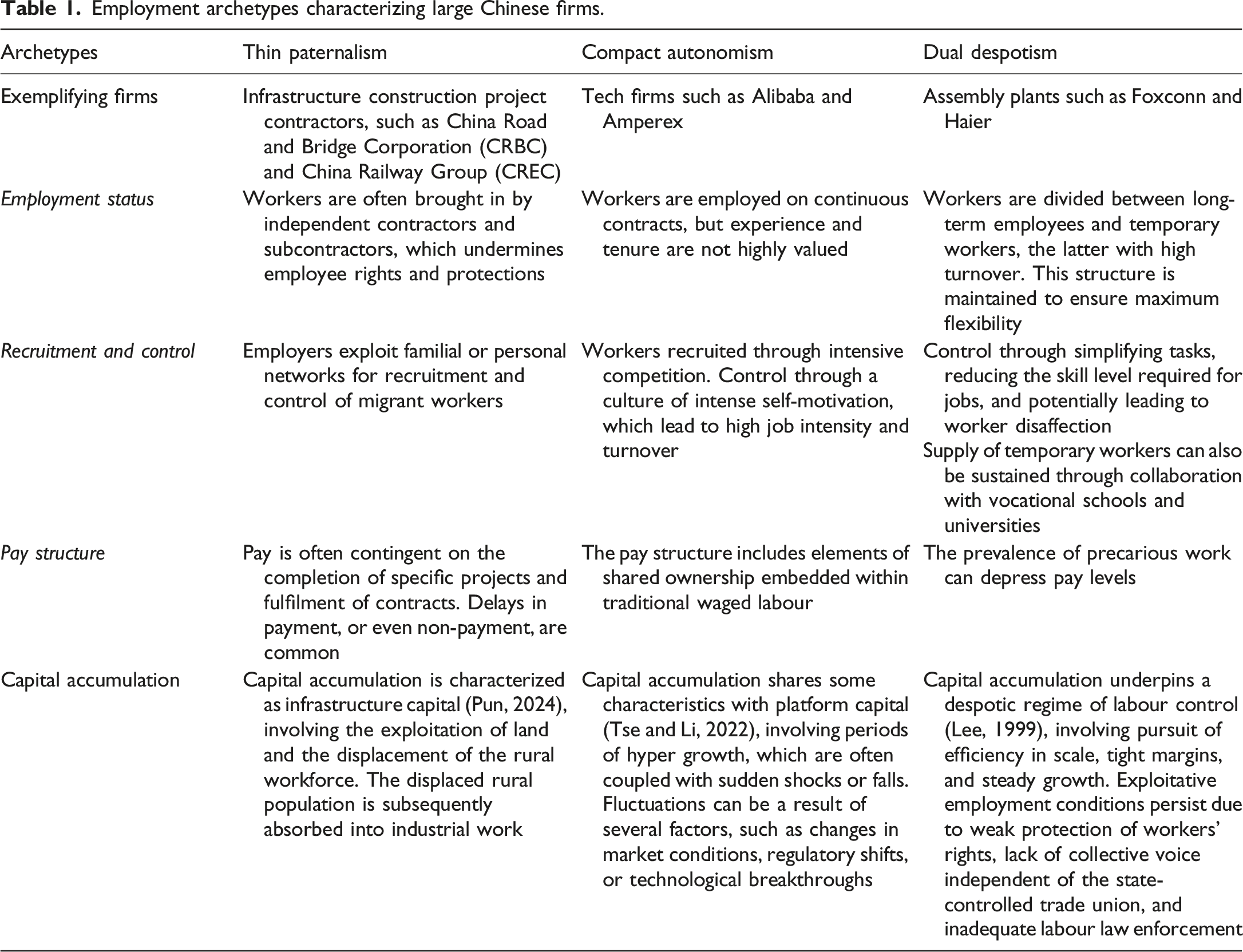
Thin paternalism rests on the state-led unravelling of permanent employment relationships and the mass mobilization of the rural population to become industrial workers. Enterprise paternalism, where employers provide social welfare benefits to workers, has declined as China’s economic reforms shift these responsibilities away from employers. Nonetheless, paternalistic control over the movement of labour remains crucial for employers. This is because state control over labour mobility persists amid weakening employment security, especially in Chinese state-funded major infrastructure projects, which is key to China’s industrial policy to stimulate economic growth (Démurger, 2001). Pun (2024) suggests that China’s infrastructure capital is characterized by the integration of transport networks, systematic land exploitation, and continuous displacement of labour. Employment on a fixed-term basis is determined by the length of projects. Infrastructure projects heavily rely on a migrant workforce, which is sourced through extended subcontracting chains and labour supply networks (Pun and Xu, 2011). The complexity and risks associated with infrastructure projects ‘necessitate’ a low-cost and productive workforce, most of whom are displaced from rural areas and reskilled to perform manual tasks (Swider, 2015). Labour displacement is part of primary or primitive accumulation in China, facilitating bounded capital-labour relocation. The collective deployment of labour undermines resources that workers could draw on to move autonomously. Kinship-based (families, relatives, and hometown mates) networks are the main resources for migrant workers to secure or change employment and are utilized by contractors and subcontractors to source and control workers (ibid).
Compact autonomism shares some elements with the performance-based human resource management (HRM) approach. The opening-up to foreign investments has prompted indigenous firms to remodel their employment practices based on HRM models championed by MNCs, consultancy firms, and business schools (Brown and Chang, 2017; Smith and Liu, 2016). Many home-grown technology firms in China have embraced this shift in the way they strategize around labour mobility. They draw on a diverse workforce comprising rural and urban migrants, as well as locally resident workers. Many of these workers are young and well-educated, with a strong aspiration for rapid personal success (Sier, 2021). They often use job-hopping to seek improved pay, better career prospects or to avoid being laid-off, which is prevalent in China’s IT firms (Wu, 2021). Tenure and loyalty are less valued by both employers and workers themselves (Liang, 2021). The short-term orientation towards individual employers and jobs among the workers can translate into more willingness to tolerate extended working hours, intensive work pressure, and a lack of long-term benefits (Li, 2023; Yan, 2020). Professional competence and personal growth are prioritized, which often lead to workers valuing workplace autonomy and perceiving the relative ease to change jobs positively (Li, 2023). Some employers use a variety of reward schemes, including Employee Stock Ownership Plans (ESOPs) to manage labour mobility (Cheng et al., 2023), although high turnover and high work intensity are widespread. These practices are not unique to China but are ubiquitous among tech firms worldwide – a testament to the normalization of a fast-paced work culture and short-termism in the IT industry (Tse and Li, 2022).
Dual despotism is an employment archetype in which firms divide long-term employees and temporary workers, aiming to preserve employment flexibility. Although long-term employees may benefit from increased job stability, the prevalence of insecure work among temporary workers can exert downward pressure on overall wage levels within the workforce. Dual despotism is facilitated by weak protection of workers’ rights, the absence of a collective voice independent of the state-controlled trade union, and inadequate enforcement of labour laws (Brown and Chang, 2017; Liu and Kuruvilla, 2016). While capital flow benefits from the state relaxing restrictions on labour mobility, the clustering of firms allows workers to swiftly move for marginal improvements in employment conditions. The most significant example of this is the manufacturing sector, particularly in electronics assembly plants. Since the 1990s, the assembly sector has played a leading role in China’s export-oriented growth strategy. The state has allowed capital inflow, relaxed control over domestic migration, and facilitated the movement of labour from less industrialized to more industrialized regions. This has led to the growth of industrial towns centred around large-scale assembly plants (Shen and Wu, 2017). Many of these assembly plants, which are often contract manufacturers supplying international brands, pursue efficiency through scale (Lüthje, 2004). For example, Foxconn, a Taiwanese-owned company, is the largest electronics contract manufacturer globally and generates much of its revenue in China. Employment dualism is expressed through degrees of employment temporariness and worker volition over mobility. A majority of the workforce consists of internal migrant workers with short tenure but mobility power, alongside collaborative partnerships with vocational schools and universities for the employment of student workers on very short-term contracts, over which they have limited control (Smith and Chan, 2015).
Migrant workers in China are uniquely dependent on their employers due to the hukou, a household registration system that ties access to education, work, and social welfare to residency (Huang, 2020). While internal migration restrictions were eased following the hukou reform in 2014, the inflow of new migrants into the cities has put pressure on wages among the incumbent migrant workers (An et al., 2024). Mobility power as exercised through high labour turnover to improve wages is constrained within loose labour markets. The relocation of assembly plants often involves long-term planning. In contrast, the costs for workers to move between jobs are relatively low, especially when the labour market is tight (Chow et al., 1999). Du and Wei (2020) suggest that labour turnover is also increasing as China invests in digitalization and automation that standardize work tasks. Labour mobility increases the demand for a constant replenishment of workforces on a large scale. With limited alternative accommodation options, migrant workers often live in employer-provided dormitories, further deepening their dependence (Li and Duda, 2010; Pun and Smith, 2007). Despite declining opportunities for socio-economic advancement (Xie et al., 2022), many migrant workers believe that they are better off than their parents’ generation (Lu, 2022) and that they have brighter prospects than their rural peers (Kaland, 2021). This hope for long-term improvement may underpin their consent to precarious employment conditions, amid periodical worker protests and strikes (Elfstrom, 2021).
Managing labour mobility in Europe among Chinese MNCs
The outflow of Chinese capital has introduced new patterns of labour mobility, a critical and controversial issue for Chinese MNCs. Some scholars observe that the scale of migrant workers brought by the Chinese MNCs has varied across countries. Sourcing migrant workers from China is an employment practice particularly prevalent during the initial stages of international expansion (Yang, 2022), concentrated in infrastructure construction projects sponsored by Chinese state loans (Cooke et al., 2018), and sustained in less developed or emerging economies where there is a lack of democratic government (Ghiselli and Morgan, 2022).
In Europe, the direct replication of firm practices for controlling labour mobility as practiced in China is unrealistic. Early research suggests that local institutional actors have welcomed Chinese investment, viewing Chinese MNCs as ‘silent’ or ‘patient’ investors reluctant to lay off workers (Raess, 2021). A study examining trade unionists’ attitudes towards Chinese investors found that labour officials generally do not differentiate between Chinese investors and other foreign investors. Instead, their focus is on whether the investment is driven by short- or long-term profitability considerations and how well foreign investors comply with labour laws and practices (Burgoon and Raess, 2014).
However, as Chinese MNCs become more established in Europe, concerns are growing over them exploiting gaps in labour regulations, evading local employment laws, and undermining the power of trade unions and workers’ rights groups monitoring labour standards (Ceccagno and Sacchetto, 2020). In Piraeus Greece, where two container terminals were acquired by the China Shipping Group (COSCO), deregulation has led to concessions on shift lengths, staff levels, and health and safety measures (Meunier, 2014; Zheng and Smith, 2017). The Chinese Overseas Engineering Company (COVEC) attempted to import Chinese workers to build the A2 highway between Warsaw and Lodz and was met with strong protests from local employers and workers (Jacoby, 2014). The construction of the Peljesac Bridge in Croatia, and the Serbian section of the Belgrade-Budapest railway, contained agreements for Chinese MNCs to source workers from China (Dragojlo, 2021; Kirby 2022). These cases demonstrate the dynamics in capital flow and labour mobility played out as China’s economic presence in European countries deepens and local governments make concessions on labour issues.
Chinese MNCs’ varied strategies of managing labour mobility in European countries.
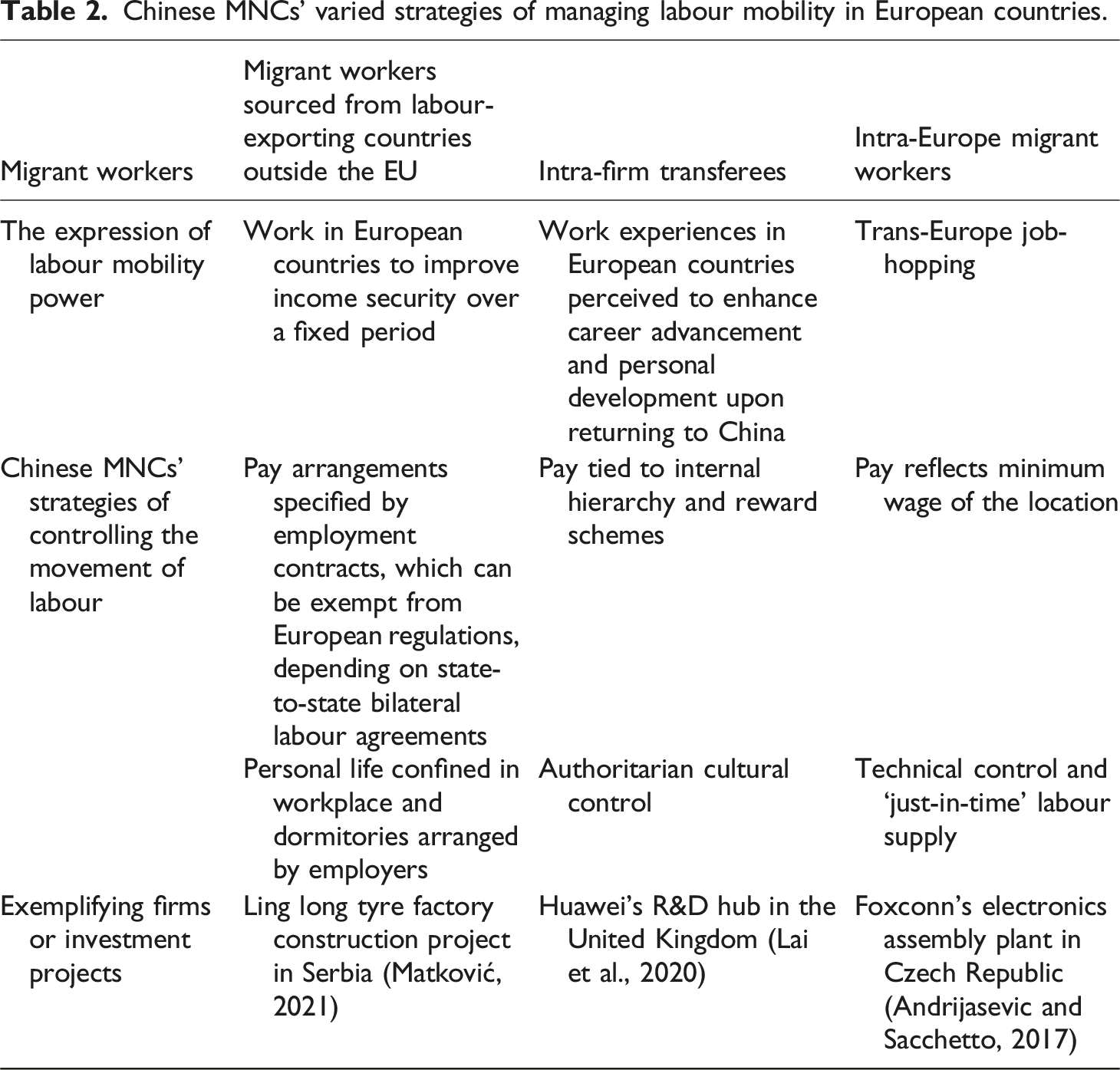
Chinese MNCs’ sourced workers collected from China and can control their movement using firm-bound hierarchical obligations, contractual structures of pay arrangements, and personal life confined due to accommodation arrangements provided through the employers in the host countries. The employment systems applied to the migrant workers distinguish them from local labour regimes which are embedded within families, communities, and civic society institutions (Chu and Fafchamps, 2022). Migrant workers’ dependency on the employers in the overseas location allowed employers to prioritize operational efficiency over workers’ health and safety (Smith and Zheng, 2016).
Continuous and exclusive employment of workers imported from China on a large scale cannot be sustained. This is partly because international expansion is driven by the need to escape rising labour costs at home and the Chinese government’s enhancement of its labour laws (Cooke, 2020). Additionally, host country governments and local workers’ rights groups exert pressure on Chinese MNCs to comply with legal and normative practices to hire and manage local workforces (Jacoby, 2014).
It is also important to note that the mechanisms enabling the Chinese MNCs to use non-wage-based control over labour mobility and create increased dependence are not simply administered by the firms independently. The mechanisms enable Chinese employers to source and control the migrant workforce and reinforce worker’s dependency include state-to-state bilateral labour agreements, various work permit or visa extending categories of intra-firm transferees, and collaborative partnerships with employment agencies. Figure 1 illustrates these mechanisms, which will be further elaborated in the discussions below. Mechanisms enabling Chinese MNCs to leverage labour mobility in Europe. *includes Chinese graduates in Europe who are sourced locally, put on an employment contract with the headquarters, and hold intra-firm transferee status under the host country’s immigration rules.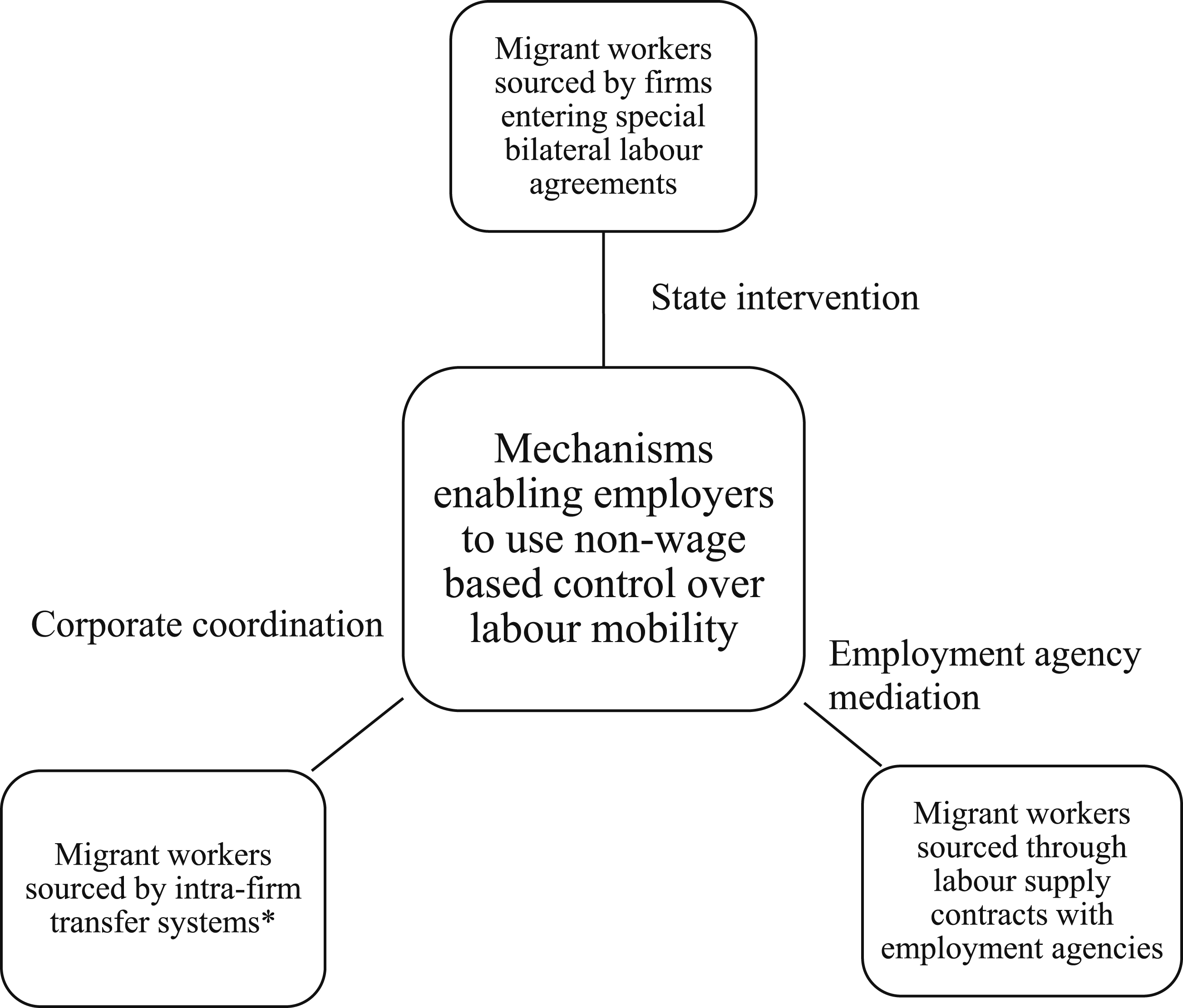
State intervention through bilateral labour agreements
The active intervention role played by the Chinese state is most evident in bilateral government agreements on investment conditions and labour supply, the establishment of development banks, prioritized state funding for a select group of firms, and the coordination of mergers between Chinese firms to minimize competition (Holtbrügge and Berning, 2018). The Chinese government also promotes the collective deployment of workforces, which is coordinated by state-sponsored employment intermediaries (Cooke, 2014; Zhang, 2019). The political alliance between the Chinese state and local national government significantly influences the coordination and formalization of workforce deployment through bilateral labour agreements and trade deals (Burgoon and Raess, 2014). These agreements serve as a platform for negotiation between states, employers, and unions. The content of these bilateral labour agreements can vary widely, reflecting specific contexts and priorities in terms of labour provision, worker protections, and collective representation (Brown, 2019). These agreements specify the number, types, and conditions under which Chinese MNCs can import migrant workers (Latham and Wu, 2013). The employment status of the workers brought under these bilateral labour agreements is bound to the specific tasks or projects assigned by the employers.
Bilateral labour agreements potentially provide a ground for collective contestation. Industrial associations and employee representative bodies have the power to restrict the number, types, and terms of migrant workers imported by Chinese MNCs. Shipper (2002) even argues that individual firms’ role in deciding the terms and conditions of foreign migrant workers becomes secondary in the face of state ministries, industrial associations, and organized crime gangs. Despite its significance, empirical research studying the role played by European industrial associations and trade unions remains limited, largely due to a lack of transparency in China’s approach to bilateral labour agreements.
Recruitment agencies mediation
The Chinese state imposes exit controls, which mean that Chinese workers cannot leave the country without a valid work visa. These mobility restrictions create material barriers for Chinese workers seeking employment overseas independently. Chinese workers can secure overseas work via government-licensed labour dispatch agencies (Wang, 1995). The government approve two channels of dispatching labour abroad: workers contracted to work on overseas projects run by Chinese companies and workers under the labour-service arrangements to work for foreign firms or individuals (Zhang, 2019). Chinese employers either second workers abroad through state-sanctioned brokers or send workers through intermediary agencies, who charge fees and execute service contracts. Additionally, a large number of workers also go abroad through informal brokers (Halegua and Ban, 2020).
The number of Chinese workers brought into a country through Foreign Direct Investment (FDI) varies according to the strength of host labour institutions. Where resistance to Chinese workers is present, the number of Chinese migrants is kept down. However, local workers are not necessarily employed even when Chinese workers are not brought into host countries because international recruitment agencies may bring in other migrants. For example, in the case of Vietnamese workers at the Chinese-owned Ling Long factory in Serbia, who worked excessive overtime, were paid below local standards and below those of Chinese migrants and lived in poor factory-converted dormitories adjacent to the factory (Matković, 2021: 125). Ling Long was an ‘Overseas Project Contracting Enterprise (OPCE)’, which commissioned other companies to build part of its factory in Serbia. It sought Vietnamese workers from two Vietnamese recruitment agency companies, both registered in Serbia. These migrant workers are more vulnerable to exploitative employment conditions. Many of them have borrowed from families, friends, or informal creditors to fund their employment in Europe, which undermined the resources that workers could draw on to move autonomously, whether to return to Vietnam or seek alternative employment in Serbia.
Chinese MNCs also employ intra-EU migrant workers. Foxconn’s electronic assembly plants in the Czech Republic use intra-European migrants (Andrijasevic and Sacchetto, 2017). With the assistance of temporary work agencies, Chinese employers can source and replace migrant workers, who tend to leave for better employment opportunities. These workers are paid minimum wage, and temporary work agencies play a key part in assisting the employers’ continued access to different segments of migrant workers, notably from the new accession countries in the EU (ibid). Recruitment agencies also provide accommodation and transportation for the migrant workers, many of whom view working for the Chinese employer as temporary (Pun et al., 2020). Deployment of migrant workers from within the EU through the mediation of temporary work agencies is not a unique strategy adopted by the Chinese MNCs. Employment agencies, in facilitating migrant workers to relocate and maintain employment, also monitor compliance with the conditions for maintaining their migration status in the host countries (Sporton, 2013).
Corporate coordination through the intra-firm transfer systems
Another group of migrant workers often deployed by Chinese companies overseas includes those who migrate independently but require employer sponsorship to work in Europe, such as international students from China. This group of migrants is found in Chinese MNCs that require more technical and professional skills. They work alongside the intra-firm transferees sourced from China and often face authoritarian cultural control (Lai et al., 2020). Chinese MNCs can tap into reserves of independent Chinese migrants, a supply of so-called ‘local’ employees who constitute semi-dependent migrant workforces. Unlike EU or EEA migrants, international students must extend their student visa or obtain a temporary post-graduate permit to search for work in the EU, with stays varying from 6 to 18 months (European Commission, 2021). Upon securing employment, graduates need to apply for an EU Blue Card, which is valid for 24 months or 3 months beyond the end of the employment contract if the contract is shorter than 24 months (European Union, 2021). After 12 months, they can move to another EU country and apply for a new Blue Card. The Blue Card system offers a path to permanent residence, typically taking 5 years, but it also restricts workers from changing jobs or moving between EU countries to a different degree.
There is a growing population of Chinese migrants in Europe (NBSC, 2024). International higher education has become a significant labour mobility route for Chinese citizens. Since 2016, Chinese student migration from China to Europe has overtaken family reunions and low-skilled Chinese rural migrants as the dominant category of migrants. Approximately 200,000 Chinese students were studying in Europe in early 2020 (Thunø and Li, 2020). Many Chinese students in Europe seek post-study and in-study work, creating a ready labour supply for Chinese firms in Europe. These internal migrants are controlled by a performance reward system administered and remunerated at the parent firm, and, unsurprisingly, are characterized as hardworking, motivated, and efficient (Lai et al., 2020).
The intra-firm transfer system can be used to manage the locally sourced international students. Chinese graduates in European countries tend to have a more China-oriented long-term migration plan, partly due to policy ambiguity in student-to-residence transition routes in host countries (Tu and Nehring, 2020). Surveys among Chinese students in the United Kingdom show that less than a quarter of them regard gaining residence as their main motivation for leaving China (ibid). Relocation between European countries is also found to be frequent among Chinese graduates (Latham and Wu, 2013), which suggests that these graduates tend to change employment to pursue better pay or to improve their career prospects. The short-term orientation towards work in Chinese MNCs among the Chinese graduates in Europe means firms can secure continued access to a pool of relatively inexpensive and well-trained workers. Large Chinese MNCs run graduate schemes to source Chinese graduates locally with their employment contract in the headquarters and employment status as intra-firm transferees in the host country (Lai, 2016). These international graduates form a quasi-local workforce and can be moved on a short-term basis given the intra-firm transfers permitted by European countries’ immigration policies.
Conclusion
This paper has examined Chinese employers’ management practices around labour mobility in Europe, offering a critique to existing institutionalist frameworks that emphasize the territorial nature of work, workplaces, and workers, and MNCs’ influences through diffusion of employment systems. The key problem with this approach is that country boundaries for employment systems are not stable and hybrid models of home and host employment systems neglect dynamics of labour sourcing and circulation in MNCs. Considering the global expansion of Chinese MNCs and increased labour mobility associated with their growth, this paper proposes a labour process perspective to emphasize the power relations embedded in capital flow and labour mobility channelled through MNCs. The dynamics characterizing the employment relationship between the Chinese employers and migrant workers are illustrated through the variegated employment practices and the mechanisms enabling these practices.
By adopting a labour process perspective and focussing on power relations in transnational mobility, the framework proposed here offers an analytical angle to capture the transaction-based relationships between MNCs and a broader range of migrant workforces, highlighting the ability of capital to access and mobilize workforces in interconnected transnational labour markets. The employment archetypes developed in China are enabled by mobility dynamics embedded in Chinese society. When examining the leading Chinese MNCs in Europe, we do not see these archetypes being simply transferred. Instead, Chinese MNCs strategize around using diverse groups of migrant workers, whether they are directly administered by the firms, supplied by employment agencies, or sourced locally. The practices of Chinese companies for sourcing labour as companies internationalize may be facilitated by more interconnected transnational labour markets, and the role of states, the employment agencies, and more mobile groups of workers, such as international students. Chinese MNCs rely on varied mechanisms to leverage labour mobility and immobility: seeking a continued supply of workers to replace migrant sources that become undesirable or inaccessible and at the same time undermining disruptions caused by workers changing employment voluntarily.
Chinese MNCs in Europe exhibit diversity in their employment practices in managing labour mobility. To explain such diversity, this study considered the roles played by state-to-state bilateral agreements, employment agencies, and migrant workers’ employment status. Employment practices adopted by Chinese MNCs have evolved and transformed in European workplaces. The resurgence of neoliberalism in European labour markets has reinforced the casualization of employment relations, opening opportunities for new entrants, such as Chinese MNCs, to negotiate with existing institutional players (i.e. national states, trade unions, and employment agents) and deploy a more diverse set of employment practices.
This study acknowledges that economic incentives for capital flow and labour mobility are influenced by regulatory frameworks enforced by states and institutional agencies at national and transnational levels. However, institutional heterogeneity alone does not sufficiently explain varied patterns of employment relations and the segmentation of international workforces. Employment relations concerning migrant workforces are a result of the increased fluidity in labour markets and concessions made by national states in favour of transnational capital. In response to growing opposition and uncertainties surrounding Chinese investment in Europe, Chinese MNCs have engaged more with networks of local actors, supplementing (Cao and Alon, 2021) and replacing administrative control with other forms of coordination and collaboration (Bonet et al., 2013). These engagements have contributed to emerging patterns of employment relationships.
Due to space limitations, we were not able to fully evaluate the impacts of Chinese MNCs on the European labour markets, such as whether the mechanisms enabling Chinese MNCs to manage labour mobility will lead to further stratification of the labour markets in the host countries. Future research should explore the impacts of the internationalization of labour-rich countries, such as China, on shifts in transnational labour markets in terms of workforce composition, working conditions, and employment status. Comparing the Chinese case with workplace-based research on MNCs from other emerging economies would be valuable. Another direction for future research is comparing the use of flexible employment in established MNCs with that observed in Chinese MNCs. While this study focuses on Chinese MNCs, the flow of labour is not exclusively from China, as evidenced by the use of international employment agencies to source migrant workers. Finally, there is a need for case studies among the different categories of migrant workers to put the voice of labour into the debate, and reveal the strategies used by workers to contest employer strategies in managing labour mobility.
Footnotes
Declaration of conflicting interests
The author(s) declared no potential conflicts of interest with respect to the research, authorship, and/or publication of this article.
Funding
The author(s) received no financial support for the research, authorship, and/or publication of this article.
