



Abstract
Finding limited representation in established unions, a growing number of precarious and migrant workers of the gig economy have been turning to self-organization. Yet little is known about how these workers can compensate for their lack of material resources and institutional support and negotiate effectively with employers. Drawing on interviews, frame, and content analysis grounded in ethnographic research with the precarious and migrant workers of British ‘indie’ unions, we examine the significance of self-mediation practices in facilitating effective negotiations. We find that the effectiveness of campaigns can be enhanced by strategically integrating vibrant direct action of workers and allies with self-mediated messages, which are framed to resonate with the general public and mainstream media – a practice that we call communicative unionism. These findings extend labour movement scholarship by showing the analytical importance of considering workers’ discursive power-building practices. They also contribute to addressing social movement studies’ historical neglect of workers’ collective engagements with employers.
Keywords
Introduction
The processes of de-standardization, outsourcing, and flexibilization that characterize globalization have resulted in growing numbers of precarious workers, many of whom are migrants (Kalleberg, 2009; Kofman, 2015). Having found limited representation and support in established unions (Alberti and Però, 2018; Hyman, 2007; Martínez Lucio et al., 2017; Ness, 2014; Standing, 2011), these workers have often chosen to self-organize in an attempt to improve their harsh conditions (López-Andreu, 2020; Moyer-Lee and Lopez, 2017; Però, 2020; Rizzo and Atzeni, 2020). However, little is known about how these workers can negotiate effectively with employers, given their limited resources and institutional support. This article asks: what role can discursive power play in boosting precarious workers’ chances of winning workplace disputes? Despite their neglect of labour movements, this article will show how social movement studies offer important tools for the analysis of emerging forms of unionism in the age of precarity.
Drawing on a combination of multi-sited ethnography, interviews, frame and content analysis, the article addresses the role of communicative strategies in negotiating concessions from employers through the case study of the British indie unions Independent Workers’ union of Great Britain (IWGB) and United Voices of the World (UVW). In particular, it first examines, how indie unions frame the conditions of their precarious workers in their self-mediation practices directed to the public arena; and second, how such framing finds resonance in mainstream media, thus enhancing their negotiating power. The article defines this approach that combines self-mediation practices for the public arena with direct action as communicative unionism.
The article is organized as follows. First, it discusses the literature on communicative practices in social and labour movement studies, highlighting the significance of framing in building discursive power. Then, it outlines the research strategy and methodology adopted. This is followed by a brief introduction to indie unions; an analytical description of how their self-mediation practices frame their disputes; an exploration of the communicative strategies underpinning such framing; and finally, an examination of how such framing resonates favourably in some mainstream media. The discussion outlines the empirical and theoretical contribution of the findings, highlighting the importance of discursive power to understand contemporary labour disputes of precarious workers and their effectiveness.
Precarious workers’ initiatives, communicative practices and framing
In discussing how precarious workers attempt to improve their disadvantageous conditions, we use as a heuristic device a typology of power recently developed by Schmalz et al. (2018) in their power resources approach that distinguishes four types of labour power. Structural power refers to the power arising from workers’ position in the economic system and the possibility to disrupt it. Associational power stems from workers’ uniting to act collectively. Institutional power emerges from workers’ ability to shape and use institutions (e.g., legal and political) in asserting their interests. Societal power refers to workers’ ability to represent their interests through public support articulated (i) via developing alliances with other civil society groups and organizations (coalitional power) and/or (ii) via appealing to and influencing the general public through communicative and symbolic practices that align with prevailing views of fairness (discursive power). 1
Labour relations research on organizing has traditionally privileged the initiatives of established unions (Alberti and Però, 2018; Atzeni, 2021; Sullivan, 2010; Tapia et al., 2015) and has only recently begun to focus on precarious workers’ collective agency. Here attention has been paid mainly to associational power, focusing on how workers develop collective initiatives despite working in fragmented, outsourced and heterogeneous environments (see for example Alberti and Però, 2018; Cioce et al., 2022; Englert et al., 2020; López-Andreu, 2020; Però, 2020; Rizzo and Atzeni, 2020; Royle and Rueckert, 2022; Smith, 2021; Tassinari and Maccarrone, 2020). Underpinning many of the initiatives considered in this literature is a particular form of associational power, communities of struggle (see Però, 2020). This is an inclusive and participatory space where workers experiencing multiple forms of oppression can receive and provide support to each other, co-develop a contentious collective identity, plan and undertake industrial action, while acquiring confidence, self-esteem, a sense of empowerment and embeddedness alongside gaining material rewards (such as better pay and conditions). 2
This associational power has combined with societal (coalitional) power through the building of collaborations and alliances with other civic and activist groups, so as to enhance the visibility of their protest and the disruption of workplace production (Acciari and Però, 2017; Moyer-Lee and Lopez, 2017; Però, 2022; Shalmy, 2018). Some studies also focus on union members’ use of social media (e.g., Twitter) to recruit supporters for industrial actions (e.g., Panagiotopoulos, 2021; Pasquier et al., 2020; Pasquier and Wood, 2020).
This article considers a further strategy to enhance overall negotiating weight – the development of discursive (societal) power. This has received limited attention. One exception is Chun (2009) who has explored the significance of the symbolic and public dimension of struggles staged in the streets in the US and South Korea by outsourced workers in coalition with allied organizations (coalitional power). Another is Pasquier et al. (2020) who have discussed attempts to improve unions’ mobilization capacity through the incorporation of a connectivist logic that involves members’ use of social media (Twitter) and interpersonal networks. In contrast to both Chun (2009) and Pasquier et al. (2020), this article focuses specifically on the additional negotiating power that communicative practices of self-mediation and framing can offer to workers’ efforts to induce organizational change. Sometimes referred to as symbolic power (Chun, 2009; Pasquier et al., 2020; Tsoukas, 1999), discursive power is a route that has often characterized the mobilization of so-called new social movements and their analysis.
Framing and communicative strategies in social movements studies
Frames are schema of interpretation that enable people to ‘locate, perceive, identify and label occurrences within their life space and the world at large’ (Snow et al. in Della Porta and Diani, 2020: 74). They attribute meanings and responsibilities for a problematic situation in order to activate engagement and mobilization. Their analysis is important to understand the relationship existing between the attribution of meaning to particular events, behaviours or actors and the development of contentious collective initiatives (including their impact) (Della Porta and Diani, 2020; Gitlin, 2003; Snow, 2008).
[Framing] focuses attention on the signifying work or meaning construction. . .relevant to the interests of social movements and the challenges they mount [. . .] [it] views movements as signifying agents engaged in the production and maintenance of meaning for protagonists, antagonists and bystanders. (Snow, 2008: 384; our emphasis)
The frames deployed by social movements (often referred to as collective action frames) are intended not only to activate adherents but also to transform bystanders into supporters, in order to facilitate the extraction of concessions from targets and demobilize antagonists (Gamson, 2004; Snow, 2008; Snow and Benford, 1988). Journalists are bystanders of strategic importance, as they can help convert a very large number of other bystanders into supporters through their media. According to the ‘protest paradigm’, journalists typically frame protests in terms of ‘law and order’, associating them with illegitimacy and/or taking attention away from the issue that is being contested (see McLeod, 2007). They can, however, deviate from this paradigm and when they do so they can contribute to widening movements’ support, validating their causes and ultimately altering the power balance in their favour (Gamson and Wolfsfeld, 1993). Journalists and the media are crucial in bringing the movements’ disputes into the broader public sphere (Ferree et al., 2002). 3
Social movement research has generally privileged the study of collective initiatives targeting the state, but has more recently started to explore the relationships between social movements and the corporate organization (King, 2008). In doing so, this research has privileged the practices of ‘secondary stakeholders’ (King, 2008), i.e., those actors (e.g., from civic and community groups) who are ‘external’ to the corporate organizations. In line with social movement studies’ traditional disregard for the labour movement (see Della Porta and Diani, 2020; Però, 2014), this has overlooked the collective practices of ‘primary stakeholders’, i.e., workers’ initiatives, in particular workers’ practices in the public arena, to target the employer organization indirectly (through self-mediation and mediation).
Framing and communicative strategies in industrial relations
The under-theorization of workers’ communicative and framing strategies has been compensated only in part by industrial relations studies (Tapia et al., 2015). 4 Kelly (1998) has developed a seminal framework for the analysis of collective power-building practices aimed at improving workers’ rights and conditions (see also Gahan and Pekarek, 2013; Gall and Holgate, 2018). At the centre of this process lies the key question of the perception of injustice, with mobilization depending on workers framing their employment relations as unjust due to exploitative and oppressive managerial practices.
In terms of labour power dimensions, Kelly’s approach confined framing to the development of associational power from structural power – i.e., to the moment when workers occupying a particular position in the productive structure start to ‘see’ workplace injustice as unacceptable and associate to redress it. More recently, other authors have begun to extend the analysis of workers’ framing to the bottom-up communicative practices of precarious and dispersed workers (Jiang and Korczynski, 2016; López-Andreu, 2020; Royle and Rueckert, 2022). Among these, Royle and Rueckert (2022) refined the analysis of framing in industrial relations by introducing Benford and Snow’s (2000) distinction between diagnostic framing (concerned with the identification of the source of the problem – e.g., employers) and prognostic framing (concerned with the identification of the solution – e.g., collective workers’ mobilization) in their examination of fast-food workers’ initiatives in Britain.
However, even in these recent studies, framing tends to be examined largely in terms of the ‘internal’ communicative practices of the workers’ constituency (i.e., of fellow workers and their unions). This means that the communicative practices directed ‘outwards’ have remained understudied. Exceptions are Pasquier et al. (2020) who looked at how unions ‘camouflage’ their ‘collectivist’ framing in their tweets in order to generate online support from their own personal networks, and Panagiotopoulos (2021) who similarly looked at how unions use Twitter to interact with diverse ‘imagined audiences’ in their own stakeholder groups. These works confirm the importance of considering the communicative practices addressing sympathetic and supportive secondary stakeholders (King, 2008) including the new employment relations actors (such as civic and community associations; Heery and Frege, 2006; Heery et al., 2012). To this broader constituency, we argue, should be added journalists and the more ‘idle’ bystanders.
In this context, one aspect to consider concerns the resonance that workers’ outward framing has in mainstream media and how this can deviate from the protest paradigm in media coverage of labour disputes (which normally ranges from disruptive public nuisance inconveniencing customers and bad for business to illegal and illegitimate initiatives; see Beharrell and Philo, 1976; Hartmann, 1979; Thomas, 2012 among others) . In sum, important analytical silences persist not only in social movements studies but also in Industrial Relations theory with regard to how workers frame their disputes for ‘external’ audiences in an attempt to boost their support, build discursive power, increase the pressure on employers and obtain concessions. 5
The article argues that labour mobilization analysis in the context of precarity must also consider workers’ externally-oriented practices of framing and, more generally, their use of discursive power in the attempt to boost their overall negotiating power and induce change in the employer organizations. We demonstrate the significance of this point through the case of British indie unions. We have called this form of labour mobilizing practices communicative unionism, that is a form of unionism that combines vibrant industrial action with framing and staging disputes in the public arena so as to appeal to sympathetic bystanders in order to elicit concessions from employers.
Research strategy and methodology
In order to examine indie unions’ discursive strategies this article considers three interconnected aspects: how they frame and represent their disputes online to the bystanders of the public arena; what assumptions and strategies underpin this self-mediated representations and framing; and how the latter resonate in the practices of an important group of sympathetic bystanders – mainstream journalists with social democratic inclinations – as these can challenge the public image and reputation of employers and legitimize the workers’ campaign.
Firstly, we grounded this examination in pre-existing ethnographic knowledge. Ethnography has been used to acquire detail-rich and contextualized first-hand knowledge on indie unions workers’ views and organizing practices. Davide Però had become familiar, trusted to take part in face-to-face interactions with the social actors in their ‘habitual’ settings and contexts (Okely, 2012), including meetings, protests, strikes, and parties. This data-gathering process included participation in over 115 events, numerous informal conversations and 59 semi-structured interviews with members and organizers that took place mostly in 2015–2018. This ethnographic approach strengthens the overall validity and rigour of the analysis, as it grounds insights in a social context studied largely by ‘being there’ over a prolonged period of time. For example, the UVW workers’ campaign at the London School of Economics (LSE) whose online framing we discuss below had also been observed ethnographically. This approach also enabled frank and detail-rich interviews and conversations facilitated by the long-standing rapport of trust between the ethnographer and the participants.
Secondly, we used frame analysis to systematically examine the social media self-mediation and framing by indie unions as articulated in their webpages, YouTube videos, Facebook sites and Twitter accounts. Self-mediation is defined as communication that is at least partially controlled by the unions themselves. When using social media, actors are dependent upon, and constrained by, the conventions and rules of the platforms they use. They do not have complete control over the communicative process but they do have some autonomy in how they present themselves. In our analysis of self-mediation we adopt Entman’s (1993) approach that sees frames as schema intentionally chosen by journalists (and other actors). He defines the act of framing as the selection of ‘some aspects of a perceived reality and make them more salient in a communicating text, in such a way as to promote a particular problem definition, causal interpretation, moral evaluation and/or treatment recommendation for the item described’ (Entman, 1993: 52). This approach enables us to analyse how communicators define problems, diagnose causes, evaluate issues morally, and suggest remedies. Our purpose here is to indicate what emerges as a recurrent frame across the large majority of their acts of self-mediation across platforms, as well as a frame that then finds resonance in mainstream media. In this article we focus on UVW webpages as an illustration of such a frame.
Thirdly, we dug underneath the self-representations and framing offered online. This entailed in-depth interviews with indie unions’ key organizers in order to understand the underpinning aims, logic and strategy of their communicative practices, their relationship with face-to-face protests, industrial and legal initiatives, and their intended outcomes in terms of media resonance and amplification.
Fourthly, we used media content analysis to see how far indie unions’ framing resonated in mainstream media. This entailed providing descriptive statistics of the manifest content of media texts, in this case newspaper articles. Here we were not looking for an implicit or deep meaning in the texts but rather describing how many articles there were, in which newspapers they appeared, and who were the main protagonists in the coverage (Deacon et al., 2007). The newspaper articles were harvested from the Nexis online database of news and business information via keyword searches of UK national newspapers. The fact that an indie union is mentioned does not necessarily tell us anything about how it is represented or the evaluative position that the journalist may or may not take towards these unions, it merely indicates their degree of visibility to the readers of national newspapers. We inferred the standing of the unions as mediated by the journalist by examining how often the competing protagonists are directly quoted, as these quotations carry the rival frames (Ferree et al., 2002). Taken together, these methods allowed us to gain insights into how communicative practices of self-mediation are used by indie unions as well as how such practices can enhance the overall negotiating power of precarious workers’ organizations.
Indie unions: A short introduction
Indie unions are grassroots labour organizations, mostly made up of precarious migrant workers that started to form in London in 2012. The Independent Workers’ union of Great Britain (IWGB), the United Voices of the World (UVW) and the Cleaners and Allied Independent Workers Union (CAIWU) are all legally registered trade unions that formed to represent, organize and bargain for (and with) low-paid precarious migrant workers in the service sectors, such as outsourced cleaners, porters, riders, sex workers and security guards from over 67 different national backgrounds. They emerged largely because of the inadequate treatment that these workers received in mainstream unions (Alberti and Però, 2018; Moyer-Lee and Lopez, 2017; Però, 2020; see also Alberti, 2016; Lagnado, 2016; Petrini, 2019; Shalmy, 2018; Smith, 2021). Recently, indie unions have also begun to represent non-migrant workers in precarious conditions (such as foster carers and private hire drivers) and are expanding beyond the London area. Besides offering individual and collective representation on work-related issues (including pay and conditions, harassment, victimization and dismissals) to well over 6000 members, indie unions provide a range of services and opportunities that include English classes and free workshops on labour, housing and benefits rights (Però, 2020). Because of this constituency of highly precarious workers, indie unions tend to lack structural power, material resources and infrastructures and rely mostly on their members’ subscriptions (Però, 2022). The nature of this funding, however, has allowed them to be independent and ‘political’, enabling them to draw on a broad and creative repertoire of collective action that they have deployed effectively in terms of visibility and impact. There has been a long string of successes against much more powerful employers, including Sotheby’s, the Barbican Centre, Harrods, the Daily Mail, and the University of London (see also Acciari and Però, 2017; Alberti and Però, 2018; Moyer-Lee and Lopez, 2017; Però, 2022; Shalmy, 2018). Their initiatives have begun to inspire change in some mainstream unions (see Smith, 2021) and their significance in the history of the British labour movement has started to be acknowledged especially in terms of their contribution to union renewal (see Alberti and Però, 2018; Holgate, 2021). What is theoretically and praxiologically important to examine is how indie unions manage to compensate for their lack of structural power in negotiating effectively with employers.
The online self-representation of indie unions’ disputes
We now consider one of the key vehicles of indie unions’ self-mediation to the outside world – their websites – using UVW’s as an illustrative instance, bearing in mind that while the specific circumstances of the different industrial disputes of both the UVW and the IWGB may vary, the framing remains largely consistent. In terms of diagnostic framing a key problem for precarious workers, according to the UVW, is that they are paid ‘poverty wages’, defined as less than the London Living Wage. Their terms and conditions (holiday and sick pay, pension entitlements, hours of work) mean that they are vulnerable to the vagaries of life. This situation is attributed to employers who, despite their vast economic power and huge profits, impose upon workers exploitative and demeaning terms and conditions. In terms of prognostic framing such a situation is portrayed as morally unacceptable and the remedy is that workers – through direct collective action and mediated reputational attacks on employers – redress this situation.
As of October 2019, the UVW website (www.uvwunion.org.uk) contained 11 successful examples of their industrial actions, nearly all of them following a similar narrative structure. First, the ‘crime scene’ is established. This description usually dwells upon the wealth and/or prestige of the employer in question and the ruthlessness of their employment or outsourcing practices. Frequently, the disputes involved workers directly employed by ‘nameless’ service companies rather than by the well-known institutions that contract them in order to save on labour costs. However, it is the latter who constitute the main target of the dispute and media campaign and who are presented as being Goliaths: very wealthy yet unwilling to accommodate the easily affordable requests of the heroic workers. This strategy is similar to those of consumer movements (see O’Rourke, 2005), such as boycott campaigns targeting Nike and Apple for the exploitative conditions at their factories in developing countries. What is remarkable here is indie unions’ ability, enabled at least in part by access to low-cost communication technology, to apply such a strategy very effectively in the context of scarce material resources and lack of institutional support.
Thus, using an approach similar to that described by Chun (2009) but extended to the virtual platform of the internet, the well-known employer is targeted, rather than an almost anonymous service company, because it has a reputation to lose. Employers’ practices are often framed as being ‘illegal’. Harrods, for instance, is accused of ‘stealing the tips’ from waiters and kitchen staff in their restaurants, while the prestigious London School of Economics is reported as denying its outsourced cleaners dignified treatment as well as parity of pay and employment conditions with in-house staff (see Figure 1). Here indie unions, through a skilful politics of signification (Hall, 1982), effectively invert the law and order frame that underpins established social arrangements (Snow, 2008) and the protest paradigm (McLeod, 2007) to suggest that it is the employers who have committed ‘illegal’ acts that disturb the status quo, common sense or the natural order of things.
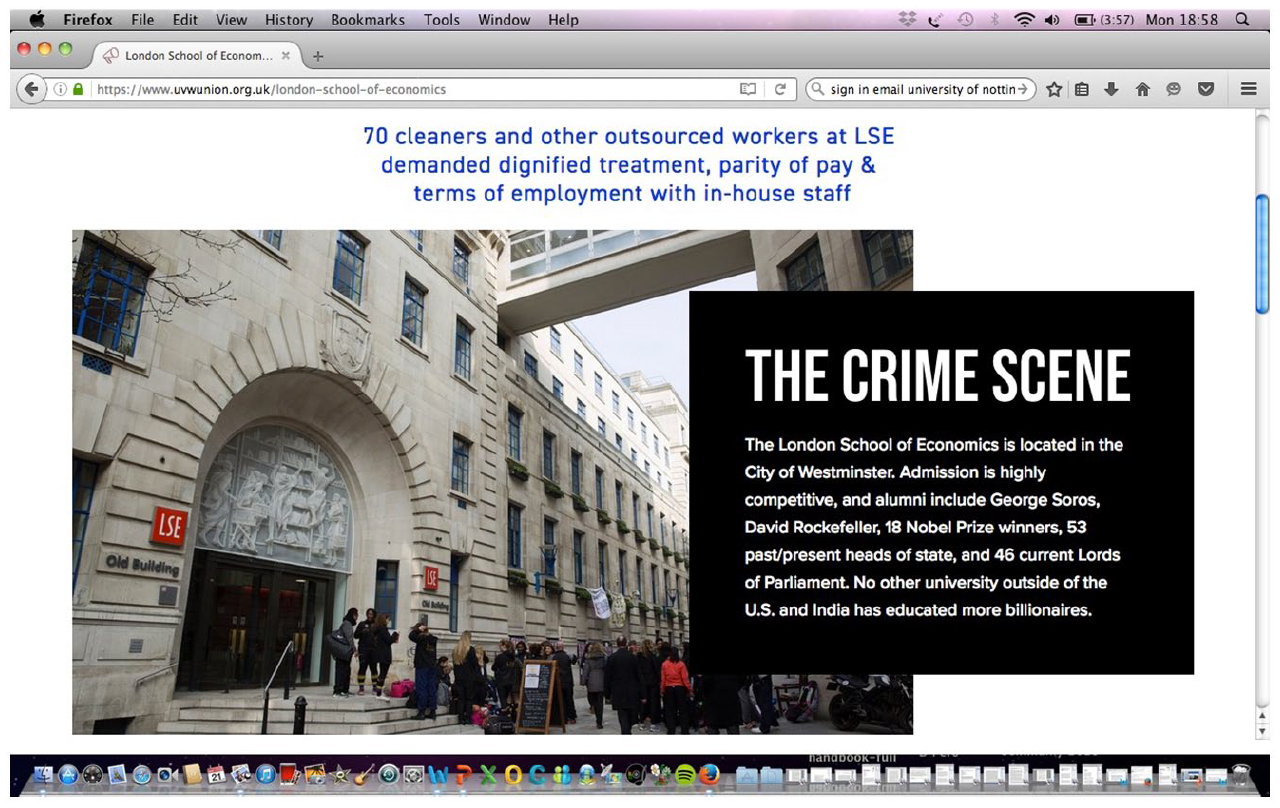
The well-known employer is targeted.
Second, the ‘campaign’ is outlined (see Figure 2) emphasizing acts of energetic, colourful, non-violent grassroots protest that foreground moral claims based on recognizing the humanity of the workers: payment of a higher wage – ‘the living wage’ – that will enable them to live a life worthy of a human being; the phrase ‘We are not the dirt we clean!’ appears regularly on placards and in videos of chanting demonstrators, which is in essence a demand to be treated with the respect due to a human being. In framing their message for wider audiences indie unions choose to speak ‘mainstreamease’ (Gamson and Wolfsfeld, 1993) and cast their redistributive demands and campaigns in a language of recognition and human rights, fairness and respect. This is a language that is more attuned to liberal and social democratic elements of mainstream media and society than that of socialist redistribution and class struggle.
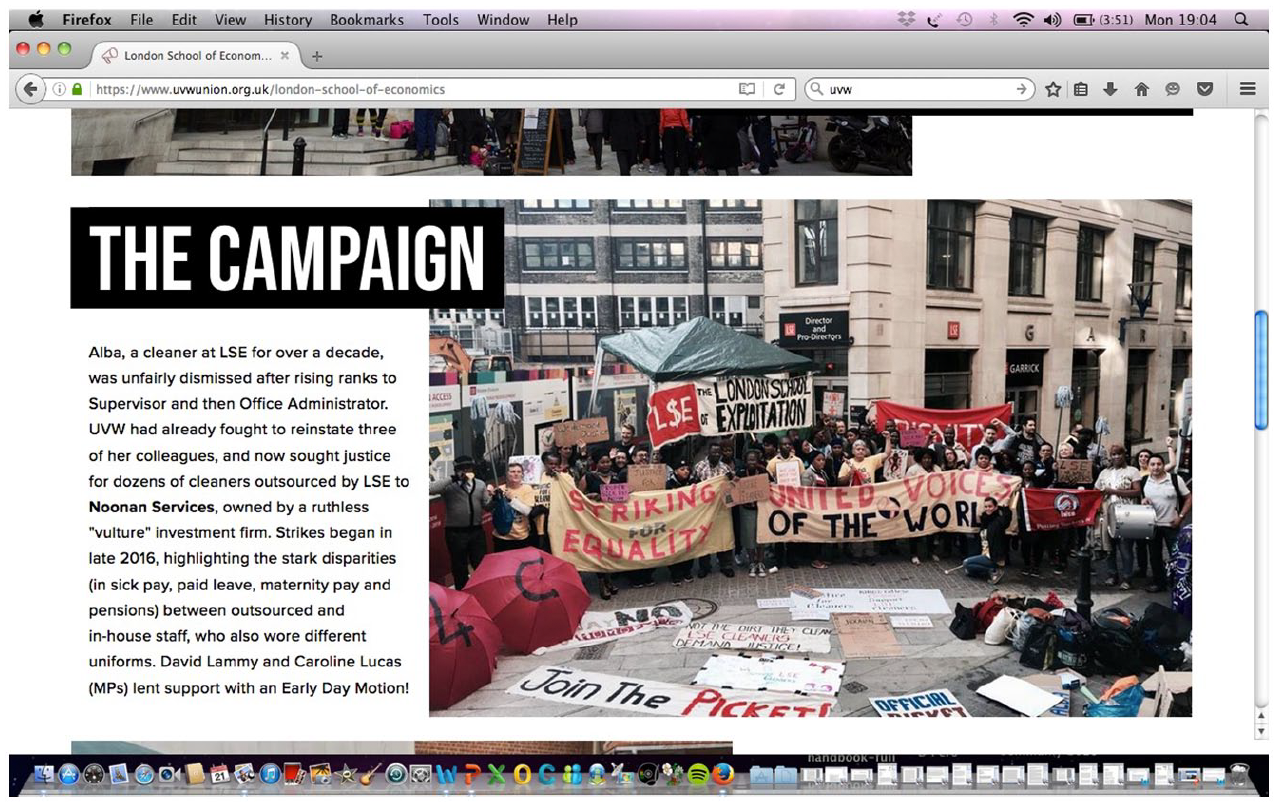
The outsourced workers’ campaign is outlined.
Third, the successful outcomes of the campaigns are emphasized, detailing the concessions won. This three-part narrative structure (see also Snow and Benford, 1988) is then followed by acknowledging their network of supporters that ranges from Labour and Green politicians, to unions, journalists, and civic organizations (see Figure 3).
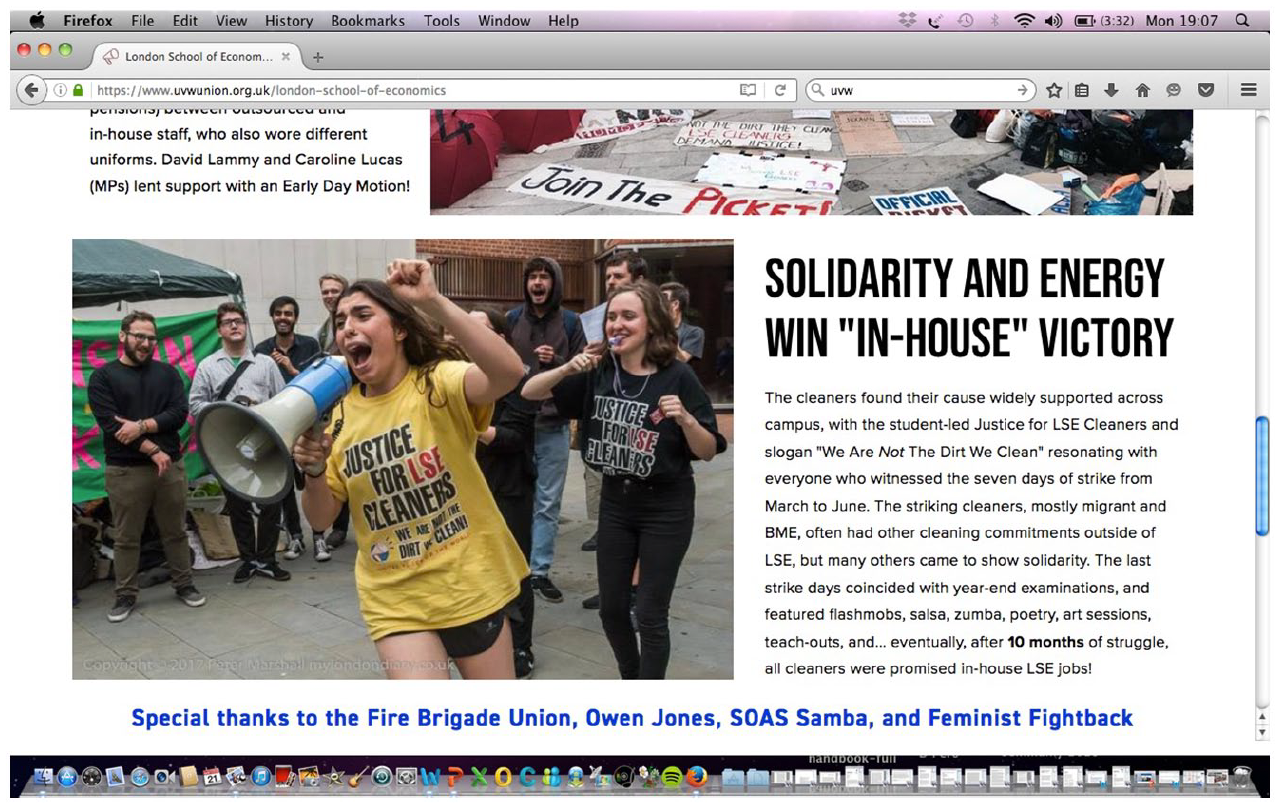
The successful outcomes of the campaign are emphasized.
Each campaign is then illustrated with high quality photographs and videos and supplemented by links to the supportive mainstream media coverage it received.
Key features of indie unions’ communicative unionism
Most indie unions’ campaigns depend on the presence of high profile employers who endeavour to present their best face to the general public, often emphasizing their corporate social responsibility, which makes them also potentially vulnerable to reputational damage. Indie unions focus the communicative dimension of their strategy on this vulnerable point, as illustrated by Louis, one of the leaders of the UVW:
[. . .] we have moral leverage over employers [. . .] Living wage, sick pay and respect. [. . .] So it’s really shameful [. . .] for an employer to say, ‘We don’t believe in the living wage, we don’t want to pay a living wage.’ ‘Really? You want to tell this to the world or the media?’ [. . .] It’s using the brand against the employer [. . .]. Barbican Centre, you know – biggest arts centre in Europe. Sotheby’s Auction House – largest auction house in the world [. . .]
Through inflicting or threatening to inflict this reputational damage, indie unions amplify the pressure put on employers to make concessions, working on the basis that the cost of the concessions is less than the cost of reputational damage. In the words of Martin, one of the IWGB leaders: ‘The kind of common denominator in all these things is that every employer has a pressure point, has a weak spot. Now all of them [. . .] care about reputation’. As a consequence of indie unions’ successful campaigns, employers may pre-emptively come to terms with their demands.
Indie unions’ effectiveness lies in their ability to appeal to wider audiences by constructing moral arguments in favour of improving pay and conditions that resonate with mainstream ideas of fairness and decency. There is here not only a reliance on ‘basic’ and widely accepted notions such as respect, dignity and fairness, but a significant toning down of the traditional leftist language of exploitation, alienation, class struggle and socialism. This is strategic self-censorship in the interests of waging a successful communicative campaign through recruiting bystanders to their cause. As Martin (IWGB) emphasizes: ‘what we have always tried to do is frame our issues in a way that no reasonable objective person could disagree with what we are trying to do’.
Self-mediation is strongly embedded in indie unions’ campaign strategies from the outset, as illustrated by Louis (UVW).
[. . .] you can have like a month build-up to a protest let’s say during which time there’ll be talking online, social media. We’ll try and get media coverage [. . .] That will bring negative publicity because then the employer’s name will start to appear in searches [. . .] or in the media even better. Then you have the protest itself. Then you get a lot of coverage of the protest. [. . .]. So we actually get automatically a wide audience [. . .] We’re definitely trying to make as much noise as possible both on and offline for the longest period possible before, during and after all of our [direct] actions.
Another key feature of the communicative practices of indie unions is the accessibility of the message to wide audiences as Martin (IWGB) illustrates when discussing their couriers’ campaigns.
The couriers [. . .] are paid a piece rate, they are not paid hourly rates, so they get paid a certain amount for the job. We had this huge debate [. . .] and they said “oh we need to campaign for £4 per docket blah-blah-blah”. I was making the case [. . .] that is not going to get us nowhere in the public [. . .] because no one knows what a docket is, no one is going to compute and see how much. We need to frame this in terms of living wage. That is a concept that everyone knows, understands, in a cross political spectrum pretty much everyone supports. [. . .] We say ‘we should earn the living wage, they are refusing to pay it.’ [. . .] I think that is kind of the overarching strategy.
Clearly, the struggle here is conceived as being not only in the workplace but also in the public sphere, and so the frame tries to be culturally embedded in mainstream public culture, in this case borrowing from the communicative strategies of other groups promoting the notion of a living wage (e.g., Citizens UK). Indeed, without the communicative dimension, the workplace struggle alone is regarded as much harder to win, and without a resonant framing there is the perception of a more limited prospect of winning. This means that the dispute itself becomes tailored around the self-mediation actions of the union that aims to influence media coverage and public opinion. We call this approach communicative unionism, whereby communicative action becomes constitutive of the dispute itself and should be understood as such, rather than as separate from or an add-on to the actual struggle.
One of the ‘publics’ considered as key in indie unions’ self-mediating practices, and communicative unionism more generally, is that of mainstream journalists and media, as they are able to amplify their messages and frames, allowing the campaigns to reach wider audiences and thus boost their negotiating power. Martin from the IWGB illustrates this point.
Securing favourable press coverage [. . .] increases our power with employers. The other day we had some representation of foster care workers. They copied me in so that I could write to the Director of Children Services at the Local Authority [. . .] ‘if you don’t clean up your act we won’t hesitate to take legal action and bring this to the attention of the press and if you have any doubt about the types of cases we bring, our success rate and the amount of favourable press coverage we get, do check out our website’ and I put a link to the website [. . .] If I was an employer I would be scared [. . .] because [. . .] it is terrible press coverage for employers.
The importance attributed to mainstream media can also be seen in Martin’s description of the degree of care that goes into nurturing indie unions’ relationship with journalists.
I think press strategy, building up personal relationships with journalists and whatnot is also part of it. They know that we are reliable. If they want to interview workers we produce that. They can trust what we are saying and this type of thing. I think also we are doing things that is in the public interest. The gig economy thing is a big part of public debate these days.
Journalists are offered stories with drama, conflict and action, in a labour initiative that parallels the transactional nature of the relationship highlighted by Gamson and Wolfsfeld (1993).
The resonance of indie unions’ framing in mainstream media
In order to gain a sense of the extent to which the online framing of indie unions’ campaigns acquires increased purchase and weight, we must consider how it resonates with mainstream journalists and media. To this end a keyword search of the Nexis online database of news and business information was undertaken for the appearance of either of the terms ‘United Voices of the World’ or ‘IWGB’ in UK national newspapers. Either or both of these search terms were found in 249 articles in London edition national newspapers up until 30 September 2019 (see Table 1).
Number of articles mentioning the UVW and the IWGB in UK national newspapers 1 January 2013 – 30 September 2019.
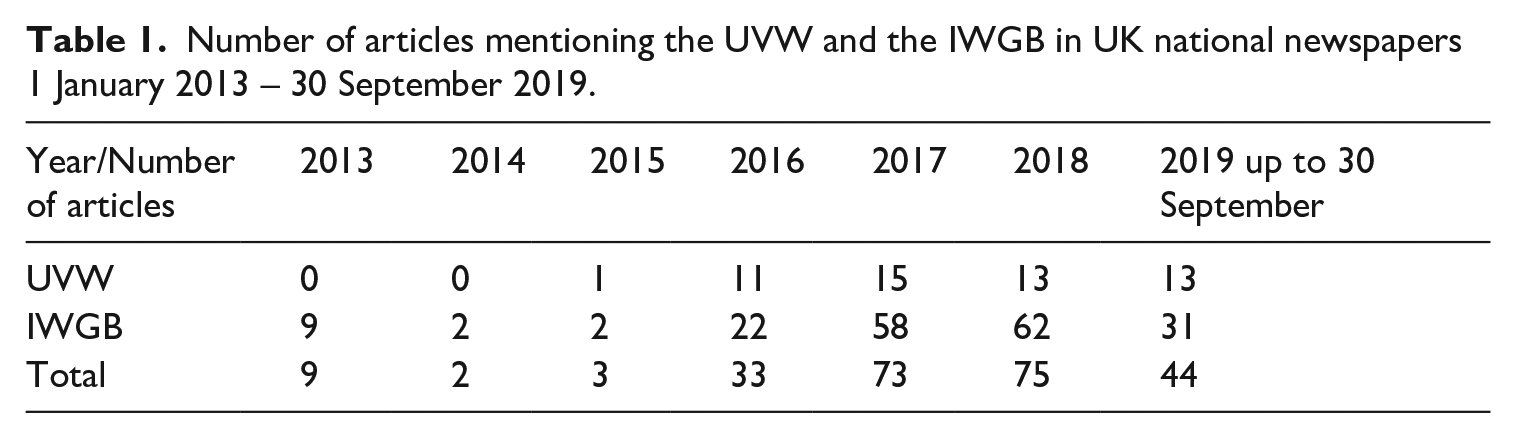
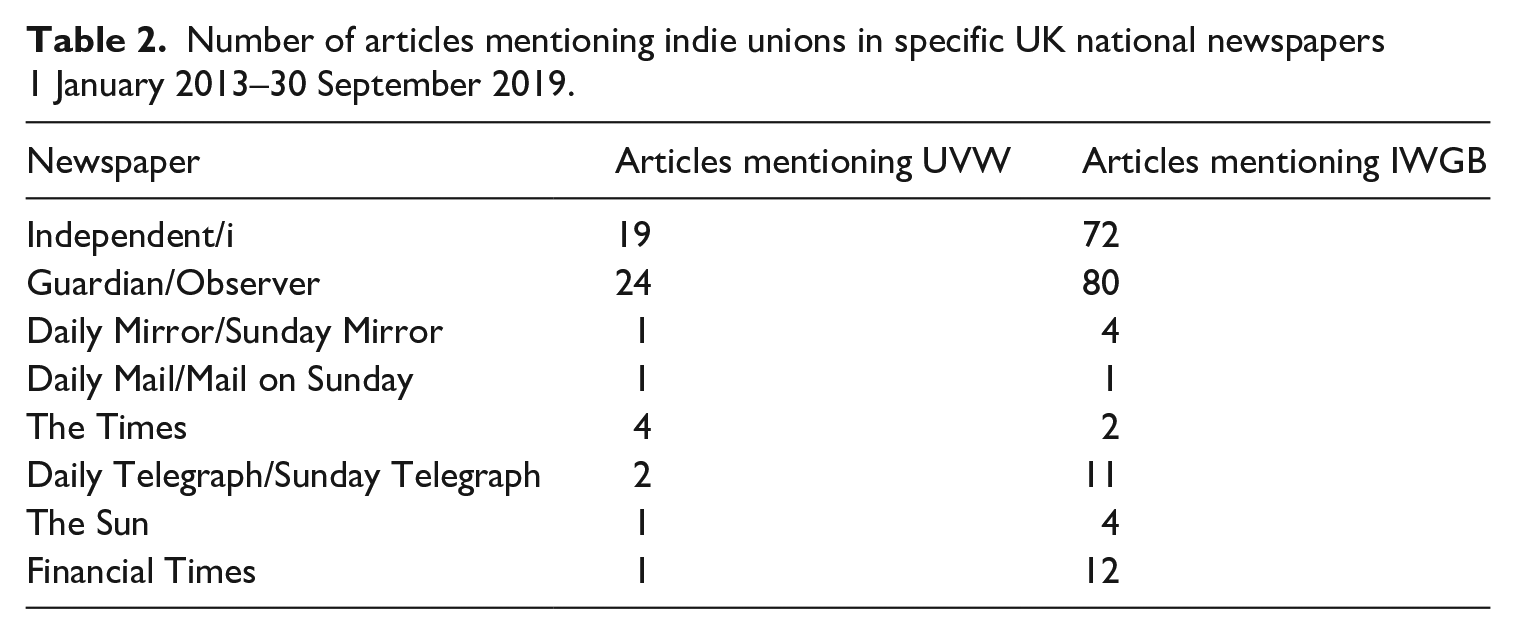
While there are still only a relatively small number of articles that mention indie unions, it is apparent that the issues that they campaign on became a modest but growing part of mainstream media coverage and debate in 2016, with coverage doubling again in 2017. The Guardian and The Independent, both social democratically inclined newspapers aimed at highly educated audiences, dominate coverage, with over 80% of articles that mention the UVW and the IWGB published between them, whereas limited coverage existed in other newspapers. Thus, the issue entered mostly the social democratic and liberal ‘quality’ segment of the mainstream (see Table 2). There is only limited evidence of further diffusion, although union representatives have now appeared on mainstream news and current affairs programmes such as Channel 4 News, Radio 4 News and the Victoria Derbyshire Show on BBC. These unions, through their protests and support of legal action, have played a translational role, bringing issues from the margins of the public sphere into the mainstream via sympathetic bystanders amongst national press journalists (Cottle, 2008).
Number of articles mentioning indie unions in specific UK national newspapers 1 January 2013–30 September 2019.
One of the best ways of ascertaining whether indie unions were successful in transmitting their frames to the mainstream media – and thus encouraging them to deviate from the protest paradigm – is to look at who (individuals and organizations) are directly quoted in news articles. Journalists make a decision as to whether to cover indie unions at all. They then decide whether the unions are merely present in the articles or whether they are to be given a voice; if they have a voice, they can then attempt to frame the dispute in the newspaper, as the purpose of the quotation is generally to provide the perspective of the protagonist. Such a voice may not be uncontested in the article as other frames may be presented (e.g., the employer’s) but it is at least present and visible. Sometimes journalists will engage in an ‘objectivity ritual’ where opposing protagonists are quoted and there is no explicit evaluation of either frame on the part of the journalist (Tuchman, 1972). Whereas practices of impartiality are required on broadcast news, there is no such requirement for UK newspapers, who are at liberty to take sides, becoming – on some occasions and to a certain extent – campaigning institutions in their own right. This is, we would contend, the case in most of the coverage of indie unions in The Guardian and The Independent, who have become de facto part of the campaign for the rights of precarious workers (see Table 3). Some sense of how contested a union frame is can be assessed by whom is given a voice (for example, individuals representing employers or institutions with whom the union are in dispute).
Number of articles in which different categories of organizations and individuals were quoted 1 January 2013–30 September 2019.
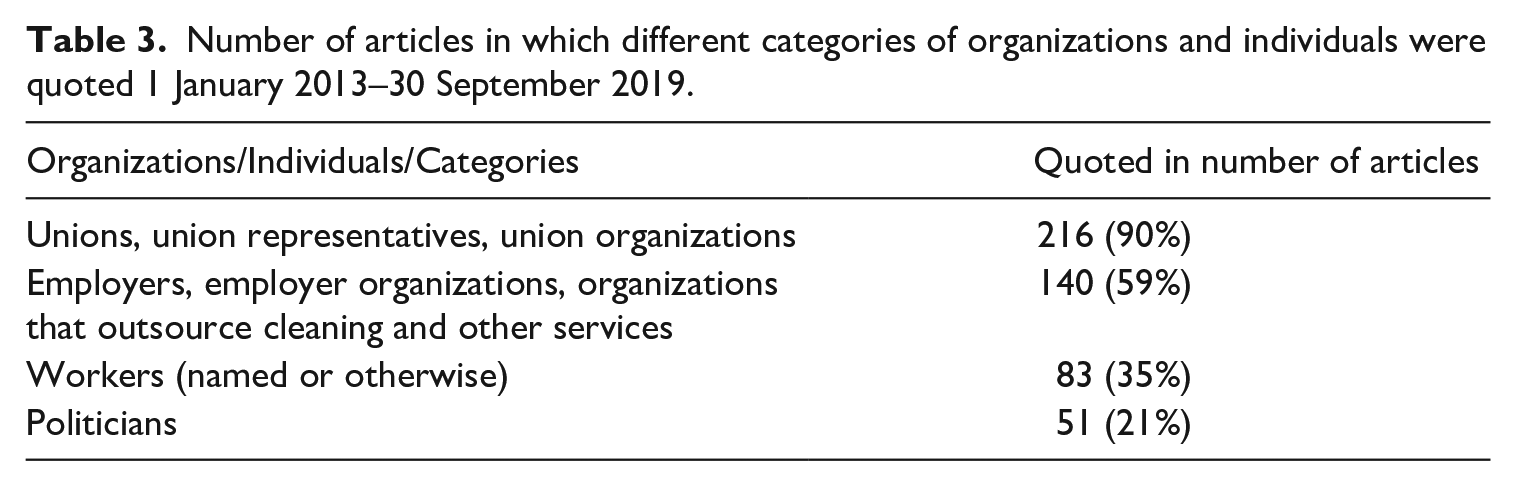
The unions or people named as union representatives were directly quoted in 90% of the articles in comparison to less than 60% for employers or employer organizations. Rather unusually unions enjoyed greater media access than employers. Often quotes from unions were preceded or followed by direct quotations from workers, either named or not, commenting on their working conditions. They were often then supported by elite voices such as politicians (defined here as Members of Parliament and other representatives of political parties operating at national level), mostly representatives of the Labour or Green Party. As a guide, critics of precarious employment practices are quoted twice as often in the newspaper articles as supporters. Clearly then the frames of the indie unions not only find their way into some mainstream media coverage but also dominate the coverage.
If we look at who are the most prominent people quoted in the debate we can see that they are from the indie unions and workers categories rather than from the employer organizations. Jason Moyer-Lee, General Secretary of the IWGB, is the most quoted individual by far (quoted 66 times) followed by Maggie Dewhurst and Jim Farrar, both representatives of the IWGB (19 and 25 respectively) and Petros Elia, General Secretary of the UVW (18). An unusual feature of the coverage is the number of times that workers are quoted, often describing their working conditions and/or protesting against their pay and conditions. Many of these workers are recent migrants from Latin America. Of the mainstream politicians quoted only 10 are Conservatives. The most frequently quoted politician is Frank Field (quoted 9 times) speaking as chair of the House of Commons Work and Pensions Select Committee, which published a report that was highly critical of precarious employment practices. This again provides evidence of the translational role that indie unions have played in bringing these issues to the attention of the public through influencing elites such as Members of Parliament. These elites usually have greater access to mainstream media because of the tendency for journalists to refer to or index elite sources in constructing news stories (Bennett, 1990).
Indie unions have attracted support from prominent and sympathetic British journalists such as Aditya Chakrabortty and Owen Jones. Jones has almost one million Twitter followers and became a committed supporter of the UVW strike at the LSE in 2017 when he refused to cross a UVW picket line and then endorsed the strike in The Guardian (see also Acciari and Però, 2017). What we can see here again is indie unions’ discursive power, and in particular their influence on the work of some prominent journalists, bringing their actions to a wider audience in an appealing manner. The boundaries between newspapers, journalists and activists are further blurred when newspapers open up their comment sections to representatives of indie unions. The IWGB has been particularly adept at this. Moyer-Lee alone has written 11 comment pieces for The Guardian while Sarah Anderson of the IWGB’s foster carers’ branch has written two for the same newspaper during the sample period. Yasser Akhtar, who is a London Uber driver and member of the IWGB, wrote a comment article for The Independent. This process helps validate the campaign, expanding the constituency of supporters and their negotiating power (Gamson and Wolfsfeld, 1993).
In sum, we can clearly see a virtuous circle of sympathetic mainstream coverage and contention developing. Indie unions, through their self-mediation practices and growing social capital, bring their dispute to the attention of mainstream media and elites, whose concern for the plight of precarious and migrant workers, whether pre-existing or more recently discovered, serves both to emphasize the importance of the issue and the legitimacy of the indie unions’ struggles. This discursive power then adds weight and negotiating power to indie unions.
Discussion and conclusions
This article set out to examine one important and understudied aspect of the representational and negotiating efforts of precarious workers, namely how the discursive power they generate through communicative practices of self-mediation in the public arena can enhance their overall negotiating power in workplace disputes. The intent has been to advance existing debates on the effectiveness of labour and social movements in obtaining concessions from employer organizations, and to contribute insights of praxiological relevance for the labour and other justice movements.
Existing social movements research has traditionally focused on the relations between movements, the state and its policies and only recently extended its focus to corporate organizations (King, 2008). This has been operationalized largely by examining the practices of what King (2008) calls ‘secondary stakeholders’, that is actors who are external to the organization, such as civic and community activists, consumers, and the wider public. However, while important, this focus missed the examination of the collective practices of primary stakeholders (such as workers), not least in terms of the public framing of their demands. Industrial relations research, on its part, has historically focused on framing largely as a communicative practice internal to the workplace, aimed at complementing workers’ structural power with the development of associational power (see Gahan and Pekarek, 2013; Kelly, 1998). While essential, this approach overlooks the external dimension of unions’ communicative strategies and is of limited help in accounting for how subcontracted and dispersed precarious workers, with scarce material resources and institutional support, can obtain concessions from powerful employer organizations.
Through a combination of ethnography, interviews, frame and content analysis, this article has examined the negotiating significance of discursive power generated by workers’ communicative practices of self-mediation. This has been done by considering the experience of two independent unions recently formed in London by precarious migrant workers, the IWGB and the UVW, whose initiatives have been remarkably effective, resulting in a long string of successful campaigns and concessions that until recently were considered unthinkable for this constituency of workers. The article finds that a crucial aspect of communicative unionism consists in integrating disruptive industrial action, documented elsewhere (see Alberti and Però, 2018; Moyer-Lee and Lopez, 2017; Però, 2020; Shalmy, 2018), with self-mediation practices. Workers’ demands are framed in moral terms that are hard-to-dispute in public, attributing responsibilities to unscrupulous and immoral employers who impose unnecessarily harsh and precarious working conditions on their workers, paying them poverty wages while making huge profits. This framing is designed with the wider public in mind (ranging from activists to consumers, clients, journalists and employers) and not simply directed ‘internally’ to fellow workers. Crucially, this ‘outward’ framing is intended to resonate with mainstream ideas of fairness, decency, dignity and respect populating the public arena, so as to generate discursive power and boost workers’ overall negotiating leverage. To this end this framing adopts an inclusive language of recognition centred on human rights, deliberately and strategically playing down the socialist language of redistribution and class struggle as the latter could hinder favourable responses from the public. This enables journalists to adopt a similar framing in which the employer is cast into the newsworthy role of civic ‘villain’, acting illegitimately and immorally in pursuit of socially inconsiderate margins of profit, challenging the latter’s precious public image and reputation.
These findings show that considering the framing of disputes for external audiences (i.e., potentially sympathetic bystanders, out-group members, etc.) can have analytical relevance in accounting for the effectiveness of precarious workers’ initiatives. In particular, they show how the negotiating power of this category of workers can be enhanced further when the framing of the employment relationship as ‘unjust’ is not only directed internally to the workers’ constituency (e.g., Kelly, 1998), but also externally to the broader arena of public opinion, consumers, clients, civic organizations and the mass-media, where employer organizations have a valuable and vulnerable reputation to defend. In this strategy that we have called communicative unionism, the media are encouraged to deviate from the protest paradigm (McLeod, 2007) and instead amplify the workers’ frames. Of course, the need to appeal to the mainstream for support may affect not only how unions frame their struggle but also the character of the struggle itself. Such a strategy can add significant discursive power to whatever structural and/or associational power workers may already have, exerting further pressure on employers to make concessions.
Taken together, these findings contribute to existing labour movement studies (such as Jiang and Korczynski, 2016; López-Andreu, 2020; Royle and Rueckert, 2022) by extending their appreciation of workers’ and unions’ framing activities to those directed to external arenas. This is important to refine the understanding of how the emerging but relatively powerless precarious and migrant workers can empower themselves to some extent in disputes with employers. Considering discursive power-building practices of self-mediation and their media resonance can help us understand better how disenfranchised and highly precarious labour actors can strengthen their chances of success. In addition, these findings also advance social movements studies’ recent analytical engagement with collective initiatives targeting corporations – which have privileged ‘secondary stakeholders’ such as civic and community actors (King, 2008) – with the examination of ‘primary stakeholders’ such as workers. Finally, these findings offer insights that may be relevant to labour initiatives of precarious workers in other contexts, as well as to democratic repositories of knowledge such as those of the (labour) community of practice (Smith, 2021) and public sociology (Burawoy, 2005).
Footnotes
Acknowledgements
We wish to thank Elizabeth Cotton and Michael Brookes as well as the three anonymous reviewers at WES for their insightful and helpful comments on the article. We also wish to thank Gerardo Patriotta and Elisabetta Zontini for their precious suggestions. Thanks also to Amber Davis and Lucy James for their editorial assistance. Finally, a big thank you goes to the research participants from the IWGB and UVW for the invaluable information they shared with us.
Funding
The authors received no financial support for the research, authorship, and/or publication of this article.
