



Abstract
Based on the case of a Belgian meat processing company that relies on posted workers employed by two subcontractors, this study investigates how posting affects client capital’s ability to control labour. Analysed through a Labour Process Theory lens, the findings reveal that posting fragments capital and substantially reduces the client firm’s control over workers’ effort and mobility power. This is due to the low-cost, temporary nature of posting, the disembeddedness of posted workers and their stronger relations with their employer than with the client firm. Competing to control posted labour, both units of capital enact practices commonly associated with trade unions: client capital advocates for posted workers in its interactions with the subcontractor, and the subcontractor promotes posted workers’ reduction of effort and increased mobility against the interests of client capital. Because of their structural vulnerability, posted workers might leverage conflicts within capital to resist the harshest forms of exploitation.
Keywords
Introduction
Over the past two decades, the literature on posted workers has widely documented how this form of labour mobility within the European Union renders workers particularly vulnerable to exploitative working conditions (Alberti and Danaj, 2017; Berntsen, 2015; Wagner, 2018), leading to a broad public debate on its harmful effects for both posted and local workers (De Wispelaere and Pacolet, 2017; Lillie, 2012). A posted worker is ‘a worker who, for a limited period, carries out his work in the territory of a [European Union] Member State other than the State in which he normally works’ (Directive 96/71/EC: 3). Posted workers are often employed by a subcontractor that sends them to deliver services to a client firm in the destination country (Wagner, 2015b, 2018). The literature shows how posting facilitates exploitation by fragmenting labour, enabling firms in the destination country to rely on statutorily less protected and cheaper workers not covered by national collective bargaining mechanisms (Lillie, 2012; Wagner and Lillie, 2014), and hampering trade unions’ organization of posted workers (Berntsen, 2015; Danaj and Sippola, 2015).
While the negative consequences of posting on workers’ effective legal protection, mobilization and industrial action are today widely known, much less attention has been paid to how posting actually affects the control of workers on the shop floor (yet see Alberti and Danaj, 2017). However, it cannot be simply assumed that the weak legal and institutional protection of workers automatically entails management’s effective ability to exploit posted workers. According to Labour Process Theory (LPT), this ability can never be taken for granted, as labour power always remains, to some extent, indeterminate (Braverman, 1974; Smith, 2006). Workers retain effort power and mobility power (Smith, 2006), referring to the degree of ‘freedom’ over, respectively, the amount of effort they expend in the labour process and the decision on ‘where and to which employer’ (Thompson and Smith, 2009: 924) they sell their labour. The indeterminacy of labour power is a source of uncertainty for capital, which needs to be reduced by developing a managerial apparatus to ensure that labour power is actually delivered by workers (Smith, 2006, 2015; Thompson and Smith, 2000).
Indeed, both the recent research on migrant workers and on outsourcing have documented how capital’s control over workers remains incomplete despite their particularly vulnerable position. Studies have shown, for example, how migrants’ higher (international) mobility compared to local workers may confront capital with unanticipated retention problems (Alberti, 2014; Andrijasevic and Sacchetto, 2016) and how outsourcing entails the client firm’s loss of control over workers due to the transfer to the subcontractor of the formal right and ability to steer the labour process (Lee, 2013; Zuberi, 2013).
Taking stock of these insights, this study adopts an LPT lens to investigate the effects of reliance on posted labour on a client firm’s ability to control labour. Empirically, this study investigates a company which relies on East European posted workers employed by foreign subcontractors. The company is active in the Belgian meat industry, a sector in which posting has become endemic over the last two decades (Wagner, 2015a). This article first reviews the current debates on the vulnerability of posted workers. It then elaborates on the literature on migrant workers and outsourcing to question the idea, central in the posted worker literature, that posting facilitates capital’s control over posted workers. After outlining the research methodology and the case study, the findings show how posting complicates the client firm’s control over workers’ labour power. This article concludes with a discussion of the implications of this research for the understanding of capital’s control and exploitation of posted workers. It contributes to the extant literature by revealing the complexity of the power dynamics involved in posting, which not only fragments labour – as often held – but also capital. It exposes how the conflicting interests between the client firm and the subcontractor surprisingly lead both to adopt practices towards posted workers resembling those of trade unions.
Posting as a form of labour mobility that makes labour vulnerable
The literature has well documented how posting renders workers particularly vulnerable in their relation to capital. Unlike ‘regular’ migrant workers who move to another country on their own initiative, posted workers constitute a capital-driven form of migration (Arnholtz and Refslund, 2019). They are in ‘spaces of exception’ (Wagner and Lillie, 2014: 403), as they fall under the free movement of services, rather than of labour (Lillie and Wagner, 2015). The rights of posted workers are grounded in the Posting of Workers Directive (PWD) of 1996, which has been heatedly debated, in particular over the question of whether posted workers are entitled to the terms and conditions of the host versus the home country (Alberti and Danaj, 2017; Wagner, 2018). Although the PWD originally specified that the conditions apply that are the most advantageous for posted workers, the European Court of Justice reinterpreted the PWD in the Laval case of 2007 by restricting the ‘most-favourable principle (. . .) to only more favourable conditions in the home country’ (Cremers, 2010: 302).
These rulings have enabled employers to apply conditions of the sending country (Cremers, 2013; Lillie, 2012), creating an important economic incentive for companies in high-wage Member States to rely on the services of posted workers employed in low-wage Member States (Berntsen, 2015; Wagner, 2015b). This has led to social dumping practices, whereby local firms replace local workers by cheaper foreign labour (Arnholtz and Refslund, 2019). Posted workers only constitute a very small fraction of Europe’s total employed population (1.2% in 2018; see De Wispelaere et al., 2020). However, the frequent use of posting in specific sectors of the economy (including the construction, transportation and meat industries) has put the employment and working conditions of more expensive local workers in these same sectors under great pressure (Cremers, 2010; Lillie, 2012; Riesco-Sanz et al., 2020). Whereas the 2018 revision of the PWD, which took effect in 2020, ensures equal pay and conditions for posted and local workers and imposes maximum terms for assignments, it still maintains the low-cost character of posted labour by allowing subcontracting firms to pay posted workers’ social security contributions in the country of origin (Riesco-Sanz et al., 2020).
Posting has also been criticized for allowing capital to circumvent national collective bargaining (Wagner and Lillie, 2014), undermining the position of both posted and local workers and that of unions (Wagner, 2018; Wagner and Refslund, 2016). The rulings of the European Court of Justice practically excluded posted workers from collective bargaining, further fragmenting labour. They stipulated that ‘host country regulators – including private players such as trade unions – cannot oblige foreign service providers to respect labour rights that go beyond the minimum standards of the PWD’ (Lillie and Wagner, 2015: 160). At the same time, the possibilities for home country unions to collectively represent the interests of posted workers are hampered by their limited resources and the difficulties of supporting workers located in another country, among others because ‘union jurisdictions are divided along national-territorial lines’ (Lillie, 2012: 153).
Host country union efforts to reach out to posted workers are also complicated by language barriers and posted workers’ fear of losing their job (Arnholtz and Refslund, 2019; Berntsen, 2015; Danaj and Sippola, 2015). Common union tactics, such as exerting pressure on abusive employers through the media (Arnholtz and Refslund, 2019; Berntsen and Lillie, 2016) and engaging with migrant community organizing (Danaj and Sippola, 2015; Wagner, 2015a) may not necessarily yield the intended results, among others because the time required for these strategies may be longer than the period of posting (Berntsen and Lillie, 2016). Studies have documented how posting strengthens capital because it complicates attempts to hold firms accountable for abusive practices (Berntsen and Lillie, 2016; Cremers, 2013; Wagner, 2018). Practices such as underpaying posted workers and not respecting maximum working hours are hard to tackle, due to the lack of effective transnational labour protection and sanction mechanisms (Berntsen, 2015; Cremers, 2013; Riesco-Sanz et al., 2020). Owing to their limited control mandates, national administrative bodies face difficulties identifying who is responsible for irregularities in long transnational subcontracting chains (Cremers, 2010; Wagner, 2015b, 2018).
At the same time, posted workers cannot easily familiarize themselves with the local regulatory and institutional context. They are often disconnected from their host society due to their limited knowledge of the local language and their segregation through accommodations arranged by their employer (Berntsen, 2015; Berntsen and Lillie, 2016; Caro et al., 2015). This disembeddedness effectively divides labour into posted and local workers. Posted workers’ individual resistance strategies, such as using their social networks to find more favourable jobs and organizing wild cat strikes, may provide minimal gains, yet generally fail to substantially improve employment and working conditions (Berntsen, 2016; Thörnqvist and Bernhardsson, 2015).
Studying posted labour as indeterminate
The literature on posting tends to emphasize how this legal arrangement puts labour into a position of structural vulnerability relative to capital, facilitating stricter control and harsher forms of exploitation. However, capital’s ability to exploit labour is never guaranteed, as even particularly vulnerable workers retain some degree of ‘freedom’ over their labour power (Braverman, 1974; Smith, 2006). On the one hand, despite employers’ authority over the labour process, workers might reduce their work effort and might display low levels of commitment (Smith, 2006). A large part of the LPT literature has indeed traditionally focused on the effort bargain between workers and their employer (Thompson and Smith, 2009). On the other hand, although employers may attempt to limit labour mobility through ‘retention, selection, reward and career development’ (Smith, 2006: 391) practices, workers may decide to exit a dissatisfactory employment relation. Initially identified by Edwards and Scullion (1982), mobility as a source of labour indeterminacy was for a long time a largely ‘overlooked dimension of labour power’ (Alberti, 2014: 868), yet has recently been revived (Smith, 2006). The uncertainty created by workers’ effort and mobility power for capital features prominently in the literature on migrant labour and on outsourcing, two aspects which are combined in posting.
The vast literature on capital’s employment of migrant workers from different countries of origin employed in different contractual arrangements (e.g. fixed-term, agency and casual contracts) points to the indeterminacy of their labour power (Alberti, 2014; Ciupijus et al., 2020; Dawson et al., 2018). Firms may have the illusion that they can extract more effort from migrants, as these workers are often initially motivated by the higher salary in the host country compared to their home country (Baxter-Reid, 2016). However, over time, migrants tend to reduce their work effort, as they learn more about the local labour market and host society and realize that their salary is low according to local standards (Dawson et al., 2018; Hopkins, 2017; MacKenzie and Forde, 2009). Despite firms’ understanding that migrants are ‘good workers’ (MacKenzie and Forde, 2009), migrants may work only as hard as strictly necessary to keep their job, similar to local workers (Baxter-Reid, 2016; Thompson et al., 2013), especially when they become aware of their rights and have acquired (language) skills securing their position in the labour market (Dawson et al., 2018; MacKenzie and Forde, 2009; Thompson et al., 2013).
Moreover, migrant workers’ looser attachment to the local society makes them more mobile on the international labour market, increasing the indeterminacy of their mobility power (Alberti, 2014; Andrijasevic and Sacchetto, 2016; Berntsen, 2016; Ciupijus et al., 2020). Firms that rely on migrant labour may thus be confronted with high levels of turnover, as migrants might swiftly pursue jobs with more favourable conditions, independent of the location (Andrijasevic and Sacchetto, 2016; Berntsen, 2016). It might further be difficult for capital to limit migrants’ mobility, as these workers partially base their mobility choices on non-monetary incentives – for instance to be closer to their family, diversify their skills and/or gain cultural experiences (Alberti, 2014; Ciupijus et al., 2020).
At the same time, the outsourcing literature points to how outsourcing activities affect the indeterminacy of labour for the client firms (Bonazzi and Antonelli, 2003; Cappelli and Keller, 2013; Lee, 2013). Corner-cutting, low-quality service provision and low levels of worker loyalty towards the client firm are not uncommon (MacKenzie, 2000; Rubery et al., 2003; Zuberi, 2013). Yet the client firm cannot rely on the human resources (HR) policies which are normally used by firms to manage the effort and mobility of their workers (Smith, 2006), such as hiring, instructing, monitoring, sanctioning, rewarding, promoting and firing, as outsourcing transfers the formal employment and control to the subcontractor (Cappelli and Keller, 2013; Legge, 2007).
Taken together, the literature on LPT, migrant workers and outsourcing suggest that posting, while rendering workers vulnerable, cannot in itself ensure their exploitation by capital. Therefore, this study investigates how capital’s control over posted workers is exerted on the shop floor, as an essential condition to ensure that labour power is actually delivered (Smith, 2006, 2015; Thompson and Smith, 2000). More specifically, two research questions are addressed: How does posting undermine the client firm’s control over labour effort and mobility? How does the client firm attempt to regain control over posted workers’ effort and mobility?
Method
A qualitative case study was conducted at an organization in the meat industry in Belgium, a sector in which posting is frequently used (Berntsen, 2015). The German meat industry, which is particularly known for the use of precarious posted workers and for the absence of a minimum wage until 2015 (Wagner, 2015a; Wagner and Refslund, 2016), has put meat processing firms in neighbouring countries under pressure to reduce their labour costs through strategies such as posting. The Belgian meat processing plant under study, which is given the pseudonym EatMeat, relies on East European posted workers employed by foreign subcontractors to conduct its core meat processing tasks.
EatMeat is a family business founded around the turn of the century, which predominantly serves a few large supermarket chains in its vicinity. These chains put pressure on the organization to deliver varying amounts of meat depending on promotions or seasonal demands, impose tight deadlines, and threaten to give fines and to terminate the contract if conditions are not met. EatMeat initially employed around 50 full-time and part-time workers and additionally relied on 80 to 100, mainly local ethnic minority, temporary agency workers to increase production in peak seasons. However, about a decade ago, EatMeat gradually started to outsource its production to foreign subcontractors in order to solve persistent issues of local workers’ absenteeism and labour shortage.
At the time of the data collection, EatMeat had two foreign subcontractors that posted workers from Poland and Romania, with whom it had worked together for, respectively, four and eight years. The subcontractors each posted up to 50 workers from their country to Belgium. They carried out tasks such as the deboning, cutting off fat, marinating, breading, pre-cooking, weighing and packaging of the meat. Moreover, a Dutch organization provided the Polish subcontractor assistance with accommodation, administration and transport arrangements for its workers. It was also present on site to facilitate communication between the Polish team and EatMeat personnel. Figure 1 provides a visual overview of the involved actors.
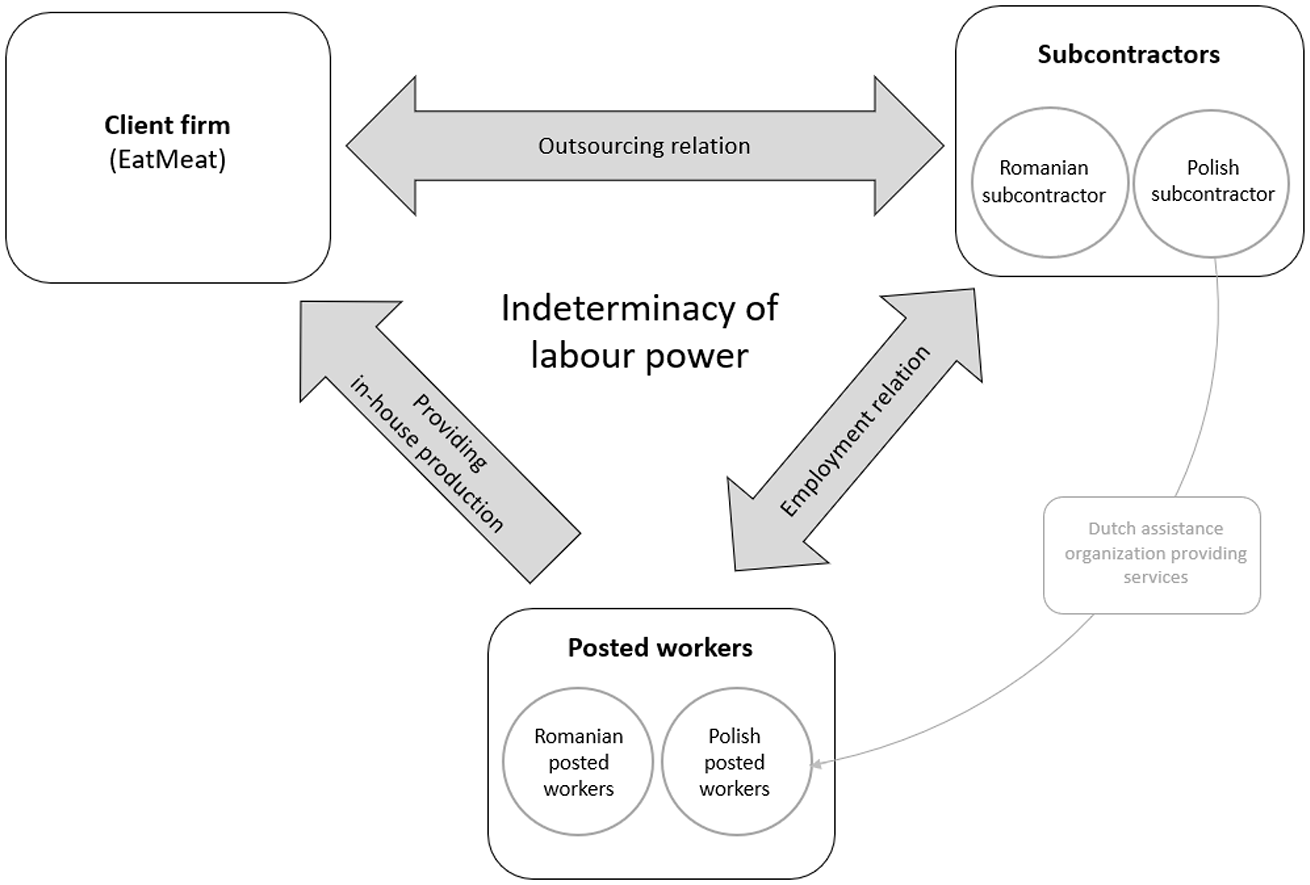
Actors and their mutual relations.
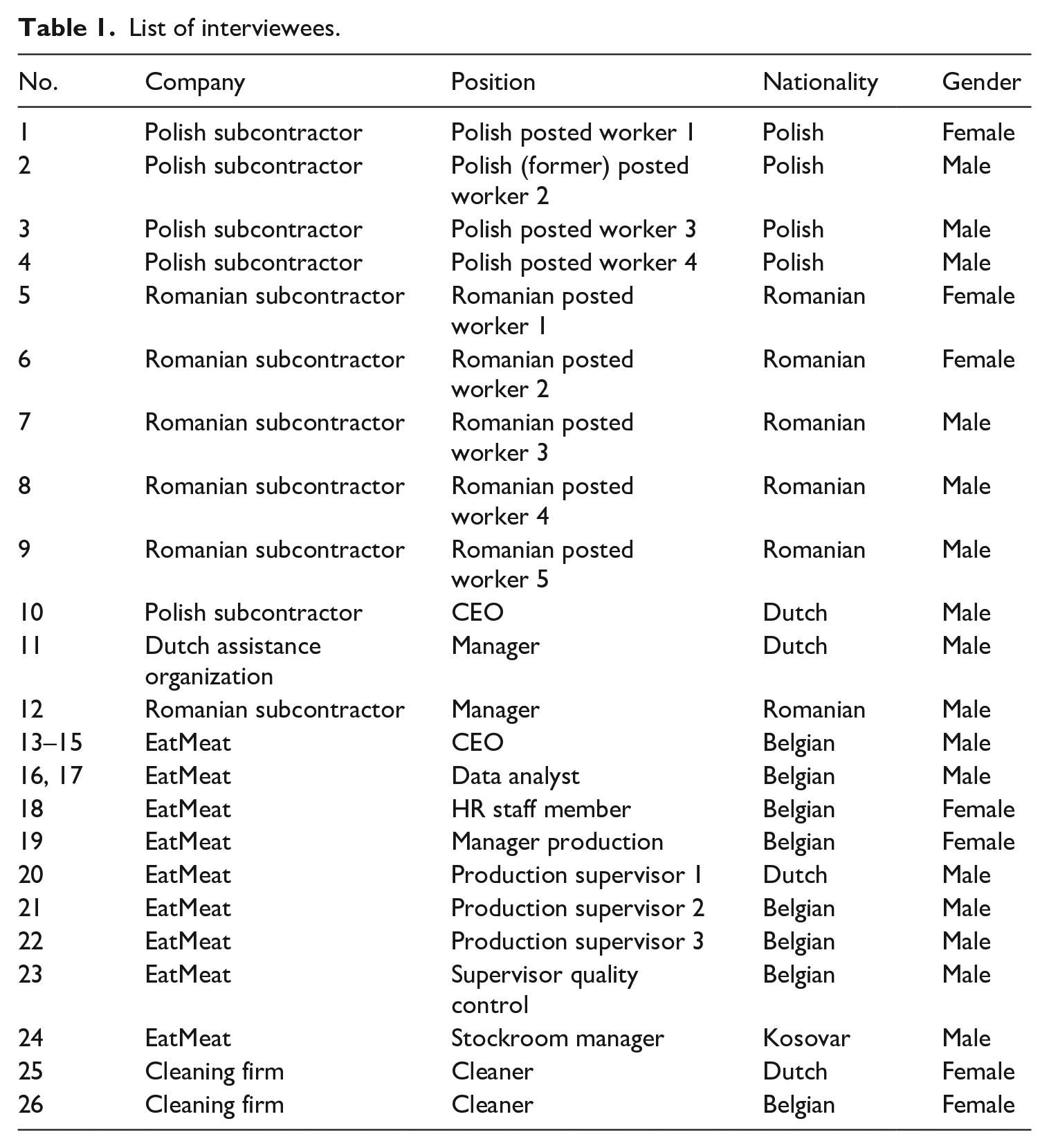
In the period between December 2017 and July 2019, 26 semi-structured interviews were conducted, 12 of which were with the CEO and the employees of EatMeat, two with local cleaners employed by a cleaning firm, nine with posted workers, and three with managers of the subcontractors and the Dutch assistance organization. More details on the profile of the respondents can be found in Table 1. EatMeat’s CEO and its data analyst were interviewed several times, as they occupied key positions in the organization. The interview data were complemented with observations during two guided visits of the plant and with organizational documents, such as training material for posted workers.
List of interviewees.
Interviews with EatMeat’s CEO and employees focused on the firm’s competitive strategy and its relationship with the subcontractors and their workers (e.g. What are the challenges of working with subcontractors? How do you control workers?). The interviews with the managers of the Polish and Romanian subcontractors and the Dutch organization focused on the relations between the various firms, and on the way in which they each interacted with the posted workers (e.g. How would you describe the collaboration with EatMeat? How do you make sure that you reach your targets? What do you do to retain workers?). Finally, posted workers were interviewed to gather information on their experiences with posting, their labour market strategies and the control mechanisms they were confronted with (e.g. Why did you decide to take this job? What are the advantages and disadvantages of your job? What are your future career plans?). The interviews with the posted workers were conducted with the help of interpreters. All interviews, except one, were recorded with the consent of the respondents and transcribed. The interviewer took notes during the interview that was not recorded.
Data analysis
Throughout the data analysis the interviews were used as the main data source, and the observation notes and organizational documents for triangulation purposes. In the first phase of the data analysis, the authors went through all the data sources to reconstruct the history of the firm, the actors involved and the original reasons for outsourcing production to foreign subcontractors employing posted workers. The second phase of the data analysis focused on the first research question (How does posting undermine the client firm’s control over labour effort and mobility?). The first author went through the material, identified all fragments which reported lack of control of the client firm over posted workers’ effort and mobility and open coded them. In the next step, these codes were clustered into higher-order thematic codes (see Braun and Clarke, 2006). Examples of such themes include ‘inability to give direct instructions to posted workers’ (effort), ‘production demands from the subcontractor emphasizing quantity over quality’ (effort) and ‘posted workers leaving the job’ (mobility). The second and third authors reviewed them and then discussed them with the first author to finalize them. The third phase of the data analysis addressed the second research question (How does the client firm attempt to regain control over posted workers’ effort and mobility?). The first author again went through the material and identified fragments reporting strategies to solve the lack of control as identified in the previous phase. She thematically open coded the new fragments. Illustrative codes are ‘installing production supervisors to verify work quality’ (effort) and ‘negotiating better accommodation for posted workers with subcontractors’ (mobility). These were again extensively discussed among the three authors until consensus was reached.
(Losing) control over posted workers’ effort
Initially, EatMeat’s CEO saw the use of posted workers employed by a foreign subcontractor as an effective means to increase its control over workers. He praised the posted workers for being ‘highly motivated, because they come here to earn money and they make three, four, five times more than in their home country’ (CEO, EatMeat). Moreover, he considered working with subcontractors as a major advantage, as he could now ‘charge [the subcontractors] a price per kilo [of meat]’, obtaining ‘a stable cost’ for his product (CEO, EatMeat) as opposed to paying his own workers a wage. This created an economic incentive for subcontractors to ‘be stricter’ (CEO, EatMeat) with their posted workers, ensuring that deliveries to the supermarket chains were on time. Yet after having worked with posted workers for almost a decade, EatMeat management had lost confidence that working with posted labour could solve EatMeat’s control problems. On the contrary, reliance on posting created major new ones.
Some posted workers mentioned how they would sometimes refuse to work during lunch breaks or in extremely long consecutive shifts. However, these occasional forms of resistance did not seem to form a major matter of concern for EatMeat. Rather, the organization was particularly affected by its limited control over the effort that posted workers invested in the quality of their work. During the interviews, EatMeat staff regularly complained about posted workers failing to meet quality standards, to process the meat uniformly, to verify quality during production and to ensure a visually appealing product for customers, all essential to meet the supermarket chains’ demands: I think it was two weeks ago, the meat had a very light colour, so the meat skewers didn’t have enough marinade on them, and uh . . . [. . .] eight people [posted workers] had had them in their hands, and nobody had reported this. Eventually, it got flagged by our production supervisor. (Quality control supervisor, EatMeat)
In an attempt to increase production quality, EatMeat assigned supervisors to closely monitor the production process and to intervene whenever quality standards were not respected. Although they were continuously present on the shop floor, the production supervisors felt that their efforts to safeguard production quality did not sufficiently pay off. During the interviews they expressed their frustrations about what they saw almost as a Sisyphean task: Here, everything has to be perfect, especially [because we are] a food company. We have to constantly manage [posted workers], and that is exhausting. It is also exhausting to have to explain it to [EatMeat’s CEO], that it’s a continuous problem. [. . .] How is it possible that, if I forget one day to tell them exactly [how to put the meat in the plastic containers], that it doesn’t happen the right way? (Production supervisor 3, EatMeat)
Whereas EatMeat’s production supervisors tried to stimulate posted workers to pay careful attention to production quality, the subcontractors’ team leaders of the different groups of posted workers put their employees under ‘pressure to work quickly’ (Polish posted workers 1 and 3) to maximize production. The CEO of EatMeat shared his suspicion that the subcontractors, when instructing posted workers, ignored EatMeat’s requests to improve quality in order to reach their own production goals: He [the subcontractor’s team leader] might tell me: ‘Yeah, that girl needs to do a better job when making meat skewers’, but [. . .] he could tell that girl that she needs to make them faster instead of better! We want better meat skewers, [. . .] but he knows that to make better ones, she will produce two kilos per hour less. (CEO, EatMeat)
The language barriers further facilitated these practices, undermining EatMeat’s control attempts. The production supervisors believed that the subcontractors’ team leaders, who served as interpreters between EatMeat’s staff and the posted workers, purposely mistranslated EatMeat’s instructions in order not to slow down production. For instance, one explained that he thought that his request to put two pieces of meat symmetrically in the packages would not be translated correctly, because not doing so would allow workers to be faster. ‘But I cannot understand him [the subcontractor’s team leader] when he speaks Polish or Romanian [. . .], so I need to trust him’ (Production supervisor 1, EatMeat).
EatMeat further attempted to regain control over the quality of posted workers’ output by organizing training sessions to teach its posted workers how to carry out their tasks ‘correctly’. Workers were told that ‘people buy products in the shop with their eyes. If there is marinade on the outside of the plastic container [. . .], people won’t buy my product’ (CEO, EatMeat). Since most of the posted workers only spoke their native language, these training sessions were given with the help of an interpreter. In these attempts to regain control, language barriers were not just a technical matter of communication. They played a crucial role in the conflict between EatMeat and the subcontractors to direct posted workers’ effort, as EatMeat did not want to rely on the team leaders to translate the trainings, but rather on a professional interpreter who ‘translates things correctly’ (CEO, EatMeat).
Our analysis reveals how EatMeat’s reliance on posted workers employed by a foreign subcontractor undermined its ability to control and exacerbated the indeterminacy of effort power. The widespread practice of corner-cutting quality standards was not only an attempt of posted workers to resist exploitation. It also resulted from subcontractors’ shielding off of posted workers from EatMeat’s push for quality in the production process, which was aided by the language barriers in the workplace. Moreover, posted workers’ limited language skills undermined the effectiveness of EatMeat’s control attempts as they rendered practices such as quality training increasingly complex. Therefore, while reliance on posted workers employed by a subcontractor allowed the client firm to reduce costs and to pay a fixed price per kilo of processed meat, it had much more ambiguous effects on the client firm’s ability to enforce labour’s compliance with quality standards than anticipated. Reliance on posting rendered labour less controllable by the client firm because the fragmentation of capital exacerbated the indeterminacy of labour power.
(Losing) control over posted workers’ mobility
Reliance on posted labour did not only increase EatMeat’s control uncertainties over posted workers’ efforts to pay attention to quality, it also undermined its control over posted workers’ mobility. Workers’ mobility was particularly problematic, as new workers needed some time to get acquainted with the job before they could carry it out adequately. EatMeat staff, subcontractors and posted workers frequently mentioned in the interviews that there was an extremely high level of turnover. Dissatisfied workers were likely to quit their job, often only a few weeks after starting, either to go back to their home country, or to work in another country. EatMeat staff, who witnessed a continuous coming and going of posted workers, expressed their frustrations with the posted workers’ lack of loyalty towards their organization: They [posted workers] don’t have any attachment to our company. For us, this is a company [where] we still want to be working next year. But some of the people who work here think: ‘Well, if it doesn’t work out here, I will go somewhere else to work for another company’. They don’t have any connection with our organization, while a Belgian employee would be much more loyal than, for example, a Romanian worker. (Production supervisor 3, EatMeat)
According to one of the posted workers, many of his newly arrived colleagues would ‘complain that it is too cold [on the shop floor], or that it’s going too fast, or the work is too hard, or the working hours are too long. That’s why they come and leave’ (Polish posted worker 4). Furthermore, a former posted worker from Poland who had returned to his home country explained: ‘I made the decision to stay here in Poland. I will earn money slowly, [. . .] but I can live like a human and not like a slave. I am not a robot and it is better for me’ (Polish (former) posted worker 2).
In an attempt to gain control over posted workers’ mobility, EatMeat tried to influence subcontractors’ reward and promotion decisions. For example, it tried to negotiate a higher salary with the subcontractors on behalf of highly productive posted workers who took on key positions in the production process: Good guys who say, ‘We are going to look for something else’ [. . .] then you know that something is wrong. [. . .] Then I take the initiative and say: ‘Look, we will sit together [with the subcontractor], that guy delivers good work and he wants to find something else, but I want to keep him here’. Then I usually make some agreement that those team leaders get paid a bit more. (CEO, EatMeat)
Moreover, when EatMeat discovered that some Romanian posted workers were unhappy with the overcrowded apartments they lived in, it talked with the subcontractor to arrange better living conditions for them: It’s up to the subcontractor [to arrange accommodation for posted workers], [. . .] but if we hear people complaining then we discuss it with the subcontractor. [. . .] The Romanian [posted workers] were with too many [in one apartment] and then we said [to the subcontractor], ‘Look, can you arrange additional accommodation and rearrange that?’ because the people said they had little privacy. (CEO, EatMeat)
Nevertheless, these control attempts by EatMeat were complicated by the specific characteristics of posting, as the CEO of the Polish subcontractor mentioned how paying workers more than the minimum wage would ‘undermine our competitiveness’. Moreover, the CEO of EatMeat acknowledged that it was difficult for the subcontractors to ‘find good accommodation for the posted workers’, as ‘new houses are not rented out to [the posted workers]. [Landlords] only have contracts for long-term renting, and prefer not to work with such firms [the subcontractors]’ (CEO, EatMeat).
Besides being confronted with posted workers’ individual decisions to leave, EatMeat was also affected by subcontractors’ decisions to move workers between client firms. When posted workers were not satisfied with work at EatMeat, the subcontractor would move them to another client firm in order to retain them, which, however, implied that EatMeat would lose them: When somebody says, ‘All that lifting is too heavy for me, I have back problems’, then we can switch this worker to another client, where the type of work matches his capabilities. So that’s a way to retain workers. (CEO, Polish subcontractor)
Subcontractors’ managerial authority over their employees played an important role in the uncertainties that EatMeat faced to control posted workers’ mobility. The hypermobility of the posted workers was exacerbated by the outsourcing arrangement. Not only could individual posted workers decide to leave, but there was also the possibility of collective worker mobility through the subcontractor: They [posted workers] come here, to Belgium [. . .] and if their boss decides tomorrow, or next year, that he no longer wants to collaborate with EatMeat, but with another company [. . .] these people go somewhere else. [. . .] If that subcontractor decides, or they decide themselves, that they no longer want to work in this firm, or want to go somewhere else, it doesn’t matter so much for these people, as long as they earn money. (Production manager, EatMeat)
Therefore, while reliance on posted labour reduced EatMeat’s costs, it did not straightforwardly increase its ability to exert control over labour, as it also substantially increased the indeterminacy of labour mobility. Posted workers’ lack of attachment to the organization and of embeddedness in the host society facilitated their exit, while EatMeat’s attempts to limit their mobility were rendered ineffective, due to the short-term and low-cost characteristics of posting. Additionally, while EatMeat had limited control over posted workers’ individual mobility decisions, it had even less influence on the way in which the subcontractors influenced mobility. Mobility indeterminacy was further exacerbated by the subcontractors, who could autonomously relocate individual workers and even exit their entire organization. Again, posting rendered labour less controllable by the client firm because the fragmentation of capital exacerbated the indeterminacy of labour power.
Discussion
This study investigated how EatMeat’s reliance on posted workers affected its control over labour. Although posting creates the structural conditions of vulnerability that facilitate exploitation by capital, it does not ensure it. Even particularly vulnerable workers retain some degree of freedom, rendering their labour power indeterminate (Smith, 2006; Thompson and Smith, 2009).
A first important insight from the analysis of the EatMeat case is that reliance on posted labour substantially undermines client capital’s ability to control workers on the shop floor. Posted workers’ disembeddedness from ‘the influence of national, regional or local regulations, customs and practices’ (Altreiter et al., 2015: 78) does not only render them particularly vulnerable to exploitation, as argued in the literature (Alberti and Danaj, 2017; Berntsen, 2015; Wagner, 2018), but also, at the same time, makes them substantially less controllable by client capital. On the one hand, posting entails that client capital renounces the formal authority over labour, which the law only grants to the employer. On the other hand, posted workers’ lack of local language skills, their detachment from the local context and the short-term character and cost-saving structure of posting severely limit the effectiveness of any attempts of client capital to control them. This loss of control for client capital is largely overlooked by the extant literature, which emphasizes how posting, as a legal arrangement, enables capital to control and exploit labour. Posted labour’s exceptional status and disembeddedness thus not only makes labour more vulnerable and exploitable by capital (Wagner, 2018), but simultaneously less easily controllable by client capital. Although this study is based on only one case, it is plausible to hypothesize that client capital substantially loses control over labour in other contexts as well, especially in those where it relies on posted workers in an in-house setting, which increases the subcontractor’s control. Future research is, however, warranted that empirically investigates to what extent this occurs, and also in other sectors in which posting is frequently used, such as the transport and construction industries (De Wispelaere et al., 2020).
Client capital’s loss of control over posted workers points to the necessity to take the fragmentation of capital seriously to understand the effects of posting on workers. The analysis of this article unveils that client and subcontractor capital stand in fundamentally different, even opposed, relations to posted labour. The subcontracting literature has documented how the fragmentation of capital leads to partially conflicting control goals between different units of capital with respect to a single labour force (Lee, 2013; Rubery et al., 2003). Yet this research shows how the cross-border nature of posting further deepens this fragmentation, strengthening subcontractor capital’s ability to control relative to that of client capital. Posted workers are not only legally and socially severed from the client firm, but also have strong ties with the subcontractor, with which they often share a common language and cultural background and on which they depend for income, transport and accommodation (Berntsen, 2015; Berntsen and Lillie, 2016; Caro et al., 2015). To date, the literature on posting has focused on the fragmentation of labour (Arnholtz and Refslund, 2019; Berntsen, 2015; Wagner, 2018), conceptualizing capital largely as unitary. Yet to generate a more fine-grained understanding of the effects of posting on labour, future research should also acknowledge and address the fragmentation of capital. In particular, it could examine more in depth the power dynamics between the client and subcontractor in their competing attempts to exert control on posted workers. This study could only partially capture such dynamics due to its reliance on data mostly gathered through interviews and the focus on client capital.
Client capital’s loss of control over posted labour found in this research further speaks back to the broader LPT literature, as it suggests that one unit of capital might increase the indeterminacy of labour power for another one. The indeterminacy of labour traditionally refers to the ‘power over work effort’ and ‘power to move between firms’ (Smith, 2006: 392) retained by individual workers despite capital’s formal authority to organize the labour process, which forces capital to set up an apparatus of control to actually extract labour power from them (Smith, 2006, 2015; Thompson and Smith, 2009). In the case of posted work, however, the indeterminacy of labour does not seem to solely originate in the agency of individual workers (e.g. Alberti, 2014; Andrijasevic and Sacchetto, 2016; Baxter-Reid, 2016). It can also acquire a collective dimension, due to the possibility that the subcontractor coordinates workers’ reduction of efforts (e.g. to produce high quantities of meat rather than producing higher quality meat) and facilitates forms of labour mobility (towards other client firms). Some of the forms of workers’ resistance against client capital’s control, such as corner-cutting and leaving the company to work for another client of the subcontractor, are clearly at once forms of compliance towards subcontractor capital, reflecting that this latter, from its position, can act as a catalyst exacerbating the indeterminacy of posted labour from the client capital’s perspective.
Against the background of such limited control over posted workers, the only way for client capital to attempt to reduce the indeterminacy of labour is to advocate for better pay and conditions (e.g. higher salary, better housing) with subcontractor capital for (the most compliant and productive) workers. Doing so, client capital enacts practices that appear more aligned with the ones of trade unions than of employers (cf. Grimshaw et al., 2019), as indicated by the fact that these improvements would increase subcontractor’s costs and reduce the exploitation of posted labour. Overall, the case suggests that once capital is fragmented, the conflict between units of capital for the control over labour fundamentally complicates the struggle between capital and labour over labour power, expanding the practices capital deploys to control labour to include the coordination of workers’ reduction of effort and increased mobility (for subcontractor capital) and advocacy ones (for client capital). Future research is warranted that explores how the conflict between units of capital can be leveraged by posted labour to obtain better working terms and conditions, also within the more favourable legal framework delineated by the revised PWD.
Conclusion
The literature on posting emphasizes how this arrangement increases labour’s vulnerability towards capital. However, to accumulate wealth, capital remains dependent on its ability to control and actually extract labour power from workers. This study has shown that posting does not equally strengthen all units of capital in their relation to labour, but rather undermines client capital’s control over labour in favour of the subcontractor’s. The fragmentation of capital and differential ability to control posted labour has profound effects on the dynamics of control and resistance in posting. Especially because of posted workers’ limited possibilities to resist due to lack of collective representation (Lillie, 2012; Lillie and Sippola, 2011), conflicts within capital might represent an important potential source of individual and collective resistance at least against the harshest forms of exploitation. Although the gains to be obtained by pitting units of capital against each other are for future research to assess, this study shows that the unity of capital should not be overestimated and that its internal contradictions might harbour possibilities for labour to resist.
Footnotes
Acknowledgements
We would like to thank the WES editors and anonymous reviewers for their helpful and supportive comments. Moreover, we would like to express our appreciation for the valuable feedback that was provided by Robert MacKenzie and Marieke van den Brink. We are also grateful to Suzanne Decat, Rani Vanderstegen, Sabine Heulsen, Anca Barbita, Katarzyna Żmudzińska and Marijn Straetemans for their support in various phases of the research. Finally, we would also like to thank all respondents for their collaboration.
Funding
The authors disclosed receipt of the following financial support for the research, authorship, and/or publication of this article: The PhD project of the first author was funded by BOF New initiatives (Universiteit Hasselt), nr. BOF17NI03.
