




Abstract
This study examines one of the highest-profile Chinese investment projects in Europe. Using data collected over the period 2019–2021, we address important questions about the impact on employment and workplace regimes of the state-run Piraeus Port Authority (PPA) and China Ocean Shipping Company (COSCO)-run Piraeus Container Terminal (PCT) sides of Piraeus port in Greece. Our key findings indicate that while COSCO’s investment has created much-needed local employment, the adoption of widespread subcontracting of the labour force has segmented workers into very different workplace regimes depending on the side of the port at which they work. We found that the new workplace regime introduced by PCT has evolved over time since the inception of operations but retains the key elements of a labour control strategy detrimental to workers’ agency. We examine these findings in light of the facilitative and enabling role that the national labour market reforms played in paving the way for COSCO’s adoption and deployment of such working practices and contextualise them within a multi-scalar governance architecture that connects transnational, national, sectoral, and firm-specific elements of the prevailing labour conditions.
Introduction
Piraeus port, the second-largest port in the Eastern Mediterranean, was state-run until 1999. Although the port was floated on the Athens Stock Exchange in 2003, the state remained the majority stakeholder and little changed in terms of the underperformance it was often associated with (Psaraftis and Pallis, 2012). In 2006, the involvement of international actors emerged, with a conservative government promoting the concept of further port service liberalisation to increase competitiveness. China Ocean Shipping Company (COSCO) won the bid and signed a 35-year concession agreement with Piraeus Port Authority (PPA, also referred to as OLP) for an initial period of 30 years (Triantafillidis, 2019). In 2010, while container terminal Pier I remained under PPA’s management, COSCO started to wholly manage and operate container terminal Pier II and later constructed a new Pier III as part of the concession agreement under its subsidiary in Greece, the Piraeus Container Terminal (PCT). In 2016, COSCO bought 67% of PPA’s shares, ending its role as ‘tenant’ at Piraeus port and becoming a majority shareholder of PPA, although the Greek government still has a seat on the board of directors. The share arrangement was divided into two parts: the initial 51% acquired in 2016 and the remaining 16% received in 2021 under the condition of mandatory investments, or the so-called ‘master plan’ (HRADF, 2021).
This investment stands out because it is one of the flagship projects of the China-backed Belt and Road Initiative (BRI) in Europe, a strategy introduced to increase connectivity and promote trade (Lairson, 2018). Before 2009, port handling was approximately 1.5 million twenty-foot-equivalent units (TEUs) according to Eurostat data. It then increased to 3.7 million TEUs in 2017 and 5.4 million in 2020, despite the pandemic. These trade volume increases in Piraeus port after COSCO’s arrival took place against the backdrop of technology transfer, investment in capital, and spillover effects.
Nevertheless, the idea of privatisation received the expected negative reaction from local trade unions and port workers. The fear of losing their jobs and working for foreign investors instead of the Greek state triggered a series of strikes between 2006 and 2009 against this decision (Eurofound, 2010). While media coverage of this investment project is more extensive, NPR (2011) and Neilson (2019) are among the few to report on the contrasting labour conditions in the pier operated by the PPA and the entirely Chinese-run PCT side of the port. Hatzopoulos et al. (2014) also refer to Piraeus port as a case study as part of their examination of global supply chains, which finds complex interrelationships between local forces and global players in reshaping work.
This study unravels the story behind Chinese investment under the BRI in Piraeus port, Greece. We contribute to the existing labour relations literature by analysing labour standards and relations from a multi-scalar governance perspective. We identify a multi-scalar architecture of transnational-, national-, sectoral-, and firm-level factors resulting in employment patterns characterised by inbuilt flexibility and precariousness due to extensive subcontracting, with the role of state legislation emphasised as facilitative and mediating. In this respect, we build on Voskeritsian and Kornelakis’s (2019) analysis of power reallocations from labour to capital and include the transnational level in the picture beyond the national level. In so doing, we elucidate the role of COSCO as it is enabled by policy mandates dictated at the transnational and national (political) levels. Rather than being attributed solely to the acquisition, the resulting workplace regime should be seen as the outcome of COSCO being a willing and able actor that could meet such mandates while pursuing the acquisition. In addition, when analysing the labour process, we identify a mechanism through which trade unions are deployed as a direct form of labour control by undermining workers’ associational and mobilisation capacities. Against this theoretical framework of reference, we ask the following questions: (i) what was the impact of COSCO’s arrival on workplace regime outcomes on the PPA and PCT sides of the port? and (ii) what is the relevance of looking beyond COSCO and the port itself to justify and interpret these outcomes?
The remainder of this paper proceeds as follows: the methods and data section provides a discussion of the methodology and data collection process. The third and fourth sections contextualise our theoretical framework within the findings by adopting a multi-scalar interpretative lens and specifically discussing the evidence and conceptualisation surrounding transitioning workplace regimes, characterising the use of subcontracting, and discussing the implications from the point of view of labour control and agency. The final section concludes the paper.
Methods and data
Our data collection process consisted of two phases conducted during 2019–2021. During the first pilot phase in 2019, we identified the gatekeepers, conducted preliminary interviews, and abductively generated our analytical framework. Following an iterative approach, broader categories that recurred in two or more respondent interviews in the pilot were initially identified, and the interview guides were updated and deployed during the second full-scale phase of data collection. 1
The second phase of data collection was disrupted by the unexpected COVID-19 pandemic; therefore, we conducted the remaining interviews online. Respondents were selected purposively, following a snowball sampling technique, from union representatives, dockworkers, senior managers, local and national institutional representatives, policymakers and analysts, and external service providers (ESPs) which were not included in the subcontracted companies’ umbrella, ship forwarders (3rd-party logistics, 3PL), and current and former PCT employees who were familiar with the socio-economic and political background of the Piraeus port acquisition. The interviews were semi-structured and lasted an average of 50 min. Responses were audio-recorded when permitted, and the interviews were conducted in English or Greek.
Our final sample included 25 interviews with five focus groups and two email responses; 7 of the interviews were conducted in the initial pilot phase and the remainder in the second phase. To avoid double counting, all follow-up interviews conducted to triangulate our findings were excluded. Primary data were analysed through content analysis (Hsieh and Shannon, 2005; Schreier, 2012) using a series of triangulation strategies. Specifically, we used a combination of NVivo and manual coding to initially identify themes, including institutional response, economic and labour implications, and spillover effects. We triangulated the data internally by interviewing different categories of respondents on the same themes and conducting follow-up interviews where needed. In addition, we externally triangulated the data by incorporating additional sources of data beyond the interviews. Specifically, we collected trade statistics and conducted several rounds of archival research of newspaper articles as well as business and policy reports, which were incorporated into our analysis.
An important limitation of the collected dataset was that we could not approach PCT dockworkers within or outside their work premises. We made the conscious decision not to put any of those workers in danger by further pursuing access through our gatekeepers, as we learnt that the difficulties we were experiencing were because the workers, when signing their contracts, were asked to agree to never speak publicly about their employment to the media or any other external body to PCT. Workers would have lost their jobs if discovered, which explains why very few accounts and testimony are publicly available from them (e.g. see the accounts in NPR, 2011; Equal Times, 2022). Triangulation, including through colleagues of the dockworkers employed in different positions, such as yard planners or engineers, has therefore been particularly important in replacing the information we could not directly source from PCT dockworkers themselves.
Workplace regimes in transition
A multi-scalar architecture
High unemployment levels in Greece are considered a structural and long-term issue. In 2001, the rate stood at 10.5%, the second highest in the EU (Seferiades, 2003). This was worsened by the 2009 debt crisis, when the country experienced a further 10% decline in formal employment levels (Psychogios et al., 2020). The high rates of unemployment in Greece can be attributed to a multiplicity of co-existing factors such as structural institutional weaknesses and the mismatch between the demand and supply of skilled labour (Katsanevas and Livanos, 2006; Psychogios et al., 2020). Against this background, the Chinese investment in Piraeus port led to an increase in trade volumes and provided a powerful mechanism of unemployment absorption on the one hand, by opening up hundreds of new unskilled, semi-skilled, and skilled jobs, as described in the words of one of our respondents, who was referring to the employee numbers in 2019: The number of employees that [PCT] currently has is all new business, [in other words] 1852 new jobs [have been created]… (Interview 2 - respondent with direct experience of the companies operating at Piraeus port)
2
Fears that local workers might be replaced by imported Chinese workers or disposed of as a result of port privatisation did not materialise (Jenkins, 2006), and there is some evidence of indirect employment creation in the broader economy, albeit more limited: This particular business created more than 5,000 jobs for the Greek economy [...] because trains come into the port, and you have small companies working a lot with the port because the volumes have increased. (Interview 2 - respondent with direct experience of the companies operating at Piraeus port) When [our company started] collaborating with COSCO, they have hired a big amount of people because they needed so in order to go with the international shipping. (Interview 9 - respondent with direct experience of the companies operating at Piraeus port)
3
On the other hand, labour relations for new employees are regulated not only by interaction with their managers – almost always Greek in our case – but also by new organisational and production practices introduced by COSCO that revolve around the subcontracting mode of employment. The features of this model embody the imperatives of fast-paced, competitive transnational production networks to which industrial relations and workplace practices must adapt. Labour control issues encompassing managerial methods, working conditions, cultural control, and teamwork strategies are used to convert labour capacity into production processes and outcomes (Nichols et al., 2004; Taylor and Rioux, 2017). Such labour control dynamics acquire particular salience when they are seen as part of the prevailing power relations linking capital, labour, the state, and transnational production processes and actors. Strong competitive pressures stemming from transnational production processes result in the adoption of flexible labour regimes pivoting on subcontracting arrangements as a technique to contain costs and lower risks for firms (Gereffi and Lee, 2016; Standing, 1999), which has an inevitable knock-on effect on the labour process and control mechanism (Taylor and Rioux, 2017).
In line with this conceptualisation, this study visualises labour standards at the workplace level as materialising at the bottom of a composite architecture formed by different layers of governance (Masino et al., 2023). Specifically, from a multi-scalar perspective, the transnational, national, sectoral, and workplace levels intersect with each other (Alford et al., 2017; Coe et al., 2008; Oya and Schaefer, 2021). At the transnational level, we picture actors and regulatory processes determined internationally or globally, whereas the national level relates to public regulatory processes or those that see the interaction of public and private actors. At the sectoral level, processes and actors specific to each industry sector appear, whereas at the workplace level, interactions between firms, managers, and workers form the lowest layer of the architecture.
As indicated in Figure 1, it is important to note that in the particular case of Piraeus port, the sectoral and firm levels often overlap, given the enclave-like production environment, where lead management emanates from two connected firms. In Figure 1, while the sectoral-/firm-level factors affect each company separately, the national-level factors are clearly common. At the transnational level, political pressures stemming from EU-level mandates affect both sides of the port, whereas Chinese production-related practices are confined to PCT-managed piers. As the following section explains in detail, the national drive towards flexibilisation in the aftermath of the 2010 crisis led to a generalised decentralisation of the collective bargaining process. This process is depicted in Figure 1 as cutting across the national, sectoral, and firm levels. The resulting dualistic workplace regime outcomes materialise at the bottom of such a multi-scalar hierarchy of governance sources. Workplace regimes in Piraeus port: A multi-scalar governance architecture.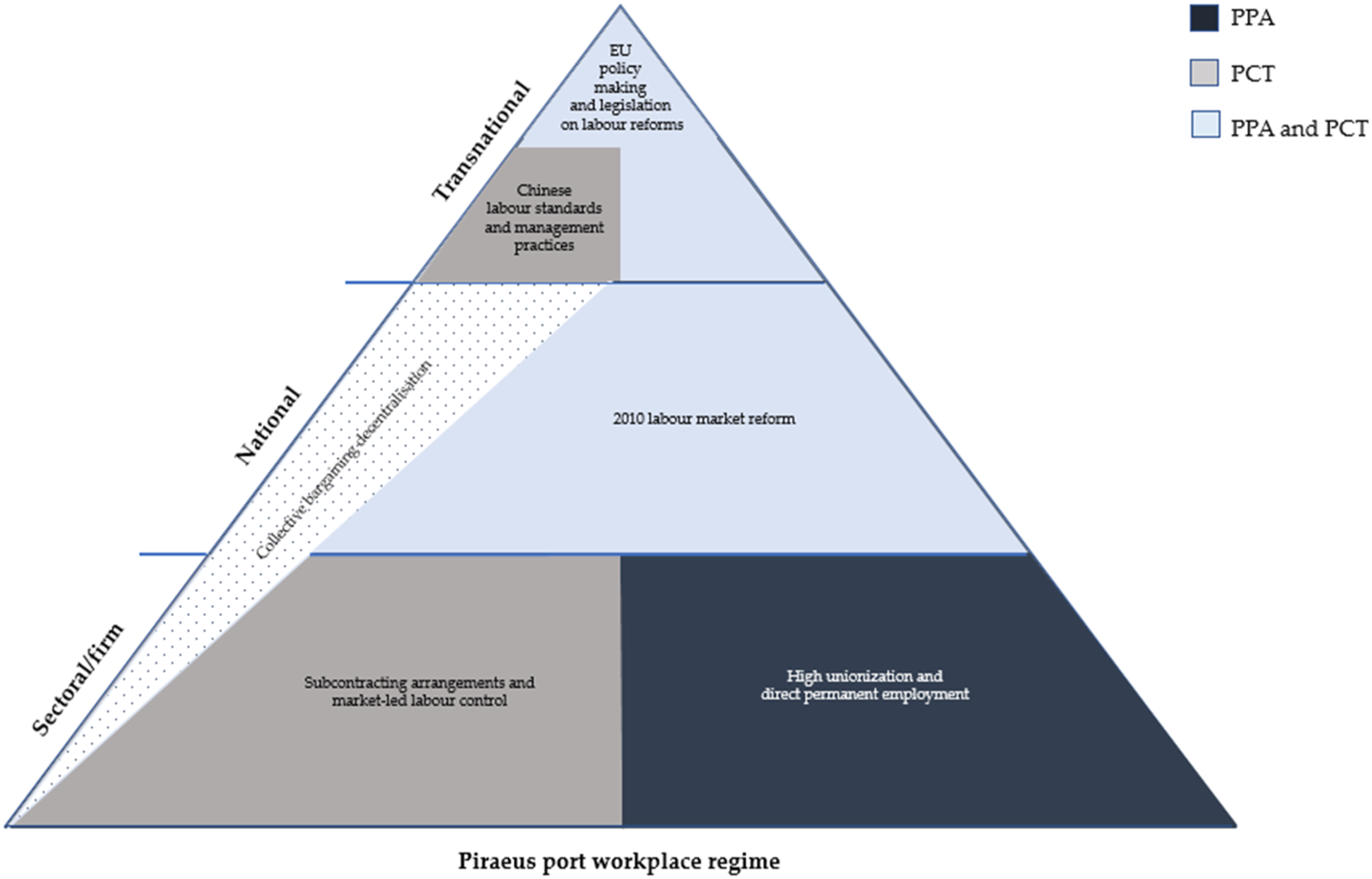
Role of the state
We follow the literature that describes a crucial inter-scalar mediatory role for the state (Coe and Yeung, 2019; Lee et al., 2014), with such mediation occurring between national and transnational governance sources as well as between public and private sector sources (James et al., 2019). States’ governance functions in relation to labour standards can be divided into the facilitative function, geared towards enabling firms’ activities, and the regulatory and distributive functions, which pose limits to firms’ activities in a way that determines the accumulation patterns of wins and losses (Alford and Phillips, 2018; Horner, 2017; Mayer and Phillips, 2017). Such a state-function typology allows for a variety of shared labour standards governance pathways involving public and private firms and non-firm actors. Locke (2013) argues that improved labour standards are more likely when the actions of non-firm private entities (e.g. NGOs) are combined with an overarching political and legislative function exerted by states and with active cooperation on the part of lead firms.
However, doubts arise concerning the de facto ability of states in today’s globalised world to autonomously follow a certain governance trajectory that is devoid of the influence of powerful transnational lead firms on the one hand, and powerful transnational political agendas on the other (James et al., 2015, 2019). Such power imbalances and the resulting labour standards governance configuration are particularly relevant in the context of our work, where COSCO carries its own set of corporate values and a labour standard configuration informed by its own national legislation of reference, which may differ from the regulation mandates in EU host investment locations. At the same time, European labour legislation systems have themselves undergone a sustained process of flexibilisation reform that is reflected not only in country-level regulations but also in EU-level policies and guidelines directed at individual countries (Papadopoulos and Lyddon, 2020). For example, in the context of Greece, the 2010 austerity programme led to a change in Greek labour law provisions to allow a significant increase in the permitted renewal period for temporary contracts, which could now be renewed for 36 months (as opposed to 8) before becoming permanent. In addition, wage rates were reduced for part-time work and agency work not covered by sector agreements; similar trends are observed in other European countries (Izquierdo et al., 2017; Papadopoulos and Lyddon, 2020).
Collective bargaining decentralisation reforms and transnational processes
Such reforms represent a clear break from the interventionist role that the Greek state has played in industrial relations, characterising the Third Hellenic Republic since 1974. The statutory codification of labour standards has traditionally permeated the operation of all industrial relations institutions, including collective bargaining, and a series of institutions were established in the 1990s to direct this process in the spirit of national multiparty cooperation (Koukiadaki and Kokkinou, 2016). In this context, sectoral agreements could be made compulsorily applicable to all employees if already applicable to over half the relevant employees, the so-called ‘extension principle’; in addition, firm-level bargaining could top up and improve on the standards agreed at national and sectoral levels, subject to the principle of ‘favourability’. However, as employers’ associations grew increasingly critical of the collective bargaining framework for being too inflexible and too much in favour of employees, so did EU-level institutions, which indeed, in the aftermath of the debt crisis, started to view Greek trade unions as part of the problem. The unions were therefore marginalised in policy discussions with the Greek Government, giving some powerful firms the opportunity to capture the regulatory process and steer it in a direction that promoted their interests. The results were ‘austerity measures far more wide-ranging and radical than those adopted in other EU member states’ (Koukiadaki and Kokkinou, 2016: 216).
While wage determination and collective bargaining are excluded from EU competence, in the aftermath of the economic crisis, grounds were laid that enabled interference in and monitoring of the wage policy and wage-setting across the EU when needed to correct macroeconomic imbalances (Erne, 2012). In Greece, a concerted attempt was pursued through these regulatory openings to establish a market-based determination of wages and labour conditions through firm-level bargaining, essentially allowing firm-level bargaining to override national- and sector-level bargaining (Marginson, 2015). According to Marginson (2015), the 2009 Greek debt crisis represented a critical moment in the evolution of the articulation between levels in the country’s labour standard governance architecture. As the EU required radical changes to bargaining arrangements as a mandatory condition of financial assistance, the 2010–2012 legislation that followed initiated a ‘disorganised decentralisation’ (Koukiadaki and Kokkinou, 2016: 219). In this process, both the extension and favourability principles described earlier were suspended, dismissals were made much easier for employers to pursue, and company-level agreements were given hierarchical precedence and eventually allowed to derogate from the wage and working time provisions of national or sectoral agreements.
Voskeritsian and Kornelakis (2019) shed light on how such national reforms enacted a shift of power away from labour and towards capital, with the former deprived not only of power resources but also of their decisionality and ability to exercise such power. Their focus on national-level power reallocation dynamics is in line with a large portion of the literature on this topic (Koukiadaki and Kokkinou, 2016; Marginson, 2015). However, ignoring the way that such power reallocation dynamics take shape at the transnational level – namely, through EU legislation and the intersection between Greek and Chinese labour standard practices – risks an excessively narrow focus on the national level, thus missing the role of international capital and actors. In other words, it does not allow us to capture the full complexity of today’s globalised and transnational production processes, which inevitably feed and tie into national-level policymaking. In our case, the two key transnational processes we emphasise are the EU-level transnational pressures just described, along with the influence of COSCO’s pre-existing labour standards configuration, corporate values, and management practices. As mentioned above, in fact, international lead firms may begin to operate in host locations such as Greece ‘at or near the lowest common denominator that domestic policies and legal frameworks allow’ (Henderson et al., 2002: 452) if there are no home and/or host-country labour regulations or international regulations tying them to superior standards (Masino et al., 2023).
Subcontracting
Owing to the organisational advantage it offers, subcontracting as a mode of employment is becoming increasingly widespread, not just in the maritime sector, but across industries and countries worldwide. This is also clearly reflected in the rapid global growth of formal temporary staffing agencies and their role in facilitating the flexibilisation of labour in more liberalised labour markets (Barrientos, 2013; Peck et al., 2005). Moreover, power imbalances imply that even existing state-led attempts to regulate the outsourcing process are often just a façade (Alford and Phillips, 2018; Mayer and Phillips, 2017). In Greece, labour market liberalisation and flexibilisation efforts by the government have been underway since 2010, following the Greek debt crisis, and in response to international political and market pressures at the EU level (Koukiadaki and Kokkinou, 2016; Papadopoulos and Lyddon, 2020). More specifically, in the context of the structural reforms mandated by the bailout Memorandum of Understanding (MoU), the Greek government intervened to pave the way for a generalised flexibilisation of labour mobilisation and labour control issues at the national level (Voskeritsian and Kornelakis, 2019), which facilitated the expansion of subcontracting.
In this study, we look more closely at the widespread practice of subcontracting, as we observe that this underlies the difference in labour control between PCT and PPA. Firms use subcontracting across a large variety of industrial sectors to cope with the cost-cutting pressures faced in today’s globalised economy (Gereffi and Lee, 2016; Peck et al., 2005; Standing, 1999). Labour standards deterioration is often reported in the literature as being associated with the use of subcontracting arrangements (Barrientos, 2013; Barrientos and Kritzinger, 2004; Lund-Thomsen et al., 2012). Indeed, in Piraeus port, a dualistic workplace regime has emerged, with the PCT-managed Piers II and III run by an almost entirely subcontracted workforce. The first collective bargaining agreement (CBA) negotiated between the PCT project contractor and subcontractors, on the one hand, and SYNEDEP, the majority workers’ union, on the other, was not finalised until 2019. In comparison, PPA-managed Pier I is still highly unionised, and labour standards are consistently regulated by collective bargaining processes.
This resulted in the segmentation of the workforce in multiple respects: spatially, contractually, and with regard to their mobilisation strategies. Subcontracting has been described as a device that allows lead firms to share labour control responsibility and spread it along their supply chain, while allowing the transfer of substantial competitive and cost pressures down to subcontractors (Fei, 2020; Malesky and Mosley, 2018). The words of one of our respondents appear to closely match this conceptualisation to the reality in Piraeus port today and express the personal view that subcontracting served COSCO’s cost-cutting and productivity-seeking purposes. Subcontractors are best for projects that require specific skill sets, while employees are great for on-going, long-term projects. In Piraeus port’s and COSCO’s case, rapid development in the area of the port owned by the Chinese government needed to be done on a short-term basis with the least cost possible, in terms of personnel wages. Therefore, sub-contracting was a necessary measure. (Interview 14 - manager with direct experience of the companies operating at Piraeus port)
PCT hired a local Greek contractor, DPort, to manage the port and, most importantly, its human resources, leaving only approximately 200 white-collar workers (engineers, yard planners, and control tower staff) on PCT’s direct payroll. Therefore, PCT is an umbrella company, in which the relationship between COSCO/PCT and DPort is through a project contract rather than a shareholder link (CNN Greece, 2022). Furthermore, DPort coordinates six smaller Greek subcontractors.
Therefore, subcontracting takes the form of a cascading process whereby the lead firm passes duties and costs related to workers’ management and social security to lower-tier firms. In our case, DPort and the subcontracting companies (S1 to S6 in Figure 2) had the sole responsibility for hiring and managing workers as well as for the CBA negotiations. Some foresee that the extension of subcontracting to Pier I will eventually result in the application of the operational model to PPA workers (Papageorgiou, 2020). Indeed, beyond the risk diversification motive, one respondent also explains that the subcontracting arrangements exist to shield COSCO and PCT from worker mobilisation. They knew that in Piraeus, there were a lot of strikes, and a lot of delays, so they didn’t want to risk on that. And they thought that this was the way to avoid it. (Interview 12 - external observer) Subcontracting structure of PCT-managed piers.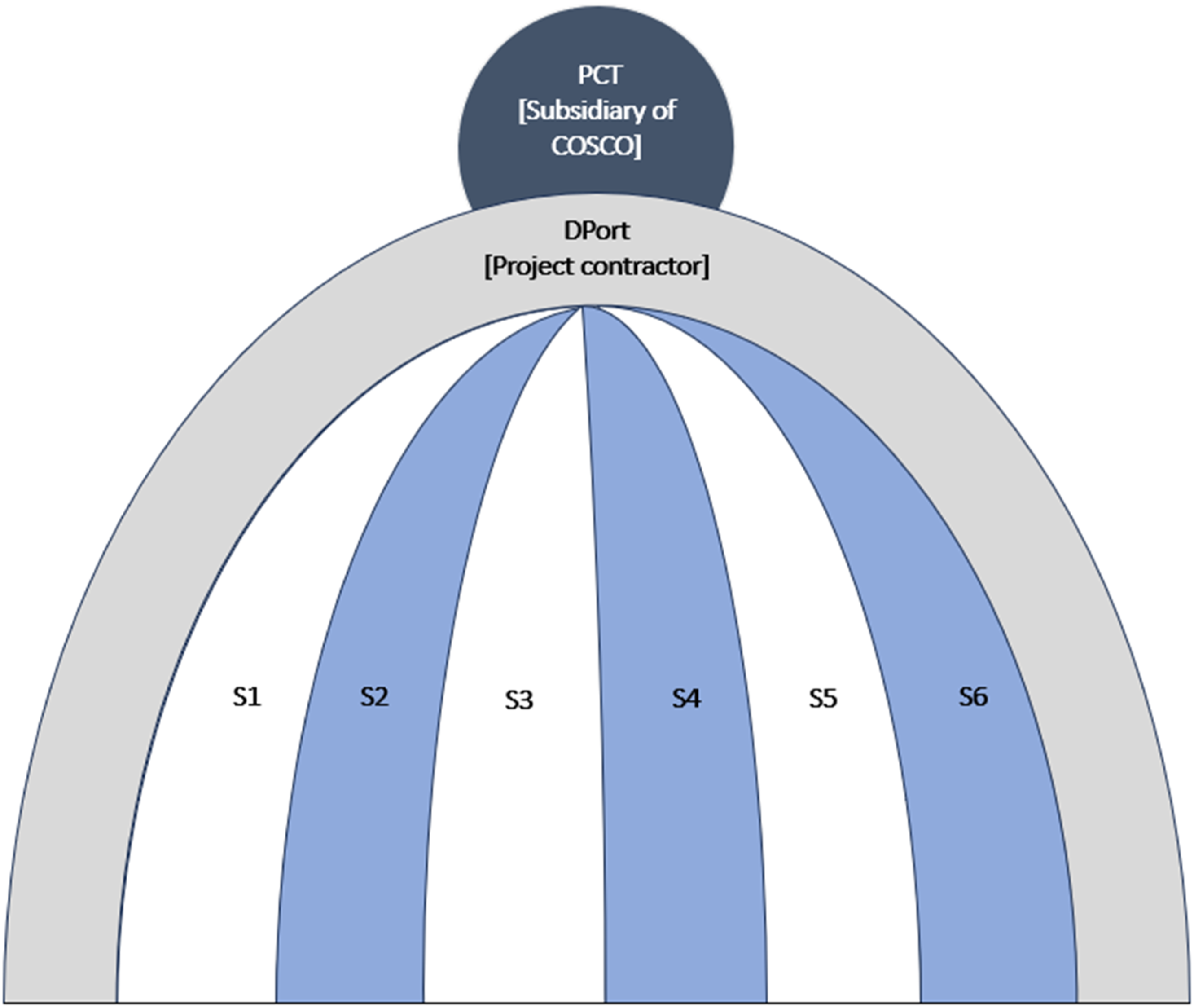
DPort and its subcontracting companies (S1–S6 in Figure 2) are solely accountable for all CBA-related grievances. PCT never appears as a signatory, given that its direct employees are white-collar workers who are not members of SYNEDEP. This adds weight to the suggested shielding role that subcontracting plays in favour of the lead firm. In this sense, from a workplace regime perspective, the power relations implicit within a subcontracting set up lead to an undermining of workers’ agency through the spatial discontinuity and disjunction they introduce between workers, the lead firm, and their ‘real’ employer (Wills, 2009), in what can be seen essentially as a form of market-led labour control (Anner, 2015). In Piraeus port, this is compounded by the fact that PPA dockworkers are in general more experienced, as they have been on the job for a very long time, which gives them stronger territorial ties and connections to the business, translating into greater mobilisation power. DPort instead hired staff in bulk, most of them young unemployed workers who were to be trained from scratch, as they had no port-related expertise. This background fits appropriately with the subcontracting mode of employment and relational discontinuity described above, resulting in the inevitable weakening of employees’ bargaining power.
Contracts, shifts, and remuneration
Looking specifically at the working conditions prevailing onsite, we found no traditional (when compared to Pier I arrangements) stability in work patterns and shifts for workers hired under subcontracting, as in the words of a Pier I dockworker and a former PCT employee, respectively. Here in Pier I, it’s more, let’s say, organised, and I know most of my schedules. I know that, on Wednesday, I have a day off. For the other workers, in Pier II and III, this is not the case: you may have the day off, you may receive a text the last night and you have to come, it’s not compulsory officially, but in reality, it is compulsory, you have to go. [Also on Pier I], you are not expecting to receive a call on your day off saying to you: ‘Oh, can you please come to work? (Interview 3) I mean that you know that you have a monthly salary and you have an employment contract [in Pier I]. Whereas the subcontracted employee [in Piers II and III] is waiting to receive the SMS of whether he will come on duty or not (. . . ) Everything is better (in PPA); it cannot be compared. The company employees have a fixed salary; the outsourced employee does not necessarily have the fixed salary of a company employee [due to their variable working hours – they do not have a fixed salary]. (Interview 16)
Following a fatal incident, the national Greek press highlighted one of the challenges of working as a subcontracted worker on Piers II and III as having 12-h shifts or the practice of what is called ‘back-to-back shifts’, when a worker works two full shifts with just 8 h of rest in between (Efsyn, 2021). A manager from one of the six subcontractors also explained that firms see subcontracted workers as convenient because they are easily replaceable and redeployable, owing to the nature of the practice: Fixed-term contracts without considerable health benefits and insurance, in most cases, mean that workers under the COSCO side of the port are more expendable and subject to any shifts in work schedule, nature of work, etc. (Interview 14)
However, a contrasting narrative emerged, with some managerial respondents believing that workers were willing to take on more work and longer hours, as they were remunerated accordingly.
The workers brought in to fill PCT positions for the largest part had not been dockworkers previously. They were unemployed and looking for jobs. However, the welfare system afforded to PPA dockworkers can still be compared to that of the PCT’s subcontracted workforce because they perform the same type of work. Our respondents pointed out that working conditions did not remain static but had evolved since the inception of COSCO’s operations in 2009. Specifically, contract uncertainty and flexibility are said to have occurred only during port downtime periods. Therefore, while turmoil was caused by excessive flexibility in the demand for workers around the beginning of COSCO’s operations in Piraeus port, this was no longer the case at the time of our interviews, when all shifts were fully booked and scheduled daily owing to the huge increase in trade volumes 4 . In this view, subcontracting leads only to welfare losses, while the port operated suboptimally. Subsequently, subcontracted employees worked in a manner comparable to that of employees on Pier I in terms of stability and shifts.
However, there were differences across the piers in terms of the number of workers in a gang. Specifically, a longstanding union-backed and agreed provision required that a gang of nine people work at a gantry crane at all times on Pier I. COSCO believed such personnel allocation to be a waste of resources and reformed this practice to use a crew of just four or, at times, a maximum of five dockworkers. Four or five workers were believed to be more than enough to carry out the work that the gangs were supposed to perform, and it was believed that such allocations responded to a more economical and efficient use of resources. Some of our respondents agreed, while others – especially dockworkers and union respondents from Pier I – strongly disagreed and saw the change as reflecting very different views of the trade-off between productivity and workers’ safety and well-being at work.
In addition, a former PCT employee added that PPA workers operating cranes normally undertook 4-h shifts, in line with many other European port standards, but for PCT crane workers, shifts were extended to 8 h. It was difficult to compare monthly salaries between the two parts of the ports because subcontracted salaries are calculated on a 22-day basis rather than a monthly salary. However, our respondents indicated that the average negotiated salary for PPA dockworkers was in the range of 1,500–1,600 euros per month, while lower amounts were reported for PCT dockworkers, with some of our respondents indicating 1,150 euros per month in 2019 and Equal Times (2022) reporting 1,300 euros per month. More importantly, what emerged from some of our interviews was that PPA salaries were mostly fixed, while changes in shift lengths, overtime hours worked, and, in general, the flexibility described above allowed PCT workers to earn substantially more than their basic salaries. Furthermore, on Pier I, dockworkers were assigned to a broader range of tasks on a daily basis, but none of these affected the contractual (and CBA-agreed) pay to a large extent. In Piers II and III, workers’ remuneration is much more connected to their speciality level and sector The higher a worker’s level of specialisation, the higher the salary they get. Even if I use him as a driver, I pay him as a quay crane driver. (Interview 2 - respondent with direct experience of the companies operating at Piraeus port)
Workers on both sides of the port received benefits and allowances. We found that the PCT-subcontracted workers’ benefit package included private health insurance, lunches on site, and free driving lessons. By contrast, the benefit package for PPA workers included wedding packages and tuition fees for their children.
Labour control through workers’ unionisation
Unionisation levels differ across piers in Piraeus port, with Pier I workers falling under at least three large established unions: the Federation of Port Workers of Greece (OMYLE), the Association of Dockworkers of PPA, and the Union of Supervisors and Foremen (OFE). We consistently identified very high levels of unionisation across all PPA employees, with CBAs forming the backbone of the representation strategy.
The workers on PCT piers are primarily represented by two main unions: the Union of Piraeus Port Dock Container Workers (ENEDEP), created in 2014, and the Union of Employees of Firms Operating on Piers II and III (SYNEDEP), formalised in 2018 5 . The first union is a left-wing, politically militant union. While PCT’s subcontractors and ENEDEP had long confronted each other over the issue of CBAs, including a 3-month strike (Efsyn, 2018), the union failed to secure a deal in 2018 (Pamehellas, 2018) and was not formally recognised by the company until the extensive mobilisation and union activity that followed the death of an ENEDEP member at Pier II in October 2021 (Efsyn, 2022). As a result of the fatality, PCT workers held strikes and ENEDEP demanded the establishment of a Health and Safety Committee at PCT, the termination of back-to-back shifts and 12-h shifts for dockworkers, and more importantly, the negotiation of new rounds of CBAs. However, the new CBA was signed with SYNEDEP instead, as it had become the main representative union due to having the largest number of members by this time. Most requests were accepted, and it was decided that the number of staff members per gang would be increased from four to five (Efsyn, 2021).
Some of our respondents associated SYNEDEP with the far-right Greek political party Golden Dawn and explained that PCT compelled every PCT dockworker to automatically sign up as a member of SYNEDEP upon signing their contract: SYNEDEP is the union, [...] it was partly initiated by Golden Dawn [...] and you know Golden Dawn, comes from employers in order to have less strikes. (Interview 5 - external observer) It is a condition in workers’ contracts that if they want to start working in the port, they must be a member in SYNEDEP [...] many became members of SYNEDEP without knowing they had automatically. [...] They took this case to the court, and at the end of the day, and after a long period that the court could not decide [...], there was a certain person that went to the court and they say: look, I am a member of the board of ENEDEP, and I know that I’m there because I’m elected, but I’m conscious enough in order to know what I’m doing. And I never ever asked to be a member of SYNEDEP, how on earth we are there. (Interview 23 - unionist with direct experience of the companies operating at Piraeus port) If there’s something that was imposed, SYNEDEP is the special case of the union [...] In my opinion, they are yellow unions. (Interview 1 - unionist with direct experience of the companies operating at Piraeus port)
As, by law, the CBA is to be signed with the union that has the largest representation of the workers, many believe that the forced sign-up was no more than a strategy to fictitiously attribute the largest representation base to a company-managed-union (Equal Times, 2022; Rizospastis, 2018); in other words, DPort and the subcontractors set up its own syndicate, so that it could negotiate with itself (Katiousa, 2018). Therefore, this allowed SYNEDEP to replace ENEDEP as the largest union.
Voskeritsian and Kornelakis (2019) see the role of trade unions as having been greatly reconfigured following the 2010 reforms because of the role of capital, which was allowed to grow larger, and the collective bargaining decentralisation reforms. Our framework interprets this as collective bargaining shifting downward through the scalar architecture from the national and industry/sector levels to the firm level under the influence of transnational factors (Koukiadaki and Kokkinou, 2016; Marginson, 2015). Our field evidence supports the intensification of the labour process because of the power reallocation dynamics depicted in Voskeritsian and Kornelakis (2019). In addition, it also suggests that PCT managed to manipulate the unionisation process in PCT piers by a forced sign-up of membership, giving advantage to a union preferred by the employer or that is less militant (SYNEDEP), and thus shaping the CBA to its favour and maintaining the managerial control regime or the status quo.
While the port has a tradition of strong union presence and activity, the collective bargaining decentralisation reforms did not seek to disband this entirely, and a stronghold was maintained on Pier I. The partial transition thus limited losses in the eyes of many and made it easier to justify new employment arrangements in an area of the port that was either reorganised or built entirely from scratch. In addition, the port only features two managing companies, thus significantly skewing power dynamics in favour of employers in the newly organised part of the port.
Conclusions
Our approach in conducting this study has been to focus on a better understanding of the workplace regime outcomes that have developed on the PPA- and PCT-operated sides of Piraeus port in Greece, one of the most visible and important investments in the context of the BRI in one of the most important Mediterranean ports. We cast a multi-scalar perspective on the case study as a specific way of interpreting our findings to link the transnational to the national and sectoral/firm levels, thus going beyond a narrow focus on COSCO and the port itself.
Our findings point to positive employment effects when local workers were recruited during a time of exceptionally high unemployment in Greece following the 2009 debt crisis. However, from a distributive perspective, following COSCO investment, substantial productivity increases in terms of trade volumes and business activity have not translated into improved labour conditions. In this respect, we identify employment patterns characterised by inbuilt flexibility and precariousness due to extensive subcontracting. In addition, a trade union has emerged as an instrument of labour control on the PCT-managed side of the port, with some initial evidence that workers’ agency is at least partially undermined by control over their unionisation and mobilisation. Simultaneously, evidence of significant breakthroughs has also emerged, with the activity of another militant union recently gaining partial recognition.
We propose a multi-scalar governance architecture in which the interactions between transnational-, national-, sectoral-, and firm-level factors enable subcontracting and unionisation outcomes. In particular, we argue that, on the one hand, the national legislative reforms, started in 2010 in response to and under the pressures of the bailout programmes, facilitated labour outsourcing to achieve liberalisation and flexibilisation of the labour market. Without these reforms and the flexible working practices that they allowed COSCO to adopt, any transnational production actor might have deemed investment in Piraeus too risky. The resulting segmented workplace regime observed for port workers is characterised by the disjunction between the lead firm, COSCO, and the remuneration and representation of the workforce at Piers II and III offered by subcontractors. This is not yet the case for Pier I, but the facilitatory role of the state raises the question of whether such a dual arrangement is set to persist.
On the other hand, we emphasise the importance of the transnational level in channelling state reforms, with the role of COSCO seen as important, but playing alongside the powerful mandates of the European Union’s MoU. More specifically, the flexibilisation pressures that drove the acquisition of Piraeus port were not specific to the port, or even to Greece. Rather, they respond to globalised competition and productivity imperatives. The resulting configuration of new labour relations in the wholly Chinese-operated part of the port is thus as much the product of the acquisition as it is the result of the national policy responses that the EU bailout demanded. COSCO, as an investor, introduced the inevitable coexistence of corporate cultures, production approaches, and workplace regime configurations in a previously exclusively Greek-operated productive environment. However, it is not possible to generalise and speak of a specific Chinese stamp to the resulting workplace regimes. While common traits in the workplace regimes of Chinese companies in host locations worldwide have been uncovered in the literature (see e.g. Lee et al., 2014 or Fei, 2020), in Piraeus port, COSCO retained only eight managers at the very top management level and delegated all other labour management functions to local managers and subcontractors. Thus, COSCO made a conscious choice to delegate the shaping of the new workplace regime in the port to the interaction between the new transnational productivity mandates and the reorganisation of the labour force around a production model that could allow it, that is, a subcontracting model. It would be difficult to guess the outcome if a company owned by different investors had won the tender, as we did not observe this counterfactual. This study supports the idea that governance outcomes are the product of multifaceted matrices of factors encompassing lead firms’ corporate culture, host locations’ pre-existing legislation and practices, and the international political and regulatory environment. Thus, in this case, COSCO was the actor that enabled policy directives created outside the productive sphere at the transnational and national political levels.
Against the interplay of such transnational and national elements, collective bargaining processes in Greece were being decentralised, which represents a shift from the national and sectoral levels to the firm level in the governance architecture we have presented. Thus, we argue that the workplace regime outcomes of COSCO’s investment in Piraeus port cannot be meaningfully interpreted without utilising a scalar perspective that sees the various governance levels as interconnected. Future research on this case study should focus on widening the scope of available data to enable more in-depth research on the motives of subcontracted employees and the power asymmetries that limit their decisionality and agency. In addition, such research should focus on uncovering the private, public, and institutional factors that currently enable firm practices detrimental to workers in the port and skew the national legislative framework towards a facilitative rather than a redistributive function. A comparison of such lines of enquiry in other ports across Europe would further enrich the analysis.
Footnotes
Declaration of conflicting interests
The author(s) declared no potential conflicts of interest with respect to the research, authorship, and/or publication of this article.
Funding
The author(s) received no financial support for the research, authorship, and/or publication of this article.
