




Abstract
This article is based on a comparative analysis of precarious work and employment relations practices at McDonald’s stores in China and the UK. It applies the concepts of workplace regimes and sensemaking. The authors argue that in both countries recruitment policies, contracts and working time are manipulated by McDonald’s management as control mechanisms, but that sensemaking in different national institutional and cultural contexts produces variations in control styles and the manner of worker responses. The findings suggest that the work regime at McDonald’s China is partly shaped by Confucian values, an enduring feature of Chinese culture, leading to a form of patriarchal control and self-imposed subordination amongst the predominantly female and student workforce. At McDonald’s UK, arbitrary control is enabled by an institutional context of minimal worker protections (particularly zero-hour contracts) and an acquiescent workforce predominantly made up of young workers, economic migrants and other marginalized workers.
Introduction
Precarious work is associated with uncertain, unstable and insecure jobs where employees bear more of the risks and receive few of the benefits (Kalleberg and Hewison, 2013; Kalleberg and Vallas, 2017). Under neoliberal economic globalization, the recent decades have seen a considerable growth of precarious work on a global scale (ILO, 2016; Keeley, 2015). In 2019–2020 about 9.3% of the UK workforce remained in precarious work, which amounted to 5.2% of the UK population (Pósch et al., 2020). In China, the increase in precarious work is heavily linked to informal employment as a result of the shift towards a more market-based economy (Kalleberg and Hewison, 2013). Precarious work is not only concerned with working lives, but also affects broader macro-social issues such as economic and social policy and the welfare state (Kalleberg and Vallas, 2017). Given such practical significance, the study of ‘precarious work’ has been the subject of significant academic and policy interest (see Conen and Schippers, 2019; Doellgast et al., 2018; Kalleberg, 2018; Standing, 2011; Vosko, 2010). Existing research has investigated the incidence and forms of precarious work drawing on the evidence from labour markets (e.g. Arnold and Bongiovi, 2013; Eichhorst and Tobsch, 2017; Katz and Krueger, 2019; Lewchuk, 2017; Olsthoorn, 2014; Prosser, 2016). Moreover, some studies focus on explaining the cause of precarious work, which reflects shifts in the balance of power between labour and capital, as either being stimulated by state policies (Baccaro and Howell, 2011; Rubery et al., 2018) or firm strategies (Greer and Doellgast, 2017; Kalleberg, 2009). More recent research focuses on worker experience or individual subjectivity at the micro level. For example, Trappmann et al. (2024) examine how precarious workers interpret and legitimize their situations, while Berry and McDaniel (2022) examine the apparent ‘normalization’ of precarity in the post-crisis economy. Other studies examine the ideological orientations of young precarious workers (Ioannou, 2024) and the personalization, differentiation and deindividuation in experiences of workers in the ‘precariat’ (Manolchev et al., 2021).
However, these studies focus on either macro-level regulatory context or micro-level workers’ subjectivity but tend to overlook workplace dynamics in precarious work, especially interactions between actors (employers and workers). Although it is acknowledged that the prevalent forms and manifestations of precarious work are likely to vary significantly across countries and are influenced by contextual factors (such as institutions and culture) (Prosser, 2016), the connections between workplace dynamics in precarious work and contextual factors are not well understood (Manolchev et al., 2021).
To address this gap, we apply the concepts of ‘workplace regimes’ and ‘sensemaking’ to bridge the macro-level context and the micro-level workplace dynamic. While workplace regimes help to illustrate workplace dynamics among actors (mainly around managerial control and worker responses), sensemaking helps us to understand how individuals make sense of contextual factors (such as institutions and culture) and to interpret and explain environmental cues and how these affect their behaviours.
We conducted an in-depth qualitative case study of the McDonald’s Corporation, the largest food service company in the world. It has been argued that McDonald’s has a highly standardized system of employment practices, driving a ‘low-road Americanization’ of employment relations practices across different countries (Royle, 2000, 2010) creating a system of ‘McJobs’ (Ritzer, 1998). According to Kalleberg’s typology of job quality, ‘McJobs’ fits well into the category of ‘precarious work’ (Kalleberg, 2009, 2011; Kalleberg and Vallas, 2017). Existing research on McDonald’s and its ‘McJobs’ in Europe and the USA suggests that the majority of McDonald’s jobs are low-skilled, fast-paced and unrelenting when stores are busy, with workers raising many common grievances across countries. These include: insecure hours; poor wages; wage theft; poor enforcement of health and safety standards; management bullying and harassment; little or no protection against aggressive customers; and a deep rooted hostility to trade unions, meaning that even in some countries where unions have gained recognition and established collective bargaining, there is often little effective independent voice at store level (Barnes, 2023; Royle, 2000, 2010; Royle and Rueckert, 2022; Royle and Urano, 2012). This article provides a comparative analysis of McDonald’s employment relations practices in two different national institutional and cultural contexts – China and the UK – in one highly standardized fast-food multinational enterprise (MNE). With an international comparative approach, analysing the same themes across different contexts reveals commonalities while also enabling a nuanced assessment of divergences. The main research questions are, first, what kind of managerial controls are applied and what are worker responses in the workplace regimes at McDonald’s in China and the UK? Secondly, how does the sensemaking of managers and workers influence their behaviours, especially in terms of managerial control and worker responses?
Theoretical lens and literature review
Burawoy (1985) developed the concept of ‘factory regimes’ by connecting labour process theory (Braverman, 1974; Edwards, 1979; Friedman, 1977), ‘the coordinated set of activities and relations involved in the transformation of raw materials into useful products’ with the wider institutional environment, ‘the institutions that regulate and shape struggles in the workplace’ (Burawoy, 1985: 87). In other words Burawoy combines micro politics within workplaces and macro politics/institutions within national contexts and categorizes different types of workplace regimes in capitalist industries. The first is market despotism, where coercion clearly prevails over consent, especially in the absence of collective forms of organization with workers having no ability to effectively resist arbitrary coercion (Burawoy, 1985). The second is hegemonic regime, which suggests that state instituions (such as social insurance) can subordinate the market by reducing workers’ dependence on wage employment and labour legislation, and facilitating resistance to arbitrary coercion. However, Burawoy argued that following the neoliberal economic orthodoxy of the 1980s, a new form of workplace regime emerged, that of ‘hegemonic despotism’, in which workers have become more vulnerable to the mobility of capital and where hegemony in the workplace has been reproduced through the aggressive and authoritarian imposition of market discipline.
More recent work applying the ‘factory regime’ concept has tended to focus on distinguishing between the way in which standard and non-standard employment relations manifest in workplace regimes. For example, Chun (2001) coins the term ‘flexible despotism’ to describe a labour regime in which employers exploit and mask the coercive character of their labour control strategies through contractual arrangements, creating, maintaining and reproducing workers’ consent to the stress and insecurity associated with flexible production regimes. Nichols et al. (2004) suggest that there are three aspects of labour regimes: labour control, material support and contracts in the factory regimes in three East Asian regions. Similar outcomes were also found in Degiuli and Kollmeyer’s (2007) research on temporary agency contracts in Italy and in Zhang’s (2014) study on the paradox of labour force dualism in the Chinese automobile industry. These latter two studies examine how employment status modifies the wage–effort relationship in workplace regimes. Wood (2020, 2021) also applies the concept of ‘workplace regime’ in the retail sector and emphasizing flexible working time (temporal flexibility) under flexible despotism; however, he arguably underestimates the issue of employment contract (numerical flexibility).
Despite the considerable rise of the service sector there are still few studies on workplace regimes in low-end service sectors and yet these provide very different settings to those in manufacturing (Ó Riain and Healy, 2024). First, low-end service employers tend to seek various forms of flexibility, not only in employment status but also in working time arrangements (Spreitzer et al., 2017). More short-term, non-standard employment forms prevail in service sectors with working time being more fragmented (Ikeler, 2016). Second, technological development is arguably creating a more rationalized and exploitative working environment (Bain et al., 2002; Callaghan and Thompson, 2001), in which ‘digital Taylorism’ has overtaken Braverman’s account of change in office work (Huws, 2014; Neufeind et al., 2018). Third, the workforce is likely to be more diverse in service sectors. In contrast to the ‘masculinity’ of manufacturing workplaces, more female and young workers work in service sectors and this is also associated with various demographic characteristics and social identities (Nixon, 2009). Fourth, there is usually a much lower level of unionization in service sector workplaces.
The concept of ‘workplace regime’ helps us to understand the dynamic relationship between employers and workers and acknowledge the impact of institutions on employment relations practices in workplaces. However, it does not provide nuanced views on how behaviours of employers and workers are generated, particularly in the way they make sense of their environment. Sensemaking is a process of social construction in which individuals interpret and explain sets of cues from their environments. Weick et al. (2005: 409) state: Sensemaking unfolds as a sequence in which people concerned with identity in the social context of other actors engage ongoing circumstances from which they extract cues and make plausible sense retrospectively, while enacting more or less order into those ongoing circumstances.
Sensemaking allows individuals to create and maintain an intersubjective world as they ‘interpret their environment in and through interactions with others, constructing accounts that allow them to comprehend the world and act collectively’ (Maitlis, 2005: 21). In other words, the concept of sensemaking helps to explain how individuals and groups answer the questions ‘what is going on here?’ and ‘what should I do next?’ Identity is also associated with sensemaking. As Weick (1995: 24) explains, . . .what the [interrupted] situation means is defined by who I become while dealing with it or what and who I represent. I derive cues as to what the situation means from the self that feels most appropriate to deal with it, and much less from what is going on out there.
Sensemaking is therefore intertwined with identity construction as it involves interpreting what is perceived and how it is perceived, thus influencing the actor’s sense of self (Gioia and Thomas, 1996). In addition, power issues inherent in work relations can arguably affect how the micro-processes of sensemaking are enacted, guided and controlled, and in some cases lead to tensions in organizational sensemaking (Brown et al., 2015; Maitilis and Christianson, 2014). Power (either systemic or episodic) can shape not only the content of sensemaking, but also the form of sensemaking process (Schildt et al., 2020). As Vlaar et al. (2006) suggest, the process of generating understanding is inevitably entangled with power dynamics and self-interested behaviour. Actors with more formal authority, such as managers, try to influence and shape others’ beliefs to align with their own preferences, interpreting phenomena through the lens of their own interests (Vlaar et al., 2006). Additionally, they may strategically withhold information from other parties or wield their power to ensure that certain issues are either included or omitted from formal documents or policies. Therefore, authoritative sensemaking is not merely neutral; rather, it operates as a hegemonic force, exerting power to mobilize and perpetuate the active consent of those under its influence (Brown et al., 2015).
Sensemaking is unlikely to take place in isolation, but in specific contexts. Arguably, broader contexts (such as institutions and culture) can influence and constrain sensemaking processes and their outcomes (Weber and Glynn, 2006; Weick et al., 2005), and shape expectations and assumptions (Sandberg and Tsoukas, 2015; Weber and Glynn, 2006). Weber and Glynn (2006) identify three mechanisms where institutional context is brought into the process of sensemaking – priming providing social cues, editing through social feedback processes and triggering by providing dynamic foci that demand continued attention, or by creating puzzles that require sensemaking due to the contradictions, ambiguities and gaps that are inherent in institutions. Drawing on culture theory, Malsch et al. (2012) suggest that four types of interactive and non-deterministic cultural biases in organizations, individualism, hierarchy, egalitarianism and fatalism, are associated with different sets of framing assumptions which affect the sensemaking of individuals. However, although the role of contextual factors has been acknowledged, relatively limited empirical studies have investigated how this influence may occur. Thus, Maitlis and Christianson (2014) called for more studies that explore the role of macro-level factors, such as social, cultural, economic and political, in the constitution of sensemaking processes, both within and across organizations.
Research methods
The single case study employed in this article provides for deep immersion in the research context, rich data from multiple sources and intensive insights into the research setting (Yin, 2013), enabling the examination of complex organizational process and phenomena at a fine-grained level (Ozcan et al., 2017).
Case profile
McDonald’s is the world’s best-known brand, the largest food service company and one of the world’s largest employers with around 2 million employees 1 (Forbes, 2020). It is also the market leader in the fast-food sector in nearly every country where it operates. By 2023, McDonald’s had well over 40,000 stores worldwide and a market value of $197bn in 2022 (Statistics, 2023). China is McDonald’s second largest market and the fastest growing market in the world. In 2023 McDonald’s had around 5,400 stores in China, which accounts for more than 10% of its total stores worldwide (Reuters, 2023). McDonald’s UK is the corporation’s second largest European market with over 1,450 stores and approximately 170,000 employees (ScrapeHero, 2023). Earlier research shows that the hierarchy in McDonald’s stores is remarkably similar in all the countries where it operates (Royle, 2000, 2010; Royle and Urano, 2012). In both the UK and China, there is usually one salaried business manager and three to five salaried assistant managers depending on the size of the store, while the majority of the workforce (over 90%) are hourly-paid workers; this includes: shift managers, crew trainers and crew members. The total number of salaried managers, shift managers and hourly-paid workers depends on the size of stores, with some exceptions: high street stores typically employ around 50 in total (with three to four salaried staff) whilst large drive-ins may employ up to 200 staff or more, although only a smaller proportion of these staff work in the store at any one time.
Data collection
The data for this article were collected in 2017, 2018 and 2019 and derive from participant observation, semi-structured interviews and an analysis of documents. Participant observation was conducted at McDonald’s stores in China and the UK, providing a deep understanding of working conditions and employee relations practices at workplace level. I (the first author) was employed on a full-time contract at a McDonald’s store in a large-sized city in China for five weeks. In this period I worked 29 shifts and 199 hours in total with only one day off each one week (average daily working hours 6.86 hours). In the UK I was employed on a part-time contract at a McDonald’s store in a medium-sized city for 15 weeks. I worked there for 20 shifts equivalent to 132 hours (average daily working hours 6.6 hours). These two stores were selected based on purposive and convenience sampling (Gentles et al., 2015). In both stores, I mainly worked on the tills and took orders from customers. As the work was fast-paced and often unrelenting, field notes were written up at the end of each working day.
Semi-structured interviews were undertaken with (ex-)employees and (ex-) store-level managers at McDonald’s in both China and the UK. The interviews were undertaken based on convenience and snowballing sampling which began with some personal contacts; some other interviewees were sought through social media platforms (such as WeChat, Weibo in China; Facebook, LinkedIn in the UK). Across China 27 workers and managers from 20 McDonald’s stores (from 12 cities in 10 provinces) were interviewed. In the UK 24 workers and managers in 19 different McDonald’s stores across 15 cities were interviewed (see Appendices 1 and 2). Nine of the workers interviewed in the UK were involved in the McDonald’s strikes that took place in 2017, 2018 and 2019. The number of interviews conducted in the two countries met the requirements for code saturation (indicating researchers have ‘heard it all’) and meaning saturation (indicating researchers have ‘understood it all’) (Hennink et al., 2017). Typical questions included: ‘What contract or agreement did you sign with McDonald’s?’ ‘How is the scheduling arranged and by who?’ ‘How are you notified about your shifts?’ ‘How would you describe your relationships with store managers and other workers?’ Managers were also asked about recruitment, contract and working time arrangements and their relationships with workers. Additional interviews included two government officials dealing with labour issues in China, whom we asked about labour regulation and its implementation in China; and one union organizer from the UK Bakers, Food and Allied Workers Union (BFAWU), whom we asked about union organizing at McDonald’s in the UK. An analysis of documentary materials was also carried out including newspaper reports, McDonald’s operational reports, government documents, trade union reports and regulatory and policy documents relating to labour standards in both China and the UK.
Data analysis
All the interview transcripts, field notes and documents were entered into QSR NVivo, and following the template analysis approach (King and Brooks, 2017) a comprehensive process of data coding and identification of themes was undertaken. Themes in the template are stipulated in advance of coding to reflect specific areas of research aims, but the themes and the template can be modified as researchers gain a better understanding of the data (King and Brooks, 2017). This approach is flexible and pragmatic as it enabled us to use a process of thematic coding, both deductive deriving from the theoretical framework and inductive emerging from the raw data (Fereday and Muir-Cochrane, 2006). In this study, the template was developed based on the research aims and the theoretical framework and we organized a priori top-level themes around main issues related to managerial control, worker responses, managers’ sensemaking and employees’ sensemaking. Preliminary coding was carried out and emerging themes were transferred to hierarchically organized codes. Higher-order codes were listed under each of these heading themes and were defined based on the literature and raw data. For instance, some control strategies, such as personal control or bureaucratic controls, have been suggested in previous literature (Edwards, 1979); however, if some sections of the text appeared relevant or contributed to other control strategies, such as patriarchal control or arbitrary control, these were highlighted producing new codes. Lower-order codes were developed through a more iterative process of reading through the data. Parallel coding was also conducted with parallel themes related to employment relations practices, workforce characteristics, employment contracts and working time, as it was likely that the main themes that derived from theoretical framework would intersect with these aspects of employment relations practices.
Hierarchical relationships between codes and themes were identified and the initial template was iteratively modified and developed. For example, if some codes emerged which suggested inadequacies in the initial template, modifications were made and new themes were inserted into the template. The Chinese data were coded first and the initial template was developed from these data; this initial template was used for the UK data then modified. Comparing the two final templates from the two countries served as the basis for the comparative analysis.
Subordinated despotism at McDonald’s China
In China the 1995 Labour Law codified a universal labour contract system for formal employment in China. However, under pressure to achieve more economic growth, it contains a number of regulatory loopholes and is poorly enforced. Furthermore, as other research has shown, only one trade union is allowed in China: the All-China Federation of Trade Unions (ACFTU)– an arm of the state whose main role is to avoid conflict and is largely ineffective in terms of protecting workers’ interests (Taylor and Li, 2010). This leaves a lot of space for employers to disregard or undermine employment laws; accordingly most workplace regimes in China are said to be ‘despotic’ (Chan, 2010; Chan and Zhu, 2003; Lee, 1999). For example, Chinese labour law provides full-time and part-time workers with statuary labour rights while others, such as student workers and retired workers (over 50 for females and over 60 for men), are excluded from the law (Ho, 2009). At McDonald’s, managers take advantage of this institutional void by predominantly employing students and retired women with low education levels on service agreements (Wei, 2024). This allows management to exploit the hierarchical nature of Chinese society, creating a workplace regime of subordinated despotism, through a combination of patriarchal control and self-imposed subordination.
Patriarchal control
Chinese law identifies three kinds of part-time hourly-paid workers: non-student part-time workers, student workers and retired workers. Full-time workers and non-student part-time workers are entitled to a labour contract with legally underpinned labour rights (for example, minimum wage, maximum working hours and grievance procedures). McDonald’s China violates this law and only gives labour contracts to full-time workers. In other words, all part-time hourly-paid workers were given service agreements including non-student part-timer workers. Non-student part-timers represent a very small proportion of a typical store workforce (fewer than 10% of the typical McDonald’s workforce), were predominantly female and usually had another low-paid service sector job, often in retail or hospitality and only worked at McDonald’s when they had no shifts in their other employment. On average student workers and retired workers account for more than 70% of the typical McDonald’s workforce, with full-time employees making up the remaining 20%. Most students were from lower-ranked local universities or college students (students at top-rated universities were more likely to find better paid opportunities elsewhere) and worked at McDonald’s to earn ‘pocket money’ and to gain some work experience.
Full-time hourly paid workers are 80–90% women; they were usually second income earners with a low level of education, between the ages of 30 and 50 and often struggled to find better jobs elsewhere. Being a university educated female in my late twenties, I (first author) as a full-time worker was seen as ‘the odd one out’. One older woman asked me, ‘Why did you want to work here? I can’t understand it at all. You are too good to be working at McDonald’s. You should find another job’ (field notes).
Due to McDonald’s own age restrictions all the retired workers in stores are female and between 50 and 60 years old. McDonald’s China also restricts the age of student workers to 16 to 23. Overall this means that McDonald’s employs very few hourly-paid men: no male retired workers at all and very few hourly-paid male non-student workers. By contrast the majority of salaried managers are men. Our findings suggest that managers deliberately hired poorly educated women and students. As managers stated, We like to hire students they are easy to deal with. Women work hard, and they don’t talk back to us. (CN-Business manager-1) At McDonald’s, we don’t need smart people. We only need them to be obedient, do what the handbook says and whatever we say. If a crew member has too many ideas we see them as troublemakers. (CN-Assistant manager-1)
Managers exhibited patriarchal control over these workers, especially students. Workers were typically asked two weeks ahead to report which times and day(s) of the week they would not be available to work. Managers then recorded workers’ ‘unavailability’ and workers would then be notified of the weekly shift schedule through a chat group on WeChat (Chinese version of WhatsApp), not through an online scheduling system as is the case in the UK. Managers automatically assumed that workers could come to work at any time except for the ‘unavailable’ time. Students for example were asked to submit a copy of their university timetable when they first started work; managers then assumed that students would come to work at any time when they were not in classes and students were normally expected to fill the gaps in understaffed shifts. After checking student timetables, managers selected and named some students in the WeChat group and if necessary phoned the students to come into work. Most students found it difficult to refuse such requests.
I would be too embarrassed to say ‘no’ in such a situation where managers have already asked you personally. (CN-Student-14) I regret submitting my university timetable. Now the managers know when I don’t have to attend classes and they ask me to come to work. I feel like I have no time of my own. (field notes)
If students did not reply or answer phone calls (possibly because they knew they might be asked for more shifts) then managers would call students’ parents to pressure them to work. During one lunch time, one girl rushed into the staff room, changed her outfit, and complained, It is ridiculous that they called my mum to ask me to attend that shift. I was just at a shopping mall, and got a call from my mum asking me to go to work. My mum thought that I had skipped the shift, actually it was not my shift at all. (field notes)
On one occasion in the store where I worked, a manager told several students in the WeChat group to come into work. However, as it was September, students were busy with their own university work and few responded. The manager was furious with the lack of response and sent a long message in the WeChat group, berating students, saying that they did not respect managers and that their behaviour would affect store business.
Similarly, students who appeared late for work, asked for leave or were deemed to be behaving ‘badly’ would be scolded by managers. In some cases where students expressed discontent, managers adopted the persona of ‘teacher’ and would try to indoctrinate them by reinforcing Chinese ‘work values’ and telling them that they must be obedient at work. The following quotes are typical: You are too young now you should learn this from your first job. The first rule at work is to respect and listen to your bosses and follow their orders. I am more like your tutor in your career. What I teach you now will surely benefit you a lot after you graduate. (CN-Business manager-1) As long as they are obedient and don’t make trouble, everything should be fine. Most of students are quite obedient, which is good. (CN-Assistant manager-2)
One business manager also stated: These students do not have much working experience and most of them are single kids [have no siblings]. They have been spoiled. They need to be lectured by us. We teach them, we discipline them. You know the well-known saying in China, ‘a teacher for a day is a father for a lifetime’. So they should respect us!’
Self-imposed subordination, coalition of consent and covert resistance
Most students stated that they liked working with their college/university friends, but the general notion of ‘harmony’ masked a good deal of dissatisfaction. Unquestioning respect for and obedience to the ‘teacher’ is still deeply ingrained in young Chinese people (Smith and Chan, 2015). Students at McDonald’s tended to accept managerial authority, be obedient and docile, and maintain the profile of the ‘good student’ similar to the way they behaved in college. Students were afraid and unwilling to question management. In some stores, some students worked more hours than full-time employees. Even though they were not happy with such long hours and the short notice given by managers, they seldom challenged managers. When asked why they did not complain, one student stated: I know managers would be unhappy if I told them I could not come to work tomorrow. They would say I am not thoughtful, or I didn’t respect them. I have been used to working long-hours and other part-time students were the same, so I just accept it. (field notes)
Furthermore, older female workers (either full-time, non-student part-time or retired workers) rarely complained, tended to subordinate themselves to management hierarchy and the notion of ‘harmony’ in the store. It is worth noting that the subordination of women in China, particularly those with lower education and social status, is a prevailing feature of Chinese society and a legacy of Confucian culture. Despite some societal change through the opening up of the Chinese economy, Confucianism has been the chief codifier of women’s behaviour in China (Gao, 2003) and still influences behaviour and includes for example the ‘three obediences’
2
and the ‘four virtues’, which suggest that women should exhibit tranquillity, safeguard the integrity of regulations, keep things in an orderly manner, speak only when the time is right, choose words carefully, guard one’s action with a sense of shame and prepare food neatly and orderly to offer to guests (Lee, 2009). Such cultural elements were still evident in the behaviour and mindsets of older female workers, which arguably produced a form of self-imposed subordination. In the store where I worked, most retired workers had worked at McDonald’s for three to five years. Although they were not full-time, they worked seven hours a day with heavy and unrelenting workloads and usually had only one day off per week, the same as full-time employees. They rarely refused the shifts allocated by managers. One early morning, I saw a retired worker coming to the store, but it was not her scheduled shift. When asked why she was there she stated: Sometimes the managers ask me to do more work or do more shifts at very short notice because I live nearby. If I was free, I would just come to help them. I don’t like arguing with the managers. (field notes)
In a more extreme case one older woman in my store worked a whole shift from 6am to 1pm even though she had serious kidney pain; other workers asked her (without success) to go home.
I don’t want to make trouble for others and for our store. If I can carry on, I would and I did. (field notes)
Furthermore, young students and older female workers perceived themselves as fitting into an accepted hierarchy. Older female workers called students ‘kids’ and the students and other younger workers called the older women ‘aunties’.
3
Students talked about their concerns at work and sometimes sought help from their ‘aunties’. The ‘aunties’ often acted as ‘peacemakers’, promoting harmony (or tranquillity) and avoiding conflict (protecting the regulations). The following types of conversations in the staff room were typical: Kid, it is better to avoid trouble. There is no need to argue with these managers. (field notes) He [the business manager] just asked you to do a bit more work. This is not a big deal. Don’t let this trifling matter affect the harmonious relations in the store. (field notes)
Our findings suggest that the predominance of women and students at McDonald’s meant that the workforce were unlikely to resist managerial prerogative and the older women also helped to repress any potential resistance from students or others, helping to create a ‘coalition of consent’ with students.
Despite this, the data did reveal some covert resistance in stores. Slacking off or taking a rest was the most common tactic that workers used. Usually those who had worked at McDonald’s for a long time had learned when and how to slack off without being caught, and they passed on their experience to new workers. For example, when I began work at McDonald’s China, if I was not actively doing something all the time, the business manager shouted at me to clean the bin or mop the floor in the dining area, thus following the well-known McDonald’s motto, ‘If you’ve got time to lean, you’ve got time to clean’ (Royle, 2000: 59). After a couple of days, a retired worker told me that there was a blind spot in the dining area where managers could not easily notice and suggested that I stay in the blind spot when I needed a rest: I usually stay there with a broom, to avoid managers shouting at me and then if he notices me I just pretend to clean the floor. . . sometimes you need to protect yourself, or they will never let you rest.
Another common form of individual resistance was to miss a shift altogether. This was particularly common amongst students, who often skipped shifts when they knew they would have to work with a ‘bad’ manager; or they might miss the next shift after a manager had told them off. One student shared an extreme example, where in his store all the students skipped work, pretended to be sick, or asked for another shift when they were scheduled to work with a particular ‘bad’ manager. In addition, workers also used ‘sabotage’ to vent their grievances. For example, they broke hash browns into two pieces so that they could not be sold, but would then be eaten by workers for free. Some workers did not operate the ice cream makers properly and made the machines go out of order so that they did not need to make more ice cream, especially in summer when there was high demand. Nevertheless, the possibility of workers taking collective action at McDonald’s China was very remote. This is in part because the ACFTU is relatively ineffective in terms of representing workers’ interests, but also because there is no legal right for trade unions or workers to strike in China (Taylor and Li, 2010) and, given the context of a workforce predominantly made up of poorly educated women and young students, this is not surprising, with students being largely short-term oriented and obedient and women suppressing resistance and accepting their conditions as part of ‘their place’ in society. It is interesting to note in this regard that in the unprecedented collective action that took place at Wal-Mart in China in 2014, the action was enabled and led by a male store manager (Li and Liu, 2016).
Flexible despotism at McDonald’s UK
The combination of economic austerity and labour market deregulation in the UK has arguably resulted in the availability of cheap and flexible labour with weakened employment protections (Grimshaw et al., 2017). It can be argued that despotism is created in a context where market forces and minimal state regulation predominate and especially in low-end service sectors where there is little or no union presence or collective bargaining. The incidence and the growth of zero-hour contracts (ZHCs) is arguably symptomatic of the erosion of institutional structures of labour protection (Koumenta and Williams, 2018). ZHCs are an extremely attractive proposition for big companies in labour-intensive service sectors like McDonald’s, as they provide maximum employer flexibility and more managerial control. McDonald’s UK has exploited the weak institutional framework to produce a high level of managerial control, particularly over working time, in a workplace regime of flexible despotism, where workers face a higher level of arbitrary control and managers face few constraints from legal regulations.
Arbitrary control
There are two main types of hourly-paid workers at McDonald’s in the UK: full-time and part-time workers. McDonald’s interpretation of ‘full-time’ equates to a minimum of 21 hours per week, while part-time is anything up to 20 hours per week. However, in practice, there are blurred distinctions between full-time and part-time workers, and a large majority of hourly-paid workers are employed on ZHCs no matter whether they are part-time or full-time because store managers have complete discretion as regards the scheduling of working hours. As one shift manager stated, One thing with McDonald’s is the ZHCs, it’s up to managers whether or not they give you any shifts to do any work. For example, you could be on a part-time contract but you could have full-time hours; or you could be full-time and then they can still say ‘oh we only want to give you one day a week’ so that’s totally up to managers. (UK-Shift manager-6)
In April 2017, under the pressure from the trade union-led Fast-Food Rights Campaign (Royle and Rueckert, 2022), which aimed to achieve union recognition and abolish ZHCs and the youth minimum wage, McDonald’s UK stated that it would offer all its UK employees the choice of fixed contracts by the end of 2017 and, that this would include its franchised stores. This was supposed to provide workers with the option of having a minimum number of guaranteed weekly hours from 4, 16 or 30 hours per week. However, at the time of writing it is estimated that only around 5% of hourly-paid workers have signed fixed contracts. When workers start at McDonald’s they are automatically asked to sign a ZHC and workers reported that in most cases they are not informed about fixed contracts. Fixed contracts were not actively advertised within stores, and store managers provided very little or no information to workers – in effect the offer of minimum guaranteed hours was kept ‘secret’. Business managers had total discretion over fixed contracts and even if workers asked, they were told that there was no guarantee that they would get them. Some managers might ask workers to show some ‘justification’ that they needed fixed contracts by providing evidence that they had already been working for a set number of hours over previous months. In practice, as workers were employed on ZHCs, it was difficult for workers to do that. If workers persisted, store managers would often try to make workers feel bad about it, suggesting for example that fixed contracts would negatively affect their work mates: They [managers] tried to make you feel guilty as though you are doing something wrong. (UK-Shift manager-3)
If fixed contracts were offered it was usually only on terms that suited store managers, but not the workers themselves – typically with fixed hours offered at unsocial or unpopular shift times such as weekends and late nights. As one manager admitted: When there was not enough staff at weekend, we would lie to workers with guaranteed hours that the shifts for weekdays have already been scheduled for others. So, they had to take the shifts on weekends, which was what we wanted. (UK-Assistant manager-2)
The findings suggest that management control over working time arrangements at McDonald’s UK allows for ‘forced availability’ and is more arbitrary than it is at McDonald’s China, where the emphasis is on ‘determining unavailability’ and exploiting any remaining time. At McDonald’s UK the online scheduling system – ‘Myschedule’ – allows workers to post their availability. However, in practice, managers often unilaterally changed workers’ availability into full availability at short notice without workers’ consent, especially when stores were busy; some workers were often forced to work on public holidays such as Christmas Day or New Year’s Day, whether they were willing or not. This ‘forced availability’ gave UK managers a high level of flexibility in matching business demand. Furthermore, UK managers did not even notify workers directly about shift changes on the ‘Myschedule’ system, even at very short notice. Managers assumed that it was workers’ responsibility to regularly check the system. If workers did not check and did not show up on shifts, managers disciplined workers for a ‘no-show’. In effect workers were expected to be constantly checking the system, representing a considerable incursion into workers’ private lives. One crew member stated: On Thursday I got a phone call on my day off, and they asked, ‘Where are you? You are meant to be here.’ Then I checked Myschedule and found that they put me on shift. I hadn’t checked it so I didn’t know about that at all. (UK-Crew-7)
It was even common practice for managers to ask workers with fixed contracts to be available for more than the guaranteed hours, in effect meaning more ‘stand-by’ hours.
They [managers] asked you to put in 50 percent more availability than what you actually want to take. If you want a 30-hour contract you should give them an availability of 45 hours, and then they will decide your shifts from the 45 hours. (UK-Shift manager-3)
Acquiescence and resistance amongst workers
As also evidenced by earlier research (Royle, 1999, 2000, 2010; Royle and Rueckert, 2022), there appears to be deliberate policy of recruiting young workers and economic migrants, who make up the majority of the workforce in McDonald’s UK stores, along with a small number of second income earners and other workers usually with few qualifications. At store level, more than half are estimated to be between 18 and 25 years old and some are under 18, including university/college/school students and some who may have dropped out of university or college. Economic migrants make up a substantial part of the workforce in some stores, often from many other countries where there are fewer job opportunities. These workers may have limited use of English and/or may have qualifications that are not recognized in the UK. They are likely to be more financially dependent on the company with few prospects for finding a better job. In each store there is usually a small number of employees (five or six from a typical store of 50) who tend to stay longer with the company, often because they think they have few other opportunities (Royle, 2000). One worker (female) who had worked at McDonald’s for 20 years expressed her frustration: I have always had to soldier on at McDonald’s the best I can, because I needed hours of work for my son and this is for our lives. It is hard to get another better job. (UK-Crew-2)
As has been previously argued (Royle, 1999), the majority are likely to be ‘acquiescent’ to management authority: young workers often have no other work experience and are easily manipulated and as they usually have little or no awareness of their employment rights. Other workers are also likely to fear management reprisal if they challenge management; for example, economic migrants and those with low qualifications may lack confidence and be very concerned about losing their job. At the store I worked in the UK, there was a male employee from Turkey who had worked at McDonald’s for more than six years, but he rarely went back to Turkey because he could not afford it. He only stayed at McDonald’s because it was difficult to find another job. In some cases, workers chose to work even if they were sick as they could not afford to lose the money. Workers were also worried about the ‘scheduling discipline’, which meant that they would get fewer shifts or undesirable shifts if they asked for sick leave, so they stayed at work in order not to ‘upset’ managers.
There have been a couple times where someone has become ill on shift. They were vomiting during a shift. Obviously, when you vomit you have to go home, but the managers would be mad at you for being ill. So, we have to hang on in there. (UK-Crew-11)
There was evidence of workers carrying out individual acts of resistance, similar to that found in China. Workers reported deliberately slacking off, or spoiling food and then in some cases putting it back for customers to eat or allowing machines to break down so they did not have to operate them. In previous work McDonald’s workers reported deliberately dropping sweat from their foreheads (‘sweating competitions’) onto the burgers on the hot grills when managers were not watching (Royle, 2000: 60).
As previous research has shown (Royle, 2000), most resistance at McDonald’s UK was of an individualistic nature. This is in part because collective resistance in the UK fast-food sector is extremely difficult. Trade unions faced considerable obstacles in gaining access to workers, recruiting and organizing workers and, given the high level of flexibility and insecurity of McJobs and the lack of workers’ awareness about unions and employment rights, it is extremely difficult to build solidarity amongst workers. This is compounded by McDonald’s extensive franchising arrangements and small unit sizes.
Nevertheless, in 2017, some 40 years after opening its first UK store, McDonald’s experienced its first UK strike. About 40 staff went on strike at two McDonald’s stores in Crayford and Cambridge (Kollewe and Slawson, 2017). In May and October 2018 and November 2019 three more strikes followed, with workers joining in from other stores. Our findings suggest that some of the more extreme and arbitrary behaviour of McDonald’s managers, which included bullying and sexual harassment (Barnes, 2023), triggered a strong sense of injustice among workers. For example, a 17-year-old girl made a formal complaint to senior management about inappropriate messages she had received from a store salaried manager. However, as one of the few union shop stewards stated, regional managers who were investigating the complaint appeared to undermine the victim: The questions that the manager was asking her during the hearing were like, ‘are you sure she did not provoke him or invite this kind of behaviour or do anything to. . ..’ She was 17 and he was like 30. I thought it was really inappropriate and really badly handled. [They are] trying to say it was basically her fault that he was sending her really inappropriate sexual messages. . . (UK-Crew-11)
Equally important was that the UK strikes took place in a context of the international Fast-Food Rights Campaign launched in 2014 and led by the (American) Service Employees International Union (SEIU) and the IUF (International Union of Food, Agricultural, Hotel, Restaurant, Catering, Tobacco and Allied Workers Associations). In the UK the BFAWU was initially the only union willing to take part. Its participation relied on getting support from the SEIU (which included the funding and training of one national fast-food organizer), however it is notable that a number of Labour Party MPs were also very supportive of the campaign. The BFAWU national organizer became a key factor in gaining access to workers. Worker activists sensed and responded to the (political) opportunity provided by the campaign and were ‘educated’, encouraged to take collective action (Royle and Rueckert, 2022). One crew member stated, He [the BFAWU national organizer] taught us how to address issues and how to help people. It was about how to grow a union in a store. He taught us so much. I would not know even a quarter of the stuff I know now if it was not for him. (UK-Crew-4)
Worker leaders and the national organizer played an important role in building up trust and solidarity amongst workers and encouraging other workers to join the union: He was the one who told me that he wants to start unionizing workers in order to get better rights. Before that, I had never heard of trade unions. I was educated by him. I thought obviously it’s a really good idea being a first-hand witness to all the problems, and it makes sense that we should get together to try and make it better for us. (UK-Crew-11) One of my friends was in trouble in another McDonald’s store, so she said ‘Oh, I know the national fast-food organizer’. We met him in London and his friend took this guy’s case on, tribunal and disciplinaries, we joined the union and it snowballed from there. (UK-Shift manager-3)
The strikes received a good deal of media coverage, but they did not achieve union recognition or remove ZHCs. Achieving recognition was always likely to be a difficult challenge given the nature of the workforce, difficulty of accessing workers and UK’s union recognition law. However, where workers had established union shop stewards for a short time, store managers did act more professionally and respectfully towards workers; suggesting that even without union recognition, independent union representation at store level can have a positive effect for workers.
Discussion and conclusion
This article applies the concepts of workplace regimes and sensemaking to understand the workplace dynamics at McDonald’s in two different societal and institutional contexts. We compare two workplace regimes in terms of managerial control mechanisms, control styles and worker responses, and also link the macro-level context and the micro-level workplace dynamic to illustrate managers’ and workers’ sensemaking and behaviours in precarious work. We argue that in both countries recruitment policies, contracts and working time are manipulated and exploited by McDonald’s management as control mechanisms, but that the sensemaking formed in different national institutional and cultural contexts produces variations in control styles and the manner of worker responses. The work regime at McDonald’s China is partly shaped by Confucian values – an enduring feature of Chinese culture, leading to a form of patriarchal control and self-imposed subordination amongst the predominantly female and student workforce. At McDonald’s UK arbitrary control is enabled by an institutional context of minimal worker protection (partly ZHCs) and an acquiescent workforce predominantly made up of young workers, economic migrants and other marginalized workers.
This article makes several contributions to the existing literature. First, it contributes to the literature on precarious work. Previous studies focus on either macro-level labour market/institutional context or micro-level workers’ subjectivity. In contrast, we offer a dynamic lens to examine interactions among managers and workers in the organizational domain of precarious work. The article illustrates that even in highly standardized MNEs, the workplace dynamics of precarious work are influenced by different national employment relations institutions and societal cultures.
Second, we contribute to the literature on workplace regimes. In both workplace regimes, recruitment, contractual arrangements and working time arrangements are manipulated and extensively exploited by managers as control mechanisms. Despite different forms of employment contracts in the two countries, in this kind of low-end service sector, managers are able to establish contractual arrangements which are either ‘unregulated’ or subject to minimal regulation, thus providing managers with a very high level of discretion over numerical and temporal flexibility. Similar outcomes are evident in the gig economy, where not only are tasks and working time fragmented, but also employment status is marginalized (Wood et al., 2019), producing chronic precarity for many workers.
In addition, we demonstrate the complexity of contemporary workplace regimes and highlight the importance of both institutional and cultural factors and the resulting subtle variations in control styles and worker responses. Previous research on workplace regimes placed more emphasis on macro-level institutions and the market, but arguably neglected the impact of culture. Our findings suggest that cultural elements were more clearly evident and significant at McDonald’s China. Although McDonald’s management exploited loopholes in the Chinese employment relations system to predominantly recruit unregulated workers on service contracts (Wei, 2024), management were also able to exploit the hierarchical nature and values associated with Confucianism (for example the ‘three obediences’ and ‘four virtues’ directed at women) to exert a more subtle form of patriarchal control over students and poorly educated, middle-aged women. Other studies also suggest that Chinese management represents a patriarchal hierarchy, providing leaders with absolute authority and expectations of total obedience from subordinates (Child and Warner, 2003; Farh and Cheng, 2000). McDonald’s managers expected an extreme level of obedience from students which was despotic and personally intrusive, making student workers particularly vulnerable to exploitation. Chinese managers assumed the same level of obedience from middle-aged women workers, where patriarchal control was reinforced by their self-imposed subordination.
In the UK by contrast, neoliberal orthodoxy more overtly shapes the institutional context, with economic and social policies favouring employer prerogative, producing a deregulated and flexible labour market, with weak employment protections and an expansion of low-wage jobs and limited trade union presence (Grimshaw et al., 2017). In this context, McDonald’s UK has been able to create a workplace regime of flexible despotism. Taken together with the extensive use of ZHCs, the recruitment of young workers and economic immigrants produces an acquiescent workforce, providing management with a high degree of arbitrary control over workers.
Third, this article contributes to the theoretical lens of sensemaking by examining the intersection of contextual factors and identity in sensemaking. On the one hand, contextual factors, such as institutions and culture, provide social cues for actors in organizations (Mayson and Barrett, 2017; Weber and Glynn, 2006). On the other hand, our findings suggest that managers are able to select and pragmatically edit ‘advantageous’ cues, for example, Confucian values in China and weak employment protections (such as ZHCs) in the UK, to provide plausible explanations for their control behaviours. Furthermore, workers’ social identity or social status affect their sensemaking and behaviours in workplaces. At McDonald’s China, students and poorly educated female workers are influenced by their existing social identities in the Chinese cultural environment which is deeply rooted in Confucian values. These values encompass moral cultivation, family and interpersonal relationships, respect for hierarchy, reciprocity and harmony, and are deeply embedded in workers’ mindsets and reflected in their behaviours (Fu and Kamenou, 2011). Student workers tend to maintain the habitus of obedient ‘students’, whilst middle-aged female workers act as ‘peacemakers’ in a form of self-imposed subordination, promoting the notion of ‘harmony’ at the workplace. At McDonald’s UK, acquiescence and the less obvious forms of individual resistance have been the dominant features of workforce responses. The lack of any effective voice for workers and overwhelming managerial prerogative play a part in workers’ sensemaking, resulting in most UK workers fatalistically accepting their ‘lot’ in the McDonald’s hierarchy. Arguably, this outcome can also be related to the social identity of these workers in their process of sensemaking. The majority of the UK workforce are mostly weak and/or marginalized groups in the labour market, with little awareness of employment rights and little previous work experience (young workers), few resources (economic migrants) or few qualifications (other hourly-paid).
In this context the UK McDonald’s 2017–2019 strikes were unusual; building solidarity amongst fast-food workers in union-hostile companies and in a weak legal framework is extremely difficult. The small number of McDonald’s workers who took part in the strikes exhibited a collective sense of injustice and solidarity triggered by managers’ extreme and arbitrary behaviours, and the action that took place was made possible by a small number of worker leaders, who responded to the (political) opportunity provided by the international Fast-Food Rights Campaign (Royle and Rueckert, 2022). Nevertheless, the strikes involved proportionally very few workers and changed very little for the vast majority of McDonald’s UK workers.
Finally, we highlight the issue of power in the sensemaking of managers and workers. Although one previous study suggests knowledge structures and identities in the systemic power structure influence the content of sensemaking in organizations (Schildt et al., 2020), limited attention has been paid to the structural power relations between managers and workers. We argue that the sensemaking of managers and workers not only interact, but are also affected by the power imbalance inherent in employment relations. Managers’ despotic sensemaking legitimizes their excessive power over recruitment, contracts and working time, allowing them to exploit either cultural values or weak institutions for organizational and their own self-interests, suppressing workers’ resistance, manipulating acquiescence and eliciting the subordination of workers. We suggest that more studies could further explore the role of power dynamics in the sensemaking of managers and workers in employment relations.
Footnotes
Appendices
Interviewees in the UK.
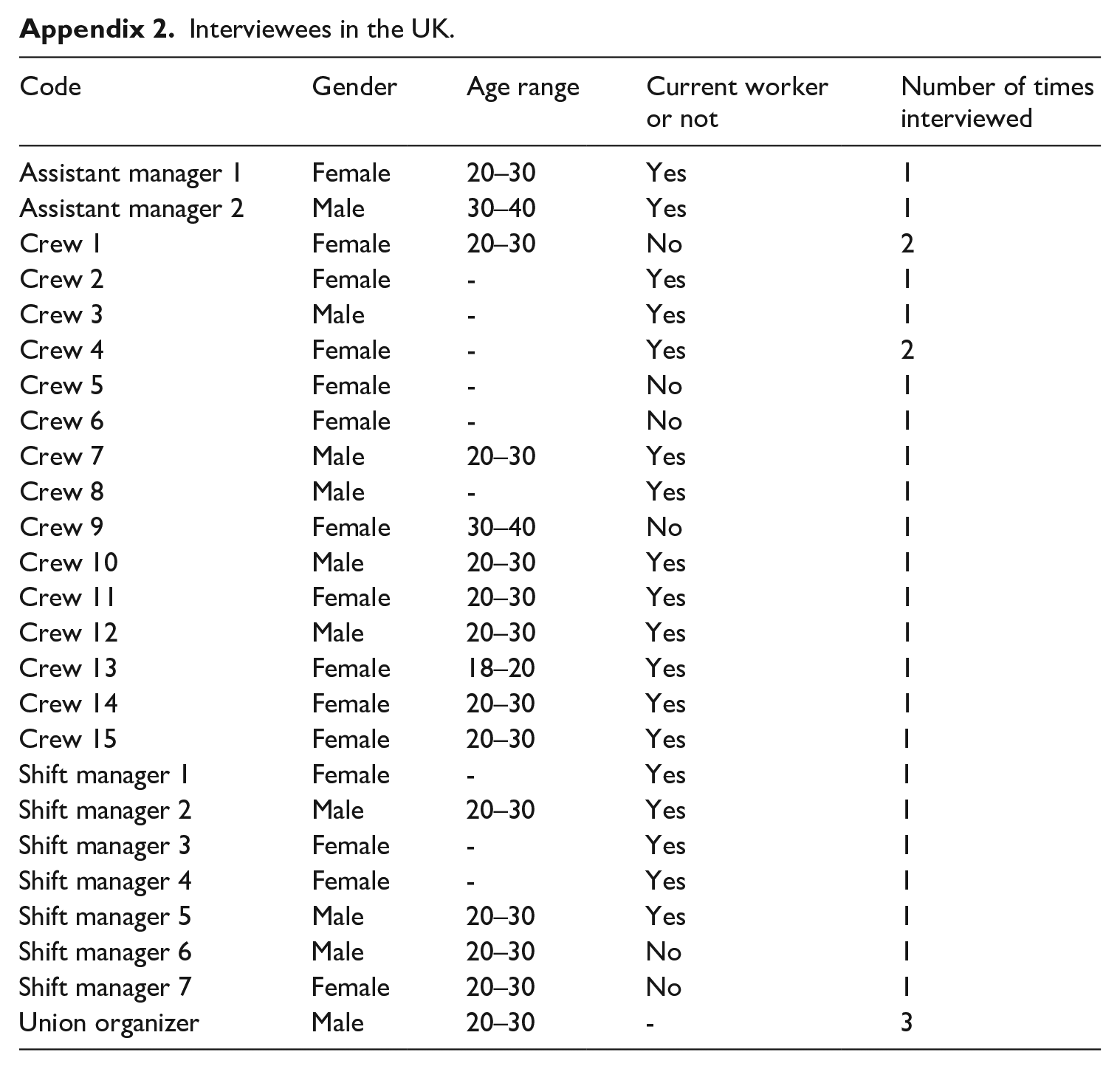
| Code | Gender | Age range | Current worker or not | Number of times interviewed |
|---|---|---|---|---|
| Assistant manager 1 | Female | 20–30 | Yes | 1 |
| Assistant manager 2 | Male | 30–40 | Yes | 1 |
| Crew 1 | Female | 20–30 | No | 2 |
| Crew 2 | Female | - | Yes | 1 |
| Crew 3 | Male | - | Yes | 1 |
| Crew 4 | Female | - | Yes | 2 |
| Crew 5 | Female | - | No | 1 |
| Crew 6 | Female | - | No | 1 |
| Crew 7 | Male | 20–30 | Yes | 1 |
| Crew 8 | Male | - | Yes | 1 |
| Crew 9 | Female | 30–40 | No | 1 |
| Crew 10 | Male | 20–30 | Yes | 1 |
| Crew 11 | Female | 20–30 | Yes | 1 |
| Crew 12 | Male | 20–30 | Yes | 1 |
| Crew 13 | Female | 18–20 | Yes | 1 |
| Crew 14 | Female | 20–30 | Yes | 1 |
| Crew 15 | Female | 20–30 | Yes | 1 |
| Shift manager 1 | Female | - | Yes | 1 |
| Shift manager 2 | Male | 20–30 | Yes | 1 |
| Shift manager 3 | Female | - | Yes | 1 |
| Shift manager 4 | Female | - | Yes | 1 |
| Shift manager 5 | Male | 20–30 | Yes | 1 |
| Shift manager 6 | Male | 20–30 | No | 1 |
| Shift manager 7 | Female | 20–30 | No | 1 |
| Union organizer | Male | 20–30 | - | 3 |
Declaration of conflicting interests
The authors declared no potential conflicts of interest with respect to the research, authorship, and/or publication of this article.
Funding
The authors received no financial support for the research, authorship, and/or publication of this article.
