




Abstract
The article investigates the emergence of ‘new’ forms of working such as ‘lean production’ and ‘learning organisations’ in Western Europe, 1995–2015. First, the article identifies the dominant forms of work organisation (‘workplace regimes’) across Western Europe, including new ‘pressure’ and ‘extreme’ varieties of previously identified regimes. Second, the article analyses the implications of these workplace regimes for various important worker outcomes – insecurity, income, intensity of work and intrusion of work into non-working life – and assesses the ‘trade-offs’ of different outcomes across regimes. Third, the article assesses the changing distribution of these regimes, whether certain forms such as Lean Production are coming to dominate the division of labour, and where and for whom. The shape of the ‘new world of work’ is increasingly Lean, but remains open to political contestation – both in how regimes themselves are organised and in the mix of regimes in particular societies and for particular workers.
Recent decades have seen the emergence of ‘new’ forms of working such as ‘lean production’ and ‘learning organisations’ as part of the organisational landscape. The implications of these changes are multi-faceted and complex. There is a significant body of research that argues that working life has, because of this, been transformed to become more intense, intrusive, insecure and unequal, even as we see the institutionalisation of work processes that rely more heavily on worker decision-making, teamwork and learning. At the same time, it is notable that many indicators have not shifted dramatically – for example, the EU Labour Force Survey shows only marginal increases in temporary employment in recent decades and the European Working Conditions Survey (EWCS) and the US General Social Survey show similarly stable levels of team working. This article attempts to reconcile these apparently contradictory trends in the risks and rewards of work today. It does so through an analysis of the form, effects and prevalence of the main ways of organising work in 14 Western European countries between 1995 and 2015, using the EWCS.
The article pursues three aims relating to this question. First, it seeks to identify the dominant forms of work organisation across Western Europe. While there are many dimensions of the organisation of work and employment, with varying dynamics and effects, we argue that organisations combine various aspects of work into characteristic configurations that form ‘workplace regimes’. These in turn shape and to a large extent regulate the experiences and potential actions of workers. Therefore, we build on recent research on workplace regimes including the work of Holm and Lorenz (2015) identifying the major regimes of Simple, Taylorist, Lean (Constrained Learning) and Learning (Discretionary Learning) work organisation.
These categories echo others advanced in previous research and turn out to be central to our analysis also. However, we add to these studies by assessing, in particular, how varying combinations of forms of labour control and varying organisations of working time generate additional regimes (which prove to have significant consequences for workers). In particular, we identify two new ‘internal’ varieties of these regimes – ‘Pressure’ sub-regimes that include particularly intensive mechanisms of labour control and ‘Extreme’ sub-regimes that combine intensive labour control mechanisms with more extensive demands for flexible working time. Identifying this range of workplace regimes allows us to assess the prevalence and effects of different workplace regimes at the macro-societal level. However, our configurational approach also dovetails with the qualitative case studies that have identified many of the new forms of work organisation, allowing for more explicit location of case studies within overall patterns of workplace organisation (as advocated by Tomaskovic-Devey and Avent-Holt, 2019).
Second, the article analyses the effects of these forms of work organisation on a number of key worker outcomes. These include the important elements of the workplace ‘effort bargain’ (intensity of work and income insecurity) but also further key elements that arise from the restructuring of the boundary conditions of work (intrusion of work into non-working life) and employment (insecurity) (Chung and Tijdens, 2013; Green et al., 2022; Tomaskovic-Devey and Avent-Holt, 2019). Most analyses of these work life outcomes identify a series of factors that affect these outcomes for workers and provide valuable insights into how these various features of the workplace affect worker experiences. However, our approach complements these domain-specific analyses by assessing the effect on these multiple outcomes of working in a particular overall ‘regime’, using a set of identical models that allow us to assess the relative impact of different regimes on workers’ experiences of work. We find that these issues arise in varied and uneven ways, with different levels of significance in different workplace regimes. Therefore, we find that different regimes offer significant trade-offs between the various worker outcomes that we examine. However, overall, we show that the path to ‘standard employment’ or to ‘good work’ has been narrowing, as fewer workers are working in regimes that protect or buffer them from each of the pressures of employment insecurity, income insecurity, intensity of work and intrusion.
Third, the article assesses how the distribution of these workplace regimes shifted between 1995 and 2015 and how they are distributed across social groups, economic sectors and national capitalisms. This section addresses current debates regarding the likely evolution of workplace organisation, analysing which workplace regimes are likely to be dominant, where and for whom. In particular, we provide evidence that is generally supportive of arguments that Lean Production workplace regimes are coming to dominate the division of labour (Janoski and Lepadatu, 2021). We find that this is due not only to the spread of ‘Lean’ regimes but also to the growth of similarly ‘pressurised’ forms of other regimes, not only in manufacturing but extending into both private and public services. Nonetheless, a variety of ‘models of work’ still remain within contemporary capitalisms and we provide evidence of the ‘menus’ of regimes across different sectors, how these are distributed across workers of different occupations and genders, and how important differences in workplace regimes persist across ‘worlds of capitalism’. However, we also show a surprising degree of similarity between the Liberal and Continental capitalisms in their workplace regimes, while Nordic and Mediterranean capitalisms retain distinctive profiles.
Contemporary workplace regimes
We seek to advance the understanding of the character of workplace regimes; to analyse the different outcomes associated with them (including ‘trade-offs’ between those outcomes within regimes); and to assess claims regarding trends in these regimes, including whether ‘Lean Production’ is increasingly dominant, and has spread beyond manufacturing and to a wider range of countries. The rest of this section explores these questions in greater detail.
Workplace regimes
The article’s initial contribution is to analyse the structure of different modes of organisation of work, or ‘workplace regimes’ (Acker, 2006; Burawoy, 1995; Thompson and van den Broek, 2010; Wood, 2021). The various aspects of the workplace are never experienced in isolation but always in the context of a particular configuration of different elements of work organisation that provide the context for our working lives. For example, when we go to work, we do not simply experience a particular set of opportunities for learning – we always experience that learning in the interlinked contexts of the amount of autonomy we have to make decisions based on it, the degree and type of control applied to our work by others, a more or less secure employment situation, and so on. The experience and possibilities afforded to us by the same access to learning at work can look quite different depending on the configuration of all these features. Following a range of other authors, we call the configuration of these different elements a ‘workplace regime’, as it refers to a combination of different workplace practices that govern our work experiences and that are constructed and contested through particular sets of institutionalised social relations. While these regimes are organised along common core dimensions, they also vary significantly (Wood, 2021) and are gendered and racialised in different ways (Acker, 2006).
This approach has its roots in many respects in the classic analysis of the ‘contested terrain’ of the work process by Richard Edwards (1979). Edwards identified three types of managerial strategies of labour control – simple control based on personal relations, technical control where social relations were mediated through technologies of production (e.g. the Taylorist assembly line) and bureaucratic control, depersonalising control by basing it in rules and procedures. Bureaucratic control is largely applied to professional workers, or those with the protection of internal labour markets. Friedman (1977) argues that these workers were controlled through ‘responsible autonomy’. In many respects, the story of the workplace in the almost half century since these authors’ research is the ever-closer refinement by managers of workplace regimes employing strategies of ‘responsible autonomy’, as they seek to direct and shape the actions of an increasingly highly educated and professionalised workforce.
A large qualitative literature has explored these regimes, with a flurry of studies in the 1980s of ‘new production concepts’ (Kern and Schumann, 1984), ‘flexible specialisation’ (Piore and Sabel, 1984), the learning organisation (Senge, 1990), lean production and its alternatives (Berggren, 1993; Vänje and Brännmark, 2017; Womack et al., 1990), and more.
This strand of research has continued and has been complemented in recent years by quantitative efforts to provide a classification of workplace regimes. Using the European Working Conditions Survey between 2000 and 2010, previous analyses used variables associated with learning, autonomy and labour control to identify four different forms of workplace organisation: Simple, Taylorist, Lean (or Constrained Learning) and Learning (or Discretionary Learning) (Holm and Lorenz, 2015; Lorenz and Valeyre, 2005). Simple and Taylorist work organisation echo Edwards’ categories, the former based on interpersonal relations in the work process (sometimes with a degree of autonomy) and the latter on control through intensive production technologies and processes. However, their analysis also draws on the second generation of qualitative studies in identifying two further regimes which are distinguished by access to complex work and learning opportunities, both formal and informal. Holm and Lorenz (2015) usefully refer to these regimes as systems of discretionary (Learning) or constrained (Lean) learning, recognising that while both are based on learning, one allows for more discretion in the application of that learning to the work. Nonetheless, while recognising this insight, we prefer to continue to refer to the two regimes as Lean and Learn regimes, given the now large literatures on ‘Lean Production’ and ‘Learning Organisations’. The critical distinctions between these regimes are based on different mixes of learning and autonomy – with Taylor low on both, Simple low on learning but often with a degree of autonomy in the work process, and crucially Lean higher on learning but low on autonomy while Learn combines both learning and autonomy. Indeed, Lean has always been a particularly interesting regime as it combines features that were often thought to be incompatible – a strong emphasis on learning combined with relatively tight control (Brown et al., 1993). Figure 1 portrays this fourfold distinction, although it should not be read to imply, for example, that the levels of autonomy in Learn and Simple regimes are the same.
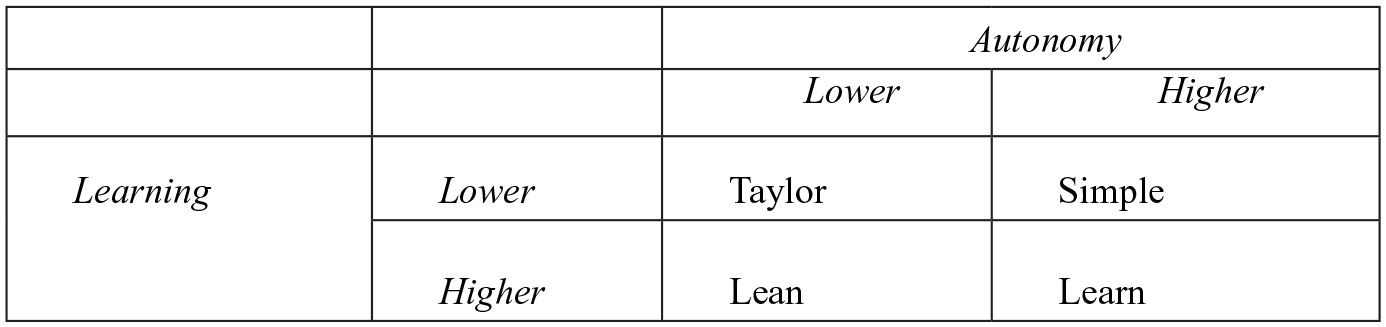
Schematic outline of basic workplace regimes.
Our analysis both complements and extends that of Lorenz and colleagues. We expect the four major regimes identified in their analyses to be central to our own but we include two further important dimensions of the workplace in our analysis. We include additional variables relating to the ‘non-standard’ nature of working time and the structure of pay, assessing whether some regimes are more ‘flexible’ in their organisation of these ‘boundaries’ of work. This allows us to explicitly examine a critical dimension of the changes in the contemporary workplace as the organisational forms that ‘contain’ work become more porous and flexible. We expect that demands around flexibility of hours and working times will be more important for some workers than others, potentially generating significant additional variation in workplace regimes that are otherwise similar in terms of workplace learning, autonomy and control.
In addition, while variables relating to modes of labour control were included in the previous analyses, we pay more attention to how these modes of labour control vary within these more encompassing categories of Lean, Learning and so on. Qualitative studies of workplaces have consistently shown that even workers with significant levels of task autonomy are still often subject to various forms of control (e.g. the deadlines that control software developers, the role of customers in controlling personal service workers and more [Ó Riain, 2010]).
Analysis of these dimensions should allow us to capture further important variation. For example, in the fourfold classification, a teacher working set hours and a software developer working to deadlines and on flexible hours would both most likely fall under the Learn regime (particularly as both have a high degree of learning and autonomy at work). However, our approach allows us the possibility of distinguishing between these quite different work situations, primarily in terms of the different degree and forms of control they experience and the flexibility of hours and pay. Indeed, this also facilitates greater complementarity between our analysis and the qualitative case studies which reveal how these kinds of difference in relations of control across apparently similar work regimes can have a significant impact on work intensity (Huo et al., 2022; Oudhuis and Tengblad, 2022).
Regimes and outcomes
Developing a more detailed categorisation of work regimes is only worthwhile if it enhances our understanding of the effects of this variety of forms of work organisation. Therefore, the second stage of the analysis examines how these regimes are linked to a range of important outcomes for workers, addressing Janoski’s (2015) concern that we still have insufficient understanding of whether Lean, and by implication other workplace regimes, are beneficial for workers. It is particularly important to assess the outcomes associated with different regimes given the reconfiguration of aspects of work and employment into new workplace regimes with potentially ambiguous or conflicting sets of outcomes. For example, shop workers may combine a degree of autonomy with poor employment security; ‘knowledge workers’ may combine autonomy and employability with intense work environments and demands on their non-working time; and workers in manufacturing may find themselves increasingly able to give input into the design of their work but within an overall intensification of work.
We have chosen the outcomes for our analysis based on their centrality to both classic and contemporary workplace debates, paying attention to both the experience of the work process and to the organisation and rewards of employment. We examine the impact of workplace regimes on the two key dimensions of the classic ‘effort bargain’ in the workplace – the exchange of ‘effort’ (taken here to be the Intensity of work) for a reward (taken here to be Income insecurity – or lack thereof – measured here as ‘difficulty in making ends meet’). However, an increasingly significant aspect of contemporary workplaces is the uncertain and contested boundary between the workplace and the world around it. One major aspect of this is the intrusion of the work undertaken as part of employment into ‘non-work’ time and space (Intrusion, in our terms). It also involves the uncertain nature of the employment nature itself (or Insecurity). These ‘Four I’s’ – Intensity, Income insecurity, Intrusion and Insecurity of employment – are the key outcomes that our analysis examines.
There are extensive literatures in each of these areas and we seek to add to these, not by providing comprehensive explanations of each outcome, but by focusing in our analysis on whether and how workplace regimes, as configurations of workplace practices and relations, can help explain variation in each outcome. In addition, applying similar models to each outcome allows us to analyse which regimes are characterised by each of the particular challenges identified above. We briefly note below some of the ways that existing literature has incorporated organisational processes into understanding these outcomes and how a focus on workplace regimes can add to these approaches.
Green et al. (2022) investigate the particular variables that determine higher levels of intensity in jobs in the UK from 2001 to 2017. This is a particularly good example of research that carefully identifies the range of organisational and other variables that affect the relevant outcome – including in this case how aspects of computerisation, quality circles, repetitive tasks, reorganisation of work, gender of employees and hours worked affect work intensity. The analysis also reveals an important organisational dimension as it finds no significant changes in these factors’ effects within industry–occupation settings, with the implication ‘that these effects are associated with time-invariant occupation–industry-specific characteristics, which are themselves linked with required work intensity’ (Green et al., 2022: 479). Indeed, given this finding, the analysis goes some way to specifying clearer definitions of the broader work system contexts (‘regimes’) that have a persistent effect on intensification of work. However, we build on this approach by directly comparing the effects of various regimes on intensity, controlling for sectoral and occupational contexts. Furthermore, our approach specifies the organisational configurations that have an effect in addition to the sectoral contexts which are likely to blend techno-economic and organisational factors.
A further large literature investigates the intrusion of working life into ‘non-work’ time and space, most often investigated through the study of the organisation of working time. Chung and Tijdens (2013) investigate the organisational aspects of working time arrangements, using factor analysis to identify clusters of aspects of working time organisation that generate different ‘working time regimes’, which are categorised based on the degree to which they facilitate employee or employer control over working time flexibility. Chung (2019), for example, finds that access for workers to control over their own schedule depends on the interaction of worker gender with the gendering of the occupation in which they work, with relatively little cross-national variation. Our analysis adds to this work by focusing on the impact on intrusion of broad workplace regimes, rather than the regimes specifically related to working time.
Research on insecurity of employment finds that job insecurity (of various kinds) is linked to organisational processes – both to the general employer search for numerical flexibility but also to processes that generate change and uncertainty, including new technologies and organisational restructurings (Gallie et al., 2017). These pressures may be mutually reinforcing, as Bernhard-Oettel et al. (2019) demonstrate that job characteristics such as demanding work and emotional strain vary according to employment status. Complementing this research focus on organisational processes and turbulence, our research examines which of the (apparently relatively stable) workplace regimes make insecurity of employment more likely.
Similarly, there is a vast literature on income and wage inequality, some of which relates income specifically to features of the workplace (Tomaskovic-Devey and Avent-Holt, 2019). Avent-Holt et al. (2020) document the presence of such organisational effects by showing that variation between establishments is of greater importance than occupation in explaining variation in wages in four out of five advanced capitalist countries. Although our analysis is limited to a measure of income as ‘difficulty in making ends meet’, we seek to provide greater specificity regarding these organisational processes by examining what specific aspects of establishments (in this case, their workplace regime) account for such variation in income.
This brief overview can only give a flavour of the research on these topics. Nonetheless, it shows that organisational factors have received increasing attention in each of these areas, typically pursued through a focus on domain-specific organisational forms (e.g. forms of insecure employment, types of working time arrangements); through comparing intra- and inter-industry and/or occupational variation (e.g. Avent-Holt et al., 2020; Green et al., 2022); or assessing the impact of particularly relevant features of the occupational or industry context (e.g. Chung, 2019; Tomaskovic-Devey and Avent-Holt, 2019). Previous analyses also reveal the effects of variables relating to particularly relevant organisational processes in each domain, with a significant difference across each outcome in the mix of variables considered.
The purpose of our approach is to complement rather than to replace these analyses. We add to the organisational analysis of workplace outcomes by identifying ‘workplace regimes’ that characterise the broad parameters of the work situation, and provide a general context for more specific features (e.g. use of temporary contracts, degree of computerisation, shift work). We advance this ‘meso’ level of organisational analysis and link it to the analysis of worker outcomes, which has typically examined either the overall level of intra- and inter-organisational variation or focused on micro-level features of the work organisation. Where existing domain-specific analyses have categorised workplace ‘regimes’ these have tended to focus on the specific configurations of the most relevant organisational features (e.g. ‘working time regimes’ in Chung and Tijdens, 2013) rather than on broader organisational models such as those which we examine.
Our approach sacrifices some of the ability of more domain-specific analyses to focus on organisational processes of particular interest or multiple dimensions of the outcomes themselves. However, it allows us to examine more clearly and consistently how certain organisational settings (‘workplace regimes’) generate certain combinations not just of elements of work organisation, but also of particular outcomes for workers. This allows us to directly compare a variety of outcomes across regimes and thus to analyse how various outcomes for workers can combine in different organisational settings. Recognising that workers tend to work in a given context (the ‘regime’), with only some scope for variation in specific features of work, makes it more important but also easier to identify complementarities and contradictions and trade-offs across those outcomes. We see the potential for fruitful combination of these approaches as research progresses.
Convergence in workplace regimes?
Given the variation in workplace regimes and the likelihood that various important worker outcomes are associated with that variation, it is important to assess the distribution of those regimes over time and space and by economic and social position. Recently, Janoski and colleagues (Janoski, 2015; Janoski and Lepadatu, 2021) have reviewed the prevalence of various work regimes and argued that ‘Lean Production’ is the core of the new division of labour – essentially driving a process of at least partial convergence across different countries. They note that there is a need for further research on whether Lean (or another regime) is now the dominant form of work and the extent to which Lean has spread beyond its origins in manufacturing in the United States and Japan. The availability of European survey data over a 20-year period allows us to examine the spread of Lean and competing workplace regimes across a range of countries, controlling for a range of social and economic influences.
In general, we might expect a degree of convergence across countries in their forms of organisation as mechanisms for organisational diffusion have become significantly more effective, with transnational corporate structures, global supply chains and diffusion of models of management particularly crucial to work organisation (Frenkel, 2018). In addition, while Lean had its origins firmly in manufacturing, it has become more common in service sectors as the critical elements in common with other regimes are not technical but social and organisational, although they may be embedded in technologies. Furthermore, Lean workplace regimes are a likely candidate for global diffusion given their origins in ‘success stories’ such as Japanese manufacturing, their appeal to management in combining efficiency with managerial control, and a degree of appeal to workers given the possibility of some input into their work processes (Janoski, 2015).
Nonetheless, for much the same reasons, we can also expect continuing divergence in workplace regimes. As discussed above, we expect to identify a diverse range of competing workplace regimes that represent different organisational strategies and that are likely to be a focus of struggle. While these regimes are likely to be increasingly internationally available as ‘organisational templates’, the international transmission of models of work is mediated through ‘societies characterised by different industrial-occupational architecture and specific types of labour market regulation’ (Frenkel, 2018: 336). Therefore, we use our European survey data to look beyond the classic US and Japanese cases to examine the mix of workplace regimes in Western Europe, as well as the variation across different national worlds of capitalism. We limit ourselves to Western Europe due to data availability, our own regional expertise and the relatively similar macro-historical context which allows to look at both general trends in the region and how they vary across different worlds of capitalism within it.
While we cannot explore the causes shaping comparative differences, we assess the degree to which they vary across the diverse ‘worlds of capitalism’ in Western Europe. We borrow the terminology of ‘worlds’ of capitalism from Esping-Andersen (1990), reflecting the ways in which different institutional systems and social bargains shape the ways that national capitalisms work. However, we extend this comparative perspective to patterns of work organisation, as a crucial linking mechanism between social protection and economic coordination (Behling et al., 2015).
In our analysis for this article, we follow a fairly conventional taxonomy of national capitalisms, identifying four groups:
Continental: Austria, Belgium, France, Germany, Netherlands
Mediterranean: Greece, Italy, Portugal, Spain
Nordic: Denmark, Finland, Sweden
Anglo-Liberal: Ireland, UK
It might appear that the more recent distinction between liberal and social market economies in the Varieties of Capitalism perspective (Hall and Soskice, 2001) is more appropriate, given that this perspective focused on production systems and therefore might be expected to shed more light than Esping-Andersen’s fourfold categorisation (1999) which was based fundamentally on welfare systems. However, these ‘welfare capitalism’ groupings of countries are also revealed in a number of studies of business systems – for example that of Hotho (2014), which shows distinctive groupings that largely correspond to the groups (and labels) above. Furthermore, the fourfold classification also allows the comparison of ‘liberal’ and ‘social’ market capitalisms that is central to the Varieties of Capitalism perspective, as ‘social market’ economies are a combination of Nordic and Continental capitalisms (Pontusson, 2005).
In this analysis, we remain largely agnostic about which features of the worlds of capitalism in our analysis are causing the patterns that we identify. We do not investigate, for example, whether the business system, welfare model, gender regimes or other features shape the prevalence and effects of workplace regimes. However, our research can shed light on the degree to which workplace regimes are similar or different across the broad categories in this conventional taxonomy, results that have implications for typologies of capitalisms that should be explored further in future analyses.
Data and approach
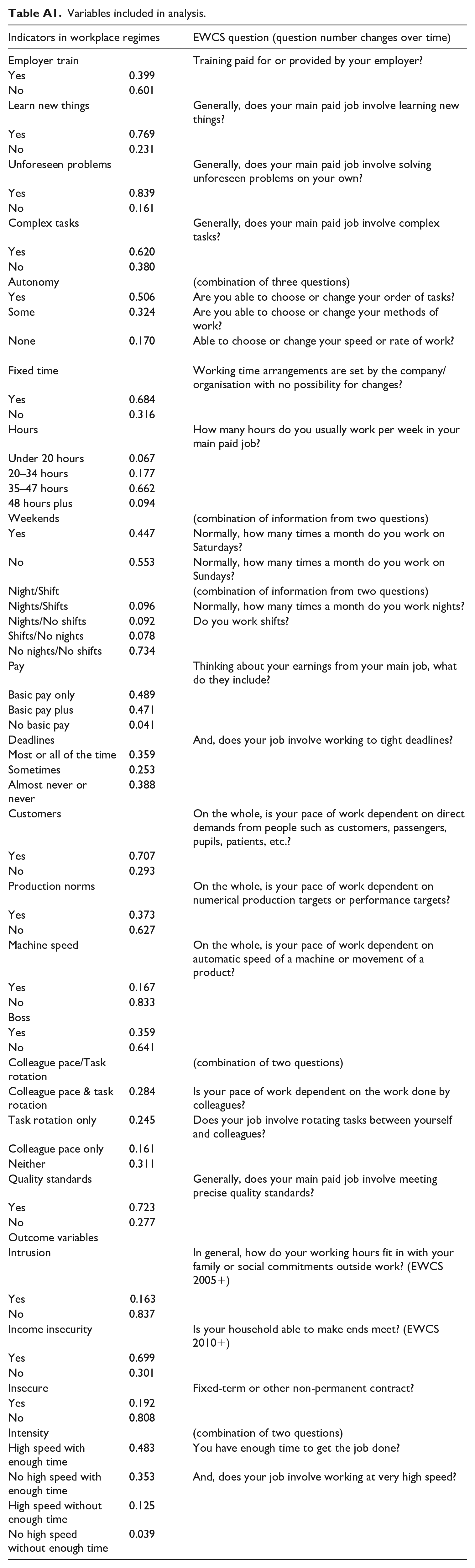
The European Working Conditions Survey (EWCS) is a cross-sectional survey that gathers data on working conditions and quality of employment from a representative sample of workers in participating countries at five-year intervals, beginning in 1995. The most recent comparable data are from 2015. 1 By pooling these data (similarly to Holm and Lorenz, 2015), the survey provides us with a large data set (N = 60,755 after cases with missing data are excluded) and broadly consistent data on a large number of relevant variables over two decades, allowing us to examine patterns of cross-national variation and change in work processes, employment arrangements and the social relations of coordination and control. 2 While new variables and countries have been added to the EWCS over time, we have built our work regimes from variables and countries (those in Western Europe) that have been present in all surveys to date (see Table A1 in the Appendix for a full list of variables and descriptive summaries of each). As discussed previously, to build our work regimes, we have included conceptually appropriate variables related to autonomy, learning opportunities, control mechanisms, pay and working time as follows:
Autonomy
This is a combination of three variables: ability to choose or change the order of tasks, methods of work and/or the speed/rate of work It is coded as yes (autonomy on all three variables), some (autonomy on some of the variables) or none.
Learning opportunities
This includes four distinct variables: employee training, opportunities to learn new things, complex tasks at work and unforeseen problems at work.
Control mechanisms
This includes six distinct variables: deadlines, customers, production norms, machine speed, quality standards and a variable that combines colleague influence on pace of work and the presence or absence of task rotation.
Pay
This is one variable coded as: basic pay, basic pay plus (e.g. incentive pay) or no basic pay (e.g. piece work).
Working time
This includes four distinct variables: fixed time working hours, number of hours worked per week, night work/shift work (two variables combined) and weekend work.
To measure worker outcomes, we have included variables for intensity, income insecurity, intrusion and employment insecurity.
Intensity of work (combination of two variables): speed of job (high speed or not) and whether employee has time to complete work.
Income insecurity: ‘ability to make ends meet’.
Intrusion (work–life balance): ‘do your working hours fit in with your family or social commitments outside work?’
Employment insecurity: contract type.
While variables measuring intensity and employment insecurity have been present in all five rounds of the EWCS, the variables we are using to measure intrusion and income insecurity were introduced in 2005 and 2010, respectively.
Data analysed included all non-agricultural and non-military employees including full- and part-time and those in permanent and non-permanent employment. While the EWCS has collected data from a wide variety of European countries, in the interest of continuity and consistency of data, our focus here is on the countries of the EU-15, excluding Luxembourg. 3
Our analysis proceeds in three steps. Firstly, latent class analysis (LCA) was used to identify the workplace regimes using Latent Gold (5.0). LCA is a data-reduction technique for categorical (nominal or ordinal) variables (McCutcheon, 1987). Conceptually, LCA is based on the identification of how variables interact to produce distinct combinations of social elements within a broader social space. This provides an ideal conceptual fit with our concept of the workplace regime as reflected in recent work in this area (e.g. Lukac et al., 2019; Van Aerden et al., 2015).
LCA accounts for the distribution of cases within a cross-tabulation, producing mutually exclusive latent classes (in this research, workplace regimes) from the indicators/manifest variables used to build the workplace regimes. LCA identifies these latent classes through a maximum likelihood algorithm that was originally developed by Goodman (1974a, 1974b). For each case included in the analysis, the probability of being in each workplace regime is calculated as part of the solution with all of the probabilities adding to one for each respondent.
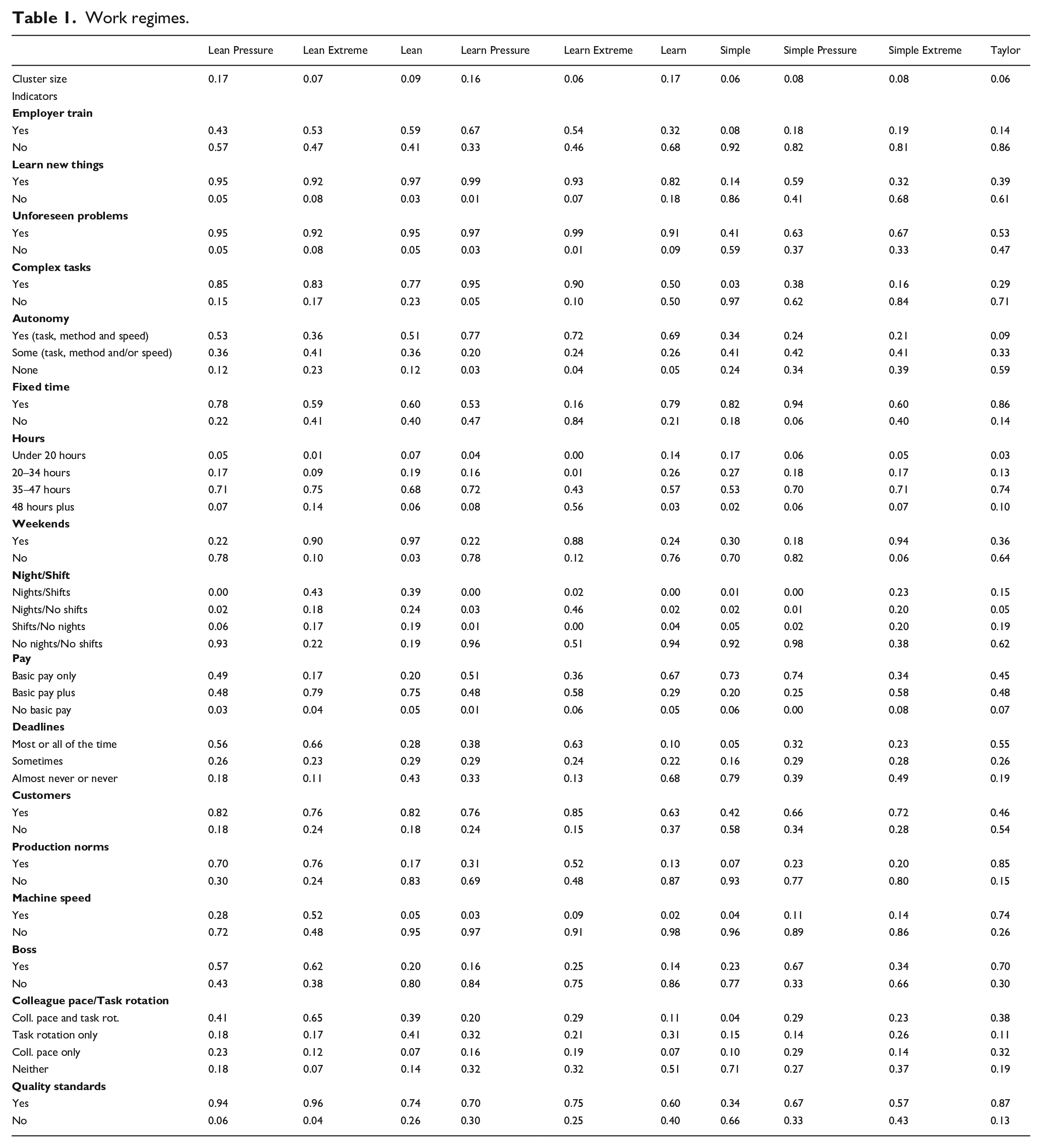
A further advantage of LCA is that goodness-of-fit indices are provided that assist the researcher in choosing the best-fitting number of classes. The Bayesian information criterion (BIC) is the most commonly used of these indices; it takes the likelihood chi-square statistic and adjusts for degrees of freedom and sample size (Magidson and Vermont, 2004). For this analysis, the lowest fitting BIC was associated with a 10-class solution (see Appendix and Table A2 for discussion and indices). We proceed with the 10-class solution both because of its superior goodness-of-fit and because it generated a set of workplace regimes that were clearly intelligible in conceptual terms (these are described in Table 1). 4
Work regimes.
In the second part of the analysis, we analyse the effects of work regime on a range of worker outcomes. We analyse which regimes are more likely to generate experiences of intrusion, intensity, income insecurity and insecure employment. We control for age, gender, citizenship, occupation, sector, company size, world of capitalism and survey year. Three of the outcomes (intrusion, income insecurity and insecurity) are measured as a series of dummy variables (see Table A1 for coding information), and we therefore use logistic regression to predict the odds of experiencing one of these outcomes. Intensity has been built from two variables (working at high speed and having enough time) and has four categories. This has then been analysed with the same control variables using multinomial logistic regression.
In the third part of the analysis, we examine prevalence of various work regimes by sector, social group, time and place. This part of the analysis uses fractional logit (FL) to determine which socio-demographic groupings and political economies are associated with each of the workplace regimes, controlling for relevant sectoral and occupational variables. FL is similar to logistic regression but is used to analyse dependent variables in the form of proportions which sum to one (Buis, 2010; Papke and Wooldridge, 1996). We analyse the probability of being in each of the workplace regimes, using the probability of being in all other regimes as the reference category.
Weighting for these analyses used a two-step process. First, the design weights included with each data set were used to adjust for sampling error. Then, each sector by country was weighted to be equal to ensure that no sector or country would dominate the work typologies (Gallie, 2013; Kankaraš et al., 2011). Clustered standard errors have been used given that the data were collected within countries.
This analysis has a number of noteworthy features relating directly to Janoski’s agenda for research on Lean and other work regimes. It uses dummy variables for each survey year to examine change over time in the prevalence of each regime, controlling for a range of variables. We can also examine which social groups are more likely to work in each regime, the occupations and sectors in which each regime is more likely to be found, and the effect of ‘world of capitalism’ on the prevalence of regimes.
Identifying workplace regimes
We identify a total of 10 workplace regimes, clustered around four basic types: Simple, Taylorist, Learning and Lean (see Table 1). These four are most fundamentally based on the mix of learning and autonomy at work. The first two of these offer workers few opportunities either for learning or autonomous decision-making at work. ‘Simple’ workplace regimes consist of jobs with a low level of complexity and few opportunities for learning. They are often carried out on an individual basis (and partly because of this sometimes have a moderate degree of autonomy). ‘Taylorist’ workplace regimes are similar in their lack of learning but are more intensively controlled by a wide variety of control mechanisms, but crucially by the production process itself (e.g. ‘machine speed’) as these workplaces are typically found in manufacturing or sectors with automated, ‘deskilled’ work processes. These Simple and Taylorist workplace regimes are broadly consistent with Edwards’ (1979) characterisations of direct and technical control, respectively.
The other sets of regimes are those based around Lean and Learning regimes. All six regimes under these headings have much higher levels of learning new things, dealing with unforeseen problems and complex tasks, and employer training (albeit to a slightly lesser degree). However, Learn regimes have higher levels of autonomy (particularly relatively complete autonomy) and are generally subject to fewer control mechanisms.
However, we also find that each of the Simple, Lean and Learning regimes can take multiple forms. In particular, in addition to the basic form of each, there is a ‘Pressure’ form which is characterised by more intensive control mechanisms and an ‘Extreme’ form where non-standard pay and hours are combined with a variety of control mechanisms, combining both pressure and uncertainty for workers in these regimes.
While there are pressure versions of each of the three main forms of work organisation, the particular control mechanisms that generate this pressure differ for each. Lean is already clearly more pressurised than either Simple or Learn and this becomes even clearer when we look at the Pressure versions of each. Simple Pressure and Learn Pressure involve the moderate use of customers, colleagues, deadlines and standards but Lean Pressure involves more intensive use of these mechanisms combined with control by the boss and production norms. In addition, Simple (Basic and Pressure) and Learning (Basic and Pressure) both are associated with greater prevalence of fixed regular hours and pay than in the Lean regimes.
Learn Extreme is clearly a Learn regime with its high levels of autonomy but has a similar range of control mechanisms to Lean Pressure. This work regime is characterised by long and irregular hours, giving them an Extreme character despite their high levels of autonomy (as we will see, these tend to be largely professional and managerial jobs). It is important to note that identifying Learn Pressure and Learn Extreme complicates the generally positive interpretation given to Learning regimes – while these are less tightly controlled working environments than their Lean counterparts, they are significantly different from the basic Learn regime.
There is only one form of the Taylorist regime, because it is already Extreme, with non-standard employment common and a wide range of control mechanisms strongly present. Taylorist, Lean Pressure and Lean Extreme stand out for the use of almost the full range of control mechanisms. Within this group, Taylorist is distinguished by its lack of learning and autonomy and Lean Extreme by the prevalence of flexible non-standard hours and non-fixed elements of pay.
Overall, when we look at these workplace regimes, we see the complexity and oftentimes ambiguity of contemporary workplaces. In contrast to Simple or Taylorist work, in Lean and Learning workplaces diverse forms of workplace pressure and control are combined with learning at work and even elements of autonomy. And within each of these forms, there is a particularly intensively controlled Pressure regime and a more flexible but also controlled Extreme regime. The Pressure and Extreme versions of the regimes indicate that while the fourfold classification of regimes in Holm and Lorenz (2015) illuminates key differences in ways of organising work, it also obscures important differences within those categories and arguably glosses over some of the more troubling aspects of the related workplace regimes.
Workplace regimes and worker outcomes
We can briefly review the effect of workplace regimes on the key issues for contemporary workers under four headings – the ‘Four I’s’ of Intensification, Intrusion, Income insecurity and Insecure employment.
The first two of these relate mainly to the pressures of work. ‘Intensification’ refers to the pressures on work effort itself (high speed work), and whether the worker has enough time to do their work (see Table 2). Working to ‘high speed with enough time’ is the fastest growing form of intensification of work. ‘Intrusion’ refers to the extent to which working life is likely to intrude in various ways on life outside of work, including family and leisure time (see Table 3, column 1).
Intensity (ref: no high speed with enough time).
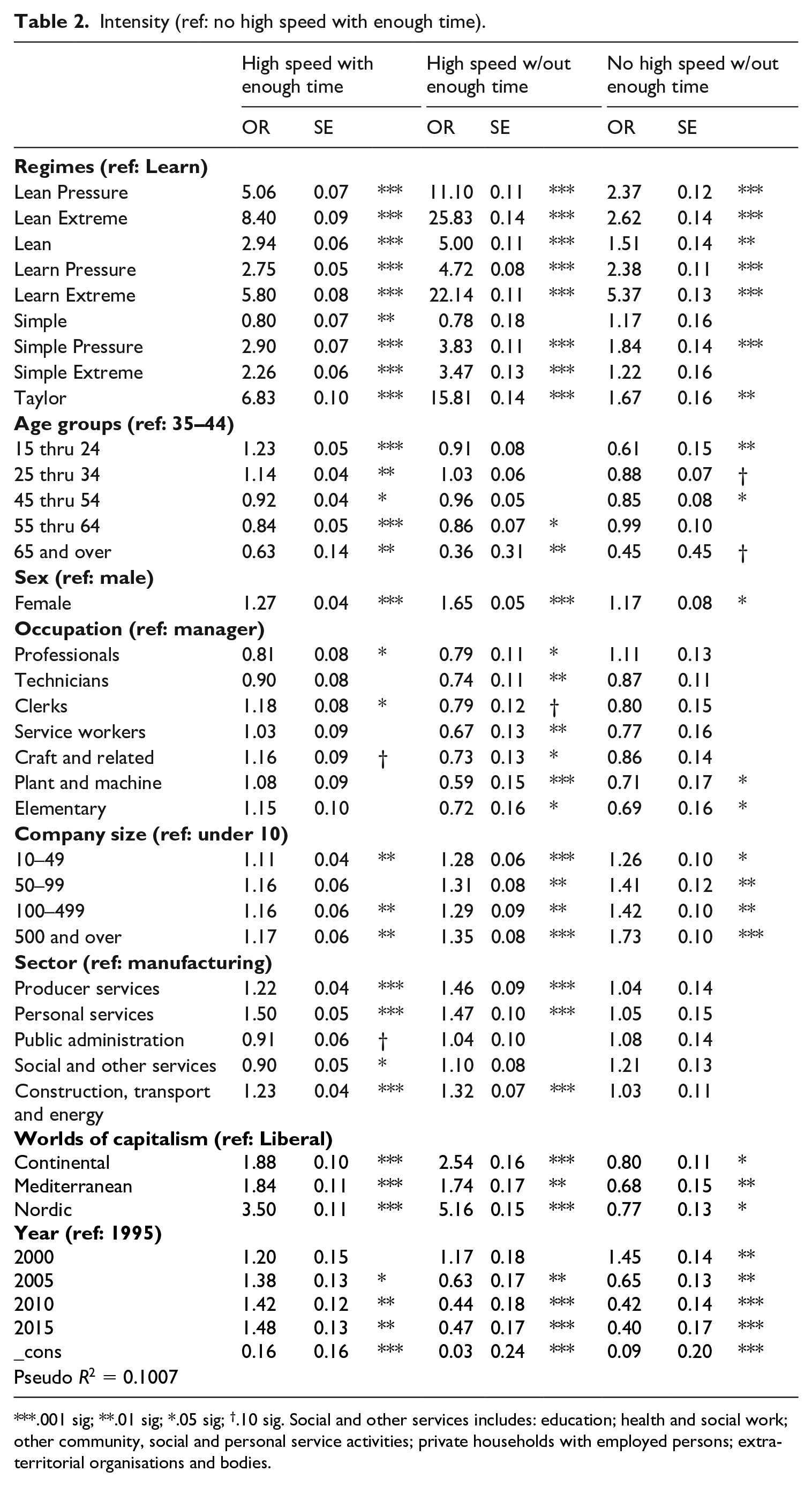
.001 sig; **.01 sig; *.05 sig; †.10 sig. Social and other services includes: education; health and social work; other community, social and personal service activities; private households with employed persons; extra-territorial organisations and bodies.
Intrusion, Income insecurity and Insecure employment.
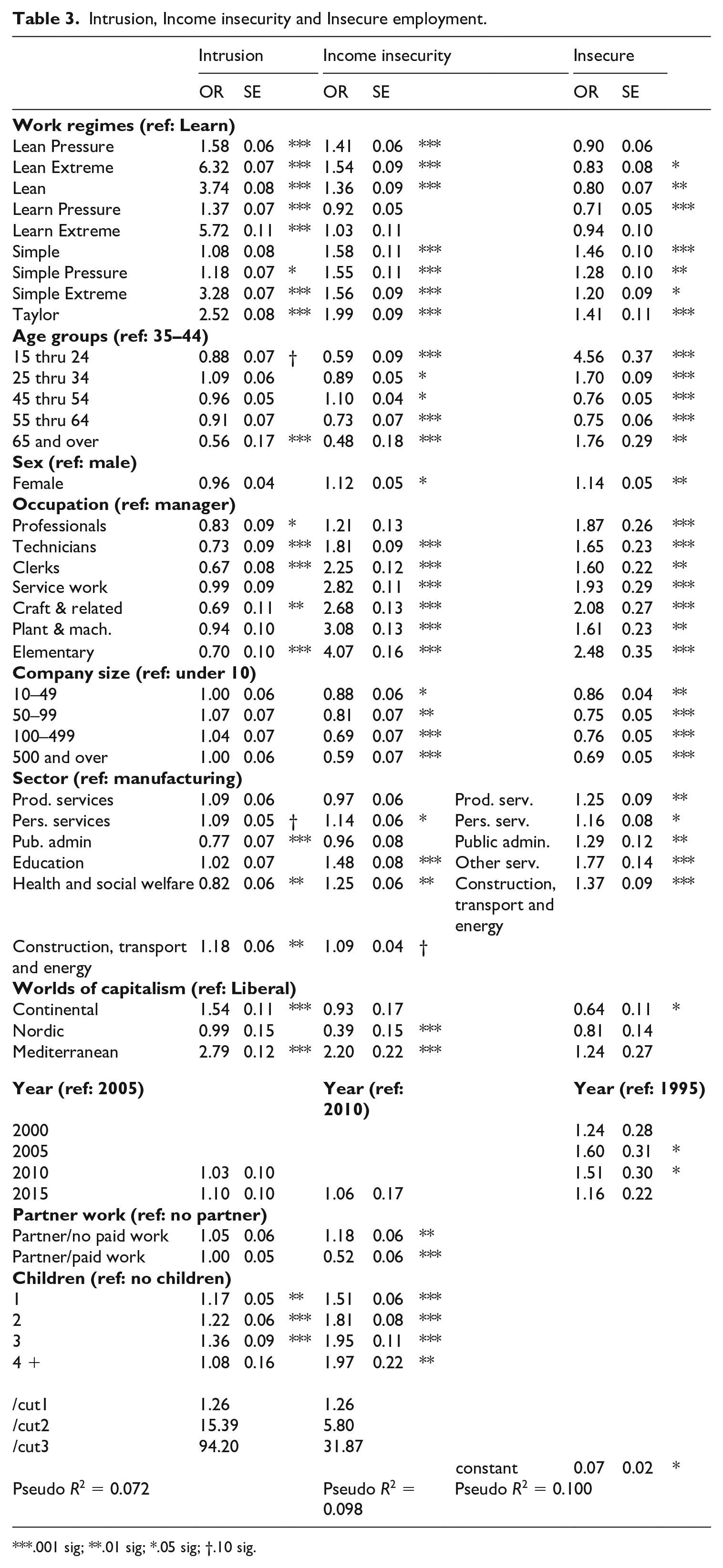
.001 sig; **.01 sig; *.05 sig; †.10 sig.
Simple and Learn regimes have the lowest levels of both intensification and intrusion. They share an absence of extensive employer controls and a degree of autonomy, albeit in the context of very different levels of learning and complexity. Nonetheless, these shared features appear to provide protection from both intensive and extensive job demands. The presence of tighter employer control mechanisms in Simple Pressure moderately raises both intrusion and intensification.
These pressures are raised further in Lean, Learn Pressure and Simple Extreme regimes, where intrusion and intensification are at similar levels and significantly above those of Simple and Learn. The similar outcomes associated with these regimes are interesting because of their different sources. While Lean incorporates a certain lack of autonomy in its basic form, the autonomy of Learn Pressure workers is counter-balanced by employer controls while Simple Extreme workers face pressure arising from flexibility and ‘on demand’ work.
Outcomes are more challenging still in the tightly controlled regimes of Taylorist and Lean Pressure work, where intensification is very high and intrusion (possibly related to shift work) is also common. Most demanding in all respects are the Lean Extreme and Learn Extreme regimes, with exceptionally high levels of both intrusion and intensification across almost all measures. Autonomy and learning do not seem to counter-balance the effects of pressure and flexibility of these regimes but may even heighten them.
It is striking that the inclusion of Pressure and particularly Extreme forms of each of the workplace regimes sheds significant light on the causes of these pressures at work. It seems that despite the variety of the four basic forms of work regime, and the many differences between them, it is the Extreme combinations of flexibility and control that are most likely to generate these kinds of intense pressures on workers, both inside and outside their work. This also provides further evidence that the basic Lean and Taylorist regimes are relatively close to the more pressurised regimes. However, it is when flexibility and control are combined with learning and some degree of autonomy that intrusion and intensification appear to be at their highest.
The last two of the ‘Four I’s’ workplace issues are related to insecurity of employment rewards. Income insecurity relates to the degree of difficulty respondents have in ‘making ends meet’ while Insecure employment relates to the absence of permanency of employment. Table 3 presents the pattern of results for the effect of workplace regime on these outcomes, controlling for a wide variety of socio-demographic and economic variables.
A different set of regimes generate these precarities than generated the work pressures. All three Simple work regimes and the Taylorist regime have higher levels of Income and employment Insecurity. The Lean regimes also make it more difficult for workers to make ends meet so that it is only Learn regimes which are associated with comfort in making ends meet. The mix of Lean and Learn regime effects is somewhat different for insecurity of employment with Lean, Lean Extreme and Learn Pressure associated with greater security than Lean Pressure, Learn and Learn Extreme. Nonetheless, there is a clear dividing line between the Lean and Learn regimes and the Simple and Taylorist regimes, so that regimes with low learning have higher insecurity (of employment and, to a lesser degree, of income) than those with higher levels of complexity and learning.
Looking across the range of socio-demographic and socio-economic variables, outcomes are generally somewhat worse for women – although the presence of intrusion is associated more with the presence of children than directly with gender. There are also clear class effects across the outcomes, although they vary in their specific form. The pattern of outcomes is mixed for the different worlds of capitalism. Mediterranean capitalisms seem to offer the worst workplace outcomes with high levels of intrusion and both income and employment insecurity. The clearest trade-off is in the Nordics where greater intensity at work is combined with lower levels of intrusion and income and employment insecurity.
We have found a series of independent effects of workplace regimes on these outcomes. Some regimes offer little for workers. Simple Extreme, Taylorist and Lean Pressure regimes combine intrusion, intensification and both forms of insecurity at relatively high levels. Others offer more of a trade-off. The Lean Extreme and Learn Extreme regimes demand even higher levels of intensity and intrusion but offer much greater security and reward in the labour market. Learn Pressure (and to some extent Lean) offers a more attractive trade-off, with better labour market security and less intensity and intrusion. Perhaps ironically, at the cost of security, Simple work regimes (and to a lesser extent Simple Pressure) may offer a degree of protection from intensification – not so much because of the autonomy and learning in the job but because of the relative lack of control mechanisms applied to them. However, there are only a small number of regimes that are not strongly linked with one or other of these damaging outcomes of work. Therefore, there are very few regimes that provide secure income and employment as well as limiting the intrusions and intensity of work itself – only Learn offers this relatively appealing form of work and even then at the cost of some insecurity.
Convergence and diversity in workplace regimes
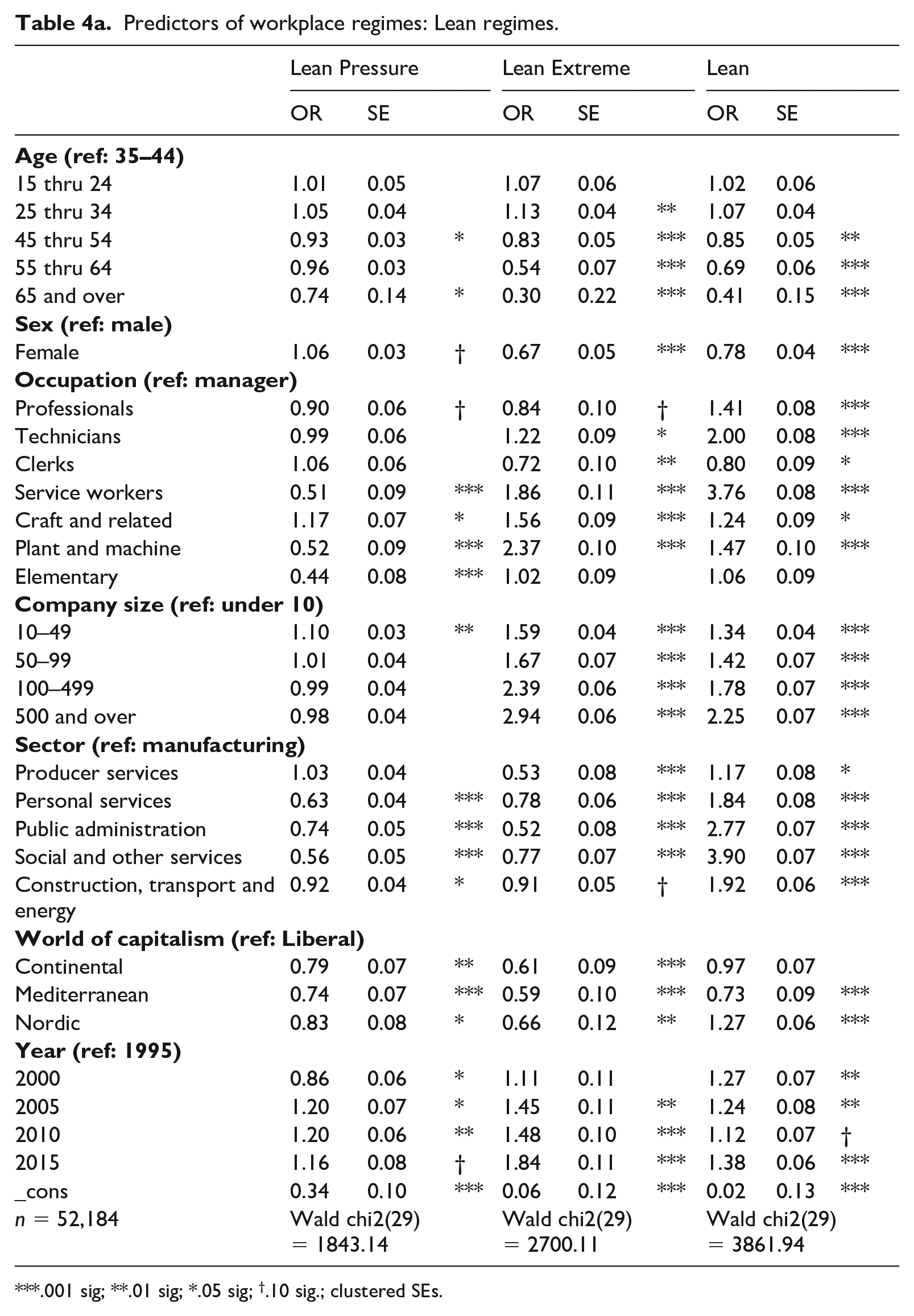
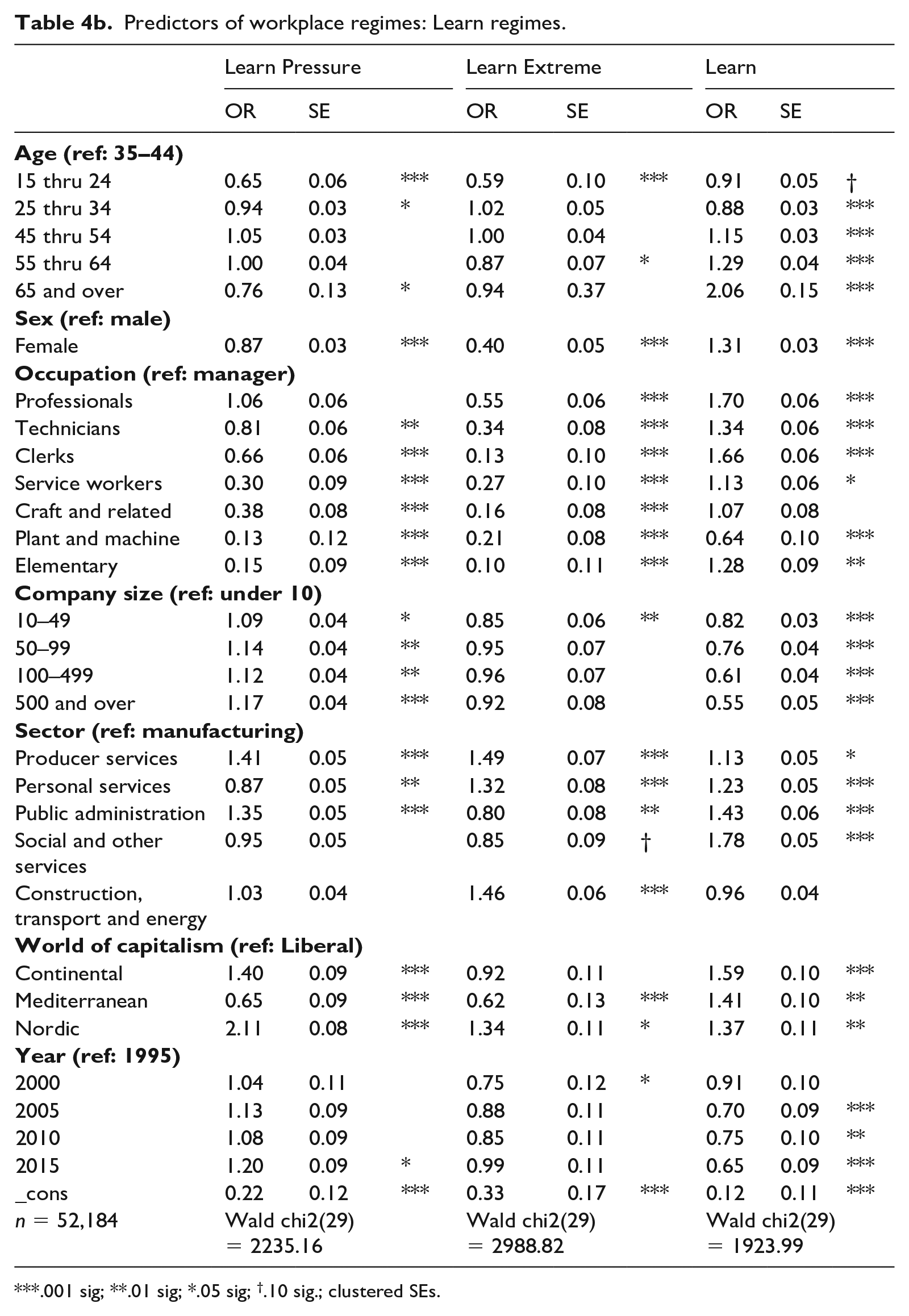
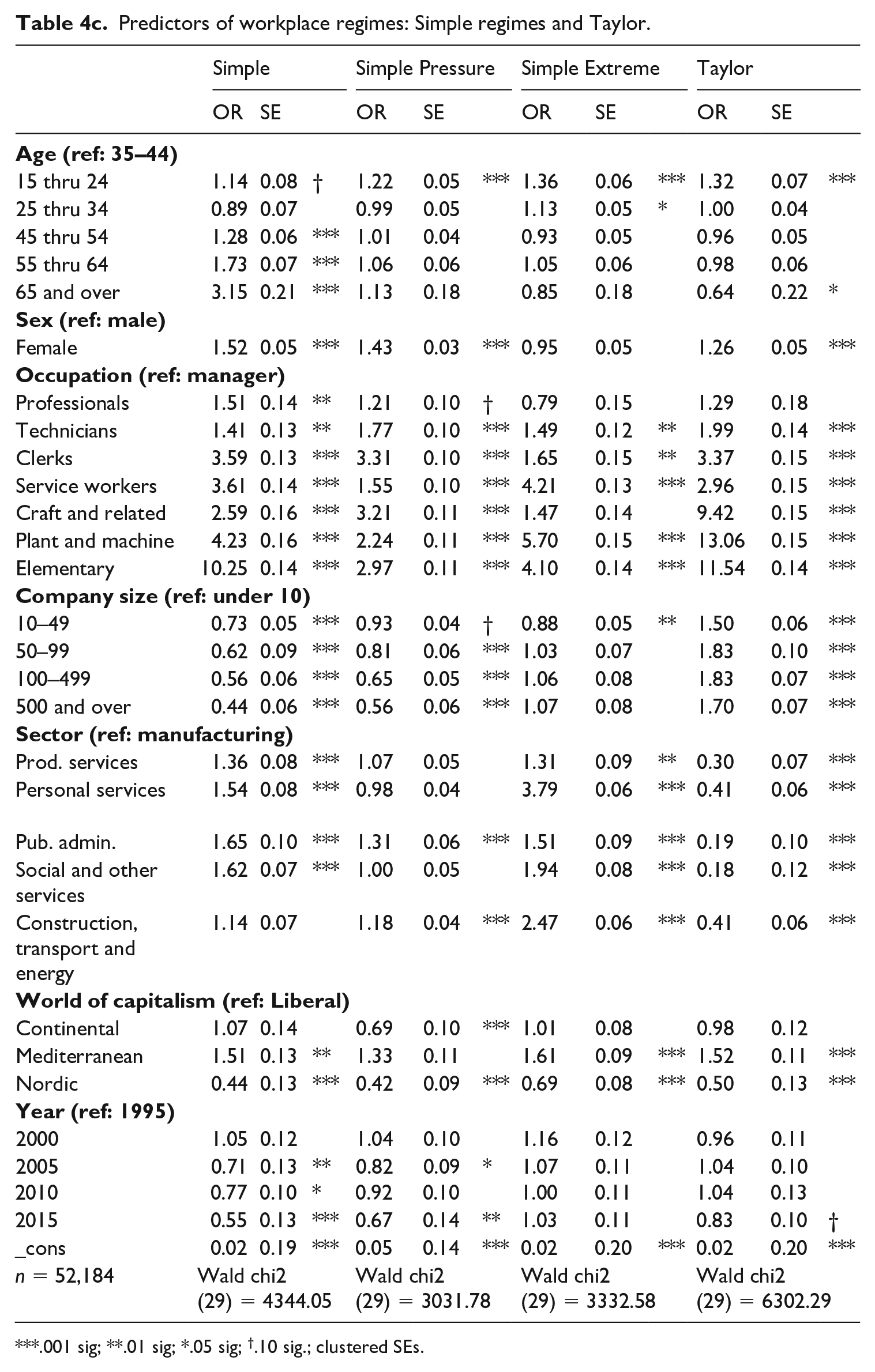
Given these significant differences in worker outcomes associated with different regimes, it becomes all the more important to examine the distribution of these workplace regimes across social groups and capitalisms and over time (see Tables 4a, 4b and 4c).
Predictors of workplace regimes: Lean regimes.
.001 sig; **.01 sig; *.05 sig; †.10 sig.; clustered SEs.
Predictors of workplace regimes: Learn regimes.
.001 sig; **.01 sig; *.05 sig; †.10 sig.; clustered SEs.
Predictors of workplace regimes: Simple regimes and Taylor.
.001 sig; **.01 sig; *.05 sig; †.10 sig.; clustered SEs.
When we look at the direction of change between 1995 and 2015 it is clear that there is a tendency towards more pressurised and constrained forms of work. All three Lean regimes see significant and sustained increases, controlling for other influences, from 1995 to 2015 (generally starting after 2000). The Learn regime, which has the most favourable mix of outcomes, declines significantly after 2000 while the pressurised version of Learn grows marginally at first and then significantly in 2015. Among the regimes with lower complexity and learning, Simple and Simple Pressure decline steadily over time while the particularly difficult Simple Extreme and Taylorist regimes remain broadly stable, with a marginal decline in Taylorism after 2010.
Where in the economy and society are these changes likely to have the greatest effect? Learn regimes are broadly associated with professional and managerial workers, Simple and Taylorist with working class occupations, and Lean regimes with a wide range of clerical, manual and non-manual production, particularly in large companies. While Lean Pressure, Lean Extreme and Taylorist regimes are associated with manufacturing (the site of many classic studies of Lean production), Lean and Learn regimes are associated with a wide range of services (producer, personal and social). While there is some overlap between social (largely public) and producer (private) service organisations, the most demanding regimes are more likely to be in the private sector (including Lean Pressure and Learn Extreme). There is also evidence that firms in certain sectors are likely to make different ‘choices’ regarding different workplace regimes with, for example, producer services firms and skilled workers prominent in the adoption of both Lean Pressure and Learn Pressure regimes.
It is noteworthy that even controlling for these sectoral and occupational differences, gender differences are relatively clear, with Lean regimes generally more male and the low complexity regimes more female. However, the Learn regime is also more female, suggesting a greater polarisation in the working conditions of women.
Finally, there are also clear differences between the worlds of capitalism in their mixes of workplace regimes. Nordic economies have higher levels of Lean and Learn regimes (of all types). They have particularly low levels of all Simple and Taylorist regimes, where the Mediterranean economies clearly have the highest levels. While Liberal economies have the highest levels of the most intense Lean regimes (Pressure and Extreme), they generally fall between the Nordic and Mediterranean economies. Indeed, despite their identification as different ‘varieties of capitalism’, the Liberal and Continental economies have significant overlaps in their mixes of workplace regimes, including similar levels of Lean, Simple, Learn Extreme, Simple Extreme and Taylor regimes (generally regimes associated with significant problematic outcomes). However, Continental capitalisms share the tendency of Nordic economies to have a greater share of Learn and Learn Pressure and lower levels of Lean Pressure and Extreme than the Liberal economies (suggesting higher levels of autonomy for a significant portion of workers). These significant comparative differences would be obscured by a twofold distinction between Liberal and Social capitalisms and the fourfold classification of welfare capitalisms and related business systems proves more helpful.
Perhaps Janoski and Lepadatu (2021) are premature in declaring that Lean is the dominant model of production, but the momentum is certainly with Lean workplace regimes, and those regimes that are closest to them. This shift towards Lean seems to consist of two separate trends. Additional constraints are being placed on workers in Learning work regimes, which then results in some of these regimes becoming Lean – or remaining as Learning regimes (with fairly high levels of autonomy in the work process) but now in the expanding Learn Pressure form. The second trend is the incorporation of learning and complexity into Simple and Taylorist regimes, as Lean regimes became the dominant model across manufacturing and increasingly in private services. The regimes that have classically been seen as ‘bad’ jobs – Simple and Taylorist – have declined. However, this ‘upgrading’ of work regimes through increased learning is typically combined with intensified control, generating very significant pressures of intensification and intrusion, as outlined in the previous section.
Conclusion
This article has shown that when we combine a range of critical elements of work organisation they form a variety of distinctive workplace regimes, organised around four main kinds of work (Simple, Taylorist, Lean and Learning) and the Pressure and Extreme versions of each of those. In addition, we have seen that these regimes are linked in different ways to the problems of intensification, intrusion, income insecurity and insecure employment in many contemporary workplaces. Some regimes combine quite high levels of all four of these undesirable outcomes, while others offer difficult trade-offs between security and intensity. Only the Learn regime provides protection against both pressure and precarity, and even then with pockets of insecurity of employment. The fastest growing regimes are those which generate either pressure or precarity, and sometimes both, for workers. This growth is happening both directly through ‘Lean’ regimes, but also in related ‘Lean-adjacent’ regimes such as Learn Pressure.
The contemporary workplace cannot be understood as a simple march towards a single destination for all, whether considered in terms of form of work regime or particular outcomes. There are many new pressures appearing for workers, and they emerge through different work regimes. Some tend to bring more pressure and some bring precarity. Many bring both – including many of those regimes that are growing fastest. Generally, while there are a variety of trends in workplace regimes, there is a narrowing path to what might be taken as a ‘good job’ – rewarding, interesting work in the context of steady, ‘standard’ employment that has a tolerable level of intensity and intrusion. While different workers in different regimes will have different specific issues to deal with, the generalised anxiety around the contemporary workplace must be significantly increased by this ever-narrowing path to the ‘good job’.
Nonetheless, there are elements that can be rescued from the new worlds of work. Some features like learning and autonomy are clearly generally taken as features of ‘good work’ and are increasingly widespread. Others like increased engagement with customers and colleagues, working to a higher quality and flexible schedules have great potential to humanise work, but can also become sources of pressure and precarity.
We can see, for example, that some of the major high-profile concerns about contemporary work are rooted in the features of major workplace regimes. The platform work of the ‘gig economy’ may be mediated by technology but is rooted in the Simple work regimes of low complexity combined with control that is indirect and often through the discipline of the labour market. The routines of call centres, for example, are closely linked to the rise of Lean production regimes. Meanwhile, even among the most fortunate workers, the flexible excesses of professional and managerial work are rooted in the growing Lean Extreme and Learn Extreme regimes. The shape of the ‘new world of work’ is looking increasingly Lean, as Janoski and others have argued, but a wide range of workplace regimes remain and are open to political contestation – both in the mix of regimes in particular societies and in how regimes themselves are organised. Further research could investigate the institutional and political factors shaping the mix of workplace regimes in sectors and national capitalisms, how these regimes are gendered and racialised, and connect the broader workplace regimes identified in this article to more domain-specific organisational processes.
Footnotes
Appendix
Variables included in analysis.
| Indicators in workplace regimes | EWCS question (question number changes over time) | |
|---|---|---|
| Employer train | Training paid for or provided by your employer? | |
| Yes | 0.399 | |
| No | 0.601 | |
| Learn new things | Generally, does your main paid job involve learning new things? | |
| Yes | 0.769 | |
| No | 0.231 | |
| Unforeseen problems | Generally, does your main paid job involve solving unforeseen problems on your own? | |
| Yes | 0.839 | |
| No | 0.161 | |
| Complex tasks | Generally, does your main paid job involve complex tasks? | |
| Yes | 0.620 | |
| No | 0.380 | |
| Autonomy | (combination of three questions) | |
| Yes | 0.506 | Are you able to choose or change your order of tasks? |
| Some | 0.324 | Are you able to choose or change your methods of work? |
| None | 0.170 | Able to choose or change your speed or rate of work? |
| Fixed time | Working time arrangements are set by the company/organisation with no possibility for changes? | |
| Yes | 0.684 | |
| No | 0.316 | |
| Hours | How many hours do you usually work per week in your main paid job? | |
| Under 20 hours | 0.067 | |
| 20–34 hours | 0.177 | |
| 35–47 hours | 0.662 | |
| 48 hours plus | 0.094 | |
| Weekends | (combination of information from two questions) | |
| Yes | 0.447 | Normally, how many times a month do you work on Saturdays? |
| No | 0.553 | Normally, how many times a month do you work on Sundays? |
| Night/Shift | (combination of information from two questions) | |
| Nights/Shifts | 0.096 | Normally, how many times a month do you work nights? |
| Nights/No shifts | 0.092 | Do you work shifts? |
| Shifts/No nights | 0.078 | |
| No nights/No shifts | 0.734 | |
| Pay | Thinking about your earnings from your main job, what do they include? | |
| Basic pay only | 0.489 | |
| Basic pay plus | 0.471 | |
| No basic pay | 0.041 | |
| Deadlines | And, does your job involve working to tight deadlines? | |
| Most or all of the time | 0.359 | |
| Sometimes | 0.253 | |
| Almost never or never | 0.388 | |
| Customers | On the whole, is your pace of work dependent on direct demands from people such as customers, passengers, pupils, patients, etc.? | |
| Yes | 0.707 | |
| No | 0.293 | |
| Production norms | On the whole, is your pace of work dependent on numerical production targets or performance targets? | |
| Yes | 0.373 | |
| No | 0.627 | |
| Machine speed | On the whole, is your pace of work dependent on automatic speed of a machine or movement of a product? | |
| Yes | 0.167 | |
| No | 0.833 | |
| Boss | ||
| Yes | 0.359 | |
| No | 0.641 | |
| Colleague pace/Task rotation | (combination of two questions) | |
| Colleague pace & task rotation | 0.284 | Is your pace of work dependent on the work done by colleagues? |
| Task rotation only | 0.245 | Does your job involve rotating tasks between yourself and colleagues? |
| Colleague pace only | 0.161 | |
| Neither | 0.311 | |
| Quality standards | Generally, does your main paid job involve meeting precise quality standards? | |
| Yes | 0.723 | |
| No | 0.277 | |
| Outcome variables | ||
| Intrusion | In general, how do your working hours fit in with your family or social commitments outside work? (EWCS 2005+) | |
| Yes | 0.163 | |
| No | 0.837 | |
| Income insecurity | Is your household able to make ends meet? (EWCS 2010+) | |
| Yes | 0.699 | |
| No | 0.301 | |
| Insecure | Fixed-term or other non-permanent contract? | |
| Yes | 0.192 | |
| No | 0.808 | |
| Intensity | (combination of two questions) | |
| High speed with enough time | 0.483 | You have enough time to get the job done? |
| No high speed with enough time | 0.353 | And, does your job involve working at very high speed? |
| High speed without enough time | 0.125 | |
| No high speed without enough time | 0.039 | |
Acknowledgements
The authors are grateful for the reviewers’ very helpful comments and to Don Tomaskovic-Devey for advice and encouragement at earlier stages of this research.
Declaration of conflicting interests
The authors declared no potential conflicts of interest with respect to the research, authorship, and/or publication of this article.
Funding
The research was funded by the European Research Council via the New Deals in the New Economy project at the National University of Ireland Maynooth.
