




Abstract
This paper compares responses to crises through analysis of labour market policy in Sweden and the UK between the Global Financial Crisis to the COVID-19 pandemic. In drawing on ‘restructuring regimes’, we offer insights into the dynamics of change in the two countries, focussing on the development of short-time working schemes. We argue that Sweden learned lessons from the GFC that helped prepare for future crises, whereas the UK’s muted response left it ill-prepared for the COVID-19 crisis. The paper contributes to debates around restructuring regimes through an analysis of the journey between two crises in which we characterise Sweden’s approach as proactive and pre-emptive and the UK’s as reactive and ad hoc. By locating analysis in traditions of self-regulation and voluntarism in Sweden and the UK, respectively, we expand upon the role that industrial relations play in maintaining the stability, or not, of national restructuring regimes.
Introduction
Global labour markets have recently been hit by the two worst crises since the Great Depression: the Global Financial Crisis (GFC) in 2007-09 and the COVID-19 pandemic in 2020-21. Although economic shocks were experienced globally, countries were disrupted in different ways and due to variations in national institutional profiles developed divergent labour market responses to the crises. This paper compares the labour market policy responses of Sweden and the UK over the period spanning the GFC and COVID-19 crisis. Drawing on the conceptual framework of ‘restructuring regimes’ (Bergström, 2019; Gazier, 2008), the paper examines the contrasting responses to crises of Sweden’s negotiation-oriented and the UK’s market-oriented approaches to restructuring. Whilst responses to the COVID-19 crisis have attracted a lot of attention in recent years, we argue these responses are not best viewed on the basis of a snap-shot of recent events but are better located in a longer-term perspective: to these ends we focus analysis on the journey between these two global crises and how the experience of the former informed responses to the latter.
Building on cross-country analyses of changing restructuring regimes (Bergström, 2019), the paper offers insight into the dynamics of change in Sweden and the UK through analysis of labour market policy development. In Sweden, the state and the social partners were proactive in making policy changes that ultimately contributed to the stability and flexibility of Sweden’s restructuring regime. By contrast the ad hoc and reactive nature of the UK response highlights the potential instability of the market-oriented regime, as exposed by the extremes of the COVID-19 crisis. The paper locates the analysis of the role of the social partners in the negotiation-orientated regime in Sweden within the industrial relations traditions of self-regulation (Kjellberg, 2017). In the UK, by comparison, the tradition of voluntarism that dominated the 20th century gave way to deinstitutionalisation in the latter decades (Flanders, 1974; Purcell, 1993), which left subsequent governments without institutional levers to pull at times of crisis. Therefore, whilst Sweden’s negotiation-oriented regime was able to incorporate responsiveness to the market, the UK’s market-oriented regime was left with a paucity of levers of change.
Although both countries implemented a type of short-time working (STW) policy during COVID-19, the paper illustrates the contrast in approaches to arrive at that point. We argue that Sweden learned lessons from the GFC that helped prepare for future crises, whilst the muted response to the GFC and lack of subsequent labour market policy development left the UK ill-prepared for the COVID-19 crisis. Sweden’s incremental development of an STW policy was in stark contrast to the UK’s hastily developed furlough scheme.
The paper begins with a review of debates on institutional conditions, industrial relations traditions and restructuring regimes in Sweden and the UK. Next, the paper draws empirically on reports from relevant institutional actors to analyse the actions taken between the GFC and COVID-19. The paper ends by comparing how the regime actors in Sweden and the UK dealt with the crises and discusses what might explain the different handling of the crises.
Restructuring regimes and industrial relations traditions
Drawing influence from Varieties of Capitalism approaches, the ‘regimes of restructuring’ perspective offers a nuanced insight into different national institutional profiles and the role of the state and social partners in the regulation of restructuring (Bergström, 2019; Gazier, 2008). Understood as ‘the combination of adjustment mechanisms and measures controlled or adopted by a particular group of actors’ (Bergström, 2019), regimes accord to three ideal types: market-oriented, in which employers and employees are the key actors; negotiated approaches, which involve employers, employers’ associations and trade unions; and state administered approaches based on government agencies and authorities. Through these actors, different adjustment measures are implemented: ‘wage and labour cost adjustments’, which avoid or limit redundancies by reducing wages or postponing wage increases; ‘quantitative adjustments’, which limit or reduce the supply of labour through redundancies, early retirement and STW schemes; and ‘qualitative adjustments’, which rely on the provision of training and education for displaced workers (Bergström, 2019).
National regimes are categorised according to their dominant approach to restructuring: for example, the Swedish regime is characterised as a negotiated approach and the UK as market-oriented – although this does not preclude the possibility of the coexistence of different adjustment mechanisms within national regimes. Restructuring regimes tend to be path-dependent, shaped by national industrial relations systems and long histories of interactions between dominant actors. While the external shock of crises may prompt changes in configurations between the state and social partners, research on industrial relations systems during COVID-19 suggests that the pandemic ‘reinforced some of the patterns, mode of interaction and frictions’ between actors already present in national institutional set-ups (Meardi and Tassinari, 2022:97).
Restructuring regimes must be located within other institutional influences and national industrial relations traditions, notably the organising principles of self-regulation and voluntarism in Sweden and the UK, respectively. Although self-regulation and voluntarism share certain similarities there are crucial distinctions, anchored in historic relations between the dominant actors, which hold implications both for the analysis of restructuring regimes and the regulation of employment more generally.
In Sweden, the principle of self-regulation, meaning unions and employers associations regulate relations between themselves with minimal state involvement (Kjellberg, 2017), became institutionalised through the historic compromise known as the Saltsjöbaden Agreement in 1938. The agreement reflected the shared desire of the social partners to decide their own fate, without state involvement (Elvander 2002; Kjellberg, 2017), which was concluded against the background of a serious threat of state intervention due to a high rate of industrial conflicts. Subsequent decades saw periodic reforms to the Swedish industrial relations system implemented on the basis of negotiation between the social partners: albeit often underscored by the threat of state intervention in the event of agreement not being reached.
For example, the decentralisation of bargaining in the late 20th century was a negotiated process between the social partners, reflecting the principles of self-regulation, which therefore did not lead to deinstitutionalisation. Decentralisation took place when Sweden was experiencing a productivity crisis that threatened competitiveness and the Social Democratic government proposed price, wage and strike stoppages.
The 1997 Industry Agreement codified the decentralisation of collective bargaining by establishing principles for central agreements at industry level to act as coordination mechanisms for negotiations between the employers and unions at different workplaces (Kjellberg, 2017). Thus, the Swedish model relies on the combination of self-regulation at central (now industry) and local level. Moreover, the state contributes to the underpinning of the role of the social partners through employment regulations such as the Employment Protection Act (1974) and the Codetermination Act (1976). Therefore, despite recent reforms, self-regulation underpins an industrial relations system that remains strongly institutionalised, with collective agreements as its core pillars.
Although the principle in UK industrial relations includes analogous traditions of actors being left to regulate the employment relationship with minimal state intervention, reforms over recent decades have brought about a deinstitutionalisation of the industrial relations system (Howell, 2021; Purcell, 1993). Under voluntarism, employers and trade unions are free to enter processes of collective bargaining without state interference (Flanders, 1974). However, the nature of the historic relationship between the state and the social partners under voluntarism differs in character to the self-regulation of the Swedish model. Whereas self-regulation underpins the key coordinating role for the social partners in the regulation of employment in Sweden, voluntarism has arguably had the opposite effect. Although some tripartite concertation was apparent during wartime and the ill-fated social contracts of the 1970s, the social partners in the UK have not played such a coordinating role as seen in Sweden, and given the paucity of employers’ associations with bargaining mandates (and state-sponsored undermining of trade unions in recent decades), arguably lacked the actor capacity to do so (Compston, 2002).
Although voluntarism characterised UK industrial relations through the early and mid-20th century, new employment legislation from the 1970s such as the Trade Unions and Labour Relations Act (1974) and Employment Protection Act (1975) increased the interventionist role of the state in contradiction of voluntarist traditions. The increased juridification of industrial relations did not result in any legal rights for collective bargaining. The ideological and legislative anti-union agenda of Conservative governments in the 1980s and beyond shifted the industrial relations landscape in favour of employers. For example, the Employment Act (1980), which contradicted voluntarist traditions by including statutory requirements for unions to obtain formal recognition agreements with employers, contributed to a raft of new legislation that circumscribed union activity. Such state-sponsored undermining of the legitimacy of unions had the effect of weakening the voluntary commitments of employers to collective bargaining arrangements. Moreover, rather than the coordinated decentralisation witnessed in Sweden, decentralisation of bargaining in the UK exacerbated the deinstitutionalisation process, as part of a policy agenda based on the primacy of the liberalisation of the economy and increased flexibility in labour markets (Howell, 2021; Purcell, 1993). However, one of the ironies of deinstitutionalisation is that governments have periodically been compelled to intervene in the regulation of employment despite the ideological commitment to state withdrawal (Martinez Lucio and MacKenzie. 2017).
The regulation of restructuring
The regulation of restructuring in Sweden has followed a pattern of self-regulation with periodic state intervention. Restructuring policy was established in the 1950s, based on the Rehn–Meidner model. This model was the result of collaboration between the state and the labour movement and became the cornerstone of Swedish labour market policy through which workers were transferred from low-productivity to high-productivity companies through active labour market policies (Bengtsson and Berglund, 2012). The 1970s witnessed key moments of state intervention: for example, the 1976 Co-determination Act and the 1974 Employment Protection Act established redundancy notice periods, semi-compulsory rules on selection criteria, the requirement for employers to inform and consult unions over restructuring and encouraged local collective agreements. New legislation therefore simultaneously expanded the area for local negotiations over restructuring and underlined the importance of self-regulation to Sweden’s negotiated approach to restructuring.
Since the 1970s, the state has taken financial measures to support industries in crisis whilst also making it clear that local regions and social actors were to assume responsibility for the economic fallout from restructuring (Engstrand, 2003; Näringsdepartementet, 1998; Regeringen, 1997). Thereafter, in the early 2000s, the responsibility for handling restructuring was largely bestowed upon companies, unions, transition organisations, local communities and regions (Hansson et al., 2021; Rydell and Wigblad, 2011).
The favouring of qualitative adjustment mechanisms was restated through the 2004 Transition Agreement between the Confederation of Swedish Enterprise and the Swedish Trade Union Confederation (LO). Similar agreements now cover nearly the whole Swedish labour market (Jansson and Ottosson, 2021; Walter, 2015).
In comparison, there have not been any landmark collective agreements establishing principles or procedures for the management of restructuring in the UK. Instead, legislation such as the Redundancy Payments Act 1965 and the Employment Rights Act 1996 codified a market-oriented focus, establishing restructuring as a ‘private’ problem between employers and employees. Statutory regulation of the consultation period between management and employee representatives over restructuring is addressed in Trade Union and Labour Relations (Consolidation) Act 1992 and was reduced in 2013, as discussed below. The UK’s market-oriented restructuring regime has led to limited investment in competency development through qualitative adjustments and instead justified a managerial prerogative focused on wage/labour cost adjustments and redundancies as the primary response to economic crises.
While negotiation between employers and unions is not characteristic of the UK’s restructuring regime, decentralised bargaining since the 1980s has resulted in more quantitative and qualitative measures at the organisational level. Large organisations, particularly with public sector heritage and a strong union presence, would typically employ such approaches to restructuring (Johnstone et al., 2019; McLachlan et al., 2022). Within these negotiated approaches, the UK state and devolved governments in Wales, Scotland and Northern Ireland have played some coordinating role in multi-agency ‘task force’ responses to high-profile, politically sensitive restructuring events (McLachlan et al., 2022; Stuart et al., 2007). The preference for non-intervention in the context of a primarily market-oriented regime has thus led to the emergence of soft regulation approaches to state involvement. Similarly, the Advisory Conciliation and Arbitration Service (ACAS), an arms-length state institution, offers non-binding codes of practice relating to restructuring which can lead to financial penalties for non-compliance (Dix and Barber, 2015).
Responses to the GFC
Sweden
In response to the GFC, Swedish macroeconomic policy prioritised financial and fiscal stimuli to boost demand and economic output (Anxo and Ericson, 2015). The state invested in road, rail and construction infrastructure to stimulate activity along with increased funding for municipalities and county councils, with a focus on providing more resources for ALMPs (Anxo and Ericson, 2015). Whilst Sweden recovered in terms of GDP and overall employment levels, increased and persistent unemployment amongst vulnerable groups has also been a feature of the Swedish labour market post-GFC.
In terms of labour market policy responses, the Swedish combination of state- and self-regulation saw changes between the GFC and COVID-19 crisis, although these were ultimately in accordance with a negotiated-oriented restructuring regime. During the GFC the social partners lobbied the bourgeois alliance government for support to mitigate the effects of restructuring but the state was reluctant to act, which reflected the arms-length state-regulated support for restructuring since the 1970s.
Consistent with the principles of self-regulation, in March 2009 the social partners in the manufacturing industry engaged in central-level negotiations over how to tackle the crisis (Svalund et al., 2013). Consequently, the employers’ organisation, the Swedish Association of Engineering Employers (SAEE) and the IF Metall union, concluded the so-called Crisis Agreement. The one-year agreement included provisions regarding quantitative and qualitative adjustment mechanisms: quantitative in terms of shortened working hours and reduced wages, meaning wages could not be lower than 80% of ordinary wages; qualitative in terms of a wish that the local parties agreed to education and company-based training (Ahlstrand, 2015).
Prior to the agreement, the SAEE had an interest in the German opening clauses in industry-level agreements that allowed companies to conclude local agreements that deviated from agreed working-time standards and to reduce wages in extraordinary times. Swedish unions had previously opposed such agreements, fearing they could be used to institutionalise cyclically adjusted wages that varied according to market changes. However, the crisis weakened the unions’ position because of the risk to their members of unemployment, which was exacerbated by the fear of capital flight by MNCs due to the often-repeated argument that Sweden was a low-cost country for plant closures. As noted, in the context of the state taking less responsibility in times of restructuring, compounded by a troublesome labour market situation, Swedish employers achieved a breakthrough in the race to develop more market responsive terms of employment. As the crisis deepened, the principle of self-regulation was reflected in 673 local crisis agreements signed in 2009-10 in the manufacturing industry (Teknikföretagen, 2010), incorporating quantitative solutions, such as four-day weeks and 10% wage reductions, underpinned by an increased emphasis on market responsiveness.
Thus in response to the GFC the Swedish restructuring regime, historically attached to qualitative adjustment mechanisms, increasingly incorporated new quantitative adjustment mechanisms that went beyond redundancies or non-renewal of fixed-term contracts. The rebalancing of adjustment mechanisms was achieved via the traditional negotiation-oriented levers of change: through engagement of the social partners. That is, Sweden’s regime underscored dialogue amongst the social partners, which allowed them to contrast different perceptions of the STW scheme and reflect on previous approaches to addressing the severity of the economic crises that characterised the GFC. The prominent role played by the social partners and arms-length role of the government was hence consistent with the traditions of self-regulation.
In the aftermath of the GFC, the state and social partners in Sweden began a joint learning journey that led to long-term changes to the prevailing restructuring regime. A key event in the learning process was the largest employers and unions in the manufacturing industry jointly visiting Germany, Finland and the Netherlands to examine how equipped they were to respond to severe downturns, as witnessed in the GFC. The visit extended understanding about how STW systems permitted employers to reduce working hours during temporary economic difficulties (Gruvornas Arbetsgivareförbund et al., 2011, 2012). Although the unions were previously opposed to STW schemes, the Crisis Agreements signed during the GFC had initiated a journey towards accommodation of such a scheme. In addition, the visits prompted further tripartite discussions between the state and the social partners that involved questioning previous approaches to managing crises and particularly ‘extraordinary deep downturns’ that compromised the entire economy, which resulted in the government commissioning a report that proposed a system for the financing and activation of an STW scheme (Finansdepartementet, 2012).
Therefore, following the GFC, the government prioritised a stabilisation policy that targeted the labour market. The aim was to maintain employment during severe downturns by incentivising companies to retain workers, assuming recovery would be smoother with a ready workforce when demand rebounded. The government adopted a more interventionist approach, passing new legislation (2013:948) in 2013 on STW schemes: albeit in congruence with the position of the social partners (Regeringen, 2013). There was provision in the legislation for social partners to conclude central and local agreements on STW: interestingly, among the first to conclude an STW agreement was the SAEE and IF Metall in December 2013, narrowly pre-empting the legislation. As a result, Sweden’s regime was supplemented with a legally mandated quantitative adjustment mechanism in a state-supported STW scheme. The unions and employers were satisfied with the outcome as they could rely on state support during future severe downturns. However, the unions were disappointed by the lack of financial support for qualitative adjustment mechanisms, such as competence development, in the new legislation. The government argued that targeting resources to redundant or unemployed workers in the aftermath of crises was more of a priority: competence development for workers who retained a job through STW schemes was considered to be the employers’ responsibility, as they could also access funding from the European Social Fund. That said, the government stated that, if necessary, it could increase places in the municipal adult education systems, universities and the vocational training system, which extended an ongoing commitment to the importance of qualitative adjustment mechanisms in responding to economic crises. The law on STW represented a combination of state intervention and a negotiated response to increased concerns that self-regulation alone was insufficient in addressing the consequences of restructuring that emerged from the GFC. On the basis of lessons learned from GFC, the development of the 2013 STW law was thus a pre-emptive measure to deal with future economic crises.
In 2018, the Social Democratic-Green government proactively undertook an international comparative investigation into whether the scheme could provide better competitive advantage during severe downturns (Finansdepartementet, 2019) while maintaining the Swedish tradition of supporting structural change. The former president of IF Metall was appointed as a ‘special investigator’, working in collaboration with partners, ministries, government agencies and local businesses. The results highlighted an important dilemma that the existing STW scheme could only be activated during ‘extraordinary deep downturns’, whereas in Germany, France and Finland support was available in cases of temporary downturns or similar disruptions. The recommendations were that in addition to existing support during extraordinary deep downturns comprising the entire economy, a new STW scheme would address severe crises in individual industries and companies (Finansdepartementet, 2018). Financial state support for reduced working hours and wage costs would help avoid redundancies, so companies could increase production when the market situation improved and thus recover from the economic downturn quicker. Furthermore, employers should also have support for competence development and validation activities during the whole or part of the STW period (Finansdepartementet, 2019).
Although the government and social partners could be seen as acting pre-emptively in view of potential new crises, these recommendations were shaped by political processes that partly coincided with the social partner negotiations of a new main agreement. The formation of the Social Democratic-Green government after the 2018 elections was based on concessions to the Centre Party and Liberals over labour market reforms, known as the January Agreement (Januariavtalet, 2019). Against this backdrop, there was pressure on the social partners to reach a compromise to avoid government intervention over labour market reform.
The period between the two crises therefore saw significant developments in Sweden. Albeit reconcilable with the negotiation-oriented regime, the state moved from a position of arms-length reliance on the social partners, to a more interventionist approach. Building on initial reforms instigated by the social partners in response to the GFC, and reflecting the delicate balance between self-regulation and state intervention through tripartite negotiation, new STW arrangements were established as pre-emptive measures to address future economic downturns.
UK
The UK’s response to the GFC involved macroeconomic interventions that loosened fiscal and monetary policy to support economic growth and to shore up the financial sector through partial or full nationalisation of some high-street banks. In mitigating the effects on the labour market, the UK relied upon existing pre-crisis measures that focused mostly on young and disadvantaged or long-term unemployed workers. For example, the remit of Local Employment Partnerships was widened from support for long-term unemployed to include workers affected by redundancy, with Labour’s ‘New Deal’ workfare programme from 1998 also being utilised post-GFC. Although there were no new state-backed mechanisms specifically developed for workers made redundant because of the crisis, new labour market policies such as the Future Jobs Fund and New Enterprise Allowance were introduced by the Labour government. However, such policies were replaced or had their funding cut by the incoming Coalition government in 2010. Employers’ responses to the GFC were based on numerical flexibility and freezing/cutting wages, although labour hoarding and job retention practices were also reported (Coulter, 2016).
The UK did not respond to the GFC with any state-coordinated collective agreements, which is consistent with the voluntarist approach to industrial relations and decentralised collective bargaining. Any negotiated approaches to restructuring were due to existing piecemeal arrangements or pockets of joint regulation rather than a coordinated response to the GFC, as discussed above. The response to the GFC thus generally reflected a continuation of a market orientation.
During the period between the GFC and COVID-19, there were minor adjustments to the UK’s restructuring regime that did not alter the underlying dominance of the market-oriented approach. Politically, there was a change of government from Labour to a Conservative-Liberal Democrat Coalition in 2010, followed by an outright Conservative majority in 2015. These new governments reaffirmed their ideological commitments to reduce constraints on business with a priority on strengthening the UK’s ‘flexible’ labour market.
In terms of the restructuring regime, there were changes to legislation covering redundancy consultation periods (Trade Union and Labour Relations (Consolidation) Act 1992 Amendment Order 2013). The consultation period for employers proposing 100 or more redundancies was reduced from 90 to 45 days; for 20–99 redundancies the period was reduced from 60 to 30 days. Employees on fixed term contracts were excluded from the legislation. The new legislation sought to make it quicker and cheaper for employers to make redundancies, as shorter consultation periods also generated potential savings in wages paid to affected workers. Support for the reduction came most strongly from business representative organisations and large employers; the proposals were most forcefully opposed by unions and individuals (BIS, 2012). Unions argued that reduced consultation periods would discourage early engagement between employers and workers and instead lead to ‘fire and rehire’ tactics by employers. The government ultimately justified the reduction based on increasing market responsiveness by removing delays to restructuring. In keeping with the logic of market-oriented regime, reducing worker protections was also consistent with the Coalition’s priority to strengthen the UK’s flexible labour market model.
There were some changes to the qualitative adjustment mechanisms available at state level. However, investment in the labour market was ‘temporary, rather limited and did not change the dominant mode of managing restructuring’ (Bergström, 2019). One significant change was the abolishment of Regional Development Agencies in 2010, which were replaced by Local Enterprise Partnerships (LEPs). Although the existing employment support functions were subsumed by LEPs, the introduction of these represented a ‘fresh, market-driven attempt by the government to alter the institutional framework for meeting local labour needs through local business leadership’ (McGurk and Meredith, 2019:692). Their effectiveness in terms of qualitative adjustments and support for redundant workers has been weak given the voluntarist and employer-led nature of skills and training provision. These changes were also accompanied by labour market policies that centred around the government’s ‘welfare-to-work’ agenda that made receipt of benefits conditional on claimant’s engagement with job search programmes.
Responses to the COVID-19
Sweden
Sweden’s COVID-19 strategy followed advice from its Public Health Agency. Unlike most other countries, Sweden did not implement a lockdown protocol, although many workers were encouraged to switch to homeworking where possible. Relative to other countries, Sweden’s approach was considered the most lenient policy possible (Hale et al., 2020). Instead, Sweden relied on voluntary cooperative behaviour and individual responsibility to halt the spread of infection. As the pandemic evolved, restrictions such as the use of facemasks, social distancing and limitations on the use of public space were eventually implemented. Whilst Sweden’s COVID-19 strategy has been debated in the international scientific community, the effects on labour market and the economy were nonetheless unique in comparison to other countries.
Comparative Allocation of Costs for a Reduction in Working Hours 2013 (STW Introduced) and 2020 (STW During COVID-19).
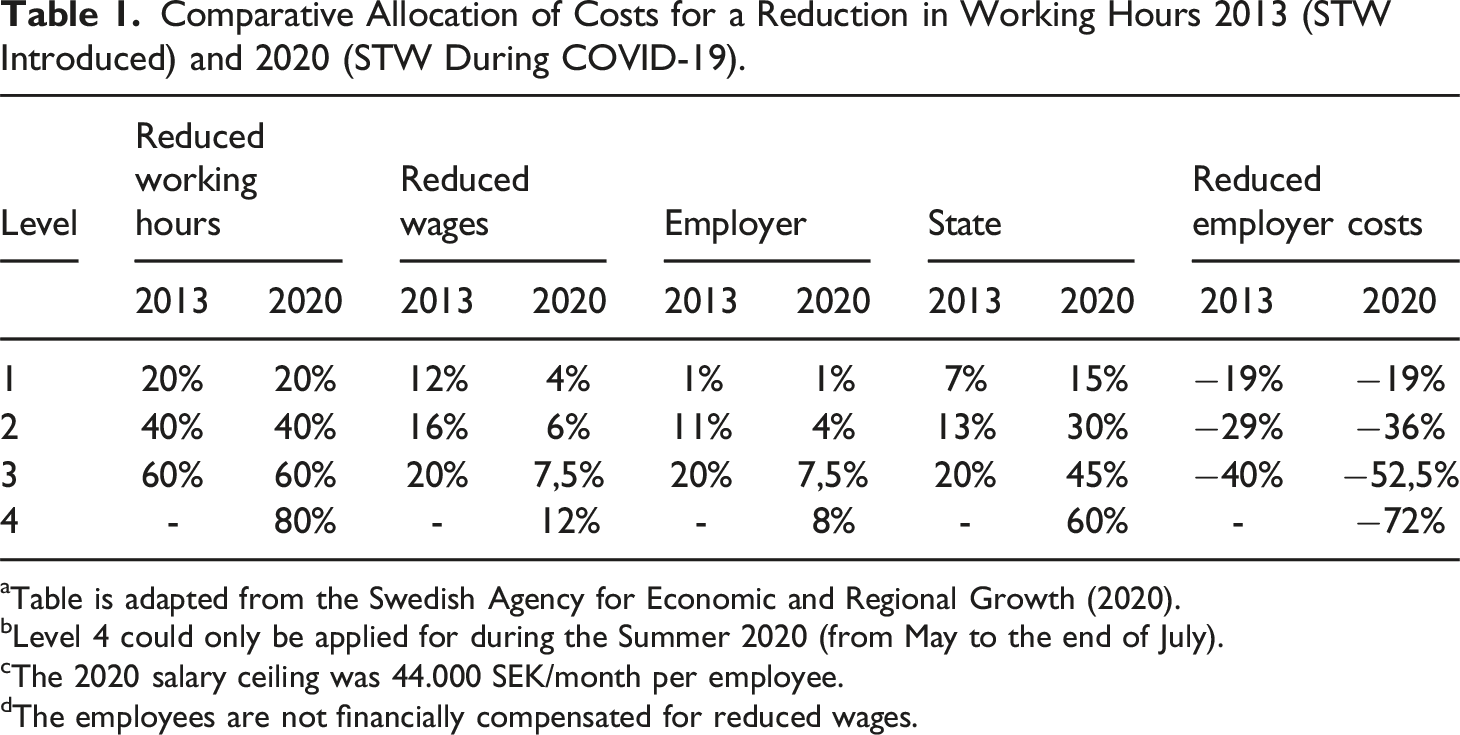
aTable is adapted from the Swedish Agency for Economic and Regional Growth (2020).
bLevel 4 could only be applied for during the Summer 2020 (from May to the end of July).
cThe 2020 salary ceiling was 44.000 SEK/month per employee.
dThe employees are not financially compensated for reduced wages.
Reflecting a historic continuity with the Rehn–Meidner model, the STW scheme’s rules stipulated that support should not be approved if companies were not competitive under normal circumstances. Companies therefore had to demonstrate they were not insolvent and had taken measures to reduce costs.
The combined influence of state and negotiated approaches resulted in a complementarity between qualitative and quantitative adjustment mechanisms, as the social partners pushed for working-time adjustments to be supplemented with competency development. Although the STW could be predominantly characterised as a quantitative adjustment mechanism, there was a strengthening of qualitative adjustment mechanisms more typical of the Swedish regime through state and self-regulated systems of training and education that had been eagerly anticipated by the social partners. Companies could receive financial support for competence development for STW employees (Tillväxtverket, 2021), which included initiatives aimed at increasing the competence of employees and validating existing competences. However, to receive support the competence development activities had to be regulated by local collective agreements.
The focus on competency development pushed by the social partners mirrored broader negotiations that culminated in the new Main Agreement on Security, Transition and Employment Protection, in Autumn 2020. The agreement covered issues such as investment in education and competence development, including financial support via new student grants and loans for adults. Reflecting the ongoing importance of self-regulation, the agreement was seen as important as the historic Saltsjöbaden agreement. The deal on employment protection maintained union influence but, as a clear effect of the January agreement, included some flexibilisation in the Employment Protection Act (LAS). Exceptions to the ‘last-in-first-out’ rule were increased, which had been consistently rejected by unions for many years.
That Sweden’s COVID-19 strategy did not involve a total lockdown meant the STW scheme could be utilised to cope with the downturn in economic activity: public health and labour market policy worked in accord to address the specific challenges of the pandemic. Moreover, having the STW scheme already in place allowed the social partners to conclude central and local collective agreements during the pandemic that provided the basis for company decisions on the scheme, which reinforced the continuing role of self-regulation even in the event of increased state intervention due to the crisis.
UK
The UK’s response to COVID-19 placed far greater restrictions in comparison to Sweden, with a nationwide lockdown and ‘stay-at-home’ orders that prohibited many workers from attending work in person. A tiered system of lockdown restrictions was also developed to reflect variations in the spread of the virus. The full lifting of all restrictions did not occur until May 2021, meaning much of the economy had experienced considerable uncertainty for over a year.
Although the GFC brought little systematic change to the market approach to restructuring, the outbreak of COVID-19 caused a significant, though temporary, shift in the UK from a market-oriented to a state-led restructuring regime (Stuart et al., 2021a). The level of intervention in the labour market was unprecedented, although arguably unavoidable given the effects of lockdown on the economy. The government’s flagship labour market policy was the Coronavirus Job Retention Scheme (CJRS) which allowed firms to ‘furlough’ workers with the government initially subsidising 80% of wages up to a maximum of £2500 per month. The CJRS was a novel policy intervention, modelled on STW schemes in Denmark and Germany, and initially involved discussions with the Trade Union Congress and Confederation of British Industry that echoed a state-led negotiated process, yet did not fundamentally alter the historic voluntarist approach to industrial relations. Although often described as a STW scheme, the key distinction of the UK scheme was that furloughed staff members were not allowed to work and were thus economically inactive. Furthermore, unlike Sweden’s graduated system, the furlough scheme introduced in March 2020 had a single level of state wage subsidy (although some employers topped-up payments voluntarily). The more extreme restrictions in the UK meant that take-up of the CJRS was inevitably higher than Sweden’s STW scheme as some sectors had no choice but to suspend, or severely limit, their operations whilst the lockdown was in place.
Consistent with the ad hoc nature of its initial development, the furlough scheme underwent a series of reforms that vacillated between statements that the scheme would be withdrawn to a series of extensions and rejigs. For example, a planned replacement for the furlough scheme, the Job Support Scheme, was abandoned in one of a series of government U-turns (McLachlan et al., 2022). The furlough scheme was ultimately extended five times during 2020–2021, with incremental adaptations aimed at encouraging the ‘reopening’ of the economy, in the context of changes in the medical situation (Stuart et al., 2021b).
In July 2020, a new stage known as ‘flexible furlough’ was announced, which allowed employers to bring furloughed staff back to work on a part-time basis with the government still paying up to 80% of wages. The state subsidy was incrementally reduced to 70% in September 2020, then 60% in October 2020, though topped up by employer contributions, before increasing again to 80% in November 2020 to reflect the rise in infections (Stuart et al., 2021b). The flexible furlough scheme came to resemble the Swedish STW scheme in terms of differential working-time and wage reductions, however a key distinction was working hours were determined by employer discretion in the UK compared to the set graduated levels in Sweden.
Overall, 11.7 million jobs were furloughed at a cost of £70bn, an unprecedented amount in terms of government expenditure on the labour market (HMRC, 2023). Although the inception of the furlough scheme involved some discussions with the social partners, that the government ignored their entreaties to continue the scheme, particularly from the TUC, speaks to the highly limited role of the negotiated approach to structural change in the UK context. The furlough scheme ended in September 2021, and with it the temporary experimentation with state-led adjustment mechanisms.
Beyond COVID: Lessons learned?
In Sweden, a report for the Swedish government acknowledges the STW scheme’s positive effect on cushioning the fall in employment and thus supporting the economy throughout the crisis and in its aftermath (Tillväxtanalys, 2022). However, the Swedish scheme has been criticised in an OECD report for its cost to employers (Araki et al., 2023). Araki et al. (2023) also suggest that the scheme should have been restricted to the duration of the crisis rather than continuing into the recovery period. The Swedish Agency for Growth Policy Analysis (Tillväxtverket, 2021) also recognises its prolonged nature yet stresses the lessons learned around using the STW scheme during crises only and not in the recovery period. While premature to fully evaluate the impact of the scheme, these initial reports are arguably indicative of the learning capacity inherent in Sweden’s restructuring regime given the proactive statements about how to improve the use of the scheme in the future.
A direct comparison with the UK of the costs to employers of the Swedish scheme is problematic due to policy design and the context of respective COVID restrictions. For example, the maximum employer contribution to the respective schemes was 8% in Sweden and 20% in the UK. As noted, Sweden had a graduated scheme throughout, whereas the UK scheme initially had no mandatory employer contribution and only introduced a parallel flexible element three months after its launch: therefore, Swedish employers would have been paying more from the beginning. That said, the fewer lockdown restrictions in Sweden meant there was less need for employers to participate in the scheme, unlike in the UK where there was greater compulsion to furlough staff: such a distinction complicates any normative comparison of the schemes. There is also a lack of data in both countries on employers’ contribution levels, how many hours staff members were working and for how long. However, when flexible furlough was introduced in the UK the numbers of jobs furloughed dropped considerably. These numbers only rose when a fresh national lockdown was called in Winter 2020, when the government temporarily paid 100% of the subsidy again. Less is also known about the cost to employers of the furlough scheme because some employers were topping up wages above the government maximum of £2500; survey data suggests 70% of employers were topping up wages either partially or fully, particularly in the public sector and in firms with recognised unions (Stuart et al., 2021b).
The UK government’s overall evaluation of the scheme nonetheless highlighted its ‘value for money’ and a sound return in terms of economic and societal benefit for taxpayers. A comparison of the costs to the state suggests that the UK was more expensive than the Swedish scheme: approximately £5982 was spent per job saved in the UK compared to £4254 in Sweden, reflecting 2% and 0.7% of GDP in 2020, respectively (Drahokoupil and Muller, 2021). Furthermore, the overall benefit of the furlough scheme has also been brought into question due to allegations of approximately £3.5bn lost to fraud from businesses erroneously claiming the subsidy, along with some employers paying some of the subsidy they received back to the state.
In focussing on the UK, the impact on the labour market can be seen as positive in terms of protecting jobs, and 84% of furloughed staff members were still employed in June 2022 with 54% working for the same employer (HRMC, 2023). The furlough scheme has also been celebrated for preventing business closures and reducing the scarring effects of unemployment. Despite positive assessments of the CJRS and calls from the TUC for the development of a permanent STW scheme (TUC, 2021; UK Parliament, 2021), the refusal of the government to commit to such a policy is arguably illustrative of the nature of a market-oriented regime: there is no mechanism for the social partners to proactively negotiate for change in the wake of the pandemic, which places limitations on the UK’s capacity to learn lessons from crises.
While difficult to fully evaluate the legacy of the CJRS, there has been enough labour market volatility to remain equivocal around the overall trajectory of the UK’s recovery since the abandonment of the state-oriented approach and reversion to a market regime. In contrast to the years after the GFC, the employment rate has been steadily decreasing (Murphy and Thwaites, 2023) and the UK has experienced the highest rates of industrial action since the late 1980s, in response to falling real wages due to high inflation (Cominetti et al., 2023).
Discussion and conclusion
This paper compared the labour market policy responses of Sweden and the UK to the GFC and the COVID-19 pandemic. Through analysis of the journey between these two crises, we characterise Sweden’s approach to restructuring policy as proactive and pre-emptive and the UK’s as reactive and ad hoc. The paper contributes to existing debates around restructuring regimes, which point to the importance of institutional path dependency (Bergström, 2019; Gazier, 2008), by locating analysis in respective industrial relations traditions of self-regulation and voluntarism in Sweden and the UK.
The paper argues that Sweden’s negotiated process of change was informed by lessons learned by the state and social partners following the GFC, which led to the development of an STW scheme, and in turn provided the basis of the response to the pandemic. Whilst Sweden’s scheme was first employed during COVID-19, it was a system proactively developed through negotiations and concertation between the state and social partners to understand how to better manage major economic downturns. In contrast, the lack of a specific labour market policy response to the GFC and the continued reliance on existing market-oriented approaches to restructuring left the UK ill-prepared for future crises, with little reflection on the experience of the GFC in any subsequent policy developments. As a result, the response triggered by COVID-19 was the hastily developed furlough scheme (CJRS). The furlough scheme was therefore an ad hoc, one-off response to what was seen by the UK government as a unique problem, of little use beyond these exceptional circumstances: nor intended to be so.
Although the introduction of Sweden’s STW policy was a return to a similar policy abandoned in the 1990s (Larsson et al., 2011), it was nonetheless more extensive and represented a dramatic change in the management of restructuring during economic crises. Drawing on the restructuring regimes framework (Bergström, 2019; Gazier, 2008), the STW policy involved a new quantitative adjustment mechanism in the reduction of working hours and wage adjustments through state subsidies, whilst existing qualitative adjustment mechanisms were also reinforced by increasing investment in competence development and education. Locating analysis in terms of the principle of self-regulation provides deeper insights into how key pillars of national industrial relations traditions underpin the role of restructuring regimes in the response to economic crises. The history of state commitment to the role of the social partners in Swedish labour market policy (Bergström and Styhre, 2022; Howell and Givan, 2011) was reflected in the development of the STW scheme. The role of the social partners in research visits and government’s own investigations during the development of the STW scheme offered further insights into the relationship between restructuring regimes and institutional learning. Sweden’s state-coordinated involvement of social partners laid the foundations for proactive, pre-emptive policy development; in turn, this institutional framework provided the means to both reflect on lessons learned from the GFC and collectively contribute to changes within the restructuring regime.
In contrast, the small legislative changes made in the UK in the wake of the GFC were essentially a reaffirmation of the market orientation, which did not suggest learning informing adaptive change. The furlough scheme signalled a shift from a market-oriented approach to a temporary state-led regime during the pandemic (Stuart et al., 2021a), which we suggest reflects the ad hoc and reactive nature of the UK restructuring regime. The furlough scheme can be seen as a concomitant to the lockdown imposed by the UK government, allowing firms to retain staff to facilitate a quicker return to full productive capacity when lockdown restrictions were lifted (Spencer et al., 2023; Stuart et al., 2021a). In the absence of alternatives, the furlough scheme was arguably expedient; however, it was ultimately a costly and hastily contrived response that was not designed to extend beyond the pandemic.
While Bergström (2019) highlights the general stability in European restructuring regimes following the GFC, our analysis points to potential instability in the UK regime, which was exposed by the extremes of the COVID-19 crisis. The volte face from market-oriented to state-led approach was in stark contrast to the continuity and stability seen in the Swedish regime. In comparison to the ad hoc approach of the UK, the institutional capacity for negotiated change in the Swedish regime represented stability with flexibility. The central role of the social partners in the Swedish system means that the state could rely on their actor capacity (Bergström and Styhre, 2022), reflecting wider debates about the continuity of national industrial relations systems in the aftermath of the pandemic (Meardi and Tassinari, 2022). Even as the Swedish state went through its own period of withdrawal (Schnyder, 2012), the social partners stepped in to compensate; for example, signing transition agreements that took on responsibilities previously held by the public labour office (Arbetsförmedlingen). In relation to the STW scheme, the apparent need for responsiveness to market imperatives was incorporated into the negotiation-oriented restructuring regime. The unions’ journey from Crisis Agreements to acceptance of the STW policy was facilitated by faith in levers of change based on negotiation, which allowed for accommodation of market responsiveness in the context of the compensatory social protection afforded by the Swedish institutional context. Hence, the introduction of the STW policy illustrates how the Swedish restructuring regime has demonstrated stability with the capacity for change.
By contrast, the UK tradition of voluntarism gave way to an increased deinstitutionalisation of industrial relations, with unions essentially excluded from all but occasional policy consultations of the sort seen during COVID-19. The neoliberal economic agenda finds reflection in a predominantly market-oriented restructuring regime albeit with pockets of negotiation at subnational or sectoral level. However, in keeping with broader patterns of continuity elsewhere in Europe (Meardi and Tassinari, 2022), there were no substantive changes to the UK industrial relations system during the pandemic. The mantra of market primacy coupled with deinstitutionalisation and the exclusion of social partners from policy circles has left UK governments lacking the levers and actor capacity available in Sweden; the market regime lacks the levers of change through which the negotiated regime was able to achieve market responsiveness. The absence of a role for unions and employers in the collective regulation of restructuring at a national regime level limited the levers available to the UK government. Thus when faced with a crisis of a proportion that demanded intervention, such as COVID-19, there was a paucity of institutional machinery to draw on to mitigate its effects. The UK government was forced to intervene but did so in an ad hoc and reactive fashion. Although the furlough scheme was an unprecedented level of state intervention in the labour market, it was without a longer-term or future-oriented objective.
In response to pressure for change restructuring regimes may crystallise as hybrids of adjustment mechanisms, as seen in Sweden; alternatively, they may revert to longer-term regime characteristics once the threat of crisis is perceived to have subsided, as seen in the UK. The Swedish restructuring regime was able to introduce new adjustment mechanisms due to its traditional levers of change. Ironically, being responsive to market signals was facilitated by the negotiation-oriented regime in a way that the market-oriented approach was unable to achieve due to the lack of levers to pull in response to market imperatives. Thus the UK’s market-oriented regime is inherently reactive, lacking in the means of proactive intervention of the sort seen in Sweden. The existence of such levers of change allows for both stability and responsiveness in a way a reliance on market imperatives alone does not. Indeed, to refer to market-oriented approaches as a regime is perhaps a misnomer. If a regime is understood to be a systematic and ordered way of doing things, the market-oriented approach that was dominant in the UK is perhaps better conceived as a non-regime; devoid of levers of change in times of crisis and prone to ad hoc experimentation with alternatives.
Footnotes
Declaration of conflicting interests
The author(s) declared no potential conflicts of interest with respect to the research, authorship, and/or publication of this article.
Funding
The author(s) disclosed receipt of the following financial support for the research, authorship, and/or publication of this article: The Swedish Research Council for Health, Working Life and Welfare. 2018-00760.

Author biographies