




Abstract
The creation of a common European market for financial services has significantly altered the strategic edifice for banks, as well as for the trade unions representing their employees. In the Nordic countries, where regulation of the labour market has long relied on multiemployer bargaining and strong sector-level actors, this has led to a strategic realignment. Faced with mergers and acquisitions, the potential for delocalization and an increasing amount of directly applicable EU-regulation in the sector, Nordic finance trade unions have supported the creation of company-level trade union alliances within MNCs, while still building upon resources and repertoires stemming from Nordic ‘comparative institutional advantage’. Our ‘extended case study’ of three such alliances in the finance sector, called ‘Nordic company clubs’, concludes that, while trade unions there still benefit from strong, typically Nordic institutional and associational power resources, important actor-centred variables and capabilities such as narratives, scaling, resourcefulness and institutional experimentation complement and strengthen our understanding of trade union strategies and institutional change in the context of market integration.
Global and EU integration of financial markets accelerated since 1980, altering the strategic context of European banks, nestled in national markets before (Thalassinos, 2008). Mergers and acquisitions were the response, especially in the Nordic countries, where smaller domestic players reacted to the tremendous growth of European financial markets. Additionally, information technology has led to structural changes in finance, making traditional jobs obsolete and creating new professional categories, thereby placing workers in direct competition with colleagues abroad (Marin, 2006). Enter stage left: the financial crisis of 2008, and its significant aftershocks for labour (Bieler and Erne, 2015).
Trade union (TU) responses to the challenges of market integration vary between defensive positions based on national institutions to creating transnational TU networks and labour relation (Fichter and Sydow, 2008). They are generally understood as a reflection of institutions and the resources and repertoires they provide. Our paper aims to showcase what specific resources actors draw upon from both national and international institutions to embark on an instance of ‘institutional experimentation’ (Ferraras et al., 2020).
The research questions that our paper addresses are: (1) is there a pattern of strategic TU responses to commonly experienced disruptions of market integration and successive crises in Europe; (2) is the transnational expansion of companies followed by transnational TU strategies, and if so, do they weather? and (3) what institutional resources and levers (both, national and transnational) help, hinder or shape the development of such strategies?
TUs in the Nordic countries have long relied on multiemployer bargaining and strong sector-level corporatism with employers’ associations (Due and Madsen, 2008). Our article analyzes three ‘most similar cases’ (Seawright and Gerring, 2008) of transnational TU alliances (called ‘Nordic company clubs’ here) set up in Nordic banks as they have expanded into Europe. By mapping the varying degree of internationalization that TUs have embraced and, more importantly, their non-linear development, we seek to isolate the institutional resources and levers that trade unions utilize from purely actor-driven experimentation. By doing so, the article contributes both to institutional analysis of market integration, and to research into transnational trade unionism and TU renewal.
First, the article will discuss literature around institutional change, power resources and strategic capabilities. It will then present the extended case study methodology and field work. After going into some detail of the three selected Nordic trade union clubs, it will then contrast them and discuss the relevance of common or diverging findings. We will conclude that the past 15 years have indeed provided for a fruitful terrain in experimenting with transnational TU strategies, mobilizing power resources and levers from the Nordic institutional framework for elements of both, continuity and change.
Theorizing market integration, institutional change and TUs
The main argument of our paper is that repeated shocks and crises have served as a backdrop for strategic experimentation, while building upon institutional resources and various manifestations of Nordic ‘comparative institutional advantage’ (Hall and Soskice, 2001), as well as transnational incentive structures. As a common point of departure, institutional literature holds that TUs in ‘coordinated market economies’ (CMEs; ibid.) may remain strong political and social forces, shaping market integration in their respective national contexts. This view is traditionally held of TUs in the Nordic countries (Esping-Andersen, 1990a). However, and even without adopting spillover type arguments (Abbot, 2007), enduring transnational, company-level TU strategies within European multinationals do challenge this narrative to a certain point.
Initially, neo-institutionalism considers structural context to be more powerful than global forces of market integration, shaping firms’ incentive structures to permit for a diversity of capitalist regimes. Where institutional frameworks create ‘employment systems’ (Marsden, 1999), permitting MNCs to flourish despite (or precisely because of) strong worker representation, TUs should not become obsolete (Thelen, 2001), but become part of a CME ‘path dependency’ (Ebbinghaus, 2009). Therefore, TU alliances may be seen as invaluable tools of redistributing TU power from places where institutions preserve it towards making gains where it is being eroded.
There has long been evidence on TUs deriving ‘power resources’ (Esping-Andersen, 1990b; Korpi, 1978) from a CME setup, thus wielding ‘institutional power’ (Turner, 2007a), leveraging elements of presumed path dependency to shape new institutional paths. This concept has been applied to TU action (or inaction) in the Nordic context (Arnholtz and Refslund, 2019). In that sense, actor-centred considerations have been carefully introduced into mainstream analysis of ‘gradual institutional change’ (Mahoney and Thelen, 2010), especially in the context of ‘institutional drift’ (Streeck, 2009).
A further insight from the power resource approach has been the insistence on coalition building, so-called ‘associational power’ (Wright, 2000). This power is understood to be actively created on four levels: company, sectoral, national and transnational (Refslund and Arnholtz, 2022). All four are relevant to our analysis in this paper.
Alternatively, institutional analysis may interpret TU alliances as tools to perpetuate the privileges of institutionally sheltered actors and keep workers elsewhere at bay. Absent significant transnational resources and opportunities, incentive structures in CMEs are simply stacked against transnational strategies, mired in ‘competitive solidarity’ (Streeck, 2000). This has been argued with regards to Nordic TUs in the Baltic countries and in Poland (Adamczyk, 2018) and this dilemma will be illustrated in more detail through our empirical findings.
At the very least, it is argued that TUs need a capacity for ‘scaling’ (Golden and Erne, 2022) for transnational opportunities to be seized. They can rely on transnational institutional resources offered by the EU, as well as creative networking abroad, contributing to associational power at the EU-level (Meardi, 2012). In fact, transnational network building leads us back to institutional analysis in its sociological twist, as it considers social actors to be rooted in ‘discursive institutionalism’ (Schmidt, 2010), underscoring commonly shared norms and narratives as a basis for ‘rooted cosmopolitans’ (Tarrow, 2005) to promote cooperation and transnational solidarity (Bieler and Lindberg, 2010).
Company-level TUs becoming transnational in scope may thus require an important capacity to construct, maintain and reinvent TU ‘repertoires’ (Tilly, 2006), such as the active involvement in transnational alliances. Narratives facilitating such repertoires may stem from a common language, regional ties or similar ‘union identities’ (Hyman, 2001). While this perspective has also been mobilized in support of TU power in less clement institutional set-ups (Turner, 2007b), all the above elements certainly point to the Nordics as a fruitful terrain.
An in-depth look into the inner workings of multinationals is equally helpful to reach a less deterministic approach. Depending on where in the global value chain (GVC) a labour market actor is situated and what other local players are present, it possesses a certain number of strategic levers (Kristensen and Zeitlin, 2005), leading to considerable variations of strategic actions within distinct institutional models (Meardi et al., 2009). This strand of research again illustrates the importance of associational power resources, including network embeddedness and narratives (Levesque and Murray, 2010a), stemming directly from the location of the TU within the GVC. Their strategic capabilities and resourcefulness (Ganz, 2002) then become important concepts to explain ‘transformation experiences’ (Hyman, 2007), implying either a departure from established national repertoires to cooperate transnationally, or leveraging national institutional resources to bolster their already privileged position. Research on institutional entrepreneurship in the automobile sector (Greer and Hauptmeier, 2008) has advanced similar concepts. Thereby, GVC analysis intersects with the literature on transnational TU alliances.
In fact, transnational TU alliances have long been considered worthy of our consideration, providing rich theoretical insights (Fairbrother et al., 2013; Hoffmann et al., 2018; Müller and Platzer, 2009). Regardless of whether they are seen as an outgrowth of spillover, or following a more sociological approach, conditions for success and failure of such alliances have been described in detail, and they can be filtered into three broad sets of input variables: (1) institutional/national-level, (2) organizational/company-level and (3) union-specific narratives and repertoires.
Transnational TU alliances then reflect push-and-pull factors stemming from: (1) institutional factors (such as power resources and legal constraints from national labour relations frameworks); (2) organizational factors, such as the structure of the GVC and company-level micro-corporatism; and (3) the narrative frame of action and established strategic repertoires of the TUs involved. Power resource analysis may refer to this latter part as ideational power resources (Refslund and Arnholtz, 2022). Chocs and crises in the long-term then present an open-ended experiment for the adoption, revision, adaptation or even reversal of transnational TU strategies. This process we refer to as institutional experimentation in the context of market integration is reproduced in Figure 1. Conceptualizing factors of success and failure for transnational TU alliances.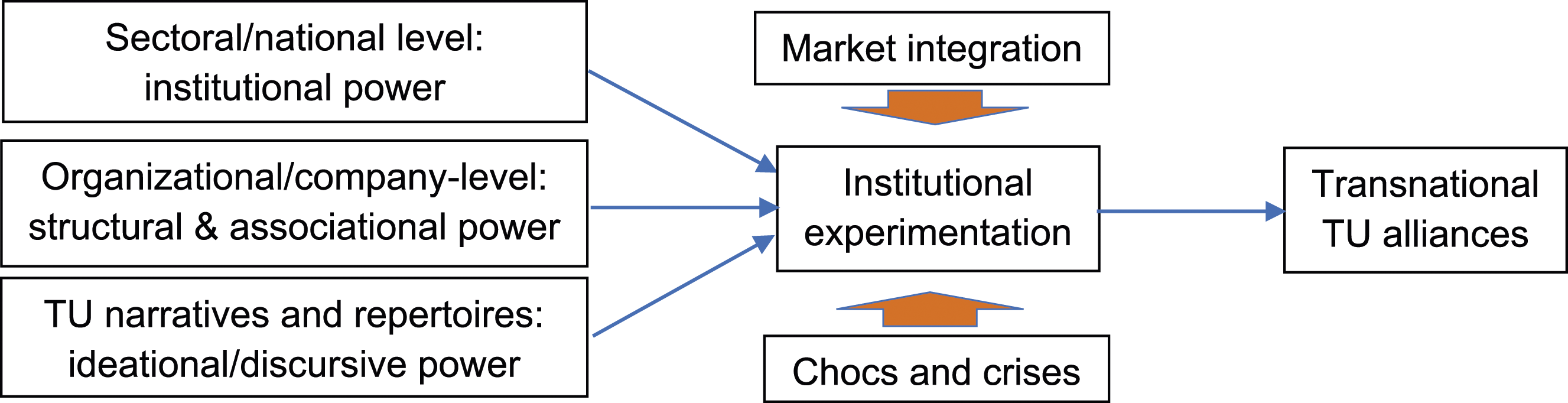
The concept of ‘institutional experimentation’ completes this approach by injecting a distinct temporal lens that is neither too historical to be mired in path dependency nor too short-term, exaggerating purely actor-based explanations. Based on their strategic capacities and institutional resources, actors may develop certain strategies in response to external chocs or crises at point A, but they may just as well revert to previous repertoires or develop new ones at point B. Because such institutional entrepreneurship relies on the context-appropriate utilization of resources (Brookes, 2013) and it requires coherent narratives, this process is neither a one-way street nor predetermined. By focussing on the distinct forms of experimentation and transnational cooperation, and by contributing to a better understanding of the persistent variations over time between very similar MNCs within one and the same powerful institutional framework, we seek to point to TU-specific repertoires and how they are creatively employed in a process of institutional experimentation.
Transnational TU alliances in CMEs can then be understood as both, the natural evolution of one institutional model dealing with market integration and resourceful actors embarking upon institutional experimentation. Adopting a nuanced institutional perspective permits to elucidate how institutionally nested actors, deriving resources from their respective national frameworks still partake in a game of multi-level governance (Marginson and Sisson, 2006), becoming drivers of transnational employment relations. On a more normative level, studying the conditions for success of such alliances may hint to what went wrong in cases where cross-border solidarity has failed, and how to avoid it.
Conceptualizing transnational TU alliances in the Nordic context
For Nordic labour unions, European integration has proved problematic. Regulation of Nordic labour markets has long relied on multiemployer bargaining and strong sector-level corporatist relations. Nevertheless, they have also reserved an important space for micro-corporatist relations at the company-level (Huzzard and Nilsson, 2004). Decentralized wage-setting, based on company-level agreements, has become more common in the finance sector than in others, and more so in Denmark than in Sweden (Kjellberg, 2022). As Scandinavian banks expanded within an integrated European market, opportunities for company-level, win-win solutions arose, even though unions and workers were placed in direct competition with traditionally non-unionized staff elsewhere. Soon, the value of transnational TU alliances at the company-level became of interest (Falkensjö, 2017).
Table of TU Challenges in the Nordic Finance Sector.
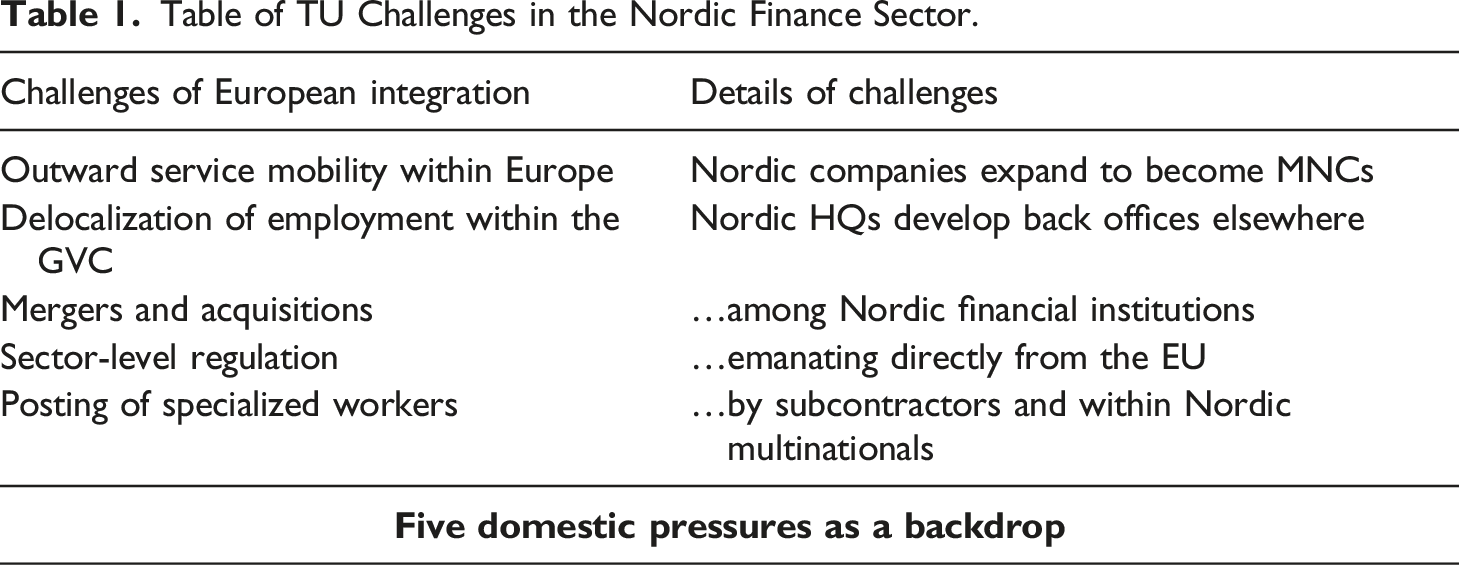
Compounding the EU-induced challenges during the 2010s, were five mounting domestic pressures. First, there was a marked change in the Nordic employers’ associations’ negotiation strategies towards more confrontation and decentralized bargaining. Second (and third), the increasing upskilling and individualization of workers’ identities caused difficulties to unionize high-skilled workers within regular, white-collar unions (thus resulting in some level of union competition for IT and academic workers from professional unions). Fourth, the shortage of skilled labour in the Nordic finance sector has meant that TUs had to organize nimbly to integrate newly arriving workers via EU labour mobility, often stemming from countries where the finance sector is not very unionized at all. Finally, the finance sector turned away from face-to-face customer interactions and towards internet-based solutions.
As the Icelandic experience during the financial crisis of 2008 and onward differs significantly, the cases discussed in this article are exclusively covering the other four Nordic countries (Denmark, Sweden, Norway and Finland). While only Finland is a member of the Eurozone, and Norway isn’t a member of the EU, all four countries partake equally in the Common Market and enjoyed a period of expansion and consolidation during the 2010s, therefore providing for a level analytical playing field.
Nordic challenges stemming from EU integration are well documented in pre-existing research (Navrbjerg et al., 2009). The main result has been a drive towards company-based solutions. This sets up a triangle of strategic tensions (Figure 2) between (1) the dangers and opportunities of European integration (where the relationship between national and transnational company clubs is potentially conflict-ridden and may sideline non-Nordic workers unless there is effective interunion collaboration); (2) traditional sector-level collective bargaining in the Nordic countries based on strong coordination on the national level (sector-level TUs are weary of transnational company agreements impinging on their sectoral bargaining mandates, covering issues usually reserved for sector-level agreements); and (3) company-based solutions at the national level (transnational company unionism may exacerbate the competition between micro-corporatism at the headquarters and national, sector-based TUs). In the absence of stable TU alliances, the main danger are ‘whipsaw’ effects (Greer and Hauptmeier, 2016), as management leverages their bargaining power linked to lower working conditions and wages elsewhere in Europe. Triangle of tensions between institutional levels.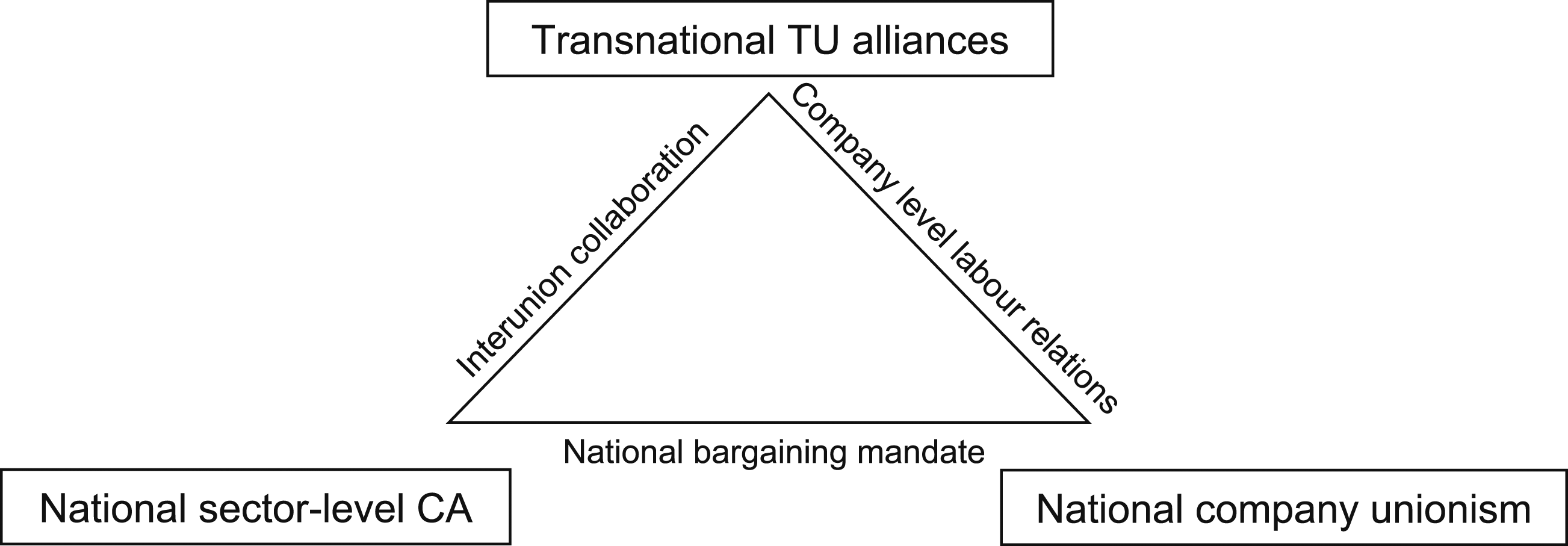
Some Nordic labour unions in other sectors have opted for strengthening the tried-and-tested national institutions of sector-based coordination (Gebert, 2012). But like TUs in other countries and other sectors (Lillie and Martinez Lucio, 2004; Turnbull, 2006), Nordic finance unions also adopted a set of new, international strategies. Other research has shown similar findings about TUs in different Nordic sectors exposed to European integration (Ilsøe, 2017; Murhem, 2003).
Fast forward 10 years later. Financial markets have generally recovered, but other frequent and overlaying crises (that of the Eurozone, Brexit, and the Panama Papers) continue to create insecurity. Not to mention the Covid-19 pandemic furthering structural change towards online services, cashless transactions, and the mounting public debt, as Europe adopted large stimulus packages. In this context of continued volatility we undertook the second round of our fieldwork, which we shall now turn our attention to.
Research design and methodology
Our fieldwork has been carried out in two distinct phases, one in 2010 and one in 2021, permitting us to track the development and institutionalization of the Nordic company clubs, by which we mean institutionalized forms of TU alliances within Nordic companies. It can be classified as a contextualized case study (Yin, 2003), meaning that each case is interpreted within its own substantive development over a longer period, the first timeframe covering the late 2000s (integration and financial crisis) and the second covering the 2010s (consolidation and Eurozone crises). And while national, sector-level TUs, and even Brussels-based TU organizations, do play an important role in this strategic puzzle, we shall limit ourselves to the company level (both national and transnational) as the main unit of analysis. That level is of particular interest, given the importance of financial MNCs, and the high hopes that this form of TU cooperation had awoken in the early 2010s.
Preferring understanding over prediction and exploring a rather unique, recent phenomenon, the methodology of this project has been purely qualitative, and includes documentary research and 34 in-depth, semi-structured interviews with practitioners and experts (see Annex 1), varying in length between 45 and 90 min each. The 2010 multi-level fieldwork in Brussels, Norway, Sweden and Denmark involved interviews with key TU representatives on five institutional levels (company, sector, confederation, Nordic and European). For logistical reasons, the 2021 iteration was limited to Denmark and Sweden.
Interviewees were selected in a stratified snowball method, separately executed for Denmark and Sweden: from the European level to the confederation level, to the sectoral level, and finally to the company level. We were also able to complete some participant observation of transnational TU activities, such as general meetings of transnational company clubs and of the Nordic Finance Unions (NFU). Completing our data collection was documentary research (websites, reports and minutes), all of which was coded and analyzed according to the factors of success and failure of establishing TU alliances, paying particular attention to institutional and actor-based variables, as well as the intervening macrolevel challenges (market integration and successive crises). The gathered data and preliminary analysis have also been subject to exchanges with Nordic scholars of labour relations, in December 2021, and with a diverse cross-section of scholars on European labour relations at a special seminar in Leuven, in April 2022.
Rather than a strict longitudinal case study, with outside factors controlled and dependent variables (union strategies) described over time, one could refer to this arrangement as an extended case study (Burawoy, 1998), seeking to elucidate the dynamics and acts of institutional experimentation over time, rather than presuming causal relationships. As mentioned previously, it is precisely the non-linear and reversible nature of (some) of the strategies we have observed, the persistence of intra-model variance among very similar cases, along with an uneven development of strategic capacities among similar TUs that support actor-centred explanations.
Our cases: Company TU clubs to the rescue?
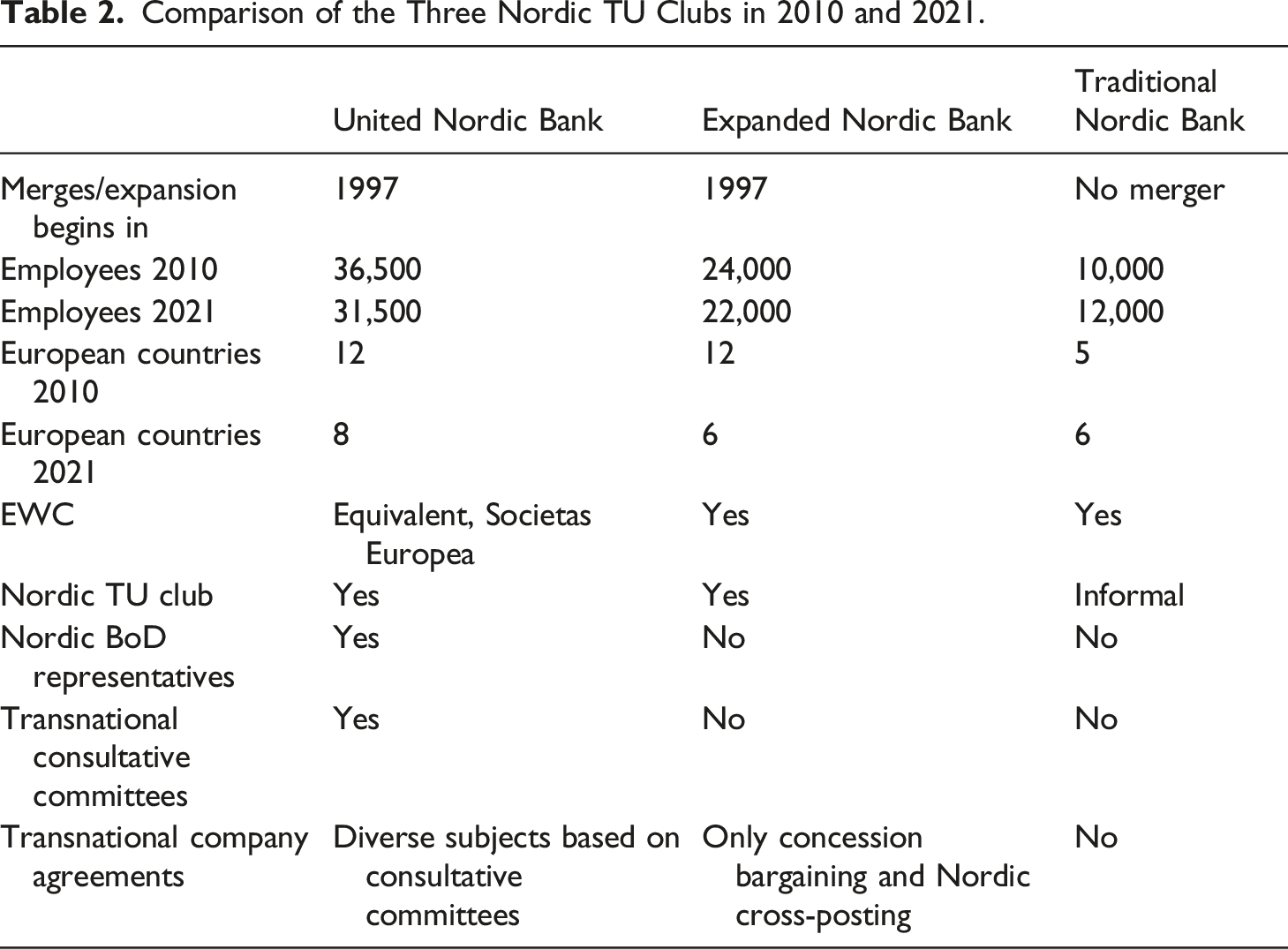
Let us now turn to the three examples of transnational TU alliances in the Nordic finance sector, each representing a different stage of strategic internationalization. We have dubbed them United Nordic Bank, Expanded National Bank and Traditional National Bank.
Five national TUs from four Nordic countries are involved, representing employees in the three companies in their respective countries. Norway represents a minority of employees in all three cases, Sweden the original home country of two and Denmark the home country of the remaining case. Finland is a special case, having recently been the beneficiary of one headquarters’ move to Helsinki. We will first present some of the main descriptive data, before then analyzing them considering the challenges of market integration.
In 1997,
Subsequently, there was a gradual integration of Danish and Norwegian subsidiaries, both on the consultative committees and in the TU club. As a societas europea, UNB’s worker representation follows a somewhat different pattern than in the other two cases. To this day, the combination of consultative committees and TU club fulfills all requirements of the EU’s EWC directive, so that UNB never created a separate EWC. The transnational TU club was institutionalized as an official company union (‘Union in UNB’) in 2005. Its aggressive expansion has led UNB to dramatically increase its presence in Poland, transferring some of the back-office jobs from the Nordic countries there. This latest phase of expansion also tested the limits of transnational trade unionism: despite a collaborative employer and concentrated membership drives, the Polish subsidiary of Union in UNB had no more than about 50 members by 2010. While this achieved some unionized Polish representation on consultative committees and in UNB, it did not ensure representativeness regarding the full Polish workforce of over 2000 then (standing at well over 3500 now).
During the 2010s, the market-seeking expansion of UNB had come to a halt, while the delocalization of back-office employment away from the Nordic countries never stopped. Overall employment in the bank has dropped to around 31,500 albeit dipping back up in recent years. As of 2021, the headquarters of UNB had been moved to Finland, it had spun off its banking operations in the Baltics and the back-office operations in Poland now make up around 12% of the total workforce. UNB is also facing the consequences for its (small) British subsidiary after Brexit, and leaves transnational worker representation there uncertain, even though the non-regression clause under the EU-UK trade and cooperation agreement should normally safeguard it.
Contrary to UNB, national structures of worker representation, such as business unit consultative committees and national works councils keep their importance. The role of the national company clubs in the country of origin and the privileged relations to headquarters management remain very strong. It has in effect been institutionalized by requiring that the presidency of ‘ENB Unions’ be held by a representative from the home country, while the vice-presidency rotates among representatives from one of the other countries. Nevertheless, this predominant role has not prevented significant relocations (e.g. IT services) to subsidiaries in the Baltics, the Czech Republic and even to India.
Like UNB, as of 2021, ENB has also ceased to operate front offices in the Baltics, largely because of spotty oversight and compliance. However, the bank maintains a rather large back office in Lithuania, where it is now one of the country’s biggest employers. While overall employment is rather stable (at about 22,000), a growing percentage of employees now work in Eastern Europe, with almost a fifth (19%) of ENB’s employees now based there. Contrary to UNB, it has divested from its activities in England and Scotland, but it maintains a very active presence in the Netherlands and in Northern Ireland.
Transnational worker representation within TNB has been limited to establishing an EWC, which functions well and provides a common space for exchanges between TU representatives. The presence of non-unionized staff is not an issue here. Instead of a formal TU company club, the home country union has thus opted to leverage the regular EWC meetings for informal TU cooperation, rather than setting up and institutionalizing a separate structure. And while the home country company union is quite dominant in the process, the EWC presidency on the TU side is currently held by a representative from another country.
Comparison of the Three Nordic TU Clubs in 2010 and 2021.
The inclusion of countries that do not share the same, strong TU history has been uneven. Successful organizing there is rare. And in countries where the finance sector is organized, but where micro-corporatist relations are seen as alien – such as the UK and Ireland – inclusion into Nordic TU clubs has been more difficult. Also, an institutionalized TU structure has not halted the twin phenomena of outsourcing and delocalization, but only helped to mitigate them. Resources are a further challenge: who pays for the coordination effort on the workers’ side? Should resources be concentrated on coordinating the organized or on organizing the others? Which resources (institutional and organizational) can be shared across borders, and which need to be borrowed from other levels?
In multinationals where TU cooperation lags, it is mostly left up to the home-country TU club to negotiate with company management. EWCs only get secondary considerations. Where such negotiations include redundancies, outsourcing and technological change across borders, TU representatives do, however, admit their need for reaching out to workers in the other countries. The reliance on relations with home country management is unsurprising, as the management practices of the three companies are rather tightly integrated. Nordic managers are commonly posted to foreign subsidiaries, and following the 2018 scandals, much tighter control is exercised over the compliance departments, many of which are in the Eastern European back offices.
The tendency of home country TU clubs to act as an agent of workers’ interest in all countries where the bank does business is laudable, but tricky: for example, Swedish company clubs have advance access to extremely confidential information and business strategies through their BoD representation. Furthermore, Swedish law requires advance notice to headquarter TUs before any redundancies may take place, giving them the power to coordinate (or not) with unions elsewhere before they happen, ‘calling in favours’ from their home-country management to advance workers’ plights there (or not).
Without direct representation of those on behalf of whom such interventions are undertaken, no one can guarantee their buy-in, particularly when concessions are required. National company clubs may also fear that non-union channels of worker representation in other countries could undermine their strategic position and opt for a centre/periphery (Nordic/non-Nordic) strategy instead. Inversely, non-Nordic employee representatives may fear the dominance of Nordic codetermination structures. Brexit has raised the additional spectre of how to include UK colleagues working for Nordic banks. Ironically, the Brexit transition agreements only require British firms to maintain EWCs in their European subsidiaries, but European firms do not need to include British workers in theirs.
Analysis: Common trends and patterns, as well as intra-model variation
The creation of transnational company unions has certainly exacerbated several tensions. In all three cases we studied, national TU clubs have had to compose with transnational structures that sometimes include non-unionized colleagues. They have also had to tread a fine balance between reaching out to and even representing colleagues abroad and safeguarding their privileged relationships at home. Finally, a shift to transnational company unionism has put pressure on the national TUs, as they have had to step up their coordination game to preserve their sectoral collective agreements. Without this, transnational banks may use their leverage over company unions to shop around for more advantageous arrangements. Tying this back to our theoretical discussion, one would say that waning structural and institutional power prompted by institutional drift has set up a particular version of the strategic triangle of tension in each of the three cases.
Previous research has confirmed the role of national TUs as potentially pivotal for developing alliances on the company level (Levesque and Murray, 2010b). In the Nordic finance sector, company-based clubs, called Kredse in Denmark and Fackklubbar in Sweden dominate the sector-level TUs. The largest banks’ employee associations typically represent about three quarters of their membership, and membership density is also much higher there than in smaller companies or territorially organized units. Thus, national company clubs have both, a superior level of resources (in terms of full-time releases from the employer and in terms of membership dues) and a predominant voice at the table of the national sector-level TU. In that sense, associational power resources remain strong in all three cases, making a push for company-level agreements not a problem as such. It is here, for instance, that win-win solutions to technological and structural change are negotiated.
National Finance-sector TUs: Challenges and Strategies.
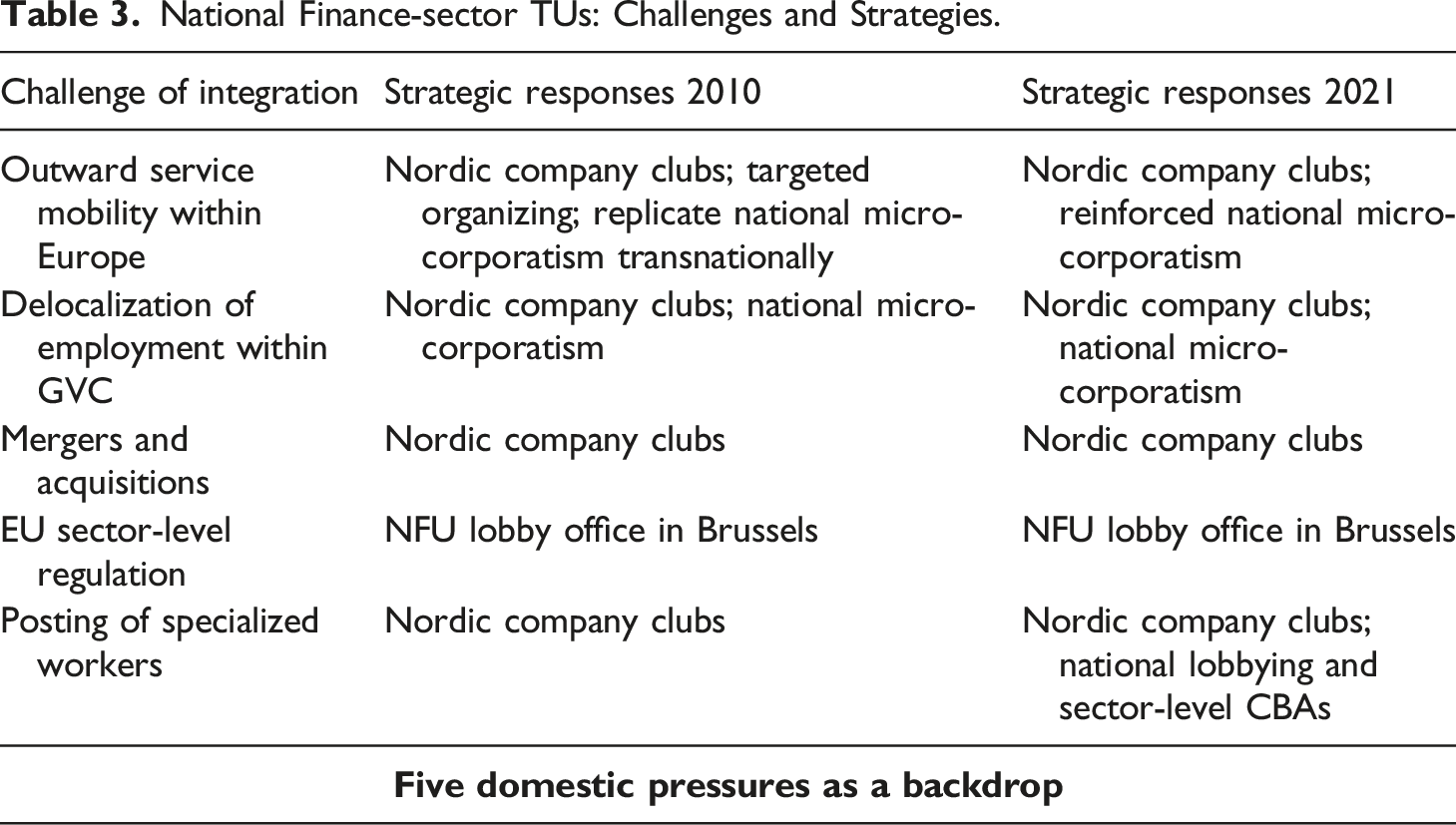
The use of EU resources, such as special project funding and EWC agreements, is actively encouraged. In that sense, one could argue that Nordic finance-sector TUs have ‘Europeanized’ considerably. However, they do so in a very Nordic way, using EU-resources and structures only to stabilize and extend to the Nordic level, what was already established practice within national structures. By hiring consultants at the company-level, they have helped to resolve the triangle of tensions, while accompanying a shift to the transnational arena. This could be seen as evidence of scaling up national micro-corporatism to the transnational level and tapping into transnational resources to supplement increasingly stretched national ones.
By 2021, while cooperation between Nordic TU representatives is stronger than ever, efforts to effectively include Eastern European colleagues seem to have been largely abandoned. The UK presents a mixed picture, with ENB being more effective at including their Norther Irish colleagues than UNB seems to be with its much smaller UK contingent. Labour conditions in Poland, however, have dramatically improved since, and have diminished some of the salary advantages there. Additionally, and in the wake of some operational and oversight problems, at least one of the three companies has moved some back-office employment back home. Finally, and given the need for customer service in Nordic languages, some functions are simply hard to move abroad in the first place.
Back home, finance-sector unions have also undertaken a rebranding as ‘modern’ and ‘smart’, offering broader membership services. Some have merged with smaller unions, thereby increasing economies of scale. Almost all have modified mission statements and logos. The value-added of transnational representation has played an important role in renewing their narratives. Also, Europeanization turns out to be helpful in integrating newly arriving colleagues through EU labour mobility. Professionalization and Europeanization have solidified between 2010 and 2021, leveraging institutional resources proper to the Nordic model, building transnational associational and discursive power, and tapping into borrowed resources (Martin and Ross, 2001) from the transnational arena.
Do differences between the Nordic countries have a direct impact on company-level strategies? In Sweden, most resources (e.g. staff releases) are already provided at the company level. Micro-corporatism seems stronger here, and the national TU has neither the resources nor the mandate to organize activities on behalf of the Fackklubbar. Assistance is rather informal, through training and research provided to the executives of the company clubs. Collective agreements, however, remain more centralized in Sweden. One could say that there is a well-resourced division of labour in Sweden, but a stronger coordination effort in Denmark.
Decentralizing resources to organize activities on behalf of the company clubs allows for a better coordination between the national sector-level union and the various clubs, but also increases the clout of the company union. The potential for TU alliances that are biased towards the national company club is quite present in TNB and ENB, while UNB represents a somewhat more balanced picture. It remains to be seen what (if any) impact the move of the company headquarters to Finland will have, in this regard.
Between the three cases, there is a similarity in the institutional and organizational variables, but some difference in narratives, repertoires and leadership. For instance, the introduction of English as a common working language in UNB has facilitated expanding transnational TU strategies there. The transnational (Nordic) mix of TU leadership has played an important role in developing transnational solidarity and leveraging TU alliances in UNB and TNB. And even in the two cases, where the home-country unions play somewhat of a paternalistic role vis-à-vis its Nordic and European colleagues (ENB and TNB), they have still mobilized their traditional micro-corporatist strength to further a transnational agenda. Purposeful rebranding of the TU (‘Union in UNB’ and ‘ENB’s unions’) exemplifies the creation of discursive power resources.
Our three cases have advanced to varying degrees in the direction of transnational company unionism, but they give us an overview of the phenomenon at hand. Although tensions persist and much work remains to be accomplished, transnational company clubs figure at the heart of TU strategies in the Nordic finance sector. National sector-level TUs have acknowledged their strategic value and play critical support roles to establish and fund these clubs. So, how can we account for a certain degree of variation in a common context of market integration, as well as similarly strong national institutions?
Discussion: Path departure, power resources and institutional entrepreneurship
The Nordic finance sector has seen a significant strategic realignment, especially concerning the possibility of institutionalizing company-based, cross-border TU alliances and codetermination structures. This section will discuss if the initiatives are largely built upon the institutional framework and the resources it offers, or whether actor-centred explanations, such as the scaling of strategic responses and resourcefulness in building new power resources should also be considered.
To begin, one should underscore again, how similar the strategic realignment in the four countries has generally been, meaning a much closer cooperation on the Nordic level, investing more resources at the company-level and a joint move towards the policy process in Brussels. All these moves come on the background of a conflict between micro-corporatism on a national level, traditional sector-level collective agreements and growing pressures to negotiate and coordinate norms within multinationals.
Beyond the manifest tensions between the three institutional arenas, one must appreciate both, elements of continuity and change. But is the move towards transnational arenas (targeting companies, TUs and regulators at the EU-level, as well as companies and unions on a sub-regional, i.e., Nordic level) a departure from the (national) institutional paths? Or does it represent a strengthening, logical evolution and extension of the national paths to the European (or at least a pan-Nordic) level?
The continued cooperative relations, both on a company and national sector-level, are evidence of continuity. Traditionally dominated by union clubs in the larger banks, established mechanisms of codetermination (Medbestämning and Samarbejdsudvalg), as well as strong personal relations between company and union leadership, are still central to TU identity here. Expanding these mechanisms across borders, at least to the Nordic level, is thus a perfectly coherent strategy. Like in other Nordic examples (Kvinge and Ulrichsen, 2008), management also seems open to maintain corporatist relations (and even to export them, where it facilitates the style of Nordic expatriate managers). Additionally, Nordic finance-sector TUs derive considerable power resources, both organizational (ex. privileged micro-corporatist relations with company headquarters) and institutional (ex. mandatory BoD representation) from their Nordic institutional set-up.
The organizational support for Nordic company unions, as well as cross-border micro-corporatist strategies (as far-reaching as pan-Nordic agreements), however, go far beyond the traditional institutional path, at least in two of the cases we presented. This is even more significant, as finance-sector unions are generally far from exemplary in their usage of EWCs or similar European company-level structures (Dahlkvist, 2009; Waddington, 2003). Nordic unions making creative usage EU resources, their dominant role within UNI-Finance and holding meetings in English rather than in an ‘inter-Scandinavian’ language are all signs of significant departures from established repertoires. And if these forms of path departure are solely linked to market integration, then the recent retrenchment should have put an end to them (which it hasn’t).
‘Path blockage’ or some form of ‘critical juncture’ (Crouch, 2005) faced by the Nordic model can hardly be the main factor. It certainly cannot explain why some cases are moving much faster and much further than others. The challenges to Nordic financial institutions and finance-sector TUs are big, but not critical enough to throw overboard decades of national coordination. Although the EU-lobbying on sector-level regulation probably approaches support for a spillover argument, there is little evidence that strong Nordic TUs, possessing reliable ties with management and government, would need to institutionalize transnational TU alliances to deal with EU-regulation.
Instead, they have embarked on a process of reinvention and undertaken a profound makeover. They institutionalize transnational TU alliances on their own terms and utilize them for agenda-setting within those codetermination structures. These are examples of borrowed resources, framing and scaling that the literature on strategic capabilities is centred on. Transnational sharing of nationally prescribed codetermination rights, as well as soliciting EU funding for TU coordination mechanisms, and scaling up micro-corporatism from the headquarters to the entire multinational require strategic capabilities. While some may strengthen micro-corporatist relations, others may branch out into new policy arenas and help translating national repertoires to an international arena. Strong mutual trust, superior language capabilities and high levels of professionalism are mobilized to reinforce coordination mechanisms, notably the well-resourced and professionalized NFU, as well as permanent secretariats of transnational company clubs in two of the Nordic multinationals (UNB, ENB) we studied.
The final result has been the active redefining of many of the financial unions’ mission statements and turn to ‘value-added’ trade unionism (with an English-language and European-oriented twist). Contrary to TUs that defensively back into complicated merger projects or focussing entirely on a rapidly ageing core workforce, they have proactively redesigned their unions’ purpose and narratives, paired with efforts in branding and membership engagement. Whether induced by European or domestic challenges, previously underused transnational repertoires have been mobilized. They should hence be considered complementary explanations to structural elements of continuity and change.
The pressures of market integration, structural change and repeated crises provide the backdrop for a resourceful experimentation with new institutional models, preserving and recombining elements of previous institutional gains. In doing so, Nordic TUs are becoming ‘mediators’ (Pulignano and Kluge, 2007) between strong established systems of worker representation and new structures emerging from dual pressures of market integration and strategic volatility. Their institutional entrepreneurship thus goes well beyond passively avoiding institutional blockage.
Conclusion: The future of transnational TU alliances
We have seen that European integration, through mergers, the potential for delocalization, growing EU-regulation and labour mobility has put Nordic TUs in a bind. As multinationals leverage their increased bargaining power, traditional collective bargaining frameworks erode. National sector-level TUs cannot coordinate as easily what local company unions concede vis-à-vis management. Thereby, the efficacy of national collective agreements and the clout of sector-level actors (both unions and employers’ associations) diminish. TU responses then oscillate between shoring up the established institutions, as much as possible, and experimenting with novel strategic initiatives, including at the transnational company-level.
We have asked if there were patterns of strategic TU responses to commonly experienced disruptions of market integration and successive crises in Europe, and if the transnational expansion of companies is (still) followed by transnational TU strategies. By applying these questions to three very similar cases within the same institutional model, we have attempted to isolate institutional resources and levers from actor-centred initiatives.
As we have seen, Nordic TUs have embraced is the establishment of TU alliances among workers of the same multinational, and its institutionalization in the form of a Nordic company club. Active collaboration of national sector-level TUs helps to mediate the triangle of tensions between the various institutional arenas. National finance-sector TUs in the Nordic countries have thus transformed vices into virtue. Instead of stemming the tide of institutional change induced by market integration, they have proactively experimented with, and institutionalized TU alliances on their own terms, while borrowing resources along the way, from national institutions, company management and the EU.
Even the recent retrenchment of the Nordic banks hasn’t led to abandoning transnational strategies, although Nordic cooperation now looks relatively stronger than European strategies. In fact, collaboration between the Nordic countries is now stronger and more natural than ever before, with headquarters scattered across the four countries and TU officials of all four nationalities playing leading roles (and not necessarily within the companies that are headquartered in their native country).
So, what does it all mean? Our extended case study demonstrates the complex nature of transnational TU alliances, calling for an analysis that goes well beyond the structural debates often surrounding globalization and multinationals. TU actors can and do reinvent their repertoires and build strategic capabilities that may transform them into transnational, potentially even global actors, experimenting their way out of repeated crises and volatility. The development of transnational TU strategies at the company-level is an example of such institutional experimentation. Power resources and repertoires of nested Nordic labour organizations are enablers to address the intertwined challenges of an integrated European (and global) financial market, domestic structural and technological changes, as well as the repeated shocks and crises of the recent past. While that experimentation creates obvious tensions, it is ultimately in high-resource, high-trust environments that actors can afford to invest into institutional experimentation in the form of transnational strategies, and to do so from a position of power rather than weakness.
Footnotes
Acknowledgements
This paper wouldn’t have been possible without the priceless, long-term collaboration, impressive network and detailed knowhow of the FAOS research institute in Copenhagen, where I was able to spend several months as a guest researcher to complete the two stages of my field work. Much gratitude in particular goes to its director Soren Kaj Andersen. Of almost equal importance was the hospitality and the invaluable network of the European Trade Union Institute in Brussels, and the many helpful conversations with its director, Philippe Pochet. My gratitude goes to all the Nordic labour organizations and practitioners who made a significant commitment in terms of time and access to partake in this study. They are too many to enumerate. Finally, I would like to thank the FRQSC research council in Québec and the Programme de démarrage de l’Université de Sherbrooke for their funding of the first and second stages of my fieldwork, respectively.
Declaration of conflicting interests
The author(s) declared no potential conflicts of interest with respect to the research, authorship, and/or publication of this article.
Funding
The author(s) disclosed receipt of the following financial support for the research, authorship, and/or publication of this article: This work was supported by the Fonds de Recherche du Québec-Société et Culture (Bourse de mobilité (regroupements stratégiques)) and Université de Sherbrooke (Programme de démarrage de l'École de gestion).

Appendix
Chronological table of interviews and observations by level and country.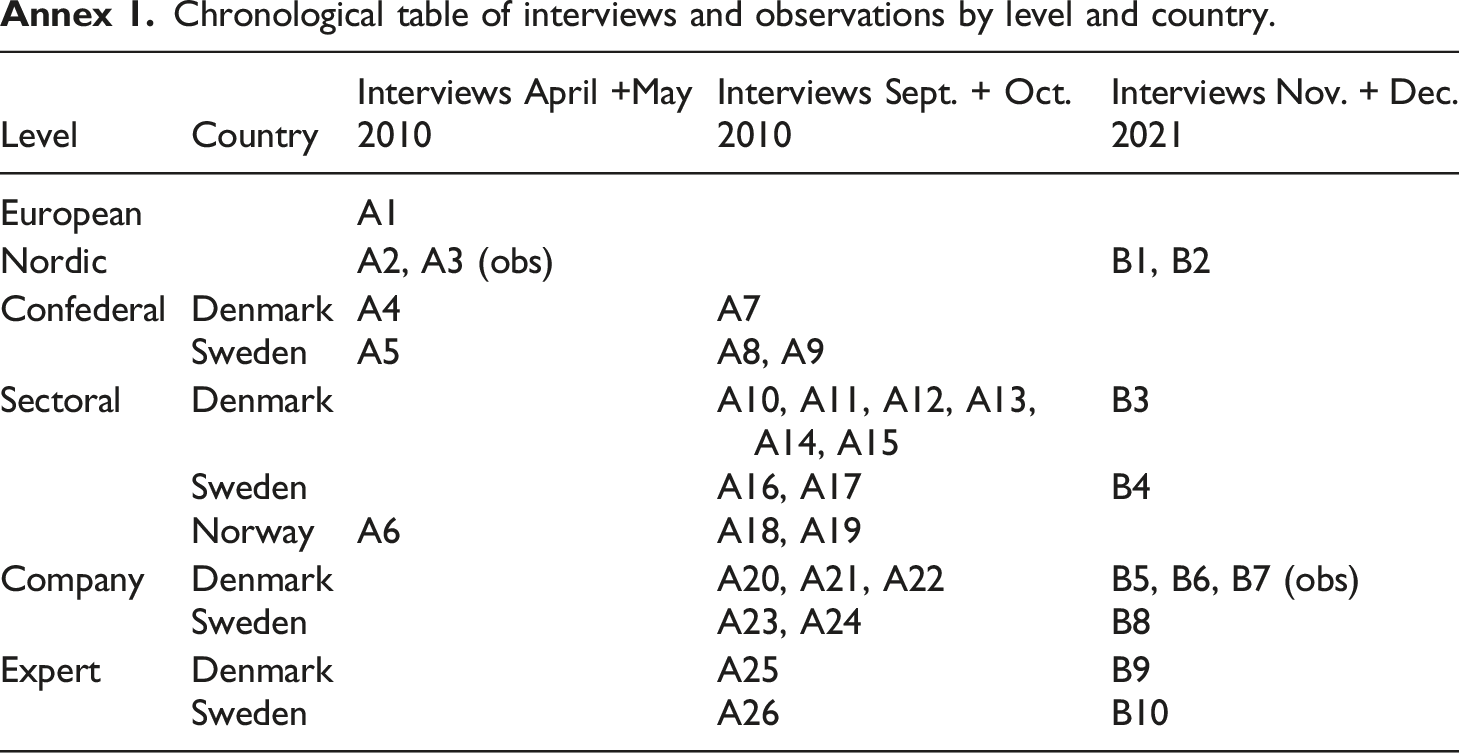
Level
Country
Interviews April +
Interviews Sept. + Oct. 2010
Interviews Nov. + Dec. 2021
European
A1
Nordic
A2, A3 (obs)
B1, B2
Confederal
Denmark
A4
A7
Sweden
A5
A8, A9
Sectoral
Denmark
A10, A11, A12, A13, A14, A15
B3
Sweden
A16, A17
B4
Norway
A6
A18, A19
Company
Denmark
A20, A21, A22
B5, B6, B7 (obs)
Sweden
A23, A24
B8
Expert
Denmark
A25
B9
Sweden
A26
B10