




Abstract
This paper analyzes the role of public sector wage-setting (PSWS) in Mediterranean countries before and after the Eurozone crisis. Extant literature suggests public sector wage inflation to be the norm in these countries due to the lack of institutional preconditions for wage restraint and the role of PSWS in shoring up the publicly financed domestic demand-led growth regime. Yet, the cases of France, Italy, Portugal and Spain do not to neatly fit these predictions, showing instead notable cross-country and intra-country diachronic variation. We provide an alternative account by treating PSWS as fiscal policy under EMU. Variation in PSWS outcomes before the Eurozone crisis is best explained in terms of the institutions governing PSWS. In France and Portugal, PSWS is highly centralized at the national level, and a strong Finance Ministry plays a central role in the oversight of PSWS to ensure budgetary discipline. To the contrary, Italy and Spain underwent processes of disorganized decentralization of PSWS through the 1990s and 2000s, leading to fragmented – and often clientelist – practices resulting in disorderly inflationary wage increases across the country. After the sovereign debt crisis, all countries relied on restrictive PSWS to support internal devaluation and fiscal adjustment, though with different intensity related to the country-specific problem load and external constraints.
Keywords
Introduction
Active state intervention in economic governance has been one of the defining traits of Mediterranean economic models in the post-WWII era (Molina & Rhodes, 2006; Schmidt, 2002; Shonfield, 1965). State intervention in the economy has come in different forms and with diverse effects, ranging from direct ownership of large public sector companies to the heavy regulation of labour markets and industrial relations. Among the plethora of roles played by the state in the economy, public sector employment relations and wage-setting (PSWS henceforth) have often played a central (Traxler, 1999), yet sometimes underestimated, role. For instance, governments in Italy have strategically acted as employers of last resort, using public sector employment to sustain households’ incomes and stabilize economic output in backward regions lacking private sector jobs (Santoro, 2014). Similarly, centralized PSWS has been exploited in Italy to redistribute fiscal resources from the central budget through PSWS towards the backward south where public employment is relatively larger and the cost of living lower than the rest of the country (Alesina et al., 2001). However, the Great Recession has put an end to the strategic use of the public sector. Southern European governments’ financial vulnerability has induced public employers to reduce public spending through public sector wage and employment cuts to shore up public finances and achieve internal devaluation.
When it comes to the strategic use of public budgets, the public sector is accordingly a double-edged sword. It is a mechanism to rapidly adjust fiscal conditions in hard times, as happened during the Eurozone crisis. But it also constitutes a powerful tool to support domestic growth through fiscal spending (Palley, 2018), especially in the consumption-led growth regimes of Southern Europe (Baccaro & Pontusson, 2016; Hassel & Palier, 2021). Thus, investigating the role played by PSWS within growth regimes becomes particularly interesting for Mediterranean countries given their tradition of state intervention in the economy and their growth regimes driven by domestic consumption and centred around large, sheltered sectors (Scharpf, 2016).
This paper analyzes the role of PSWS in Mediterranean countries before and after the Eurozone crisis. Industrial relations and political economy literature suggest public sector wage inflation to be the norm in these growth regimes due to the lack of institutional preconditions for wage restraint (Hancké, 2013; Johnston, 2016). Yet, the cases of France, Italy, Portugal and Spain seem not to neatly fit these predictions given notable cross-country and intra-country diachronic variation. We therefore provide an alternative account by treating PSWS as a fiscal policy conducted by governments under the strictures of the EMU economic governance regime. Our findings indicate that variation in PSWS outcomes before the Eurozone crisis is best explained in terms of two crucial institutional differences in the PSWS systems of these growth regimes. In France and Portugal, PSWS is highly centralized at the national level, and a strong/insulated Finance Ministry plays a central role in the oversight of PSWS to ensure budgetary discipline. To the contrary, Italy and Spain underwent processes of disorganized decentralization of PSWS through the 1990s and 2000s, leading to fragmented – and often clientelist – PSWS resulting in disorderly inflationary wage increases across the country. After the sovereign debt crisis, all countries relied on PSWS to enforce internal devaluations and fiscal adjustment, though with different intensity related to the country-specific problem load and the external constraints found in the Memoranda of Understanding imposed by the Troika institutions.
The article begins with a discussion on the institutional determinants of public sector wage policies as provided by extant literature on industrial relations and political economy. Subsequently, it introduces comparative data to highlight the presence of intra- and cross-country variation in Mediterranean countries’ PSWS outcomes. The following sections introduce the article’s alternative approach and then provide detailed case studies to account for the observed different PSWS trajectories. Conclusions wrap- up and discuss the findings.
Public sector wage-setting in Southern Europe: The missing institutional preconditions for wage restraint
Inflationary wage-setting is, according to comparative political economy literature, one of the defining traits of the Southern European or Mediterranean Model (Afonso et al., 2022; Molina 2014). The main explanation put forward in the literature to explain public sector wage inflation pertains to the institutional configuration of domestic wage-setting systems affecting wage policy’s governability.
According to neo-corporatist theory, one should expect wage inflation to be the norm in these countries given the lack of coordinated industrial relations and due to the presence of pluralist/fragmented and adversarial systems of interest representation (Amable 2003). Moreover, the intermediate centralization of collective bargaining – with sectoral agreements covering most workers – and the important role played by sub-national levels provide limited incentives for wage-setters to follow a path of wage moderation. Given the inability of industrial relations systems to deliver wage increases anchored to productivity and inflation levels (Hancké, 2013; Johnston, 2016), governments in Mediterranean countries have had to occasionally resort to peak-level agreements to achieve wage moderation in hard times (Pérez, 2000). Thus, active state intervention has historically been necessary to broker social pacts and overcome the shortcomings of the collective bargaining system (Molina & Rhodes, 2006).
If the literature has acknowledged the ‘institutional deficiencies’ of these countries’ wage-setting systems, the role of the public sector therein has often been neglected. At best, the public sector has largely been considered as a satellite of the export sector, with inflationary public sector wage outcomes resulting mostly from the lack of institutionalized mechanisms for coordination with the export sector (Hancké, 2013; Johnston, 2016). However, given the medium-to-large size of the public sector in these countries plus the control of PSWS by public-political employers and the use of fiscal money in the determination of wage increases, studying PSWS becomes especially important in Mediterranean countries. In fact, PSWS is likely to have functioned as a key institutional domain to support domestic demand within these countries’ growth regimes.
According to Hassel and Palier (2021), economic growth in Southern Europe and France has been driven by domestic demand supported by generous state spending. These countries featured low levels of financialization and ICT development and were therefore unable to pursue growth strategies based on the expansion of credit-led consumption (i.e. privatized Keynesianism (Crouch, 2009)) nor of the export of high-end services in the knowledge economy. At the same time, the lack of coordinated wage-setting regimes, low levels of R&D investments and a medium level of skills specialization prevented these countries from pursuing growth strategies based on the export of high-quality manufacturing goods (Burroni et al., 2020). As a result, during EMU’s first decade, governments in the Mediterranean regime have pursued growth strategies to support domestic demand via public deficits and active state intervention. Central to this growth strategy is the strategic use of public budgets by governments to support household consumption through generous social benefits (e.g. pensions or unemployment benefits) and/or the setting of high minimum wages (Hassel et al., 2020: p. 69). Thus, governments of Mediterranean countries are prone to pursue ‘a more active, consumption-led growth policy and let wages and social spending rise’ to sustain strategies of domestic demand-led growth (Hassel & Palier, 2021: p. 41).
Within this context, it is therefore important to analyse how expansionary or restrictive PSWS can contribute to governments’ growth strategies. Accordingly, since Hassel and Palier characterize the Mediterranean growth regimes as publicly funded domestic consumption-led, one should generally expect large public sectors in southern Europe and generous/inflationary public sector wage policies which serve the strategic macroeconomic purpose of shoring up the growth regime by financing household consumption and government spending through PSWS. Yet, as the evidence below shows, the reality is more nuanced and there has been notable intra- and cross-country variation in the cases analysed.
PSWS in Mediterranean countries before and after the Eurozone crisis
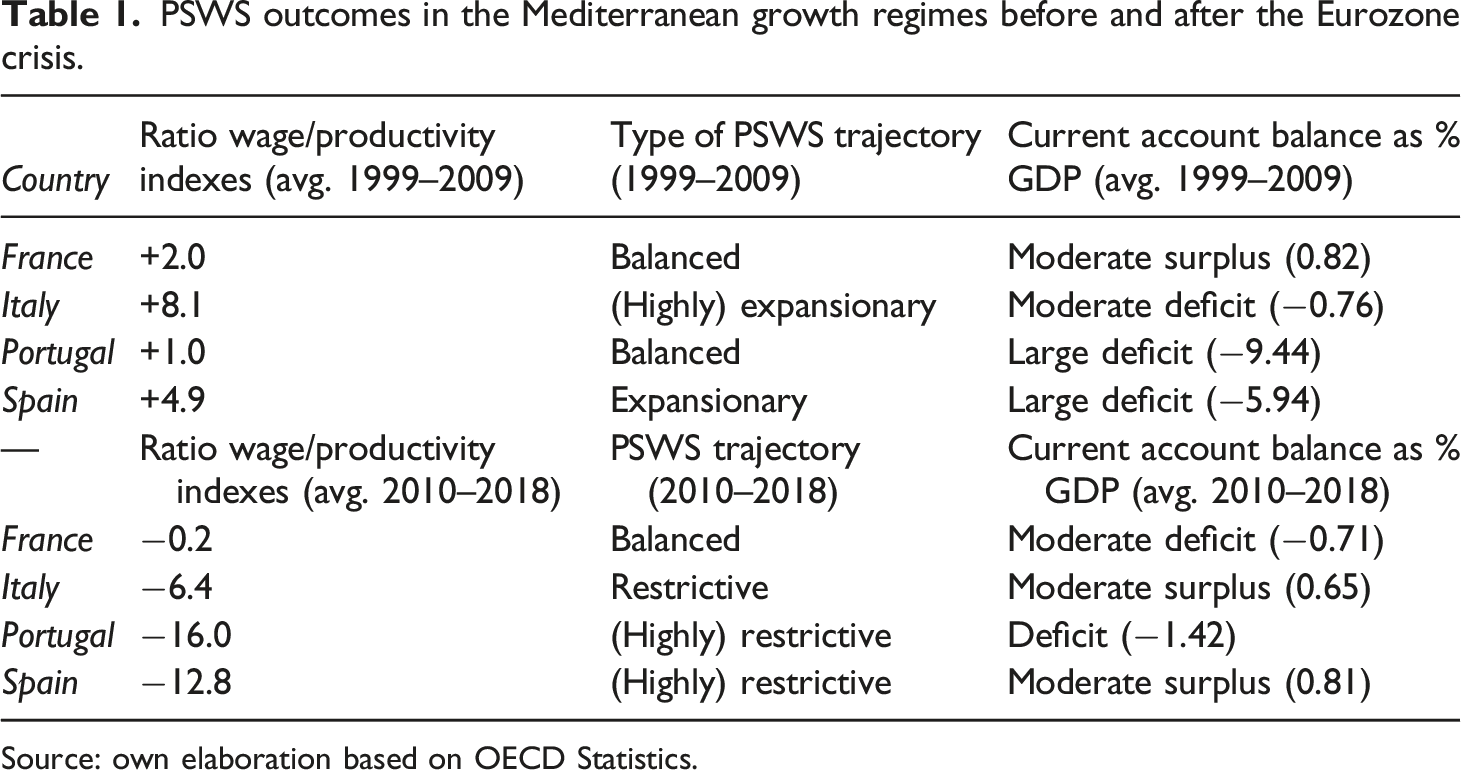
PSWS outcomes in the Mediterranean growth regimes before and after the Eurozone crisis.
Source: own elaboration based on OECD Statistics.
Overall, through Table 1 and Figure 1, it is possible to appreciate cross-country and intra-country diachronic variation in PSWS outcomes. Before the Eurozone crisis (1999–2009), expansionary PSWS occurred in Italy and Spain, where public sector real wage growth systematically outstripped labour productivity. However, PSWS outcomes remained balanced in France and Portugal, with public sector real wage growth aligned to total productivity. Ratio of real wage growth in the public sector and total labour productivity, indexes, various countries (1999–2018).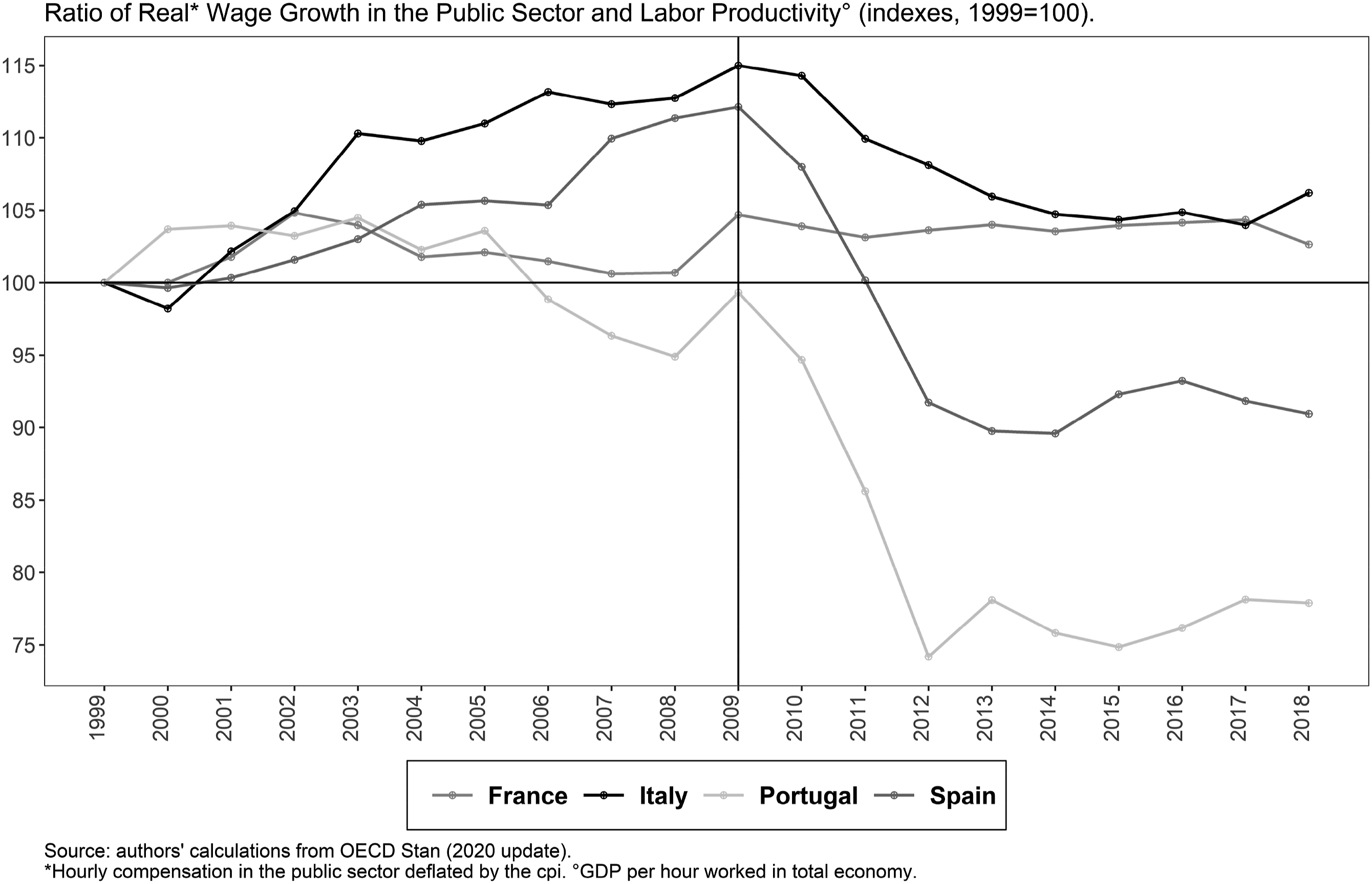
Figure 1 visualizes the pattern of wage restraint emerging during the process of ‘forced structural convergence’ (Scharpf 2016) in the aftermath of the Eurozone crisis (2010–2018). Portugal and Spain had the largest trade imbalances during EMU’s first decade and underwent trajectories of marked wage restraint in the public sector during the Great Recession and the post-crisis period. Italy, too, experienced public sector wage restraint, although to a much less extent than Portugal and Spain, considering also that Italy did not suffer from trade deficits before the Eurozone crisis. On the contrary, France’s trajectory of PSWS remained rather balanced, with public sector real wage growth aligned to labour productivity and a balanced current account throughout the whole period.
The above evidence shows a variegated picture where expansionary PSWS does not characterise fully the Southern European countries during the period considered. In all, therefore, PSWS trajectories in Southern Europe cannot be fully understood through the lens of neo-corporatist theory or the growth regimes approach that predict expansionary wage-setting based on the prevailing institutions or the growth regime.
In the following sections, we develop an alternative account of PSWS in Southern Europe considering its role as an instrument of fiscal policy and the institutional context within which it is governed.
More than just wages: The role of PSWS as fiscal and economic policymaking within the EMU economic governance
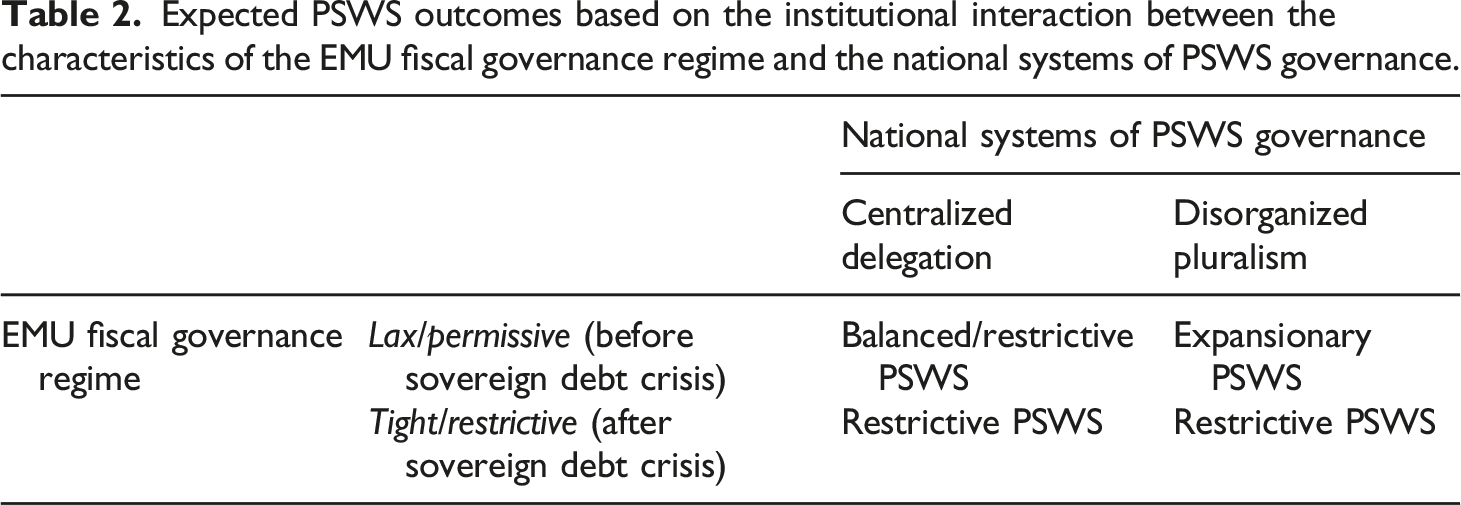
The central theoretical insight which moves our analysis of PSWS builds on the intuition that PSWS is a fiscal policy conducted by public/political employers (Beaumont, 1992; Di Carlo, 2023). Therefore, PSWS is a subset of fiscal policymaking conducted by political employers within and through the institutional matrix of the state. This basic insight carries two significant implications for a political economy analysis of PSWS. To begin with, we need to study how the state’s institutional setting enables and constrains the conduct of fiscal policymaking by governments. For Eurozone countries, this requires us to study how EMU institutions enable and constraint the conduct of fiscal policymaking at the national level. Yet, an understanding of public employers’ fiscal capacity should be complemented with an analysis of the institutional setting within which and through which PSWS is enacted. This requires us to study the institutional characteristics of national PSWS governance system to understand how they empower or limit the various state actors which participate in the decision-making process through which fiscal resources are earmarked to adjust the governments’ wage bill during PSWS cycles.
In relation to the EMU’s fiscal governance, the stance has changed in the period considered in this article. On the one hand, EMU participation initially relaxed budgetary constraints on these Mediterranean governments by lowering the previously high cost of servicing their sovereign debt, thus freeing up fiscal resources which could be employed in PSWS. Moreover, the failure to enforce the Stability and Growth Pact during the early 2000s initially eroded the credibility of the EMU’s constraining fiscal framework (Heipertz & Verdun, 2005). On the other, at least until the Eurozone’s Sovereign debt crisis, the existence of the Target 2 system for the Euro area rendered theoretically impossible balance of payment crises (Lavoie, 2015; Schelkle, 2017), thus providing these governments with the incentive to disregard the likely negative economic externalities of inflationary PSWS.
However, the policy environment changed significantly during EMU’s second decade, after the Eurozone sovereign debt crisis. The Eurozone crisis was initially interpreted as a balance of payments crisis (Scharpf, 2011). As a result, the economic governance of the EMU was strengthened to ensure greater economic and fiscal coordination through the European Semester. In the adjustment process to redress previously accumulated trade deficits within EMU, Southern European countries were then forced into fiscal austerity, internal devaluations and market-enhancing structural reforms through formal and informal conditionality imposed by European institutions (Braun et al., 2022; Bulfone & Tassinari, 2020). These measures aimed at killing the domestic drivers of growth and aimed at generating current account surpluses while imposing a process of ‘forced structural convergence’ towards export-led growth regimes (Scharpf, 2016). Hence, during EMU’s second decade, through fiscal austerity and internal devaluations, Southern European countries have been forced to engineer a transformation of their growth regimes away from domestic demand and toward export-led growth (Pérez & Matsaganis, 2019). Not surprisingly, widespread wage freezes/cuts in public sector wages have been a central component within these countries’ austerity measures (Bach & Bordogna, 2016; Glassner, 2010; Vaughan-Whitehead, 2013). Therefore, PSWS has been a central policy tool in the hands of Mediterranean governments forced to engineer the transformation of these countries’ growth regimes under the EMU’s post-crisis new economic governance.
Expected PSWS outcomes based on the institutional interaction between the characteristics of the EMU fiscal governance regime and the national systems of PSWS governance.
Research design and logic of case selection
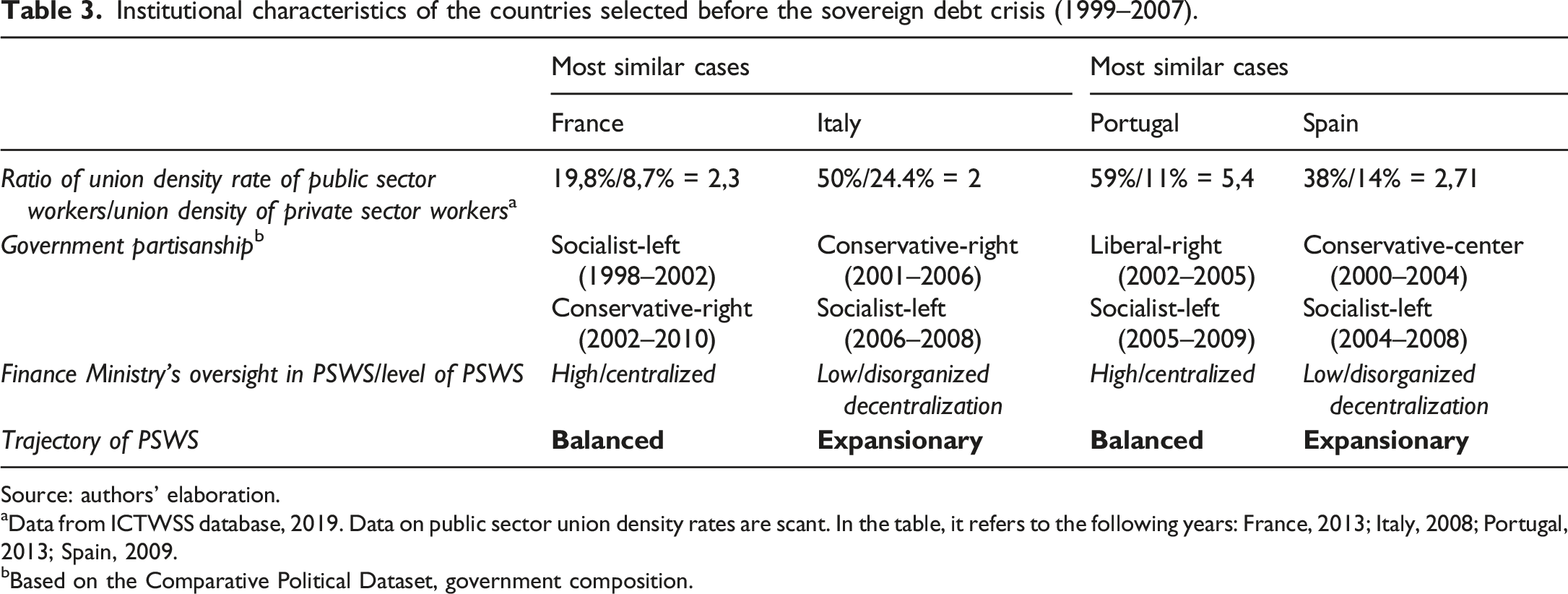
Institutional characteristics of the countries selected before the sovereign debt crisis (1999–2007).
Source: authors’ elaboration.
aData from ICTWSS database, 2019. Data on public sector union density rates are scant. In the table, it refers to the following years: France, 2013; Italy, 2008; Portugal, 2013; Spain, 2009.
bBased on the Comparative Political Dataset, government composition.
During EMU’s first decade, only Italy and Spain experienced an expansionary trajectory of PSWS while PSWS growth remained balanced in France and Portugal. The observed variation in PSWS outcomes cannot be explained fully by traditional industrial relations or political variables like the countries’ systems of interest representation or the government’s partisan affiliation, nor by public sector unions’ power resources. In fact, all countries have a low degree of corporatism and pluralist systems of interest representation. Centre-right parties in government during the mid-2000s pursued expansionary PSWS in Italy and Spain but not in France and Portugal. Moreover, relatively strong public sector unions obtained expansionary PSWS in Italy but not in Portugal. Finally, regardless of unions’ power and intense strike activity, all governments implemented public sector wage freezes/cuts unilaterally after the Eurozone crisis in their quest for austerity and export-led growth. We therefore investigate the impact of PSWS governance institutions in the various cases at stake.
The political economy of PSWS within Mediterranean growth regimes before the Eurozone crisis
PSWS in France and Italy during the EMU’s lax fiscal years
PSWS in France is highly centralized at the national level where wages are adjusted based on an index point (point d’indice) which regulates wage increases across the whole public sector (Bordogna, 2007). Collective bargaining exists since 1983 but lacks legally binding status (Mossé & Tchobanian, 1999). As a result, the determination of public sector wage policy occurs in the ‘shadow of hierarchy’, with the government de facto often implementing PSWS unilaterally via administrative acts. In PSWS, the state is represented in negotiations with the unions by the civil service minister. However, the Finance Ministry plays a crucial role in overseeing PSWS and enforcing wage/fiscal restraint through two institutionalized mechanisms. On the one hand, the Finance Ministry defines ex ante the budgetary resources available to the civil service minister for PSWS. On the other, the Finance Ministry directly monitors the bargaining process and holds a formal veto through which to impede any PSWS decisions which deviate from its preferred policy outcome (Document 1). The strength of the Finance Ministry in PSWS is furthermore granted by the presence of a senior civil servant independent from political parties as head of the central budget authority.
Through the centralized governance of PSWS, a strong Finance Ministry in France has steered moderate public sector wage growth since the early 1980s. The French state then stepped up its unilateral determination of public sector wage freezes to steer the economy’s disinflation after President’s Mitterrand decision to keep France in the European Monetary System and commit to a strong currency regime (franc fort) (Di Carlo, 2023). Restrictive PSWS has repeatedly been imposed unilaterally through state authority during the 1990s (Documents 2, 3, and 4). This practice continued once France joined the EMU. The government initially imposed very moderate wage increases in both 2001 and 2002 (Document 5) and delayed the adjustment of the index for the following years.
In Italy, instead, during the 2000s, PSWS occurred on two levels as a result of a process of disorganized decentralization which had taken place throughout the 1990s. Until the reform of the Italian wage-setting regime in 1993 (Regini & Regalia, 1997), PSWS was fragmented and tended to be highly inflationary due to political parties granting generous handouts to their public sector clienteles by means of ad hoc legislative provisions in parliament (Ricciardi, 2010; Santagata, 1995). In need to meet the Maastricht criteria for EMU entry, in 1993 PSWS was restructured as a two-tier system and the state’s representation in PSWS was centralized under the authority of a newly created independent agency (Agenzia per la Rappresentanza Negoziale, ARAN) for the purpose of ‘de-politicizing’ PSWS (Dell'Aringa, 1997). In the new system, wages’ fixed component was set nationally through negotiations between ARAN and the unions. A second pillar then allowed for top-ups over fixed pay at the local level, where further increases by local administrators were to be based on productivity gains (Bordogna et al., 1999).
However, inflationary PSWS in Italy resulted from two complementary dynamics during the 2000s. At the decentralized level, local administrators started to make use of off-budgets fund to grant at the local level generous top-ups over national agreements (Bordogna, 2002). This dynamic had been made possible by administrative reforms in the late 1990s which enabled local administrators to use own resources to fund decentralized wage increases. In this way, local level top-ups were granted detached from any considerations of productivity, service quality nor performance. Simultaneously, patterns of clientelism re-emerged in national-level PSWS under the centre-right coalition led by Silvio Berlusconi during 2001–2006. In fact, a major loophole in the delegation of wage-setting authority to ARAN consisted in the fact that the agency was not endowed of its own resources. Rather, the government used to set fiscal resources for PSWS in the budget law before giving ARAN the mandate to negotiate with the unions on how to distribute the resources among various public sector compartments (Talamo, 2009). Therefore, de facto unions knew the amount of earmarked resources before starting negotiations and repeatedly decided to walk away from the negotiating table with ARAN and lobby their political referents in government for greater fiscal resources (Di Carlo, 2023).
In all, two key institutional differences in the governance of PSWS seem conducive to the different PSWS trajectories in France and Italy: the level of PSWS and the institutionalized role played by the Finance Ministry in the oversight of PSWS.
PSWS in Portugal and Spain during the EMU’s lax fiscal years
Portugal, like France, disposes of a highly centralized system of PSWS where the Finance Ministry is the key authority charged with the oversight of sound wage/budgetary policies in PSWS. Differently from France, where the Finance Ministry holds formal agenda-setting and veto powers to indirectly control PSWS, the Portuguese Finance Ministry is itself the state’s wage-setting authority. It negotiates PSWS nationally within three separate tables based on trade-union affiliation (Document 6) to set uniform wages for the whole public sector and ensure coherent income policies and sound public finances (OECD, 1997: p. 45).
Even though collective bargaining exists for public sector workers, it is not binding for the government (Campos Lima, 2008), and the Finance Ministry has, since the 1990s, increasingly resorted to unilateral determination of PSWS with an eye to govern the process of wage-formation across the whole economy through public sector-led pattern bargaining (Document 7). Until the early 1980s, the state continued to determine wage-setting unilaterally via statutory income policies despite the new democratic regime, mostly due to the weakness and fragmentation of social partners (Barreto, 1998). After several failed attempts by various governments to promote social concertation during the 1980–90s (Campos Lima & Naumann, 2011), the Portuguese government in need to bring down inflation to access EMU was left with no option other than taking the lead in national wage policy (Document 8). Thus, in the Portuguese PSWS system, the Finance Ministry usually provides an indication for wage increases centred on the forecast inflation rate, based on which it enters negotiations with public sector unions to ensure the government’s budget constraints be enforced (Campos Lima, 2008). Generally, no later than February, if no agreement could be reached on the offer advanced by the Finance Ministry, wage increases in the public sector would be set unilaterally as a reference for wage increases across the whole economy. During the 2000s, finance ministers under both the center-right government led by José Manuel Barroso and the subsequent socialist government led by Sócrates imposed restrictive PSWS unilaterally to rein in the then high budget deficits for fear of losing access to Europe’s structural funds (Magone, 2017: p. 34). Despite unions’ protests and mobilization, the Finance Ministry eventually imposed a meagre 2.75% wage increase in 2003 (Document 9) and, in 2004, granted a 2% wage increase only to workers in the lower pay grades, while imposing a unilateral freeze for the remaining categories (Document 10). Similarly, the Finance Minister Fernando Teixeira dos Santos in the new socialist government continued to impose unilaterally restrictive PSWS in 2005 and 2006 as a ‘national imperative’ to keep public budgets under control (Stoleroff, 2007: p. 645).
In Spain, right after the transition to democracy, the Socialist government headed by Felipe Gonzalez faced the difficult task of modernizing and enlarging the public sector inherited from the dictatorship. The government undertook the first reform of public employment in 1984 with the aim of de-politicizing PSWS and establishing clear rules. Two important elements help to understand the regulation and development of public sector wages thereafter (de Luxán, 2016). First, the government regulated the role played by collective bargaining in setting public sector employees’ working conditions. Secondly, the reform intended to regulate the process of de-centralization of administrative competences in favour of regional and local governments. Accordingly, the law also regulated PSWS by establishing a two-tiered system. The basic wage, common to all workers in the public sector, was set by the government through the budget law linking public sector wage increases to forecast inflation. However, the competence to set additional top-ups linked to productivity was left to the regional and local governments. As a result, akin to the Italian case, a system of cascading negotiations set in whereby regional and local governments took the increase set by the budget law not as a ceiling but as a starting point for collective bargaining with trade unions (INAP 2005).
In the 1990s, the public sector wage policy was deeply influenced by the 1992–93 crisis and the run-up to EMU. Consequently, restrictive PSWS ensued via below-inflation increases in 1993 and a freeze in 1994. With the arrival of the Conservative Partido Popular (PP) government since 1996, the policy of freezing (in 1997) and then containment of public sector wages were inaugurated as part of a more ambitious package to bring down inflation and reduce the fiscal deficit. Once the goal of joining the Euro was reached, the Conservative government initiated an expansionary policy whereby public sector wages grew rapidly, by 5.5% on average between 1999 and 2008 (Botella et al., 2009). The Socialist government in power since 2004, continued with this expansionary approach through several agreements signed with trade unions in a context favourable to social dialogue, leading among other things to the creation of a pension fund for public sector employees as well as to the increase in several wage complements that contributed to higher wage increases in this period.
Overall, the Spanish experience, like the Italian one, shows how a soft approach to PSWS governance, consisting in an inflation benchmark for base wages, but allowing the negotiation of additional increases at regional and local levels, opened the door to political opportunism and clientelist practices. Thus, the rapid increase in public sector wages in the 1999–2008 period resulted not only from a combination of upward wage drift in regional and local level collective agreements but also shifts in the government’s policy. As a consequence, periods of intense negotiation with social partners and expansionary wage-setting have at times co-existed with unilateral wage freezes and wage restraint for public sector employees.
In all, two key institutional differences in the Portuguese and Spanish PSWS systems lie behind these countries’ different trajectories: the level of PSWS and the institutionalized role played by the Finance Ministry in the oversight of PSWS. Taken together, the four cases corroborate our argument: when PSWS is centrally governed in/directly by a strong and insulated finance minister (like in France and Portugal), public sector wage policy tends to be more restrictive as these actors are tasked with ensuring sound fiscal and macroeconomic policies to internalize negative externalities in the general interest of the collectivity. On the contrary, when this is not the case, like in Italy and Spain where PSWS underwent a process of disorganized decentralization, PSWS tends to fall prey of political interests and become expansionary as a form of fiscal handouts. These fiscal handouts, however, are largely contingent on governments’ overall fiscal space which became severely curtailed in the aftermath of the sovereign debt crisis.
The political economy of PSWS within Mediterranean Growth Regimes after the Eurozone crisis
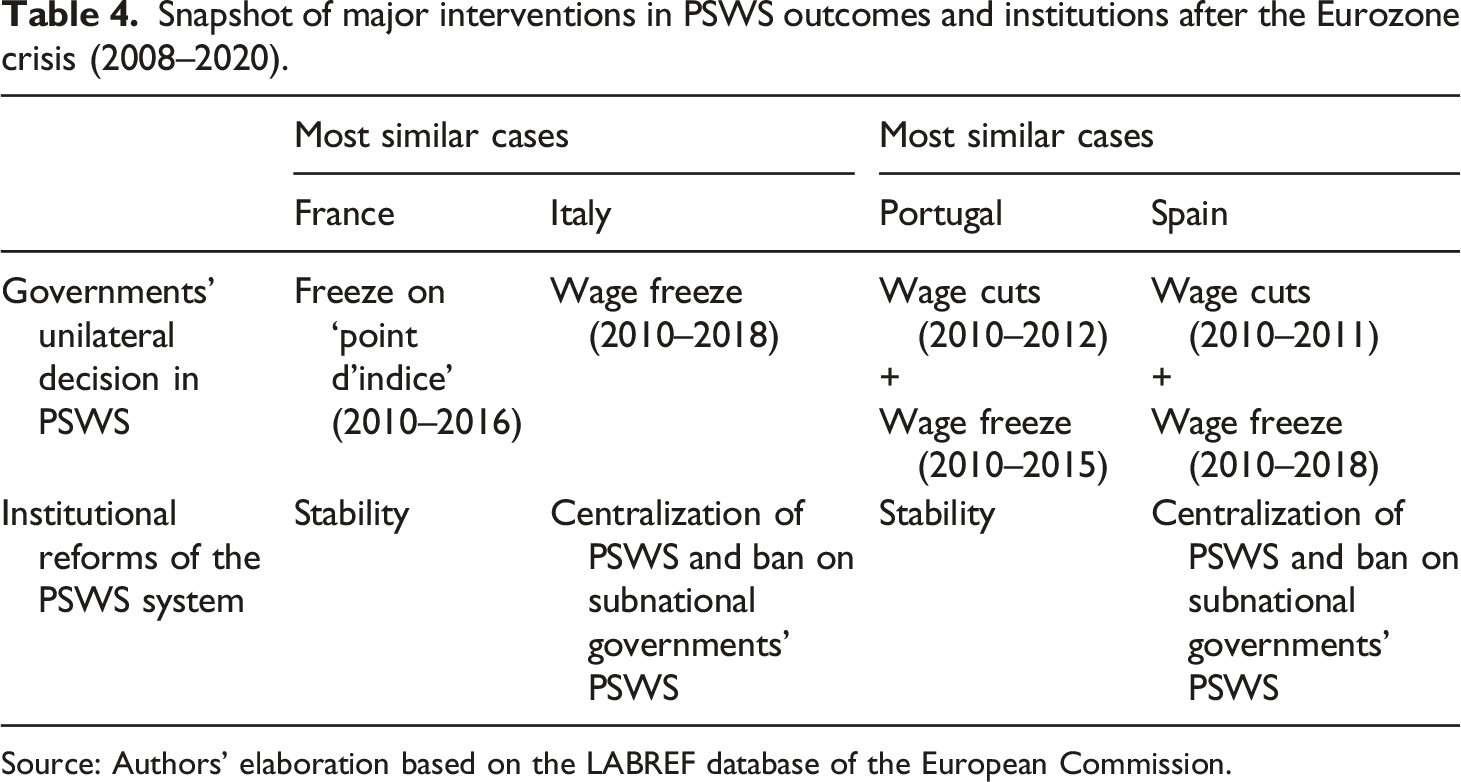
The wage containment policies adopted during and in the aftermath of the Eurozone crisis consisted mainly in a reduction in the public employment turnover ratio and/or freezes and cuts in public sector compensation. However, Mediterranean countries differ in the intensity of the adjustment and its duration. In France, after years of stalemate, wages accelerated in 2017 reflecting the increase in the remuneration of teachers and the estimated impact of the reform of the public sector general salary grid for both 2017 and 2018 (Attinasi et al., 2019). In Italy, after being frozen during the period 2010–2016, public sector wages resumed a moderate growth path in 2018. In Portugal, after marked restraint and wage cuts, public sector wages started to recover in 2015, but wage restraint persists. Finally, in Spain, an increase in public sector wages was finally introduced in the 2017 and 2018 budgets after several years of real wage restraint.
PSWS in France and Italy during the tight EMU fiscal regime
Among the four countries compared, France exhibits the highest degree of institutional stability in PSWS. This is the case before and after the Eurozone crisis. Since PSWS in France was already heavily centralized and allowed the Finance Ministry to exercise control over wage developments in the public sector, the institutional capacity to ensure wage restraint throughout the post-crisis period was already present. In fact, when the financial crisis hit, the government again froze wages unilaterally to curtail budget deficits (Bordogna & Pedersini, 2013).
The response by the French government to the financial pressures brought by the crisis on the public sector payroll had two components. First, there was a reduction of public sector jobs during Sarkozy’s government with a drastic reduction of the number of civil servants through reorganizations and a decrease of the replacement rate of retiring civil servants. This reduction consisted of 75.000 jobs cut in 2008, 45.000 in 2009 (representing 5% of jobs in the public sector over those 2 years) and led to a fall in personnel costs as a share of the national budget from 43% in 2008 to 36.5% in 2010 (Ramos, 2018: 113).
Second, it involved a freeze on the index point used to calculate wages of public sector employees. To take inflation into account, the value of the index point is normally revalued every year, during salary negotiations between the government and the civil service unions. However, the index point has been frozen since 2010. The unions unanimously bemoaned a loss of purchasing power penalizing the lowest salaries and reducing the attractiveness of public service professions (Audier et al., 2015). Major public sector strikes were organized by the main trade union confederations in 2014 and 2016 to demand better pay for public sector employees. Tens of thousands of public sector workers joined the strikes to demand higher wages and an end to austerity. Finally, in March 2016, to improve relations with civil servants, the government announced an early removal of the freeze imposed on the index point and a 1.2% revaluation.
In Italy, wage restraint in the public sector was achieved not only through a combination of unilateral government freezes but also a reform of public sector employment in 2008 that contributed to recentralize PSWS to keep wages on a moderate growth path. Similar to the 1990s, after the 2008 financial crisis outburst, the then (again) Finance Minister Tremonti imposed a 3 year wage freeze in PSWS and cuts for highly ranked civil servants through an emergency package (Bordogna & Pedersini, 2013). As the Italian crisis grew into a full-fledged sovereign debt crisis, and Mario Monti’s technocratic government came to power, PSWS was frozen for various years until a 2015 Constitutional Court’s sentence instructed the government to restart collective negotiations with the unions. Since then, public sector wage growth has restarted but only moderately.
The reform of public sector employment undertaken in 2008 – named after the Minister for Public Administration and Innovation Renato Brunetta – contributed to maintain a more balanced growth path for public sector wages once the unilateral wage freezes imposed during the Great Recession and in the post-crisis period were lifted. The reform introduced more strict criteria linked to individual employee performance and quality of output to avoid wage drift caused by the extension of the variable part of pay to all public sector employees, previously granted regardless of any criteria. From a more structural point of view, the reform has also introduced changes facilitating a stronger control of public sector wage dynamics by central public authorities. First, it reduced the scope of collective bargaining in the public sector by setting stricter legal rules and limiting the number of issues that can be negotiated, especially at decentralized level (Pedaci et al., 2018). Secondly, it strengthened the control of the central government and the Court of Auditors over negotiation procedures and outcomes pointing towards a re-centralization of PSWS.
PSWS in Portugal and Spain during the tight EMU fiscal regime
The control on PSWS exerted by the Portuguese finance minister was reinforced during and after austerity packages and the signature of Memoranda of Understanding under the Troika period (2011–2014). The crisis and austerity policies implemented led to a freeze on wage bargaining. Also other rights were curtailed, for example, career advancements (Campos Lima 2019). Some of these cuts were already reversed with the electoral victory of the Socialist Party in 2015, but there remained a ban on collective bargaining in the public sector to facilitate fulfilling the requirements of the new European economic governance regime. Despite the limitations for collective bargaining and the growth in salaries of public employees, since 2015 a process of expansion in the number of public employees began, which has led to a record high of public employees in 2021.
Since wage increases in the public sector have traditionally provided a benchmark for wage-setting in the private sector, the ban on public sector collective bargaining has been extended with an eye to avoiding that inflation spillovers in the private sector would undermine the post-crisis export-led recovery. The institutionalization of austerity thus characterized the Portuguese post-crisis experience (Tavora, 2019).
Like in the French case, maintaining wage moderation for public sector employees in the post-crisis period has triggered a wave of protests by public employees. In 2020 and 2021, strikes were organized against what trade unions in the public sector considered clearly insufficient and disrespectful wage offers by the government after several years of cuts, freezes and restraint. Whilst the government stressed the need to achieve fiscal balance to justify restrictive wage-setting in the public sector, trade unions pointed to the instrumental use of PSWS to maintain internal devaluation in the private sector.
Despite not signing a Memorandum of Understanding with the Troika, adjustment policies in the Spanish public sector have been more profound than in neighbouring countries. Expansionary PSWS in Spain came to a sudden end with the Great Recession. In May 2010, the Socialist government inaugurated a policy of public sector wage freezes and cuts that lasted until 2016 (Molina and Godino, 2020). A re-centralization of PSWS thus took place with the finance minister assuming control over public sector wages whilst a ban on collective bargaining was imposed. As a response to the implementation of these measures, a general strike of all public workers was organized in 2010 protesting against cuts in public employees’ pay imposed by the Zapatero government, followed by two general strikes of the education sector in 2012 and 2013 as well as other public sector strikes at the regional level.
A turnaround in the government’s public sector wage-setting occurred in March 2018 when a new framework agreement for public sector employees was signed after several months of negotiations with trade unions (Molina, 2018). The agreement included two important elements that marked a discontinuity with respect to previous practices in PSWS. First, it established a minimum wage increase of 6.1% for public employees over the period 2018–2020 (1.75% in 2018, 2.25% in 2019 and 2% in 2020), and a maximum of 8.9% conditional upon growth in gross domestic product (GDP) and the fulfilment of the budget deficit target for 2020. This was the first time that wage increases for public employees came to be linked to macroeconomic performance and deficit criteria, with higher wage increases to be paid when GDP growth surpasses 2.5%. This introduced a flexible mechanism to maintain moderate wage increases whilst allowing, in case of favourable economic conditions, to deliver higher increases. Secondly, the agreement also establishes that collective bargaining at regional and local is conditional upon these administrations meeting deficit objectives, thus effectively introducing elements to avoid regional and local level wage drifts.
Snapshot of major interventions in PSWS outcomes and institutions after the Eurozone crisis (2008–2020).
Source: Authors’ elaboration based on the LABREF database of the European Commission.
Conclusions
This paper has argued that PSWS systems are a key institutional component of growth regimes because of their effects on both the demand and supply side of the economy. Through the proactive governance of PSWS, governments as sovereign employers have maintained the capacity not only to steer the growth of public sector wages but also to manage fiscal adjustments when necessary. Therefore, the conduct of PSWS can conveniently be analysed as a full-fledged instrument to steer growth strategies and through which governments can contribute to support domestic demand and undergird or manipulate the functioning of extant growth regimes.
This being the case, PSWS is highly important within growth regimes centred on domestic consumption supported by the strategic use of public budgets and consumption-oriented welfare states, like the Mediterranean countries. This is because, through expansionary PSWS, governments can support the process of economic growth both directly and indirectly by stimulating government spending and upholding households’ consumption for those families dependent on public sector employment for their disposable incomes. Considering the characteristics of the industrial relations system and the medium-to-large size of the public sector in these countries, one would expect governments in Mediterranean growth regimes to have a vested interest in the pursuit of expansionary PSWS in support of ‘publicly financed domestic-demand growth strategies’ (Hassel & Palier, 2021).
Yet, this does not seem to be the case across the board. The analysis of PSWS in Mediterranean countries over the last three decades has shown key differences in public sector wage trends. Institutional characteristics of national PSWS systems help to explain these differences. Despite their domestic demand-led growth regimes, public sector wage growth in Mediterranean countries tends to remain subdued within PSWS systems where strong and independent finance ministries hold an institutionalized role in the oversight of centralized PSWS with an eye to ensuring sounds budgetary policies. This was true for France and Portugal and has apparently become true in Italy and Spain after post-crisis institutional reforms have centralized PSWS and enhanced the institutional mechanisms through which the Finance Ministry – and/or national court of auditors – monitors and vetoes the adoption of public sector wage policy.
However, while PSWS was expansionary and pro-cyclical in Italy and Spain during the EMU’s first decade, in all countries unilateral public sector wage freezes/cuts have been employed by governments under austerity imperatives and the quest for internal devaluations to engineer export-led growth. Thus, PSWS became a tool for macroeconomic adjustment where the intensity of wage cuts depended heavily on countries’ problem loads. In need to turn trade deficits into surpluses, public sector wage cuts were the harshest in the countries which had previously accumulated the largest trade deficits, namely, Portugal and Spain. Coincidentally, these were the countries where the Troika was most heavily involved in national economic policymaking, recommending structural adjustments in PSWS.
In all, the evidence for the four Mediterranean countries shows how governments maintain control over PSWS, either to give an additional boost to domestic demand in good times or to impose fiscal retrenchment and state-led internal devaluations in times of crisis. Accordingly, systems of PSWS in Mediterranean growth regimes have evolved to ensure the (re)institutionalization of centralized authority in PSWS and direct control of the Finance Ministry in the oversight of PSWS. Thus, government agency plays the central role in PSWS. However, nuances in the institutional characteristics of national PSWS systems matter for PSWS outcomes within growth regimes.
Footnotes
Declaration of conflicting interests
The author(s) declared no potential conflicts of interest with respect to the research, authorship, and/or publication of this article.
Funding
The author(s) received no financial support for the research, authorship, and/or publication of this article.
Correction (September 2023):
Author’s institution has been updated in author biography.

Note
Appendix
To retrieve specific information on processes and outcomes of PSWS, we have relied on two different historical archives: the European Industrial Relations Review (EIRR) and the Eurofound’s EIRO archives. EIRR consists of a very rich and detailed physical archive containing detailed reports and primary/secondary sources on industrial relations matters on a monthly basis. The archive covers most European countries over the period 1974–2006. The EIRO digital archive covers similar topics from 1997 onwards (Table A1). List of documents cited.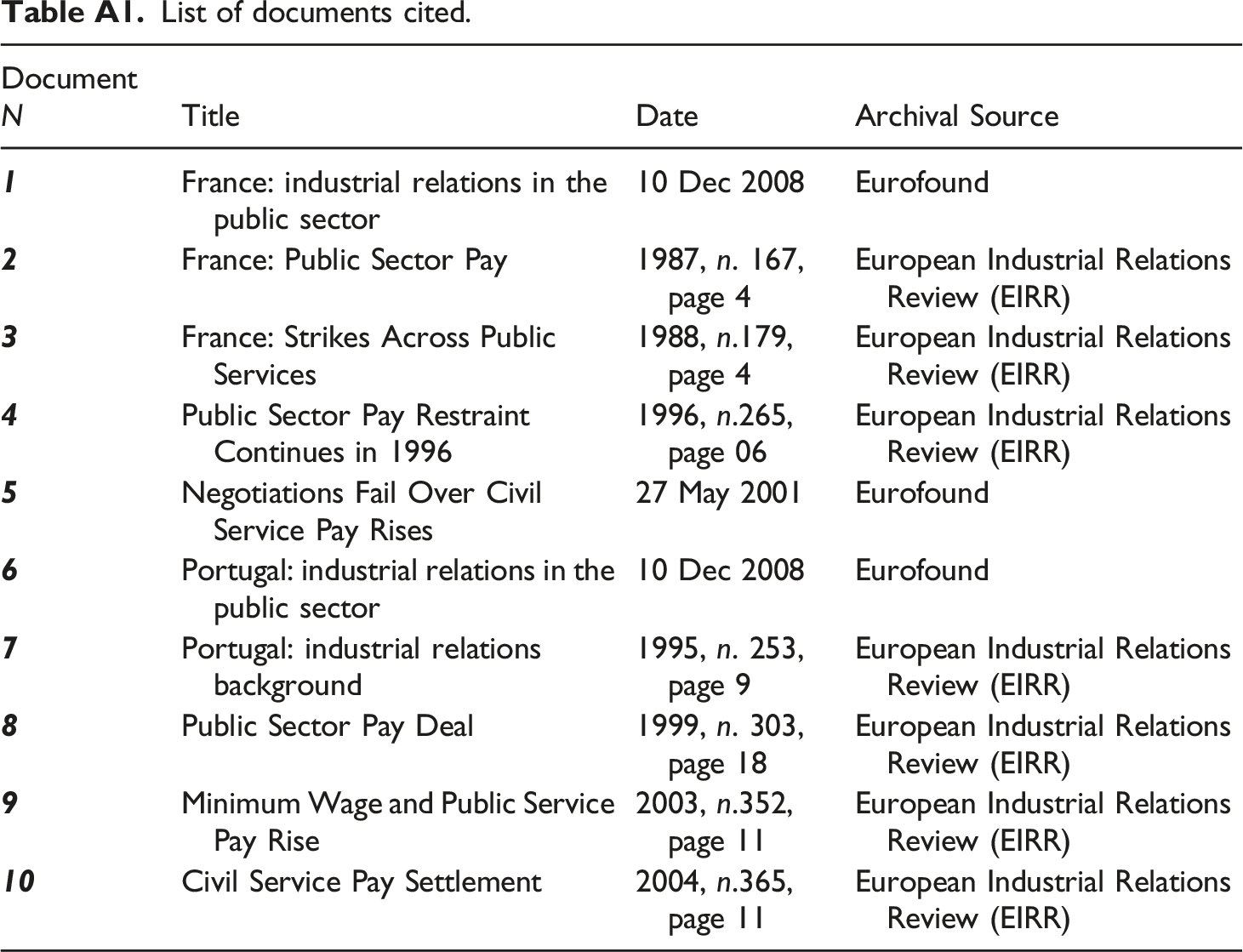
Document N
Title
Date
Archival Source
France: industrial relations in the public sector
10 Dec 2008
Eurofound
France: Public Sector Pay
1987, n. 167, page 4
European Industrial Relations Review (EIRR)
France: Strikes Across Public Services
1988, n.179, page 4
European Industrial Relations Review (EIRR)
Public Sector Pay Restraint Continues in 1996
1996, n.265, page 06
European Industrial Relations Review (EIRR)
Negotiations Fail Over Civil Service Pay Rises
27 May 2001
Eurofound
Portugal: industrial relations in the public sector
10 Dec 2008
Eurofound
Portugal: industrial relations background
1995, n. 253, page 9
European Industrial Relations Review (EIRR)
Public Sector Pay Deal
1999, n. 303, page 18
European Industrial Relations Review (EIRR)
Minimum Wage and Public Service Pay Rise
2003, n.352, page 11
European Industrial Relations Review (EIRR)
Civil Service Pay Settlement
2004, n.365, page 11
European Industrial Relations Review (EIRR)