




Abstract
This special issue (SI) brings the industrial relations scholarship on the public sector into dialogue with the comparative political economy (CPE) literature on growth models/regimes. While the former has paid great attention to the public sector, in CPE the public sector has been analysed less, and mostly as subaltern to the export-sector’s actors, interests and institutions. We posit that the public sector matters for CPE in its own right for three reasons. First, the state remains today the single largest employer in virtually every European economy, providing incomes to a large segment of the middle class. Second, public employers’ wage bill – one of the largest items of governments’ current expenditures – is funded by the taxpayers. Hence, public sector wage policy is fiscal policy, ultimately pursued by public/political employers. Third, public employers are simultaneously public managers and political sovereigns acting in the shadow of hierarchy. Case-study contributions to the SI detail how these insights matter within different European growth regimes: (1) the Mediterranean demand-led growth regime (France, Italy, Spain and Portugal), (2) the German export-led growth regime, (3) the Nordic balanced growth regime (Denmark and Sweden) and (4) the FDI-led Eastern European growth regime (Czechia and Slovakia).
Keywords
Introduction
In this special issue, we aim to combine the growth models/regimes perspective with a focus on the public sector and, more specifically, on Public Sector Wage Setting (PSWS henceforth) processes, institutions and outcomes. PSWS has come under greater scrutiny since the 2007–2008 Global Financial Crisis, when governments across Europe have turned to the public sector as an arena where to pursue internal devaluations and fiscal austerity in quest for macroeconomic adjustment (Vaughan-Whitehead, 2013). During the 2010s, public sector employees have thus experienced a generalized erosion of employment and pay conditions, including real wage cuts and prolonged salary freezes intended to shrink the government wage bill in times of crisis (Bach and Bordogna, 2016). While various scholars have long highlighted the important role of the state and the public sector in industrial relations (Howell, 2009; Meardi, 2014; Meardi et al., 2016), the outburst of the COVID-19 pandemic re-confirmed the importance of the state – and of public employees – in the provision of public goods and services to the community. Thus, growing societal support for the prolonged public employees’ struggles has contributed to partially reverse the post-crisis trend, favouring the improvement of public sector employment and pay conditions, especially in the healthcare sector (Vandaele, 2021).
Last decade’s events accordingly contributed to greater public and scholarly attention to the public sector. Within the field of industrial relations, a plethora of studies have appeared that analyse various dimensions of the public sector, ranging from the study of state actors or institutions shaping employment and pay conditions in the public sector and beyond (Howell, 2009, 2011; Hyman, 2013; Traxler, 1999), to analyses on the impact of austerity on the public sector’s institutions, governance processes and outcomes (Bach and Bordogna, 2016; Bordogna and Pedersini, 2013a, 2013b; Hansen and Mailand, 2013; Vaughan-Whitehead, 2013), to studies on the role of public sector trade unions in mediating austerity pressures (Schmidt et al., 2019), or to the long-term transformations of public sector working and employment conditions after prolonged periods of ‘institutionalized’ austerity in Europe (Keune et al., 2020).
If industrial relations scholars have paid attention to the multidimensional issues linked to public sector employment relations and PSWS, the same cannot be said about the comparative political economy (CPE) literature, apart from important exceptions (Hancké, 2013; Johnston et al., 2014; Johnston, 2016). Within CPE’s major debates, a shift has been under way from the previously dominant supply-side centred approach – that is, Varieties of Capitalism (VoC) (Hall and Soskice, 2001) – to new demand-side approaches (Stockhammer and Kohler, 2022). Recent contributions have developed new conceptual frameworks to analyse and differentiate national models of capitalism based on growth models (Baccaro and Pontusson, 2016; Baccaro et al., 2022) and growth regimes (Hassel and Palier, 2020). Thus, rather than focusing on the supply-side institutions undergirding patterns of coordination and specialization among firms and national economic actors – à la VoC – this novel approach emphasizes the demand side drivers of growth in a particular country and the political strategies adopted by key economic agents to stimulate growth and employment therein.
Yet, just as was the case in the VoC-inspired strand of political economy research, so far, the public sector remains largely neglected as a key institutional domain within the study of growth models/regimes of advanced capitalist economies. Both in the old VoC literature and in the more recent contributions, when the public sector is analysed in CPE, it is generally treated as a problem of ‘inter-sectoral coordination’ of heterogenous preferences and competing interests held by economic actors exposed to international markets (e.g. manufacturing sector) versus those sheltered sector from international competition. Thus, where CPE drew on industrial relations scholarship to study the public sector, it did so most of the times to identify and analyse those wage-setting institutions and systems conducive to the subordination of sheltered sector’s interests to the interest in wage restraint and cost competitiveness by the exposed actors. 1 This CPE scholarship has contributed substantially to our understanding of national labour market institutions and has a long pedigree (Crouch, 1990; Franzese, 1994; Garrett and Way, 1995, 1999; Soskice, 1990; Traxler and Brandl, 2012). However, its narrow focus has led to an under-appreciation of the strategic importance of public sector employment relations and PSWS in economic policy making within different models of capitalism. Moreover, the excessive emphasis put solely on the coordination capacities of export sector actors/institutions has resulted in limited knowledge of the peculiar and multifaceted role the state as a public/political employer and of the impact of different state structures in shaping PSWS across different countries.
In order to pay greater justice to the importance of the public sector in our European mixed economies, the purpose of this special issue is to combine insights from the fields of industrial relations and CPE into a novel account of PSWS. By so doing, the special issue analyzes patterns of continuity and change in European growth regimes by looking at the role played by public sector industrial relations actors and PSWS institutions in these transformations. The four contributions making up the special issue focus on the institutions and power resources which shape the politics of PSWS processes and outcomes in four different European growth regimes: the Mediterranean demand-led growth regime (France, Italy, Spain and Portugal), the German export-led growth regime, the Nordic balanced growth regime (Denmark and Sweden) and the Eastern European growth regime (Czechia and Slovakia) driven by foreign direct investments (FDIs).
We contend that scholars within the field of industrial relations and CPE would benefit from paying greater attention to the public sector and the study of PSWS for three specific reasons.
First, despite EU-induced decades of liberalizations of strategic domestic sectors with large publicly owned incumbents and waves of privatizations of state-owned enterprises (Scharpf, 1999), the state remains today the single largest employer in virtually every European economy (Hyman, 2013). Therefore, the consumption capacity of a large part of the European middle classes hinges on the incomes they derive from their public employment with the state.
Second, differently from the private sector, public employers’ wage bill – one of the largest items of governments’ current expenditures – is funded by the taxpayers. Hence, public sector wage policy is fiscal policy, ultimately pursued by governments through budget laws (Di Carlo, 2022). In this respect, PSWS is never only about wage-setting per se but should instead be analysed as a broader instrument of economic policymaking by governments acting in their capacity of political employers.
Third, differently from the private sector, public employers have the double role of ‘public managers’ and ‘political sovereigns’ (Hyman, 2013). As a result, state employers generally have greater institutional and legal capacity to govern the process of wage formation in the public sector because they can ultimately impose their preferences through legislation while always acting in the ‘shadow of hierarchy’ (Scharpf, 1997).
This introductory article begins by reviewing the different ways in which both fields have engaged with the public sector and PSWS specifically – highlighting parallel paths and limited reciprocal engagement between the two fields. The literature review is followed by a theoretical discussion on the role of PSWS within growth regimes which allows us to elaborate a battery of analytical expectations to be investigated in the country-specific contributions which make up the special issue. The article ends with a comparative assessment and preview of the main results from these contributions and discusses the broader theoretical contributions of the special issue.
The public sector in industrial relations and comparative political economy literature
Within the industrial relations field, 2 analyses of public sector employment relations and PSWS actors and institutions have received growing scholarly attention over the last decades.
The first stream of research in public sector industrial relations developed with the spread of neoliberal policies in the early 1980s, in the context of the restructuring of the state through new public management (NPM) reforms (Ferner, 1995; Bach et al., 1999; Bach and Della Rocca, 2000; Dell’Aringa et al., 2001: 111). With the UK as the country pioneering these changes (Beaumont and Leopold, 1985; Bach and Winchester, 2003), scholarly attention has focused on how the extension of private sector logics to the public sector affected working conditions and organizational practices therein (Bach and Della Rocca, 2000). Within this research stream, scholars have thoroughly examined public sector employment and industrial relations, emphasizing its unique legal nature and historical developments. Mirroring questions being asked for the liberalization of private sector’s industrial relations (Baccaro and Howell, 2017; Katz et al., 2015; Meardi, 2014), scholars have pondered whether the NPM paradigm was leading towards a convergence of national public employment systems around the neoliberal model (Bach and Bordogna, 2013; Bach and Della Rocca, 2000; Pollitt, 2005; Pollitt and Dan, 2011; Pollitt and Bouckaert, 2017). Industrial relations researchers have thus focused chiefly on the patterns and direction of change in public sector employment relations systems due to the structural transformations of the national economies (Bach et al., 1999; Bordogna, 2007). These predominantly institutionalist approaches have focused on changes in the working conditions of public sector employees and the institutional/administrative setting within which employment relations take place.
A second stream of research has focused on the role of the state in industrial relations, both as a sovereign/political employer and as the ‘rule maker’ defining the institutional structures and web of rules in industrial relations and the labour market (Meardi, 2014; Traxler, 1999). Scholars within this stream have highlighted that states are not neutral actors when it comes to industrial relations. Howell (2009), for example, has showed that in the UK, unions’ power, membership and strategies were more influenced by governmental policies than by technological or market factors. Furthermore, Howell (2011) suggests that States have become more interventionist in industrial relations to favour the liberalization of “labour market” institutions (on this point see also Meardi, 2014). The way in which the state intervenes in industrial relations has been theorized by different scholars. Traxler (1999: 57) has theorized three different roles for the state: (1) the state is itself the employer/manager in the public sector; (2) the state acts as the legislator regulating employment conditions; and (3) it is the sovereign actor which shapes the industrial relations framework and institutional setting. Along similar lines, Hyman (2013: 264) has provided a conceptual list of seven roles through which the state affects industrial relations regimes: (1) as an employer in its own right; (2) by defining and delimiting the status of industrial relations actors and the rules of the game; (3) by legislating individual employment rights; (4) by shaping the labour market through macroeconomic management; (5) through supply-side labour market policies; (6) through the maintenance of the welfare state; (7) through the matrix of ideas of industrial citizenship and the rights linked to it.
A third stream of public sector industrial relations research has flourished in the context of the austerity measures in the aftermath of the 2007–2008 Global Financial Crisis. Given the financial weight of the public sector wage bill, and the major cuts enacted to it in hard times, scholars have investigated the multidimensional impact of austerity policies on the public sectors of EU countries (Bordogna and Bach, 2013; Bach and Bordogna, 2016). These studies have brought to the fore two important aspects linked to the study of public sector employment relations. First, they have contributed to raise awareness about the public sector’s role in the economy and the great importance of the government wage bill for states’ fiscal adjustments (Glassner and Watt, 2010; Grimshaw et al., 2017). Not surprisingly, scholars’ interest in researching the public sector from this perspective has peaked during and after periods of crisis, with the literature focusing on the restructuring of the public sector because of fiscal crises. Secondly, greater attention has increasingly been paid not only to the agency of public sector trade unions (Stoleroff, 2013; Szabò, 2018; Schmidt et al., 2019) but also to the peculiar characteristics and powers of governments in their role of public/political employers (Di Carlo, 2019, 2022; Hansen and Seip, 2017).
With regards to the CPE literature, there has been surprisingly little interest in the study of the public sector and PSWS (see Martin and Thelen, 2007 for an exception). In most of the literature, PSWS is either assumed to depend on wage developments in exposed sectors (like manufacturing) or to result from governments’ unilateral decisions under conditions of budgetary constraints.
In Regulation theory, the state’s role is simply to facilitate the adaptation of the capitalist system by reconfiguring institutional arrangements regulating the social relations of production (Boyer, 1990). However, no specific role is given to the public sector which remains invisible or, at best, a mere guarantor of a newly institutionalized compromise in which the process of growth creation can be stabilized by regulation. No specific role is granted to PSWS as an independent institutional dimension which shapes the accumulation process and its contribution to regulating the formation of wages across the economy is neglected.
Continuing along similar lines, the VoC approach has only marginally contributed to our understanding of the functioning and role of the public sector within different models of capitalism. In the institutional foundations of the two ideal types of coordinated and liberal market economies, the public sector should simply be ‘incentive compatible, namely, complementary to the coordinating capacities embedded in the existing political economy’ (Hall and Soskice, 2001: 46). This formulation points to the secondary role attributed to the public sector in CPE, limited merely to providing a favourable environment compatible with the interests and forms of coordination of the leading sectors in the economy. Even though subsequent works have tried to incorporate the role of the state into the VoC approach (Amable, 2003; Molina and Rhodes, 2007; Schmidt 2002, 2009), no systematic analysis of PSWS has been made.
With the financial and sovereign debt crises in Europe, there was a renewed interest in the interaction between wage-setting – processes and outcomes – and other sectors of the economy, especially to explain differences in the institutional capacity of countries to achieve wage moderation through coordinated wage-setting. Several contributions have highlighted the importance of wage policy for the macroeconomic governance of the single currency (Baccaro and Tober, 2022; Hancké, 2013; Höpner and Lutter, 2018; Johnston, 2016; Johnston and Regan, 2016). While most of these studies focused primarily on the private – export – sector, there has been an increased attention to PSWS. Notably, the literature has highlighted how divergent trajectories of wage inflation in the public sector of the countries composing the European Economic and Monetary Union (EMU) worked as a key driver behind the accumulation of macroeconomic imbalances ahead of Europe’s sovereign debt crisis (Johnston, 2011; Johnston et al., 2014). Due to the lack of an adequate institutional framework for the coordination of PSWS with the export sector, Southern European countries and Ireland (the so called GIIPS countries) experienced public sector wage increases well above the private sector, creating inflation spill overs across the whole economy leading to a loss of cost competitiveness vis-à-vis Northern economies (Hancké, 2013; Hassel, 2014a).
In its revision of VoC, the Growth Models perspective (Baccaro and Pontusson, 2016) has incorporated the role of the public sector but has maintained its subordinate role. In demand-led regimes, the public sector – mainly understood in macroeconomic terms as government expenditures (G) – is a component of domestic demand's drivers of growth, although one is unlikely to find growth models driven solely or primarily by government consumption. But when it comes to the institutional setting underpinning different growth models, this new approach mimics VoC insofar as it stresses only those wage-setting institutions which, like in the German export-led model, allegedly assert the political domination of export sector's interests (Baccaro and Pontusson, 2019). Like VoC, the growth models perspective has so far put emphasis merely on wage-setting institutions linking PSWS to export sector wage developments, thus securing wage restraint across the board and subdued household consumption, which in turn sustains the export-led growth model. By so doing, the CPE literature has neglected the importance of state actors, power resources and institutions for PSWS while relegating the public sector to a subordinate role in the political economy.
Bringing PSWS into the growth models debates
European growth regimes and governments’ growth strategies
Our aim is to combine the growth models/regimes perspective with a focus on PSWS processes, institutions, and outcomes. The analytical framework which informs the contributions to the special issue draws on, and extends, the recent work by Hassel et al. (2020) on growth regimes and growth strategies. Therefore, in the remainder of this introduction and in the special issue’s contributions, we will refer purposefully to growth regimes – as opposed to the narrower macroeconomic definition of growth models popularized by Baccaro and Pontusson (2016).
Characteristics of the five growth regimes identified by Hassel et al. (2020).
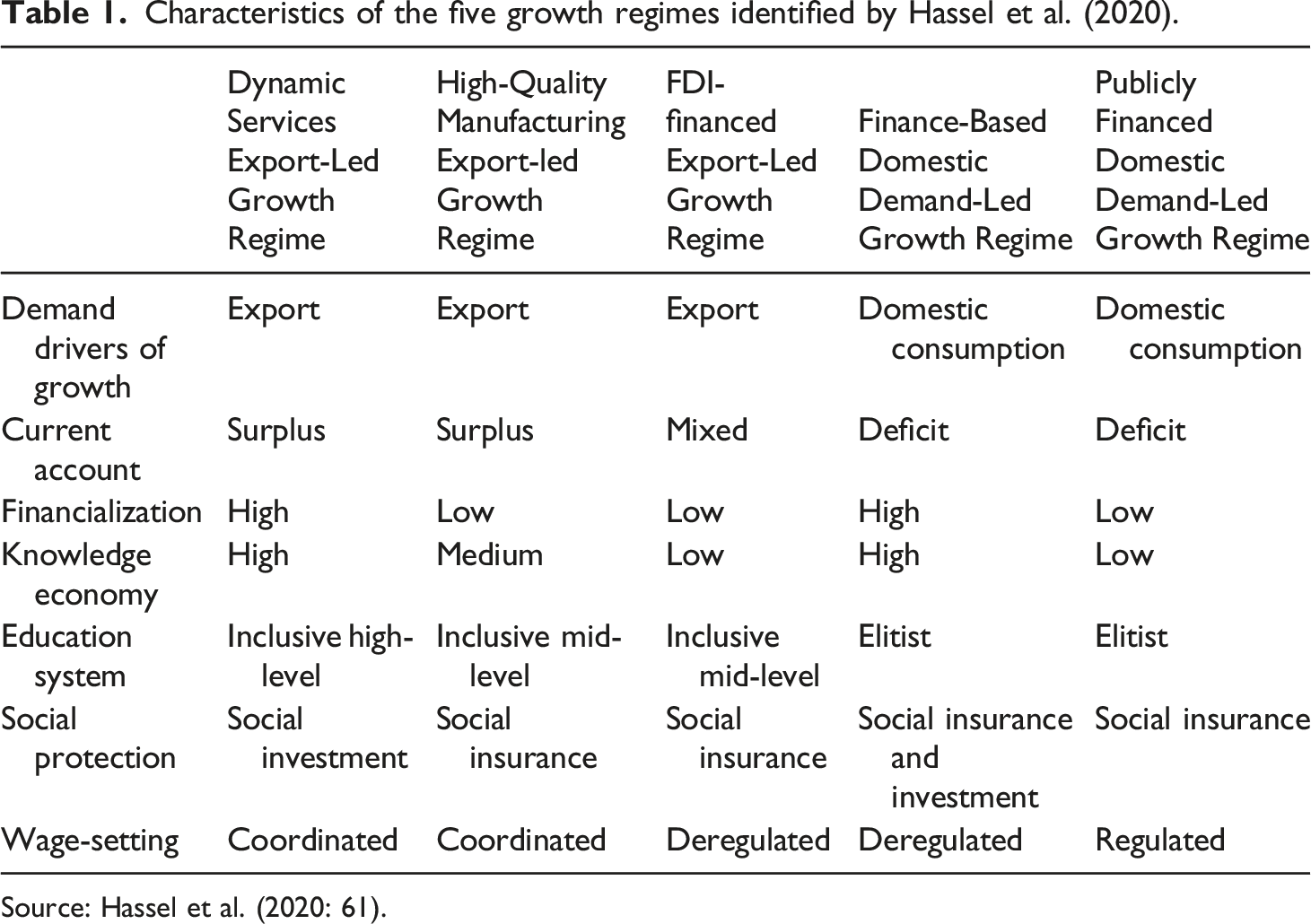
Source: Hassel et al. (2020: 61).
Growth strategies, instead, refer to a set of decisions on economic policymaking and on institutional creation/reforms taken by governments and/or employers and workers’ peak associations to boost growth and stimulate job creation in the country. These decisions are influenced by the features of the extant growth regime. As suggested by Hassel et al. (2020: 62), ‘policy decisions are embedded in given economic structures and tend to buttress existing patterns of economic and sectoral specialization’. In fact, if coherent with the ‘functional requirements’ of the growth regime, governments’ growth strategies undergird and stimulate the reproduction of the pre-existing growth regime. However, economic policy choices which contradict the inner logics of growth regimes can alter the regime’s properties in the medium term and will contribute to the regime’s transformation in the medium to long run.
Based on this theorization, Hassel et al. (2020) analyse similarities and differences across countries during the 2000s and identify five growth regimes – three types of export-led growth regimes and two types of domestic demand-led regimes – whose main institutional characteristics are summarized in Table 1.
The Nordic countries (Table 1, column 1) are classified as export-led growth regimes whose engine of growth gravitates around dynamic services – ICT-intensive services – in the knowledge economy whose development has been facilitated by venture capital and/or governments’ social investment strategies. These are rather balanced economies combining export-orientation with a strong component of domestic demand (Baccaro and Pontusson, 2016). The ‘functional requirements’ of this growth regime mandate governments to boost the quality and innovation capacity of the productive system to maintain a competitive edge in the knowledge economy. Key to this growth strategy is the development of a generous – publicly funded – welfare state where public services, social investment policies and social protection are all geared towards enhancing workers’ skills and firms’ productivity.
Germany is the prototypical export-led growth regime centred on the export of quality manufacturing goods (Table 1, column 2). Here, growth is driven by high and persistent current account surpluses underpinned by the combination of a highly competitive industrial sector based on medium-high tech exports (Streeck, 1991; Storm and Naastepad, 2015) and subdued domestic demand due to wage restraint and fiscal conservatism (Carlin and Soskice, 2009; Di Carlo, 2022). Given their excessive reliance on external demand, governments’ growth strategies must aim at ensuring both competitiveness through an underappreciated real exchange rate (Johnston and Regan, 2016) and the quality of its manufacturing base through the preservation of social insurance and the skill formation system for the skilled workforce in the industrial core of the economy (Palier and Thelen, 2010; Thelen, 2014). Firms’ cost competitiveness is achieved by controlling labour costs via sustained wage restraint – real wage growth trailing total labour productivity 3 – under the leadership of key export sectors enforcing a pattern of wage moderation on the rest of the economy through mechanisms of inter-sectoral wage coordination (Hancké, 2013; Höpner and Lutter, 2018; Johnston, 2016).
Sharing some similarities with the German model, countries in Central and Eastern Europe are also export-oriented growth regimes centred on the manufacturing sector (Table 1, column 3). However, their growth is highly dependent on the attraction of foreign direct investment (FDI) by multinational manufacturing firms (Ban and Adascalitei, 2020; Bohle and Greskovits, 2012; Nölke and Vliegenthart, 2009) interested in offshoring manufacturing operations to reduce production costs (Reurink and Garcia-Bernardo, 2020). Given that growth and employment hinge substantially on these regimes’ capacity to attract large amounts of FDI, governments’ growth strategies must aim at carving out a niche within global value chains and ensuring the economy remains attractive vis-à-vis multinational corporations who can arbitrage across jurisdictions in the global political economy. To this end, governments must ensure a competitive productive environment forged through the maintenance of low labour costs, low social spending and low corporate taxation as well as the extensive use of subsidies and fiscal exemptions targeted at attracting foreign investors (Bohle and Regan, 2021; Reurink and Garcia-Bernardo, 2020: 15–16).
Countries like the UK and the US feature growth regimes driven by domestic demand underpinned by households’ consumption (Table 1, column 4). These countries’ engine of growth resides in the private service sector, increasingly characterized by a growing dualization between low-skilled services – where real wage growth in uncoordinated labour markets has stagnated – and high-end services where sustained real wage growth for professionals in the ICT-based and financial sectors fosters income-driven consumption. The growing income inequality is compensated by financialization and credit-driven consumption (Crouch, 2009). The key goal of governments’ growth strategies within this regime is geared towards ensuring the consumption capacity of the middle classes through deregulated access to financial products, the privatization and marketization of education and welfare, as well as vibrant housing markets.
Southern European countries and France (Table 1, column 5) are classified as growth regimes driven by domestic consumption, especially undergird by patterns of historically strong state intervention (Schmidt, 2002) and generous compensatory and consumption-enhancing welfare states (Beramendi et al., 2015). Merely for geographical convenience, in the special issue we refer to these countries as the Mediterranean growth regime to highlight these countries’ similarities at the turn of the century. According to Hassel and Palier (2020), economic growth in Southern Europe and France relied heavily on domestic consumption supported by generous public spending. Governments in the Mediterranean regime have pursued growth strategies to support domestic demand via public deficits and active state intervention. Central to this growth strategy is the strategic use of public budgets by governments to support household consumption through generous social benefits (e.g. pensions or unemployment benefits) and/or the setting of high minimum wages (Hassel et al., 2020: 69). Thus, governments of Mediterranean countries are prone to pursue ‘a more active, consumption-led growth policy and let wages and social spending rise’ to sustain strategies of domestic demand-led growth (Hassel and Palier, 2020: 41).
While these established insights serve as the starting point for our special issue, we aim to extend this analytical framework with an eye to incorporating the – hitherto neglected – public sector. We thus contribute to ongoing political economy debates by bringing PSWS into the study of different growth regimes and conceptualize public sector wage policy as an instrument of governments’ growth strategies.
Why does PSWS matter for political economy debates on growth regimes?
Despite their richness, debates on growth regimes have so far neglected the public sector and the importance of PSWS. Below, we posit that studying PSWS matters for the analysis of growth regimes and governments’ strategies for three key reasons.
First, in virtually every country, the state remains today the single largest employer in the economy (Hyman, 2013). Among the OECD countries, the public sector continues to employ around 18% of the total workforce, despite decades of privatizations and NPM reforms aimed at rationalizing and curtailing the role of the state in the economy (Pollitt, 2005; Pollitt and Bouckaert, 2017). Thus, the implication of this observation for political economy analyses is that today a large chunk of the European middle classes continues to derive incomes from their public employment with the state.
Despite common economic and ideological pressures to pursue NPM reforms, there remains substantial and persistent variation in the public sector’s size across different growth regimes (Bordogna and Neri, 2011). Figure 1 points to the existence of three clusters which overlap only partially with growth regimes. As the export-oriented regime, Germany (black square in Figure 1) has the smallest public sector of all countries, with employment in the general government standing slightly above 10% of total employment. At the opposite extreme, the Nordic countries (here Denmark and Sweden, represented as white diamonds in Figure 1) with their balanced growth regimes are also the ones with the largest public sectors. With public employment at around 30% of total employment, their public sectors are on average three times larger than Germany’s.
4
With medium-sized public sectors, we find the FDI-based export-oriented regimes of Eastern Europe (here Czechia and Slovakia, represented as black bubbles in Figure 1), the credit-based demand-led economies (here the UK, grey square Figure 1) and the publicly financed demand-led countries of Southern Europe (represented as grey tringles in Figure 1). Notable variation can be observed also within the Mediterranean countries. In fact, France is more similar to the Nordic countries in that it continues to run a much larger public sector (22% of total employment), well above the OECD average (18%). On the contrary, Italy, Portugal and Spain have smaller public sectors, well below the OECD average. Public sector employment has remained largely constant between the 2008 financial crisis and the beginning of the COVID-19 pandemic in 2020. Notable exceptions are Spain where public employment as percentage of total employment has increased over the last decade and Sweden and the UK where it has decreased – quite substantially in the latter case. Employment in general government as percentage of total employment in selected countries belonging to different growth regimes,* 2007 and 2019. Source: authors’ elaboration from OECD Government at a Glance database. *Note: Publicly financed demand-led growth regime (Mediterranean countries): France, Italy, Portugal and Spain. Export-led growth regime: Germany. FDI-based export-oriented regime (Eastern Europe): Czechia and Slovakia. Credit-based demand-led growth regime: United Kingdom. Balanced growth regime (Nordic countries): Denmark and Sweden.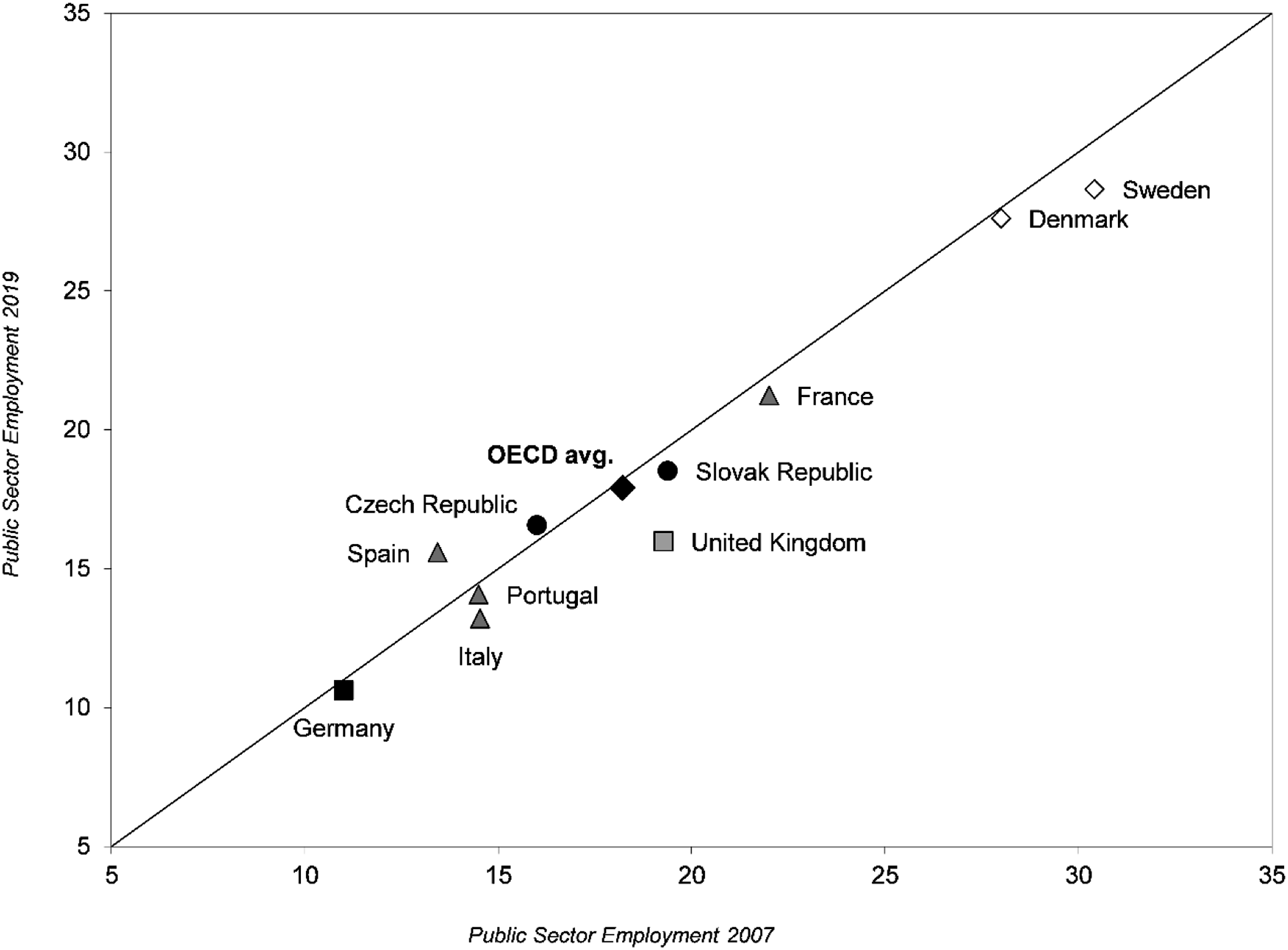
Second, differently from the private sector, public employers’ wage bill is funded by the national taxpayers. Therefore, PSWS is fiscal policy, ultimately pursued by governments through budget laws (Di Carlo, 2022) – a crucial insight which is too often neglected in both the political economy and industrial relations literature. The implication of this observation for political economy analyses is that PSWS can be analysed as a fiscal instrument of economic policymaking by governments acting in their capacity of political employers (on this point see also Beaumont, 1992). After all, governments in different growth regimes do make strategic use of fiscal policy’s allocative function to bolster the respective key economic sectors in the political economy (Haffert and Mertens, 2021). In fact, public employees’ compensation – that is, the public sector wage bill (Figure 2) – amounts to one of the largest items of governments’ current expenditures, although with marked cross-national variation. Governments’ public sector wage bill as percentage of national gross domestic product (GDP) in selected countries belonging to different growth regimes,* yearly averages 2004–2007 and 2016–2019. Source: authors’ elaboration from AMECO database. *Note: Publicly financed demand-led growth regime (Mediterranean countries): France, Italy, Portugal and Spain. Export-led growth regime: Germany. FDI-based export-oriented regime (Eastern Europe): Czechia and Slovakia. Credit-based demand-led growth regime: United Kingdom. Balanced growth regime (Nordic countries): Denmark and Sweden.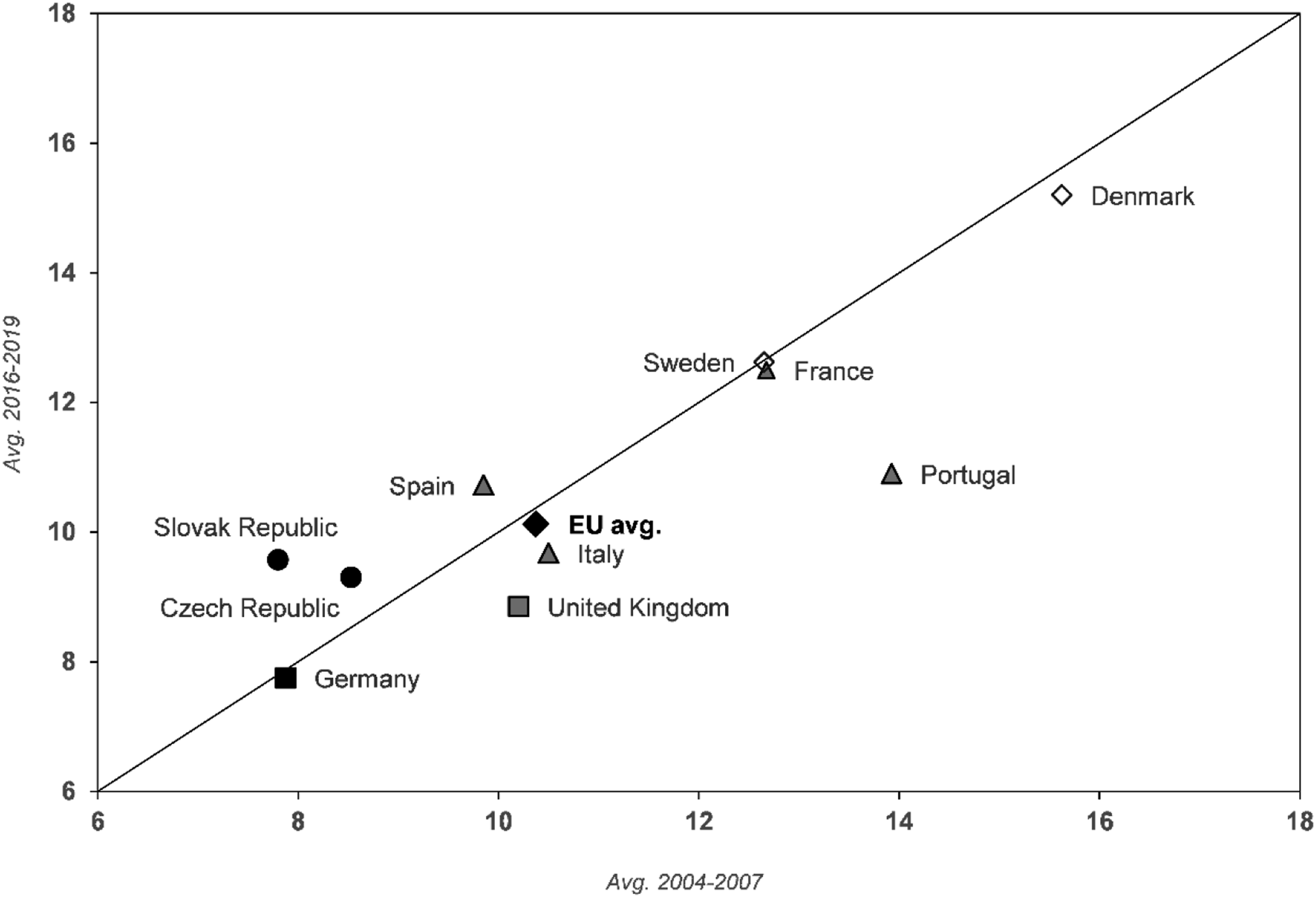
Figure 2 indicates that, on average, the size of the public sector wage bill among countries belonging to the European Union is above 10% of GDP. Germany, together with the FDI-based export-oriented economies, used to have relatively small public sector wage bills, well below the EU average. The wage bill as percentage of GDP in Germany has remained constant over the last two decades while Czechia and Slovakia have substantially enlarged their governments’ wage bills, converging towards the EU average by 2019. The UK has moved in the opposite direction, reducing substantially not only public employment (Figure 1) but also the total wage bill through wage restraint. Among the Mediterranean countries, France has the largest public sector wage bill: at above 12% of GDP, it equals Sweden’s wage bill. Italy, Portugal and Spain had public sector wage bills similar to the EU average before the financial crisis and have since then moved in opposite directions. Governments in Italy and Portugal have cut substantially their public sector wage bill after the financial crisis and because of the austerity measures. On the contrary, the public sector wage bill has slightly increased in Spain between 2016 and 2019. Denmark displays the largest public sector wage bill of all countries at almost 16% of GDP.
Third, the institutional and legal capacity of state employers to govern PSWS differs substantially from the rest of the economy. This applies with regard to both the level and the mode of wage-setting (Traxler, 1999). With few notable exceptions (discussed in the case studies), PSWS is generally centralized at the national level – covering the whole public sector – and tends to be co-ordinated vertically within the state’s subnational governmental tiers and horizontally across different regions and/or administrative units. Therefore, PSWS has been less exposed to the various dynamics of collective bargaining decentralization which have characterized the private sector over the last decades (Bulfone and Afonso, 2019; Leonardi and Pedersini, 2018). Most importantly, however, state employers differ substantially from private employers in the mode of wage determination. Public sector employment relations are generally divided according to separate legal spheres where public employees under private law status are subjected to collective bargaining between trade unions and the public employers while civil servants’ employment and wage conditions are set via the state’s legislative powers (Bordogna, 2007; Bordogna and Pedersini, 2013b). However, as shown in some of the case studies, even where collective bargaining exists in the public sector, governments can ultimately act in the ‘shadow of hierarchy’ by virtue of their nature of sovereign employers with the authority to impose their preferences unilaterally via legislative acts (Traxler, 1999).
In all, the implication of this observation for political economy analyses is that the state should generally have a greater capacity to govern the conduct of fiscal/wage policy across the country’s public sector and, when necessary, impose its preferences. However, it also means that PSWS is inherently more politicized than private sector wage-setting as politicians running for elections face large constituencies of voters working in the public sector. This ‘political logic’ of PSWS may run counter to the ‘functional imperatives’ of growth regimes.
Bringing PSWS into growth model debates
The above reasoning behoves us to incorporate PSWS into the study of the institutional characteristics of growth regimes and governments’ growth strategies.
The importance of wage-setting institutions within growth regimes is undisputed (Baccaro and Pontusson, 2018; Hope and Soskice, 2016). By structuring the distribution of growth between the factors of production (capital and labour), wage-setting institutions shape the economy’s wage share and cost-competitiveness, with implications for both the demand and supply side of growth regimes (Hassel and Palier, 2020: 19). Wage-setting institutions structure the growth of workers’ real wages, thus shaping households’ purchasing power within growth regimes. Concomitantly, by defining the growth of unit labour costs, wage-setting institutions have implications for the economy’s cost competitiveness vis-à-vis foreign producers. Hence, given the large size of today’s public sectors (Figure 1) and the fiscal nature of PSWS, we posit that PSWS systems should be of even greater relevance to students of growth regimes: PSWS has direct and indirect effects on both aggregate demand (Palley, 2018) and on the country’s real exchange rates and firms’ cost-competitiveness in foreign markets (Hancké, 2013; Johnston, 2016).
On the demand side, PSWS affects the consumption capacity of households whose incomes are derived from their employment with the state and, as a result, it indirectly affects their consumption patterns within growth regimes. Considering that the state is the single largest employer in today’s advanced economy, PSWS contributes significantly to define patterns of household consumption within growth regimes. Moreover, all else being equal, since PSWS is fiscal policy, the decision to expand/retrench the state’s wage bill is tantamount to a direct expansion/retrenchment of governments’ public spending (G) in the formation of aggregate demand. Therefore, through expansionary PSWS, governments can proactively contribute to the formation of domestic demand through a direct fiscal expansion and by indirectly supporting households’ capacity to consume.
On the supply side, PSWS has the potential to generate negative fiscal, inflation and political spill overs in the economy which reduce a country’s competitiveness (Calmfors, 1993). On the fiscal side, sustained expansionary PSWS will eventually force the government to fund the enlarged wage bill through cuts in other public expenditures or increased taxation and borrowing, with higher costs being externalized on taxpayers. Moreover, inflationary PSWS generates inflation externalities which undermine the country’s export competitiveness and may eventually force external or internal devaluations depending on the monetary regime (Holm-Hadulla et al., 2010; Johnston and Hancke, 2009; Johnston et al., 2014). Lastly, PSWS can also generate political spill overs across the wage-setting arena insofar as wage norms adopted in the public sector can set the pace for wage negotiations across other sectors of the economy.
Therefore, on the one hand, we argue for the importance of studying the characteristics of national PSWS systems as central components of growth regimes’ institutional ensembles. On the other, we posit that, whether consciously or not, the conduct of public sector wage policy by governments is a key part of the policy arsenal decision-makers dispose of to pursue growth strategies which can undergird or undermine the overall functioning and stability of the growth regime. However, the working hypothesis we lay out here is that, given their different characteristics and inner logics/imperatives of the different growth regimes, PSWS matters differently within different growth regimes.
Expectations: Growth regimes meet public sector industrial relations
In this section, we spell out some general expectations for PSWS based on the growth regimes perspective introduced above which will pave the way to the empirical/inductive analysis of public sector employment relations and PSWS to be conducted in the special issue contributions. We present expectations about PSWS processes and outcomes derived from the different growth models’ ‘functional imperatives’.
Based on this literature, the general idea is that the demand and supply side of the economy within growth regimes are both shaped by different institutional foundations, for example, product market regulation, financial systems, wage-setting institutions, social protection systems, education and training systems (Hassel et al., 2020: 19). In turn, there are feedback effects going from the demand- and supply-side. As noted above, PSWS processes and outcomes can affect both the demand and supply side in various ways making PSWS integral to any growth regime. However, this feedback relationship between growth regimes and PSWS hinges on the regime type as it sets particular functional imperatives for the economy in general and the public sector specifically.
Expectations about PSWS outcomes in different growth regimes.
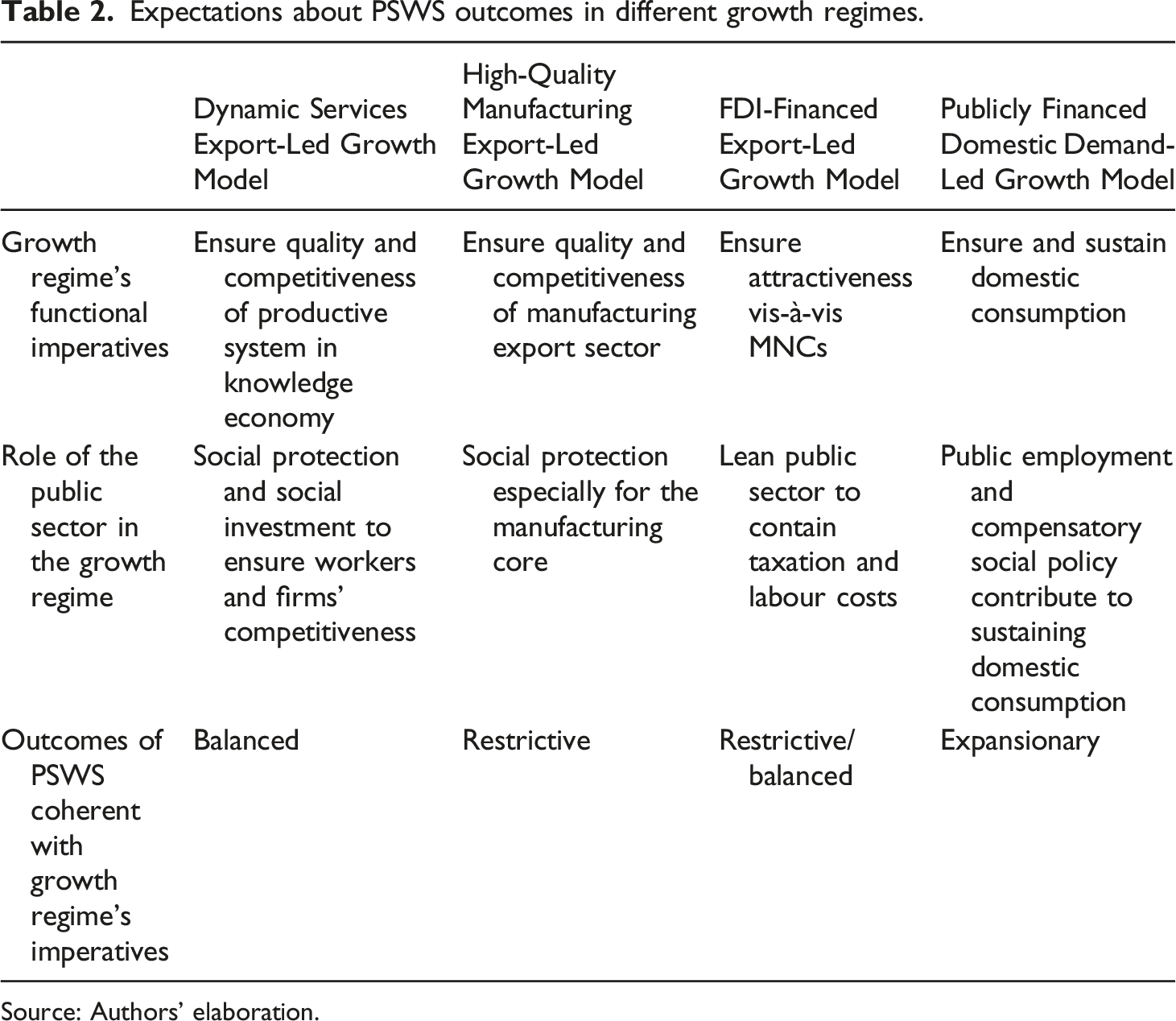
Source: Authors’ elaboration.
In the ‘Dynamic Services Export-Led Growth Model’, the engine of growth lies in the exports of dynamic, high-value added services. These services require a focus on high quality and innovation to be competitive. This growth model therefore needs a highly skilled workforce, with skills that are general enough to sustain rapid innovation. However, compared to the ‘Silicon Valley’ type of innovation, these countries rely on the public sector for social protection in times of restructuring (to provide income security through transitions) and social investment to ensure workers and firms’ competitiveness. Typical cases are the Nordic countries. Here, the public sector and PSWS is a key feature of the growth regime and can work to guarantee its stability. On the one hand, a large public sector supports domestic demand and the provision of social investment and social insurance services, but on the other, it is important that public sector wage growth does not excessively outstrip wage developments in the export sector (which are linked to total labour productivity) and does not create inflation spill overs, which may undermine export competitiveness in the medium term. The outcomes of PSWS should therefore be ‘balanced’ in that public sector wage growth is linked to productivity-adjusted wage growth in the export sector and the public sector works as a productive force for export-led growth, rather than a liability to be contained.
In the ‘High-Quality Manufacturing Export-Led Growth Model’, the engines of growth are in exports of quality-based high-value added manufacturing. The production of these goods requires a focus on high quality and incremental innovation to be competitive. This growth model therefore needs a highly skilled workforce with industry-specific (vocational) skills that can be applied in manufacturing companies. The role of the public sector in the growth model is to provide social protection for individuals with industry or firm-specific skills to secure return on training investment by firms (Estevez‐Abe et al., 2001). Keeping a small public sector is functional to having a lean public sector wage bill (fiscal conservatism) and enables the spread of the low-end and low-cost private services which make it easier for exporting manufacturing companies to buy cheaper business services and enhances competition among workers in the service sector (Hassel, 2014b). Overall, in contributing to maintaining an undervalued real exchange rate, the outcomes of PSWS – and fiscal policy – should ideally be restrictive to ease pressures on price and wage inflation. This becomes especially key in cases where exports are price-sensitive (Baccaro and Pontusson, 2016).
In the ‘FDI-Financed Export-Led Growth Model’, the engine of growth lies in exports by multinational manufacturing firms chasing low-cost production sites. While the production of these goods requires a medium-skilled workforce, companies are specifically looking for locations to cut costs, which in turn forces governments to make the regulatory and institutional environment attractive for FDI. Typical cases are the Czech Republic and Slovakia. The public sector therefore should play an important role in making the country attractive for manufacturing MNCs, which are interested in low corporate tax and low labour costs. A lean public sector and restrictive or balanced PSWS contributes to keeping the political economy attractive in the eyes of international investors putting a squeeze on spending and wage increases in the public sector. At the same time, however, non-negligible human capital investment and public services are needed to ensure/maintain a relatively skilled workforce as an asset to attract foreign companies.
In the ‘Publicly-Financed Domestic Demand-Led Growth Model’, the engine of growth lies mostly in large sheltered service sector activities. Both public and private consumption sustain economic growth, which requires growth in incomes to be sustainable. Investment in skills is encouraged to foster internal productivity growth, but companies are not as dependent as in the export-led growth models on a specific skill-profiles. Typical cases are France, Italy, Spain and Portugal. 5 The public sector has an important role to play by creating public employment, i.e. as ‘employer of last resort’ to ensure domestic consumption. Moreover, the public sector is key as it channels fiscal resources to underpin household consumption via public employment and generous public sector wage growth. The outcomes of PSWS should therefore be ‘expansionary’ in that public sector wage growth undergirds domestic consumption through the public employment and the income channel.
In contrast to these theoretically-derived functional imperatives to PSWS, however, one may also expect PSWS to follow a sui generis logic for reasons related to factors long highlighted by the public industrial relations literature – as reviewed above.
First, the terms and conditions of public sector employees are subject to a different ‘web of rules’ than private sector employees. The most important distinction relates to specific job protections for public sector employees, the role of trade unions in wage setting, the ability to strike, rules for recruitment and selection and the fact that the public sector fulfils sovereign non-marketable functions. Along these dimensions, two ideal types of public sector employment relations exist: the ‘sovereign employer’ and the ‘model employer’ type (Bach and Bordogna, 2016). In the former type, found in Continental Europe, public sector employees enjoy an employment status as civil servants, with well-paid and protected jobs which provide generous benefits and pensions and promise institutionalized career developments. These public servants have employment and wage conditions regulated by public statutes and the law and are denied the right to collective bargaining, with strict limitations to the right to strike. In the model employer type (found e.g. in Anglo Saxon and Nordic countries), instead, public sector employees are formally treated as private sector employees, but often enjoy ‘best practice’ terms and conditions because the public sector employers acknowledge the social importance of the provision of public goods. Public sector employees can unionize, are covered by collective agreements and enjoy the right to strike, although this may be subjected to limitations to guarantee essential services in the public interest. In between these two models, hybrid systems also exist which combine elements of state unilateralism with features of the model employer, such as right to collective bargaining and to strike, although often with some specific limitations in the interest of ensuring continuing provision of public services to the community. The structure and the legal nature of public sector employment relations may therefore affect PSWS in ways that diverge from the growth regimes’ imperatives.
Second, the power resources of actors in PSWS are different than those in private sector bargaining. Thus, public sector unions, as noted by Katz et al. (2015), are helped by lower labour substitutability and price elasticity for the demand of public services making the trade-off between wages and employment less severe. Similarly, the different legal status of some public sector workers may offer more job protection. These features tend to boost public employees’ bargaining power vis-à-vis political employers as compared to private sector workers vis-à-vis their profit-oriented employers. Since public employers are public authorities, PSWS is inherently political when politicians (and bureaucrats) make decisions over budgets and allocation of public funds. Moreover, the consumers of public services are voters that can hold important sway over PSWS by sanctioning public employers at the ballot box and through advocacy (Bellemare, 2000). These aspects make the calculus of public sector wage setters multifaceted and much more complex during processes of PSWS, making it hard for observers to predict PSWS outcomes ex ante.
In sum, the ‘functional imperatives’ of growth models face an institutional setting and actor constellations that may (or may not) conform to each other. An imperative of wage restraint may face strong union opposition and politicians who are trying to be re-elected by promising better public services. Alternatively, an imperative of wage expansion may run counter budget deficits and the election of politicians who ran on fiscal discipline. PSWS may be entirely decoupled from any growth model imperative if the sovereign functions and model employer ideals hold sway over PSWS. The contributions to the special issue set out to test and investigate empirically these theoretical conjectures.
The special issue’s contributions: A preview of the results
The contributions to the special issue adopt an analytical approach bridging the tradition of public sector industrial relations and the growth models/regimes literature to investigate empirically the country-based specificities of PSWS processes, institutions and outcomes. The special issue is composed of four articles, which analyse the dimensions of PSWS within four different growth regimes. The main takeaway from the special issue is that the growth models/regimes literature may benefit from consulting the industrial relations literature on the public sector to benefit from a greater understanding of how the politics and institutions of PSWS affect strategies and economic policies for growth in a given country.
The article by Christian Lyhne Ibsen, Laust Høgedahl and Flemming Ibsen investigates PSWS in the balanced export-led growth models in Denmark and Sweden. In line with the growth model-expectation, they find that agreements in the manufacturing export sector set the overall pattern for public sector wage bargaining to ensure competitiveness, whilst sustaining internal demand in both countries. However, they also find that institutional differences have significant distributive implications for public sector employees. Denmark displays more variation in the wage increases within different sub-sectors of the public sector, whereas wage structures in Sweden have remained very stable. Key drivers for these distributional differences are rooted in specific institutional differences on timing of bargaining, the level of private sector wage flexibility and various dynamics of politicization of PSWS within different sub-sectors.
The article by Berndt Keller investigates public sector employment relations and PSWS within Germany as the prototypical export-led growth regime. In line with the expectations above, restrictive PSWS, together with the downsizing of the government wage bill, have contributed to overall wage restraint and demand compression in the Germany economy. Thus, the outcomes of PSWS appear aligned to the regimes’ functional requirements. However, contrary to what is generally assumed in the CPE literature, wage restraint in the German public sector is not an outcome driven by the domination of export sector actors in the wage-setting arena (on this point, see also Di Carlo (2019, 2020, 2022)). On the contrary, the article highlights key patterns of institutional change in the institutions of the state specific to PSWS and changing power resources. Thus, factors specific to the structures, regulations and organization proper to the German public sector explain the institutionalization of public sector wage restraint within the German export-led growth regime – rather than export-sector domination.
The article by Marta Kahancová and Katarína Staroňová analyzes PSWS developments in Czechia and in Slovakia – two small, FDI-based export-oriented economies. Questioning the growth regime-expectation, they find that institutional inertia and the complexity of relationships, interests and bargaining within the public sector itself play a more important role for PSWS procedures and outcomes than direct benchmarking with the export sector. Under conditions of weak legal transparency (Czechia) and an overtly complex occupational regulation of public sector professions (Slovakia), actual bargaining and power resources between PSWS actors have a greater opportunity to shape public sector wages than benchmarking to the private sector.
Lastly, the article by Donato Di Carlo and Oscar Molina tackles PSWS in the Mediterranean growth regime since the launch of the European single currency (EMU). Partly in line with the growth regime expectation, the analysis reveals that until the sovereign debt crisis, PSWS was indeed expansionary in Spain and Italy, thus contributing to supporting domestic demand within these publicly financed demand-led growth regimes. However, public sector wage growth remained moderate in France and Portugal where finance ministers were proactively engaged in governing PSWS centrally and unilaterally to ensure fiscal and wage moderation in line with the imperatives of the EMU. Thus, in Italy and Spain, PSWS was a key component of the growth regime and generous public sector wage policies contributed to buttress demand-led growth. However, under the austerity pressures which followed the sovereign debt crisis, all countries shifted to a pattern of wage freezes/cuts in the public sector. In this context, highly restrictive PSWS and the public sector’s downsizing have contributed to these countries’ post-crisis shift towards export-led growth.
In all, on the one hand, the cases only partly corroborate theoretical expectations derived from growth models/regimes’ functional imperatives. On the other, they illustrate the existence and importance of specific public-sector-specific elements that explain deviations from the functionalist logics of VoC and growth models/regimes. Elements proper to PSWS, such as the level, mode and legal bases of PSWS, the political role of public employers in making fiscal policy decisions and public sector actors’ power resources and configurations all bear consideration in order to understand both cross-country differences but also variation over time in PSWS patterns. The SI’s findings thus contribute to longstanding industrial relations and CPE literature by illustrating the need for scholars to look at the public sector in its own right – and not as a sector subaltern to export-sector actors and institutions – to investigate (1) the role of the state in PSWS as an independent actor in its own right, (2) the state’s structures and institutions proper of PSWS within which public/political employers operate vis-à-vis powerful public sector unions, (3) the foundations of power resources strategically employed by PSWS actors and (4) the historical legacies which shape state structures and PSWS institutions.
Footnotes
Declaration of conflicting interests
The author(s) declared no potential conflicts of interest with respect to the research, authorship, and/or publication of this article.
Funding
The author(s) received no financial support for the research, authorship, and/or publication of this article.
