




Abstract
The paper asks for the contribution of growth models for the explanation of public sector employment relations in Germany. The paper is subdivided into three parts. The first elaborates on long-term developments as well as forms of employment. The second part analyzes wage setting systems, that is, bilateral collective bargaining for employees and unilateral decision-making for civil servants. The third part compares the empirical outcomes of both sub-systems with the assumptions of growth models and distinguished explicitly various concepts of the state as corporate actor.
Introduction: Some caveats
The public sector (hereinafter ps) has traditionally been neglected in comparative political economy with its focus on manufacturing sectors and industries. This avoidance is also (or especially) true for the elaborate growth models of advanced capitalist economies independent of their ‘consumption-led’ or ‘export-led’ variant (Baccaro and Howell, 2017). This neglect is also typical for past and present industrial relations research whose sub-field of ps employment relations is hardly integrated in mainstream analysis. Germany is of special relevance in comparative political economy because it is supposed to constitute a prototypical example of the export-led growth model with export of quality manufacturing goods as the main driver of external demand and economic growth (Baccaro and Hadziabdic, 2022).
In order to fill the gap, more sector-specific analyses need to be made and to focus on institutional prerequisites and determinants. They differ to a significant degree and, therefore produce outcomes that could diverge from expected outcomes at macro level. Furthermore, more recently, some authors have taken up a traditional line of comparative research and argued that not only the dominant macro level and its ‘methodological nationalism’ but also the sectoral level constitutes the appropriate level for autonomous comparative analysis; the coherence and homogeneity implied in the analysis of ‘national models’ must be put in question (Bechter et al., 2011, 2012). In this line of arguing, sector-specific comparisons are even more important than national ones.
In the following, we elaborate on two interrelated sector-specific issues, long-term developments and forms of employment as well as institutions and different forms and policies of wage setting. The underlying assumption is that an exclusive concentration on wage setting systems constitutes a too narrow focus because employment is of equal importance. The quantitative effects for overall outcomes need to be carefully considered. We deal with the entire ps as the largest and most important employer and we do not single out certain parts (such as education, healthcare or administration).
Employment: Long-term developments and forms
Overall employment
The long-term development of overall and subsector-specific employment relations must be analyzed. Especially the size (or number of employees) and the percentage of overall employment deserve special attention. In contrast to the time frame of our original proposal for this special issue (1999–2019), the period under investigation has to be extended for the German case. In comparative regard, Germany is characterized by a different national trajectory and constitutes an outlier.
Major cutbacks happened already since the early/mid 1990s and, therefore, took place much earlier than in the majority of other EU member states (Vaughan-Whitehead 2013). The main political and economic reasons for this significant restraint were the following: After the unexpected sudden collapse of state socialism in the German Democratic Republic, re-unification in 1990 required the complete reconstruction of the ps in the five new states (at state and municipal level) and opted for the adaptation to former West German standards. Regulations that existed in the Federal Republic of Germany were transferred (Kahancová and Staronňová, this issue for developments in other former state socialist countries).
These necessities exerted high pressure and had consequences for all public budgets. Moreover, various privatization measures of former monopolies (among others at federal level postal and telecommunication service and railways and at municipal level hospitals) were carried out and considerably reduced employment. Additionally, the forthcoming introduction of the common currency, the Euro, and the politically defined strict deficit criteria of the European Monetary Union had to be taken into account. Finally, throughout the 1990s, unemployment rates were persistently high and growth rates remained low in a more or less stagnating economy.
The major cutbacks that were carried out especially at municipal level continued even throughout the early/mid 2000s but were less serious than during the 1990s. All in all, ps employment significantly decreased by almost one third (from 6.7 to 4.5 mio). The ps, especially its size and claimed inefficiency (or ‘cost disease’), was at least implicitly, especially in neoliberal thinking and policy even explicitly blamed for the lasting unfavorable conditions, particularly for slow or even missing growth. The public sector is, as in other EU member states, still the most important employer.
Later on, an unexpected and, in comparative regard unusual U-turn happened. The German economy managed quickly and earlier than others to recover from the financial and debt crisis of 2008/2009. Germany, the largest economy in the EU, changed from the frequently quoted ‘sick man of Europe’ to the ‘economic miracle’ – and was even heavily criticized for its extraordinary position with growing and unusually high annual export surpluses (‘export word champion’). Overall employment kept rising and even reached historic extremes in 2019/2020 (of more than 44 mio); formerly high unemployment rates gradually decreased and remained low.
The perception of the ps changed from harsh criticism throughout the 1990s to the recognition of its importance, especially during both crises; during the COVID-19 pandemic major parts, such as healthcare were even labeled ‘system-necessary’. The provision of its functional preconditions and infrastructure that are necessary not only for the fulfillment of public tasks but also for activities of private industry, are nowadays more acknowledged and appreciated.
In contrast to southern EU member states, especially Greece, Italy, Portugal and Spain, the so-called GIPS states, there was no necessity for further major cutbacks and strict austerity packages that would have seriously hit the ps. Furthermore, forms of active intervention with tight control measures by international institutions, such as the ‘Troika’ (European Commission, European Central Bank and International Monetary Fund) were definitely superfluous. Quite the opposite trend materialized in a period of uninterrupted economic growth with increasing revenues, in some years even with unexpected budget surpluses and a decrease of debts. This upturn was unusually long, finally lasted for more than a decade throughout the 2010s and came only to an end with the beginning of the COVID-19 pandemic.
These favorable macroeconomic and financial conditions favored small annual increases of ps employment. They did not constitute a linear trend but occurred almost exclusively in carefully selected areas of widely undisputed high demand (especially pre-school education at municipal level, universities and police at state level). Employment kept slowly growing from 4.5 to 5 mio (in mid-2020) (Destatis et al., 2021). The steady downward trend of the 1990s and early/mid 2000s was ended, to a limited degree and partially even reversed but definitely not re-balanced.
In comparative regard, especially but not exclusively with the Scandinavian countries (Høgedahl et al., this issue, OECD, 2021), the ps workforce has always been of fairly limited size. Nowadays, it is at about 11% of total employment and even far below the average of OECD or EU member states. More recently, this long-term stable pattern has, despite major crisis, not changed (OECD, 2021). Therefore, expenditure on staff as a share of gross domestic product is at about eight per cent also low in comparative regard (DGB, 2022). This rather limited size in a developed welfare state has the consequence that significant long-term shortages continue to exist and create major future difficulties. Healthcare and education from pre-school education to universities are frequently quoted examples for permanent underfunding. Public expenses have kept being restrained despite the urgent need of higher investment at all three levels.
The sheer size or number of employees constitutes only one side of the coin. The German federalist polity is characterized by a national-specific distribution of (compulsory as well as voluntary) tasks and responsibilities that is defined in the Basic Law. Among others, the states are in charge of police, judicial systems, education at all levels and cultural affairs that require highly qualified and therefore expensive staff. Therefore, staff that is necessary to fulfill these tasks is unequally distributed (federal level 10, state level 50, municipal level 32%, plus 8% in social insurance, a German specificity) (DBB, 2022). In comparative regard, there is one peculiarity between two groups: The high percentage at state level is, in contrast to unitary states, typical for federalist states whereas their federal level is unusually small (OECD, 2021).
One has to consider the fact that many public services are very labor-intensive and require highly qualified staff. Due to the overall distribution of assignments, expenditure on staff as a percentage of total expenses differs significantly between the three levels. In figures (for 2019): They are much higher at state level (about 38%) than at municipal level (about 26%) and federal level (almost 10%) (Destatis et al., 2021: 139). This skewed distribution, that has been stable over time, is important for the outcomes of wage setting that we discuss later. Major problems exist especially at municipal level that has no right to levy taxes; quite a few municipalities suffer from high levels of long-term debts.
Forms of employment
Another important feature is different contract forms of employment. In contrast to widespread views, there are not any longer exclusively safe, long-term or even lifetime jobs as in the traditional career-based model of the ‘Weberian bureaucracy’.
First of all, over the past decades, part-time employment has significantly increased to nowadays one third of overall employment. This development is closely correlated with the integration of women in the labor force: In the ps, women constitute the vast majority of part-time employees (84%). The overall percentage of women has slowly increased over time. Nowadays, they constitute more than half (57%) of ps employment (Destatis et al., 2021; DBB, 2022) and their share is higher than in private industry. The distribution has led to a sector-specific form of ‘gender wage gap’: The principle of ‘equal pay for equal work’ applies in the ps but women are concentrated in specific tasks and responsibilities (such as children’s day care, healthcare and schools) (DGB, 2022).
Forms of non-standard (or ‘atypical’) employment do not exist exclusively in the private industry. In the long run, the overall number of ps employees with temporary (or fixed-term) contracts, especially for ‘entrants’ has kept growing to about 9%. Surprisingly or not, they are nowadays even more frequent than in the private industry (Keller and Seifert, 2015). The formerly dominant normal employment relationship has lost in importance, and contract forms are nowadays more diverse.
All in all, labor markets are hierarchically ordered and highly segmented. The traditional legal employment status, employees versus civil servants still constitutes a decisive difference. In the internal ps labor market, the level of schooling, formal education and training/apprenticeship constitute recruitment principles for individual classification at specific ‘ports of entry’ and compensation as well as later opportunities of promotion and career development. Existing differences between permanent versus temporary employment contracts constitute an additional reason for the existence of internal and external segments of the labor market.
Furthermore, workloads have definitely intensified because of the expansion of tasks and assignments without corresponding increase in the number of employees. All in all, in quantitative (or workload) as well as qualitative (or work intensity) regard, working conditions have deteriorated already since the 1990s in comparison with former standards (DGB, 2022).
The ‘quality’ of the ps refers not only to the number of its employees but also to the goods and services provided by the welfare state for its citizens, especially for the most vulnerable groups. Their availability and quality have deteriorated because of the indicated lack of human resources and permanent understaffing. Various privatization measures that happened especially throughout the 1990s had lasting effects on the quantity as well as the quality of provided services.
Forms and policies of wage setting I: Bilateral collective bargaining
Changing contours of collective bargaining
As in private industry, ps employment relations are of ‘dual’ nature, and in purely legal view, both parts are separated. At the sectoral level, there are two legally distinct forms of interest representation, (bilateral) collective bargaining (hereinafter CB) for employees and (more unilateral) forms for civil servants. Both forms are of focal interest for our analysis.
The institutionalized CB system was traditionally not only highly centralized but also strictly co-ordinated between the federal, state and municipal level (Keller, 1993). In contrast to other federalist states and despite differing interests, all employers negotiated together. In comparative regard, the degree of vertical as well as horizontal integration was exceptional. Its outcomes consisted of standardized working conditions (wages, weekly working hours and bonus payments). This traditional system lasted for several decades after it had been introduced in the early 1970s.
It changed only in the early 2000s when the long-lasting bargaining coalition of all employers broke apart. It has to be explicitly pointed out that this breakup was caused by internal conflicts of the employers’ associations, especially the Bargaining Coalition of States (TdL) when some states thought that they would be in a more favorable position if they decided ‘to go alone’. Their ‘exit’ instead of the continuation of ‘voice’ did not take place, as could be assumed because of the financial and debt crisis but before this ‘great recession’. In other words, this ‘critical juncture’ was not caused by any supranational or European development but was of purely national origin. After the breakup states, with the only exception of Hesse decided to stay together and to maintain the close horizontal co-ordination of their CB strategies – instead of completely dissolving their association, the TdL.
Since this institutional change, two formally independent CB systems have existed, one for the federal and the municipal level, the other for the state level. In the following years, new framework agreements were signed for both parts (2005 TvöD, 2006 TV-L) (Dribbusch and Schulten, 2007). They finally abolished all still existing status differences between blue-collar workers and white-collar employees.
At municipal level, there are, among others, differences of interest between rich and poor municipalities. Forms of close co-operation cannot automatically be taken for granted but require protracted processes of co-ordination within their encompassing federation, the Federation of Local Government Employers Association (VkA). As already indicated, municipalities are important employers and because of the size of their workforce constitute corporate actors in CB. These constellations of different interest constitute an idiosyncrasy of the ps and cannot be neglected. They manage to keep wage dynamics under control because of the necessity of close horizontal co-ordination.
These collective contracts facilitated more ‘flexibility’ in specific subsectors by means of the introduction of opening clauses (Keller, 2011). There are six versions of TVöD. 1 They allow group-specific deviations, among others in the number and level of pay scales or additional days off, but do not constitute completely independent collective agreements. Except the TV-L, there exist special contracts for doctors and trainees, in some states there are special agreements for university hospitals. Some group-specific increases in allowances have been agreed in regular bargaining rounds.
Despite these recently concluded contracts for individual groups it is still correct to argue that “TVöD and TV-L are not the only collective agreements, but they are by far the most important” (Schmidt and Müller, 2022: 4). Despite this differentiation, the overall number of ‘bargaining units’ remains low in comparative perspective. Changes that have occurred cannot be labeled as trends in ‘fragmentation’.
On the employees’ side, the (multi-)industry United Services Union (ver.di), the second largest German union, is the decisive corporate actor. 2 Ver. di and the bargaining wing of DBB-tarifunion are members of different federations. However, in the mid-2000s, they formed a bargaining coalition that was supposed to mediate existing political tensions and accommodate existing inter-union rivalry. Before ‘joint’ CB rounds with employers’ associations, they face the necessity to negotiate internal compromises in order to reconcile differing demands of their member organizations. So far, they have managed to solve this problem of inter-confederate co-ordination and to develop forms of pragmatic co-operation.
This trend towards ‘decentralization’ happened late and started from the highest possible, the national level. Its consequences remained limited and did not lead, as in Italy or Spain (Di Carlo and Molina, this issue), to expansionary wage policies. In other words, the extent of vertical and horizontal decentralization matters and leads to differing outcomes (Grimshaw et al., 2017).
Furthermore, we know from previous comparative research (on private industry) that not only, as frequently assumed the level of centralization but also the level of co-ordination influences and even shapes outcomes (Traxler et al., 2001). The latter is still fairly high in the German ps so that both prerequisites are fulfilled. From a formal point of view, its vertical dimension is less narrow than before the reform; in empirical regard, however, it continues to exist and to be effective. One could argue that the associations’ capacity to moderate wage increases constitutes a necessary precondition for the CB system.
In a detailed analysis of forms of decentralization, this specific one is to be characterized as ‘controlled’ instead of ‘wild’ or ‘disorganized’ (Traxler, 1998). In comparison with other, especially other federalist polities, the present German system and its institutional infrastructure are still fairly centralized at almost some kind of ‘industry level bargaining’ and, characterized by a relative uniformity of outcomes. This high degree of centralization is also the reason for the fact that, in contrast to other EU member states a ‘recentralization of employment relations’, especially of wage setting systems has not taken place.
In contrast to parts of private industry, especially private service sectors occurring forms of decentralization can definitely not be entitled ‘fragmented’ or ‘eroded’. Nowadays, no corporate actors is interested in a more far-reaching decentralization of authority and responsibility towards ‘single employer bargaining’ because of high ex-ante (for drafting, negotiating and safeguarding) as well as ex-post-transaction costs (for maladaptation and adjustment).
Interestingly enough, despite this formal division of tasks and competence and the end of the former CB system, the empirical outcomes of both present systems are still very similar, if not even the same (Keller, 2020). In between rounds of CB, small differences can exist due to differences in timing. However, they are only of temporary nature and balanced in the next CB round of the others. In the long run, both systems of institutional ‘embeddedness’ are not legally but informally and nevertheless loosely interconnected. In this regard, the initial hopes of employers at state level to reap benefits of their separation from their federal and especially their municipal partners have not materialized and a fundamental transformation has not happened. Negotiated wage increases continue to be moderate and lower than in major sectors of the private industry (Figure 1). Employment of collectively agreed wages 2000–2020 .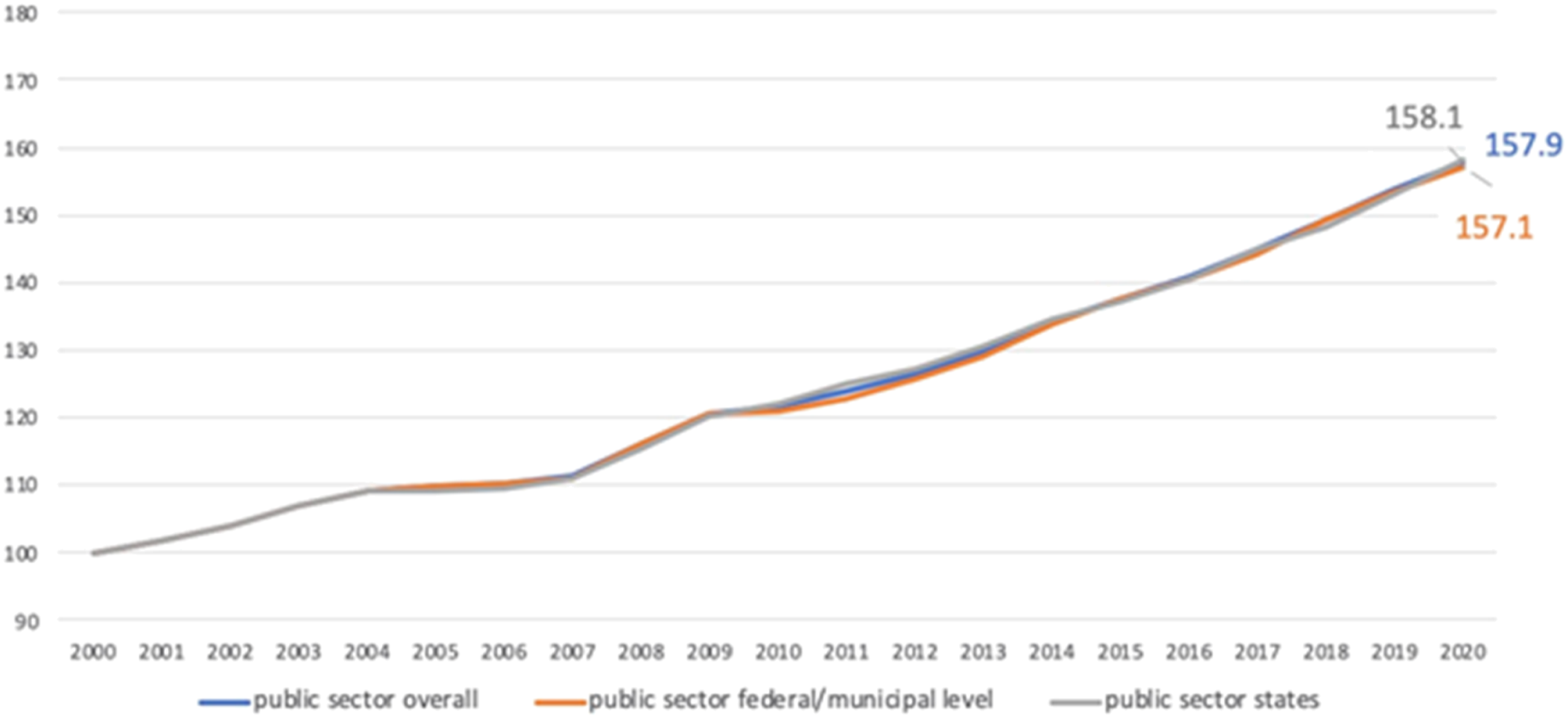
Forms of CB make a difference. Among others, the level of CB and/or co-ordination (‘single-employer’ versus ‘multi-employer’ in traditional private industry terminology) has an impact on outcomes. In case of higher centralization, they are of more egalitarian and less dispersed nature. Furthermore, governance of CB is easier than in the decentralized case.
Density ratios constitute focal determinants and exert major influence on the outcomes. On both sides, they are far above the national average. On the employers’ side, almost all (more than 90%) are organized and this rate is even higher than on the opposite side (Keller, 2017a). On the employees’ side, density ratios have traditionally been higher than in private industry (at present at about 17%). Therefore, in the terminology of power resource theory, employees possess not only (individual) market power but also (collective) organizational power. Their unions take advantage of these resources.
As a consequence of high density ratios on the employers’ side, coverage rates, another focal indicator for the state of employment relations, are exceptionally high (at more than 90%). In clear contrast to sectors of private industry (Ellguth and Kohaut, 2021), they have not declined. The collapse of the former bargaining coalition that comprised all three levels changed only the composition of coverage rates, but not their still existing high level.
The indicated introduction of opening clauses opened up opportunities of improvements for some groups (among others, in social services such as day care). During the COVID-19 pandemic, some groups of employees, especially in hospitals received a tax-free special bonus. This payment was generally acceptable because of the extraordinary situation and the necessity not only to recruit but also to retain qualified staff.
Strikes and industrial unrest
Strikes and other forms of ‘industrial unrest’ have to be on the agenda of ps research because they constitute important indicators for the state of employment relations. Strikes have always been rare and Germany has never been a strike-prone country. In the whole period since WW II, only three major strikes happened (1974, 1992 and 2006) (Keller, 2017b). More recently, some strikes happened in social services, children’s day care and hospitals.
Frequent demonstrations and campaigns by specific groups take place, and warning strikes are repeated measures especially shortly before and during CB rounds. In contrast to some other EU member states, there has not been a general increase of “wage militancy” in the recent past.
In the traditional CB system, strikes took place at the local level. They were initiated by the mobilization of specific groups in key positions, especially garbage collection and transport and, therefore with extraordinary market and organizational power. Due to the former high degree centralization, they automatically initiated wage increases at all three levels.
Nowadays, this automatic transfer does not exist any longer because of the changes of the CB structure. Therefore, at state level unions, especially ver. di are confronted with the problem that other groups, among others, employees in healthcare and pre-school education are to be activated and involved in strike activities. The corporate actors are still the same without major new unions or independent state agencies, as ARAN in Italy or similar forms in Sweden; other ‘newcomers’ such as social movements do also not exist.
Forms and policies of wage setting II: Unilateral decision-making
In comparative perspective, three modes of ps governance are to be distinguished: CB as the sole or prime method, more or less unilateral decision-making by public authorities and mixed forms (Traxler et al., 2001). In Germany, CB is not the only form, especially of wage setting. It is important to note that differences of legal status and, therefore, individual and collective rights exist within the hybrid nature and establish a mixed form (CB model versus legislation model). In this regard, the legal-institutional design as well as factual governance differs significantly from private industry. The consequences of law as one focal institution have been neglected in contemporary research and, therefore, require the extension of our sector-specific analysis.
Persisting contrasts have been caused by the legal separation of the workforce that dates back to the 19th century. The legacy of professional civil service is even enshrined in the Basic Law. This traditional dualism of employment status has frequently been contested but has kept existing, and basic status transformations, as described for Scandinavian countries, have not materialized. Employees (about 62%) have the same rights as their counterparts in private industry, including the right to CB whereas civil servants (about 38%) (DBB, 2022) are not allowed to CB and/or to go on strike.
There are two federations of interest organizations, German Federation of Civil Servants and Bargaining Union (DBB) and German Trade Union Federation (DGB). They have legally guaranteed and formally institutionalized rights to participation and consultations before parliamentary decisions on working conditions are made. These forms of more unilateral decision-making have traditionally existed for all civil servants – as a group and not for specific focal tasks – and were even expanded in the more recent past.
The empirical impact of this legal peculiarity is difficult to be generally assessed. It differs over time, disputed topics and involved corporate actors. In some cases, they constitute almost functional equivalents of CB despite the legal verdict to CB; in others, they approach unilateral decision-making (Keller, 2020). Their overall consequence is that civil servants are mostly treated in the same way as employees. Anyhow, these rights were neither strengthened and expanded nor only introduced during or after the financial and debt crisis. Therefore, an expansion of employer discretion as part of the neoliberal conversion in the sphere of industrial relations in advanced capitalist economies (Baccaro and Benassi, 2014; Baccaro and Howell, 2017) did not take place in the ps of Germany.
Since the early/mid 1970s, the federal parliament was in charge of setting the working conditions for all civil servants. The generally accepted principle was to transfer the results of preceding CB without substantial differences or temporal delays. The political principle of ‘equality of living conditions’ of all employees remained uncontested. Interestingly enough, the Federal Minister of the Interior and not the Minister of Finance as in other countries (for recent examples, Di Carlo and Molina, this issue) always had the bargaining mandate, took the leadership and managed the vertical co-ordination of employers’ interests.
In the mid/late 2000s, a major politically motivated reform of federalism took place and shifted, more or less as a non-intended by-product, major parts of regulatory powers for all civil servants of the states from the federal to the state level. The decisive reason for this vertical shift of legislative competence was the political decision to substantially modify the Basic Law. This major shift of constitutional power was definitely neither associated with the shift of the CB system that happened a few years earlier nor was it related to the financial and debt crisis that occurred later. It meant, in contrast to recent developments in other countries (for Czechia and Slovakia Kahancová and Staronňová, this issue) not more but a shift of legislative power for specific groups within the ps.
Especially during its early stages, this politically – and not economically – motivated constitutional reform resulted in some formerly non-existing group-specific differences at the horizontal level between richer (southern) and poorer (mostly northern) states (in salaries, weekly working hours, range of career groups and special bonuses) (Keller, 2020). These differences for the same activity exist especially at state level; their overall extent can be noticeable but is difficult to quantify exactly.
In international comparative regard, such differences of working conditions for specific groups are by no means unusual. They exist, in most cases even on a much larger scale in other federalist states with strictly decentralized systems of employment relations. More recently, forms of greater unilateralism were expanded especially in those states that were deeply affected by the financial and debt crisis but not in Germany where specific variants of unilateralism have traditionally existed and have not been substantially changed.
Outcomes of wage setting systems
The legal and institutional differences in the regulatory framework include these two different forms of wage setting, bilateral CB and (more) unilateral decision-making. They could but must not necessarily lead to differences in outcomes. In empirical regard, outcomes are usually the same (or at least very similar) for both groups. In some more recent cases, certain time lags occurred, when increases for civil servants were delayed either for some months and/or reduced for specific groups, especially for highly enumerated ranks.
All in all, the empirical consequences of the strict legal separation of traditional employment status in terms of remuneration have remained limited. The political composition of coalition governments that have always existed at federal as well as at state level has had no major impact on the outcomes. Strategies of vote maximization of political parties and their orientation to the median voter model, as assumed in public choice theory do not provide convincing explanations for outcomes of wage setting.
In contrast to some other EU member states, all political efforts to introduce social pacts or other procedures of wage moderation have never been overtly successful (Keller, 2023). Any formalized forms, such as temporary indexation as quasi-automatic instrument of adaptation in Italy or France (Di Carlo and Molina, this issue) are unknown. Wage freezes, as among others in Italy, happened shortly in the mid-1990s but not in the recent past. Binding wage ceilings or strict rules of ex-ante mandatory wage restraint are unknown and would not be compatible with the principle of bargaining autonomy that is guaranteed by the Basic Law.
In comparative regard, the late introduction of the national statutory minimum wage in 2015 had above all consequences for the large low-wage sector of Germany. Recent empirical research indicates that private service sectors are most frequently affected (hospitality; arts, entertainment and recreation; trade, repair and repair of motor vehicles; and transport and storage) (Börschlein et al., 2022). The introduction had no major impact on the ps (Kahancová and Staronňová, this issue for different effects).
Wages, especially those of highly qualified employees are certainly not higher than in private industry, their increases are definitely not greater than increases of total labor productivity. Quite the contrary is correct, the ps has been lagging behind. A comparison with the most important industrial sector, the metal industry, illustrates this fact. As in other European states, a ‘wage premium’ does definitely not exist (Schmidt et al., 2018) (Figure 2). Employment of collectively agreed wages 2000–2020 .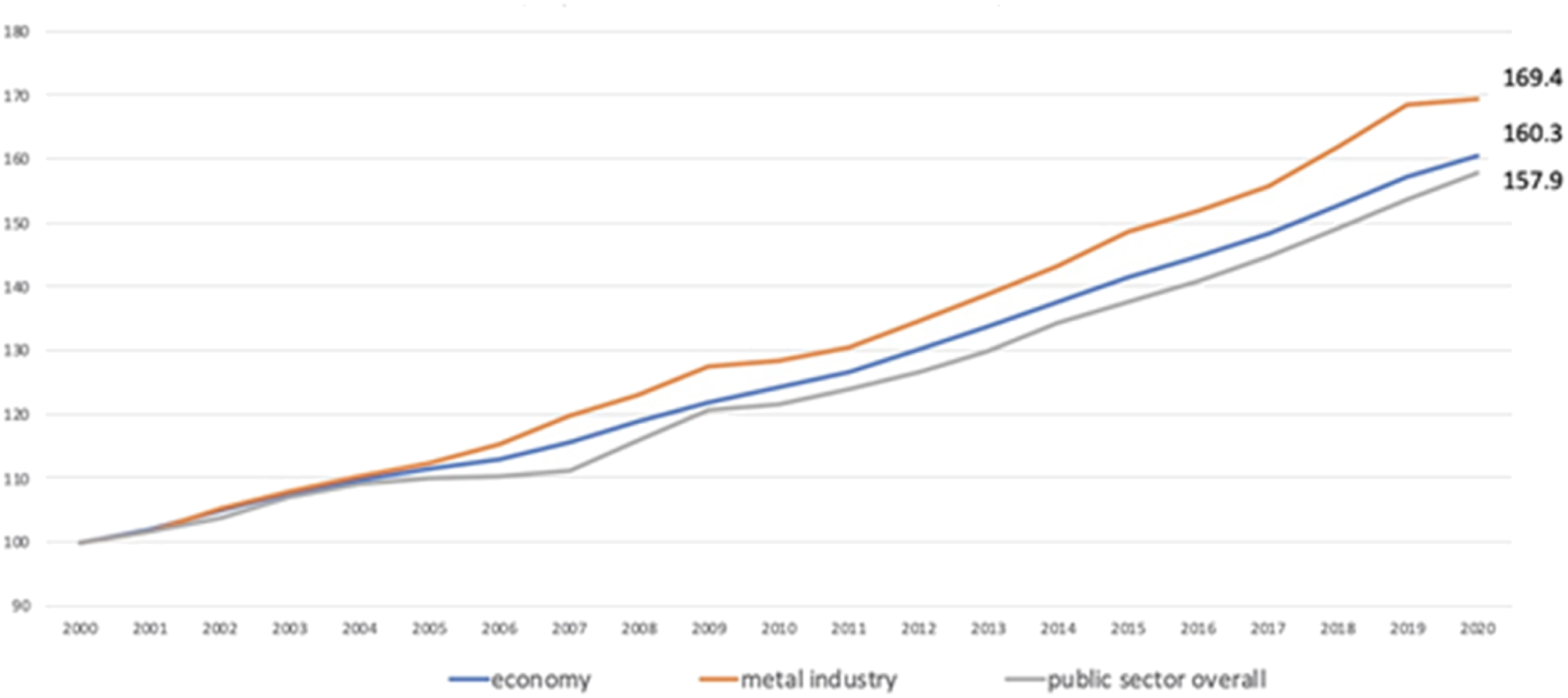
In the extended period of economic growth (2008–2020), ps wages grew steadily but always at moderate rates. Nominal wage increases were negotiated and in some years, there were even increases in real wages. On no account, these increases can be blamed for having created negative externalities, such as inflationary tendencies. Unions have not pursued ‘expansionary’ wage policies that would have led to externalities. The assumption of ‘rent-seeking’ strategies or the existence of narrow interest groups and their ‘distributional coalitions’ (in public choice terms, Olson, 1982) hardly constitute an accurate description of former or present CB activities of unions. All in all, there is no empirical support for the assumption of ps wage inflation.
The need of ‘wage restraint’ was a constant claim not only by public employers but also by their private counterparts or some of their ‘stakeholders’, especially parts of the media and conservative politicians. These claims were more frequent throughout the 1990s and early 2000s than throughout the 2010s.
Growth models shift the focus of analysis from the supply side that is highlighted in the ‘varieties of capitalism” models to the level and composition of aggregate demand (Baccaro et al., 2022). In the German case, vigorous demands for increases of domestic consumption as drivers of growth originated not from the national but from the supranational, especially EU level. However, they were hardly implemented and did not become part of macroeconomic policy (Höpner and Baccaro, 2022). They were unrelated to the minimum wage whose late introduction fulfilled fierce demands of national trade unions and constituted a response to the growing low-wage sector. More recently, annual export surpluses have continued to rise and have not been consciously re-balanced at the expense of foreign demand. Opposing views of (some) neo-Keynesian economists constituted a minority in a broad consensus in the opposite direction.
Growth models and public sector employment relations
Growth models clearly focus on private industry and try to describe and analyze national differences and their consequences for growth. They do not deal with (Baccaro and Pontusson, 2022) – or do not even mention the ps (Baccaro and Pontusson, 2016; Baccaro and Howell, 2017). In other words, the ps is beyond their range of interest. 3 Therefore, it is not realistic, and probably not even fair to expect that they contribute to the explanation of employment relations, especially wage setting systems as well as employment.
The ps requires a specific and interdisciplinary analysis of its own because it follows a logic different from private industry (Bach et al., 1999; Dell’Aringa et al., 2001; Bach and Bordogna, 2016 as some examples for this tradition of comparative employment relations). Its ultimate rationale is not to contribute (as much as possible) to growth (or at least not to hinder or even prevent it) or to maximize profits of private investors. But as the non-for-profit base of the economy, the ps provides, frequently as the only provider essential goods and services that are urgently needed by its citizens and cannot, at least in the short run be replaced (such as education, healthcare, social care and social security).
Furthermore, the ps executes focal functions of the principle of sovereignty that do, by definition not exist in private industry (among others, administration, defense, police, judicial system, finance and taxation). The demand for these tasks is highly inelastic and their substitution is, at least in the short run difficult if not impossible. Last but not least, as we elaborate on in more detail, institutions and practice of employment relations differ from private industry (among others, traditionally unilateral forms, high density ratios on both sides).
In one regard, one could possibly argue that the growth model approach is right: Export-led growth regimes, such as Germany as one typical case are supposed to have a small ps (Höpner and Baccaro, 2022). However, empirical analyses have to be more detailed than just drawing formal analogies at the highly aggregated macro level and take lower levels into account (Coleman, 1990). In our case, what are not only the particular national but especially sector-specific determinants? After expansion in times of the Taylorist-Fordist accumulations regime in the decades following the Second World War, significant retrenchments were made, as indicated above in the early/mid 1990s and continued in attenuated form until the early 2000s. Major cuts were made in the eastern states as a consequence of the extraordinary national event, re-unification in 1990. Minor increases throughout the 2010s happened in selected, politically sensitive areas of widely undisputed high demand and long previous neglect.
The context of inter-sectoral versus intra-sectoral interdependence of wage setting systems is of special importance. The far-reaching hypothesis of ‘pattern setting’ by private industry, especially manufacturing and ‘pattern following’ by the ps is widespread, among others widely used in growth models with Austria and Germany as prominent cases. A more recent version reads as follows: ‘A similar evolution (of sheltered and exposed sectors, BK) might also exist in countries where inter-industry co-ordination of wage bargaining remains strong. Austria and Germany might be cases for the latter: both have pattern bargaining systems where wage-setters in all sectors (usually) shadow the metalworking industry’ (Johnston and Hancké, 2009: 615). 4
However, in empirical regard, this hypothesis of inter-sectoral dependence is definitely not correct, at least not for Germany (for empirical details, Di Carlo, 2019, 2020). The ps follows private industry neither formally nor informally in a model of inter-sectoral dependence. The chronological order differs: Former annual and nowadays bi-annual CB rounds can take place earlier than in major sectors of private industry such as the export-oriented metal industry. Furthermore, they also lead to differences in outcomes. Strict patterns of the timing of CB, as in Denmark (Høgedahl et al., this issue) do not exist in Germany.
Within the ps there exists, with hardly any exception, a long-term, regular sequence of ‘pattern setting’ and ‘pattern following’ (Di Carlo 2019, 2022). CB for employees always takes place first and legislation for civil servants follows. This intra-sectoral mode was even more concentrated in times of the extremely high ‘centralization’ but still exists after the indicated limited form of ‘decentralization’ and its introduction of changes at state level.
Due to cross-country variations, there are more national growth regimes and not only two as in the binary distinction of ‘consumption-led’ versus ‘export-led’ ones. Therefore, some authors distinguish more (five) ideal-typical growth regimes in (more) contemporary advanced economies (Hassel et al., 2020; Baccaro and Hadziabdic, 2022). 5 Their linkage of welfare states and growth regimes differentiates more clearly these modes of governance but does not include a sectoral analysis and a thorough analysis remains excluded. The macro(-economic) orientation of ‘Trajectories of Neoliberal Transformation’ leaves ample room for sector-specific and detailed analysis because the ps is not just the missing appendix, or simple complement of private industry.
One could argue that growth models implicitly treat the ps as an appendix or satellite of private industry, especially its export-led sectors especially the metal industry and chemicals. Any close kind of ‘complementarity’ between the growth regime and ps regime is difficult to prove in a detailed empirical analysis.
As indicated, the ps needs an independent analysis. The exclusive concentration on wage setting systems including their capacity of wage moderation and the avoidance of inflation provides a too limited focus because levels of employment are of equal importance for all outcomes and their consequences for overall expenditure. Therefore, forms and development of employment need to be carefully considered. Furthermore, this paper illustrates major ingredients of study and argues that not the highly aggregated macro level but the meso level of the sector is the appropriate one for analysis. If (some) growth model analyses focus on specific sectors (Johnston and Hancké, 2009), the ps is not included.
In the case of Germany, explanations for the ps size are the existence of established national trajectories, decisions of the social partners, such as the termination of the bargaining coalition on the employers’ side and politically motivated changes of the Basic Law, such as the analyzed reform of federalism, but not the variant of export orientation of the national economy.
In empirical regard, growth models are not the best-fitting and theoretically most convincing explanation of the development and present state of the German case. The fact that they do not constitute the most appropriate base for the illustration of a specific national case does of course not mean that their theory is generally refused. In other words, a contradicting case study cannot falsify the theory.
As the reports of this special issue indicate, national outcomes differ (Høgedahl et al., this issue, for the opposite Scandinavian experience). Such national differences and consequences for the ps are not surprising because of national-specific legal-administrative regulations and different policies of corporate actors. In a broader frame of reference comparative, institutional analysis indicates that divergent paths of development happen (Morgan et al., 2010). Generally formulated growth models can be more appropriate for an explanation of other national cases than the German one. The existing diversity of national institutions leads to different mediating effects and outcomes.
Concepts of ‘the’ state as corporate actor
For ps research, its idiosyncrasies need specific attention that is not necessary in studies on private industry. First of all, the factual heterogeneity of ‘the’ state has to be conceptualized. We describe the conventional models and elaborate on a more recent conceptualization.
A well-known notion perceived the state as ‘employer of last resort’ that had to offer jobs when no other opportunities were available. This was a recommended model especially during the post-war decades, the ‘golden age’ of stable growth and lasting prosperity when the welfare state expanded and the ps as its necessary ingredient kept growing (Keller, 1993). This concept was, among others frequently used in the southern parts of Italy to avoid high unemployment and to stabilize domestic consumption (Di Carlo and Molina, this issue). However, this model was gradually abandoned at the latest in the 1970s when the Tayloristic-Fordist accumulation regime came to its end and continuous ps growth terminated.
Another notion conceptualizes the state as ‘model employer’ that sets decent standards. This concept is correct in a strictly legal sense because the state, especially at federal level has the exclusive power and legal capacity to establish the regulatory framework especially but not exclusively for the ps (among others, employment security, rights of participation, wages and social benefits and pensions). However, on an empirical base, this concept of the state as a benign employer is not accurate any longer (Briken et al., 2014).
Former differences between private and public employers gradually vanished and collective activities are nowadays similar if not the same. Measures of deregulation, privatization, marketization and commercialization were introduced so that the traditionally strict distinction of ‘open’ and ‘sheltered’ (or ‘protected’) sectors faded away (Traxler and Brandl, 2010). The formerly clear-cut distinction of internationally ‘exposed’ (with competitive constraints on excessive wages) and domestically ‘protected’ (or excluded from competition and external pressures) sectors with the ps as a major part of the latter group is not valid any more.
Finally, the state was conceptualized as the independent or ‘sovereign employer’. The meaning depends on the exact connotation of ‘sovereignty’. On the one hand, from a legal point of view, the state constitutes the ultimate authority and rule or regime setter, especially for the professional cadre of employees with the otherwise unknown status of public servants. France and Germany were supposed to be typical examples of this unilateralism. On the other hand, in empirical perspective, the state as an employer is restrained by the legal and institutional framework, the bargaining power of unions, lobbying activities of interest organizations, financial restrictions at all levels as well as permanently high demand for urgently needed goods and services. In a federalist polity, its intentional and strategic ‘steering’ capacity ‘to guarantee the stability of the growth model’ (the coordinators of this special issue) is strictly limited due to the legal as well as factual partition of tasks and responsibilities between the three ps levels. Last but not least, the state has to compete with private industry for qualified personnel and can, therefore, hardly offer highly unfavorable employment conditions.
More appropriate is another notion. In employment relations of federalist polities, the ‘state’ comprises not only as in unitary polities two but even three groups of corporate actors at federal, state and municipal level. Therefore, the state does by no means constitute a ‘unitary’ actor but consists of a set of diverse corporate actors with heterogeneous interests. There are vertical conflicts between the levels as well as horizontal conflicts, at state and especially municipal level. The collapse of the former long-term bargaining coalition on the employers’ side proved the existence of deviating preferences of employers’ associations at state level. At municipal level, the intermediation of differing interests is even more complicated because of the much higher number of municipalities.
One variable that needs further empirical investigation in future research is public finance (Di Carlo, 2019). Especially the structure of the tax regime and its vertical as well as horizontal payments need more attention. The financial and debt crisis had a significant impact on all budgets and led to strict austerity measures in a number of EU member states as well as to more or less long-term increases in debts (Vaughan Whitehead, 2013; Bach and Bordogna, 2016). The relationship between finance and the ps is an indirect one and not of the same strict nature in all member states.
The specific form of political federalism in Germany does not correspond with the existing system of fiscal federalism (Articles 106–107 Basic Law). Or, the distribution of legally defined tasks is not in line with the distribution of taxes. Therefore, there are vertical as well as horizontal equalization payments. The first means payments from the federal to the state and municipal level, the latter between richer and poorer states (fiscal equalization of states). The ultimate goal is the ‘unification of living conditions’.
In contrast, especially to the federal but also the state level, municipalities always are because of their missing fiscal autonomy in a difficult budgetary situation that limits their room for strategic manoeuvring in CB. They have to fulfill mounting tasks of provision and responsibilities, especially social expenditure without being allowed with few minor exceptions to levy or rise own taxes. The most important exemption is the business tax. Therefore, a number of municipalities are highly dependent on vertical transfers of resources from the state level (municipal financial compensation). Such equalization payments exist but are not sufficient.
In case of urgent financial needs, municipalities are allowed to borrow additional loans to guarantee solvency. These bridging loans are short-term loans that are supposed to be paid off in the same fiscal year. Since the early 1990s, their extent has considerably increased especially in a number of municipalities with already existing long-term debts (over-year bridging loans) (Deutsche Bundesbank, 2021).
In other words, it has to be kept in mind that there are enormous differences not only between the three levels but also at individual, especially the municipal level (Keller, 2014). The majority of poor municipalities with unusually high former debts are not located in the east but in specific, nowadays, deindustrialized regions in the west (among others, North Rhine-Westphalia and Rhineland-Palantine). Their ability to make necessary investments is rather limited.
Outlook
Future research should make a U-turn and argue the other way round. A larger ps could provide more and better resources that are urgently needed for the functioning of a still ‘export-led’ highly competitive economy, such as a highly qualified workforce especially in times of progressing digital technologies or a well-functioning infrastructure. Therefore, the export-led sectors, the major contributors to growth could even be interested in some ps growth. From a different point of view, one could argue that if citizens prefer not only more but also better services they would also favor a larger ps. Scandinavian countries constitute examples for this line of reasoning. Last but not least, such a trend would boost disposable incomes and domestic consumption.
One could argue that recent extraordinary crisis led to a re-evaluation of the necessity of the welfare state and especially of the ps, its personnel and the essential goods and universal services it provides for all citizens. In the early 2010s, fears were expressed that the financial and debt crisis would have serious negative effects on national ps because of additional saving measures (Bach and Bordogna, 2013; Vaughan-Whitehead, 2013). These fears did not materialize in the case of Germany.
One focal question that needs political reactions at national as well as European level refers to the time after the COVID-19 pandemic: Will recent strategies of not only national but, for the first time also European fiscal expansion be continued? If so, will they include an expansion of the ps and a certain renaissance of the welfare state?
Or will there be a more or less complete, fast or slow return to strict budgetary restrictions and balanced budgets, co-ordinated austerity measures, the rigorous ‘debt break’ of the German constitution and strict debt limits of the Stability and Growth Pact? 6 If this return happened, consequences for the ps, the provision of goods and services as well as investment would be harsh despite the fact that more investment in various parts of the infrastructure, among others, health and care systems are urgently needed.
Footnotes
Declaration of conflicting interests
The author(s) declared no potential conflicts of interest with respect to the research, authorship, and/or publication of this article.
Funding
The author(s) received no financial support for the research, authorship, and/or publication of this article.