




Abstract
The cultural and creative industries (CCI) is a sector where the workforce is highly educated, yet precarious working conditions are prominent. Although flexible and marginal work is often treated as an overall feature of the sector, this study based on register data on all workers in the sector shows that processes of flexibilization and marginalization are highly divergent between its subsectors. In half of the CCI subsectors, some form of collectively bargained response to the ongoing flexibilization and marginalization has emerged. This first of all shows that creative workers do indeed not only care about expressing their creativity but also about their material working and living conditions. Also how employers’ organizations and trade unions respond to these developments by means of collective agreements varies. Where they disagree, concrete action is postponed. Where they align, either counteracting measures are included, or attempts are made to bridge the divide between employees and the self-employed to some extend in the collective agreement. By doing so, they counteract processes of dualization, paving the road for innovative approaches of industrial relations actors. Still, this counts only for part of the CCI as much of it remains not covered by collective agreements.
Introduction
Over the past 15 years, the Dutch labour market has been flexibilizing rapidly, outdoing almost all other EU countries. In its slipstream, the number of zero-hour and on-call jobs has more than doubled and also part-time positions with very few working hours have been on the rise (De Beer, 2018), transferring labour market risks from the employer to the worker. Marginal work, that is, work that generates too little income to live off because of too few working hours or low wages or both, has increased in the Netherlands and in most OECD countries (Kalleberg, 2018; Vosko, 2010). This has resulted in a growing group of ‘working poor’ (Gill and Pratt, 2008; Lohmann, 2009), fueling ongoing discussions on labour market dualization and liberalization (Baccaro and Howell, 2017; Doellgast et al., 2018; Emmeneger et al., 2012). These discussions reflect that although capitalist labour markets have always known groups of lower skilled and lower status workers, since the seventies, this group has increasingly been subject to low earnings and insecure working conditions (O’Sullivan, 2019). As marginal work is normally imposed by employers rather than being the choice of the worker, it is often associated with workers in less powerful labour market positions, for example, those with lower education, women and migrants (ibid.). Moreover, it is likely to be prevalent in those sectors of the economy where trade unions lack influence (Doellgast et al., 2018; Keune and Pedaci, 2020). This works two ways as marginal work is more likely to occur where trade unions lack influence, but marginal workers also tend to be less organized, lowering in turn trade union influence.
Marginal work is however not exclusively associated with the traditional vulnerable groups. High-skilled and high status workers are also increasingly subject to precarity (Gill and Pratt, 2008; Menger, 2017). Whereas this phenomenon can be observed in various sectors of the economy, the cultural and creative industries (CCI) is the number one example of a sector where the workforce is highly educated, yet precarious work is prominent, regardless the national context (e.g. De Peuter, 2011; McRobbie, 2011). In the Netherlands, the number of self-employed workers in the CCI is almost three times as high as the average in the Dutch economy (SER, 2016); the number of temporary contracts is increasing (SER, 2016, 2017) and so are the number of small jobs with very few working hours (Rutten et al., 2019). Moreover, earnings in the CCI tend to be low for large groups of workers (Alper and Wassall, 2006; De Peuter, 2011; Gill and Pratt, 2008; Longden and Throsby, 2021). As a coping strategy, many workers in the creative industries hold more than one job (Serafini and Banks, 2020; Throsby and Zednik, 2011). Also in the Netherlands, the share of multiple job holders in the CCI far exceeds the national average (SER, 2016).
One of the problems, however, of much of the CCI literature is that it treats the sector as a homogenous one where precarious and marginal work and related changes over time are fairly similar. This in spite of the fact that there are studies that suggest substantial differences between the subsectors within the CCI (e.g. Alper and Wassall, 2006; Comunian et al., 2011). Another is that much of the research on the CCI concerns one particular subsector (e.g. Bennett, 2009 on music and dance; Blair, 2001 on the film industry; McGuigan, 2010 on television; Neff et al., 2005 on fashion and new media; Umney and Krestos, 2015 on London jazz musicians) but the conclusions on the level, type and development of marginal work are often explicitly or implicitly extrapolated to the entire CCI. To overcome these problems, the first objective of the present paper is to provide a more differentiated view of the processes of flexibilization and marginalization of work in the CCI, uncovering the differences between subsectors. Hereto, we map the processes of flexibilization and occurrence of marginal work in the subsectors of the CCI based on register data of Statistics Netherlands covering all workers in the CCI for the period 2010–2018. This study is among the very first to unpack these differences in a systematic way. As our analysis will show, the level and development of flexibilization and marginalization of work differs substantially between the CCI subsectors.
The high degree of flexibilization and marginal working conditions in the CCI has been linked to a number of arguments. One concerns the supposed priority CCI workers give to expressing their creativity and following their creative passion, and their respective willingness to accept precarious conditions to be able to do so (Bataille et al., 2020; Umney and Kretsos, 2015; Umney and Conderre-LaPalme, 2017). A second is related to the nature of CCI work and the CCI labour market and argues that characteristics like the project-based nature of CCI work and the importance of building portfolios lead contractors to favour self-employed and temporary employees over permanent employees and again spur workers to accept precarious conditions (Eikhof and Warhurst, 2013; McGuigan, 2010; Pettica Harris et al., 2015). A third concerns the prevalence of an entrepreneurial discourse among workers in the sector: workers feel personally responsible for their careers, level of knowledge and networks to find new projects to works on, regardless of whether they are employees or self-employed (Eikhof and Warhurst, 2013; Hennekam and Bennett, 2016; Neff, 2012). This points to a highly individualized way in which work and the related successes and failures are perceived.
All these arguments, each in their own way, emphasize the individuality of the CCI worker and may pose obstacles to the collective identity, organization and representation of workers, self-employed and employers in the CCI and thus to the collective regulation of employment conditions through collective agreements. The absence of collective organization and related collective bargaining, in combination with a high incidence of self-employment, is a fourth possible explanation of the high level of marginalization in the CCI. However, although we do not know of any example of trade unions successfully organizing or collective agreements covering the CCI as a whole, there are many examples for subsectors like journalism, orchestras, architects and others (e.g. Broughton, 2001; Hennekam and Bennett, 2017). This is also the case in the Netherlands.
In this context, the second objective of this paper is to determine how employers’ organizations and trade unions have dealt with the processes of flexibilization and marginalization in collective agreements concluded in CCI subsectors in the 2010–2018 period. Hereto, we studied the successive versions of the collective agreements in place during this period.
The question if collective agreements manage to reduce the incidence of marginal work depends to an important extent on the type of workers they target. Do they mainly aim to protect core workers who already have the best employment conditions (the so-called insiders), or do they also take up the cause of the so-called outsiders, that is, the more marginal, flexible low wage workers. Insider–outsider proponents argue that from the side of trade unions the latter is unlikely because they mainly defend the interests of the insiders, who constitute their membership, while ignoring or opposing the interests of outsiders (cf Lindbeck and Snower, 1986; Rueda, 2005). They claim that unions therefore have little interest in addressing low wage problems and in raising the wage floors, or in reducing the incidence of marginal jobs. Whereas this may be true in some cases, in particular where occupational unions are concerned, in recent decades, many unions in Europe have attempted to represent the interests of precarious workers through collective bargaining and other strategies (Doellgast et al., 2018; Hyman and Gumbrell-McCormick, 2017; Keune, 2013; Martínez Lucio et al., 2017). They do so on the one hand out of recognition of the fact that the well-being of insiders and of outsiders are interrelated and that employers use precarious workers to put pressure on insiders’ wages, contracts and conditions; on the other hand, they do so motivated by normative ideas about social solidarity and social justice (Keune, 2013; Keune and Pedaci, 2020).
Also employers and their organizations may have an interest in counteracting precarization and downward spirals in wages and working conditions through collective agreements, including the issue of increasing numbers of self-employed workers as a particular form of flexibilization. Precarity may affect productivity and creativity negatively. In addition, one of the arguments of why employers traditionally favour multi-employer agreements is to increase stability and predictability, and to avoid poaching by taking wages and basic working conditions out of competition (Bulfone and Afonso, 2020; Streeck, 1989). Where the respective interests of unions and employers align, they are more likely to address flexibilization and marginal work in collective agreements.
Collective bargaining actors can follow a variety of strategies to address the issue of flexible and marginal work (e.g. Penninx and Roosblad, 2002; Heery and Abbott, 2000). One is exclusion, that is, the rejection of such types of work, aiming to eliminate it. A second is inclusion, that is, the bridging of the divide between precarious and regular employees through the improvement of the conditions of the marginal workers. A third is addressing ‘third parties’ that have a direct or indirect influence on employment conditions like the government, which determines much of the institutional context in which work takes place, or parties that influence the quality and quantity of labour supply (e.g. educational institutions).
Apart from a cooperative and negotiated logic (collective bargaining, social dialogue and bilateral initiatives), bargaining strategies can have a conflictive logic (strikes, protests and organizing). Strategies towards flexibilization and marginal work in collective bargaining processes could thus include rejection, bridging the divide, addressing third parties and conflict.
In this article, we will analyse the existing collective agreements in the CCI subsectors to determine what strategies they follow towards marginal work. Combining then the two objectives of this paper and their focus on the CCI subsectors allows us to gain insights in the interaction between processes of flexibilization and marginalization and the responses offered by collective agreements. In this way, we aim to bring the literature on the CCI together with the literature on the regulation of marginal work and industrial relations.
In the next section, we will present our data and methodology. Subsequently, we present the results from first the quantitative analysis on subsectoral developments in flexibilization and marginalization of work and second the qualitative analysis of the collective agreements. We conclude with a discussion in which we bring the results of the two parts together.
Data and methodology
This study applies a convergent parallel mixed method approach (Creswell and Plano Clark, 2011). Labour market flexibilization and the occurrence of marginal work are studied using a quantitative approach (STEP 1), whereas clauses in collective agreements are studied qualitatively (STEP 2). The quantitative analysis makes use of monthly observations on the employment status and earnings of all workers in the CCI between January 2010 and December 2018 within register data kept by Statistics Netherlands. For the qualitative analysis, all subsectoral collective agreements in place in the CCI in between January 2010 and December 2018 were collected and analysed. Both analyses are first conducted independently from each other, after which the results are related to each other. We will now discuss the two steps in more detail.
STEP 1: Quantitative analyses of longitudinal register data
For the first step, we make use of the Social Statistical Dataset (SSD) of Statistics Netherlands (Bakker et al., 2014). We use this data to analyse processes of labour market flexibilization and marginalization in the CCI in the Netherlands. Statistics Netherlands collected this data by combining information from the basis integral registration (‘Polisadministratie’), from the tax administration (‘belastingdienst’) and the Employee Insurance Agency (‘UWV’) (ibid.).
A longitudinal dataset was created containing all workers with at least one position in the CCI, thus including the employed and the self-employed. The dataset contains monthly observations on the labour market position and earnings of all workers in the CCI for the period January 2010–December 2018. For the employed, the datasets also contains information on the working hours. A broad definition of the CCI was applied, involving both the arts and business driven creative subsectors. This definition is also used in the policy context of the Netherlands (CBS 2017). NACE-codes were used to identify workers within the CCI. The CCI then consists of 12 subsectors: (1) producers of performing arts; (2) public relations and communication activities; (3) advertising agencies; (4) architects; (5) publishing activities; (6) cultural heritage; (7) industrial design; (8) motion picture, video and television programme production, sound recording and music publishing activities; (9) photography; (10) practice of performing arts; (11) artistic design and (12) support of the performing arts.
To gain insight in processes of labour market flexibilization in the CCI and the occurrence of marginal work, the composition of the CCI labour market is analysed in terms of the employment status of workers. Six different positions are distinguished: (1) solo self-employed, (2) self-employed with personnel, (3) director-large shareholder, (4) permanent contract, (5) temporary contract and (6) multiple jobholder. Workers are categorized as multiple jobholders if they are employed by multiple employers within the scope of a month or when they are employed within a certain month but also registered as self-employed within that year. In both cases, a requirement for being labelled as multiple jobholders in the analyses is that at least one of the positions is located within the CCI.
First, the changes in the labour market composition between January 2010 and December 2018 were analysed for the CCI as a whole. Second, the labour market composition is broken down into subsectors. Third, we zoom in on marginal work in the sector in terms of working hours (mini-jobs) and income (marginal earnings). With regard to working hours, we distinguish between jobs with on average less than 10 h per week, jobs with an average of 10–15 working hours a week and jobs with 15 plus hours per week. To analyse marginal earnings, the mean gross earnings (excluding overtime) in the Netherlands for 2010 and 2018 are used as a reference point. 1 A distinction is made between those that earn less than 2/3rd of the mean and those that earn more. For the analyses on the prevalence of marginal work in the CCI, we compare the situation in January 2010 and November 2018 (most recent available date for data on the self-employed) to gain insight in changes over time. We present the results for the CCI overall, as well as separately for each of the subsectors.
STEP 2: Qualitative longitudinal analyses of collective agreements in the CCI
For the second step, all subsectoral collective agreements in the CCI 2 were analysed. We got an overview of all collective agreements in the sector through a project run by the sector itself, called Digipacct. 3 This information was crossed with the database of the Ministry of Social Affairs and Employment containing all collective agreements in the Netherlands that are registered with the government. 4 This resulted in seven collective agreements in the CCI, which were traced backwards to collect all versions that were valid during the period 2010–2018. Two collective agreements cover entire subsectors of the CCI (architecture; publishing activities), while five agreements cover parts of four other subsectors (see below for details). Six subsectors do not have any collective agreement in place.
All collective agreements that were valid during 2010, or closest to that date when there was no collective agreement in place in 2010, were then systematically analysed on the following topics: (1) descriptions that specifically recognize or address (processes of) labour market flexibilization in the subsector, (2) clauses that aim to steer flexibilization of the sector and (3) clauses that address marginal work in terms of remuneration and/or working hours. Next, where applicable, the next version of collective agreements was analysed for new or rephrased clauses on these topics and so forth until the version of the collective agreement that was valid at the end of 2018.
Results
Flexibilization of the CCI and its subsectors
First, we look at the processes of flexibilization in the CCI as a whole between January 2010 and December 2018, as shown in Figure 1. At the start of the observation period, most workers were employed on a permanent contract (37%). This is far below half of the workers, meaning that already at that time most workers held at least one flexible position. Most common were ‘solo self-employed’ (22.5%), ‘multiple jobholder’ (17%) and temporary contract (14%). Less common were self-employed with personnel (5%) and director-large shareholder (4%). At the end of the observation period in December 2018, the total number of workers increased by 23.4% and the make-up of the CCI in terms of labour market positions has been completely reshuffled. Now, solo self-employment has become the largest category (37%) as a result of a rise in self-employment and decrease in permanent contracts (now 23% of the total workforce). Also, the category of multiple jobholders (22%) has increased in importance. The relative importance of the category temporary contracts has stayed the same (around 14%), although it has increased in absolute terms, following the growth of the sector as a whole. Development in number of workers in the CCI by employment status, 2010–2018.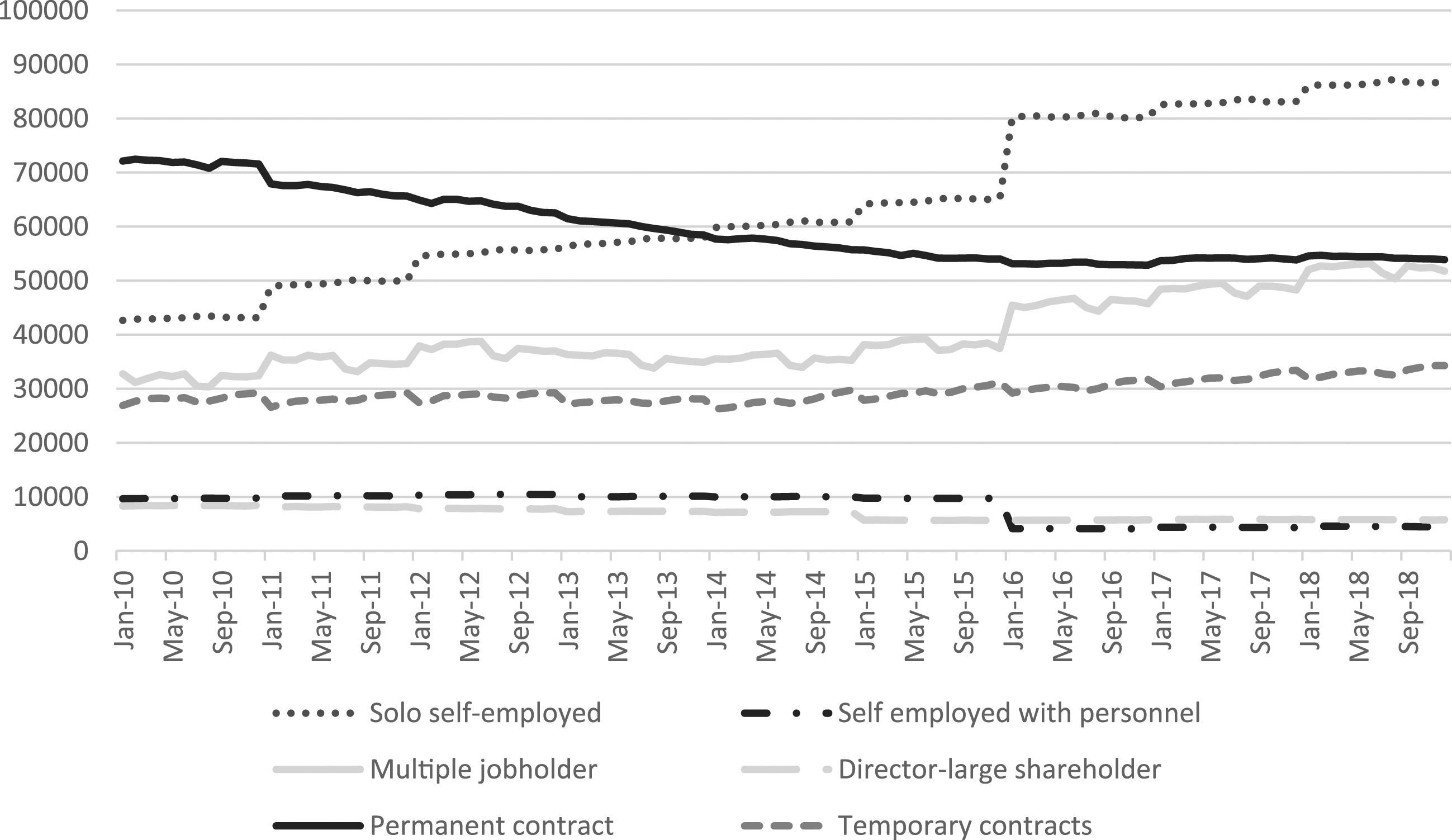
Then we decomposed the developments by subsectors. Very different subsectoral processes underly the overall sectoral developments. Four different types of developments can be distinguished: (A) subsectors in which permanent and temporary contracts have been replaced by solo self-employment and multiple jobholding (‘producers of performing arts’, ‘public relations and communication activities’ and ‘advertising agencies’), (B) declining subsectors characterized by a strong decrease in permanent contracts which are only to a limited extend replaced by flexible employment (‘architects’ and ‘publishing activities’), (C) subsector that have remained stable over the observation period (‘cultural heritage’) and (D) growing subsectors due to an increase in solo self-employment and multiple jobholders (‘industrial design’, ‘motion picture, video and television programme production, sound recording and music publishing activities’, ‘photography’, ‘performing arts’, ‘artistic design’ and ‘support of the performing arts’). The overall flexibilization of the CCI is thus not a simple replacement process of permanent contracts by self-employment, multiple jobholding and temporary contracts. Rather, it is the result of strongly diverging subsectoral developments, both in terms of growth or decline of the number of jobs and in terms of the type of jobs.
Marginal work in the CCI
Marginal work has two dimensions: a low number of hours and low earnings. A comparison between the situation in January 2010 and November 5 2018 shows that the percentage of mini-jobs in the CCI has decreased for employees over the observation period regardless whether they are employed on a permanent contract or a temporary contract. Also, among multiple jobholders, the occurrence of mini-jobs has decreased. However, since the labour market composition of the CCI has changed quite extensively over this same period (see Figure 1), the decrease in mini-jobs could be a compositional effect and does not necessarily point to less marginal work in the CCI. Indeed, since the number and percentage of self-employed increased but there is no information on their hours worked, it could be that the work that was previously being done on a contract with a low number of hours (mini-job) is now performed by self-employed workers.
Turning to marginal work in the CCI in terms of earnings, no less than 50% of CCI workers had marginal earnings in 2010 and that this percentage increased to 53% in 2018. The overall growth of marginal earnings is mainly driven by the growing share of self-employed workers, the category of workers in the CCI with the largest proportion of marginal earnings. Indeed, the CCI is thus a sector where marginal earnings are very widespread, confirming the precarious nature of CCI work.
The analysis of the flexibilization processes in the subsectors of the CCI already showed that the differences between subsectors are substantial. And indeed, the subsectors also vary extensively in the occurrence of marginal earnings. Especially industrial design (58%), photography (68%), performing arts (63%), producers of performing arts (46%), the support of the performing arts (53%) and artistic creation (67%) show high proportions of workers with earnings below 2/3 of the national mean in November 2018. Within other subsectors, such as publishing (24%), cultural heritage (30%) and architecture (29%), this proportion lies much lower. This again argues against considering the CCI as one, relatively homogenous sector.
Collective agreements’ approach to flexibilization and marginalization
Subsectoral collective agreements in the CCI.
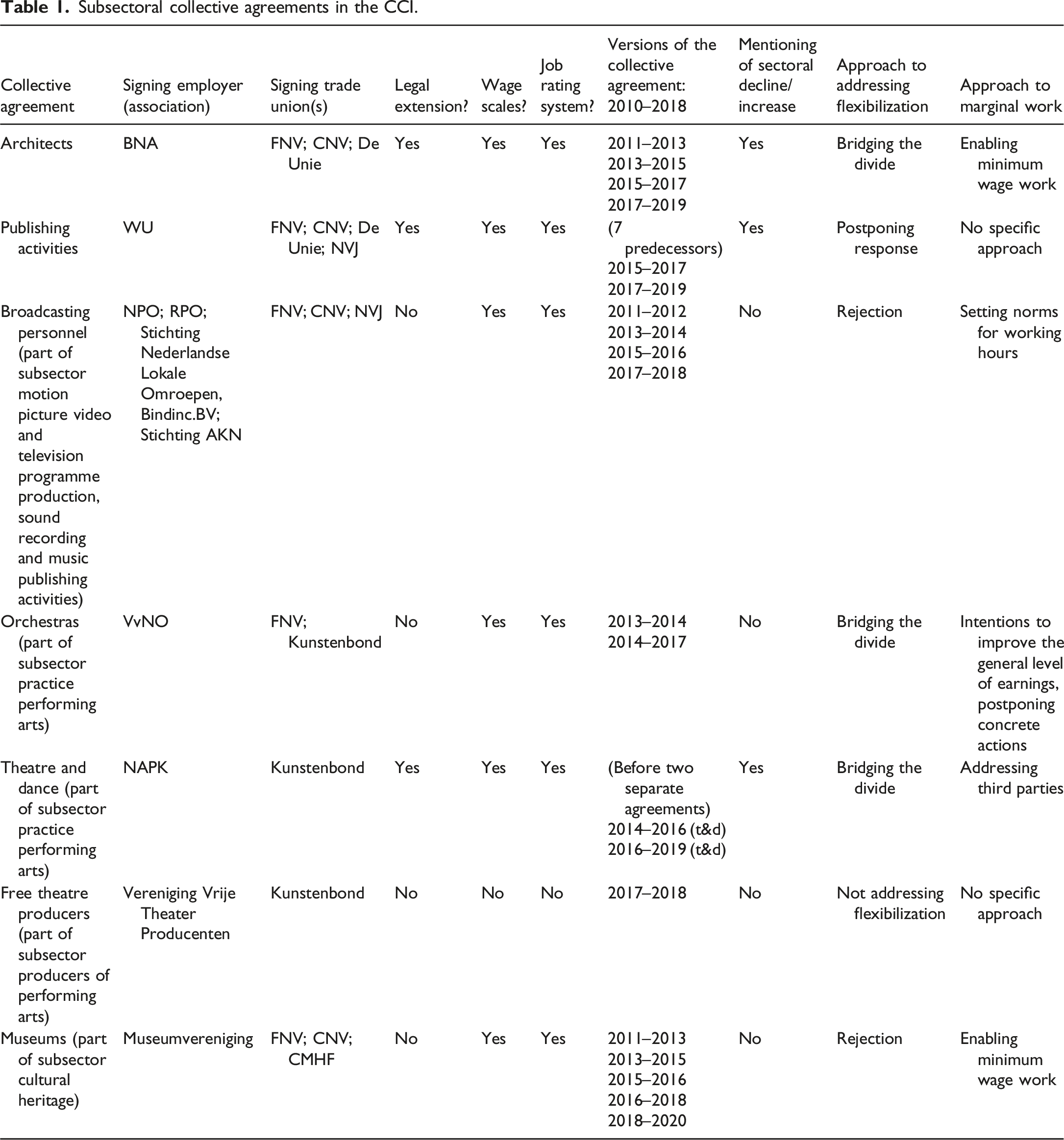
The collective agreements in the CCI show an ample diversity in the way they address labour market developments, labour market flexibilization and marginal work (Table 1). To start with, the two collective agreements that cover subsectors that show an employment decline during the observation period, ‘architecture’ and ‘publishing activities’, both come to acknowledging this development during the observation period. For example, in architecture, the first collective agreement in the covered period (2011–2013) does not yet mention a sectoral decline. However, in the subsequent three collective agreements, the sectoral decline is indeed recognized. Also, the publishing collective agreement of 2015–2017 mentions the sectoral decline and the challenges it poses. The growing subsectors, on the other hand, hardly mention the increasing number of workers in the sector. The only exception is the ‘theatre and dance’ collective agreement, which addresses the overcrowding of the sector with recent graduates, perceived as fueling marginal work, replacement-effects and unemployment. All three collective agreements that problematize decline or growth attempt to influence the process by addressing the causes and/or consequences: the ‘architects’ collective agreement provides employers with the opportunity to refrain from collective wage increases in those cases where this will prevent job losses and consent of employees is given. The ‘publishing activities’ agreement aims to keep the declining sector attractive for young talent by extending work-life balance policies. And the ‘theatre and dance’ agreement tries to reduce the inflow in the sector by addressing third parties, the ministry and educational institutes, informing them of the need to reduce the number of graduates in the field. We are in rough weather and both employers and employees are bothered by it. The sector has been halved in just a couple of years’ time. The economic circumstances are tough and the perspectives are not good. Architecture collective agreement 2013-2015
Almost all collective agreements addressed processes of labour market flexibilization in some way in the observed period. The responses vary but can be divided into three broad categories: ‘bridging the divide’, ‘rejection’ and ‘postponing’ (Table 1). Under ‘bridging the divide’, fall attempts to bring self-employed workers under the sphere of influence of the collective agreement. The ‘rejection’ category aims to limit the incidence of flexible contracts, for example, through clauses that put a cap on the proportion of flexible contracts employers are allowed to use, and the clearest example of ‘postponing’ is the assembling of study groups to come up with answers to labour market flexibilization. Four collective agreements take a bridging the divide approach. In the 2015–2017 version of the architects’ collective agreement, a chapter on the self-employed was added, stating among other things that the remuneration of the self-employed should be equal to the hourly rates of employees. Reasons to do so were to provide room for flexibility and at the same time creating a level playing field and a basis for good ‘clientship’. The competition authorities did however object to this clause; therefore, it was removed from the subsequent agreement (2017–2019), albeit with great reluctance from the social partners involved. Also, the theatre and dance collective agreement of 2016–2019 added a clause on the remuneration of the self-employed stating that it should be the same as the salary of employees doing the same work, topped up with an additional 30%. It however only applies to self-employed replacing employees. Here again the arguments for doing so are the creation of a level playing field and being a decent employer and a decent commissioning company. The orchestra collective agreement takes a slightly different approach as it set up a special agreement for replacements in the standard formation: the ‘replacements in orchestras’ collective agreement. The signing parties acknowledge however that this special collective agreement institutionalizes temporary positions and may negatively affect permanent contracts within orchestras. It is specifically stated that efforts should be made to prevent this from happening.
The Architects Collective agreement 2015-2017 received a lot of attention. It was the first collective agreement containing a chapter on minimum tariffs for contractors, solo self-employed workers and with that the first collective employment and contractor agreement (ceca). The authority for consumers and markets has concluded after consultation with the social partners that this approach is potentially in violation of competition law, resulting in the withdrawal of the ceca for the time being. […] The social partners continue to be in support of a level playing field for all workers.
Architect collective agreement 2017-2019
Three collective agreements reject flexibilization and attempt to limit it. The specific approach varies however. The broadcasting collective agreements take the most direct approach by setting a maximum to the proportion of flexible contracts that can be used by employers. Already the broadcasting collective agreement of 2011–2013 contained regulation on the ideal divide between permanent and flexible positions. There were two options employers could choose from. This was simplified in the 2015–2016 version of the collective agreement that states that the division should be 75% permanent positions versus 25% temporary contracts. This can be rearranged up to a 60-40 divide with consent of the works council. Instead of focussing on flexibilization in general, the libraries collective agreement focuses, throughout the whole observation period, specifically on trying to reduce the replacement of personnel by volunteers. The museum collective agreement for the major part of the observation period did not have any specific clauses addressing flexibilization. In the 2018–2020, however, a clause was added that structural and continuous work is in principle performed by employees.
A variety of different contract types can be found within the museum context. Work is being done by employees, temporary agency workers, solo self-employed workers, volunteers and interns. As a general principle counts that structural and continuous work by default is done by employees.
Museum collective agreement 2018-2020
The publishing collective agreement reflects a vivid discussion and disagreement between trade unions and employers on the topic of labour market flexibilization, leading to a response of postponement. The first joined publishing collective agreement was agreed for the period 2015–2017. Until that time, there were seven different, smaller collective agreements in place. Within this first joined collective agreement, a study concerning the best response to labour market flexibilization was decided upon. In the next collective agreement (2017–2018), this approach is continued with the setup of a study committee with the task to come up with a solution to what good clientship looks like and how to maintain a level playing field. The subsequent discussion is reflected in the collective agreement of 2019–2020 which contains a statement that employers refuse to come to an agreement regarding this topic, whereas trade unions continue to pressure to do so. The intermediate solution is found in a continuation of the study committee.
When it comes down to addressing marginal work in the sector, that is, work that generates too little income to live off because of too few working hours or low wages, none of the collective agreements has a comprehensive, multi-dimensional approach towards its reduction. Nevertheless, many do include clauses that are likely to have an effect on the occurrence of marginal work. First of all, the collective agreements that took a bridging approach to labour market flexibilization by bringing the self-employed workers under its sphere of influence (architects, orchestras and theatre and dance), automatically also affect marginal work in terms of earnings, as they set a baseline for the remuneration of the self-employed. This does however not necessarily mean an effort to reduce marginal work. The architects agreement, as a crisis intervention, between 2013 and 2017, collective agreement included a clause that allowed paying starting architects the minimum wage for a maximum period of 2 years, that is, the work-experience period they have to pass to be able to claim their title, thereby actively enabling low pay. Something similar happens in the museum collective agreement which contains a clause that states that temporary workers that are not eligible to become permanent employees are paid the statutory minimum wage. However, this does go hand in hand with an attempt to reduce flexible work (including temporary work) in the sector. Even though the other collective agreements in the CCI do have wage scales at (or below) the minimum wage level, these wage scales appear to be largely empty as the respective job rating systems contain no positions corresponding to these wage scales (or only for special needs groups on the labour market). Also, there are three collective agreements that attempt to reduce marginal work, albeit in different ways. The broadcasting collective agreement does it through working hours by stating that in principle contracts are for 5 days a week with a possible reduction of 1 day on request of the employee. Indeed, the analysis in PART 1 showed that marginal work in the subsector broadcasting is part of is scarce. As mentioned, the theatre and dance collective agreement (2014–2016) explicitly acknowledged that the large inflow of recent graduates puts pressure on earnings. It aimed to solve this by addressing third parties: starting a conversation with the schools and responsible ministry on this problem. Finally, the successive orchestra collective agreements mentioned a need and wish to increase the general level of remuneration in the sector. However, no concrete actions were agreed upon. Rather, the bargaining parties settled to study the topic and agreed on a best effort obligation to obtain the necessary means. They also indicated that the dependency on external funding (e.g. subsidies) seriously hampers the ability to act upon the wage-related problems in the subsector.
Discussion and conclusions
Although we often speak of the CCI as a homogenously flexibilized and marginalized sector, in fact the sector is far from uniform. Taken as a whole, the sector has been flexibilizing rapidly over the last decade in the Netherlands and whereas the workers with a permanent contract constituted the largest group of workers at the beginning of 2010, by the end of 2018 the largest group were the self-employed. The dominance of self-employment is also characteristic of the CCI in other countries such as the United States (e.g. Woroncowicz, 2015), the United Kingdom (Easton and Beckett, 2021) as well as Italy and Germany (Borghi et al., 2018). Flexibilization in the form of a direct substitution between permanent employment and self-employment only occurred in three out of 12 subsectors in the Netherlands. Another important driver of the overall trend was the decline of some subsectors at the cost of workers on a permanent contract, while at the same time other subsectors were growing due to an inflow of solo self-employed workers. The flexibilization of the CCI over the last decade is thus as much a story of growth and decline of subsectors as it is of replacement of permanent contracts by flexible ones. The CCI is also strongly characterized by marginal work, in particular because of the very high percentage (above 50%) of workers with low earnings, something that has been pointed out as a general characteristic of the sector regardless the national context (e.g. Alacovska and Bille, 2021; De Peuter, 2011). But here again the variation between subsectors is enormous in the Netherlands, ranging from just over 20% to just below 70%, reflecting similar variety found in the United Kingdom (Comunian et al., 2011).
In half of the CCI subsectors some form of collectively bargained response to the ongoing flexibilization and marginalization has emerged. This first of all shows that creative workers do indeed not only care about expressing their creativity but also about their material working and living conditions. In most cases so do employers. A range of responses emerged from the analysis of the collective agreements: a bridging attempt, rejection and addressing third parties. These responses are in line with the literature (Heery and Abbott, 2000; Penninx and Roosblad, 2002). A ‘postponing response’ came out as an additional category. In cases where social partners cannot agree on the way forward, a postponing response, in the form study groups, was decided upon. The analyses made clear that an active response towards labour market flexibilization, by either bridging, rejection or addressing third parties, was only possible where and when social partners aligned their interests.
That being said, the bridging the divide approaches that some collective agreements in the CCI have developed are among the most innovative ones in the Netherlands. They not only bridge the divide between insider and outsider employees, but also attempt to draw in the self-employed. In doing so, they bridge (to a certain extent) the divide between self-employed and employees, counteracting dualization tendencies (Doellgast et al., 2018). Collective agreements in the CCI were the first to experiment with this approach in the Netherlands, pushing the boundaries of legal possibilities (Grosheide and Barenberg, 2015), something currently hotly debated at the European level where EU competition law limits the possibilities to cover self-employed by collective bargaining (Countouris et al., 2021; Daskolova, 2018). The approaches of these CCI collective agreements can be seen as forerunners in how industrial relations can act in the context of labour market flexibilization and a high incidence of non-standard workers, and where individualization seems to prevail. At the same time, the fact that only two of the twelve subsectors of the CCI are completely covered by collective agreements, four subsectors are only partially covered by collective agreements (including one agreement containing only one clause extending flexibility) and six subsectors are not covered at all shows that there is still a long way to go in bringing flexibilization and marginalization in the CCI under control in the Netherlands.
This study has some limitations. Due to its descriptive nature, it is impossible to say anything about causal relations and mechanisms. We were able to draw a detailed picture on the developments in the CCI, both in terms of labour market trends and contents of collective agreements. We do however not explain the underlying mechanisms of why flexibilization shows such varying patterns in the different subsectors of the CCI. Moreover, we do not address the processes that lead to the contents of the collective agreement analysed or the effects they have on labour market developments. More detailed studies are needed to provide insights into these questions.
Footnotes
Declaration of conflicting interests
The author(s) declared the following potential conflicts of interest with respect to the research, authorship, and/or publication of this article: This is to confirm that Associate Professor Anna Ilsøe and Trine P. Larsen, FAOS, University of Copenhagen as a third party and in her capacity as co-editor on the special issue for EJIR has been authorized on behalf of the authors to submit this manuscript to EJIR. There is no conflicting interests and payment involved with granting Anna Ilsøe Trine P. Larsen the permission to submit our paper on our behalf.
Funding
The author(s) disclosed receipt of the following financial support for the research, authorship, and/or publication of this article: This research is funded by Instituut Gak, the Netherlands
