




Abstract
This scoping review identified and synthesized the theoretical statements on life projects contained in articles indexed in databases of psychology and related fields. Six online databases were searched for articles using the term life project in their titles, abstracts, or keywords. Only articles that contained theoretical statements on life projects were included, yielding 93 manuscripts. A total of 15 theoretical approaches from diverse fields were identified. A thematic analysis with the articles’ theoretical statements resulted in six themes describing different properties and correlates of life projects. Another thematic analysis, based on the articles’ explicit life project definitions, resulted in four defining features. The findings reveal that the theoretical approaches and life project definitions conflict with each other. However, the theoretical dimensions and defining features enabled the identification of commonalities across the theories. Future studies need to integrate these distinct theoretical dimensions and defining features to form a comprehensive theory of the life project.
The term life project (LP) has become popular over the years to describe intentional structures and actions taken by people to accomplish meaningful outcomes in the future. Its increased popularity might be credited to intense social transformations that have occurred globally in the last decades (Coscioni, 2021). These social transformations are often attributed to postmodernity, a historical time marked by increasing uncertainty and unpredictability around different aspects of life, including the future (Savickas et al., 2009). Uncertainty and unpredictability regarding the future has implications for how people organize their personal experiences. As a result, authors such as Giddens (1991) acknowledge future life-planning as an important tool to foster a sense of coherence and unity in life.
People’s need to organize their future stories has prompted the development of theories regarding this aspect of life. Indeed, in the last decades, the scientific literature has witnessed the emergence of several terms referring to people’s psychological future (Seginer, 2009). The proliferation of terms in the field has reached a point where, on the one hand, different terms have defined the same phenomenon and, on the other, a single term has been used to describe distinct constructs (Coscioni et al., 2020). According to Coscioni et al. (2020), one of the most controversial concepts in the field is the LP. Despite differences in definitions, the term is commonly acknowledged as an important component of motivation, action, and personality. Given their central role in human psychological functioning, LPs have been the subject of study across diverse fields, constituting a transdisciplinary concept. While multiple theoretical approaches have elucidated various facets of LPs, disagreements regarding their definition and primary dimensions have led to conflicting conclusions (Coscioni, 2021).
One literature review assessed the LP definitions contained in 22 empirical studies with adolescents published between 2000 and 2012 (Dellazzana-Zanon & Freitas, 2015). The review was published in Portuguese but included search terms in both Portuguese and English. The Portuguese search terms were projeto de vida and projeto vital, which translate into English as “life project” and “vital project,” respectively. The English search terms were life purpose and purpose in life. The reason for such a mismatch across languages is due to the fact that the term purpose has been mistranslated into Brazilian Portuguese as a synonym for LP (Coscioni, 2021). This mistranslation serves as an example of the controversies surrounding the concept of LP in the literature.
Despite the discrepancies, the literature review by Dellazzana-Zanon and Freitas (2015) systematically analyzed the LP definitions found in the corpus, describing four common features across the articles included. First, an LP is conceived as a personal construct with its genesis in adolescence; second, an LP is intrinsically related to meaning in life; third, an LP is influenced by the cultural context; and, fourth, an LP is consequential for the world beyond the self. Dellazzana-Zanon and Freitas (2015) criticized the fourth feature, arguing that an LP may not necessarily involve other people. The emergence of this category could be attributed to the inclusion of purpose in life in the English search terms. Damon (2008) defined purpose as “a stable and generalized intention to accomplish something that is at the same time meaningful to the self and consequential for the world beyond the self” (p. 33). The fourth feature is evidently connected to the last words of Damon’s definition.
In the literature review by Dellazzana-Zanon and Freitas (2015), 10 out of the 14 included articles in Portuguese did not provide an explicit definition of LP. This finding reinforces the fact that the term LP is often used without a clear definition (Venturini & Piccinini, 2014). Furthermore, Neiva-Silva (2003) highlighted that the term LP has been frequently employed interchangeably with other concepts related to people’s psychological future, such as the future time perspective, future expectations, and aspirations.
The inaccurate use of the term LP is not limited to Portuguese, but extends to other languages. For instance, the Life Project Reflexivity Scale (Di Fabio et al., 2019) was created in Italy and is presented as a tool for career counseling. However, no explicit LP definition is provided. Additionally, numerous studies from various fields can be found where the term LP is employed without an explicit definition (e.g., Dantas, 2017; Lens et al., 2012; Savickas et al., 2009). Therefore, further studies are needed to systematically assess the distinct theories of LPs, with the aim of clarifying the similarities and controversies across them. Such research endeavors will contribute to a better understanding of the nature of LPs, as well as their distinction from other related concepts within the field.
This article reports on a scoping review that aimed to identify and synthesize the theoretical statements on LPs contained in articles indexed in databases of psychology and related fields. Three types of theoretical features were assessed. First, the existing theoretical approaches employed to support the concept of LP were mapped. Second, theoretical dimensions were created to describe the properties and correlates of LPs. The theoretical dimensions resulted from a thematic analysis that systematically assessed all theoretical statements on LPs found within the corpus. Third, the defining features that explicitly described the concept of LP were identified. These defining features resulted from another thematic analysis that assessed the factors comprising the explicit LP definitions within the corpus.
Method
This article consists of a scoping review, which is a knowledge-synthesis method that is used to map the literature in a specific field (Arksey & O’Malley, 2005). In contrast to a systematic review, a scoping review often does not include hypotheses. Instead, its main goal is to identify the key concepts, definitions, and methodological and theoretical features of a certain topic or field. It typically integrates sources of different types, such as reviews, theoretical studies, and empirical studies with different methods. Hence, scoping reviews usually do not include meta-analyses; rather, they serve as precursors to systematic reviews and meta-analyses (Munn et al., 2018). Given the purpose of this study to identify and synthesize theoretical statements on LPs, a scoping review is recommended over the traditional approaches of a systematic review.
Research strategy and article selection
Six online databases were searched: ProQuest (ERIC [Education Resources Information Center], Sociological Abstracts, and Social Services Abstracts), PsycNET (PsycINFO and PsycARTICLES), and PubMed. These databases index scientific literature on education, sociology, and social services; psychology and psychiatry; and health and medical sciences, respectively. The searches were restricted to the fields of title, abstract, and keywords, using the following search terms: “life project” OR “life projects.” Filters were applied to limit the search results to articles, and no time or language filters were used. The preliminary findings indicated a high prevalence of publications by Brazilian researchers. Consequently, the searches were expanded to three online Latin American databases: LILACS (Latin American and Caribbean Health Sciences Literature), SciELO (Scientific Electronic Library Online), and PePSIC (Periódicos Eletrônicos de Psicologia). In these databases, the following Portuguese search terms were employed: “projeto de vida” OR “projetos de vida” OR “projeto vital” OR “projetos vitais.”
Articles were included if they contained theoretical statements on LPs. A theoretical statement refers to an excerpt that defines a concept (term definition), claims the existence of the phenomenon associated with a concept (existence statement), or describes a relationship between concepts (relational statement; Reynolds, 2016). An example of a term definition found within the corpus is: “[a] life project is an intention to transform one’s daily life, composed of a representation toward such transformation” (Ferreira et al., 2010, p. 167; our translation). An example of an existence statement is: “the term ‘project’ primarily refers to an action undertaken within a time perspective” (Almeida & Magalhães, 2011, p. 207; our translation). Lastly, an example of a relational statement is: “there is a connection between life projects and personal identity” (Kudlowiez & Kafrouni, 2014, p. 231; our translation). Moreover, articles were excluded if the concept of LP was used in a context unrelated to psychology, such as a few French nursing and medical articles employing the term LP to refer to a protocol for hospitalized patients.
Study eligibility screening
Figure 1 provides a summary of the eligibility study, which was employed following the PRISMA (Preferred Reporting Items for Systematic Reviews and Meta-Analyses) extension for scoping reviews (Tricco et al., 2018). Two independent reviewers (doctoral students) searched the six online databases on July 18, 2019, retrieving 1,563 items. Duplicates, non-article items, and articles without available abstracts were removed. Altogether, 1,078 articles’ titles, abstracts, and keywords were screened. Out of this total, only 651 articles employed the term LP, of which six were missing their full text. Articles that did not employ the term LP often referred to research projects with titles ending in the word “life,” such as “family life project” and “tree of life project.” After applying exclusion and inclusion criteria, 93 articles with theoretical statements on LPs in a context related to psychology were included. Any discrepancies among the reviewers were resolved through consensus discussions involving a third reviewer (an expert in the field).
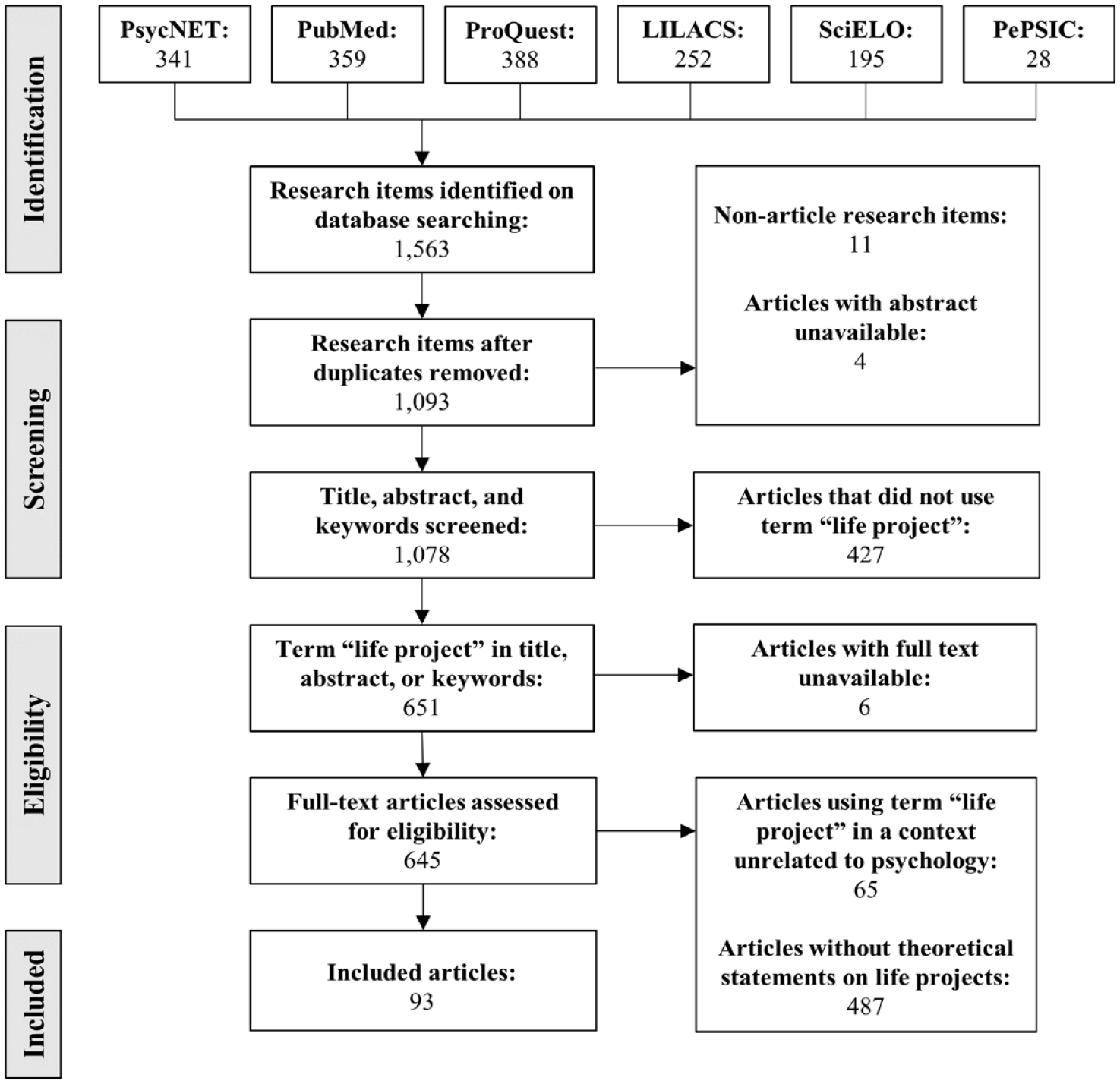
PRISMA flow diagram.
Data extraction and analyses
Two independent raters (the reviewers from the eligibility screening) assessed the 93 full-text articles and extracted data concerning publication language and date, authors’ location (the country where their universities were located), and theoretical statements on LPs. Differences in the extraction among the raters were rare and resolved through discussions involving a third rater (the expert involved in the previous stage). The excerpts underwent systematic analysis to identify three theoretical features: theoretical approaches, theoretical dimensions, and defining features.
Theoretical approaches
The references cited in the theoretical statements were systematically assessed. The raters initially coded them, and any divergences were discussed with the third rater. One of the raters reviewed all of the coded references to identify theoretical approaches to LPs. Their main exponents and contributions were summarized and discussed with the third rater. Subsequently, the approaches were categorized based on their respective fields of knowledge.
Theoretical dimensions
A thematic analysis (Braun & Clarke, 2006) was conducted to categorize the coded theoretical statements. Using NVivo 12 software, one of the raters grouped the theoretical statements by semantic similarity. Specifically, excerpts were grouped together when they contained theoretical statements describing similar properties and correlates. Themes were created a posteriori to describe the coded properties and correlates. The expert who participated in the earlier stages of the review supervised the creation of the themes. The resulting themes were then described and explained to a second rater (a master’s student), who coded the excerpts into the existing thematic categories. The reliability between the raters was assessed using the kappa coefficient, and the results indicated excellent agreement (0.80 < κ < 0.90) based on Cohen’s (1960) criteria. The resulting themes represent the theoretical dimensions assessed in this review.
Defining features
The explicit LP definitions were also assessed. Initially, the two raters coded them independently, with differences across them being discussed with the third rater. Subsequently, they were systematically assessed using the aforementioned thematic analysis procedures. The kappa coefficients demonstrated good to excellent reliability between the raters (0.66
The three types of theoretical features (theoretical approaches, theoretical dimensions, and defining features) represent distinct yet interconnected characteristics within the corpus. A theoretical approach refers to a specific body of knowledge that makes statements on LPs based on particular theoretical lenses. The resulting categories describe the existing approaches to the concept of LP found in the current scientific literature. The two other theoretical features are categories derived from the systematic analyses conducted within the corpus. The theoretical dimensions resulted from the first thematic analysis, which assessed all of the theoretical statements to identify the common properties and correlates associated with LPs across different theories. Conversely, the defining features resulted from the second thematic analysis, which focused on evaluating the explicit LP definitions to identify the key factors that define an LP. Consequently, the theoretical dimensions and defining features facilitated the identification of commonalities across different theories.
Results
Appendix 1 provides the data regarding publication date, language, and authors’ location. The included articles were published from 1978 to 2019, and approximately two-thirds (n = 64, 68.8%) were published from 2010 to 2019. Most of the articles were published in Portuguese (n = 52, 55.9%), followed by English (n = 22, 23.7%) and Spanish (n = 16, 17.2%). Articles in French (n = 4, 4.3%), Italian (n = 2, 2.2%), and Russian (n = 1, 1.1%) were less common. Latin America (n = 69, 74.2%) was the most common location, with Brazil (n = 53, 57.0%) being the predominant country. Europe (n = 18, 19.4%) and anglophone America (the USA and Canada; n = 12, 12.9%) also had a notable presence. Articles from Africa (n = 5, 5.4%) and Oceania (n = 1, 1.1%) were rare, and no Asian articles were found. Regarding the study type, 72 articles (77.4%) were empirical research studies, 19 (20.4%) were theoretical studies or reviews, one (1.1%) reported a documentary research study, and one (1.1%) was a practical experience report.
Theoretical approaches
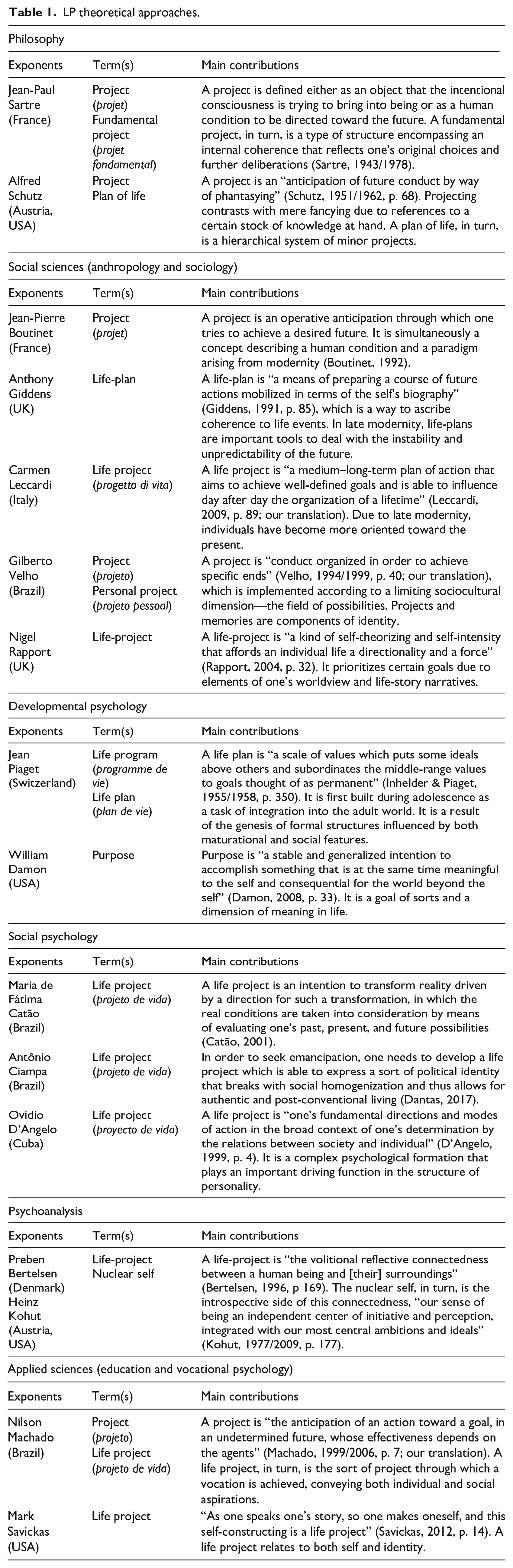
In total, 15 theoretical approaches to LPs were identified in six fields of knowledge: philosophy, social sciences (anthropology and sociology), developmental psychology, social psychology, psychoanalysis, and applied sciences (education and vocational psychology). Table 1 presents the main exponents and contributions of these approaches. The exponents originate from Europe, Latin America, and the USA, and only seven originally employed the term life project. The others referred to terms such as fundamental project, plan of life, life plan, personal project, life program, purpose, or the general notion of project. Therefore, most studies were grounded in theoretical approaches that did not originally use the term LP. Despite differences in terminology, important assumptions stated by these authors may ground the concept here entitled LP. The main exponents cited in each selected article are presented in Appendix 1. Approximately one-third of the articles (n = 33, 35.5%) did not reference any theoretical approach to LPs. The most frequently cited exponents were Velho (n = 17, 18.3%), Catão (n = 10, 10.8%), Damon (n = 10, 10.8%), Schutz (n = 9, 9.7%), Boutinet (n = 7, 7.5%), and D’Angelo (n = 7, 7.5%).
LP theoretical approaches.
Theoretical dimensions
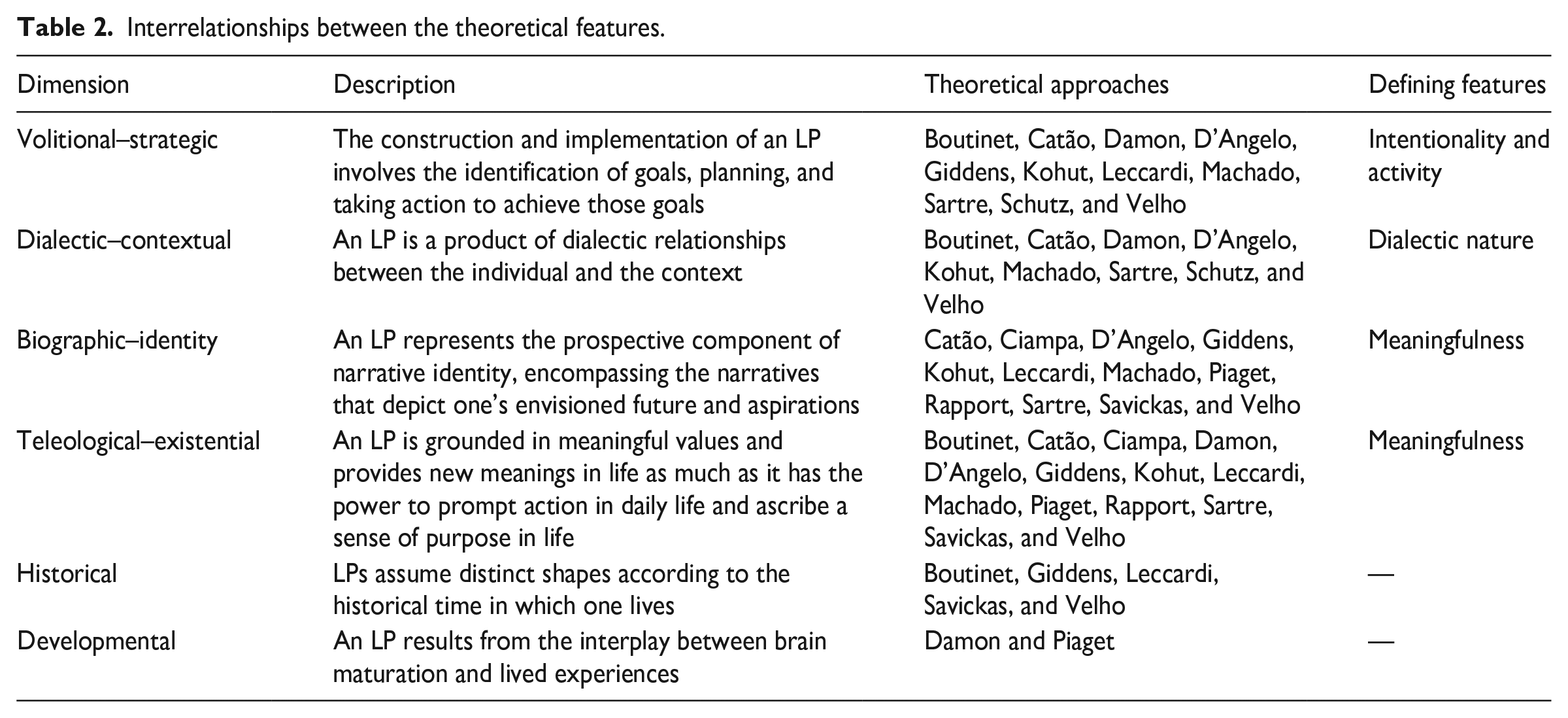
A total of six themes were created based on the coding of 273 excerpts. These themes represent distinct theoretical dimensions and are entitled: volitional–strategic (expressed in 74.2% of the articles, n = 69), dialectic–contextual (expressed in 67.7% of the articles, n = 63), biographic–identity (expressed in 58.1% of the articles, n = 54), teleological–existential (expressed in 57.0% of the articles, n = 53), historical (expressed in 26.9% of the articles, n = 25), and developmental (expressed in 26.9% of the articles, n = 25). Table 2 presents a brief description of each dimension as well as their relationships with the theoretical approaches.
Interrelationships between the theoretical features.
Volitional–strategic dimension
The volitional–strategic dimension emphasizes that the construction and implementation of LPs involves the identification of goals, planning, and taking action to achieve those goals. This dimension establishes a connection between LPs and other concepts in action theories, such as intention, anticipation, and planning. Several articles defined an LP as an intention with specific features. For example, based on Catão (2001), Kudlowiez and Kafrouni (2014) stated that an LP entails “an intention to transform reality, driven by a representation of the direction of such transformation” (p. 236; our translation). Similarly, based on Damon (2008), Klein and Arantes (2016) argued that an LP “reveals the intention of accomplishing something whose meaning transcends the limits of the self and is also related to the world” (p. 136).
Many articles also acknowledged the general concept of a project as an anticipation of future actions. For instance, Almeida and Magalhães (2011) stated that “the term ‘project’ primarily refers to an action undertaken within a time perspective, anticipating something to be achieved in the future” (p. 207; our translation). This statement is connected to various approaches to the general notion of projects. According to Boutinet (1992), a lack of commitment differentiates formal operative anticipations (i.e., wishes) from operational anticipations (i.e., goals, ends, plans, and projects). Thus, a project is not merely a desire but also a commitment to a future outcome. Similarly, Schutz (1951/1962) distinguished projecting from mere fancying based on the concept of voluntative fiat, borrowed from William James. This concept refers to the transformation of a future state of affairs into an aim, represented by “the inner command ‘Let us start!’” (Schutz, 1951/1962, p. 67). In other words, the voluntative fiat is the means by which an intention takes a concrete course of action. Similarly, Machado (1999/2006) defined a project as the anticipation of an action driven by a specific goal. Likewise, Sartre (1943/1978) conceptualized a project as a component of human action. Finally, Velho (1994/1999) described a project as conduct aimed at achieving specific ends. Therefore, the general concept of a project is often introduced to underscore that an LP, like any other type of project, is not just a mere intention but one that is necessarily enacted.
The emphasis on action is also recognized in other theoretical approaches to the specific concept of an LP and life plan. Drawing from Kohut (1977/2009), existential psychology, and action theories, Bertelsen (1996) created a theoretical framework that integrates the concepts of activity, LP, and self. An activity represents the “active connection between an organism and its surroundings” (p. 169). The other two concepts mean a volitional connectedness either with oneself (the self) or with one’s surroundings (the LP). Leccardi (2009) defined an LP as a plan of action. D’Angelo (1999) described an LP as fundamental directions and modes of action. Giddens (1991) defined a life-plan as a means of preparing a course of future actions. Therefore, the volitional–strategic dimension finds consensus across approaches and primarily portrays an LP as an integration of internal processes (cognition, motivation, and volition) and actions.
Dialectic–contextual dimension
The dialectic–contextual dimension focuses on the influences of the social–cultural context on LPs. Although an LP is defined as a personal construct, it is constantly affected by the context in which one lives. As discussed by Almeida and Magalhães (2011):
Even though the individual and those around them may believe that one can choose freely and that the project would naturally be conceived as individual, the project’s subject is inserted into a larger context and is influenced by the various spheres present in it. Thus, the social environment, family, and factors such as class, generation, gender, among others, play a fundamental role in this process. (p. 211; our translation)
This dimension also emphasizes the active role of the individual when interacting with the context. LPs are constructed and implemented through dialectical relationships with the environment. Therefore, an LP is built at the interface between subjectivity and objectivity, constrained yet not entirely determined by the individual’s access to resources, social values, and interpersonal relationships. As posited by Ferreira et al. (2010):
The formulation of LPs is not restricted to the individual’s objective conditions. Rather, it is promoted through the dialectic between subjectivity and objectivity. It is through the analysis of the individual’s life experiences that they may evaluate their possibilities and impossibilities of transformation in their life story. (p. 167, our translation)
The dialectic–contextual dimension is addressed by several theoretical approaches. Sartre (1957/1963) defined a project as a transition between two objective situations. While the second situation represents the intended goal, the first refers to the given—that is, the concrete objective situation at the moment when the project is assumed. Velho (1994/1999) emphasized the relationships between a project and the field of possibilities, which he defined as a “sociocultural dimension, the space for formulation and implementation of projects” (p. 40; our translation). Catão (2001) discussed the interplay between the individual and the context, highlighting that social representations serve both as means and ends of LPs. As an end, LPs can be objects of social representations, and thus social knowledge influences the construction of LPs. Bertelsen (1996), Boutinet (1992), Damon (2008), D’Angelo (1999), Machado (1999/2006), and Schutz (1951/1962) also emphasized the dialectic–contextual dimension by describing the influence of social values or defining an LP as a connection between the individual and the context. Therefore, the dialectic–contextual is largely consensual and reinforces an LP as a product of dialectic relationships between the individual and the context.
Biographic–identity dimension
The biographic–identity dimension emphasizes the influence of life experiences on LPs. Past lived experiences influence how individuals attribute meaning to their lives and envision the future. Thus, the past plays a crucial role in the construction and implementation of LPs. As discussed by Klein and Arantes (2016): “Even though projects are oriented toward the future, they are thought of and formulated in the present time, based on lived experiences and opportunities that are signified in the present” (p. 140; our translation). A few theoretical approaches focus on the role of past experiences in the construction of LPs. For instance, Sartre (1957/1963) stated that the given must also include one’s “childhood,” referring to the important life experiences that ascribe a character to an individual. Likewise, both Catão (2001) and Velho (1994/1999) emphasized that individuals construct an LP considering both the current situation and past experiences.
This dimension also highlights that an LP embodies the prospective component of narrative identity, encompassing the narratives that depict one’s intended future and aspirations. In turn, life trajectories embody the retrospective component of narrative identity, reflecting one’s autobiographical memories. As discussed by Kudlowiez and Kafrouni (2014):
There is a connection between LPs and personal identity, as the former represents the intersection between the psychological aspect of people’s lives and the influences they receive from their social environment. . . . LPs are constituted as a result of the dialectical tension between coexisting internal and external realities, which are experienced, thought about, and reflected upon. (p. 231)
Several approaches regard an LP as a component of personality. LPs (or related terms) have been associated with concepts such as self (Bertelsen, 1996; Savickas, 2012), personality (D’Angelo, 1986; Inhelder & Piaget, 1955/1958), identity (Catão, 2001; D’Angelo, 2000; Dantas, 2017; Giddens, 1991; Leccardi, 2009; Savickas, 2012; Velho, 1994/1999), narrative (Rapport, 2004), and trajectory (Machado, 1999/2006). Thus, the biographic–identity dimension is largely consensual. Although based on different philosophical assumptions, these approaches often describe the significant role of LPs in providing a sense of unity and coherence in life.
Teleological–existential dimension
The teleological–existential dimension describes an LP as the expression of the human condition to project itself toward the future. This human condition manifests as a teleological trend, driving individuals to seek a purpose in life. For instance, based on Machado (1999/2006) and Boutinet (1992), Pereira and Stengel (2015) stated: “It is inherent to human beings to make plans, just as having their life as a project; in other words, the most characteristic trait of human activity is the ability to create projects” (p. 585; our translation). This perspective is heavily associated with Sartre (1943/1978), who asserted that human consciousness is constantly driven toward the future.
This dimension also entails that an LP is grounded in meaningful values and provides new meanings in life. Thus, it has the power to prompt action in daily life to ascribe a sense of purpose that organizes one’s personal experiences. For instance, Palomino et al. (1991) stated:
the meaning in life actively and consciously guides the development of the LP. This directly affects the preservation of that meaning, as one progressively finds justification for one’s existence by pursuing one’s project. This drive will impel one to continue setting goals in order to achieve self-fulfillment. (p. 75; our translation)
The idea of an LP as a guiding compass in life is widely accepted across theories. Sartre (1943/1978) voiced that human beings define themselves through their projects, employing the term fundamental project to describe an internal structure encompassing one’s original choices and subsequent deliberations. Machado (1999/2006) stated that individuals are constantly driven toward the future to shape their lives as projects. Rapport (2004) defined an LP as self-theorizing that emphasizes certain goals above others, prompting a direction in life. Bertelsen (1996), Catão (2001), Damon (2008), D’Angelo (1999), Giddens (1991), Inhelder and Piaget (1955/1958), Leccardi (2009), Savickas (2012), and Velho (1994/1999) have similarly arrived at this conclusion. Therefore, the description of an LP as a meaningful construction is largely accepted.
Lastly, this dimension also underscores the significance of LPs as a means to achieve authenticity and emancipation. This idea is based on the work of Ciampa (1987/2009), who proposed a paradox in consumerism: despite individuals’ consumption in the pursuit of originality, they often find themselves succumbing to social homogenization that suppresses their authentic selves. Dantas (2017) further elaborated on this idea and argued that attaining a post-conventional and authentic self is possible only through the cultivation of LPs that are deeply rooted in genuinely personal values. As discussed by Dantas and Ciampa (2014):
Individuals who do not develop an LP end up living in a heteronomous manner. External conditions exert a significant influence on their life courses. When individuals become more aware of their LPs (which have, at least partially, an authentic nature), they cease to automatically reproduce what identity policies impose as “necessary” and begin to experience a certain sense of autonomy. (p. 150; our translation)
Historical dimension
The historical dimension focuses on the influence of historical time on LPs. An LP is thus seen as the product of historical changes associated with modernity and enlightenment. This idea is frequently associated with Velho (1994/1999) and, especially, Boutinet (1992), who asserted that the incorporation of the concept of a project into various aspects of daily life stems from the operative time perspective that emerged in modernity. In premodern societies, the future was perceived as a mere repetition of events that had occurred in previous generations. Modernity shifted the perception of the future, making it dependent on the individual and no longer controlled by fate. As affirmed by Almeida and Magalhães (2011):
The influence of the future on individuals’ lives became relevant in modernity. Concerns about prospective time and the anticipation of events are characteristics of societies that emerged in metropolises in the late 19th century. Prior to that, societies described by Boutinet (2002) as “without-project” prevailed. In these societies, individuals were not strongly connected to time, especially future time, but rather to collective coexistence and the present moment. (p. 207; our translation)
Furthermore, this dimension asserts that, with the onset of postmodernity, LPs have become more flexible, reflexive, and oriented to the short term in order to navigate the uncertainty and constant changes in the contemporary era. This notion is predominantly supported by the works of Giddens (1991), Leccardi (2009), and Savickas (2012), who posited that while modernity shifted individuals’ time orientation from the present to the future, postmodernity has redirected it to the present. The focus on the present serves as a coping mechanism in response to the uncertainty surrounding the future. As argued by D’Avila et al. (2011):
Contemporaneity can be characterized as a moment of extreme complexity and dynamism, as a world of possibilities, diversities, options, and choices constantly presents itself to the individual. Therefore, thinking and planning about individual futures (i.e., LPs) becomes essential. (p. 351; our translation)
Developmental dimension
The developmental dimension emphasizes that the genesis of LPs takes place in adolescence due to maturational and social processes. Generally, constructing an LP is seen as a developmental task that prepares adolescents for their transition into adulthood. As posited by Marcelino et al. (2009):
Adolescence is a period in which choices are made and projects begin to be built . . . . Within these projects lie the adolescent’s vision of themselves, their qualities, and what they aspire to achieve . . . . The construction of an LP is a process of personal and social development. The adolescent is ready to embark on this construction after being able to form their identity, share it with their group, and communicate dreams, desires, plans, and goals. It is at this moment that they can enter a new stage of life. (p. 545; our translation)
This idea has been associated with Damon (2008) and, particularly, Inhelder and Piaget (1955/1958), who stressed that a life program is an abstract structure that depends on the genesis of hypothetical–deductive thinking. On the one hand, the maturation of the nervous system enables the development of hypothetical–deductive thinking, which supports the planning skills necessary for projecting into the future. On the other, adolescents are encouraged to make choices about their future, which involves tasks that promote maturation and the development of formal structures. As a result, an LP is seen as the result of the interplay between brain maturation and lived experiences.
Definitions and defining features
A total of 66 explicit definitions were identified in 57 articles (61.3%, listed in Appendix 1). More than a third of the corpus (n = 36, 38.7%) did not provide any explicit definition. The most frequent definition was Damon’s (2008) conception of purpose, used in seven articles (7.5%) by researchers from Brazil. As mentioned earlier, Damon’s definition of purpose has been translated into Brazilian Portuguese as projeto vital (“vital project”) or projeto de vida (“life project”). Thus, in Brazil, purpose and LP have often been used as synonyms.
Three general defining features were proposed based on the 66 LP definitions: intentionality, activity, and meaningfulness. The first describes an LP as an intentional state or representation toward the future, such as goals, intentions, ends, aspirations, choices, plans, and steps, among others. Some definitions did not explicitly designate an LP as an intentional state or representation but emphasized its aim to attain states or representations akin to that. The second feature defines an LP as a driver of daily actions. Some works have defined it as future-oriented conduct. The last feature entails an LP as either shaped or guided by meaningful conceptions, values, or beliefs. Some definitions even described an LP as a structure or set of axes guiding the self. As seen in Table 2, the first two defining features are predominantly associated with the volitional–strategic dimension, which acknowledges the interrelation of intentions and actions during the development of LPs. The third feature is connected to both the teleological–existential and biographic–identity dimensions. The former emphasizes how LPs are constructed based on meaningful values and concepts. The latter, on the other hand, defines an LP as a component of narrative identity that provides a sense of coherence and unity in life.
Intentionality emerged as the most prevalent defining feature (n = 65, 98.5%), 1 with only one definition lacking this aspect. This definition acknowledged only the LP’s meaningfulness and described it as a disposition of personal concepts—that is, “each person’s development, refinement, and disposal of specific concepts (e.g., manliness, Americanism) from a range of culturally established alternatives” (Mick & Buhl, 1992, p. 318). Approximately half of the definitions (n = 30, 45.5%) focused solely on intentionality. These definitions reduced an LP to a cognitive representation of intended future states of affairs—that is, “the set of goals one sets for life” (Zordan & Wagner, 2009, p. 92; our translation). Some purely intentional definitions also portrayed an LP as an intention to transform reality—that is, “an intention to transform one’s daily life, composed of a representation toward such transformation” (Ferreira et al., 2010, p. 167; our translation).
Approximately half (n = 35, 53.0%) of the definitions established connections between intentionality and the other two defining features. The intentional–active definitions (n = 16, 24.2%) considered an LP as an action, a movement, or a representation encompassing both intentions and actions. For instance, one may refer to Velho’s (1994/1999) definition of project—that is, “conduct organized in order to achieve specific ends” (p. 40; our translation). The intentional–meaningful definitions (n = 12, 18.2%) embody ideas of an LP as a representation of meaningful future states of affairs, such as Damon’s (2008) definition of purpose. Only seven definitions (10.6%) included all three defining features but they differ on the ontological category to which an LP belongs. They described an LP as directions and modes of action (D’Angelo, 1999), a connectedness with one’s surroundings (Bertelsen, 1996), areas of investment of time and energy (Ruth et al., 1996), a set of goals (Gobbo et al., 2019), an envisaged existence (Riard, 1994), a purpose (Silva & Salazar, 2009), and an evaluative perspective (Velázquez, 2016).
A fourth defining feature, termed dialectic nature, was present in one-third of the definitions (n = 22, 33.33%), representing the interplay between an LP and its contextual dynamics. This feature refers to a connectedness between the individual and society—for example, “one’s fundamental directions and modes of action in the broad context of one’s determination by the relations between society and individual” (D’Angelo, 1999, p. 4; our translation). It also stresses the appraisal of one’s real conditions when an LP is constructed and implemented—for example, “the intention to transform reality, guided by a representation of the sense of this transformation, in which the future perspective is guided by the actual conditions governing the relationship between the past and present” (Marcelino et al., 2009, quoted in Coscioni et al., 2018, p. 110). Of the seven definitions that acknowledged the three previous defining features, only four referred to dialectic nature (Bertelsen, 1996; D’Angelo, 1999;Gobbo et al., 2019; Riard, 1994).
Discussion
This scoping review identified and synthesized the theoretical statements on LPs contained in 93 articles indexed in databases for psychology and related fields. Three categories of theoretical features were assessed: theoretical dimensions, theoretical approaches, and defining features. The systematic analysis of these theoretical features enabled the acknowledgment of conflicts across theoretical approaches and definitions. Yet the theoretical dimensions and defining features resulted from thematic analyses that systematically assessed the theoretical statements on LPs within the corpus. Thus, they facilitated the identification of commonalities across the theories.
The motivational and volitional nature of life projects
The volitional–strategic dimension is the predominant dimension, being largely accepted across theories. It is intrinsically related to two defining features—intentionality and activity—thus making it an operational dimension. It primarily describes the interrelation between intentional structures and actions during the construction and implementation of LPs. Therefore, LPs are not simply motivational but also volitional variables. Kuhl and Beckmann (1985) described motivation and volition as terms stating different psychological processes, although they are often used interchangeably. This misconception dates back to the work of Kurt Lewin, who considered intentions and needs almost as synonyms:
According to Lewin, an intention as well as a need is characterized by an underlying goal-directed tension system which presumably persists until the goal is reached. Also, an intention creates, just as a need does, valence in the environment that directs goal-oriented behavior. (Kuhl & Beckmann, 1985, p. 91)
As Lewin was one of the main exponents of motivational psychology, this idea gained popularity, leading to the reduction of the problem of volition to that of motivation. A comprehensive theory of LPs must consider both motivation and volition as two independent yet related processes. Motivation involves “a continuous dynamic orientation that regulates the ongoing interaction between the individual and [their] behavioral world [the environment as perceived and conceptualized by the individual]” (Nuttin, 1980/1984, p. 75). On the other hand, volition encompasses “a self-regulatory process that energizes the maintenance and enactment of intended actions” (Kuhl & Beckmann, 1985, p. 90).
Most explicit definitions of an LP focus solely on intentionality, neglecting its active nature. Although predominant, these definitions are limited and reduce the concept of LP to other terms within action theories, such as goals, plans, and intentions. Some resemblance to the concept of aspirations is also observed, although the definition of aspiration raises the question of motivation and volition. There is a consensus in the literature that aspirations represent valued future outcomes. However, the question remains whether aspirations also imply commitment. The Aspiration Index (Grouzet et al., 2005), one of the most famous methods to assess aspirations, asks three questions for each listed goal: (a) the degree of importance ascribed; (b) the subjectively perceived likelihood of attainment; and (c) the degree of attainment already achieved. Clearly, only the third question entails volition.
The meaningful and biographical nature of life projects
The meaningfulness of LPs is widely accepted across theories, being acknowledged in both the teleological–existential and biographic–identity dimensions. The inherent meaningfulness of LPs sets them apart from ordinary projects. In fact, intentional–active definitions of LPs resemble Little’s (2007) concept of personal projects—that is, “extended sets of personally salient action in context” (p. 25). However, unlike an LP, an ordinary personal project does not necessarily involve a meaningful outcome.
Some theoretical approaches and definitions acknowledge the meaningfulness of an LP but fail to recognize its active nature. This is evident in the Brazilian studies based on Damon (2008) that used LP and purpose as synonyms. A purpose is an enduring intention, which does not necessarily imply one that is already in progress. It is common to refer to purposes not enacting actions and, therefore, not activating projects. Therefore, purpose and LP are misused as synonyms.
In other definitions, the meaningfulness of LPs is described in direct relation to their active nature. This is the case in Bertelsen’s (1996) approach, which, as stated by Bertelsen himself, is congruent with Sartre’s (1943/1978) concept of fundamental project. In his perspective, an LP is seen as a personal disposition driving intentions and actions. This definition overlaps with other concepts, such as teleonomic trend, personal striving, life theme, and personality orientation.
According to Allport (1937), the study of personality must consider the purposes that individuals typically strive to achieve, which he termed teleonomic trend. Yet he cautioned that teleonomic trends do not refer to future goals but to the end of the act itself: “It is not a description of behavior, for example, to say that a man is chopping wood in order to build a fire. We say, merely, that he is chopping wood” (p. 206).
Building on the concept of teleonomic trend, Emmons (1989) defined personal striving as “the typical types of goals a person hopes to accomplish in different situations” (p. 92). A personal striving does not express an intention itself but rather serves as a personal feature that gives rise to intentions. For example, an individual may have a personal striving to make the world a better place. This is something they are typically doing in different circumstances. Their personal striving may manifest as an intention to provide health assistance to senior citizens, which may be part of their LP of being a nurse committed to the elimination of health inequalities.
The term life theme also represents a form of teleonomic trend. It is defined as “a problem or set of problems which a person wishes to solve above everything else and the means the person finds to achieve solution” (Csikszentmihalyi & Beattie, 1979/2014, p. 83). Mick and Buhl (1992) contrasted the terms of life theme and LP by ascribing to the former a pervasive and repetitive nature that guides the selection, implementation, maintenance, and disposal of the latter. They represented the difference between the concepts through a metaphor: “a life theme is a single melody with many variations that are played out in different life situations. We believe these variations are the life projects through which life themes are manifested” (Mick & Buhl, 1992, p. 320). Similarly, D’Angelo (1986) conceived an LP as the concretization of one’s personality orientation, which, in turn, he defined as one’s essential goals and directions.
The terms teleonomic trend, personal striving, life theme, personality orientation, and fundamental project, as well as Bertelsen’s (1996) definition of LP, entail an enduring component of the self. Nevertheless, most LP definitions describe it as a provisional construction through which minor projects are integrated to provide intentions with a concrete and meaningful course of action. An LP is not an ideal mode of actions driving one’s intentions. Instead, it encompasses actions that are already in progress. This set of actions forms a long-term project that integrates various minor projects. This idea is underlined in multiple theories that describe systems in which short-term projects form intricate long-term projects. According to Nuttin (1980/1984):
Some goals and behavioral projects have a higher hierarchical status in life than others. That means that the pursuit of many subordinated goals is implied in some major decisions already made in the past. Thus, when the basic need for self-development has been concretized in the goal and plan of a professional career, say, becoming a medical doctor, that major goal, once attained, commands almost automatically a great many minor goals and plans to be pursued in daily life. (p. 152)
Building on Nuttin’s idea, it can be further suggested that the project of becoming a medical doctor would have already entailed the successful completion of a considerable number of minor projects prior to achieving that goal. During undergraduate or even high school years, the intention of becoming a medical doctor may well have been the driving force behind numerous decisions and daily actions, such as choosing biology over mathematics and studying hard to get into university. Nevertheless, the project of becoming a doctor cannot be regarded as an LP but rather as a core project that encompasses an LP. Little (2007) defined core projects as enduring personal projects inherently connected to other projects and to meaningful values. A core project does not encompass the prospective component of identity. Therefore, it is the long-term and biographical nature of LPs that sets them apart from other ordinary core projects.
The dialectic and situational nature of life projects
The dialectic nature of LPs is primarily described in the dialectic–contextual dimension. Although widely accepted across theories, this idea has been further developed in the social sciences and social psychology approaches. An LP is conceptualized as a construct that represents an interplay between the individual and their surrounding context. As a result, the term field of possibilities has been introduced to represent the social–cultural dimension that grounds the construction and implementation of LPs. The historical dimension expands on the dialectic–contextual dimension to underscore that an LP also depends on the historical situation lived by the individual. It acknowledges the historical signs as components of the field of possibilities. Hence, both the dialectic–contextual and historical dimensions acknowledge that an individual’s LP exhibits similarities with the LPs of other individuals living in similar conditions.
Building on Sartre’s (1957/1963) dialectic method, the given (i.e., the field of possibilities) includes not only the present situation but also past experiences that shape how the individual perceives the current situation. This statement is inherently connected to both the biographic–identity dimension and the developmental dimension. The former emphasizes how the individual’s autobiographical past influences the way in which they ascribe meanings to the current situation. The latter, on the other hand, highlights how the individual’s lived experiences shape their capacities to project themselves toward the future. Therefore, both the biographic–identity and developmental dimensions entail that the influences of the historical–cultural context on LPs take place through the internalization of personal experiences. This adheres a situational nature to the concept of LP, which is precisely what sets it apart from concepts like teleonomic trend, personal striving, life theme, personality orientation, and fundamental project. An LP is a provisional response to the individual’s current life circumstances. If the life circumstances change, the LP also undergoes transformation.
The impreciseness of the term life project
Despite the theoretical diversity, more than a third of the articles did not introduce any theoretical approaches to LPs; a similar percentage did not provide an explicit definition of an LP. Moreover, out of the 645 fully assessed articles that mentioned the term life project in either their title, abstract, or keywords, only 93 were included in this scoping review. In total, 85.6% either lacked any theoretical statement on LPs or employed LP in a context unrelated to psychology. Hence, the concept of LP has often been utilized either as a sort of jargon or as an imprecise scientific term. Even among the 66 explicit definitions and 15 theoretical approaches identified in this review, no consensus exists. Based on these differences, it may be concluded that they pertain to different facets of an LP or even distinct psychological constructs.
Limitations
This scoping review has a specific corpus of analysis, which was selected according to systematic and rigorous procedures following the recommendations of the PRISMA statements (Tricco et al., 2018). While guided by standardized and internationally well-accepted recommendations, the selection of the corpus involved a range of personal choices, such as the online databases selected, the string of search terms used, and the inclusion and exclusion criteria applied. Different decisions could have resulted in different results and conclusions. First, there is no consensus on the term life project. As indicated by the findings of this review, other terms are commonly used with slightly similar meanings, such as life plan, personal project, project of actions, or simply project. Second, our search initially focused on international online databases in English, and, later, Portuguese search terms and Latin American databases were utilized. Therefore, the corpus exhibits a linguistic and regional bias, although the inclusion of Portuguese searches was justified. Third, the corpus could have included additional document types besides articles, such as books, theses, dissertations, and conference presentations. Lastly, a more comprehensive strategy would have included references from the selected articles. Despite these limitations, numerous empirical works and theoretical approaches were identified.
Conclusions
This scoping review identified and synthesized the theoretical statements on LPs contained in articles indexed in databases for psychology and related fields. The review analyzed 93 articles and identified various theoretical approaches that conflict with each other. Despite these differences, the systematic analysis of theoretical statements allowed for several conclusions to be drawn. First, the majority of LP definitions solely focus on its intentional nature, thus reducing it to concepts within action theories, such as intention, goals, and plans. An LP is more than just an intention; it involves actions that are already in progress. Second, an LP is a meaningful construct, and this meaningful nature is what distinguishes it from other ordinary personal projects. Third, an LP is not synonymous with purpose. While both constructs entail meaningful constructs, only an LP necessarily involves actions. Fourth, an LP encompasses the prospective component of narrative identity, which is what sets it apart from an ordinary core project. Fifth, an LP changes according to life circumstances, and this situational nature is what distinguishes it from concepts such as teleonomic trend, personal striving, life theme, personality orientation, and fundamental project. While an LP involves a provisional response to the current circumstances, the other concepts entail relatively enduring components of the self.
This review reinforces the fact that the term LP is a multidisciplinary concept that is employed in very distinct fields. Despite theoretical diversity, the existing theoretical approaches and LP definitions contrast to the point of referring to different LP facets or even distinct psychological constructs. Although differences across theories are expected due to distinct philosophical backgrounds, it would be beneficial to develop a framework that integrates the diverse facets of an LP. The six theoretical dimensions and four defining features proposed in this review provide an initial taxonomy on the various components of an LP. The main conflicts across approaches certainly result from the focus on one or a few specific dimensions. While this review provides a background to interpret these differences, future studies will need to further integrate these diverse perspectives to develop a comprehensive theory of LPs.
Although proposing a comprehensive theory is beyond the scope of this study, the findings offer insights that may help advance the field. The next logical step would be to determine the ontological category to which an LP belongs. An LP has been defined as an intention, a plan, a mode of action, or a purpose, among other concepts. While it is evident that an LP integrates all these concepts, adopting a processual definition of LPs could help resolve some of the conflicts. Rather than being solely an intention, a plan, or a mode of action, an LP encompasses a process that integrates all these elements and, therefore, forms a provisional component of personality.
Footnotes
Acknowledgements
We would like to thank Sérgio Armando López Castillo for his involvement with the data extraction.
Declaration of conflicting interests
The authors declared no potential conflicts of interest with respect to the research, authorship, and/or publication of this article.
Funding
The author(s) disclosed receipt of the following financial support for the research, authorship, and/or publication of this article: This study was financed in part by the Coordenação de Aperfeiçoamento de Pessoal de Nível Superior – Brazil (Capes) – Finance Code 88882.346414/2010-01 (Doctoral Scholarship) and 88887.363292/2019-00 (‘Sandwich’ Doctoral Scholarship).
Ethical statement
This is a scoping review that does not involve data collection with human participants or animals.
