




Abstract
In the language used by those who take an empirical approach to the study of consciousness, the subliminal–supraliminal binary and the unconscious–conscious process binary are treated as one and the same, despite the unconscious–conscious process distinction having a historical association to a different meaning. The historical meaning of the unconscious–conscious process distinction may then become implicitly associated with the interpretations of related studies, resulting in a misinterpretation of evidence. This is to say, where the ability to differentially respond to subliminal and supraliminal stimuli may be indicative of a variety of “unconscious” and “conscious” processes, as these terms relate to a qualitative conception of consciousness, subliminal threshold testing does not tell us anything about consciousness and the associated binary of “unconscious” and “conscious” processes as these terms relate to their historical, metacognitive conceptions.
Keywords
Consciousness is a word worn smooth by a million tongues. . . Maybe we should ban the word for a decade or two until we can develop more terms for the several uses which “consciousness” now obscures. (Miller, 1962/1988)
Regarding the empirical study of consciousness, there seems to be a misalignment between what is tested with the standard methodology and what we interpret ourselves as having tested. Seemingly, much of this misalignment can be attributed to the longstanding failure to distinguish the subliminal–supraliminal stimulus distinction from the unconscious–conscious process distinction, which may result in a misinterpretation of available evidence. I believe the abundance of ingenuity present in associated fields will be better directed once this conflation is addressed; consequently, it is my aim to show which constructs are being conflated and how and why this leads to misinterpretation.
Because much of this conversation revolves around semantics, I find the best way to go about this discussion is to walk through each concept relevant to the conclusion so that my definitions can be evaluated as premises. If my definitions are agreeable, then it will hopefully be recognized that, while the issue is merely one of semantics, it leads to an honest error in the empirical study of consciousness.
Further, for simplicity’s sake, I will be accusing the fields of neuroscience and cognitive psychology of operating on a “single construct binary.” This is to say, regarding the study of consciousness, both fields generally organize theoretical subconstructs and experimental evidence around a single general conception of consciousness or lack thereof. I will explore single construct binary shortly; however, I would first like to note that this accusation is a generalization. It may certainly be the case that some scholars in these fields have already noticed this single construct binary is insufficient in and of itself; however, regardless of whether or not the things I wish to say are already implicitly understood by some, I have yet to see them explicitly stated. Conversely, the misinterpretations consequent of adopting the single construct binary still seem rather ubiquitous within these fields, and I feel as if this warrants an address.
Two conceptions of consciousness
The first important point of address is that the term “consciousness” is associated with a plethora of distinct, often exclusive, meanings (e.g., Block, 1995; Dennett, 1991; Facco et al., 2019; Gallagher, 2010; Rosenthal, 1986; Sara & Pistoia, 2010; Tassi & Muzet, 2001; by some estimates, consciousness has as many as 40 associated characterizations; Vimal, 2010). I will focus specifically on what seem to be the two main families of characterization, what I will call the historical and qualitative conceptions of consciousness.
Of late, the qualitative conception has become the favourite child of consciousness scholars. This conception may come packaged under other labels such as “phenomenal consciousness,” “minimal consciousness,” or “sentience” 1 (e.g., Block, 1995; Bronfman et al., 2016; Zelazo, 1996). To say that an organism is sentient is to suggest that there is “something-it-is-like-to-be” that organism (Nagel, 1974), that it has a phenomenal, qualitative experience of the world, or qualia. That is, if we take an organism with trichromatic vision, we assume its experience of red is qualitatively different from its experience of blue, and, if equipped with the appropriate chemoreceptors, it experiences the taste of chocolate as being qualitatively different from the taste of rhubarb, and so on. Obviously, different organisms may perceive the world differently—or, importantly, they may perceive different aspects of the available sensory world—but we may still, informally, conclude that, for much of the animal kingdom, there is an ongoing stream of sensory experience to-be-had.
On this, I would like to note how easily the word “sentience” can be interchanged with words like “perception,” “sensation,” and “experience,” like I have done in the paragraph above. There may be a meaningful distinction between sentience and perception when operating outside of a monist perspective; however, if qualitative experience is assumed to be coupled part and parcel with the processing of sensory information, then logical grounds for this distinction disappears. Although there are notable objections to monism, at present, I find a monist perspective 2 to be the best available vantage point to survey the landscape that I wish to cover in this writing; subsequently, I will continue to treat such words as perception and sentience interchangeably. From this view, it might be more apt to characterize the “hard problem of consciousness” (Chalmers, 1995) as the hard problem of perception, to reduce some of the linguistic confusion surrounding the word “consciousness”; however, this point is merely a token of the type of issue I wish to address.
The historical conception of consciousness seems to be more congruent with the colloquial understanding of the term (at least, it’s what I think of when consciousness is mentioned), and with how psychologists and philosophers of mind treated consciousness before the focus shifted towards qualia. Relative to the qualia-centered conception, there is larger variation in the historical treatment of what I would include under this second conception, but, generally, the variants all deal with some notion of a reflective, recursive layer of thought over the regular sensory capacity; this is the elusive “I,” the “self,” the “ghost in the machine,” and the “voice in our heads” (even if it’s not always a voice) that seems to have such an intimately present view of our lived experience, the thing that seems to be who—or perhaps what—we are. This is also sometimes referred to as “access consciousness” (Block, 1995), alluding to our privileged access to our own experience. It is important to note that this is also the very same consciousness that the behaviourists demonstrated to be superfluous in the learning and performance of almost every behaviour (e.g., Skinner, 1938; Thorndike, 1911). More on this later.
In the psychological vocabulary, several terms have become closely associated with this conception of consciousness, either as synonyms or as facets of: metacognition, explicit forms of memory such as working memory and episodic memory, declarative knowledge or “knowing-that,” autonoetic consciousness, self-awareness, meta-awareness, and so on (see Table 1). The characterization of “offline cognition” also seems apt for this conception, as it alludes to being “uncoupled” from present sensory data and the associated stimulus–response feedback cycles.
Consciousness associated terminology.
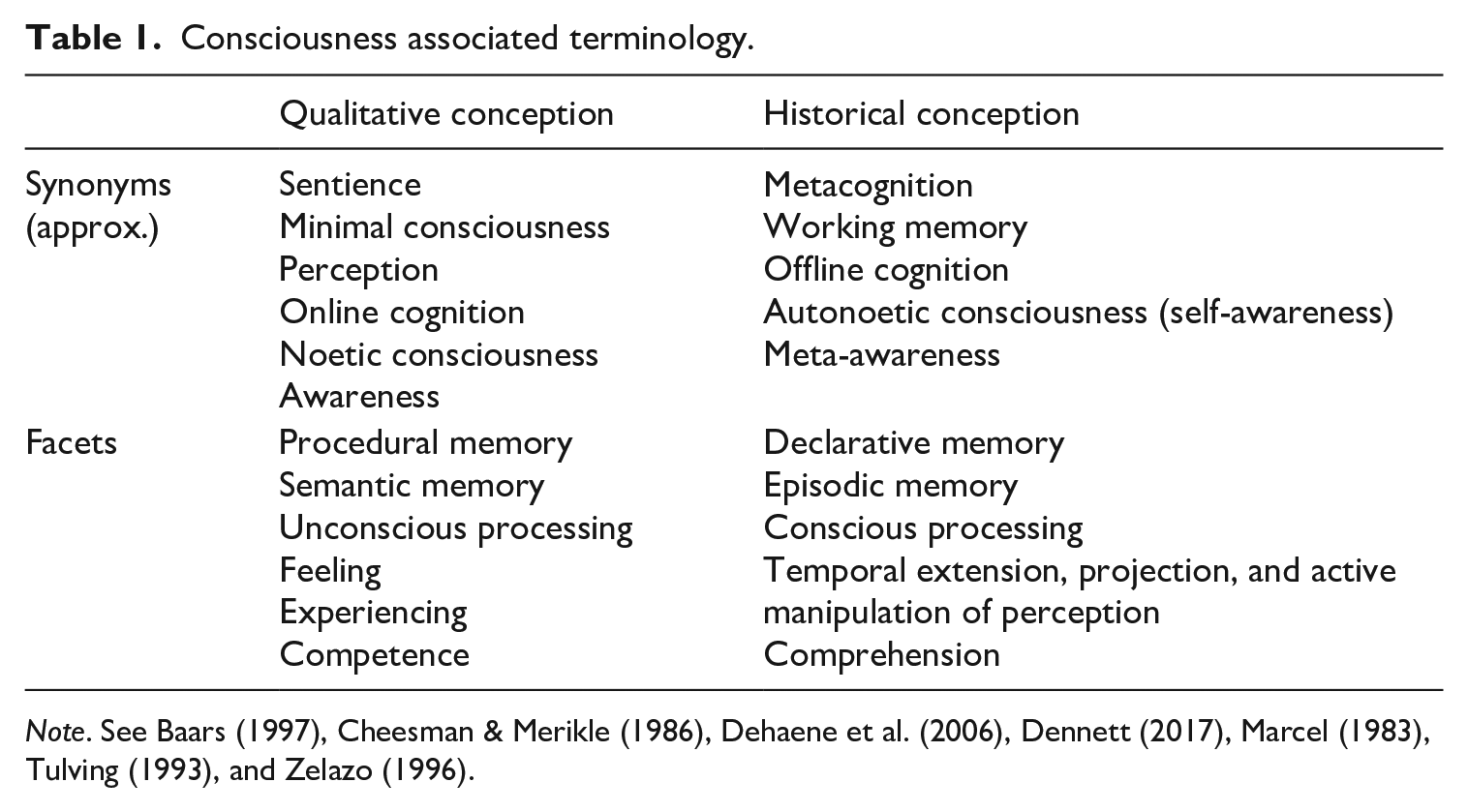
Typically, the list of concepts from the above paragraph are characterized as “conscious processes” in the unconscious–conscious process binary (e.g., Baars, 1997; Cheesman & Merikle, 1986; Deheane, 2014; Dehaene et al., 2006; Dehaene & Naccache, 2001; Marcel, 1983). Conversely, we might associate sentience with the regular list of “unconscious processes”: implicit forms of memory such as associative memory and procedural memory, “knowing-how,” online cognition—which alludes to being “coupled” to the continuous stream of ongoing sensory input and the associated stimulus–response feedback cycles—and the aforementioned concepts of perception, sensation, experience, and so on.
From the above, given the two conceptions of consciousness, there is potential for two construct binaries in contrast to the single construct binary mentioned earlier. This is to say, in investigations of consciousness, it may be insufficient to simply make claims in relation to some general conception of consciousness or a lack thereof. We can imagine a distinction between sentience and a lack thereof, having qualitative experience of the world or having none at all, and we can imagine a distinction between being sentient (unconscious processes) and being consciously, recursively aware of our sentient experience (conscious processes). In other words, it may be perfectly true that a cheetah is aware of a gazelle without it being aware that it is aware of the gazelle.
As plainly as can be stated, the misinterpretations in empirical studies of consciousness seem to come from a failure to realize that the language of the single construct binary has been forced to fit over two distinctions. This misfit of constructs becomes evident when the dual construct binary is considered in tandem with the standard methodology used in such studies.
The standard methodology
Of the various methods used to study “consciousness” (e.g., Baars, 1997; Cheesman & Merikle, 1986; Crick & Koch, 1990, 2003; Dehaene & Changeux, 2011; Dehaene et al., 2006; Dehaene & Naccache, 2001; Grill-Spector et al., 2000; Marcel, 1983; Weiskrantz, 1986; for user-friendly review, see Dehaene, 2014), including attentional blink and blindsight studies, I would like to focus on the most common variety: subliminal threshold studies (although, all the current methodology test the same construct; the choice of focus is simply for ease of explanation). The logic behind subliminal threshold testing is simple and ingenuous. For our example, we will consider a study of visual “consciousness,” which typically involves a tachistoscope: a screen-type instrument used to present stimuli for scheduled periods of time (normally, this stimulus is presented in a sequence with other stimuli, either as a part of a “mask” and “target” pair or as a prime, depending on what the study is aiming to test; however, we will consider only the bare necessities for the moment). When a stimulus is presented for a very brief period of time, below approximately 50 milliseconds for human participants (e.g., Dehaene, 2014), it goes unperceived and is said to be subliminal. Conversely, supraliminal stimuli are those presented long enough to be perceived by the participant. The subliminal threshold, then, is the duration of presentation in which a participant reports perception of the target stimulus 50% of the time. Studies can then be conducted on the basis of measuring differential responses to stimuli presented at threshold (or above or below, again, depending on what the study is aiming to test). Differential behavioural responses—such as the verbal report—should be corroborated by a measurement of brain activity, wherein a distinct activity pattern corresponds to trials of reported perception, with a separate pattern that corresponds to the markedly subliminal trials (usually depicting substantially less brain activity relative to the supraliminal trials).
In considering this style of method, the most charitable interpretation is to assume an alignment of the single construct binary with the qualitative conception of consciousness. This is to say, when neuroscientists and cognitive psychologists perform studies on their general conception of consciousness, they are actually studying sentience. Subliminal threshold tests are tests of differential responses to what is or is not part of a participant’s phenomenal experience of the world.
This may seem obviously true; however, the issue arises with the specious language used in interpreting such tests; participant reports of having perceived the target stimulus are taken as indication of consciousness and of having been mediated by conscious processing, in some general sense. Similarly, responses to subliminal stimuli are taken as indication of having been mediated by unconscious processes. This is the crux of the issue: in the language used by those who take an empirical approach to the study of consciousness, the subliminal–supraliminal binary and the unconscious–conscious process binary are treated as one and the same, despite the unconscious–conscious process distinction having a historical association to a different meaning. The historical meaning of the unconscious–conscious process distinction may then become implicitly associated with the interpretations of such studies, resulting in a misinterpretation of evidence. This is to say, where the ability to differentially respond to subliminal and supraliminal stimuli may be indicative of a variety of “unconscious” and “conscious” processes, as these terms relate to the qualitative conception of consciousness, sentience, subliminal threshold testing does not tell us anything about consciousness and the associated binary of “unconscious” and “conscious processes” as these terms relate to their historical, metacognitive conceptions. Figuratively, all that these tests show is that the cheetah is aware of the gazelle, that the gazelle has become part of the cheetah’s phenomenal experience of the world, and not that the cheetah is aware of its awareness. Where the issue is not so much that we explicitly make this overinterpretive error, the language of the single construct binary allows us to implicitly slide from discussing those conscious processes associated with subliminal threshold testing to those attributes typically associated with metacognitive functioning or lack thereof, all within some ambiguous, generalized definition of consciousness.
While the language affords the possibility to equivocate on “consciousness” in this way, it does not seem to be the main source of error consequent of the single construct binary. In fairness to scholars of consciousness, in subliminal threshold studies, it is common to see consciousness talked about as “perceptual consciousness,” “visual consciousness,” or the like, hedged with some prefacing word that alludes to the author’s tentativeness to use consciousness in some general sense. This is part of the reason I mentioned earlier that I informally suspect that some scholars already find the single construct binary insufficient; the language already seems to want to pull towards a bifurcation in the construct, as if to say, “oh, it is not that we are dealing with the consciousness, we are dealing with ‘perceptual consciousness,’ something primary.”
The more common manifestation of this error regards the equivocation of “unconscious processes.” A large program of interest regarding the empirical study of consciousness seeks to determine what behaviours can be entirely accounted for without “conscious processing,” and so looks to define the range of influence subliminal stimuli have on behaviour—what is supposedly the purview of “unconscious processes” (for a good review of this program, see Dehaene, 2014, Chapter 2). Of course, given the method, the program is really testing the extent to which we can respond to things that are not part of our phenomenal experience of the world (see also the blindsight paradigm, e.g., Weiskrantz, 1986). As mentioned, the converse of which, perceiving the target stimulus, can only be considered a conscious process with regard to the qualia-centered conception of the term; there is no reason as to why the target stimulus becoming part of the participant’s phenomenal experience should mean that the consequent behaviour is the result of a conscious process, as the term is historically understood. It cannot reasonably be doubted that a rat that learns to press a lever for food in response to a light being turned on perceives the components of the contingency. This perception withstanding, to the likes of behaviourists, the rat’s behaviour, and almost every other conceivable behaviour, is still considered unconscious, because, from the historical conception, unconscious processes are not defined by a lack of perception, they are defined by a lack of reflective thought (there was a strong urge, here, to say that “they are defined by a lack of consciousness,” but alas, I’ll resist). It is completely consistent within this conception that the continuous stream of sensory experience and associated stimulus–response feedback loops are mediated completely unconsciously. From this view, subliminal threshold testing does not parse unconscious processes from conscious processes, but, rather, the limits of subliminal unconscious processes from the regular variety of unconscious processes.
On this, while the list of documented behaviours that can be elicited subliminally is impressive, it does not tell us much about an organism’s behaviour in the real world where stimuli are not presented for subliminal durations. The real world consists of competing streams of sensory information that are continuously present; one of which, an organism will be coupled to (more on this later), while the other streams may be referred to as preconscious (Deheane et al., 2006), in that we could become conscious—a term that here is being used to relate to the qualia-centered conception—of these streams of information given a shift in attentional resources (e.g., Posner, 1994; operating from a capacity model of attention, e.g., Kahneman, 1973; Moray, 1967). While subliminal threshold testing may be a good way to test the approximate influence of preconscious stimuli on behaviour, there still seem to be some important differences; namely, subliminal influence is fleeting, whereas preconscious information should be able to provide continuous influence over behaviour (e.g., Dehaene, 2014; Dehaene et al., 2006). Further, where a subliminal stimulus is definitionally absent from perception, preconscious stimuli are still qualitatively present, to a degree. While I watch my step on the trail, the sound of my music from my earphones is not entirely absent from my experience, nor does the world literally go black when my attention returns to the music. It is important to note, here, again, that while my footing or my music may become the center of my phenomenal experience at any given moment, I am not required to be recursively aware of my attentional focus on either. We are still only discussing consciousness as the term relates to qualia, sentience, and we do not need to invoke any secondary degree of thought to account for the phenomenology of such examples; these are still unconscious processes, under the historical conception. Another example may be to say that the cheetah stalking the gazelle is no longer minding her nearby cubs, who can perhaps be seen from the periphery. While the cubs still exist in the mother’s Umwelt, it is merely that they are not the actionable stimulus set for the time that the mother is coupled to those stimuli associated with her hunt.
Informally, I suspect a factor that contributes to the specious allure of the single construct binary is the typical participant species used in subliminal threshold testing: humans. Because humans seem to have a capacity for conscious thought, as the term is historically understood (regardless of whether or not consciousness is a necessary component in accounting for behaviour), on a supraliminal trial, not only do we perceive the target stimulus, but we are explicitly aware of the perception. As both things occur approximately simultaneously, it is much harder to tell that there are still, in fact, two things occurring. As such, the historical conception of consciousness may be implicitly lumped together with the interpretation of subliminal threshold tests.
Unfortunately, when this logic is followed to conclusion, we can start to see some of its insufficiencies. Operating from a single distinction, if we wish to deny some organism metacognition, we deny, by extension, the organism’s phenomenal experience of the world, and if we wish to grant some organism phenomenal experience, we seem obligated also to grant the organism with the awareness of such experience.
While this quirk in participant species means the single construct binary may be slightly less pernicious with regard to the study of adult humans, there is the potential for more problematic misinterpretation regarding organisms whose metacognitive capacity is in question, such as nonhuman animals (e.g., Ben-Haim et al., 2021; Birch et al., 2020; Cowey & Stoerig, 1995) and human infants along various stages of development (e.g., Basirat et al., 2014; Kouider et al., 2013). It would be better to be more cautious with the language that pertains to our current method, especially as research interest moves toward a comparative study of consciousness.
A case study
To this point, I have intentionally avoided looking at particular studies that have operated from the single construct binary. It seems uncharitable—and pointless—to blame individuals for adopting the available language, particularly when the language affords such a promising, if specious, method of investigation. Still, I would like to look at one recent project from which I believe we can learn and benefit.
Ben-Haim et al. (2021) have recently taken the logic of subliminal threshold testing to the study of nonhuman animals, specifically rhesus monkeys (Macaca mulatta). Despite convention, for the purposes of this article, I find it apt to cite their abstract in full: Scholars have long debated whether animals, which display impressive intelligent behaviors, are consciously aware or not. Yet, because many complex human behaviors and high-level functions can be performed without conscious awareness, it was long considered impossible to untangle whether animals are aware or just conditionally or nonconsciously behaving. Here, we developed an empirical approach to address this question. We harnessed a well-established cross-over double dissociation between nonconscious and conscious processing, in which people perform in completely opposite ways when they are aware of stimuli versus when they are not. To date, no one has explored if similar performance dissociations exist in a nonhuman species. In a series of seven experiments, we first established these signatures in humans using both known and newly developed nonverbal double dissociation tasks and then identified similar signatures in rhesus monkeys (Macaca mulatta). These results provide robust evidence for two distinct modes of processing in nonhuman primates. This empirical approach makes it feasible to disentangle conscious visual awareness from nonconscious processing in nonhuman species; hence, it can be used to strip away ambiguity when exploring the processes governing intelligent behavior across the animal kingdom. Taken together, these results strongly support the existence of both nonconscious processing as well as functional human-like visual awareness in nonhuman animals. (p. 1)
Considering the method, the logic of double dissociation varieties of subliminal threshold tests comes from a need to circumvent typical reliance on verbal responses. Obviously, it is difficult to get nonhuman animals to verbally communicate whether or not they have perceived some stimulus presented at threshold, so the objective becomes creating a method in which some other difference in behaviour is contingent on the perception or nonperception of some stimulus. Ben-Haim and colleagues implemented a version of a double dissociation test based on a spatial-cueing paradigm (e.g., Herreros et al., 2017; McCormick, 1997). Rhesus monkeys’ responses to a target stimulus were timed. The presentation of the target stimulus was preceded by a cue that always appeared in the opposite direction of the target. Given the pattern, one would predict distinct outcomes for trials in which the preceding cue was presented subliminally versus supraliminally. On supraliminal trials, the identification of the preceding cue should lead to a faster response to the target stimulus, whereas subliminal presentation of the preceding cue should lead to an orientation of attention in the wrong direction, and, consequently, lead to a significantly slower response to the target stimulus. Of course, this is exactly what was found.
The issue lies in the language used to interpret these results. Given the method, the monkeys are tested on whether they differentially respond to stimuli that are or are not part of their qualitative experience of the world. Still, the authors conclude that the method provides grounds to “disentangle conscious visual awareness from nonconscious processing in nonhuman species” (Ben-Haim et al., 2021, p. 1), without qualification as to what kind of consciousness is being differentiated with this distinction. This ambiguity in the general conception of consciousness falsely leads the authors back to the attributes associated with the historical conception. They conclude the study provides evidence of the existence of “human-like” awareness in nonhuman animals; however, given the method, this is an egregious non sequitur, unless the initial assumption was that sight was a uniquely human ability. It should be little surprise that nonhuman animals can see the things that they respond to; the more interesting finding in such studies, actually, is that they can still respond to things they cannot see. Still, neither of these things require the invocation of conscious processes in any way that the term relates to “human-like” awareness. As I have said, such studies disentangle only a special variety of unconscious processes, subliminal processes, from the regular variety of unconsciousness.
I want to labour the fact that, given the framework of the single-construct binary, Ben-Haim et al.’s (2021) method was inspired. In order to answer a difficult question, they implemented a method that, in the context, was a creative and elegant means to an end. The point to be taken is only how operating from a single-construct binary—treating the subliminal–supraliminal distinction the same as the unconscious–conscious process distinction—can mislead the best of us.
Two (brief) considerations
At this point, I would like to consider, as briefly as possible, two potential counter-objections to my analysis of the single construct binary. The first such objection may be that I am ignorant of, or have ignored, the relevant neuroscience—namely, the medley of the conscious access and global workspace hypotheses and the associated collection of what are referred to as neural correlates of consciousness (e.g., Baars, 1988/1993, 1997, 2002; Crick & Koch, 1990, 2003; Dehaene, 2014; Dehaene & Changeux, 2011; Dehaene & Naccache, 2001; Dennett, 1991; Grill-Spector et al., 2000). In brief, neural correlates of consciousness are the aforementioned measures of brain activity that correspond to supraliminal trials in subliminal threshold tests. Where a subliminal stimulus may initiate brain activity that is relatively minimal, localized, and fleeting, a supraliminal stimulus may initiate brain activity that is said to be “global.” Roughly, the assumption is that this global ignition of brain activity is a type of figurative workspace in which the information may be shared with various brain regions to the effect that we may gain “access” to the information and so that we may manipulate and play with it as we like. It could be said that the global workspace is the mechanistic foundation of working memory.
There are, however, minimally two important things to note regarding the global workspace hypothesis and neural correlates of consciousness. First, the methods for educing neural correlates of consciousness are the same methods discussed all along; we are measuring differences in response to what is or is not part of a participant’s phenomenal experience. It is merely the case that we are no longer looking at differences in overt behaviour in response to the presentation of subliminal versus supraliminal stimuli; rather, we are looking at differences in brain activity.
Second, sensory information that is shared globally around the brain may not mean it is automatically shared with whichever component of our brain is assumed to gain recursive “access” to information. We may be mistaking a type—global brain activation—for a token—the explicit awareness of experience. This is to say, I think it is likely that measures of brain activity would register global activity during metacognitive thought; however, I do not think all instances of global brain activity are instances of metacognition; and, actually, I assume the vast majority of instances are not. Moreover, although, superficially, the conscious access hypothesis is quite attractive, it borders very close to being a repackaging of Descartes’ theatre (Dennett, 1991), and it is important that the efficacy of our models does not inadvertently rely on sneaking the ghost back into the machine.
I think a better interpretation of the global ignition of brain activity in response to some supraliminal stimulus is that the stimulus has become actionable for the observer; it is what the observer is “coupled” to out of all the available stimuli in the environment. If we consider, for instance, Freeman’s work on rabbit olfaction (Freeman & Schneider, 1982), global ignition of brain activity in a rabbit’s olfactory bulb, as measured by EEG, was only witnessed on trials where the rabbit was presented with a smell that it was previously conditioned to associate with some consequence. Global ignition of brain activity in the olfactory bulb was not observed when the rabbit was presented with unconditioned smells because such smells afford no action. It is not that such smells could not become the center of the rabbit’s phenomenal experience, but that there is no reason for the smell to be the center of the rabbit’s phenomenal experience. Conversely, a conditioned smell has implicit meaning to the rabbit; it is actionable, and the rabbit has reason to orient behaviour around such a stimulus. All this is to say: information is for action (for review, see Barrett et al., 2022).
It may be the case that scholars of consciousness would argue that the notion associated with “coupling” to some stimulus (or stimulus set) is essentially what they mean when they say an organism has become conscious of some stimulus, that I have described the same framework in different terms, and that everyone, more or less, has the same general understanding. To a large extent, I think (or perhaps hope) this is true; however, if we wish to treat the phrases “becoming conscious of some stimulus” and “coupling to some stimulus” interchangeably, we need to explicitly limit our definition of consciousness to only its qualia-related conception. As I have said before, there does not seem to be anything about perceiving some stimulus that requires us to be recursively aware of these perceptions.
This said, a second point of objection might turn on the possibility of this last assumption being wrong. It could be that the dual-construct binary I have drawn in place of the single-construct binary highlights an erroneous distinction between the qualitative and historical conceptions of consciousness. This is to say, the analogy, that the cheetah might be aware of the gazelle—in that it perceives the gazelle and that its behaviours are coupled to this perception—without being recursively aware of this awareness, could very well be faulty. There may be no difference in kind between awareness and the awareness of one’s awareness. The awareness of one’s perception might merely be a specific focus of perception, perception turned in on itself (whatever that might mean—sure sounds good though); or, perhaps, the difference might be scalar, qualitative, which would constitute a spectrum of awareness; perhaps, some combination of these. Of course, this is all wild speculation; regardless, some objection could be drawn pointing to a faulty hierarchy of concepts, wherein I have incorrectly bifurcated a single construct, and this certainly warrants consideration.
On this, a demonstration showing that we are really only dealing with a single construct would be a problem for the label “dual-construct binary”; however, the sentiment of this objection is not exclusive to the conclusion of my analysis. I am sympathetic to the notion that consciousness might be scalar; however, where minimal consciousness, sentience, might be a necessary condition for meta variations of awareness, consciousness as can be found on the other end of the hypothetical spectrum, it cannot be a sufficient condition or the two would not be functionally dissociable. This is to say, regardless of the relationship between sentience and metacognition, having qualitative experience of the world still does not guarantee a recursive awareness of this experience. We are still susceptible to type one errors if we infer the presence of some general conception of consciousness from the results of the types of studies we have been conducting. It is more epistemically diligent to make only the minimal interpretation regarding the results of subliminal threshold tests and the like.
Discussion
Given the discussion above, there seem to be two potential directions we can take the language of consciousness in order to reduce potential misinterpretation.
Ideally, I would like to see the term consciousness dissociated from its qualia-related conception; we already have words that suffice in this role: sentience, phenomenal or qualitative experience, and, most obviously, perception. In place, then, of Dehaene et al.’s (2006) taxonomy of subliminal, preconscious, and conscious stimuli, we would instead have subliminal, preperceptive, and perceived or supraliminal stimuli—being conscious of perceived stimuli being categorically secondary to the taxonomy. And, of course, as mentioned, the “hard problem of consciousness” becomes “the hard problem of perception.” The terms consciousness, conscious processes, and unconscious processes could be restored to their historical conceptions regarding a reflective, recursive layer of thought over the regular sensory capacity, or lack thereof. The perception of some stimuli and responses contingent on this perception or lack thereof, what is tested with our current methodology in “consciousness” studies, could be referred to as subliminal and supraliminal processes so that we no longer conflate the subliminal–supraliminal distinction with unconscious–conscious process distinction.
Alas, as nice as I would consider this to be, I feel that the treatment of consciousness as qualia is likely here to stay. If this is the case, we should be explicit in limiting its definition to exclude its historical connotation so that it is not so easy to misrepresent what is tested with the current methodology, especially regarding the equivocation of unconscious processes.
Regardless of which conception we decide to ascribe to the label of consciousness, it seems time to pick a hat.
Footnotes
Acknowledgements
The final version of this manuscript has benefited from the thoughtful suggestions of my two anonymous reviewers, whom I would like to sincerely thank. I would also like to thank the editing team for such a smooth facilitation of the publishing process and for giving my thoughts a home. As this is a special publication for me, I would also like to thank a list of educators, whose indirect contribution to this manuscript cannot go unsung; alphabetically, I would like to thank Louise Barrett, Bruce Galenza, Peter Henzi, Javid Sadr, and Tina Strasbourg. Finally, this paper is dedicated, with limitless appreciation, to Dennis and Michelle Jobson.
Declaration of conflicting interests
The author declares that the research was conducted in the absence of any commercial or financial relationships that could be construed as a potential conflict of interest.
Funding
The author received no financial support for the research, authorship, and/or publication of this article.
