




Abstract
This article focuses on bordering as a fundamental semiotic process of human psychological functioning. First, we discuss similarities between semiosis and bordering and explore their relationships. In the perspective of cultural psychology of semiotic dynamics, psychic life is a process of purposeful production and interpretation of signs, carried out through cycles of culturally guided, selective internalization and externalization. Signs and borders are not only entities “out there”: they emerge in the purposeful movement of the organism in the course of future-oriented action in everyday life. Second, we discuss borders in mind and society as particular types of signs, through which humans regulate their own and others’ conduct. Finally, we propose a general genetic law of bordering development: borders are first conceived as tools created and established by humans as interpsychic activities. Later, the sign is internalized and begins to regulate psychological functioning. It also becomes a psychological tool for dealing with other humans and with the environment.
The bloody origin of border semiotics
One of the most famous myths passed down from ancient Rome is the story itself of the foundation of the eternal city. The symbolic form of myth has always been used in psychology as a reservoir of examples to illuminate psychological processes. So do we, with the myth of Romulus and Remus. Several versions of the myth exist (Cornell, 1975), yet the majority share the basic elements. Romulus and Remus were the twin sons of the god Mars and the vestal Rea Silvia. On the orders of their uncle, they were cast into the river Tiber. The children survived the river and were found by a she-wolf, Lupercal, who suckled them in her cave. Rescued by shepherds, the grown-up twins got revenge on their uncle. They decided to found a new town in the hills where the city of Rome would later lie. Having interpreted the auguries in his favour, Romulus started digging a trench with a plough around what was to be his new city (Figure 1). In protest, Remus, who had another interpretation of the auguries and believed himself to be entitled to found the town, jumped over the trench to challenge his brother, who killed him in the fight.
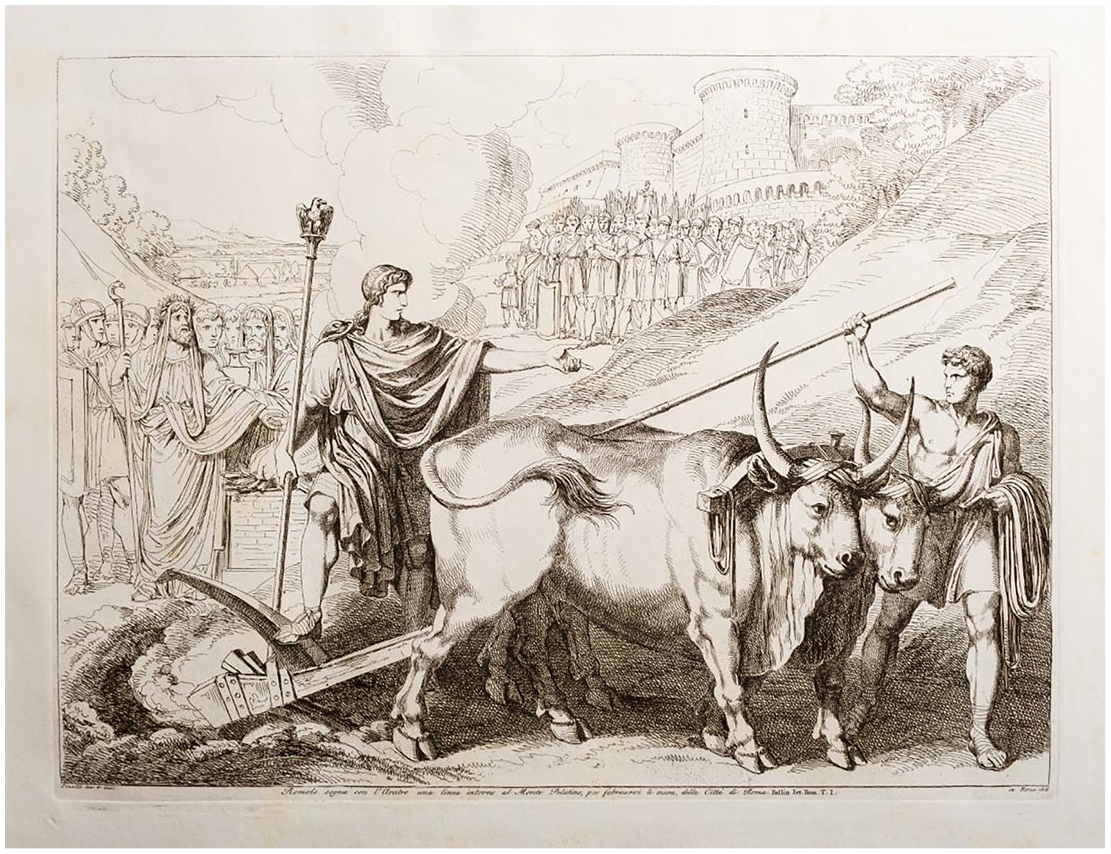
Bartolomeo Pinelli, Romulus marks out a line around the Palatine Hill (1818), Thorvaldsen Museum, Copenhagen, public domain licence.
The role of semiosis in the functioning of the psyche
We use the story of Romulus and Remus as a metaphor for the bordering process. The theoretical elements we are going to discuss in this article are represented in the narrative sequence of the myth. The story begins with the condition of an undivided whole (the twins, a virgin territory). A sign is produced which creates a distinction (the trench). Immediately, two subparts emerge (the trace of the future town and its surroundings) together with a relationship of value between the subparts of the whole (inside–outside the town). The trench becomes a border invested with a system of regulation (who is allowed to cross it) and at the same time with the potentiality of violating the regulation itself (Remus’ challenge in crossing the trench). What was before an undivided environment becomes an appropriated territory, a nascent town (Lambert, 2015), surrounded by its “outside.”
The universal process of signs’ production and interpretation by living organisms is called semiosis. Semiotics thus studies “communicative structures and the sign systems that create them” (Kull, 2001, p. 3). When applied to human psychic processes, semiotics reveals the peculiar nature of human beings as active producers and interpreters of signs (Valsiner, 2007). As soon as one moves from the purely physiological level of exchanging with the organism’s surroundings to the active interaction, the mediation of signs, their production and interpretation, becomes the instrument employed by human beings to construct their experience of the world. The myth shows how a number of interesting characteristics emerge from the simple act of producing a semiotic distinction in an undivided environment, which becomes a border and is provided with a law that can “surround and subjugate each body present on the territory on which it applies” (Lambert, 2015, p. 11). Human beings organize the world by categorizing things according to some selective traits. Once categories are applied to objects, those objects will be subject to consequences, that is, the “laws” of the territory in which they are located. In our interpretation of the myth, Remus had not internalized the border in the same way Romulus intended it as he rejected his interpretation of the sign of the trench. The production and interpretation of signs mediate the meaning of the messages we produce and receive during our mundane interactions. Human beings actively select the features of messages during their internalization and produce their version of the same messages.
The internalization of a message about “the duty to defend the holy borders of my nation” can lead to very different outcomes depending on the personal interpretations of this moral imperative about borders. One can decide to avoid conflict with neighbours because, after all, one has to live with them. A border zone can be built either as a consequence of a conflict (or to stop a conflict), or it can be the product of conflict (or of peace; Tateo & Marsico, 2019a).
Not only at the macrosocial level, but also in micro interactions, the regulation of social distance is a complex semiotic process (Sommer, 1959) that requires the development of subtle and flexible border negotiations. The border is a regulator of relationships and emotions, as in the example of Romulus and Remus, that produces conditions of tension/negotiation, which can result in different outcomes depending on the meaning-making process.
In the following sections, we will discuss the relationship between the concept of border and the concept of sign, arguing that the former is a type of sign (that can be both material and immaterial) extremely relevant for human psychic life. “Man’s position in the world is defined by the fact that in every dimension of his being and behaviour he finds himself at every moment between two boundaries,” where humans live in between a “more or less, a right and left; an above or below, a better or worse” (Simmel, 1918/2010, p. 1). Borders are necessary, and every specific border can be crossed, although a new border emerges immediately after. In our metaphor, “Remus does not jump the trench because he actually wants to reach the other side; rather, he does so to manifest the nullity of this boundary imposed upon him” (Lambert, 2015, p. 11). However, our hypothetical Remus fails as he ignores that, by crossing the border, the dual reality of the border itself is confirmed: “the unified act of life includes both boundedness and the transcendence of the boundary” (Simmel, 1918/2010, p. 3). Romulus produces (externalizes) a sign as an act of interpretation of the gods’ will: The trench is the material manifestation of a diagram imagined in Romulus’ head. In that sense, Romulus was the first Roman architect, as with his trench, he “drew” a line that would subjugate the bodies and implement a law. (Lambert, 2015, p. 11)
The “law” represents the condition for the interpretation of the sign. The same representamen (the trench) is producing two different imaginative acts in the twins: two different interpretations. Remus interprets the sign by producing a new interpretant of violating the law: a sign in the form of the action of crossing the border. The new sign is related to a disruptive interpretant and leads to the ultimate conflict: “breaking the law not for one’s own interest, but rather as a protest against the law itself” (Lambert, 2015, p. 11). In our interpretation of the foundation myth of Rome, a clear generative role of semiosis and bordering is observable: bordering in human activities can be created and experienced in multisensory modalities (e.g., as physical barriers or passages, soundscapes, smellscapes, surfaces, visual cues, or barriers to the gaze) or ethical modalities (e.g., lawscapes; Ansaloni & Tedeschi, 2016; Philippopoulos-Mihalopoulos, 2013). The currently rich field of border studies, however, focuses predominantly on the material and sociological aspects of international borders (for an overview, see Marsico, 2016). From our semiotic perspective, it is not relevant to discuss the ontological nature of borders. We aim at describing the common, and overlooked, feature of borders working as internalized semiotic artefacts that regulate psychic life. This view leads directly to the theoretical question that we are going to develop: what is the role of bordering as a semiotic process in human meaning-making?
Beyond ontology: The semiosis of bordering
The word border is vast and polysemic. It can have different connotations, from national frontiers to social distinctions, from interpersonal distancing to intrapsychic barriers. Can we define what a border exactly is? Is it a frontier or a threshold? Why does this term so often imply a controversial issue in human affairs? In general understanding, a border is presented as a natural or artificial line to delimit the extension of a territory or national sovereignty. However, is that a real line? What do we know about it? What are its features and qualities? Borders seem to play a role in shaping I–Other relationships (Kullasepp, 2021) and our mental functioning. We are who we are because of the borders within which our lives unfold (De Luca Picione, 2021). The human psyche can hardly conceive a boundless reality even with enormous imaginative effort (Falk, 2010).
Borders can be material or immaterial, concrete or imaginary, well-defined or vague. They determine what is admissible or not within a circumscribed space. They also define what is knowledgeable and what should be kept away as alien or dangerous. By tracing a border, we impose our norms upon a physical or psychological territory. Whoever tries to penetrate or step in can be perceived as an enemy, threatening the order we have established. Borders mark the place of a difference, be it real or presumed. In this sense, a border is a space lying in between things and even if, apparently, it mainly concerns the physical environment, it is first and foremost a psychological process of meaning-making. Borders delineate a space in mind and society (Scott, 2021) that both creates and reproduces a specific order.
Discussing the manifold ontological nature of “border” is perhaps not so productive as focusing on bordering. The act of bordering helps to attribute a subjective set of meanings. Indeed, we talk about borders every time we think about something as separate from the adjacent surroundings. This seems to be a basic process through which we recognize and classify the reality around us.
Theoretical foundation: Bordering as a semiotic process
The idea that the primary operation of psychic life is the emergence of consciousness—from the segmentation and stabilization of a stream of thought into units—is not new (James, 1890/1950). Herbst (1976) suggests that the genesis of logic and behaviour is the operation of producing a distinction in an undistinguished field or flow of events. Similarly, Peirce claims that the mind is a specific form of semiosis (Colapietro, 1988), in which signs are produced and interpreted by creating a relationship out of an undivided element of Firstness, at the moment a distinction is produced in a relationship: A sign, or Representamen, is a First that stands in a genuine triadic relation to a Second, called its Object, as to be capable of determining a Third, called its Interpretant, to assume the same triadic relation to its object in which it stands itself to the same object. The triadic relationship is genuine, that is its three members are bound together by it in a way that does not consist in any complex of dyadic relation. (Peirce, 1931/1958, Vol. 2, para. 274)
Without distinction, no conscious psychic life can emerge. Yet, distinction does not create separate entities, but rather generates a dynamic system. Drawing a distinction creates a border that concurrently divides and unites two parts where a single undifferentiated instance previously existed (Marsico & Varzi, 2015). Every distinction passes through the acknowledgement of a higher level of organization and, at the same time, by binding, it creates distinctiveness: By choosing two items from the undisturbed store of natural things in order to designate them as “separate,” we have already related them to one another in our consciousness, we have emphasized these two together against whatever lies between them. And conversely, we can only sense those things to be related which we have previously somehow isolated from one another; things must first be separated from one another in order to be together. (Simmel, 1994, p. 5)
This process is not neutral. Creating a distinction into a previously undistinguished entity attaches a preference to the new subparts. Binding elements that were previously perceived as distinct creates an internal hierarchy in the new emerging whole. In the example of Romulus and Remus, drawing a border equates to producing a sign that immediately creates a distinction on a previously undefined territory, where some defying characteristics emerge simultaneously. A border implies an inside and an outside, with different values attached to each part. Values can be added to the subparts following the apprehension of a distinction (“X is different from Y, therefore one must be better than the other”) or to detect a difference (“X is better than Y, therefore they must be somehow different”; Valsiner, 2001). However, both the value-adding and the value-leading processes should be embedded into a whole system of relationships, mediated by an interpretant, in order to be meaningful. Figure and background, inside and outside, central and peripheral, codefine each other’s properties and values with regard to their relationship to a third organism: as I am apprehending an A, I also apprehend a non-A in some sense. So, we have to do with a difference regarding what is apprehended . . . a difference regarding what stands opposite [gegenübersteht] each intellectual experience as its object [Gegenstand] . . .. In the non-A, then, there is a further objective factor, the “non,” as it were, supervening on the A. (Meinong, 1983, pp. 14–15)
The single primary distinction actualizes a triadic set of elements. With “the removal of the boundary, a distinction between inside and outside is no longer possible. The same result is obtained if either the inside or the outside is eliminated, for then also the other two components of the triad disappear as well” (Herbst, 1976, p. 89). The operation of distinction produces an “inclusive separation” (Valsiner, 2001), that is, a higher order level of organization in which the distinction makes sense. Then, in order for a bordering process to function, an interpreter is required for whom the distinction is meaningful.
Bordering requires an act of interpretation
This is why we claim that bordering is an act of semiosis. A sign is defined as something that stands for or signifies something else in function of a third entity or, more precisely, something relating, in some respect or capacity, to something else for someone. Signs emerge from an embodied affective relation with the world of Firstness. This affective relation leads to the production of distinctions, that is, Secondness (Tateo, 2018), which requires an interpretative act with respect to a Thirdness, as it generates some “reaction against it” and becomes a “generalizing or associating element” (Peirce, 1931/1958, Vol. 8, para. 144) through the interpretant. The sign is indeed made of a triad (representamen, object, interpretant) in which two different elements are mediated by a third (Figure 2).
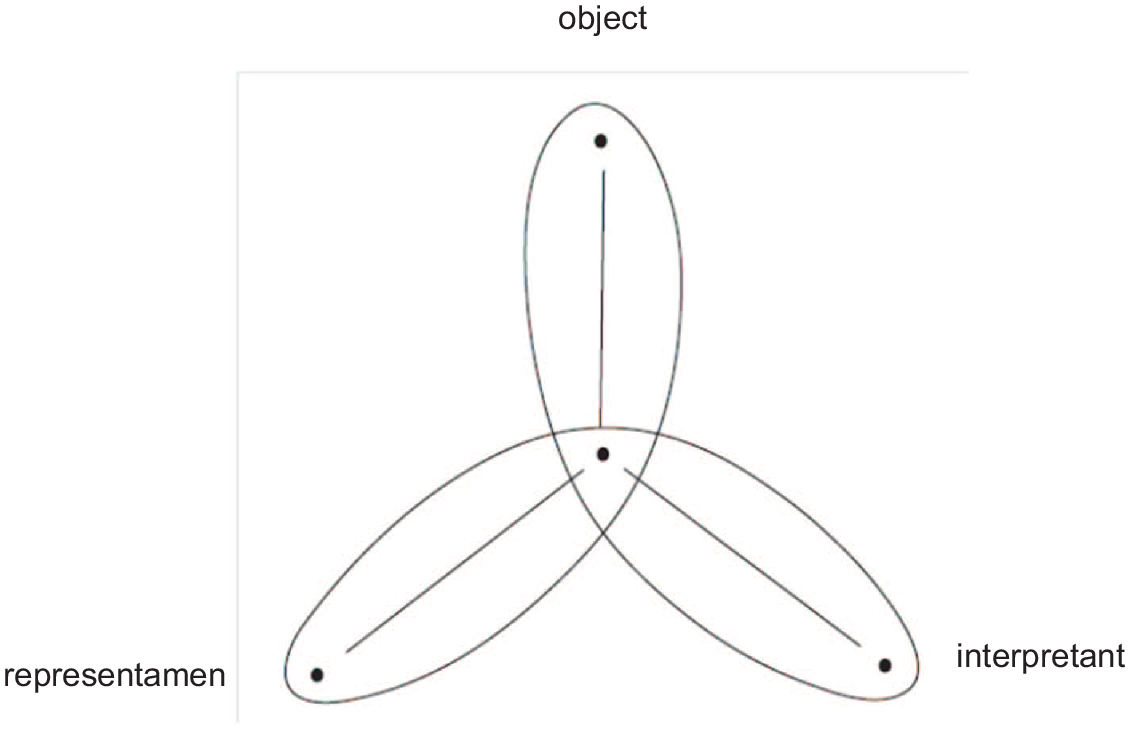
Peirce’s concept of sign.
According to Peirce, semiosis is a process in which the roles in the triad can be occupied by anything according to circumstances, and it is a universal process of potentially relating everything-to-everything in an infinite movement, in which anything that is a representamen can become an object of a higher level sign, and every interpretant can become a representamen in return. The sign is the complex system emerging from the triadic relationship between the elements. The triad creates special relationships between the subparts of the sign-complex. The elements establish a relationship of (a) substitution, because the representamen by definition stands for its object; (b) distinction, because by logic the representamen cannot be the object it represents; (c) unification, because the semiotic production of the sign brings into the same whole elements that were not necessarily subparts of the triad before; and (d) temporality because semiosis takes place into irreversible time: something always turns into something else, which turns into something else, and so on (Tateo, 2018). Thus, the interpretation process is “governing facts in the future” (Peirce, 1931/1958, Vol. 1, para. 23).
We suggest that bordering functions in a similar way. The production of distinction (drawing a border) creates a triad (“A”>“non-A”>border) as a higher level cogenetic system (Tateo, 2016), in which the subparts are codefined by their relationships (Marsico & Varzi, 2015). For instance, when one talks about “our people” or “low-income groups,” a boundary is created between “us” and those who are “not-our people” or “non-low-income groups.” Likewise, in semiosis, the elements establish a relationship of (a) substitution, because a border by definition bounds its object, therefore, an object can be represented through its borders; (b) distinction, because by definition a border lies between two different entities; (c) unification, because the emergence of a border creates a triadic higher level system between elements that were not subparts of the triad before; and (d) temporality, because this mutual relationship genetically leads to the emergence of further phenomena. Moreover, “A” can be historically subject to further distinctions, in a process of infinite bordering (in analogy with infinite semiosis). The bordering process also establishes a double negation, in which “A” is defined as something that is also “non-non-A.” Affective distinctions trigger conceptual distinctions and affect evaluation, that is, once we create alternatives, one must be better than the other (Tateo, 2016). This operation allows for the establishment of a hierarchy of social power and personal preference. You cannot dominate what is not already in a relationship with you. The very same distinction also creates the possibility for the permeability of the border, hence, in some respects, “non-A” acquires the “capacity” to become quasi-A. The codefinition of “A” through “non-A” is bidirectional. For instance, phenomena like “masculinity” or “patriotism” (A), at a given historical moment, are defined by a set of characteristics and by “nonmasculinity” or “nonpatriotism” (non-A). The border between two fields of meaning is represented by signs, in the form of actions, objects, or symbols, often related to or applied to the body. Thus, a real man or a real patriot is someone who does masculine or patriotic things, who dresses or talks like a man or a patriot. At the same time, “A” is also the one who “does not” do feminine or antipatriotic things (non-non-A). The field of “nonmasculine” or “nonpatriotic” includes an infinite number of instances that vary in latitude and magnitude such as “feminine,” “quasi-masculine,” “gay,” and “nonmasculine.” In the border zone, one finds a number of signs that can move from one field of meaning to the other (e.g., beauty treatments, tattoos, flags, foods).
As a historically situated phenomenon, whose contingent conditions act as interpretant (e.g., in times of “war on terror” or “pandemic,” patriotism can become particularly significant), bordering is subject to change, that is, boundary is the element that mediates the meaning of the subparts of the whole (Marsico & Varzi, 2015). Mediation provides both the “meaning” of the sign and the necessary degree of uncertainty, thus allowing any possible development. Consequently, by implying the possibility of misunderstandings, negotiations, and even deceit, it leads to different outcomes in the process of meaning-making. For instance, the meaning-complex of “normal” (A), in psychology defined through the boundary with what is “abnormal” (non-A), leads to the field of meaning of what is “nonabnormal” (non-non-A). Any action of border crossing modifies the system and, at the same time, creates a new distinction that requires a new interpretation. For example, an action related to the body can be a sign whose meaning is determined by the complementarity between its being more or less “masculine,” “nonmasculine,” “almost feminine,” and so on.
Having presented bordering as a form of semiosis, we can now explore how it emerges in mind and society.
The phenomenology of bordering
The spatial metaphor is, at the same time, ubiquitous and reductive when talking about borders. It requires defining types and ontology of borders. One cannot help imagining borders as loci of both demarcation and contact between two or more places or things. Borders simultaneously unite and divide (Marsico, 2016; Marsico et al., 2013). They can be conflicting areas and spaces of dialogue at the same time (Konrad, 2015). In the perspective of cultural psychology of semiotic dynamics, the ontological definition of borders is overcome by developing the concept of bordering process. Psychic life is a process of purposeful production and interpretation of signs, through cycles of selective and culturally guided internalization and externalization (Valsiner, 1999, 2014).
Borders as signs are not only “out there.” They emerge with the purposeful movement of the organism in the course of future-oriented everyday life actions. The life-field of any organism is populated by peripheral “potential” signs that work as affective suggestions for the organism itself.
In human activity, architecture provides a good example of an environment filled with potential affective orientations (e.g., stairs, doors, corridors, ornaments) that suggest specific ways of feeling and behaving. Corridors are examples of semiosis according to the concept of border (Figure 3). They are border zones that play an important role in human spatiality and mobility. Besides, they act simultaneously as connectors and separators between points “A” and “B,” as they occupy a space in between.
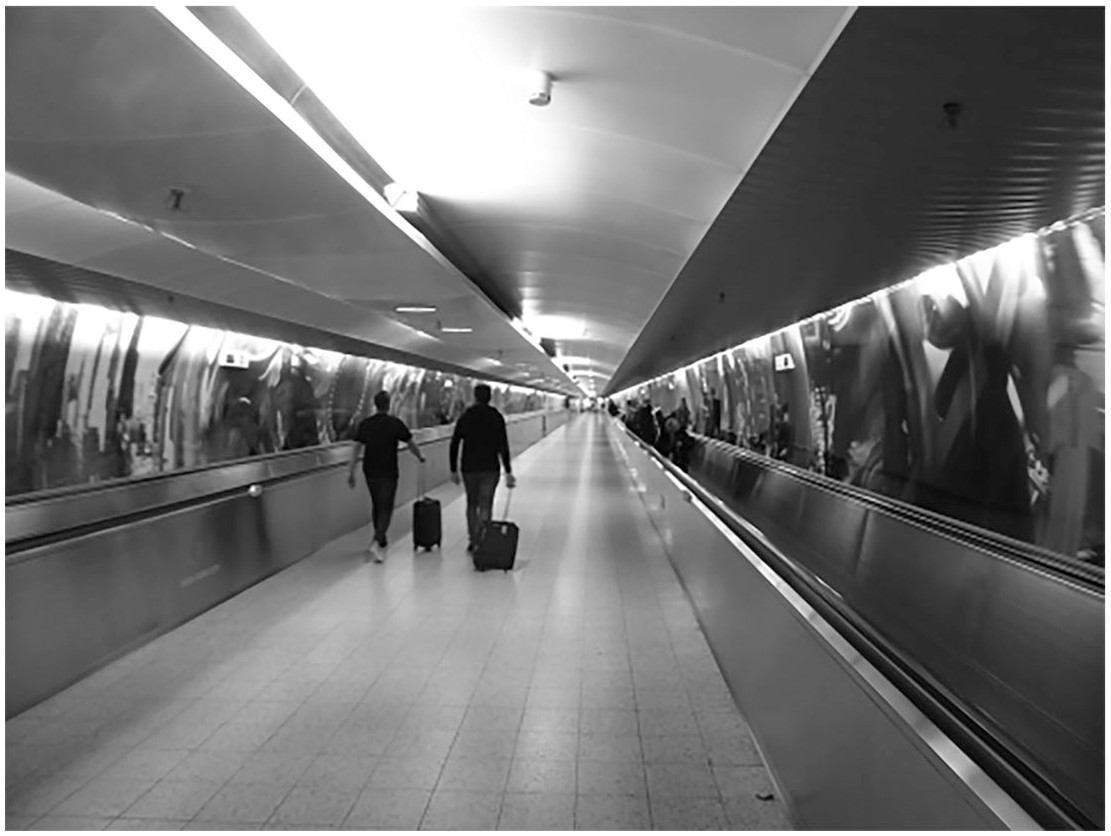
Passenger tunnel, Frankfurt airport (photo by G. Marsico, 2017).
In the approach called New Urbanism (Katz et al., 1994), a corridor is an urban element that facilitates connection and mobility between neighbourhoods and districts. Typical examples are the corridors or tunnels in airports, train stations, and metros. At Frankfurt airport, the colossal artistic photos of different world destinations by Martin Liebscher decorate the passenger tunnel (Figure 3).
Every day, thousands of travellers can enjoy this artwork while reaching their gates, and in so doing they connect themselves with the world outside. These gigantic pictures of amazing world destinations amplify the here-and-now-being-on-the-move traveller’s identity and connect the closed airport transfer area with the external world. Corridors are connecting border zones, between physical spaces (the areas of the terminals) but also with distal geographical places and temporal dimensions (Marsico et al., 2018).
What is the psychological reason for humans to decorate border zones? According to Valsiner (2018): We decorate our environments. These decorations—ornaments—are not occasional “attachments” of what we haphazardly prefer to see as merely “beautifying” our life-worlds. They encode various meanings in the form of {A<>non-A} oppositions that involve inherent tension between the opposing parts within the whole. These tensions we project into the environments, and through that we further guide the feelings of our minds as if those were impending upon us from within our environments. By decorating ourselves and our environments we are transforming ourselves into ever new ways of being human. (p. 230)
The decorated corridor is a culturally meaningful architectural space that acts as a psychological tool of semiotic mediation. Through decorations, peripheral sign-complexes can become central under some conditions and act as regulators of psychic experience. The forms of decoration provide insight into the set of meanings, values, and affects that humans project into their environments, turning them into something more than simple places (Cornejo et al., 2018). Ornaments fill peripheral sensory systems with cultural suggestions. This is an act of “constructive externalization—the goal of which is further feed-forward to equally constructive internalization” (Valsiner, 2018, p. 230). Hence, the importance of decorations of thresholds, passages, and borders that characterize all human cultures.
Bordering and semiotic regulation
Signs regulate both one’s own and others’ feelings and conduct (Valsiner, 2014), drawing a border between the acceptable and the unacceptable. They are disseminated in the human-featured environment in many forms (street signs, architectural elements, sounds). The personal nature of meaning-making in self-regulation makes it possible, for instance, for a person to know about an expectation or a norm (or to expect others to know about it) but to ignore it or not use it themselves. Hence, the important presence of prohibition signs as peripheral elements in public spaces. For instance, imagine running into a regulatory sign in the environment (Figure 4). The sign represents a border or a limitation (e.g., “smoking can kill”) that produces the socially correct interpretant (e.g., “I shall not smoke”).
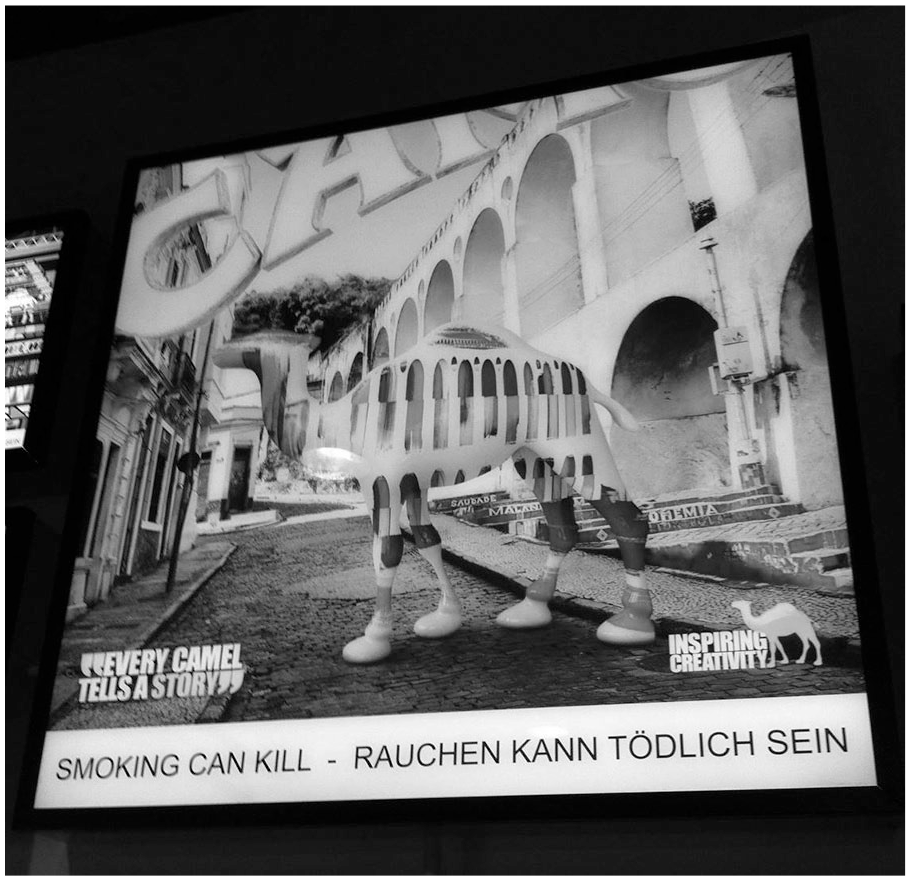
Ambivalent border sign (photo by L. Tateo, 2018).
Yet, interpretation is purposeful and all signs are ambivalent and polysemic; the first interpretant can become the object of a new semiotic act. So, one can produce another sign, a new regulation (“I will smoke anyway”), that overcomes and neutralizes the first one, albeit both are still working. This is the most basic process upon which distinction-making emerges (“I am me, and you are you, and we are different”). Distinction-making grounds the process of value-adding. At the same time, through the regulation of signs over other signs, distinctions and values can be demolished or circumnavigated to create new meanings (e.g., “I am me, but I do not care, so I will do that anyway”) that can lead to different externalizations. According to Marsico et al. (2013), meaning-making, distinction-making, and value-adding are exactly the three processes involved in the construction of borders in mind and society. Borders, in the semiotic perspective, are thus a special type of sign. Individual life course and space progressively populates meaningful objects and persons that constitute a system including (internal and external) borders. Borders produce hierarchies, value differences, and needs that generate complex configurations of vectorial forces (Lewin, 1935, 1936). Bordering therefore unifies the parts into a system of meaningful relations (substitution, distinction, unification, and temporality; Marsico & Tateo, 2017; Tateo, 2018). Within the new established subset (e.g., a group, a territory, or a category) those instances (e.g., individuals, objects, and dimensions) that meet certain criteria will be included and will acquire a special value. The elements that do not have those characteristics will be excluded. However, bordering both reduces and increases ambiguity (Marsico et al., 2013). On the one hand, borders reduce ambiguity through the act of demarcation, by limiting the space and the expected alternatives of behaving. On the other hand, since the division is neither rigid nor fixed, the interpretation of the border/sign is a partially fluid space where ambiguity reemerges. This space for fluidity suggests the conception of a border as a “space in between” (Marsico, 2011, 2016): The space in between is neither separable and divisible into discrete and tangible things, nor a mere “nothing” produced by our conceptualization, but rather it is the ground (for a figure) in which flow and counter-flow take place, through a fluid interplay in a distinct bounded context. (Marsico, 2011, p. 191)
The distinctions produced by bordering are not always sharp. The border/sign in Figure 4 should reduce ambiguity in the interpreter (“Smoking can kill”), by suggesting the meaning of “smoke-free zone.” At the same time, the sign itself cultivates ambiguity (with the reference to “inspiring creativity”) thus producing a positive value in smoking. The dialectic between “killing” and “creating” provides the space for new meanings to emerge. Ambiguity remains a fundamental aspect of borders just as polysemy is an important feature of signs. It creates space for negotiation and dialogue, but also for misunderstanding and possible confusion. It allows the coexistence of different parts in dialogue within the same whole (Marsico, 2016) and the emergence of a multiplicity of symbolic and material interactions (Brambilla, 2015). The space in between provides a richness of meaning, which requires negotiation and dialogue between the parts. However, such richness can produce further ambiguity (Figure 5).
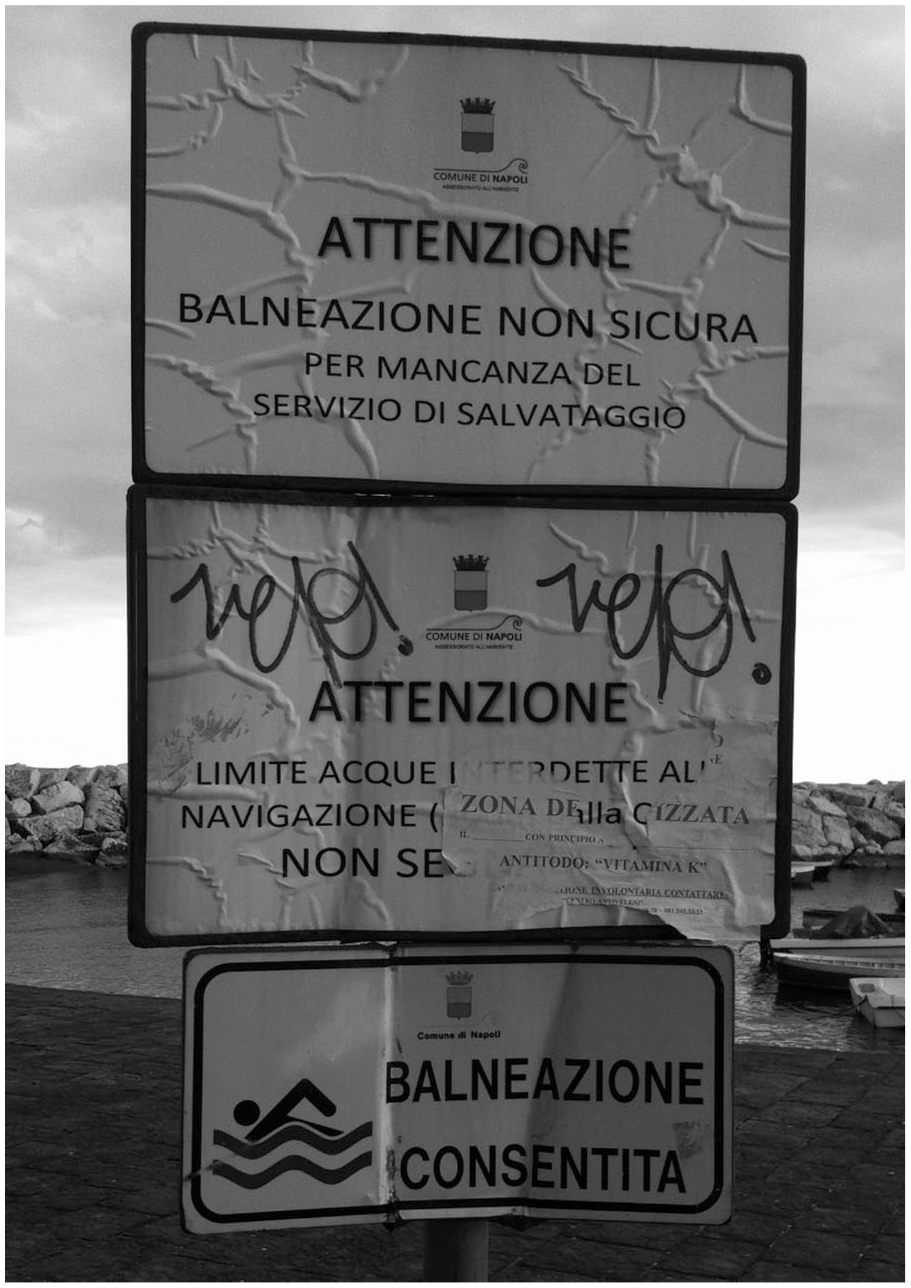
Border/sign ambiguity: when swimming is forbidden it is also allowed. The top sign reads “Swimming is forbidden – no lifeguard on duty,” while the bottom sign reads “Swimming allowed” (photo by L. Tateo, 2016).
The meaning of the border/sign is coercive while opening the possibility of its circumnavigation.
Temporality and bordering semiosis
Our interpretation of the myth of Romulus and Remus also suggests that borders exist and become salient and significant when they are meaningful to someone (e.g., when someone wants to cross them to go swimming, as in Figure 5). Even when there is no one actually crossing, the possibility (albeit remote) of an imaginary person intending to cross it is sufficient to maintain the border. Borders inhabit the realm of possibility (Bruner, 1986). Peirce’s idea of possibility is the infinite realm of Firstness; future possible individual events that we still do not know will occur (Noble, 1989). Like a representamen that is not in relation to any object, its interpretants in the future could be infinite and their meaning could equal zero: an empty signifier. Possibilities become meaningful only when they are bound to a relationship: The function of signs is always future-oriented—both in their immediate impact (turning the next immediate future into a new present) and their general orientation towards encountering similar situations in some indeterminate future moment. (Valsiner, 2014, p. 117)
A border does not exist if not as part of a system, as Thirdness. Like any sign, a border is an entity that demarcates something else in some respect or capacity. The meaning of a border “consists in what would be the case under circumstances if they remain unchanged throughout a series of actual occurrences” (Peirce, 1931/1958, Vol. 8, para. 226). Norms and values become instantiated—either prohibiting or enforcing conducts—as parts of the temporal continuity between habit and future orientation. Every sign, in the present moment, is partially constrained by the past experiences and the cultural suggestions present in the environment. Social talk, narrative, and artefacts precede the internalization of what is not yet there. The interpretation of a sign, hence the interpretation of a border, is channelled by the continuity with a past, habit, or “law.” Yet, the sign is also a horizon of possible new interpretations and a border is the horizon of potential overcoming. To the extent that borders are edges, they include both limits and horizons. Hence, “continuity necessarily presupposes possibility and cannot, therefore, be prescinded from it” (Noble, 1989, p. 170).
Historically, border zones are, at the same time, places of control and places of multiplication as (il)legal activities and trades. The human being is the “bordering creature that has no border” (Simmel, 1994, p. 10); establishing distinctions also implies opening connections and any crossing is also a new bordering (Marsico, 2011; Tateo, 2016): Borders have always been in motion, and the making and unmaking of borders is just a matter of time. . . . Yet, the trap of seeing the border line rather than viewing the dynamic interaction of which the border line is but one component, has rendered the simple border line durable and the complex motion surrounding it hazy if not superfluous. (Konrad, 2015, p. 1)
The relationship of temporality we have found in semiosis and bordering implies that meaning-making takes place on the edge of the constant move from a present moment to the immediate next one. Moreover, once the sign is produced, it immediately becomes part of a habit exerting a constraint to interpretation, reverberating into the future. Bordering is related to the purposefulness of meaning-making and to the future orientation of human activity (Tateo et al., 2018). Without temporality no semiosis is possible and, at the same time, semiosis is produced by distinctions in the flow of irreversible time. Crossing a border once or for the first time is qualitatively different from crossing it several times or every day.
Developmental aspects of bordering semiosis
Step by step, we are building the concept of border as a type of sign, an element of transition that simultaneously unites and divides two parts, accounting for both processes of continuity and discontinuity, conflict and negotiation, innovation and reproduction in meaning-making. The border indicates a separation (and a relationship) of different areas. The temporal emerging of a border can thus be applied to study human psychological functioning in the genesis of meaning. A phenomenon and its complement are identified by a person as X and non-X (e.g., I am X and not Y; X is fair and Y is unfair; inside is my home and behind the door is not my home). Meaning exists as a system in psychic experience: X becomes in a relation of distinction, substitution, unification, and temporality with non-X. The border zones can be embedded in the environment as culturally guided physical structures (Figures 3 and 6), sounds, smells, words, or any other form a sign can take. In order to have a regulatory function, they must appear at the intrapsychological level in what can be considered a general genetic law of bordering development: 1 borders first appear at the interpsychological level and then they appear again at the intrapsychological level as regulatory signs. A border is not an event that emerges at a certain point in time but is the outcome of a genetic formation with its own temporality (Tateo, 2018). Figure 6 shows a temporal border zone embedded into architectural elements.

The portal of the cathedral in Köln, Germany (photo by L. Tateo, 2019).
The portal of a Gothic cathedral is the liminal zone of transition from the outside to the inside. It has a certain depth and the lines of perspective suggest a specific way of crossing this border. For the ancient citizens of Köln, the figures adorning the portal were as many signs to be interpreted, and the temporal lapse required to cross from the full light of the outside to the special illumination of the inside was guided by the progressive narrowing of the funnelling shape. The act of crossing the portal was accomplished with a particular temporality and directionality, enacting conditions for crossing into a different affective and spiritual atmosphere. This also implies a value addition and a value distinction between the inside and the outside: the former acquires more value over the latter (Marsico et al., 2013; Marsico & Varzi, 2015). The temporal guidance of crossing is crucial in determining the value of the border itself. The longer the time, the more crossing becomes a liminal experience, as people daily crossing check points all over the world know (Español et al., 2019). Social guidance is also at work in creating meaningful temporal borders (Vygotsky, 1998), as, for instance, the multiplication of subsegmentation in the life course with the invention of adolescence, postadolescence, young adulthood, fourth-age, and so on.
Bordering is an act of signification that generates a differential (an asymmetry of magnitude in the value of the two sides) in many human affective experiences: “othering” (us and them), nostalgia (for the other side), secrecy (what is visible and invisible), and envy (the fruit in the neighbour’s garden). Different meanings and values are produced as the border creates an asymmetry between what is inside and what is outside. A border acquires its meaning from goals: a line may become a border depending on people’s purposes, actions, and intentions. Borders do not exist as fixed in time; they emerge, unfold, develop, and disappear in time. The double process of internalization/externalization between borders in space and borders in the mind (Hamez, 2011) creates a number of incongruities and connections in a constant dialectical movement. The border is thus a developmental locus that accounts for processes of continuity and discontinuity, conflict and negotiation, innovation and reproduction in living open systems (Marsico, 2016). It is a place of both tension and pacification, of meeting and potential clash, of discrimination and desire, of violence and dialogue. It marks and puts into relationship what is possible to know, to say, or to do with what is unknowable, unspeakable, or unworkable. It defines what is crossable and what is not even approachable, dividing order on one side and chaos on the other, but also showing people the possibility of crossing.
Conclusions
Are borders and signs the same thing? The answer is both yes and no. In ontological terms, the answer is of course negative and even useless. We know that in everyday life one encounters both signs and borders. Moreover, if bordering semiotics were a too- extensive notion, it would become useless like a concept without borders. We have argued that bordering is a semiotic process. So, borders can be understood as a special type of sign complex.
Human beings’ everyday environments are filled with some types of signs that may be interpreted as borders as well (Figure 7).

Signs and borders in everyday life (photo by L. Tateo, 2014).
Learning to recognize signs and borders in the environment is an important developmental task for the organism. The image of children spending a long time trying to learn to colour within the lines is a kind of stereotypical representation of education. The developing person is expected to internalize the dynamics of borders as a way to construct their own identity in relation to others. Learning what is allowed and what is forbidden at a specific age is a milestone of moral development in all civilizations. For instance, imagine a toddler trying to climb stairs. Their parent is immediately ready to tell them lovingly: “don’t do that, it is dangerous!” Initially, the stairs are not a border for the toddler. They rather represent an element in the environment that allows for climbing. The parent produces a particular sign (“don’t do that, it is dangerous!”) that at a certain moment becomes associated with the object “stairs.” A new meaning complex emerges in the environment and the stairs turn into a border. It is important to point out that no border would be meaningful without the toddler’s purposeful action of trying to climb it. Moreover, the value of the stairs changes as a consequence of the bordering. One can even expect its becoming even more attractive to climb because of the parent’s interdiction. However, the sign complex will not be effective unless the child has internalized the border/sign and uses it to regulate their conduct. They can choose to comply with the interdiction, reject it, ignore it, or simply produce a new sign that overcomes the previous one (“it is forbidden but I will climb it anyway”). Once a border/sign has been produced, it becomes a psychological tool for dealing with other humans and with the environment (Valsiner, 1999). It can also be internalized and orient one’s own psychological experiences (Vygotsky, 1997). This basic process of border internalization that creates a differential and a system of self-regulation is not limited to childhood. It is one of the most pervasive and strong elements of purposefulness and desire in the course of human life, from adolescence to adulthood. Humans strive to overcome a multiplicity of boundaries, in a process of constant “border crossing.” This basic principle is present in several phenomena, from marketing to sport performances. For instance, the meaning of: actions, places and events can be escalated–deescalated through processes of semiotic regulation of access to those objects. The most common form of symbolic regulation of access is any kind of ticketing. Establishing the price of an access and providing symbolic tools to mark it (tickets, bracelets, etc.) immediately can turn a quite ordinary holiday or concert, into an extraordinary experience. (Tateo & Marsico, 2019b, p. xxiv)
Borders exist as long as they are meaningful. At the same time, limiting the access to something makes it meaningful. Creating a border or a prohibition produces a differential between the two subparts of the system (e.g., “priority boarding,” “economy comfort,” or VIP zone) that acquire a special lure for consumers. One can easily naturalize borders, forgetting that a border does not exist unless people are interested in it, hence the “VIP zone” is no longer a convention but becomes an identity marker.
We have discussed bordering as a fundamental semiotic process of psychic functioning. We have presented borders in mind and society as particular types of signs that regulate our own and others’ conduct through cycles of selective internalization/externalization. Like the sign system in Peirce’s semiotic theory, the border/sign can only be understood as a whole (Figure 8).
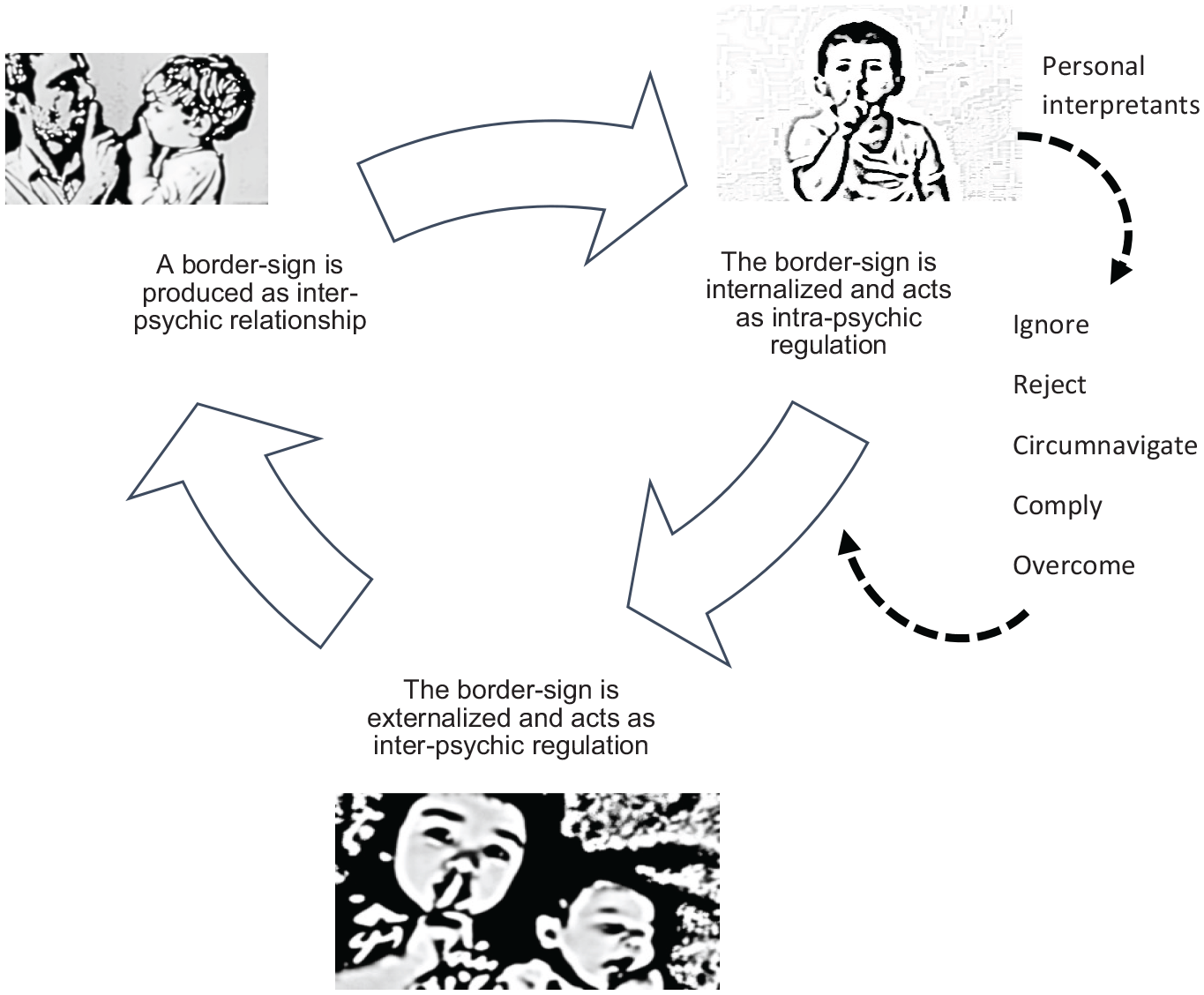
General genetic law of bordering development.
Therefore, we propose a general genetic law of bordering development that defines borders as sign complexes. First, they are tools created and established as interpsychic activities. A border is a sign complex that immediately creates a triadic system (A>non-A>border), in which a differential value is attached to distinction making (“A” must be better than “non-A” or vice versa, e.g., “living in paradise, which we have not experienced, must be better than our ordinary living”). Later, the border/sign is internalized and regulates meaning-making in relationship with the self (leading to different possible interpretants depending on the individual purpose), others, and the environment (through externalized signs).
One can conceive ontogenetic development as continuous production, maintenance, and demolition of border/signs, operating in both the inter and intrapsychological domain. In the external or physical world, borders organize the environment and space–time in which humans live. In the intrapsychic experience, borders regulate the feelings, sense of intimacy, and the definition/modification/negotiation of identities. The very moment a border is defined, it mediates the person’s relationship with the environment, creates a distinction in the field and in the flow of events, and shapes conduct.
The relationship is asymmetric because the two sides of the border do not have the same value for each person or group. Value depends on the agent’s directionality (Figure 8), which determines a certain degree of preference or value charging of one subpart compared to the other.
We are aware of the limitations of the current theoretical elaboration. Much empirical work is needed to provide a large phenomenology on the psychological functioning of borders in mind and society and to test if the theoretical model of the law of bordering development can be generalized. However, we have tried to draw a systematic understanding of bordering as fundamental semiotic process regulating psychic life. Humans constantly interpret, create, and modify the meaning of border/signs and act to establish and maintain them.
Footnotes
Declaration of conflicting interest
The authors declare that there is no conflict of interest.
Funding
The authors received no financial support for the research, authorship, and/or publication of this article.
Ethical statement
This article does not contain any studies performed by the authors involving human participants or animals.
