




Abstract
Children are socialised to understand themselves and others through gender categories. However, there are few observational studies of how this happens in social interaction. Based on video-recorded interactions at a UK preschool nursery setting, this study uses ethnomethodology and conversation analysis to examine the extent and ways cis-heteronormativity is reproduced through gendered descriptions in interactions involving children and adults in preschool role-play activities. The everyday play activities of 26 children (3–4 years old) were video-recorded over a period of 6 months, totalling 7 hours of recordings. Four episodes of role play were identified in which children used gendered descriptions to organise and allocate roles to themselves and other children. One adult used gendered descriptions to validate or correct the children's role allocations. The children's and the adult's actions in many ways reproduced cis-heteronormative assumptions of identities and relationships. These assumptions were integral to the ways in which they made sense of one another's actions and organised their participation within emerging role-play scenes. The children's role allocations nevertheless sometimes departed from cis-normative expectations, thus leading to a composite picture. This study contributes to a growing body of research that highlights the ways in which gender normativities can shape interaction.
Aided by social scaffolding such as books and films, cis-heteronormativity shapes identities and relationships in “largely invisible” ways (Ericsson, 2012, p. 406). This study examines the extent and ways cis-heteronormativity is reproduced through gendered descriptions in interactions involving children and adults in preschool role-play activities. The article contributes to research on gender and language socialisation, feminist research on gender and language and studies of children's social interactions in Western settings. In this introduction, we provide an overview of these research areas, and our theoretical framework grounded in feminist, ethnomethodological and conversation analytic (EMCA) theory.
Gender and Language Socialisation
The earliest experiences of language socialisation are linked to gender categories. In the United Kingdom (UK), the national context of our study, most babies are described as boys and girls from birth, and frequently in utero. The expectation that binary gender categories and their culturally informed attributes exhaust the field of gender possibilities is set before a child is even born (Kane, 2006). Through their earliest interactions with adults, children learn to "understand human behaviour in terms of (the two available) gender categories” (Cromdal, 2011, p. 294).
Language and gender are linked, with language informing how children learn about gender and gender informing how children use language (Sheldon, 1990). The primary contexts of language socialisation are family and early socialisation settings. Preschool settings, including nurseries – the setting for this study – constitute for many children one of the first contexts in which they are socialised into gender norms.
Ethnographic studies have explored the role of gender in the social organisation of girls’ and boys’ play activities (Cahill, 1986; Goodwin, 1980, 1985; Lever, 1976), the development of gender terms in children's language socialisation (Eckert & McConnell-Ginet, 2013; Sachs, 1987) and the expression of gender in classroom discussions (Davies, 2003). Much childhood gender and language research has focused on differences between girls’ and boys’ play behaviour, including boys’ use of more task-oriented assertive speech acts (Leaper, 2000) and girls’ avoidance of appearing dominant (Goodwin, 1980). Research examining gender differences has claimed that boys are socialised to assert dominance, whereas girls are socialised to maintain collaboration (Maltz & Borker, 1982). More recent research has explored societal influences on gender socialisation, including educational settings (Bhattacharjee, 2021; Chapman, 2016), films (Baig et al., 2021) and parenting (Morawska, 2020). Though undoubtedly valuable research, many ethnographic studies treat gender as a preestablished and exogenous factor rather than a dimension whose relevance is constituted within interaction. West and Zimmerman (1987) shifted this perspective to one that conceptualises gender as something people do.
Ethnographic studies seldom examine details of talk-in-interaction whereby participants observably orient to, embody and reproduce gendered norms through their social actions. EMCA enables us to document practices whereby participants deploy gender categories as resources in the constitution of their courses of action and how, by doing so, they reflexively (re)produce particular gender identities and relationships as normative (Butler & Weatherall, 2011; Cromdal, 2011; Goodwin, 2011; Kitzinger, 2005). The payoffs of this approach are to reveal how gender categorisation is intimately embedded in the very details of how participants design their actions to accomplish practical tasks in everyday life, and to examine how gender as a form of social organisation is constantly maintained through participants’ situated actions.
Cis-Heteronormativity
Feminist research has identified heteronormativity as a set of normative assumptions that establish attraction between opposite genders as the norm (Berlant & Warner, 1998; Ellis et al., 2020; Ericsson, 2012; 2018; Schilt & Westbrook, 2009), whilst marginalising other sexualities (Ericsson, 2021). Heteronormativity requires and reflexively reinforces gender binarism, which establishes female and male genders as opposites, and cis-normativity (Schilt & Westbrook, 2009), which establishes correspondence between sex assigned at birth and lived gender as the norm (Ericsson, 2021). Cis-heteronormativity can thus be conceptualised as a set of assumptions establishing a particular configuration of gender identities and relationships as normative: the heterosexual relationship of a cis-gender man and a cis-gender woman. To investigate whether and how these assumptions are (re)produced in interactions involving children and adults, we draw on ethnomethodology and conversation analysis.
Ethnomethodology
Ethnomethodology investigates the commonsense knowledge and methods that members of society use to make sense of their social worlds (Heritage, 1984). Garfinkel’s (1967) study of Agnes – a person who might today identify as transgender – identified practices whereby sex status is achieved in social interaction, thus reconceptualising it from a fixed and predetermined category to a situated accomplishment. Though Garfinkel's terminology and objectification of Agnes is problematic (Goldberg, 2019; Serano, 2024), the study built the foundations for a theory that makes observable the methods participants use to do gender in interaction (Stokoe, 2006; West & Zimmerman, 1987). Kessler and McKenna (1978) extended investigation into practices people use to attribute genders to others in social interaction (Kessler & McKenna, 1978). These seminal studies reframed gender as a collaborative accomplishment (C. Butler & Weatherall, 2011), shifting analytic attention from the internal and individual to the social-interactional and institutional arenas in which gender is constituted (West & Zimmerman, 1987). This view centres the reflexive processes whereby gender is both “created through interaction and at the same time structures interaction” (West & Zimmerman, 1987, p. 131).
Some scholars have critiqued the ethnomethodological approach on the basis that it reduces gender to a doing or performance (McCarty & Breneman, 2016), thus neglecting, on the one hand, that many, if not most, experience gender as the result of intrinsic inclinations, and, on the other hand, that others gender us “primarily based on our physical bodies rather than our behaviours" (Serano, 2024, p. 192). Our use of ethnomethodology is not meant to artificialise gender by reducing it to a social construct. Gender is, rather, an experienced and lived reality shaped by multiple determinants, including biology (J. Butler, 2024). We are more interested in social interaction as a field where practices are deployed to display, attribute and mobilise gender as a resource to accountably organise and make sense of everyday activities in “seen but unnoticed” ways (Garfinkel, 1967, p. 36). Under such conditions, some gender categories and their attributes are centred and normalised, whilst others are marginalised and rendered unintelligible; and gender normativities are variously reproduced or, alternatively, upset and destabilised.
Ethnomethodology further enables us to appreciate how learning to do gender is embedded in children's socialisation. From a young age, children display knowledge about gender categories (C. Butler & Weatherall, 2011; Goodwin, 2011; Sheldon, 1990), which they use to make sense of what they see and hear. Children learn that gender categories, like other social categories, come with rights and responsibilities (Sacks, 1972), so that their incumbents are expected to behave in certain ways. Adults mobilise category-bound attributes to sanction conduct – including language use – that they treat as departing from social expectations (Cromdal, 2011). This contributes to the reproduction of inequity, such as when a girl is called “bossy” if they tell someone what to do, whilst a boy is called “assertive” whilst performing the same action (Sheldon, 1990, p. 10). The deployment and reproduction of gender categories and associated attributes are also central in socialising children to cis-heteronormativity. Research has evidenced that when engaged in play, children work to maintain a social order that is implicitly “hetero-normal” (Goodwin, 2011, p. 252).
Conversation Analysis
Conversation analysis (CA) investigates the practical resources that participants use to accomplish courses of action in social interaction (Robinson et al., 2024). This includes ways in which participants negotiate participation through practices of turn-taking; collaboratively coordinate courses of action through practices of sequence organisation; and address issues in speaking or signing, hearing or seeing and understanding through practices of repair (Raymond & Robinson, 2024).
CA further centres the ways in which participants mobilise social categories to accomplish courses of action (Sacks, 1992). CA brackets researchers’ presuppositions about the relevance of social categories, including gender, by instead focusing on the observable ways in which participants make categories relevant and consequential at specific points in their interactions (Schegloff, 1992; Stokoe & Weatherall, 2002).
Feminist CA uses CA methods to address feminist concerns, investigating how social norms entailed in perpetuating inequity are reproduced through participants’ actions (Ericsson, 2021; Kitzinger, 2000, 2005; Land & Kitzinger, 2005; Mondada, 2021; Ostermann, 2017). As an example, Kitzinger’s (2005) study of out-of-hours calls to a medical practice in the UK demonstrated the ways in which a doctor made sense of callers’ family arrangements in ways that embodied and reproduced heteronormative assumptions. Especially interesting for our study is that the participants in these calls did not demonstrably orient to how their actions may have reproduced heteronormativity. They were “simply getting on with the business of their lives. In so doing, the social order they reproduce is profoundly heteronormative: in these calls the nuclear family is always a heterosexual one, individuals are (apparently) universally heterosexual” (Kitzinger, 2005, p. 494). Similarly, in our study, we do not claim that children and adults consciously reproduce or challenge cis-heteronormative assumptions but that certain configurations of gender identities and relationships are resources they observably mobilise to organise their activities, and these deployments have emergent effects in terms of normalising or upsetting cis-heteronormative arrangements.
We expand existing research by investigating children's early social interactions. Normative assumptions of gender binarism and heterosexuality can be reproduced by adults’ and children's actions in interaction (Bergstrom-Lynch, 2020). We focus on role-play activities in a UK nursery setting. In the UK, nursery settings are instrumental in children's early socialisation and interactional development, with “85% of 3 and 4 years olds attending formal childcare settings” (Farquharson & Olorenshaw, 2022, p. 2), and government allowances supporting 15–30 hr per week. Although there has been valuable CA research done in nurseries (Kyratzis, 2000; Monaco & Pontecorvo, 2010), this is still a largely unexplored setting, especially when it comes to investigating gender and sexuality normativities. This study thus asks whether and how children and adults reproduce cis-heteronormative identities and relationships by deploying gendered descriptions as resources to organise role play.
Method and Data
Research Site
The first author video-recorded naturally occurring interactions in a UK nursery in 2024. The nursery offers full-time care to preschool-aged children in three age groups: 0–2 years (Group A), 2–3 year olds (Group B) and 3–5 year olds (Group C).
Participants
From our video-recordings of Groups B and C, we focus on Group C, where children use language more. Data from Group C comprise nine video-recordings for a total running time of 7 hr. The group involved 26 children whose parents provided written informed consent, and eight staff members who provided written informed consent. Written informed consent included permission to publish pseudonymised transcripts. Ethical approval was provided by Loughborough University Ethics Review Sub-Commitee (ID 2023-14530-15900). All interactions were in British English.
Rather than assuming participants’ gender based on names and appearance (Ansara & Hegarty, 2014), we refer to participants’ gender based on how they self-define and are identified by others in the setting (at the time of data collection, no incongruities between these were observed).
Data Collection
Group C had a designated space consisting of two adjoining rooms and an outdoor area. Video cameras captured free play sessions in two corners of one room (red dots in Figure 1): one with either a climbing frame or self-fastening panels, and the home corner with child-sized replica of furniture and utensils. Play in these areas was typically led by the children, though the staff sometimes suggested activities.
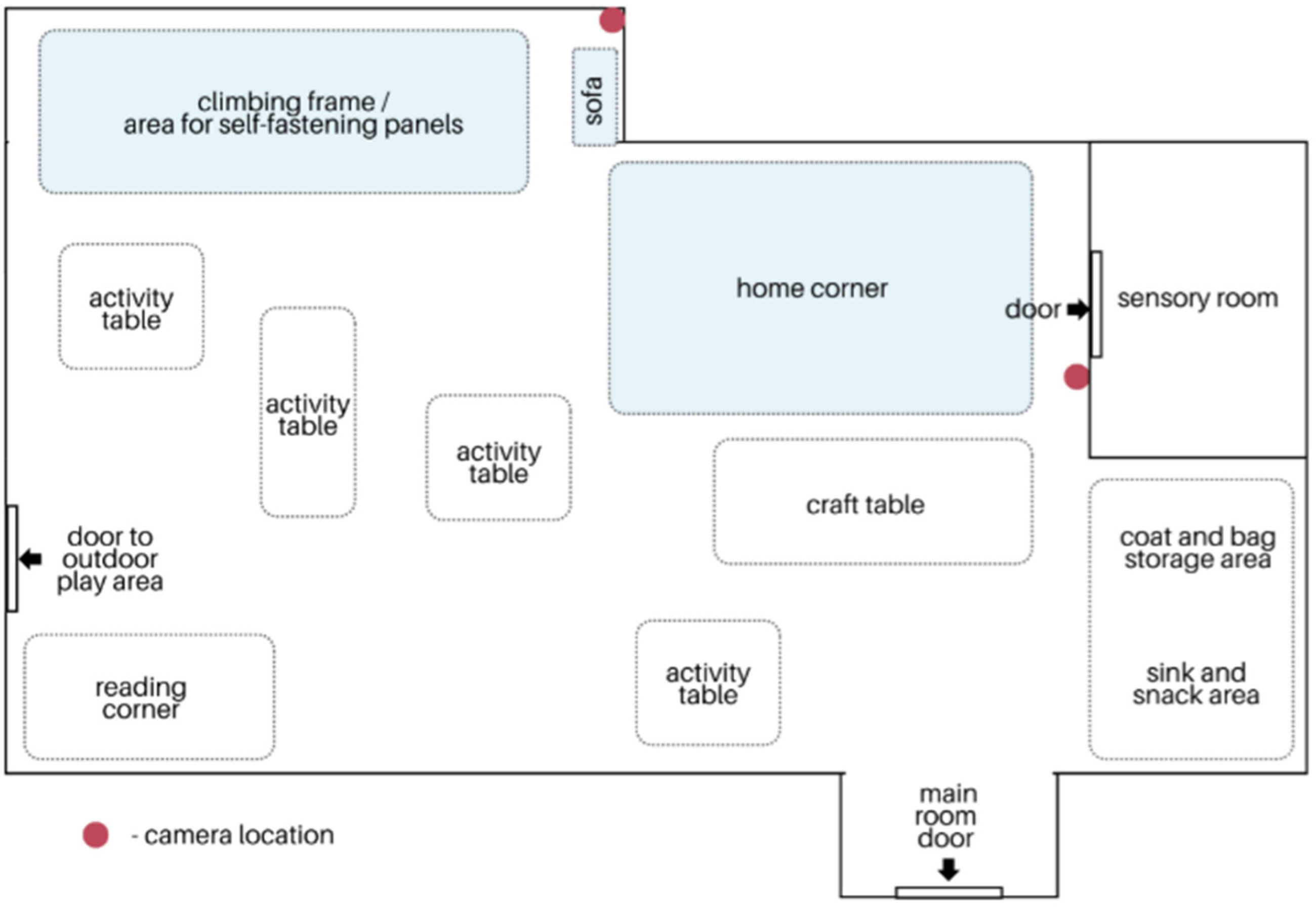
The room’s layout.
Data Analysis
The first author screened the dataset for instances where participants’ actions made gender relevant. This was rarely observed, arguably because of the selectivity necessarily associated with camera placement, the difficulty of comprehensively capturing action in large rooms where many children were often mobile and the noise levels making it difficult to always discern children's spoken interactions. We nevertheless identified four episodes of interaction in which participants used gendered descriptions – such as being a girl, boy, mummy, or daddy – to allocate roles within role play. We understand role play as creating an imagined reality in which participants embody roles other than those they ordinarily embody (e.g., a child performing being a parent; Vygotsky, 2004, as cited in Devi et al., 2021). In these episodes, role play was initiated by children rather than prompted by adults.
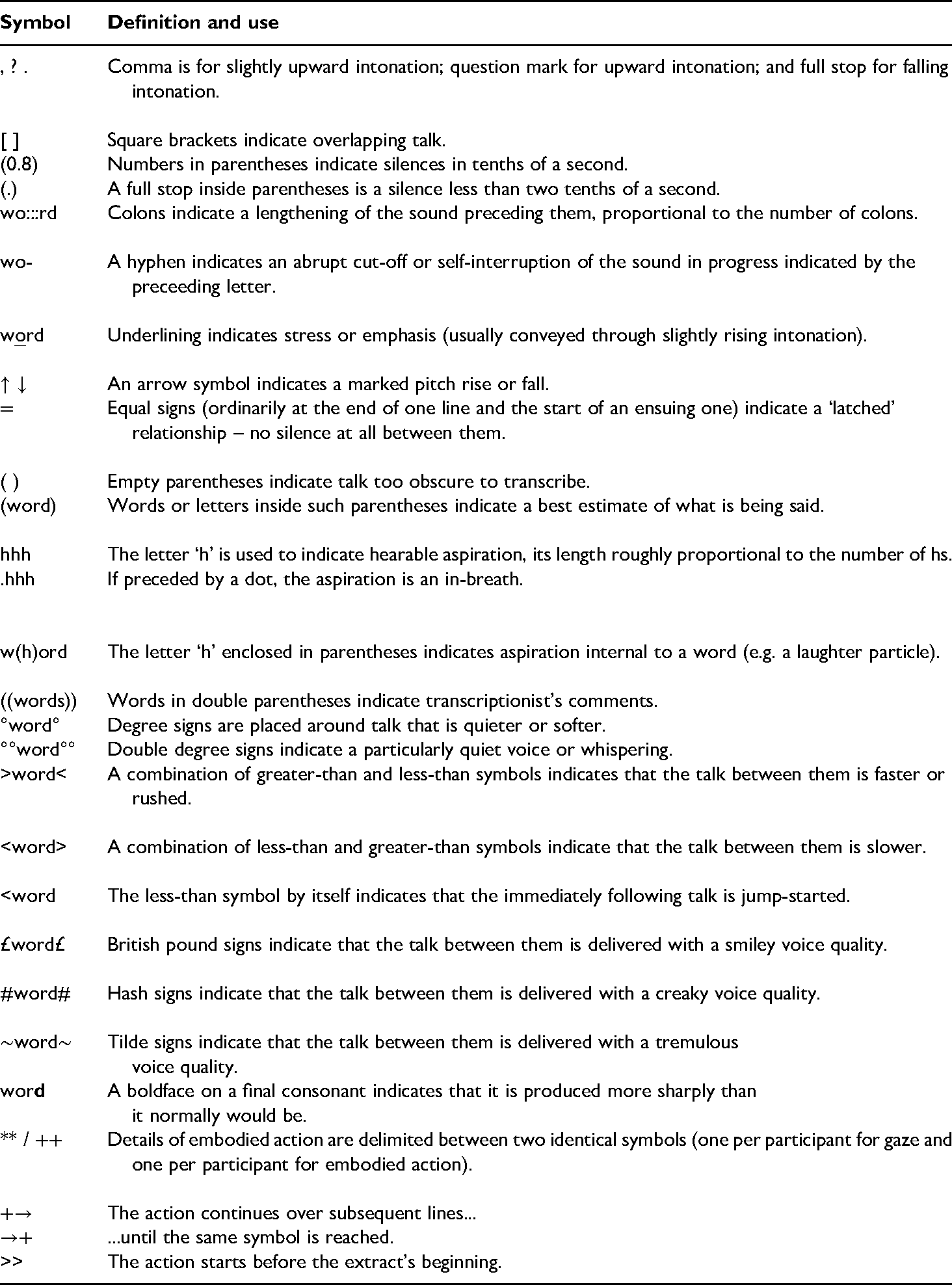
The first author transcribed the interactions using CA methods for representing talk (Jefferson, 2004) and visible conduct (Mondada, 2018). Mondada's method expands Jefferson's by marking the moments in which visible actions (e.g., manual gestures) start and end within the temporal forward movement of interaction. This is accomplished through symbols to mark the onset and offset of visible actions relative to talk and silences.
Analysis proceeded by using CA methods to examine role allocations as social actions. This involved systematic, line-by-line scrutiny of their sequential placement, and of how they simultaneously responded to prior talk and conduct and shaped subsequent participants’ actions. Analytic attention was also given to compositional features including use of categories, laughter and intonation.
In line with our feminist CA focus, we characterised the extent and ways in which role allocations and uses of gendered descriptions within them reproduced cis-heteronormativity. In three of the four episodes, children role-played familial relationships (the remaining episode of role play, shown as Extract 3, did not feature family relationships). Within these, they consistently produced heterosexual relational arrangements. We also found that in three of the four episodes, participants’ actions produced cis-normative arrangements, as detailed in the next section. The extracts in this article are from the four episodes of role play that constitute our collection, and thus comprehensively illustrate our findings.
The extracts feature Mondada's (2018) conventions to represent details of embodied action, including gaze, movements, manual actions and gestures (see Appendix).
The primary method used to validate analyses was the next-turn proof procedure (Raymond & Robinson, 2024), which grounds analysts’ accounts of participants’ actions in the understandings that participants themselves display through their responses to one another's actions. The analyses we report in the next section include discussion of this source of evidence.
Findings
Three of the four episodes of role play feature family relationships. In all these cases, participants’ actions leverage heterosexual understandings of identities and relationships to organise role play. They deploy gendered categories (such as mummy, daddy, queen, king) that provide a framework for how the pretend characters relate to each other. In pairing mummy and daddy, and king and queen, these gendered role categories normalise heterosexual relationships through children's sense-making of the constructed pretend world. In three of the four episodes, participants’ actions also embody cis-normative understandings of identities by mapping children's roles onto their lived genders. We report these findings in two sections dedicated to children's and staff's uses of gendered descriptions respectively.
Children's Uses of Gendered Descriptions
The children organise role play by specifying and filling category sets of players (Bateman & Butler, 2014; see also C. Butler & Weatherall, 2006; Sacks, 1992). In the three episodes where they use familial relationships to organise play, they incrementally build a family structure centred around a heterosexual couple and use this as a resource to allocate roles, as Extract 1 exemplifies.
George, Archie and Ben (all aged 3) are playing on the climbing frame. They are known and present as boys.
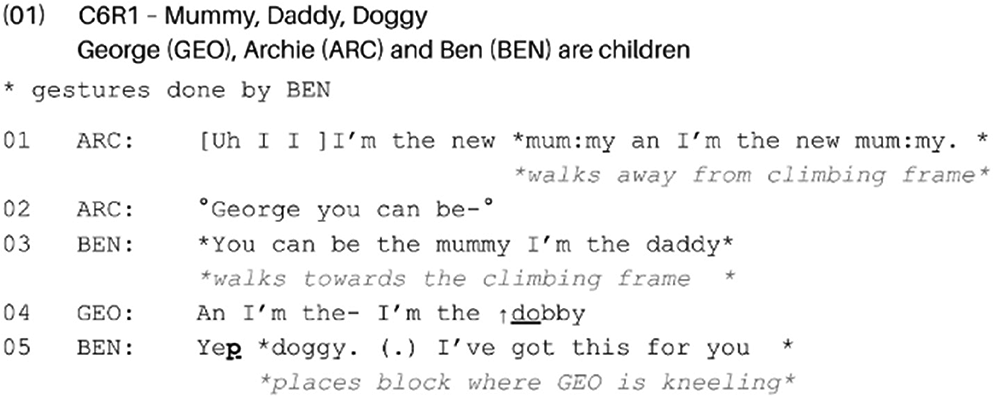
Prior to this extract, George was underneath the climbing frame and Ben asked him about the noises he was making, which were excited dog noises. This exchange is halted as Archie looks at Ben and George and produces Line 1. Archie uses the gendered description “new mummy” to self-allocate that role (Line 1). “New” suggests that the role may have been filled by someone else in prior play (not captured by our cameras). “The” establishes the presence of no more than one mummy and is thus compatible with (and can even be heard as inviting the realisation of) a family structure built around a ‘standard relational pair’ (Sacks, 1972) of one mummy and one daddy.
Archie's self-allocation is not challenged. Indeed, Archie's subsequent attempt to allocate a role to George is cut off (Line 2) as Ben steps in to validate Archie's self-allocation and self-nominate for the complementary role of “daddy” (Line 3). This response realises the heterosexual relational pair implied by Archie's use of “the” in Line 1. George further builds on this to self-allocate the role of “doggy” (Line 4). Whilst this choice validates the established relational pair, it interestingly departs from a norm of reprogendering (Hornscheidt, 2015) whereby reproduction is essential to the life of a heterosexual couple. George's self-allocation does not materialise the presence of children otherwise implied by Archie's and Ben's self-allocation of the roles of mummy and daddy.
Extract 1 is also the only episode in our collection showing an unproblematic departure from cis-normativity. Archie's self-allocation of the “mummy” role does not leverage his gender as a boy and unproblematically self-allocates a role conventionally associated with girls and women. It thus departs from expectations of gender constancy – a feature of cis-normativity that “constructs women and men as coherent, natural genderings which are given at birth and which remain constant over time throughout a person's life” (Hornscheidt, 2015, p. 37).
It has been suggested that children only develop a sense of gender constancy between the ages of 4 and 7 (Serano, 2024). This could help interpret Extract 1. However, the other episodes in our collection show gender constancy being upheld by adults and by children aged 3–4. Extracts 2 and 3 exemplify these findings.
In Extract 2, Sai (age 3) is standing on the climbing frame and attempts to recruit Piper (age 3) to role play. Immediately prior, Piper was told by a staff member, Josie, to take off her shoes and socks before she joins Sai on the climbing frame (part of the nursery safety protocol), and as she sits on a nearby sofa (Figure 1) to do this, she is joined by Archie (age 3). In Lines 4, 7–8 and 10, Piper and Archie have a separate conversation about something on the floor, not related to Sai's attempt to recruit Piper to role play. Sai and Archie are known and present as boys, Piper as a girl and Josie as a woman.
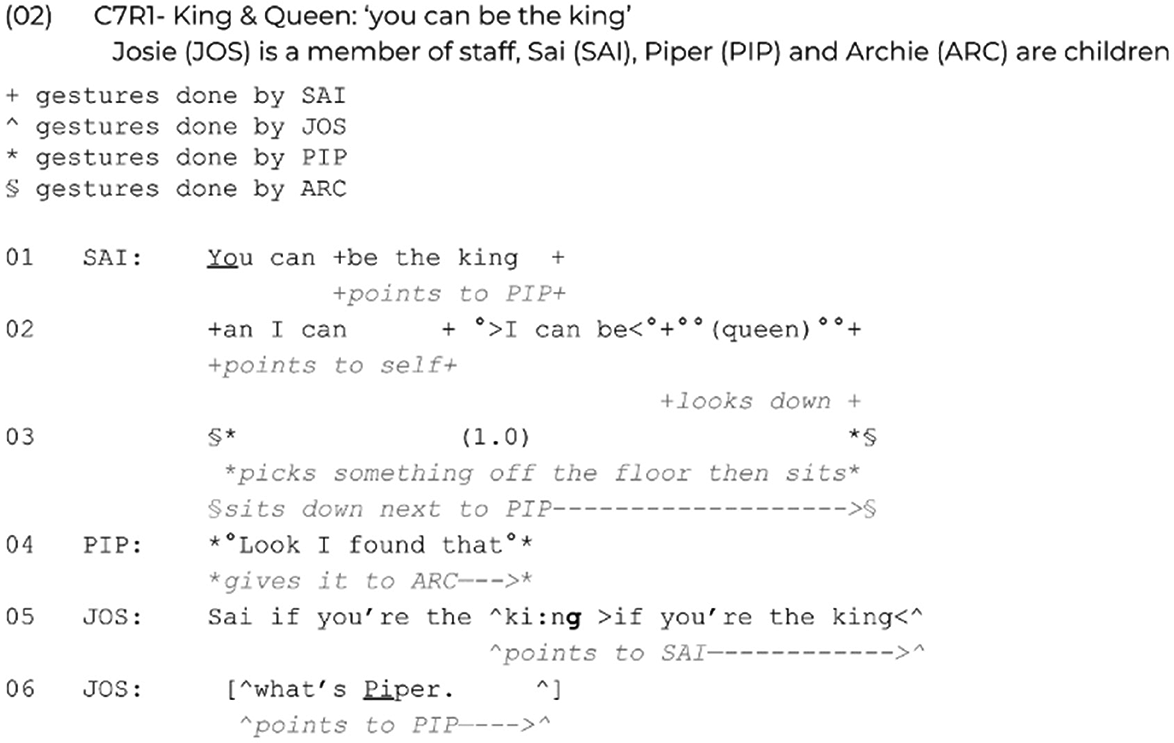
It is possible that before Extract 2, the children have initiated role play and that this is undetectable to us due to background noise. Regardless, Sai attempts to recruit Piper by assigning her the role of “king” (he points to Piper in Line 1). The use of “the” king (Line 1) is compatible with (and can even be treated as inviting) the addition of a queen, thus enabling a heterosexual relational configuration. Concurrently, Sai's allocation departs from a cis-normative expectation of gender constancy by allocating a traditionally male role to a girl. Unlike Extract 1, though, Sai's allocation in Extract 2 displays interactional trouble and is eventually corrected.
Having nominated Piper for the role of king, Sai proceeds to name the role of “queen” (Line 2), thus realising the heterosexual unit implied by his use of “the” in Line 1. As he proceeds to self-allocate the role of queen, Sai first utters “an I can” (Line 2), but this is followed by audible hesitation. He engages in self-initiated self-repair (Bolden, 2018), halting the progression of his turn-at-talk and restarting it with “I can be”, followed by “queen” uttered at a significantly lower volume whilst shifting his gaze away from Piper and looking down.
Sai's audible hesitation appears to provide the opportunity for Josie to step in (Line 5; in Line 4, Piper is not responding to Sai as she is engaged in an unrelated interaction with Archie, who responds to Piper in the interaction that follows [data not shown]). Josie's action emerges as a known-answer question, which invites Sai to correctly locate Piper's role in the king–queen relational pair based on the understanding that Sai will occupy the role of king. With this assistive action, Josie treats Sai's trouble in turn production as failing to allocate roles through a correct application of assumptions grounded in heterosexuality and gender constancy. Therefore, Josie's action not only reinforces the heterosexual pairing already instituted by Sai's action, but it also maps play roles onto the children's lived genders, in line with gender constancy. We further examine Josie's actions in the next section.
Extract 3 demonstrates that children's actions can also uphold (rather than depart from) gender constancy in role allocations. Prior to Extract 3, Ben (age 3), Lucy (age 4) and an adult volunteer, Max, have been using fastening panels to build a child-sized hospital and established where the different areas of the hospital are. Max is known and presents as a man, Ben as a boy and Lucy as a girl.
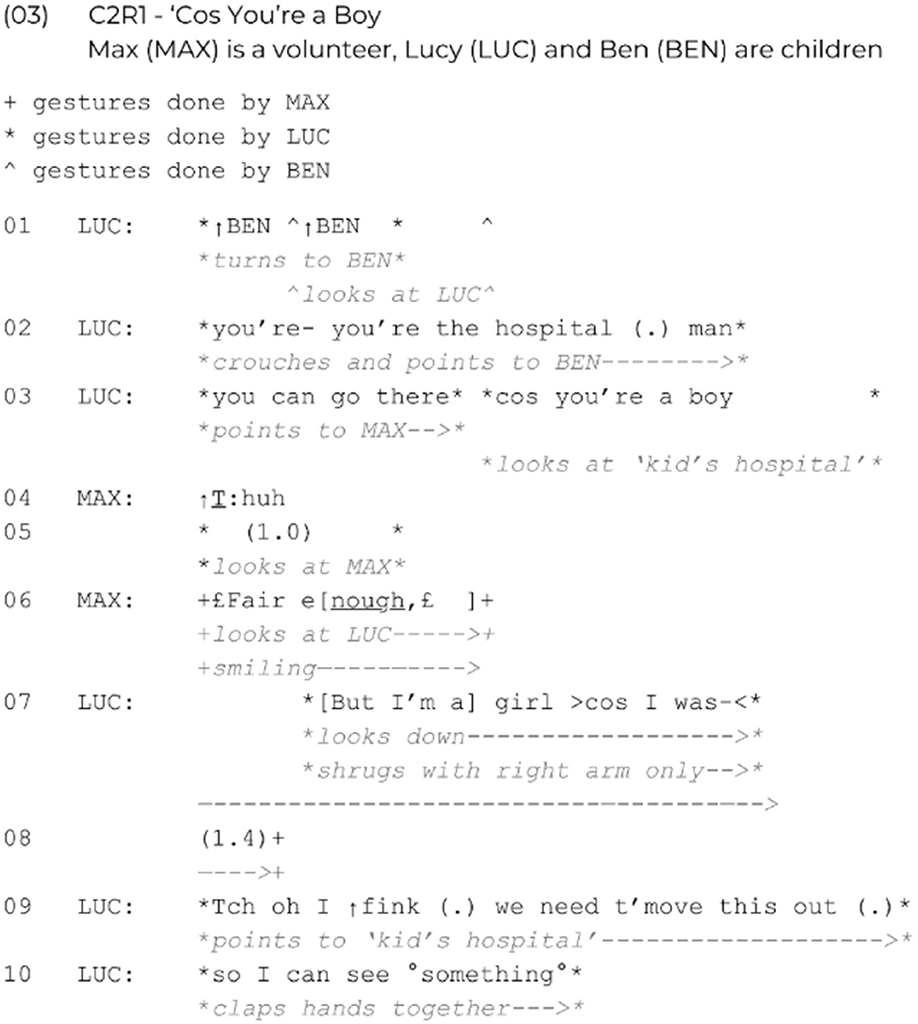
After summoning Ben (Line 1), Lucy uses a gendered description to allocate the role of “hospital man” (in context, doctor) to him (Line 2). She then allocates the role of child patient to Max by describing him as “a boy” (Line 3) whilst instructing him to go to a location, which she gazes at, that had previously been designated as the children's hospital (data not shown). The roles Lucy assigns to Ben and Max match their genders, but they do not match their ages – Ben being assigned the role of doctor, and Max, the role of a child patient. This could be the aspect of Lucy's directive (Line 3) that Max treats as laughable (Lines 4 and 6). The laughter (Line 4), the smiley voice in his concessionary “Fair enough” (Line 6) and his smiling gesture whilst gazing at Lucy (Line 6) can be seen as responses to being allocated the role of “boy”. Max's responsive conduct could also be treating as inapposite an adult receiving a directive from a child – though any time spent in the company of preschool children has likely familiarised him to such occurrences. In any event, Max's response can be understood as not fully aligning with Lucy's action. Importantly, his laughter, verbal response and smiling (Lines 4–8) do not make explicit what aspects of that role allocation he specifically treats as inapposite, and are thus designedly ambiguous (Holt, 2012). This accounts for why Lucy's response (Line 7) addresses Max's action as a challenge but treats as challenging yet another aspect of her role allocation – its gendered basis.
The turn-initial “but” frames her turn as an objection (Line 7), and her shrugging gesture appears to display resistance to Max’s prior action. Her objection consists of invoking her own gender (Line 7). Although at this point, Lucy has not yet self-allocated a role, she appears to be implying that her role allocations should not be challenged on the basis that they match the participants’ genders. This is consistent with her role allocations (Lines 2–3), which aligned role-play genders to Ben's and Max's lived genders. Extract 3 thus exemplifies how children can organise play, distribute roles and uphold role allocations in ways that reproduce cis-normative assumptions about gender constancy.
To summarise, when the children enact family roles, which happens in three out of four episodes of role play, they reproduce heteronormativity by building a heterosexual family unit, as shown in Extracts 1 and 2 (the remaining case in which this happens is shown later as Extract 4). In three out of four episodes, participants’ actions embody cis-normative expectations of gender constancy, as seen in Extracts 2 and 3 (the remaining case is shown later as Extract 4). In only one case, the children's role allocations unproblematically depart from gender constancy (Extract 1).
Staff's Uses of Gendered Descriptions
Role play in our data is initiated by the children without adult intervention. The adults nevertheless sometimes participate in role play (Extract 3), ask questions about it and comment on it (Extracts 4a–b and 5a–b). Given our focus, we looked for instances in which staff members use gendered descriptions within these episodes of interaction. We found that one staff member, Josie, uses gendered descriptions to validate the children's role allocations (Extracts 4a and 4b) or to correct them (Extracts 5a and 5b). Across these cases, Josie's actions reinforce cis-heterosexual identities and relationships.
Validating Role Allocations Through Repetition
Josie uses repetition to validate role allocations and thereby contributes to reproducing a normative common ground (Clark, 2009) of cis-heterosexual relationships and identities.
In Extract 4a, Josie joins Nikolas (age 3), Meredith (age 4), Elsa (age 4) and Cole (age 3). Nikolas and Cole are known and present as boys, Elsa and Meredith as girls and Josie as a woman.
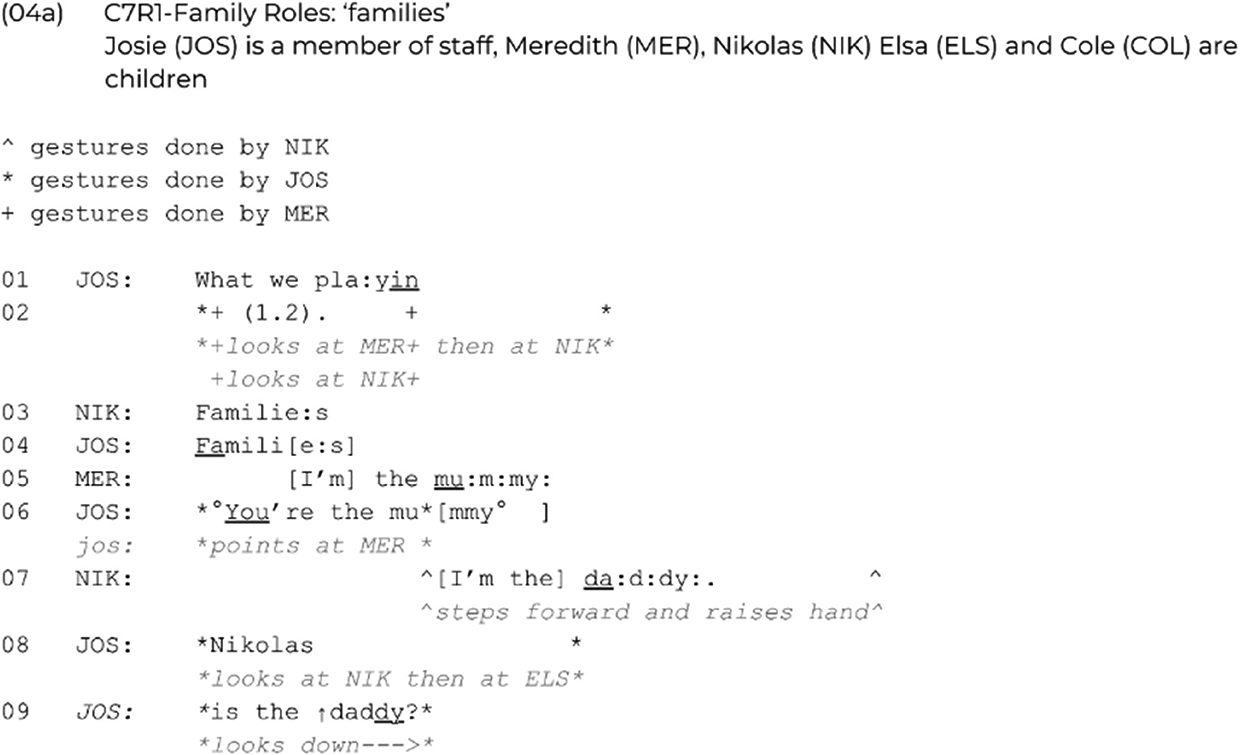
Josie asks about the play in progress (Line 1). Nikolas describes it as “families” (Line 3), which Josie repeats (Line 4). The intonation at the end of “families” in Line 4 is audibly level and largely matches the intonation and volume of Nikolas's previous turn. Josie's repetition can thus be heard as validating Nikolas’s answer (rather than initiating its repair).
Meredith extends the sequence by specifying her role with “I’m the mummy” (Line 5) in slight overlap with Josie's “families” (Line 4). This response embodies Meredith's understanding that a family normatively contains a “mummy”. Her use of “the” is compatible with a heterosexual family built around a standard relational pair.
Josie's repetition, “you’re the mummy” (Line 6), again expressed with level intonation at the end of “mummy” – whilst pointing towards Meredith – validates Meredith's self-allocation. Nikolas self-allocates the role of “daddy” (Line 7) and thus realises what was implied by Meredith's previous self-allocation: a heterosexual family structure.
Josie does something different when validating Nikolas’s self-allocation, however, as she refers to him in the third person, and the intonation of her repeat rises at the start and end of “daddy” (Lines 8–9). She also shifts her gaze from Nikolas to Elsa as she says “Nikolas” (Line 8). The rising intonation marks Nikolas's self-allocation as one item in a series in progress, thus – coupled with the glance to Elsa – inviting the other children to nominate their roles within the emerging family structure. This is confirmed in Extract 4b, which continues immediately from Extract 4a.
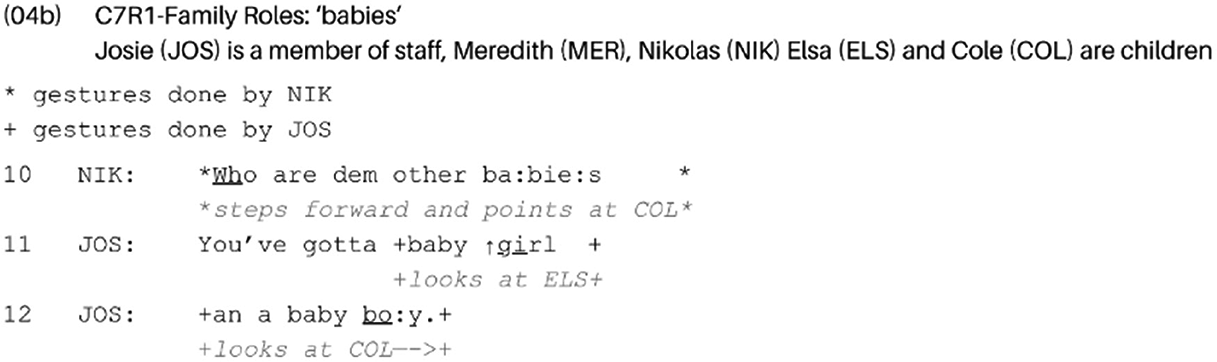
Nikolas's action (Line 10) treats Josie's previous turn as making relevant the articulation of additional roles, as he steps forward and asks, whilst pointing at Cole, “who are dem other babies” (Line 10). With this, Nikolas recruits others into his and Meredith's game, proposes roles for Elsa and Cole 1 and demonstrates his understanding that a family is perhaps incomplete without “babies” – an example of how reprogendering (Hornscheidt, 2015) is instantiated in play.
Josie's response (Lines 11–12) can be heard as answering Nikolas's question (Line 10) on behalf of Cole and Elsa. By reusing the term “baby”, she validates Nikolas's recruitment of Cole and Elsa into those roles. Josie's response further reproduces a norm of gender constancy. She nominates Elsa into the role of “baby girl” (Line 11), and Cole into the role of “baby boy” (Line 12). As Nikolas's role allocation shows (Line 10), it is not necessary to gender babies in role-play activities. It is interesting therefore that Josie does that, treating the children's gender as a resource to allocate roles. These actions consolidate gender constancy as a criterion for role allocation and reinforce cis-heteronormative understandings of familial identities and relationships.
Correcting Gendered Descriptions
Correction is an action remedying problematic aspects in one's own and others’ conduct, including instances where conduct embodies a “lapse in competence” (Jefferson, 1987, p. 88). Extracts 5a–b show how Josie corrects children's gendered descriptions that appear to depart from cis-heteronormative understandings of identities and relationships.
Extract 5a extends Extract 2. As noted previously, in Lines 4, 7, 8 and 10, Piper and Archie are engaged in a separate conversation. Piper, thus, does not respond to Sai's recruitment.
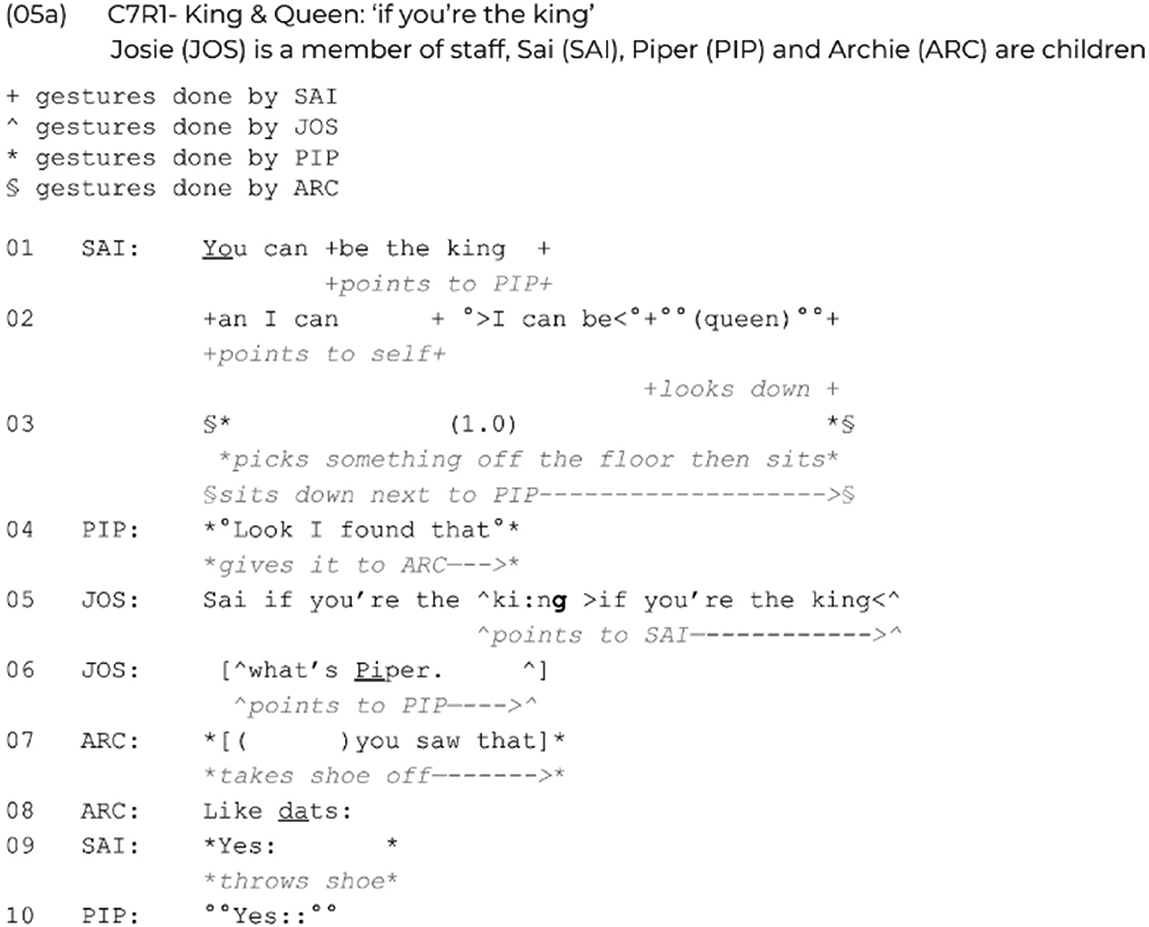
Sai displays interactional trouble when self-allocating a role (Line 2), which recruits Josie to assist (Kendrick & Drew, 2016). Josie's “Sai if you’re the king” (Line 5) may seem puzzling in the context of Sai having self-allocated the role of queen (Line 2). We propose two analytic possibilities.
First, Josie might not have heard Sai's articulation of “queen” (Line 2) clearly (it is uttered very quietly, leading us to transcribe it tentatively in parentheses; see Appendix). Josie might be producing a guess about what Sai said. Under this analysis, Josie's action instantiates gender constancy by consolidating Sai's presumed self-allocation of the role of king and by inviting correction of his allocation of the role of king to Piper (it seems clear that Josie has heard Line 1, otherwise, it would be difficult to make sense of Line 6).
Second, Josie may have heard “queen” (Line 2) and proceeded on the assumption that this was a word-based error and that Sai meant “king”. Under this analysis, Josie's Line 6 still invites a self-correction of Sai's Line 1; and Josie's Line 5 features an embedded correction of Sai's Line 2 (on embedded correction, see Jefferson, 1987). Under both analyses, Josie's actions consolidate an emergent heterosexual family unit whilst instituting gender constancy.
The “if” formulation in “Sai if you’re the king” (Line 5) projects an if–then compound turn design, which invites Sai to wait until the “then” component reaches possible completion (Kitzinger, 2008). This is evidence of Josie's action being designed to create a “teachable moment”, specifically by teaching the correct formation of relational pairs. If Sai is someone, then the person he is recruiting to play (in this case, Piper) must be someone in relation to him.
Josie completes the if–then compound through a known-answer question (Mehan, 1979), inviting Sai to repair his allocation of the role of king to Piper (Line 6). Sai's response, though affirmative, is misaligned (Line 9). Extract 5b continues directly on from Extract 5a, with Josie pursuing an answer.
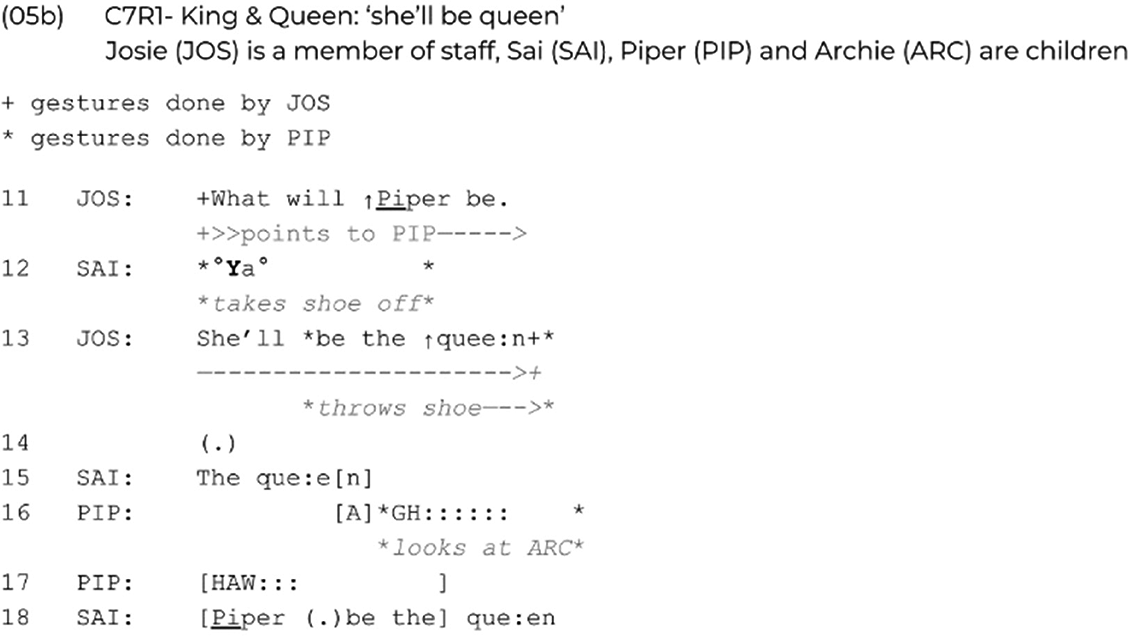
Josie reformulates her earlier question “What will Piper be” (Line 11), designed to guide Sai towards the expected answer. Josie's question (Extract 5a, Line 6) and its reformulation (Extract 5b, Line 11) make relevant the matched relational category of queen. Along with Josie ascribing the role of king to Sai (Line 5), this operation appears designed to realign the play roles to the genders of the children, thus establishing gender constancy. Sai's responses (“Yes”, Extract 5a, Line 9; “Ya”, Line 12), though misaligned, are affirmative, which suggests that he is not rejecting Josie's intervention and her attempts at reallocating the roles.
Josie then provides Sai with the answer, “She’ll be the queen” (Line 13). The marked upward intonation on “queen” invites Sai to respond with a repetition, which he partially does with “the queen” (Line 15). Sai then produces a new role allocation for Piper (Line 18). Known gender is thus (re)established as a resource to realise the cis-heteronormative standard relational pair of king and queen.
In summary, the adult's validation and correction of children's role allocations reproduce recognisable cis-heteronormative arrangements of identities and relationships – mummy and daddy, king and queen.
Discussion
We started with the consideration that practices of early socialisation, language use and gender categorisation are inextricably linked (Blaise, 2005; Bussey & Bandura, 1999; Eckert & McConnell-Ginet, 2013; Lorraine Radtke, 2017; Oakley, 2015; Speer, 2004; Talbot, 2019). Social cognitive theory posits that the processes of modelling, reinforcement and instruction in early childhood develop a child's concept of gender roles (Bussey & Bandura, 1999). Recent research within this area of psychological theory highlights parental influence in the reinforcement of “gender stereotypical play” (Morawska, 2020, p. 572) – our research builds on this to explore how this is done on a linguistic level (Zimman, 2021) in a preschool nursery setting.
Our EMCA approach enabled us to evidence some of the “seen but unnoticed” (Garfinkel, 1967, p. 36) ways in which gender is mobilised and reflexively constituted as a category to organise scenes of daily activity. Our feminist CA standpoint focused our gaze on the ways in which participants’ actions established certain configurations of gender identities and relationships as normative.
In an analysis of child–parent conversations about gender and sexuality in a Swedish context, Ericsson (2021) showed how some research findings can reveal patterns that reproduce normative cisgender and heterosexual configurations, whilst other findings challenge them. This approach is helpful to make sense of our findings.
Our results show that participants’ actions repeatedly reproduced patterns of cis-heteronormativity. Children used descriptions (mummy, daddy, queen, king) to introduce gendered categories into the organisation of play and elect individual children as their prospective occupiers. In three episodes of role play, initial role allocations, such as the self-allocation of the role of “the” mummy (Extract 1), imply a heterosexual relational configuration that other children are tacitly invited to recognise. The use of “the” implies a relational matrix in which the presence of no more than one mummy makes sense. It projects the possibility of a heterosexual standard relational pair (Sacks, 1972), which is subsequently realised through other children's complementary role allocations (Extracts 1, 2 and 4). Additionally, in three of four episodes of role play, participants’ role allocations reproduce assumptions of gender constancy.
We have also observed that an adult's actions can ratify role allocations through linguistic repetition (Extract 4). In these ways, children's and adults’ actions reproduce recognisable patterns of cis-heterosexual arrangements of identities and relationships. Our CA approach has allowed us to note for the first time how these arrangements were deeply embedded in participants’ practical activities as enabling resources for action in a nursery setting, such as when a child claims an exclusive role in an emergent role-play family (e.g., “the” daddy) before this is assigned to or claimed by another child (e.g., Extract 1, Line 3).
It is worth restating what we mean when we say that these actions reproduce cis-heteronormativity. An important analytic technique in CA is to validate analyses by grounding them in participants’ own demonstrable orientations to one another's actions (Robinson et al., 2024). One way to interpret this tenet would be to say that to support our claims about the reproduction of cis-heteronormativity, we would need to identify instances in which participants themselves treat an action as embodying cis-heteronormativity, for example, by calling it out. However, according to Kitzinger, ...it would be unbearably limiting to use CA if it meant that I could only describe as ‘sexist’ or ‘heterosexist’ or ‘racist’ those forms of talk to which actors orient as such. Indeed, it is precisely the fact that sexist, heterosexist and racist assumptions are routinely incorporated into everyday conversations [original emphasis] without anyone noticing or responding to them that way which is of interest to me. (Kitzinger, 2000, p. 171)
Another way in which cis-heteronormativity becomes a resource for action is by informing assistive and pedagogic work. It is important to note that our analyses do not suggest that adults’ actions unilaterally impose a cis-heteronormative matrix. The normalisation of cis-heterosexual identities and relationships appears to begin with how a scene is made sense of. In Extract 5a, a child, Sai, stumbles over his own words when attempting to use familiar devices (gendered descriptions that implement role allocations) to recruit another child into role play. This could be made sense of in various ways, but it seems that on this occasion, the adult, Josie, construes it as a failed attempt to correctly apply play-organisational and role-attributional practices grounded in assumptions of gender constancy and heterosexuality. Correction is not realised by punitively policing a departure from cis-heteronormativity, but rather by aiding a child in realising what is already seen as an attempt to implement cis-heterosexuality. Cis-heteronormativity is thus both an emergent outcome, reinforced by taking it for granted as the bedrock for the organisation of role play, and a resource for action formation and ascription (in this case, for how to make sense of a child's attempts at self-repair).
Like Ericsson's study (2021), our findings also show ways in which children's actions can depart from (rather than reproduce) patterns of cis-heteronormativity. For instance, children's role allocations can depart from gender constancy, such as when a boy self-allocates the role of “mummy” and others validate it (Extract 1). These role allocations potentially destabilise cis-normative assumptions of “coherent, natural genderings which are given at birth and which remain constant over time throughout a person's life” (Hornscheidt, 2015, p. 37). Role play perhaps offers a privileged site for children's experimentation with identities and roles – something that future research should investigate further (but see C. Butler & Weatherall, 2011).
The limited number of instances of gender becoming relevant in our collection invites caution in interpreting our findings. It is unlikely that we have been able to exhaustively capture the ways in which children's and adults’ actions mobilise gender in role play in the nursery. Yet our aim has not been to produce generalisations but to generate detailed analyses of the procedures whereby role play can be structured by children, with and without adult participation, in ways that leverage and reflexively constitute gender as an organising principle for scenes of daily activity. The picture that emerges from our findings is complex. It shows that children's actions can exhibit a certain fluidity, such as when departing from assumptions of gender constancy and reprogendering. Yet the heterosexual family unit emerges as a taken-for-granted organisational device, raising the question of how it may be experienced by children whose family configurations do not match its form. When a particular arrangement of identities and relationships becomes “the” arrangement, other lived realities are made invisible or unintelligible. In these ways, otherwise unremarkable ordinary actions contribute to the reproduction of normative arrangements that enable some forms of existence whilst restricting others.
Footnotes
Acknowledgements
A note of thanks to the Discourse and Rhetoric Group (DARG) community, who have supported this research with such enthusiasm. We are grateful to the research participants who gave their time to this project. We would also like to thank the anonymous reviewers, whose feedback greatly improved this article.

Ethical considerations
Ethical consent was granted by Loughborough University's Ethics Review Sub-Committee (ID: 2023-14530-15900). All research was conducted in accordance with institutional guidelines.
Consent to Participate
All participants gave full written consent or were granted parental/guardian written consent to be recorded and for the data to be used for a range of research purposes.
Consent for Publication
All participants gave full written consent or were granted parental/guardian written consent for data to be reproduced as transcripts for publication. All identifying names and places have been anonymised.
Funding
This research was undertaken as part of a PhD programme funded by Loughborough University.
Declaration of Conflicting Interest
The authors declared no potential conflicts of interest with respect to the research, authorship, and/or publication of this article.
Data Availability Statement
The data presented in this article are not readily available due to restrictions dictated by the Ethics Subcommittee’s approval.
Notes
Author Biographies
Appendix: Transcription Conventions.
|
|
|
|---|---|
| , ? . | Comma is for slightly upward intonation; question mark for upward intonation; and full stop for falling intonation. |
| [ ] | Square brackets indicate overlapping talk. |
| (0.8) | Numbers in parentheses indicate silences in tenths of a second. |
| (.) | A full stop inside parentheses is a silence less than two tenths of a second. |
| wo:::rd | Colons indicate a lengthening of the sound preceding them, proportional to the number of colons. |
| wo- | A hyphen indicates an abrupt cut-off or self-interruption of the sound in progress indicated by the preceeding letter. |
| w |
Underlining indicates stress or emphasis (usually conveyed through slightly rising intonation). |
| ↑ ↓ | An arrow symbol indicates a marked pitch rise or fall. |
| = | Equal signs (ordinarily at the end of one line and the start of an ensuing one) indicate a ‘latched’ relationship – no silence at all between them. |
| ( ) | Empty parentheses indicate talk too obscure to transcribe. |
| (word) | Words or letters inside such parentheses indicate a best estimate of what is being said. |
| hhh | The letter ‘h’ is used to indicate hearable aspiration, its length roughly proportional to the number of hs. |
| .hhh | If preceded by a dot, the aspiration is an in-breath. |
| w(h)ord | The letter ‘h’ enclosed in parentheses indicates aspiration internal to a word (e.g. a laughter particle). |
| ((words)) | Words in double parentheses indicate transcriptionist's comments. |
| °word° | Degree signs are placed around talk that is quieter or softer. |
| °°word°° | Double degree signs indicate a particularly quiet voice or whispering. |
| >word< | A combination of greater-than and less-than symbols indicates that the talk between them is faster or rushed. |
| <word> | A combination of less-than and greater-than symbols indicate that the talk between them is slower. |
| <word | The less-than symbol by itself indicates that the immediately following talk is jump-started. |
| £word£ | British pound signs indicate that the talk between them is delivered with a smiley voice quality. |
| #word# | Hash signs indicate that the talk between them is delivered with a creaky voice quality. |
| ∼word∼ | Tilde signs indicate that the talk between them is delivered with a tremulous voice quality. |
| wor |
A boldface on a final consonant indicates that it is produced more sharply than it normally would be. |
| ** / ++ | Details of embodied action are delimited between two identical symbols (one per participant for gaze and one per participant for embodied action). |
| +→ | The action continues over subsequent lines... |
| →+ | ...until the same symbol is reached. |
| >> | The action starts before the extract’s beginning. |