




Abstract
Talk about gender equality in relation to parental leave is pervasive in Sweden. The state encourages families to share parental leave and has recurrently tasked the Swedish Social Insurance Agency (SSIA) to promote gender equality. As theories and applications of street-level bureaucracy have emphasized, how policy is practically realized in social interaction with clients is an important question, specifically whether gender equality discourse also permeates such encounters. We use conversation analysis to examine how equal sharing of parental leave is raised in interactions between parents and practitioners at the SSIA. The data consist of 300 telephone calls, 378 email exchanges, and 642 Facebook exchanges. Our analysis indicates that the talk of equal sharing is not as omnipresent as previous research might suggest. When parents orient to equal sharing, they tend to describe parental responsibilities, while practitioners connect equality to regulations that in themselves work to promote equal sharing. Equal sharing is also a resource for negotiating the citizen–state relationship, as parents complain about state interference while practitioners in response must balance provision of personalized support with the state imperative to promote sharing. The study highlights the complex work of practitioners in the “feminist welfare state” and sheds light on nuanced notions of equality promotion.
Universal social insurance aims to provide basic security to all citizens while equalizing life opportunities for different groups. Gender equality has increasingly become a target of such welfare measures. In Sweden, considered one of the top-ranking countries in the world in terms of gender equality (World Economic Forum, 2022), numerous reforms have sought to elevate women's opportunities. A key policy area for this is parental leave, as women's extensive leave from work to care for children affects their careers, with long-term effects on income and pensions (Augustsson & Harryson, 2015). While Swedish parental leave has a gender-neutral construction since 1974, granting parents equal rights to parental benefit regardless of gender, men's usage is still considerably lower than women's (Duvander & Viklund, 2020). This has spurred several reforms to support a dual-earner, dual-carer model; for instance, reserving a portion of the benefit for each parent and giving a bonus to families who divide their leave equally (Nygård & Duvander, 2021).
The state has functioned as a norm-builder in this area, providing economic incentives for certain choices, but also actively promoting such ideals in other ways (Bergqvist & Saxonberg, 2016). The Swedish Social Insurance Agency (SSIA), which administers parental benefits, has repeatedly been tasked by the government to promote gender equal use of parental leave, and numerous state-funded media campaigns have addressed this issue, encouraging fathers to increase their leave (Klinth, 2008). While research has investigated both gendered patterns in parental benefit usage (e.g., Duvander et al., 2022; Duvander & Viklund, 2020) and parents’ attitudes from a gender perspective (e.g., Almqvist et al., 2011; Boye & Evertsson, 2018), little is known about the SSIA's practical role in promoting gender equality. Gaining such knowledge is important given the increased emphasis within policy research on frontline, or street-level (Lipsky, 2010), work for the realization of policy, which argues that policy is “talked into being” in bureaucratic encounters with clients (Caswell, 2020). This involves both the application of regulations as part of decision-making and the ways in which policy is described or explained to clients. In this sense, the study of frontline encounters can provide an “empirical window into social equities in practice” (Maynard-Moody & Musheno, 2012, p. 20), as policy is examined through a social psychological lens. This approach enables knowledge about the practical processes by which parents come to make informed decisions about their parental leave, and how notions of gender equality feature in these processes.
This study examines interactions between SSIA practitioners and parents who seek information, service, or advice about parental leave, investigating to what extent they orient to “equal sharing,” how this is done, and what interactional functions talk about equal sharing serves. By such means, the study contributes new knowledge on the feminist welfare state in action.
Parental leave in the feminist welfare state
The Swedish parental benefit scheme is considered one of the most generous in the world, and is a gender-neutral, 1 universal social insurance for covering loss of income during parental leave. It can be used until a child turns 12 and the regulations are complex. Parental benefit is paid for 480 days in total, split equally between the parents, of which 90 days are reserved for each parent on a “use it or lose it” basis. These are colloquially often referred to as “daddy days” or father quota, but in fact apply to mothers and fathers alike. The remaining days can be shared as the parents decide. The benefit is calculated based on the person's income—1 “benefit day” covers 77.6% of regular earnings per day, up to a ceiling level. During the first 18 months of parental leave, parents can stay home without using the benefit, or use the benefit part-time. This means that parents may weigh income against time at home with the child, as saving benefit days for later use can extend the total time on leave (although some of it will be unpaid). In addition, there are two benefit levels that can be used in different ways, so parents need to keep track of which type of “day” they are allowed to use at a certain point, which also affects how much money they get. Parents can also use a limited number of days at the same time, if they want to stay home together.
The complex regulations allow for flexibility in how to use the benefit to serve the family's interests best. This flexibility, however, is used unevenly across groups, as low-income households need full compensation to a higher degree to be able to stay at home from work, whereas middle-class households often prioritize longer leaves with a smaller compensation in order to delay the start of preschool or save days to use during school holidays (Duvander & Viklund, 2020). In addition, there are clear gendered patterns in usage. While practically all mothers in Sweden use parental benefit in the first 2 years, around 82% of fathers do so (Inspektionen för socialförsäkringen, 2021). While fathers’ use may seem high in international comparison, it thus differs considerably from mothers’ use in this respect. Mothers also take considerably longer leaves—the average length for women is 13.5 months (of which 9.5 months are paid) and for men, 3.5 months (of which, 2 months are paid; Duvander & Viklund, 2020). Men who are older, have higher education, earn more, and were born in Sweden use parental benefit to a higher degree than their counterparts (Ma et al., 2020). While it is often assumed that men's generally higher salaries, as compared to women's, encourage fathers in heterosexual couples to take less parental leave, this is not so straightforward. Top-up schemes that most employers offer outside of the regular social insurance system do not seem to strongly affect men's leave, suggesting that shifts in norms or culture should be considered together with purely financial aspects (Duvander et al., 2022).
The ways in which parents navigate economic and moral incentives of state policies have received comparatively little attention from researchers (cf. Bergqvist & Saxonberg, 2016). People in Sweden generally think that it is important to share childcare responsibilities (Duvander, 2014) and tend to support gender equality on a theoretical level. Fathers also take considerable responsibility for practical childcare matters as compared to those in many other countries. In practice, however, parenting is not equally shared and studies of parents’ post hoc accounts of their parental benefit usage point to gendered patterns in how families reason around their choices (Almqvist et al., 2011; Alsarve, 2021). Traditional and more gender-equal norms exist side-by-side, and although motherhood and fatherhood are seen as equally important, they are not seen as exchangeable, with different expectations of mothers and fathers (e.g., that mothers should stay at home the first year to bond with the child and breastfeed; Boye & Evertsson, 2018). Nevertheless, the strong discourse of equal sharing—including the equally allotted days to parents—entails that deviations from sharing the parental leave involve extra efforts for parents, who “are made aware that they are going against the national ideal of care, in which they should share the leave time equally” (Bergqvist & Saxonberg, 2016, p. 1473). In sum, the emphasis on gender equality in political discourse (Nygård & Duvander, 2021) has largely been adopted by parents, who tend to present themselves as gender equal and as striving to share parental leave equally (Almqvist et al., 2011). Whether this tendency, combined with the SSIA's mission to promote gender equality, means that practitioners and parents visibly orient to equal sharing in their encounters is, however, not known. In order to investigate this, we apply a conversation analytic (CA) approach, which is described in the next section.
A conversation analytic approach
CA is a theoretical and methodological approach derived from Garfinkel's (1967) ethnomethodology. The core of CA is to study naturally occurring interaction, adopting the assumption that all interaction is socially organized and exploring how people “go about” their everyday life (Sacks, 1992). Unlike mundane interaction, interaction in institutional settings is often restricted and can involve orienting to organizational goals and institutional agendas (Heritage & Clayman, 2010).
In this study, we draw on CA to examine how feminist welfare state policies are enacted in street-level encounters (cf. Lipsky, 2010). Kitzinger (2000) argues for combining CA and a feminist approach, as CA provides the possibility to study how “genders, sexualities and power are accomplished in interaction” (p. 188), and how social actions are interactionally designed to achieve this (Edmonds & Pino, 2023). This aligns with the discursive psychological argument that “an adequate social psychology of domestic life requires attention to … everyday discursive practices” (Dixon & Wetherell, 2004, p. 169). In addition to examining doings of gender in interaction, this approach also enables investigation of how equality may be understood as an ongoing interactional concern (Flinkfeldt, 2014). We therefore adopt a CA perspective in exploring equal sharing as it is raised as part of two activities in street-level encounters between parents and practitioners at the SSIA, namely requesting and providing information and complaining.
Requesting and providing information are two central actions in institutional interaction (Heritage & Clayman, 2010). Clients may request advice and information by means of questions seeking recommendations or confirmations of appropriate approaches (cf. Vehviläinen, 2009). Requesting advice often entails that participants acknowledge uncertainty of future courses of action, not seldom displaying lack of knowledge (cf. Heritage & Sefi, 1992). This makes the advice-giving situation specifically linked to epistemic asymmetry (cf. Ekberg & LeCouteur, 2015). Practitioners also have to manage complaints (Ekström & Lundström, 2014). We understand complaining as the activity of expressing “feelings of discontent about some state of affairs, for which responsibility can be attributed to ‘someone’ (to some person, organization or the like)” (Heinemann & Traverso, 2009, p. 2381). Complaints can also be deployed in questions, such as requests for information in which a complaint is projected (Sidnell, 2013). Practitioners tend to not affiliate with complaints from clients, but work to suppress them by trying to find alternate solutions (Ekström & Lundström, 2014). Although complaints have been explored extensively in CA, research has so far given limited attention to complaints in digital interaction, to which this study contributes.
Data and analytic procedure
The data for this study consist of verbal and textual interactions between practitioners and parents, including telephone calls to the SSIA customer service (n = 300), email exchanges (n = 378), and contacts at the official Facebook page for parents administered by the SSIA (n = 642); that is, 1,320 exchanges in total. The study has been approved by the Swedish Ethical Review Authority (Reference number 2019-01727), and data collection has been done with permission from the SSIA. Practitioners received oral and written information; they provided written consent for use of the phone calls, while for emails and Facebook posts, they could opt out if they did not want to participate. Parents calling the SSIA were informed about the study and had the possibility to opt out, while parents emailing the SSIA or writing on their Facebook page were given more general information about the public nature of the exchange and were asked not to disclose personal information. Names and personal details have been changed, and data have been stored securely. We have translated extracts into English (but see Appendix in the online supplemental material for original extracts).
We read or listened to all exchanges and identified segments where participants oriented to equal sharing, which covered, for instance, descriptions of rules (e.g., the default split of days) and descriptions of current or future scenarios in relation to dividing days. The phone call segments were transcribed using Jeffersonian notation (Jefferson, 2004), and all instances were analysed using CA. Although CA has traditionally been used for spoken interaction, a subfield of “digital CA” has emerged, showing how CA, with some modifications, can be applied to textual interaction (Giles et al., 2015). Contrastive to oral interaction, textual interaction does not provide the possibility to analyse, for example, tone or prosody, restricting the focus of analysis in the same way as the participants themselves are restricted. The analytic procedure involved identifying social actions produced by participants when orienting to equal sharing, and how this was accomplished, in each data set. We then compared the data sets with each other. The collections of social actions were found to involve requesting/providing information and complaining, which will be elaborated upon in the next section.
Analysis
An important finding in this study is that invocations of gender equality are unusual in client–practitioner interaction across the examined channels. Our sorting of data generated 36 exchanges where participants oriented to gender equality (12 in the telephone corpus, 13 in the email corpus, and 11 in the Facebook corpus). Despite the pervasive gender equality discourse in Sweden, such concerns are thus not so visible in frontline encounters with parents. We here focus on describing what such invocations do, divided into two sections that examine how participants orient to equal sharing as they: (a) request and provide information, and (b) make complaints. Thus, we do not cover all aspects of sharing and gender equality in institutional interaction, but rather what the participants themselves orient to. We have chosen the clearest examples to illustrate patterns in the data as a whole. Six of the extracts feature questions by women, which reflects that most questions in our data were written by women. Spelling or grammatical mistakes have been preserved in the translations where possible, and the most relevant passages have been marked using bold type.
Orienting to equal sharing when requesting or providing information
When parents raise the issue of equal sharing, it is typically done either as part of a question or setting up premises or assumptions that condition a question. A characteristic of requesting and providing information about parental leave is that this relates to intricate aspects of managing one's personal life while simultaneously having to take state rules and regulations into account. In Figure 1, we see an example in an email from a prospective mother.
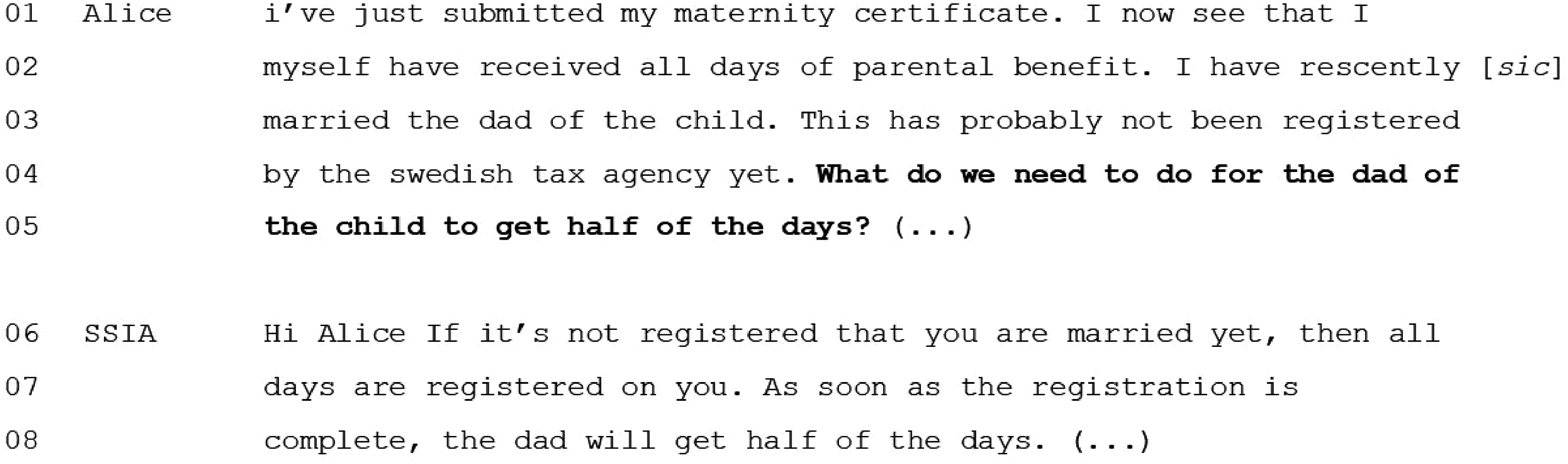
Parent requesting information (Email 73).
In asking what needs to be done for the father to receive half the parental benefit (Lines 4–5), Alice displays knowledge about how the rules imply a default split of days and treats equal sharing as the norm. In response, the practitioner accounts for why the days have not been divided equally in their case (Lines 6–8) and presents a solution (“as soon as the registration is complete”; Lines 7–8). Equal sharing thus becomes visible in how the practitioner interprets and explains rules and routines in relation to the specific situation, treating the split of days as normal and unproblematic, but also withholding additional (yet relevant) information about how the parents can transfer days to each other at a later stage. While this is not something the parent in this extract asks about, the next example shows how a practitioner directly refuses to answer a question that relates to the division of days between parents. In his email, Steve mentions equal sharing as a premise for his question about how they should divide their days in the financially smartest way.
Steve's question concerns how to mix paid and unpaid parental leave (cf. Duvander & Viklund, 2020). Before asking about what is financially better, he points out that the question is asked based on a desire to share equally, but sharing here relates to time with the child rather than benefit usage. Steve thus presents himself and his partner as equal while asking about a scenario that implies inequality in terms of how much money they will each get, seeking what is financially most beneficial for the family as a unit. The yes/no declarative question, “surely you benefit from letting the partner with the highest salary take more days with parental benefit?” (Lines 2–3), invites confirmation (cf. Raymond, 2003), thus treating the practitioner as understanding and supporting this version of equality.
Instead of informing Steve how to make these calculations, the practitioner resists answering his questions (cf. Raymond, 2003), explicitly stating that “I cannot comment on this unfortunately” (Line 6). This response is not accounted for and, in this sense, the practitioner treats the question as an inapposite request for advice on private matters that the SSIA should not be involved in. The practitioner explains that it is up to each individual to decide how to use their benefit (Line 7), shifting from the family perspective launched by Steve to the more individualistic approach taken in Swedish parental leave policy.
The parents and practitioners in the first two extracts display various degrees of certainty regarding equal sharing in relation to knowledge about the family's situation. That is, although inclination to share the parental leave is within the parent's knowledge domain, it can change depending on the rules. In Figure 2, equal sharing is produced as an intended future scenario (cf. Speer, 2012), framed as an active but undecided choice (“provided you want to”; Line 1). By such means, Steve seeks confirmation that the proposed course of action is right, while also indicating that their plans may change depending on the practitioner's information. Similarly, in Figure 1, the question “what do we need to do for the dad of the child to get half of the days?” (Lines 4–5) implies an intended future scenario (cf. Speer, 2012). However, Alice here displays a high degree of certainty in that equal sharing is framed as a given. This demonstrates how equal sharing may be negotiated both in relation to families’ own wishes and to policy.
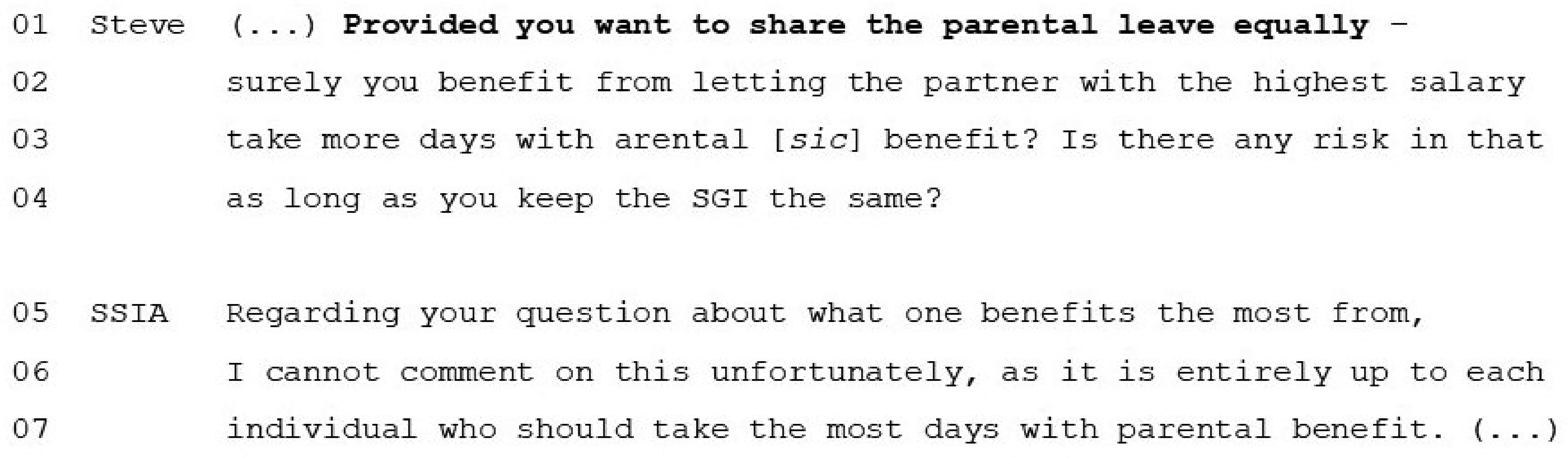
Equal sharing as a premise for a question (Email 16).
Notably, although equal sharing is generally linked to gender equality (Nygård & Duvander, 2021), there is a difference in how it is oriented to in terms of gender in the data. In Figure 1, equal sharing is produced in a gendered context by the third-party reference to the “dad” (Lines 3, 4). In contrast, Steve in Figure 2 refers to “partner” (Line 2) and the gender-neutral, third person “you” (cf. Höglund & Flinkfeldt, 2023). In this sense, equal sharing does not need to be explicitly linked to gender equality.
Having considered parents’ orientations to equal sharing as part of seeking information, we now turn to two instances where practitioners invoke equal sharing.
Olivia's questions are framed as general, seeking information about the allocation of days and how they may be used, but she does not specify whether it is the number of days per child or each parent's share that she is after. In response, the practitioner specifies both, making available the information that they will get an equal share of days. The practitioner treats the division of days as something Olivia does not know about, as interactants design utterances based on what knowledge they expect others to have (Stivers et al., 2011, p. 10). The practitioner thus makes sharing parental leave relevant, while producing it as something that is not taken for granted. Like in Figure 1, the practitioner does not mention that days can be transferred between the parents; if Olivia does not already know this, she might be led to think that parents’ shares are more tightly tied to them as individuals than they actually are, thus promoting an order where the parents will in fact use the days equally. Had the practitioner described possibilities to transfer days, this would correspondingly have encouraged unequal use of parental leave. Practitioners’ withholding of information from parents—which can be viewed as a way to impose sanctions against clients (Lipsky, 2010)—in this case thus serves to promote equal sharing values.
While Figure 3 shows a rule-oriented approach, Figure 4 is an example from a phone call where the practitioner takes a more normative stance.
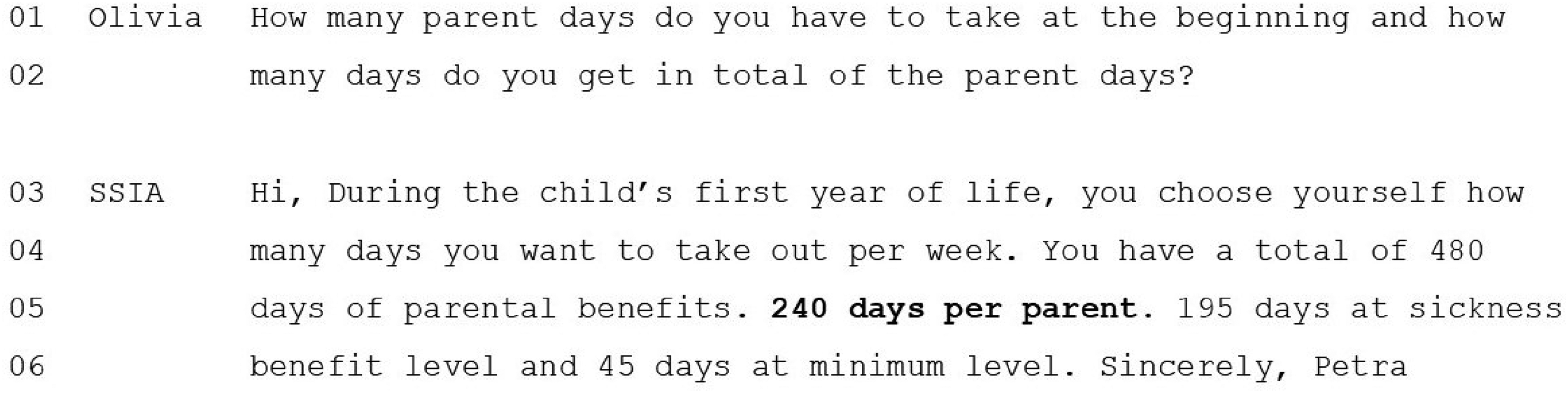
Practitioner providing rule-based information (Email 58).
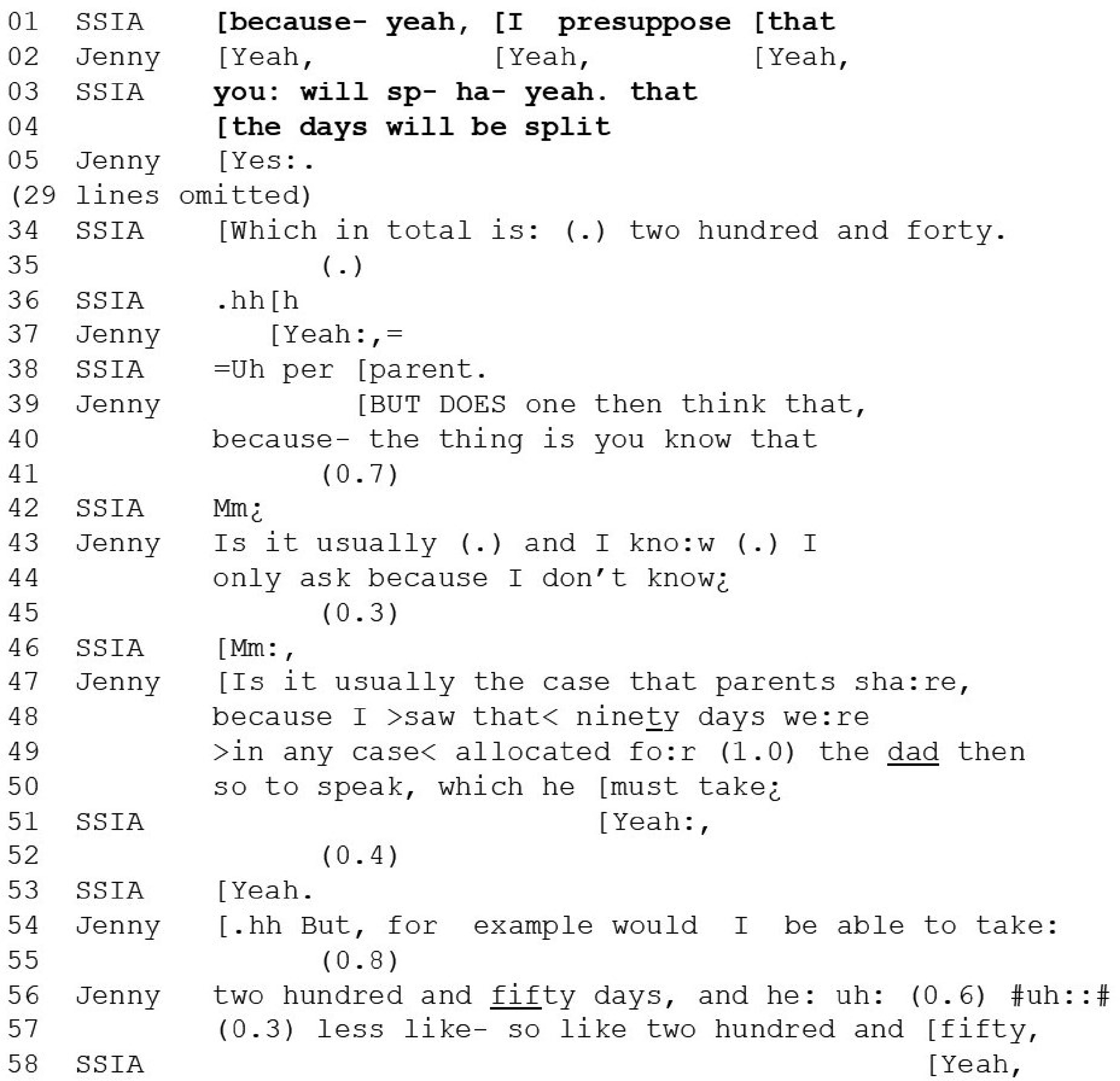
Practitioner orienting normatively to equal sharing (Phone call 1444).
The practitioner in Lines 1–4 displays an expectation that the parents will share the parental leave, treating this as norm (“I presuppose that … the days will be split”). This is cut-off, changing the wording from “you will” to “the days will be,” thus shifting focus from the parents as agents and working to avoid instructing or advising them what to do. Jenny confirms the practitioner's assumption in overlap (“yes”; Line 5), treating such an arrangement as self-evident and in line with the displayed norm.
While the participants talk about division of days, they do not specify how many days each parent will use. In Line 34, however, the practitioner informs Jenny about the default number of days allocated to each parent. Similarly to Figures 1 and 3, this works to promote equal sharing as it does not include information that actual use of days may differ from the initially allocated share. Since parents in the email corpus were unable to reply to the practitioner, it is not possible to analyse whether they pick up on the equality-promoting aspects. However, Figure 4 shows how the parent in this phone call does just this, by asking a follow-up question that treats the practitioner's information as incomplete regarding how many days can be maximally used. By asking about possibilities for using the other parent's days, Jenny makes available a scenario in which they will not share the days equally. She displays knowledge about the regulations in Lines 48–50, but singles out fathers as having 90 days for their individual use (a “father's quota”), whereas in fact, this quota applies to both parents. By such means, Jenny treats it as self-evident that she (as the mother) will use more benefit days, making the rule relevant only for the father, who would use “less” (Line 57).
Interestingly, Jenny provides an account (“I ask only ask because I don’t know”; Lines 43–44) before asking “Is it usually the case that parents share” (Line 47), which is hedged with several restarts. This illustrates how the practitioner's display of equal sharing as normatively expected—in line with parental leave policy—can create a context in which unequal sharing needs to be accounted for, thus involving extra interactional work for parents.
In conclusion, these extracts demonstrate how practitioners “make policy” in welfare encounters (cf. Lipsky, 2010) in orienting to, and promoting, equal sharing as the norm by taking both rule-oriented and normative stances. This is done by using institutional terminology that involves equal sharing and leaving out information about rules that work against equal sharing, but also by displaying normative assumptions about how parents plan their parental leave. In the next section, we discuss how equal sharing can work as a resource for parents’ complaints.
Equal sharing as a resource for making complaints
Parents make complaints where they raise involuntary unequal sharing to resist policy. In Figure 5, Elin brings up equal sharing in a complaint on Facebook.
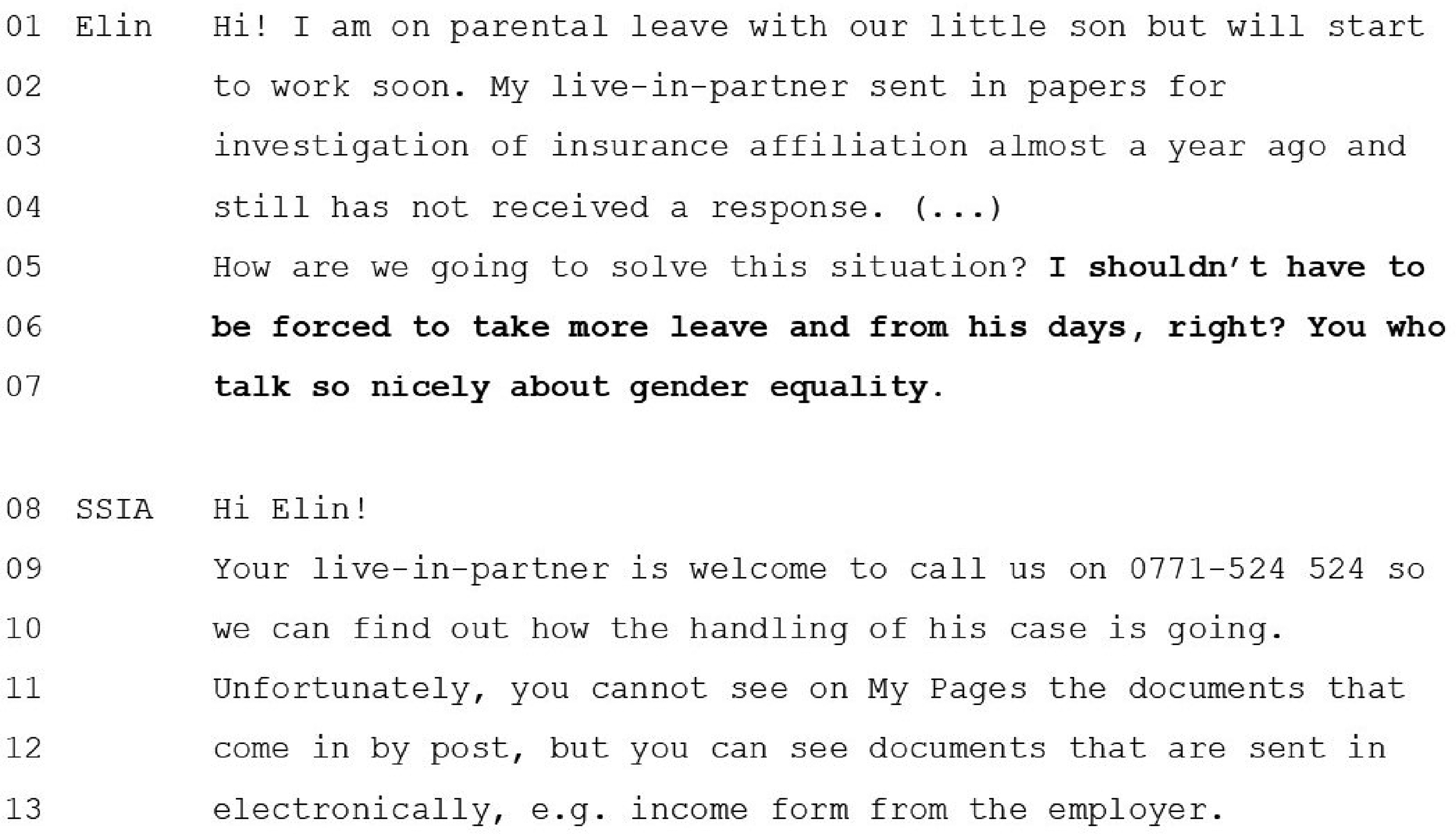
Parent complaining using equal sharing as a resource (Facebook Post 2).
Elin describes her current situation as being on parental leave but returning to work soon (Line 1), after which, her live-in partner will take over. The problem is that his registration has not come through yet. Elin launches a complaint, first with a general question requesting advice about how to solve the situation (Line 5), and then formulating her opinion (designed as a question) that she should not be forced to use his days (Lines 5–6; cf. Sidnell, 2010). While this in itself makes available a stance that parental leave should be shared equally, equality is then explicitly invoked, as Elin points out that the SSIA “talk so nicely about gender equality” (Lines 6–7). This is produced as ironic, calling into question whether parental benefit procedures are actually supporting equal sharing, thus indicating that they may in fact be doing the opposite.
The practitioner displays resistance by not responding to the complaint, but addresses Elin's partner in third person, informing her that he can contact the SSIA (Line 9). Practitioners tend to manage complaints by, for example, offering alternatives to solve the issue at hand (Ekström & Lundström, 2014). In this case, however, the practitioner suggests another channel, thus treating the textual online modality as insufficient. The practitioner also manages the complaint by treating it as a question that does not concern Elin, treating her as the “wrong” recipient, although the issue is of interest also to her as her plan to go back to work is at stake.
The next example (Figure 6) is similar. Sandra has called about her partner's right to parental benefit. We enter the call after the practitioner has explained that he has not worked enough to be eligible, which means that he will only receive parental benefit based on his income after 180 days have passed. In Line 1, the practitioner explains that this period corresponds to about half a year.
As the practitioner establishes that Sandra's partner must postpone his parental leave if he wants to receive the income-based benefit, Sandra treats this as a threat to their possibilities to share the leave equally. She produces a precomplaint in Lines 15–16 (“we will share as much as possible”), thus orienting to trying and to potential failure. She also invokes common ground by “you know” (ju; Line 15), which treats equal sharing as a recognizable norm while also orienting to an epistemic asymmetry between herself and the practitioner in terms of the intended plans (cf. Heinemann et al., 2011). Sandra makes the complaint in Lines 19–24, where she raises the rules as preventing equal sharing, similarly to Figure 5. This is done with the dispreference marker “but” (Line 19)—suggesting a contrastive opinion (cf. Schiffrin, 1988)—in combination with the assessment “it gets weird” (Line 23). Sandra here invokes her comparably higher income, drawing on the fact that Swedish families tend to motivate their traditionally gendered choices with economic incentives (cf. Almqvist et al., 2011).
The practitioner does not align or affiliate with Sandra's complaint but responds minimally with “mm mm” (Line 25) and silence (Line 27), thus indicating what Lipsky (2010) has conceptualized as unresponsiveness. In contrast to Figures 3 and 4, in which practitioners worked to promote equal sharing, the practitioners in both Figures 5 and 6 do not affiliate with the equality-oriented complaints and do not work to support such ideals.
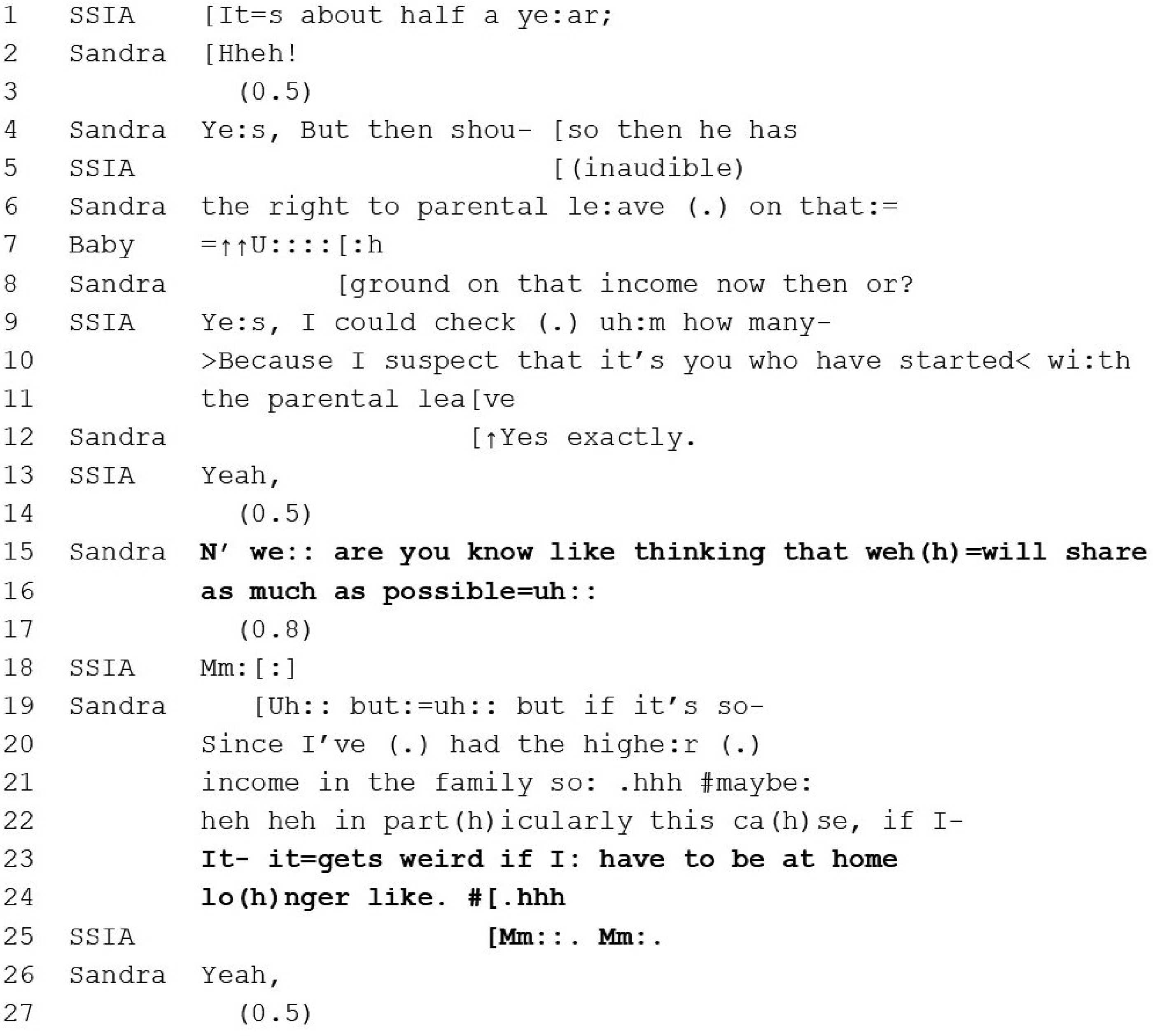
Parent complaining about rules preventing equal sharing (Phone call 222).
In the final extract Figure 7, equal sharing is used as a resource for a complaint involving resistance to policy. It is from a Facebook thread where Anna asks whether it is possible to transfer all days with parental benefit to one parent (Lines 2–3).
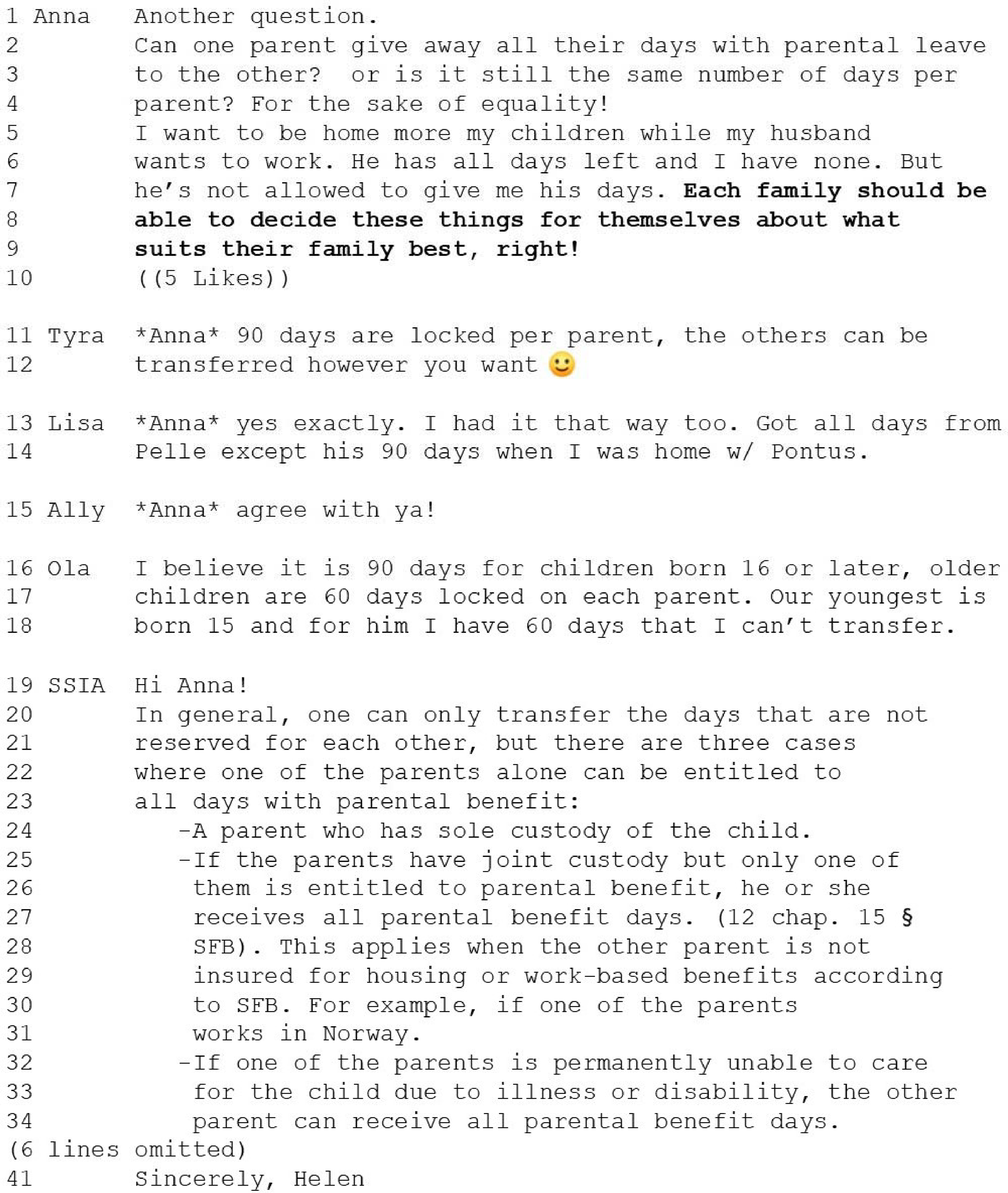
Parent complaining about policy (Facebook Post 553).
Anna asks an alternative question with two options: whether one parent can use all days, or if parents get the same number of days (cf. Hayano, 2012). She displays knowledge about the rules not only by describing them but also by referring to potential changes (“is it still the same”; Line 3). Anna then exclaims “For the sake of equality!” (Line 4), raising equal sharing in what could be seen as a postcompletion stance marker, that is, an element placed after an utterance that represents “retrospective or retroactive alignments toward it, or consequences of it” (Schegloff, 1996, p. 90). By such means, Anna uses irony to question how ideas of gender equality have shaped the parental benefit rules in ways that restrict parents’ use. She further displays knowledge by providing the answer herself in Lines 5–6 (“But he's not allowed to give me his days”), thus invoking her own personal experience. Anna also suggests that the family rather than the state should decide how to allocate parental leave (Lines 7–9), using her own situation in a way that makes available traditionally gendered views (“I want to be home more with my children while my husband wants to work”; Lines 5–6). Anna thus produces the imperative of equal sharing as a threat to the individual's right, by making it a question of state interference.
Following Anna's complaint, four “peers” join the discussion. Both Tyra and Ola treat Anna's post as a request for information: while Tyra answers that days not reserved for each parent can be transferred, Ola describes the rule in more detail, specifically orienting to changes over time. Both thus resist aligning or affiliating with the complaint. In contrast, Lisa agrees with Anna (“yes exactly”; Line 13) and adds a similar experience, followed by Ally who also affiliates with Anna's complaint (Line 15). Parental benefit policy in relation to equal sharing is here negotiated by peers by orienting to both rules and personal experiences.
In the reply, the practitioner displays unresponsiveness as they neither respond to Anna's questions nor her complaint (cf. Lipsky, 2010). Rather than commenting on the rules or explaining the rationale behind them, they produce a generic description of the rule's exceptions. This can be understood as a transformative answer, that is, that the practitioner “proposes alterations to the question's terms or agenda” (Stivers & Hayashi, 2010, p. 2). By specifying three cases where the rule does not apply, the practitioner frames the rule as having few exceptions, thereby demonstrating the inflexibility of the regulations. In this way, the practitioner produces sharing of days (albeit not necessarily equal) as the norm.
In sum, parents flexibly draw on notions of equal sharing to question parental benefit procedures—either criticizing policy for not sufficiently facilitating equal sharing or for being too rigid and not letting families decide for themselves. In their responses, practitioners avoid engaging with the complaints, thus dodging the issue of equal sharing and not clearly working to support gender equal ideals (nor to question them).
Discussion
Swedish discourse on gender equal parental leave is pervasive, both on a political level and among parents (e.g., Duvander, 2014; Nygård & Duvander, 2021). Parental benefit regulations provide incentives for equal sharing, and Swedish governments have recurrently tasked the SSIA to promote gender equality as well as launched campaigns to promote fathers’ leave (e.g., Klinth, 2008). As the growing field of street-level bureaucracy research (e.g., Lipsky, 2010) has brought attention to how policy is brought to life and practically realized in social interaction, it might thus be expected that equal sharing would visibly play a role in SSIA encounters. Examining telephone, email, and Facebook interactions between practitioners and parents, we have, however, found surprisingly little of this. Parents and practitioners rarely raise the issue of equal sharing, and goals to promote gender equality thus do not translate into actual encounters with clients to any larger extent. This is in line with previous research indicating that SSIA customer service is not a setting where “personal” stances are typically talked about (Flinkfeldt, 2020). Previous research has, for instance, shown how SSIA practitioners in child maintenance cases avoid talking about parents’ relationship with regard to occurrence of intimate partner violence, although they are tasked to do so (Tegler et al., 2023).
Our analysis shows that parents orient to equal sharing somewhat more than practitioners do, and in different ways: while parents tend to relate equal sharing to their personal situation, practitioners raise equal sharing by reference to bureaucracy and regulations. In seeking information, parents draw on notions of equal sharing to specify the premises for their questions, thus presenting themselves as acting in line with gender equal norms. In responding, practitioners can, on the other hand, be seen to “make policy” in how they promote equal sharing by taking both rule-oriented and normative stances (e.g., volunteering information about how days are divided but leaving out information about rules that enable one parent to use more days).
In making complaints, parents orient to equal sharing as they question social insurance procedures, either criticizing policy for misaligning with norms of equal sharing or for restricting families’ decision-making. By such means, parents make visible a conflict between state interference and liberalism, highlighting equal sharing as a personal rather than a state matter. Meanwhile, practitioners do not affiliate with the complaints and neither support nor question the clients’ stances linked to equal sharing (cf. Ekström & Lundström, 2014). However, we do see such affiliative stance-taking among peers in our social media corpus. This highlights how different channels may stimulate different kinds of interactions. For instance, social media clearly open up for complaints and debate, which may make practitioners’ information work difficult, while the public visibility of information given, on the other hand, means that equality-promoting or equality-preventive strategies may have a wider spread.
The findings advance knowledge in particularly two areas. First, the study adds to the literature on policy-in-action, that is, how policy is enacted and “talked into being” in interaction between practitioners and clients (cf. Caswell, 2020). By using the Swedish context as a case, this facilitates understanding of the practical realization of the feminist welfare state. The work of practitioners to promote equality depending on the information they choose to share with clients is an important area for further investigation across welfare settings. While such information practices can be viewed as imposing sanctions against clients (cf. Lipsky, 2010), the relationship to feminist aspects of policy makes the issue complex. In providing insight into the extent to which aspects of sharing and equality are treated as relevant in parental benefit interactions at the SSIA, as well as how they function as interactional resources for particular institutional activities, the study makes visible the situated meaning bound to notions of equality in this setting. Meanwhile, explicit invocations do not tell the whole story about how gender equality may be “done” in interaction. In addition, although we refer to the participants as parents, most questions are asked by women, which is another way in which gender may matter in this context. An important question for further research is therefore whether there are gendered patterns, for example, in who contacts the SSIA or in how practitioners treat mothers and fathers in ways that may be equality promotive or preventive—that is, do practitioners take gender equality into account in more tacit ways?
Second, equal sharing in our data does not necessarily overlap with gender equal sharing, that is, the participants do not always make gender visible as part of orienting to sharing ideals. As parental leave in Sweden tends to be discussed in terms of gender and promoting fathers’ use, we nevertheless argue that our examples can be understood in a heteronormative context, and thus linked to gender. Instances where both equal sharing and gender equality are brought up together also confirm this. Meanwhile, previous research has found that SSIA practitioners tend to avoid gendered references when interacting with parents, thus resulting in gender, to a large extent, being made invisible in this context (cf. Höglund & Flinkfeldt, 2023). More research is therefore needed on the ways gender-neutral language may hide aspects of gender (in)equality from view, and what effects this can have on policy, practice, and on research.
Supplemental Material
sj-docx-1-fap-10.1177_09593535231217135 - Supplemental material for The practical realization of the feminist welfare state: Equal sharing and gender equality in institutional interaction about parental leave in Sweden
Supplemental material, sj-docx-1-fap-10.1177_09593535231217135 for The practical realization of the feminist welfare state: Equal sharing and gender equality in institutional interaction about parental leave in Sweden by Frida Höglund and Marie Flinkfeldt in Feminism & Psychology
Footnotes
Declaration of conflicting interests
The author(s) declared no potential conflicts of interest with respect to the research, authorship, and/or publication of this article.
Funding
The author(s) disclosed receipt of the following financial support for the research, authorship, and/or publication of this article: This work was supported by the Swedish Research Council for Health, Working Life and Welfare (Forskningsrådet för hälsa, arbetsliv och välfärd, FORTE; Grant No. 2017-01448).

Supplemental material
Supplemental material for this article is available online.
Notes
Author Biographies
References
Supplementary Material
Please find the following supplemental material available below.
For Open Access articles published under a Creative Commons License, all supplemental material carries the same license as the article it is associated with.
For non-Open Access articles published, all supplemental material carries a non-exclusive license, and permission requests for re-use of supplemental material or any part of supplemental material shall be sent directly to the copyright owner as specified in the copyright notice associated with the article.
