



Abstract
This paper studies how national welfare-state institutions influenced the positions states took on the social rights of refugees during the negotiation, adoption, and ratification of the 1951 United Nations Convention Relating to the Status of Refugees. Through an analysis of the drafting process and the reservations and interpretative declarations states issued when rat-ifying the Convention, the paper demonstrates that concerns about national welfare-state institutions shaped the commitments states made. Earlier scholarship on the origins of the refugee regime has focused on international relations, diplomatic history, and law and largely neglected the role of welfare-state institutions.
This paper studies how national welfare-state institutions influenced the positions states took on the social rights of refugees during the negotiation, adoption, and ratification of the key instruments of international refugee law: the 1951 United Nations Convention Relating to the Status of Refugees (or “Refugee Convention”) and its 1967 Protocol (which removed the geographical and temporal limitations of the original Convention).
The origins of the international refugee regime have been studied previously by scholars of international relations, diplomatic history, and law, who have typically approached it as a humanitarian response to the problem of displacement after the Second World War (Einarsen, 2011; Holborn, 1975). Previous scholarship has argued that the role and remit of the Refugee Convention and the United States High Commissioner for Refugees (UNHCR) were influenced by Cold-War rivalry (Goodwin-Gill, 2015; Marrus, 2002; Suhrke and Zolberg, 2002), decolonization (Krause, 2021; Mayblin, 2017; Peterson, 2015), and bureaucratic politics (Barnett and Finnemore, 2004; Betts et al., 2012; Loescher, 2017). Political concerns related to national welfare-state institutions have largely been overlooked—even if the refugee regime coincided with the “golden age” of the welfare state in the 1940s, 1950s, and 1960s (Flora, 1986; Huber and Stephens, 2001). In recent years, another large literature has emerged on the relationship between migration and the welfare state within countries, demonstrating that governments in different types of welfare states have made different choices about both admission policies (Banting, 2000; Boräng, 2015, 2018; Hollifield, 2000) and the social rights of migrants (Römer, 2017; Sainsbury, 2006, 2012). So far, however, this literature has not examined the origins of the international refugee regime as such—even if it led to some of the most important migration-policy reforms of the twentieth century.
Our empirical findings suggest that emergent welfare-state institutions did influence the negotiation, adoption, and ratification of the 1951 Refugee Convention and its 1967 Protocol. Governments that financed their welfare programs through both social contributions and general taxation were more reluctant to grant refugees extensive rights than governments relying mainly on contributory financing, especially when their welfare programs were relatively generous. This meant that governments in what Esping-Andersen (1990) calls “social-democratic” welfare states were most reluctant. Governments in “conservative” welfare states were least reluctant, with governments in “liberal” welfare states falling in between.
After introducing our main concepts and theoretical ideas in the next section, we begin our empirical investigation with a detailed analysis of the welfare articles in the Refugee Convention. We then analyze the bargaining positions of individual states and the reservations they made when they ratified the Convention or acceded to the Protocol. Governments generally sought to strike a balance between meeting the basic needs of refugees and limiting the financial exposure of receiving states. When individual governments worried that those limitations were not enough—because of the organization of their national welfare-state institutions—they issued reservations to individual articles to limit their financial exposure. We end our analysis by examining parliamentary debates and media coverage on refugee policy in Sweden in the 1950s and 1960s, to learn more about how the Refugee Convention was framed in domestic political debates in a country with an expanding welfare state. Swedish policymakers stated that their bargaining stance in the international negotiations reflected concerns about Swedish welfare-state institutions.
A welfare-state perspective on refugee law
The main argument of this paper is that the willingness of states to extend social rights to refugees depended on the structure of national welfare-state institutions. A key factor was how welfare programs were financed—through contributions, general taxation, or both.
The international refugee regime traces its origins to the interwar years, but its main institutions—the UNHCR and the Refugee Convention—were created after the Second World War in response to the displacement of millions of individuals in Europe in the war’s aftermath. The establishment of the UNHCR followed the dissolution of two other organizations, the United Nations Relief and Reconstruction Agency and the International Refugee Organization (Betts et al., 2012; Suhrke and Zolberg, 2002).
To understand why national welfare-state institutions influenced how governments behaved in these negotiations, it is important to note that the Refugee Convention is concerned not only with the admission of refugees but also with the rights they enjoy in their new country of residence, including, importantly, their access to the welfare state. (Throughout the paper, we use the term “refugees” to refer to persons recognized under Article 1 of the 1951 Convention. Obligations under Articles 20–24 primarily concern this legally defined category, not claimants awaiting determination.)
Most classifications of welfare states go back to the work of Richard Titmuss, who distinguished between the “residual,” “industrial achievement-performance,” and “institutional-redistributive” welfare models (Titmuss, 1974). In the residual model, the state assumes responsibility for the welfare of citizens only after other options—the private market or the family—have been exhausted, and benefits are typically restricted to meeting basic needs. In the achievement-performance model, benefits are more generous but tied to prior contributions, which limits their reach. In the institutional-redistributive model, finally, benefits are both more generous than in the residual model and have a wider reach than in the achievement-performance model. Titmuss’s work has influenced many later classification attempts, including Esping-Andersen’s distinctions between “liberal,” “conservative,” and “social-democratic” types of welfare states (Esping-Andersen, 1990; Esping-Andersen and Korpi, 1986; Korpi, 1980).
Many of these institutional differences between national welfare-state regimes had already emerged in the 1950s and 1960s, the period we are mainly interested in here. A key design choice concerned whether welfare-state programs were tax-financed, contribution-financed, or both. A distinguishing characteristic of what Titmuss called the “achievement-performance” model and Esping-Andersen called “conservative” welfare states is their emphasis on contributory financing (for convenience, we’ll use Esping-Andersen’s terminology from now on). This is evident already in the original Bismarckian welfare laws in 1880s Germany. In both liberal and social-democratic welfare states, general taxation plays a more important role. This, too, is evident in early welfare-state laws. The National Insurance Act 1911 in England and Wales put in place a mixed system of contributory and tax-based financing, and the first nationwide noncontributory pensions were introduced in Scandinavia more than a century ago (Baldwin, 1990).
The choice between contributory and tax financing was, and is, highly consequential. While contributory systems distribute risk over time, tax-based systems allow for more redistribution between social groups. Indeed, Rasmussen and Knutsen (2024, 173) describe the choice between a contributory and noncontributory pension system as “a critical juncture, leading countries down different paths of welfare development with implications for pension stratification, coverage, generosity, public-private mix, and implied redistribution.”
It also has important consequences for the status of refugees and other migrants. We argue that granting social rights to refugees was particularly demanding for social-democratic welfare states that combine generous benefits with universal access, and we therefore expect those states to have been especially reluctant to do so. In welfare states of this type, social policies require high levels of taxation, and once an individual is granted social rights, they immediately have access to a wide range of benefits. In conservative welfare states that rely mainly on contributions, the immediate fiscal effects of immigration are more limited. Not only are benefits financed with contributions rather than taxes; it also takes a long time before newly arrived migrants qualify for benefits. In liberal welfare states, many benefits are paid by taxes, as in the social-democratic welfare states, but these systems also put in place rules that restrict the number of beneficiaries and restrict benefits to basic needs. For these reasons, we expect liberal welfare states to be more hesitant than conservative welfare states but less hesitant than social-democratic welfare states to grant social rights to refugees. This argument contrasts with previous scholarship on the relationship between the generosity of the welfare state and social rights for resident migrants at the national level, which suggests that governments in social-democratic welfare states are likely to pursue more generous policies than others. For example, Sainsbury (2006, 2012) finds that immigrants enjoy more rights, and are less likely to be poor, in comprehensive welfare states, and Römer (2017) finds that immigrants have more access to welfare benefits. However, this literature is concerned with domestic policymaking in the late twentieth and early twenty-first centuries, not international negotiations more than half a century ago. This is important to keep in mind for two reasons. First, many theories of the relationship between the welfare state and immigration policy today are based on the idea that welfare states have shaped societal norms over many decades, following Esping-Andersen’s observation (1990, 55) that the “organizational features of the welfare state help determine the articulation of social solidarity.” Comprehensive welfare states today may well have fostered tolerance and reduced ethnic divisions through their positive effects on solidarity, cohesion, and trust (Boräng, 2015, 2018; Crepaz, 2008; Crepaz and Damron, 2009), but it seems unlikely that emerging welfare states had produced such effects already in the 1940s and 1950s. This period saw the construction of new welfare-state programs on an unprecedented scale (Flora and Heidenheimer, 1981), but the long-run effects of these reforms were difficult to foresee at the time. Second, comparative welfare-state research is mainly concerned with policy areas in which state sovereignty remains intact. The decision to ratify the Refugee Convention was something quite different: it meant that states gave up some of their discretionary power over future social policies. States tend to be mindful of such “sovereignty costs” of international agreements, and they are usually particularly wary in areas related to migration and security (Abbott and Snidal, 2000).
Design and data
The first part of our empirical analysis concerns the negotiation of the welfare-state articles in the Refugee Convention in the late 1940s and early 1950s. Our main sources are the text of the Convention itself and legal commentaries on the travaux préparatoires (preparatory work) (Weis, 1995; Zimmermann, Machts, and Dörschner, 2011). This part of the analysis allows us to examine how questions of social rights were framed and addressed in the negotiations that preceded the adoption of the Convention’s original text.
The second part of the empirical analysis examines the positions of individual states and the reservations they made to the welfare-related articles when they ratified the Convention or acceded to the 1967 Protocol. For evidence on the positions, we again refer to the travaux préparatoires. For evidence on the reservations, we rely on the records of the United Nations High Commissioner for Refugees. We note here that the available evidence on the negotiations does not allow us to analyze proposed changes to the Convention text with the same level of confidence as the reservations that were made at the ratification stage. This constitutes a limitation of our study. When comparing the number and content of the reservations across countries with different welfare-state institutions, we rely on the widely-used classification proposed by Esping-Andersen (1990). Although that typology was developed in a later period than the one under investigation, it builds on earlier classifications and reflects institutional differences that were already present by the mid-twentieth century.
The third part of the analysis turns to domestic politics and explores whether welfare-state concerns were visible in national debates in Sweden, often described as a prototypical social-democratic welfare state. The aim here is not to generalize from a single case, but to assess whether concerns about the welfare state were explicitly mentioned in domestic parliamentary debates and public discourse. The case study therefore allows us to study whether actions governments took at the international level were meaningfully connected to domestic political considerations. We examine all relevant parliamentary records from the time of Sweden’s ratification of the Convention and Protocol as well as media coverage drawn from the National Library of Sweden’s digitized newspaper archives.
The welfare state in the refugee convention
This section examines the welfare-related provisions in the Refugee Convention. Our aim is to understand how states addressed questions of social rights during the drafting process and how concerns related to national welfare-state institutions were reflected in these negotiations. The international negotiations that eventually led to the adoption of the Refugee Convention in 1951 were initiated in 1947 by the Com-mission on Human Rights, which resolved that governments should strengthen the protection of refugees and stateless persons. The United Nations Economic and Social Council (ECOSOC) asked the Secretary- General to undertake a study that could form the basis of the subsequent negotiations. This resulted in “A Study on Statelessness,” which proposed drafting a new convention. Upon request from the ECOSOC, the Secretary-General appointed a committee for the preparations, the Ad Hoc Committee on Statelessness and Related Problems. The committee held multiple meetings during 1950 and then presented a Draft Convention. The Secretary-General next convened a Conference of Plenipotentiaries to “study, negotiate, draft, and possibly sign” the final convention. All states were invited, and 26 attended, joined by observers from inter-state organizations and civil-society organizations.
The conference took place in Geneva on 2–25 July 1951 (Einarsen, 2011; Weis, 1995, 1–4). The Convention entered into force in 1954, when it had acquired the minimum number of signatures. It has had one major amendment: the New York Protocol of 1967. The Protocol removed the geographic and temporal limits that restricted the application of the original Convention to people who had become refugees as a result of “events occurring in Europe before 1 January 1951.” The Refugee Convention remains the core of the international refugee regime (Janmyr, 2021).
The Convention consists of a preamble and seven chapters, comprising 46 articles. The seven chapters are called “General Provisions” (articles 1–11), “Juridical Status” (Articles 12–16), “Gainful Employment” (Articles 17–19), “Welfare” (Articles 20–24), “Administrative Measures” (Articles 25–34), “Executory and Transitory Provisions” (Articles 35–37), and “Final Clauses” (Articles 38–46). We concentrate on the welfare articles in Chapter IV, which are concerned with rationing (Article 20), housing (Article 21), public education (Article 22), public relief (Article 23), and labor legislation and social security (Article 24).
As the Convention explains, the duties of states toward refugees are not uniform. All individuals under a state’s jurisdiction are entitled to a basic set of rights, but beyond that, the obligations of states depend on the refugee’s legal status and attachment to the host country. The rights also depend on the standard of treatment that non-refugees enjoy. Beyond a set of absolute rights that accrue to all refugees, rights are defined as comparable to either non-citizens in general, non-citizens of a most-favored state, or the state’s own nationals (Hathaway, 2021, 174–175).
Article 20 deals with rationing, a policy that was implemented in many European countries during and after the Second World War. The article says that where a rationing system exists, “refugees shall be accorded the same treatment as nationals.” This meant that refugees did not have to produce their passports to get ration cards, which is something other foreigners were often required to do (Weis, 1995, 160). This provision reflected the underlying idea that refugees are entitled to basic necessities. Compared with many other articles, Article 20 did not generate much debate or controversy (Lester, 2011a).
Article 21, on housing, did not go as far as Article 20. It is less inclusive, as it is limited to refugees that are “lawfully staying” in the country. Moreover, it only requires that refugees get “treatment as favourable as possible and, in any event, no less favourable than that accorded to aliens generally in the same circumstances.” In other words, refugees do not enjoy all the same rights as nationals. In the negotiations, some states did call for parity with nationals, whereas others were skeptical about including any provisions on housing for refugees at all, since housing shortages were acute after the war (Weis, 1995).
Article 22 concerns public education. Judging from the travaux préparatoires, there was broad agreement on the first paragraph of the article, which says that states must provide elementary education on the same conditions as for nationals. Elementary education was already compulsory in many countries, and schools were seen as a “rapid and effective instrument of assimilation”. Moreover, the Universal Declaration of Human Rights had recently categorized elementary education as a human right. Weis underlines that the text omits qualifiers such as “lawfully staying” (1995, 164, 170). There was much more disagreement of the second paragraph, which deals with secondary and tertiary education. The decision was to limit the provisions to public education—that is, education provided by public authorities and paid for or subsidized with public funds. The Convention states that the treatment should be “as favourable as possible, and, in any event, not less favourable than that accorded to aliens generally in the same circumstances.”
The brief Article 23 is concerned with “public relief”—social assistance, in today’s terminology. It offers a basic level of protection for destitute refugees and has an important function in the Convention as a safeguard against deportation (refoulement) (Lester, 2011b, 1044). The article as it stands is quite expansive: it is limited to refugees lawfully staying in the country, but their entitlements are on par with those of nationals (Hathaway, 2021, 1011–1028). An important limitation, however, is that it does not guarantee social assistance for refugees if the state does not provide it for nationals (Hathaway, 2021, 1025).
We now get to the much longer Article 24, on labor law and social security. It largely follows Article 6 of the 1949 ILO Convention on Migration for Employment, which was the basis for the Ad Hoc Committee’s discussions (Weis 1995, 176–178; Lester, 2011c, 1061).
When it comes to labor law, regulated in the first part of Article 24, refugees normally enjoy the same rights as nationals. The explanation is that most states wished to avoid putting downward pressure on wages (Lester, 2011c, 1068).
The second part, on social security, was more controversial. Paragraph 1b requires states to give refugees the same treatment as nationals when it comes to social security, subject to some limitations, the most important being the following: National laws or regulations of the country of residence may prescribe special arrangements concerning benefits or portions of benefits which are payable wholly out of public funds, and concerning allowances paid to persons who do not fulfil the contribution conditions prescribed for the award of a normal pension.
The specific wording of this clause follows that of Article 6 in the ILO Convention on Migration for Employment. There was a debate on whether it should be amended to say “payable wholly or partially out of public funds,” but this additional limitation was not added to the final text (Lester, 2011c; Weis, 1995).
As this debate suggests, the provisions on social security were a sensitive matter for several states. The general exception for benefits that are “payable wholly out of public funds” means that states are not required to treat refugees as generously as nationals if social programs are wholly tax-financed. For several states, however, this exception did not go far enough. We discuss why in the next section, which examines the bargaining positions of individual states and the reservations they made during the ratification process, concentrating on differences across welfare-state regime types.
The reservations
When states ratify international conventions such as the Refugee Convention, they often have the opportunity to make reservations to specific articles. This section analyzes the reservations states made to the Refugee Convention and the 1967 Protocol, concentrating on the welfare-state articles, 20–24. Our main goal is to assess whether these reservations reflect concerns about national welfare-state institutions. As we have argued, the financial structure of a country’s welfare regime is likely to shape its incentives to grant rights to refugees. We expect to find systematic variation across liberal, conservative, and social-democratic welfare states, especially in relation to the second part of Article 24, which concerns social security.
There are some articles in the Refugee Convention that cannot be subject to reservations since they are considered essential to international refugee law, including Article 1 (the definition of refugee), Article 3 (non-discrimination), Article 4 (religion), Article 16(1) (access to the courts), Article 33 (non-refoulement), and Articles 36–46 (the procedural articles). In other words, the Convention has a few core, non-negotiable articles. But it also has many articles to which states could make reservations, including the five welfare-state articles. This design was chosen to get as many states as possible to sign and ratify the Convention (Goodwin-Gill, 2015, 26).
Several of the non-negotiable articles concern the right of refugees to enter and stay in the country. For example, Article 1 defines who should get refugee status, Article 3 prevents states from restricting entry based on country of origin (which for long served as an important immigration policy instrument), and according to Article 33 states cannot deport or return (refouler) a refugee to a place where they are in danger (due to any of the reasons defined in Article 1). The non-negotiable status of these articles meant that states had few opportunities to limit their financial exposure by restricting admission. In contrast, the articles that concern the social rights of refugees after admission did come with the opportunity to make reservations.
Number of reservations per article.
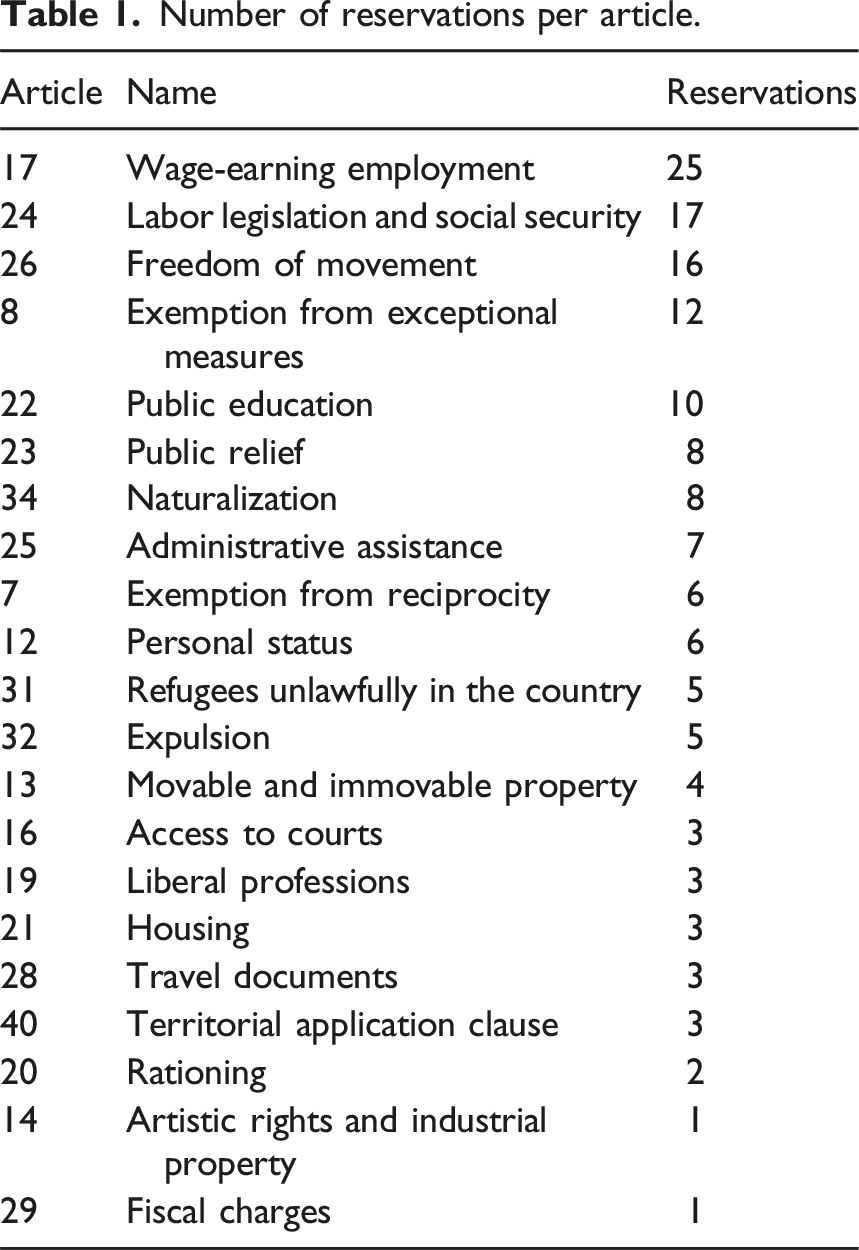
As Table 1 reveals, two of the welfare-state related provisions have led to only a handful of reservations: Article 20 on rationing and Article 21 on housing. But the three remaining articles have led to many reservations: Article 23 on public relief, Article 22 on education, and especially Article 24 on labor law and social security. It is also worth noting that several other articles that were highly contested are indirectly related to the welfare state, including Article 17 on wage-earning employment, which received the most reservations of all. These patterns have been observed in earlier research (see for example Blay and Tsamenyi, 2016; Hathaway 2021), but the differences among countries have not been studied extensively and, to the best of our knowledge, never from a welfare-state perspective.
The reservations.
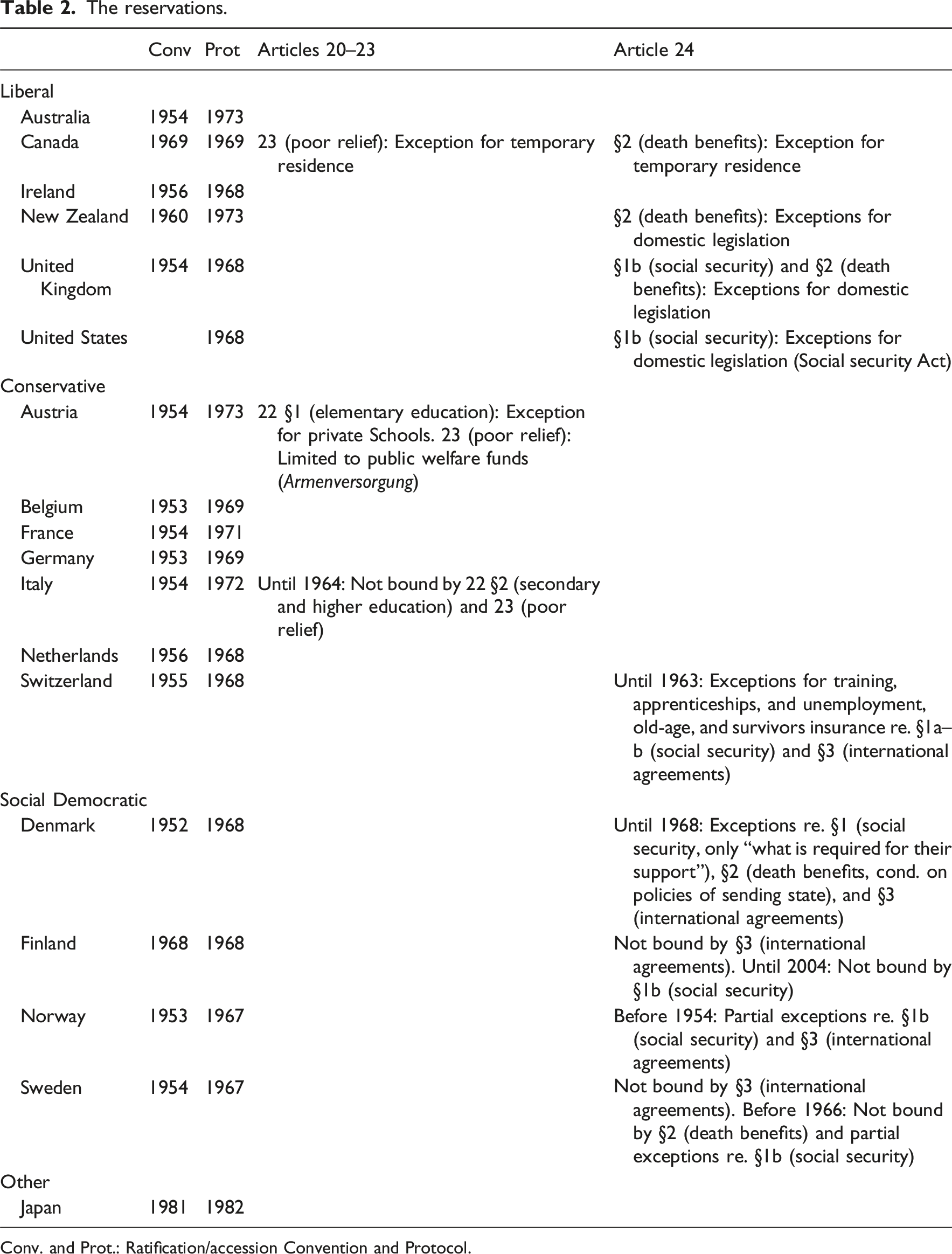
Conv. and Prot.: Ratification/accession Convention and Protocol.
We learn several important things from this table. First of all, reservations to articles 20–23 have been uncommon among democratic welfare states. There are no reservations at all to the articles on rationing (Article 20) or housing (Article 21), and the only reservations to Article 22 (education) are Austria’s reservation concerning private schools (which are rare in Austria, as discussed in Ansell and Lindvall 2021: Chapter 5) and Italy’s reservation concerning higher education (before 1964). Before 1964, Italy also had a general reservation concerning the article on poor relief (Article 23, which it treated as a recommendation, not a binding rule). Austria has a reservation to Article 23 which clarifies that in the Austrian context, “public relief” referred to poor relief (Armenversorgung) and not to other parts of the social-welfare system. During the original negotiations, the Austrian representative declared that whereas unemployment insurance benefits were given equally to nationals and refugees, Emergency Help, or Notstandshilfe (which is provided when unemployment benefits run out), would continue to be reserved for nationals since “the financial position of Austria does not permit the inclusion of refugees in this category on the basis of equality with nationals” (Weis, 1995, 182).
There are many more reservations to Article 24, on labor law and social security. In the previous section, we saw that this article was subject to more intense debates than the other welfare articles. We now find a clear pattern when we compare reservations across countries with different welfare-state institutions. The main cleavage is between contributory and mixed financing, with contributory conservative systems making fewer reservations than both liberal and social-democratic systems, but when we compare the liberal and the social-democratic regimes, we also find that governments of social-democratic states issued the most far-reaching reservations.
Among the conservative welfare states in Continental Europe, which have mainly contribution-based social-welfare systems, there were almost no reservations to Article 24. The reason is most likely that refugees were unlikely to qualify for generous benefits anyway, at least in the short run, and when they did qualify, this was not politically controversial since they claimed benefits for which they had paid qualifying contributions themselves. The only exception is Switzerland, which for a few years after ratifying the convention made reservations to Article 24’s social-security provisions and provisions on international agreements. During the negotiations, Switzerland explained that when it came to old-age pensions, widows, and orphans, refugees would be treated as other foreigners. They were only entitled to help if they had contributed for at least 10 years, and the grant they then received was two-thirds of that received by Swiss nationals (Weis, 1995, 183).
These results are in line with a study of national immigration policies during 1880–1920 by Kalm and Lindvall (2019), who note that in the early days of social insurance, governments were more likely to exclude migrants from benefit schemes in systems with tax financing, compared with contribution-based systems. They observe, for instance, that Paragraph 45 of the National Insurance Act in Britain stated that “No part of the benefits to which such a person may become entitled shall be paid out of moneys provided by Parliament,” and if foreigners were entitled to sickness, disability, and maternity benefits, those benefits were reduced to seven-ninths of the normal benefit for men and three-quarters of the normal benefit for women. By contrast, Germany’s pioneering social-insurance laws from the 1880s did not contain any separate provisions on the rights of foreign nationals—coverage was defined in terms of occupation.
Among the liberal welfare states in the English-speaking countries—that is, the British Isles and the English-speaking settler societies in North America and Oceania—there were more reservations, but they were relatively limited in scope compared with what we will see in the social-democratic welfare states in the Nordic countries. Canada and New Zealand only made reservations to the provisions on death benefits—not the main social-security provisions in §1b—and the United Kingdom and the United States made exceptions for potential conflicts with specific pieces of legislation that had recently been passed when Britain ratified the Convention in 1954 (the National Health Service Act of 1946) and when the United States acceded to the Protocol in 1968 (the Social Security Act, as amended through Lyndon B. Johnson’s Great Society reforms in 1965).
As expected, we find the most reservations to article 24 among the social-democratic welfare states in the Nordic countries: Denmark, Finland, Norway, and Sweden. Norway only made short-lived reservations, but the governments of Denmark, Finland, and Sweden made broad reservations to the core provisions on Social Security in §1b when they ratified the Convention in the 1950s (Denmark and Sweden) and 1960s (Finland). The likely explanation is that they were concerned about the implications of claims from refugees to the more universal, tax-funded benefits that the governments of those countries were putting in place at the time. For example, during the negotiations, the Swedish representative said that while Sweden could on the whole accept the paragraph, for some benefits, especially old-age pensions, Sweden would reserve the right to treat nationals and foreigners differently. Norway and Denmark had similar positions (Weis, 1995, 188–189).
These findings suggest that all governments paid close attention to how their own welfare-state institutions would be affected by the provisions in the Convention. As we learned in the previous section, the Convention’s welfare-state provisions appear to have been drafted with either fully contributory or fully tax-financed systems in mind. States with mixed systems—especially the Nordic countries—therefore faced both administrative incompatibilities and immediate fiscal costs, which helps explain why they made a comparatively large number of reservations.
Several countries that initially made broad reservations later withdrew some of them. There are several potential explanations for this. One is that policymakers adopted a precautionary approach—planning for large numbers of arrivals—since they did not know how many refugees would seek protection after the ratification of the Convention. In many cases, the reservations were removed during periods of relatively low refugee inflows to these countries. Another possible explanation is offered by research suggesting that over time, having a large and generous welfare state fosters a broader sense of solidarity and more inclusive policies toward refugees (see Boräng et al. (2022) for an overview). This dynamic may have led governments in countries with social-democratic welfare institutions to adopt more open refugee policies at a later stage.
Let us consider some alternative explanations for the patterns we observe in Table 2. One is the geographical context: the social-democratic welfare states are also Nordic countries. However, it seems unlikely that geography or Nordic cooperation alone explains the patterns in the data. If anything, due to their remote geographical location, governments in the Nordic region in the 1950s should have been less concerned than their continental counterparts about the prospect of large-scale refugee migration. Another potential explanation is government composition. This explanation, too, seems insufficient. While several social-democratic welfare states were governed by social-democratic parties during the 1950s, not all were. Moreover, if welfare-state concerns were not a significant factor, one would have expected left governments to be less inclined to make reservations, given their ideological commitment to internationalism. Taken together, these alternative explanations do not convincingly account for the observed patterns in the data. Concerns about the sustainability of national welfare states remain the most compelling explanation.
To sum up, a comparison among countries with different types of welfare regimes suggests that national welfare-state institutions influenced government decisions about which reservations they would issue when they ratified the 1951 Convention or acceded to the 1967 Protocol, which in turn reflects concerns these states expressed already during the original negotiations. The next section explores these dynamics in more detail through a case study of Sweden, examining how domestic political debates reflected or reinforced concerns about the long-term implications of granting social rights to refugees.
Case-study evidence from Sweden
In the previous section, we saw that social-democratic welfare states made the most reservations to Article 24 of the Refugee Convention. Our theoretical argument suggests that this pattern was driven by political concerns about the impact of the Convention on welfare states that offer both generous benefits and universal access. We will now explore if such concerns were also expressed in domestic political debates on the Convention. We concentrate on the case of Sweden. We begin by examining the broader societal debate through media reports and then we analyze elite-level political debates with the help of the parliamentary papers.
Overall, media coverage of the drafting of the Refugee Convention in the late 1940s and 1950s was sparse and concentrated to the labor press. Given its overall strong interest in social policy, it is noteworthy that, at this time, the labor press did not even mention the potential implications of the Convention for the welfare state. In 1950, the Social Democratic newspaper Arbetet reported that “a question of immense importance from a humanitarian point of view is currently being handled by the United Nations Economic and Social Council” (Flyktingar, 1950). During the conference itself, the syndicalist newspaper Arbetaren featured a longer article about the United Nations’ work on refugees in general and the Geneva conference in particular (23 June 1951). This newspaper continued to report on the issue (30 July 1951, 17 December 1952).
While the media was almost silent on the implications for the welfare state, domestic political elites did express concern about those implications. On 19 February 1954, the government submitted the ratification bill to parliament and provided a detailed account of the drafting process. The responsible minister, Östen Undén, emphasized that already during the Convention negotiations, the Swedish representative had indicated that Sweden would likely enter reservations to Article 24 (Prop, 1954). The reason was that this article could not be reconciled with the structure of the Swedish welfare system. In particular, the government noted that since the level of the universal basic pension (folkpension) was not related to previous employment or contributions, it could not be extended to foreigners. The issue of pensions was at the top of the political agenda at the time. A commission of inquiry dealing with the issue was underway, and heated debates about the future of the pension system culminated a few years later in a referendum, a new election, and, eventually, an extremely close vote in parliament in favor of the pension proposal of the Social Democrats. The conference delegation had also indicated that Sweden was going to make reservation against Article 17:2 (about exemptions from work permits), as the Article would be in conflict with Sweden’s system of mandatory work permits for foreigners.
In his statement on the bill, Östen Undén emphasized that, with regard to Article 24, refugees already enjoyed equal labor-market rights and largely comparable social rights to those of Swedish citizens (Prop, 1954). Still, a number of reservations were made concerning labor-market and social policy. As anticipated, Sweden made a reservation to Article 17:2 and added another to the section on unemployment insurance in Article 24. In the bill, the government noted that foreigners currently had the same rights as Swedish citizens to join unemployment insurance funds. However, it wanted to preserve the authority of the Labor Market Board on this matter, “in view of the funds’ close connection to the labor unions” (Prop, 1954, 31). Sweden’s reservations in relation to health care were motivated by a conflict between the convention and the demand for census registration in the existing health-insurance system.
The Convention text made explicit that for “benefits or portions of benefits which are payable wholly out of public funds,” states were not bound by the Convention. The importance of this formulation is clear in the Swedish case: had it not been there, the Swedish government would have considered it necessary to make several additional reservations. As noted above, the Swedish delegation at the negotiations predicted that there would be reservations from the Swedish side around universal basic pensions. In the end, this was not necessary, since these were paid for entirely by taxes. The same was true for child benefits: the government noted in the bill that since child benefits were paid for by taxes, no reservation would be necessary. But as we have seen, there were areas in which the general exception for tax-financed programs did not apply, and in those areas, the government explained that it needed to make reservations.
In March, the press reported that the Minister for Foreign Affairs had proposed that the parliament approve the ratification of the Convention, but there was no discussion of the content of the bill, nor of the Convention itself. During the following months, the parliamentary committee on foreign affairs handled the bill. They delivered their report on 22 April. The committee supported the bill, including the suggested reservations to certain articles of the convention, and there was no note about any reservations made by committee members. The bill passed in the First Chamber without any debate at all, and there was no substantial debate in the Second Chamber.
At the time of the withdrawal of some of the reservations, in the late 1960s, there was no parliamentary debate at all. It was simply noted in a report to the Parliament in January 1967 that some reservations had been withdrawn the previous year.
What is clear from the Swedish case is that the country’s political leaders considered carefully the implications of the Convention not only for the welfare state that existed at the time, but also for anticipated future social-policy reforms. The lack of debate in parliament on how the social-democratic government intended to deal with these implications suggests that there were no major divisions between the political parties on this issue. As discussed earlier, states are mindful of sovereignty costs associated with entering international agreements, and they may reduce these costs either through the precise design of the treaties or through reservations against particular articles. In the Swedish case, both of these methods were important. The design of the Convention, which allowed states to make exceptions to the principle of equal treatment when social policies were paid for by public funds, kept important social-policy domains under national control. When this was not enough, Sweden made reservations to specific articles.
We also note that there was little public debate about these matters. While politicians were clearly preoccupied with the potential implications of the Convention for the welfare state, these aspects of the Convention were not discussed in the newspapers. At this time, immigration policymaking remained an elite-level process, with the general public paying much less attention to the issue of refugee migration than today.
The Swedish case thus provides further support for our argument that concerns about fiscal exposure and sovereignty were important motivations behind the reservations states made to Article 24. But it also underscores the elite-driven nature of treaty-making in this area—making international legal commitments was a sensitive matter, but it was not the subject of widespread public contestation.
Conclusions
In this paper, we have studied how emerging welfare-state institutions influenced the behavior of states during the negotiation, adoption, and ratification of the 1951 Refugee Convention. Building on comparative welfare-state research, we have argued that national governments sought to limit the potential financial and political exposure of their welfare programs by limiting their obligations under international law. We tested this argument through an analysis of the provisions on social policy in the Convention itself, the decisions of states to issue reservations to some of those provisions, and a case study of Sweden.
Our main finding is that the behavior of different states during the negotiations—especially which states chose to make reservations against which particular articles and clauses in the Convention—can be explained by the types of welfare states that had emerged after the Second World War. The provisions on the welfare state in the Convention were most politically challenging in welfare states that wished to combine universal access with generous benefits financed through a combination of contributions and taxes. This is reflected both in the negotiations and in the reservations. In future research, it would be interesting to investigate whether the pattern also holds for the provisions that are more indirectly related to access to the welfare state. The case study of Sweden shows that policy makers explicitly stated that the actions taken at the international level were motivated by concerns about the welfare state. Policymakers were reluctant to limit their ability to further expand social-policy programs in the future. In other words, theories of welfare-state regimes help to explain the behavior of states in international negotiations on refugee law in the middle of the twentieth century, with differences in the mode of welfare-state financing being particularly important for the positions governments took. As we learn from the Swedish case study, however, these debates were often confined to the elite level and did not involve a broader set of social and political stakeholders.
Our findings has important implications for scholarship arguing that generous welfare states and inclusive policies vis-à-vis refugees and other migrants often go together. Several comparative studies have shown that immigrants enjoy more extensive rights and are less likely to be poor in comprehensive welfare states (Sainsbury, 2006, 2012), and that comprehensive welfare-state institutions can foster social solidarity and support for the inclusion of migrants (Boräng, 2015, 2018). The findings in this paper suggest that these patterns may have emerged during the second half of the twentieth century, for in the 1950s and 1960s, governments in generous, tax-financed welfare states seem to have been concerned about limiting their fiscal exposure when ratifying the Refugee Convention. As scholarship in international relations reminds us, political choices often have unintended consequences and governments operate with short time horizons (Abbott and Snidal, 2000; Barnett and Finnemore, 2004; Loescher, 2017). Policymakers in the 1950s and 1960s seem to have focused on immediate fiscal exposure and institutional fit rather than on long-term implications that only became apparent decades later.
We end by noting that the concerns governments had about the Refugee Convention’s implications for the welfare state were shaped by the specific types of welfare states that existed or were being constructed in the 1940s and 1950s. States could not anticipate developments that occurred several decades later. It’s particularly interesting to note that the Convention has very few provisions on child care and care for the elderly. Those are programs that have expanded greatly in the rich democracies during the last few decades, and they are central to contemporary political debates on the access of asylum seekers and refugees to government programs and public services.
Footnotes

Ethical considerations
All applicable ethical guidelines have been followed. It was not necessary to seek local ethics approval, since the paper is historical and does not contain sensitive personal data. The paper does not involve research on human subjects.
Funding
The authors disclosed receipt of the following financial support for the research, authorship, and/or publication of this article: This research was supported by the Swedish Research Council (grant numbers 2016-00783 and 2017-01644).
Declaration of conflicting interests
The authors declared no potential conflicts of interest with respect to the research, authorship, and/or publication of this article.