




Abstract
Social policy scholars often argue that policy programs are more popular when they are universally accessible, targeted at deserving social risk groups, or provided in kind rather than in cash. I argue, however, that most existing evidence is inconclusive because it typically conflates the respective factors of programs’ policy design, risk group deservingness and mode of delivery. Using data from a factorial vignette experiment in Belgium and the United States, this article is the first to uncover both the relative and additive causal impact of these factors on popular support for social policy. Results show that while policy design has a stronger impact relative to risk group deservingness and delivery mode, it is the specific combination of these factors that matters most for programs’ popularity. Given what we know about policymakers’ responsiveness to public opinion, these findings also have important implications for the political success and redistributive outcomes of social policy programs.
Introduction
It is often argued that the long-term success and survival of social policy programs is at least partly driven by the level of support they receive among the general public, because it is –electorally speaking– more attractive for policymakers to maintain the generosity and quality of a program if it is highly popular (Brooks and Manza, 2006). Well-liked policy programs, so the argument typically goes, will have larger budgets at their disposal, making them also more effective in alleviating poverty and narrowing income inequality (Korpi and Palme, 1998). By contrast, programs that are highly unpopular among the public are unlikely to receive large political support and are hence expected to yield worse redistributive outcomes. A key question for social policy scholars and entrepreneurs is then: how can such popular support be boosted?
This article scrutinizes three relevant claims that are frequently put forward in both specialized literature and public/political debates on social policy. The first is that popular support can be increased by making social policy programs universally accessible for all rather than targeting these at the poor only through means testing (Jacques and Noël, 2018; Korpi and Palme, 1998; Skocpol, 1991). This is mainly because such a universal policy design creates larger “welfare constituencies” (Pierson, 2001) and is supposedly seen as morally superior by most citizens (Larsen, 2006; Rothstein, 1998). The second claim is that support can be strengthened by targeting social risk groups that are seen as highly deserving by the public (such as the elderly or the sick and disabled) rather than groups commonly perceived as less deserving (e.g. the working-aged unemployed) (Greenstein, 1991; Laenen, 2020; Schneider and Ingram, 1993). The third claim is that popular support can be improved by offering in-kind services rather than cash benefits, mainly because the former mode of delivery is generally considered less susceptible to potential fraud or misuse on the part of program recipients (Currie and Gahvari, 2008; Liscow and Pershing, 2022).
Importantly, while there is some empirical evidence for each of these claims in public opinion research, I argue that this evidence is largely inconclusive because most prior studies have in fact conflated the respective factors of “design”, “deservingness” and “delivery”. With regard to the first, we can see that the studies concluding that universal social policy programs are indeed more popular than means-tested ones for the poor typically compare programs that not only differ in terms of their universality but also in terms of the social risk group they target as well as their mode of delivery (see Laenen and Gugushvili, 2021 for a review). Generally speaking, the same goes for studies claiming that programs targeted at deserving risk groups are more popular (Kangas, 2003; Laenen, 2018; Larsen, 2006) and studies concluding that in-kind services receive more support than cash benefits (Campbell and Gaddis, 2017; Liscow and Pershing, 2022). To illustrate this, consider the example of a study that finds (as many in fact do) that a universally accessible healthcare program is significantly more popular than a means-tested social assistance benefit for the working-aged unemployed. Such a simple finding can be interpreted and understood from each of the three perspectives introduced above, without there being any conclusive answer as to which of these is most accurate. Accordingly, it remains unclear whether the observed gap in popular support is driven by differences in the policy design of these programs, the social risk groups that are being targeted, their mode of delivery, or, alternatively, the particular combination of these factors.
Using data from a factorial vignette experiment (Auspurg and Hinz, 2015), this article is –to the best of my knowledge– the first to isolate and compare the relative impact of policy design, risk group deservingness and mode of delivery on popular support for social policy. Additionally, I also investigate the additive effect of these three broadly recognized factors, as it might be the case that it is the specific combination of (1) universal access, (2) a deserving risk group, and (3) in-kind provision that makes social policy programs particularly popular (rather than any of these factors alone). In the following, I first discuss the design, deservingness and delivery factors in greater detail, demonstrate how previous research has conflated them and explain why this constitutes an important knowledge gap, and reflect on potential cross-country variation. After that, I present the methodology and results of a novel survey experiment that was conducted among a sample of 2000 respondents living in two very different welfare states: Belgium and the United States (US). Results show that although there is certainly some basic truth to the different claims made in the literature, there are simply too many instances in which the survey evidence does not support the idea that any of the three oft-cited factors makes the difference on its own. Instead, the main conclusion arising from the findings is that the popularity of social policy programs is determined by the specific way in which the factors of design, deservingness and delivery are combined in different welfare state contexts. Finally, I discuss the theoretical and political implications of these findings, and suggest new avenues for future research.
Theory and hypotheses
The design factor
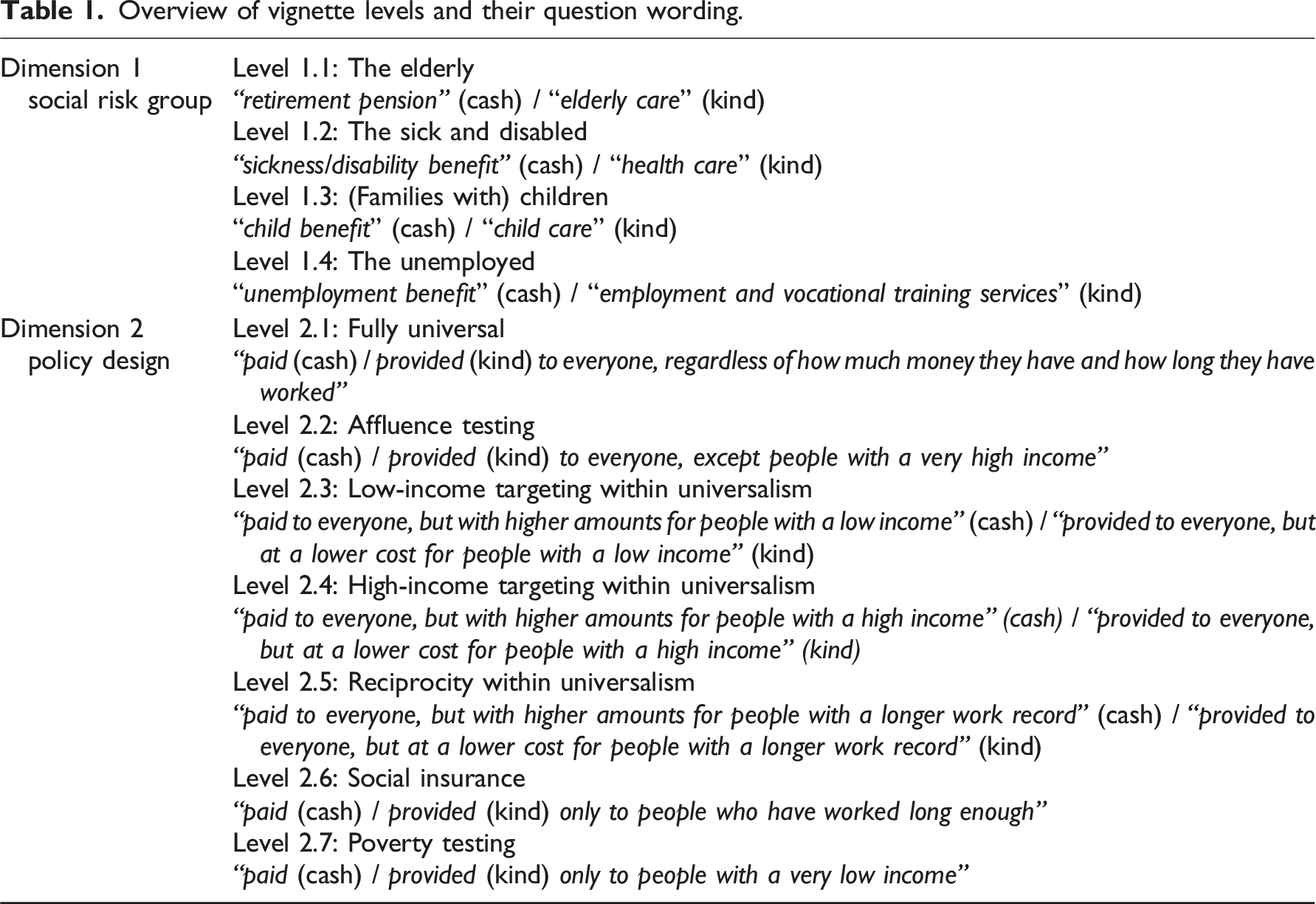
In social policy literature, it is often argued that the key to understanding variation in the popularity of different programs lies with their policy design. In this article, I define policy design as the institutional “rules of the game” that determine who gets what from a policy program. More specifically, I focus on one of the most important, and most debated, aspects of policy design: the eligibility criteria that regulate benefit access. At one extreme, such access can be granted universally on the basis of citizenship or residency, meaning that all those who encounter a certain social risk are entitled to government support. At the other extreme, access can be made highly selective, by restricting such support to low-income groups through the use of a means test (also known as “poverty testing”; Kangas, 1995). There are of course many policy options situated in between these two extremes. In the empirical analyses presented below, I include the following in-between policy designs: (1) “low-income targeting within universalism”, in which access is granted universally but low-income groups receive higher benefits (in case of cash provision) or face lower costs (in case of in-kind provision) (Jacques and Noël, 2020), (2) “high-income targeting within universalism”, which refers to universal programs that are regressively designed so that high-income earners receive higher benefits or face lower costs; (3) “affluence testing”, in which a means test is used to only exclude the highest income groups and access is usually quasi-universal (depending on the level of the income threshold) (Kangas, 1995), (4) “reciprocity within universalism”, in which access is universal but the payment (cost) increases (decreases) with longer work records, and (5) “social insurance”, in which access is restricted to workers with a sufficiently long work record.
It is a long-standing claim, in both American and European literature, that universally accessible social policy programs receive higher levels of popular (and thus political) support than their selective, means-tested counterparts that are targeted at the poor only (Jacques and Noël, 2018; Korpi and Palme, 1998; Larsen, 2006; Rothstein, 1998; Skocpol, 1991). 1 From a self-interest perspective, such poverty-tested programs are supposedly unpopular because they exclude large parts of society –including the middle and upper classes–, who are nevertheless required to pay for these programs through income taxes (Korpi and Palme, 1998). Additionally, these programs are –according to some authors (most notably Rothstein, 1998)– also disliked from a moral point-of-view, because they single out poor people as being a “different breed” (Larsen, 2006). Universal programs, by contrast, are said to enjoy greater popular support because they serve larger groups of “welfare constituencies” (Pierson, 2001) and are considered morally superior (Rothstein, 1998). As a result, they allegedly have a larger budget at their disposal, making them more effective in alleviating poverty than their poverty-tested counterparts (Korpi and Palme, 1998; Nelson, 2004), which are in constant danger of becoming, for political reasons, “poor programs” (Sen, 1995). In sum, the first hypothesis (H1) thus states that: Social policy programs that are universally accessible will receive higher levels of popular support than means-tested programs for the poor only (irrespective of their social risk group and mode of delivery).
The deservingness factor
From another perspective, scholars have argued that the key to understanding variation in the popularity of different social policy programs lies with the perceived deservingness of the social risk groups they are targeted at. Already in the earliest work on popular welfare attitudes, deservingness was identified as an important determinant (e.g., Coughlin, 1980; Taylor-Gooby, 1985). It was not until the work of Van Oorschot (2000, 2006), however, that the deservingness explanation turned into a more structured theoretical framework. Van Oorschot recognizes five criteria that people use to decide who should get what from the welfare state: control, attitude, reciprocity, identity, and need. Together, these so-called “CARIN criteria” (Van Oorschot et al., 2017) help to explain why prior research consistently finds that some social risk groups (most notably the elderly, sick and disabled) are seen as more deserving of social welfare than other groups (most notably the able-bodied unemployed), and why the programs targeted at the former tend to be more popular than the programs directed towards the latter (see Laenen, 2020 for a review). For example, the elderly are considered highly deserving because they are generally seen as subject to the uncontrollable event of growing old (control), as grateful for the help they receive (attitude), as having contributed a great deal to society in the past (reciprocity), as relatively similar to “us” (identity), and as having special age-related needs (need). By contrast, the unemployed tend to be evaluated more negatively on these criteria, as they can be suspected of being individually responsible for their situation, having made fewer contributions, and so on (Larsen, 2008; Van Oorschot, 2006).
Similar to the policy design explanation, it is often argued that such popular perceptions of deservingness have important political repercussions, either because policymakers share similar perceptions (Cook and Barrett, 1992), or because they are influenced by them through mechanisms of policy responsiveness (Laenen, 2020). One prominent example in this regard is (Schneider and Ingram 1993, 2005: 16) social construction theory, which argues that “the social construction of deservedness has serious and long-term implications for allocating benefits and burdens in society”. In their view, policymakers find it much more to their advantage to establish beneficial (social) policy for positively constructed, deserving groups than for negatively constructed, undeserving groups. Several studies seem to confirm that social policy programs are indeed more generous and effective when they are targeted at social risk groups that are considered highly deserving in public opinion (Greenstein, 1991; Hubl and Pfeifer, 2012; Laenen, 2020; Larsen, 2008). Programs for the undeserving, by contrast, tend to degrade into “undeserving programs” (Handler and Hasenfeld, 1991: 239). In sum, the second hypothesis (H2) thus states that: Social policy programs that are targeted at highly deserving social risk groups will receive higher levels of popular support than programs that are targeted at less deserving groups (irrespective of their policy design and mode of delivery).
The delivery factor
From yet another point-of-view, it might be that the key to understanding variation in the popularity of different social policy programs lies with their mode of delivery, which I define here as the way in which a program is provided: either as an in-kind service, or as a cash benefit. 2 It is often said that in-kind provision garners much greater popular support than its cash counterpart. The most frequently invoked reason for this popularity gap is that most people supposedly prefer that the government is able to exert at least some level of control over the way in which tax-funded public aid is being used, which is far easier for in-kind services compared to cash benefits. Indeed, recipients of cash programs are usually free to spend the money as they please. This can collide, however, with paternalistic concerns that the money should not be (mis)used to pay for socially deviant conduct, such as the purchase of drugs or alcohol (Liscow and Pershing, 2022). In-kind services, by contrast, are said to prevent such misuse of taxpayers’ money, because they are delivered directly to program recipients.
Given that suspicions of misuse, abuse or even fraud are known to be detrimental for citizens’ support for social policy (some claim this to be its “Achilles’ heel”; Roosma et al., 2016), it seems very plausible that in-kind services are indeed more popular than cash benefits. If this is true, we should also expect that in-kind programs are seen as more desirable by electorally motivated and responsive policymakers, whom will have greater incentives to make these programs more generous and sustainable (Currie and Gahvari, 2008). In that sense, it could be said that in-kind programs have a higher likelihood of being “kind programs”. In sum, the third hypothesis (H3) thus states that: Social policy programs that provide in-kind services will receive higher levels of popular support than programs that provide cash benefits (irrespective of their social risk group and policy design).
Conflating design, deservingness and delivery
At first glance, there seems to be empirical evidence supporting each of the three claims made above. Many opinion studies, conducted in different countries and years, explicitly argue that universally accessible social policy programs are indeed more popular than their poverty-tested counterparts (see Laenen and Gugushvili, 2021 for a review). Likewise, study after study concludes that the perceived deservingness of the risk group targeted by social policy programs is a major determinant of their popular support, leading to higher levels of support for programs targeted at the old, sick and disabled compared to programs targeted at the working-aged unemployed (see Laenen, 2020 for a review). Furthermore, there is also plenty of evidence suggesting that in-kind social services are generally more popular than cash social benefits (Campbell and Gaddis, 2017; Liscow and Pershing, 2022; Peillon, 1996).
At the same time, however, most prior studies tend to conflate the factors of design, deservingness and delivery, and are thereby unable to isolate and compare their relative impact on popular support. Several scholars have noted the often made conflation between policy design and risk group deservingness in particular. For example, as argued by Bay & Pedersen (cited in Larsen, 2006: 100), “it is often pointed out that means-tested programs are less popular than universally provided benefits, but it is difficult to say whether this is a true design effect or simply an effect of attitudes towards the social risk and the composition of the beneficiaries covered by the different schemes” (see Kangas, 2003; Laenen, 2018 for similar arguments). As suggested by a recent literature review (Laenen and Gugushvili, 2021), the existing evidence is therefore inconclusive, because most of the studies confirming that universalism is more popular than poverty testing typically compare programs that not only have a different policy design but also target different social risk groups known to vary in terms of their perceived deservingness. This conflation creates confusion around the driving factor(s) behind the observed variation in support for these programs: is it their policy design, or the deservingness of the risk group they are targeted at? For example, if a study finds –as many in fact do– that a universally accessible old-age pension is more popular than a poverty-tested social assistance scheme for the unemployed, is this then because the former is universal, or because it is targeted at the deserving elderly? In a similar vein, welfare deservingness scholars have given little attention to the fact that the programs they typically compare are not just targeted at different risk groups, but also have different designs –as some of them are means-tested while others are granted universally (Laenen, 2020). What is needed, therefore, are studies that compare the level of support for social policy programs that have similar policy designs but target different risk groups (e.g., universal old-age pensions vs universal child benefits), or vice versa, have different designs but target similar risk groups (e.g., universal vs means-tested pensions). 3
Similar arguments apply to the third factor under consideration here (i.e., programs’ mode of delivery), whose conflation with the other two factors has –to the best of my knowledge at least– not been discussed as explicitly in existing social policy scholarship. Let us consider the example of public healthcare to illustrate how prior opinion research has conflated the delivery factor with both the design and the deservingness factor. It is a well-established empirical fact that healthcare tends to rank among the most popular social policy programs (Laenen, 2020; Schlesinger and Lee, 1993). This has often been attributed to the fact that, in most European countries at least, existing public healthcare programs are universally accessible for all citizens/residents (Jordan, 2010), as well as to the fact that sick people are generally regarded as highly deserving of state support (Jensen and Petersen, 2017). A third explanation, however, states that healthcare is so popular because it is provided in kind rather than in cash (Schlesinger and Lee, 1993). The problem is that prior opinion research cannot tell us which explanation is most accurate, because it does not isolate and compare the relative influence of the respective factors. This study is –as I explain below– the first to accomplish this, by analyzing a survey experiment in which the factors of design, deservingness and delivery are orthogonal to each other and we can hence assess their relative, causal impact on popular support for social policy (Auspurg and Hinz, 2015). 4
Before turning to potential cross-national variation, however, it is important to point out the possibility that what is important for popular support might be the particular combination of the three factors rather than any of these factors alone. It could be, for example, that universal programs are only popular insofar as they are also targeted at a deserving risk group and/or provided in kind. Conversely, it could well be that poverty-tested programs are only unpopular when targeted at less deserving risk groups and/or provided as a cash benefit. Accordingly, the fourth (H4) hypothesis states that: Popular support will be highest when social policy programs are universally accessible + targeted at deserving groups + provided in kind; and lowest when accessible only for the poor + targeted at less deserving groups + provided in cash.
Design, deservingness and delivery in different contexts
In all of the above, the (implicit) assumption is that the factors of design, deservingness and delivery affect popular support in similar ways in different countries, leading to a cross-national consensus on which types of social policy programs are most/least popular. This is particularly evident in deservingness literature, where scholars have long argued for the existence of a universal rank order of deservingness in which some social risk groups are seen as more deserving than others, irrespective of the specific country context (Coughlin, 1980; Van Oorschot, 2006). According to some, this is in large part due to the deeply rooted psychological “deservingness heuristic” that has evolved throughout the course of human evolution to enhance group survival, prompting us to separate undeserving “cheaters” from deserving “reciprocators” (e.g., Jensen and Petersen, 2017). In a similar vein, many social policy scholars –often implicitly– assume that universally accessible programs are more popular than poverty-tested ones (Laenen and Gugushvili, 2021), or that in-kind services are preferred over cash benefits (Campbell and Gaddis, 2017), regardless of the country context.
There are, however, alternative views predicting greater variation in the popularity of different types of social policy programs across countries. Most notably, policy feedback theory argues that citizens’ preferences are to a large extent shaped by the social policies that are in place in the country they live in. At the macro level, it is a long-standing hypothesis that citizens will prefer those policy programs that are most dominant in the welfare regime they live under. From that perspective, citizens living in liberal welfare states (e.g., the US) are more likely to have a preference for poverty-testing programs, while their counterparts in corporatist-conservative welfare states (e.g., Belgium) are more likely to opt for social insurance programs (Esping-Andersen, 1990). In a similar vein, it has been argued that because liberal welfare states put much more emphasis on the deservingness of program recipients, this factor should have a stronger impact there compared to the other worlds of welfare (Larsen, 2006). Zooming in closer, other scholars argue that popular preferences are (also) influenced by individual policy programs at the meso level, in the sense that citizens might simply prefer the types of social policies that currently exist in their country (Laenen, 2018). For example, it seems plausible that people living in a country where child benefits are in fact universally accessible (e.g., Belgium) are more likely to prefer this policy design, compared to those living in a country where they are means tested (e.g., the US). At the same time, however, it has also been recognized that policy feedback may also be negative, meaning that citizens develop preferences that are opposite to the social policies they are exposed to (Jordan, 2010).
Given this multitude of (oftentimes contrasting) theoretical expectations regarding potential cross-national variation in the role of design, deservingness and delivery in shaping popular support for social policy, I refrain from formulating formal hypotheses and will approach the issue in a more exploratory fashion in the empirical analyses reported below.
Data and methods
The theoretical hypotheses are tested empirically with the help of a large-scale survey conducted in November 2023 among a sample of 1000 adults living in Belgium and another 1000 living in the US. These countries were selected because they represent two highly diverging welfare states, with the former being a prototypical example of a relatively encompassing corporatist-conservative welfare regime dominated by social insurance programs and the latter being widely known as a typical liberal welfare regime characterized by a host of residual, poverty-tested social assistance programs (Esping-Andersen, 1990). Respondents were recruited via Bilendi in Belgium and Torfac in the US. These are online partner panels that select interlaced quota samples based on age, gender, and in the case of Belgium, language (i.e., Dutch and French). These criteria, as well as education, are used for the applied post-stratification weighting procedure that corrects for any under- or overrepresentation of particular demographic groups in the sample (most notably: men between the age of 18 and 34 in the US and those with a tertiary education degree in both countries, respectively; see Appendix I). As a result, the selected samples are overall fairly representative of their respective national populations in terms of age, gender and education.
Overview of vignette levels and their question wording.
OLS regressions estimating the relative impact of design, deservingness and delivery.
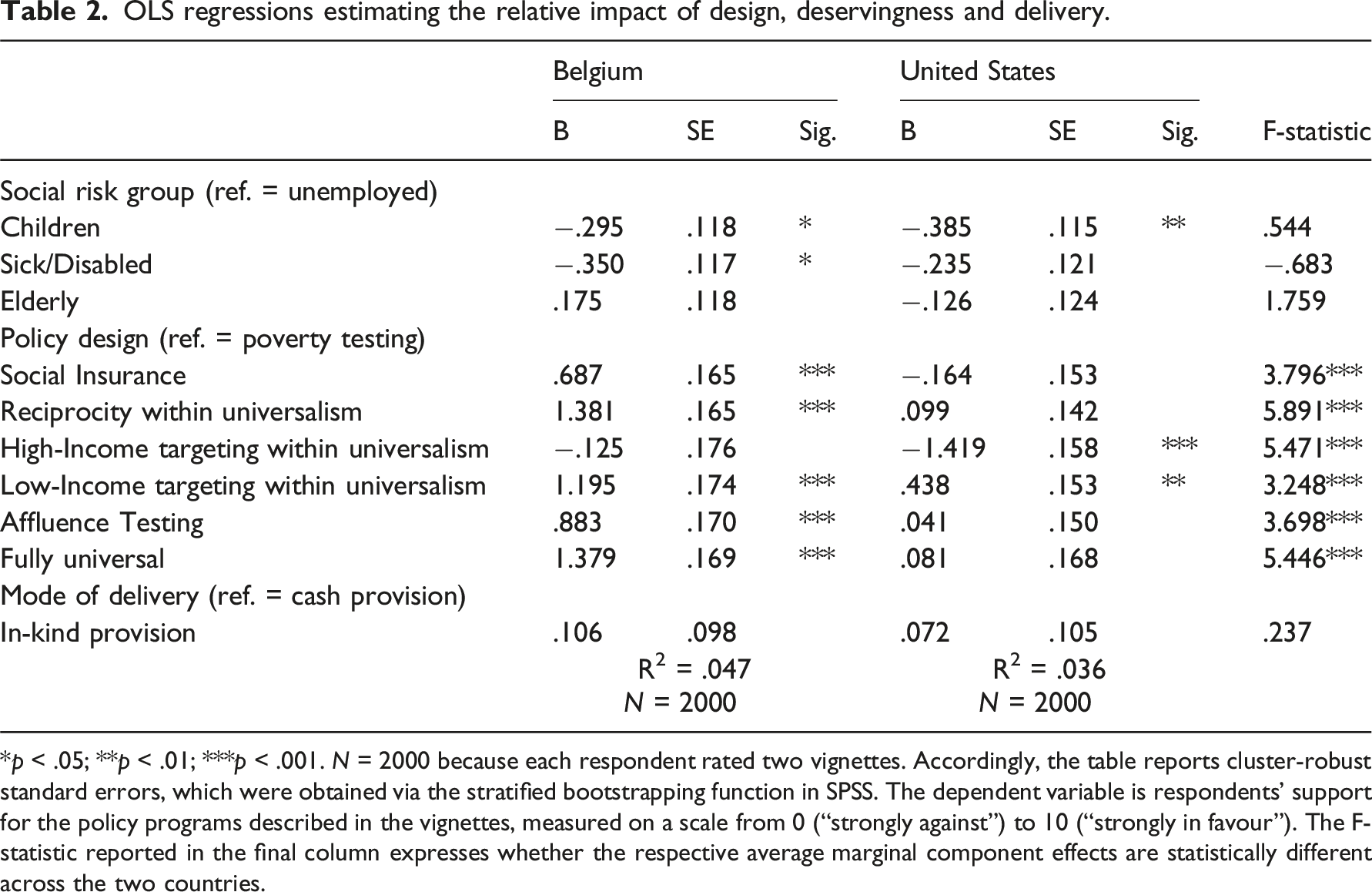
*p < .05; **p < .01; ***p < .001. N = 2000 because each respondent rated two vignettes. Accordingly, the table reports cluster-robust standard errors, which were obtained via the stratified bootstrapping function in SPSS. The dependent variable is respondents’ support for the policy programs described in the vignettes, measured on a scale from 0 (“strongly against”) to 10 (“strongly in favour”). The F-statistic reported in the final column expresses whether the respective average marginal component effects are statistically different across the two countries.
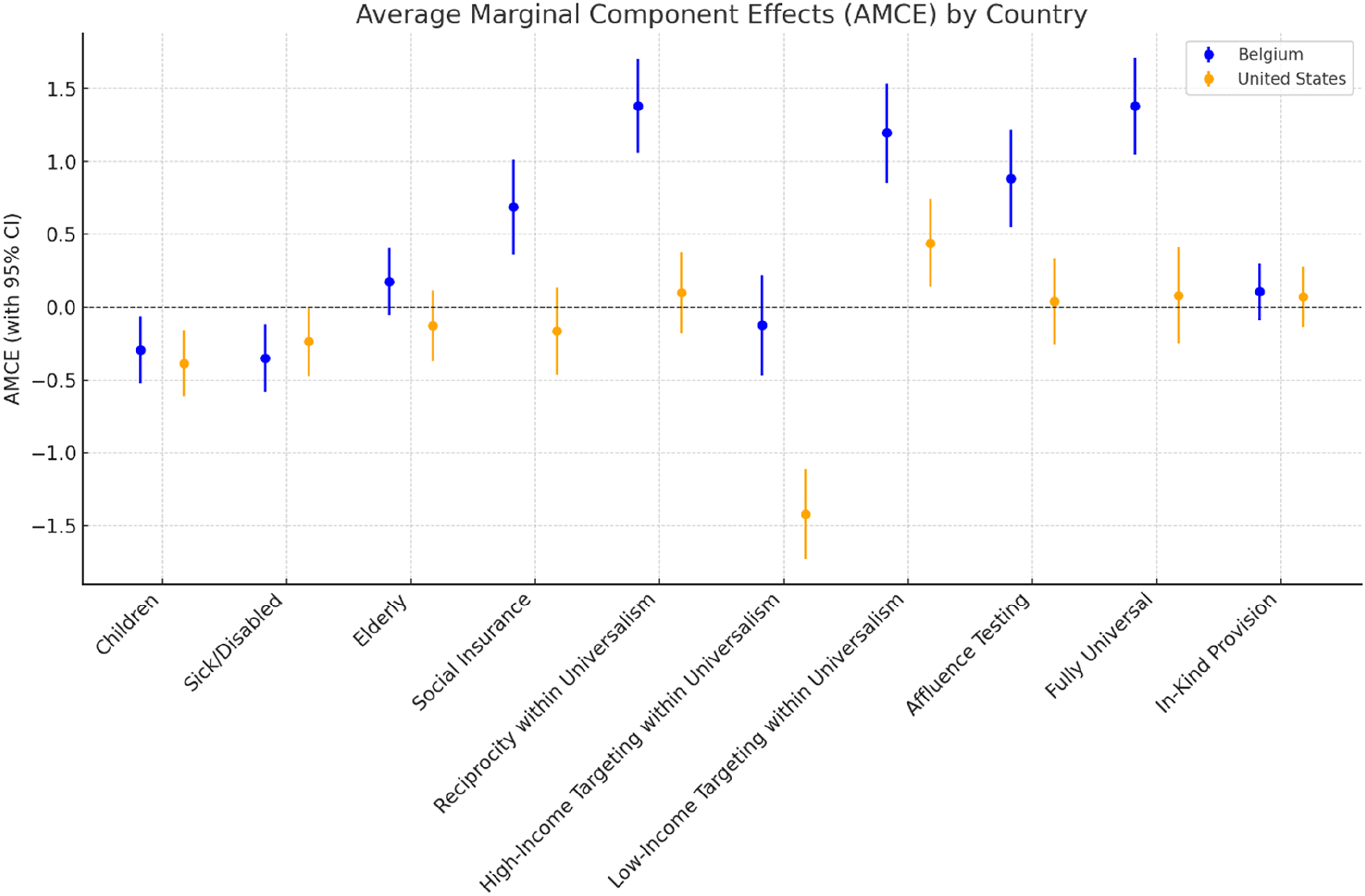
The relative effects of design, deservingness and delivery.
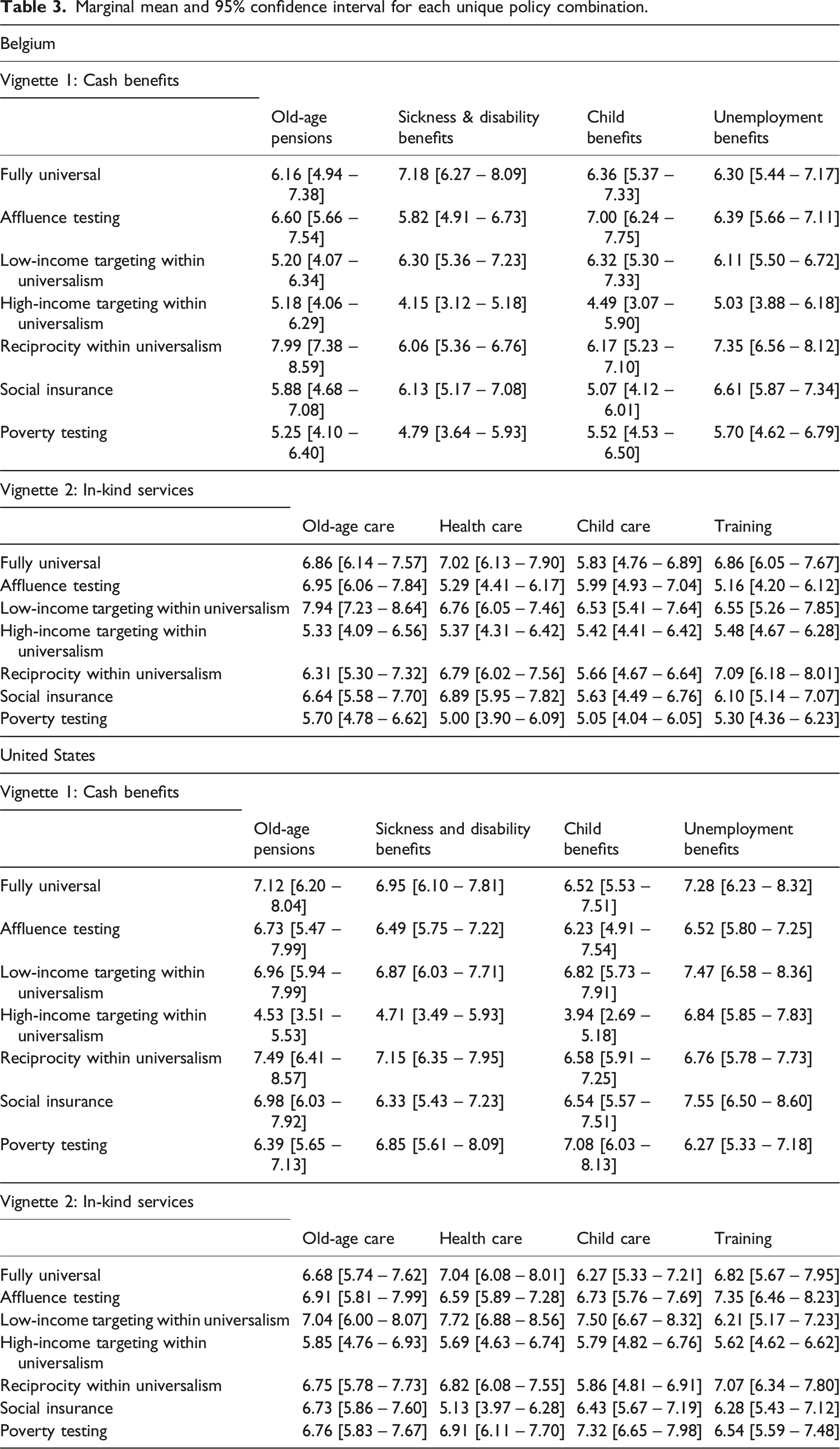
Marginal mean and 95% confidence interval for each unique policy combination.
Results
The relative impact of design, deservingness and delivery
Table 2 and Figure 1, showing the average marginal component effects (AMCEs) of all the different levels in the vignette experiment, suggest that it is mainly programs’ policy design that matters for their popular support. In Belgium, means-tested programs for the poor only (i.e., the reference category) are significantly less popular than all other policy design options. The only exception here are universally accessible programs that regressively pay out higher benefit amounts (or provide services at a lower cost) to high-income earners, which are about unequally unpopular as poverty testing. These differences are not only statistically significant but also substantively meaningful. As shown in Appendix IV, the marginal mean for poverty testing (M = 5.29) is more than 1 scale point lower than the mean for most of the universal programs (e.g., M = 6.57 for a fully universal design). More concretely, this means that the number of program supporters (scoring 6 or more on the response scale) increases from a little less than 50% to about 70%. In the US, however, the observed pattern points in a different direction (as also shown by the F-statistics reported in Table 2). With the exception of low-income targeting within universalism, poverty testing is not significantly less popular (which might be due to the fact that Americans live in a liberal welfare regime). In fact, most other policy designs are about equally popular, as can be seen from the insignificance of the other effects in Table 2. An important exception, however, is the option of high-income targeting within universalism, whose marginal mean (M = 5.36) is well below all other policy designs (ranging between M = 6.53 for social insurance to M = 7.10 for low-income targeting within universalism). This finding confirms prior research showing that Americans strongly dislike regressively designed social policies, as they exist for example in the form of tax expenditures that mainly benefit higher-income earners (Ashok and Huber, 2020; Faricy and Ellis, 2014).
These findings provide some evidence for the hypothesis (H1) that universally accessible social policy programs receive greater popular support than poverty-tested programs, net of their social risk group and mode of delivery (which are controlled for in the experiment). Importantly, however, this applies mostly to Belgium and less to the US (where universalism is only more popular if it provides additional benefits to low-income earners). Furthermore, I did not find any evidence for hypotheses 2 and 3 either. It is clearly not the case, as predicted by H2, that popular support is higher when programs are targeted at the elderly or the sick/disabled vis-à-vis children or the unemployed, despite the fact that these risk groups differ in terms of their perceived deservingness in the expected way (see Appendix II). In fact, the evidence even shows that (at least in Belgium) policy programs for the sick/disabled (M = 5.96) are somewhat less popular than programs for the unemployed (M = 6.11), although the difference is small and barely reaches statistical significance. The same goes for programs targeted at families with children, in both Belgium and the US. Likewise, I also reject the hypothesis (H3) that programs provided in kind are more popular than programs provided in cash (net of their risk group and policy design). Although in-kind provision receives more support than cash provision, the difference is statistically insignificant and substantively negligible in both Belgium and the US. This does not imply, however, that programs’ mode of delivery and social risk group are entirely inconsequential for their popular support. As I demonstrate below, the key lies in the specific way in which the factors of delivery, deservingness and design are combined within social policy programs in different contexts.
The additive impact of design, deservingness and delivery
Table 3, showing the marginal mean for each of the 56 unique combinations of policy design, risk group and delivery mode, first of all confirms what we already knew from the regression analysis: programs are not necessarily more popular when targeted at a deserving vis-à-vis undeserving risk groups, and they do not automatically receive greater support when provided in kind rather than in cash. It also demonstrates, however, that policy design alone does not tell the full story either. This can be seen from the fact that the popularity of some well-liked policy design options (as shown by the regression analysis) can decrease when linked to a particular social risk group and/or mode of delivery (and vice versa). In Belgium, for example, affluence testing receives somewhat higher support in general (M = 6.14; see Appendix IV) than when applied to healthcare (M = 5.29), in which case the number of program supporters decreases from 62.5% to 43.5% (but note that this mean difference is not statistically significant). Conversely, while Americans generally dislike regressively designed social policies (M = 5.36), they are considerably more supportive of an unemployment benefit that pays out higher amounts to high-income earners (M = 6.84) (as shown by the pairwise mean comparison, this difference is also highly significant, with p < .001). Overall, these results thus demonstrate that popular support is very often a function of the specific combination of programs’ policy design, social risk group and mode of delivery rather than being singlehandedly driven by any of these.
To illustrate this further, I now compare the most popular policy program(s) with the least popular program(s) in the two countries. This provides some, but certainly not full, evidence for the hypothesis (H4) that popular support is highest when social policy programs combine (1) a universal design with (2) a deserving risk group and (3) in-kind provision. The most popular policy programs indeed tend to combine at least two of these factors. However, the other part of the hypothesis, stating that support is lowest when programs contain the opposite sides of these factors, is clearly not confirmed by the data. Furthermore, the observed pattern is slightly different between the two countries under consideration. Belgians, on their part, seem most supportive of universally accessible programs targeted at the elderly in particular, as can be seen from the fact that the marginal means for (a) an old-age pension that rewards longer work records and (b) an old-age care program that provides services at a lower cost for low-income earners are both very close to 8 on a scale from 0 to 10. The least popular program in Belgium is a regressively designed disability/sickness benefit (M = 4.15). Correspondingly, moving from the most to the least popular program implies that the number of program supporters is cut in half (from 85.5% to 43%). A pairwise mean comparison confirms that this difference is also statistically significant (p < .001). Only two other programs do not reach the mid-point of the response scale: means-tested disability/sickness benefits for the poor only (M = 4.79) and child benefits applying the principle of high-income targeting within universalism (M = 4.49). Interestingly, not a single in-kind program is situated below the mid-point (even though some, mostly poverty-tested in-kind services, are very close to it).
In the US, support tends to be higher than in Belgium, and the differences between the respective policy programs are generally smaller (as also demonstrated by the F-statistics in Table 2). Nevertheless, also in the US, the gap between the most and the least popular program is both statistically significant (p < .001) and substantively large (81.5% - 36.5% = 45%). The highest marginal mean is observed for a public healthcare program applying the principle of low-income targeting within universalism (M = 7.72). This is very closely followed, however, by a range of other policy programs situated around a marginal mean of 7.50 (which, in terms of program supporters, hardly presents any difference). Perhaps somewhat surprisingly (at least from the deservingness perspective), this also includes unemployment benefits designed as either a social insurance (M = 7.55) or as a universal program that pays out higher amounts to low-income earners (M = 7.47). The least popular program in the US is clearly a regressively designed child benefit paying out higher amounts to high-income earners (M = 3.94), followed by old-age pensions (M = 4.53) and disability/sickness benefits (M = 4.71) with a similar design. These are the only programs below the mid-point of the scale, which means that there are again no in-kind services below that cut-off point. Finally, it is interesting to note that poverty-tested programs are seldom least popular in the US (contrary to Belgium), but are at the same time also rarely most popular (as one would perhaps expect from welfare regime theory). The only exceptions in this regard are child allowances and childcare, which are at the top of the popularity ranking when they are poverty tested (M = 7.08 and M = 7.32, respectively).
Despite these cross-national differences, the empirical findings in both countries do corroborate the core idea that the specific combination of policy design, risk group and delivery mode matters more than any of these factors alone. I will reflect on possible explanations for the observed cross-country differences and other relevant findings in the next section.
Conclusion and discussion
This article started from the oft-cited claim that popular support for social policy programs can be boosted by making them universally accessible, targeting them at deserving social risk groups, or providing them in kind rather than in cash. I argue, however, that prior studies on the matter typically conflated the respective factors of policy design, risk group deservingness and mode of delivery in their empirical analyses. The factorial vignette experiment presented in this article is, to the best of my knowledge, the first to causally determine both the relative and additive effects of the design, deservingness and delivery factors. In doing so, it offers a highly detailed “3D perspective” (as in: three-dimensional) on popular support for social policy.
Starting with their relative impact, the regression analyses suggest that policy design matters more than social risk group and delivery mode. Contrary to much prior research (e.g., Ashok and Huber, 2020; Laenen, 2020), which did not isolate the net, relative impact of these factors, I did not find many significant differences between programs targeted at different social risk groups nor between cash benefits and in-kind services. By contrast, I did find a significant main effect of policy design, confirming that –most notably in Belgium– universally accessible programs are systematically more popular than means-tested programs for the poor only. The fact that this was not as strong in the American sample could be interpreted as a “welfare regime effect”, indicating that poverty-tested programs may be more popular in a liberal welfare state context where such programs carry greater weight compared to other welfare regimes. This does not mean, however, that poverty testing stands out as the most popular design option in the US (as one might expect). The survey findings simply show that poverty-testing is not as unpopular in the liberal US as it is in corporatist-conservative Belgium. It is not the case either that the Belgian respondents have a clear preference for social insurance, which is the most dominant program type in the welfare state context they live in.
It would nevertheless be a mistake to conclude that popular support for social policy is singlehandedly driven by policy design. The analysis of the marginal means for each unique policy combination in the vignette experiment clearly shows that there is more to the story than policy design alone. Instead, what matters most is how the factors of design, deservingness and delivery are combined within a policy program. In line with the theoretically derived expectation, the most popular programs seem to combine a universal policy design with a deserving risk group and (albeit to a lesser extent) in-kind provision (e.g., universal old-age care). In contrast, the least popular programs often combine poverty testing with a deserving risk group (e.g., healthcare for the poor only). The latter finding might simply indicate that citizens generally dislike the idea of putting people whom they see as highly deserving of social welfare through the often cumbersome and demeaning process of a poverty means test.
In addition to these broader patterns, I also find that the relative popularity of the specific policy combinations varies quite a lot between Belgium and the US. This cross-national variation is not readily explained by differences in macro-level welfare regimes, and might instead be attributable to cross-country differences in meso-level policy programs. More specifically, it could be argued that the survey respondents simply favor those programs that currently exist in their country. This might explain why, for example, Belgians prefer a universal childcare system that provides services at a lower cost for low-income earners (as it is currently organized), or why Americans favor a poverty-tested child benefit (resembling the current Child Tax Credit). Both examples could be interpreted as clear evidence of positive policy feedback (Jordan, 2010). However, it is certainly not the case that public preferences and policy reality are always a perfect match. For example, I find a clear preference for a universal healthcare system in the US, which currently does not exist there. Another example pertains to the case of unemployment insurance in Belgium, which –despite being organized as such in reality– does not receive greater support than fully universal unemployment benefits. This shows that citizens deviate from policy reality when their preferences are out of tune with that reality, which suggests that processes of negative policy feedback are at play as well. I leave it up to future research to investigate such policy feedback in greater detail.
Another important task for future research is to cross-validate these experimental results against observational data. The experiment’s core strength (i.e., its ability to isolate the independent, causal impact of the different factors by the grace of their orthogonality) is concomitantly also its main weakness, in the sense that it implies that many of the policy programs considered in this article simply do not exist in real life –thereby reducing the realism and external validity of the study findings. What is needed, therefore, are complementary observational studies that compare the popularity of real-world programs with different combinations of policy design, risk group and mode of delivery (see Appendix V).
Additionally, it is important to note that the findings reported here have broader implications that reach well beyond the issue of public opinion. It is often argued that –because they are supposedly more popular– universal programs (e.g., Korpi and Palme, 1998), programs for deserving risk groups (e.g., Laenen, 2020) and in-kind programs (e.g., Ashok and Huber, 2020) receive higher levels of political support from democratically elected policymakers, which in turn increases their generosity and poverty-reducing effectiveness. If, however, programs’ popularity crucially hinges on the specific combination of design, deservingness and delivery, then this should have consequences for their political success and redistributive outcomes as well. Accordingly, I encourage future studies to investigate more systematically how social programs with different combinations of policy design, risk group and delivery mode vary in terms of their political support, generosity and capacity to alleviate poverty.
Finally, I want to make clear that the claim being made here is not that popular support is only driven by design, deservingness and delivery: while these factors are arguably important, other program features may also play a role. However, I leave it up to future (experimental) research to explore how design, deservingness and delivery interact with other relevant dimensions of social policy programs, including their financing structure (e.g., income taxes vs social security contributions), transfer type (e.g., cash benefits vs tax subsidies), stated policy goals (e.g., poverty alleviation vs risk insurance) and achieved policy outcomes (e.g., high vs low levels of benefit take-up). Only by studying the interactions between such programmatic features will we move closer to a truly multi-dimensional perspective on popular support for social policy and its political and redistributive ramifications.
Supplemental Material
Supplemental Material - What makes social policy programs (un)popular? Disentangling the causal impact of policy design, risk group deservingness and mode of delivery
Supplemental Material for What makes social policy programs (un)popular? Disentangling the causal impact of policy design, risk group deservingness and mode of delivery by Tijs Laenen in Journal of European Social Policy.
Footnotes
Declaration of conflicting interests
The author(s) declared no potential conflicts of interest with respect to the research, authorship, and/or publication of this article.
Funding
The author(s) disclosed receipt of the following financial support for the research, authorship, and/or publication of this article: This work was supported by HORIZON EUROPE Marie Sklodowska-Curie Actions (101023631).

Supplemental Material
Supplemental material for this article is available online.
Notes
References
Supplementary Material
Please find the following supplemental material available below.
For Open Access articles published under a Creative Commons License, all supplemental material carries the same license as the article it is associated with.
For non-Open Access articles published, all supplemental material carries a non-exclusive license, and permission requests for re-use of supplemental material or any part of supplemental material shall be sent directly to the copyright owner as specified in the copyright notice associated with the article.
