




Abstract
As the asylum crisis hit Europe in tandem with the Great Recession, concerns about declining support for equal welfare provision to immigrants grow. Although studies on welfare deservingness show that immigrants are deemed least entitled to welfare compared to other target groups, they have fallen short of isolating welfare claimants’ identity (i.e. foreign origin) with competing deservingness criteria that might explain the immigrant deservingness gap. This article studies the importance of welfare claimants’ foreign origins relative to other theoretically relevant deservingness criteria via a unique vignette experiment among 23,000 Dutch respondents about their preferred levels of unemployment benefits. We show that foreign origin is among the three most important conditions for reduced solidarity, after labour market reintegration behaviour (reciprocity) and culpability for unemployment (control). Furthermore, favourable criteria do not close the gap between immigrants and natives in perceived deservingness, emphasizing the difficulty of overcoming the immigrant penalty in perceived welfare deservingness. We conclude our findings in the light of ongoing theoretical and political debates.
Introduction
Over the last years, concerns with immigration and tenability of (support for) the welfare state – dubbed the ‘progressive dilemma’ (Goodhart, 2004) – have hit a new high in the face of the refugee crisis in tandem with the Great Recession. Welfare chauvinism – favouring welfare redistribution among the native in-group while excluding out-groups from welfare – is well established (Kitschelt, 1997). Public opinion assumes that immigrants take out more from the welfare state than they contribute to it (De Koster et al., 2013). Consequently, immigrants are perceived as least deserving of welfare provision compared to a range of other target groups (van Oorschot, 2000; 2006a), causing citizens to impede immigrants’ access to welfare (Reeskens and van Oorschot, 2012).
Despite increased attention to welfare chauvinism (Ford, 2016; Harell et al., 2016; Reeskens and van Oorschot, 2012), survey research has not properly addressed this issue by failing to acknowledge the existence of variation among immigrants. Findings tend, mistakenly, to treat immigrants as a homogeneous group whose deservingness is perceived without differentiation (van Oorschot, 2000, 2006a). This article challenges this proposition by studying (1) to what extent immigrants are penalized for their identity as immigrants in comparison with other relevant deservingness criteria and (2) whether they are able to overcome the expected immigrant penalty via favourable attributes, so that support for their welfare entitlement is (more) equal to that of natives.
A first crucial question is whether immigrants’ identity as persons of foreign origin itself serves as a penalty that explains suppressed solidarity from natives, or whether other unfavourable attributes that are associated with foreign origin contribute to their perceived lower deservingness. Van Oorschot (2000, 2006a) introduced four other deservingness criteria, namely, claimants’ need for benefits, control over social risks, reciprocity to contributors and attitude towards received support (see also van Oorschot et al., 2017). Immigrants generally fare worse on these criteria, which eventually may drive the supposed immigrant penalty. For instance, immigrants’ recent arrival and socioeconomic vulnerability induce shorter and more inconsistent labour market trajectories (Kogan, 2006). Immigrants, particularly from non-European Union (EU) countries (Dustman and Frattini, 2014), therefore have averagely made comparatively lower contributions to the welfare state (Boeri et al., 2002) and eventually put pressure on welfare state spending (Soroka et al., 2016), which might lower their perceived deservingness (see Reeskens and van Oorschot, 2012).
The second crucial question is whether and to what extent immigrants are able to overcome such immigrant penalty to enable them to be perceived as equally deserving of welfare benefits as are native claimants with similar deservingness criteria. Some suggest that the deservingness gap of ethnic out-groups is inevitable (Allport, 1954; Gilens, 1999), others that the gap can and should be overcome in exceptional conditions (Peffley et al., 1997). In this respect, recent survey evidence suggests that many Europeans are inclined to grant immigrants equal access to welfare only after they have worked and paid taxes for a considerable time (Reeskens and van Oorschot, 2012). While this suggests that the immigrant penalty can be overcome, it is not a true test as surveys fail to contrast favourable and unfavourable immigrant welfare claimants with similarly favourable and unfavourable native claimants.
Our study is not the first to isolate identity from other deservingness criteria (see Ford, 2016; Hainmueller and Hopkins, 2015; Harell et al., 2016; Hjorth, 2016; Kootstra, 2016). In the first place, our aim is to deepen theoretical aspects of deservingness literature (van Oorschot et al., 2017). Furthermore, whereas earlier studies tended to employ a within-person vignette experiment, we opted for a between-person design, in which each respondent is offered only one randomly constituted vignette. Between-person vignette experiments are less likely to suffer from rationalization or harmonization of responses than the within-person design. However, this benefit comes at a cost: a between-person vignette experiment requires a large set of vignettes and respondents.
We therefore set up a large-scale survey vignette experiment covering 3672 randomly constituted vignettes offered to a total of 23,015 respondents. The experiment is conducted in the Netherlands, which – similar to many other EU member states – has been subjected to austerity measures during the Great Recession. Traditional welfare arrangements have come under pressure, shifting towards the paradigm of a ‘participation society’ (Knijn and Hopman, 2015). Concurrently, immigration has become one of the most pressing political issues since 2002 (Pellikaan et al., 2007). This study asks about support for unemployment provisions for specific unemployed welfare claimants with varying theoretically relevant attributes. Not only is unemployment provision an important aspect of social protection (Pierson, 1996) but support for labour market policies that specifically benefit immigrants is also waning (Brady and Finnigan, 2014). Randomizing attributes over vignettes and vignettes over respondents allows the relative importance of each attribute to be completely deconstructed, as well as enabling how they interact to be studied.
Our findings show a sizable and inevitable gap in the perceived deservingness of immigrants compared to natives. The identity criterion plays a strong role in the perceived deservingness of welfare claimants; only control and reciprocity have a stronger influence. Moreover, this deservingness gap is inevitable: even the most positive attributes of unemployed welfare claimants are not able to cancel out the immigrant penalty in the perceived deservingness of immigrants.
Theorizing immigrants’ perceived welfare deservingness
Deservingness criteria and the immigrant welfare beneficiary
Why some are perceived as more deserving of welfare than others depends on so-called deservingness ‘heuristics’, that is, ‘decision rules that produce quick judgments based on limited information and, hence, allow for opinion formation even when substantive information is absent’ (Petersen et al., 2010: 26). These heuristics boil down to five criteria (van Oorschot, 2000; 2006a), need, identity, control, reciprocity and attitude, and provide citizens with rivalling cues whether or not to consider target groups as deserving. This particularly holds for immigrants. Evidently, the need criterion postulates that those with social needs, particularly beyond current encountered risk, are met with more sympathy. Immigrants generally accumulate disadvantages, that is, they are more vulnerable on the labour market (Kogan, 2006) and have weaker health outcomes (Moullan and Jusot, 2014). By contrast, they are generally perceived as undeserving of welfare (van Oorschot, 2006a).
The immigrant penalty therefore might reflect a myriad of deservingness criteria. Prominently, the identity condition supposes that perceived deservingness depends on being considered as ‘one of us’ (van Oorschot, 2000): solidarity declines with cultural distance (Hainmueller and Hopkins, 2015). This insight builds on the homophily argument: people generally prefer others similar to them (McPherson et al., 2001). Regarding the other criteria, control (or by Cook (1979) described as ‘locus of responsibility’) predicts that those individually responsible for their needy situation are perceived as less deserving (see also Larsen, 2008), for example, being fired because of an unprofessional work ethos (internal locus of responsibility) compared to being sacked because of an economic downturn (external locus of responsibility). Reciprocity suggests that perceived deservingness depends upon the extent to which one has ‘earned’ support (van Oorschot, 2000), for example, by having contributed to the generation of welfare by having worked continuously. Finally, attitude describes that perceived deservingness is higher for groups who are thankful and grateful for the received support (van Oorschot, 2000).
Particularly, immigrants’ welfare deservingness combines several attributes that are difficult to unravel by conventional research methods (e.g. van Oorschot, 2006a). For example, for reciprocity, evidence suggests higher support for welfare equal to natives for immigrants who have contributed by working and paying taxes (Reeskens and van Oorschot, 2012). Immigrants are, however, disadvantaged, as they often have incomplete employment trajectories in their destination country (Kogan, 2006). Furthermore, public opinion assumes that immigrants have an opportunistic attitude to the welfare state (De Koster et al., 2013). In addition, control can be invoked for explaining motives for migration: political refugees tend to receive more sympathy, allowing them to be perceived as more deserving than economic migrants (O’Rourke and Sinnott, 2006) because they migrated for motives beyond their control. Combined, these examples clearly show the importance of isolating immigrants’ identity from other relevant deservingness attributes which might coincide with their foreign origin and drive down perceived deservingness.
What deservingness criteria matter most?
As immigrants averagely tend to combine several unfavourable deservingness criteria, it is important to deconstruct these before studying whether favourable attributes are able to overcome the supposed deservingness gap. Doing so will also reveal the relative importance of each deservingness criterion. Surprisingly, no empirical evidence exists that documents which criteria matter more in perceived deservingness. The main reason lies in data restrictions: existing survey studies have not allowed for a simultaneous test that isolates the importance of foreign origin relative to other relevant deservingness criteria. The design proposed in this study overcomes this problem.
In line with arguments regarding the ‘moral foundation of the welfare state’ (Mau, 2003), we can expect that public opinion on welfare deservingness reflects social policies. Social policies were originally designed to grant citizens social rights (Marshall, 2009 [1950]) that allowed them to enjoy and share ‘at least a basic level of social-economic and cultural well-being’ (Cohen, 2010: 81). The economic upsurge after the Second World War lead to the implementation of welfare policies to protect citizens against misuses from the market; recent policy innovations, however, shifted focus ‘to “empower” people in order to integrate them into the market’ (Cantillon and Van Lancker, 2012: 659). The underlying principles for this shift are reciprocity and control. Giddens’ (1998: 65) third-way politics emphasizes ‘no rights without responsibilities’, implying that unemployment benefits can be claimed only by those who – quid pro quo – are willing to reintegrate into the labour market. Particularly in health policy, the transition towards the privatization of social risks is most apparent (Pintelon et al., 2013; van Oorschot, 2006b); 1 this transition is also clear in the provision of unemployment benefits, with limited access to benefits in the case of instant dismissal because of poor performance.
This welfare state paradigm shift also applies to the Dutch welfare state, as it has encountered ‘a principled shift from a system based on collective solidarity towards one [based] predominantly on individual solidarity’ (van Oorschot, 2006b: 58). Although it is characterized as a hybrid between the social democrat and conservative regime (Arts and Gelissen, 2002), there is an emphasis on individual control in terms of the privatization of risks (Snel et al., 2008). This transformation culminated in the political rhetoric of the ‘participation society’, that is, the idea that government should become less responsible for dealing with social risks, while social initiatives should prevail (see Knijn and Hopman, 2015). At the same time, social policy prohibits a distinction being made between natives and immigrants, for as long as those immigrants have residency status. Although public opinion might perceive immigrants as undeserving (van der Waal et al., 2010) and despite the ongoing politicization of immigration after 2002 (Pellikaan et al., 2007), social policies treat immigrants in the same way as they do those who are native born.
Following the argument that social policy and public opinion interact (Mau, 2003), we can expect that reciprocity and control are important deservingness criteria that influence perceptions of who should be entitled to generous welfare provision. The fact that immigrants are perceived as the least deserving social risk group (van Oorschot, 2006a) further suggests that identity as deservingness is by itself is also highly relevant. For two criteria – need and attitude – we have lower expectations because the universal character of Dutch welfare provision downplays them (but see De Swaan, 1988, who more generally formulated strong theoretical expectations), that is, means tests do not apply to the provision of unemployment benefits, and being thankful for the received benefits is not asked for.
Overcoming the immigrant penalty
Isolating identity from other relevant criteria makes it possible to respond to the question about whether favourable deservingness criteria are able to mitigate or even completely counteract the immigrant penalty. Are immigrants who deviate from these unfavourable conditions, for instance, by looking for a job during unemployment, perceived as equally deserving – or at least closer to being equally deserving – of welfare as similar native claimants?
On the one hand, the literature provides little reason to be hopeful. Insights from social psychology show that changing existing stereotypes is extremely difficult. This ‘inevitability of prejudice’ explanation (Allport, 1954; Billig, 1985) proposes that negative sentiments towards out-groups flow from social categorization – stereotyping. Furthermore, automatic stereotyping can only be mitigated if people are motivated to do so (Fiske et al., 1999) and depend upon cognitive resources (Gilbert and Hixon, 1991). Particularly, the American cliché of the ‘black welfare queen’ (Gilens, 1999) exemplifies this psychological model: the racialization of welfare recipients seems to inhibit social solidarity at large (Harell et al., 2016). The ‘inevitability of prejudice’ account therefore suggests that offering counter-stereotypical deservingness conditions will not reward immigrants more than natives; gaps in perceived deservingness persist.
Alternatively, some studies challenge this automatic activation of stereotypes by arguing that the first stage of stereotyping is followed by deliberate considerations of the stereotype (Devine, 1989), which is facilitated by providing counter-stereotypical information. In one of the few experimental studies on racialized welfare preferences, Peffley et al. (1997) asked more than 2000 white respondents questions about not only how welfare-deserving are those who are white, and those who are black, but also how welfare-deserving are those who are immigrants. The finding was that whether individuated information on black people confirms stereotypical expectations, then white people oppose welfare provisions more strongly than for a white welfare claimant with the same attributes. Alternatively, if the information counters their existing stereotypes, white respondents are far more likely to support welfare provisions, in some cases even more than for white people under the same condition. 2 As the authors argue (Peffley et al., 1997: 45), ‘[f]rom the perspective of whites with a disparaging view of blacks, then, blacks who try hard are an exception, and in consequence, deserve to be treated exceptionally well’.
Immigration has become increasingly politicized in Europe (Kriesi et al., 2006) and particularly in the Netherlands (Pellikaan et al., 2007). Relying on the limited number of studies on welfare chauvinism (Reeskens and van Oorschot, 2012), we agree with Peffley et al. (1997). Briefly put, we expect that in case of unfavourable stereotype-confirming conditions (i.e. negative attributes), immigrants are punished more severely than native respondents. Alternatively, in cases where immigrants are portrayed with favourable counter-stereotypical conditions (i.e. positive attributes), their expected deservingness gap with natives will narrow. In short, this model suggests that favourable deservingness attributes suppress the effect of identity on perceptions of welfare deservingness. This finding has also been discovered in a recent study by Kootstra (2016), who suggests that favourable attributes allow immigrants to overcome the deservingness gap.
Large-N vignette experiment
A vignette experiment
The depth of deservingness theory requires an innovative empirical design. We need to assess the relevance of a large number of attributes that might explain the deservingness gap between natives and immigrants. Moreover, we need to study these attributes in various potential combinations to test whether the deservingness gap can be overcome via moderating effects of counter-stereotypical attributes. Finally, we need to exclude the risk of endogeneity (i.e. reverse causality). For these purposes, we conducted a vignette experiment, with vignettes of unprecedented detail.
Vignettes assess responses to attributes in specific circumstances rather than the more general value-based attitudes assessed in common survey battery items. Specifically, the vignettes in this study focus on respondents’ perceptions of others’ deservingness for unemployment benefits. Unemployment benefits are an important aspect of welfare protection (Pierson, 1996) but most in danger of losing support due to immigration (Brady and Finnigan, 2014). Although the Dutch welfare state is a hybrid mix of continental and social-democratic elements (Arts and Gelissen, 2002), universality prevails in law on unemployment benefits. The unemployed are granted 70 percent of their latest income (after a 2-month transition period in which they receive 75 percent), under the conditions that they have worked for at least 26 weeks, reside in the Netherlands and are not culpable for their current unemployment. In return, the beneficiaries are obliged to actively seek for work.
Within an otherwise standardized vignette, we introduced respondents to an unemployed resident of the Netherlands with a mix of nine randomly inserted attributes. The unemployed person is fixed to have worked as a tiler in a medium-sized company. The gender of the unemployed person is fixed to male in order to reduce gender biases.
3
The dependent variable regards whether the unemployed resident described in the vignette should (1) receive more than 70 percent of his latest income, (2) 70 percent of his latest income, (3) less than 70 percent of his latest income or (4) not be entitled to unemployment provisions. Each vignette was introduced by
In the Netherlands, the unemployed receive 70 percent of the latest income after having been laid off. The government wants to reform the unemployment provisions. We want to know in which situation you think the unemployed should be granted unemployment benefits.
We closed each vignette with the question: ‘To what extent should this person ACCORDING TO YOU be entitled to unemployment benefits?’
The nine attributes are loosely defined around the five deservingness criteria (heuristics) defined above (see Table 1). We balanced the operationalization of these criteria against socially relevant and objectively measurable attributes and in line with previous theoretical reflections concerning welfare deservingness (van Oorschot, 2000). Methodological advances (Hainmueller et al., 2014) showed that experiments with few attributes might induce bias because deservingness perceptions would be based on omitted information; alternatively, offering many attributes might overwhelm respondents, making it possible that some are not even thoroughly considered. The recommendation is nevertheless that all theoretically relevant deservingness criteria should be considered (Hainmueller et al., 2014).
Operationalization of the five deservingness criteria.
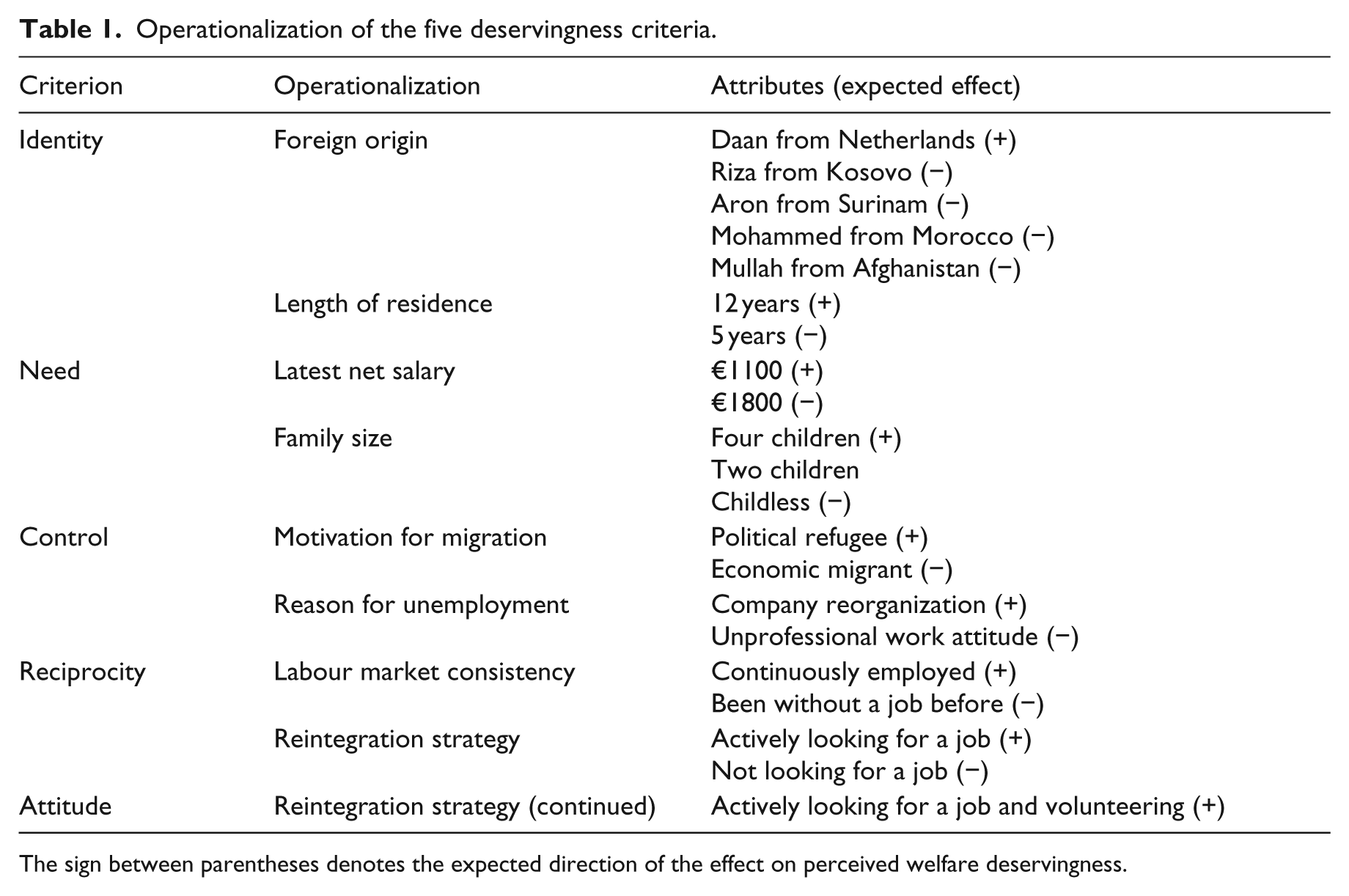
The sign between parentheses denotes the expected direction of the effect on perceived welfare deservingness.
Identity is proxied first and foremost by country of origin. The set of countries is chosen to be diverse, relevant to Dutch society and outside the EU (as the inclusion of hypothetical claimants from other EU countries would further complicate our experiment). With each country of origin, we manipulate the name of the recipient, to ensure that respondents understand the vignette as a person rather than an abstract generalization. These names are chosen to be typical for the country of origin but otherwise socio-politically neutral. ‘Daan from the Netherlands’ serves as control condition. In close proximity are ‘Riza from Kosovo’ (a recent immigration country) and ‘Aron from Surinam’ (a former Dutch colony, with citizens speaking predominantly Dutch). More distant is ‘Mohammed from Morocco’ (a common country of origin in the Netherlands since the 1970s) and most distant is ‘Mullah from Afghanistan’. Second, because we expect that support increases with immigrants’ length of residence (because they are more ‘like us’), we manipulate immigrants’ length of stay (expecting that length of residence is positively associated with (perceived) integration); 12 years is put forward as the most and 5 years as the least deserving condition.
Need is tested by, on the one hand, the unemployed person’s latest net salary, for which we differentiate between €1100 and €1800, with the former as the most needy condition. These salaries are in line with the job description in the vignette. In addition, we introduce family size, varying from being childless (less need) to two children and four children (most in need).
Control is operationalized twofold. First, original motives for migration are the status of political refugee (no control) and the status of a migrant out of economic considerations (full control). 4 Second, for the reasons for unemployment, we distinguish between unemployment due to company reorganization (no control) and due to an unprofessional work attitude (full control).
Reciprocity inspired various conditions. First, we differentiate by labour market consistency between those who have been continuously employed (high on reciprocity) and those who have been without a job before (low on reciprocity). Second, we take age into account, expecting that people of older age have contributed more to society than younger residents, distinguishing between 56 years old (high on reciprocity), 43 years old and 31 years old (low reciprocity). Our operationalization of attitude mixes with reciprocity: we look at labour market integration strategies, where we distinguish between not looking for a job (unfavourable), actively looking for a job (reciprocity) and actively looking for a job and engaging in voluntary work in the meantime (reciprocity and favourable attitude).
The empirical operationalization of the theoretical deservingness criteria is not always as clear-cut as we would ideally prefer. Attitude, for instance, is somewhat intertwined with reciprocity. Similarly, family size may represent not only need but also identity, as immigrants – particularly those from non-EU countries – have, on average, higher fertility rates compared to natives (e.g. Stonawski et al., 2016). However, for the integrity and consistency of the experiment, we limited the operationalization of these deservingness criteria to potentially registered outcomes and actions. Consequently, we did not further specify the vignettes by assigning subjective attitudes and intentions, even though that would have made the operationalization of the criteria more precise.
Vignettes
This combination of nine attributes (varying between two and five conditions each) adds up to 3672 strictly randomized combinations. The randomization of conditions over vignettes ensures that the weight of a specific deservingness heuristics can be tested. To illustrate the randomized use of nine different deservingness criteria, we show two different vignettes that actually have been offered to respondents. The most favourable vignette (i.e. the unemployed with the most favourable criteria) reads as follows:
Daan from the Netherlands is a 56-year old man. He is married and has four children. Since the age of 22, he has been employed continuously. For the past four years, he has worked as a tiler in a medium-sized company and his monthly net income was €1,100 net. He has been fired because of a company reorganization and is currently on unemployment benefits. After five months, he combines job-seeking with voluntary work; he has still found no job.
This condition consists of a native Dutch (close proximity), of older age (high on reciprocity) and having four children (high need), with a consistent labour market trajectory (high on reciprocity) but a rather low income (high need), laid off because of reorganization (no control) and combines looking for a job with voluntary work (high on reciprocity and attitude).
By contrast, the least deserving vignette is the following:
Mullah from Afghanistan is a 31-year-old man who arrived in the Netherlands five years ago out of economic considerations. He is married and childless. Since the age of 22, he has been more often without a job than with. For the past four years, he has worked as a tiler in a medium-sized company and his monthly net income was €1,800 net. He has been fired because of an unfavourable work attitude and is currently on unemployment benefit. After five months, he is still not looking for a job; he has still found no job.
This vignette combines an immigrant from a culturally distant society who came to the Netherlands with economic motives (high control). He is rather young (low on reciprocity) and childless (low need), with an inconsistent labour market trajectory (low on reciprocity), a rather high income (low need), unfavourable work attitudes (high control) and lacking effort to seek reemployment (low attitude).
The use of nine varying criteria in 3672 combinations runs the risk that respondents cannot see the wood for the trees, as they are asked to balance too much information. This could induce small effects and large standard errors. However, the results show that this is far from the case.
Data and design
Our large set of attribute combinations requires a similarly large sample of respondents. Given these demands, we embedded our vignette experiment in a wave of the EenVandaag Opinion Panel (hereafter 1VOP), organized by the Dutch public daily news show EenVandaag. Each 1VOP wave covers the large number of respondents (on average about 25,000) necessary to cover all combinations of attributes. The panel consists of a large and broad cross section of the Dutch electorate. Despite biases towards men, the higher educated and socio-politically interested, 5 this broad cross section of Dutch respondents boosts external validity compared to, for instance, student samples. Moreover, 1VOP members are not used to participating in experimental studies. 6
To minimize social desirability, we opted for a between-person design over a within-person design. A within-person vignette design presents the same respondent with different vignettes. Consequently, the central comparison in the analysis revolves around the extent to which each respondent offers similar or different answers to subsequent vignettes. A risk in such designs is benchmarking or rationalization. The first vignette may then affect answers to the second one, either because the first functions as a benchmark (to which the other is favourably or unfavourably compared because of the previous vignette) or because respondents actively seek to make their answers consistent. A between-person vignette design offers each respondent one completely randomized vignette. The central analytical comparison is then the extent to which different respondents offer similar or different answers to their single vignette. The advantage is that it is more likely to tap into less cognitive processes.
The between-person comparison is only enabled by the successful randomization of attributes over vignettes and vignettes over respondents. We confirmed that randomization was successful by comparing the demographic composition of the groups that were assigned to different treatments on each attribute. 7 To further exclude any potential influence of respondent attributes, we control our models for a range of other determinants of welfare preferences (see van Oorschot et al., 2012): gender, age, income, employment status, housing type and level of education. As is to be expected from our randomization procedure, the inclusion of these controls does not affect our findings.
The experiment took place from 10 to 13 March 2014. After excluding respondents from non-Dutch origins and respondents from abroad, the final sample size is 23,015 respondents. We checked the time that respondents spent on the vignettes and tested the robustness of our findings to the inclusion or exclusion of respondents who spent less than 15 seconds on their vignette. Our findings were robust.
Results
The importance of three attributes
Because of successful randomization of the vignettes, descriptive results are highly informative. Figure 1 provides these results. Across the whole pool of vignettes (with more and less favourable attributes), 49.8 percent of the respondents prefer the lawful status quo, that is, considering the beneficiary to receive 70 percent of the latest income. Whereas 14.9 percent think that the beneficiary ought to be entitled to more than the 70 percent threshold, 19.6 percent prefer lower unemployment benefits and 15.8 percent propose no unemployment benefits whatsoever.
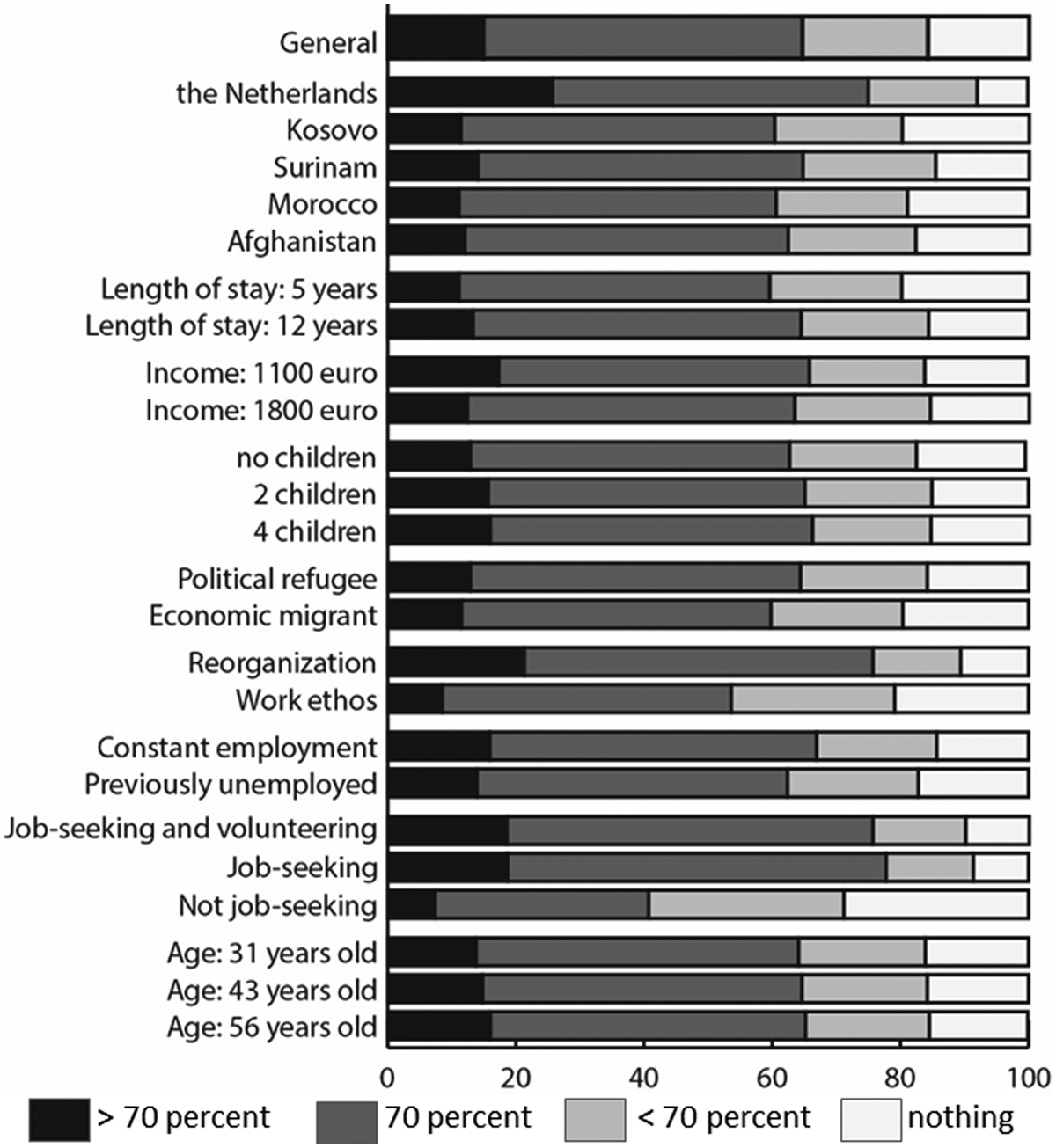
Preferred levels of unemployment provision, by nine deservingness attributes.
Figure 1 breaks down this preference by attributes. Surprisingly, preference for the status quo (70 percent of one’s last income) is very stable regardless of attribute, but large variation exists among the other options. Three attributes stand out.
The third largest difference is caused by country of birth. The Dutch beneficiary should receive more than 70 percent of unemployment benefits according to 25.7 percent of the respondents. For those born in other countries, this varies between 11.1 percent (Morocco) and 14.1 percent (Surinam). Concurrently, whereas 24.9 percent propose to give the native Dutch beneficiary less or no welfare provisions, this share increases to 35.3 percent (Surinamese) to 39.7 percent (Kosovan) in the immigrant conditions. Despite these small differences, we do not find a strong ethnic hierarchy, which is in line with Kootstra’s (2016) finding for the Netherlands (although she discovered a clear hierarchy in the United Kingdom).
The second largest difference is the consequence of cause of unemployment. Those fired because of their own poor work ethos should be entitled to less than 70 percent according to 25.5 percent of the respondents or to no benefits at all according to 20.9 percent. By contrast, those fired because of a company reorganization should be entitled to less than 70 percent according to 13.7 percent of the respondents or to no benefits at all to 10.6 percent. This is a total difference of 22.1 percentage points.
The most important difference is caused by labour market reintegration strategies. Among those beneficiaries who are actively looking for a job, 18.7 percent of the respondents propose unemployment benefits higher and 22.2 percent benefit lower than 70 percent. Among those who are actively looking for a job and volunteering, these figures are quite similar with 18.6 and 24.4 percent, respectively. However, those who are not actively looking for a job can count on little sympathy: only 7.4 percent of the respondents propose higher unemployment benefits, compared to 59.3 percent who want lower unemployment benefits.
Table 2 provides the outcomes of a multivariate multinomial test of these effects, controlling for all recipient attributes as well as a range of respondent characteristics. Essentially, the multivariate test provides the same information, confirming the successful randomization at two stages of the experiment. All recipient attributes show significant effects, but only a few provoke the most substantially relevant effects.
Multivariate effects of deservingness criteria on preferred levels of unemployment provisions (reference: 70% of income).
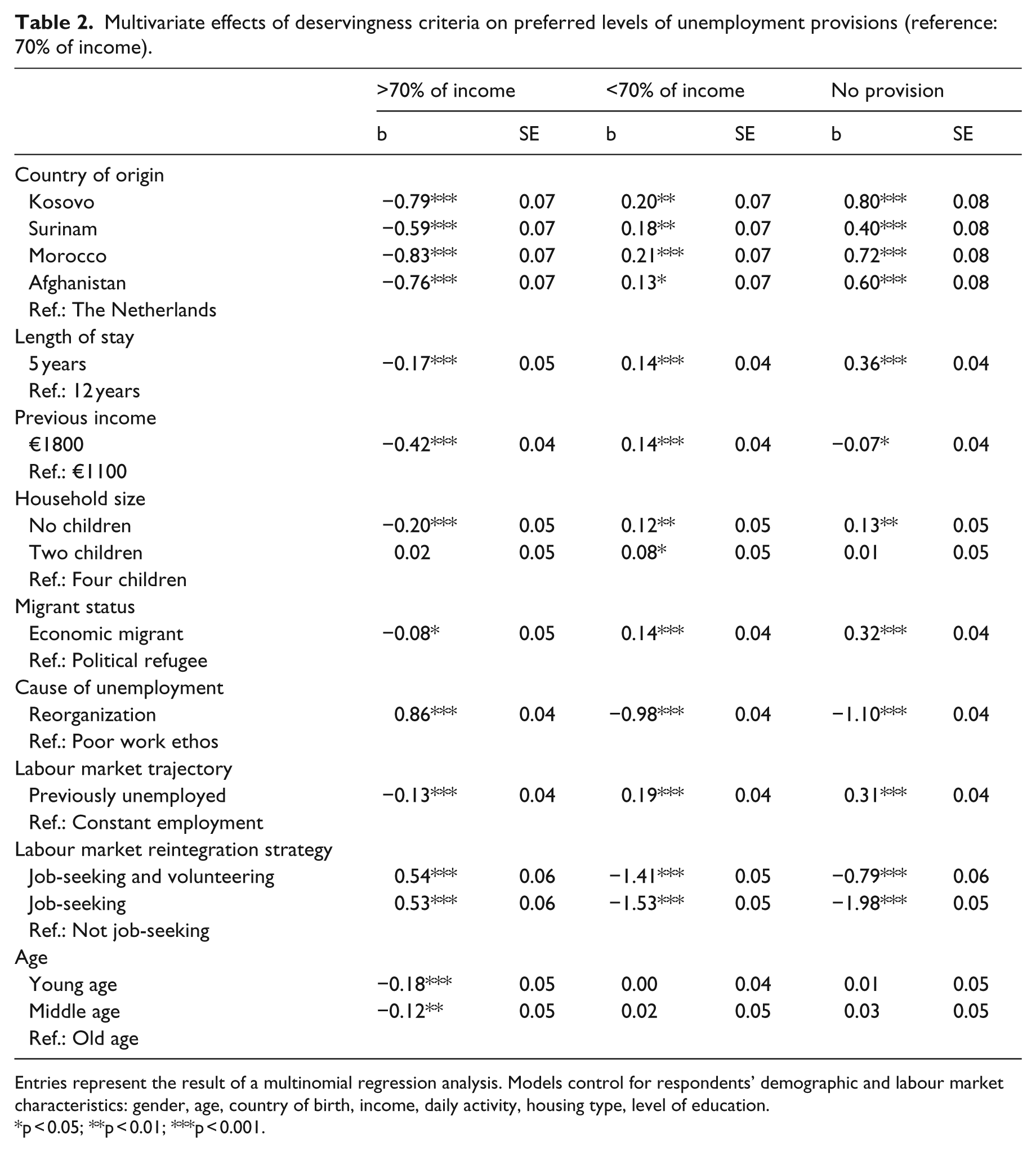
Entries represent the result of a multinomial regression analysis. Models control for respondents’ demographic and labour market characteristics: gender, age, country of birth, income, daily activity, housing type, level of education.
p < 0.05; **p < 0.01; ***p < 0.001.
In sum, the analyses indicate that three attributes strongly condition preferences for entitlement to unemployment provision: an active labour market strategy for reintegration, externality of the cause of unemployment and country of origin. Two of these three characteristics are already proscribed by law, highlighting the importance of individual responsibility and reciprocity: unemployment should not be culpable, and the unemployed should actively look for a new job in order to receive unemployment benefits. Only nativity is not embedded in law as a favourable deservingness criterion. Rather the contrary, as the Article 1 of the Dutch Constitution forbids discrimination. Moreover, country of origin is the only ascribed welfare claimant attribute we enclosed in the experiment. Combined, our study confirms that country of birth is a socially relevant deservingness attribute in public opinion.
The insurmountable immigrant penalty
Next, we test to what extent immigrants are able to close the deservingness gap with native recipients, when their behaviour goes against prejudiced ideas. Table 3 focuses on two conditions that particularly stood out in Figure 1 and Table 2: cause of unemployment and labour market reintegration strategies. If immigrants are able to overcome the immigrant penalty, we should find a smaller deservingness gap with natives among those fired for external reasons and those who actively look for a job. If the immigrant penalty is inevitable, we should find that such favourable deservingness criteria do not make immigrants closer to being equally deserving of welfare provisions as their native Dutch counterparts.
Moderating effects on preferred levels of unemployment provisions (reference: 70% of income).
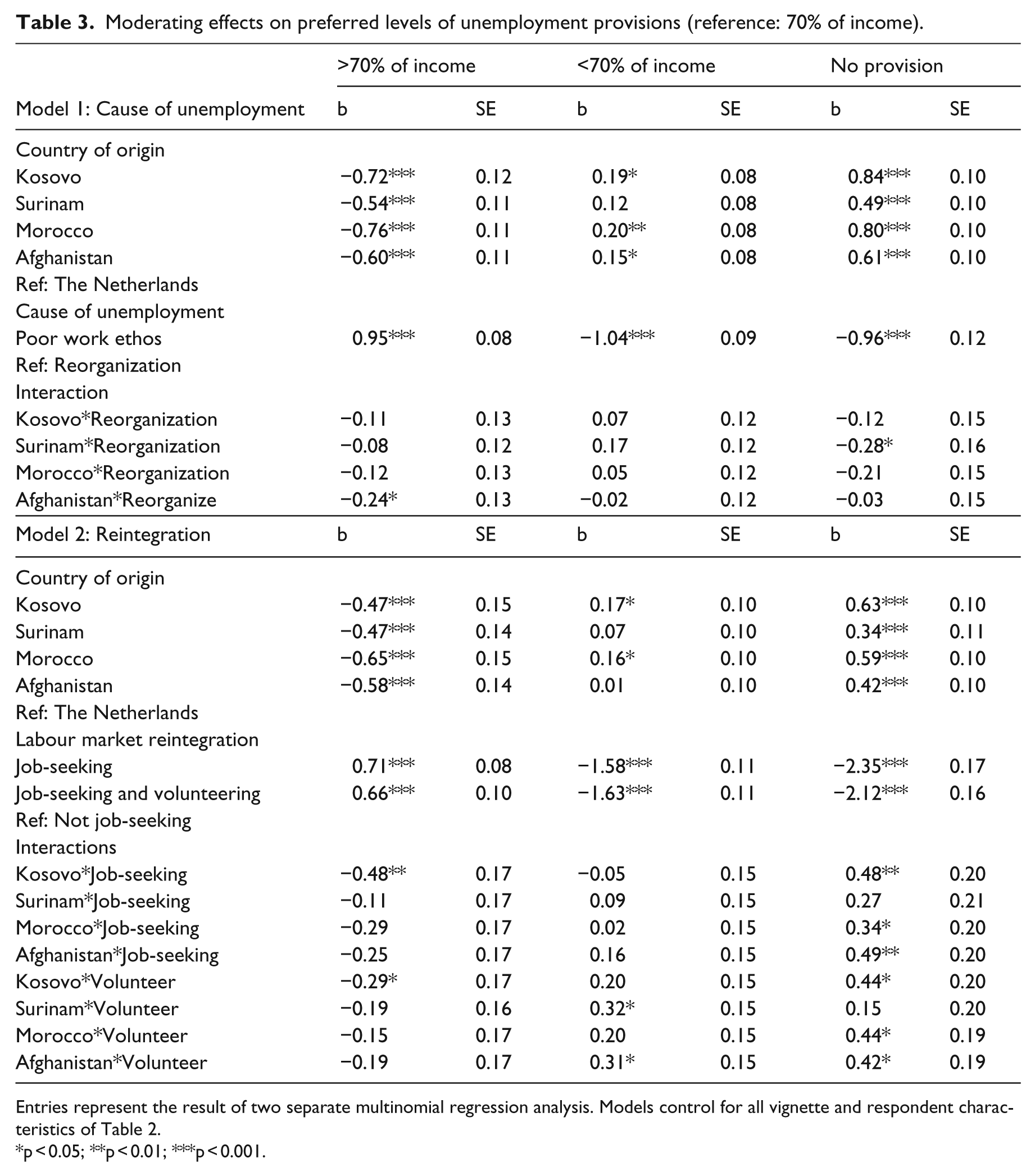
Entries represent the result of two separate multinomial regression analysis. Models control for all vignette and respondent characteristics of Table 2.
p < 0.05; **p < 0.01; ***p < 0.001.
The upper panel in Table 3 tests the moderating effect of cause of unemployment. No consistent, significant moderation takes place. External causes of unemployment do not make immigrants closer to being equally deserving of unemployment provision to natives. Alternatively, immigrants are also not further penalized for a poor work ethos either. There is only one significant moderating effect: Surinamese migrants who were fired because of a reorganization are treated somewhat more comparably to native Dutch citizens fired for the same reason.
The bottom panel in Table 3 shows whether immigrants’ active labour market reintegration strategies makes them closer to being equally deserving of welfare benefits as natives. Surprisingly, the results show that the deservingness gap is smaller between inactive immigrants and inactive natives who are unemployed than among active immigrants and natives. Mutatis mutandis, this also means that although active job-seeking behaviour is rewarded with more solidarity, natives are rewarded more for their reintegration behaviour than immigrants. These findings align with DeSante’s (2013) study on the interaction between race and work ethics in perceived welfare deservingness, as he shows that ‘whites gain more for the same level of effort, and blacks are punished more severely for the same level of “laziness”’ (p. 343).
Up to this point, we estimated direct effects and regular two-way interaction effects, that is, the moderating effects of separate attributes on the immigrant penalty. A more encompassing test on the inevitability of the immigrant penalty would be based on a fully specified model. We therefore assess to what extent immigrants who perform well on all behavioural attributes simultaneously (cause of unemployment, labour market reintegration strategies, labour market trajectory) receive a similar penalty to immigrants who perform poorly. To ensure that our model would not be underspecified, we expanded the model in Table 3 by estimating all two-way, three-way and four-way interaction effects between country of origin, cause of unemployment, labour market trajectory and labour market reintegration strategy. We used the outcomes to determine the predicted probabilities and their 95 percent confidence intervals. This allows us to contrast the perceived deservingness of immigrants with incremental (non-)favourable attributes with the perceived deservingness of the native Dutch welfare claimant with equally (non-)favourable attributes.
Figure 2 shows these predicted probabilities (dots) and confidence intervals (lines) of entitlement to more than 70 percent (left panel), less than 70 percent (middle panel) and no benefits (right panel) for native and immigrant recipients in general and among those with the most positive and most negative attributes. The figure leads to two conclusions. In relative terms, the gap between natives and immigrants is hardly affected by other – positive or negative – attributes. In particular, natives are twice as likely to be entitled to more than 70 percent of their latest income compared to migrants. However, in absolute terms, the gap between natives and immigrants is much larger among recipients with the most positive attributes. Immigrants with positive attributes are 23 percentage points less likely to be entitled to more than 70 percent of their latest income. 8
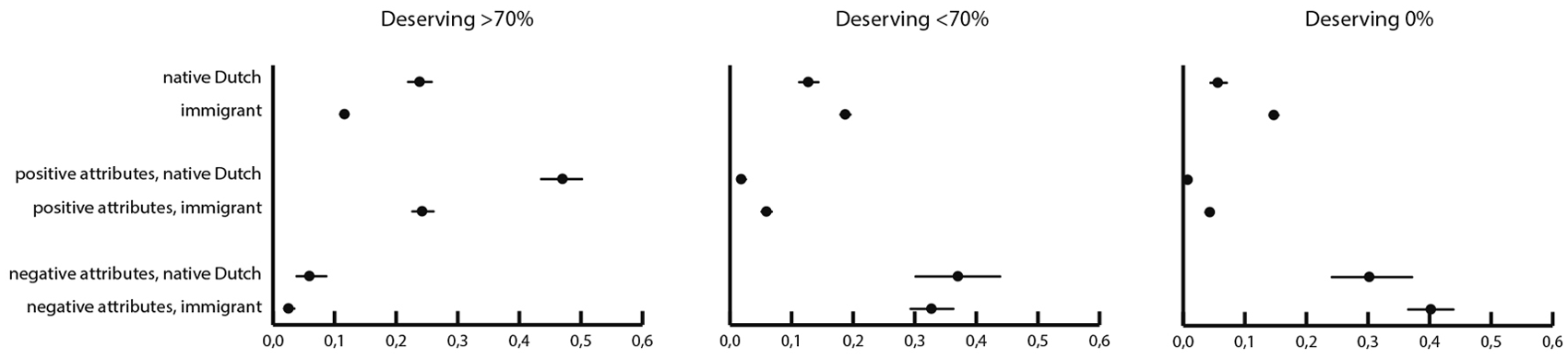
Predicted probabilities of preferred levels of unemployment provisions, natives and immigrants, by positive and negative attributes (cause of unemployment, labour market trajectory, labour market reintegration strategy).
Conclusion
The ‘Great Recession’ and the refugee crisis heated the long-standing debate about whether an inclusive welfare state is possible in the absence of closed borders (see Freeman, 1986). It is by now well established that immigrants are considered to be less deserving of welfare state benefits (e.g. van Oorschot, 2006a). However, the inevitability of this immigrant penalty remained unclear. Crucially, our between-person vignette experiment among 23,015 Dutch participants indicates that the immigrant gap (1) holds strongly in the face of rivalling explanations of solidarity and (2) is impossible to overcome by immigrants’ good – even best – behaviour.
Country of origin is the third most important deservingness heuristic, after reciprocity (in terms of active labour market reintegration strategies 9 ) and control (external cause for unemployment). Whereas 75 percent of the respondents would give the unemployed of native origin at least 70 percent of his latest income, only 60 percent would give the same to the equivalent unemployed immigrant. Concurrently, a larger share of respondents would like to reduce the latter’s provision or exclude him from benefits altogether. Being of foreign origin is thus a strong signal that makes people less likely to show solidarity. Preceding the asylum crisis sparked by the Syrian civil war and the IS threat, there is little differentiation in support for political refugees and economic migrants. Only two deservingness criteria matter more than country of origin. When a poor work attitude is the cause of unemployment and when the unemployed person does not make any effort to find a new job, public support for unemployment benefits drops sharply. As such, we confirm Kootstra’s (2016) recent findings. Both of these conditions are, in fact, laid down by law as formal prerequisites to obtain unemployment benefits, corresponding to Steffen Mau’s (2003) ‘moral economy of the welfare state’, that is, an overlap between public opinion and welfare state design. By contrast, although nativism is explicitly prohibited, public opinion on welfare deservingness differentiates between natives and immigrants.
Moreover, other favourable attributes do not help migrants overcome the immigrant penalty. For sure, immigrants who have been fired because of reorganizations (to give but one example) are deemed worthy of more welfare provisions than immigrants who are fired because of a poor work ethos. Nevertheless, behaviour that counters negative stereotypes does not close the gap with native Dutch people at all: even immigrants with the most positive attributes are equally disfavoured compared to the native unemployed Dutch population. This contrasts US evidence on the importance of counter-stereotypical attributes (Peffley et al., 1997) and nuances existing research on welfare chauvinism (Reeskens and van Oorschot, 2012) but confirms studies about the inevitability of prejudice in the realm of welfare attitudes (Gilens, 1999). Interestingly, our study does not find confirmation for Kootstra’s study (2016), who showed that favourable attributes close the gaps with natives. Differences in the design of the study might have caused these divergent findings. Potentially, the reduced risk of benchmarking or rationalizing in the between-person design used in our study, compared to the within-person design used by Kootstra (2016), might explain these differences. More (methodological) research is necessary to respond to these inconsistencies.
It is important to note that these outcomes do not imply that the immigrant penalty is a conscious decision. Because of the between-person design, respondents do not make an explicit comparison. Faced with more explicit questions, we may expect the bias to be smaller. However, our between-person design does not preclude the possibility of social desirability either, which would mean that the immigrant penalty might even be underestimated (Berinsky, 1999). Nevertheless, our study finds overwhelming evidence that country of origin is an important attribute for perceived welfare deservingness. This is the more remarkable, as the outcomes rely on respondents juggling a lot of information (nine varying attributes in 3672 combinations) to answer a single survey question. Yet, despite the dense information in the vignettes, we find major effects.
These conclusions should be viewed in a broader context. On the one hand, the experiment took place during the aftermath of the Great Recession, which might have depressed positive feelings towards immigrants. On the other hand, the experiment was held shortly before the onset of the refugee crisis, whose influence on the immigrant penalty in welfare deservingness can only be speculated on now and ought to be taken up in future analysis. Nevertheless, ultimately, the findings in this study are sobering. The status of immigrant leads to a penalty in the public opinion on welfare state deservingness. There is no easy way out of this penalty: the deservingness gap is sizable (the third most important criterion) and inevitable (insurmountable by good behaviour).
Footnotes
Funding
The author(s) received no financial support for the research, authorship and/or publication of this article.