



Abstract
This study investigates how institutional and normative characteristics affect grandparents’ labour market participation. Previous studies indicate that providing regular grandchild care reduces labour market participation, and this linkage varies between European welfare states. Yet the underlying mechanisms remain unclear, and no study has systematically disentangled cultural from institutional influence when investigating grandparents’ work–care reconciliation. Based on two mechanisms, needs and obligations, we investigate how (grandparental) support norms and childcare infrastructure jointly shape the labour market participation of active grandparents. We use six waves from the Survey of Health, Aging and Retirement in Europe (SHARE), investigating variation across 91 subnational regions in 18 countries. The results indicate that the regular provision of grandchild care increases the risk of exiting the labour market for both men and women. This linkage is stronger in contexts with stronger support norms, but also depends on the childcare infrastructure in contexts where norms are weaker.
Keywords
Introduction
In recent years, public and academic interest in the question of how older workers reconcile paid employment and unpaid family care has grown. A large number of studies have already investigated under which circumstances the provision of elder care impacts on caregivers’ employment (for an overview, see Moussa, 2019). Fewer studies have investigated how grandchild care impacts on employment (exceptions are Backhaus and Barslund, 2019; Lumsdaine and Vermeer, 2015).
Grandchild care as a potential ‘threat’ to employment is a relevant topic to study (Hank et al., 2018). Premature labour market exits increase the risk of old-age poverty, a phenomenon which is particularly prevalent among women (Eurostat, 2021). Moreover, grandchild care constitutes a commitment of a long duration (Patterson and Margolis, 2019), and competes more strongly with employment than old age care, because its demands increase as further grandchildren arrive (Bordone et al., 2016; Hank et al., 2018). Third, in most European countries, maternal employment is on the rise (Eurostat, 2020). Grandparental childcare is increasingly sought after (Geurts et al., 2014; Hamilton and Suthersan, 2020). Together with increasing retirement ages for both men and women, new challenges for reconciling family and work arise in later life.
The provision of grandchild care is widespread in Europe, but its prevalence and intensity vary across countries (Bordone et al., 2016; Igel and Szydlik, 2011), as do the gendered patterns therein (Leopold and Skopek, 2014). In Southern Europe, the likelihood of being an actively caring grandparent is smaller than in Northern Europe, but the average number of hours spent looking after grandchildren is much higher (Igel and Szydlik, 2011). These country differences have been interpreted with the availability of a formal childcare infrastructure. The absence of publicly subsidized and affordable formal childcare creates needs for grandparental childcare (Chung et al., 2018; Yerkes and Javornik, 2018). A second interpretation for the country differences refers to different normative ideals around how childcare should be organized and to what degree family members should support each other (Hamilton and Suthersan, 2020; Jappens and Van Bavel, 2012). Stronger support norms in general, and grandparental childcare expectations in particular, reinforce individually perceived care obligations among grandparents. Both needs and obligations are plausible drivers behind grandparents’ market participation exits. Yet only two studies investigate the labour market consequences of, respectively, grandparenthood (Van Bavel and De Winter 2013) and grandchild care (Backhaus and Barslund, 2019) in a comparative design. Both studies, however, do not explain the country variance with quantitative indicators for childcare policies or normative expectations.
Historically, normative ideas and welfare institutions have often co-developed and mutually influenced each other. There is ample research showing that the expansion of public childcare has weakened traditional gender norms (Andronescu and Carnes, 2015; Zoch and Schober, 2018) – and that the cultural legacies can both promote or hinder the expansion of public childcare (Grunow and Veltkamp, 2016; Lohmann and Zagel, 2015; Kremer, 2007). As welfare policies are often path-dependent (Seeleib-Kaiser, 2016), reforms tend to keep elements or political ideas referring to past normative ideals. Policy features may comprise explicit support obligations (Saraceno and Keck, 2010).
Nevertheless, the history of European welfare states has seen a number of sharp disruptions – or path departures – including gender and childcare policymaking (Pfau-Effinger, 2008; Michel and Mahon, 2002). With the dissolution of the USSR and the transition back to market economies, childcare infrastructure in many Central and Eastern European countries has eroded, while normative ideals have remained gender-egalitarian and a strong labour market attachment of mothers can be observed (Matysiak and Steinmetz, 2008; Szelewa and Polakowski, 2008). Recent developments include the orientation of German family policy towards Scandinavian models. However, slow cultural change hinders the usage of the new policy features (Ciccia and Bleijenbergh, 2014; Pfau-Effinger, 2005). This creates unique pathways among European welfare states with regard to normative obligations and childcare policies, which may in some cases stand ‘at odds’ with each other.
It is plausible to assume that the degree to which active grandparenthood affects labour market participation varies with both the institutional and normative characteristics. Particularly in contexts where norms and institutions are contradictory, normative obligations and childcare needs may exert conflicting forces, pulling grandparents in opposite directions. Such tensions are nevertheless useful for disentangling normative from institutional influence. Against this background, we ask: Does providing grandchild care affect labour market exits? How does the effect vary across specific contexts with their childcare policies and social norms?
This article contributes to the literature in several ways: first, it sheds light on ‘new’ reconciliation issues in late life. Second, it aims at disentangling normative from institutional influence by looking at specific combinations of two types of support norms and two aspects of childcare infrastructure across 18 countries and 91 regions in Europe over a time-span of 13 years. In the following, we develop two theoretical mechanisms and subsequently test these complex interactions using refined quantitative measurement of norms, accounting for both temporal and spatial within-country variation.
Theoretical background
Individual characteristics: instrumental and value rationality for grandchild care and employment
The organization of paid employment and unpaid family work is often explained by reference to Household Economy Theory (Becker, 1965). It assumes that actors (households or couples) make informed decisions regarding the allocation of their members’ time to paid and unpaid work, weighing the costs and benefits in order to maximize the unit’s common economic utility. According to these considerations, individuals with lower economic resources have lower opportunity costs, and should be more ready to leave the labour market when there is a demand for unpaid care.
With regard to grandchild care, such decision-making can plausibly be extended beyond generational and household borders (Hank et al., 2018). Regular grandchild care enables adult children to pursue their professional careers (Jappens and Van Bavel, 2012). This might benefit the family overall. Thus, grandparents’ response to childcare needs of the middle generation by giving up employment could be a rational strategy pursued by families (Lumsdaine and Vermeer, 2015). The payoff of such a strategy should be particularly high when childcare is needed on a regular basis, for example, when formal childcare is not available, is unsubsidized or not flexible enough to meet parents’ working hours (Yerkes and Javornik, 2018; Chung et al., 2018).
A second theoretical approach conceptualizes the provision of grandchild care as intergenerational solidarity. In this framework, grandchild care is defined as a time transfer provided to the next generation (Bengtson and Roberts, 1991). While intergenerational solidarity is often triggered by need, need is not a necessary precondition for support (Künemund and Rein, 1999). Rather, intergenerational support seems motivated by perceived obligations to support one’s family members (‘normative solidarity’, Bengtson and Roberts, 1991). The literature on grandparents’ motivations for providing childcare frequently mentions these individually perceived responsibilities (Bordone et al., 2016; Lee and Bauer, 2013). Such an internal norm and the resulting self-expectations can also be complied with by complementing existing childcare arrangements with sporadic childcare (Igel and Szydlik, 2011). Sporadic childcare threatens labour market participation to a much lesser degree, as it can better be organized around one’s own job schedule (Backhaus and Barslund, 2019). We will thus differentiate between regular and sporadic childcare and assume that only regular provision of childcare increases the likelihood of exiting the labour market (H1).
Contextual characteristics: institutional and normative influence on grandchild care and employment
The societal context influences the organization of grandchild care and employment in at least two ways. First, the degree to which grandparents engage in regular or sporadic childcare depends on the need for it. Need is strongly defined by the (existence or lack of a) formal childcare infrastructure (Aassve et al., 2012; Igel and Szydlik, 2011). Public childcare has been on the rise, as it constitutes an important social investment strategy with the aim to increase educational chances and decrease gender inequalities in labour market participation (Neimanns, 2017; Saraceno, 2017). However, formal childcare provision sharply differs between European welfare systems according to its availability, costs and flexibility. These features, too, shape the need for (additional) grandparental childcare (Yerkes and Javornik, 2018). In countries with a strong public childcare infrastructure, for example in Sweden or Slovenia, many children under the age of three are enrolled on a full-time basis. In the Netherlands, the enrolment rate is high, but most children are enrolled on a part-time basis. In some countries, for instance Italy, public childcare provision focuses on older children. Formal childcare for children under three is hardly available and grandmothers constitute a crucial source for childcare (Arpino et al., 2014; Chiuri, 2000). In countries relying predominantly on market-based childcare, such as the UK and Switzerland, childcare expenditures make a large part of parents’ household budgets (Foerster and Verbist, 2012). Where such structural constraints challenge mothers’ employment (Duncan, 2005), regular grandparental care is an attractive (and low-cost) alternative (Arpino et al., 2014). However, even in contexts where formal childcare is widely available and subsidized, additional grandparental childcare may be needed if formal childcare hours are not flexible enough, a prime example being Germany (Chung et al., 2018; Hank and Kreyenfeld, 2000). Different aspects of the formal childcare infrastructure thus create needs for grandparental childcare, which threatens grandparents’ labour market participation.
The second theoretical explanation comprises obligations, derived from – more general or specific grandparental – support norms prevalent in a society. Several mechanisms can explain why moral obligations at a contextual level translate into supportive behaviour. One approach departs from the idea that social norms influence behaviour via social sanctions (Elster, 2009), whereby sanctions may be negative (punishment for non-conformity) or positive (reward or gain in social status for conformity). Individuals follow normative expectations in order to avoid negative consequences and experience rewards. Previous research indicates that (the avoidance of) sanctions indeed motivate family caregiving (Verbakel, 2018; Hamilton and Suthersan, 2020). For working mothers, for instance, using grandparental childcare can be a means of avoiding sanctions, particularly in contexts where family-based childcare is normatively prescribed (Wheelock and Jones, 2002; Hamilton and Suthersan, 2020).
Interactionist approaches treat norms as the basis for negotiations between family members, which then serve for the construction and confirmation of one’s identity. One of the most prominent examples is the idea of ‘doing gender’ (West and Zimmerman, 1987), which proposes that normatively promoted gender roles are enacted and negotiated in life course decisions, social relationships and everyday life practices. Similarly, support provision is a way of enacting family norms (Connidis and McMullin, 2002). A third theoretical idea is that social norms work through inherent self-expectations. The strength of perceived obligations may vary between individuals, and these may be enacted – or not (Cooney and Dykstra, 2011). A context with stronger norms may promote the enactment of such subjective norms, activating the potential of grandparental childcare even if need for childcare is not acute.
Few studies have investigated comparatively how family or other support norms moderate the influence of caregiving on employment participation (an exception being Naldini et al., 2016). We know, however, that norms also vary within countries, both spatially (Różańska-Putek et al., 2009) and across time (Zoch and Schober, 2018), thus, an indicator of norms that is too static and broad (for example, measured by legal obligations) may not be informative. The spatial dimension is particularly essential because the ‘channels’ through which sanctions operate are rooted in everyday interactions within – locally bound – networks of personal relations with families, friends, neighbours and colleagues, which confirm moral obligations and identities (Duncan, 2005). The temporal dimension is important, too, as family and gender norms have undergone substantial change in most western countries in recent years (Inglehart et al., 2017).
Finally, we argue that these two mechanisms behind institutional and normative characteristics of a context – needs and obligations – do not operate independently from one another. The interesting question here is whether norms or institutions dominate this joint influence. Two types of interdependencies are conceivable. First, in contexts with strong norms (and stronger obligations), grandparents may regularly look after their grandchildren in order to meet normative expectations or enact the individually perceived obligations. Consequentially, they should have a higher likelihood of leaving the labour market – even if the childcare infrastructure is well-developed (and need is small). The formal childcare infrastructure should only affect labour market decisions where norms are weak (H2), as only then, needs come into play. In such a constellation, obligations dominate needs.
Second, one could assume that normative obligations only play a role where the childcare infrastructure is strong (and need is small). In contexts with a weak childcare infrastructure, norms should play a minor role for grandparents’ childcare and employment decisions, because the lack of infrastructure requires them to provide childcare. Where the childcare infrastructure is well-developed, however, families have a choice how to organize childcare. Stronger support norms in general, and grandparental care norm in particular, could motivate grandparents to enact subjectively perceived obligations and prioritize childcare over employment. In this scenario, we would observe diverse patterns of normative influence across different institutional contexts, which indicates that needs dominate obligations (H3).
Gender-specific patterns of institutional and normative influence
Care and support norms do not come in isolation, however, but are linked to other sets of norms, particularly gender norms (Arber and Ginn, 1994; Rossi and Rossi, 1990). As a consequence, social norms promoting family work affect men and women differently. Previous research has shown how gender norms differently affect men’s and women’s wellbeing at the transition to parenthood (Preisner et al., 2020). Similarly, institutional characteristics influence older men’s and women’s employment and caregiving decisions differently (Bertogg et al., 2021). A gender-specific influence of institutional characteristics also applies to the provision of grandchild care (Igel and Szydlik, 2011). Less is known about whether care norms also affect grandmothers’ and grandfathers’ labour market behaviour, and how this works in interaction with the political context, particularly the childcare infrastructure. On the one hand, one can assume that family obligations leading to intensive caregiving shape ‘moral careers’ which prompt individuals to focus on such activities – even if they stand at odds with other expectations (Goffman, 1959; Johnson and Best, 2012). On the other hand, we know that couples negotiate the division of paid employment and unpaid childcare not only in young and mid-adulthood, but also when becoming grandparents (Leopold and Skopek, 2014). Path-dependencies of accumulated labour market skills and income potentials are likely to play a role here. According to such expectations, grandfathers should be less motivated by care norms to care (intensively) but might only take up more time-intensive care at their own transition to retirement (see also Bertogg et al., 2021).
As our last hypothesis, we thus assume that the influence of normative contexts (obligations) and institutional characteristics (needs) differ between men and women. More specifically, it is to assume that for men, the provision of intensive grandchild care is more strongly driven by the institutional context, particularly, a lack of formal care provision and thus a need for grandparental childcare. For women, on the other hand, normative expectations may work more strongly than needs arising from institutional arrangements, as gender roles also inherently entail certain family roles. We can thus assume that for women, norms are a stronger driver of behaviour than institutions, whereas for men, institutions are a stronger driver of behaviour than norms. In other words, we expect to find stronger support for H2 – obligations dominating needs – for women, and stronger support for H3 – needs dominated obligations – for men (H4).
Data and methods
The analyses are based on data from the Survey of Health, Ageing and Retirement in Europe (SHARE2) (Börsch-Supan, 2019; Börsch-Supan et al., 2013). We use the six panel waves (1, 2, 4, 5, 6, 7) collected between 2004 and 2017. The third wave captured only retrospective information (SHARELIFE) and cannot be used in a panel analysis. SHARE is fielded regularly (2004, 2006, 2008, 2011, 2013, 2015, 2017), but omitting wave 3 (2008) results in a larger time gap. In order to account for these gaps, we control for wave fixed effects in all models.
Our analyses make use of the longitudinal structure of the data. Due to the complex design of the survey – including refreshment samples, countries which joined later, ended participation or paused for specific waves – panel data are not balanced. We use information from all respondents who participated at least twice in the survey, using 18 countries in which at least two subsequent panel waves were fielded and for which information was available on the selected childcare institution and (grandparental vs general) norm indicators (AT, BE, CH, CZ, DE, DK, EE, ES, FR, GR, HU, LU, IT, NL, PL, PT, SI and SE). Our analytical sample consists of biological and non-biological grandparents aged 50–68 years who live in a private household. The age range was chosen to represent a life span in which both grandparenthood and labour market exits are likely (Patterson and Margolis, 2019). We applied listwise deletion to person-year observations without valid observations on the explanatory variables. We also included respondents’ (married or cohabiting) partners meeting the criteria, as far as they were surveyed, too. In total, n = 20,486 respondents meet the criteria above and are observed in n = 64,706 person-year observations (for a detailed description of the sample, see Supplement Table A1 in the Appendix).
Dependent variable
Our dependent variable is labour market exit which is operationalized as the transition to retirement or economic inactivity. For that purpose, we recoded the self-reported five-category variable on respondents’ current job situation into a dichotomous variable. For every person-year a respondent is observed as being employed (including self-employment and part-time work), this variable takes on the value 0. For every person-year that a respondent is observed as being retired or economically inactive (including being unemployed, a homemaker, or out of work due to illness or disability), the variable takes on the value 1.
Explanatory variables: childcare, institutions, norms
Our main independent variable is the provision of grandchild care. It is assessed as a self-reported variable referring to provision of grandchild care to at least one (biological or non-biological) child in the past 12 months. We distinguish three groups: non-caregivers, sporadic caregivers (measured as less than weekly) and regular caregivers (measured as at least weekly).
Contextual level indicators.
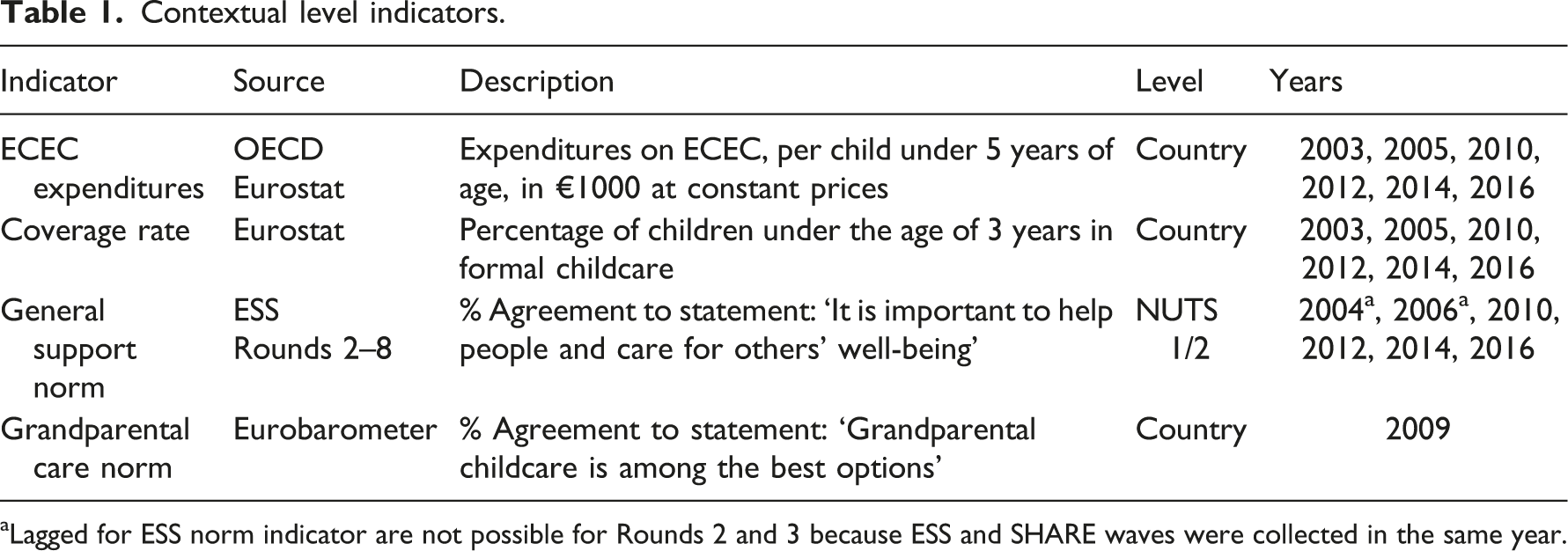
aLagged for ESS norm indicator are not possible for Rounds 2 and 3 because ESS and SHARE waves were collected in the same year.
The first indicator pertaining to support norms is measured at the regional level (NUTS 1 or NUTS 2). 1 It represents a general norm of supporting others who need help. The measure is computed using the European Social Survey (ESS, European Social Survey Cumulative File, 2020). 2 We use data from Round 2 (collected in 2004) to Round 8 (collected in 2016). The item is part of the Human Values scale, which is introduced as follows ‘Now I will briefly describe some people. Please listen to each description and tell me how much each person is or is not like you’, followed by 21 items. We use the item ‘It’s very important to him to help the people around him. He wants to care for their wellbeing.’ The original scale is dichotomized, with the value ‘1’ indicating agreement (‘Somewhat like me’–‘Very much like me’). We then aggregated this agreement variable across ESS rounds at the available NUTS-level using population weights. The second indicator comprises specific grandparental support norms. We used data from the Eurobarometer Flash survey with the topic ‘Family life and the needs of an ageing population’. That survey was fielded in September 2008. The respondents were asked ‘Childcare for pre-school children can be organized in different ways, sometimes combining several options, sometimes relying on only one option. In your opinion, what is the best way of organizing childcare for pre-school children?’, followed by seven dichotomous items ranging from ‘Public or private crèche/day care centre/nursery’ to ‘Other’. Respondents could agree to as many answers as they wished. For the purpose of this article, we aggregated the average agreement to the item ‘Childcare by grandparents or other relatives’, by country using population-based weights provided by Eurostat.
With the exception of the specific grandparental support norm from Eurobarometer, which is only available for 2008, all contextual-level indicators are time-varying. Where possible, we lagged them by 1 year to the respective SHARE wave. All indicators are centred at the grand mean.
Additional control variables
Based on the literature we consider demographic factors and opportunities and constraints as relevant predictors of leaving the labour market and caring for grandchildren. A key demographic characteristic is respondent’s age at the time of the interview, which we grouped into five categories (50–54, 55–59, 60–64, 65–68 years) to allow for a non-linear relationship. We include five measures depicting the respondent’s embedment into kinship networks: a dichotomous variable indicating whether one has at least one living parent (1 = yes), whether one has children and how far the nearest child lives away, and two continuous variables indicating the total number of grandchildren, and the age of the youngest grandchild. We also control for whether one has at least one daughter (1 = yes), because childcare is more likely to be provided to daughters than sons.
Opportunities and constraints for participating in the labour market arise from various sides. Functional health is computed as the sum of all self-reported mobility and activities of daily living (ADL) limitations. Economic needs may require individuals to work longer and delay retirement. We controlled for whether the person lived in a low-income household (calculated as whether the household income belongs to the bottom two quintiles of the respective country- and year-specific income distribution in SHARE), and – as a proxy for wealth – whether the person is a homeowner (1 = yes). We included a variable indicating partnership and partner’s employment status (partner working; partner retired; partner inactive; no partner). Moreover, other care-receivers might compete for the time of a grandparent. We controlled for whether the respondent provided any type of informal care or practical help to a third person. Finally, in order to account for period effects, we included wave fixed effects.
Analytical strategy
In order to analyse transitions between being employed and retired/inactive, we used logistic fixed effects panel regression models. These models have the advantage of holding all (observed and unobserved) between-person heterogeneity constant (correcting for bias from non-observables) and allowing changes to be explained in the dependent variables with changes in the independent variables (Allison, 2009). Fixed effects models have the disadvantage, however, that only those respondents can be analysed who exhibit variation in the dependent variable over time. Thus, all persons who do not change employment status during their participation in the panel are automatically excluded from the statistical analysis.
About one third of our respondents are observed as employed at baseline (32.83%), of which about half (50.85% for men, 49.15% for women) exit the labour market during their participation in the panel. Conversely, of those respondents who were already observed inactive or retired at baseline, only 2% transition back into the labour market (n = 378). In total, n = 4422 respondents observed in n = 14,193 valid person-years contribute to the statistical models. Supplement Figures A1 and A2 in the Appendix provide an overview.
Our analyses encompassed several steps. First, we tested whether providing sporadic or regular grandchild care (as compared to no grandchild care) influences labour market exits. In the second step, we estimated separately the effects of the two childcare infrastructure indicators and the two norm indicators: as main effects, as two-way interactions with grandchild care. In the third step, we include three-way interaction terms between grandchild care (measured at the individual level), one of the childcare infrastructure measures (measured at the national level), and either the general support norm (measured at the regional level) or the grandparental support norm (measured again at the country level). In order not to overburden the models each of the four combinations of indicators is tested separately. This allows us to investigate how providing regular grandchild care affects labour market participation differently for contexts with specific combinations of institutional and normative characteristics. All models were estimated separately by gender.
Findings
Grandparenting and labour market exits.
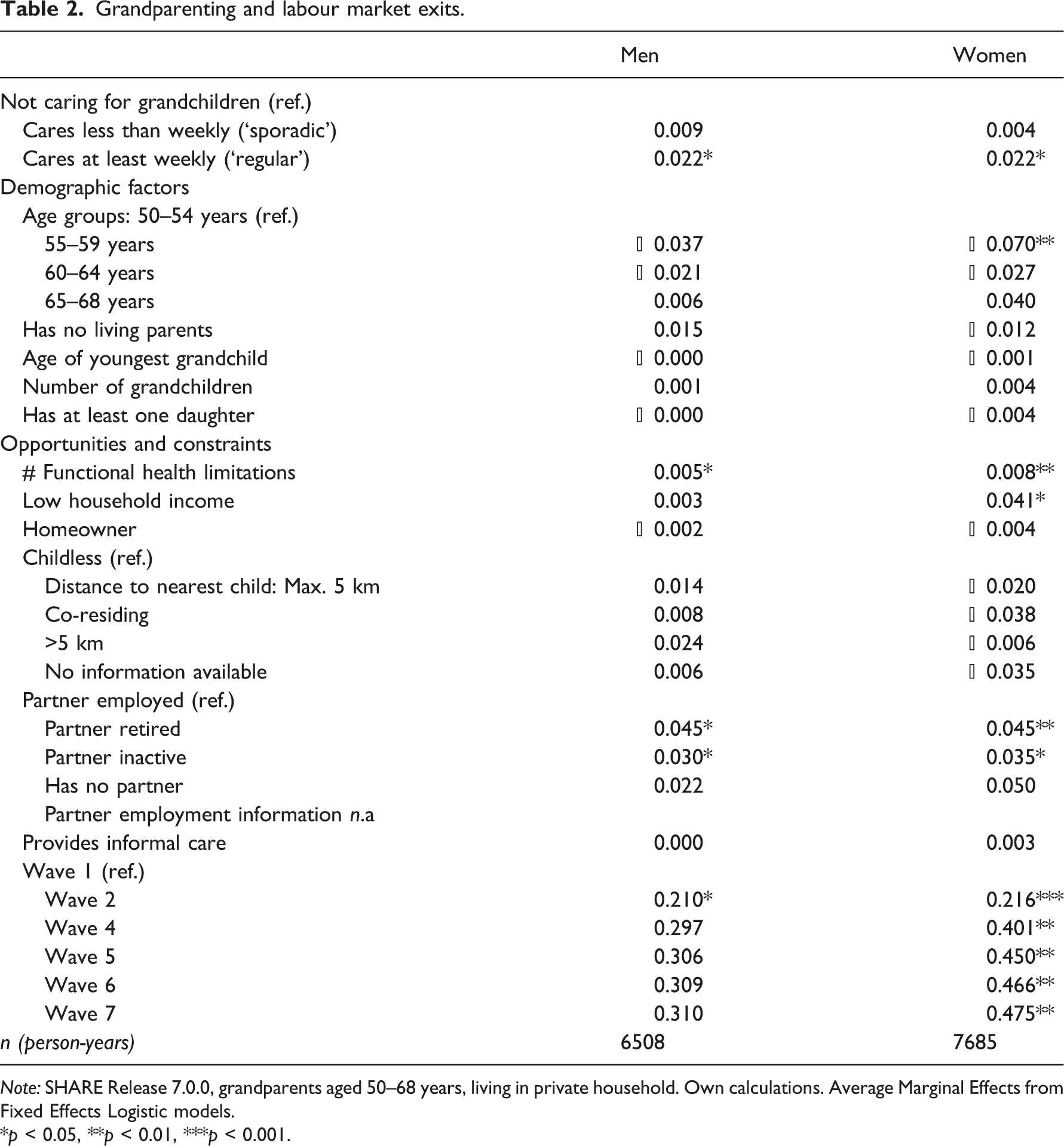
Note: SHARE Release 7.0.0, grandparents aged 50–68 years, living in private household. Own calculations. Average Marginal Effects from Fixed Effects Logistic models.
*p < 0.05, **p < 0.01, ***p < 0.001.
Grandchild care and labour market exits in context
In the next step, we examined whether the formal childcare infrastructure or support norms directly affect labour market exit, by including each norm and infrastructure indicator separately as a main effect, and whether they moderate the effect of providing grandparental childcare, by including two-way interaction terms. The findings are provided in Supplement Table A5 in the Appendix. As a short summary, all these linkages were insignificant. This indicates that neither the childcare infrastructure context, nor grandparental or general support norms explain labour market exits. The insignificant two-way interaction terms suggest that norms or infrastructure alone do not moderate the grandchild care–employment nexus. These findings support our assumption that the effects of norms and institutions do not work in isolation, but jointly.
Coefficients from three-way interactions between grandchild care, norms and institutions.
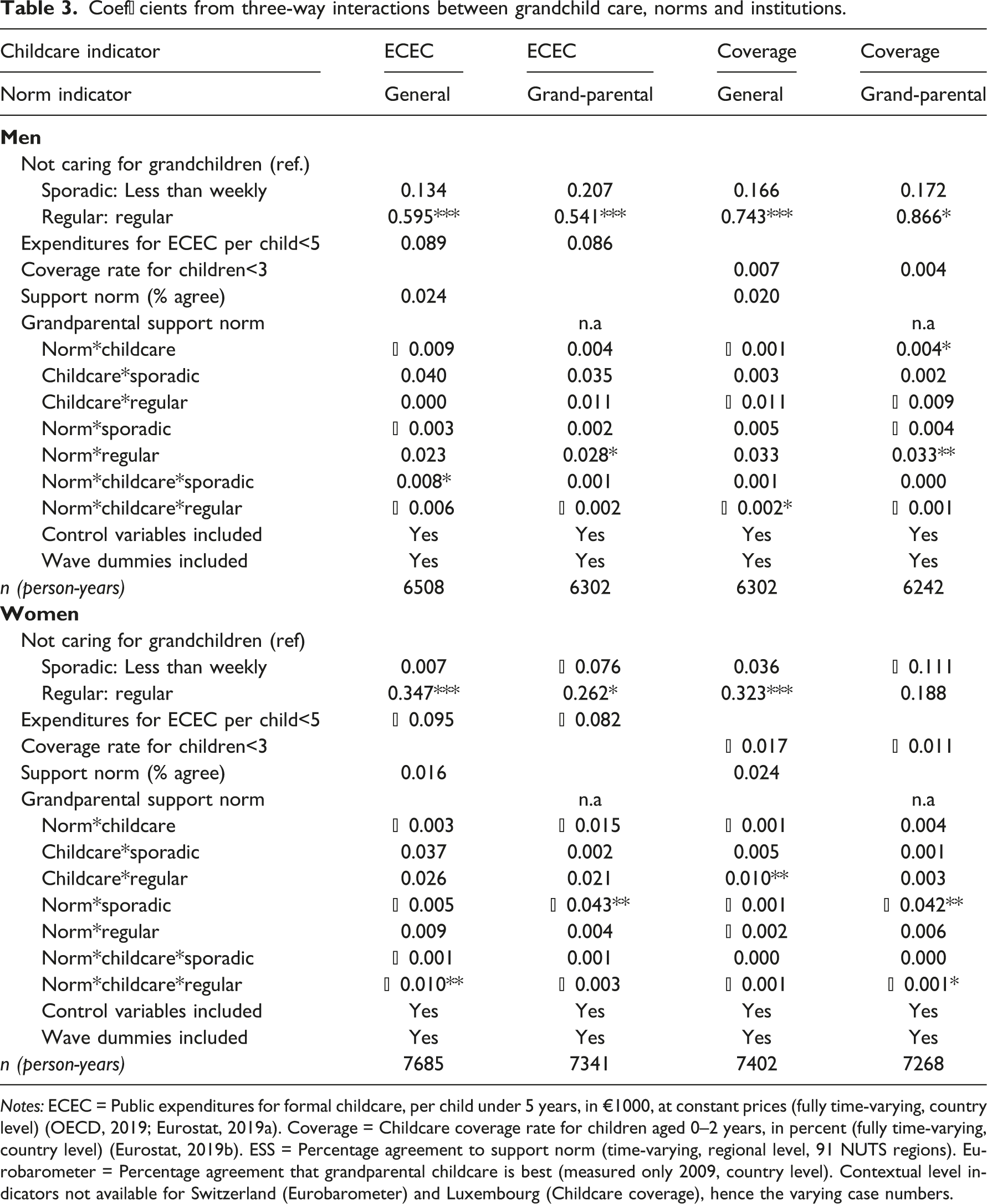
Notes: ECEC = Public expenditures for formal childcare, per child under 5 years, in €1000, at constant prices (fully time-varying, country level) (OECD, 2019; Eurostat, 2019a). Coverage = Childcare coverage rate for children aged 0–2 years, in percent (fully time-varying, country level) (Eurostat, 2019b). ESS = Percentage agreement to support norm (time-varying, regional level, 91 NUTS regions). Eurobarometer = Percentage agreement that grandparental childcare is best (measured only 2009, country level). Contextual level indicators not available for Switzerland (Eurobarometer) and Luxembourg (Childcare coverage), hence the varying case numbers.
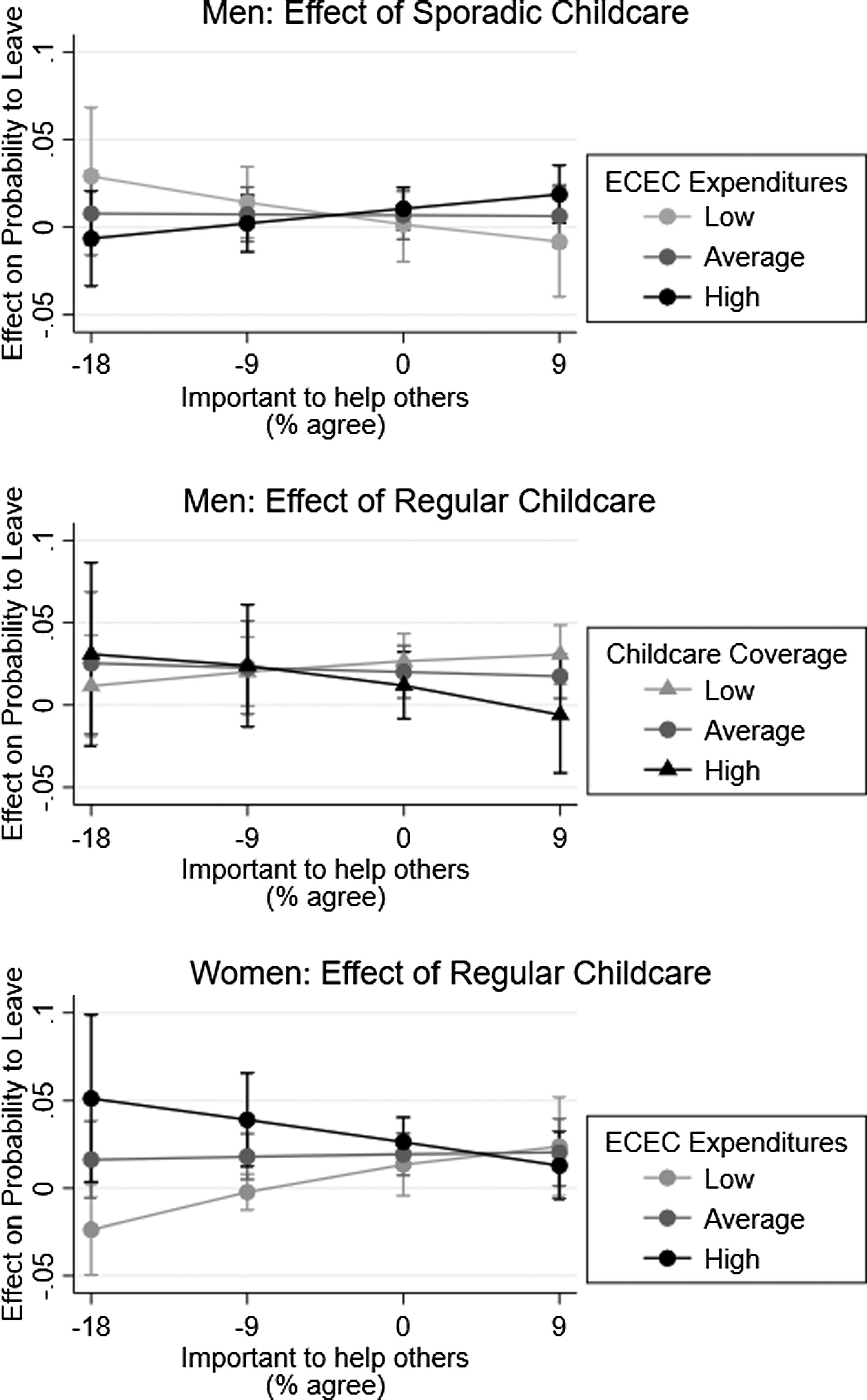
Average marginal effects of grandparenting by normative and policy characteristics.Source: SHARE Release 7.0.0, waves 1–2, 4–7, grandparents aged 50–68 years living in a private household. Norm Indicator: ESS rounds 2–8, agreement to statement ‘It is important to help others’, aggregated over 91 NUTS regions. Marginal Effects from Fixed Effects models including control variables. Separate three-way interactions. Significant interactions presented only. For coefficients of the interaction terms, see Table 3. The spikes represent the 95%-confidence intervals.
Starting with grandfathers (the left panel in Figure 1) we find that providing sporadic grandchild care significantly increases the risk of leaving the labour market where the childcare infrastructure is well-developed (the black line) and where the general support is the norm is more pronounced (upward pointing slope, see also Table 3, first column, coefficient: 0.008*). A reverse pattern of the normative influence seems to be at work for contexts with little formal childcare infrastructure (the light grey line in the first panel), but this effect is not statistically significant. With regard to our hypotheses, this finding for grandfathers lends support to H3 (needs dominating obligations) since the influence of support norms depends on the respective policy context. More specifically, this finding suggests that obligation-based considerations are only activated where the childcare policies provide formal care and thus enable families to choose their preferred work–care pattern. Moreover, this finding also lends support to our fourth hypothesis, according to which men’s behaviour is more likely to be driven by needs than by obligations.
When looking at the childcare coverage rate – and thus the uptake of formal care – we find that regularly-providing grandfathers from countries with a low coverage rate (the light grey line in the middle panel) have an increased risk of exiting the labour market the stronger the general support norm. The inverse link applies to contexts with high childcare coverage: the stronger the norms, the less likely labour market exits. These differences are significant (coefficient −0.002* in the third column). The slopes pointing in opposite directions for low- and high-childcare contexts suggest that the effect of the norms depends on the childcare infrastructure, as was expected from H3.
Are these findings robust when we use a specific grandparental support norm? Using the indicator from Eurobarometer (the second column in Table 2), we find that stronger norms increase regular caregiving grandfathers’ labour market exits (0.028* resp. 0.033*). However, this linkage does not vary systematically across childcare (expenditures, coverage) contexts, as there are no significant interaction terms. These findings support H2 (obligations dominating needs), as infrastructural contexts only play a minor role, and grandparental norms work very similarly across policy contexts.
Turning to grandmothers (the right panel in Figure 1), we find that the exit risks for regular grandchild care provision differ more strongly between the childcare infrastructure contexts where the support norm is weak. These differences converge the stronger the support norms. In other words: where support norms are substantial, caregiving grandmothers and non-caregiving grandmothers become more similar in their labour market exit risks. This holds for the interaction between the general support norm and expenditures for ECEC, as well as the specific grandparental support norm and childcare coverage (interaction terms −0.010** resp. 0.001*, see the sixth and last columns in Table 3). Our finding lends support for H2 (obligations dominating needs). It also lends support to our fourth hypothesis, according to which women’s behaviour would be more strongly determined by obligations and norms than men’s.
Moreover, we find that for irregularly providing grandmothers, stronger grandparental support norms reduce the exit risk when holding the childcare policies constant at their means (−0.42* and −0.43*). Since institutional characteristics are measured at the country level, these coefficients may reflect the effect of within-country variance (regional, and across cohorts) in support norms. It is surprising to find that irregular caregiving is protective of labour market participation among women in a traditional context. An interpretation could be that irregular caregiving is a means of conforming to norms in such contexts without jeopardizing one’s economic activity. Since working grandmothers in highly traditional contexts are rather a minority group, this finding could be an expression of ‘moral careers’.
Discussion
The aim of this article is to investigate the normative and institutional conditions under which providing grandchild care leads to labour market exits. It builds on findings from recent studies in the field (Van Bavel and De Winter 2013; Backhaus and Barslund, 2019), but extends on them by shifting the focus to specific contextual constellations of norms and policies. Drawing on a rich dataset, we employ the variance of 18 countries, 91 regional contexts and 13 years.
We find that regular grandchild care reduces labour market participation for men and women. For grandfathers, this effect is stronger the more pronounced the support norms are in a region – irrespective of the childcare infrastructure. For grandmothers, the effect of grandchild care on labour market exits depends on specific combinations of both norms and the childcare infrastructure. More precisely, grandmothers’ labour market exits are increased by stronger support norms if they live in a context with little childcare infrastructure. Thus, for grandmothers, the degree to which normative obligations affect labour market exits depends on the welfare policy context, whereas for grandfathers, the effect of norms is mostly independent of the childcare infrastructure.
As with all empirical studies, this article comes with a number of limitations. First, we are unfortunately unable to measure grandparents’ preferences and intrinsic motivations. Such unobserved heterogeneity can be held constant using fixed effects models, but it would be insightful to see how preferences or personalities play out differently in various contexts. Second, the causal linkage between employment and grandchild care is likely bi-directional. Our evidence may stem from simultaneous transitions into retirement and caregiving (Tanskanen et al., 2021) or from anticipation of care demands. More detailed information on the timing of these transitions would be desirable. Third, countries also vary with respect to their economies and the structure of the labour market. Part-time employment facilitates work–family balance for mothers (Ciccia and Bleijenbergh, 2014; Pfau-Effinger, 2005) and may also affect the need for grandparental childcare. Considering part-time regimes goes beyond the scope of this study, but we hold constant the state of the economy, by adjusting for GDP per capita.
Finally, quantifying norms at a contextual level remains difficult. Norms needed to be aggregated from survey data. Few data sets provide a broad set of indicators available for a larger number of countries, regions and time points. We rely on two measures taking different approaches to capture obligations: the general support norm is broad and may also measure other obligations. Its strength is that it can be measured across time and 91 NUTS regions, which allows us to model societal change and regional heterogeneity. The grandparental support norm is more specific to our research question but lacks spatial and temporal variance. Hence, we have to triangulate the joint influence using the full factorial of all combinations.
Despite these limitations, the present article has the potential to contribute to the literature on work–care reconciliation in the second half of life and the culture-policy debate in several ways: first, by theorizing the mechanisms through which institutional and normative characteristics jointly affect behaviour, second by exploring new ways of quantifying social norms which go beyond static and national accounts, and third, by examining the institutional and the normative jointly.
The insights from this study have implications for future research and policymaking. We encourage future studies to apply multidimensional approaches combining normative and institutional measures when analysing contextual influence on the family–work nexus. For policymakers, the high prevalence and labour market risks of grandparental care even in contexts with an established childcare infrastructure indicate that parents might rely on grandparental care for other reasons than (un-)availability of formal childcare alone. Moreover, formal childcare will not enable reconciliation and gender-equal division of labour as long as cultural ideals impede its usage. This has consequences for welfare states, as maternal non-employment and early exits from the labour market bear risks for (pension) poverty and social security. Our findings suggest that grandchild care be recognized as another domain of work–family reconciliation in the second half of life.
Supplemental Material
Supplemental Material - Needs or obligations? The influence of childcare infrastructure and support norms on grandparents’ labour market participation
Supplemental Material for Needs or obligations? The influence of childcare infrastructure and support norms on grandparents’ labour market participation by Ariane Bertogg in Journal of European Social Policy
Footnotes
Acknowledgements
This work was supported by the Jos Berghman Welfare Studies Stipend and was partly written during my research stay at KU Leuven in Belgium. I am indebted to Professor Wim van Oorschot, Professor Jan Van Bavel, Dr Wouter de Tavernier, and Dr Gianna Maria Eick for feedback on an earlier version of this manuscript. This article benefited from feedback after giving a presentation at the MZES colloquium in Mannheim. Finally, I thank my student researcher Lena-Sophia Schielke.
Declaration of conflicting interests
The author(s) declared no potential conflicts of interest with respect to the research, authorship, and/or publication of this article.
Funding
The author(s) received no financial support for the research, authorship, and/or publication of this article.

Supplemental Material
Supplementary material for this article is available on the online.
Notes
References
Supplementary Material
Please find the following supplemental material available below.
For Open Access articles published under a Creative Commons License, all supplemental material carries the same license as the article it is associated with.
For non-Open Access articles published, all supplemental material carries a non-exclusive license, and permission requests for re-use of supplemental material or any part of supplemental material shall be sent directly to the copyright owner as specified in the copyright notice associated with the article.
